Archive for Financial News – Page 221

The Fed Will Set the Mood for EURUSD

By RoboForex Analytical Department

EUR/USD starts a new week of March by consolidating around 1.0670.

This week, investors will be anxious. The key event is the meeting of the US Federal Reserve System, where monetary politicians will have to make difficult decisions, specifically the ones concerning the interest rate. As soon as problematic spots emerged in the US banking sector, the market started discussing the necessity to make a pause in lifting the interest rate to stop the crisis from expanding.

On the other hand, there are appearing more and more arguments supporting the growth of the interest rate. Among them there are the increase in base inflation and the Core PCE inflation index, tracked by the Fed.

Earlier the ECB lifted its rate by 50 base points, dismissing banking problems, and continued tightening the monetary policy. Its main goal is still beating high prices.

By the end of the week, volatility of EUR/USD will have increased noticeably.

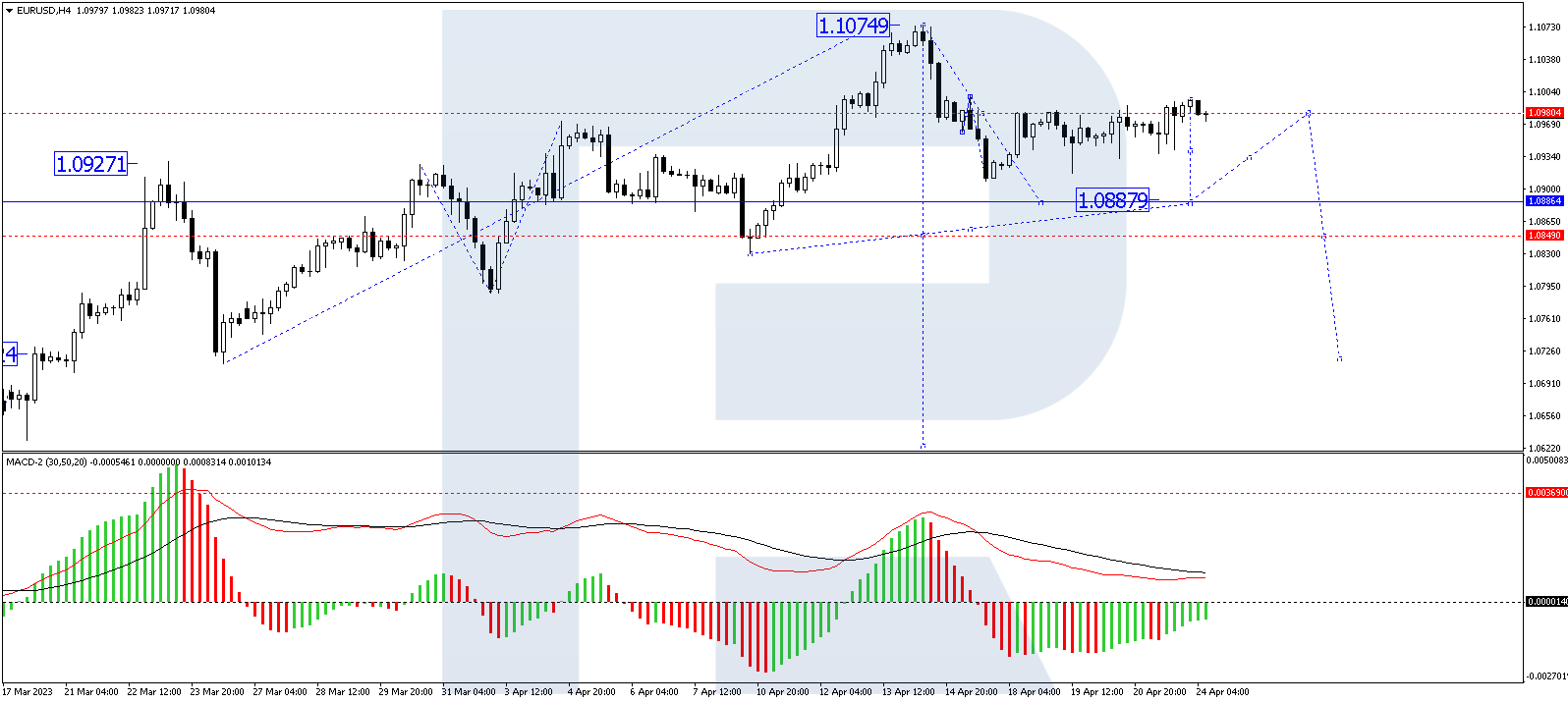
On H4, EUR/USD has formed a correctional structure to 1.0630. At the moment, the market is consolidating around it and with an escape from the range upwards might extend the structure to 1.0708. Then a decline to 1.0630 might follow. And then a link of growth to 1.0742 is not excluded. There the wave of growth will exhaust its potential. Next, the pair should go down by the trend to 1.0505. Technically, this scenario is confirmed by the MACD. Its signal line is above zero and is preparing to renew the highs.

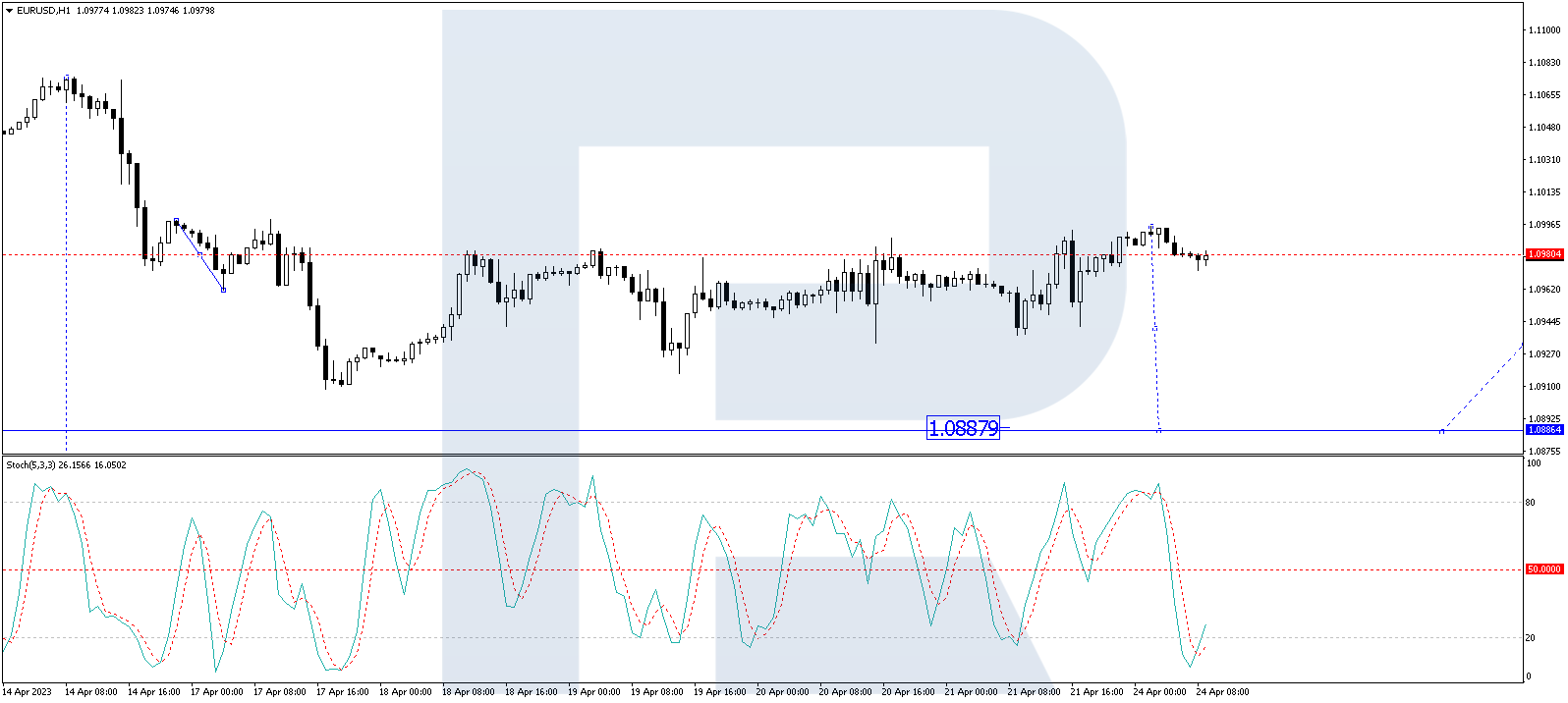
On the H1 chart, EUR/USD has completed a wave of growth to 1.0650. Today the market has already formed a link of decline to 1.0620 and a link of growth to 1.0687. At the moment, a consolidation range is forming under this level. The price might escape it upwards, opening a pathway to 1.0708. Then a decline to 1.0620 and growth to 1.0742 are expected. Upon reaching this level, the price might fall to 1.0600, and if this level breaks, the quotes might drop to 1.0540. Technically, this scenario is confirmed by the Stochastic oscillator. Its signal line is near 50, and later it should fall to 20.

Disclaimer

Any forecasts contained herein are based on the author’s particular opinion. This analysis may not be treated as trading advice. RoboForex bears no responsibility for trading results based on trading recommendations and reviews contained herein.

Central banks around the world cooperate to prevent liquidity problems

By JustMarkets

The US dollar came under pressure last week, falling about 0.8%, which was caused by a sharp drop in US bond yields. Traders and investors reassessed the Federal Reserve’s monetary policy in the US in the face of turmoil in the banking sector. Rates shifted dovish after the collapse of two mid-sized US regional banks heightened fears of financial Armageddon, prompting the Fed to take emergency measures to support depository institutions facing liquidity shortages. Late last week, the Fed injected $4.4 trillion into the Bank Term Funding Program (BTFP) to help banks. Many analysts consider this a hidden “quantitative easing” (QE). At the close of the stock market on Friday, the Dow Jones Index (US30) decreased by 1.19% (+0.13% for the week), while the S&P 500 (US500) fell by 1.10% (+2.13% for the week). The Technology Index NASDAQ (US100) lost 0.74% on Friday (+5.33% for the week).

This Wednesday is the important monetary policy meeting of the Fed, where the interest rate decision will be made. Market pricing is currently leaning toward a quarter-point interest rate hike, a move that would raise the cost of borrowing to 5.00%. The FOMC is likely to stress the importance of maintaining financial stability and its willingness to act to prevent the materialization of systemic risks. But there could be surprises, as GS strategists expect that the US Fed may announce the end of its tightening cycle. The implications of this announcement could lead to a further weakening of the US dollar.

The US Fed, the ECB, the Bank of England, the Bank of Japan, the Bank of Canada, and the Swiss National Bank from March 20 to the end of April, will conduct swap transactions between central banks on a daily basis rather than once a week. The reason is that central banks are preparing for bank liquidity problems.

Equity markets in Europe were mostly falling on Friday. German DAX (DE30) fell by 1.33% (-4.32% for the week), French CAC 40 (FR40) dropped by 1.43% (-3.97% for the week), Spanish IBEX 35 (ES35) lost 2.01% (-6.06% for the week), British FTSE 100 (UK100) was down by 1.01% (-5.33% for the week).

UBS Group AG agreed to buy Credit Suisse Group AG in a historic government-brokered deal aimed at curbing the crisis of confidence that has begun to spread to global financial markets. The Swiss bank will pay 3 billion francs ($3.3 billion) for its rival. The deal includes extensive government guarantees and liquidity provisions. The Swiss National Bank is offering UBS 100 billion francs in liquidity assistance, while the government is providing a guarantee of 9 billion francs to cover potential asset losses that UBS is taking on.

The International Criminal Court has issued arrest warrants for Russian President Vladimir Vladimirovich Putin. The ruling states that Putin is responsible for the war crimes of illegally deporting populations (children) and illegally transferring populations (children) from the occupied territories of Ukraine to the Russian Federation.

After a slight pullback on Thursday, gold prices resumed gains on Friday, rising more than 2%. Gold (XAUUSD) and silver (XAGUSD) are inversely correlated to US government bond yields. The turmoil in the banking sector has led to a drop in government bonds, which contributes to the strengthening of precious metals. But analysts expect a corrective movement as the situation begins to stabilize.

Fears of banking sector problems led both benchmarks of oil to their biggest weekly decline. Last week, Brent crude oil futures fell by 12%, while US West Texas Intermediate (WTI) crude fell by 13%. But analysts still expect tight global supply to support oil prices for the foreseeable future. OPEC+ representatives attributed the price decline to financial factors rather than supply and demand imbalances, adding that they expect the market to stabilize. Asian markets mostly declined last week. Japan’s Nikkei 225 (JP225) decreased by 1.98% for the week, China’s FTSE China A50 (CHA50) lost 0.88% for the week, Hong Kong’s Hang Seng (HK50) added 0.55% for the week, India’s NIFTY 50 (IND50) was down by 2.29%, and Australia’s S&P/ASX 200 (AU200) was negative by 2.10% for the week.

On Monday, the People’s Bank of China (PBOC) kept its annual LPR at 3.65% while the five-year LPR, which is used to determine mortgage rates, was kept at 4.30%. Both lending rates are the lowest in two decades. China’s central bank said Friday that for the first time this year, it would reduce the amount of cash banks must hold as reserves to help maintain sufficient liquidity and support the nascent economic recovery. The central bank has not yet estimated how much long-term liquidity will be released after the cuts, allowing banks to lend more money. Analysts estimate that the move freed up more than 500 billion yuan ($72.6 billion). Central bank governor Yi Gang said at a March 3 news conference that China’s real interest rates are at acceptable levels and that cutting banks’ reserve requirements will continue to be an effective tool to support the economy.

In the commodities market, futures on silver (+10.94%), lumber (+9.2%), gold (+6.77%), wheat (+4.42%), palladium (+3.87%), and corn (+2.84%) futures showed the biggest gains last week. Futures on WTI oil futures (-13.24%), Brent oil (-12.45%), gasoline (-5.81%), copper (-3.36%), and natural gas (-3.29%) showed the biggest drop.

S&P 500 (F) (US500) 3,916.64 −43.64 (−1.10%)

Dow Jones (US30)31,861.98 −384.57 (−1.19%)

DAX (DE40) 14,768.20 −198.90 (−1.33%)

FTSE 100 (UK100) 7,335.40 −74.63 (−1.01%)

USD Index 103.86 −0.55 (−0.53%)

Important events for today:
  • – China PBoC Loan Prime Rate at 03:15 (GMT+2);
  • – German Producer Price Index (m/m) at 09:00 (GMT+2);
  • – Eurozone Trade Balance (m/m) at 12:00 (GMT+2);
  • – New Zealand Trade Balance (q/q) at 23:45 (GMT+2).

By JustMarkets


This article reflects a personal opinion and should not be interpreted as an investment advice, and/or offer, and/or a persistent request for carrying out financial transactions, and/or a guarantee, and/or a forecast of future events.

Week’s main events (March 20 – March 24)

By JustMarkets

This week will be full of important events. On Wednesday is the important monetary policy meeting of the Fed, where policymakers will announce their interest rate decision. Market pricing is leaning toward a quarter-point interest rate hike, which would raise borrowing costs to 5.00%. The Bank of England (BoE) and the Swiss National Bank (SNB) will hold their meetings on Thursday. Also, inflation data from the UK, Canada, and Japan will be released during the week. The volatile week will finish with data on business activity in different countries’ manufacturing and service sectors.

Monday, March 20
The People’s Bank of China (PBoC) will update the interest rate on Monday. No surprises are expected, but volatility in Asian markets may rise. Traders may also be interested in the Eurozone and New Zealand trade balance data.
Main events of the day:
  • – China PBoC Loan Prime Rate at 03:15 (GMT+2);
  • – German Producer Price Index (m/m) at 09:00 (GMT+2);
  • – Eurozone Trade Balance (m/m) at 12:00 (GMT+2);
  • – New Zealand Trade Balance (q/q) at 23:45 (GMT+2).
Tuesday, March 21
The main event on Tuesday will be the inflation data in Canada. Inflationary pressures are expected to be lower, but volatility with the Canadian dollar will increase. Traders should also not miss the RBA’s monetary policy minutes, which will show how RBA policymakers voted at the last meeting. It’s a bank holiday in Japan.
Main events of the day:
  • – Australia RBA Meeting Minutes at 02:30 (GMT+2);
  • – German ZEW Economic Sentiment (m/m) at 12:00 (GMT+2);
  • – Eurozone ZEW Economic Sentiment (m/m) at 12:00 (GMT+2);
  • – Canada Consumer Price Index (m/m) at 14:30 (GMT+2);
  • – Eurozone ECB President Lagarde Speaks at 14:30 (GMT+2);
  • – US Existing Home Sales (m/m) at 16:00 (GMT+2).
Wednesday, March 22
On Wednesday, the Fed will hold a meeting on monetary policy and interest rates. This is a crucial meeting that will show how policymakers will respond to banking sector problems. Analysts are expecting a 0.25% rate hike, but there is a 30% chance that the Fed may press pause in QT. Volatility with USD currency pairs will increase sharply. It should also be noted that the UK will publish inflation data in the morning, which will influence the Bank of England’s interest rate decision on Thursday. A decline in consumer prices is projected.
Main events of the day:
  • – UK Consumer Price Index (m/m) at 09:00 (GMT+2);
  • – UK Producer Price Index (m/m) at 09:00 (GMT+2);
  • – Eurozone ECB President Lagarde Speaks at 10:45 (GMT+2);
  • – US Crude Oil Reserves (w/w) at 16:30 (GMT+2);
  • – US FOMC Economic Projections at 20:00 (GMT+2);
  • – US Fed Interest Rate Decision at 20:00 (GMT+2);
  • – US FOMC Statement at 20:00 (GMT+2);
  • – US FOMC Press Conference at 20:30 (GMT+2).
Thursday, March 23
Thursday will also be a volatile day. The Asian session will release important inflation data in Singapore and Hong Kong. Next, the SNB will hold a monetary policy meeting where it is expected to raise the interest rate by 0.5%, which is highly unusual for the SNB. Then the Bank of England will hold its meeting. The BoE is expected to raise rates by 0.25% if inflation data does not disappoint on Tuesday.
Main events of the day:
  • – Hong Kong Interest Rate Decision at 04:30 (GMT+2);
  • – Singapore Consumer Price Index (m/m) at 07:00 (GMT+2);
  • – Hong Kong Consumer Price Index at 10:30 (GMT+2);
  • – Switzerland SNB Interest Rate Decision at 10:30 (GMT+2);
  • – Switzerland SNB Monetary Policy Assessment at 10:30 (GMT+2);
  • – Switzerland SNB Press Conference at 11:00 (GMT+2);
  • – UK BoE Interest Rate Decision at 14:00 (GMT+2);
  • – UK BoE MPC Meeting Minutes at 14:00 (GMT+2);
  • – US Initial Jobless Claims (w/w) at 14:30 (GMT+2);
  • – US New Home Sales (m/m) at 16:00 (GMT+2);
  • – US Natural Gas Storage (w/w) at 16:30 (GMT+2).
Friday, March 24
Friday will bring various Manufacturing PMI and Services PMI statistics for many countries. This data shows how the economy works in times of high-interest rates. Rising rates are a sign of a resilient economy. In Japan, consumer price data will be released. Analysts expect inflation to decline, but there may be surprises, so traders should be focused.
Main events of the day:
  • – Australia Manufacturing PMI (m/m) at 00:00 (GMT+2);
  • – Australia Services PMI (m/m) at 00:00 (GMT+2);
  • – Japan National Core CPI (m/m) at 01:30 (GMT+2);
  • – Japan Manufacturing PMI (m/m) at 02:30 (GMT+2);
  • – Japan Services PMI (m/m) at 02:30 (GMT+2);
  • – UK Retail Sales (m/m) at 09:00 (GMT+2);
  • – German Manufacturing PMI (m/m) at 10:30 (GMT+2);
  • – German Services PMI (m/m) at 10:30 (GMT+2);
  • – Eurozone Manufacturing PMI (m/m) at 11:00 (GMT+2);
  • – Eurozone Services PMI (m/m) at 11:00 (GMT+2);
  • – UK Manufacturing PMI (m/m) at 11:30 (GMT+2);
  • – UK Services PMI (m/m) at 11:30 (GMT+2);
  • – US Durable Goods Orders (m/m) at 14:30 (GMT+2);
  • – Canada Retail Sales (m/m) at 14:30 (GMT+2);
  • – US Manufacturing PMI (m/m) at 15:45 (GMT+2);
  • – US Services PMI (m/m) at 15:45 (GMT+2).

By JustMarkets


This article reflects a personal opinion and should not be interpreted as an investment advice, and/or offer, and/or a persistent request for carrying out financial transactions, and/or a guarantee, and/or a forecast of future events.

The ECB raised the interest rate by 0.5%. The US Launches BTFP Program for Banks

By JustMarkets

The US indices rose Thursday after reports that major Wall Street banks pledged billions of dollars to bail out First Republic Bank. JPMorgan Chase & Co (JPM), Bank of America Corp (BAC), and Wells Fargo & Company (WFC) led a group of major banks that will rescue First Republic Bank (FRC) deposits totaling $30 billion. As the stock market closed on Thursday, the Dow Jones Index (US30) increased by 1.17%, and the S&P 500 Index (US500) added 1.76%. NASDAQ Technology Index (US100) gained 2.48% yesterday.

The new Bank Term Funding Program (BTFP) is very popular among banks. The US banks took $303 billion in “cash” from the Fed over the week. Many analysts believe the new BTFP instrument is a hidden quantitative easing (QE) program. In general, if you evaluate the situation in a comprehensive way: bankruptcies of banks in the USA, the problem of Switzerland’s largest bank, and liquidity problems in a number of market segments (government debt). All these are direct consequences of the aggressive increase of rates in response to inflation, which was a consequence of previous unbridled monetary and fiscal policy. The Fed simply has no choice but to shift policy tightening toward easing. The US Federal Reserve’s monetary policy meeting next week will show the FOMC’s reaction.

The Federal Reserve’s cornerstone method for determining whether US banks can survive an economic crisis has had a huge misstep over the years: regulators have not tested a scenario resembling the 2023 economy and current financial conditions. Fed officials promoted annual stress tests as the primary supervisory method for assessing the health and soundness of the nation’s largest banks. According to regulatory experts, a more realistic stress-testing scenario would not have solved the institutional problems that led to SVB’s decline. But the lack of modeling of an interest rate hike does point to a hole in the way Fed officials think about financial risk.

European stocks rose yesterday. Germany’s DAX (DE30) gained 1.57%, France’s CAC 40 (FR40) jumped by 2.03%, Spain’s IBEX 35 index (ES35) added 1.50%, Britain’s FTSE 100 (UK100) closed up by 0.89%.

The ECB raised its rate by 50bp to 3.5% and will start cutting its bonds portfolio by 15bn euros a month. Further monetary policy will be determined by new data on inflation as well as the banking sector. The ECB’s latest set of forecasts, released Thursday, shows that inflation is still slightly above the bank’s medium-term target of 2% in 2025. At the same time, it raised growth forecasts for the single currency bloc and now sees GDP growth of 1% this year.

A rapid drop in US Treasury bond yields has driven the rise in precious metals in recent days. Yields are now near their lowest level since September 2022 amid a dovish revision to the Fed’s monetary policy outlook. Gold is considered a safe haven asset, so it performs well in times of heightened uncertainty, high volatility, and financial stress. Therefore, it is not surprising that it has rallied strongly over the past few trading sessions. If the US Federal Reserve announces its latest rate hike next week, gold and silver prices could get additional support, especially if bank problems worsen.

Asian markets were mostly down yesterday. Japan’s Nikkei 225 (JP225) decreased by 0.80%, China’s FTSE China A50 (CHA50) fell by 0.60%, Hong Kong’s Hang Seng (HK50) ended the day down by 1.72%, India’s NIFTY 50 (IND50) added 0.08%, and Australia’s S&P/ASX 200 (AU200) ended the day up by 0.40%.

New Zealand’s GDP fell by 0.6% in the last quarter. For the RBNZ, this is a clear signal that it is time to cut down the tightening program, as the economy has shrunk faster than the central bank forecasts. If the second quarter of 2023 also sees a decline, it would mean that New Zealand is in about a six-month recession. According to Stats NZ, the decline in manufacturing activity was the biggest contributor to the decline, with the sector down by 1.9%. Overall, 9 of the 16 industries tracked by Stats NZ fell, especially in retail, housing, arts, leisure, and transportation.

S&P 500 (F) (US500) 3,960.28 +68.35 (+1.76%)

Dow Jones (US30)32,246.55 +371.98 (+1.17%)

DAX (DE40) 14,967.10 +231.84 (+1.57%)

FTSE 100 (UK100) 7,410.03 +65.58 (+0.89%)

USD Index 104.44 -0.20 (-0.19%)

Important events for today:
  • – Eurozone Consumer Price Index (m/m) at 12:00 (GMT+2);
  • – US Industrial Production (m/m) at 15:15 (GMT+2);
  • – US Michigan Consumer Sentiment (m/m) at 16:00 (GMT+2).

By JustMarkets


This article reflects a personal opinion and should not be interpreted as an investment advice, and/or offer, and/or a persistent request for carrying out financial transactions, and/or a guarantee, and/or a forecast of future events.

Week Ahead: More big swings for USDCHF?

By ForexTime

The Swiss Franc has been the most volatile G10 currency against the US dollar this week.

The turmoil from recent days surrounding Silicon Valley Bank and Credit Suisse has roiled USDCHF, while altering the market’s expectations for key central bank meetings due in the coming week.

And there could be more volatility in store for this FX pair, in a week that features these economic data releases and events:

Monday, March 20

  • CNH: China loan prime rates
  • EUR: ECB President Christine Lagarde speech

Tuesday, March 21

  • AUD: RBA meeting minutes release
  • EUR: Germany March ZEW survey expectations
  • CAD: Canada February consumer price index (CPI)
  • Nike earnings

Wednesday, March 22

  • NZD: New Zealand 1Q consumer confidence
  • GBP: UK February CPI
  • USD: Fed rate decision

Thursday, March 23

  • CHF: Swiss National Bank rate decision
  • NOK: Norges Bank rate decision
  • GBP: Bank of England rate decision
  • USD: US weekly jobless claims

Friday, March 24

  • JPY: Japan February CPI
  • EUR: Eurozone January manufacturing and services PMIs
  • GBP: UK February retail sales; March PMIs, consumer confidence


Typically, in a week like the upcoming one, we’d be focusing on the US Federal Reserve (Fed) and the Bank of England (BOE), being the central banks of larger economies compared to the Swiss National Bank (SNB).

However, given the recent Credit Suisse crisis, the SNB has muscled its way into the spotlight, along with its currency, the Swiss Franc (CHF).


Here are 3 reasons to watch how USDCHF fares next week:

1) Swiss National Bank’s take on Credit Suisse crisis

The SNB carries out its monetary policy assessment just 4 times per year, half the number of policy meetings that the Fed has scheduled for 2023.

For the upcoming SNB meeting, markets had expected another hike of 50-basis points (bps), following the central bank’s hikes last year totalling 175bps.

Yet, the Credit Suisse saga that’s unfolding in the SNB’s own backyard, noting the irony of Switzerland’s long-held stature as a banking haven, adds a dramatic dimension to the press conference by SNB President Thomas Jordan next week.

And the Swiss Franc (CHF) may react less to the actual adjustment to the policy rate, but rather any commentary that President Jordan may offer surrounding the Credit Suisse crisis.

Note how CHF weakened against every single one of its G10 peers as the CS drama played out across global financial markets this week:

The stakes are high for the SNB.

After all, CS is Switzerland’s second biggest lender, with the bank’s assets equal to about 70% of the country’s GDP!

Furthermore, the Bank of International Settlements has listed Credit Suisse as one of the top-30 banks most important to the global financial system.


Credit Suisse’s importance prompted the SNB to step in and extend a US$ 54 billion (CHF 50 billion) credit line to the embattled bank to help shore up liquidity.

Also, following the central bank’s previous policy meeting in December 2022, the SNB President had deviated from the norm of not commenting on individual commercial banks and publicly supported Credit Suisse’s ongoing 3-year transformation to its business.

Having already extended verbal, written, and liquidity support, should the SNB even hint that it has to step in with further aid for CS, that may actually have the unintended effect of weakening the Swiss Franc on the notion that Credit Suisse’s turmoil is not yet over.

2) Fed’s dilemma between inflation and financial stability

Last week, markets had assigned a 70% chance that the Fed would trigger a 50-bps hike at its March meeting.

That would reassert its aggressiveness in its fight against inflation after having downshifted to a relatively smaller 25-bps hike at its previous policy meeting held on January 31 – February 1st, 2023.

But that calculus has been altered dramatically, as the collapse of Silicon Valley Bank continues reverberating across the US banking sector.

With the Fed having to shore up financial stability in its own backyard, markets believe policymakers cannot follow through with yet another larger rate hike, which are intended to incur further damage to the economy so as to subdue US inflation that’s still stubbornly elevated.

Hence, at the time of writing, markets have whittled down their forecasts to an 81% chance of a 25-bps hike by the Fed next week.

Similar to the SNB (and the ECB’s press conference this week), concerns surrounding financial stability risks are set to dominate Fed Chair Powell’s session with the media after the FOMC meeting concludes.

Should markets even get a whiff that Chair Powell and his colleagues are growing more concerned about potential contagion risks and are refusing the shut the door on winding down, or perhaps even an abrupt pause, to the Fed’s rate-hike cycle, such policy clues may weaken the US dollar and drag USDCHF lower.

3) USDCHF’s one-week implied volatility surges to fresh year-to-date high

All of the above is clearly not lost on markets, prompting a surge in the expected volatility for USDCHF over the next one-week period.


With the banking woes of late leaving policymakers, both the Fed and the SNB, between a rock and a hard place:

  • Do these central bankers keep focusing on their ongoing battle against inflation and persist with a 50-bps hike, risking further damage to its financial sector that’s still raw and vulnerable?
  • Or do the likes of the SNB and the Fed opt for a relatively smaller 25-bps hike to preserve the still-fragile sentiment surrounding banks, but risk letting inflation rage further?


With so much at stake, markets are ready to react to the slightest clues.

The central bank that shows the greater concern for its own banking sector, should see its currency weaken further.

  • Should fears surrounding Credit Suisse spike anew over the coming week, that could even launch USDCHF above its 100-day simple moving average.
  • On the other hand, if yet another US bank is added to this infamous list which already features the likes of Silicon Valley Bank, Signature Bank, and First Republic, fresh alarms surrounding the US banking sector may drag USDCHF back into sub-0.920 domain.


Key levels for USDCHF

RESISTANCE

  • 0.93393: previous cycle high
  • 100-day SMA
  • 0.9440 region: early-March peaks


SUPPORT

  • 50-day SMA
  • 0.920 psychologically-important region
  • 0.905 – 0.907: year-to-date lows


From current levels, Bloomberg’s FX model points to a 73% chance that USDCHF will trade within the 0.9088 to 0.9420 range over the next week.


Forex-Time-LogoArticle by ForexTime

ForexTime Ltd (FXTM) is an award winning international online forex broker regulated by CySEC 185/12 www.forextime.com

The Shocking Truth About the FDIC and Your Bank Deposits

Why you can’t rely on the FDIC if your bank goes under

By Elliott Wave International

Editor’s note: The failures of Silicon Valley Bank and Silvergate Bank have many observers of the banking system discussing the possibility of contagion. Even so, many depositors feel safe because their deposits are covered up to $250,000 by the F.D.I.C. (Federal Deposit Insurance Corporation). However, this feeling of safety may very well be misplaced.

Here are some important insights about the F.D.I.C. and the safety of your bank deposits.


Millions of U.S. bank depositors feel safe in the knowledge that the Federal Deposit Insurance Corporation will protect their accounts, even if their bank goes under.

Yes, it’s true that the FDIC says it will do so. As their website states:

The standard insurance amount is $250,000 per depositor, per insured bank, for each account ownership category.

But, the question is: Does the FDIC have the wherewithal to fulfill its promise?

In the event of a major financial crisis, the answer is an emphatic “no.” Not even close.

Here’s what the Elliott Wave Theorist said in August 2008, near the middle of the 2007-2009 financial crisis:

The FDIC is not funded well enough to bail out even a handful of the biggest banks in America. It has enough money to pay depositors of about three big banks. After that, it’s broke.

No doubt, most bank depositors would be shocked to learn this.

But think about it: No single entity could possibly insure all of the nation’s bank deposits.

Yet, that FDIC sticker on the front of your bank is very reassuring. The discussions with your banker about your deposit “insurance” might be reassuring.

But, something that is not quite so reassuring is from none other than a former vice-chairman of the FDIC itself. Here’s what Thomas Hoenig wrote for the Los Angeles Times in a Dec. 18, 2014 article titled, “FDIC couldn’t cover a big bank bailout without taxpayer support”:

As a reminder, when the financial industry imploded in 2008, Congress had to pass a special law to fund a $700-billion bailout… . The Federal Deposit Insurance Corp. had nowhere near enough resources to fund their resolution.

Today, with assets of nearly $11 trillion and derivatives worth $4 trillion, the eight largest U.S. banks are far bigger and hold more derivatives than in 2008. Compare those numbers with the FDIC insurance fund of $54 billion. [Emphasis added]

These are eye-opening statistics.

The best way to protect your deposits is to adequately research the banks in your community, and pick one where the banks’ officers handle their customers’ deposits prudently.

Indeed, the Theorist once remarked:

Relatively safe banks may become even safer. If they have the sense to inform the public of their relative safety aspect, depositors in a developing financial crisis will move funds out of weak banks into stronger ones, making the weak ones weaker and the relatively strong ones stronger.

But, as you’ve seen, it’s a myth that the FDIC can always protect your bank deposits, and it’s not the only myth. We have more.

You can see them in EWI’s classic report, “Market Myths Exposed.” It’s part of your free 21-day Elliott wave journey across U.S. markets — FreePass for a Changed World.

You’ll discover the 10 most nefarious myths and how they undermine your financial safety. Myths like:

  • News and Events Drive the Markets
  • Earnings Drive Stock Prices
  • To Do Well Investing, You Have to Diversify
  • And 7 more

Don’t delay. Join FreePass for a Changed World and read the FREE “Market Myths Exposed” report instantly.

This article was syndicated by Elliott Wave International and was originally published under the headline The Shocking Truth About the FDIC and Your Bank Deposits. EWI is the world’s largest market forecasting firm. Its staff of full-time analysts led by Chartered Market Technician Robert Prechter provides 24-hour-a-day market analysis to institutional and private investors around the world.


Defense Products Firm To Be Cash Flow Positive This Year

Source: Darren Odell  (3/15/23)

This Australian company, which is experiencing sales momentum and attracting defense contractors’ attention, also is a takeout target, noted a Peloton Capital report.

DroneShield Ltd. (DRO:ASX; DRSHF:OTC) will be operating cash flow positive by year-end and “is an acquisition target,” purported Peloton Capital analyst Darren Odell in a March 9 research note.

With respect to achieving this cash goal, the Australian counterdrone products and solutions company has the following many factors working in its favor, Odell wrote.

1) DroneShield recently raised AU$29.4 million (AU$29.4M) through its stock purchase plan resulting from the AU$10.9M placement last month.

“The recent capital raise has provided DroneShield the ability to build inventory in anticipation of material contracts (and fulfill smaller contracts faster) that are expected to close, in the short to medium term,” wrote Odell.

2) DroneShield recently landed two contracts totaling AU$22M.

3) The company has a robust AU$200M sales pipeline consisting of multiple contracts, each worth more than AU$10. Peloton Capital expects DroneShield to close three large and several smaller deals this year.

“Our DroneShield valuation to AU$0.84 is based on increased confidence on the closure of larger contracts in 2023 and beyond,” wrote Odell.

Compared to Peloton’s AU$0.84 target price, DroneShield’s current share price is about AU$0.335. The company is a Buy.

4) Existing contracted customers in the Five Eyes countries will likely buy more products from DroneShield.

5) The U.S. Department of Defense recommends DroneShield.

6) The Russia-Ukraine war has heightened interest in products like those sold by DroneShield.

Attractive to Potential Buyers

With respect to DroneShield likely being acquired, Odell indicated the following factors support the belief it will happen.

1) One of DroneShield’s shareholders, owning about a 5% interest, is Epirus, a California-based unmanned aerial vehicle firm.

2) Private equity backs DroneShield.

3) The U.S. government recommends DroneShield.

4) Global defense contractors have taken note of DroneShield and its recent contracts.


Disclosures:
1) Doresa Banning wrote this article for Streetwise Reports LLC and provides services to Streetwise Reports as an independent contractor. She or members of her household own securities of the following companies mentioned in the article: None. She or members of her household are paid by the following companies mentioned in this article: None.

2) The following companies mentioned in this article are billboard sponsors of Streetwise Reports: None. Click here for important disclosures about sponsor fees. The information provided above is for informational purposes only and is not a recommendation to buy or sell any security. As of the date of this article, an affiliate of Streetwise Reports has a consulting relationship with: DroneShield Ltd. Please click here for more information. The information provided above is for informational purposes only and is not a recommendation to buy or sell any security.

3) The article does not constitute investment advice. Each reader is encouraged to consult with his or her individual financial professional and any action a reader takes as a result of information presented here is his or her own responsibility. By opening this page, each reader accepts and agrees to Streetwise Reports’ terms of use and full legal disclaimer. This article is not a solicitation for investment. Streetwise Reports does not render general or specific investment advice and the information on Streetwise Reports should not be considered a recommendation to buy or sell any security. Streetwise Reports does not endorse or recommend the business, products, services or securities of any company mentioned on Streetwise Reports.

4) From time to time, Streetwise Reports LLC and its directors, officers, employees or members of their families, as well as persons interviewed for articles and interviews on the site, may have a long or short position in securities mentioned. Directors, officers, employees or members of their immediate families are prohibited from making purchases and/or sales of those securities in the open market or otherwise from the time of the decision to publish an article until three business days after the publication of the article. The foregoing prohibition does not apply to articles that in substance only restate previously published company releases. As of the date of this article, officers and/or employees of Streetwise Reports LLC (including members of their household) own securities of DroneShield Ltd., a company mentioned in this article.

Disclosures For Peloton Capital, DroneShield Ltd., March 9, 2023

This report is provided by Peloton Capital Pty Ltd (Peloton) (ABN 22 149 540 018, AFSL 406040) and is general in nature. It is intended solely for the use of wholesale clients, within the meaning of the Australian Corporations Act 2001. This report must not be copied or reproduced, or distributed to any person, unless otherwise expressly agreed by Peloton. This document contains only general securities information or general financial product advice. The information contained in this report has been obtained from sources that were accurate at the time of issue, including the company’s ASX releases which have been relied upon for factual accuracy. The information has not been independently verified. Peloton does not warrant the accuracy or reliability of the information in this report. The report is current as of the date it has been published.

In preparing the report, Peloton did not take into account the specific investment objectives, financial situation or particular needs of any specific recipient. The report is published only for informational purposes and is not intended to be personal financial product advice. This report is not a solicitation or an offer to buy or sell any financial product. Peloton is not aware whether a recipient intends to rely on this report and is not aware of how it will be used by the recipient. Before acting on this general financial product advice, you should consider the appropriateness of the advice having regard to your personal situation, investment objectives or needs. Recipients should not regard the report as a substitute for the exercise of their own judgment.

Peloton may assign ratings as ‘speculative buy’, ‘buy’ and ‘sell’ to securities from time to time. Securities not assigned are deemed to be ‘neutral’. Being assigned a ‘speculative buy’, ‘buy’ or ‘sell’ is determined by a security total return potential, with the total return potential being aligned to the upside or downside differential between the current share price and the targeted price within a specified time horizon, if deemed appropriate. The views expressed in this report are those of the analyst/author named on the cover page. No part of the compensation of the analyst is directly related to inclusion of specific recommendations or views in this report. The analyst/author receives compensation partly based on Peloton revenues as well as performance measures such as accuracy and efficacy of both recommendations and research reports.

Peloton believes that the information contained in this document is correct and that any estimates, opinions, conclusions or recommendations are reasonably held or made at the time of its compilation in an honest and fair manner that is not compromised. However, no representation is made as to the accuracy, completeness or reliability of any estimates, opinions, conclusions or recommendations (which may change without notice) or other information contained in this report. To the maximum extent permitted by law, Peloton disclaims all liability and responsibility for any direct or indirect loss that may be suffered by any recipient through relying on anything contained in or omitted from this report. Peloton is under no obligation to update or keep current the information contained in this report and has no obligation to tell you when opinions or information in this report change.

Peloton does and seeks to do business with companies covered in research. As a result, investors should be aware that the firm may have a conflict of interest which it seeks to manage and disclose. Peloton and its directors, officers and employees or clients may have or had interests in the financial products referred to in this report and may make purchases or sales in those the financial products as principal or agent at any time and may affect transactions which may not be consistent with the opinions, conclusions or recommendations set out in this report. Peloton and its Associates may earn brokerage, fees or other benefits from financial products referred to in this report. Furthermore, Peloton may have or have had a relationship with or may provide or has provided, capital markets and/or other financial services to the relevant issuer or holder of those financial products.

Specific Disclosure: Peloton Capital raised $40.3m for DroneShield (DRO), announced March 2023, for which it earned fees.

Specific Disclosure: The analyst does hold securities in DRO.

Specific Disclosure: The report has been reviewed by DRO for factual accuracy.

Specific Disclosure: As at 9th March, Peloton Capital held c.1m DRO shares and 15m call options. This position may change at any time and without notice, including on the day that this report has been released. Peloton and its employees may from time-to-time own shares in DRO and trade them in ways different from those discussed in research. Peloton Capital may arrange the buying and selling securities on behalf of clients.

Murrey Math Lines 16.03.2023 (USDCHF, XAUUSD)

By RoboForex.com

USDCHF, “US Dollar vs Swiss Franc”

On H4, USDCHF pair has broken through the 200-day Moving Average and is now above it, which indicates a possible bullish trend. The RSI is approaching the overbought area. In this situation we should expect the price to test 5/8 (0.9338) and its further breakdown and increase to resistance level of 6/8 (0.9399). A break-down of the support at 4/8 (0.9277) will cancel this scenario. In this case the pair may fall to the 3/8 (0.9216).

USDCHF_H4
Risk Warning: the result of previous trading operations do not guarantee the same results in the future

On M15, the upper line of the VoltyChannel indicator has been broken. This event increases the probability of further price growth.

USDCHF_M15
Risk Warning: the result of previous trading operations do not guarantee the same results in the future

XAUUSD, “Gold vs US Dollar”

On H4, level 8/8 (1937.50) and broke away from it, which indicates a possible corrective decline in the price. Convergence is observed on the RSI, which is also a signal of drop in the price. As a result, the price is likely to break down the level of 6/8 (1906.25) and then fall to the support level 4/8 (1875.00). Overcoming resistance at 7/8 (1921.88) can cancel this scenario. If that happens, the price of gold might return to the 8/8 (1937.50).

XAUUSD_H4
Risk Warning: the result of previous trading operations do not guarantee the same results in the future

On M15, a break-down of the bottom line of the VoltyChannel indicator will be an additional signal for the downside movement of the price.

XAUUSD_M15

Article By RoboForex.com

Attention!
Forecasts presented in this section only reflect the author’s private opinion and should not be considered as guidance for trading. RoboForex LP bears no responsibility for trading results based on trading recommendations described in these analytical reviews.

European indices collapsed because of the problems with Credit Suisse. Oil falls amid intensifying banking crisis

By JustMarkets 

The released US producer price index data came in better than expected. Factory inflation decreased by 0.1% last month. Markets reacted with a drop in US Treasury bond yields. This indicates an impending change in the Fed’s rhetoric and the imminent end of the rate hike cycle. Federal funds futures show a 40% probability that the rate will remain unchanged at the March 22 meeting and a 60% probability that 25 bps will raise the rate to the 5.00% level. At the same time, it is expected that the maximum rates will be formed already at the next meeting, and by the end of 2023, the Fed will cut the rate to 3.75%. At the close of the stock market on Tuesday, the Dow Jones Index (US30) was down by 0.87%, and the S&P 500 Index (US500) fell by 0.70%. The NASDAQ Technology Index (US100) gained 0.05% yesterday.

Concerns about the deepening banking crisis persist. Shares of the struggling Swiss bank Credit Suisse fell to a new historic low. Credit Suisse’s biggest sponsor, the National Bank of Saudi Arabia, said it would not provide further financial assistance to the bank. The bank’s shares fell more than 26%. After European markets closed, Swiss regulators said that Credit Suisse was now meeting capital and liquidity requirements and that the Swiss National Bank would provide additional liquidity if needed. It became known today that Credit Suisse will exercise an option to borrow up to 50 billion Swiss francs ($53.68 billion) from the Swiss National Bank under two lines of credit to strengthen liquidity conditions. This situation has led to renewed sell-offs among European banks: French Societe Generale, Spanish Banco de Sabadell, and German Commerzbank fell sharply yesterday, pulling European indices into the abyss. German DAX (DE30) shed by 3.27%, French CAC 40 (FR40) fell by 3.58%, Spanish IBEX 35 (ES35) lost 4.37%, British FTSE 100 (UK100) closed yesterday down by 3.83%.

The consumer price index in France rose from 6.0% to 6.3% in annual terms. Inflationary pressures in Europe remain resilient and figures from Germany, Spain, and France clearly show it. Reuters reported yesterday that the European Central Bank intends to stick to its plans to raise its key rate by 50 basis points at its meeting today. ECB head Christine Lagarde’s remarks on the European central bank’s future plans are also worth a closer look. The Office for Budget Responsibility (OBR) forecast, taking into account the new UK budget, argues that the country will not enter a technical recession as originally thought. Instead, the UK economy is expected to contract by a modest 0.2%. The government has also pledged to halve inflation, and further OBR projections suggest that inflation will fall to 2.9% by the end of 2023.

Gold strengthened its position at $1900 on Wednesday, hitting a new six-week high. The banking crisis is forcing investors to hide money in precious metals. The technical on spot gold suggests it could go much higher. The fundamental picture now is also in favor of further growth in gold and silver.

Crude oil prices are down for the third straight day. The US WTI crude oil has fallen below $70 a barrel. The collapse of SVB, the problems of Credit Suisse, and the general financial instability contribute to the decline in quotes. While US authorities tried to ease fears of a broader contagion in the banking sector, the financial turmoil at Swiss bank Credit Suisse posed an additional threat to the global economy. At the same time, the IEA (International Energy Agency) reported an increase in oil inventories, pushing oil supply to an 18-month-high.

Asian markets were mostly up yesterday. Japan’s Nikkei 225 (JP225) gained 0.03%, China’s FTSE China A50 (CHA50) added 0.02%, Hong Kong’s Hang Seng (HK50) jumped by 1.52%, India’s NIFTY 50 (IND50) declined by 0.42% and Australia’s S&P/ASX 200 (AU200) was positive 0.86% by Wednesday.

Bank of Japan (BOJ) Governor Haruhiko Kuroda, who is retiring in April, said his ten-year monetary experiment, during which $3.7 trillion was injected into the economy, was “half successful.” In addition to lowering borrowing costs, Kuroda’s policies sought to sway public opinion and lead the public out of deflation with a powerful kick of monetary stimulus. Kuroda left a mixed legacy for the Bank of Japan: his massive stimulus was praised for pulling the economy out of deflation, but it reduced bank profits and distorted market functions through prolonged low rates. In 2016, Kuroda added a cap on long-term rates as part of a policy called yield curve control (YCC), which is still in effect. Many analysts expect the Bank of Japan to begin dismantling Kuroda’s stimulus policy under a new governor, Kazuo Ueda.

In Australia, the latest labor market data showed that the economy added 64,600 jobs last month, with the unemployment rate falling to a record 3.5%. The stronger-than-expected employment figures for February reinforced fears of further interest rate hikes by the Reserve Bank of Australia (RBA).

S&P 500 (F) (US500) 3,891.93 −27.36 (−0.70%)

Dow Jones (US30)31,874.57 −280.83 (−0.87%)

DAX (DE40) 14,735.26 −497.57 (−3.27%)

FTSE 100 (UK100) 7,344.45 −292.66 (−3.83%)

USD Index 104.74 +1.14 (+1.10%)

Important events for today:
  • – Japan Trade Balance (m/m) at 01:50 (GMT+2);
  • – Australia Unemployment Rate (m/m) at 02:30 (GMT+2);
  • – Italian Consumer Price Index (m/m) at 11:00 (GMT+2);
  • – US Building Permits (m/m) at 14:30 (GMT+2);
  • – US Initial Jobless Claims (w/w) at 14:30 (GMT+2);
  • – US Philadelphia Fed Manufacturing Index (m/m) at 14:30 (GMT+2);
  • – Eurozone ECB Interest Rate Decision at 15:15 (GMT+2);
  • – Eurozone ECB Monetary Policy Statement at 15:15 (GMT+2);
  • – Eurozone ECB Press Conference at 15:45 (GMT+2);
  • – US Natural Gas Storage (w/w) at 16:30 (GMT+2).

By JustMarkets


This article reflects a personal opinion and should not be interpreted as an investment advice, and/or offer, and/or a persistent request for carrying out financial transactions, and/or a guarantee, and/or a forecast of future events.

STOX50 Wobbles As Markets Eye ECB Amid Credit Suisse Drama

By ForexTime 

European shares traded mixed on Thursday as investors remained guarded towards the chaos revolving around Credit Suisse Group AG ahead of the European Central Bank (ECB) meeting.

Despite Credit Suisse receiving a US $54 billion lifeline from the Swiss National Bank, Switzerland’s central bank, some caution still lingered in the air.  The STOX50 Index which represents the 50 largest companies from 11 Eurozone countries struggled for direction this morning amid the lingering unease. However, the banking sector flashed green with Credit Suisse shares rallying over 20% following the emergency loan. With the ECB meeting just a few hours away and investors digesting the series of events concerning Credit Suisse, markets may switch into standby mode until another fundamental spark is brought into the picture.

Taking a brief look at the technical picture, the STOX50 is under pressure on the daily charts. The recent breakdown and daily close below the 4100 support level may open the door to further downside.

It’s all about the ECB meeting…

The European Central Bank is set to announce its rate decision this afternoon at 13:15 GMT.

According to a survey of economists by Bloomberg, most expect a 50-basis point hike. However, when factoring the negative developments concerning Credit Suisse – expectations may differ from reality.

The red flags appeared last week (March 9th) after Credit Suisse was forced to delay the publishing of its annual report thanks to a last-minute query from the US Securities and Exchange Commission. Yesterday (March 15th) the alarm bells rang after Ammar Al Khudairy, the chairman of Credit Suisse’s largest shareholder, Saudi National Bank, said that he would “absolutely not” make further investments in Credit Suisse. These comments sent shockwaves across financial markets and compounded recent fears following Silicon Valley Bank’s failure.

A battle between ECB hawks and doves

There is no doubt that the Credit Suisse drama will add more flavor to the pending ECB meeting.

Growing fears around the overall health of the financial system following the latest developments could empower ECB doves. This may result in the ECB opting for a smaller-than-expected rate hike to prevent further damaging the financial system. On the other hand, inflation still remains hot with core inflation hitting a record high of 5.6% year-on-year in January. This could serve as a strong enough argument for ECB hawks  – resulting in a 50-bp hike. Whatever the outcome, it will be a challenging meeting for the ECB and will certainly set the tone for the euro this month.

How does this impact the STOX50 Index?

Now, this is where things get interesting.

Given today’s environment, a larger-than-expected rate hike may fuel recession risks for the Eurozone while further damaging confidence about the health of the financial system. This would be bad news for European stock markets as the risk aversion, empowers equity bears – sending the STOX50 lower. It will be interesting to see whether the ECB mentions anything about the Credit Suisse situation.  If the central bank strikes a confident tone and suggests that the Credit Suisse situation is temporary, this could boost investor confidence – ultimately supporting the STOX50.

A deep dive into the technicals…

The STOX50 index on the D1 time frame was in a strong uptrend that made a last higher top at 4325.0 on 6 March. The bears then saw an opportunity and started coming into the market in more numbers.

After the top at 4325.0, the price broke through the 15 and 34 Simple Moving Averages (SMA) and the Momentum Oscillator changed course to the downside, both also confirming the increased bearish momentum in the market. A weekly support level was also breached and this became a new resistance level.

A possible critical support level formed when a lower bottom was recorded at 4070.6 on 13 March. Bulls tried to push the market up without success and the price formed a lower top on 14 March at 4190.4, touching the new weekly resistance level.

The very next day the bears broke through the critical support level at 4070.6 and three possible price targets were projected from there. Attaching the Fibonacci tool to the lower bottom at 4070.6, and dragging it to the lower top at 4190.4, the following targets were calculated. The first target can be estimated at 3996.6 (161.8%) which is located at the next weekly support level. The second price target may be calculated at 3876.8 (261.8%) and the price will have to break through yet another weekly support level to reach the third and final target which might be expected at 3682.9 (423.6%).

If the resistance level at 4190.4 is broken, the above scenario is canceled and must be re-assessed.

As long as the bears stay in control, the outlook for STOX50 on the D1 time frame will remain negative.


Forex-Time-LogoArticle by ForexTime

ForexTime Ltd (FXTM) is an award winning international online forex broker regulated by CySEC 185/12 www.forextime.com