Archive for Financial News – Page 196

All major central banks except the Bank of Japan remain on track to tighten monetary policy

By JustMarkets

The US indices traded yesterday without a single trend. By the close of trading yesterday, the Dow Jones Index (US30) decreased by 0.22%, while the S&P 500 Index (US500) was down by 0.04%. The Technology Index NASDAQ (US100) closed yesterday positive by 0.27%.

The US trade deficit narrowed by 6.1% to $91.1 billion from $97.1 billion in April. But even with the reduction in May, the trade deficit is up more than 10% since March. According to analysts, trade is likely to be a drag on US economic growth in the second quarter.

Tesla (TSLA) shares jumped more than 2% on optimism that lower prices supported demand and pushed sales to record levels in the April-June quarter. Analysts estimate Tesla could sell 155,000 vehicles in China in Q2, up 13% from the first quarter.

Stock markets in Europe mostly rose Wednesday. German DAX (DE30) gained 0.64%, French CAC 40 (FR40) added 0.98% yesterday, Spanish IBEX 35 (ES35) jumped by 0.99%, and British FTSE 100 (UK100) closed positive by 0.52%.

ECB President Christine Lagarde said yesterday that if the base case scenario holds, the European Central Bank will continue to raise rates in July. She added that core inflation is not declining as expected and did not comment on the September meeting. At the same time, Fed Chairman Powell indicated that monetary policy was not restrictive enough and said he did not rule out the possibility of raising rates at the next meetings. The Fed chief added that the strong labor market continues to fuel consumer spending, which accounts for about two-thirds of economic growth. The policymaker’s comments increased the likelihood of a Fed rate hike in July to about 82%, up from 74% the day before.

Governor Bailey told the European Central Bank Forum that last week’s decision to raise the bank rate from 4.5% to 5% was the best way the Bank of England could have responded to the latest economic data. Market indicators imply further bank rate hikes to 6.00% by the end of the year as service sector price-fixing boosted core inflation for the second month in a row. That said, markets are predicting no rate cuts this year and for most of 2024 through September.

Inflation in Italy was softer than expected and down significantly from the previous month, which bodes well for the broader EU inflation figure to be released Friday. Italy’s inflation rate fell to 6.4% from 7.6% y/y. Germany will release the inflation data today.

Asian markets were mostly bullish yesterday. Japan’s Nikkei 225 (JP225) gained 2.02%, China’s FTSE China A50 (CHA50) gained 0.36%, Hong Kong’s Hang Seng (HK50) added 0.12% on the day, while Australia’s S&P/ASX 200 (AU200) closed up by 1.10% on Wednesday.

Bank of Japan (BOJ) Governor Kazuo Ueda said Wednesday that the Central Bank would see a good reason to change monetary policy if it is “reasonably confident” that the country’s inflation rate will accelerate in 2024 after a period of slowdown. The Bank of Japan expects inflation to slow due to the waning effects of past import price hikes before rising again in 2024, Ueda said at the Central Bank forum. Asked whether Japan could intervene in the currency market to support the yen, Ueda said that the decision fell under the jurisdiction of the Finance Ministry.

S&P 500 (F) (US500) 4,376.86 −1.55 (−0.035%)

Dow Jones (US30)33,852.66 −74.08 (−0.22%)

DAX (DE40) 15,949.00 +102.14 (+0.64%)

FTSE 100 (UK100) 7,500.49 +39.03 (+0.52%)

USD Index 103.01 +0.52 (+0.50%)

Important events for today:
  • – Japan Retail Sales (m/m) at 02:50 (GMT+3);
  • – Australia Retail Sales (m/m) at 04:30 (GMT+3);
  • – US Fed Chair Powell Speaks (m/m) at 09:30 (GMT+3);
  • – German Consumer Price Index (m/m) at 15:00 (GMT+3);
  • – US GDP (q/q) at 15:30 (GMT+3);
  • – US Initial Jobless Claims (w/w) at 15:30 (GMT+3);
  • – US Pending Home Sales (m/m) at 17:00 (GMT+3);
  • – US Natural Gas Storage (w/w) at 17:30 (GMT+3).

By JustMarkets


This article reflects a personal opinion and should not be interpreted as an investment advice, and/or offer, and/or a persistent request for carrying out financial transactions, and/or a guarantee, and/or a forecast of future events.

Economic optimism is boosting stocks. Australia and Canada are seeing a slowdown in inflation

By JustMarkets

The US stock indices rose yesterday, helped by positive economic data. Durable goods orders rose by 1.7% in May, well above the expected 1% drop. The US new home sales rose in May to their highest level in more than a year, helped by limited inventory in the secondary market. Purchases of new single-family homes increased by 12.2% to 763,000 year-over-year. Consumer confidence also rose from 102.5 to 109.7 (forecast: 104), a 17-month-high. The US consumer confidence rose on the back of renewed optimism in the labor market. As the stock market closed yesterday, the Dow Jones Index (US30) was up by 0.63%, and the S&P 500 Index (US500) added 1.15%. The Technology Index NASDAQ (US100) closed yesterday positive by 1.65%.

On the other hand, upbeat economic data suggests that the Federal Reserve may have to keep raising interest rates in order to slow demand in the overall economy. Morgan Stanley (MS) said Tuesday that it now expects the Fed to raise its key interest rate by 25 basis points in July, up from an earlier estimate of a pause.

Investors will also be watching closely as ECB head Christine Lagarde speaks alongside Fed Chair Jerome Powell and other global central bank governors at a panel discussion on Wednesday at the ECB’s annual forum in Sintra, Portugal. The topic of inflation and monetary policy will be the center of attention.

Inflationary pressures in Canada continue to decline. Inflation in Canada has slowed to its lowest level in two years. The consumer price index for May declined from 4.4% to 3.4% year-over-year. Core inflation (which excludes food and energy prices) declined from 4.1% to 3.7%. But despite the slowdown in inflation, the Bank of Canada may still consider another rate hike in July if gross domestic product (GDP) and labor market numbers remain excessively positive.

Equity markets in Europe mostly rise on Tuesday. Germany’s DAX (DE30) increased by 0.21%, France’s CAC 40 (FR40) gained 0.43% yesterday, Spain’s IBEX 35 (ES35) added 1.28%, Britain’s FTSE 100 (UK100) closed positive by 0.11%.

Speaking at a Central Bank forum in Sintra, Portugal, ECB President Christine Lagarde pointed out that inflation in the Eurozone is too high and will remain so for a long time to come. The Eurozone faced higher inflation rates after Russia’s invasion of Ukraine, leading to higher energy prices across the bloc. At the same time, the biggest jump in prices was in food. Speeches of the heads of the Central Banks of the US, Britain, Japan, and the Eurozone are expected today.

Sweden’s Central Bank (Riksbank) will meet on June 29. The market expects a 25bp rate hike to 3.75%. The swap market expects a final rate between 4.00% and 4.25% by the end of the year. The Swedish Krona has lost about 3% against the dollar this year and almost 5% against the euro.

Oil prices fell more than -2% on Tuesday on signals that central banks may continue to raise interest rates. But much will also depend on whether China’s oil demand rises in the second half of the year. Chinese Premier Li Qiang said yesterday that China will take steps to revive markets.

Asian markets were mostly on the rise yesterday. Japan’s Nikkei 225 (JP225) decreased by 0.49% yesterday, China’s FTSE China A50 (CHA50) added 0.51%, Hong Kong’s Hang Seng (HK50) jumped by 1.88%, and Australia’s S&P/ASX 200 (AU200) closed positive by 0.56% on Tuesday.

Despite numerous initiatives to support the real estate market in China, stress remains. Two more real estate developers failed to meet their dollar commitments over the weekend. Central China Real Estate, the 33rd largest real estate developer by contract sales, failed to pay its interest rate in dollars before the weekend. It announced it would suspend payments on all offshore debt. The second developer, Leading Holdings Group, is not one of the top 100 Chinese builders. Late last week, it failed to pay its $119.4 million debt in full.

In Australia, the consumer price level fell from 6.8% to 5.6% (forecast 6.1%) in annual terms. The decline in inflation was largely due to falling fuel prices amid weakness in global crude oil markets. Core inflation (which excludes food and energy prices) declined from 6.5% to 6.4%, indicating that the key components of inflation (housing and goods) remain resilient. But lower inflation eases pressure on the Reserve Bank of Australia to keep rates rising.

S&P 500 (F) (US500) 4,378.41 +49.59 (+1.15%)

Dow Jones (US30)33,926.74 +212.03 (+0.63%)

DAX (DE40) 15,846.86 +33.80 (+0.21%)

FTSE 100 (UK100) 7,461.46 +7.88 (+0.11%)

USD Index 102.50 −0.19 (-0.18%)

Important events for today:
  • – Australia Consumer Price Index (m/m) at 04:30 (GMT+3);
  • – UK BoE Gov Bailey Speaks at 16:30 (GMT+3);
  • – Japan BOJ Gov Ueda Speaks at 16:30 (GMT+3);
  • – Eurozone ECB President Lagarde Speaks at 16:30 (GMT+3);
  • – US Fed Chair Powell Speaks at 16:30 (GMT+3);
  • – US Crude Oil Reserves (w/w) at 17:30 (GMT+3).

By JustMarkets


This article reflects a personal opinion and should not be interpreted as an investment advice, and/or offer, and/or a persistent request for carrying out financial transactions, and/or a guarantee, and/or a forecast of future events.

Stocks and Junk Bonds: “This Divergence Appears Meaningful”

“Everything was aligned until February 2”

By Elliott Wave International

The trends of the junk bond and stock markets tend to be correlated.

The reason why is that junk bonds and stocks are closely affiliated in the pecking order of creditors in case of default. The rank of junk bonds is only slightly higher than equities because debt involves a contract.

Given these two markets are usually correlated, it’s worth paying attention when a divergence takes place. Indeed, a divergence is in the works now. In other words, while stocks have been holding up, the price of junk bonds have been trending lower for much of the year.

Here’s a headline from a few months ago (Reuters, March 16):

Investors shun high-yield bonds on recession, banking risks

At the same time, as mentioned, the S&P 500 and especially the NASDAQ has remained elevated.

The June 16 U.S. Short Term Update, which is a thrice weekly Elliott Wave International publication, discussed this divergence via this chart and commentary:

The graph shows that junk bonds diverged relative to stocks at the January 2022 peak, when stocks started their bear market. Both trends then came into alignment during the decline as well as the countertrend rallies that were interspersed in the selloff. Everything was aligned until February 2, which is when the yield on junk bonds made a low (shown as a high on the inverted chart). Yields then started to rise but instead of stocks declining, which would keep both trends side by side, equities continued to rally. This divergence appears meaningful.

The U.S. Short Term Update goes on to say that this divergence is not meant to be used for near-term market timing. But it is an indicator to keep in mind along with other indicators as well as the Elliott wave model.

If you’re unfamiliar with Elliott wave analysis or need to re-acquaint yourself, you are encouraged to delve into the definitive text on the subject, Elliott Wave Principle: Key to Market Behavior, by Frost & Prechter.

Here’s a quote from the book:

After you have acquired an Elliott “touch,” it will be forever with you, just as a child who learns to ride a bicycle never forgets. Thereafter, catching a turn becomes a fairly common experience and not really too difficult. Furthermore, by giving you a feeling of confidence as to where you are in the progress of the market, a knowledge of Elliott can prepare you psychologically for the fluctuating nature of price movement and free you from sharing the widely practiced analytical error of forever projecting today’s trends linearly into the future. Most important, the Wave Principle often indicates in advance the relative magnitude of the next period of market progress or regress. Living in harmony with those trends can make the difference between success and failure in financial affairs.

Here’s the good news: You can read the entire online version of the book for free once you become a Club EWI member.

Club EWI is the world’s largest Elliott wave educational community and is free to join. Moreover, members enjoy free access to a wealth of Elliott wave resources on investing and trading.

Get started by following this link: Elliott Wave Principle: Key to Market Behavior — get free and unlimited access now.

This article was syndicated by Elliott Wave International and was originally published under the headline Stocks and Junk Bonds: “This Divergence Appears Meaningful”. EWI is the world’s largest market forecasting firm. Its staff of full-time analysts led by Chartered Market Technician Robert Prechter provides 24-hour-a-day market analysis to institutional and private investors around the world.

Japanese Candlesticks Analysis 27.06.2023 (EURUSD, USDJPY, EURGBP)

By RoboForex.com

EURUSD, “Euro vs US Dollar”

EURUSD has formed a Harami reversal pattern on H4 near the support level. Currently, the instrument is going by the reversal signal in an ascending wave. The growth target might be the resistance level at 1.1000. However, the price could correct to 1.0855 and continue the uptrend after the test of the support level.

EURUSD
Risk Warning: the result of previous trading operations do not guarantee the same results in the future

USDJPY, “US Dollar vs Japanese Yen”

USDJPY has formed an Inverted Hammer reversal pattern on H4. Currently, the instrument is going by the reversal signal in an ascending wave. The growth target might be 144.40. However, the quotes might pull back to 143.00 and continue the uptrend after a correction to the support level.

USDJPY
Risk Warning: the result of previous trading operations do not guarantee the same results in the future

EURGBP, “Euro vs Great Britain Pound”

EURGBP has formed a Hammer reversal pattern on H4. Currently, the instrument is going by the reversal signal in an ascending wave. The pullback target might be 0.8600. Upon testing this level and rebounding from it, the price will get a chance to continue the downtrend. However, the quotes might still drop to 0.8525 without testing the resistance level.

EURGBP

Article By RoboForex.com

Attention!
Forecasts presented in this section only reflect the author’s private opinion and should not be considered as guidance for trading. RoboForex LP bears no responsibility for trading results based on trading recommendations described in these analytical reviews.

The US stock market continues to decline due to recession fears. Natural gas is approaching $3

By JustMarkets 

At Monday’s close, the Dow Jones Index (US30) decreased by 0.04%, and the S&P 500 Index (US500) lost 0.45%. Technology Index NASDAQ (US100) fell by 1.16% yesterday. The stock market closed negative again due to recession fears.

Investors are now focused on the next interest rate move. While the Fed halted rate hikes this month, Chairman Jerome Powell said this does not mean the Central Bank is stopping further tightening, with the possibility of two more rate hikes this year, as the Fed is determined to get interest rates back on track to the 2% target rate.

Investors will also be watching closely as ECB head Christine Lagarde speaks alongside Fed Chair Jerome Powell and other global central bank governors at a panel discussion on Wednesday at the ECB’s annual forum in Sintra, Portugal. The topic of inflation and monetary policy will be the center of attention.

Equity markets in Europe traded without a single dynamic on Monday. German DAX (DE30) fell by 0.11%, French CAC 40 (FR40) added 0.29% yesterday, Spanish IBEX 35 (ES35) gained 0.09%, and British FTSE 100 (UK100) closed negative by 0.11%.

Despite Germany’s declining business climate, the Bundesbank said Monday in its monthly report that Germany’s recession will end next spring and gross domestic product will grow slightly in the second quarter. The Bundesbank also said that growth would be supported by the German industry’s ability to weather the continued decline in demand thanks to lower energy prices, the removal of supply bottlenecks, and a full order book.

Gold prices rose slightly on Monday as the dollar declined ahead of the release of key PCE inflation data, which could determine the actions of the world’s major central banks in the coming weeks. Investors will get an update on the possible future trajectory of interest rates Friday after the release of May data on the Personal Consumption Price Index, the Federal Reserve’s preferred measure of inflation.

Natural gas hit March highs, approaching the $3 mark. The main catalyst for this upward move comes from the abnormal heat wave that has affected many southern US states, which has led to revisions in short-term inventory forecasts.

Asian markets were mostly down yesterday. Japan’s Nikkei 225 (JP225) fell by 0.25% yesterday, China’s FTSE China A50 (CHA50) lost 1.49%, Hong Kong’s Hang Seng (HK50) ended the day down by 0.51%, and Australia’s S&P/ASX 200 (AU200) ended Monday negative by 0.29%.

S&P Global lowered its forecast for China’s economic growth this year, highlighting the uneven nature of the country’s recovery from the pandemic. S&P now expects China’s GDP growth to be 5.2% in 2023, down from an earlier estimate of 5.5%. This was the first time the global rating agency had lowered its outlook for China this year, but it followed lowered forecasts by major investment banks, including Goldman Sachs.

Japanese Finance Minister Shunichi Suzuki continued to verbally warn about the yen’s depreciation on Tuesday, saying the government would respond accordingly if currency fluctuations become excessive.

S&P 500 (F) (US500) 4,328.82 −19.51 (−0.45%)

Dow Jones (US30)33,714.71 −12.72 (−0.038%)

DAX (DE40) 15,813.06 −16.88 (−0.11%)

FTSE 100 (UK100) 7,453.58 −8.29 (−0.11%)

USD Index 102.78 −0.13 (-0.12%)

Important events for today:
  • – Canada Consumer Price Index (m/m) at 15:30 (GMT+3);
  • – US Building Permits (m/m) at 15:30 (GMT+3);
  • – US Durable Goods Orders (m/m) at 15:30 (GMT+3);
  • – US New Home Sales (m/m) at 17:00 (GMT+3);
  • – US CB Consumer Confidence (m/m) at 17:00 (GMT+3).

By JustMarkets


This article reflects a personal opinion and should not be interpreted as an investment advice, and/or offer, and/or a persistent request for carrying out financial transactions, and/or a guarantee, and/or a forecast of future events.

Stocks cautious ahead of central bank pow-wow

By ForexTime 

  • NQ100_m attempts to stabilise around 21-day SMA after recent losses
  • Recession fears weigh on “expensive” US stocks
  • Talk of further rate hikes by central bankers this week may drag US stocks even lower

US stocks futures are trying to find a more solid footing after Monday’s declines.

The 21-day simple moving average is offering immediate support on the NQ100_m index at 14,751.

Further declines may call upon the following support levels to the fore:

  • The early-June cycle high at 14,673.9 may be the next area of interest for bears (those hoping prices will move lower)
  • Further south, the 61.8% Fibonacci level from its long term (November 2021 – October 2022) peak-to-trough price action, may offer stronger support around 14,351.
    (Note that this region had offers support for this index, which tracks the tech-heavy Nasdaq 100, on a couple of occasions since late May.)


US equities extend last week’s losses

On Monday, the benchmark S&P 500 lost 0.45% and the Nasdaq 100 finishing lower by 1.36%.

The tech sector underperformed with big losses in Meta, Nvidia and Alphabet while Tesla fell more than 6% after cautious commentary from investment bank, Goldman Sachs.

Interestingly, small caps were resilient with the Russell 2000 closing in the green amid gains in the regional banking sector.

Tech stocks have led markets strongly higher in the first two quarters of the year with moderating inflation and AI-led gains to the fore.

We’ve also seen narrow leadership from a handful of megacap, growth companies with the wider blue-chip S&P 500 up around 12.7% this year, while the tech-laden Nasdaq 100 index still boasts of a year-to-date advance of over 34%.

This has driven equities to more expensive levels with valuations above historic averages, which is starting to grab the headlines and offers a note of caution to some of these handsome gains.

READ MORE: (June 14) Can US share markets go up higher today?

Sintra on the market’s mind

This week sees the ECB annual forum on central banking which takes places at Sintra in Portugal.

The symposium is entitled “Macroeconomic stabilisation in a volatile inflation environment” with the key segment being the policy panel tomorrow featuring:

  • Fed Chair Powell
  • BoE Governor Bailey
  • BoJ Governor Ueda

Several ECB speakers are scheduled to appear today including ECB President Lagarde and Schnabel as well as members of the Bank of England’s MPC.

Central bankers as a whole remain relatively hawkish after changing gears slightly in recent weeks in their battle against sticky, core inflation.

But markets are fearing a recession even though they price in more rate hikes.

So any signs of a change in the hawkish policy drumbeat certainly might hit risk assets, including the US share market.

However, if risk-on sentiment can be restored should markets overcome recession fears, that may prompt the NQ100_m to revisit its recent high at the 15,300 mark.


Forex-Time-LogoArticle by ForexTime

ForexTime Ltd (FXTM) is an award winning international online forex broker regulated by CySEC 185/12 www.forextime.com

Navigating EUR/USD Stability, Speculation, and Technical Analysis

By RoboForex Analytical Department

EUR/USD remains steady near 1.0910 as it enters the new week of June, shrugging off some of the tension it previously faced.

In the recent past, the market was consumed with speculation and conjecture about the next moves of the US Federal Reserve System regarding interest rates. According to the CME FedWatch monitor, there is a high likelihood of a credit cost increase at the July meeting.

Monetary policymakers at the Fed have been hinting at similar possibilities. Fed Chair Jerome Powell, while addressing politicians last week, expressed that the idea of raising rates again seemed reasonable.

The primary objective for the Fed remains the same—to bring inflation back to 2%. Presently, inflation figures are considerably higher, necessitating an ongoing battle.

From a technical analysis perspective, EUR/USD has followed the projected upward wave to 1.1000 on the H4 timeframe. Subsequently, the market experienced a downward impulse, reaching 1.0844. A correction to 1.0930 could develop today, and after its completion, a new downward wave to 1.0740, possibly extending to 1.0660, may ensue. This scenario gains support from the MACD indicator, with its signal line currently at highs and descending sharply towards zero.

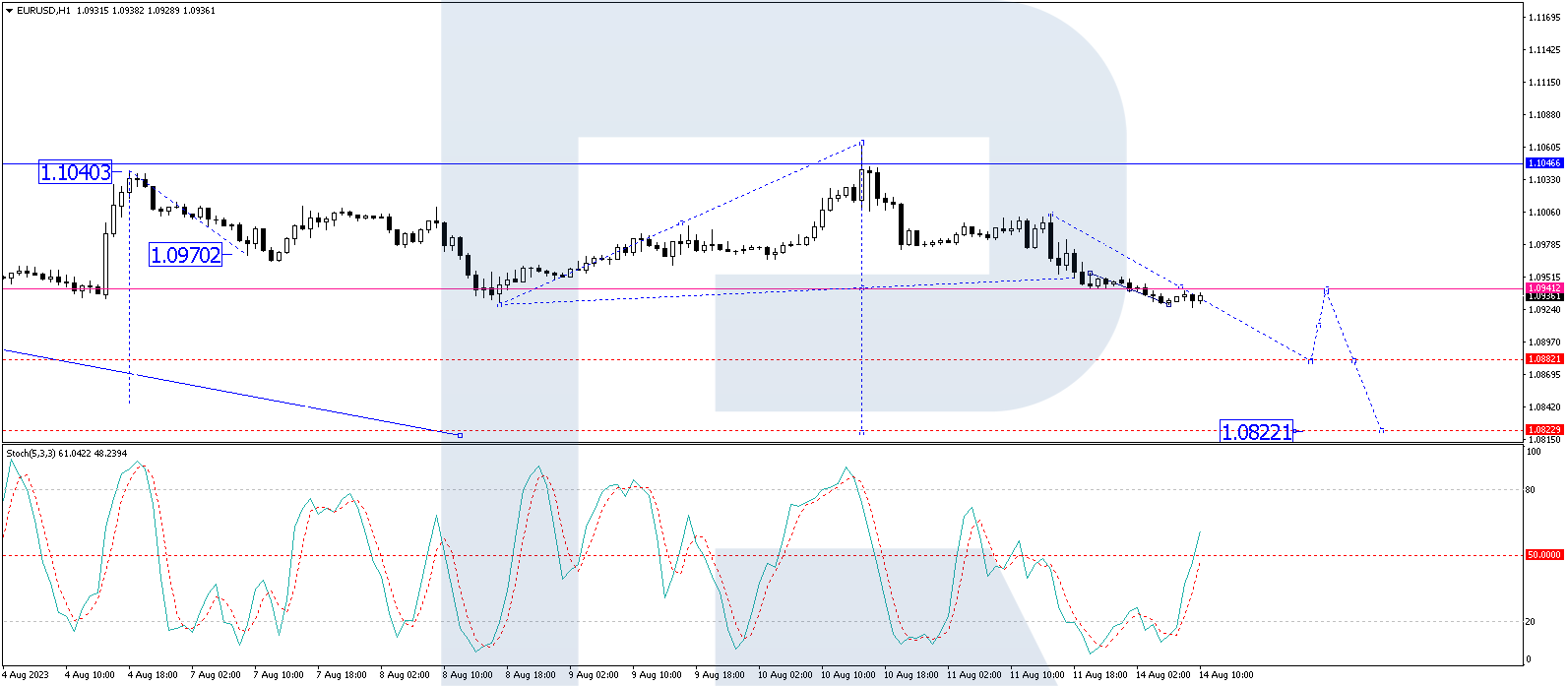
On the H1 timeframe, a consolidation range has formed around 1.0940. Upon breaking out upwards, the market exhibited an extended structure, reaching 1.1000. It then underwent a downward impulse to 1.0840. A correction to 1.0940 has already occurred today, testing from below. Following its completion, a fresh downward wave to 1.0840 could commence. This technical scenario finds confirmation from the Stochastic oscillator, as its signal line is above 50 and could potentially rise to 80 today.

Overall, EUR/USD has remained resilient near the 1.0910 level, exhibiting stability despite previous uncertainties. The upcoming actions of the US Federal Reserve System regarding interest rates continue to be a focal point for market participants, with analysts closely monitoring the potential impact on the currency pair. From a technical standpoint, various indicators and patterns suggest the possibility of both corrective rallies and downward movements, indicating the importance of monitoring key levels and trend developments.


Disclaimer

Any forecasts contained herein are based on the author’s particular opinion. This analysis may not be treated as trading advice. RoboForex bears no responsibility for trading results based on trading recommendations and reviews contained herein.

The recessionary sentiment is intensifying in the United States. Japanese policymakers are once again talking about intervention

By JustMarkets

The US stock indices fell on Friday as technology stocks caused the NASDAQ (US100) to decline and interrupted an eight-week upward move. By the close of the stock market, the Dow Jones Index (US30) decreased by 0.65% (-2.14% for the week), and S&P 500 (US500) lost 0.77% (-2.09% for the week). The Technology Index NASDAQ (US100) closed negative by 1.01% on Friday (-2.64% for the week).

Speaking last week in the House and Senate, Federal Reserve Chairman Jerome Powell said that further rate hikes are likely in the coming months. After that, 10-year bond yields fell a full percentage point below 2-year rates, deepening the inversion of the yield curve that is usually seen as a harbinger of recession.

Fed Richmond President Tom Barkin said he is not sure inflation is on a steady downward trajectory toward the Fed’s 2% target. San Francisco Fed President Mary Daly said two more rate hikes this year is a “very reasonable” projection.

Equity markets in Europe were mostly down on Friday. Germany’s DAX (DE30) decreased by 0.99% (-2.72% for the week), France’s CAC 40 (FR40) lost 0.55% on Friday (-2.58% for the week), Spain’s IBEX 35 Index (ES35) was down by 1.01% (-1.98% for the week), the British FTSE 100 (UK100) closed negative by 0.54% (-2.34% for the week).

Friday’s portion of disappointing Eurozone business activity statistics may cause a change in sentiment inside the ECB. Eurozone manufacturing activity worsened its decline in June, falling to 43.6 from 44.8 in May, reaching its lowest level in 37 months, a sign that the manufacturing recession is getting worse. Unless demand conditions in the region stabilize and improve soon, the ECB will have a hard time justifying further rate hikes, as a more restrictive stance could trigger a deeper recession.

A look at the yield on UK securities reveals the current problems and points to a recession. Two- and five-year fixed mortgage rates have risen sharply since the Bank of England began raising rates more than a year ago, and repayment costs are skyrocketing. Rates are expected to be even higher in the coming months, consumer spending will fall sharply, and this will hit the UK economy.

Oil prices rose in early trading in Asia on Monday after a failed Russian mercenary mutiny last weekend raised concerns about political instability in Russia and the potential impact on oil supplies from one of the world’s biggest producers.

Asian markets traded lower last week. Japan’s Nikkei 225 (JP225) was down by 2.92% for the week, China’s FTSE China A50 (CHA50) lost 1.63%, Hong Kong’s Hang Seng (HK50) fell by 5.15% for the week, and Australia’s S&P/ASX 200 (AU200) was negative by 1.34% for the week.

The Japanese currency, which is often seen as a safe haven asset, is now coming under renewed pressure from sellers, threatening a surge in the value of imports to hit consumers. Japan’s deputy finance minister for international affairs indicated Monday that the government has not ruled out responding to the yen’s excessive movement. The last time Japan conducted a currency intervention to buy the yen was last October.

S&P 500 (F) (US500) 4,348.33 −33.56 (−0.77%)

Dow Jones (US30)33,727.43 −219.28 (−0.65%)

DAX (DE40) 15,829.94 −158.22 (−0.99%)

FTSE 100 (UK100) 7,461.87 −40.16 (−0.54%)

USD Index 102.87 +0.48 (+0.48%)

Important events for today:
  • – German Ifo Business Climate (m/m) at 11:00 (GMT+3);
  • – Switzerland SNB Chairman Thomas Jordan speaks at 11:50 (GMT+3);
  • – Eurozone ECB President Lagarde Speaks at 20:30 (GMT+3).

By JustMarkets


This article reflects a personal opinion and should not be interpreted as an investment advice, and/or offer, and/or a persistent request for carrying out financial transactions, and/or a guarantee, and/or a forecast of future events.

The cryptocurrency market digest (BTC, DOGE). Overview for 26.06.2023

By RoboForex.com

The BTC exchange rate is about 30,250 USD on Monday. Over the past 24 hours, the flagship cryptocurrency has been moderately declining. However, it has gained about 14.5% within a week.

The last week was victorious for BTC as the leading cryptocurrency saw the most significant weekly result since March of this year. The weekly high was recorded at the level of 31,431 USD.

Several factors have worked in favour of buyers. First of all, this is the launch of EDX Market platform supported by The Charles Schwab and Fidelity. In addition, the giant BlackRock is getting ready to launch a cryptocurrency spot ETF. Following the investment fund, others, including Fidelity and Wisdom Tree, want to do the same. This is a good and promising signal: if the whales consider funds potentially profitable, it means they see conditions for an increase in prices.

BTC has broken the 31,000 USD level upwards. This opens the way for the buyers to 33,000-34,000 USD. A significant support level is at the 29,650 USD level, and the one below it is at the 29,200 USD level.

The capitalisation of the cryptocurrency market reached 1.176 trillion USD. BTC’s share has risen to 49.9%, while the share of ETH decreased to 19.2%.

Japan eases taxes for cryptocurrency companies

The Tax Agency of Japan intends to ease taxation for cryptocurrency companies. In particular, such companies could be exempt from paying tax on unrealised gains. This should facilitate running an industry-specific business in Japan.

Robinhood clients invest in Dogecoin

Robinhood clients invested about 1 billion USD in the DOGE token over the past month. According to publicly available data, Robinhood clients currently hold about 27.4% of the market supply of meme coins.

Article By RoboForex.com

Attention!
Forecasts presented in this section only reflect the author’s private opinion and should not be considered as guidance for trading. RoboForex LP bears no responsibility for trading results based on trading recommendations described in these analytical reviews.

Trade of the Week: EURUSD to suffer another inflation scare?

By ForexTime

  • Bloomberg FX model: 74% chance EURUSD will trade within 1.0784 – 1.1010 this week.
  • Traders to react to Powell vs. Lagarde comments due June 27-28
  • EURUSD typically sees 38% larger 1-day move on European CPI release days

The world’s most-traded FX pair has managed to shrug off the threat to the Putin regime over the weekend.

While keeping a wary eye over potential developments in Russia, it’s back to the usual grind of watching the incoming inflation data, and interpreting what the CPI numbers could mean for the European Central Bank’s (ECB) next moves on interest rates.


Here’s are two main factors to look out for this week:


1) Speeches by Fed and ECB chiefs

Firstly, note that traders and investors tend to boost the currency of the central bank that appears to have more rate hikes in store (hawkish).

That’s what markets will be thinking about, as Fed Chair Jerome Powell and ECB President Christine Lagarde are set to offer public comments between Tuesday, June 27th and Wednesday, June 28th.


What markets currently think the Fed will do next?

Markets are only pricing in just one more 25-basis point hike out of the US Federal Reserve for the rest of 2023.

Yet, Fed Chair Jerome Powell has been trying to convince markets since the FOMC meeting earlier this month that the Fed may have 2 more rate hikes this year.

Except that, markets just aren’t buying it.


What markets currently think the European Central Bank (ECB) will do?

Markets expect the ECB to trigger two more 25-bps hikes (50-bps in total) before the year is over.

Hence, no surprise that EURUSD has climbed by about 2% so far this month.


Potential Scenarios:

  • Should markets finally take heed of Powell’s hawkish messaging, that could lead to a stronger US dollar that drags EURUSD lower.
  • Alternatively, should Powell’s hawkish intentions be once again pooh-poohed by markets, that may push EURUSD even higher.


2) European inflation data

Thursday, June 29th: Germany June CPI (consumer price index, which is used to measure headline inflation)

Markets are expecting inflation to tick back higher in the Europe’s largest economy:

  • Month-on-month CPI (June 2023 vs. May 2023) to be 0.2% higher; inflation back to positive growth after May’s 0.1% month-on-month contraction)
  • Year-on-year CPI (June 2023 vs. June 2022) to be 6.3% higher.
    If so, that would mean inflation is ticking back up at a faster pace compared to May 2023’s 6.1% year-on-year number.


Friday, June 30th: Eurozone June CPI

Here are the market’s forecasts:

  • Month-on-month CPI (June 2023 vs. May 2023) to be 0.3% higher; inflation back to growth after May’s 0.0% month-on-month reading.
  • Year-on-year CPI (June 2023 vs. June 2022) to be 5.6% higher; a slower annual pace compared to May’s 6.1% year-on-year advance
  • Core CPI (excluding more volatile items such as food and fuel) to be 5.5% higher year-on-year (June 2023 vs. June 2022).
    If so, that would mean inflation is ticking back up at a faster pace compared to May 2023’s core CPI year-on-year number of 5.3%.

Overall, signs of still stubborn inflation may ramp up market bets for more ECB rate hikes.

The prospects of more rate hikes in an economy tend to strengthen its currency.


Potential Scenarios:

  • Higher-than-expected CPI prints out of Germany/Eurozone later this week may translate into a stronger Euro versus the US dollar.
  • Alternatively, lower-than-expected CPI prints out of Germany/Eurozone later this week may translate into a weaker EURUSD.


EURUSD tends to post larger-than-average moves on CPI data

So far in 2023, EURUSD has seen an average intraday move of 80 pips between any given day’s highest price and that same day’s lowest.

However, on the days that Germany or Europe releases their respective CPI data, EURUSD tends to see an average intraday move of 110 pips, which is about 38% (or 30 pips) more than the daily average so far this year.

In other words, expect greater EURUSD volatility when Germany and the Eurozone release their respective CPI prints later this week.


Note also that EURUSD has posted larger intraday moves in 3 out of the past four of Germany’s CPI releases, compared to EURUSD’s 1-day move on the day of the Eurozone’s CPI release.

After all, Germany is the largest economy in Europe. Hence, the former’s CPI print is seen as a forerunner to the bloc’s headline CPI print.


Key levels

Potential Support

  • 14-day simple moving average (SMA)
  • 1.08444: intraday low on June 23rd
  • 100-day SMA around 1.080 psychologically-important level


Potential Resistance

  • 1.09426: 50% Fibonacci level from EURUSD’s Jan 2021 – Sept 2022 drop, peak-to-trough
  • 1.09708: intraday high on June 16th
  • 1.10123: recent cycle high


Bloomberg’s FX model now points to a 74% chance that EURUSD will trade within the 1.0784 – 1.1010 range in the next one week.


Forex-Time-LogoArticle by ForexTime

ForexTime Ltd (FXTM) is an award winning international online forex broker regulated by CySEC 185/12 www.forextime.com