Archive for Financial News – Page 182

Inflationary pressures are rising sharply in Australia. Corporate earnings keep indices from falling

By JustMarkets

As of Tuesday’s stock market close, the Dow Jones Index (US30) was up by 0.54%, while the S&P 500 (US500) increased by 0.73%. The NASDAQ Technology Index (US100) closed positive by 0.93% yesterday. Stocks rose moderately on Tuesday on the back of better-than-expected corporate earnings results. A negative factor for stocks was Tuesday’s stronger-than-expected US manufacturing activity data, which was hawkish for Fed policy. The S&P US manufacturing PMI for October unexpectedly rose to a 6-month high of 50.0, which was stronger than expectations of a decline to 49.5.

General Electric (GE) closed higher by more than 6% after reporting third-quarter adjusted EPS of 82 cents, well above the consensus of 56 cents, and raising its 2023 adjusted EPS guidance. Verizon Communications (VZ) shares are up more than 9%, leading gains in the S&P 500 (US500) and Dow Jones Industrials (US30), after the company reported third-quarter adjusted earnings per share of $1.22, which was better than the consensus estimate of $1.18. Coca-Cola Co (KO) closed higher by more than 3% after reporting 11% organic revenue growth in the third quarter, well above the consensus of 6.91%. Shares of Google Alphabet (GOOG) Inc. are down more than 5% after weaker-than-expected revenue growth from its cloud computing operations. Microsoft (MSFT) reported fiscal first-quarter results on Tuesday that beat Wall Street forecasts, as the tech giant’s investments in artificial intelligence fueled growth in its Azure cloud business. The stock price rose more than 4% after the report was published.

In the Middle East, French President Macron met with Prime Minister Netanyahu in Israel on Tuesday before calling for an international coalition to fight Hamas and warning other Iranian-backed militant groups against opening new fronts in the war between Israel and Hamas.

Equity markets in Europe were mostly up yesterday. Germany’s DAX (DE40) rose by 0.54%, France’s CAC 40 (FR40) gained 0.63% on Tuesday, Spain’s IBEX 35 (ES35) fell by 0.28%, and the UK’s FTSE 100 (UK100) closed positive 0.20%.

The Eurozone manufacturing PMI for October unexpectedly fell by 0.4 to 43.0, weaker than expectations of a rise to 43.7. The German GfK consumer confidence index for November fell by 1.4 to a 7-month low of 28.1, weaker than expectations of 27.0. In her speech yesterday, ECB President Lagarde told the Presidents of the European Commission, European Council, and Eurogroup that stagnation and downside risks await the Eurozone economy in the next few quarters, although inflation risks have become more balanced.

Asian markets were predominantly up yesterday. Japan’s Nikkei 225 (JP225) increased by 0.20%, China’s FTSE China A50 (CHA50) added 0.03%, Hong Kong’s Hang Seng (HK50) ended the day down by 1.05%, and Australia’s ASX 200 (AU200) ended Tuesday positive 0.19%. Chinese stocks continued their recovery rally on Wednesday after the government announced plans for a massive bond issue. Beijing announced plans to issue 1 trillion yuan ($1=7.3088 yuan) worth of government bonds to support the economy. Nevertheless, Chinese stocks remain near 2023 lows, having suffered significant losses on fears of slowing economic growth and a collapse in the real estate market. Despite Wednesday’s optimism, the factors that drove domestic markets lower are still in place.

Japan’s business activity index for the manufacturing sector for October was unchanged at 48.5. The services PMI for October fell by 2.7 to 51.1, the lowest reading in 10 months.

In Australia, the consumer price index unexpectedly rose. In annual terms, the inflation rate rose from 5.2% to 5.6%. In quarterly terms, the index rose from 0.8% to 1.2%. Such data gives grounds for further interest rate increase by the Reserve Bank of Australia next week.

S&P 500 (F)(US500) 4,247.68 +30.64 (+0.73%)

Dow Jones (US30) 33,141.38 +204.97 (+0.62%)

DAX (DE40)  14,879.94  +79.22 (+0.54%)

FTSE 100 (UK100) 7,389.70 +14.87 +(0.20%)

USD Index  106.26 +0.73 (+0.69%)

News feed for 2023.10.25:
  • – Australia Consumer Price Index (m/m) at 03:30 (GMT+3);
  • – German Ifo Business Climate (m/m) at 11:00 (GMT+3);
  • – US Building Permits (m/m) at 15:00 (GMT+3);
  • – US New Home Sales (m/m) at 17:00 (GMT+3);
  • – Canada BoC Monetary Policy Report at 17:00 (GMT+3);
  • – Canada BoC Interest Rate Decision at 17:00 (GMT+3);
  • – US Crude Oil Reserves (w/w) at 17:30 (GMT+3);
  • – Canada BoC Press Conference at 18:00 (GMT+3);
  • – Eurozone ECB President Lagarde Speaks at 20:00 (GMT+3);
  • – US Fed Chair Powell Speaks at 23:35 (GMT+3).

By JustMarkets


This article reflects a personal opinion and should not be interpreted as an investment advice, and/or offer, and/or a persistent request for carrying out financial transactions, and/or a guarantee, and/or a forecast of future events.


The situation in the Middle East has a negative impact on market sentiment

By JustMarkets

American stock indices traded yesterday without any unified dynamics. At Monday’s close, the Dow Jones Index (US30) decreased by 0.58%, while the S&P 500 Index (US500) was down by 0.17%. The NASDAQ Technology Index (US100) closed positive by 0.27%. The decline in T bond yields on Monday was bearish for the US dollar and bullish for stock indices. The dollar on Monday initially found support in the jump in the 10-year bond yield to a new 16-year high, but then bond yields reversed and headed lower. From a fundamental perspective, the tightening of financial conditions in the US is certainly reducing the need for further monetary tightening, and many US Fed officials have moved to a less hawkish tone. Markets are currently pricing in just a 2% chance that the FOMC will raise the lending rate by 25 bps at its next meeting, which ends on November 1, and a 23% chance that the rate will be raised by 25 bps at its December 13 meeting.

The fear that the war between Israel and Hamas could escalate into a regional conflict is weighing on market sentiment. Western countries stepped up efforts to prevent the war between Israel and Hamas from escalating, and EU leaders supported the UN’s call for a “humanitarian pause” in the war. President Biden held talks with the presidents of Canada, France, Germany, and Italy to strengthen coordination among the allies. At the same time, late yesterday, there was news of explosions at three US military bases in the Middle East. This news interrupted Biden’s live-streamed remarks. Intelligence reports indicate that Iranian-backed militias are poised to step up attacks on US troops in the Middle East. Israel has said it supports diplomatic efforts to get Hamas to release hostages from Gaza, which could delay a possible ground invasion, but is not going to wait long to launch a ground offensive. Iran and its proxy forces in Lebanon, Iraq, and Yemen have warned they could retaliate against Israel if Israeli troops enter Gaza.

Equity markets in Europe traded flat yesterday. Germany’s DAX (DE40) rose by 0.02%, France’s CAC 40 (FR40) added 0.50% on Monday, Spain’s IBEX 35 (ES35) decreased by 0.37%, and the UK’s FTSE 100 (UK100) closed negative by 0.37%.

British consumers are curbing their spending ahead of the festive season, and the latest survey from Gfk suggests that the weather is not the only reason for this. Retail sales fell by 0.9% in September, well above expectations of a 0.3% decline. The Gfk Consumer Confidence Index fell back to 30. The outlook for the British economy remains bleak as growth is sluggish, and recent economic indicators point to a slowdown in manufacturing activity, while UK inflation remains stubbornly high.

The potential for an escalation of the conflict between Israel and Hamas and poor corporate earnings have left investors looking for safe havens, of which there are few left. The US dollar is not in the best position at the moment, as the US Federal Reserve does not plan to continue its tightening policy in the near future. According to economists, apart from the US dollar, only gold and the Swiss franc remain as safe havens. The Swiss franc is a longtime safe haven asset that recently hit its highest level against the euro since 2015 and has held up against the losses of its traditional peers.

Last Wednesday, the US said it would ease sanctions on Venezuela’s oil exports for six months in exchange for measures to ensure the country holds fair presidential elections next year. The easing of sanctions will bring additional oil supplies to the global market, which some analysts estimate will be about 200,000 barrels per day. However, oil traders believe that tension in the oil market will still remain due to the extension of the OPEC+ agreement on production cuts.

Asian markets were mostly declining yesterday. Japan’s Nikkei 225 (JP225) decreased by 0.83%, China’s FTSE China A50 (CHA50) was down by 0.62%, Hong Kong’s Hang Seng (HK50) lost 0.72% on the day, and Australia’s ASX 200 (AU200) was negative by 0.82% on Monday. On Tuesday, most Asian stocks extended losses after weak business activity data in Japan and Australia. At the same time, Chinese markets rebounded from pre-pandemic lows thanks to a government fund starting to buy some stocks.

Japanese government bond (JGB) yields rose to new multi-year highs on Monday as investors assess the likelihood that the Bank of Japan will continue to adjust its yield curve control (YCC) policy next week. One possibility being discussed is an increase in the 1% ceiling for the 10-year yield.

S&P 500 (F)(US500) 4,217.04 −7.12 (−0.17%)

Dow Jones (US30) 32,936.41 −190.87 (−0.58%)

DAX (DE40)  14,800.72 +2.25 (+0.015%)

FTSE 100 (UK100) 7,374.83 −27.31 (−0.37%)

USD Index  105.62 −0.54 (−0.51%)

News feed for 2023.10.24:
  • – Australia Manufacturing PMI (m/m) at 01:00 (GMT+3);
  • – Australia Services PMI (m/m) at 01:00 (GMT+3);
  • – Japan Manufacturing PMI (m/m) at 03:30 (GMT+3);
  • – Japan Services PMI (m/m) at 03:30 (GMT+3);
  • – UK Unemployment Rate (m/m) at 09:00 (GMT+3);
  • – German Manufacturing PMI (m/m) at 10:30 (GMT+3);
  • – German Services PMI (m/m) at 10:30 (GMT+3);
  • – Australia RBA Gov Bullock Speaks at 11:00 (GMT+3);
  • – Eurozone Manufacturing PMI (m/m) at 11:00 (GMT+3);
  • – Eurozone Services PMI (m/m) at 11:00 (GMT+3);
  • – UK Manufacturing PMI (m/m) at 11:30 (GMT+3);
  • – UK Services PMI (m/m) at 11:30 (GMT+3);
  • – Eurozone ECB President Lagarde Speaks at 15:30 (GMT+3);
  • – US Manufacturing PMI (m/m) at 16:45 (GMT+3);
  • – US Services PMI (m/m) at 16:45 (GMT+3).

By JustMarkets


This article reflects a personal opinion and should not be interpreted as an investment advice, and/or offer, and/or a persistent request for carrying out financial transactions, and/or a guarantee, and/or a forecast of future events.

Murrey Math Lines 24.10.2023 (AUDUSD, NZDUSD)

By RoboForex.com

AUDUSD, “Australian Dollar vs US Dollar”

AUDUSD quotes are below the 200-day Moving Average on H4, revealing the prevalence of a downtrend. The RSI is nearing the resistance line. In this situation, a test of 5/8 (0.6378) is expected, followed by a rebound from this level and a decline to the support at 2/8 (0.6286). The scenario can be cancelled by rising above the 5/8 (0.6378) level. In this case, the pair could reach the resistance at 6/8 (0.6408).

AUDUSD
Risk Warning: the result of previous trading operations do not guarantee the same results in the future

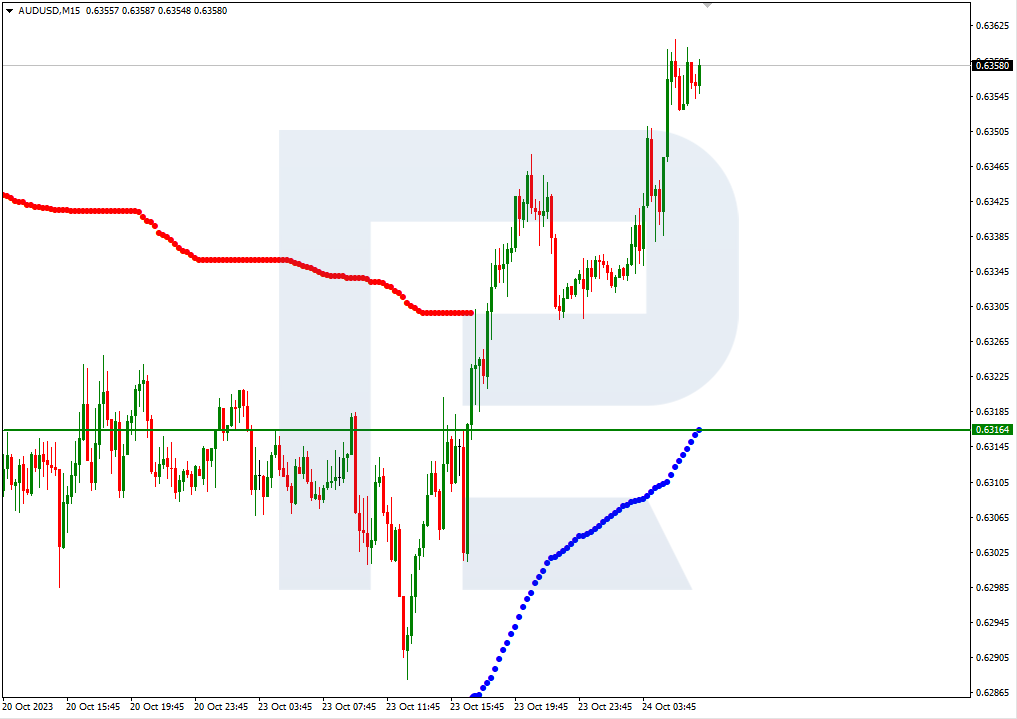
On M15, after a rebound from 5/8 (0.6378), a further price decline could be additionally supported by a breakout of the lower boundary of the VoltyChannel.

AUDUSD
Risk Warning: the result of previous trading operations do not guarantee the same results in the future

NZDUSD, “New Zealand Dollar vs US Dollar”

NZDUSD quotes are in the oversold area on H4. The RSI has broken the resistance line. In this situation, the quotes could rise above the 0/8 (0.5859) level, subsequently reaching the resistance level of 2/8 (0.5920). The scenario can be cancelled by a downward breakout of -1/8 (0.5828). In this case, the pair might drop to the support at -2/8 (0.5798).

NZDUSD
Risk Warning: the result of previous trading operations do not guarantee the same results in the future

On M15, the upper boundary of the VoltyChannel is broken. This increases the probability of a further price rise.

NZDUSD

Article By RoboForex.com

Attention!
Forecasts presented in this section only reflect the author s private opinion and should not be considered as guidance for trading. RoboForex LP bears no responsibility for trading results based on trading recommendations described in these analytical reviews.

Technical Analysis & Forecast 13.10.2023

By RoboForex.com

EURUSD, “Euro vs US Dollar”

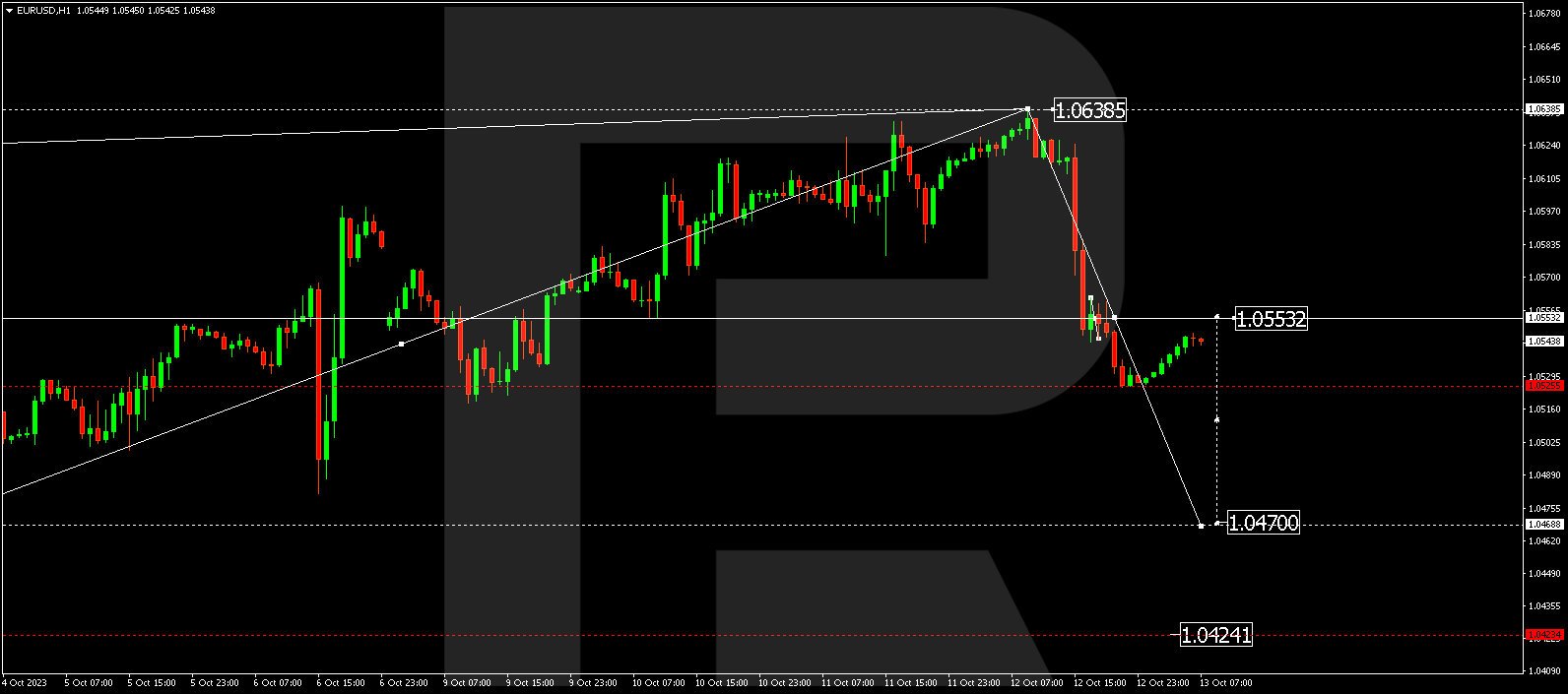
EURUSD has completed a wave of growth to 1.0638. The market has formed a consolidation range under this level and, escaping it downwards, continues developing the declining wave to 1.0470. After the price hits this level, a link of growth to 1.0550 is not excluded (with a test from below), followed by a decline to 1.0424.

EURUSD
Risk Warning: the result of previous trading operations do not guarantee the same results in the future

GBPUSD, “Great Britain Pound vs US Dollar”

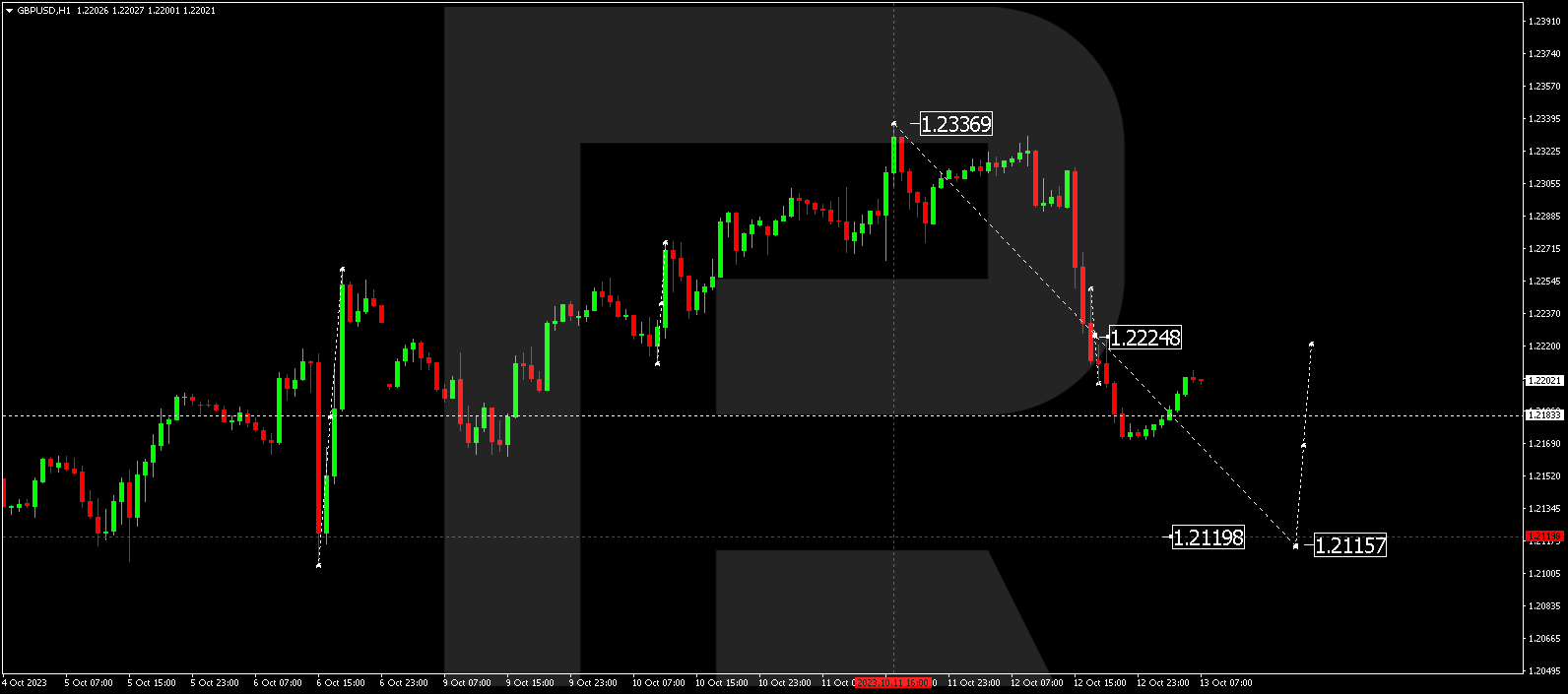
GBPUSD has completed a wave of growth to 1.2337. By now, the market has formed a consolidation range under this level. Breaking the range downwards, the market completed a declining wave to 1.2171. A link of correction to 1.2222 is not excluded (with a test from below), followed by a decline to 1.2121. This is a local target.

GBPUSD
Risk Warning: the result of previous trading operations do not guarantee the same results in the future

USDJPY, “US Dollar vs Japanese Yen”

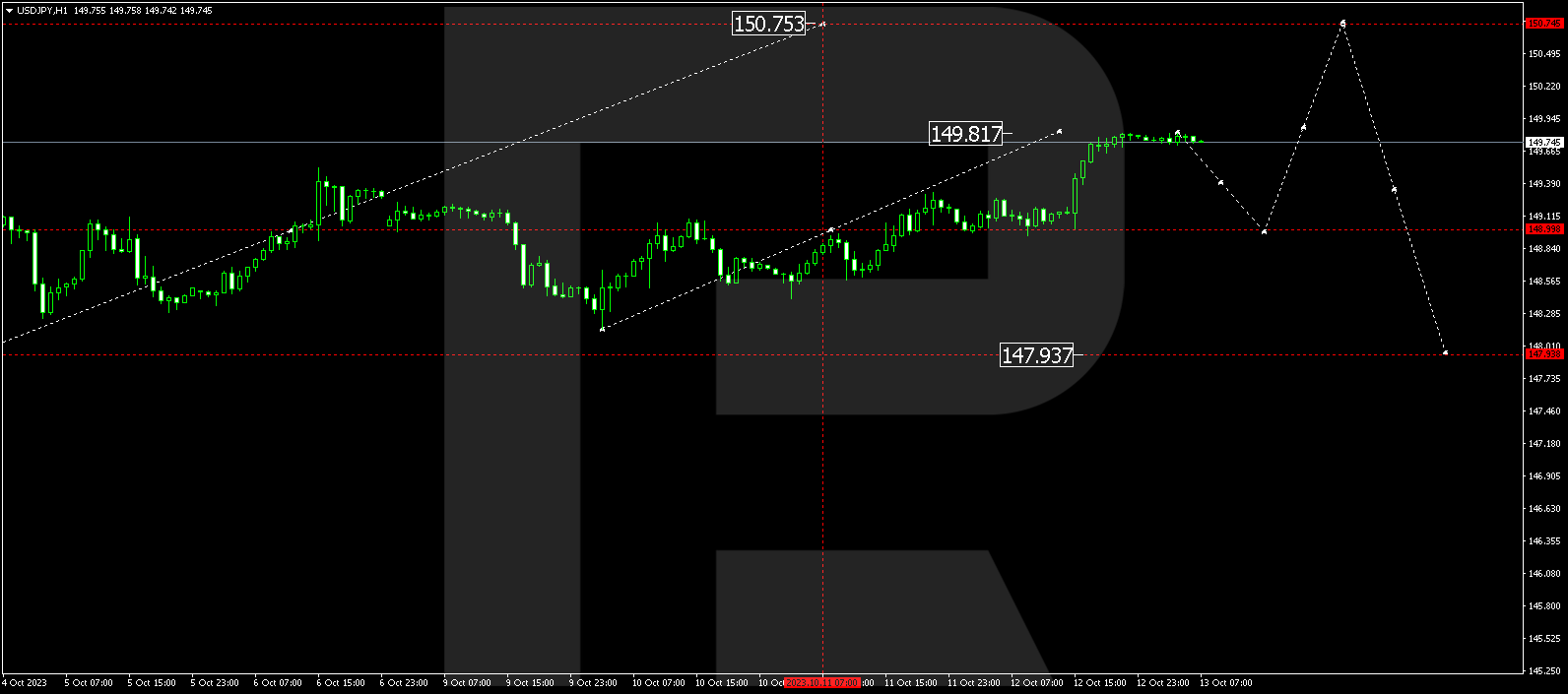
USDJPY has completed a wave of growth to 149.81. A link of decline to 149.00 is expected (with a test from above). Next, a link of growth to 150.75 might follow.

USDJPY
Risk Warning: the result of previous trading operations do not guarantee the same results in the future

USDCHF, “US Dollar vs Swiss Franc”

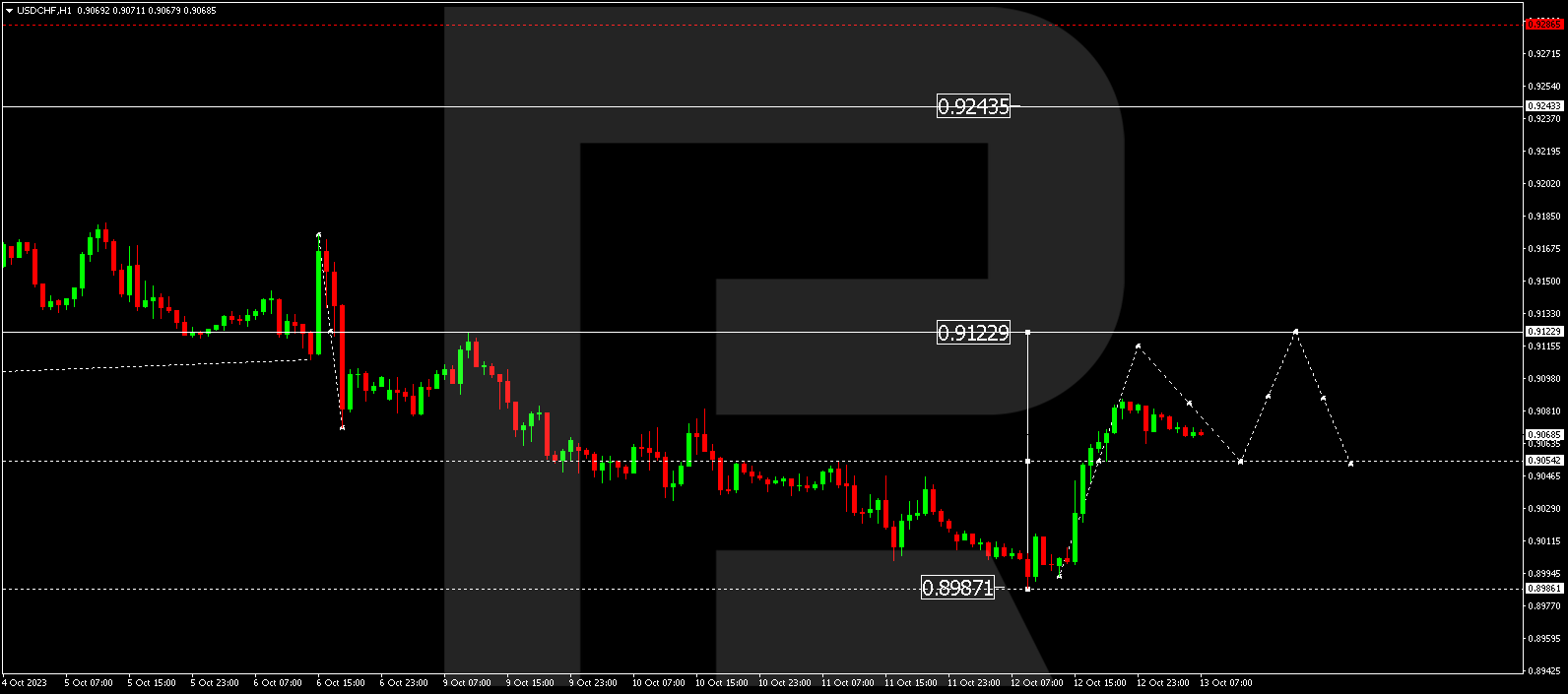
USDCHF has completed a wave of decline to 0.8989. By now, the market has formed a consolidation range above this level and is forming a growing impulse to 0.9122, escaping the range upwards. This is the first target.

USDCHF
Risk Warning: the result of previous trading operations do not guarantee the same results in the future

AUDUSD, “Australian Dollar vs US Dollar”

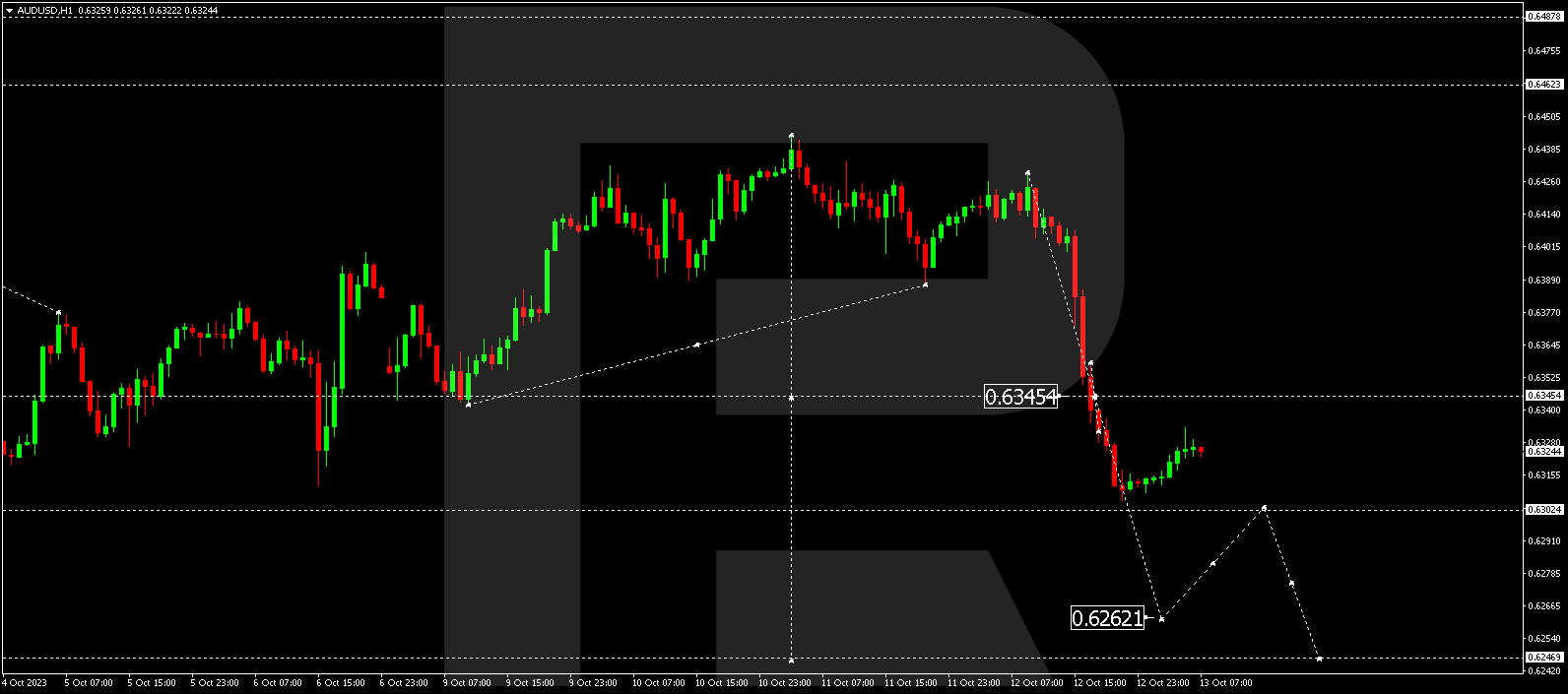
AUDUSD has completed a rising link to 0.6444. Practically, the market demonstrates the wave of growth as complete. By now, a consolidation range has formed under 0.6444 and, escaping it downwards, the market develops an impulse of decline to 0.6262. This is a local target.

AUDUSD
Risk Warning: the result of previous trading operations do not guarantee the same results in the future

BRENT

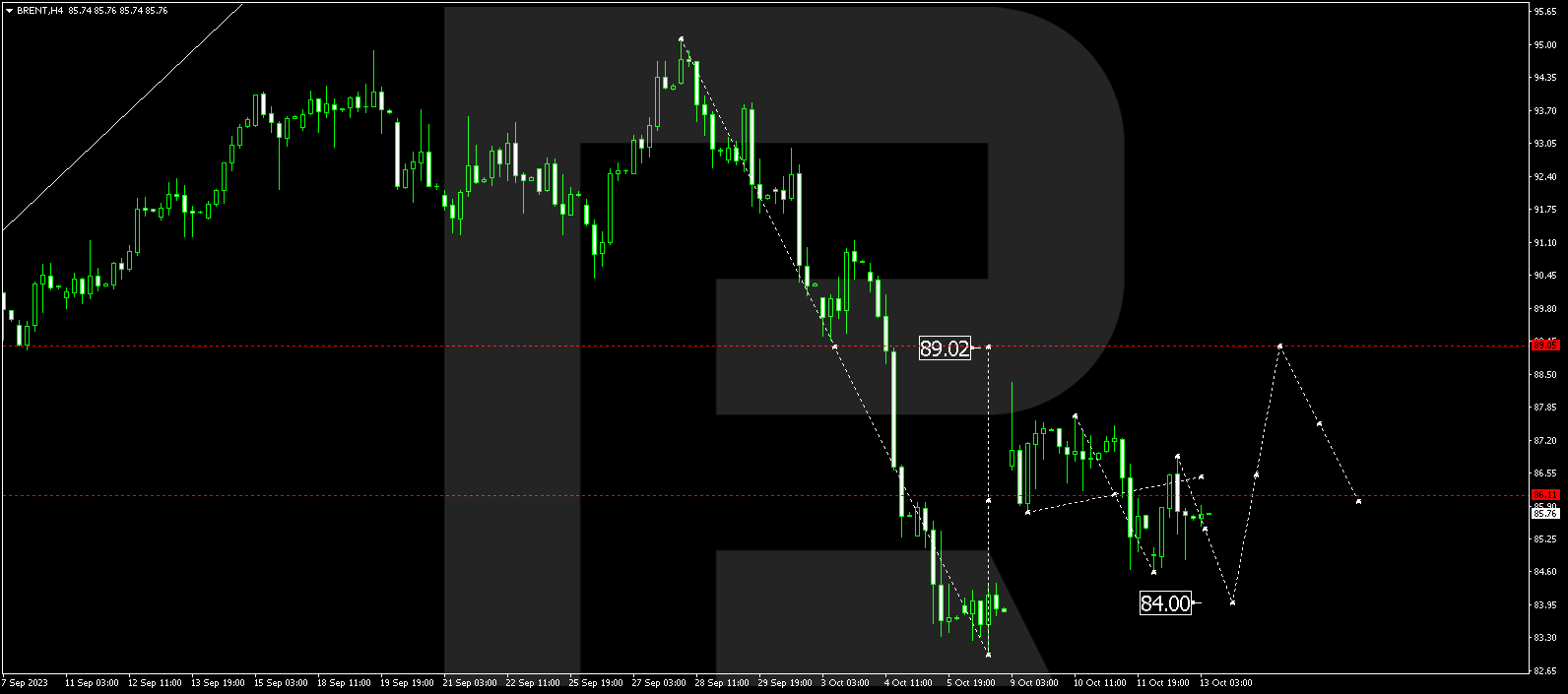
Brent continues forming a consolidation range around 86.00. A link of decline to 84.00 is not excluded, followed by a rising link to 89.00. This is the first target.

BRENT
Risk Warning: the result of previous trading operations do not guarantee the same results in the future

XAUUSD, “Gold vs US Dollar”

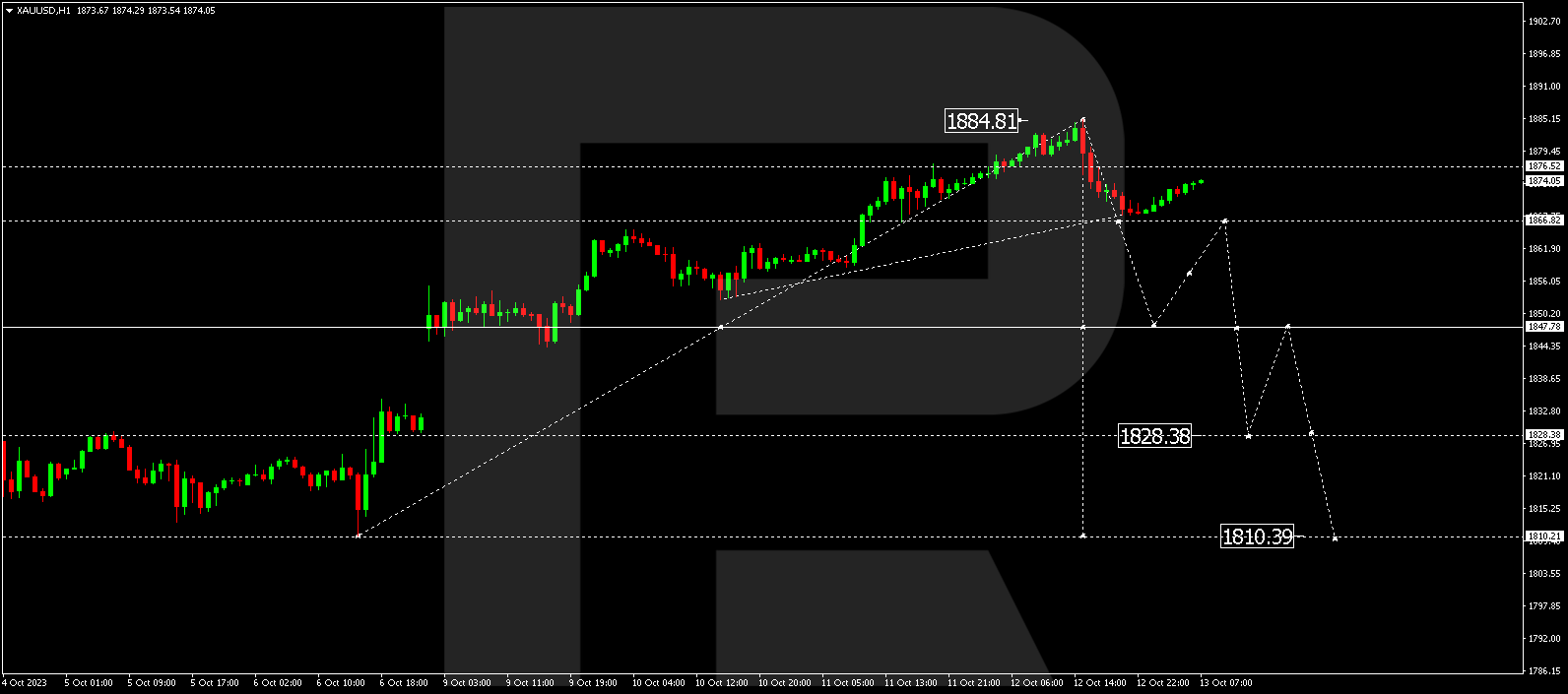
Gold has completed a wave of growth to 1884.80. Today the market has performed a declining impulse to 1867.00 and a rising link to 1876.55. Practically, a consolidation range has formed which the price might later break downwards to 1847.77. This is the first target.

GOLD
Risk Warning: the result of previous trading operations do not guarantee the same results in the future

S&P 500

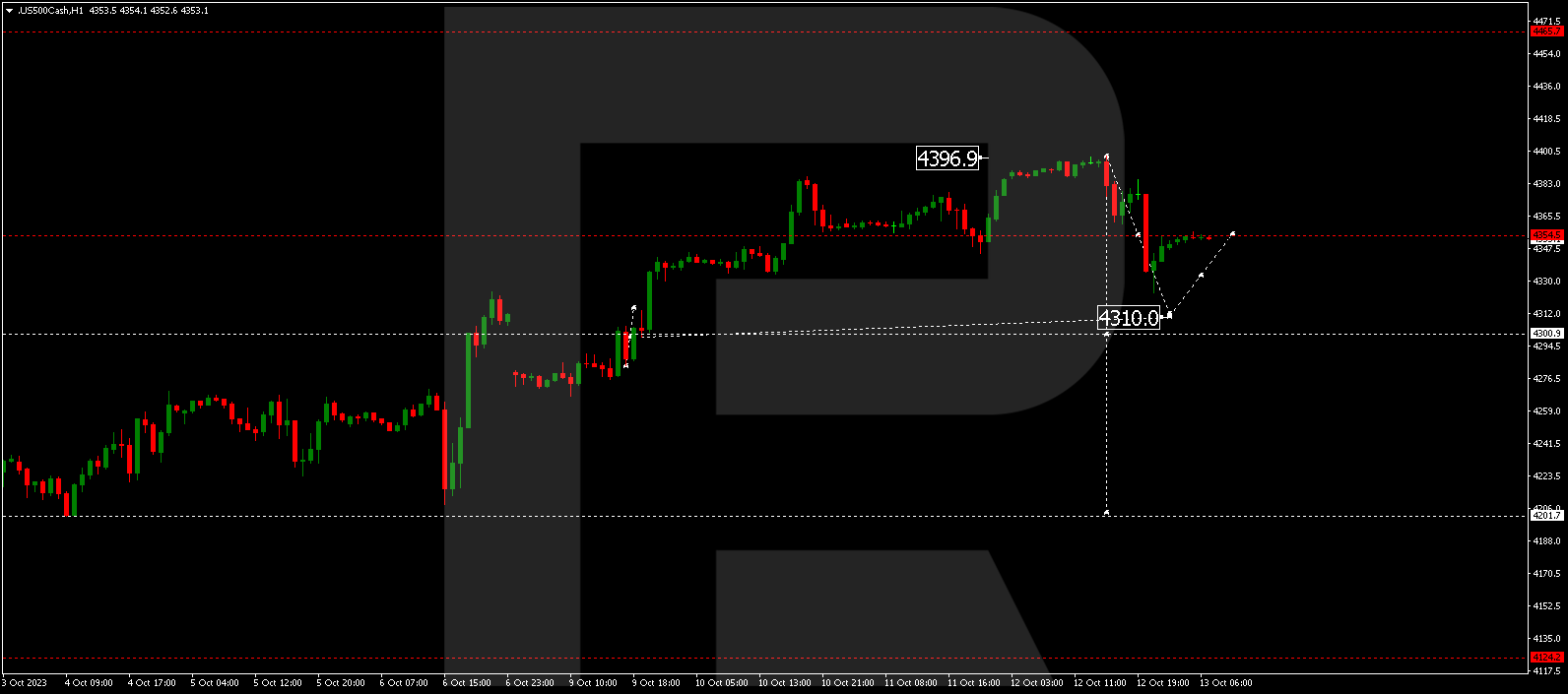
The stock index is forming a declining impulse to 4310.0. Next, the quotes might rise to 4355.0 (with a test from below). Next, a new wave of decline to 4200.0 might begin. This is a local target.

S&P 500

Article By RoboForex.com

Attention!
Forecasts presented in this section only reflect the author s private opinion and should not be considered as guidance for trading. RoboForex LP bears no responsibility for trading results based on trading recommendations described in these analytical reviews.

The situation in the Middle East is heating up. Inflation data in China disappointed investors

By JustMarkets

At Wednesday’s stock market close, the Dow Jones Index (US30) decreased by 0.51%, while the S&P 500 Index (US500) lost 0.62%. The NASDAQ Technology Index (US100) closed yesterday negative by 0.63%. Stocks posted moderate losses on Thursday amid a stronger-than-expected US CPI report for September. In addition, weekly US initial jobless claims remained unchanged, which was hawkish for Fed policy. Thursday’s hawkish reports keep the likelihood of another Fed rate hike this year alive. Stocks continued to lose ground Thursday afternoon as T-bond yields rose further amid weak demand at the $20 billion auction of 30-year Treasury bonds.

Concerns that the conflict between Israel and Hamas will spread to the Middle East was another negative factor for stocks amid reports that Israel launched airstrikes on major airports in Damascus and Aleppo in Syria. In turn, Iran has begun moving military equipment to its western border. Whether this equipment will travel further through Iraq toward Israel is still unknown, but the geopolitical risks of another major war have increased significantly in recent days.

The US Consumer Price Index for September came in at 3.7% y/y, unchanged from August and stronger than the 3.6% y/y decline. The core CPI excluding food and energy for September declined to 4.1% y/y from 4.3% y/y in August, which was in line with expectations. US weekly initial jobless claims were unchanged at 209,000, indicating a slight strengthening of the labor market compared to expectations of a rise to 210,000.

FRB Boston President Collins commented that she favors a pause in Fed rate hikes.

Equity markets in Europe traded lower yesterday. Germany’s DAX (DE40) decreased by 0.23%, France’s CAC 40 (FR40) lost 0.37% on Thursday, Spain’s IBEX 35 (ES35) was 0.26% cheaper, and the UK’s FTSE 100 (UK100) closed positive by 0.32%.

ECB Governing Council spokesperson Centeno said yesterday, “At the current level of interest rates, we will make a significant contribution to the 2% inflation target. We will achieve this target by continuing with this monetary policy stance, holding it for some time until we are fully confident that inflation is falling.” Another representative of the ECB Governing Council, Wunsch, said, “If we continue to see inflation figures in line with the forecast, we will not need to raise interest rates again.” Minutes from the ECB’s September 13-14 meeting showed that the risks of too much tightening and too little tightening have become more balanced and the ECB will hold off on raising interest rates.

Crude oil prices gave up early gains on Thursday amid a stronger dollar and after the EIA’s weekly crude oil inventories report showed an unexpected rise in crude stockpiles and US crude production hit a record high. Oil initially opened higher on Thursday on concerns over the escalating conflict between Israel and Hamas. Oil was also supported by comments from Saudi Arabia’s Energy Minister, Prince Abdulaziz bin Salman, who said oil producers will continue to work together and be proactive to keep the oil market balanced.

Asian markets were predominantly rising yesterday. Japan’s Nikkei 225 (JP225) rose by 1.75%, China’s FTSE China A50 (CHA50) gained 0.85%, Hong Kong’s Hang Seng (HK50) rose by 1.93% and Australia’s ASX 200 (AU200) ended the day positive by 0.04%.

In China, the Consumer Price Index (CPI) was unchanged in September, missing forecasts for a 0.2% y/y rise. In August, the CPI rose by 0.1% y/y. On an annualized basis, core inflation, excluding food and fuel prices, was up by 0.8%, the same as in August. The Producer Price Index (PPI) fell to 2.5% y/y, marking the 12th consecutive negative month, although the rate of decline slowed from August. Economists had forecast a drop to 2.4% y/y. CPI inflation at zero indicates that deflationary pressures in China remain a real threat to the economy. The recovery in domestic demand will not be strong without significant stimulus from the government.

S&P 500 (F)(US500) 4,349.61 −27.34 (−0.62%)

Dow Jones (US30) 33,631.14 −173.73 (−0.51%)

DAX (DE40)  15,425.03 −34.98 (−0.23%)

FTSE 100 (UK100) 7,644.78 +24.75 (+0.32%)

USD Index  106.58 +0.76 (+0.72%)

News feed for 2023.10.13:
  • – Singapore GDP (q/q) at 03:00 (GMT+3);
  • – China Consumer Price Index (m/m) at 04:30 (GMT+3);
  • – China Producer Price Index (m/m) at 04:30 (GMT+3);
  • – China Trade Balance (m/m) at 06:00 (GMT+3);
  • – Sweden Consumer Price Index (m/m) at 09:00 (GMT+3);
  • – Switzerland Producer Price Index (m/m) at 09:30 (GMT+3);
  • – UK BoE Gov Bailey Speaks at 11:00 (GMT+3);
  • – Eurozone Industrial Production (m/m) at 12:00 (GMT+3);
  • – US FOMC Member Harker Speaks at 16:00 (GMT+3);
  • – Eurozone ECB President Lagarde Speaks (m/m) at 16:00 (GMT+3);
  • – US Michigan Consumer Sentiment (m/m) at 17:00 (GMT+3).

By JustMarkets


This article reflects a personal opinion and should not be interpreted as an investment advice, and/or offer, and/or a persistent request for carrying out financial transactions, and/or a guarantee, and/or a forecast of future events.

US CPI comes in above expectations – what should you do with investments?

By George Prior 

US Consumer Price Index (CPI) data published Thursday supports the case that the Federal Reserve will likely implement one more interest rate hike, says the CEO of one of the world’s leading financial advisory, asset management and fintech organizations.

The prediction from Nigel Green of deVere Group comes as September CPI inflation rises 3.7%, above expectations of 3.6%. US CPI is now up for four consecutive months. Core CPI inflation fell to 4.1%, in line with expectations.

He comments: “Taking into account the latest US CPI data, and the minutes from the most recent Federal Reserve meeting, which were published on Monday, we expect there to be one last 25 basis point hike at its two-day meeting beginning October 31.

“The Fed will be conscious of growing uncertainty of the trajectory of the world’s largest economy and the risks of overtightening – especially in times of growing geopolitical uncertainty; while at the same time, want to avoid complacency in the continuing battle against inflation.”

The deVere CEO continues: “As a result, we expect that interest rates will still continue to remain higher for longer.”

Based on the assertion that interest rate hikes are likely to be nearing an end, and high-interest rates are expected to continue, investors may want to consider rebalancing their portfolios.

“Financial institutions, such as banks and insurance companies, tend to benefit from higher interest rates as they can charge more for loans and earn higher yields on their investments. A portfolio allocation to financial services stocks or exchange-traded funds (ETFs) may be considered,” says Nigel Green.

“The energy sector also benefits from a robust economy and high interest rates. It’s typically positively correlated with economic growth and tends to perform well in such environments.

“Certain segments of the consumer discretionary sector, such as automotive, housing, and luxury goods, can perform well when interest rates are high. Consumer spending can remain strong, particularly if the economy is healthy, and these industries can benefit.

“Industrial companies often benefit from increased infrastructure spending and a robust economy. With expectations of continued high interest rates, these companies are likely to see growth opportunities in construction, manufacturing, and transportation.”

He goes on to add: “While technology stocks can be sensitive to interest rate changes, some tech companies continue to thrive in a high-interest rate environment, especially those with strong fundamentals and growth potential.

“Meanwhile, the healthcare sector is typically less sensitive to interest rate changes, making it a relatively stable option for a portfolio, as will essential goods, such as food, beverages, and household products.”

As ever, an investor’s best tool for mitigating risk and seizing opportunities is to remain properly diversified and by working with an independent financial advisor.

The FOMC since March 2022 has raised its key interest rate 11 times, taking it to a targeted range of 5.25%-5.5%, the highest level in 22 years.

Nigel Green concludes: “We don’t think we’re at the end of the hiking cycle just yet, even though we’re close, and rates will continue to be high, potentially impacting your investment portfolio.”

About:

deVere Group is one of the world’s largest independent advisors of specialist global financial solutions to international, local mass affluent, and high-net-worth clients.  It has a network of offices across the world, over 80,000 clients and $12bn under advisement.

Uranium Prices, Demand Continue Rising in Tight Market

Source: Streetwise Reports  (10/11/23)

Uranium prices and demand are forecast to keep rising through late 2023 amid tight supply, increasing the appeal of uranium stocks, say analysts.

Uranium prices and demand should continue their upward trajectory through the remainder of 2023, according to a recent industry report. Analysts attribute the positive momentum to sustained uranium supply deficits. With inventory levels low and global nuclear capacity expanding, the structurally undersupplied market continues tightening.

In the report, analysts increased their uranium demand estimates through 2030 and 2035. Total nuclear capacity is projected to grow at a 3.6% compound annual rate through 2030. This translates into a 30% rise in annual uranium requirements. New reactor construction in China and India, coupled with plant life extensions in the West, drive the demand growth.

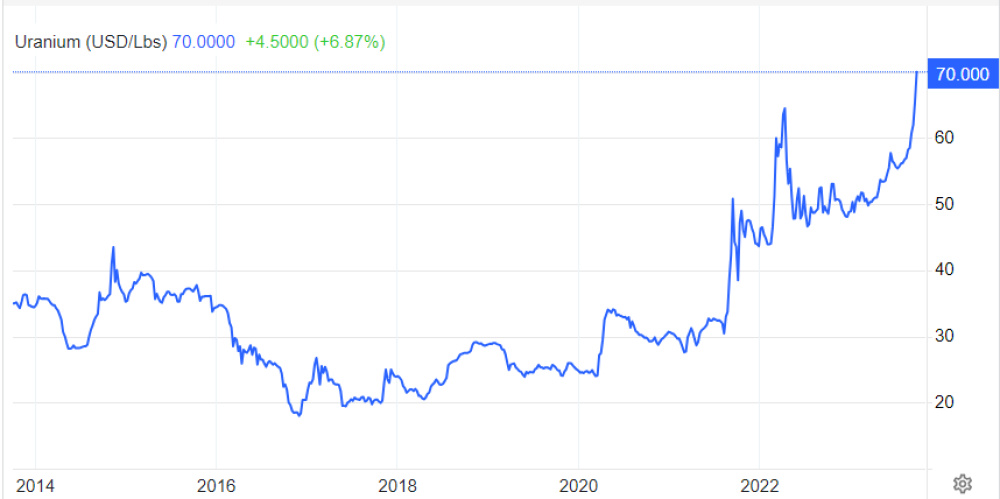
Source: Trading Economics

While primary mine output increases, risks remain regarding achieving targeted production rates. Ongoing supply chain constraints and labor shortages could hinder bringing new capacity online. Even current mine supply faces challenges like coup d’etats, restart delays, and reduced guidance. Analysts emphasize that permitting, technical, and financing risks persist for essential greenfield projects.

With demand climbing and supply challenged, the uranium market will likely stay in a significant deficit for years. Spot prices have already hit 12-year highs of around US$70 per pound. Analysts boosted their long-term outlook to US$75, reflecting inflationary impacts on production costs. They expect an effective Western premium price of US$80 for most miners.

In fact, earlier this month, Katusa Research released a report on uranium, saying, “Today, more nuclear reactors are being built than any year since 1992. All of that has increased demand for uranium, but it’s also accidentally created something much bigger: a source of demand That NEVER EXISTED Before . . . It’s one that’s going to completely change how the uranium market works. The prospect of unquenchable global thirst for uranium has invited speculators into the uranium market.”

These dynamics prompted analysts in the above report to recommend adding leverage by increasing positions in uranium developers and miners.


Important Disclosures:

  1. The article does not constitute investment advice. Each reader is encouraged to consult with his or her individual financial professional. By opening this page, each reader accepts and agrees to Streetwise Reports’ terms of use and full legal disclaimer. This article is not a solicitation for investment. Streetwise Reports does not render general or specific investment advice and the information on Streetwise Reports should not be considered a recommendation to buy or sell any security. Streetwise Reports does not endorse or recommend the business, products, services or securities of any company mentioned on Streetwise Reports.

For additional disclosures, please click here.

Can SPX500_m bears keep up their momentum?

By ForexTime 

  • SPX500_m flirts above weekly resistance ahead of US CPI
  • Bears in control on weekly timeframe
  • Three potential targets identified.
  • Bearish scenario invalidated If 4401.1 price level is broken
  • Will key US inflation report support SPX500_m bulls or bears?

The SPX500_m seems to be in the process of a technical bounce on the daily charts with prices flirting above key weekly resistance ahead of the US CPI report later today. Nevertheless, bears remain in firm control on the weekly charts. Even though the current correction wave is strong – it is approaching a point of possible resistance at the trend line.

On the daily timeframe, prices are at a weekly resistance turned support level and the bullish strength is undeniable with an extended correction wave in the current down trend clearly visible. This leaves the field open for either bullish continuation or a bearish intervention and the possible start of a new impulse wave in the down trend. Since both the weekly and the daily trend is downwards, a more detailed bearish opportunity is discussed on the H4 chart.

The H4 chart reveals more details with a strong bullish trend in progress. As mentioned above the higher time frames as well as the effect on traders based on the CPI news event might cause the bears to take over again.

Attaching a modified Fibonacci tool to a trigger level near a last bottom at 4343.3 and dragging it to a stop loss just above a last proper swing at 4401.1, three possible targets can be established:

  • The first possible target at 4314.3 (Target 1) with risk management in sight.

  • The second potential price target at 4273.9 (Target 2) – located just before weekly support level.

  • The third and last price target is feasible at 4236.3 (Target 3) if bears can break through the weekly support level.

If the price at 4401.1 is broken, this scenario is no longer applicable.


Forex-Time-LogoArticle by ForexTime

ForexTime Ltd (FXTM) is an award winning international online forex broker regulated by CySEC 185/12 www.forextime.com

Oil prices are declining amid growing geopolitical risk in the Middle East. The FOMC minutes were mixed

By JustMarkets

At Wednesday’s close, the Dow Jones Index (US30) added 0.19%, while the S&P 500 Index (US500) was up by 0.43%. The NASDAQ Technology Index (US100) closed positive by 0.71% yesterday.

According to the FOMC minutes released on Wednesday last month, the Federal Reserve leadership considered the outlook for the US economy uncertain and said it would “proceed cautiously” in deciding whether to raise the benchmark interest rate further. Such caution is generally seen as an indication that the Fed is not inclined to raise rates in the near future. Economic data over the past few months have indicated that inflation is slowing, according to the September 19-20 meeting minutes. Policymakers added that more evidence of inflation slowing to the Fed’s 2% target is needed to be confident that inflation will slow to the Fed’s 2% target. Officials generally acknowledged that the risks to Fed policy are increasingly balanced between raising rates too high, which hurts the economy, and not raising them enough to contain inflation.

Late Tuesday, San Francisco Fed spokeswoman Daly said that tighter financial conditions could mean the Fed wouldn’t have to do as much in terms of interest rates. Also on Wednesday, Fed spokesman Waller said that the Fed finally got a very good hold on inflation and can now take an observational stance.

The US PPI for September rose by 0.5% m/m and 2.2% y/y, which was stronger than expectations of 0.2% m/m and 1.6% y/y. In addition, the Food & Energy Price Index rose by 0.3% m/m and 2.7% y/y, stronger than expectations of 0.2% m/m and 2.3% y/y.

Equity markets in Europe traded yesterday without any unified dynamics. German DAX (DE40) increased by 0.24%, French CAC 40 (FR40) declined by 0.44% on Wednesday, Spanish IBEX 35 (ES35) added 0.06%, and British FTSE 100 (UK100) closed negative by 0.11%.

The European currency retreated from its best levels amid dovish comments from ECB Governing Council representative and Bundesbank President Nagel, who said a pause could be an option for the ECB at its next policy meeting later this month.

WTI crude oil and gasoline prices fell sharply on Wednesday amid early signs that the war between Israel and Hamas will have a limited impact on oil flows in the Middle East. In addition, Wednesday’s US producer price index report came in stronger than expected, reinforcing speculation that the Federal Reserve will hold interest rates longer, which could dampen economic growth and energy demand.

Asian markets were predominantly up yesterday. Japan’s Nikkei 225 (JP225) increased by 0.60%, China’s FTSE China A50 (CHA50) gained 0.37%, Hong Kong’s Hang Seng (HK50) added 1.29% and Australia’s ASX 200 (AU200) ended the day positive by 0.68%.

Hong Kong’s Hang Seng Index jumped by 1.8% on Thursday thanks to a 3% rise in banking stocks after China’s state fund Central Huijin Investment increased stakes in four major banks.

Japan’s September machine tool orders fell by 11.2% y/y, the ninth consecutive decline.

S&P 500 (F)(US500) 4,376.95 +18.71 (+0.43%)

Dow Jones (US30) 33,804.87 +65.57 (+0.19%)

DAX (DE40)  15,460.01 +36.49 (+0.24%)

FTSE 100 (UK100) 7,620.03 −8.18 (−0.11%)

USD Index  105.73 −0.10 (−0.09%)

News feed for 2023.10.12:
  • – Japan Producer Price Index (m/m) at 02:50 (GMT+3);
  • – UK GDP (m/m) at 09:00 (GMT+3);
  • – UK Industrial Production (m/m) at 09:00 (GMT+3);
  • – UK Manufacturing Production (m/m) at 09:00 (GMT+3);
  • – UK Trade Balance (m/m) at 09:00 (GMT+3);
  • – Eurozone ECB Monetary Meeting Accounts at 14:30 (GMT+3);
  • – US Consumer Price Index (m/m) at 15:30 (GMT+3);
  • – US Initial Jobless Claims (w/w) at 15:30 (GMT+3);
  • – US Natural Gas Storage (w/w) at 17:30 (GMT+3);
  • – US Crude Oil Reserves (w/w) at 18:00 (GMT+3);
  • – US FOMC Member Bostic Speaks at 20:00 (GMT+3).

By JustMarkets


This article reflects a personal opinion and should not be interpreted as an investment advice, and/or offer, and/or a persistent request for carrying out financial transactions, and/or a guarantee, and/or a forecast of future events.
Why Canada Must Develop Vital Mineral Production

Source: Bob Moriarty  (10/10/23)

Bob Moriarty of 321Gold shares that as conflict rises globally, Canada must develop its rare earth element resources like Defense Metals’ Wicheeda project to secure critical mineral supply chains.

This past weekend’s events in Palestine highlight the rapid evolution of modern warfare. Videos on October 7 showed a US$500 drone controlled by a cell phone dropping a US$50 mortar on a US$10 million tank. This underscores how spending on expensive hardware is pointless when cheap drones are readily available. Tanks are now what outdated battleships were to Pearl Harbor. The real value lies in the technology behind cell phones and drones.

With rising global conflict, securing critical mineral supply chains matters more than concerns over price. By outsourcing most mining and production, the U.S. and Canada made a strategic mistake. China now controls the global market for rare earth elements, vital for electric vehicles, electronics, and defense systems.

I’ve spoken about Defense Metals Corp.’s (DEFN:TSX.V; DFMTF:OTCQB; 35D:FSE) Wicheeda rare earth project in British Columbia. Located near infrastructure, Defense recently increased the project’s resource by 31% to 45 million tonnes of rare earth oxides. Last week, they began advanced geotechnical drilling for an upcoming pre-feasibility study.

Defense plans to produce 20-25 million tonnes of rare earth oxides — potentially 10% of global output. With no current rare earth production in North America, projects like Wicheeda are critical for economic security. Despite discussing assistance for juniors advancing these deposits, the U.S. and Canada must move swiftly from talk to action.

Defense Metals is an advertiser, and I own shares, making me admittedly biased. However, their corporate presentation is excellent reading for any investors interested in the vital rare earths sector. Due diligence is always essential. The global rare earth supply chain is a coming battleground, and Canada must develop projects like Wicheeda to secure its economic future.

The conflict in Ukraine underscores how vital it is to control supply chains for key technological minerals. China currently dominates rare earth production at nearly 90% of global output. By failing to develop its own domestic rare earth projects, Canada leaves itself vulnerable to supply disruptions during times of conflict.

Companies like Defense Metals offer a path to Canadian rare earth production and independence. Its Wicheeda project has major resource expansion potential and advanced infrastructure. With pre-feasibility studies underway, Wicheeda could be operational within a few years to secure domestic rare earth supply.

Projects like Wicheeda are thus strategic national assets that Canada must leverage. The world is entering an era of resource nationalism surrounding minerals like rare earths. By exercising foresight and enabling domestic production, Canada can guarantee its own technological security and prosperity.

The stakes are clear — as geopolitical tensions rise, rare earths and lithium will be 21st-century economic weapons. Vision is required to invest decisively in vital mineral supply chains. The window of opportunity is closing fast. Canada must act now to develop its resource base and avoid potential supply shocks or conflicts.

Overall, the coming rare earth war makes projects like Wicheeda national security priorities. Canada’s economic future depends on establishing domestic rare earth production. The time for talk is over — concrete action is required to guarantee mineral security and technological leadership. Companies like Defense Metals offer a clear pathway forward if Canada has the courage to seize it.

Important Disclosures:

  1. Defense Metals Corp. is a billboard sponsor of Streetwise Reports and pays SWR a monthly sponsorship fee between US$4,000 and US$5,000.
  2. As of the date of this article, officers and/or employees of Streetwise Reports LLC (including members of their household) own securities of Defense Metals Corp.
  3. Bob Moriarty: I, or members of my immediate household or family, own securities of: Defense Metals Corp. My company has a financial relationship with: Defense Metals Corp. I determined which companies would be included in this article based on my research and understanding of the sector.
  4. Statements and opinions expressed are the opinions of the author and not of Streetwise Reports or its officers. The author is wholly responsible for the validity of the statements. The author was not paid by Streetwise Reports for this article. Streetwise Reports was not paid by the author to publish or syndicate this article. Streetwise Reports requires contributing authors to disclose any shareholdings in, or economic relationships with, companies that they write about. Streetwise Reports relies upon the authors to accurately provide this information and Streetwise Reports has no means of verifying its accuracy.
  5.  This article does not constitute investment advice. Each reader is encouraged to consult with his or her individual financial professional. By opening this page, each reader accepts and agrees to Streetwise Reports’ terms of use and full legal disclaimer. This article is not a solicitation for investment. Streetwise Reports does not render general or specific investment advice and the information on Streetwise Reports should not be considered a recommendation to buy or sell any security. Streetwise Reports does not endorse or recommend the business, products, services or securities of any company.

For additional disclosures, please click here.