Archive for Financial News – Page 111

Oil prices are declining due to weakening demand from China. US and European stock indices continue to rise in price

By JustMarkets

On Friday, the Dow Jones (US30) Index gained 0.24% (+2.79% for the week), while the S&P 500 (US500) Index gained 0.20% (+3.78% for the week). The NASDAQ Technology Index (US100) closed positive 0.21% (for the week +4.99%). A busy week of economic data helped the market recover from earlier losses in August. Lower inflation, strong retail sales, and fewer jobless claims helped calm fears of a possible recession. In addition, investor sentiment was boosted by Federal Reserve officials signaling a possible rate cut in September, which supported the week’s momentum.

The US presidential race is heating up as Democrats seek to boost Vice Presidential nominee Kamala Harris during the party’s convention in Chicago, which begins on Monday. During the four-day event, prominent Democratic figures are expected to deliver speeches to bolster Harris’s support. Harris has energized the Democratic base and narrowed the gap with Republican nominee Donald Trump in some opinion polls. As the election race tightens, investors seek clarity on Harris’ policy positions. In particular, Harris has emphasized her commitment to maintaining the independence of the Federal Reserve, which is in stark contrast to Trump’s stance.

Equity markets in Europe mostly rose on Friday. Germany’s DAX (DE40) rose by 0.77% (for the week +3.03%), France’s CAC 40 (FR40) closed up 0.35% (for the week +2.09%), Spain’s IBEX 35 (ES35) added 0.59% (for the week +2.52%), and the UK’s FTSE 100 (UK100) closed down 0.43% (for the week +1.75%).

WTI crude futures fell 1.9% to settle at $76.65 per barrel on Friday following reports that Qatar urged Iran to ease tensions with Israel during ceasefire talks in the Gaza Strip. The drop in oil prices also reflects broader concerns about weakening demand from China, the world’s top oil importer. Recent data on China’s economy show slowing growth, falling housing prices, and rising unemployment, which has prompted Chinese refineries to cut back on oil processing. In addition, the Organization of the Petroleum Exporting Countries (OPEC) and the International Energy Agency (IEA) lowered their estimates for oil demand growth due to China’s weakening economy.

Asian markets were mostly up last week. Japan’s Nikkei 225 (JP225) rose by 7.91%, China’s FTSE China A50 (CHA50) added 1.15%, Hong Kong’s Hang Seng (HK50) gained 1.91% over 5 trading days, and Australia’s ASX 200 (AU200) posted a positive 2.49%.

The Nikkei 225 Index (JP225) fell by 1.77%, and the broader Topix Index lost 1.4% on Monday, ending a five-day run of gains amid profit-taking and a rising yen-pressured domestic equities. A stronger yen hurts the profitability outlook for Japan’s export-oriented industries and discourages investors from borrowing the currency to invest in higher-yielding assets. Markets now await Japanese inflation data on Friday to clarify the Bank of Japan’s (BoJ) monetary policy path.

Thailand’s economy grew by 0.8% in the second quarter of 2024, compared with market estimates of 0.9% after a marginally revised 1.1% growth in the first quarter. The slowdown came amid heightened political uncertainty due to several major court cases in the constitutional court. Private consumption growth slowed sharply (0.3% vs. 1.1% in the first quarter) amid uncertainty over the fate of the $14 billion stimulus plan.

S&P 500 (US500) 5,554.25 +11.03 (+0.20%)

Dow Jones (US30) 40,659.76 +96.70 (+0.24%)

DAX (DE40) 18,322.40 +139.16 (+0.77%)

FTSE 100 (UK100) 8,311.41 −35.94 (−0.43%)

USD Index 102.40 −0.06 (−0.06%)

There are no important events today.


by JustMarkets, 2024.08.19

We advise you to get acquainted with the daily forecasts for the major currency pairs.
By JustMarkets


This article reflects a personal opinion and should not be interpreted as an investment advice, and/or offer, and/or a persistent request for carrying out financial transactions, and/or a guarantee, and/or a forecast of future events.


XAUUSD: Holds near record high…what next?

By ForexTime 

  • Gold ↑ 21% year-to-date
  • FOMC minutes & Jackson Hole in focus
  • Bullish but RSI overbought on multiple timeframes
  • Bloomberg FX model: 73% XAUUSD – (2440.49 – 2567.13)
  • Key technical level – $2500

In case you missed it, gold surged over 2% last Friday to create a fresh all-time high above $2509!

Prices sprinted past the psychological $2500 level after disappointing US economic data boosted bets around faster and deeper cuts by the Fed. With the US dollar and Treasury yields on the back foot, it felt like everyone wanted a shiny piece of the zero-yielding metal.

Gold

Despite the shaky start to the new week, gold bulls remain in a position of power.

However, the Relative Strength Index on the daily, weekly and monthly are signalling that prices are heavily overbought. If the upside momentum loses steam, this could lead to a technical pullback.

Note: A technical pullback is a temporary pause or decline in an asset’s overall bullish trend.

Gold weekly

In our mid-year review, we highlighted how gold’s outlook will be influenced by what actions the Fed takes in the second half of 2024. Much has changed since then with traders currently expecting one 25 bp rate cut by September, another 25 bp cut by November and a potential 50bp cut by December.

With all the above said, this promises to be another eventful week for gold.

Here are 3 factors that could spark volatility:


    1) FOMC minutes + US Jobless claims

The aggressive price action witnessed last Friday shows how gold remains highly sensitive US interest rate expectations.

This could mean more volatility on the horizon, especially with the incoming FOMC minutes and US jobless claims. Last month, Fed Chair Jerome Powell struck a dovish tone and signalled that rate cuts were on the horizon during his press conference. Should the minutes mirror the same message, this could further support rate cut bets.

Regarding the US initial jobless claims report on Thursday, any weakness in the labour forces could reinforce expectations around faster and deeper cuts.

  • Gold prices are likely to push higher if soft US data supports the case for lower rates.
  • Should economic data print higher than expected, this may drag the precious metal lower.


    2) Jackson Hole Symposium

As covered in our week ahead report, Jackson Hole is an annual event packed with central bankers, finance ministers and economists discussing pressing global economic issues. This year it will be held from August 22nd – August 24th.

On Friday 23rd August, Fed Chair Jerome Powell is expected to signal that a September rate cut is on the cards. This could mean fresh volatility for gold due to its sensitivity to US interest rates. Ultimately, the precious metal’s outlook could be influenced by what’s said or not during Powell’s big speech.


    3) Technical forces

Prices are firmly bullish on the daily charts as there have been consistently higher highs and higher lows.  The candlesticks are trading above the 50, 100 and 200-day SMA but the RSI is trading near overbought territory.

  • Should $2500 prove to be reliable support, this may encourage a move towards the next psychological point at $2550.​​​​​​​
  • Sustained weakness below $2500, could open a path toward $2483, $2450 and $2440.  

Gold 2

According to Bloomberg’s FX forecast model, there’s a 73% chance that XAUUSD trades within the 2440.49 – 2567.13 range this week.


Forex-Time-LogoArticle by ForexTime

ForexTime Ltd (FXTM) is an award winning international online forex broker regulated by CySEC 185/12 www.forextime.com

AUD/USD climbs as RBA maintains firm stance on interest rates

By RoboForex Analytical Department 

The Australian dollar (AUD) is witnessing a rise against the US dollar (USD) for the second consecutive day, reaching 0.6629. This upward movement is bolstered by the Reserve Bank of Australia’s (RBA) current policy stance. RBA Governor Michelle Bullock emphasized today that discussions on interest rate cuts are premature despite some easing in inflationary pressures.

Inflation, according to Governor Bullock, remains uncomfortably high, with expectations for it to settle within the target range of 2-3% only towards the end of next year. This viewpoint underpinned the RBA’s decision last week to maintain the official cash rate at 4.35%, marking the sixth consecutive hold. The RBA cites ongoing economic stability and persistent inflation risks as key reasons for their cautious approach.

This stance starkly contrasts with other major central banks, including the Reserve Bank of New Zealand (RBNZ), which have been more open to adjusting rates. However, the RBA’s consistent and factual communication strategy has minimized speculative market reactions, contributing to a more stable forex forecast for the AUD.

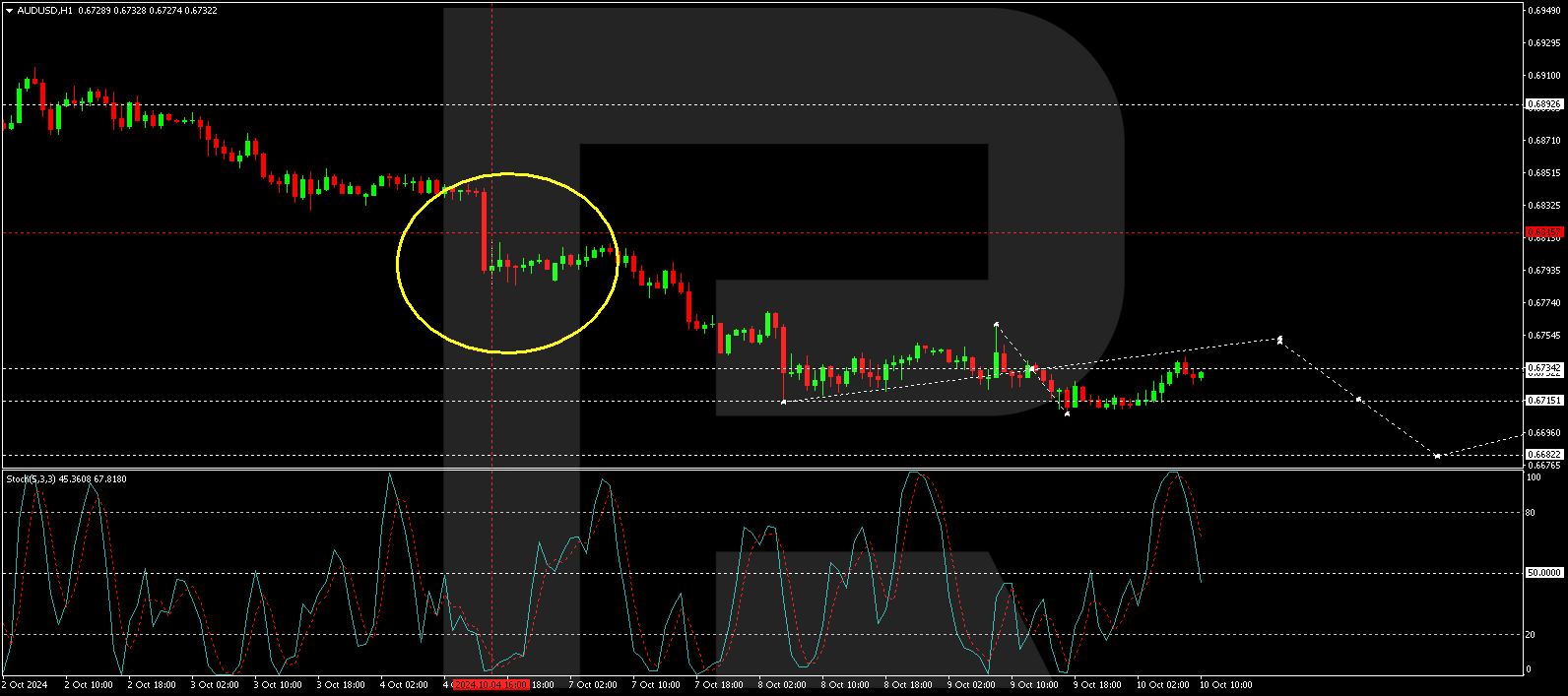
Technical analysis of AUD/USD

The AUD/USD pair has reached a peak at 0.6640 and is now showing signs of consolidating below this level. Should the pair break downwards from this consolidation, a decline to 0.6450 could be anticipated. Following this potential drop, a rebound to 0.6545 for a retest from below might occur before a further descent towards 0.6200. This bearish outlook is supported by the MACD indicator, which shows the signal line retreating from highs and gearing towards a downturn.

On the hourly chart, after a decline to 0.6555, the AUD/USD pair corrected upwards to 0.6628. A consolidation below this level is expected, which could lead to a new downward wave aiming for 0.6540. This bearish prediction aligns with the Stochastic oscillator readings, where the signal line is poised to move from above 80 downwards to 20, indicating potential selling pressure ahead.


Disclaimer

Any forecasts contained herein are based on the author’s particular opinion. This analysis may not be treated as trading advice. RoboForex bears no responsibility for trading results based on trading recommendations and reviews contained herein.

COT Metals Charts: Speculator Bets led by Gold & Platinum

By InvestMacro

Here are the latest charts and statistics for the Commitment of Traders (COT) data published by the Commodities Futures Trading Commission (CFTC).

The latest COT data is updated through Tuesday August 13th and shows a quick view of how large traders (for-profit speculators and commercial entities) were positioned in the futures markets.

Weekly Speculator Changes led by Gold & Platinum

The COT metals markets speculator bets were mixed this week as three out of the six metals markets we cover had higher positioning while the other three markets had lower speculator contracts.

Leading the gains for the metals was Gold (28,515 contracts) with Platinum (1,648 contracts) and Palladium (1,020 contracts) also recording positive weeks.

The markets with declines in speculator bets for the week were Copper (-3,801 contracts), Silver (-3,792 contracts) and with Steel (-23 contracts) also seeing lower bets on the week.


Metals Net Speculators Leaderboard

Legend: Weekly Speculators Change | Speculators Current Net Position | Speculators Strength Score compared to last 3-Years (0-100 range)


Strength Scores led by Gold & Silver

COT Strength Scores (a normalized measure of Speculator positions over a 3-Year range, from 0 to 100 where above 80 is Extreme-Bullish and below 20 is Extreme-Bearish) showed that Gold (92 percent) and Silver (79 percent) lead the metals markets this week. Steel (74 percent) comes in as the next highest in the weekly strength scores.

On the downside, Palladium (12 percent) comes in at the lowest strength level currently and is in Extreme-Bearish territory (below 20 percent). The next lowest strength score was Copper (48 percent).

Strength Statistics:
Gold (92.4 percent) vs Gold previous week (80.1 percent)
Silver (78.6 percent) vs Silver previous week (83.8 percent)
Copper (48.0 percent) vs Copper previous week (51.5 percent)
Platinum (49.9 percent) vs Platinum previous week (45.5 percent)
Palladium (12.3 percent) vs Palladium previous week (4.9 percent)
Steel (73.7 percent) vs Palladium previous week (73.8 percent)


Gold & Steel top the 6-Week Strength Trends

COT Strength Score Trends (or move index, calculates the 6-week changes in strength scores) showed that Gold (11 percent) leads the past six weeks trends for metals and is the only positive mover in the latest trends data this week.

Platinum (-32 percent) and Copper (-31 percent) lead the downside trend scores currently with Silver (-14 percent) as the next market with lower trend scores.

Move Statistics:
Gold (11.0 percent) vs Gold previous week (-3.2 percent)
Silver (-14.3 percent) vs Silver previous week (-9.3 percent)
Copper (-31.1 percent) vs Copper previous week (-28.4 percent)
Platinum (-32.1 percent) vs Platinum previous week (-27.5 percent)
Palladium (-11.2 percent) vs Palladium previous week (-2.5 percent)
Steel (-0.6 percent) vs Steel previous week (0.2 percent)


Individual Markets:

Gold Comex Futures:

Gold Futures COT ChartThe Gold Comex Futures large speculator standing this week equaled a net position of 267,264 contracts in the data reported through Tuesday. This was a weekly rise of 28,515 contracts from the previous week which had a total of 238,749 net contracts.

This week’s current strength score (the trader positioning range over the past three years, measured from 0 to 100) shows the speculators are currently Bullish-Extreme with a score of 92.4 percent. The commercials are Bearish-Extreme with a score of 6.8 percent and the small traders (not shown in chart) are Bullish with a score of 62.0 percent.

Price Trend-Following Model: Strong Uptrend

Our weekly trend-following model classifies the current market price position as: Strong Uptrend. The current action for the model is considered to be: Hold – Maintain Long Position.

Gold Futures StatisticsSPECULATORSCOMMERCIALSSMALL TRADERS
– Percent of Open Interest Longs:65.017.510.0
– Percent of Open Interest Shorts:12.275.35.0
– Net Position:267,264-292,50225,238
– Gross Longs:328,76988,31350,388
– Gross Shorts:61,505380,81525,150
– Long to Short Ratio:5.3 to 10.2 to 12.0 to 1
NET POSITION TREND:
– Strength Index Score (3 Year Range Pct):92.46.862.0
– Strength Index Reading (3 Year Range):Bullish-ExtremeBearish-ExtremeBullish
NET POSITION MOVEMENT INDEX:
– 6-Week Change in Strength Index:11.0-11.27.1


Silver Comex Futures:

Silver Futures COT ChartThe Silver Comex Futures large speculator standing this week equaled a net position of 45,289 contracts in the data reported through Tuesday. This was a weekly lowering of -3,792 contracts from the previous week which had a total of 49,081 net contracts.

This week’s current strength score (the trader positioning range over the past three years, measured from 0 to 100) shows the speculators are currently Bullish with a score of 78.6 percent. The commercials are Bearish with a score of 20.1 percent and the small traders (not shown in chart) are Bullish with a score of 74.7 percent.

Price Trend-Following Model: Weak Uptrend

Our weekly trend-following model classifies the current market price position as: Weak Uptrend. The current action for the model is considered to be: Hold – Maintain Long Position.

Silver Futures StatisticsSPECULATORSCOMMERCIALSSMALL TRADERS
– Percent of Open Interest Longs:41.625.821.6
– Percent of Open Interest Shorts:10.970.97.1
– Net Position:45,289-66,77621,487
– Gross Longs:61,45838,07931,934
– Gross Shorts:16,169104,85510,447
– Long to Short Ratio:3.8 to 10.4 to 13.1 to 1
NET POSITION TREND:
– Strength Index Score (3 Year Range Pct):78.620.174.7
– Strength Index Reading (3 Year Range):BullishBearishBullish
NET POSITION MOVEMENT INDEX:
– 6-Week Change in Strength Index:-14.314.7-12.8


Copper Grade #1 Futures:

Copper Futures COT ChartThe Copper Grade #1 Futures large speculator standing this week equaled a net position of 15,797 contracts in the data reported through Tuesday. This was a weekly fall of -3,801 contracts from the previous week which had a total of 19,598 net contracts.

This week’s current strength score (the trader positioning range over the past three years, measured from 0 to 100) shows the speculators are currently Bearish with a score of 48.0 percent. The commercials are Bearish with a score of 49.4 percent and the small traders (not shown in chart) are Bullish with a score of 69.8 percent.

Price Trend-Following Model: Strong Downtrend

Our weekly trend-following model classifies the current market price position as: Strong Downtrend. The current action for the model is considered to be: Hold – Maintain Short Position.

Copper Futures StatisticsSPECULATORSCOMMERCIALSSMALL TRADERS
– Percent of Open Interest Longs:37.431.79.1
– Percent of Open Interest Shorts:30.642.35.3
– Net Position:15,797-24,4038,606
– Gross Longs:86,01372,86020,861
– Gross Shorts:70,21697,26312,255
– Long to Short Ratio:1.2 to 10.7 to 11.7 to 1
NET POSITION TREND:
– Strength Index Score (3 Year Range Pct):48.049.469.8
– Strength Index Reading (3 Year Range):BearishBearishBullish
NET POSITION MOVEMENT INDEX:
– 6-Week Change in Strength Index:-31.132.5-26.0


Platinum Futures:

Platinum Futures COT ChartThe Platinum Futures large speculator standing this week equaled a net position of 11,939 contracts in the data reported through Tuesday. This was a weekly increase of 1,648 contracts from the previous week which had a total of 10,291 net contracts.

This week’s current strength score (the trader positioning range over the past three years, measured from 0 to 100) shows the speculators are currently Bearish with a score of 49.9 percent. The commercials are Bearish with a score of 42.0 percent and the small traders (not shown in chart) are Bullish with a score of 76.9 percent.

Price Trend-Following Model: Weak Uptrend

Our weekly trend-following model classifies the current market price position as: Weak Uptrend. The current action for the model is considered to be: Hold – Maintain Long Position.

Platinum Futures StatisticsSPECULATORSCOMMERCIALSSMALL TRADERS
– Percent of Open Interest Longs:56.723.012.3
– Percent of Open Interest Shorts:42.145.84.1
– Net Position:11,939-18,6106,671
– Gross Longs:46,28718,76910,015
– Gross Shorts:34,34837,3793,344
– Long to Short Ratio:1.3 to 10.5 to 13.0 to 1
NET POSITION TREND:
– Strength Index Score (3 Year Range Pct):49.942.076.9
– Strength Index Reading (3 Year Range):BearishBearishBullish
NET POSITION MOVEMENT INDEX:
– 6-Week Change in Strength Index:-32.130.411.0


Palladium Futures:

Palladium Futures COT ChartThe Palladium Futures large speculator standing this week equaled a net position of -12,224 contracts in the data reported through Tuesday. This was a weekly gain of 1,020 contracts from the previous week which had a total of -13,244 net contracts.

This week’s current strength score (the trader positioning range over the past three years, measured from 0 to 100) shows the speculators are currently Bearish-Extreme with a score of 12.3 percent. The commercials are Bullish-Extreme with a score of 87.3 percent and the small traders (not shown in chart) are Bullish with a score of 59.9 percent.

Price Trend-Following Model: Downtrend

Our weekly trend-following model classifies the current market price position as: Downtrend. The current action for the model is considered to be: Hold – Maintain Short Position.

Palladium Futures StatisticsSPECULATORSCOMMERCIALSSMALL TRADERS
– Percent of Open Interest Longs:30.248.07.6
– Percent of Open Interest Shorts:71.98.15.7
– Net Position:-12,22411,676548
– Gross Longs:8,84314,0592,216
– Gross Shorts:21,0672,3831,668
– Long to Short Ratio:0.4 to 15.9 to 11.3 to 1
NET POSITION TREND:
– Strength Index Score (3 Year Range Pct):12.387.359.9
– Strength Index Reading (3 Year Range):Bearish-ExtremeBullish-ExtremeBullish
NET POSITION MOVEMENT INDEX:
– 6-Week Change in Strength Index:-11.27.523.2


Steel Futures Futures:

Steel Futures COT ChartThe Steel Futures large speculator standing this week equaled a net position of -5,921 contracts in the data reported through Tuesday. This was a weekly fall of -23 contracts from the previous week which had a total of -5,898 net contracts.

This week’s current strength score (the trader positioning range over the past three years, measured from 0 to 100) shows the speculators are currently Bullish with a score of 73.7 percent. The commercials are Bearish with a score of 27.4 percent and the small traders (not shown in chart) are Bearish with a score of 25.2 percent.

Price Trend-Following Model: Downtrend

Our weekly trend-following model classifies the current market price position as: Downtrend. The current action for the model is considered to be: Hold – Maintain Short Position.

Steel Futures StatisticsSPECULATORSCOMMERCIALSSMALL TRADERS
– Percent of Open Interest Longs:9.979.50.8
– Percent of Open Interest Shorts:37.551.61.2
– Net Position:-5,9215,987-66
– Gross Longs:2,12317,057181
– Gross Shorts:8,04411,070247
– Long to Short Ratio:0.3 to 11.5 to 10.7 to 1
NET POSITION TREND:
– Strength Index Score (3 Year Range Pct):73.727.425.2
– Strength Index Reading (3 Year Range):BullishBearishBearish
NET POSITION MOVEMENT INDEX:
– 6-Week Change in Strength Index:-0.60.46.1


Article By InvestMacroReceive our weekly COT Newsletter

*COT Report: The COT data, released weekly to the public each Friday, is updated through the most recent Tuesday (data is 3 days old) and shows a quick view of how large speculators or non-commercials (for-profit traders) were positioned in the futures markets.

The CFTC categorizes trader positions according to commercial hedgers (traders who use futures contracts for hedging as part of the business), non-commercials (large traders who speculate to realize trading profits) and nonreportable traders (usually small traders/speculators) as well as their open interest (contracts open in the market at time of reporting). See CFTC criteria here.

COT Bonds Charts: Speculator Bets led by SOFR 3-Months & US Treasury Bonds

By InvestMacro

Here are the latest charts and statistics for the Commitment of Traders (COT) reports data published by the Commodities Futures Trading Commission (CFTC).

The latest COT data is updated through Tuesday August 13th and shows a quick view of how large traders (for-profit speculators and commercial hedgers) were positioned in the futures markets.

Weekly Speculator Changes led by SOFR 3-Months & US Treasury Bonds

The COT bond market speculator bets were overall higher this week as five out of the eight bond markets we cover had higher positioning while the other three markets had lower speculator contracts.

Leading the gains for the bond markets was the SOFR 3-Months (77,916 contracts) with the US Treasury Bonds (31,525 contracts), the Ultra Treasury Bonds (27,529 contracts), the Ultra 10-Year Bonds (13,624 contracts) and the the 2-Year Bonds (605 contracts) also having positive weeks.

The bond markets with declines in speculator bets for the week were the 10-Year Bonds (-84,035 contracts), the 5-Year Bonds (-6,996 contracts) and with the Fed Funds (-10,447 contracts) also seeing lower bets on the week.


Bonds Net Speculators Leaderboard

Legend: Weekly Speculators Change | Speculators Current Net Position | Speculators Strength Score compared to last 3-Years (0-100 range)


Strength Scores led by SOFR 3-Months & US Treasury Bonds

COT Strength Scores (a normalized measure of Speculator positions over a 3-Year range, from 0 to 100 where above 80 is Extreme-Bullish and below 20 is Extreme-Bearish) showed that the SOFR 3-Months (83 percent) and the US Treasury Bonds (74 percent) lead the bond markets this week. The Ultra Treasury Bonds (53 percent) comes in as the next highest in the weekly strength scores.

On the downside, the 5-Year Bonds (0 percent) and the 10-Year Bonds (3 percent) come in at the lowest strength level currently and are in Extreme-Bearish territory (below 20 percent). The next lowest strength scores were the 2-Year Bonds (24 percent) and the Ultra 10-Year Bonds (27 percent).

Strength Statistics:
Fed Funds (46.2 percent) vs Fed Funds previous week (48.5 percent)
2-Year Bond (23.8 percent) vs 2-Year Bond previous week (23.7 percent)
5-Year Bond (0.0 percent) vs 5-Year Bond previous week (0.4 percent)
10-Year Bond (2.7 percent) vs 10-Year Bond previous week (10.6 percent)
Ultra 10-Year Bond (26.5 percent) vs Ultra 10-Year Bond previous week (23.7 percent)
US Treasury Bond (74.3 percent) vs US Treasury Bond previous week (63.3 percent)
Ultra US Treasury Bond (53.0 percent) vs Ultra US Treasury Bond previous week (39.4 percent)
SOFR 3-Months (83.3 percent) vs SOFR 3-Months previous week (79.2 percent)


SOFR 3-Months & Ultra Treasury Bonds top the 6-Week Strength Trends

COT Strength Score Trends (or move index, calculates the 6-week changes in strength scores) showed that the SOFR 3-Months (36 percent) and the Ultra Treasury Bonds (22 percent) lead the past six weeks trends for bonds. The Fed Funds (16 percent) are the next highest positive movers in the latest trends data.

The 10-Year Bonds (-48 percent) and the 5-Year Bonds (-9 percent) lead the downside trend scores currently with the US Treasury Bonds (-2 percent) following next with lower trend scores.

Strength Trend Statistics:
Fed Funds (15.5 percent) vs Fed Funds previous week (13.4 percent)
2-Year Bond (7.4 percent) vs 2-Year Bond previous week (10.0 percent)
5-Year Bond (-8.8 percent) vs 5-Year Bond previous week (-11.3 percent)
10-Year Bond (-48.1 percent) vs 10-Year Bond previous week (-42.6 percent)
Ultra 10-Year Bond (0.3 percent) vs Ultra 10-Year Bond previous week (-2.2 percent)
US Treasury Bond (-1.6 percent) vs US Treasury Bond previous week (-2.4 percent)
Ultra US Treasury Bond (21.8 percent) vs Ultra US Treasury Bond previous week (-4.1 percent)
SOFR 3-Months (36.5 percent) vs SOFR 3-Months previous week (29.1 percent)


Secured Overnight Financing Rate (3-Month) Futures:

SOFR 3-Months Bonds Futures COT ChartThe Secured Overnight Financing Rate (3-Month) large speculator standing this week equaled a net position of 445,064 contracts in the data reported through Tuesday. This was a weekly advance of 77,916 contracts from the previous week which had a total of 367,148 net contracts.

This week’s current strength score (the trader positioning range over the past three years, measured from 0 to 100) shows the speculators are currently Bullish-Extreme with a score of 83.3 percent. The commercials are Bearish-Extreme with a score of 16.5 percent and the small traders (not shown in chart) are Bullish-Extreme with a score of 88.7 percent.

Price Trend-Following Model: Weak Uptrend

Our weekly trend-following model classifies the current market price position as: Weak Uptrend. The current action for the model is considered to be: Hold – Maintain Long Position.

SOFR 3-Months StatisticsSPECULATORSCOMMERCIALSSMALL TRADERS
– Percent of Open Interest Longs:17.555.10.4
– Percent of Open Interest Shorts:13.359.20.4
– Net Position:445,064-446,6201,556
– Gross Longs:1,861,2525,869,85440,261
– Gross Shorts:1,416,1886,316,47438,705
– Long to Short Ratio:1.3 to 10.9 to 11.0 to 1
NET POSITION TREND:
– Strength Index Score (3 Year Range Pct):83.316.588.7
– Strength Index Reading (3 Year Range):Bullish-ExtremeBearish-ExtremeBullish-Extreme
NET POSITION MOVEMENT INDEX:
– 6-Week Change in Strength Index:36.5-36.93.3


30-Day Federal Funds Futures:

Federal Funds 30-Day Bonds Futures COT ChartThe 30-Day Federal Funds large speculator standing this week equaled a net position of -91,291 contracts in the data reported through Tuesday. This was a weekly fall of -10,447 contracts from the previous week which had a total of -80,844 net contracts.

This week’s current strength score (the trader positioning range over the past three years, measured from 0 to 100) shows the speculators are currently Bearish with a score of 46.2 percent. The commercials are Bullish with a score of 52.6 percent and the small traders (not shown in chart) are Bullish with a score of 66.2 percent.

Price Trend-Following Model: Downtrend

Our weekly trend-following model classifies the current market price position as: Downtrend. The current action for the model is considered to be: Hold – Maintain Short Position.

30-Day Federal Funds StatisticsSPECULATORSCOMMERCIALSSMALL TRADERS
– Percent of Open Interest Longs:11.272.11.7
– Percent of Open Interest Shorts:16.766.02.3
– Net Position:-91,291101,606-10,315
– Gross Longs:188,0691,208,29128,895
– Gross Shorts:279,3601,106,68539,210
– Long to Short Ratio:0.7 to 11.1 to 10.7 to 1
NET POSITION TREND:
– Strength Index Score (3 Year Range Pct):46.252.666.2
– Strength Index Reading (3 Year Range):BearishBullishBullish
NET POSITION MOVEMENT INDEX:
– 6-Week Change in Strength Index:15.5-12.4-21.9


2-Year Treasury Note Futures:

2-Year Treasury Bonds Futures COT ChartThe 2-Year Treasury Note large speculator standing this week equaled a net position of -1,104,606 contracts in the data reported through Tuesday. This was a weekly gain of 605 contracts from the previous week which had a total of -1,105,211 net contracts.

This week’s current strength score (the trader positioning range over the past three years, measured from 0 to 100) shows the speculators are currently Bearish with a score of 23.8 percent. The commercials are Bullish with a score of 68.2 percent and the small traders (not shown in chart) are Bullish-Extreme with a score of 100.0 percent.

Price Trend-Following Model: Strong Uptrend

Our weekly trend-following model classifies the current market price position as: Strong Uptrend. The current action for the model is considered to be: Hold – Maintain Long Position.

2-Year Treasury Note StatisticsSPECULATORSCOMMERCIALSSMALL TRADERS
– Percent of Open Interest Longs:15.975.96.9
– Percent of Open Interest Shorts:40.755.62.4
– Net Position:-1,104,606901,536203,070
– Gross Longs:708,8923,382,762309,592
– Gross Shorts:1,813,4982,481,226106,522
– Long to Short Ratio:0.4 to 11.4 to 12.9 to 1
NET POSITION TREND:
– Strength Index Score (3 Year Range Pct):23.868.2100.0
– Strength Index Reading (3 Year Range):BearishBullishBullish-Extreme
NET POSITION MOVEMENT INDEX:
– 6-Week Change in Strength Index:7.4-12.918.7


5-Year Treasury Note Futures:

5-Year Treasury Bonds Futures COT ChartThe 5-Year Treasury Note large speculator standing this week equaled a net position of -1,695,072 contracts in the data reported through Tuesday. This was a weekly decrease of -6,996 contracts from the previous week which had a total of -1,688,076 net contracts.

This week’s current strength score (the trader positioning range over the past three years, measured from 0 to 100) shows the speculators are currently Bearish-Extreme with a score of 0.0 percent. The commercials are Bullish-Extreme with a score of 100.0 percent and the small traders (not shown in chart) are Bullish-Extreme with a score of 99.3 percent.

Price Trend-Following Model: Strong Uptrend

Our weekly trend-following model classifies the current market price position as: Strong Uptrend. The current action for the model is considered to be: Hold – Maintain Long Position.

5-Year Treasury Note StatisticsSPECULATORSCOMMERCIALSSMALL TRADERS
– Percent of Open Interest Longs:8.882.67.1
– Percent of Open Interest Shorts:33.761.33.5
– Net Position:-1,695,0721,447,942247,130
– Gross Longs:599,5075,622,352485,484
– Gross Shorts:2,294,5794,174,410238,354
– Long to Short Ratio:0.3 to 11.3 to 12.0 to 1
NET POSITION TREND:
– Strength Index Score (3 Year Range Pct):0.0100.099.3
– Strength Index Reading (3 Year Range):Bearish-ExtremeBullish-ExtremeBullish-Extreme
NET POSITION MOVEMENT INDEX:
– 6-Week Change in Strength Index:-8.83.719.3


10-Year Treasury Note Futures:

10-Year Treasury Notes Bonds Futures COT ChartThe 10-Year Treasury Note large speculator standing this week equaled a net position of -860,243 contracts in the data reported through Tuesday. This was a weekly reduction of -84,035 contracts from the previous week which had a total of -776,208 net contracts.

This week’s current strength score (the trader positioning range over the past three years, measured from 0 to 100) shows the speculators are currently Bearish-Extreme with a score of 2.7 percent. The commercials are Bullish-Extreme with a score of 85.3 percent and the small traders (not shown in chart) are Bullish-Extreme with a score of 100.0 percent.

Price Trend-Following Model: Strong Uptrend

Our weekly trend-following model classifies the current market price position as: Strong Uptrend. The current action for the model is considered to be: Hold – Maintain Long Position.

10-Year Treasury Note StatisticsSPECULATORSCOMMERCIALSSMALL TRADERS
– Percent of Open Interest Longs:9.178.89.6
– Percent of Open Interest Shorts:26.264.56.7
– Net Position:-860,243715,466144,777
– Gross Longs:458,1213,960,745481,134
– Gross Shorts:1,318,3643,245,279336,357
– Long to Short Ratio:0.3 to 11.2 to 11.4 to 1
NET POSITION TREND:
– Strength Index Score (3 Year Range Pct):2.785.3100.0
– Strength Index Reading (3 Year Range):Bearish-ExtremeBullish-ExtremeBullish-Extreme
NET POSITION MOVEMENT INDEX:
– 6-Week Change in Strength Index:-48.155.722.3


Ultra 10-Year Notes Futures:

Ultra 10-Year Treasury Notes Bonds Futures COT ChartThe Ultra 10-Year Notes large speculator standing this week equaled a net position of -150,633 contracts in the data reported through Tuesday. This was a weekly advance of 13,624 contracts from the previous week which had a total of -164,257 net contracts.

This week’s current strength score (the trader positioning range over the past three years, measured from 0 to 100) shows the speculators are currently Bearish with a score of 26.5 percent. The commercials are Bullish with a score of 55.3 percent and the small traders (not shown in chart) are Bullish-Extreme with a score of 92.2 percent.

Price Trend-Following Model: Weak Uptrend

Our weekly trend-following model classifies the current market price position as: Weak Uptrend. The current action for the model is considered to be: Hold – Maintain Long Position.

Ultra 10-Year Notes StatisticsSPECULATORSCOMMERCIALSSMALL TRADERS
– Percent of Open Interest Longs:12.376.310.2
– Percent of Open Interest Shorts:19.267.711.8
– Net Position:-150,633184,945-34,312
– Gross Longs:266,9381,656,652221,951
– Gross Shorts:417,5711,471,707256,263
– Long to Short Ratio:0.6 to 11.1 to 10.9 to 1
NET POSITION TREND:
– Strength Index Score (3 Year Range Pct):26.555.392.2
– Strength Index Reading (3 Year Range):BearishBullishBullish-Extreme
NET POSITION MOVEMENT INDEX:
– 6-Week Change in Strength Index:0.3-2.85.2


US Treasury Bonds Futures:

US Year Treasury Notes Long Bonds Futures COT ChartThe US Treasury Bonds large speculator standing this week equaled a net position of -26,330 contracts in the data reported through Tuesday. This was a weekly rise of 31,525 contracts from the previous week which had a total of -57,855 net contracts.

This week’s current strength score (the trader positioning range over the past three years, measured from 0 to 100) shows the speculators are currently Bullish with a score of 74.3 percent. The commercials are Bearish-Extreme with a score of 1.8 percent and the small traders (not shown in chart) are Bullish-Extreme with a score of 100.0 percent.

Price Trend-Following Model: Strong Uptrend

Our weekly trend-following model classifies the current market price position as: Strong Uptrend. The current action for the model is considered to be: Hold – Maintain Long Position.

US Treasury Bonds StatisticsSPECULATORSCOMMERCIALSSMALL TRADERS
– Percent of Open Interest Longs:20.164.013.5
– Percent of Open Interest Shorts:21.668.37.7
– Net Position:-26,330-73,703100,033
– Gross Longs:347,9971,110,611234,318
– Gross Shorts:374,3271,184,314134,285
– Long to Short Ratio:0.9 to 10.9 to 11.7 to 1
NET POSITION TREND:
– Strength Index Score (3 Year Range Pct):74.31.8100.0
– Strength Index Reading (3 Year Range):BullishBearish-ExtremeBullish-Extreme
NET POSITION MOVEMENT INDEX:
– 6-Week Change in Strength Index:-1.6-14.235.6


Ultra US Treasury Bonds Futures:

Ultra US Year Treasury Notes Long Bonds Futures COT ChartThe Ultra US Treasury Bonds large speculator standing this week equaled a net position of -349,133 contracts in the data reported through Tuesday. This was a weekly gain of 27,529 contracts from the previous week which had a total of -376,662 net contracts.

This week’s current strength score (the trader positioning range over the past three years, measured from 0 to 100) shows the speculators are currently Bullish with a score of 53.0 percent. The commercials are Bearish with a score of 49.0 percent and the small traders (not shown in chart) are Bullish with a score of 53.0 percent.

Price Trend-Following Model: Strong Uptrend

Our weekly trend-following model classifies the current market price position as: Strong Uptrend. The current action for the model is considered to be: Hold – Maintain Long Position.

Ultra US Treasury Bonds StatisticsSPECULATORSCOMMERCIALSSMALL TRADERS
– Percent of Open Interest Longs:9.277.410.7
– Percent of Open Interest Shorts:29.858.68.9
– Net Position:-349,133318,83830,295
– Gross Longs:156,8131,314,725182,390
– Gross Shorts:505,946995,887152,095
– Long to Short Ratio:0.3 to 11.3 to 11.2 to 1
NET POSITION TREND:
– Strength Index Score (3 Year Range Pct):53.049.053.0
– Strength Index Reading (3 Year Range):BullishBearishBullish
NET POSITION MOVEMENT INDEX:
– 6-Week Change in Strength Index:21.8-36.329.5


Article By InvestMacroReceive our weekly COT Newsletter

*COT Report: The COT data, released weekly to the public each Friday, is updated through the most recent Tuesday (data is 3 days old) and shows a quick view of how large speculators or non-commercials (for-profit traders) were positioned in the futures markets.

The CFTC categorizes trader positions according to commercial hedgers (traders who use futures contracts for hedging as part of the business), non-commercials (large traders who speculate to realize trading profits) and nonreportable traders (usually small traders/speculators) as well as their open interest (contracts open in the market at time of reporting). See CFTC criteria here.

COT Soft Commodities Charts: Speculator Bets led by Sugar & Wheat

By InvestMacro

Here are the latest charts and statistics for the Commitment of Traders (COT) reports data published by the Commodities Futures Trading Commission (CFTC).

The latest COT data is updated through Tuesday August 13th and shows a quick view of how large traders (for-profit speculators and commercial entities) were positioned in the futures markets.

Weekly Speculator Changes led by Sugar & Wheat

The COT soft commodities markets speculator bets were lower this week as three out of the eleven softs markets we cover had higher positioning while the other eight markets had lower speculator contracts.

Leading the gains for the softs markets was Sugar (8,747 contracts) with Wheat (1,480 contracts) and Cotton (238 contracts) also having positive weeks.

The markets with the declines in speculator bets this week were Soybean Meal (-33,676 contracts), Live Cattle (-9,035 contracts), Soybeans (-6,595 contracts), Lean Hogs (-4,998 contracts), Corn (-2,036 contracts), Cocoa (-829 contracts), Coffee (-267 contracts) and with Soybean Oil (-197 contracts) also registering lower bets on the week.


Soft Commodities Net Speculators Leaderboard

Legend: Weekly Speculators Change | Speculators Current Net Position | Speculators Strength Score compared to last 3-Years (0-100 range)


Strength Scores led by Coffee

COT Strength Scores (a normalized measure of Speculator positions over a 3-Year range, from 0 to 100 where above 80 is Extreme-Bullish and below 20 is Extreme-Bearish) showed that Coffee (83 percent) leads the softs markets this week and is the only market above 50 percent.

On the downside, Cotton (0 percent), Soybeans (7 percent), Lean Hogs (9 percent), Sugar (13 percent), Soybean Oil (14 percent), Corn (14 percent) and Live Cattle (18.0 percent) come in at the lowest strength levels currently and are in Extreme-Bearish territory (below 20 percent).

Strength Statistics:
Corn (14.3 percent) vs Corn previous week (14.5 percent)
Sugar (12.7 percent) vs Sugar previous week (9.8 percent)
Coffee (83.3 percent) vs Coffee previous week (83.6 percent)
Soybeans (7.4 percent) vs Soybeans previous week (9.0 percent)
Soybean Oil (14.4 percent) vs Soybean Oil previous week (14.5 percent)
Soybean Meal (31.3 percent) vs Soybean Meal previous week (45.1 percent)
Live Cattle (18.0 percent) vs Live Cattle previous week (27.8 percent)
Lean Hogs (8.6 percent) vs Lean Hogs previous week (13.0 percent)
Cotton (0.1 percent) vs Cotton previous week (0.0 percent)
Cocoa (40.8 percent) vs Cocoa previous week (41.7 percent)
Wheat (42.0 percent) vs Wheat previous week (41.0 percent)


Corn & Lean Hogs top the 6-Week Strength Trends

COT Strength Score Trends (or move index, calculates the 6-week changes in strength scores) showed that Corn (10 percent) and Lean Hogs (2 percent) lead the past six weeks trends for soft commodities.

Soybean Meal (-28 percent) leads the downside trend scores currently with Live Cattle (-16 percent), Cotton (-15 percent) and Soybean Oil (-10 percent) following next with lower trend scores.

Strength Trend Statistics:
Corn (9.5 percent) vs Corn previous week (2.3 percent)
Sugar (-10.0 percent) vs Sugar previous week (-3.8 percent)
Coffee (-8.6 percent) vs Coffee previous week (-11.2 percent)
Soybeans (-10.3 percent) vs Soybeans previous week (-11.3 percent)
Soybean Oil (-10.2 percent) vs Soybean Oil previous week (14.5 percent)
Soybean Meal (-27.6 percent) vs Soybean Meal previous week (-19.2 percent)
Live Cattle (-15.5 percent) vs Live Cattle previous week (-3.7 percent)
Lean Hogs (2.2 percent) vs Lean Hogs previous week (4.4 percent)
Cotton (-14.9 percent) vs Cotton previous week (-11.0 percent)
Cocoa (0.1 percent) vs Cocoa previous week (1.8 percent)
Wheat (-0.2 percent) vs Wheat previous week (3.0 percent)


Individual Soft Commodities Markets:

CORN Futures:

CORN Futures COT ChartThe CORN large speculator standing this week resulted in a net position of -154,005 contracts in the data reported through Tuesday. This was a weekly fall of -2,036 contracts from the previous week which had a total of -151,969 net contracts.

This week’s current strength score (the trader positioning range over the past three years, measured from 0 to 100) shows the speculators are currently Bearish-Extreme with a score of 14.3 percent. The commercials are Bullish-Extreme with a score of 86.1 percent and the small traders (not shown in chart) are Bullish with a score of 75.6 percent.

Price Trend-Following Model: Strong Downtrend

Our weekly trend-following model classifies the current market price position as: Strong Downtrend. The current action for the model is considered to be: Hold – Maintain Short Position.

CORN Futures StatisticsSPECULATORSCOMMERCIALSSMALL TRADERS
– Percent of Open Interest Longs:20.843.89.3
– Percent of Open Interest Shorts:30.632.510.8
– Net Position:-154,005178,071-24,066
– Gross Longs:328,996690,965146,234
– Gross Shorts:483,001512,894170,300
– Long to Short Ratio:0.7 to 11.3 to 10.9 to 1
NET POSITION TREND:
– Strength Index Score (3 Year Range Pct):14.386.175.6
– Strength Index Reading (3 Year Range):Bearish-ExtremeBullish-ExtremeBullish
NET POSITION MOVEMENT INDEX:
– 6-Week Change in Strength Index:9.5-7.7-22.6


SUGAR Futures:

SUGAR Futures COT ChartThe SUGAR large speculator standing this week resulted in a net position of 34,562 contracts in the data reported through Tuesday. This was a weekly gain of 8,747 contracts from the previous week which had a total of 25,815 net contracts.

This week’s current strength score (the trader positioning range over the past three years, measured from 0 to 100) shows the speculators are currently Bearish-Extreme with a score of 12.7 percent. The commercials are Bullish-Extreme with a score of 87.5 percent and the small traders (not shown in chart) are Bearish-Extreme with a score of 17.6 percent.

Price Trend-Following Model: Downtrend

Our weekly trend-following model classifies the current market price position as: Downtrend. The current action for the model is considered to be: Hold – Maintain Short Position.

SUGAR Futures StatisticsSPECULATORSCOMMERCIALSSMALL TRADERS
– Percent of Open Interest Longs:23.454.07.5
– Percent of Open Interest Shorts:19.158.17.7
– Net Position:34,562-33,023-1,539
– Gross Longs:188,878436,15060,828
– Gross Shorts:154,316469,17362,367
– Long to Short Ratio:1.2 to 10.9 to 11.0 to 1
NET POSITION TREND:
– Strength Index Score (3 Year Range Pct):12.787.517.6
– Strength Index Reading (3 Year Range):Bearish-ExtremeBullish-ExtremeBearish-Extreme
NET POSITION MOVEMENT INDEX:
– 6-Week Change in Strength Index:-10.012.9-21.3


COFFEE Futures:

COFFEE Futures COT ChartThe COFFEE large speculator standing this week resulted in a net position of 58,940 contracts in the data reported through Tuesday. This was a weekly fall of -267 contracts from the previous week which had a total of 59,207 net contracts.

This week’s current strength score (the trader positioning range over the past three years, measured from 0 to 100) shows the speculators are currently Bullish-Extreme with a score of 83.3 percent. The commercials are Bearish-Extreme with a score of 16.1 percent and the small traders (not shown in chart) are Bullish with a score of 68.0 percent.

Price Trend-Following Model: Strong Uptrend

Our weekly trend-following model classifies the current market price position as: Strong Uptrend. The current action for the model is considered to be: Hold – Maintain Long Position.

COFFEE Futures StatisticsSPECULATORSCOMMERCIALSSMALL TRADERS
– Percent of Open Interest Longs:37.344.04.2
– Percent of Open Interest Shorts:7.175.92.5
– Net Position:58,940-62,2783,338
– Gross Longs:72,86685,8358,160
– Gross Shorts:13,926148,1134,822
– Long to Short Ratio:5.2 to 10.6 to 11.7 to 1
NET POSITION TREND:
– Strength Index Score (3 Year Range Pct):83.316.168.0
– Strength Index Reading (3 Year Range):Bullish-ExtremeBearish-ExtremeBullish
NET POSITION MOVEMENT INDEX:
– 6-Week Change in Strength Index:-8.68.17.5


SOYBEANS Futures:

SOYBEANS Futures COT ChartThe SOYBEANS large speculator standing this week resulted in a net position of -165,723 contracts in the data reported through Tuesday. This was a weekly reduction of -6,595 contracts from the previous week which had a total of -159,128 net contracts.

This week’s current strength score (the trader positioning range over the past three years, measured from 0 to 100) shows the speculators are currently Bearish-Extreme with a score of 7.4 percent. The commercials are Bullish-Extreme with a score of 93.5 percent and the small traders (not shown in chart) are Bullish with a score of 72.1 percent.

Price Trend-Following Model: Strong Downtrend

Our weekly trend-following model classifies the current market price position as: Strong Downtrend. The current action for the model is considered to be: Hold – Maintain Short Position.

SOYBEANS Futures StatisticsSPECULATORSCOMMERCIALSSMALL TRADERS
– Percent of Open Interest Longs:14.660.55.1
– Percent of Open Interest Shorts:35.138.17.0
– Net Position:-165,723181,179-15,456
– Gross Longs:118,322489,82941,443
– Gross Shorts:284,045308,65056,899
– Long to Short Ratio:0.4 to 11.6 to 10.7 to 1
NET POSITION TREND:
– Strength Index Score (3 Year Range Pct):7.493.572.1
– Strength Index Reading (3 Year Range):Bearish-ExtremeBullish-ExtremeBullish
NET POSITION MOVEMENT INDEX:
– 6-Week Change in Strength Index:-10.312.7-20.5


SOYBEAN OIL Futures:

SOYBEAN OIL Futures COT ChartThe SOYBEAN OIL large speculator standing this week resulted in a net position of -49,363 contracts in the data reported through Tuesday. This was a weekly fall of -197 contracts from the previous week which had a total of -49,166 net contracts.

This week’s current strength score (the trader positioning range over the past three years, measured from 0 to 100) shows the speculators are currently Bearish-Extreme with a score of 14.4 percent. The commercials are Bullish-Extreme with a score of 86.3 percent and the small traders (not shown in chart) are Bearish with a score of 21.7 percent.

Price Trend-Following Model: Strong Downtrend

Our weekly trend-following model classifies the current market price position as: Strong Downtrend. The current action for the model is considered to be: Hold – Maintain Short Position.

SOYBEAN OIL Futures StatisticsSPECULATORSCOMMERCIALSSMALL TRADERS
– Percent of Open Interest Longs:21.953.75.1
– Percent of Open Interest Shorts:30.745.34.8
– Net Position:-49,36347,4071,956
– Gross Longs:122,456300,92428,595
– Gross Shorts:171,819253,51726,639
– Long to Short Ratio:0.7 to 11.2 to 11.1 to 1
NET POSITION TREND:
– Strength Index Score (3 Year Range Pct):14.486.321.7
– Strength Index Reading (3 Year Range):Bearish-ExtremeBullish-ExtremeBearish
NET POSITION MOVEMENT INDEX:
– 6-Week Change in Strength Index:-10.210.1-7.3


SOYBEAN MEAL Futures:

SOYBEAN MEAL Futures COT ChartThe SOYBEAN MEAL large speculator standing this week resulted in a net position of 9,415 contracts in the data reported through Tuesday. This was a weekly reduction of -33,676 contracts from the previous week which had a total of 43,091 net contracts.

This week’s current strength score (the trader positioning range over the past three years, measured from 0 to 100) shows the speculators are currently Bearish with a score of 31.3 percent. The commercials are Bullish with a score of 66.7 percent and the small traders (not shown in chart) are Bearish with a score of 37.9 percent.

Price Trend-Following Model: Strong Downtrend

Our weekly trend-following model classifies the current market price position as: Strong Downtrend. The current action for the model is considered to be: New Sell – Short Position.

SOYBEAN MEAL Futures StatisticsSPECULATORSCOMMERCIALSSMALL TRADERS
– Percent of Open Interest Longs:21.046.89.5
– Percent of Open Interest Shorts:19.252.16.0
– Net Position:9,415-27,70618,291
– Gross Longs:110,758246,53849,884
– Gross Shorts:101,343274,24431,593
– Long to Short Ratio:1.1 to 10.9 to 11.6 to 1
NET POSITION TREND:
– Strength Index Score (3 Year Range Pct):31.366.737.9
– Strength Index Reading (3 Year Range):BearishBullishBearish
NET POSITION MOVEMENT INDEX:
– 6-Week Change in Strength Index:-27.626.24.7


LIVE CATTLE Futures:

LIVE CATTLE Futures COT ChartThe LIVE CATTLE large speculator standing this week resulted in a net position of 36,237 contracts in the data reported through Tuesday. This was a weekly lowering of -9,035 contracts from the previous week which had a total of 45,272 net contracts.

This week’s current strength score (the trader positioning range over the past three years, measured from 0 to 100) shows the speculators are currently Bearish-Extreme with a score of 18.0 percent. The commercials are Bullish-Extreme with a score of 93.0 percent and the small traders (not shown in chart) are Bearish with a score of 26.0 percent.

Price Trend-Following Model: Uptrend

Our weekly trend-following model classifies the current market price position as: Uptrend. The current action for the model is considered to be: Hold – Maintain Long Position.

LIVE CATTLE Futures StatisticsSPECULATORSCOMMERCIALSSMALL TRADERS
– Percent of Open Interest Longs:34.835.49.9
– Percent of Open Interest Shorts:22.243.914.1
– Net Position:36,237-24,267-11,970
– Gross Longs:99,758101,33428,459
– Gross Shorts:63,521125,60140,429
– Long to Short Ratio:1.6 to 10.8 to 10.7 to 1
NET POSITION TREND:
– Strength Index Score (3 Year Range Pct):18.093.026.0
– Strength Index Reading (3 Year Range):Bearish-ExtremeBullish-ExtremeBearish
NET POSITION MOVEMENT INDEX:
– 6-Week Change in Strength Index:-15.522.5-21.5


LEAN HOGS Futures:

LEAN HOGS Futures COT ChartThe LEAN HOGS large speculator standing this week resulted in a net position of -26,488 contracts in the data reported through Tuesday. This was a weekly reduction of -4,998 contracts from the previous week which had a total of -21,490 net contracts.

This week’s current strength score (the trader positioning range over the past three years, measured from 0 to 100) shows the speculators are currently Bearish-Extreme with a score of 8.6 percent. The commercials are Bullish-Extreme with a score of 95.0 percent and the small traders (not shown in chart) are Bullish with a score of 69.0 percent.

Price Trend-Following Model: Strong Downtrend

Our weekly trend-following model classifies the current market price position as: Strong Downtrend. The current action for the model is considered to be: New Sell – Short Position.

LEAN HOGS Futures StatisticsSPECULATORSCOMMERCIALSSMALL TRADERS
– Percent of Open Interest Longs:35.039.16.5
– Percent of Open Interest Shorts:46.026.87.8
– Net Position:-26,48829,684-3,196
– Gross Longs:84,57094,47015,656
– Gross Shorts:111,05864,78618,852
– Long to Short Ratio:0.8 to 11.5 to 10.8 to 1
NET POSITION TREND:
– Strength Index Score (3 Year Range Pct):8.695.069.0
– Strength Index Reading (3 Year Range):Bearish-ExtremeBullish-ExtremeBullish
NET POSITION MOVEMENT INDEX:
– 6-Week Change in Strength Index:2.2-1.2-6.2


COTTON Futures:

COTTON Futures COT ChartThe COTTON large speculator standing this week resulted in a net position of -41,670 contracts in the data reported through Tuesday. This was a weekly gain of 238 contracts from the previous week which had a total of -41,908 net contracts.

This week’s current strength score (the trader positioning range over the past three years, measured from 0 to 100) shows the speculators are currently Bearish-Extreme with a score of 0.1 percent. The commercials are Bullish-Extreme with a score of 98.8 percent and the small traders (not shown in chart) are Bearish-Extreme with a score of 12.7 percent.

Price Trend-Following Model: Downtrend

Our weekly trend-following model classifies the current market price position as: Downtrend. The current action for the model is considered to be: Hold – Maintain Short Position.

COTTON Futures StatisticsSPECULATORSCOMMERCIALSSMALL TRADERS
– Percent of Open Interest Longs:26.149.46.2
– Percent of Open Interest Shorts:44.430.86.4
– Net Position:-41,67042,276-606
– Gross Longs:59,448112,56314,072
– Gross Shorts:101,11870,28714,678
– Long to Short Ratio:0.6 to 11.6 to 11.0 to 1
NET POSITION TREND:
– Strength Index Score (3 Year Range Pct):0.198.812.7
– Strength Index Reading (3 Year Range):Bearish-ExtremeBullish-ExtremeBearish-Extreme
NET POSITION MOVEMENT INDEX:
– 6-Week Change in Strength Index:-14.912.512.7


COCOA Futures:

COCOA Futures COT ChartThe COCOA large speculator standing this week resulted in a net position of 30,268 contracts in the data reported through Tuesday. This was a weekly lowering of -829 contracts from the previous week which had a total of 31,097 net contracts.

This week’s current strength score (the trader positioning range over the past three years, measured from 0 to 100) shows the speculators are currently Bearish with a score of 40.8 percent. The commercials are Bullish with a score of 56.2 percent and the small traders (not shown in chart) are Bullish with a score of 58.8 percent.

Price Trend-Following Model: Downtrend

Our weekly trend-following model classifies the current market price position as: Downtrend. The current action for the model is considered to be: Hold – Maintain Short Position.

COCOA Futures StatisticsSPECULATORSCOMMERCIALSSMALL TRADERS
– Percent of Open Interest Longs:37.833.68.2
– Percent of Open Interest Shorts:15.460.14.1
– Net Position:30,268-35,7385,470
– Gross Longs:51,01845,33311,037
– Gross Shorts:20,75081,0715,567
– Long to Short Ratio:2.5 to 10.6 to 12.0 to 1
NET POSITION TREND:
– Strength Index Score (3 Year Range Pct):40.856.258.8
– Strength Index Reading (3 Year Range):BearishBullishBullish
NET POSITION MOVEMENT INDEX:
– 6-Week Change in Strength Index:0.10.9-8.1


WHEAT Futures:

WHEAT Futures COT ChartThe WHEAT large speculator standing this week resulted in a net position of -38,905 contracts in the data reported through Tuesday. This was a weekly increase of 1,480 contracts from the previous week which had a total of -40,385 net contracts.

This week’s current strength score (the trader positioning range over the past three years, measured from 0 to 100) shows the speculators are currently Bearish with a score of 42.0 percent. The commercials are Bullish with a score of 58.1 percent and the small traders (not shown in chart) are Bearish with a score of 39.2 percent.

Price Trend-Following Model: Strong Downtrend

Our weekly trend-following model classifies the current market price position as: Strong Downtrend. The current action for the model is considered to be: Hold – Maintain Short Position.

WHEAT Futures StatisticsSPECULATORSCOMMERCIALSSMALL TRADERS
– Percent of Open Interest Longs:31.236.87.8
– Percent of Open Interest Shorts:40.926.08.9
– Net Position:-38,90543,517-4,612
– Gross Longs:125,365147,93731,254
– Gross Shorts:164,270104,42035,866
– Long to Short Ratio:0.8 to 11.4 to 10.9 to 1
NET POSITION TREND:
– Strength Index Score (3 Year Range Pct):42.058.139.2
– Strength Index Reading (3 Year Range):BearishBullishBearish
NET POSITION MOVEMENT INDEX:
– 6-Week Change in Strength Index:-0.2-0.33.1


Article By InvestMacroReceive our weekly COT Newsletter

*COT Report: The COT data, released weekly to the public each Friday, is updated through the most recent Tuesday (data is 3 days old) and shows a quick view of how large speculators or non-commercials (for-profit traders) were positioned in the futures markets.

The CFTC categorizes trader positions according to commercial hedgers (traders who use futures contracts for hedging as part of the business), non-commercials (large traders who speculate to realize trading profits) and nonreportable traders (usually small traders/speculators) as well as their open interest (contracts open in the market at time of reporting). See CFTC criteria here.

COT Stock Market Charts: Speculator Bets led by VIX

By InvestMacro

Here are the latest charts and statistics for the Commitment of Traders (COT) data published by the Commodities Futures Trading Commission (CFTC).

The latest COT data is updated through Tuesday August 13th and shows a quick view of how large traders (for-profit speculators and commercial entities) were positioned in the futures markets.

Weekly Speculator Changes led by VIX

The COT stock markets speculator bets were lower this week as just two out of the seven stock markets we cover had higher positioning while the other five markets had lower speculator contracts.

Leading the gains for the stock markets was the VIX (23,283 contracts) with the Nikkei 225 (1,652 contracts) also showing a positive week.

The markets with the declines in speculator bets this week were the S&P500-Mini (-57,441 contracts), the MSCI EAFE-Mini (-16,647 contracts), the Russell-Mini (-10,661 contracts), the DowJones-Mini (-6,132 contracts) and with the Nasdaq-Mini (-4,127 contracts) also registering lower bets on the week.


Stock Market Net Speculators Leaderboard

Legend: Weekly Speculators Change | Speculators Current Net Position | Speculators Strength Score compared to last 3-Years (0-100 range)


Strength Scores led by VIX & Nikkei 225

COT Strength Scores (a normalized measure of Speculator positions over a 3-Year range, from 0 to 100 where above 80 is Extreme-Bullish and below 20 is Extreme-Bearish) showed that the VIX (93 percent) and the Nikkei 225 (80 percent) lead the stock markets this week. The Russell-Mini (76 percent) and the DowJones-Mini (62 percent) come in as the next highest in the weekly strength scores.

On the downside, the MSCI EAFE-Mini (27 percent) comes in at the lowest strength level currently.

Strength Statistics:
VIX (93.2 percent) vs VIX previous week (68.0 percent)
S&P500-Mini (61.2 percent) vs S&P500-Mini previous week (69.8 percent)
DowJones-Mini (62.3 percent) vs DowJones-Mini previous week (72.3 percent)
Nasdaq-Mini (52.3 percent) vs Nasdaq-Mini previous week (58.7 percent)
Russell2000-Mini (75.7 percent) vs Russell2000-Mini previous week (83.3 percent)
Nikkei USD (79.5 percent) vs Nikkei USD previous week (65.4 percent)
EAFE-Mini (27.0 percent) vs EAFE-Mini previous week (44.2 percent)


Russell-Mini & Nikkei 225 top the 6-Week Strength Trends

COT Strength Score Trends (or move index, calculates the 6-week changes in strength scores) showed that the Russell-Mini (44 percent) leads the past six weeks trends for the stock markets. The Nikkei 225 (37 percent) and the VIX (36 percent) are the next highest positive movers in the latest trends data.

The MSCI EAFE-Mini (-9 percent) and the DowJones-Mini (-9 percent) lead the downside trend scores currently.

Strength Trend Statistics:
VIX (35.9 percent) vs VIX previous week (18.9 percent)
S&P500-Mini (-1.7 percent) vs S&P500-Mini previous week (14.8 percent)
DowJones-Mini (-8.9 percent) vs DowJones-Mini previous week (12.8 percent)
Nasdaq-Mini (-3.6 percent) vs Nasdaq-Mini previous week (8.1 percent)
Russell2000-Mini (44.1 percent) vs Russell2000-Mini previous week (33.6 percent)
Nikkei USD (36.6 percent) vs Nikkei USD previous week (27.1 percent)
EAFE-Mini (-9.1 percent) vs EAFE-Mini previous week (3.5 percent)


Individual Stock Market Charts:

VIX Volatility Futures:

VIX Volatility Futures COT ChartThe VIX Volatility large speculator standing this week reached a net position of -20,262 contracts in the data reported through Tuesday. This was a weekly lift of 23,283 contracts from the previous week which had a total of -43,545 net contracts.

This week’s current strength score (the trader positioning range over the past three years, measured from 0 to 100) shows the speculators are currently Bullish-Extreme with a score of 93.2 percent. The commercials are Bearish-Extreme with a score of 0.0 percent and the small traders (not shown in chart) are Bullish-Extreme with a score of 100.0 percent.

Price Trend-Following Model: Uptrend

Our weekly trend-following model classifies the current market price position as: Uptrend. The current action for the model is considered to be: Hold – Maintain Long Position.

VIX Volatility Futures StatisticsSPECULATORSCOMMERCIALSSMALL TRADERS
– Percent of Open Interest Longs:23.945.66.7
– Percent of Open Interest Shorts:28.941.06.2
– Net Position:-20,26218,4161,846
– Gross Longs:95,786182,83726,785
– Gross Shorts:116,048164,42124,939
– Long to Short Ratio:0.8 to 11.1 to 11.1 to 1
NET POSITION TREND:
– Strength Index Score (3 Year Range Pct):93.20.0100.0
– Strength Index Reading (3 Year Range):Bullish-ExtremeBearish-ExtremeBullish-Extreme
NET POSITION MOVEMENT INDEX:
– 6-Week Change in Strength Index:35.9-40.919.8


S&P500 Mini Futures:

SP500 Mini Futures COT ChartThe S&P500 Mini large speculator standing this week reached a net position of -23,451 contracts in the data reported through Tuesday. This was a weekly decline of -57,441 contracts from the previous week which had a total of 33,990 net contracts.

This week’s current strength score (the trader positioning range over the past three years, measured from 0 to 100) shows the speculators are currently Bullish with a score of 61.2 percent. The commercials are Bearish with a score of 33.3 percent and the small traders (not shown in chart) are Bullish with a score of 66.7 percent.

Price Trend-Following Model: Strong Uptrend

Our weekly trend-following model classifies the current market price position as: Strong Uptrend. The current action for the model is considered to be: Hold – Maintain Long Position.

S&P500 Mini Futures StatisticsSPECULATORSCOMMERCIALSSMALL TRADERS
– Percent of Open Interest Longs:14.170.912.3
– Percent of Open Interest Shorts:15.273.28.9
– Net Position:-23,451-47,51870,969
– Gross Longs:285,9871,441,253250,900
– Gross Shorts:309,4381,488,771179,931
– Long to Short Ratio:0.9 to 11.0 to 11.4 to 1
NET POSITION TREND:
– Strength Index Score (3 Year Range Pct):61.233.366.7
– Strength Index Reading (3 Year Range):BullishBearishBullish
NET POSITION MOVEMENT INDEX:
– 6-Week Change in Strength Index:-1.77.0-15.7


Dow Jones Mini Futures:

Dow Jones Mini Futures COT ChartThe Dow Jones Mini large speculator standing this week reached a net position of 1,237 contracts in the data reported through Tuesday. This was a weekly reduction of -6,132 contracts from the previous week which had a total of 7,369 net contracts.

This week’s current strength score (the trader positioning range over the past three years, measured from 0 to 100) shows the speculators are currently Bullish with a score of 62.3 percent. The commercials are Bearish with a score of 32.7 percent and the small traders (not shown in chart) are Bullish with a score of 60.7 percent.

Price Trend-Following Model: Strong Uptrend

Our weekly trend-following model classifies the current market price position as: Strong Uptrend. The current action for the model is considered to be: Hold – Maintain Long Position.

Dow Jones Mini Futures StatisticsSPECULATORSCOMMERCIALSSMALL TRADERS
– Percent of Open Interest Longs:22.059.616.5
– Percent of Open Interest Shorts:20.564.213.4
– Net Position:1,237-3,7842,547
– Gross Longs:18,01248,79413,516
– Gross Shorts:16,77552,57810,969
– Long to Short Ratio:1.1 to 10.9 to 11.2 to 1
NET POSITION TREND:
– Strength Index Score (3 Year Range Pct):62.332.760.7
– Strength Index Reading (3 Year Range):BullishBearishBullish
NET POSITION MOVEMENT INDEX:
– 6-Week Change in Strength Index:-8.97.71.0


Nasdaq Mini Futures:

Nasdaq Mini Futures COT ChartThe Nasdaq Mini large speculator standing this week reached a net position of 8,484 contracts in the data reported through Tuesday. This was a weekly decline of -4,127 contracts from the previous week which had a total of 12,611 net contracts.

This week’s current strength score (the trader positioning range over the past three years, measured from 0 to 100) shows the speculators are currently Bullish with a score of 52.3 percent. The commercials are Bearish with a score of 29.2 percent and the small traders (not shown in chart) are Bullish with a score of 78.8 percent.

Price Trend-Following Model: Uptrend

Our weekly trend-following model classifies the current market price position as: Uptrend. The current action for the model is considered to be: Hold – Maintain Long Position.

Nasdaq Mini Futures StatisticsSPECULATORSCOMMERCIALSSMALL TRADERS
– Percent of Open Interest Longs:20.160.916.7
– Percent of Open Interest Shorts:16.669.611.5
– Net Position:8,484-21,22112,737
– Gross Longs:49,051148,52440,833
– Gross Shorts:40,567169,74528,096
– Long to Short Ratio:1.2 to 10.9 to 11.5 to 1
NET POSITION TREND:
– Strength Index Score (3 Year Range Pct):52.329.278.8
– Strength Index Reading (3 Year Range):BullishBearishBullish
NET POSITION MOVEMENT INDEX:
– 6-Week Change in Strength Index:-3.6-0.04.4


Russell 2000 Mini Futures:

Russell 2000 Mini Futures COT ChartThe Russell 2000 Mini large speculator standing this week reached a net position of -13,256 contracts in the data reported through Tuesday. This was a weekly decrease of -10,661 contracts from the previous week which had a total of -2,595 net contracts.

This week’s current strength score (the trader positioning range over the past three years, measured from 0 to 100) shows the speculators are currently Bullish with a score of 75.7 percent. The commercials are Bearish with a score of 23.4 percent and the small traders (not shown in chart) are Bullish with a score of 58.2 percent.

Price Trend-Following Model: Strong Uptrend

Our weekly trend-following model classifies the current market price position as: Strong Uptrend. The current action for the model is considered to be: Hold – Maintain Long Position.

Russell 2000 Mini Futures StatisticsSPECULATORSCOMMERCIALSSMALL TRADERS
– Percent of Open Interest Longs:15.476.37.0
– Percent of Open Interest Shorts:18.575.25.0
– Net Position:-13,2564,5808,676
– Gross Longs:65,225323,85529,794
– Gross Shorts:78,481319,27521,118
– Long to Short Ratio:0.8 to 11.0 to 11.4 to 1
NET POSITION TREND:
– Strength Index Score (3 Year Range Pct):75.723.458.2
– Strength Index Reading (3 Year Range):BullishBearishBullish
NET POSITION MOVEMENT INDEX:
– 6-Week Change in Strength Index:44.1-40.00.7


Nikkei Stock Average (USD) Futures:

Nikkei Stock Average (USD) Futures COT ChartThe Nikkei Stock Average (USD) large speculator standing this week reached a net position of -75 contracts in the data reported through Tuesday. This was a weekly boost of 1,652 contracts from the previous week which had a total of -1,727 net contracts.

This week’s current strength score (the trader positioning range over the past three years, measured from 0 to 100) shows the speculators are currently Bullish with a score of 79.5 percent. The commercials are Bearish with a score of 28.0 percent and the small traders (not shown in chart) are Bearish with a score of 40.3 percent.

Price Trend-Following Model: Weak Downtrend

Our weekly trend-following model classifies the current market price position as: Weak Downtrend. The current action for the model is considered to be: Hold – Maintain Short Position.

Nikkei Stock Average Futures StatisticsSPECULATORSCOMMERCIALSSMALL TRADERS
– Percent of Open Interest Longs:17.960.921.2
– Percent of Open Interest Shorts:18.559.222.3
– Net Position:-75223-148
– Gross Longs:2,4058,1792,846
– Gross Shorts:2,4807,9562,994
– Long to Short Ratio:1.0 to 11.0 to 11.0 to 1
NET POSITION TREND:
– Strength Index Score (3 Year Range Pct):79.528.040.3
– Strength Index Reading (3 Year Range):BullishBearishBearish
NET POSITION MOVEMENT INDEX:
– 6-Week Change in Strength Index:36.6-21.8-22.4


MSCI EAFE Mini Futures:

MSCI EAFE Mini Futures COT ChartThe MSCI EAFE Mini large speculator standing this week reached a net position of -38,102 contracts in the data reported through Tuesday. This was a weekly lowering of -16,647 contracts from the previous week which had a total of -21,455 net contracts.

This week’s current strength score (the trader positioning range over the past three years, measured from 0 to 100) shows the speculators are currently Bearish with a score of 27.0 percent. The commercials are Bullish with a score of 70.0 percent and the small traders (not shown in chart) are Bearish with a score of 45.9 percent.

Price Trend-Following Model: Strong Uptrend

Our weekly trend-following model classifies the current market price position as: Strong Uptrend. The current action for the model is considered to be: New Buy – Long Position.

MSCI EAFE Mini Futures StatisticsSPECULATORSCOMMERCIALSSMALL TRADERS
– Percent of Open Interest Longs:6.390.62.8
– Percent of Open Interest Shorts:15.482.91.5
– Net Position:-38,10232,3015,801
– Gross Longs:26,554379,04211,882
– Gross Shorts:64,656346,7416,081
– Long to Short Ratio:0.4 to 11.1 to 12.0 to 1
NET POSITION TREND:
– Strength Index Score (3 Year Range Pct):27.070.045.9
– Strength Index Reading (3 Year Range):BearishBullishBearish
NET POSITION MOVEMENT INDEX:
– 6-Week Change in Strength Index:-9.18.62.0


Article By InvestMacroReceive our weekly COT Newsletter

*COT Report: The COT data, released weekly to the public each Friday, is updated through the most recent Tuesday (data is 3 days old) and shows a quick view of how large speculators or non-commercials (for-profit traders) were positioned in the futures markets.

The CFTC categorizes trader positions according to commercial hedgers (traders who use futures contracts for hedging as part of the business), non-commercials (large traders who speculate to realize trading profits) and nonreportable traders (usually small traders/speculators) as well as their open interest (contracts open in the market at time of reporting). See CFTC criteria here.

What is mpox? A microbiologist explains what’s known about this smallpox cousin

By Rodney E. Rohde, Texas State University 

On Aug. 14, 2024, the World Health Organization declared mpox a public health emergency of international concern. There have been over 15,600 cases and over 530 deaths reported in the Democratic Republic of the Congo and neighboring countries in Africa. The disease had previously caused a global outbreak from 2022 to 2023.

Mpox – previously called monkeypox – isn’t a new disease. The first confirmed human case was in 1970, when the virus was isolated from a child suspected of having smallpox in the Democratic Republic of Congo (DRC). Though usually mild, mpox can still potentially cause severe illness. Health officials are concerned that more cases will arise with increased travel.

I’m a researcher who has worked in public health and medical laboratories for over three decades, especially in the realm of diseases with animal origins. What exactly is happening in the current outbreak, and what does history tell us about mpox?

A cousin of smallpox

Mpox is caused by the monkeypox virus, which belongs to a subset of the Poxviridae family of viruses called Orthopoxvirus. This subset includes the smallpox, vaccinia and cowpox viruses. While an animal reservoir for monkeypox virus is unknown, African rodents are suspected to play a part in transmission. The monkeypox virus has only been isolated twice from an animal in nature. Diagnostic testing for mpox is currently only available at Laboratory Response Network labs in the U.S. and globally.

The name “monkeypox” comes from the first documented cases of the illness in animals in 1958, when two outbreaks occurred in monkeys kept for research. However, the virus did not jump from monkeys to humans, nor are monkeys major carriers of the disease.

Electron microscope view of monkeypox virus, showing oval-shaped, mature virus particles and spherical, immature virions
The virus that causes mpox belongs to the Poxviridae family of viruses, which includes smallpox.
CDC/ Cynthia S. Goldsmith

Epidemiology

Since the first reported human case, mpox has been found in several other central and western African countries, with the majority of infections in the DRC. Cases outside of Africa have been linked to international travel or imported animals, including in the U.S. and elsewhere.

The first reported cases of mpox in the U.S. was in 2003, from an outbreak in Texas linked to a shipment of animals from Ghana. There were also travel-associated cases in July and November 2021 in Maryland. The outbreak of mpox that began May 2022 is ongoing.

Because mpox is closely related to smallpox, the smallpox vaccine can provide protection against infection from both viruses. Since smallpox was officially eradicated, however, routine smallpox vaccinations for the U.S. general population were stopped in 1972. Because of this, mpox has been appearing increasingly in unvaccinated people.

Transmission

The virus can be transmitted through contact with an infected person or animal or contaminated surfaces. Typically, the virus enters the body through broken skin, inhalation or the mucous membranes in the eyes, nose or mouth. Researchers believe that human-to-human transmission is mostly through inhalation of large respiratory droplets rather than direct contact with bodily fluids or indirect contact through clothes.

Health officials are worried that the virus may currently be spreading undetected through community transmission, possibly through a new mechanism or route. Where and how infections are occurring are still under investigation.

Signs and symptoms

After the virus enters the body, it starts to replicate and spread through the body via the bloodstream. Symptoms usually don’t appear until one to two weeks after infection.

Mpox produces smallpox-like skin lesions, but symptoms are usually milder than those of smallpox. Flu-like symptoms are common initially, ranging from fever and headache to shortness of breath. One to 10 days later, a rash can appear on the extremities, head or torso that eventually turns into blisters filled with pus. Overall, symptoms usually last two to four weeks, while skin lesions usually scab over in 14 to 21 days.

While mpox is rare and usually nonfatal, one version of the disease kills around 10% of infected people. The form of the virus currently circulating is thought to be milder, with a fatality rate of less than 1%.

Vaccines and treatments

Treatment for mpox is primarily focused on relieving symptoms. According to the Centers for Disease Control and Prevention, no treatments are available to cure mpox infection.

Because smallpox is closely related to mpox, the smallpox vaccine can protect against both diseases.

Evidence suggests that the smallpox vaccine can help prevent mpox infections and decrease the severity of the symptoms. One vaccine known as Imvamune or Imvanex is licensed in the U.S. to prevent mpox and smallpox.

Vaccination after exposure to the virus may also help decrease chances of severe illness. The CDC currently recommends smallpox vaccination only in people who have been or are likely to be exposed to mpox. Immunocompromised people are at high risk.

This is an updated version of an article originally published on May 20, 2022.The Conversation

About the Author:

Rodney E. Rohde, Regents’ Professor & Chair, Medical Laboratory Science, Texas State University

This article is republished from The Conversation under a Creative Commons license. Read the original article.

The German DAX Index has risen for 8 consecutive sessions. Malaysia’s GDP shows strong growth

By JustMarkets

On Thursday, the Dow Jones (US30) Index gained 1.61%, while the S&P 500 (US500) Index closed 1.39% higher. The NASDAQ Technology Index (US100) closed yesterday positive 2.34%. Signs of a strengthening US economy are driving stocks higher today after July retail sales posted the largest increase in a year, and weekly initial jobless claims unexpectedly fell to a 5-week low. The strong reports bolstered the projection for a soft economic landing.

The US weekly initial jobless claims unexpectedly fell by 7,000 to a 5-week low of 227,000, indicating a strengthening labor market versus expectations of a rise to 235,000. US retail sales for July rose 1.0% m/m, exceeding expectations of 0.4% m/m and the largest increase in a year and a half. Atlanta Fed President Bostic said he is “open” to an interest rate cut in September. The Fed cannot “afford to be late” in easing monetary policy amid signs of cooling in the labor market. St. Louis Fed President Musalem said that from his perspective, “the risk to both sides of the Fed’s mandate seems more balanced. Accordingly, the time is approaching when an adjustment to the moderately restrictive policy may be appropriate ahead of future meetings.” Markets rate the odds of a 25 bps rate cut at the September 17–18 FOMC meeting at 100% and a -50 bps rate cut at this meeting at 28%.

Walmart (WMT) is up more than 6% after reporting a second-quarter revenue of $169.34 billion, which is better than the consensus estimate of $168.46 billion, and it is raising its net sales prognosis. Cisco Systems (CSCO) rose more than 8%, leading gains in the Dow Jones Industrials and Nasdaq 100 stocks after the company reported fourth-quarter revenue of $13.64 billion, better than the consensus of $13.53 billion, and projection of above-average earnings.

Equity markets in Europe were mostly up on Thursday. Germany’s DAX (DE40) rose by 1.66%, France’s CAC 40 (FR40) closed 1.23% higher, Spain’s IBEX 35 (ES35) added 1.23%, and the UK’s FTSE 100 (UK100) closed up 0.80%.

Germany’s DAX (DE40) Index has risen for 8 consecutive sessions, and it has nearly reversed losses from the global equity sell-off that ended last week. Financial stocks took center stage, with Deutsche Bank and Commerzbank adding between 2.9% and 3.3%. Finally, Mercedes, Porsche, BMW, and Volkswagen continued yesterday’s gains, although Siemens and Airbus were in slightly negative territory. Meanwhile, the UK economy slowed slightly in Q2 and stalled in June, which was in line with prognoses, but business investment unexpectedly contracted.

WTI crude oil prices rose 1.5% to $78.16 a barrel on Thursday, rebounding from two days of losses as recession fears eased. There were also fears of possible Iranian retaliation against Israel following reports that Hamas is unlikely to take part in new ceasefire talks in Gaza. However, gains were halted by lingering demand concerns, with EIA data showing an unexpected rise in US crude inventories, which increased by 1.357 million barrels last week, ending a six-week decline and contrary to expectations of a 2 million barrel drop.

The US natural gas (XNG/USD) prices hit a one-month high of $2.28 per MMBtu in August as declining domestic supply coincided with expectations of strong cooling demand. The latest EIA data showed that US utilities withdrew 6 billion cubic feet of natural gas in the week ended August 9, despite a seasonal upward trend, marking the first August decline since 2006 and contrasting with market expectations of a 43 billion cubic feet increase. Lower production is expected to support prices, making them more sensitive to any supply disruptions or additional warming.

Asian markets also had the advantage of rising yesterday. Japan’s Nikkei 225 (JP225) rose by 0.78%, China’s FTSE China A50 (CHA50) added 1.10% Hong Kong’s Hang Seng (HK50) was down 0.02%, while Australia’s ASX 200 (AU200) was positive 0.19%.

The Bank of Japan (BoJ) will take a more cautious approach to raising interest rates after the recent turmoil in global markets to avoid a rapid appreciation of the yen, BMI said in a recent note. BMI strategists said the Bank of Japan will take a more cautious approach and will only raise rates by 25 bps to 0.50% this year, down from our previous estimate of 50 bps.

Malaysia’s economy grew by 5.9% y/y in Q2 2024, compared to preliminary growth of 5.8% and 4.2% growth in Q1. This was the highest GDP growth since Q4 2022 on the back of strong output across all sectors. Activity in services accelerated (5.9% vs. 4.8% in Q1), helped by wholesale and retail trade. Production in the manufacturing industry also increased (4.7% vs. 1.9%) due to non-metallic minerals, basic metals, and products thereof, as well as petroleum, chemical, rubber, and plastics industries.

S&P 500 (US500) 5,543.23 +88.02 (+1.61%)

Dow Jones (US30) 40,563.58 +555.19 (+1.39%)

DAX (DE40) 18,183.24 +297.64 (+1.66%)

FTSE 100 (UK100) 8,347.35 +66.30 (+0.80%)

USD index 103.00 +0.44 (+0.43%)

Important events for today:
  • – New Zealand Producer Price Index (q/q) at 01:45 (GMT+3);
  • – Australia RBA Gov Bullock Speaks at 02:30 (GMT+3);
  • – New Zealand RBNZ Gov Orr Speaks at 05:30 (GMT+3);
  • – UK Retail Sales (m/m) at 09:00 (GMT+3);
  • – Eurozone Trade Balance (m/m) at 12:00 (GMT+3);
  • – US Building Permits (m/m) at 15:30 (GMT+3);
  • – US Michigan Consumer Sentiment (m/m) at 17:00 (GMT+3).

By JustMarkets


This article reflects a personal opinion and should not be interpreted as an investment advice, and/or offer, and/or a persistent request for carrying out financial transactions, and/or a guarantee, and/or a forecast of future events.
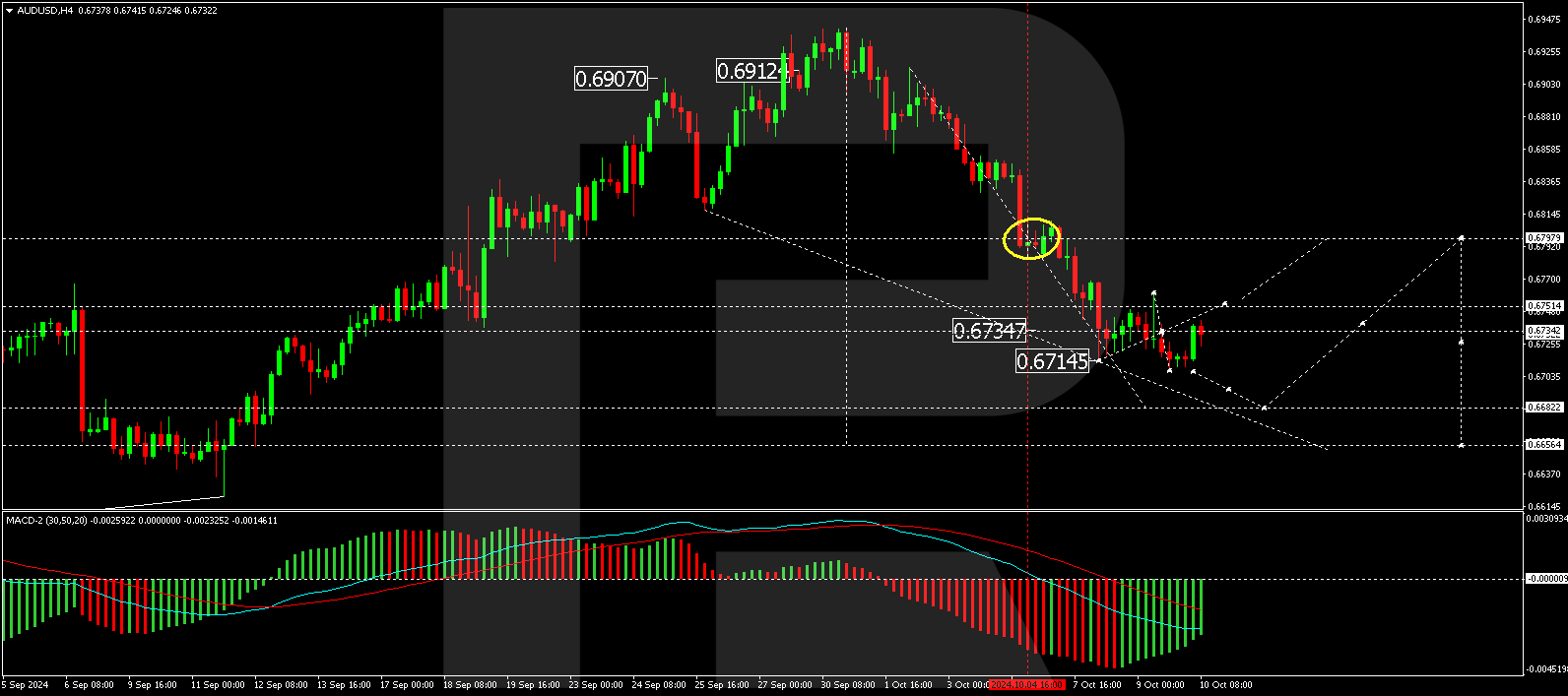
AUD/USD climbs as RBA maintains firm stance on interest rates

By RoboForex Analytical Department

The Australian dollar (AUD) is witnessing a rise against the US dollar (USD) for the second consecutive day, reaching 0.6629. This upward movement is bolstered by the Reserve Bank of Australia’s (RBA) current policy stance. RBA Governor Michelle Bullock emphasized today that discussions on interest rate cuts are premature despite some easing in inflationary pressures.

Inflation, according to Governor Bullock, remains uncomfortably high, with expectations for it to settle within the target range of 2-3% only towards the end of next year. This viewpoint underpinned the RBA’s decision last week to maintain the official cash rate at 4.35%, marking the sixth consecutive hold. The RBA cites ongoing economic stability and persistent inflation risks as key reasons for their cautious approach.

This stance starkly contrasts with other major central banks, including the Reserve Bank of New Zealand (RBNZ), which have been more open to adjusting rates. However, the RBA’s consistent and factual communication strategy has minimized speculative market reactions, contributing to a more stable forex forecast for the AUD.

Technical analysis of AUD/USD

The AUD/USD pair has reached a peak at 0.6640 and is now showing signs of consolidating below this level. Should the pair break downwards from this consolidation, a decline to 0.6450 could be anticipated. Following this potential drop, a rebound to 0.6545 for a retest from below might occur before a further descent towards 0.6200. This bearish outlook is supported by the MACD indicator, which shows the signal line retreating from highs and gearing towards a downturn.

On the hourly chart, after a decline to 0.6555, the AUD/USD pair corrected upwards to 0.6628. A consolidation below this level is expected, which could lead to a new downward wave aiming for 0.6540. This bearish prediction aligns with the Stochastic oscillator readings, where the signal line is poised to move from above 80 downwards to 20, indicating potential selling pressure ahead.


Disclaimer

Any forecasts contained herein are based on the author’s particular opinion. This analysis may not be treated as trading advice. RoboForex bears no responsibility for trading results based on trading recommendations and reviews contained herein.