Archive for Financial News – Page 100

Gold Recovers Amid Mixed US Economic Indicators

By RoboForex Analytical Department 

Gold prices recovered, reaching 2,644.00 USD per troy ounce on Friday, as investors navigated mixed signals from recent US economic data. The resilience in September’s employment market introduced some hesitations regarding the Federal Reserve’s pace of monetary easing, as the robust job data might warrant a less aggressive approach to rate cuts.

Recent inflation reports further complicated the market. While the overall consumer price index slowed, it was less than anticipated, and core inflation, which excludes volatile food and energy prices, actually increased. These developments have hindered progress in easing price pressures, leading to adjustments in expectations for US monetary policy.

Initially, there was speculation of a significant 50-basis-point rate cut; however, given the current economic landscape, a more conservative rate cut of 25 basis points is now deemed more likely at the Fed’s November meeting. This scenario holds an 86% probability, according to market forecasts. For gold, which does not yield coupon income, the prospect of easing by the US Federal Open Market Committee (FOMC) remains a positive catalyst, particularly in a lower interest rate environment where bonds and other interest-bearing assets become less competitive.

Despite the recent uptick, gold is on track to register its second consecutive weekly decline.

Technical analysis of gold (XAU/USD)

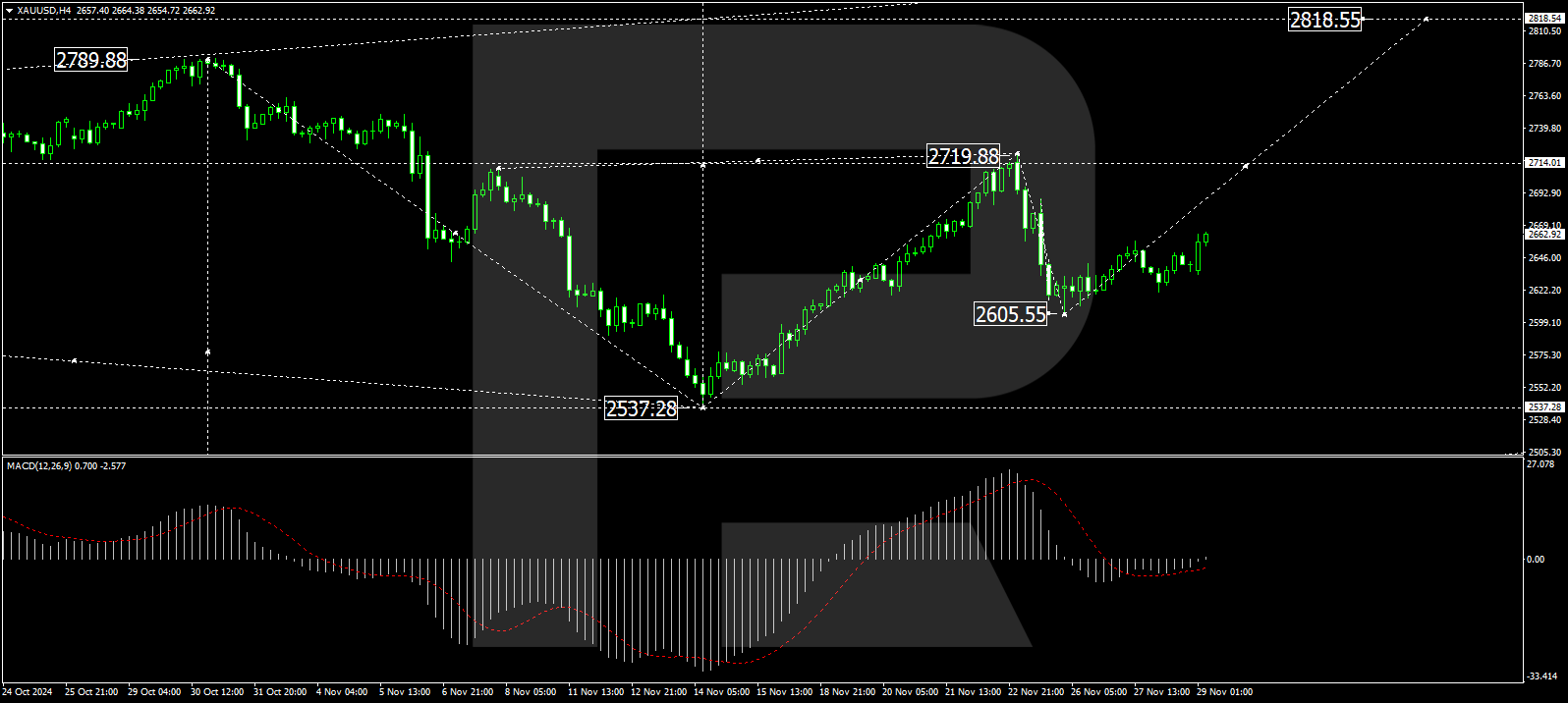
The gold market experienced a correction down to 2,605.00 but has since shown signs of resurgence. The current technical setup suggests a potential continuation towards 2,676.50, which would mark the next target in this upward trend. Following the achievement of this level, a correction back to 2,645.00 may occur. This bullish scenario is supported by the MACD indicator, which, although below zero, is gearing up for a potential rise, indicating strengthening momentum.

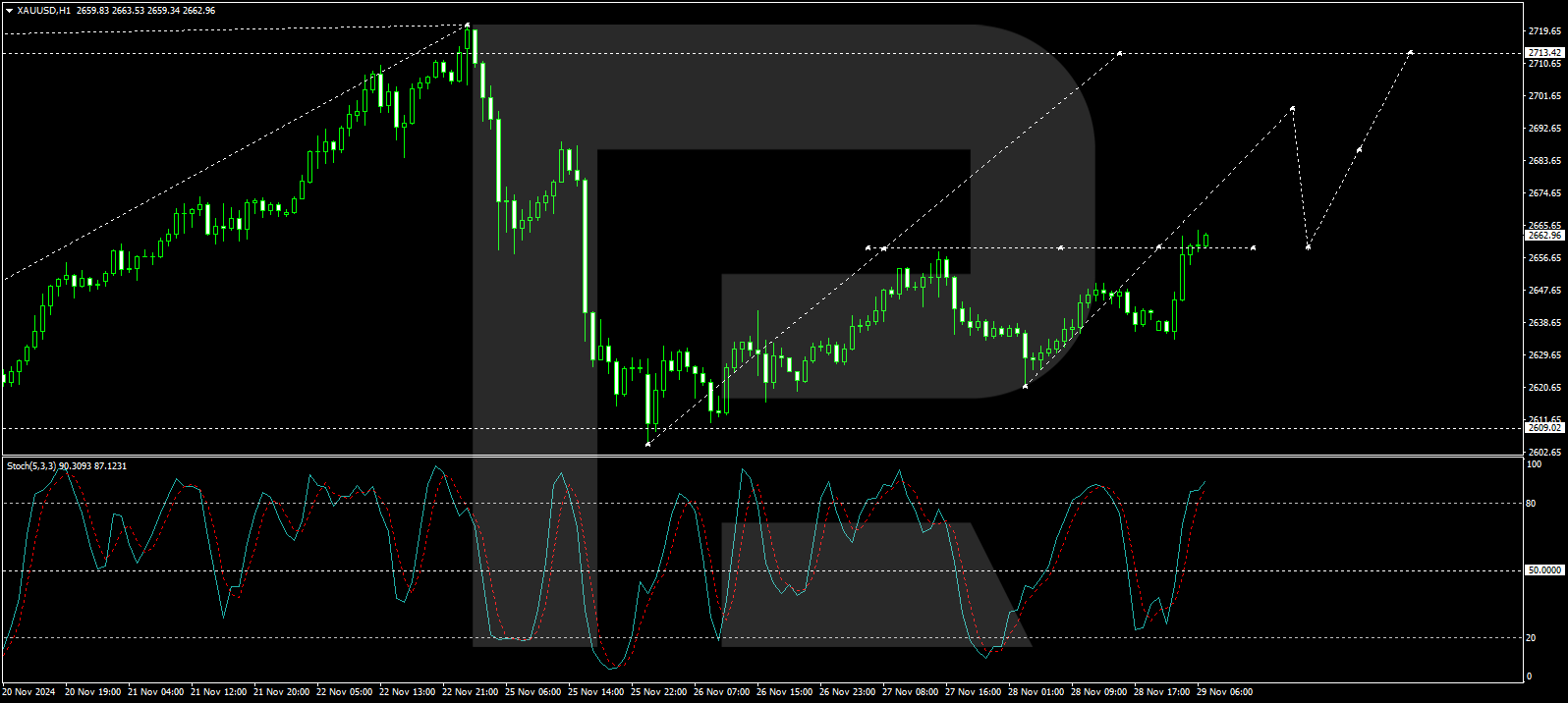
On the hourly chart, gold has formed a consolidation range above 2,605.00 and has broken upwards. It nearly reached the target of 2,644.00. Today, we might see the formation of a narrow consolidation range, and if a downward exit occurs, a corrective move to 2,625.00 could be expected. Following this correction, the market may gear up for another rise towards 2,662.00. This forecast is technically backed by the Stochastic oscillator, with its signal line currently above 80 but poised to start a decline, suggesting a short-term pullback before further gains.


Disclaimer

Any forecasts contained herein are based on the author’s particular opinion. This analysis may not be treated as trading advice. RoboForex bears no responsibility for trading results based on trading recommendations and reviews contained herein.

Hurricane Milton is putting downward pressure on natural gas and upward pressure on oil

By JustMarkets

At Thursday’s close, the Dow Jones Index (US30) was down 0.14%, while the S&P 500 Index (US500) decreased by 0.21%. The NASDAQ Technology Index (US100) closed negative 0.05%. The US stocks closed slightly lower on Thursday following the release of a sharper-than-expected inflation report, adding to uncertainty over the Federal Reserve’s upcoming rate decision in November.

The US inflation eased to 2.4% in September but exceeded average expectations of 2.3%, halting recent progress on disinflation amid rising housing, transportation, and food prices. Nevertheless, bullish assets received support from a surge in jobless claims, which refuted the view that the US labor market remains too resistant to restrictive interest rates following the release of the latest jobs report. Despite the inflation data, Fed officials are divided on whether to keep cutting rates, with some favoring a pause.

The Canadian dollar weakened to 1.37 per US dollar in October, hitting a nine-week low amid declining foreign exchange inflows and a stronger US dollar. Canada’s trade deficit widened to 1.10 billion Canadian dollars in August, the widest since May. This was helped by a 1.0% drop in exports, particularly a 4.1% drop in shipments of crude oil, the country’s main export. In addition, expectations of softening labor market data due out today fueled speculation of further monetary easing by the Bank of Canada.

Equity markets in Europe mostly fell yesterday. Germany’s DAX (DE40) fell by 0.23%, France’s CAC 40 (FR40) closed down 0.24%, Spain’s IBEX 35 (ES35) lost 0.72%, and the UK’s FTSE 100 (UK100) closed negative 0.07%.

In Europe, reports from the ECB’s last monetary policy meeting in September showed that the ECB wanted to keep options open for the next meetings and took a cautious stance on the next move. The Central Bank is expected to cut interest rates by 25 bps next week, the third cut this year.

WTI crude prices rose by 3.5% to $75.8 a barrel on Thursday amid rising demand for fuel in the US after Hurricane Milton hit Florida, concerns about supply disruptions from the Middle East, and expectations of rising energy demand in the US and China. Hurricane Milton knocked out power to more than 3.4 million homes and businesses, and nearly a quarter of gas stations across the state ran out of gasoline. These outages in one of the world’s largest oil-consuming regions contributed to the price spike. In addition, markets remain choppy, especially after Israel’s defense minister vowed that the response to Iran will be “deadly, precise and unexpected.” Additional pressure on prices comes from weak demand estimates, reinforced by China’s recent briefing, which provided few specifics on additional stimulus measures.

The US natural gas (XNG/USD) prices fell to $2.66/MMBtu, extending their decline from a three-month high of $3, as evidence of high supply reinforced weaker demand caused by hurricanes in the southeastern United States. New data from the EIA showed that natural gas inventories in the lower 48 states rose by 82 billion cubic feet in the week ending October 4, the biggest increase since March, and sharply above market expectations of a 71 billion cubic feet increase. Bearish pressure was also driven by the aftermath of Hurricane Milton on Florida’s Gulf Coast, which forced residential power outages and reduced electricity demand from gas-fired generators.

Asian markets were mostly down yesterday. Japan’s Nikkei 225 (JP225) was up 0.26%, China’s FTSE China A50 (CHA50) jumped 2.24%, Hong Kong’s Hang Seng (HK50) added 2.98%, and Australia’s ASX 200 (AU200) posted a modest 0.43% gain. Investors are cautiously awaiting the announcement of further stimulus measures from the Finance Ministry’s press conference on Saturday. Markets anticipate that officials will announce a major fiscal stimulus package, which is expected to amount to 2–3 trillion yuan. On Thursday, China’s Central Bank opened a 500 billion yuan swap facility to fund stock purchases by financial institutions as the recent stimulus rally began to fade.

The Bank of Korea cut its benchmark rate by 25 bps to 3.25% at its October meeting, the first cut since May 2020, in line with market estimates. The move brought borrowing costs to the lowest level in nearly two years, reflecting easing inflation, lower economic output, and efforts to curb household debt caused by mortgages.

S&P 500 (US500) 5,780.05 −11.99 (−0.21%)

Dow Jones (US30) 42,454.12 −57.88 (−0.14%)

DAX (DE40) 19,210.90 −44.03 (−0.23%)

FTSE 100 (UK100) 8,237.73 −6.01 (−0.07%)

USD Index 102.85 −0.08 (−0.07%)

News feed for: 2024.10.11

  • UK GDP (m/m) at 09:00 (GMT+3);
  • UK Industrial Production (m/m) at 09:00 (GMT+3);
  • UK Manufacturing Production (m/m) at 09:00 (GMT+3);
  • UK Trade Balance (m/m) at 09:00 (GMT+3);
  • German Consumer Price Index (m/m) at 09:00 (GMT+3);
  • US Producer Price Index (m/m) at 15:30 (GMT+3);
  • Canada Unemployment Rate (m/m) at 15:30 (GMT+3);
  • US Michigan Consumer Sentiment (m/m) at 17:00 (GMT+3);
  • Canada BoC Business Outlook Survey (m/m) at 17:30 (GMT+3).

By JustMarkets


This article reflects a personal opinion and should not be interpreted as an investment advice, and/or offer, and/or a persistent request for carrying out financial transactions, and/or a guarantee, and/or a forecast of future events.

Investors expect inflationary pressures to ease in the US. The People’s Bank of China launched a mechanism to support the stock market

By JustMarkets

At the end of Wednesday, the Dow Jones Index (US30) rose by 1.03%, while the S&P 500 Index (US500) gained 0.71%. The NASDAQ Technology Index (US100) closed yesterday positive 0.60%. Positive comments from Fed Vice Chairman Jefferson are helping stocks rise as he said the US economy is growing at a “robust pace”. Stocks also rose on speculation that today’s US consumer price report will ease price pressures. Economists expect annualized core inflation, which excludes food and fuel costs, to slow to 3.1% from 3.2%. Overall inflation is forecast at 2.3% y/y, down from 2.5% y/y in the previous month. The easing inflationary pressures and Friday’s strong employment report will convince the US Fed that inflation is on a steady path towards the 2% target. This will increase the likelihood that the US Fed will cut rates by 0.25% at each of its meetings in November and December. A sharper decline in inflationary pressures would be a negative scenario for the US dollar but positive for gold and risk assets (euro, pound, equities).

Minutes from the last FOMC meeting in September showed that Fed policymakers were divided over the size of the rate cut, with some participants favoring a quarter-point cut instead of the mandated 50 bps. Investors currently estimate the probability of a quarter-point rate cut in November at 78%.

Boeing’s (BA) stock price is down more than 3% and tops the list of losers in the S&P 500 (US500) and Dow Jones (US30). After talks to end a nearly month-long labor strike, it failed. Alphabet (GOOGL) shares fell more than 1% after the US Justice Department told a federal judge that it was considering recommending that Google be forced to sell some of its operations to settle an antitrust lawsuit.

Mexico’s core annual inflation rate fell to 3.91% in September, the lowest level since February 2021, down from 4% in August and slightly below forecasts. The annual inflation rate fell for the second consecutive month to 4.58%, the lowest level since March and below market expectations of 4.62%. Weakening price pressures may prompt the Bank of Mexico to consider further interest rate cuts after recent cuts, which would put pressure on the Mexican peso.

Equity markets in Europe mostly went up yesterday. Germany’s DAX (DE40) rose by 0.99%, France’s CAC 40 (FR40) closed up 0.52%, Spain’s IBEX 35 (ES35) added 0.06%, and the UK’s FTSE 100 (UK100) closed positive 0.65%.

ECB Governing Council representative Villeroy de Galhau said yesterday that an ECB interest rate cut next week is very likely and will not be the last. Still, the subsequent pace will depend on developments in the fight against inflation. His colleague, ECB Governing Council spokesman Kazaks, also said interest rates should be cut further because of the weakening Eurozone economy. Swaps discount the odds of a 25 bps ECB rate cut at the October 17 meeting by 94% and a 25 bps rate cut at the December 12 meeting by 100%.

WTI crude oil prices fell to $73.2 a barrel on Wednesday after falling 4.6% the previous day amid weak demand and rising supply. EIA data showed a 5.810 million barrel increase in US crude inventories, which exceeded market expectations by 2 million barrels, while API data totaled nearly 11 million. In addition, the US EIA revised its 2025 demand forecast downward, citing slowing economic growth in China and North America, which put additional pressure on oil prices.

Asian markets were mostly down yesterday. Japan’s Nikkei 225 (JP225) rose by 0.67%, China’s FTSE China A50 (CHA50) fell by 5.79%, Hong Kong’s Hang Seng (HK50) lost 0.91%, and Australia’s ASX 200 (AU200) posted modest gains of 0.17% over yesterday.

Today, the People’s Bank of China (PBOC) launched a RMB500 billion swap facility, allowing eligible financial institutions to use assets as collateral to provide liquidity. The initiative, known as the Swap Fund for Securities, Funds and Insurance Companies (SFISF), is part of the central bank’s efforts to develop a new structural monetary policy tool to support the stock market. This facility allows securities, funds, and insurance companies to obtain liquid assets to purchase equities using their bonds, ETFs, and stocks included in the CSI 300 index as guarantees.

S&P 500 (US500) 5,792.04 +40.91 (+0.71%)

Dow Jones (US30) 42,512.00 +431.63 (+1.03%)

DAX (DE40) 19,254.93 +188.46 (+0.99%)

FTSE 100 (UK100) 8,243.74 +53.13 (+0.65%)

USD index 102.93 −0.39 (−0.38%)

News feed for: 2024.10.10

  • US FOMC Member Daly Speaks at 01:00 (GMT+3);
  • German Retail Sales (m/m) at 09:00 (GMT+3);
  • Eurozone ECB Monetary Meeting Accounts at 14:30 (GMT+3);
  • US Consumer Price Index (m/m) at 15:30 (GMT+3);
  • US Initial Jobless Claims (w/w) at 15:30 (GMT+3);
  • US Natural Gas Storage (w/w) at 17:30 (GMT+3).

By JustMarkets


This article reflects a personal opinion and should not be interpreted as an investment advice, and/or offer, and/or a persistent request for carrying out financial transactions, and/or a guarantee, and/or a forecast of future events.

AUD/USD Stabilises Near Monthly Low Amid Mixed Signals

By RoboForex Analytical Department

The AUD/USD pair has halted its nearly continuous seven-day decline, stabilising around 0.6730 on Thursday. This level marks the monthly low for the Australian dollar, which has faced significant pressures lately due to a strengthening US dollar and uncertainties in China, Australia’s largest trading partner.

Market influences and economic indicators

The recent US jobs report and the Federal Reserve’s latest meeting minutes have led investors to reassess their expectations for future US rate cuts, affecting the currency pair. Additionally, no new stimulus measures have been announced in China, impacting sentiment, given that earlier stimulative actions are still not fully reflected in the economic performance.

In Australia, inflation expectations have decreased to a three-year low of 4% in October, providing a somewhat positive signal. However, the minutes from the Reserve Bank of Australia’s (RBA) latest meeting revealed discussions around both potential rate cuts and hikes, reflecting ongoing uncertainty about the economic outlook. The RBA concluded that the current interest rate appropriately balances the risks associated with inflation and labour market conditions.

AUD/USD technical analysis

The AUD/USD pair recently completed a downward wave to 0.6707 and is now forming a consolidation range above this level. If the pair breaks downwards, it could target a further decline to 0.6682. Conversely, an upward break might lead to a corrective move towards 0.6796. After this correction, the downward trend could continue towards 0.6655. The MACD indicator supports a bearish outlook, with its signal line positioned below zero and trending downwards.

On the hourly chart, the pair is consolidating around 0.6734. An upward breakout could lead to a rise towards 0.6815. Following this, a new downward phase could begin, potentially reaching 0.6710. If this level is breached, the decline could extend towards 0.6682. The Stochastic oscillator, with its signal line below 80 and poised to move downwards, aligns with this potential downward trajectory.

Conclusion

Investors and traders should closely monitor further developments from both the Federal Reserve and the RBA, as well as any new economic data from China, which could significantly influence the direction of the AUD/USD pair. The complex interplay of US monetary policy expectations, Chinese economic actions, and domestic Australian economic indicators will likely continue to drive volatility in the currency pair.


Disclaimer

Any forecasts contained herein are based on the author’s particular opinion. This analysis may not be treated as trading advice. RoboForex bears no responsibility for trading results based on trading recommendations and reviews contained herein.

USDInd: Eyes 100-day SMA ahead of US CPI data

By ForexTime

  • USDInd ↑ 2% in October
  • Traders pricing in 85% prob of Fed cut in November
  • Over past year, US CPI triggered ↑ 0.8% & ↓ 0.6%
  • Technical levels – 100 & 200-day SMA

Dollar bulls continue to dominate the G10 space, crushing all obstacles.

A mixture of geopolitical risk and cooling Fed cut bets continue to support upside gains.

USD

And the dollar could see more volatility this afternoon thanks to the incoming US inflation data.

US inflation is expected to cool further in September, supporting expectations around lower US interest rates. However, last Friday’s strong jobs data has extinguished hopes around another jumbo-sized cut by the Fed.

In fact, traders are now pricing in an 85% probability of a 25-basis point cut by November with a 77% probability of another 25bp cut by December.

wirp

Beyond the CPI report, it will be wise to keep an eye on other US data and speeches by numerous Fed officials which could provide more clues on the Fed’s policy path.

Golden nugget: Over the past 12 months, the US CPI report has triggered upside moves of as much as 0.8% of declines of 0.6% in a 6-hour window post-release.

Taking a look at the charts, the USDInd is firmly bullish on the daily charts with prices hitting a fresh two month high. The index has gained roughly 2% since the start of October, taking its YTD gains to 1.6%.

After shedding almost 5% in Q3, dollars bulls could stage a return this quarter if bets around lower US interest rates continue to fall.

Since securing a solid close above 101.94, bulls have their eyes on the 100-day SMA at 103.30. However, the Relative Strength Index (RSI) is signalling that prices are near overbought territory.

  • A hotter-than-expected US CPI report that dampens Fed cut bets may push the dollar higher. Key levels of interest can be found at 103.30 and the 200-day SMA at 103.80.
  • A cooler than expected US CPI report may move prices back below 101.94.

Dollar Index


Forex-Time-LogoArticle by ForexTime

ForexTime Ltd (FXTM) is an award winning international online forex broker regulated by CySEC 185/12 www.forextime.com


RBNZ cut the rate by 0.5%. RBI kept the rate at 6.5% for the tenth consecutive meeting

By JustMarkets

At Monday’s close, the Dow Jones Index (US30) was up 0.30%, while the S& P500 Index (US500) was up 0.97%. The NASDAQ Technology Index (US100) closed positive 1.45% yesterday. Stocks rose amid upbeat comments from New York Fed Chairman Williams, who said the Fed is “well positioned” to provide a soft landing for the US economy. In addition, today’s news that the US trade deficit narrowed to a 5-month low in August was a positive for US Q3 GDP.

Nvidia (NVDA) jumped by 3% after Hon Hai said it is building the world’s largest Nvidia GB200 AI chip fab. Shares of American Express (AXP) are down more than 1% after BTIG LLC downgraded the stock to “sell” from “neutral” with a $230 price target.

The Canadian dollar weakened to 1.37 per US dollar in October, hitting an eight-week low amid a worsening outlook for foreign inflows and a strengthening US dollar. Canada’s trade deficit widened to CAD1.10 billion in August from a revised CAD0.29 billion in July, exceeding expectations of CAD0.5 billion. This is the widest gap since May, driven by a 1.0% drop in exports and a 3.0% drop in energy shipments, particularly crude oil, Canada’s main export, which fell by 4.1%. Meanwhile, upcoming labor market data is expected to show further weakness in the labor market, raising the stakes for further monetary easing by the Bank of Canada (BoC).

Equity markets in Europe were mostly down yesterday. Germany’s DAX (DE40) fell by 0.20%, France’s CAC 40 (FR40) closed down 0.72%, Spain’s IBEX 35 (ES35) gained 0.15%, and the UK’s FTSE 100 (UK100) closed negative 1.36%.  European stocks fell sharply on Tuesday, pressured by China-related sectors, as markets were stunned by the scope of Beijing’s new fiscal support and investors continued to assess the extent of rate cuts expected by global central banks in near-term decisions.

ECB Executive Board spokesman Elderson said the Eurozone economy is weaker than expected, and “if our projections that inflation will converge to our 2% target in the second half of 2025 are confirmed, the ECB will continue to gradually ease its restrictive policy stance.” Nagel, another representative of the ECB Governing Council and president of the Bundesbank, said he was “willing to consider the possibility” of an ECB interest rate cut at next week’s ECB meeting.

Oil prices fell by 4% yesterday. Expected supply disruptions caused by geopolitical risks in the Middle East have yet to materialize, and investors have shifted their attention back to Chinese demand. China’s National Development and Reform Commission has not announced any new support measures. In the absence of policy intervention, slowing economic growth could reduce Chinese oil demand in the short to medium term.

Asian markets were mostly down yesterday. Japan’s Nikkei 225 (JP225) was down 1.00%, China’s FTSE China A50 (CHA50) was up 4.08%, Hong Kong’s Hang Seng (HK50) decreased by 9.41%, and Australia’s ASX 200 (AU200) was negative 0.35%.

The Hang Seng Index (HK50) fell by 9.4% to finish at 20,927 on Tuesday after rising sharply in the previous two sessions as investors booked profits after the index rose to its highest level since early 2022. Market sentiment deteriorated further on disappointment over a media briefing in China that failed to announce major new economic stimulus measures. The government unveiled a 100 billion yuan investment plan for next year, up from the 1 trillion yuan allocated this year.

The Reserve Bank of India (RBI) kept the benchmark repo rate at 6.5% for the tenth consecutive meeting to ensure inflation falls to its medium-term target of 4%. The latest move came after annual inflation accelerated slightly to 3.65% in August 2024 on rising food prices but remained below the RBI’s target of 4% over five years.

The Reserve Bank of New Zealand (RBNZ) cut the official cash rate (OCR) by 50 basis points to 4.75%, the second consecutive rate cut in line with market expectations. New Zealand’s annual inflation rate in Q2 2024 fell to 3.3% from 4% in the previous quarter and was below market expectations of 3.5%.

S&P 500 (US500) 5,751.13 +55.19 (+0.97%)

Dow Jones (US30) 42,080.37 +126.13 (+0.30%)

DAX (DE40) 19,066.47 −37.63 (−0.20%)

FTSE 100 (UK100) 8,190.61 −113.01 (−1.36%)

USD Index 102.52 −0.01 (−0.01%)

News feed for: 2024.10.09

  • RBNZ Interest Rate Decision at 04:00 (GMT+3);
  • RBNZ Rate Statement at 04:00 (GMT+3);
  • German Trade Balance (m/m) at 09:00 (GMT+3);
  • US FOMC Member Logan Speaks at 16:15 (GMT+3);
  • US FOMC Member Barkin Speaks at 17:30 (GMT+3);
  • US FOMC Member Goolsbee Speaks at 17:30 (GMT+3);
  • US Crude Oil Reserves (w/w) at 17:30 (GMT+3);
  • US FOMC Member Williams Speaks at 18:00 (GMT+3);
  • US FOMC Member Jefferson Speaks at 19:30 (GMT+3);
  • US FOMC Meeting Minutes at 21:00 (GMT+3).

By JustMarkets


This article reflects a personal opinion and should not be interpreted as an investment advice, and/or offer, and/or a persistent request for carrying out financial transactions, and/or a guarantee, and/or a forecast of future events.

NZD/USD Hits Seven-Week Low Amid Ongoing Sell-off and RBNZ Rate Cuts

By RoboForex Analytical Department 

The NZD/USD pair has dropped to a seven-week low, touching 0.6091, as the sell-off that started on 1 October continues to intensify. The New Zealand dollar’s weakness is largely attributed to the Reserve Bank of New Zealand’s (RBNZ) recent decisions to lower interest rates in response to decreasing inflation pressures.

The RBNZ has implemented consecutive rate cuts, most recently reducing the key rate by 50 basis points to 4.75% per annum, following a similar reduction in August. These measures aim to anchor inflation within the target range of 1-3%, with upcoming consumer price data anticipated to potentially show inflation consolidating around 2%, aligning well with the RBNZ’s objectives.

Globally, the focus is on the upcoming publication of the latest US Federal Reserve meeting minutes. These minutes are highly scrutinised as they provide crucial insights into the Fed’s future monetary policy direction. Market participants often use this information to gauge the likelihood of further Fed-rate adjustments, which, in turn, influences global currency dynamics.

Technical analysis of NZD/USD

The NZD/USD market has reached the forecasted target of the downward wave at 0.6080. Currently, a new consolidation phase is expected to form above this level. If there is an upward breakout, a corrective movement towards 0.6230 could occur. Following this correction, the potential for a further decline to 0.5944 may be considered. Alternatively, if the consolidation resolves downwards, the downward trend could continue towards 0.5944. The MACD indicator supports this bearish outlook, with the signal line positioned below zero and trending downwards.

On the hourly chart, after forming a consolidation range around 0.6126, the pair achieved the downward wave target at 0.6080 with a downward exit. An upward movement to 0.6126 is expected today, followed by a retest of 0.6100. The market may develop a new consolidation range at these levels. An upward breakout could initiate a corrective rally towards 0.6230, considered a corrective response to the recent downward trend. The Stochastic oscillator, with its signal line below 20 and pointing upwards, suggests a potential for upward correction.


Disclaimer

Any forecasts contained herein are based on the author’s particular opinion. This analysis may not be treated as trading advice. RoboForex bears no responsibility for trading results based on trading recommendations and reviews contained herein.

Is This Copper Co. Extremely Undervalued?

Source: Clive Maund (10/7/24)

Technical Analyst Clive Maund shares his thoughts on Interra Copper Corp. (Imcx:CSE; Imimf:Otcqb; 3MX:FRA) to explain why he believes it is an Immediate Buy.

Interra Copper Corp. (IMCX:CSE; IMIMF:OTCQB; 3MX:FRA) hasn’t done much since we looked at it in August, and has actually slipped a little lower, but there is big news out of the company this morning that it is thought could positively impact the share price, which is that the company has entered into a purchase agreement for the Stars Copper Project.

The difference that this will make to the company is best summed up by President and CEO of Interra Brian Thurston, who commented, “Acquiring the Stars Property is transformative for Interra. The company changes from a junior exploring to making a discovery to a junior with a discovery that is looking to define a resource. The Stars Property has two complementary exploration upsides, with an established zone of higher-grade mineralization, that Interra can grow and define and a much broader under-explored area with high potential for new discovery.”

So this development is viewed as a big “move to the right” on a chart showing the steps from exploring to being a producer. For this reason alone, the company is viewed as a candidate for revaluation, especially given its currently very low valuation and, more generally, the rapidly improving outlook for the copper price. The transaction contemplated by the Purchase Agreement is expected to close on or before December 15, 2024, and is subject to customary closing conditions and approvals, including Aurwest shareholder approval as it relates to the sale of the Property.

So, if we look at the following slide from the company’s investor deck showing its priorities for 2024, we see that with respect to Item 3, they weren’t just talking about it; they did it.

If we look at the slide showing the priorities for 2025 and compare them with the priorities for this year, we see an important difference, which is that at Thane, there are now 10 large high-priority copper-gold mineralized targets.

Before reviewing the latest stock charts for the company, it is worth reminding ourselves about the company’s two main properties prior to the proposed acquisition of Stars, which are Thane and Rip, whose locations in British Columbia are shown on the following slide

This next slide sets out the attributes of the Thane copper-gold project.

This one sets out the attributes of the Rip property.

Two copper–moly targets have been identified at Rip as a result of an aerial survey undertaken this year, whose most important findings are shown on the following slide.

Since the August article appeared, a new copper zone has been discovered at Thane, which is called the Bananas showing. It, along with the previously known Gail showing, are ranked as the highest priorities, with strong copper-gold mineralized alteration systems in favorable host rocks.

Lastly, we take a look at the capital structure of the company as set out in the latest investor deck, with the most important point to note is that of the 42.6 million shares in issue, an estimated 44% are in the float.

Turning to the charts, we see on the long-term 7-year chart that Interra Copper stock is at the tail end of a seemingly relentless brutal bear market that has, at the current price, erased 99% of its value at its 2020 peak and, according to all normal metrics it is extremely undervalued here.

Yet despite the horrendous decline in the stock price, its Accumulation line has continued to advance, and we can see on the 2-year chart that its rate of climb has been accelerating over the past year.

By itself, this is bullish and indicates clandestine accumulation even as the stock price has fallen, and the longer it goes on, the greater is the chance that a reversal to the upside will occur, and now, with the announcement of the planned acquisition of the Stars Project, we may, at last, have the necessary catalyst to make this happen.

Even though the price is still technically in a downtrend with the price below bearishly aligned moving averages there are other bullish factors to observe on this chart that point to a reversal soon and these include the increasing bunching of price and moving averages such as typically precedes a reversal, the predominance of upside volume in recent months and downside momentum having dropped out as shown by the MACD indicator.

Lastly, the 6-month chart shows recent action in much more detail. In the original article on Interra posted in August, it was not expected to drop any further but it did, although it was not by much, and now it is suspected to be at the second low of a small Double Bottom whose first low was in the middle of last month and whose second low just occurred. It should pick up from here, and it is thought that today’s news will do it.

We, therefore, stay long, and Interra Copper is rated an Immediate Buy.

Interra Copper’s website.

Interra Copper Corp. (IMCX:CSE; IMIMF:OTCQB; 3MX:FRA) closed for trading at CA$0.085, US$0.0677 on October 4, 2024.


Important Disclosures:

  1. Interra Copper Corp. has a consulting relationship with Street Smart an affiliate of Streetwise Reports. Street Smart Clients pay a monthly consulting fee between US$8,000 and US$20,000.
  2. As of the date of this article, officers and/or employees of Streetwise Reports LLC (including members of their household) own securities of Interra Copper Corp.
  3. Clive Maund: I determined which companies would be included in this article based on my research and understanding of the sector.
  4. Statements and opinions expressed are the opinions of the author and not of Streetwise Reports, Street Smart, or their officers. The author is wholly responsible for the accuracy of the statements. Streetwise Reports was not paid by the author to publish or syndicate this article. Streetwise Reports requires contributing authors to disclose any shareholdings in, or economic relationships with, companies that they write about. Any disclosures from the author can be found  below. Streetwise Reports relies upon the authors to accurately provide this information and Streetwise Reports has no means of verifying its accuracy.
  5.  This article does not constitute investment advice and is not a solicitation for any investment. Streetwise Reports does not render general or specific investment advice and the information on Streetwise Reports should not be considered a recommendation to buy or sell any security. Each reader is encouraged to consult with his or her personal financial adviser and perform their own comprehensive investment research. By opening this page, each reader accepts and agrees to Streetwise Reports’ terms of use and full legal disclaimer. Streetwise Reports does not endorse or recommend the business, products, services or securities of any company.

For additional disclosures, please click here.

Clivemaund.com Disclosures

The above represents the opinion and analysis of Mr. Maund, based on data available to him, at the time of writing. Mr. Maund’s opinions are his own, and are not a recommendation or an offer to buy or sell securities. As trading and investing in any financial markets may involve serious risk of loss, Mr. Maund recommends that you consult with a qualified investment advisor, one licensed by appropriate regulatory agencies in your legal jurisdiction, and do your own due diligence and research when making any kind of a transaction with financial ramifications. Although a qualified and experienced stock market analyst, Clive Maund is not a Registered Securities Advisor. Therefore Mr. Maund’s opinions on the market and stocks cannot be construed as a recommendation or solicitation to buy and sell securities.

RBA plans to hold rates until the end of the year. The US stock market is under pressure from rising bond yields.

By JustMarkets

At Monday’s close, the Dow Jones (US30) Index was down 0.94%, while the S&P 500 (US500) Index fell by 0.96%. The NASDAQ Technology Index (US100) closed negative 1.18%. Lower expectations of a Fed rate cut drove bond yields higher and hurt stocks. 10-year T-note yields rose to a 2-month high amid bearish sentiment from last Friday when a stronger-than-expected US September payrolls report eliminated market odds of a 50bp Fed rate cut at next month’s FOMC meeting.

Hawkish comments from Minneapolis Fed President Kashkari on Monday proved bearish for stocks when he said the Fed still has to reduce the size of its balance sheet, but it will not return to Covid-era levels. Markets are awaiting news on US consumer prices on Thursday to see if the downward trend in prices will continue. The consensus expects the Consumer Price Index for September to decline to 2.3% y/y from 2.5% y/y in August. The CPI, excluding food and energy, is expected to be unchanged from August at 3.2% y/y. Markets rate the odds of a 25 bps rate cut at the November 6–7 FOMC meeting at 85% and a 50 bps rate cut at this meeting at 0%.

Amazon.com (AMZN) stock is down more than 3% after Wells Fargo Securities downgraded the stock to equal weight from overweight. Netflix (NFLX) shares closed down more than 2% after Barclays downgraded the stock to underweight from equal weight with a $550 price target.

Equity markets in Europe were mostly up yesterday. Germany’s DAX (DE40) fell by 0.09%, France’s CAC 40 (FR40) closed higher by 0.46%, Spain’s IBEX 35 (ES35) gained 0.50%, and the UK’s FTSE 100 (UK100) closed positive 0.28%.

WTI crude oil prices fell to $75.6 per barrel on Tuesday, likely due to profit-taking after surging to the highest level in more than a month due to escalating conflict in the Middle East. Investors are closely watching Israel’s possible response to last week’s missile strike by Iran, with Iranian oil facilities seen as a possible target. However, President Biden recently urged against striking Iran’s oil fields, suggesting that alternative measures should be considered. In addition, OPEC’s spare capacity and the stability of global crude supplies are easing supply concerns.

Asian markets traded flat last week. Japan’s Nikkei 225 (JP225) rose by 1.80%, China’s FTSE China A50 (CHA50) did not trade last week due to holidays, Hong Kong’s Hang Seng (HK50) rose by 1.60%, and Australia’s ASX 200 (AU200) gained 0.68% over yesterday.

Goldman Sachs raised its outlook on Chinese equities to “overweight,” predicting a 15-20% rise if Beijing follows through on promised policy measures.

Minutes from the Reserve Bank of Australia’s September meeting showed that monetary policy should remain fairly restrictive until bank officials are confident that inflation is moving toward the 2–3% target range. Policymakers also discussed global monetary easing but agreed that domestic money rates should not move in line with other economies, given the country’s stronger inflation and labor market conditions and less tight policy.

S&P 500 (US500) 5,695.94 −55.13 (−0.96%)

Dow Jones (US30) 41,954.24 −398.51 (−0.94%)

DAX (DE40) 19,104.10 −16.83 (−0.09%)

FTSE 100 (UK100) 8,303.62 +22.99 (+0.28%)

USD Index 102.50 −0.02 (−0.02%)

News feed for: 2024.10.08

  • US FOMC Member Bostic Speaks at 01:00 (GMT+3);
  • Australia NAB Business Confidence (m/m) at 03:30 (GMT+3);
  • Australia RBA Monetary Policy Meeting Minutes at 03:30 (GMT+3);
  • Sweden Consumer Price Index (m/m) at 09:00 (GMT+3);
  • German Industrial Production (m/m) at 09:00 (GMT+3);
  • Canada Trade Balance (m/m) at 15:30 (GMT+3);
  • US Trade Balance (m/m) at 15:30 (GMT+3);
  • US FOMC Member Bostic Speaks at 19:45 (GMT+3);
  • US FOMC Member Collins Speaks at 23:00 (GMT+3).

By JustMarkets


This article reflects a personal opinion and should not be interpreted as an investment advice, and/or offer, and/or a persistent request for carrying out financial transactions, and/or a guarantee, and/or a forecast of future events.

Oil rises amid escalating conflict in the Middle East. Inflationary pressures are easing in Vietnam

By JustMarkets 

On Friday, the Dow Jones (US30) Index gained 0.81% (for the week +0.15%), while the S&P 500 (US500) Index gained 0.90% (for the week +0.43%). The NASDAQ Technology Index (US100) closed positive 1.22% (for the week +0.38%). Stocks rose on Friday as a stronger-than-expected US September Payrolls report bolstered prospects for a soft landing. However, the prospect of escalating conflict in the Middle East is dampening investor appetite for risk assets and is a negative for equities. Markets are awaiting Israel’s response to Tuesday’s rocket attack on Iran after Israeli Prime Minister Netanyahu vowed to retaliate, saying Iran “made a big mistake” and will “pay.”

The US Nonfarm Payrolls for September rose by 254,000, indicating a stronger labor market than expected 150,000 and the largest increase in 6 months. The unemployment rate for September unexpectedly fell by 0.1 to 4.1%, showing a stronger labor market than expectations of no change at 4.2%. Average hourly earnings for September rose by 0.4% m/m and 4.0% y/y, stronger than expectations of 0.3% m/m and 3.8% y/y. Markets discount the odds of a 25bp rate cut at the November 6–7 FOMC meeting to 100% and a 50bp rate cut at this meeting to 6%.

Equity markets in Europe rallied strongly on Friday, but all major indices closed negative at the end of the week. The German DAX (DE40) rose 0.55% (for the week -1.50%), the French CAC 40 (FR40) closed higher by 0.85% (for the week -2.67%), the Spanish IBEX 35 (ES35) gained 0.35% (for the week -2.26%), the British FTSE 100 (UK100) closed down 0.02% (for the week -0.48%).

French Industrial Production rose 1.4% m/m in August, beating expectations of 0.3% m/m and the largest increase in 15 months. ECB Governing Council spokesman Centeno said on Friday that Eurozone labor market dynamics had cooled slightly, and inflation is very close to 2%, hinting at further rate cuts by the ECB. Swaps discount the odds of a 25bp ECB rate cut at the October 17 meeting to 90%.

WTI crude oil prices rose by 0.9% to close at $74.4 per barrel on Friday, the highest level in five weeks, amid concerns over possible supply disruptions in the Middle East. Concerns intensified after Biden refrained from directly condemning a potential Israeli strike on Iran’s oil facilities. Tel Aviv vowed this week to retaliate against Iran while ramping up operations in Beirut amid the ongoing conflict with Hezbollah. Meanwhile, OPEC’s spare production capacity and stability in global oil supplies eased supply concerns.

Asian markets traded flat last week. Japan’s Nikkei 225 (JP225) was down 1.23%, China’s FTSE China A50 (CHA50) did not trade last week due to holidays, Hong Kong’s Hang Seng (HK50) was up 11.20%, and Australia’s ASX 200 (AU200) was negative 0.76%.

Vietnam’s annual inflation rate fell to 2.63% y/y in September 2024 from 3.45% y/y in August, the lowest since July 2023 after a super typhoon hit the country earlier this month. Prices fell in several categories, including housing. Annual core inflation, which excludes volatile items, remained relatively stable (2.54% vs. 2.53%), close to the lowest level since August 2022. Vietnam’s GDP growth hit a 2-year high in the third quarter. Vietnam’s GDP grew 7.40% year-on-year in Q3 2024, accelerating from an upwardly revised 7.09% growth in Q2, the sharpest increase since Q3 2022.

Australia’s trade surplus in goods in August 2024 was A$5.64 billion. This was the largest trade surplus since April despite a small decline in both exports and imports.

Japan’s Index of leading economic indicators, which is used to gauge the economic outlook several months ahead on data such as job offers and consumer sentiment, fell to 106.7 in August 2024 from a final reading of 109.3 in the previous month, falling short of market estimates of 107.4.

S&P 500 (US500) 5,751.07 +51.13 (+0.90%)

Dow Jones (US30) 42,352.75 +341.16 (+0.81%)

DAX (DE40) 19,120.93 +105.52 (+0.55%)

FTSE 100 (UK100) 8,280.63 −1.89 (−0.02%)

USD Index 102.58 +0.06 (+0.06%)

News feed for: 2024.10.07

  • Eurozone Retail Sales (m/m) at 12:00 (GMT+3);
  • US FOMC Member Bowman Speaks at 20:00 (GMT+3);
  • US FOMC Member Kashkari Speaks at 20:50 (GMT+3).

By JustMarkets


This article reflects a personal opinion and should not be interpreted as an investment advice, and/or offer, and/or a persistent request for carrying out financial transactions, and/or a guarantee, and/or a forecast of future events.