Archive for Energy – Page 22

Crude Oil: 23 Years of Spot-on Forecasts You Can Fact-Check

For commodities like crude oil, supply and demand factors aren’t everything

By Elliott Wave International

Everyone who drives a car is relieved that gas prices have dropped from what they were a little while back.

However, if one major Wall Street firm is correct, get ready for higher prices at the pump again. This is a Nov. 1 headline from Markets Insider:

Tightening oil supply will drive crude oil prices to $115 a barrel by April, Goldman Sachs strategist says

Of course, higher crude oil prices mean higher gas prices and vice versa.

But does a “tightening oil supply” mean higher crude oil prices? Well, that’s certainly conventional wisdom, but as Elliott Wave International has observed over the decades, you cannot count on conventional wisdom.

Indeed, Chapter 22 of Robert Prechter’s landmark book, The Socionomic Theory of Finance, asks:

Do Supply and Demand Regulate Oil Prices?

He goes on to answer that question by saying:

The correct answer is … no, they don’t. In this chapter, I support my conclusion and demonstrate its value.

In a nutshell, Elliott waves regulate the trend of oil prices and the successful calls Elliott Wave International analysts have made over the years offer strong evidence for this.

Keep in mind that as you look at this chart from the book, it took Robert Prechter 43 pages to go into the details of how Elliott wave analysis called every major price turn in crude from 1993 into 2016:

Indeed, the very title of the chart says it all:

Elliott Wave Analysis Forecasted And / Or Recognized In Real Time All Of These Waves And Their Turning Points

Keep in mind that no method of analysis offers guarantees, yet — looking at what’s going on now — the October Global Market Perspective, a monthly Elliott Wave International publication which covers 50-plus worldwide financial markets, noted:

Crude extended its string of lower lows and lower highs in September as anticipated.

The October Global Market Perspective goes on to provide a forecast for crude oil.

Looping back to that crude oil price target by the major Wall Street firm, that price may at some point be hit. The point is that it’s best to consult the Elliott wave model rather than basing a crude oil prediction on supply and demand.

If you’d like to learn about Elliott wave analysis, or need a refresher, an excellent resource is Frost & Prechter’s book, Elliott Wave Principle: Key to Market Behavior. Here’s a quote from this Wall Street classic:

After you have acquired an Elliott “touch,” it will be forever with you, just as a child who learns to ride a bicycle never forgets. Thereafter, catching a turn becomes a fairly common experience and not really too difficult. Furthermore, by giving you a feeling of confidence as to where you are in the progress of the market, a knowledge of Elliott can prepare you psychologically for the fluctuating nature of price movement and free you from sharing the widely practiced analytical error of forever projecting today’s trends linearly into the future. Most important, the Wave Principle often indicates in advance the relative magnitude of the next period of market progress or regress. Living in harmony with those trends can make the difference between success and failure in financial affairs.

Would you like to read the entire online version of Elliott Wave Principle: Key to Market Behavior? If so, you may do so for free once you become a member of Club EWI, the world’s largest Elliott wave educational community.

A Club EWI membership is also free and opens the door to complimentary access to a wealth of Elliott wave resources on investing and trading, including videos and articles from Elliott Wave International analysts.

You can have the book on your screen in moments as you follow this link: Elliott Wave Principle: Key to Market Behavior.

This article was syndicated by Elliott Wave International and was originally published under the headline Crude Oil: 23 Years of Spot-on Forecasts You Can Fact-Check. EWI is the world’s largest market forecasting firm. Its staff of full-time analysts led by Chartered Market Technician Robert Prechter provides 24-hour-a-day market analysis to institutional and private investors around the world.

Crude Oil Grew Confidently

By RoboForex Analytical Department

The commodity market efficiently reflected the improvement of the general situation. A Brent barrel on Monday is stabilising near 97.60 USD.

The main trigger for buying became an unexpected improvement in the forecasts on the global recession, which is a positive factor for the crude oil sector; also, there is a possibility that China will give up the zero tolerance regime in fighting with the coronavirus.

If these forecasts come true somehow, the commodity market will get serious support.

However, there are too few real reasons for softening the quarantine measures in China, and this understanding make commodity markets correct on Monday.

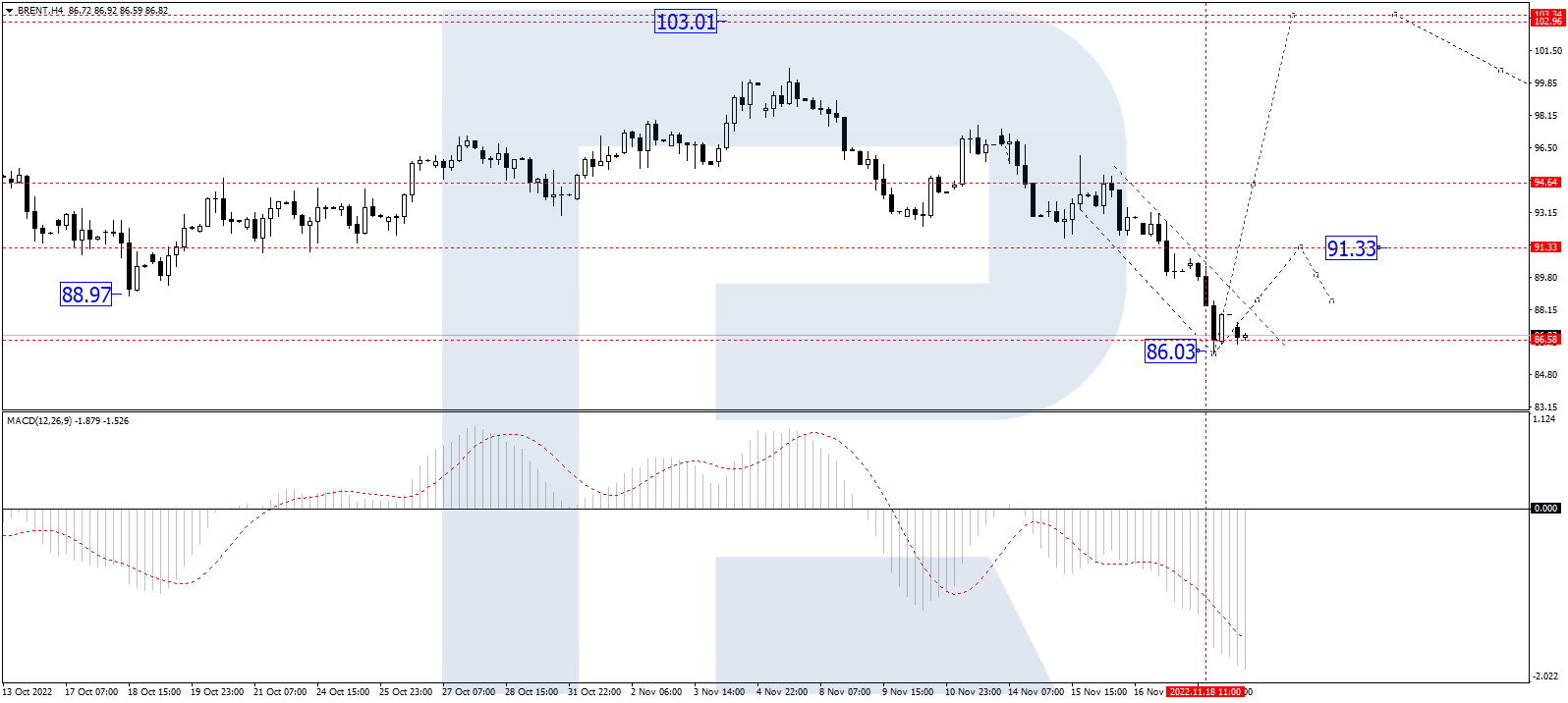
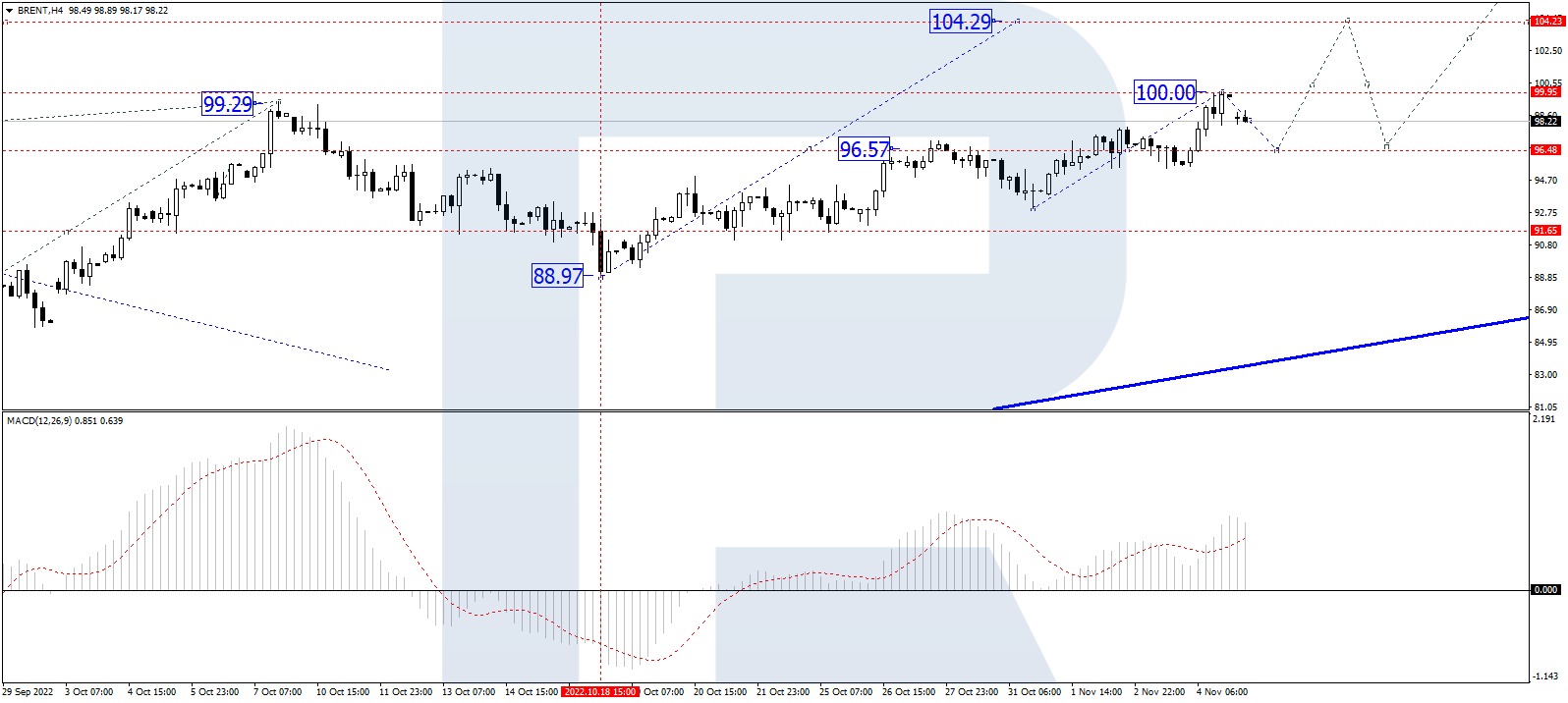
On H4, Brent has completed a wave of growth to 100.00. Today the market is forming a consolidation range under this level. Next, we expect a link of correction to 96.00. After it is over, a new wave of growth to 104.30 should start. The goal is local. Technically, this scenario is confirmed by the MACD. Its signal line is above zero in the histogram area, aimed strictly upwards.

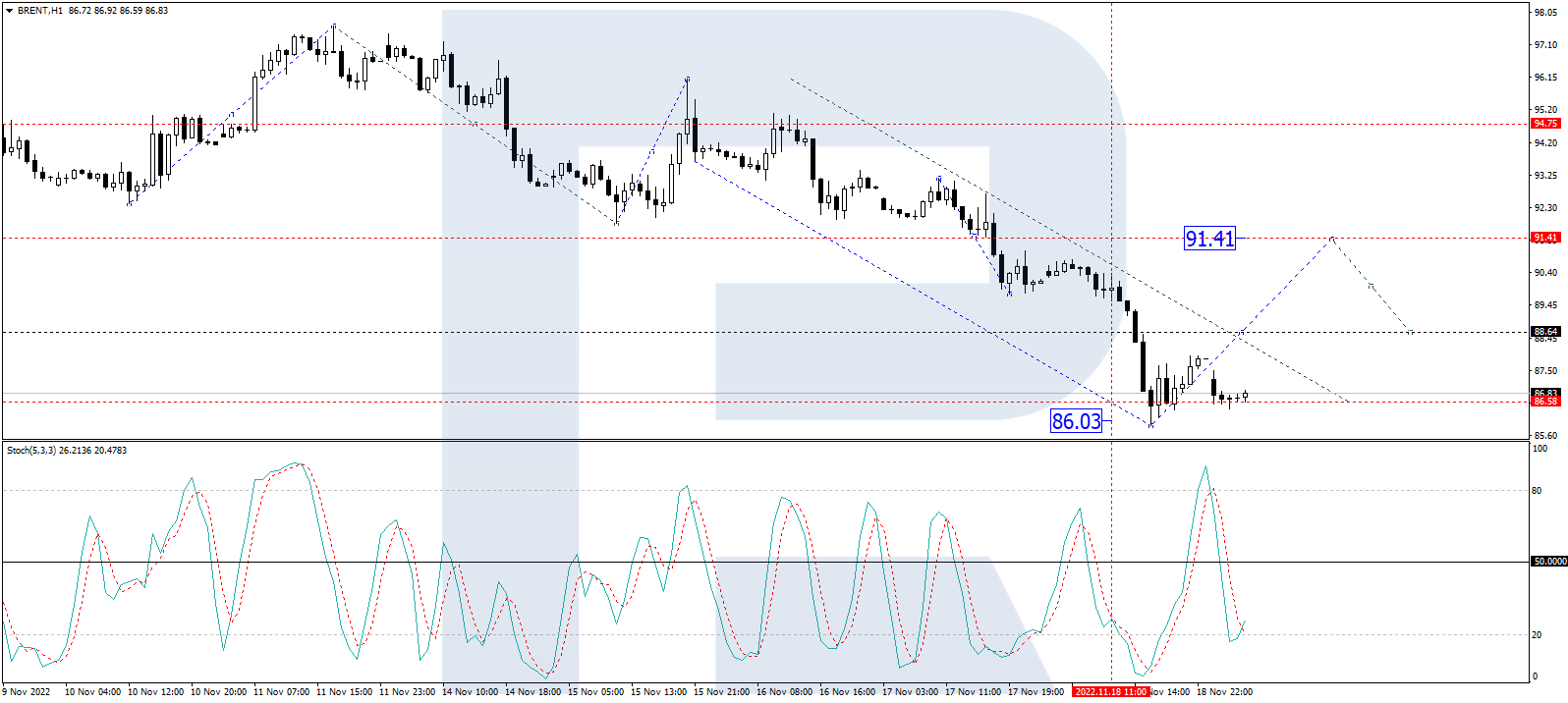
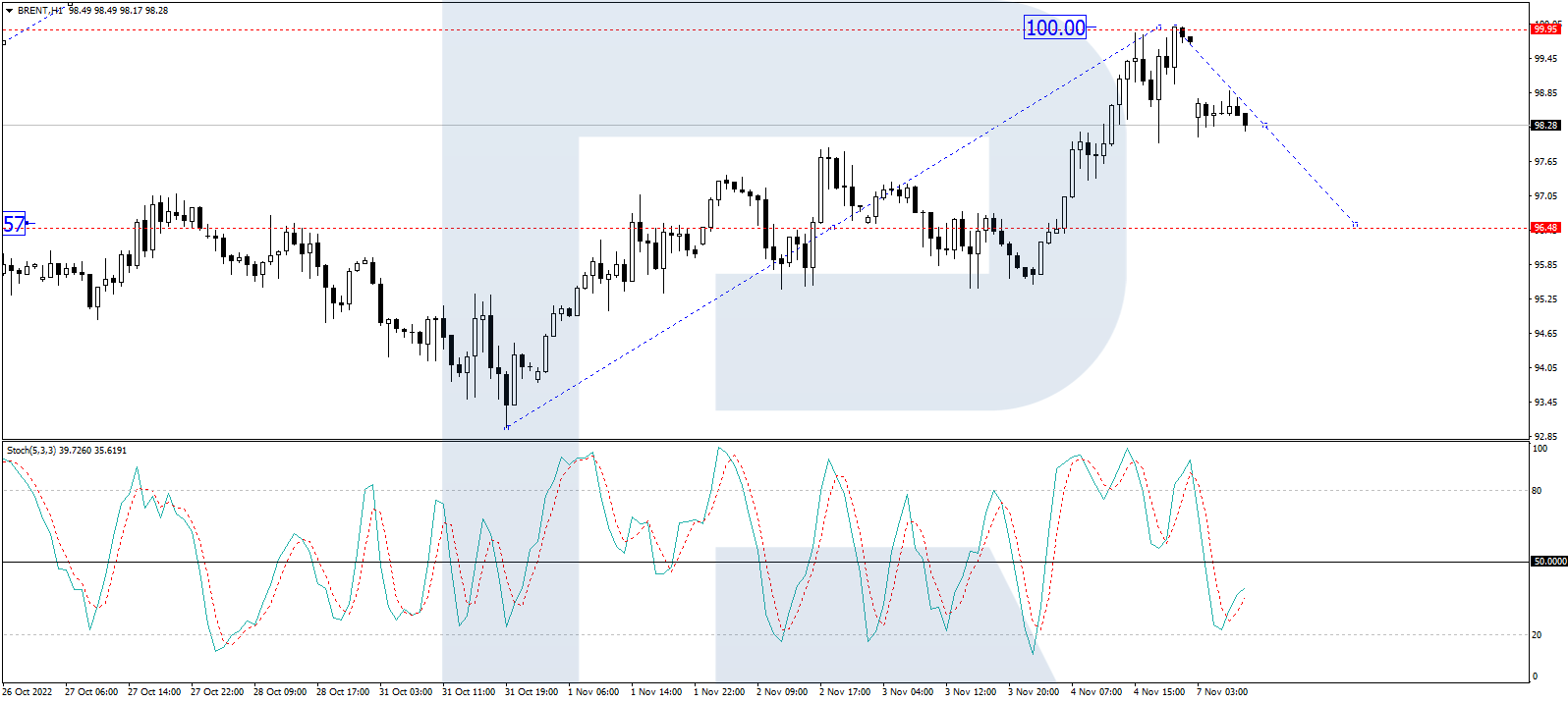
On H1, Brent has formed a consolidation range around 96.50. With an escape upwards, the market has reached the goal of 100.00. This whole wave of growth is interpreted as the third one by the trend. Then we expect a link of correcting decline to 96.50. When this correction is over, another wave of growth to 100.00 should start. And when this level is broken away, a pathway for growth to 104.30 will open. Technically, this scenario is confirmed by the Stochastic oscillator. Its signal line is under 50. Further decline to 20 is expected.

Disclaimer

Any forecasts contained herein are based on the author’s particular opinion. This analysis may not be treated as trading advice. RoboForex bears no responsibility for trading results based on trading recommendations and reviews contained herein.

Oil declines amid rising US production. RBA raises interest rate by 0.25%

By JustMarkets

The US indices fell yesterday amid weakness in the technology sector and ahead of a US Federal Reserve meeting, where a  0.75% interest rate hike is expected. At Monday’s close, the Dow Jones Index (US30) decreased by 0.39%, while the S&P500 Index (US500) lost 0.75%. The technology index NASDAQ (US100) dropped on Monday by 1.03%.

Nevertheless, experts believe the dollar’s gains could be limited if the Fed signals on Wednesday that the pace of rate hikes will slow down as it assesses the impact of its policy tightening. At the December meeting, federal funds futures forecast a 55% chance of a 50 basis point rate hike, down from 67% chance last Friday.

Famous companies reporting today are Pfizer (PFE), Toyota Motor (TM), AMD (AMD), BP (BP), Uber Tech (UBER), AIG (AIG), and Electronic Arts (EA).

Equity markets in Europe traded without a single dynamic yesterday. German DAX (DE30) gained 0.08%, French CAC 40 (FR40) dropped 0.10%, Spanish IBEX 35 (ES35) jumped by 0.51%, and British FTSE 100 (UK100) closed on Monday with a 0.66% gain.

Eurozone GDP grew slightly better than expected by 0.2% in the third quarter, indicating a clear slowdown from the 0.8% growth in the second quarter. Germany and Italy beat expectations, growing 0.3% Q/Q and 0.5% Q/Q, respectively, while Spain and France grew by 0.2% QoQ. The annualized Eurozone inflation rate reached 10.7%, against expectations of 10.3% growth. The core consumer price level, which excludes food and energy prices, rose to 5.0% from 4.8%. The purchasing managers’ composite index (PMI) showed a decline, with activity in all sectors gradually decreasing. Analysts believe a recession in the Eurozone is inevitable, and the next quarter will point to a significant drop in GDP.

German Chancellor Olaf Scholz promised a rapid introduction of natural gas price subsidies to mitigate the impact of skyrocketing energy prices. Germany, Europe’s largest economy, is at the center of an energy crisis engulfing the continent as Russia cuts gas supplies to the region and the country assembles a 200 billion euro emergency aid package. According to the Independent Natural Gas and Heating Commission, which presented its report Monday, about half of the money must be used to subsidize households and businesses.

Although Moscow has suspended its participation in a UN program to secure ships carrying grain from Ukraine amid the ongoing war, Ukrainian President Vladimir Zelensky said his country would continue a program brokered by the UN and Turkey in July to ensure an uninterrupted supply of food products to world markets.

The US is increasing its oil production, which puts downward pressure on oil quotes. Monthly government data showed that US oil production rose to nearly 12 million BPD in August, the highest since the COVID-19 pandemic. The coronavirus outbreak in China is expanding and starting to affect other cities, dampening hopes for a recovery in oil demand.

Asian markets traded flat yesterday. Japan’s Nikkei 225 (JP225) gained 1.78%, Hong Kong’s Hang Seng (HK50) ended the day down by 1.18%, and Australia’s S&P/ASX 200 (AU200) increased by 1.15%.

The Reserve Bank of Australia (RBA) raised its target interest rate by 25 basis points (BPS) to 2.85%, bringing interest rates to their highest level in 9 years. The Central Bank pledged to continue raising interest rates as necessary and will continue its data-driven approach. The RBA raised its inflation forecast for the year to 8% from 7.75%. Also, Australia’s GDP is now expected to grow by 3% in 2022, down from the previous forecast of 3.25%.

S&P 500 (F) (US500) 3,871.98 −29.08 (−0.75%)

Dow Jones (US30) 32,732.95 −128.85 (−0.39%)

DAX (DE40) 13,253.74 +10.41 (+0.079%)

FTSE 100 (UK100) 7,094.53 +46.86 (+0.66%)

USD Index 111.58 +0.83 (+0.75%)

Important events for today:
  • – Japan Manufacturing PMI (m/m) at 02:30 (GMT+2);
  • – Australia RBA Interest Rate Decision (m/m) at 05:30 (GMT+2);
  • – Australia RBA Rate Statement (m/m) at 05:30 (GMT+2);
  • – Australia RBA Governor Lowe Speaks (m/m) at 10:20 (GMT+2);
  • – UK Manufacturing PMI (m/m) at 11:30 (GMT+2);
  • – Canada Manufacturing PMI (m/m) at 15:30 (GMT+2);
  • – US ISM Manufacturing PMI (m/m) at 16:00 (GMT+2);
  • – US JOLTs Job Openings (m/m) at 16:00 (GMT+2);
  • – New Zealand RBNZ Financial Stability Report at 22:00 (GMT+2);
  • – New Zealand Unemployment Rate at 23:45 (GMT+2).

By JustMarkets


This article reflects a personal opinion and should not be interpreted as an investment advice, and/or offer, and/or a persistent request for carrying out financial transactions, and/or a guarantee, and/or a forecast of future events.

Europe’s Energy Sector: “The Lehman Moment Just Arrived”

This company’s stock price “broke a support shelf that dates back 14 years”

By Elliott Wave International

Back in October 2021, two months before Germany’s DAX hit an all-time high, our Global Market Perspective showed a big jump in references to “Lehman” in Bloomberg News.

Of course, the use of “Lehman” in a news article has become synonymous with the collapse of the then financial giant during the depths of the 2007-2009 financial crisis.

The October 2021 Global Market Perspective, an Elliott Wave International monthly publication which covers 50-plus worldwide financial markets, said:

The Lehman moment will come later, after investor optimism has receded and stock prices are well off their highs.

That was a year ago, and since then, Europe’s key stock indexes have been in a downward trend. In other words, investor optimism across the Continent has indeed receded.

The October 2022 Global Market Perspective noted:

Right on schedule, the Lehman moment just arrived at one of the Continent’s most critical sectors: “Europe’s Lehman Warning on Energy Prompts Flurry of Cash Aid” — Bloomberg, 9/6/22.

The October Global Market Perspective continued with these charts and commentary:

The chart shows stock prices at two of Europe’s utility behemoths. Centrica, the largest supplier of gas to domestic customers in the UK, trades at levels last seen in the 1990s, while Fortum Oyj, Finland’s largest company by revenue, dropped 68% over the past nine months and broke a support shelf that dates back 14 years.

… The Finnish government stepped in with a €2.4 billion bridge loan to Fortum, while Centrica is seeking billions of pounds of financing amidst soaring demands for collateral.

Then there is this chart of Uniper, the European gas giant sitting at the epicenter of the energy earthquake. On September 20, the German government forked over 8 billion “to nationalize the gas giant and stave off a collapse of the country’s energy sector.” (Bloomberg, 9/20/22)

Stave off a collapse? The chart shows that Uniper has already collapsed despite every effort.

Some of Europe’s energy sector firms face the same kind of liquidity problem which wrecked established investment banks a decade ago. Uniper was reportedly losing €100 million per day in early September, and Fortum’s collateral requirement jumped by €1 billion over one single week.

Getting back to the downtrend in major European stock indexes, the Elliott wave method for analyzing financial markets can help you determine if the decline in prices is nearly over or if there’s much more to go.

If you need to brush up on your Elliott wave knowledge, or are entirely new to the subject, an ideal resource is Frost & Prechter’s Wall Street classic book, Elliott Wave Principle: Key to Market Behavior. Here’s a quote:

[R.N.] Elliott himself never speculated on why the market’s essential form is five waves to progress and three waves to regress. He simply noted that that was what was happening. Does the essential form have to be five waves and three waves? Think about it and you will realize that this is the minimum requirement for, and therefore the most efficient method of, achieving both fluctuation and progress in linear movement. One wave does not allow fluctuation. The fewest subdivisions to create fluctuation is three waves. Three waves (of unqualified size) in both directions would not allow progress. To progress in one direction despite periods of regress, movements in that direction must be at least five waves, simply to cover more ground than the intervening three waves. While there could be more waves than that, the most efficient form of punctuated progress is 5-3, and nature typically follows the most efficient path.

If you’d like to read the entire online version of the book, you may do so for free once you become a member of Club EWI, the world’s largest Elliott wave educational community (about 500,000 worldwide members and growing rapidly).

A Club EWI membership is also free and allows you complimentary access to a wealth of Elliott wave resources. All the while, you are under no obligation.

Get started by following this link: Elliott Wave Principle: Key to Market Behaviorfree and instant access.

This article was syndicated by Elliott Wave International and was originally published under the headline Europe’s Energy Sector: “The Lehman Moment Just Arrived”. EWI is the world’s largest market forecasting firm. Its staff of full-time analysts led by Chartered Market Technician Robert Prechter provides 24-hour-a-day market analysis to institutional and private investors around the world.

Third-Party Firm Rates Hydrogen Boiler Nearly 100% Efficient

Source: Streetwise Reports  (10/17/22)

Jericho Energy Ventures is working to bring its zero-emission hydrogen boilers to companies for commercial heating, hot water, and industrial steam.

An independent third-party firm has rated Jericho Energy Ventures Inc.’s (JEV:TSX.V; JROOF:OTCMKTS) zero-emissions hydrogen boiler technology as nearly 100% fuel efficient.

The company’s Dynamic Combustion Chamber™ boiler was tested by Process Engineering Associates LLC.

“All off-gas samples taken during the test did not detect hydrogen in the sample,” said Chris Muntean, a senior process engineer with Process Engineering Associates. “This data suggests that the burners are combusting the vast majority (or all) of the H2 (hydrogen) gas being supplied to the boiler. Based on these performance results, little to no fuel is left unburned.”

As technical analyst Clive Maund wrote for Streetwise Reports, hydrogen “is a fuel of the future.”

As companies shift toward greener energy sources and look to lower their carbon footprint, Jericho hopes its boiler technology will be there for commercial heating, hot water, and industrial steam boilers.

Hydrogen Technologies, a fully owned subsidiary of Jericho, has patented its method for burning hydrogen and oxygen in a vacuum chamber to create high-temperature water and steam with no greenhouse gases or other pollutants.

The only by-product is water, which is recycled. It’s meant to replace existing boilers that burn coal, natural gas, diesel, or fuel oil.

“Our system is more efficient than traditional steam systems,” Jericho Executive Officer Brian Williamson told Streetwise Reports. “They did a whole battery of tests on our system and validated that it is, in fact, 95% cost-efficient, which is  . . .  20% plus more efficient than anything else that’s out there in the market in conventional fossil fuels. There’s also 100% hydrogen burn in the system, meaning that there’s no waste.”

The Catalyst

The test backs up Jericho’s own research on the technology, and the company hopes to use the data to attract investors and customers.

Hydrogen Technologies held a demo week at the end of September in Modesto, Calif., for possible commercial and industrial clients. The company said it was so successful it plans to hold another demo week November 14-18.

The U.S. Department of Energy said the hydrogen market “is in its infancy” but that it has the “potential for near-zero greenhouse gas emissions.”

“Hydrogen generates electrical power in a fuel cell, emitting only water vapor and warm air,” the agency wrote. “It holds promise for growth in both the stationary and transportation energy sectors.”

The element is abundant in our environment and the most abundant element in the universe. It’s stored in water, hydrocarbons (such as methane), and other organic matter.

As technical analyst Clive Maund wrote for Streetwise Reports, hydrogen “is a fuel of the future.”

‘Quite a Few’ Companies Interested

Last summer, Jericho announced it was joining with Australia’s LINE Hydrogen Pty Ltd. to bring the boilers to that country. The companies are creating a distribution “hub” that will allow a constant supply of hydrogen fuel.

Jericho said additional industrial partners will be announced in the coming months, and the first DCC™ boiler is expected to be installed in Tasmania, Australia, in 2023.

Williamson said Jericho has “quite a few” companies that have already expressed interest in the boiler system. Jericho said it will target everything from large industrial plants to schools and hopes to create other duplicate hubs in other places in the world, like the United States, Canada, and Europe.

Each boiler removes the equivalent carbon dioxide of 2,500 cars a year (or about 4,400 tons of carbon dioxide), according to the company.

Jericho was once an oil and gas business. It still has interests in those sectors and has been using money from rising fossil fuel prices to help fund its push toward hydrogen.

The company began transitioning to green energy in June 2020. In January 2021, it announced the acquisition of Hydrogen Technologies. Also, last year, it announced a collaboration with Rémy Cointreau’s Bruichladdich Distillery in Scotland to install a boiler to run its stills that produce Scotch and artisanal gin.

Other green investments include in H2U Technologies Inc., which is developing an electrocatalyst discovery process for electrolyzer and fuel cell applications, and Supercritical Solutions Ltd., which is developing a new class of water electrolyzer that will allow low-cost hydrogen production. Jericho led the seed series funding round for SuperCritical and was joined by Chris Sacca’s Lowercarbon Capital as a co-investor.

Ownership and Share Structure

Top shareholders include Michael L. Graves Inter Vivos Trust with 16.43% or 37.13 million shares, McKenna & Associates LLC with 10.78% or 24.36 million shares, the CEO Williamson with 0.87% or 1.97 million shares, company Director Allen Wilson with 0.87% or 1.97 million shares, and Nicholas W. Baxter with 0.5% or 1.14 million shares.

Jericho has a market cap of CA$81.38 million with 226 million shares outstanding, 158.3 million of them free-floating. It trades in a 52-week range of CA$0.84 and CA$0.31.

Disclosures:
1) Steve Sobek wrote this article for Streetwise Reports LLC. He or members of his household own securities of the following companies mentioned in the article: None. He or members of his household are paid by the following companies mentioned in this article: None.

2) The following companies mentioned in this article are billboard sponsors of Streetwise Reports: Jericho Energy Ventures. Click here for important disclosures about sponsor fees. The information provided above is for informational purposes only and is not a recommendation to buy or sell any security.

3) The article does not constitute investment advice. Each reader is encouraged to consult with his or her individual financial professional and any action a reader takes as a result of information presented here is his or her own responsibility. By opening this page, each reader accepts and agrees to Streetwise Reports’ terms of use and full legal disclaimer. This article is not a solicitation for investment. Streetwise Reports does not render general or specific investment advice and the information on Streetwise Reports should not be considered a recommendation to buy or sell any security. Streetwise Reports does not endorse or recommend the business, products, services or securities of any company mentioned on Streetwise Reports.

4) From time to time, Streetwise Reports LLC and its directors, officers, employees or members of their families, as well as persons interviewed for articles and interviews on the site, may have a long or short position in securities mentioned. Directors, officers, employees or members of their immediate families are prohibited from making purchases and/or sales of those securities in the open market or otherwise from the time of the decision to publish an article until three business days after the publication of the article. The foregoing prohibition does not apply to articles that in substance only restate previously published company releases. As of the date of this article, officers and/or employees of Streetwise Reports LLC (including members of their household) own securities of Jericho Energy Ventures, a company mentioned in this article.
Crude Oil has Squandered All of Its Gains

By RoboForex Analytical Department

The commodities market starts the new week in October with attempts to stabilise. The Brent barrel had previously “sagged”, but is now returning to USD 92.40. It turns out that the entire positive effect of the OPEC+ decision to reduce black gold production quotas for November has now been exhausted.

This week, however, the focus of the commodities market will be on economic data from China. The main thing investors will be interested in is GDP figures for Q3, where a 3.5% y/y increase is expected, as well as figures for industrial production and retail sales. Forecasts look very weak due to the ongoing coronavirus restrictions.

Fresh data from Baker Hughes reflected an increase of 8 rigs in the US for the week up to 610. Oil production in the country stands at 12 million bpd, IEA expects to rise to 12.3 million bpd by end-December.

On the H4 Brent chart, an upside wave to 95.40 and a correction to 91.50 have been worked out. Today the market has started to form another upside wave to the level of 95.66. We expect its break up and continuation of the trend towards 99.55. The target is local. After it is reached, we will consider the probability of correction to the level of 95.66. Further – growth to 105,50. Technically, this scenario is confirmed by the MACD oscillator. Its signal line is above the zero mark and it is ready to continue growth to new highs.

On the H1 Brent chart, the corrective wave channel has been broken upwards and quotations are trading in a rising structure towards the 95.66 level. The target in the next growth wave is the first one. After it is broken down, a correction link to 93.85 is not ruled out. Further – growth to the level of 97.00 with the prospect of trend continuation to 99.55. The target is local. Technically, this scenario is also confirmed by theStochastic oscillator. Its signal line is above the 50 mark. We expect the continuation of growth towards 80.

Disclaimer

Any forecasts contained herein are based on the author’s particular opinion. This analysis may not be treated as trading advice. RoboForex bears no responsibility for trading results based on trading recommendations and reviews contained herein.


Weekly Energy Speculator Changes led by WTI Crude Oil and Heating Oil

By InvestMacro

Weekly Energy Speculator Changes led by WTI Crude Oil and Heating Oil

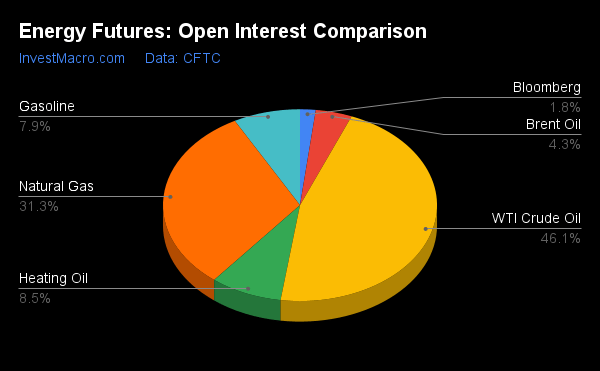
Here are the latest charts and statistics for the Commitment of Traders (COT) data published by the Commodities Futures Trading Commission (CFTC).

The latest COT data is updated through Tuesday October 11th and shows a quick view of how large traders (for-profit speculators and commercial hedgers) were positioned in the futures markets.

Weekly Speculator Changes led by WTI Crude Oil and Heating Oil

Weekly Energy Speculator Changes led by WTI Crude Oil and Heating Oil

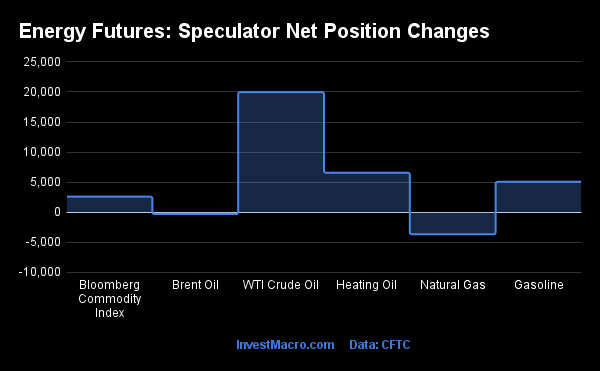
COT energy market speculator bets were mixed this week as three out of the six energy markets we cover had higher positioning this week while the other three markets had lower contracts.

Leading the gains for energy markets was WTI Crude Oil (17,221 contracts) with Heating Oil (3,668 contracts) and Bloomberg Commodity Index (176 contracts) also showing positive weeks.

The energy markets leading the declines in speculator bets this week were Gasoline (-4,974 contracts) with Natural Gas (-3,007 contracts) and Brent Crude Oil (-2,068 contracts) also registering lower bets on the week.


Data Snapshot of Commodity Market Traders | Columns Legend
Oct-11-2022OIOI-IndexSpec-NetSpec-IndexCom-NetCOM-IndexSmalls-NetSmalls-Index
WTI Crude1,499,4983259,22013-283,6268824,40641
Gold431,395094,42014-103,728879,3083
Silver125,62307,38922-15,603808,21410
Copper167,4498-15,8992416,90380-1,00419
Palladium6,8905-7541981079-5641
Platinum52,43595,92817-8,690852,7625
Natural Gas974,4685-162,10330130,0997232,00456
Brent163,11311-41,8884138,882583,00650
Heating Oil275,2622519,42371-38,4483019,02564
Soybeans694,9602655,76930-30,61477-25,15529
Corn1,408,93920325,12172-258,22535-66,8965
Coffee188,198340,53473-43,359302,82529
Sugar687,2090101,11557-135,1454334,03050
Wheat307,9019-1,990168,70572-6,71576


Strength Scores led by Bloomberg Commodity Index & Heating Oil

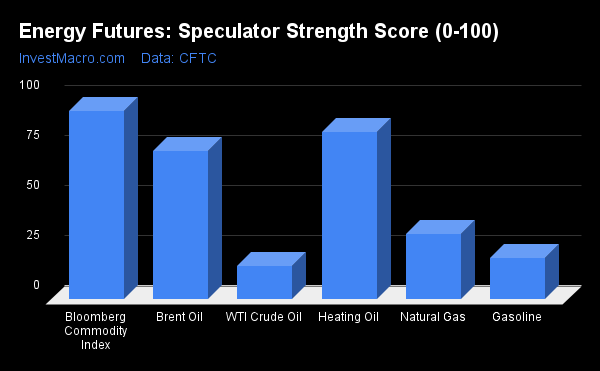
Strength Scores (a normalized measure of Speculator positions over a 3-Year range, from 0 to 100 where above 80 is extreme bullish and below 20 is extreme bearish) show that the Bloomberg Commodity Index (78.3 percent) and Heating Oil (71.0 percent) lead the energy markets with scores above 50 percent.

On the downside, WTI Crude Oil (12.8 percent) and Gasoline (15.3 percent) come in at the lowest strength level currently and both are in extreme bearish levels (below 20 percent).

Strength Statistics:
WTI Crude Oil (12.8 percent) vs WTI Crude Oil previous week (8.3 percent)
Brent Crude Oil (40.9 percent) vs Brent Crude Oil previous week (44.4 percent)
Natural Gas (29.9 percent) vs Natural Gas previous week (30.8 percent)
Gasoline (15.3 percent) vs Gasoline previous week (20.3 percent)
Heating Oil (71.0 percent) vs Heating Oil previous week (65.6 percent)
Bloomberg Commodity Index (78.3 percent) vs Bloomberg Commodity Index previous week (77.6 percent)

Bloomberg Commodity Index leads the 6-Week Strength Trends

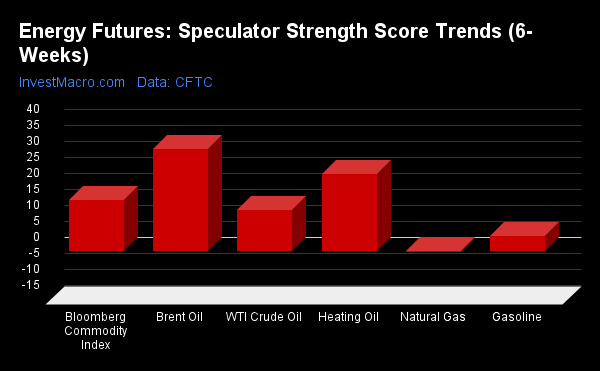
Strength Score Trends (or move index, calculates the 6-week changes in strength scores) show that the Bloomberg Commodity Index (18.9 percent) leads the past six weeks trends for energy this week. WTI Crude Oil (7.9 percent) is the only other positive mover in the latest trends data.

Natural Gas (-10.0 percent) leads the downside trend scores currently while the next markets with lower trend scores were Heating Oil (-8.5 percent) followed by Gasoline (-6.4 percent).

Strength Trend Statistics:
WTI Crude Oil (7.9 percent) vs WTI Crude Oil previous week (-1.1 percent)
Brent Crude Oil (-3.2 percent) vs Brent Crude Oil previous week (-5.7 percent)
Natural Gas (-10.0 percent) vs Natural Gas previous week (-9.2 percent)
Gasoline (-6.4 percent) vs Gasoline previous week (-4.5 percent)
Heating Oil (-8.5 percent) vs Heating Oil previous week (-8.9 percent)
Bloomberg Commodity Index (18.9 percent) vs Bloomberg Commodity Index previous week (18.6 percent)


Individual COT Energy Market Charts:

WTI Crude Oil Futures:

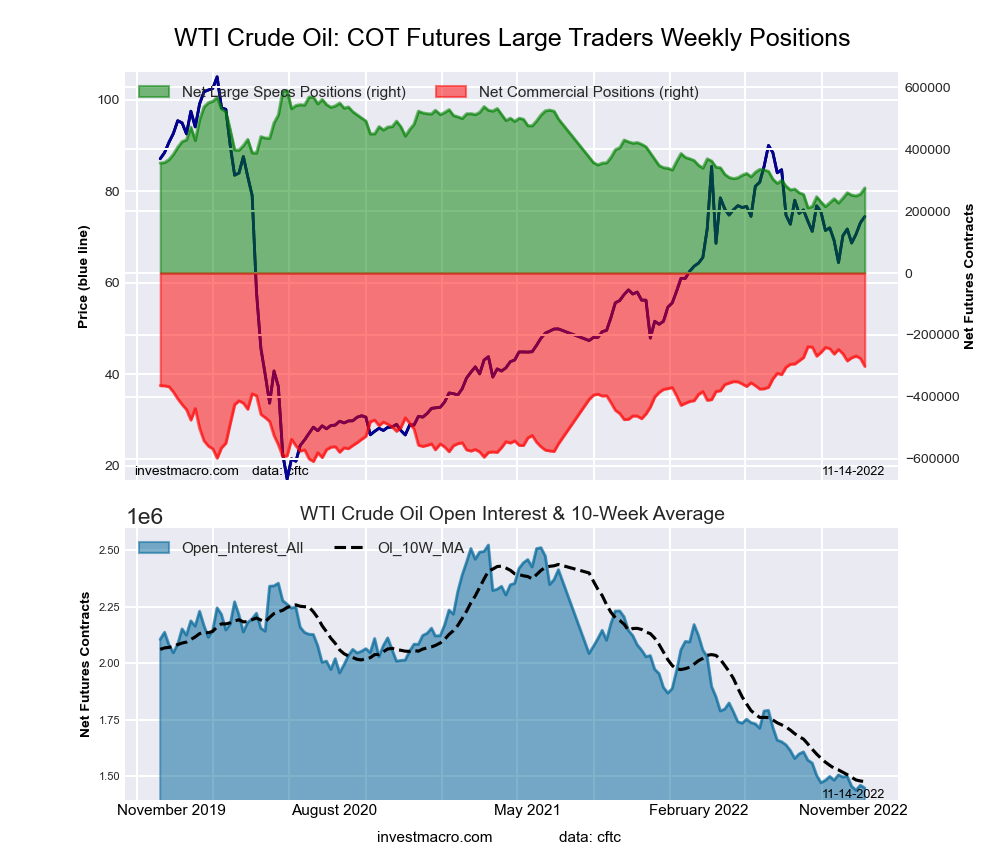
WTI Crude Oil Futures COT ChartThe WTI Crude Oil Futures large speculator standing this week resulted in a net position of 259,220 contracts in the data reported through Tuesday. This was a weekly rise of 17,221 contracts from the previous week which had a total of 241,999 net contracts.

This week’s current strength score (the trader positioning range over the past three years, measured from 0 to 100) shows the speculators are currently Bearish-Extreme with a score of 12.8 percent. The commercials are Bullish-Extreme with a score of 87.7 percent and the small traders (not shown in chart) are Bearish with a score of 40.7 percent.

WTI Crude Oil Futures StatisticsSPECULATORSCOMMERCIALSSMALL TRADERS
– Percent of Open Interest Longs:23.039.05.1
– Percent of Open Interest Shorts:5.757.93.5
– Net Position:259,220-283,62624,406
– Gross Longs:345,258584,60976,359
– Gross Shorts:86,038868,23551,953
– Long to Short Ratio:4.0 to 10.7 to 11.5 to 1
NET POSITION TREND:
– Strength Index Score (3 Year Range Pct):12.887.740.7
– Strength Index Reading (3 Year Range):Bearish-ExtremeBullish-ExtremeBearish
NET POSITION MOVEMENT INDEX:
– 6-Week Change in Strength Index:7.9-7.4-4.4


Brent Crude Oil Futures:

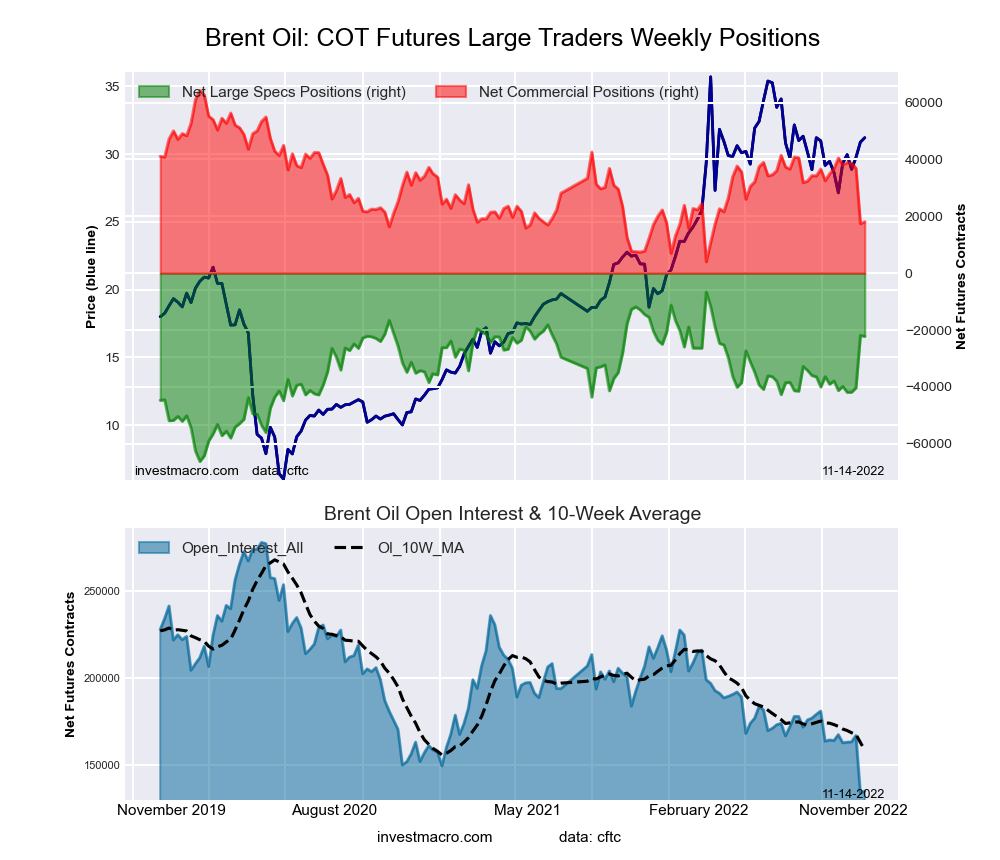
Brent Last Day Crude Oil Futures COT ChartThe Brent Crude Oil Futures large speculator standing this week resulted in a net position of -41,888 contracts in the data reported through Tuesday. This was a weekly decline of -2,068 contracts from the previous week which had a total of -39,820 net contracts.

This week’s current strength score (the trader positioning range over the past three years, measured from 0 to 100) shows the speculators are currently Bearish with a score of 40.9 percent. The commercials are Bullish with a score of 57.9 percent and the small traders (not shown in chart) are Bearish with a score of 49.9 percent.

Brent Crude Oil Futures StatisticsSPECULATORSCOMMERCIALSSMALL TRADERS
– Percent of Open Interest Longs:17.551.44.9
– Percent of Open Interest Shorts:43.227.63.1
– Net Position:-41,88838,8823,006
– Gross Longs:28,60683,8367,999
– Gross Shorts:70,49444,9544,993
– Long to Short Ratio:0.4 to 11.9 to 11.6 to 1
NET POSITION TREND:
– Strength Index Score (3 Year Range Pct):40.957.949.9
– Strength Index Reading (3 Year Range):BearishBullishBearish
NET POSITION MOVEMENT INDEX:
– 6-Week Change in Strength Index:-3.23.8-5.7


Natural Gas Futures:

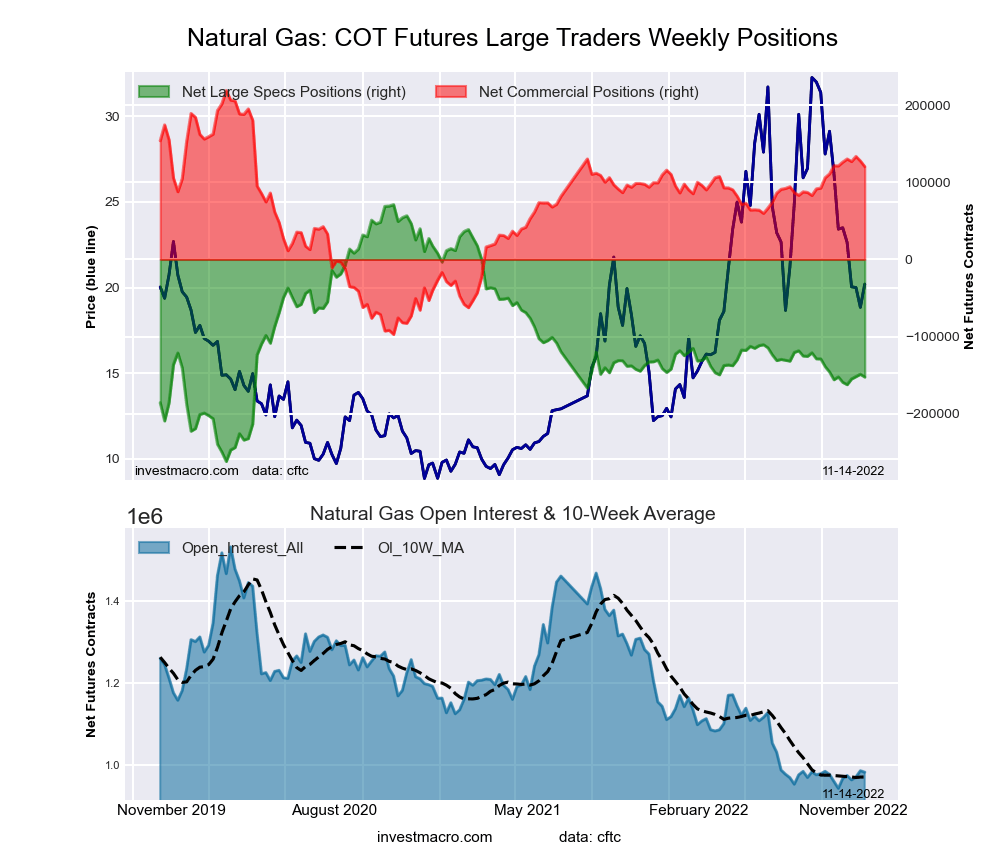
Natural Gas Futures COT ChartThe Natural Gas Futures large speculator standing this week resulted in a net position of -162,103 contracts in the data reported through Tuesday. This was a weekly reduction of -3,007 contracts from the previous week which had a total of -159,096 net contracts.

This week’s current strength score (the trader positioning range over the past three years, measured from 0 to 100) shows the speculators are currently Bearish with a score of 29.9 percent. The commercials are Bullish with a score of 71.9 percent and the small traders (not shown in chart) are Bullish with a score of 56.0 percent.

Natural Gas Futures StatisticsSPECULATORSCOMMERCIALSSMALL TRADERS
– Percent of Open Interest Longs:14.544.46.8
– Percent of Open Interest Shorts:31.131.03.5
– Net Position:-162,103130,09932,004
– Gross Longs:140,917432,66565,929
– Gross Shorts:303,020302,56633,925
– Long to Short Ratio:0.5 to 11.4 to 11.9 to 1
NET POSITION TREND:
– Strength Index Score (3 Year Range Pct):29.971.956.0
– Strength Index Reading (3 Year Range):BearishBullishBullish
NET POSITION MOVEMENT INDEX:
– 6-Week Change in Strength Index:-10.011.9-10.1


Gasoline Blendstock Futures:

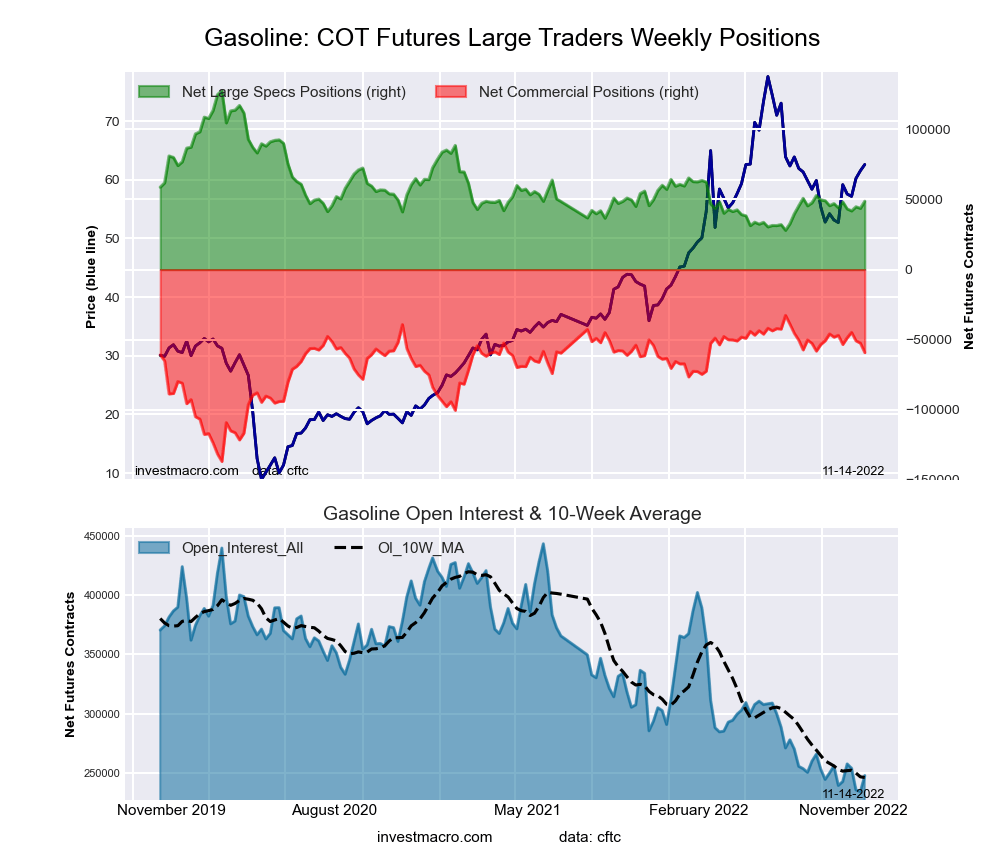
RBOB Gasoline Energy Futures COT ChartThe Gasoline Blendstock Futures large speculator standing this week resulted in a net position of 43,282 contracts in the data reported through Tuesday. This was a weekly decrease of -4,974 contracts from the previous week which had a total of 48,256 net contracts.

This week’s current strength score (the trader positioning range over the past three years, measured from 0 to 100) shows the speculators are currently Bearish-Extreme with a score of 15.3 percent. The commercials are Bullish-Extreme with a score of 84.7 percent and the small traders (not shown in chart) are Bearish with a score of 48.5 percent.

Nasdaq Mini Futures StatisticsSPECULATORSCOMMERCIALSSMALL TRADERS
– Percent of Open Interest Longs:28.653.07.7
– Percent of Open Interest Shorts:11.871.95.6
– Net Position:43,282-48,6435,361
– Gross Longs:73,663136,45719,739
– Gross Shorts:30,381185,10014,378
– Long to Short Ratio:2.4 to 10.7 to 11.4 to 1
NET POSITION TREND:
– Strength Index Score (3 Year Range Pct):15.384.748.5
– Strength Index Reading (3 Year Range):Bearish-ExtremeBullish-ExtremeBearish
NET POSITION MOVEMENT INDEX:
– 6-Week Change in Strength Index:-6.44.610.8


#2 Heating Oil NY-Harbor Futures:

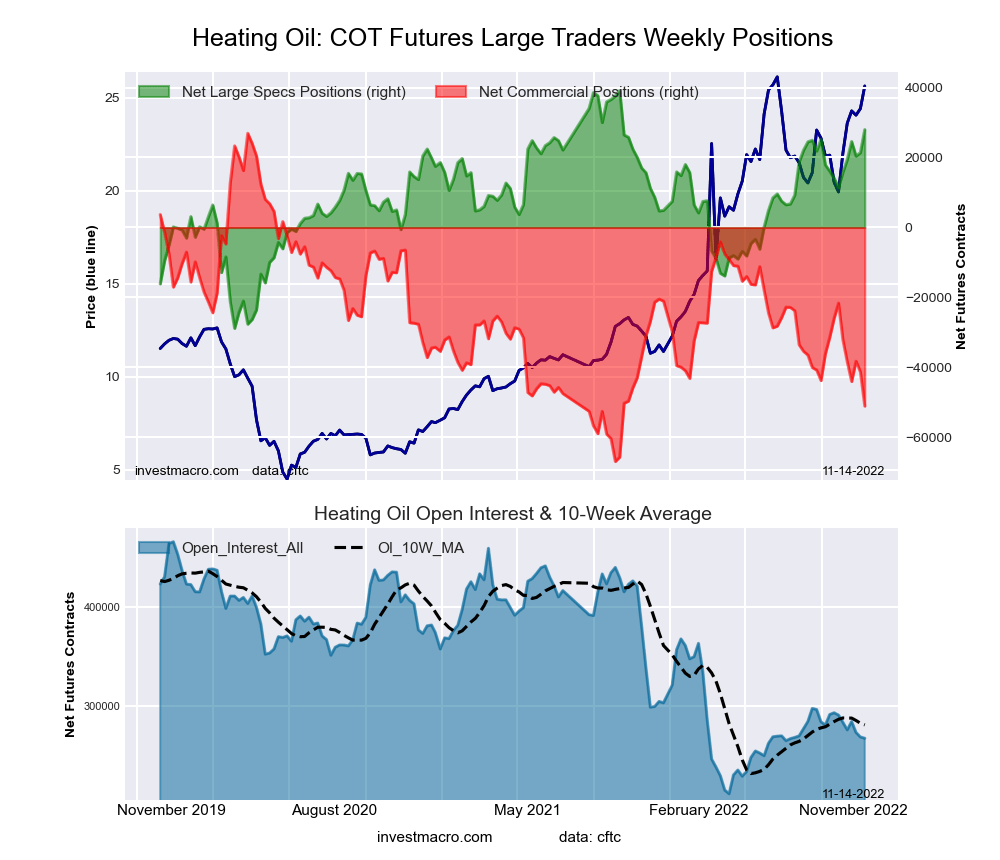
NY Harbor Heating Oil Energy Futures COT ChartThe #2 Heating Oil NY-Harbor Futures large speculator standing this week resulted in a net position of 19,423 contracts in the data reported through Tuesday. This was a weekly rise of 3,668 contracts from the previous week which had a total of 15,755 net contracts.

This week’s current strength score (the trader positioning range over the past three years, measured from 0 to 100) shows the speculators are currently Bullish with a score of 71.0 percent. The commercials are Bearish with a score of 30.3 percent and the small traders (not shown in chart) are Bullish with a score of 64.3 percent.

Heating Oil Futures StatisticsSPECULATORSCOMMERCIALSSMALL TRADERS
– Percent of Open Interest Longs:15.148.416.5
– Percent of Open Interest Shorts:8.162.49.6
– Net Position:19,423-38,44819,025
– Gross Longs:41,620133,30145,373
– Gross Shorts:22,197171,74926,348
– Long to Short Ratio:1.9 to 10.8 to 11.7 to 1
NET POSITION TREND:
– Strength Index Score (3 Year Range Pct):71.030.364.3
– Strength Index Reading (3 Year Range):BullishBearishBullish
NET POSITION MOVEMENT INDEX:
– 6-Week Change in Strength Index:-8.55.71.6


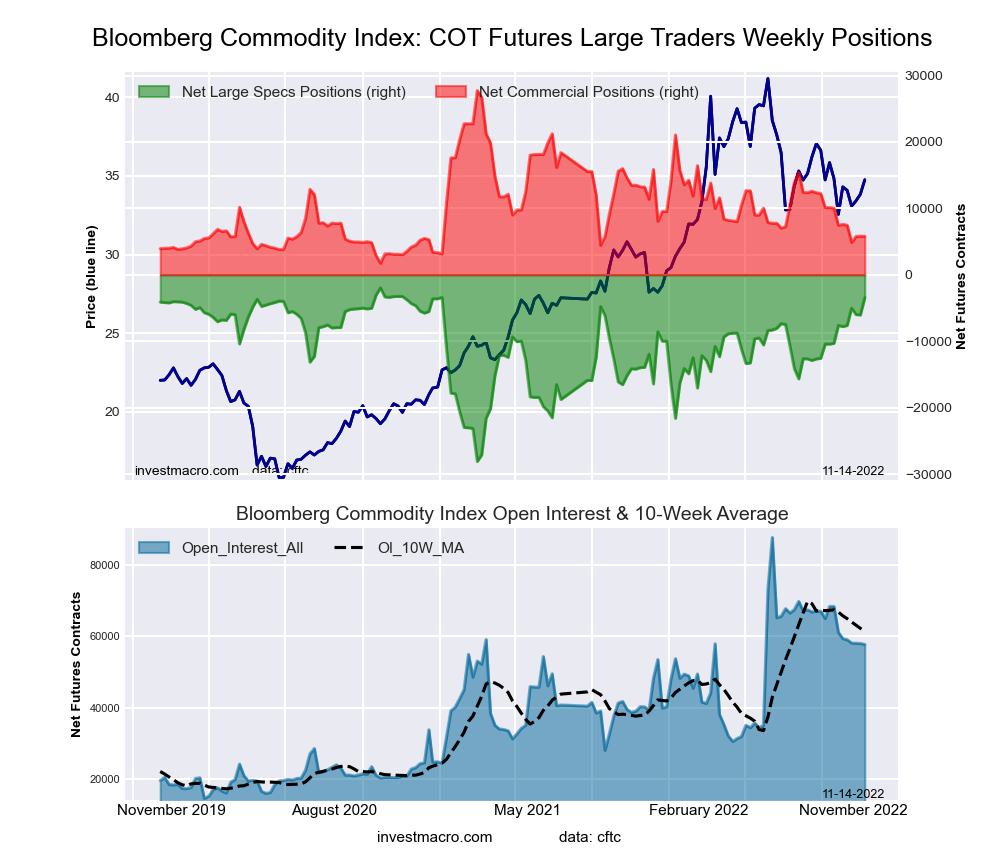
Bloomberg Commodity Index Futures:

Bloomberg Commodity Index Futures COT ChartThe Bloomberg Commodity Index Futures large speculator standing this week resulted in a net position of -7,623 contracts in the data reported through Tuesday. This was a weekly gain of 176 contracts from the previous week which had a total of -7,799 net contracts.

This week’s current strength score (the trader positioning range over the past three years, measured from 0 to 100) shows the speculators are currently Bullish with a score of 78.3 percent. The commercials are Bearish with a score of 22.0 percent and the small traders (not shown in chart) are Bearish-Extreme with a score of 15.5 percent.

Bloomberg Index Futures StatisticsSPECULATORSCOMMERCIALSSMALL TRADERS
– Percent of Open Interest Longs:19.676.40.4
– Percent of Open Interest Shorts:32.563.80.2
– Net Position:-7,6237,468155
– Gross Longs:11,55945,105253
– Gross Shorts:19,18237,63798
– Long to Short Ratio:0.6 to 11.2 to 12.6 to 1
NET POSITION TREND:
– Strength Index Score (3 Year Range Pct):78.322.015.5
– Strength Index Reading (3 Year Range):BullishBearishBearish-Extreme
NET POSITION MOVEMENT INDEX:
– 6-Week Change in Strength Index:18.9-18.4-6.8


Article By InvestMacroReceive our weekly COT Newsletter

*COT Report: The COT data, released weekly to the public each Friday, is updated through the most recent Tuesday (data is 3 days old) and shows a quick view of how large speculators or non-commercials (for-profit traders) were positioned in the futures markets.

The CFTC categorizes trader positions according to commercial hedgers (traders who use futures contracts for hedging as part of the business), non-commercials (large traders who speculate to realize trading profits) and nonreportable traders (usually small traders/speculators) as well as their open interest (contracts open in the market at time of reporting). See CFTC criteria here.

Oil bulls try to make a comeback

By ForexTime 

The Crude Oil market on the D1 time frame was in an extended down trend until 26 September when a last lower bottom was recorded at 76.13. Bulls found the price attractive at those levels and demand started overcoming supply.

A closer look at the Momentum Oscillator reveals a positive divergence between points “a” and “b” when comparing the bottoms at 83.74 and 76.13. This could have alerted technical traders that the downtrend might be losing momentum.

After the lower bottom at 76.13, the price of Crude Oil broke through the 15 and 34 Simple Moving Averages and the Momentum Oscillator cut through the 100 base-line into bullish territory.

A higher top and possible critical resistance level formed on 10 Oct at 92.59. Bears are currently trying to drive the price lower but a possible higher bottom might be forming at a support level on 12 October at 85.17.

If the support level holds and the bulls manage to break through the critical resistance level at 92.59, then three possible price targets can be calculated from there. Applying the Fibonacci tool to the higher top at 92.59 and dragging it to the bottom of the support area at 85.17, the following targets may be considered. The first target may be likely at 97.18 (161%) and the second price target at 104.60 (261.8%). The third and final target may be expected at 116.60 (423.6%).

If the support level at 85.17 is broken, the bullish scenario is overturned and the scenario needs to be re-assessed.

As long as the supply remains constrained, the outlook for the Crude Oil market in the D1 time frame will remain bullish.


Forex-Time-LogoArticle by ForexTime

ForexTime Ltd (FXTM) is an award winning international online forex broker regulated by CySEC 185/12 www.forextime.com

Murrey Math Lines 07.10.2022 (Brent, S&P 500)

Article By RoboForex.com

BRENT

As we can see in the H4 chart, after breaking the 200-day Moving Average, Brent is trading above it to indicate a possible ascending tendency. However, there is divergence on the Relative Strength Index, which is a signal in favour of decline. In this case, the pair is expected to break 6/8 (93.75) and continue falling towards the support at 5/8 (90.62). However, this scenario may be cancelled if the price breaks the resistance at 7/8 (96.88) to the upside. After that, the instrument may move upwards to reach 8/8 (100.00).

BRENTH4
Risk Warning: the result of previous trading operations do not guarantee the same results in the future

In the M15 chart, the pair may break the downside line of the VoltyChannel indicator and, as a result, continue its decline.

BRENT_M15
Risk Warning: the result of previous trading operations do not guarantee the same results in the future

S&P 500

As we can see in the H4 chart, the S&P 500 index is trading inside the “oversold area”. The Relative Strength Index has broken the descending trendline to the upside. In this case, the price is expected to break 0/8 (3750.0) and continue moving upwards to reach the resistance at 1/8 (3906.2). However, this scenario may no longer be valid if the price breaks the support at -1/8 (3593.8) to the downside. After that, the instrument may continue to fall towards -2/8 (3437.5).

S&P 500_H4
Risk Warning: the result of previous trading operations do not guarantee the same results in the future

In the M15 chart, the pair may break the upside line of the VoltyChannel indicator and, as a result, continue trading upwards.

S&P 500_M15

Article By RoboForex.com

Attention!
Forecasts presented in this section only reflect the author’s private opinion and should not be considered as guidance for trading. RoboForex LP bears no responsibility for trading results based on trading recommendations described in these analytical reviews.

A secretive legal system lets fossil fuel investors sue countries over policies to keep oil and gas in the ground – podcast

By Gemma Ware, The Conversation and Daniel Merino, The Conversation 

A new barrier to climate action is opening up in an obscure and secretive part of international trade law, which fossil fuel investors are using to sue countries if policy decisions go against them.

In this episode of The Conversation Weekly podcast, we speak to experts about the investor-state dispute settlement (ISDS) mechanism and how it works. Many are worried that these clauses in international trade deals could jeopardise global efforts to save the climate – costing countries billions of dollars in the process.

ISDS clauses were first introduced into international trade agreements in the post-colonial period. Most of these treaties were between a developed and a developing country. “It was really intended in the first instance to protect the interests of multinational companies from the global north when they were operating in these newly decolonised parts of the world,” explains Kyla Tienhaara, an expert in ISDS and environmental governance at Queen’s University in Ontario, Canada.

Yet Tienhaara says the use of ISDS has “morphed beyond all recognition” of the treaties’ original intentions, due to what she calls “creative lawyering” and the fact the system is stacked in favour of investors and against governments.

A looming concern is the chilling effect these clauses could have on countries’ decisions to phase out fossil fuels or take other action to protect the environment if investors decide to sue for compensation. In April, a summary report by the UN’s Intergovernmental Panel on Climate Change singled out ISDS clauses saying that they may “limit countries’ ability to adopt trade-related climate policies” and stick to their commitments under the 2015 Paris agreement.

In a recent study, Tienhaara and her colleagues estimated that countries could face up to US$340 billion in financial and legal risk from cancelling fossil fuel projects covered by ISDS clauses.

Some countries are more vulnerable than others because of the nature of the contracts they’ve entered into. Mozambique, with its large gas and coal reserves, is particularly so, explains Lea Di Salvatore, a PhD candidate at Nottingham University in the UK.

She analysed 29 of the country’s mega-projects for gas, coal and hydrocarbons and found that the vast majority are covered by ISDS clauses. This means that “the company can directly go and initiate an arbitration against Mozambique”, she says, if it feels a government policy has negatively affected its investment.

We hear what it’s like inside one of these arbitration rooms from Emilia Onyema, a professor of international commercial law at SOAS, University of London in the UK. “It’s a private process,” she explains. “The parties determine who the arbitrator is. They appoint the arbitrator. They pay the arbitrator. So they have more powers over the process than they would have in litigation.”

And we tell the story of one ISDS case launched against Italy by the British oil company, Rockhopper Exploration. In 2016, Italy banned oil drilling 12 nautical miles off its coast, which blocked Rockhopper’s exploration of the offshore Ombrina Mare field in the Adriatic Sea. Maria-Rita D’Orsogna, a US-based mathematician and leading campaigner against oil exploration in Abruzzo, explains what was at stake and what happened next.

Listen to the whole episode on The Conversation Weekly to find out about the fight back against ISDS, including moves to reform a big international trade treaty covering the fossil fuel industry and what countries are doing to limit their risk from ISDS climate arbitration.

This episode was produced by Gemma Ware and Mend Mariwany, with sound design by Eloise Stevens. The executive producer was Gemma Ware. Our theme music is by Neeta Sarl.

You can find us on Twitter @TC_Audio, on Instagram at theconversationdotcom or via email. You can also sign up to The Conversation’s free daily email here. A transcript of this episode will be available soon.

You can listen to “The Conversation Weekly” via any of the apps listed above, download it directly via our RSS feed, or find out how else to listen here.The Conversation

About the Author:

Gemma Ware, Editor and Co-Host, The Conversation Weekly Podcast, The Conversation and Daniel Merino, Assistant Science Editor & Co-Host of The Conversation Weekly Podcast, The Conversation

This article is republished from The Conversation under a Creative Commons license. Read the original article.