Archive for Energy – Page 21

Crude Oil: Why You Should Look Beyond Supply / Demand

The primary regulator of the rises and falls in oil’s prices is market psychology

By Elliott Wave International

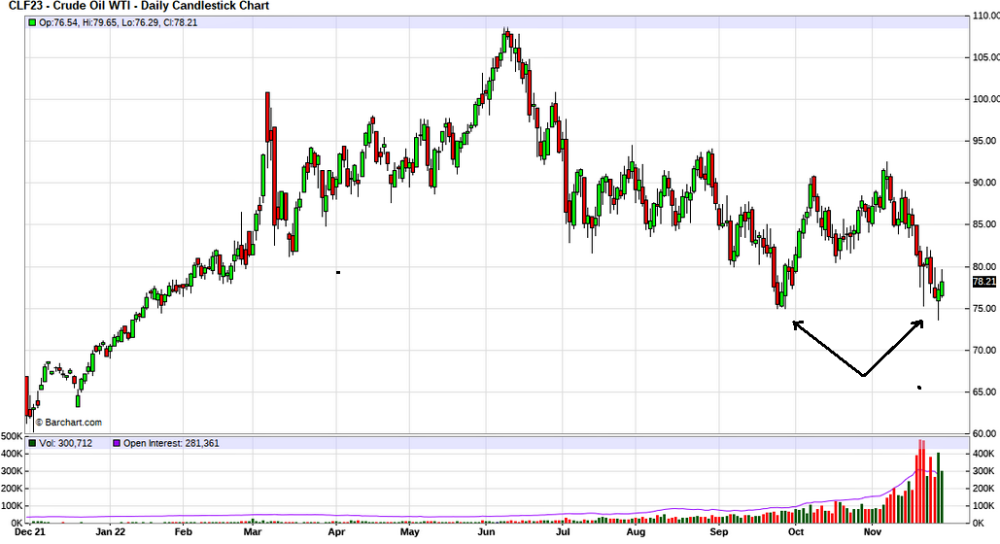
As I write on the morning of Friday, Nov. 18, crude oil is on track for its second weekly decline.

The financial media usually finds “reasons” for a market’s price action that are rooted in “market fundamentals,” and this decline in oil’s price was no exception.

On Thurs., Nov. 17, a CNBC headline noted:

Oil falls on easing geopolitical tension, China demand outlook

The gist of the story was that a rising number of COVID-19 cases in China would contribute to a lower demand for crude oil in the world’s second largest economy; hence, the falling prices.

However, Elliott Wave International has observed over the years that supply and demand doesn’t play as large of a role in oil’s price trend as widely believed. Indeed, all too often, oil’s price moves in the opposite direction from what supply and demand observers expect.

That’s why we would argue — and this may seem like a radical notion — that changes in the supply and demand for oil are far more a result of price fluctuations than a cause of them.

Let me explain. This chart and commentary from Robert Prechter’s Socionomic Theory of Finance provides insight:

Elliott waves of social mood, as reflected in stock prices, regulate feelings of optimism and pessimism among producers, alternately motivating them to overproduce and then underproduce oil relative to contemporaneous consumption. Their optimism makes them believe business will expand, so they produce more; and their pessimism makes them believe business will contract, so they produce less. This depiction of causality accounts quite well for the rises and falls in oil’s production/consumption ratio.

You may be interested in knowing that our crude oil analysis in our monthly Global Market Perspective is also based on Elliott waves of market psychology.

On Nov. 4, when the November Global Market Perspective published (the Global Market Perspective is a monthly Elliott Wave International publication which covers 50-plus global financial markets), Elliott Wave International’s chief energy analyst said:

… at this juncture the intermediate-term outlook remains down.

On the date this forecast was made, WTI Crude Oil (NYMEX) closed at $91.45. As of this writing on the morning of Nov. 18, WTI Crude Oil is at $79.35 a barrel. Note that the Global Market Perspective‘s Nov. 4 forecast didn’t mention a single “geopolitical” or “fundamental” factor. Elliott Wave International’s chief energy analyst relied strictly on the bearish picture of market psychology in crude oil’s price charts.

Do know that Elliott wave analysis does not always work out to a “T;” however, it’s the best forecasting method for oil prices — and other liquid markets — of which Elliott Wave International knows. That’s why Elliott Wave International has relied on it for over 40 years.

If you’d like to delve into the details of Elliott wave analysis, read Elliott Wave Principle: Key to Market Behavior by Frost & Prechter. Here’s a quote from this Wall Street classic:

In the 1930s, Ralph Nelson Elliott discovered that stock market prices trend and reverse in recognizable patterns. The patterns he discerned are repetitive in form but not necessarily in time or amplitude. Elliott isolated five such patterns, or “waves,” that recur in market price data. He named, defined and illustrated these patterns and their variations. He then described how they link together to form larger versions of themselves, how they in turn link to form the same patterns of the next larger size, and so on, producing a structured progression. He called this phenomenon The Wave Principle.

You may be interested in knowing that you can access the entire online version of the book for free once you become a member of Club EWI, the world’s largest Elliott wave educational community.

A Club EWI membership is also free, and members enjoy instant and complimentary access to a variety of Elliott wave resources on financial markets, investing and trading without any obligation.

Join Club EWI now by following this link: Elliott Wave Principle: Key to Market Behaviorget free and unlimited access.

This article was syndicated by Elliott Wave International and was originally published under the headline Crude Oil: Why You Should Look Beyond Supply / Demand. EWI is the world’s largest market forecasting firm. Its staff of full-time analysts led by Chartered Market Technician Robert Prechter provides 24-hour-a-day market analysis to institutional and private investors around the world.

Green Co. Taking Steps To Start Construction of Ecuador Plant

Source: Streetwise Reports  (11/25/22)

BacTech Environmental Corp. is completing an engineering report needed to start construction of its bioleaching plant in Tenguel, Ecuador.

BacTech Environmental Corp. (BAC:CSE;BCCEF:OTCQB;OBT1:FRA) is looking to complete an important engineering report on its bioleaching plant in Tenguel, Ecuador, by the end of the year.

The detailed engineering progress report was about 90% done as of Oct. 31, the company said.

BacTech is building the plant to take advantage of the growing green mining space. Research company Markets and Markets said the sector is expected to grow from an estimated US$9 billion in 2019 to US$12.9 billion by 2024.

Pressures from government and environmental groups are forcing companies to raise their capital and operating expenditures.

“As the countries tighten the environmental regulations and the public concern about the mining industry grows, this increases the pressure on these mining companies to minimize their environmental impacts and pay a higher amount to the occurring local issues,” Markets and Markets wrote.

Chris Temple, editor of The National Investor, has said he believes that process with the community will go smoothly. “This is a great project for the area,” he said.

But BacTech thinks it has a solution. Using naturally occurring bacteria, bioleaching makes it possible for those companies to work with lower-grade ore and recover metals from tailings sites as well as mines.

“Our bugs eat rocks,” the company says. Bacteria chew and oxidize the sulfides in the rock like mortar in a brick wall. Once that mortar is gone, the wall crashes down, President and Chief Executive Officer Ross Orr said.

“We really have no competition as we are pursuing this, which everyone else is running away from,” Orr told Streetwise Reports.

Bioleaching was attempted commercially in South Africa in 1986. There have been more than 20 plants built globally since then.

The Catalyst

BacTech received approval from the Ecuador government for its environmental impact study on the site for the plant last month. All that’s left from a regulatory standpoint is the final community consultation phase before the final environmental permit is issued.

The company will give presentations, hold town halls, and reply to questions from residents.

Chris Temple, editor of The National Investor, has said he believes that process with the community will go smoothly. “This is a great project for the area,” he said.

Procurement Underway

The site’s construction permit was approved in March, and BacTech signed an Investment Protection Agreement (IPA) with the government in May, giving it a 12-year income tax holiday and international arbitration for disputes.

As of the end of October, about 62% of the equipment for the plant had been procured, the company said.

“Procurement will now begin to command greater attention in an effort to lock down key supplier relationships and equipment pricing,” said BacTech Chief Operating Officer David Tingey.

The company said discussions were ongoing with several groups with respect to financing for the project, which will depend on permitting and completion of the detailed engineering report.

The plant will also have a small footprint, as much of the 100 acres of land bought for it will continue to be used by local farmers. BacTech has agreed to let them keep harvesting 80% of the farm’s thousands of cocoa trees.

For the feed going into the plant, there are 90 small mines in the area that produce significant amounts of arsenic with gold in the area. The plant would process about 30,900 ounces gold (Au) per year. There is potential for expansion; the total availability of materials in the area is an estimated 250 tonnes per day.

The plant would have pre-tax earnings of about US$10.9 million and a two-year payback period, according to data from EPCM Consultores.

The company is also opening a pilot facility to treat low-grade nickel in pyrrhotite and recover associated elements like iron and sulfur.

Ownership, Coverage, and Share Structure

BacTech recently started trading on the OTCQB Venture Market in the United States under the ticker symbol BCCEF. It continues to be traded on the Canadian Stock Exchange under BAC.

Nearly half of the company, 49%, is held by insiders, management, and strategic shareholders, the biggest of which is Option Three Advisory Services Ltd., which owns 8.98%, or 15.57 million shares, according to Reuters. That also includes CEO Orr, who owns 3.78% or 6.54 million shares, and Board Director Timothy Lewin, who owns 0.57% or 0.98 million shares.

Currently, BacTech is covered by newsletter writers of clivemaund.com, of 321gold.com, and of The National Investor. Click “See More Live Data” in the data box below to see what they are saying.

The company has 173.4 million shares outstanding, including 149 million free floating. Its market cap is CA$10.32 million, and it trades in a 52-week range of CA$0.165 and CA$0.06.

Disclosures:

1) Steve Sobek wrote this article for Streetwise Reports LLC. He or members of his household own securities of the following companies mentioned in the article: None. He or members of his household are paid by the following companies mentioned in this article: None.

2) The following companies mentioned in this article are billboard sponsors of Streetwise Reports: BacTech Environmental Corp. Click here for important disclosures about sponsor fees. The information provided above is for informational purposes only and is not a recommendation to buy or sell any security. As of the date of this article, an affiliate of Streetwise Reports has a consulting relationship with BacTech Environmental Corp. Please click here for more information.

3) The article does not constitute investment advice. Each reader is encouraged to consult with his or her individual financial professional and any action a reader takes as a result of information presented here is his or her own responsibility. By opening this page, each reader accepts and agrees to Streetwise Reports’ terms of use and full legal disclaimer. This article is not a solicitation for investment. Streetwise Reports does not render general or specific investment advice and the information on Streetwise Reports should not be considered a recommendation to buy or sell any security. Streetwise Reports does not endorse or recommend the business, products, services or securities of any company mentioned on Streetwise Reports.

4) From time to time, Streetwise Reports LLC and its directors, officers, employees or members of their families, as well as persons interviewed for articles and interviews on the site, may have a long or short position in securities mentioned. Directors, officers, employees or members of their immediate families are prohibited from making purchases and/or sales of those securities in the open market or otherwise from the time of the decision to publish an article until three business days after the publication of the article. The foregoing prohibition does not apply to articles that in substance only restate previously published company releases. As of the date of this article, officers and/or employees of Streetwise Reports LLC (including members of their household) own securities of BacTech Environmental Corp., a company mentioned in this article.

Crude Oil Started with Crash

By RoboForex Analytical Department

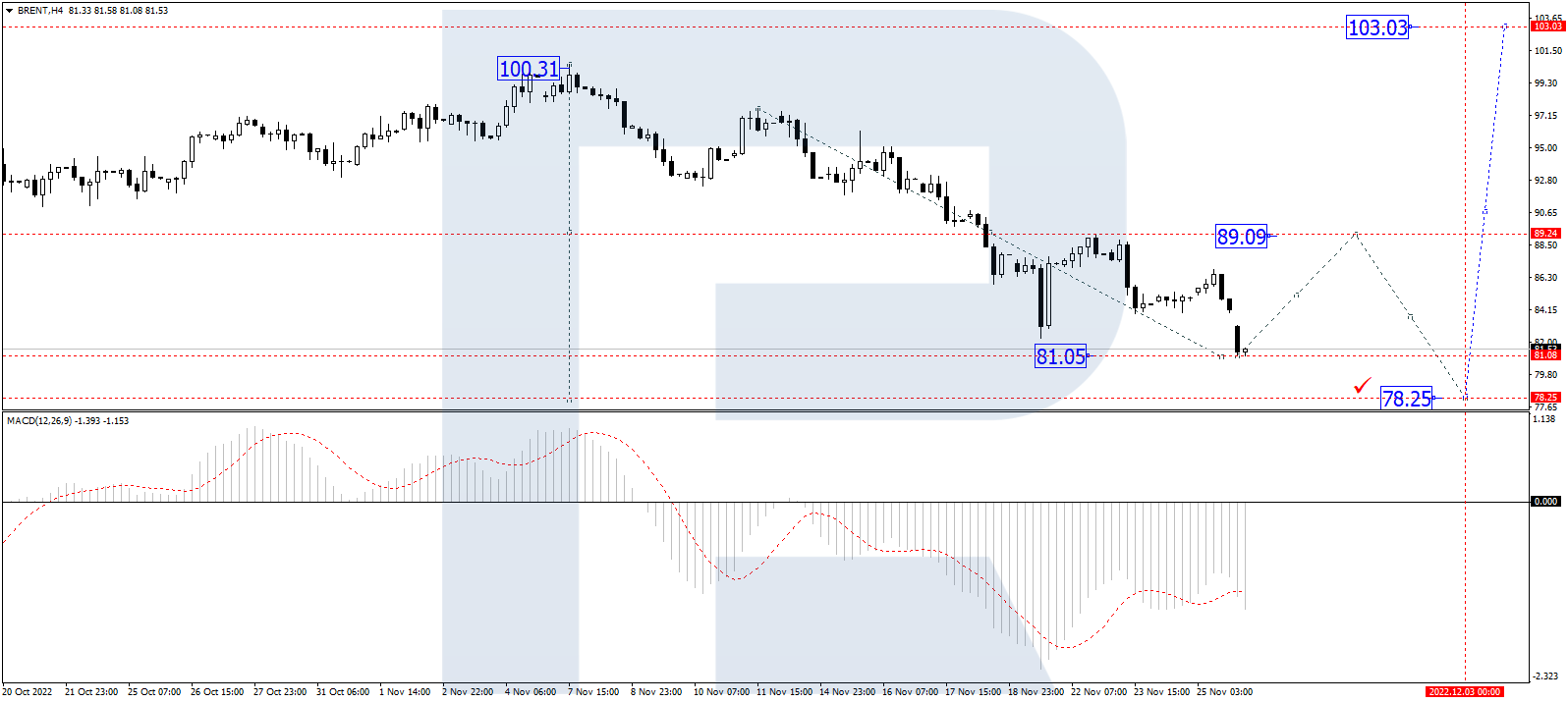
Crude oil market started the new week with sales. A Brent barrel is falling to 81.40 USD.

The worst of the news comes from China. The Chinese are rebelling against tough anti-coronavirus measures and lockdowns imposed by the government due to many new cases of COVID-19. The situation generates points of uncertainty because it is yet unclear how the Chinese authorities will react and how it all ends.

The issue with the maximum price level for Russian oil also keeps the market nervous.

According to Baker Hughes, the number of active oil rigs in the US increased last week by 4, reaching 627.

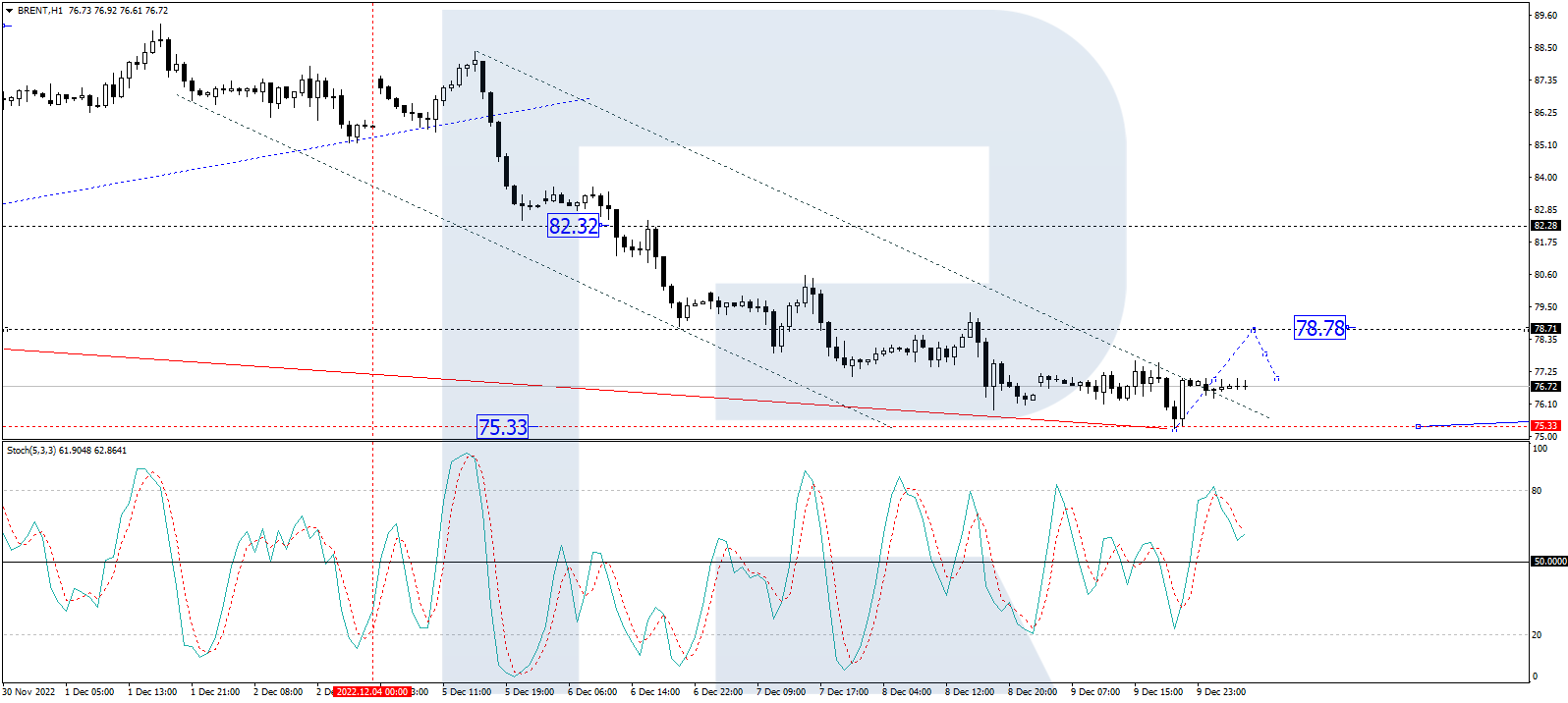
On H4, Brent has completed a wave of decline to 81.05. Today a consolidation range may form around it. With an escape upwards, a correction link to 89.09 might form. Then a link of decline to 78.78 and even 78.25 becomes possible. Technically, this scenario is confirmed by the MACD. Its signal line is at the lows, preparing to grow to zero.

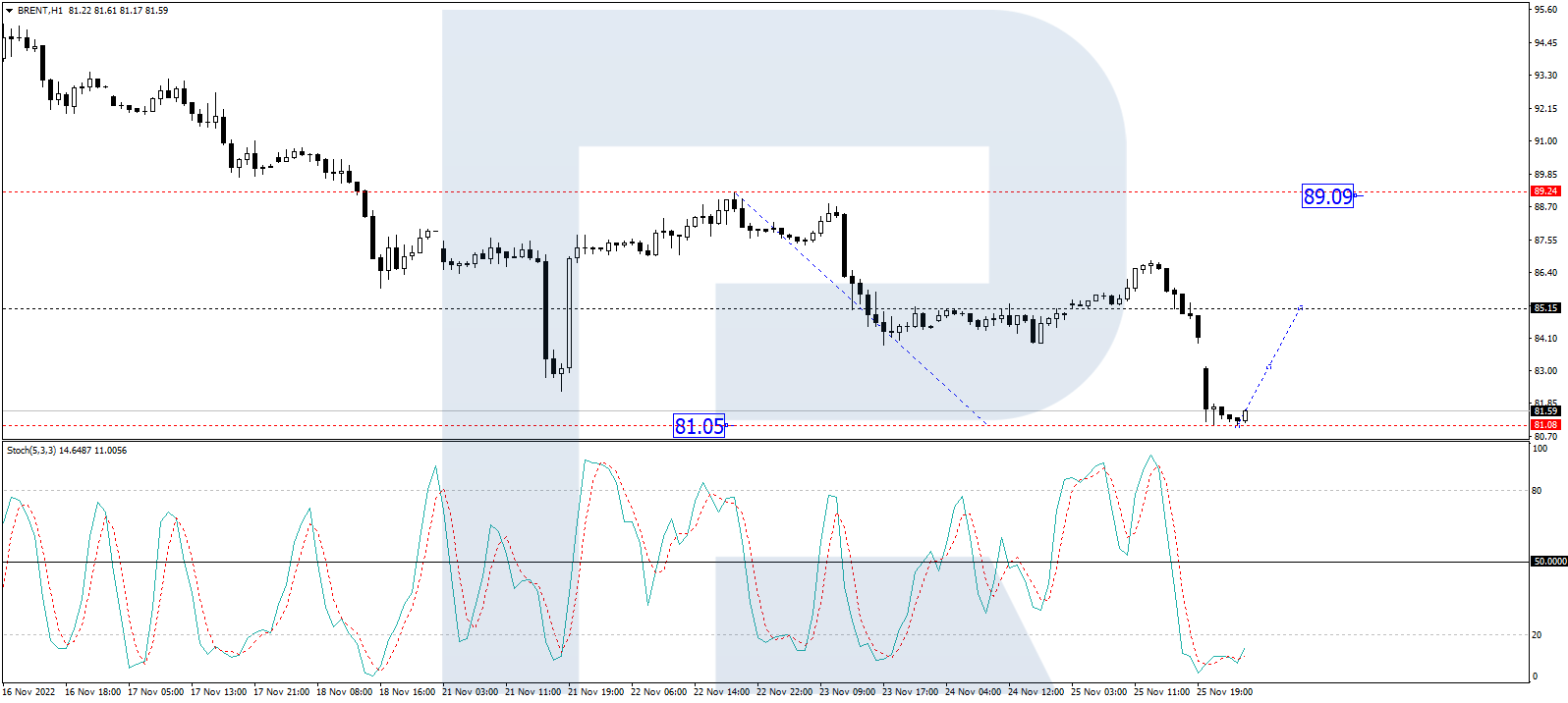
On H1, Brent has formed a consolidation range around 85.00. Today with an escape downwards, a local goal of the declining wave has been reached at 81.05. With an escape upwards, a pathway up to 85.00 will open (a test from below). Technically, this scenario is confirmed by the Stochastic oscillator. Its signal line is under 20, headed straight upwards. The indicator is expected to grow to 50.

Disclaimer

Any forecasts contained herein are based on the author’s particular opinion. This analysis may not be treated as trading advice. RoboForex bears no responsibility for trading results based on trading recommendations and reviews contained herein.

Why fixing methane leaks from the oil and gas industry can be a climate game-changer – one that pays for itself

By Jim Krane, Jones Graduate School of Business at Rice University 

What’s the cheapest, quickest way to reduce climate change without roiling the economy? In the United States, it may be by reducing methane emissions from the oil and gas industry.

Methane is the main component of natural gas, and it can leak anywhere along the supply chain, from the wellhead and processing plant, through pipelines and distribution lines, all the way to the burner of your home’s stove or furnace.

Once it reaches the atmosphere, methane’s super heat-trapping properties render it a major agent of warming. Over 20 years, methane causes 85 times more warming than the same amount of carbon dioxide. But methane doesn’t stay in the atmosphere for long, so stopping methane leaks today can have a fast impact on lowering global temperatures.

That’s one reason governments at the 2022 United Nations climate change conference in Egypt focused on methane as an easy win in the climate battle.

So far, 150 countries, including the United States and most of the big oil producers other than Russia, have pledged to reduce methane emissions from oil and gas by at least 30%. China has not signed but has agreed to reduce emissions. If those pledges are met, the result would be equivalent to eliminating the greenhouse gas emissions from all of the world’s cars, trucks, buses and all two- and three-wheeled vehicles, according to the International Energy Agency.

There’s also another reason for the methane focus, and it makes this strategy more likely to succeed: Stopping methane leaks from the oil and gas industry can largely pay for itself and boost the amount of fuel available.

Capturing methane can pay off

Methane is produced by decaying organic material. Natural sources, such as wetlands, account for roughly 40% of today’s global methane emissions. But the majority comes from human activities, such as farms, landfills and wastewater treatment plants – and fuel production. Oil, gas and coal together make up about a third of global methane emissions.

In all, methane is responsible for almost a third of the 1.2 degrees Celsius (2.2 degrees Fahrenheit) that global temperatures have risen since the industrial era.

Unfortunately, methane emissions are still rising. In 2021, atmospheric levels increased to 1,908 parts per billion, the highest levels in at least 800,000 years. Last year’s increase of 18 parts per billion was the biggest on record.

Among the sources, the oil and gas sector is best equipped to stop emitting because it is already configured to sell any methane it can prevent from leaking.

Methane leaks and “venting” in the oil and gas sector have numerous causes. Unintentional leaks can flow from pneumatic devices, valves, compressors and storage tanks, which often are designed to vent methane when pressures build.

Unlit or inefficient flares are another big source. Some companies routinely burn off excess gas that they can’t easily capture or don’t have the pipeline capacity to transport, but that still releases methane and carbon dioxide into the atmosphere.

Nearly all of these emissions can be stopped with new components or regulations that prohibit routine flaring.

Making those repairs can pay off. Global oil and gas operations emitted more methane in 2021 than Canada consumed that entire year, according to IEA estimates. If that gas were captured, at current U.S. prices – $4 per million British thermal unit – that wasted methane would fetch around $17 billion. The IEA determined that a one-time investment of $11 billion would eliminate roughly 75% of methane leaks worldwide, along with an even larger amount of gas that is wasted by “flaring” or burning it off at the wellhead.

The repairs and infrastructure investments would not only reduce warming, but they would also generate profits for producers and provide direly needed natural gas to markets undergoing drastic shortages due to Russia’s invasion of Ukraine.

Getting companies to cut methane emissions

Motivating U.S. producers to act has been the big hurdle.

The Biden administration is aiming for an 87% reduction in methane emissions below 2005 levels by the end of the decade. To get there, it has reimposed and strengthened U.S. methane rules that were dropped by the Trump administration. These include requiring drillers to find and repair leaks at more than 1 million U.S. well sites.

The U.S. Inflation Reduction Act of 2022 further incentivizes methane mitigation, including by levying an emissions tax on large oil and gas producers starting at $900 per ton in 2024, increasing to $1,500 in 2026. That fee, which can be waived by the Environmental Protection Agency and doesn’t affect small producers or leaks below 0.2% of gas produced, is based on the social cost to society from methane’s contribution to climate damage.

Customers are also putting pressure on the industry. Regulatory indifference by the Trump administration to U.S. methane flaring and venting led to cancellation of some European plans to import U.S. liquefied natural gas.

Reducing methane isn’t always straightforward, though, particularly in the U.S., where thousands of oil companies operate with minimal oversight.

A company’s methane emissions aren’t necessarily proportional to its oil and gas production, either. For example, a 2021 study using data from the EPA found Texas-based Hilcorp Energy reporting nearly 50% more methane emissions than ExxonMobil, despite producing less oil and gas. Hilcorp, which specializes in acquiring “late life” assets, says it is working to reduce emissions. Other little-known producers have also reported large emissions.

Investor pressure has pushed several publicly traded companies to reduce their methane emissions, but in practice this sometimes leads them to sell off “dirty” assets to smaller operators with less oversight.

In such a situation, the easiest way to encourage companies to clean up is via a tax. Done right, companies would act before they had to pay.

Using technology to keep emissions in check

Unlike carbon dioxide, which lingers in the atmosphere for a century or more, methane only sticks around for about a dozen years. So, if humans stop replenishing methane stocks in the atmosphere, those levels will decline.

A review of methane leaks in the Permian Basin shows the big impact that some regions can have.

Researchers found that gas and oil operations in the Permian, in west Texas and New Mexico, had a leakage rate estimated at 3.7% in 2018 and 2019, before the pandemic. A 2012 study found that leakage rates above 3.2% make climate damage from using natural gas worse than that from burning coal, which is normally considered the biggest climate threat.

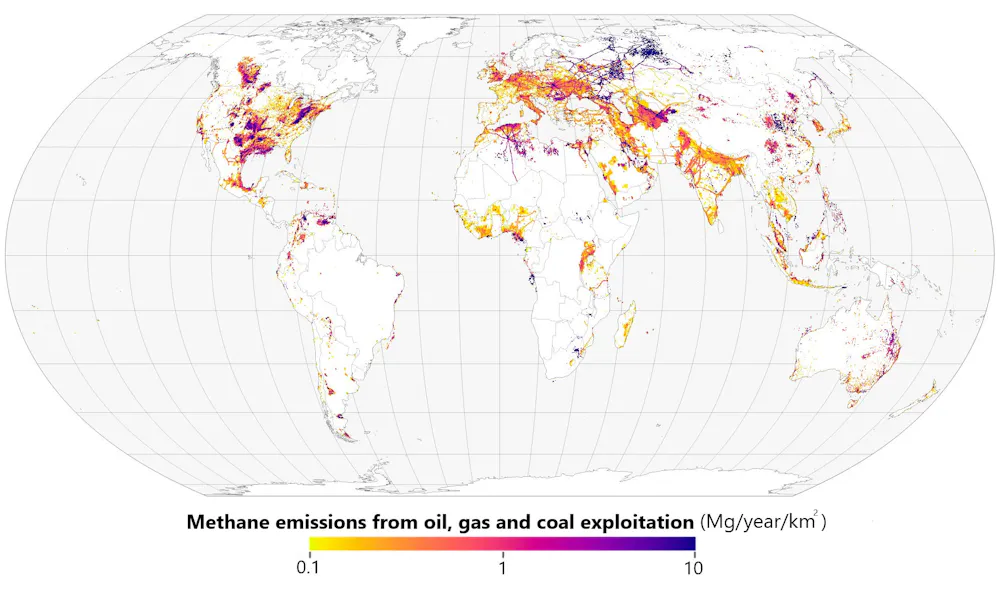
Map showing largest emissions in Russia, the Middle East and the US
Map of methane emissions from oil, gas and coal globally, 2016.
Joshua Stevens/NASA Earth Observatory

Methane leaks used to escape detection because the gas is invisible. Now, the proliferation of satellite-based sensors and infrared cameras makes detection easy.

Companies such as GTI Energy’s Veritas, Project Canary and MiQ have also launched to assist natural gas producers in reducing emissions and then verifying the reductions. At that point, if leaks are less than 0.2%, producers can avoid the federal fee and also market their output as “responsibly sourced” gas.The Conversation

About the Author:

Jim Krane, Fellow for Energy Studies, Baker Institute for Public Policy; Lecturer, Jones Graduate School of Business at Rice University

This article is republished from The Conversation under a Creative Commons license. Read the original article.


How to design clean energy subsidies that work – without wasting money on free riders

By Eric Hittinger, Rochester Institute of Technology; Eric Williams, Rochester Institute of Technology; Qing Miao, Rochester Institute of Technology, and Tiruwork B. Tibebu, Rochester Institute of Technology 

The planet is heating up as greenhouse gas emissions rise, contributing to extreme heat waves and once-unimaginable flooding. Yet despite the risks, countries’ policies are not on track to keep global warming in check.

The problem isn’t a lack of technology. The International Energy Agency recently released a detailed analysis of the clean energy technology needed to lower greenhouse gas emissions to net zero globally by 2050. What’s needed, the IEA says, is significant government support to boost solar and wind power, electric vehicles, heat pumps and a variety of other technologies for a rapid energy transition.

One politically popular tool for providing that government support is the subsidy. The U.S. government’s new Inflation Reduction Act is a multibillion-dollar example, packed with financial incentives to encourage people to buy electric vehicles, solar panels and more.

But just how big do governments’ clean energy subsidies need to be to meet their goals, and how long are they needed?

Our research points to three important answers for any government considering clean energy subsidies – and for citizens keeping an eye on their progress.

Why subsidize at all?

An obvious first question is: Why should governments subsidize clean energy at all?

The most direct answer is that clean energy helps to reduce harmful emissions – both of gases that cause local pollution and of those that warm the planet.

Reducing emissions helps to lower both public health costs and damage from climate change, which justifies government spending. Reports have estimated that the U.S. spends US$820 billion a year just on health costs associated with air pollution and climate change. Globally, the World Health Organization estimated that the costs reached $5.1 trillion in 2018. Taxing and regulating polluting industries can also cut emissions, but carrots are often more politically popular than sticks.

A female scientist holds a solar cell between tweezers
Subsidies helped launch the solar industry. Buyers today can get a 30% tax credit for home solar installations.
Joe DelNero/NREL

A less obvious reason for subsidies is that government support can help a new and initially expensive technology become competitive in the market.

Governments have been central to the development of many technologies that are pervasive today, including microchips, the internet, solar panels and GPS. Microchips were fantastically expensive when first developed in the 1950s. Demand from the U.S. military and NASA, which could pay the high price, fueled the growth of the industry, and costs eventually dropped enough that they’re now found in everything from cars to toasters.

Government support has also helped to bring down the cost of solar power. Rooftop solar system costs fell 64% from 2010 to 2020 in the U.S. because cells became more efficient and higher volumes drove prices down.

How much money?

So, subsidies can work, but what’s the right amount?

Too low, and a subsidy has no effect. Giving everyone a coupon for $1 off an electric car won’t change anyone’s buying plans. But subsidies can also be set too high.

The government doesn’t need to spend money persuading consumers who already plan to buy an electric car and can afford one, yet studies show clean energy subsidies disproportionately go to richer people. When people who would have purchased the item anyway receive subsidies, they’re known as “free riders.”

The ideal subsidy attracts new buyers while avoiding free riders and overspending on people who are already convinced. The subsidy can only work when it convinces a previously uninterested consumer to buy a product.

Chart shows costs falling as solar purchases rise.
Between 2009 and 2017, solar prices fell 50% and solar purchases increased tenfold with the help of subsidies. Lower cost makes a technology more attractive, while a growing solar industry is able to produce panels at lower cost.
Barbose et al., 2021; Solar Market Insight Report/SEIA

How long should subsidies last?

Timing is also important when thinking about the size of subsidies. When a promising technology is new and expensive, free riders are less of an issue. A large subsidy may be needed to attract even a few buyers, build out the emerging market and support the industry’s growth.

Solar power is a good example: In 2005, solar was several times more expensive than traditional electricity sources. Subsidies, like the 30% Investment Tax Credit established that year, helped lower the cost, and today’s solar is about one-tenth the price and cost-competitive with other electricity sources.

Once a clean technology is competitive, subsidies can still play an important role in speeding up the energy transition, but at a lower level than in the past.

In our research on residential solar panels, we estimate that the ideal subsidy for rooftop solar should have been initially higher than the actual federal tax credit but fall more quickly, declining to zero after 14 years from its start date.

By starting the subsidy about 20% higher, our models found that it would have boosted production faster, which would cut costs faster and reduce the need for high future subsidies.

Should subsidies eventually disappear?

It makes sense for subsidies to disappear altogether once a technology is sufficiently cost-competitive. However, even if a technology is competitive, it might be worth further subsidy if the speed of adoption is important.

The argument for continuing a subsidy depends on whether the additional adoption it stimulates is cost-effective in reducing emissions. Wind power is cheaper than fossil fuel power in many parts of the country. Even so, we found that continuing subsidies for wind power would lead to valuable emission benefits.

That said, sometimes subsidies stick around when they shouldn’t.

Fossil fuels have been heavily subsidized for decades, despite their harm to human health, the environment and the climate, all of which raise public costs. Governments globally spent almost $700 billion on fossil fuel subsidies in 2021. The U.S. government, in recent years, has spent more on renewable energy tax credits than fossil fuels, which is a promising transition of government support.

Global impact

While the U.S. was the focus of our solar subsidy research, this way of thinking – balancing the costs and benefits of subsidies – can be applied in other nations to design better subsidies for clean energy technologies.

The subsidy is just one policy tool, but it is an important one for both stimulating early-stage technologies and accelerating deployment of more competitive options. As the world attempts the fastest energy transition in history, today’s energy subsidy decisions will affect its ability to succeed.The Conversation

About the Author:

Eric Hittinger, Associate Professor of Public Policy, Rochester Institute of Technology; Eric Williams, Professor of Sustainability, Rochester Institute of Technology; Qing Miao, Associate Professor of Public Policy, Rochester Institute of Technology, and Tiruwork B. Tibebu, Ph.D. Student, Rochester Institute of Technology

This article is republished from The Conversation under a Creative Commons license. Read the original article.


Crude Oil Inclined Down

By RoboForex Analytical Department

The crude oil market began the week with a crash. A Brent barrel is falling to 86.75 USD and looks very week.

Curiously, nothing has changed on the hews horizon.

On the one hand, the market is reacting negatively to the news about the coronavirus spreading in China. The country remains the main importer of crude oil. Any COVID-19 bound limitations might shorten the industrial demand for energy carriers. On the other hand, investors are caring for the comments of the US Federal Reserve System about further interest rate strategy.

Moreover, information has spread about a surplus of crude oil at European oil plants.

All this taken together is dragging the barrel price down.

On H4, Brent corrected to 86.00 and started developing a consolidation range. At the moment, the quotes performed and corrected an impulse of growth. Practically, they have set the borders of the range. With an escape upwards, a new wave of growth to 94.75 may start. The goal is first. Technically, the scenario is confirmed by the MACD. Its signal line is at the lows, getting ready to start growing to zero.

On H1, with a breakaway of 91.41, oil declined and extended the wave to 86.00. At the moment, the market completed an impulse of growth to 87.90 and a correction to 86.55. Another wave of growth is going to develop to 88.66. With a breakaway of this level upwards, a pathway to 91.41 should open. Technically, this scenario is confirmed by the Stochastic oscillator. Its signal line is under 50, aiming strictly upwards. Growth of the indicator to 80 is expected.

Disclaimer

Any forecasts contained herein are based on the author’s particular opinion. This analysis may not be treated as trading advice. RoboForex bears no responsibility for trading results based on trading recommendations and reviews contained herein.

WTI Crude Oil & Heating Oil led last week’s speculator changes

By InvestMacro

Here are the latest charts and statistics for the Commitment of Traders (COT) data published by the Commodities Futures Trading Commission (CFTC). The COT release was delayed due to a Federal Holiday last week.

The latest COT data is updated through Tuesday November 8th and shows a quick view of how large traders (for-profit speculators and commercial hedgers) were positioned in the futures markets.

WTI Crude Oil & Heating Oil lead the Weekly Speculator Changes

The COT energy market speculator bets were higher last week as four out of the six energy markets we cover had higher positioning this week while the other two markets had lower contracts.

Leading the gains for energy markets was WTI Crude Oil (19,981 contracts) with Heating Oil (6,578 contracts), Gasoline (5,069 contracts) and Bloomberg Commodity Index (2,608 contracts) also showing positive weeks.

The energy markets leading the declines in speculator bets this week was Natural Gas (-3,655 contracts) with Brent Crude Oil (-293 contracts) also registering lower bets on the week.


Data Snapshot of Commodity Market Traders | Columns Legend
Nov-08-2022OIOI-IndexSpec-NetSpec-IndexCom-NetCOM-IndexSmalls-NetSmalls-Index
WTI Crude1,446,6581274,79017-301,3258326,53543
Gold488,4711682,33810-91,144918,8062
Silver140,4371313,00328-22,088749,08514
Copper169,929102,91339-3,4266451328
Palladium9,46717-2,410102,57389-16332
Platinum60,3012219,44935-23,295673,84620
Natural Gas982,5967-152,30833120,2226932,08656
Brent135,0781-22,2017418,085234,11665
Heating Oil266,7302327,95884-51,0591723,10178
Soybeans611,011887,80940-60,96668-26,84326
Corn1,484,42731301,55469-254,18236-47,37216
Coffee217,64625-4,68341,9121002,77138
Sugar766,3401490,18244-122,5615632,37948
Wheat350,84327-17,214023,68693-6,47277


Bloomberg Commodity Index & Heating Oil lead the Strength Scores

Strength Scores (a normalized measure of Speculator positions over a 3-Year range, from 0 to 100 where above 80 is extreme bullish and below 20 is extreme bearish) showed that the Bloomberg Commodity Index (94.3 percent) and Heating Oil (83.6 percent) lead the energy category and are both in bullish extreme positions (above 80 percent). Brent Crude Oil (74.0 percent) comes in as the next highest energy market in strength scores.

On the downside, WTI Crude Oil (16.9 percent) comes in at the lowest strength level currently and is followed by Gasoline (20.8 percent).

Strength Statistics:
WTI Crude Oil (16.9 percent) vs WTI Crude Oil previous week (11.7 percent)
Brent Crude Oil (74.0 percent) vs Brent Crude Oil previous week (74.5 percent)
Natural Gas (32.9 percent) vs Natural Gas previous week (33.9 percent)
Gasoline (20.8 percent) vs Gasoline previous week (15.7 percent)
Heating Oil (83.6 percent) vs Heating Oil previous week (73.9 percent)
Bloomberg Commodity Index (94.3 percent) vs Bloomberg Commodity Index previous week (84.3 percent)

Brent Crude Oil & Heating Oil top the Strength Trends

Strength Score Trends (or move index, calculates the 6-week changes in strength scores) show that Brent Crude Oil (32.0 percent) leads the past six weeks trends for energy this week. Heating Oil (24.3 percent), the Bloomberg Commodity Index (16.0 percent) and WTI Crude Oil (12.9 percent) fill out the next top movers in the latest trends data.

Natural Gas (-0.1 percent) came in as the only market with lower trend scores for last week.

Strength Trend Statistics:
WTI Crude Oil (12.9 percent) vs WTI Crude Oil previous week (3.9 percent)
Brent Crude Oil (32.0 percent) vs Brent Crude Oil previous week (26.9 percent)
Natural Gas (-0.1 percent) vs Natural Gas previous week (2.1 percent)
Gasoline (4.7 percent) vs Gasoline previous week (-3.4 percent)
Heating Oil (24.3 percent) vs Heating Oil previous week (10.7 percent)
Bloomberg Commodity Index (16.0 percent) vs Bloomberg Commodity Index previous week (16.3 percent)


Individual COT Market Charts:

WTI Crude Oil Futures:

WTI Crude Oil Futures COT ChartThe WTI Crude Oil Futures large speculator standing this week was a net position of 274,790 contracts in the data reported through Tuesday. This was a weekly boost of 19,981 contracts from the previous week which had a total of 254,809 net contracts.

This week’s current strength score (the trader positioning range over the past three years, measured from 0 to 100) shows the speculators are currently Bearish-Extreme with a score of 16.9 percent. The commercials are Bullish-Extreme with a score of 82.9 percent and the small traders (not shown in chart) are Bearish with a score of 43.2 percent.

WTI Crude Oil Futures StatisticsSPECULATORSCOMMERCIALSSMALL TRADERS
– Percent of Open Interest Longs:25.538.15.4
– Percent of Open Interest Shorts:6.559.03.5
– Net Position:274,790-301,32526,535
– Gross Longs:368,585551,74977,784
– Gross Shorts:93,795853,07451,249
– Long to Short Ratio:3.9 to 10.6 to 11.5 to 1
NET POSITION TREND:
– Strength Index Score (3 Year Range Pct):16.982.943.2
– Strength Index Reading (3 Year Range):Bearish-ExtremeBullish-ExtremeBearish
NET POSITION MOVEMENT INDEX:
– 6-Week Change in Strength Index:12.9-14.79.7


Brent Crude Oil Futures:

Brent Last Day Crude Oil Futures COT ChartThe Brent Crude Oil Futures large speculator standing this week was a net position of -22,201 contracts in the data reported through Tuesday. This was a weekly fall of -293 contracts from the previous week which had a total of -21,908 net contracts.

This week’s current strength score (the trader positioning range over the past three years, measured from 0 to 100) shows the speculators are currently Bullish with a score of 74.0 percent. The commercials are Bearish with a score of 23.4 percent and the small traders (not shown in chart) are Bullish with a score of 64.9 percent.

Brent Crude Oil Futures StatisticsSPECULATORSCOMMERCIALSSMALL TRADERS
– Percent of Open Interest Longs:23.144.36.8
– Percent of Open Interest Shorts:39.530.93.7
– Net Position:-22,20118,0854,116
– Gross Longs:31,21559,7859,133
– Gross Shorts:53,41641,7005,017
– Long to Short Ratio:0.6 to 11.4 to 11.8 to 1
NET POSITION TREND:
– Strength Index Score (3 Year Range Pct):74.023.464.9
– Strength Index Reading (3 Year Range):BullishBearishBullish
NET POSITION MOVEMENT INDEX:
– 6-Week Change in Strength Index:32.0-37.245.3


Natural Gas Futures:

Natural Gas Futures COT ChartThe Natural Gas Futures large speculator standing this week was a net position of -152,308 contracts in the data reported through Tuesday. This was a weekly reduction of -3,655 contracts from the previous week which had a total of -148,653 net contracts.

This week’s current strength score (the trader positioning range over the past three years, measured from 0 to 100) shows the speculators are currently Bearish with a score of 32.9 percent. The commercials are Bullish with a score of 68.8 percent and the small traders (not shown in chart) are Bullish with a score of 56.1 percent.

Natural Gas Futures StatisticsSPECULATORSCOMMERCIALSSMALL TRADERS
– Percent of Open Interest Longs:13.645.66.9
– Percent of Open Interest Shorts:29.133.43.6
– Net Position:-152,308120,22232,086
– Gross Longs:133,199448,26467,376
– Gross Shorts:285,507328,04235,290
– Long to Short Ratio:0.5 to 11.4 to 11.9 to 1
NET POSITION TREND:
– Strength Index Score (3 Year Range Pct):32.968.856.1
– Strength Index Reading (3 Year Range):BearishBullishBullish
NET POSITION MOVEMENT INDEX:
– 6-Week Change in Strength Index:-0.1-0.32.6


Gasoline Blendstock Futures:

RBOB Gasoline Energy Futures COT ChartThe Gasoline Blendstock Futures large speculator standing this week was a net position of 48,753 contracts in the data reported through Tuesday. This was a weekly rise of 5,069 contracts from the previous week which had a total of 43,684 net contracts.

This week’s current strength score (the trader positioning range over the past three years, measured from 0 to 100) shows the speculators are currently Bearish with a score of 20.8 percent. The commercials are Bullish with a score of 74.5 percent and the small traders (not shown in chart) are Bullish-Extreme with a score of 82.5 percent.

Nasdaq Mini Futures StatisticsSPECULATORSCOMMERCIALSSMALL TRADERS
– Percent of Open Interest Longs:33.645.09.0
– Percent of Open Interest Shorts:13.968.94.8
– Net Position:48,753-59,22610,473
– Gross Longs:83,270111,34822,245
– Gross Shorts:34,517170,57411,772
– Long to Short Ratio:2.4 to 10.7 to 11.9 to 1
NET POSITION TREND:
– Strength Index Score (3 Year Range Pct):20.874.582.5
– Strength Index Reading (3 Year Range):BearishBullishBullish-Extreme
NET POSITION MOVEMENT INDEX:
– 6-Week Change in Strength Index:4.7-11.850.8


#2 Heating Oil NY-Harbor Futures:

NY Harbor Heating Oil Energy Futures COT ChartThe #2 Heating Oil NY-Harbor Futures large speculator standing this week was a net position of 27,958 contracts in the data reported through Tuesday. This was a weekly gain of 6,578 contracts from the previous week which had a total of 21,380 net contracts.

This week’s current strength score (the trader positioning range over the past three years, measured from 0 to 100) shows the speculators are currently Bullish-Extreme with a score of 83.6 percent. The commercials are Bearish-Extreme with a score of 16.9 percent and the small traders (not shown in chart) are Bullish with a score of 78.4 percent.

Heating Oil Futures StatisticsSPECULATORSCOMMERCIALSSMALL TRADERS
– Percent of Open Interest Longs:17.641.517.8
– Percent of Open Interest Shorts:7.160.79.1
– Net Position:27,958-51,05923,101
– Gross Longs:46,818110,82047,495
– Gross Shorts:18,860161,87924,394
– Long to Short Ratio:2.5 to 10.7 to 11.9 to 1
NET POSITION TREND:
– Strength Index Score (3 Year Range Pct):83.616.978.4
– Strength Index Reading (3 Year Range):Bullish-ExtremeBearish-ExtremeBullish
NET POSITION MOVEMENT INDEX:
– 6-Week Change in Strength Index:24.3-31.444.7


Bloomberg Commodity Index Futures:

Bloomberg Commodity Index Futures COT ChartThe Bloomberg Commodity Index Futures large speculator standing this week was a net position of -3,439 contracts in the data reported through Tuesday. This was a weekly boost of 2,608 contracts from the previous week which had a total of -6,047 net contracts.

This week’s current strength score (the trader positioning range over the past three years, measured from 0 to 100) shows the speculators are currently Bullish-Extreme with a score of 94.3 percent. The commercials are Bearish-Extreme with a score of 15.6 percent and the small traders (not shown in chart) are Bearish-Extreme with a score of 0.0 percent.

Bloomberg Index Futures StatisticsSPECULATORSCOMMERCIALSSMALL TRADERS
– Percent of Open Interest Longs:21.375.20.6
– Percent of Open Interest Shorts:27.265.24.7
– Net Position:-3,4395,797-2,358
– Gross Longs:12,26843,434373
– Gross Shorts:15,70737,6372,731
– Long to Short Ratio:0.8 to 11.2 to 10.1 to 1
NET POSITION TREND:
– Strength Index Score (3 Year Range Pct):94.315.60.0
– Strength Index Reading (3 Year Range):Bullish-ExtremeBearish-ExtremeBearish-Extreme
NET POSITION MOVEMENT INDEX:
– 6-Week Change in Strength Index:16.0-6.3-54.6


Article By InvestMacroReceive our weekly COT Newsletter

*COT Report: The COT data, released weekly to the public each Friday, is updated through the most recent Tuesday (data is 3 days old) and shows a quick view of how large speculators or non-commercials (for-profit traders) were positioned in the futures markets.

The CFTC categorizes trader positions according to commercial hedgers (traders who use futures contracts for hedging as part of the business), non-commercials (large traders who speculate to realize trading profits) and nonreportable traders (usually small traders/speculators) as well as their open interest (contracts open in the market at time of reporting). See CFTC criteria here.

Expert Says, ‘Oil Prices Looking Set To Follow Stocks Higher’

Source: Clive Maund  (11/10/22)

As the prices of oil stocks are running ahead of oil prices, expert Clive Maund reviews the 7-month, 3-year, and 20-year charts of the oil index to tell you where he believes the commodity is headed. 

A key point to bear in mind with respect to the outlook for oil prices going forward is that the powers that be intend to bankrupt the population at large and reduce them to a state of dependency in order to force them into the Universal Basic Income (UBI) and have already said so (“You will own nothing and be happy”) and a key plank to achieving this will be making the prices of the basics of life exorbitantly expensive.

A high oil price makes everything more expensive since oil is generally used to create and distribute food and products. Even if demand collapses, it will be possible to maintain high oil prices by engineering supply chain problems that may include sabotage and the effects of war.

The entire commodity sector looks set to rally, not least oil, in which case, emboldened by having just made new highs, it may simply continue to advance and may even accelerate. Its moving averages are in strongly bullish alignment, which helps.

Anticipation of higher oil prices may explain why the prices of oil stocks are running ahead of oil prices as we will now proceed to see as we review the charts.

In the last Oil Market update posted toward the end of August, we were prematurely bullish on oil, as it went on to drop further to hit bottom a month later towards the end of September, the decline being largely due to the strong dollar as was the case with many other commodities.

What was taken to be a breakout from a downtrend turned out to be the right side of the Left Shoulder of the now completed Head-and-Shoulders bottom that is shown on the latest 7-month chart for Light Crude below.

At the time, I was fooled by the strong Accumulation line, but as it turns out, it was just starting the basing process. In any event, oil’s chart now looks most promising, especially as other commodities such as copper, palladium, and Precious Metals appear to be breaking out at this time as the dollar looks increasingly vulnerable to a severe decline.

On the 3-year chart for Light Crude, it is immediately clear why the oil price corrected through the Summer – it had gotten ahead of itself with a dramatic spike to become extremely overbought early in the year.

Whilst the pattern that formed from March through June could mark a final high, a Double Top, that is not thought likely because of the way most commodities appear to be setting up for a major rally in the facing of rapidly mounting inflation, and also, as mentioned at the outset, because the powers that be want a high price to further their nefarious purposes, which they also happen to benefit from as they are the major stakeholders in the oil sector.

Overall this chart still looks positive, with oil having reacted back to a key support level where it appears to be turning up with momentum (MACD) swinging positive, suggesting renewed advance, and the oil stocks index, shown at the top of this chart, already starting to make new highs which is a sign that they are expecting higher oil prices. If we do see renewed advance soon, the moving averages will quickly swing back into strongly bullish alignment.

The moves shown on the long-term 20-year chart for Light Crude, at first sight, look random and chaotic, and they can only be understood in the context of the fundamental situations that generated them.

Commodities are looking set to take off higher as the dollar drops.

Thus, the plunge in 2008 – 2009 was directly attributable to the general market crash at that time, while the absurd lows of Spring 2020 were the result of Covid, and oil spiked early this year around the time of the Russian invasion of Ukraine.

The recent reaction has brought it back to the zone of significant support shown above the 2019 highs, which is turning it higher again.

As mentioned above, the positive divergence of oil stocks, whose index is shown at the top of this chart, strongly suggests a rising oil price going forward as oil stocks tend to lead oil itself and the position of the MACD indicator, which is closet to neutrality, shows that there is plenty of scope for a rally.

Turning now to the oil stocks, we see on the 7-month chart for the XOI oil index that it has been gyrating around rather wildly this year and has advanced strongly over the past six weeks or so, way outperforming oil itself, so that it is now overbought on its MACD indicator.

However, this may not stop it because the entire commodity sector looks set to rally, not least oil, in which case, emboldened by having just made new highs, it may simply continue to advance and may even accelerate. Its moving averages are in strongly bullish alignment, which helps.

On the 3-year chart for the XOI index, we can see that the oil sector has way outperformed the broad stock market this year — the S&P500 index is shown at the top of this chart — with the broad market putting in a dismal performance while oil stocks are now nudging new highs.

Whilst the oil index is now overbought, and thus in some danger of forming a Double Top with its June highs, this is not considered likely to the reasons already given, namely that commodities are looking set to take off higher as the dollar drops.

Instead, it looks set to advance to clear new highs and then continue to ascend for a while before a correction perhaps sets in.

The long-term 20-year chart for the XOI oil index is interesting as it shows that it has this year broken above a line of tops extending back to 2008.

Whilst the break to new highs is still not yet by a convincing margin, which means that it could slump back into the larger pattern, the outlook for the commodities sector here and the associated outlook for the dollar and for inflation implies that the sector could soon break higher and advance away from all those previous tops, which is not so surprising when you take into account that if you factor in inflation even if only up to now, it would have to rise quite a long way above its 2008 highs to attain the same inflation-adjusted value.


CliveMaund.com Disclosures

The above represents the opinion and analysis of Mr. Maund, based on data available to him, at the time of writing. Mr. Maund’s opinions are his own, and are not a recommendation or an offer to buy or sell securities. Mr. Maund is an independent analyst who receives no compensation of any kind from any groups, individuals or corporations mentioned in his reports. As trading and investing in any financial markets may involve serious risk of loss, Mr. Maund recommends that you consult with a qualified investment advisor, one licensed by appropriate regulatory agencies in your legal jurisdiction and do your own due diligence and research when making any kind of a transaction with financial ramifications. Although a qualified and experienced stock market analyst, Clive Maund is not a Registered Securities Advisor. Therefore Mr. Maund’s opinions on the market and stocks can only be construed as a solicitation to buy and sell securities when they are subject to the prior approval and endorsement of a Registered Securities Advisor operating in accordance with the appropriate regulations in your area of jurisdiction.

Disclosures:
1) Statements and opinions expressed are the opinions of Clive Maund and not of Streetwise Reports or its officers. The author is wholly responsible for the validity of the statements. Streetwise Reports was not involved in any aspect of the article preparation. The author was not paid by Streetwise Reports LLC for this article. Streetwise Reports was not paid by the author to publish or syndicate this article.

2) This article does not constitute investment advice. Each reader is encouraged to consult with his or her individual financial professional and any action a reader takes as a result of information presented here is his or her own responsibility. By opening this page, each reader accepts and agrees to Streetwise Reports’ terms of use and full legal disclaimer. This article is not a solicitation for investment. Streetwise Reports does not render general or specific investment advice and the information on Streetwise Reports should not be considered a recommendation to buy or sell any security. Streetwise Reports does not endorse or recommend the business, products, services or securities of any company mentioned on Streetwise Reports.

3) From time to time, Streetwise Reports LLC and its directors, officers, employees or members of their families, as well as persons interviewed for articles and interviews on the site, may have a long or short position in securities mentioned. Directors, officers, employees or members of their immediate families are prohibited from making purchases and/or sales of those securities in the open market or otherwise from the time of the decision to publish an article until three business days after the publication of the article. The foregoing prohibition does not apply to articles that in substance only restate previously published company releases.

Eight Resource Companies You Need To Pay Attention to

Source: Adrian Day  (11/8/22) 

Several companies on expert Adrian Day’s list have either reported quarterly earnings or had other news. In the case of the larger companies, most have already pre-announced production or sales.

Barrick Gold Corp. (ABX:TSX; GOLD:NYSE) reported results in line with expectations, though free cash flows were weak. The company had pre-announced production, as well as overall costs.

The weaker-than-expected free cash flows reduced the net cash balance and, therefore, the dividend, part of which is based on the company’s excess cash balance, to US$0.15 rather than last quarter’s US$0.20.

Nonetheless, the stock price decline — it fell over US$2 from Wednesday to Thursday, to as low as US$13, before a partial recovery Friday as gold jumped — appears grossly overdone and is as much a reflection of investor concern about the gold market, and general concerns about the increase in costs at large miners, than about Barrick in particular.

Organic Growth Beats M&A

CEO Mark Bristow said the company was on track to meet annual guidance at the low end of the range for gold and mid-range for copper.

He emphasized that the company was pursuing organic growth, even though it continues to look at M&A opportunities, adding that those that meet the company’s investment criteria remain “few and far between.”

Barrick has several large-scale organic opportunities, including the Pueblo Viejo expansion, the restart of Porgera, and the new Reko Diq copper project in Pakistan. The company expects to increase reserves, net of depletion, at year-end.

So far this year, it has bought back 1% of its outstanding shares and, together with dividends, has returned over US$1.2 billion to shareholders.

Bristow said the company would buy its own shares when they were materially below intrinsic value, and in comments, he was almost chomping at the bit to start buying shares again, “more, significantly more.”

We should join him; buy.

Another Solid Quarter for Wheaton

Wheaton Precious Metals Corp. (WPM:TSX; WPM:NYSE) saw sales somewhat down, partly a reflection of two modest streams terminated during the quarter and partly a matter of the timing of sales. Ongoing bottlenecks affected sales, though these are being cleared up.

One major positive was the report that Phase 3 at Vale’s Salobo is now 98% complete. Other development projects appear on the track, while a handful of new mines are scheduled to begin construction in 2023.

Given that the last two quarters saw weak results at Salobo, which is Wheaton’s largest single asset, there had been concern that the expansion was being delayed. The company has nearly half a billion in cash, no debt, and US$2 billion on an unused line of credit.

A strong multi-year growth profile, rock-solid balance sheet, and conservative management make Wheaton a top pick. Given the jump in the stock price on Friday, we would hold off adding to positions, though you can take new positions here.

Royal Is on Track for a Strong End of Year

Royal Gold Inc. (RGLD:NASDAQ; RGL:TSX) had pre-released sales, which showed a minor miss of estimates largely due to a weak quarter at Cortez. Access to high-grade ore at that mine is now expected this quarter and will help Royal with a strong end of the year.

The company is maintaining its full-year guidance. This quarter is also expected to include the first royalties from its new Cortez royalty, which were not factored into the company’s full-year estimates. Note that Royal has two royalties on Cortez.

In addition, the Khoemacau copper mine in Botswana, on which royal has a silver stream, expects to have completed its ramp-up by the end of this year or early next. Most importantly, the mine life of oft-troubled Mount Milligan, Royal’s largest asset, has been extended another four years to 2033.

Average annual production is projected at 175,000 oz of gold and 68 million lbs of copper. Royal has streams on both metals.

This had been announced by operator Centerra last month. Royal has US$122 million cash and about $550 million available on its credit facility after paying down another US$50 million during the quarter. It intends to pay down debt further from ongoing cash flow. Royal has some quality assets and near-term growth. It is a buy at this price.

Lara Is a Must Own as the End Game Approaches

Lara Exploration Ltd. (LRA:TSX.V) announced that partner Capstone Copper had earned 49% in the Planalto Copper Project in Brazil after investing more than US$5 million in exploration expenditures. Capstone can move to 51% and become the operator by a US$400,000 payment to Lara, and then move to 61% by delivering a feasibility study.

This news follows the commencement of a new drilling campaign (see Bulletin 838); there is every indication that Capstone intends to continue in the joint venture and potentially look to buy the entire project.

As discussed previously, Planalto is not the only “company maker” that Lara holds. It also controls the Liberdade copper project, also in Brazil, on which it recently won a favorable court ruling in a dispute with Vale; and it owns 70% of the Mantaro phosphate project in Peru, each of which is arguably worth the company’s entire market cap., and potentially far more.

With solid management running a lean operation, Lara is one of my all-time very favorite junior companies. (You can assume that clients of my money management hold all the stocks which I discuss favorably in this unaffiliated newsletter. I should disclose, however, that clients own over 16% of Lara.)

This will be a big winner, but in exploration, things take time. Just as I did with Virginia Gold and then with Reservoir Minerals, I have been thumping the table on Lara repeatedly for a while now. This is one you need to own, and I strongly suspect that the outcome will be just as pleasurable as the outcome was for those other two.

The stock is thinly traded, and you don’t want to drive it up with your own buying. But a year from now, I suspect, it won’t really matter whether you paid US$0.65 or US$0.75, or even more; the important thing is that you own it.

Orogen Implements Strategy While Revenue Increases

Orogen Royalties Inc. (OGN:TSX.V) has optioned the Pearl String gold project in Nevada’s Walker Lane Trend to Barrick, giving it the right to earn 100% of the project in return for a US$1.5 million payment and US$4 million in exploration expenditures.

Orogen will retain a 2% royalty. The often neglected Walker Lane trend in southwestern Nevada hosts Anglo’s Silicon deposit on which Orogen (and Altius) hold royalties.

Separately, Orogen and Altius have signed a generative exploration alliance, looking for new targets geologically similar to Silicon. Altius will make the initial funding, while Orogen will make available its database and exploration team. Altius holds over 16% of Orogen as well as some warrants.

In Mexico, First Majestic announced a production record at its Santa Elena mine, with “strong production” from the Ermitaño deposit on which Orogen holds a royalty. First Majestic, noting that Ermitaño has higher grades than the Santa Elena mine, said it was processing a higher percentage of ore from Ermitaño.

As with Lara, Orogen is a junior you need to own. Closing Friday at 0.40 x 0.42, it is just above its 6-month average price, where it remains a solid buy.

Midland Continues Exploration Success

Midland Exploration Inc. (MD:TSX.V) reported encouraging success from its recent exploration program in the Labrador Trough, part of a strategic alliance with SOQUEM. Several new mineralized horizons were discovered at surface, with very attractive grab samples. The companies will continue their work over the winter, seeking to understand the geologic setting. We would expect the team to be back in the field next summer.

With strong management, a solid balance sheet, and the activity of multiple projects, many with first-class partners, Midland remains a buy.

Vista Cuts Costs as Deal Process Takes Time

Vista Gold Corp. (VGZ:NYSE.MKT; VGZ:TSX), in its third-quarter report, noted that it was advancing work to maximize value on its Mt Todd project, focusing on controlling costs while the process was ongoing. Fixed-cost spending is running 15% under the US$7 million budgeted for the full year; most of those reductions have been in personnel costs.

And the company also expects a reduction in discretionary spending now the feasibility study and drilling programs are complete; it spent just under US$1 million at Mt Todd in the quarter.

However, even at the reduced rate, its US$9.6 million cash as of the end of the quarter, healthy though that is, represents little more than one year’s worth of expenses. Hold.

Gladstone Performs Well in Difficult Environment

Gladstone Investment Corp. (GAIN: NASDAQ) reported a strong quarter with adjusted Net Investment Income, a key metric for Business Development Companies, of US$0.29, up from US$0.25, and total investments valued at US$738 million, up from US$690 million at the end of June.

The company made one new investment of US$39 million, and it recapitalized an existing investment adding another net of US$20 million. The portfolio suffered a small decline in valuations, largely the result of lower multiples being assigned.

Gladstone reported that its portfolio companies were meeting the challenges of the economic environment and higher interest rates, and in fact one company came off non-accrual status, leaving just two companies on non-accrual.

New Dividend Equals Over 10% Yield

As a result of the strong performance, the company increased its monthly dividend by almost 7%, and it announced another supplement distribution of US$0.12. If the company can make similar extra distributions in the coming 12 months, the forward yield would be over 10%. It yields a healthy 6.9% just on the monthly dividends.

With a high yield, a strong balance sheet and low leverage, and growth opportunities, Gladstone remains a long-term holding. However, with the stock price up sharply after its results — and it is up from under US$12 a share three weeks ago — we are holding.

BEST BUYS this week are few; given that the markets have rallied recently, and the gold and resource stocks in particularly jumped sharply on Friday, we are not chasing, even though many of the prices remain attractive on a longer-term basis. In addition to those above, buys this week include Agnico Eagle Mines Ltd. (AEM:TSX; AEM:NYSE) and Nestle SA (NESN:VX; NSRGY:OTC).

Adrian Day Disclosures:

Adrian Day’s Global Analyst is distributed for $990 per year by Investment Consultants International, Ltd., P.O. Box 6644, Annapolis, MD 21401. (410) 224-8885. www.AdrianDayGlobalAnalyst.com. Publisher: Adrian Day. Owner: Investment Consultants International, Ltd. Staff may have positions in securities discussed herein. Adrian Day is also President of Global Strategic Management (GSM), a registered investment advisor, and a separate company from this service. In his capacity as GSM president, Adrian Day may be buying or selling for clients securities recommended herein concurrently, before or after recommendations herein, and may be acting for clients in a manner contrary to recommendations herein. This is not a solicitation for GSM. Views herein are the editor’s opinion and not fact. All information is believed to be correct, but its accuracy cannot be guaranteed. The owner and editor are not responsible for errors and omissions. © 2022. Adrian Day’s Global Analyst. Information and advice herein are intended purely for the subscriber’s own account. Under no circumstances may any part of a Global Analyst e-mail be copied or distributed without prior written permission of the editor. Given the nature of this service, we will pursue any violations aggressively.

Disclosures:

1) Adrian Day: I, or members of my immediate household or family, own securities of the following companies mentioned in this article: All. I personally am, or members of my immediate household or family are, paid by the following companies mentioned in this article: None. My company has a financial relationship with the following companies mentioned in this article: None. Funds controlled by Adrian Day Asset Management, which is unaffiliated with Adrian Day’s newsletter, hold shares of the following companies mentioned in this article: All. I determined which companies would be included in this article based on my research and understanding of the sector.

2) The following companies mentioned in this article are billboard sponsors of Streetwise Reports: None. Click here for important disclosures about sponsor fees. The information provided above is for informational purposes only and is not a recommendation to buy or sell any security.

3) Statements and opinions expressed are the opinions of the author and not of Streetwise Reports or its officers. The author is wholly responsible for the validity of the statements. The author was not paid by Streetwise Reports for this article. Streetwise Reports was not paid by the author to publish or syndicate this article. Streetwise Reports requires contributing authors to disclose any shareholdings in, or economic relationships with, companies that they write about. Streetwise Reports relies upon the authors to accurately provide this information and Streetwise Reports has no means of verifying its accuracy.

4) This article does not constitute investment advice. Each reader is encouraged to consult with his or her individual financial professional and any action a reader takes as a result of information presented here is his or her own responsibility. By opening this page, each reader accepts and agrees to Streetwise Reports’ terms of use and full legal disclaimer. This article is not a solicitation for investment. Streetwise Reports does not render general or specific investment advice and the information on Streetwise Reports should not be considered a recommendation to buy or sell any security. Streetwise Reports does not endorse or recommend the business, products, services, or securities of any company mentioned on Streetwise Reports.

5) From time to time, Streetwise Reports LLC and its directors, officers, employees, or members of their families, as well as persons interviewed for articles and interviews on the site, may have a long or short position in the securities mentioned. Directors, officers, employees, or members of their immediate families are prohibited from making purchases and/or sales of those securities in the open market or otherwise from the time of the decision to publish an article until three business days after the publication of the article. The foregoing prohibition does not apply to articles that in substance only restate previously published company release. As of the date of this article, officers and/or employees of Streetwise Reports LLC (including members of their household) own securities of  Wheaton Precious Metals Corp. and Agnico Eagle Mines Ltd., companies mentioned in this article.

Clean Nuclear Med Tech With Quantum Blue Sky

Source: Penny Queen  (11/9/22)

With MedTech ASP Isotopes hitting NASDAQ tomorrow, expert Penny Queen reviews the company to tell you why she believes it is worth your attention.

This week, ASP Isotopes will be hitting the Nasdaq as $ASPI.

They hold an exclusive, global license for the aerodynamic separation of isotopes, essentially a much less expensive and environmentally friendly method of harvesting and enriching natural radioactive isotopes for medical scans and treatments.

These are not by-products of nuclear energy reactors.

Their technology has much broader (and even more lucrative) potential than the medical market, but we’ll get to that later.

For now, we will focus on the 8.1-billion-dollar global market for nuclear medicine, which happens to be packing a 13% compound annual growth rate.

If you have ever had a diagnostic scan, like a CT or PET scan, or radiation treatment for cancer, you have already benefited from these isotopes. Eighty percent of all diagnostic medical scans worldwide rely on molybdenum-99 (99Mo to its friends) or its child isotope, technetium-99m (99mTc).

ASP’s plants are modular, with a small footprint, and can be constructed faster and for significantly less capital than traditional isotope separation facilities.

As a result of this IPO, their first plant to manufacture Molybdenum isotopes (Mo-100) is expected to be commissioned in early 2023, with commercial production beginning in late 2023 or early 2024.

The plan after the first plant is to self-finance future plants. They are currently focused on Molybdenum due to the increasing demand for medical isotopes and the planned phase-out of nine out of 10 of the existing nuclear reactors.

Longer-term opportunities exist in the enrichment of Silicon-28, Lithium-6, Oxygen-18, Zinc-68, Xenon-136, and Ytterbium-176. If you aren’t a physicist, this probably doesn’t mean much.

What is important to understand is that this technology has many applications and that while they will produce less material than a traditional isotope separation plant, they will be producing at much higher margins.

Catalyst: Demand & Geopolitical Pressure

Global demand for radioisotopes is growing, especially in China and India, where modern medical technology use is reaching the new middle class.

The U.S. is currently dependent on Russia for 31 radioisotope supply chains, and as of July this year, 19 of those had already experienced disruption.

The real blue sky here is the future technologies in development that will need isotopes.

With souring relations with Russia and the planned closure of nine out of 10 aging research reactors in the next eight to 10 years, the U.S. Department of Energy has acknowledged the supply issue, and legislation is being worked on that will provide government support to this industry. It is my assumption that ASP will attempt to benefit from some of this funding.

Blue Sky Rabbit Holes

If you know me or my picks, you will know that I like a solid business case with a lot of built-in blue skies. For ASP Isotopes, the Mo99 business will more than make the numbers work if they execute their business plan.

The real blue sky here is the future technology in development that will need isotopes. My three favorite possibilities are the use of Silicon-28 for quantum computing, U-235 and Lithium-6 for small modular reactors, and of course, Chlorine-37 for molten salt reactors for safe energy storage.

Any one of these three technologies could revolutionize this world. Quantum computing alone, with an expected 1000x increase in computation power, would unlock knowledge at unprecedented rates for humanity. It is being held back by, guess what, a bad isotope. Si-29 currently causes decoherence of qubits, and Si-28, with a 60% higher thermal conductivity, will lessen this problem and can be applied to solar cells and fiber optics. ASP can produce Si-28 enriched to 99.9%

There is almost nothing in the market that makes a good comparison to $ASPI.

Small modular reactors are all the craze in the nuclear energy world. These can be produced in a factory with greater safety, efficiency, and the ability to bring power supplies to isolated areas.

This is likely the future of nuclear and the US DOE has committed billions to the Advanced Reactor Design Program (ARDP).

Molten Salt Reactors (MSRs) are in development with several companies, and if successful, the technology will give us a much cleaner alternative to lithium batteries. Think grid-connected battery farms to stabilize the power grid and expand clean energy storage. These MSRs rely on liquid salt or fluoride and, of course, chlorine-37.

Ownership and Share Structure

I already own shares in $ASPI from before their IPO (I am always on the lookout for new deals and asymmetric trades, wink, wink). The IPO transaction is expected to price at $4, giving them a market cap of $120 million.

Who knows what will happen at the opening?

I expect it to begin trading today or tomorrow. The date will be subject to approval by the SEC, as always. With about 32 million shares total, the actual trading float should be in the neighborhood of 3.5 million shares, which is very tight for a Nasdaq-listed company.

Revenue Expectations

When it comes to listing on the Nasdaq, companies cannot put out forward-looking statements, so I had to hunt around to see what they had expected before deciding to list. So, know that these statements are what I believe to be accurate, but since the company cannot legally speak to them in a quiet period, it is the best I can provide.

ASP Isotopes had said before that they had signed a letter of intent for five times the productive capacity of the first plant. That would be 20 million in revenue and 16m in gross profit. They have stated before that because of the large return on investment, they plan on reinvesting proceeds into additional capacity. I expect to see them build several new plants in the next five years.

There is almost nothing in the market that makes a good comparison to $ASPI, I was able to find International Isotopes (INIS), which currently has a trailing price-to-earnings ratio of 23, and China Isotope & Radiation Corporation (1763. HK) traded on the HKSE with a trailing P/E of 10.88. Like all things with new innovative technology and companies, there is little use in comparing the old with the new.

This is a pre-revenue company; read this as a speculative play.

While I never give investment advice and am not an investment advisor, I can tell you that my $ASPI shares are a part of my high-risk / high-reward portfolio. This is where I put companies that I feel have huge potential, but that still requires a lot out of management to make my dreams come true.

My total high-risk / high-reward portfolio makes up no more than 25% of total stock market investments and must be rebalanced a lot because there is a lot of volatility in it.

PennyQueen Disclosures

I have not and will not be compensated for this report in any way. I write reports on my favorite picks; this is meant to be educational and not investment advice, as I am not an investment advisor, just a mom on a mission to make the world better and make money along the way.

Disclosures

1) PennyQueen: I, or members of my immediate household or family, own securities of the following companies mentioned in this article:  ASP Isotopes. I personally am, or members of my immediate household or family are, paid by the following companies mentioned in this article: None.

2) The following companies mentioned in this article are billboard sponsors of Streetwise Reports: None. Click here for important disclosures about sponsor fees. The information provided above is for informational purposes only and is not a recommendation to buy or sell any security. As of the date of this article, an affiliate of Streetwise Reports has a consulting relationship with: None. Please click here for more information.

3) Statements and opinions expressed are the opinions of the author and not of Streetwise Reports or its officers. The author is wholly responsible for the validity of the statements. The author was not paid by Streetwise Reports for this article. Streetwise Reports was not paid by the author to publish or syndicate this article. Streetwise Reports requires contributing authors to disclose any shareholdings in, or economic relationships with, companies that they write about. Streetwise Reports relies upon the authors to accurately provide this information and Streetwise Reports has no means of verifying its accuracy.

4) The article does not constitute investment advice. Each reader is encouraged to consult with his or her individual financial professional and any action a reader takes as a result of information presented here is his or her own responsibility. By opening this page, each reader accepts and agrees to Streetwise Reports’ terms of use and full legal disclaimer. This article is not a solicitation for investment. Streetwise Reports does not render general or specific investment advice and the information on Streetwise Reports should not be considered a recommendation to buy or sell any security. Streetwise Reports does not endorse or recommend the business, products, services or securities of any company mentioned on Streetwise Reports.

5) From time to time, Streetwise Reports LLC and its directors, officers, employees or members of their families, as well as persons interviewed for articles and interviews on the site, may have a long or short position in securities mentioned. Directors, officers, employees or members of their immediate families are prohibited from making purchases and/or sales of those securities in the open market or otherwise from the time of the decision to publish an article until three business days after the publication of the article. The foregoing prohibition does not apply to articles that in substance only restate previously published company releases. As of the date of this article, officers and/or employees of Streetwise Reports LLC (including members of their household) own securities of ASP Isotopes, a company mentioned in this article.