Archive for Energy – Page 23

Russia’s energy war: Putin’s unpredictable actions and looming sanctions could further disrupt oil and gas markets

By Amy Myers Jaffe, Tufts University 

Russia’s effort to conscript 300,000 reservists to counter Ukraine’s military advances in Kharkiv has drawn a lot of attention from military and political analysts. But there’s also a potential energy angle. Energy conflicts between Russia and Europe are escalating and likely could worsen as winter approaches.

One might assume that energy workers, who provide fuel and export revenue that Russia desperately needs, are too valuable to the war effort to be conscripted. So far, banking and information technology workers have received an official nod to stay in their jobs.

The situation for oil and gas workers is murkier, including swirling bits of Russian media disinformation about whether the sector will or won’t be targeted for mobilization. Either way, I expect Russia’s oil and gas operations to be destabilized by the next phase of the war.

The explosions in September 2022 that damaged the Nord Stream 1 and 2 gas pipelines from Russia to Europe, and that may have been sabotage, are just the latest developments in this complex and unstable arena. As an analyst of global energy policy, I expect that more energy cutoffs could be in the cards – either directly ordered by the Kremlin to escalate economic pressure on European governments or as a result of new sabotage, or even because shortages of specialized equipment and trained Russian manpower lead to accidents or stoppages.

Dwindling natural gas flows

Russia has significantly reduced natural gas shipments to Europe in an effort to pressure European nations who are siding with Ukraine. In May 2022, the state-owned energy company Gazprom closed a key pipeline that runs through Belarus and Poland.

In June, the company reduced shipments to Germany via the Nord Stream 1 pipeline, which has a capacity of 170 million cubic meters per day, to only 40 million cubic meters per day. A few months later, Gazprom announced that Nord Stream 1 needed repairs and shut it down completely. Now U.S. and European leaders charge that Russia deliberately damaged the pipeline to further disrupt European energy supplies. The timing of the pipeline explosion coincided with the start up of a major new natural gas pipeline from Norway to Poland.

Russia has very limited alternative export infrastructure that can move Siberian natural gas to other customers, like China, so most of the gas it would normally be selling to Europe cannot be shifted to other markets. Natural gas wells in Siberia may need to be taken out of production, or shut in, in energy-speak, which could free up workers for conscription.

European dependence on Russian oil and gas evolved over decades. Now, reducing it is posing hard choices for EU countries.

Restricting Russian oil profits

Russia’s call-up of reservists also includes workers from companies specifically focused on oil. This has led some seasoned analysts to question whether supply disruptions might spread to oil, either by accident or on purpose.

One potential trigger is the Dec. 5, 2022, deadline for the start of phase six of European Union energy sanctions against Russia. Confusion about the package of restrictions and how they will relate to a cap on what buyers will pay for Russian crude oil has muted market volatility so far. But when the measures go into effect, they could initiate a new spike in oil prices.

Under this sanctions package, Europe will completely stop buying seaborne Russian crude oil. This step isn’t as damaging as it sounds, since many buyers in Europe have already shifted to alternative oil sources.

Before Russia invaded Ukraine, it exported roughly 1.4 million barrels per day of crude oil to Europe by sea, divided between Black Sea and Baltic routes. In recent months, European purchases have fallen below 1 million barrels per day. But Russia has actually been able to increase total flows from Black Sea and Baltic ports by redirecting crude oil exports to China, India and Turkey.

Russia has limited access to tankers, insurance and other services associated with moving oil by ship. Until recently, it acquired such services mainly from Europe. The change means that customers like China, India and Turkey have to transfer some of their purchases of Russian oil at sea from Russian-owned or chartered ships to ships sailing under other nations’ flags, whose services might not be covered by the European bans. This process is common and not always illegal, but often is used to evade sanctions by obscuring where shipments from Russia are ending up.

To compensate for this costly process, Russia is discounting its exports by US$40 per barrel. Observers generally assume that whatever Russian crude oil European buyers relinquish this winter will gradually find alternative outlets.

Where is Russian oil going?

The U.S. and its European allies aim to discourage this increased outflow of Russian crude by further limiting Moscow’s access to maritime services, such as tanker chartering, insurance and pilots licensed and trained to handle oil tankers, for any crude oil exports to third parties outside of the G-7 who pay rates above the U.S.-EU price cap. In my view, it will be relatively easy to game this policy and obscure how much Russia’s customers are paying.

On Sept. 9, 2022, the U.S. Treasury Department’s Office of Foreign Assets Control issued new guidance for the Dec. 5 sanctions regime. The policy aims to limit the revenue Russia can earn from its oil while keeping it flowing. It requires that unless buyers of Russian oil can certify that oil cargoes were bought for reduced prices, they will be barred from obtaining European maritime services.

However, this new strategy seems to be failing even before it begins. Denmark is still making Danish pilots available to move tankers through its precarious straits, which are a vital conduit for shipments of Russian crude and refined products. Russia has also found oil tankers that aren’t subject to European oversight to move over a third of the volume that it needs transported, and it will likely obtain more.

Traders have been getting around these sorts of oil sanctions for decades. Tricks of the trade include blending banned oil into other kinds of oil, turning off ship transponders to avoid detection of ship-to-ship transfers, falsifying documentation and delivering oil into and then later out of major storage hubs in remote parts of the globe. This explains why markets have been sanguine about the looming European sanctions deadline.

One fuel at a time

But Russian President Vladimir Putin may have other ideas. Putin has already threatened a larger oil cutoff if the G-7 tries to impose its price cap, warning that Europe will be “as frozen as a wolf’s tail,” referencing a Russian fairy tale.

U.S. officials are counting on the idea that Russia won’t want to damage its oil fields by turning off the taps, which in some cases might create long-term field pressurization problems. In my view, this is poor logic for multiple reasons, including Putin’s proclivity to sacrifice Russia’s economic future for geopolitical goals.

Russia managed to easily throttle back oil production when the COVID-19 pandemic destroyed world oil demand temporarily in 2020, and cutoffs of Russian natural gas exports to Europe have already greatly compromised Gazprom’s commercial future. Such actions show that commercial considerations are not a high priority in the Kremlin’s calculus.

How much oil would come off the market if Putin escalates his energy war? It’s an open question. Global oil demand has fallen sharply in recent months amid high prices and recessionary pressures. The potential loss of 1 million barrels per day of Russian crude oil shipments to Europe is unlikely to jack the price of oil back up the way it did initially in February 2022, when demand was still robust.

Speculators are betting that Putin will want to keep oil flowing to everyone else. China’s Russian crude imports surged as high as 2 million barrels per day following the Ukraine invasion, and India and Turkey are buying significant quantities.

Refined products like diesel fuel are due for further EU sanctions in February 2023. Russia supplies close to 40% of Europe’s diesel fuel at present, so that remains a significant economic lever.

The EU appears to know it must kick dependence on Russian energy completely, but its protected, one-product-at-a-time approach keeps Putin potentially in the driver’s seat. In the U.S., local diesel fuel prices are highly influenced by competition for seaborne cargoes from European buyers. So U.S. East Coast importers could also be in for a bumpy winter.

This article has been updated to reflect conflicting reports about the draft status of Russian oil and gas workers.The Conversation

About the Author:

Amy Myers Jaffe, Research professor, Fletcher School of Law and Diplomacy, Tufts University

This article is republished from The Conversation under a Creative Commons license. Read the original article.

PREVIEW: OPEC+ could rock oil markets today

By ForexTime

OPEC+ will be holding an in-person meeting in Vienna today, and is set to announce a major decision that’s likely to reverberate across global oil markets.

Given the forward-looking nature of markets, oil benchmarks have climbed over the past week in anticipation of today’s keenly-awaited meeting.

Brent is now in sentinel mode, hovering above the psychologically-important $90/bbl line at the time of writing, but still remains in the downtrend that’s persisted since June.


Brent’s recent recovery have been based on the notion that the OPEC+ alliance would significantly tighten its oil taps in November, perhaps by as much as 2 million bpd, in order to shore up prices.


What is OPEC+?

OPEC+ is an alliance of 23 major oil-producing nations, with Saudi Arabia and Russia seen as its de facto leaders.

Their collective job is to determine how much of their oil supplies are sent out into the world, which in turn influences global prices such a Brent and US Crude.


Econs 101: Supply vs. Demand

Let’s revisit some basic Economics in order to understand how OPEC+’s upcoming decision will impact oil prices:

  • When supply is higher than demand = prices go down
  • When demand is higher than supply = prices go up


Note in the chart above how Brent has been dropping since June.

This is because of fears that global demand for oil is weakening amid a potential recession.

Lower demand (possible global recession) + Higher supply (OPEC+ restoring supplies; more on this below) = Brent prices falling.


The declines in oil prices have already prompted OPEC+ to sit up and act.

Earlier this month, the alliance had already imposed a symbolic 100k bpd supply reduction for October.

100,000 bpd pales in comparison against the 100,000,000 (100 million) barrels that the world uses per day. That’s just 0.1%

Even with such a token sum, that was already an early sign of a U-turn.

  • Recall how since July 2021, OPEC+ has been gradually raising output, or more specifically, restoring output back to pre-pandemic levels.
  • Today, they could announce a sizeable lowering of its output starting in November.

The hope is that:

Elevated global demand + lower supplies = prices move back higher
(so that OPEC+ members can continue earning higher revenue from those elevated global oil prices).


Here are 3 potential scenarios for markets to consider in light of the imminent OPEC+ decision:


  1. OPEC+ announces a 2 million bpd cut

Such an announcement may lead to a knee-jerk spike in oil prices.

Potential immediate resistance for Brent:

  • $93.50 = 50-day simple moving average (SMA)
  • $95.11 = previous cycle high


Now this is where it gets tricky, cause the devil is in the details.

Such a massive headline figure also must meaningfully change that supply-demand equation (as above) for global markets.

Note that, under the previous campaign (since mid-2021) to restore output, OPEC+ members had already been struggling to reach their respective ramped-up output quotas.

Due to years of underinvestment and even political instability in some OPEC+ members, many countries couldn’t pump out as many barrels of oil as they said they were going to under the previous agreement.

Bloomberg estimates that gap between the output target vs. the actual output = 3.5 million bpd.

Hence, even if OPEC+ announces a 2 million bpd cut, it may just be perceived as empty words and may not be an actual cut in the real world.

It all boils down to how those 2 million bpd would filter down to each OPEC+ member’s actual output levels.


  1. OPEC+ announces an output cut of 1 million bpd – 1.5 million bpd

Brent prices may just hold around current levels


  1. OPEC+ announces an output cut that’s smaller than 1 million bpd

Such disappointing news may prompt Brent to unwind its recent gains.

Potential immediate support levels for Brent:

(previous cycle lows)

  • $86.88
  • $84.77
  • $82.53


Overall, OPEC+ has to forcefully demonstrate its desire to restore prices to market fundamentals in order to offer meaningful support for oil benchmarks, amid the wave of demand-destroying policy tightening by central banks around the world.

In order for oil prices to continue marching higher, the OPEC+ announcement today has to not just materially influence the global supply-demand equation, but the alliance also has to signal its willingness for more output cuts in the future.


Forex-Time-LogoArticle by ForexTime

ForexTime Ltd (FXTM) is an award winning international online forex broker regulated by CySEC 185/12 www.forextime.com

Weekly Energy COT Speculator Bets led by Natural Gas & Bloomberg Commodity Index

By InvestMacro

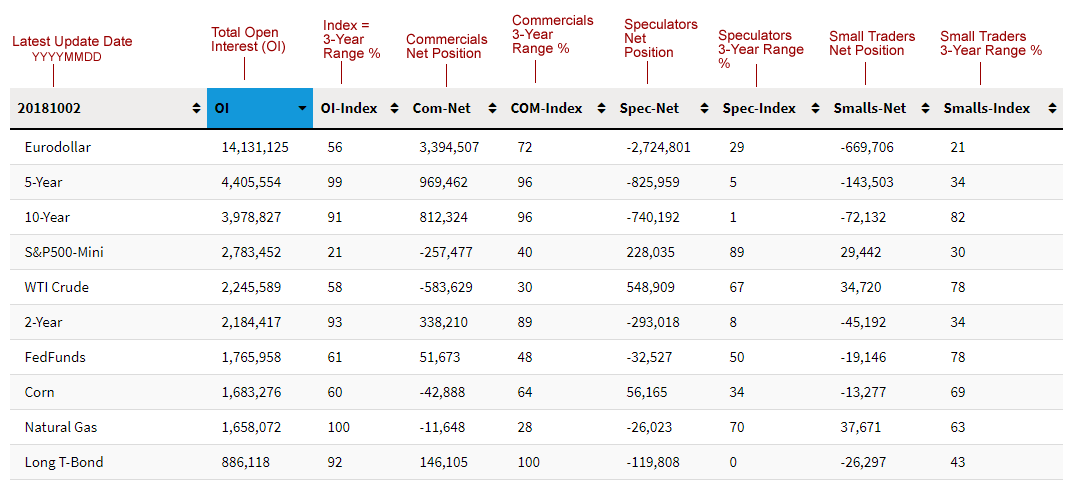
Here are the latest charts and statistics for the Commitment of Traders (COT) data published by the Commodities Futures Trading Commission (CFTC).

The latest COT data is updated through Tuesday September 27th and shows a quick view of how large traders (for-profit speculators and commercial hedgers) were positioned in the futures markets.

Weekly Speculator Changes led by Natural Gas and Bloomberg Commodity Index

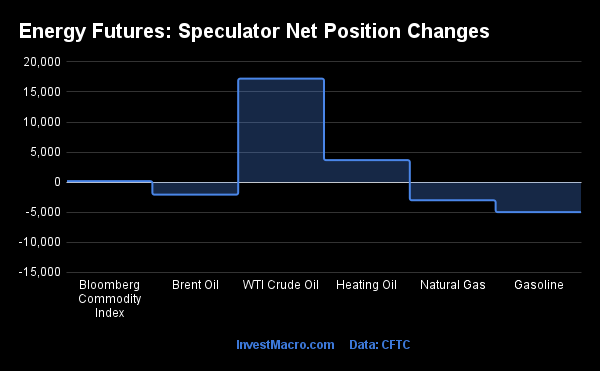
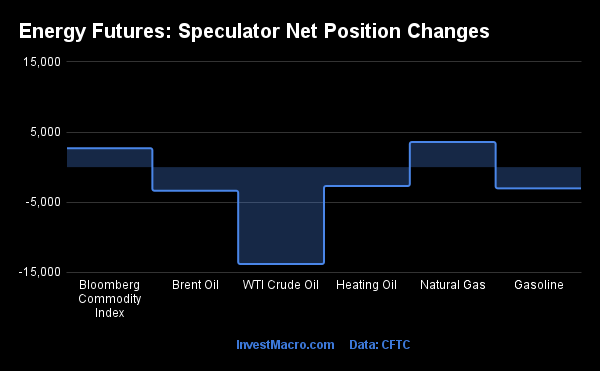
The COT energy market speculator bets were lower this week as two out of the six energy markets we cover had higher positioning this week while the other four markets had lower contracts.

Leading the gains for energy markets was Natural Gas (3,587 contracts) with the Bloomberg Commodity Index (2,703 contracts) also showing a positive week.

The energy markets leading the declines in speculator bets this week was WTI Crude Oil (-13,798 contracts) with Brent Crude Oil (-3,354 contracts), Gasoline (-3,013 contracts) and Heating Oil (-2,683 contracts) also recording lower bets on the week.


Data Snapshot of Commodity Market Traders | Columns Legend
Sep-27-2022OIOI-IndexSpec-NetSpec-IndexCom-NetCOM-IndexSmalls-NetSmalls-Index
WTI Crude1,504,9913226,0804-246,8729820,79235
Gold457,061152,0810-62,13810010,0571
Silver129,000075815-6,860896,1020
Copper173,66113-27,7561628,88486-1,12819
Palladium6,0801-831181,23682-40520
Platinum58,994201619-2,525932,3640
Natural Gas943,2410-152,12433121,1356930,98954
Brent167,44414-41,2574240,4906176720
Heating Oil290,2653111,41459-21,6254810,21134
Soybeans699,3112780,05138-50,20671-29,84521
Corn1,347,27811296,62268-229,43639-67,1864
Coffee185,149144,68077-46,664271,98418
Sugar710,887248,60147-56,409577,80818
Wheat290,77122,735234,67566-7,41072


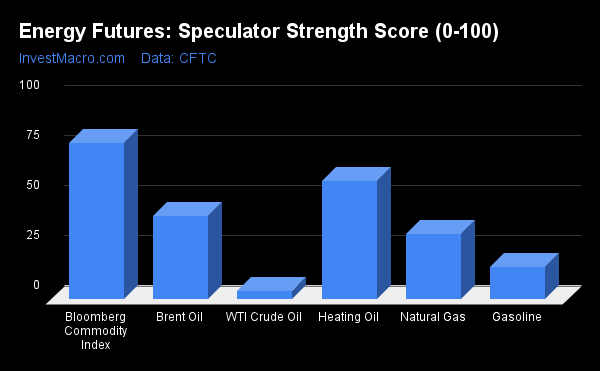
Strength Scores

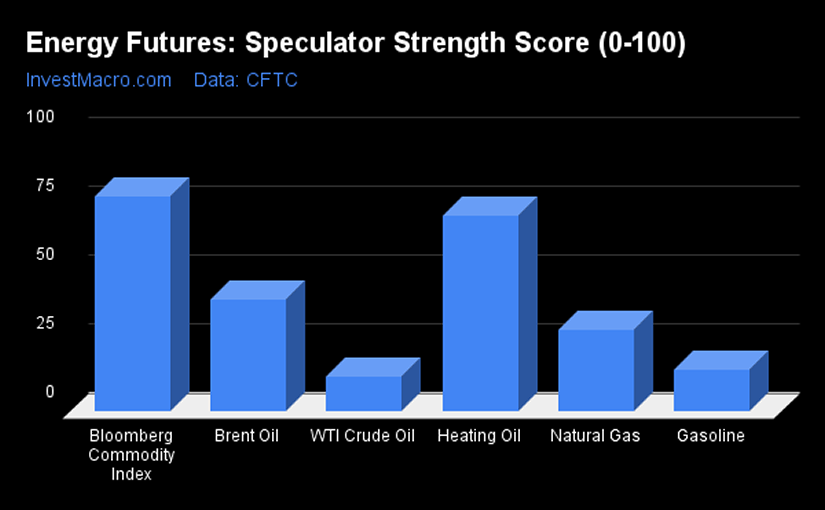
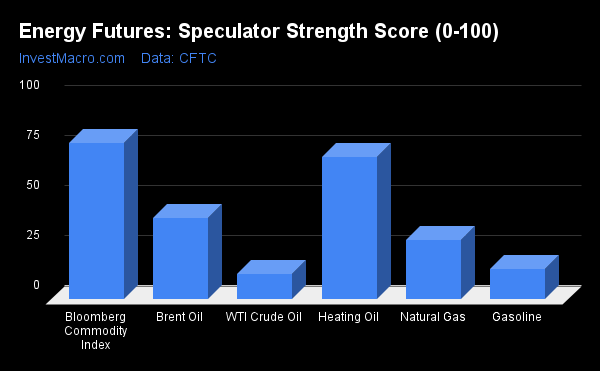
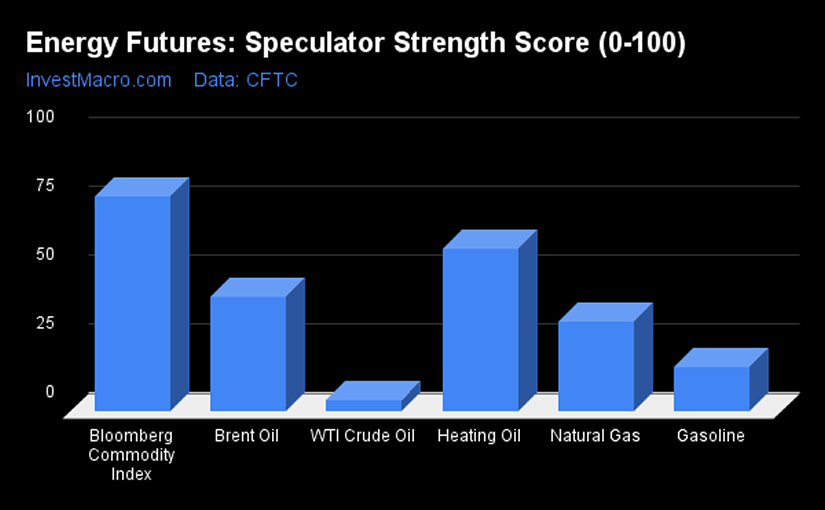
Strength Scores (a normalized measure of Speculator positions over a 3-Year range, from 0 to 100 where above 80 is extreme bullish and below 20 is extreme bearish) showed that the Bloomberg Commodity Index (78.4 percent) and Heating Oil (59.2 percent) lead the energy markets currently. These are the only two markets that have scores above 50 percent or above the midpoint of the 3-year range.

On the downside, the WTI Crude Oil (4.1 percent) comes in at the lowest strength level and is followed by Gasoline at 16.1 percent. Both of these markets are currently in bearish extreme positions with scores below 20 percent.


Strength Statistics:
WTI Crude Oil (4.1 percent) vs WTI Crude Oil previous week (7.7 percent)
Brent Crude Oil (41.9 percent) vs Brent Crude Oil previous week (47.6 percent)
Natural Gas (32.9 percent) vs Natural Gas previous week (31.8 percent)
Gasoline (16.1 percent) vs Gasoline previous week (19.1 percent)
Heating Oil (59.2 percent) vs Heating Oil previous week (63.2 percent)
Bloomberg Commodity Index (78.4 percent) vs Bloomberg Commodity Index previous week (68.0 percent)

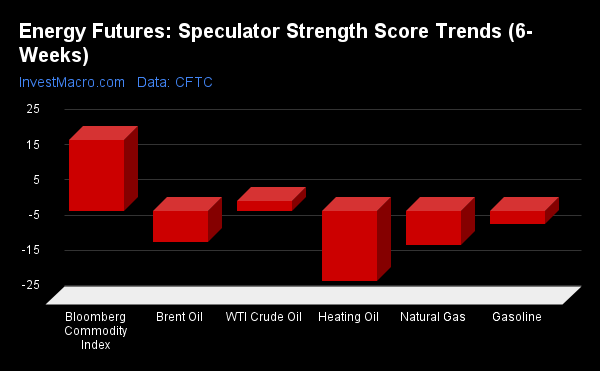
Strength Trends

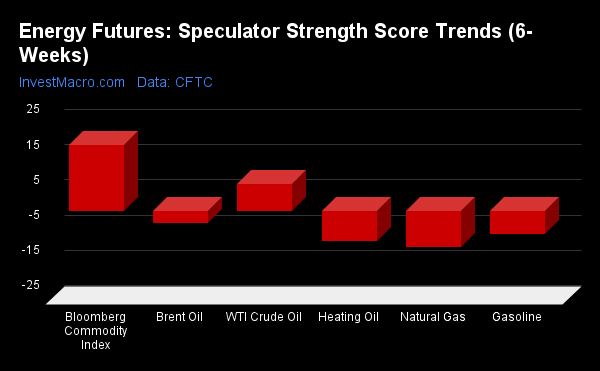
Strength Score Trends (or move index, calculates the 6-week changes in strength scores) showed that the Bloomberg Commodity Index (20.2 percent) leads the past six weeks trends for energy this week. The only other positive mover in the latest trends data was WTI Crude Oil at 2.9 percent.

Heating Oil (-19.9 percent) leads the downside trend scores currently while the next market with lower trend scores was Natural Gas (-9.4 percent) followed by Brent Crude Oil (-8.8 percent).

Strength Trend Statistics:
WTI Crude Oil (2.9 percent) vs WTI Crude Oil previous week (7.7 percent)
Brent Crude Oil (-8.8 percent) vs Brent Crude Oil previous week (-6.2 percent)
Natural Gas (-9.4 percent) vs Natural Gas previous week (-9.1 percent)
Gasoline (-3.6 percent) vs Gasoline previous week (1.6 percent)
Heating Oil (-19.9 percent) vs Heating Oil previous week (-15.3 percent)
Bloomberg Commodity Index (20.2 percent) vs Bloomberg Commodity Index previous week (8.9 percent)


Individual COT Market Charts:

WTI Crude Oil Futures:

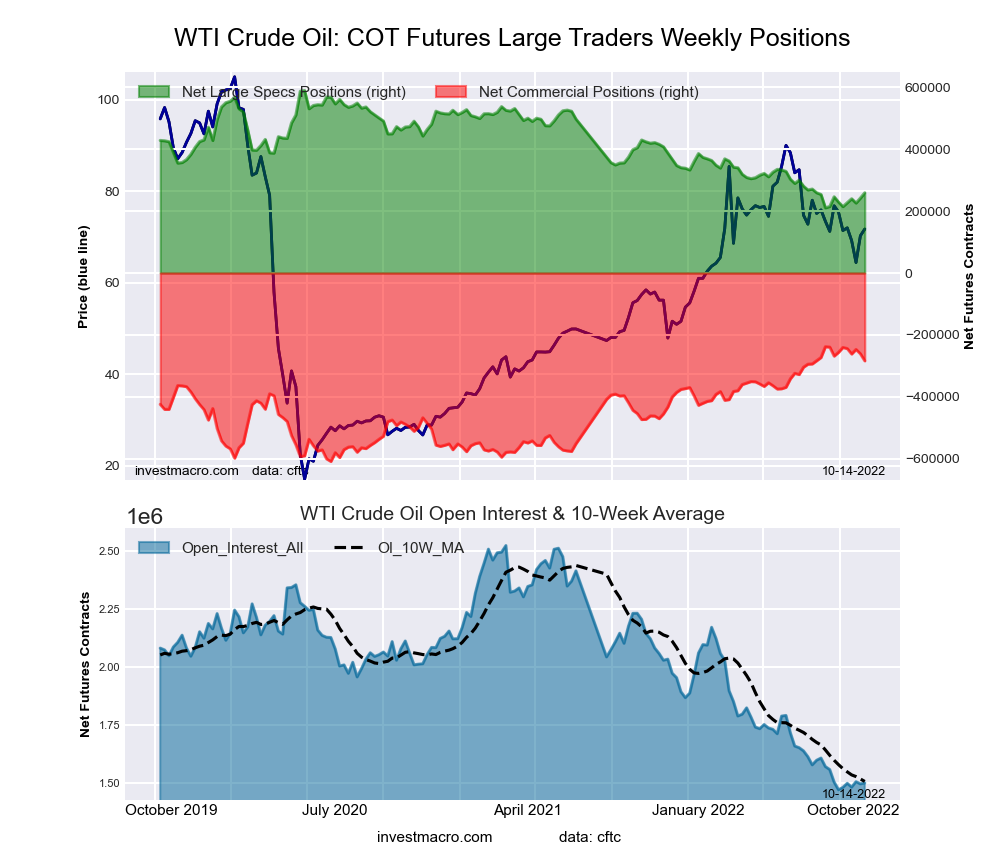
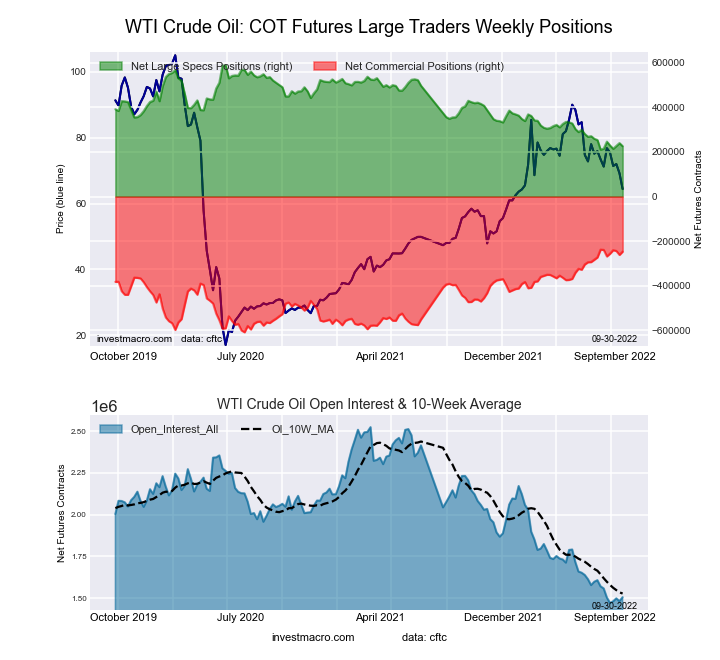
WTI Crude Oil Futures COT ChartThe WTI Crude Oil Futures large speculator standing this week reached a net position of 226,080 contracts in the data reported through Tuesday. This was a weekly fall of -13,798 contracts from the previous week which had a total of 239,878 net contracts.

This week’s current strength score (the trader positioning range over the past three years, measured from 0 to 100) shows the speculators are currently Bearish-Extreme with a score of 4.1 percent. The commercials are Bullish-Extreme with a score of 97.6 percent and the small traders (not shown in chart) are Bearish with a score of 34.7 percent.

WTI Crude Oil Futures StatisticsSPECULATORSCOMMERCIALSSMALL TRADERS
– Percent of Open Interest Longs:22.239.85.0
– Percent of Open Interest Shorts:7.256.23.6
– Net Position:226,080-246,87220,792
– Gross Longs:333,933598,42875,054
– Gross Shorts:107,853845,30054,262
– Long to Short Ratio:3.1 to 10.7 to 11.4 to 1
NET POSITION TREND:
– Strength Index Score (3 Year Range Pct):4.197.634.7
– Strength Index Reading (3 Year Range):Bearish-ExtremeBullish-ExtremeBearish
NET POSITION MOVEMENT INDEX:
– 6-Week Change in Strength Index:2.9-2.0-5.9


Brent Crude Oil Futures:

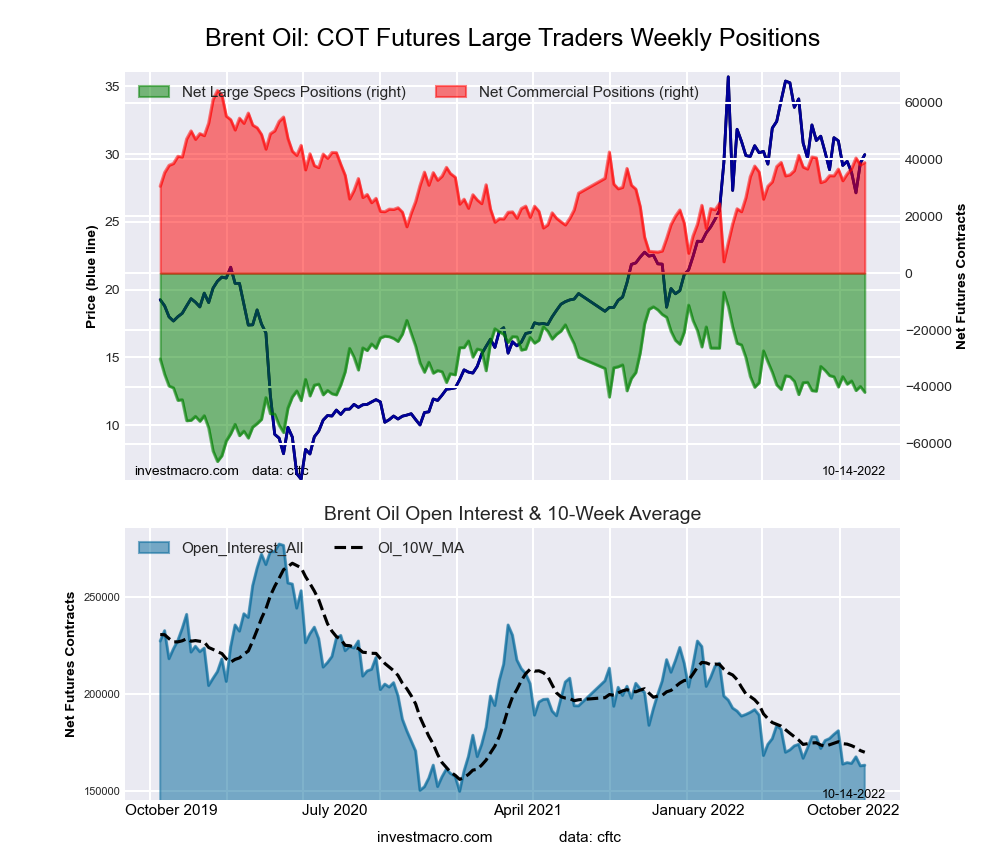
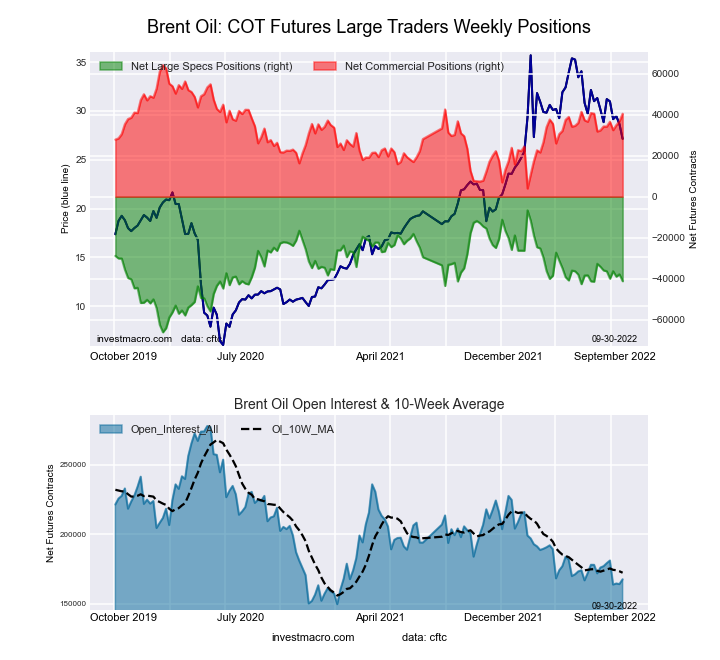
Brent Last Day Crude Oil Futures COT ChartThe Brent Crude Oil Futures large speculator standing this week reached a net position of -41,257 contracts in the data reported through Tuesday. This was a weekly decline of -3,354 contracts from the previous week which had a total of -37,903 net contracts.

This week’s current strength score (the trader positioning range over the past three years, measured from 0 to 100) shows the speculators are currently Bearish with a score of 41.9 percent. The commercials are Bullish with a score of 60.6 percent and the small traders (not shown in chart) are Bearish-Extreme with a score of 19.6 percent.

Brent Crude Oil Futures StatisticsSPECULATORSCOMMERCIALSSMALL TRADERS
– Percent of Open Interest Longs:15.353.24.3
– Percent of Open Interest Shorts:40.029.03.9
– Net Position:-41,25740,490767
– Gross Longs:25,69689,1277,236
– Gross Shorts:66,95348,6376,469
– Long to Short Ratio:0.4 to 11.8 to 11.1 to 1
NET POSITION TREND:
– Strength Index Score (3 Year Range Pct):41.960.619.6
– Strength Index Reading (3 Year Range):BearishBullishBearish-Extreme
NET POSITION MOVEMENT INDEX:
– 6-Week Change in Strength Index:-8.810.3-12.9


Natural Gas Futures:

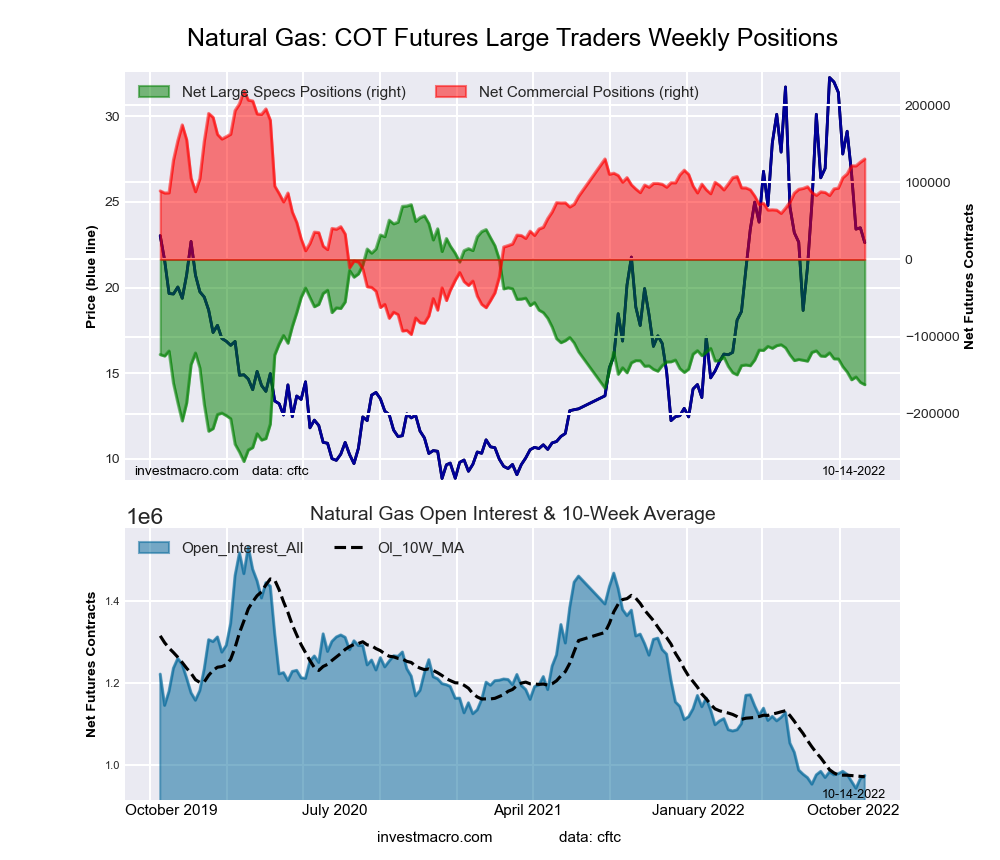
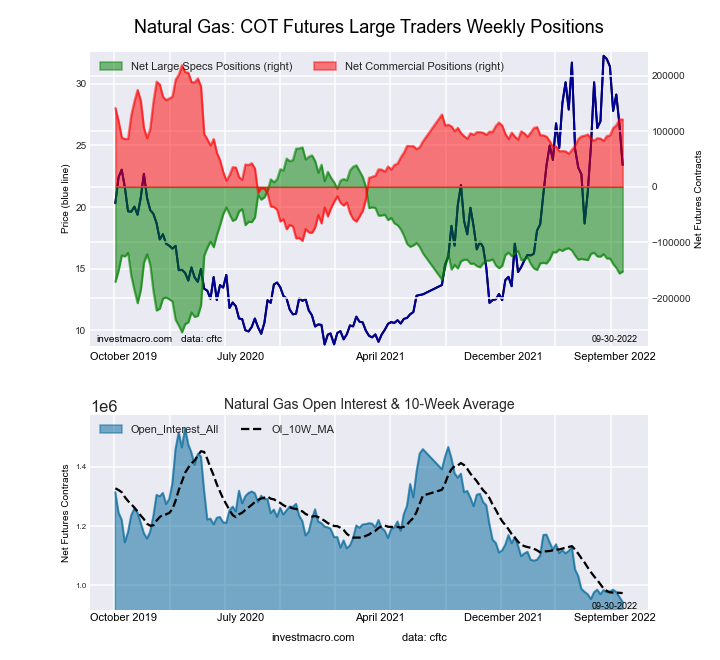
Natural Gas Futures COT ChartThe Natural Gas Futures large speculator standing this week reached a net position of -152,124 contracts in the data reported through Tuesday. This was a weekly lift of 3,587 contracts from the previous week which had a total of -155,711 net contracts.

This week’s current strength score (the trader positioning range over the past three years, measured from 0 to 100) shows the speculators are currently Bearish with a score of 32.9 percent. The commercials are Bullish with a score of 69.1 percent and the small traders (not shown in chart) are Bullish with a score of 53.6 percent.

Natural Gas Futures StatisticsSPECULATORSCOMMERCIALSSMALL TRADERS
– Percent of Open Interest Longs:15.143.36.5
– Percent of Open Interest Shorts:31.230.53.2
– Net Position:-152,124121,13530,989
– Gross Longs:142,021408,87161,287
– Gross Shorts:294,145287,73630,298
– Long to Short Ratio:0.5 to 11.4 to 12.0 to 1
NET POSITION TREND:
– Strength Index Score (3 Year Range Pct):32.969.153.6
– Strength Index Reading (3 Year Range):BearishBullishBullish
NET POSITION MOVEMENT INDEX:
– 6-Week Change in Strength Index:-9.412.1-16.6


Gasoline Blendstock Futures:

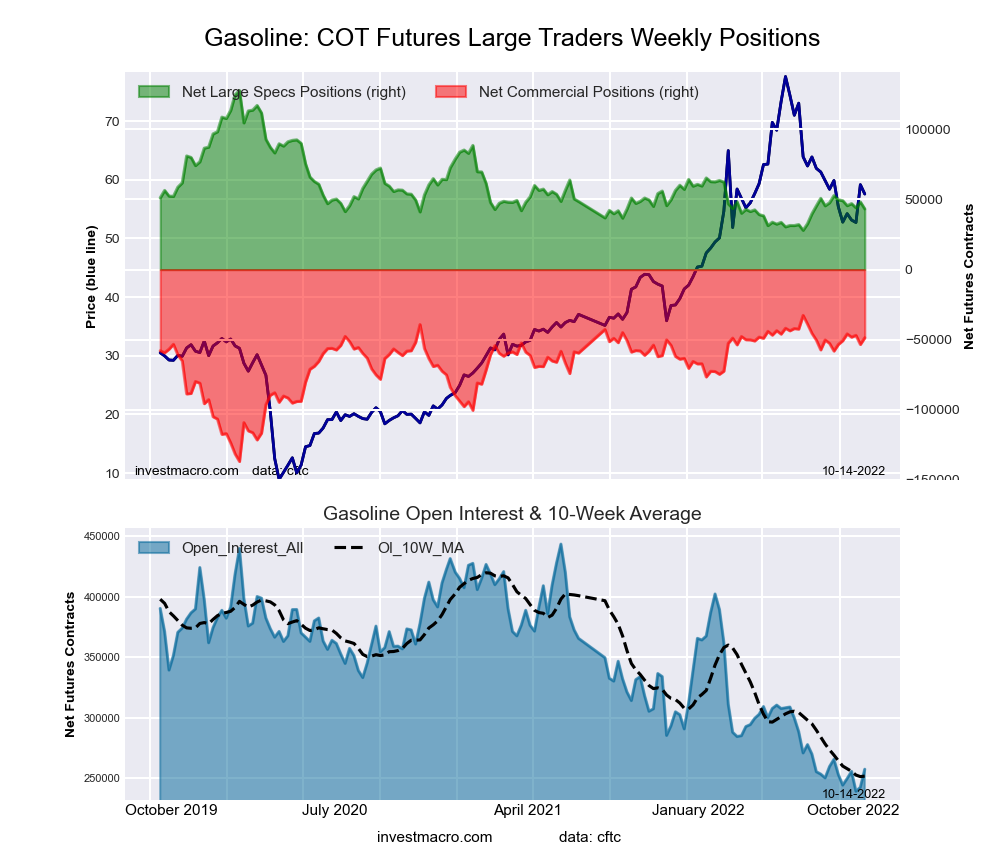
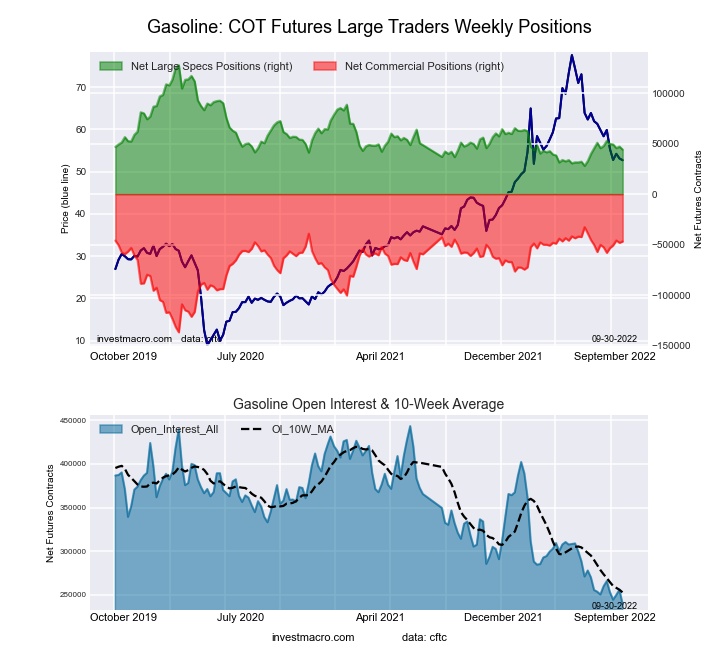
RBOB Gasoline Energy Futures COT ChartThe Gasoline Blendstock Futures large speculator standing this week reached a net position of 44,060 contracts in the data reported through Tuesday. This was a weekly lowering of -3,013 contracts from the previous week which had a total of 47,073 net contracts.

This week’s current strength score (the trader positioning range over the past three years, measured from 0 to 100) shows the speculators are currently Bearish-Extreme with a score of 16.1 percent. The commercials are Bullish-Extreme with a score of 86.4 percent and the small traders (not shown in chart) are Bearish with a score of 31.7 percent.

Nasdaq Mini Futures StatisticsSPECULATORSCOMMERCIALSSMALL TRADERS
– Percent of Open Interest Longs:32.946.87.6
– Percent of Open Interest Shorts:14.566.46.4
– Net Position:44,060-46,9042,844
– Gross Longs:78,843111,94718,200
– Gross Shorts:34,783158,85115,356
– Long to Short Ratio:2.3 to 10.7 to 11.2 to 1
NET POSITION TREND:
– Strength Index Score (3 Year Range Pct):16.186.431.7
– Strength Index Reading (3 Year Range):Bearish-ExtremeBullish-ExtremeBearish
NET POSITION MOVEMENT INDEX:
– 6-Week Change in Strength Index:-3.65.5-14.1


#2 Heating Oil NY-Harbor Futures:

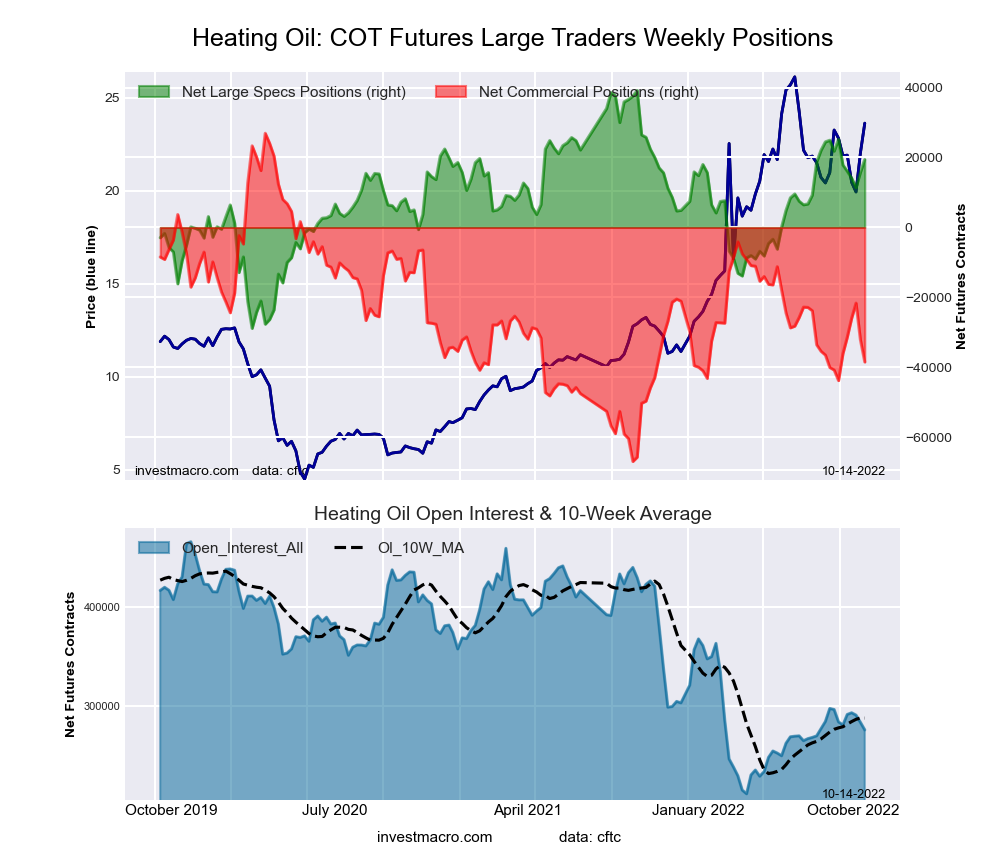
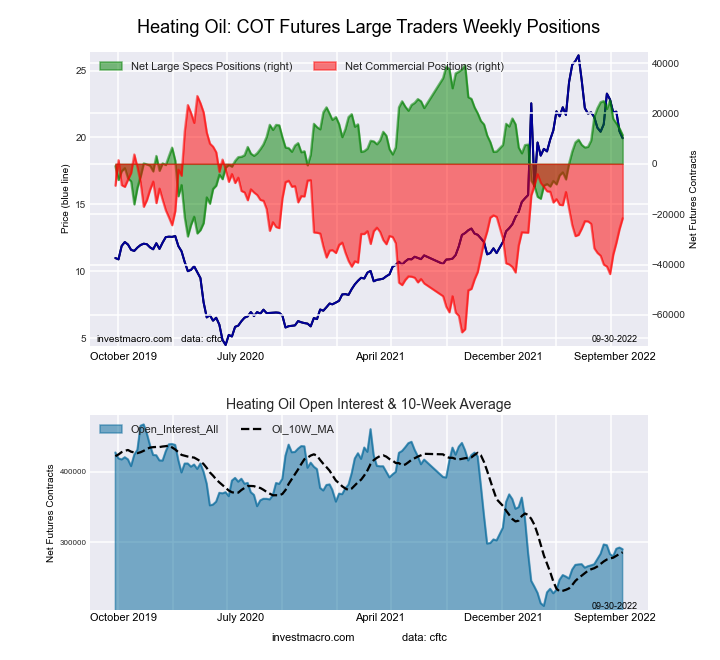
NY Harbor Heating Oil Energy Futures COT ChartThe #2 Heating Oil NY-Harbor Futures large speculator standing this week reached a net position of 11,414 contracts in the data reported through Tuesday. This was a weekly decline of -2,683 contracts from the previous week which had a total of 14,097 net contracts.

This week’s current strength score (the trader positioning range over the past three years, measured from 0 to 100) shows the speculators are currently Bullish with a score of 59.2 percent. The commercials are Bearish with a score of 48.2 percent and the small traders (not shown in chart) are Bearish with a score of 33.7 percent.

Heating Oil Futures StatisticsSPECULATORSCOMMERCIALSSMALL TRADERS
– Percent of Open Interest Longs:13.653.313.2
– Percent of Open Interest Shorts:9.760.89.7
– Net Position:11,414-21,62510,211
– Gross Longs:39,591154,77838,397
– Gross Shorts:28,177176,40328,186
– Long to Short Ratio:1.4 to 10.9 to 11.4 to 1
NET POSITION TREND:
– Strength Index Score (3 Year Range Pct):59.248.233.7
– Strength Index Reading (3 Year Range):BullishBearishBearish
NET POSITION MOVEMENT INDEX:
– 6-Week Change in Strength Index:-19.919.6-16.9


Bloomberg Commodity Index Futures:

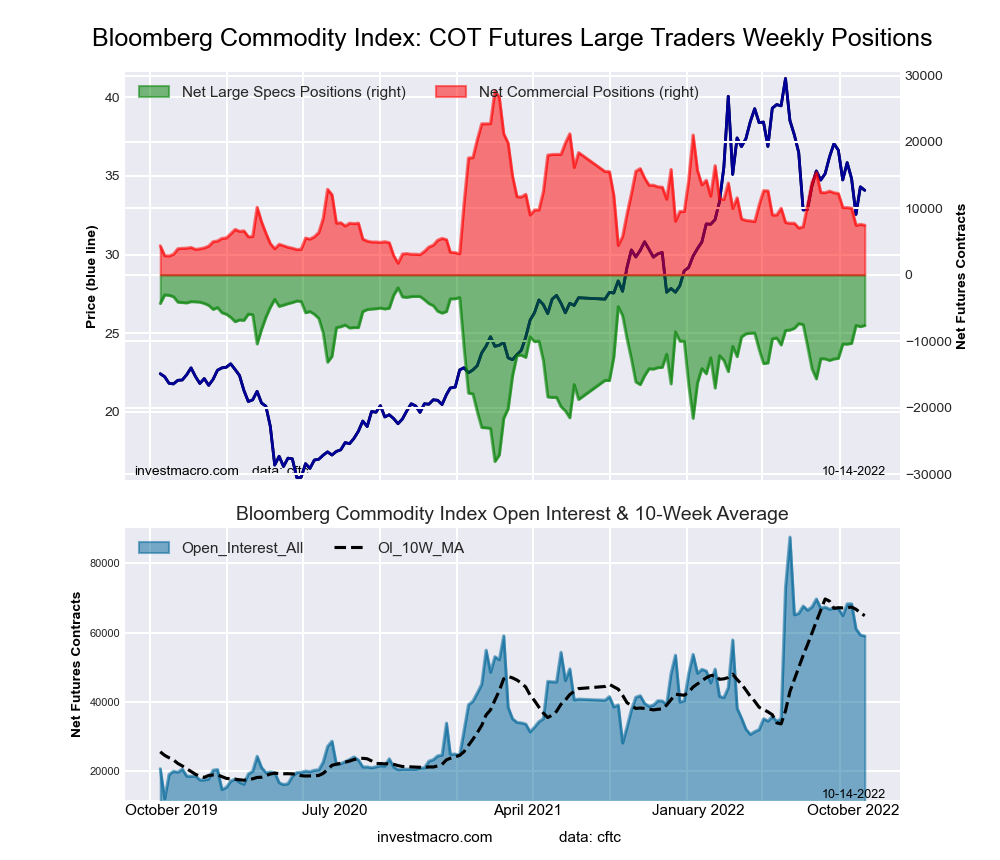
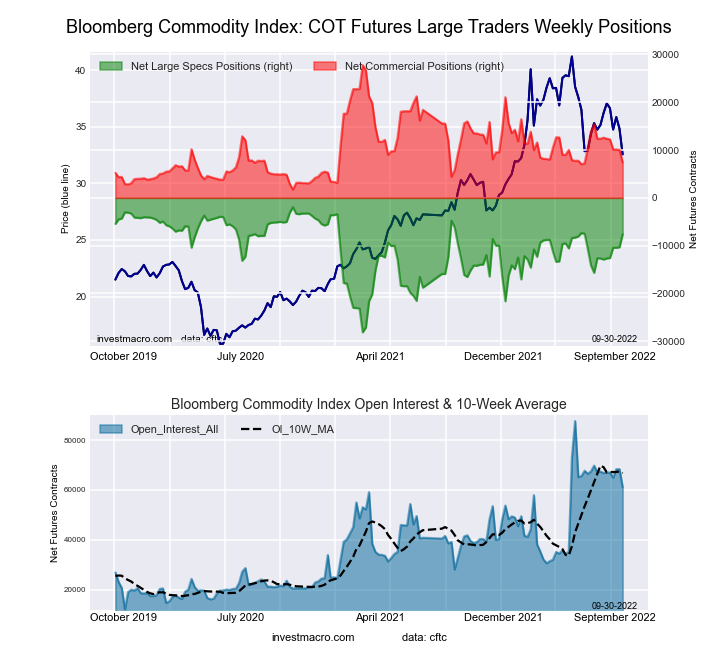
Bloomberg Commodity Index Futures COT ChartThe Bloomberg Commodity Index Futures large speculator standing this week reached a net position of -7,614 contracts in the data reported through Tuesday. This was a weekly gain of 2,703 contracts from the previous week which had a total of -10,317 net contracts.

This week’s current strength score (the trader positioning range over the past three years, measured from 0 to 100) shows the speculators are currently Bullish with a score of 78.4 percent. The commercials are Bearish with a score of 21.9 percent and the small traders (not shown in chart) are Bearish-Extreme with a score of 16.1 percent.

Bloomberg Index Futures StatisticsSPECULATORSCOMMERCIALSSMALL TRADERS
– Percent of Open Interest Longs:24.074.10.4
– Percent of Open Interest Shorts:36.461.90.2
– Net Position:-7,6147,445169
– Gross Longs:14,65245,267271
– Gross Shorts:22,26637,822102
– Long to Short Ratio:0.7 to 11.2 to 12.7 to 1
NET POSITION TREND:
– Strength Index Score (3 Year Range Pct):78.421.916.1
– Strength Index Reading (3 Year Range):BullishBearishBearish-Extreme
NET POSITION MOVEMENT INDEX:
– 6-Week Change in Strength Index:20.2-19.8-4.9


Article By InvestMacroReceive our weekly COT Newsletter

*COT Report: The COT data, released weekly to the public each Friday, is updated through the most recent Tuesday (data is 3 days old) and shows a quick view of how large speculators or non-commercials (for-profit traders) were positioned in the futures markets.

The CFTC categorizes trader positions according to commercial hedgers (traders who use futures contracts for hedging as part of the business), non-commercials (large traders who speculate to realize trading profits) and nonreportable traders (usually small traders/speculators) as well as their open interest (contracts open in the market at time of reporting). See CFTC criteria here.


Solar geoengineering might work, but local temperatures could keep rising for years

By Patrick W. Keys, Colorado State University; Curtis Bell, US Naval War College; Elizabeth A. Barnes, Colorado State University; James W. Hurrell, Colorado State University, and Noah Diffenbaugh, Stanford University 

Imagine a future where, despite efforts to reduce greenhouse gas emissions quickly, parts of the world have become unbearably hot. Some governments might decide to “geoengineer” the planet by spraying substances into the upper atmosphere to form fine reflective aerosols – a process known as stratospheric aerosol injection.

Theoretically, those tiny particles would reflect a little more sunlight back to space, dampening the effects of global warming. Some people envision it having the effect of a volcanic eruption, like Mount Pinatubo in 1991, which cooled the planet by about half a degree Celsius on average for many months. However, like that eruption, the effects could vary widely across the surface of the globe.

How quickly might you expect to notice your local temperatures falling? One year? Five years? Ten years?

What if your local temperatures seem to be going up?

As it turns out, that is exactly what could happen. While modeling studies show that stratospheric aerosol injection could stop global temperatures from increasing further, our research shows that temperatures locally or regionally might continue to increase over the following few years. This insight is essential for the general public and policymakers to understand so that climate policies are evaluated fairly and interpreted based on the best available science.

Why local temperatures might continue to rise

In an article published in the Proceedings of the National Academy of Sciences on Sept. 27, 2022, we explore how the effectiveness of stratospheric aerosol injection could be hidden by the natural variability of Earth’s climate.

Natural climate variability refers to variations in climate that are not driven by humans, such as chaotic, unpredictable interactions within and between the ocean, atmosphere, land and sea ice. One example of natural climate variability is the El Niño Southern Oscillation phenomena. During an El Niño year – or its opposite, La Niña – many parts of the world experience warmer or cooler conditions than they might otherwise. These are inescapable features of Earth’s climate system.

We looked at 10 climate model simulations that include stratospheric aerosol injection and analyzed the temperatures that people might experience over a 10-year period if enough aerosols were added to limit the rise in global temperatures to 1.5 degrees Celsius (2.7 F) above preindustrial levels, the U.N. Paris climate agreement goal.

Illustration shows effects of blocking solar energy at different layers of the atmosphere.
Some potential methods limiting the amount of solar energy in the atmosphere.
Chelsea Thompson, NOAA/CIRES

We found that a substantial fraction of the Earth’s population could experience continued warming even as average temperatures decreased at a global scale, with as much as 55% still experiencing rising temperatures for a decade after stratospheric aerosol injection begins.

This could be true in parts of the largest and richest countries in the world, including the United States, China, India and parts of Europe. The very countries that have the ability to attempt stratospheric aerosol injection in the future could be those most likely to still see temperatures rise.

Consequences are still poorly understood

Many different types of solar radiation modification have been proposed, but most experts consider stratospheric aerosol injection to be both the most effective and least expensive approach.

The basic idea would be to produce tiny, reflective particles in part of the stratosphere between about 12 and 16 miles (20 and 25 kilometers) in altitude – which is above where airplanes typically fly. While some science fiction stories suggest that rockets might be used to do this, most experts think that modified aircraft would be required to distribute aerosols both high enough and consistently enough.

In 2021, the U.S. National Academies of Sciences, Engineering, and Medicine released a report on the topic of solar radiation modification, including stratospheric aerosol injection. The report was written by a committee of climate scientists, economists, lawyers and others. The group came to the conclusion that the U.S. should fund research on the topic. It recommended this in part because the consequences of solar radiation modification were still poorly understood.

This lack of understanding is quite a risk, since it remains unknown what might happen if the world pursues strategies like stratospheric aerosol injection, let alone if a specific country or organization decides to pursue these interventions by itself.

Pros and cons of solar geoengineering. The Economist via YouTube.

In our view, research into the potential consequences of stratospheric aerosol injection should include studies to examine potential changes in crop yields, shifts in global rainfall patterns or changes in critical regions of the Earth’s biosphere, like the Amazon rainforest. The fact is that we don’t know very well what would happen with stratospheric aerosol injection – which is why research on this topic is so critical.

Reducing emissions is fundamental to curb climate change

We want to be absolutely clear that we are not advocating for the actual use of stratospheric aerosol injection.

The most direct way to avoid the uncertainty of solar radiation modification strategies like stratospheric aerosol injection is to address the root cause of global warming. That, as documented by many scientific studies, will require the aggressive reduction of emissions of carbon dioxide, methane and other greenhouse gases into the atmosphere.The Conversation

About the Authors:

Patrick W. Keys, Assistant Professor, Department of Atmospheric Science, Colorado State University; Curtis Bell, Associate Professor of Maritime Security and Governance, US Naval War College; Elizabeth A. Barnes, Professor of Atmospheric Science, Colorado State University; James W. Hurrell, Professor and Scott Presidential Chair in Environmental Science and Engineering, Colorado State University, and Noah Diffenbaugh, Professor of Earth System Science, Stanford University

This article is republished from The Conversation under a Creative Commons license. Read the original article.


WTI Crude Oil leads Energy Speculator Bet Changes this week

By InvestMacro

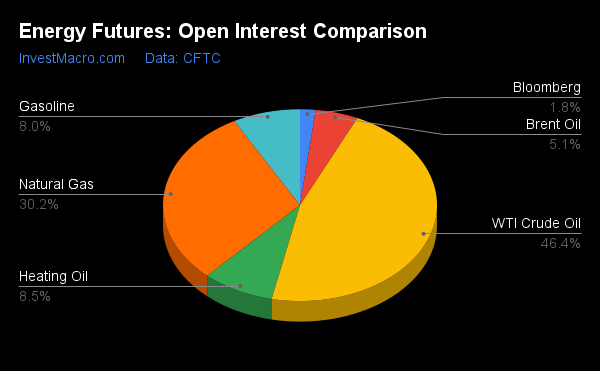
Energy Futures Open Interest OI Comparison

Here are the latest charts and statistics for the Commitment of Traders (COT) data published by the Commodities Futures Trading Commission (CFTC).

The latest COT data is updated through Tuesday September 20th and shows a quick view of how large traders (for-profit speculators and commercial hedgers) were positioned in the futures markets.

WTI Crude Oil leads the Weekly Speculator Changes

The COT energy market speculator bets were a little higher this week as four out of the six energy markets we cover had higher positioning this week while the other two markets had lower contracts.

Leading the gains for energy markets was WTI Crude Oil (12,821 contracts) with Gasoline (1,481 contracts), Brent Crude Oil (1,120 contracts) and Bloomberg Commodity Index (117 contracts) also showing positive weeks.

The energy markets leading the declines in speculator bets this week were Natural Gas (-9,996 contracts) with Heating Oil (-1,967 contracts) also registering lower bets on the week.


Data Snapshot of Commodity Market Traders | Columns Legend
Sep-20-2022OIOI-IndexSpec-NetSpec-IndexCom-NetCOM-IndexSmalls-NetSmalls-Index
WTI Crude1,481,5451239,8788-261,5689421,69036
Gold469,395565,7220-75,4281009,7060
Silver132,1070-1,64012-5,629907,2694
Copper163,0584-20,2862223,21582-2,9298
Palladium5,9931-1,081171,26182-18033
Platinum62,900272,39012-5,496893,1065
Natural Gas960,2361-155,71132121,3086934,40362
Brent164,02511-37,9034836,732541,17125
Heating Oil292,6343214,09763-25,9414411,84439
Soybeans656,3101884,77339-55,48570-29,28822
Corn1,330,8419305,67769-241,23838-64,4396
Coffee191,433541,07274-42,998301,92617
Sugar744,972837,34544-35,86061-1,4856
Wheat285,5670-4,029149,98274-5,95380


Strength Scores

Strength Scores (a normalized measure of Speculator positions over a 3-Year range, from 0 to 100 where above 80 is extreme bullish and below 20 is extreme bearish) showed that the Bloomberg Commodity Index (68.0 percent) and Heating Oil (63.2 percent) lead the energy category this week and are the only two markets above their midpoint of the past three years (50 percent).

On the downside, WTI Crude Oil (7.7 percent) and Gasoline (19.1 percent) come in at the lowest strength levels currently and are in bearish extreme positions (below 20 percent). Natural Gas (31.8 percent) and Brent Crude Oil (47.6 percent) are the next lowest strength scores.

Strength Statistics:
WTI Crude Oil (7.7 percent) vs WTI Crude Oil previous week (4.3 percent)
Brent Crude Oil (47.6 percent) vs Brent Crude Oil previous week (45.7 percent)
Natural Gas (31.8 percent) vs Natural Gas previous week (34.8 percent)
Gasoline (19.1 percent) vs Gasoline previous week (17.6 percent)
Heating Oil (63.2 percent) vs Heating Oil previous week (66.1 percent)
Bloomberg Commodity Index (68.0 percent) vs Bloomberg Commodity Index previous week (67.6 percent)

Strength Trends

Strength Score Trends (or move index, calculates the 6-week changes in strength scores) show that the Bloomberg Commodity Index (8.9 percent) leads the past six weeks trends for energy this week. WTI Crude Oil (7.7 percent) and Gasoline (1.6 percent) fill out the other positive movers in the latest trends data.

Heating Oil (-15.3 percent) leads the downside trend scores currently while the next markets with lower trend scores were Natural Gas (-9.1 percent) followed by Brent Crude Oil (-6.2 percent).


Strength Trend Statistics:
WTI Crude Oil (7.7 percent) vs WTI Crude Oil previous week (-7.0 percent)
Brent Crude Oil (-6.2 percent) vs Brent Crude Oil previous week (-10.5 percent)
Natural Gas (-9.1 percent) vs Natural Gas previous week (-6.2 percent)
Gasoline (1.6 percent) vs Gasoline previous week (-5.2 percent)
Heating Oil (-15.3 percent) vs Heating Oil previous week (-8.8 percent)
Bloomberg Commodity Index (8.9 percent) vs Bloomberg Commodity Index previous week (8.4 percent)


Individual COT Market Charts:

WTI Crude Oil Futures:

WTI Crude Oil Futures COT ChartThe WTI Crude Oil Futures large speculator standing this week equaled a net position of 239,878 contracts in the data reported through Tuesday. This was a weekly increase of 12,821 contracts from the previous week which had a total of 227,057 net contracts.

This week’s current strength score (the trader positioning range over the past three years, measured from 0 to 100) shows the speculators are currently Bearish-Extreme with a score of 7.7 percent. The commercials are Bullish-Extreme with a score of 93.7 percent and the small traders (not shown in chart) are Bearish with a score of 36.2 percent.

WTI Crude Oil Futures StatisticsSPECULATORSCOMMERCIALSSMALL TRADERS
– Percent of Open Interest Longs:23.139.84.9
– Percent of Open Interest Shorts:6.957.43.5
– Net Position:239,878-261,56821,690
– Gross Longs:342,588589,44573,243
– Gross Shorts:102,710851,01351,553
– Long to Short Ratio:3.3 to 10.7 to 11.4 to 1
NET POSITION TREND:
– Strength Index Score (3 Year Range Pct):7.793.736.2
– Strength Index Reading (3 Year Range):Bearish-ExtremeBullish-ExtremeBearish
NET POSITION MOVEMENT INDEX:
– 6-Week Change in Strength Index:7.7-6.3-9.5


Brent Crude Oil Futures:

Brent Last Day Crude Oil Futures COT ChartThe Brent Crude Oil Futures large speculator standing this week equaled a net position of -37,903 contracts in the data reported through Tuesday. This was a weekly gain of 1,120 contracts from the previous week which had a total of -39,023 net contracts.

This week’s current strength score (the trader positioning range over the past three years, measured from 0 to 100) shows the speculators are currently Bearish with a score of 47.6 percent. The commercials are Bullish with a score of 54.4 percent and the small traders (not shown in chart) are Bearish with a score of 25.1 percent.

Brent Crude Oil Futures StatisticsSPECULATORSCOMMERCIALSSMALL TRADERS
– Percent of Open Interest Longs:15.653.74.7
– Percent of Open Interest Shorts:38.831.34.0
– Net Position:-37,90336,7321,171
– Gross Longs:25,66388,0067,706
– Gross Shorts:63,56651,2746,535
– Long to Short Ratio:0.4 to 11.7 to 11.2 to 1
NET POSITION TREND:
– Strength Index Score (3 Year Range Pct):47.654.425.1
– Strength Index Reading (3 Year Range):BearishBullishBearish
NET POSITION MOVEMENT INDEX:
– 6-Week Change in Strength Index:-6.27.2-8.5


Natural Gas Futures:

Natural Gas Futures COT ChartThe Natural Gas Futures large speculator standing this week equaled a net position of -155,711 contracts in the data reported through Tuesday. This was a weekly fall of -9,996 contracts from the previous week which had a total of -145,715 net contracts.

This week’s current strength score (the trader positioning range over the past three years, measured from 0 to 100) shows the speculators are currently Bearish with a score of 31.8 percent. The commercials are Bullish with a score of 69.2 percent and the small traders (not shown in chart) are Bullish with a score of 61.6 percent.

Natural Gas Futures StatisticsSPECULATORSCOMMERCIALSSMALL TRADERS
– Percent of Open Interest Longs:15.943.56.9
– Percent of Open Interest Shorts:32.230.83.3
– Net Position:-155,711121,30834,403
– Gross Longs:153,110417,43166,185
– Gross Shorts:308,821296,12331,782
– Long to Short Ratio:0.5 to 11.4 to 12.1 to 1
NET POSITION TREND:
– Strength Index Score (3 Year Range Pct):31.869.261.6
– Strength Index Reading (3 Year Range):BearishBullishBullish
NET POSITION MOVEMENT INDEX:
– 6-Week Change in Strength Index:-9.110.9-10.1


Gasoline Blendstock Futures:

RBOB Gasoline Energy Futures COT ChartThe Gasoline Blendstock Futures large speculator standing this week equaled a net position of 47,073 contracts in the data reported through Tuesday. This was a weekly advance of 1,481 contracts from the previous week which had a total of 45,592 net contracts.

This week’s current strength score (the trader positioning range over the past three years, measured from 0 to 100) shows the speculators are currently Bearish-Extreme with a score of 19.1 percent. The commercials are Bullish-Extreme with a score of 85.1 percent and the small traders (not shown in chart) are Bearish with a score of 20.2 percent.

Nasdaq Mini Futures StatisticsSPECULATORSCOMMERCIALSSMALL TRADERS
– Percent of Open Interest Longs:30.549.67.2
– Percent of Open Interest Shorts:12.168.56.8
– Net Position:47,073-48,1921,119
– Gross Longs:77,904126,88718,448
– Gross Shorts:30,831175,07917,329
– Long to Short Ratio:2.5 to 10.7 to 11.1 to 1
NET POSITION TREND:
– Strength Index Score (3 Year Range Pct):19.185.120.2
– Strength Index Reading (3 Year Range):Bearish-ExtremeBullish-ExtremeBearish
NET POSITION MOVEMENT INDEX:
– 6-Week Change in Strength Index:1.62.0-24.2


#2 Heating Oil NY-Harbor Futures:

NY Harbor Heating Oil Energy Futures COT ChartThe #2 Heating Oil NY-Harbor Futures large speculator standing this week equaled a net position of 14,097 contracts in the data reported through Tuesday. This was a weekly fall of -1,967 contracts from the previous week which had a total of 16,064 net contracts.

This week’s current strength score (the trader positioning range over the past three years, measured from 0 to 100) shows the speculators are currently Bullish with a score of 63.2 percent. The commercials are Bearish with a score of 43.6 percent and the small traders (not shown in chart) are Bearish with a score of 39.4 percent.

Heating Oil Futures StatisticsSPECULATORSCOMMERCIALSSMALL TRADERS
– Percent of Open Interest Longs:13.854.713.3
– Percent of Open Interest Shorts:9.063.69.3
– Net Position:14,097-25,94111,844
– Gross Longs:40,428160,16539,038
– Gross Shorts:26,331186,10627,194
– Long to Short Ratio:1.5 to 10.9 to 11.4 to 1
NET POSITION TREND:
– Strength Index Score (3 Year Range Pct):63.243.639.4
– Strength Index Reading (3 Year Range):BullishBearishBearish
NET POSITION MOVEMENT INDEX:
– 6-Week Change in Strength Index:-15.311.2-0.6


Bloomberg Commodity Index Futures:

Bloomberg Commodity Index Futures COT ChartThe Bloomberg Commodity Index Futures large speculator standing this week equaled a net position of -10,317 contracts in the data reported through Tuesday. This was a weekly lift of 117 contracts from the previous week which had a total of -10,434 net contracts.

This week’s current strength score (the trader positioning range over the past three years, measured from 0 to 100) shows the speculators are currently Bullish with a score of 68.0 percent. The commercials are Bearish with a score of 31.9 percent and the small traders (not shown in chart) are Bearish with a score of 20.7 percent.

Bloomberg Index Futures StatisticsSPECULATORSCOMMERCIALSSMALL TRADERS
– Percent of Open Interest Longs:25.270.00.5
– Percent of Open Interest Shorts:40.355.30.1
– Net Position:-10,31710,031286
– Gross Longs:17,20047,853361
– Gross Shorts:27,51737,82275
– Long to Short Ratio:0.6 to 11.3 to 14.8 to 1
NET POSITION TREND:
– Strength Index Score (3 Year Range Pct):68.031.920.7
– Strength Index Reading (3 Year Range):BullishBearishBearish
NET POSITION MOVEMENT INDEX:
– 6-Week Change in Strength Index:8.9-9.00.2


Article By InvestMacroReceive our weekly COT Newsletter

*COT Report: The COT data, released weekly to the public each Friday, is updated through the most recent Tuesday (data is 3 days old) and shows a quick view of how large speculators or non-commercials (for-profit traders) were positioned in the futures markets.

The CFTC categorizes trader positions according to commercial hedgers (traders who use futures contracts for hedging as part of the business), non-commercials (large traders who speculate to realize trading profits) and nonreportable traders (usually small traders/speculators) as well as their open interest (contracts open in the market at time of reporting). See CFTC criteria here.

Natural Gas and Gasoline lead the COT Energy Speculator bets lower

By InvestMacro

Here are the latest charts and statistics for the Commitment of Traders (COT) data published by the Commodities Futures Trading Commission (CFTC).

The latest COT data is updated through Tuesday September 13th and shows a quick view of how large traders (for-profit speculators and commercial entities) were positioned in the futures markets.

Weekly Speculator Changes led lower by Natural Gas and Gasoline

The COT energy market speculator bets were sharply lower this week as just one out of the six energy markets we cover had higher positioning this week while the other five markets had lower contracts.

Leading the gains for energy markets was WTI Crude Oil  with a total gain on the week of 12,579 contracts.

The energy markets leading the declines in speculator bets this week were Natural Gas (-7,077 contracts), Gasoline (-3,574 contracts) and Brent Crude Oil (-2,635 contracts) with Heating Oil (-1,796 contracts) and Bloomberg Commodity Index (-14 contracts) also having lower bets on the week.


Data Snapshot of Commodity Market Traders | Columns Legend
Sep-13-2022OIOI-IndexSpec-NetSpec-IndexCom-NetCOM-IndexSmalls-NetSmalls-Index
WTI Crude1,498,0593227,0574-244,0079816,95028
Gold463,674397,3442-110,9389913,5949
Silver135,5303-4,6409-2,551937,1914
Copper157,9000-18,9862320,51280-1,52616
Palladium6,0851-1,273161,45583-18233
Platinum68,57436-1,8797-2,051933,93017
Natural Gas977,1164-145,71535110,7946634,92163
Brent164,41512-39,0234634,919514,10465
Heating Oil290,9163116,06466-31,3533815,28951
Soybeans643,0181592,11042-61,42468-30,68619
Corn1,310,4116294,56968-234,17939-60,3908
Coffee197,6571042,26775-44,360292,09319
Sugar751,873968,33051-79,4265311,09622
Wheat287,0460-8,128812,97778-4,84985


Strength Scores

Strength Scores (a normalized measure of Speculator positions over a 3-Year range, from 0 to 100 where above 80 is extreme bullish and below 20 is extreme bearish) showed that the Bloomberg Commodity Index (67.6 percent) and Heating Oil (66.1 percent) lead the energy markets. These two markets are the only ones in energy that are above the 3-year midpoint at the current time (above 50 percent).

On the downside, WTI Crude Oil (4.3 percent) comes in at the lowest strength level followed by Gasoline (17.6 percent) and both are in bearish extreme readings (below 20 percent).


Strength Statistics:
WTI Crude Oil (4.3 percent) vs WTI Crude Oil previous week (1.0 percent)
Brent Crude Oil (45.7 percent) vs Brent Crude Oil previous week (50.1 percent)
Natural Gas (34.8 percent) vs Natural Gas previous week (37.0 percent)
Gasoline (17.6 percent) vs Gasoline previous week (21.2 percent)
Heating Oil (66.1 percent) vs Heating Oil previous week (68.7 percent)
Bloomberg Commodity Index (67.6 percent) vs Bloomberg Commodity Index previous week (67.6 percent)

Strength Trends

Strength Score Trends (or move index, calculates the 6-week changes in strength scores) show that the Bloomberg Commodity Index (8.4 percent) leads the past six weeks trends for energy this week and is the only positive mover in the latest trends data.

Brent Crude Oil (-10.5 percent) leads the downside trend scores currently and is followed by Heating Oil (-8.8 percent), WTI Crude Oil (-7.0 percent), Natural Gas (-6.2 percent) and Gasoline (-5.2 percent).


Strength Trend Statistics:
WTI Crude Oil (-7.0 percent) vs WTI Crude Oil previous week (-11.8 percent)
Brent Crude Oil (-10.5 percent) vs Brent Crude Oil previous week (8.6 percent)
Natural Gas (-6.2 percent) vs Natural Gas previous week (-6.1 percent)
Gasoline (-5.2 percent) vs Gasoline previous week (3.8 percent)
Heating Oil (-8.8 percent) vs Heating Oil previous week (-1.2 percent)
Bloomberg Commodity Index (8.4 percent) vs Bloomberg Commodity Index previous week (20.1 percent)


Individual Markets:

WTI Crude Oil Futures:

WTI Crude Oil Futures COT ChartThe WTI Crude Oil Futures large speculator standing this week reached a net position of 227,057 contracts in the data reported through Tuesday. This was a weekly gain of 12,579 contracts from the previous week which had a total of 214,478 net contracts.

This week’s current strength score (the trader positioning range over the past three years, measured from 0 to 100) shows the speculators are currently Bearish-Extreme with a score of 4.3 percent. The commercials are Bullish-Extreme with a score of 98.4 percent and the small traders (not shown in chart) are Bearish with a score of 28.3 percent.

WTI Crude Oil Futures StatisticsSPECULATORSCOMMERCIALSSMALL TRADERS
– Percent of Open Interest Longs:22.740.15.1
– Percent of Open Interest Shorts:7.656.43.9
– Net Position:227,057-244,00716,950
– Gross Longs:340,716600,61875,790
– Gross Shorts:113,659844,62558,840
– Long to Short Ratio:3.0 to 10.7 to 11.3 to 1
NET POSITION TREND:
– Strength Index Score (3 Year Range Pct):4.398.428.3
– Strength Index Reading (3 Year Range):Bearish-ExtremeBullish-ExtremeBearish
NET POSITION MOVEMENT INDEX:
– 6-Week Change in Strength Index:-7.07.8-3.6


Brent Crude Oil Futures:

Brent Last Day Crude Oil Futures COT ChartThe Brent Crude Oil Futures large speculator standing this week reached a net position of -39,023 contracts in the data reported through Tuesday. This was a weekly fall of -2,635 contracts from the previous week which had a total of -36,388 net contracts.

This week’s current strength score (the trader positioning range over the past three years, measured from 0 to 100) shows the speculators are currently Bearish with a score of 45.7 percent. The commercials are Bullish with a score of 51.3 percent and the small traders (not shown in chart) are Bullish with a score of 64.7 percent.

Brent Crude Oil Futures StatisticsSPECULATORSCOMMERCIALSSMALL TRADERS
– Percent of Open Interest Longs:16.753.75.8
– Percent of Open Interest Shorts:40.432.53.3
– Net Position:-39,02334,9194,104
– Gross Longs:27,45588,3219,542
– Gross Shorts:66,47853,4025,438
– Long to Short Ratio:0.4 to 11.7 to 11.8 to 1
NET POSITION TREND:
– Strength Index Score (3 Year Range Pct):45.751.364.7
– Strength Index Reading (3 Year Range):BearishBullishBullish
NET POSITION MOVEMENT INDEX:
– 6-Week Change in Strength Index:-10.55.142.7


Natural Gas Futures:

Natural Gas Futures COT ChartThe Natural Gas Futures large speculator standing this week reached a net position of -145,715 contracts in the data reported through Tuesday. This was a weekly lowering of -7,077 contracts from the previous week which had a total of -138,638 net contracts.

This week’s current strength score (the trader positioning range over the past three years, measured from 0 to 100) shows the speculators are currently Bearish with a score of 34.8 percent. The commercials are Bullish with a score of 65.8 percent and the small traders (not shown in chart) are Bullish with a score of 62.8 percent.

Natural Gas Futures StatisticsSPECULATORSCOMMERCIALSSMALL TRADERS
– Percent of Open Interest Longs:16.042.86.9
– Percent of Open Interest Shorts:30.931.53.3
– Net Position:-145,715110,79434,921
– Gross Longs:155,945418,58067,120
– Gross Shorts:301,660307,78632,199
– Long to Short Ratio:0.5 to 11.4 to 12.1 to 1
NET POSITION TREND:
– Strength Index Score (3 Year Range Pct):34.865.862.8
– Strength Index Reading (3 Year Range):BearishBullishBullish
NET POSITION MOVEMENT INDEX:
– 6-Week Change in Strength Index:-6.27.3-5.8


Gasoline Blendstock Futures:

RBOB Gasoline Energy Futures COT ChartThe Gasoline Blendstock Futures large speculator standing this week reached a net position of 45,592 contracts in the data reported through Tuesday. This was a weekly lowering of -3,574 contracts from the previous week which had a total of 49,166 net contracts.

This week’s current strength score (the trader positioning range over the past three years, measured from 0 to 100) shows the speculators are currently Bearish-Extreme with a score of 17.6 percent. The commercials are Bullish-Extreme with a score of 87.3 percent and the small traders (not shown in chart) are Bearish-Extreme with a score of 14.9 percent.

Nasdaq Mini Futures StatisticsSPECULATORSCOMMERCIALSSMALL TRADERS
– Percent of Open Interest Longs:30.548.67.2
– Percent of Open Interest Shorts:12.267.07.1
– Net Position:45,592-45,909317
– Gross Longs:76,103121,49118,029
– Gross Shorts:30,511167,40017,712
– Long to Short Ratio:2.5 to 10.7 to 11.0 to 1
NET POSITION TREND:
– Strength Index Score (3 Year Range Pct):17.687.314.9
– Strength Index Reading (3 Year Range):Bearish-ExtremeBullish-ExtremeBearish-Extreme
NET POSITION MOVEMENT INDEX:
– 6-Week Change in Strength Index:-5.210.9-41.0


#2 Heating Oil NY-Harbor Futures:

NY Harbor Heating Oil Energy Futures COT ChartThe #2 Heating Oil NY-Harbor Futures large speculator standing this week reached a net position of 16,064 contracts in the data reported through Tuesday. This was a weekly reduction of -1,796 contracts from the previous week which had a total of 17,860 net contracts.

This week’s current strength score (the trader positioning range over the past three years, measured from 0 to 100) shows the speculators are currently Bullish with a score of 66.1 percent. The commercials are Bearish with a score of 37.9 percent and the small traders (not shown in chart) are Bullish with a score of 51.3 percent.

Heating Oil Futures StatisticsSPECULATORSCOMMERCIALSSMALL TRADERS
– Percent of Open Interest Longs:14.155.014.2
– Percent of Open Interest Shorts:8.665.89.0
– Net Position:16,064-31,35315,289
– Gross Longs:41,005160,00041,349
– Gross Shorts:24,941191,35326,060
– Long to Short Ratio:1.6 to 10.8 to 11.6 to 1
NET POSITION TREND:
– Strength Index Score (3 Year Range Pct):66.137.951.3
– Strength Index Reading (3 Year Range):BullishBearishBullish
NET POSITION MOVEMENT INDEX:
– 6-Week Change in Strength Index:-8.84.36.8


Bloomberg Commodity Index Futures:

Bloomberg Commodity Index Futures COT ChartThe Bloomberg Commodity Index Futures large speculator standing this week reached a net position of -10,434 contracts in the data reported through Tuesday. This was a weekly decline of -14 contracts from the previous week which had a total of -10,420 net contracts.

This week’s current strength score (the trader positioning range over the past three years, measured from 0 to 100) shows the speculators are currently Bullish with a score of 67.6 percent. The commercials are Bearish with a score of 32.2 percent and the small traders (not shown in chart) are Bearish with a score of 21.8 percent.

Bloomberg Index Futures StatisticsSPECULATORSCOMMERCIALSSMALL TRADERS
– Percent of Open Interest Longs:26.970.40.7
– Percent of Open Interest Shorts:42.255.60.2
– Net Position:-10,43410,122312
– Gross Longs:18,40248,090447
– Gross Shorts:28,83637,968135
– Long to Short Ratio:0.6 to 11.3 to 13.3 to 1
NET POSITION TREND:
– Strength Index Score (3 Year Range Pct):67.632.221.8
– Strength Index Reading (3 Year Range):BullishBearishBearish
NET POSITION MOVEMENT INDEX:
– 6-Week Change in Strength Index:8.4-8.73.1


Article By InvestMacroReceive our weekly COT Reports by Email

*COT Reports: The COT data, released weekly to the public each Friday, is updated through the most recent Tuesday (data is 3 days old) and shows a quick view of how large speculators or non-commercials (for-profit traders) were positioned in the futures markets.

The CFTC categorizes trader positions according to commercial hedgers (traders who use futures contracts for hedging as part of the business), non-commercials (large traders who speculate to realize trading profits) and nonreportable traders (usually small traders/speculators) as well as their open interest (contracts open in the market at time of reporting). See CFTC criteria here.


Brent is Stressed Again

By RoboForex Analytical Department

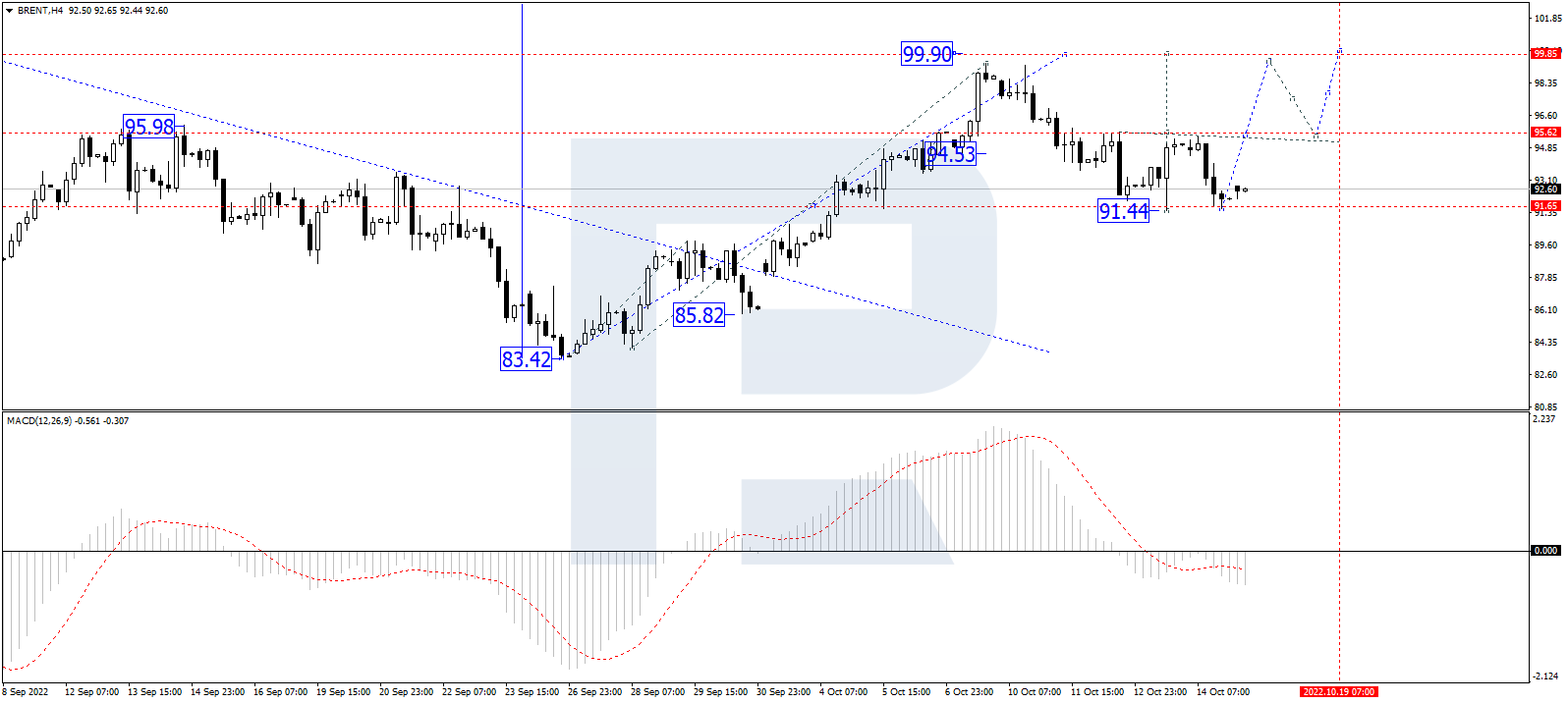
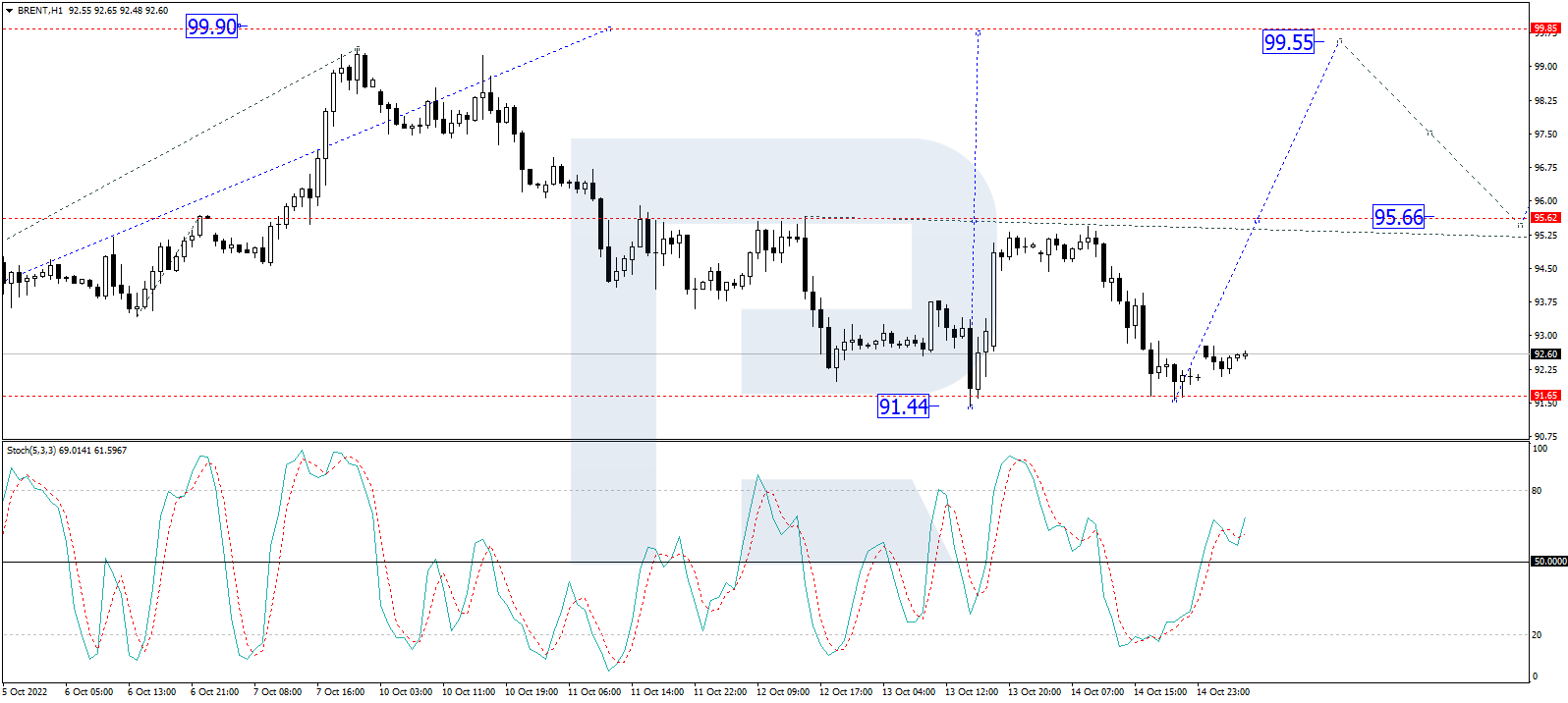
The commodity market remains extremely volatile. On Monday, a Brent barrel is declining to 91.50 USD and looks unstable. Previously, the market was afraid that Russia will cut down on supply and pushed prices upwards, but risks of stable demand have become more serious now.

This week, investors will keep an eye on the flow of inflation statistics both from the EU and the US. In the latter case, the information will help to form clearer expectations from the results of the Fed’s meeting in September.

Baker Hughes statistics, published earlier, demonstrated a decline in the number of active oil rigs in the US – by 5 units to 591 rigs.

Regardless of Brent falling on, the current movement can still be interpreted as a correction of a mighty bullish trend. The quotes are now testing the support area that used to be a strong resistance level in 2018 and 2020. It was broken away only at the beginning of this year. The price pattern is a bullish 5-0. By this pattern, after a correction the price will head for renewing the high, so in the long run, the quotes may rise to 139.00. The downtrend may start again only if the lower border of the Cloud is broken and prices secure under 70.00.

brent crude oil

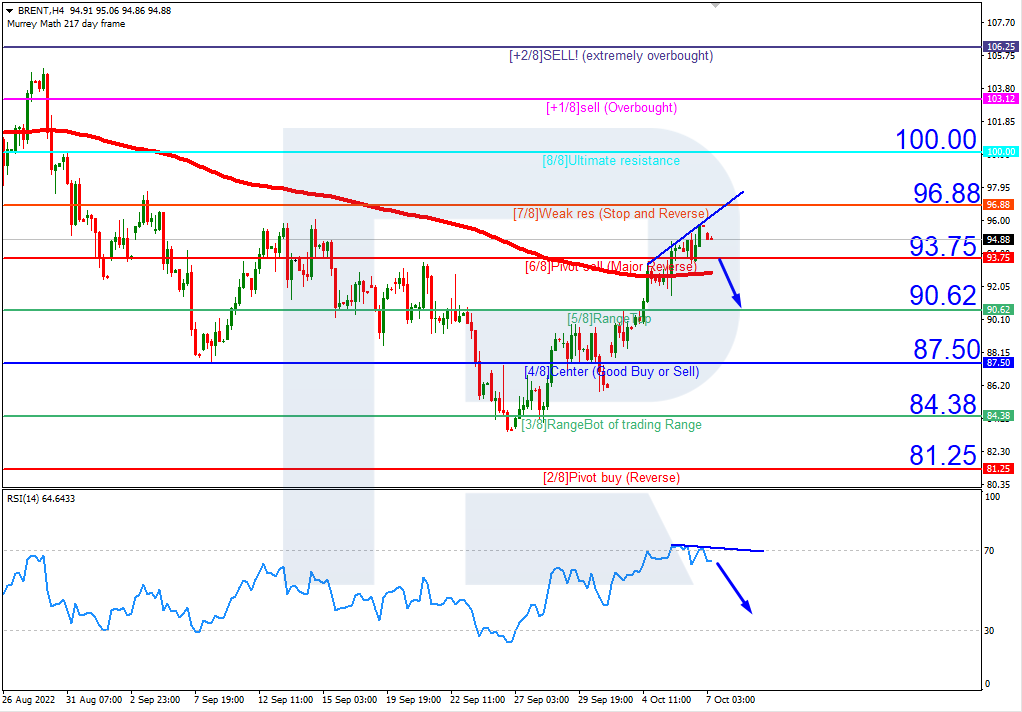
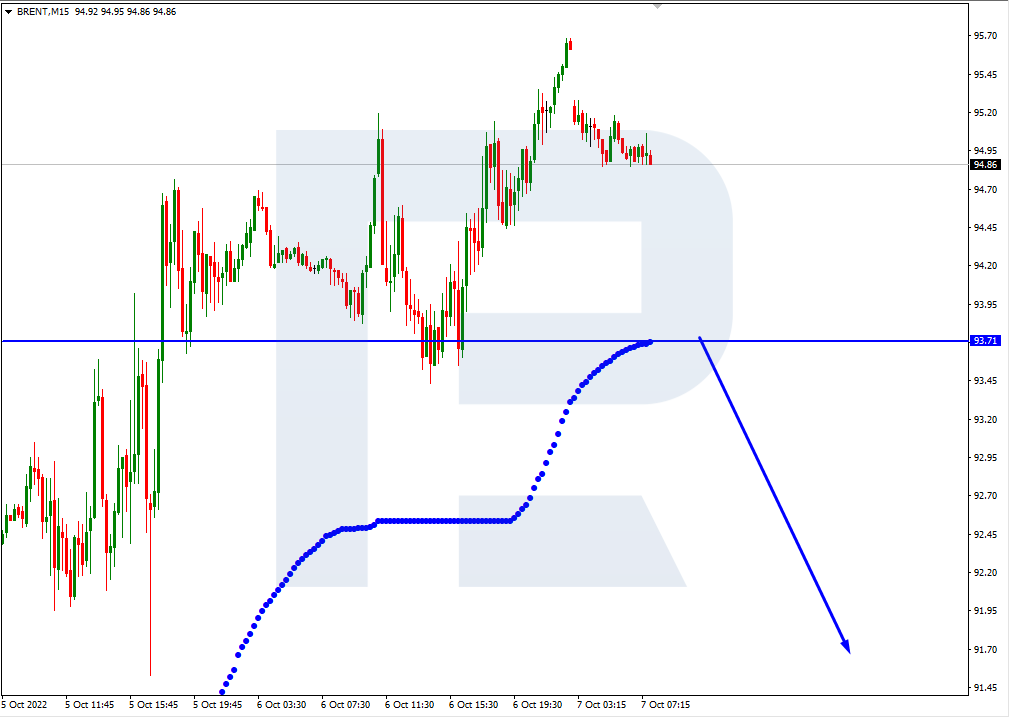
On H4, Brent has bounced off the lower border of a bullish Wolfe Wave. The goal of the movement is 105.45. A strong signal confirming the growth of the pair will be a breakaway of the upper border of the descending channel. With it, the descending movement that started at the end of August will be over. The second signal is a Double Bottom reversal pattern forming on the RSI. The indicator is already testing the upper border of the pattern, and as soon as it is broken away, they might hit 80. A negative scenario for the bulls will be another price decline and securing under 86.00, which will cancel the bullish pattern and indicate further falling.

Disclaimer

Any forecasts contained herein are based on the author’s particular opinion. This analysis may not be treated as trading advice. RoboForex bears no responsibility for trading results based on trading recommendations and reviews contained herein.

COT Energy Speculators Weekly Bets led lower by WTI Crude & Natural Gas

By InvestMacro

Energy Futures Open Interest Comparison

The latest charts and statistics for the Commitment of Traders (COT) data published by the Commodities Futures Trading Commission (CFTC) showed that speculators reduced their positioning in the energy markets. The latest COT data for Week 36 is updated through Tuesday September 6th and shows a quick view of how large traders (for-profit speculators and commercial entities) were positioned in the futures markets.

Weekly Speculator Changes led lower by WTI Crude & Natural Gas

COT Energy Speculators Weekly Bets led lower by WTI Crude & Natural Gas

The COT energy market speculator bets were lower this week as two out of the six energy markets we cover had higher positioning this week while four markets had lower contracts.

Leading the gains for energy markets was Brent Crude Oil (3,625 contracts) and the Bloomberg Commodity Index (2,147 contracts) also showing a positive week.

The energy markets leading the declines in speculator bets this week were WTI Crude Oil (-14,711 contracts) and Natural Gas (-9,873 contracts) with Heating Oil (-7,336 contracts) and Gasoline (-536 contracts) also registering lower bets on the week.


Data Snapshot of Commodity Market Traders | Columns Legend
Sep-06-2022OIOI-IndexSpec-NetSpec-IndexCom-NetCOM-IndexSmalls-NetSmalls-Index
WTI Crude1,480,3201214,4781-240,4179925,93943
Gold465,9084103,8574-114,0649810,2070
Silver138,3005-12,78405,0551007,7296
Copper160,2512-23,9901926,82084-2,8309
Palladium6,0651-1,602142,12987-52713
Platinum78,61053-6,75103,1521003,59912
Natural Gas984,6425-138,63837105,8026432,83658
Brent163,66611-36,3885032,508473,88062
Heating Oil280,2102717,86069-36,0893318,22962
Soybeans606,187781,25138-50,82671-30,42520
Corn1,280,0872286,54767-230,70239-55,84511
Coffee193,938747,16880-49,276252,10819
Sugar760,6011157,77149-61,944564,17313
Wheat289,3290-9,759613,67779-3,91890


Strength Scores

Strength Scores (a normalized measure of Speculator positions over a 3-Year range, from 0 to 100 where above 80 is extreme bullish and below 20 is extreme bearish) show that Heating Oil (68.7 percent) and the Bloomberg Commodity Index (67.6 percent) lead the energy markets currently. Brent Crude Oil (50.1 percent) comes in as the next highest energy market in strength scores and above the 3-Year midpoint.

On the downside, WTI Crude Oil (1.0 percent) comes in at the lowest strength level and is in a bearish extreme level (below 20 percent).

COT Energy Speculators Weekly Bets led lower by WTI Crude & Natural Gas

Strength Statistics:
WTI Crude Oil (1.0 percent) vs WTI Crude Oil previous week (4.9 percent)
Brent Crude Oil (50.1 percent) vs Brent Crude Oil previous week (44.0 percent)
Natural Gas (37.0 percent) vs Natural Gas previous week (39.9 percent)
Gasoline (21.2 percent) vs Gasoline previous week (21.7 percent)
Heating Oil (68.7 percent) vs Heating Oil previous week (79.5 percent)
Bloomberg Commodity Index (67.6 percent) vs Bloomberg Commodity Index previous week (59.4 percent)

Strength Trends

Strength Score Trends (or move index, calculates the 6-week changes in strength scores) show that the Bloomberg Commodity Index (20.1 percent) leads the past six weeks trends for energy this week. Brent Crude Oil (8.6 percent) and Gasoline (3.8 percent) are the only other positive movers in the latest trends data.

WTI Crude Oil (-11.8 percent) leads the downside trend scores currently while the next market with lower trend scores were Natural Gas (-6.1 percent) followed by Heating Oil (-1.2 percent).

COT Energy Speculators Weekly Bets led lower by WTI Crude & Natural Gas

Strength Trend Statistics:
WTI Crude Oil (-11.8 percent) vs WTI Crude Oil previous week (-11.1 percent)
Brent Crude Oil (8.6 percent) vs Brent Crude Oil previous week (2.2 percent)
Natural Gas (-6.1 percent) vs Natural Gas previous week (-2.5 percent)
Gasoline (3.8 percent) vs Gasoline previous week (9.9 percent)
Heating Oil (-1.2 percent) vs Heating Oil previous week (23.5 percent)
Bloomberg Commodity Index (20.1 percent) vs Bloomberg Commodity Index previous week (6.0 percent)


Individual Markets:

WTI Crude Oil Futures:

WTI Crude Oil Futures COT ChartThe WTI Crude Oil Futures large speculator standing this week totaled a net position of 214,478 contracts in the data reported through Tuesday. This was a weekly decrease of -14,711 contracts from the previous week which had a total of 229,189 net contracts.

This week’s current strength score (the trader positioning range over the past three years, measured from 0 to 100) shows the speculators are currently Bearish-Extreme with a score of 1.0 percent. The commercials are Bullish-Extreme with a score of 99.4 percent and the small traders (not shown in chart) are Bearish with a score of 43.2 percent.

WTI Crude Oil Futures StatisticsSPECULATORSCOMMERCIALSSMALL TRADERS
– Percent of Open Interest Longs:22.040.55.3
– Percent of Open Interest Shorts:7.556.83.6
– Net Position:214,478-240,41725,939
– Gross Longs:326,007599,68978,942
– Gross Shorts:111,529840,10653,003
– Long to Short Ratio:2.9 to 10.7 to 11.5 to 1
NET POSITION TREND:
– Strength Index Score (3 Year Range Pct):1.099.443.2
– Strength Index Reading (3 Year Range):Bearish-ExtremeBullish-ExtremeBearish
NET POSITION MOVEMENT INDEX:
– 6-Week Change in Strength Index:-11.811.62.8


Brent Crude Oil Futures:

Brent Last Day Crude Oil Futures COT ChartThe Brent Crude Oil Futures large speculator standing this week totaled a net position of -36,388 contracts in the data reported through Tuesday. This was a weekly boost of 3,625 contracts from the previous week which had a total of -40,013 net contracts.

This week’s current strength score (the trader positioning range over the past three years, measured from 0 to 100) shows the speculators are currently Bullish with a score of 50.1 percent. The commercials are Bearish with a score of 47.3 percent and the small traders (not shown in chart) are Bullish with a score of 61.7 percent.

Brent Crude Oil Futures StatisticsSPECULATORSCOMMERCIALSSMALL TRADERS
– Percent of Open Interest Longs:17.652.65.2
– Percent of Open Interest Shorts:39.832.82.8
– Net Position:-36,38832,5083,880
– Gross Longs:28,73586,1268,497
– Gross Shorts:65,12353,6184,617
– Long to Short Ratio:0.4 to 11.6 to 11.8 to 1
NET POSITION TREND:
– Strength Index Score (3 Year Range Pct):50.147.361.7
– Strength Index Reading (3 Year Range):BullishBearishBullish
NET POSITION MOVEMENT INDEX:
– 6-Week Change in Strength Index:8.6-13.440.0


Natural Gas Futures:

Natural Gas Futures COT ChartThe Natural Gas Futures large speculator standing this week totaled a net position of -138,638 contracts in the data reported through Tuesday. This was a weekly decline of -9,873 contracts from the previous week which had a total of -128,765 net contracts.

This week’s current strength score (the trader positioning range over the past three years, measured from 0 to 100) shows the speculators are currently Bearish with a score of 37.0 percent. The commercials are Bullish with a score of 64.2 percent and the small traders (not shown in chart) are Bullish with a score of 57.9 percent.

Natural Gas Futures StatisticsSPECULATORSCOMMERCIALSSMALL TRADERS
– Percent of Open Interest Longs:16.642.36.8
– Percent of Open Interest Shorts:30.731.53.4
– Net Position:-138,638105,80232,836
– Gross Longs:163,659416,04166,617
– Gross Shorts:302,297310,23933,781
– Long to Short Ratio:0.5 to 11.3 to 12.0 to 1
NET POSITION TREND:
– Strength Index Score (3 Year Range Pct):37.064.257.9
– Strength Index Reading (3 Year Range):BearishBullishBullish
NET POSITION MOVEMENT INDEX:
– 6-Week Change in Strength Index:-6.17.2-5.7


Gasoline Blendstock Futures:

RBOB Gasoline Energy Futures COT ChartThe Gasoline Blendstock Futures large speculator standing this week totaled a net position of 49,166 contracts in the data reported through Tuesday. This was a weekly fall of -536 contracts from the previous week which had a total of 49,702 net contracts.

This week’s current strength score (the trader positioning range over the past three years, measured from 0 to 100) shows the speculators are currently Bearish with a score of 21.2 percent. The commercials are Bullish-Extreme with a score of 82.7 percent and the small traders (not shown in chart) are Bearish with a score of 23.2 percent.

Nasdaq Mini Futures StatisticsSPECULATORSCOMMERCIALSSMALL TRADERS
– Percent of Open Interest Longs:32.747.37.1
– Percent of Open Interest Shorts:12.568.16.5
– Net Position:49,166-50,7381,572
– Gross Longs:79,830115,59117,453
– Gross Shorts:30,664166,32915,881
– Long to Short Ratio:2.6 to 10.7 to 11.1 to 1
NET POSITION TREND:
– Strength Index Score (3 Year Range Pct):21.282.723.2
– Strength Index Reading (3 Year Range):BearishBullish-ExtremeBearish
NET POSITION MOVEMENT INDEX:
– 6-Week Change in Strength Index:3.8-0.4-22.3


#2 Heating Oil NY-Harbor Futures:

NY Harbor Heating Oil Energy Futures COT ChartThe #2 Heating Oil NY-Harbor Futures large speculator standing this week totaled a net position of 17,860 contracts in the data reported through Tuesday. This was a weekly lowering of -7,336 contracts from the previous week which had a total of 25,196 net contracts.

This week’s current strength score (the trader positioning range over the past three years, measured from 0 to 100) shows the speculators are currently Bullish with a score of 68.7 percent. The commercials are Bearish with a score of 32.8 percent and the small traders (not shown in chart) are Bullish with a score of 61.5 percent.

Heating Oil Futures StatisticsSPECULATORSCOMMERCIALSSMALL TRADERS
– Percent of Open Interest Longs:15.053.515.0
– Percent of Open Interest Shorts:8.766.48.5
– Net Position:17,860-36,08918,229
– Gross Longs:42,125149,86242,127
– Gross Shorts:24,265185,95123,898
– Long to Short Ratio:1.7 to 10.8 to 11.8 to 1
NET POSITION TREND:
– Strength Index Score (3 Year Range Pct):68.732.861.5
– Strength Index Reading (3 Year Range):BullishBearishBullish
NET POSITION MOVEMENT INDEX:
– 6-Week Change in Strength Index:-1.2-2.711.7


Bloomberg Commodity Index Futures:

Bloomberg Commodity Index Futures COT ChartThe Bloomberg Commodity Index Futures large speculator standing this week totaled a net position of -10,420 contracts in the data reported through Tuesday. This was a weekly gain of 2,147 contracts from the previous week which had a total of -12,567 net contracts.

This week’s current strength score (the trader positioning range over the past three years, measured from 0 to 100) shows the speculators are currently Bullish with a score of 67.6 percent. The commercials are Bearish with a score of 32.2 percent and the small traders (not shown in chart) are Bearish with a score of 21.2 percent.

Bloomberg Index Futures StatisticsSPECULATORSCOMMERCIALSSMALL TRADERS
– Percent of Open Interest Longs:24.273.80.6
– Percent of Open Interest Shorts:40.258.20.1
– Net Position:-10,42010,122298
– Gross Longs:15,69647,944388
– Gross Shorts:26,11637,82290
– Long to Short Ratio:0.6 to 11.3 to 14.3 to 1
NET POSITION TREND:
– Strength Index Score (3 Year Range Pct):67.632.221.2
– Strength Index Reading (3 Year Range):BullishBearishBearish
NET POSITION MOVEMENT INDEX:
– 6-Week Change in Strength Index:20.1-20.31.4


Article By InvestMacroReceive our weekly COT Reports by Email

*COT Report: The COT data, released weekly to the public each Friday, is updated through the most recent Tuesday (data is 3 days old) and shows a quick view of how large speculators or non-commercials (for-profit traders) were positioned in the futures markets.

The CFTC categorizes trader positions according to commercial hedgers (traders who use futures contracts for hedging as part of the business), non-commercials (large traders who speculate to realize trading profits) and nonreportable traders (usually small traders/speculators) as well as their open interest (contracts open in the market at time of reporting). See CFTC criteria here.

Tiny algae could help fix concrete’s dirty little climate secret – 4 innovative ways to clean up this notoriously hard to decarbonize industry

By Wil Srubar, University of Colorado Boulder 

Humans produce more concrete than any other material on the planet. It is the literal foundation of modern civilization – and for good reason.

Concrete is strong, durable, affordable and available to almost every community on the planet. However, the global concrete industry has a dirty little secret – it alone is responsible for more than 8% of global carbon dioxide emissions – more than three times the emissions associated with aviation. Those emissions doubled in the past two decades as Asian cities grew, and demand is continuing to expand at an unprecedented rate.

It’s also one of the most difficult industries to decarbonize, in part because manufacturers are typically hyperlocal and operate on slim margins, leaving little to invest in technologies that could lower emissions.

However, difficult does not necessarily mean impossible.

Architects, engineers, scientists and cement and concrete manufacturers around the world are investigating and piloting several new strategies and technologies that can significantly reduce the carbon footprint of cement and concrete. Here are a few of them, including one my team at the University of Colorado is working on: figuring out ways to use all-natural microalgae to solve concrete’s biggest emissions problem – cement.

It doesn’t have to be 100% cement

The primary culprit behind concrete’s climate impact is the production of portland cement – the powder used to make concrete.

Cement is made by heating limestone rich in calcium carbonate to over 2,640 degrees Fahrenheit (1,450 Celsius). The calcium carbonate decomposes into calcium oxide, or quicklime, and carbon dioxide – a climate-warming greenhouse gas. This chemical reaction, what the Portland Cement Association calls a “chemical fact of life,” is responsible for a whopping 60% or so of cement-related emissions. The remainder comes from energy to heat the kiln.

One of the most promising short-term strategies for reducing concrete’s carbon footprint uses materials like fly ash from coal plants, slag from iron production, and calcined clay to replace some of the portland cement in concrete mixtures. These are known as supplementary cementitious materials.

Using 20% to 50% fly ash, slag or calcined clay can reduce the embodied carbon of concrete mixtures by about the same percentages.

Another method uses small amounts of ground limestone to replace some of the cement and is becoming a best practice. After rigorous testing, the California Department of Transportation recently announced it would allow portland-limestone cement mixes, known as PLC, in its projects. With 5% to 15% ground limestone replacing cement, PLC can reduce emissions by about the same amount. California’s decision quickly led other states to approve the use of PLC.

Many researchers are now advocating for the adoption of limestone calcined-clay cement, which contains about 55% portland cement, 15% ground limestone and 30% calcined clay. It could cut emissions by more than 45%.

What electrification and carbon capture can do

Cement plants have also started testing carbon capture technologies and electric kilns to slash emissions. But carbon capture is expensive, and scaling the technology to meet the demand of the cement and concrete industry is no easy feat.

Kiln electrification faces the same barriers. New technologies and large capital investments are required to electrify one of the world’s most energy-intensive processes. However, the promise of zero combustion-related emissions is enticing enough for some entrepreneurs and cement companies – including those interested in using 100% solar energy for cement production – who are racing to find solutions that are both technologically and economically viable at scale.

The Inflation Reduction Act, which Congress passed in August 2022, could help put some of these technologies to wider use. It includes funding for modernizing equipment and adding carbon capture capabilities, as well as tax credit incentives for manufacturers to cut their emissions.

Going cement-free, possibly with algae

Another strategy is to produce functionally equivalent materials that contain no portland cement whatsoever.

Materials like alkali-activated slag or fly ash cement concrete are produced by combining slag, fly ash or both with a very strong base. These materials have been shown to cut carbon emissions by 90% or more, and they might meet scale and cost criteria, but they still face technical and regulatory challenges.

Some examples of low-carbon, portland cement-free concrete products that have gained market traction include wollastonite-based modular components, compressed earth blocks and prefabricated biocement products – including those produced using photosynthetic, biomineralizing microalgae.

Algae have also been used as an alternative biofuel for heating cement kilns, and algae cultivation systems have also been linked with cement production to capture carbon.

Author Wil Surubar describes his team’s work with algae to make concrete.

My team at the University of Colorado Boulder and I are looking into the use of algae-derived limestone for portland cement production, which could help eliminate 60% of the emissions associated with cement manufacturing. This technology is appealing because it is plug-and-play with conventional cement production.

Using concrete to lock captured CO2 away

Engineers are also experimenting with injecting captured carbon dioxide into concrete as well as using aggregates made of carbon dioxide in place of gravel or sand that is mixed into concrete.

It’s an exciting concept, but so far injection has yielded limited carbon dioxide reductions, and production of carbon-dioxide-storing aggregates has yet to scale up.

A growing problem

Ultimately, time will tell whether these and other technologies will live up to their promise.

What is certain is that there has been a worldwide reckoning within the cement and concrete industry that it has a problem to solve and no silver bullet solution. It may take a suite of solutions tailored to both local and global markets to address the immediate and long-term challenges of keeping up with an ever-growing population and rapidly changing climate.The Conversation

About the Author:

Wil Srubar, Assistant Professor of Architectural Engineering and Materials Science, University of Colorado Boulder

This article is republished from The Conversation under a Creative Commons license. Read the original article.


WTI Crude, Brent Oil and Gasoline lead COT Energy Speculators bets lower

By InvestMacro | COT | Data Tables | COT Leaders | Downloads | COT Newsletter

Energy Futures Open Interest Comparison(1)

Here are the latest charts and statistics for the Commitment of Traders (COT) data published by the Commodities Futures Trading Commission (CFTC).

The latest COT data is updated through Tuesday August 30th and shows a quick view of how large traders (for-profit speculators and commercial entities) were positioned in the futures markets.

WTI Crude Oil, Brent and Gasoline lead Weekly Speculator Changes lower

The COT energy market speculator bets were lower this week as two out of the six energy markets we cover had higher positioning this week while the other two markets had lower contracts.

Leading the gains for energy markets was Heating Oil (3,373 contracts) with the Bloomberg Commodity Index (98 contracts) also showing a positive week.

The energy market leading the declines in speculator bets this week was WTI Crude Oil (-17,031 contracts) with Brent Crude Oil (-3,589 contracts), Gasoline (-3,088 contracts) and Natural Gas (-155 contracts) also registering lower bets on the week.

Energy Futures Speculator Net Position Changes


Data Snapshot of Commodity Market Traders | Columns Legend
Aug-30-2022OIOI-IndexSpec-NetSpec-IndexCom-NetCOM-IndexSmalls-NetSmalls-Index
WTI Crude1,470,2070229,1895-256,2489527,05948
Gold459,1652117,73410-129,6799211,9452
Silver138,7146-8,27102651008,0068
Copper158,3900-23,2551924,98583-1,73015
Palladium5,8750-1,129161,32382-19433
Platinum70,74740-5,3781646994,73228
Natural Gas978,8814-128,7654092,4636036,30266
Brent180,95224-40,0134436,585543,42856
Heating Oil283,4272925,19679-43,7612518,56563
Soybeans605,924783,56240-52,79168-30,77119
Corn1,267,7350283,39766-225,75940-57,63810
Coffee193,889748,68781-50,983232,29621
Sugar752,642962,55149-72,5935410,04220
Wheat288,5450-11,499414,91481-3,41593


Heating Oil leads the Strength Scores

Strength Scores (a normalized measure of Speculator positions over a 3-Year range, from 0 to 100 where above 80 is extreme bullish and below 20 is extreme bearish) showed that Heating Oil (79.5 percent) leads the energy markets and is just under the bullish extreme position threshold (above 80 percent). The Bloomberg Commodity Index (59.4 percent) comes in as the next highest energy market in strength scores.

On the downside, WTI Crude Oil (4.9 percent) comes in at the lowest strength level currently and is in a bearish extreme position (below 20 percent). The next lowest is Gasoline (21.7 percent) followed by Natural Gas (39.9 percent) and Brent Crude Oil (44.0 percent).


Strength Statistics:
WTI Crude Oil (4.9 percent) vs WTI Crude Oil previous week (9.4 percent)
Brent Crude Oil (44.0 percent) vs Brent Crude Oil previous week (50.1 percent)
Natural Gas (39.9 percent) vs Natural Gas previous week (40.0 percent)
Gasoline (21.7 percent) vs Gasoline previous week (24.8 percent)
Heating Oil (79.5 percent) vs Heating Oil previous week (74.5 percent)
Bloomberg Commodity Index (59.4 percent) vs Bloomberg Commodity Index previous week (59.0 percent)

Heating Oil also leads the 6-Week Strength Trends

Strength Score Trends (or move index, calculates the 6-week changes in strength scores) show that Heating Oil (23.5 percent) leads the past six weeks trends for energy this week. Gasoline (9.9 percent), the Bloomberg Commodity Index (6.0 percent) and Brent Crude Oil (2.2 percent) round out the rest of the positive movers in the latest trends data.

WTI Crude Oil (-11.1 percent) leads the downside trend scores currently while the next market with lower trend scores was Natural Gas (-2.5 percent).


Energy Futures Speculator Strength Score Trends (6-Weeks)(1)
Strength Trend Statistics:
WTI Crude Oil (-11.1 percent) vs WTI Crude Oil previous week (-5.8 percent)
Brent Crude Oil (2.2 percent) vs Brent Crude Oil previous week (3.3 percent)
Natural Gas (-2.5 percent) vs Natural Gas previous week (0.9 percent)
Gasoline (9.9 percent) vs Gasoline previous week (20.1 percent)
Heating Oil (23.5 percent) vs Heating Oil previous week (22.2 percent)
Bloomberg Commodity Index (6.0 percent) vs Bloomberg Commodity Index previous week (-7.5 percent)


Individual Markets:

WTI Crude Oil Futures:

WTI Crude Oil Futures COT ChartThe WTI Crude Oil Futures large speculator standing this week reached a net position of 229,189 contracts in the data reported through Tuesday. This was a weekly decline of -17,031 contracts from the previous week which had a total of 246,220 net contracts.

This week’s current strength score (the trader positioning range over the past three years, measured from 0 to 100) shows the speculators are currently Bearish-Extreme with a score of 4.9 percent. The commercials are Bullish-Extreme with a score of 95.1 percent and the small traders (not shown in chart) are Bearish with a score of 48.3 percent.

WTI Crude Oil Futures StatisticsSPECULATORSCOMMERCIALSSMALL TRADERS
– Percent of Open Interest Longs:22.640.05.3
– Percent of Open Interest Shorts:7.057.53.4
– Net Position:229,189-256,24827,059
– Gross Longs:332,415588,60177,360
– Gross Shorts:103,226844,84950,301
– Long to Short Ratio:3.2 to 10.7 to 11.5 to 1
NET POSITION TREND:
– Strength Index Score (3 Year Range Pct):4.995.148.3
– Strength Index Reading (3 Year Range):Bearish-ExtremeBullish-ExtremeBearish
NET POSITION MOVEMENT INDEX:
– 6-Week Change in Strength Index:-11.110.16.9


Brent Crude Oil Futures:

Brent Last Day Crude Oil Futures COT ChartThe Brent Crude Oil Futures large speculator standing this week reached a net position of -40,013 contracts in the data reported through Tuesday. This was a weekly reduction of -3,589 contracts from the previous week which had a total of -36,424 net contracts.

This week’s current strength score (the trader positioning range over the past three years, measured from 0 to 100) shows the speculators are currently Bearish with a score of 44.0 percent. The commercials are Bullish with a score of 54.1 percent and the small traders (not shown in chart) are Bullish with a score of 55.6 percent.

Brent Crude Oil Futures StatisticsSPECULATORSCOMMERCIALSSMALL TRADERS
– Percent of Open Interest Longs:18.051.85.0
– Percent of Open Interest Shorts:40.131.63.2
– Net Position:-40,01336,5853,428
– Gross Longs:32,55693,6809,137
– Gross Shorts:72,56957,0955,709
– Long to Short Ratio:0.4 to 11.6 to 11.6 to 1
NET POSITION TREND:
– Strength Index Score (3 Year Range Pct):44.054.155.6
– Strength Index Reading (3 Year Range):BearishBullishBullish
NET POSITION MOVEMENT INDEX:
– 6-Week Change in Strength Index:2.2-7.140.2


Natural Gas Futures:

Natural Gas Futures COT ChartThe Natural Gas Futures large speculator standing this week reached a net position of -128,765 contracts in the data reported through Tuesday. This was a weekly decrease of -155 contracts from the previous week which had a total of -128,610 net contracts.

This week’s current strength score (the trader positioning range over the past three years, measured from 0 to 100) shows the speculators are currently Bearish with a score of 39.9 percent. The commercials are Bullish with a score of 60.0 percent and the small traders (not shown in chart) are Bullish with a score of 66.1 percent.

Natural Gas Futures StatisticsSPECULATORSCOMMERCIALSSMALL TRADERS
– Percent of Open Interest Longs:17.342.06.7
– Percent of Open Interest Shorts:30.432.53.0
– Net Position:-128,76592,46336,302
– Gross Longs:168,924410,93065,677
– Gross Shorts:297,689318,46729,375
– Long to Short Ratio:0.6 to 11.3 to 12.2 to 1
NET POSITION TREND:
– Strength Index Score (3 Year Range Pct):39.960.066.1
– Strength Index Reading (3 Year Range):BearishBullishBullish
NET POSITION MOVEMENT INDEX:
– 6-Week Change in Strength Index:-2.51.86.3


Gasoline Blendstock Futures:

RBOB Gasoline Energy Futures COT ChartThe Gasoline Blendstock Futures large speculator standing this week reached a net position of 49,702 contracts in the data reported through Tuesday. This was a weekly decline of -3,088 contracts from the previous week which had a total of 52,790 net contracts.

This week’s current strength score (the trader positioning range over the past three years, measured from 0 to 100) shows the speculators are currently Bearish with a score of 21.7 percent. The commercials are Bullish-Extreme with a score of 80.1 percent and the small traders (not shown in chart) are Bearish with a score of 37.6 percent.

Nasdaq Mini Futures StatisticsSPECULATORSCOMMERCIALSSMALL TRADERS
– Percent of Open Interest Longs:31.947.37.3
– Percent of Open Interest Shorts:12.368.45.8
– Net Position:49,702-53,4383,736
– Gross Longs:80,794119,87518,480
– Gross Shorts:31,092173,31314,744
– Long to Short Ratio:2.6 to 10.7 to 11.3 to 1
NET POSITION TREND:
– Strength Index Score (3 Year Range Pct):21.780.137.6
– Strength Index Reading (3 Year Range):BearishBullish-ExtremeBearish
NET POSITION MOVEMENT INDEX:
– 6-Week Change in Strength Index:9.9-7.6-13.0


#2 Heating Oil NY-Harbor Futures:

NY Harbor Heating Oil Energy Futures COT ChartThe #2 Heating Oil NY-Harbor Futures large speculator standing this week reached a net position of 25,196 contracts in the data reported through Tuesday. This was a weekly advance of 3,373 contracts from the previous week which had a total of 21,823 net contracts.

This week’s current strength score (the trader positioning range over the past three years, measured from 0 to 100) shows the speculators are currently Bullish with a score of 79.5 percent. The commercials are Bearish with a score of 24.7 percent and the small traders (not shown in chart) are Bullish with a score of 62.7 percent.

Heating Oil Futures StatisticsSPECULATORSCOMMERCIALSSMALL TRADERS
– Percent of Open Interest Longs:17.351.514.6
– Percent of Open Interest Shorts:8.566.98.0
– Net Position:25,196-43,76118,565
– Gross Longs:49,157145,89341,370
– Gross Shorts:23,961189,65422,805
– Long to Short Ratio:2.1 to 10.8 to 11.8 to 1
NET POSITION TREND:
– Strength Index Score (3 Year Range Pct):79.524.762.7
– Strength Index Reading (3 Year Range):BullishBearishBullish
NET POSITION MOVEMENT INDEX:
– 6-Week Change in Strength Index:23.5-21.313.9


Bloomberg Commodity Index Futures:

Bloomberg Commodity Index Futures COT ChartThe Bloomberg Commodity Index Futures large speculator standing this week reached a net position of -12,567 contracts in the data reported through Tuesday. This was a weekly lift of 98 contracts from the previous week which had a total of -12,665 net contracts.

This week’s current strength score (the trader positioning range over the past three years, measured from 0 to 100) shows the speculators are currently Bullish with a score of 59.4 percent. The commercials are Bearish with a score of 40.4 percent and the small traders (not shown in chart) are Bearish with a score of 22.3 percent.

Bloomberg Index Futures StatisticsSPECULATORSCOMMERCIALSSMALL TRADERS
– Percent of Open Interest Longs:23.774.30.6
– Percent of Open Interest Shorts:42.556.00.1
– Net Position:-12,56712,243324
– Gross Longs:15,86849,746419
– Gross Shorts:28,43537,50395
– Long to Short Ratio:0.6 to 11.3 to 14.4 to 1
NET POSITION TREND:
– Strength Index Score (3 Year Range Pct):59.440.422.3
– Strength Index Reading (3 Year Range):BullishBearishBearish
NET POSITION MOVEMENT INDEX:
– 6-Week Change in Strength Index:6.0-6.44.0


Article By InvestMacroReceive our weekly COT Reports by Email

*COT Report: The COT data, released weekly to the public each Friday, is updated through the most recent Tuesday (data is 3 days old) and shows a quick view of how large speculators or non-commercials (for-profit traders) were positioned in the futures markets.

The CFTC categorizes trader positions according to commercial hedgers (traders who use futures contracts for hedging as part of the business), non-commercials (large traders who speculate to realize trading profits) and nonreportable traders (usually small traders/speculators) as well as their open interest (contracts open in the market at time of reporting). See CFTC criteria here.