Archive for Energy – Page 2

COT Energy Charts: Bloomberg Commodity Index Speculator Bets Surge Higher

By InvestMacro 

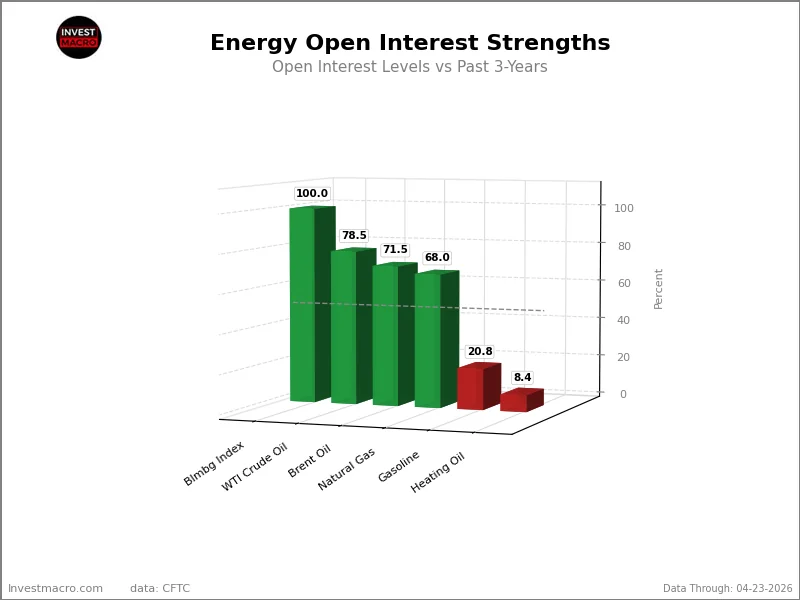
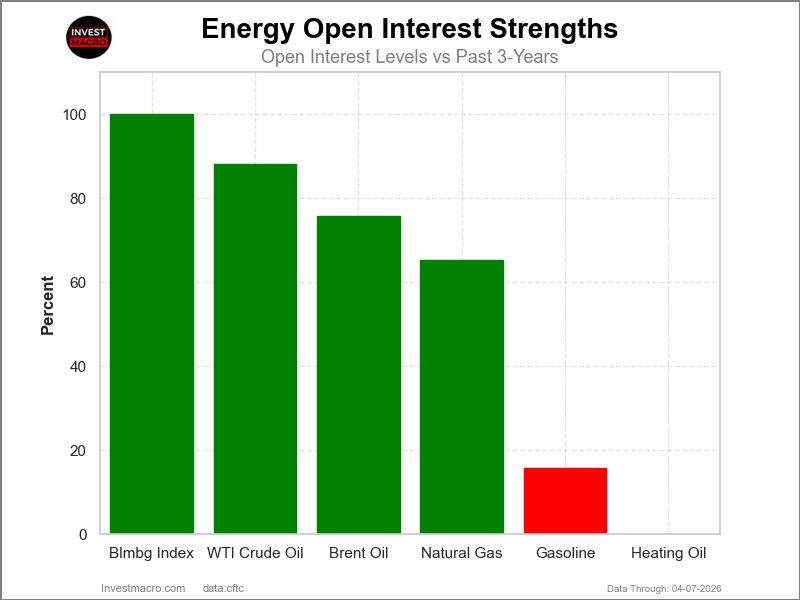
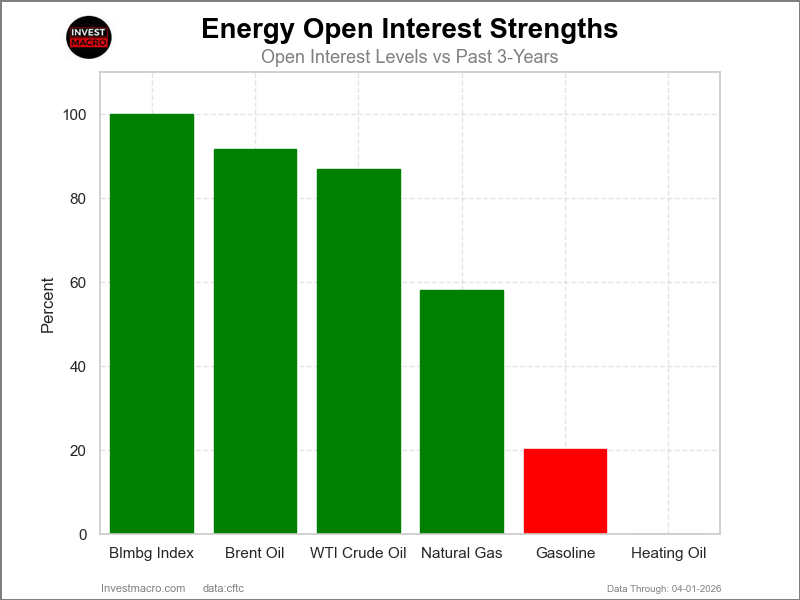
Speculators OI Energy Futures COT Chart
Here are the latest charts and statistics for the Commitment of Traders (COT) data published by the Commodities Futures Trading Commission (CFTC).

The latest COT data is updated through Tuesday March 31st and shows a quick view of how large traders (for-profit speculators and commercial entities) were positioned in the futures markets.

Weekly Speculator Changes led by the Bloomberg Commodity Index

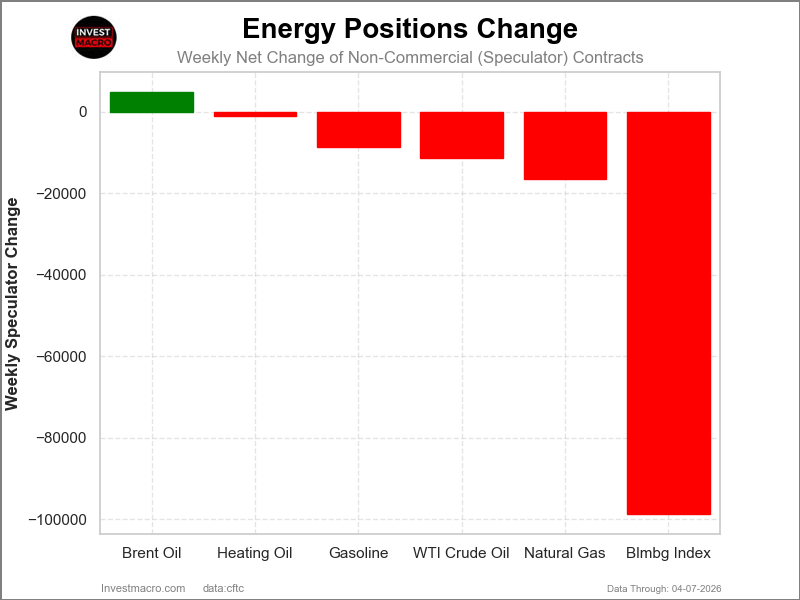
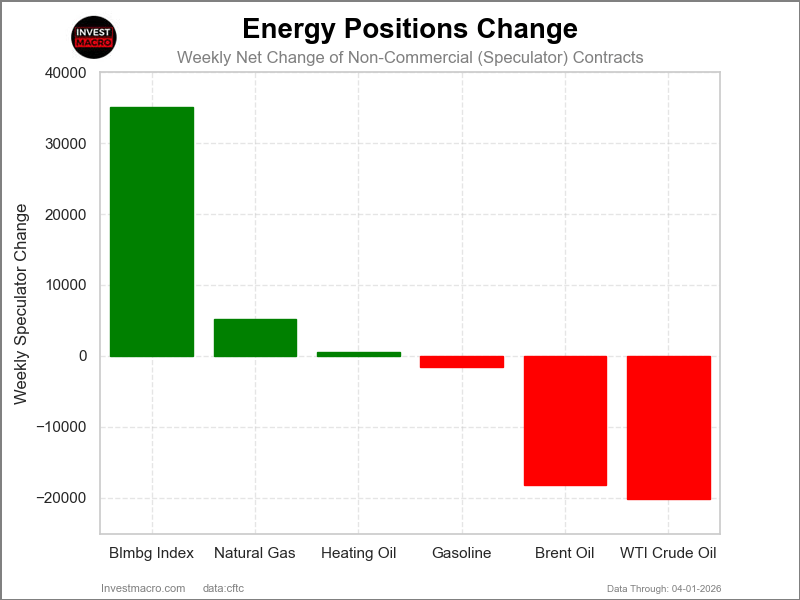
Speculators Nets Energy Futures COT Chart
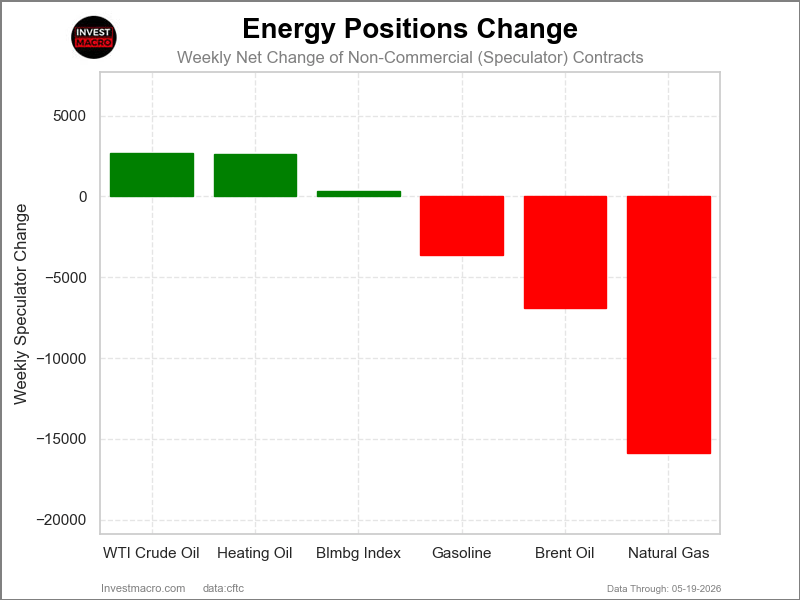
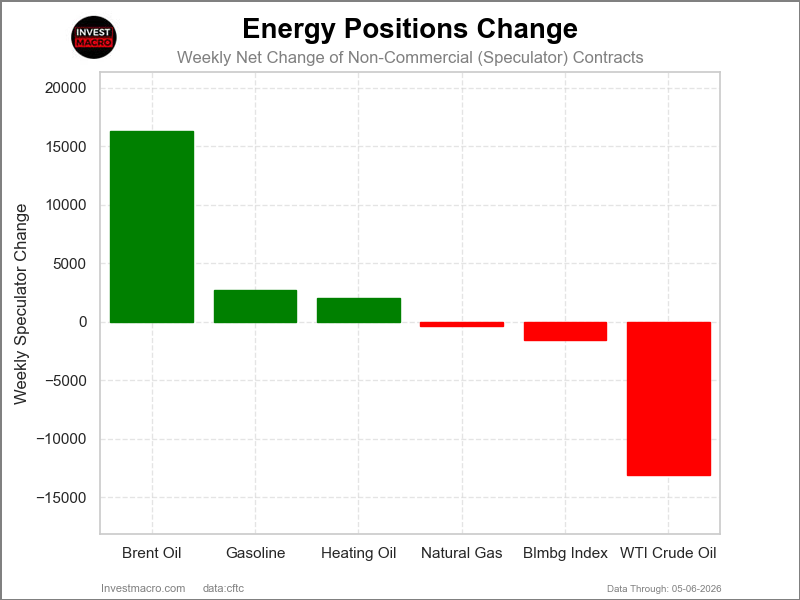
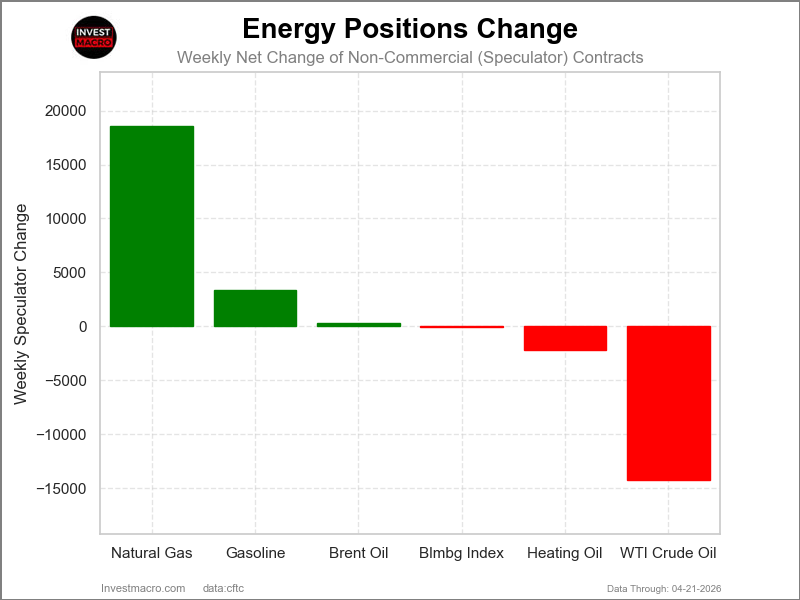
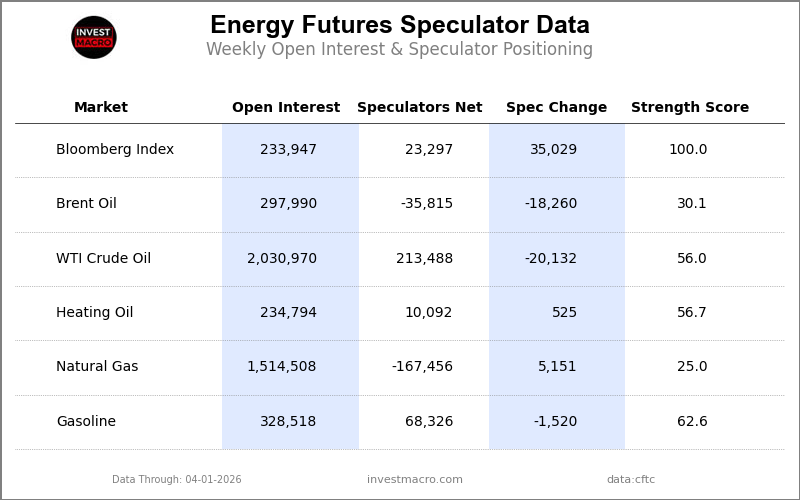
The COT energy market speculator bets were mixed this week as three out of the six energy markets we cover had higher positioning while the other three markets had lower speculator contracts.

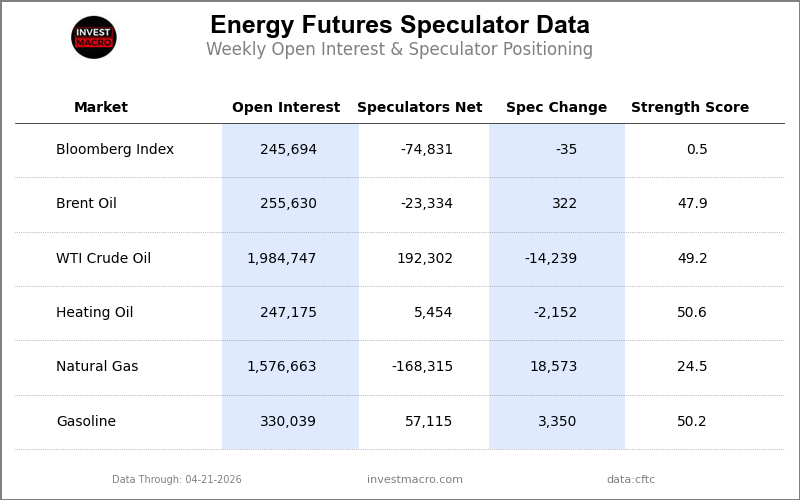
Leading the gains for the energy markets was the Bloomberg Commodity Index (35,029 contracts) with Natural Gas (5,151 contracts) and Heating Oil (525 contracts) also having positive weeks.

The markets with declines in speculator bets for the week were WTI Crude (-20,132 contracts), Brent Oil (-18,260 contracts) and with Gasoline (-1,520 contracts) also recording lower bets on the week.

Bloomberg Commodity Index Speculator Bets Surge Higher

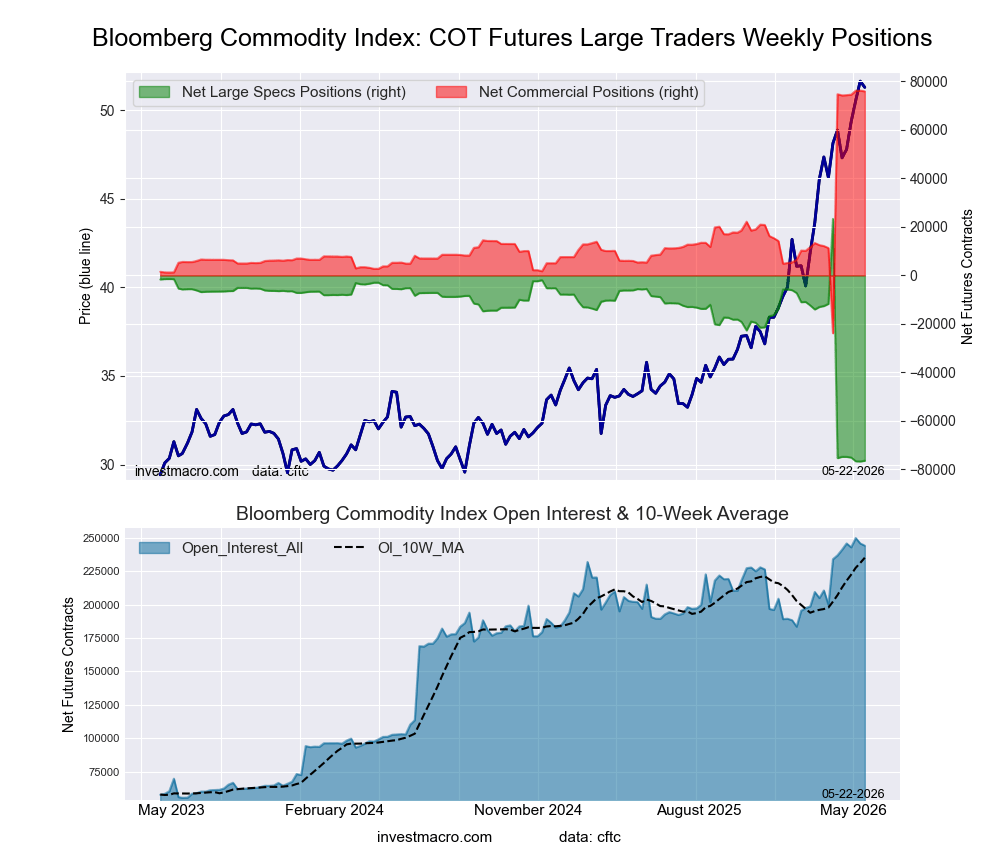
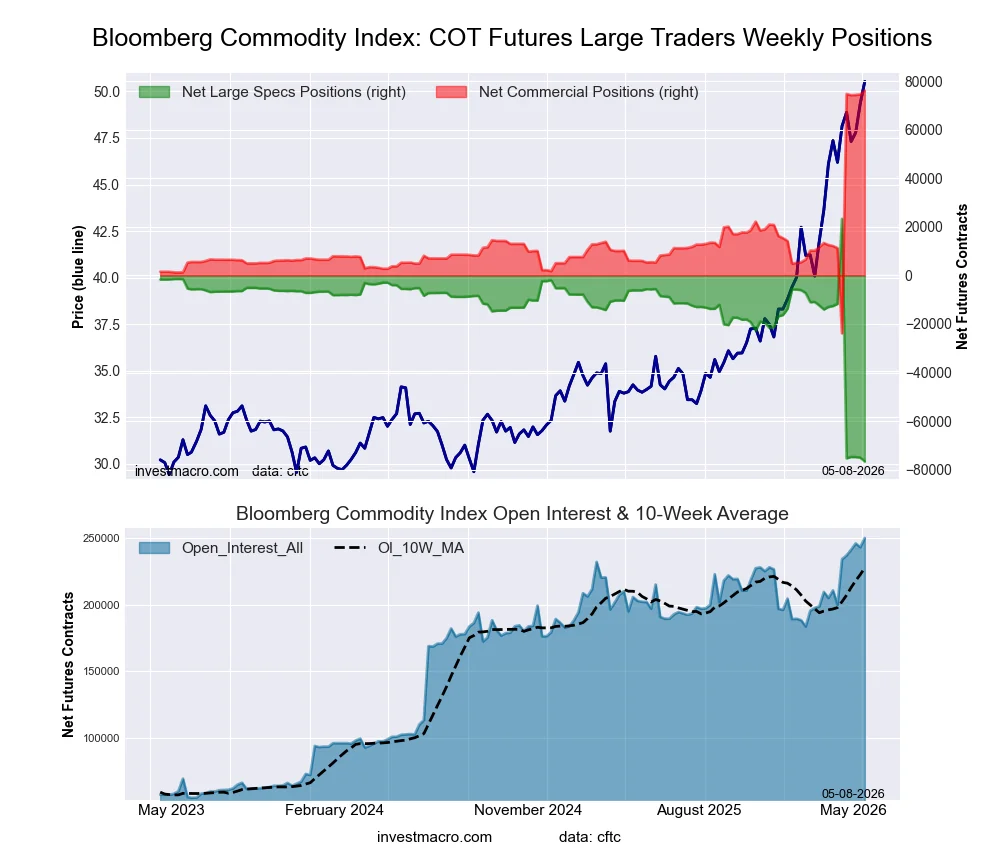
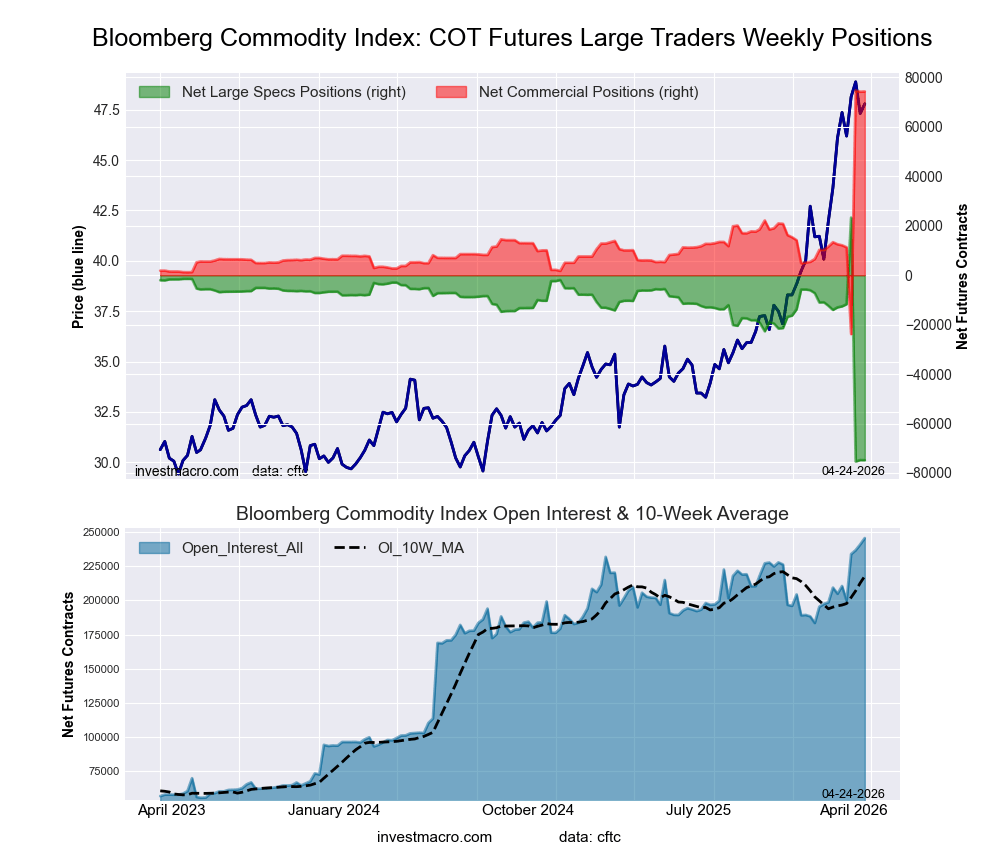
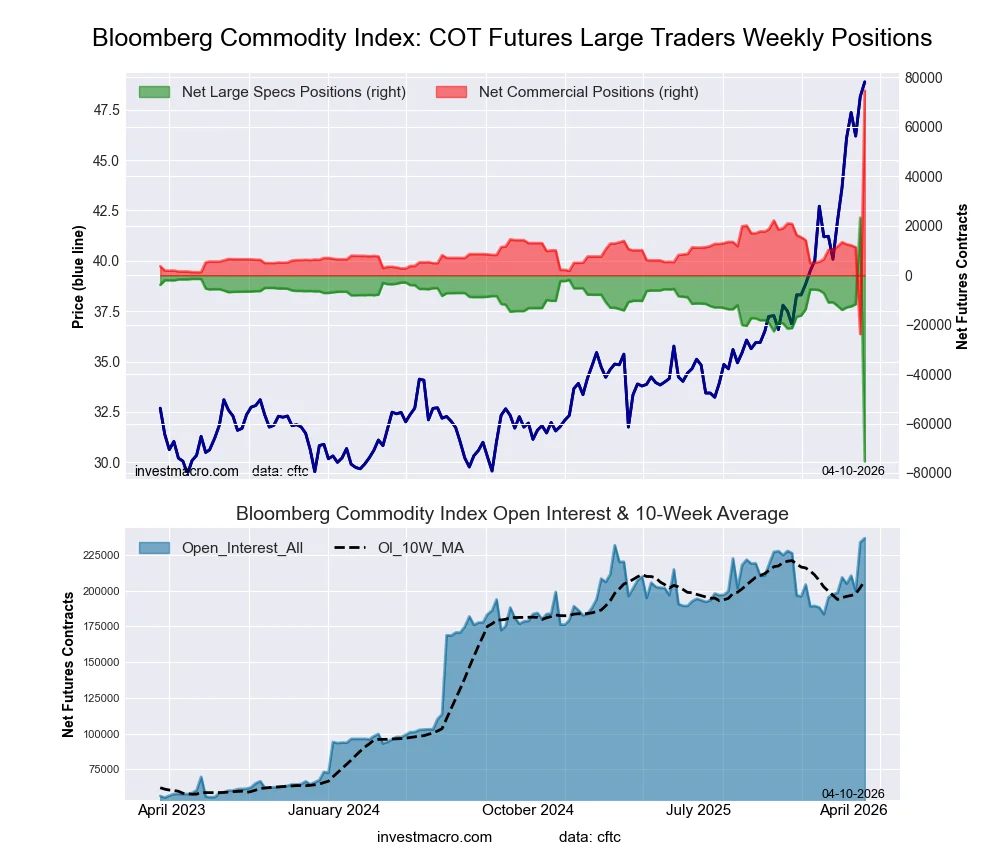
Highlighting the Energy Speculative Positioning this week was the strong gains in the Bloomberg Commodity Index. The net weekly position rose this week for a fourth consecutive week and this week’s gain, by a total of 35,029 contracts, marks the highest one-week increase on record, according to the CFTC data dating back to 2016. The Bloomberg Index is made up of multiple types of commodities with energy comprising approximately 30% of the Index. The Index price has been surging higher since the start of the Iran war and is up by approximately 33% in just the past 90 days.

WTI Crude Oil price leads the Energy market price performance

In the Energy markets this week, WTI Crude Oil saw a strong jump by almost 12% with an 11.94% surge higher over the past five days. The Bloomberg Commodity Index comes in next with a strong 5.14% gain on the week. Gasoline was up by 1.17%.

On the downside in performance, Heating Oil dipped this week by -2.99%, while Brent Crude Oil also fell by -3.14%. The leading market for the downside was Natural Gas, which dropped by -7.44% on the week.


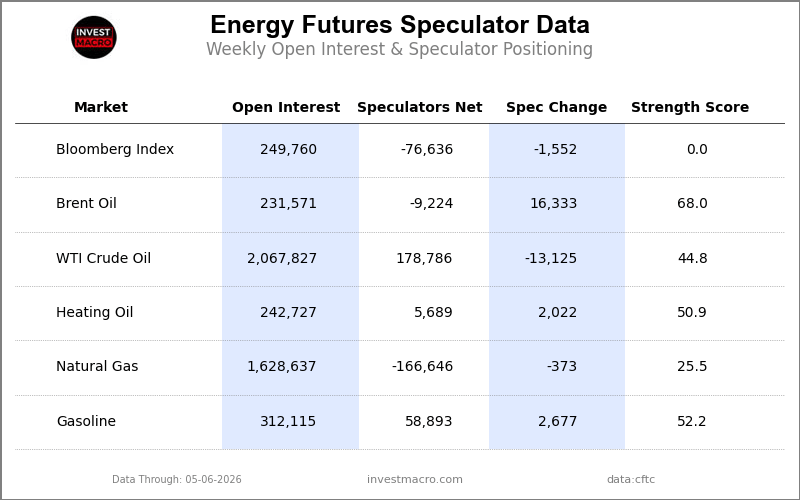
Energy Data:

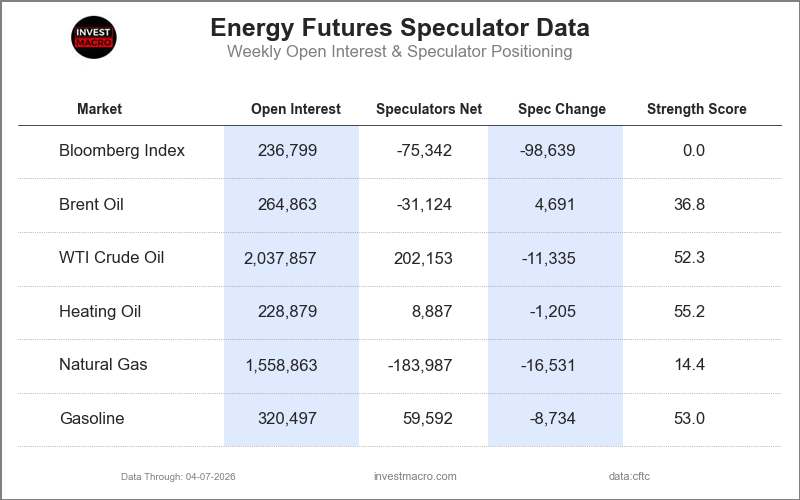
Speculators Table Energy Futures COT Chart
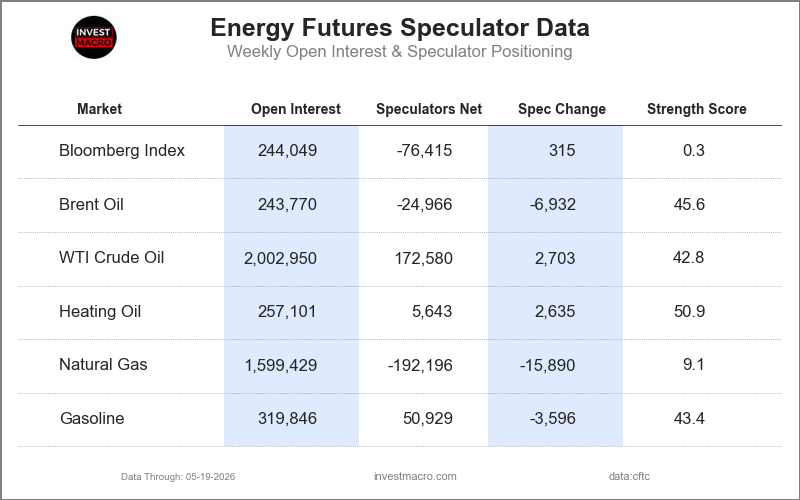
Legend: Weekly Speculators Change | Speculators Current Net Position | Speculators Strength Score compared to last 3-Years (0-100 range)


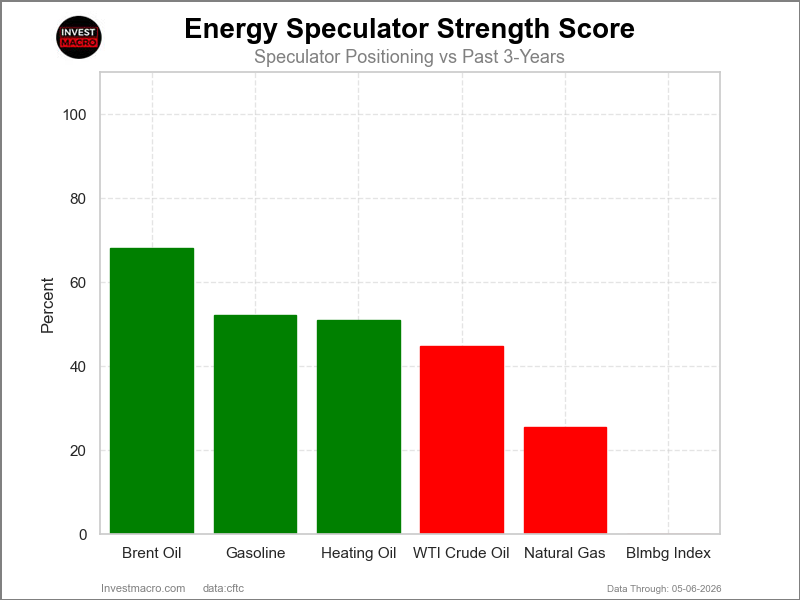
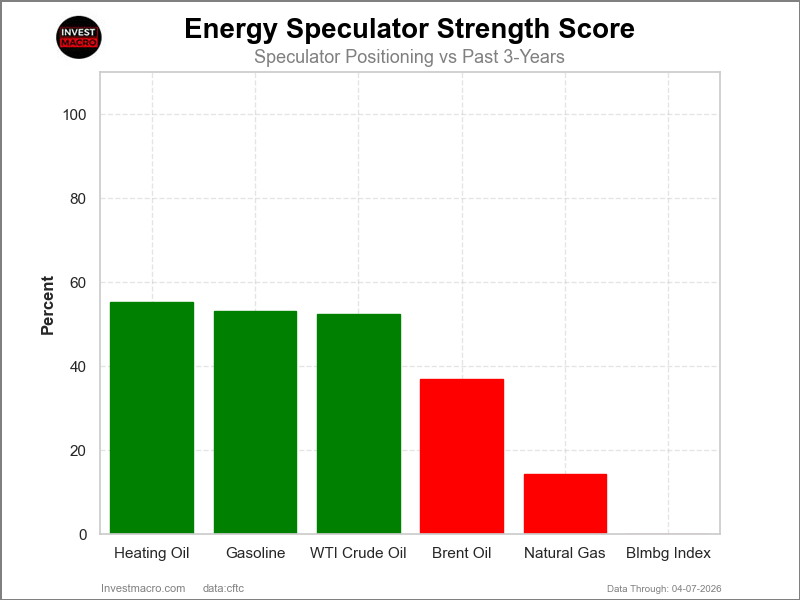
Strength Scores led by Bloomberg Index & Gasoline

Speculators Strength Energy Futures COT Chart
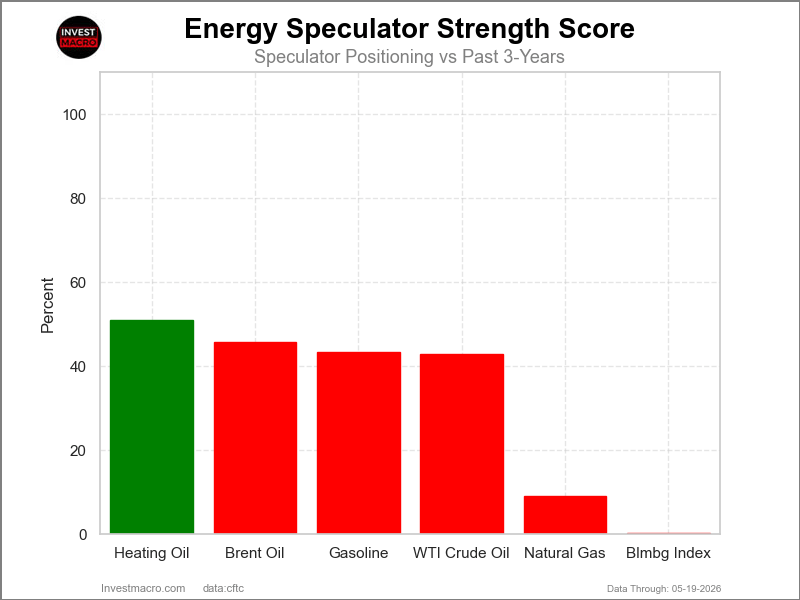
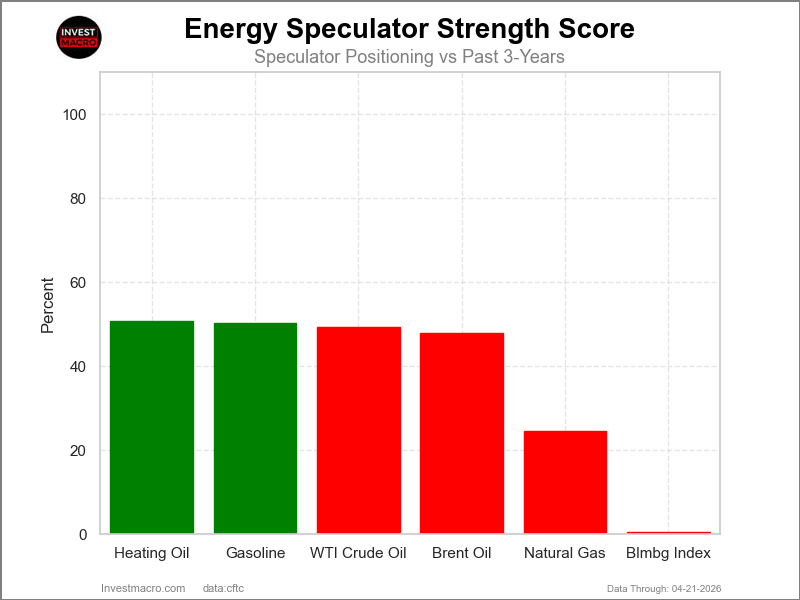
COT Strength Scores (a normalized measure of Speculator positions over a 3-Year range, from 0 to 100 where above 80 is Extreme-Bullish and below 20 is Extreme-Bearish) showed that the Bloomberg Index (100.0 percent) and Gasoline (62.6 percent) lead the energy markets this week.

On the downside, Natural Gas (25.0 percent) and Brent Oil (30.1 percent) comes in at the lowest strength level currently.

Strength Statistics:
WTI Crude Oil (56.0 percent) vs WTI Crude Oil previous week (62.5 percent)
Brent Crude Oil (30.1 percent) vs Brent Crude Oil previous week (56.1 percent)
Natural Gas (25.0 percent) vs Natural Gas previous week (21.7 percent)
Gasoline (62.6 percent) vs Gasoline previous week (64.3 percent)
Heating Oil (56.7 percent) vs Heating Oil previous week (56.1 percent)
Bloomberg Commodity Index (100.0 percent) vs Bloomberg Commodity Index previous week (23.8 percent)


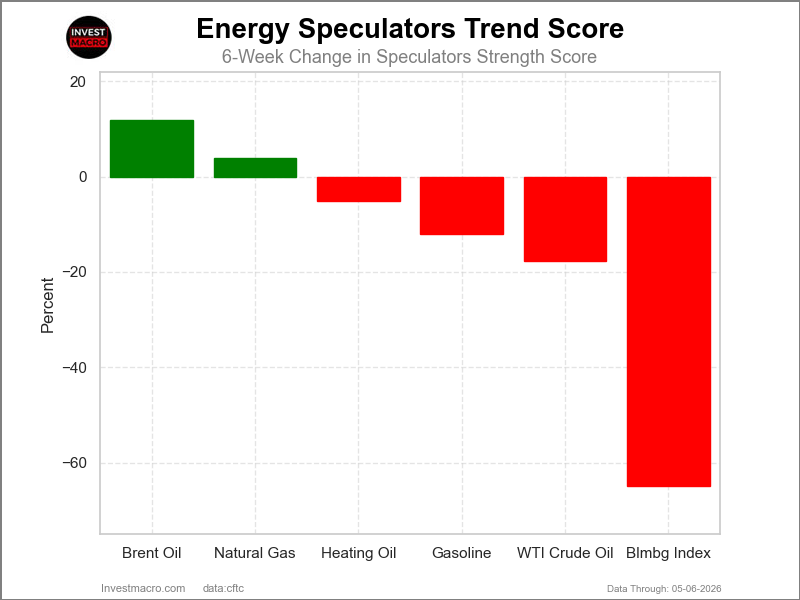
Bloomberg Index & WTI Crude top the 6-Week Strength Trends

Speculators Trend Energy Futures COT Chart
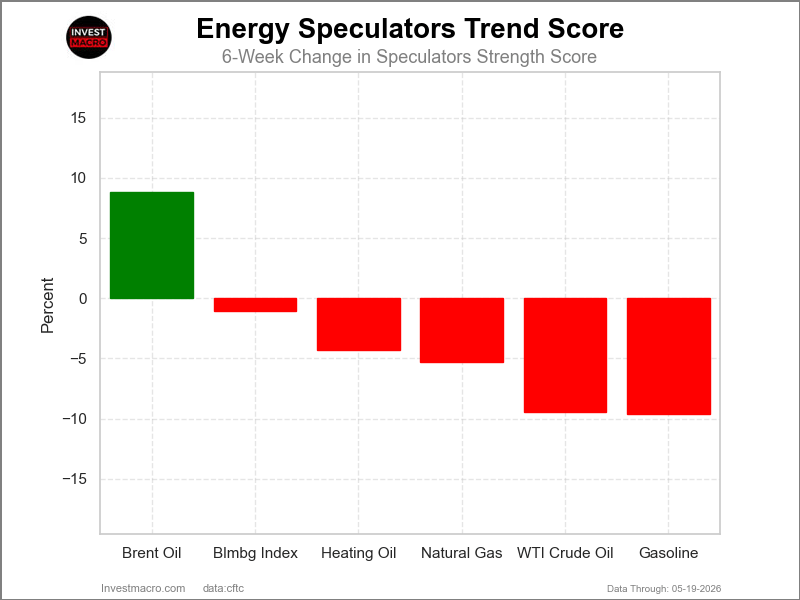
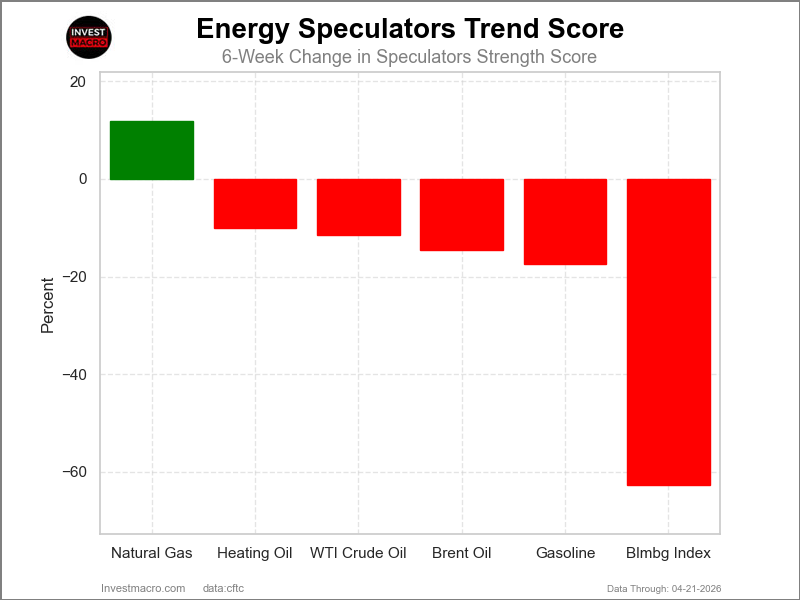
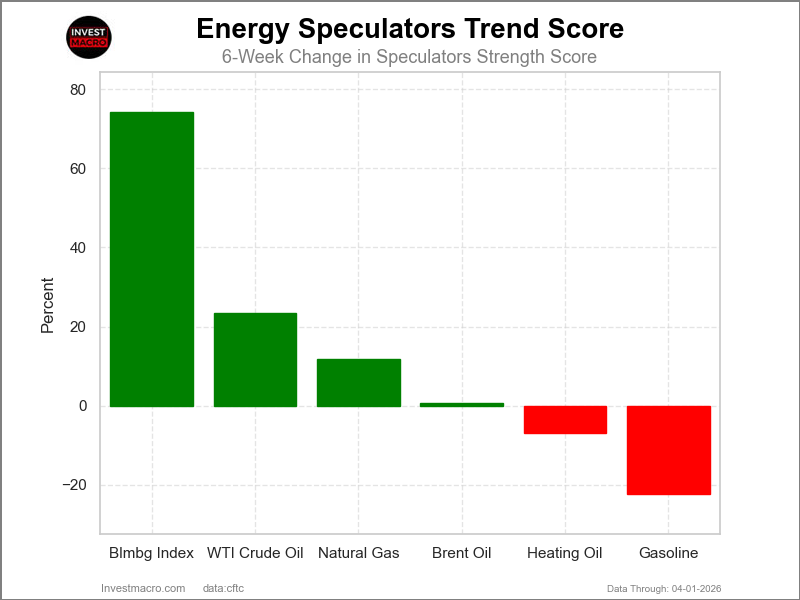
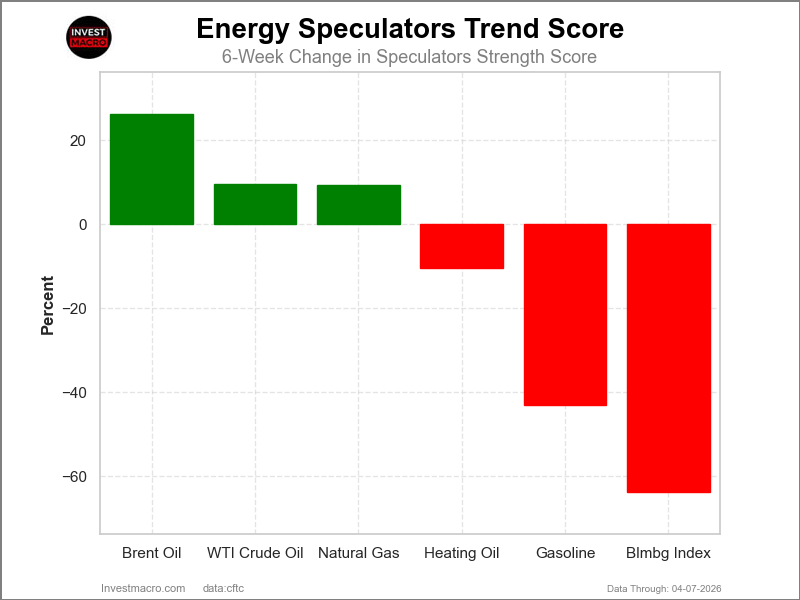
COT Strength Score Trends (or move index, calculates the 6-week changes in strength scores) showed that the Bloomberg Index (74.4 percent) and WTI Crude (23.3 percent) lead the past six weeks trends for the energy markets.

Gasoline (-22.5 percent) leads the downside trend scores currently with Heating Oil (-7.0 percent) as the next market with lower trend scores.

Move Statistics:
WTI Crude Oil (23.3 percent) vs WTI Crude Oil previous week (37.3 percent)
Brent Crude Oil (0.6 percent) vs Brent Crude Oil previous week (26.4 percent)
Natural Gas (11.8 percent) vs Natural Gas previous week (-0.5 percent)
Gasoline (-22.5 percent) vs Gasoline previous week (-22.2 percent)
Heating Oil (-7.0 percent) vs Heating Oil previous week (-13.0 percent)
Bloomberg Commodity Index (74.4 percent) vs Bloomberg Commodity Index previous week (-1.6 percent)


Individual COT Market Charts:

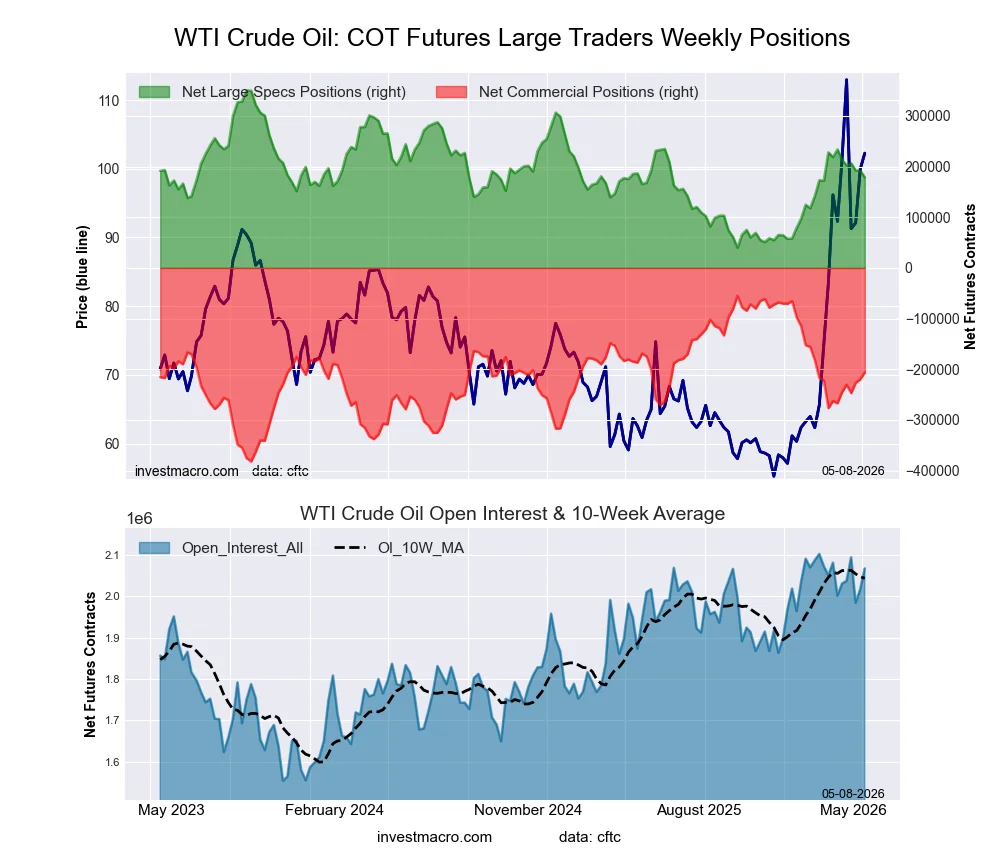
WTI Crude Oil Futures:

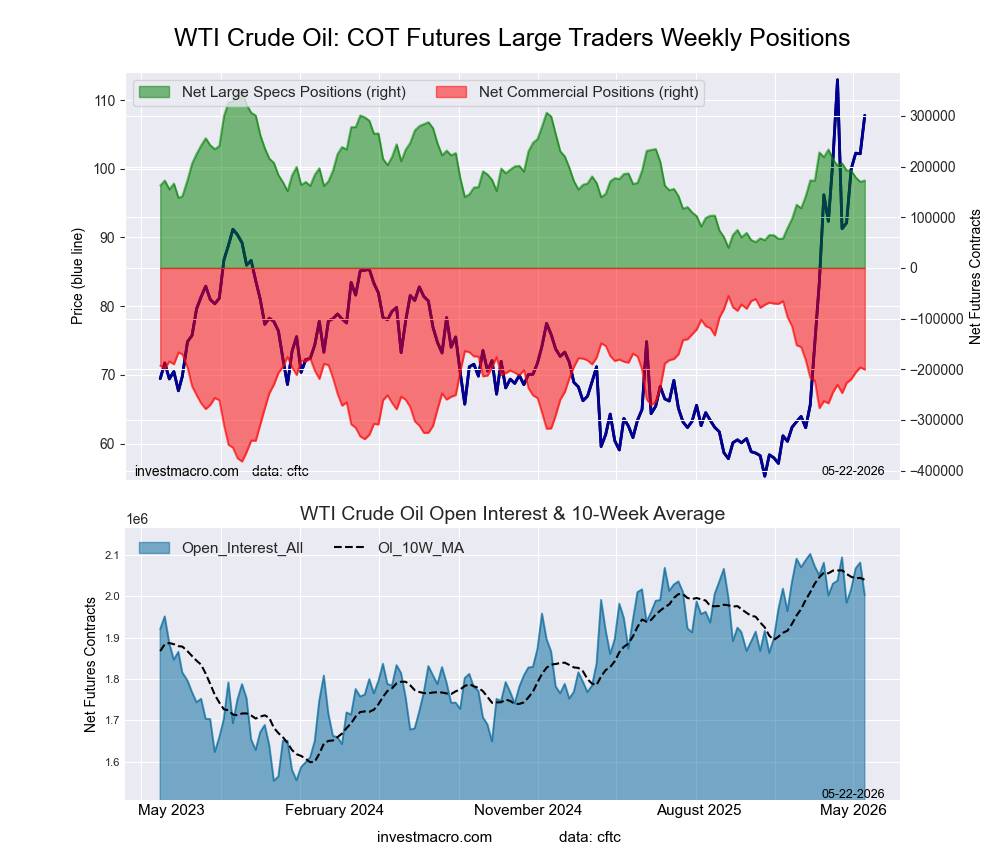
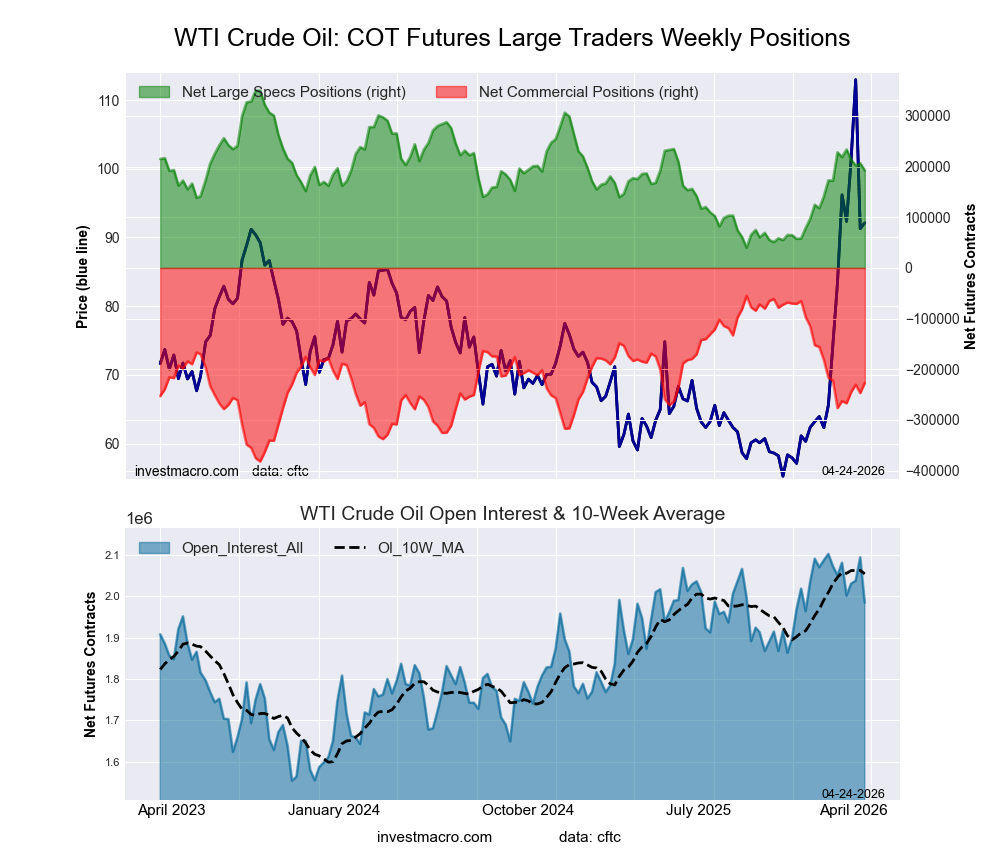
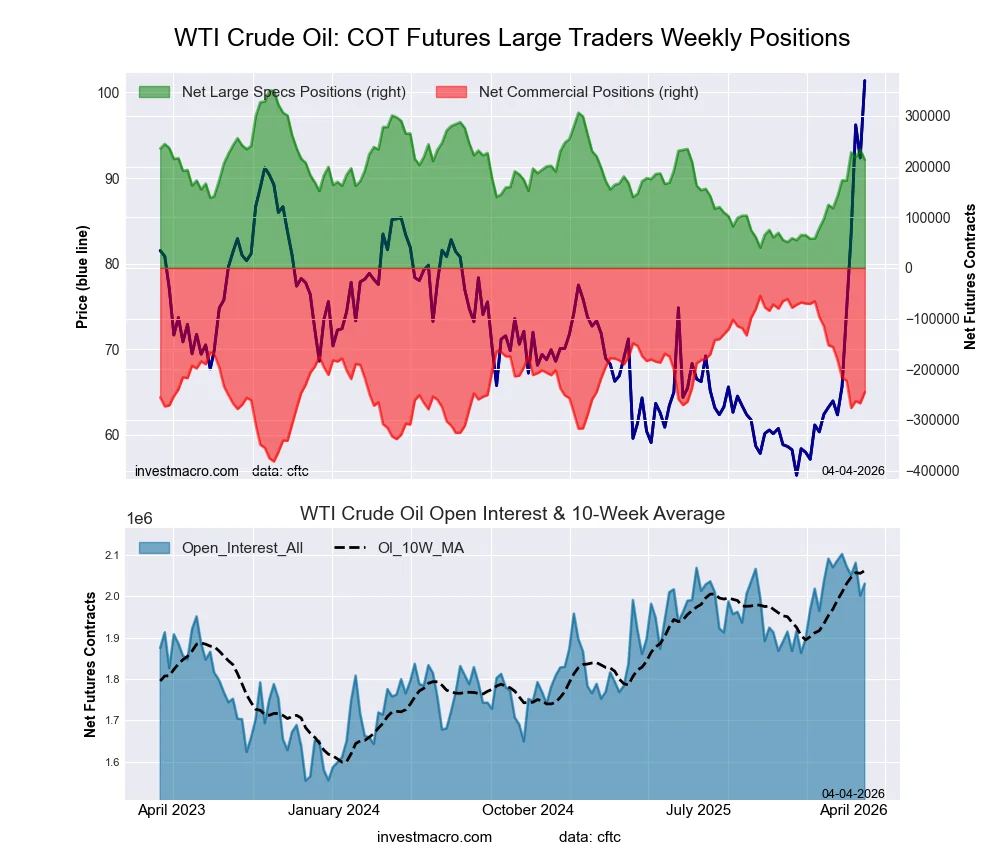
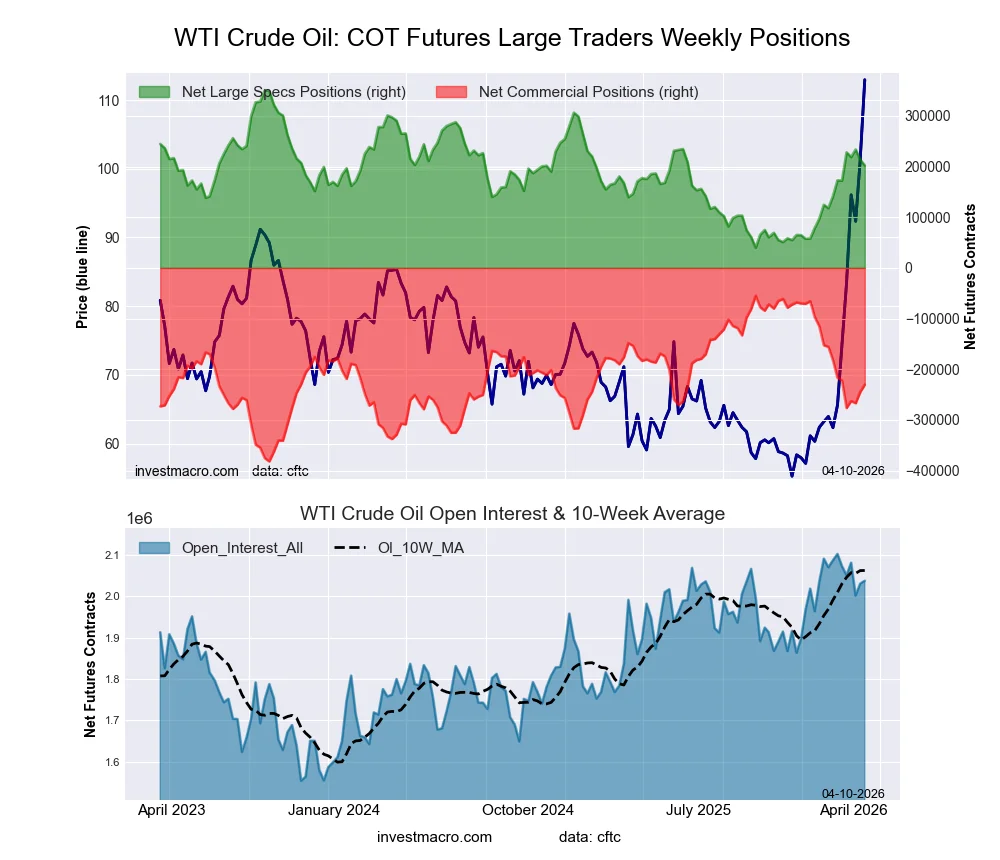
WTI Crude Oil Futures COT ChartThe WTI Crude Oil Futures large speculator standing this week totaled a net position of 213,488 contracts in the data reported through Tuesday. This was a weekly reduction of -20,132 contracts from the previous week which had a total of 233,620 net contracts.

This week’s current strength score (the trader positioning range over the past three years, measured from 0 to 100) shows the speculators are currently Bullish with a score of 56.0 percent. The commercials are Bearish with a score of 41.9 percent and the small traders (not shown in chart) are Bullish with a score of 63.3 percent.

Price Trend-Following Model: Strong Uptrend

Our weekly trend-following model classifies the current market price position as: Strong Uptrend.

WTI Crude Oil Futures StatisticsSPECULATORSCOMMERCIALSSMALL TRADERS
– Percent of Open Interest Longs:18.642.93.7
– Percent of Open Interest Shorts:8.154.92.2
– Net Position:213,488-245,09131,603
– Gross Longs:378,087870,79975,768
– Gross Shorts:164,5991,115,89044,165
– Long to Short Ratio:2.3 to 10.8 to 11.7 to 1
NET POSITION TREND:
– Strength Index Score (3 Year Range Pct):56.041.963.3
– Strength Index Reading (3 Year Range):BullishBearishBullish
NET POSITION MOVEMENT INDEX:
– 6-Week Change in Strength Index:23.3-19.4-17.1


Brent Crude Oil Futures:

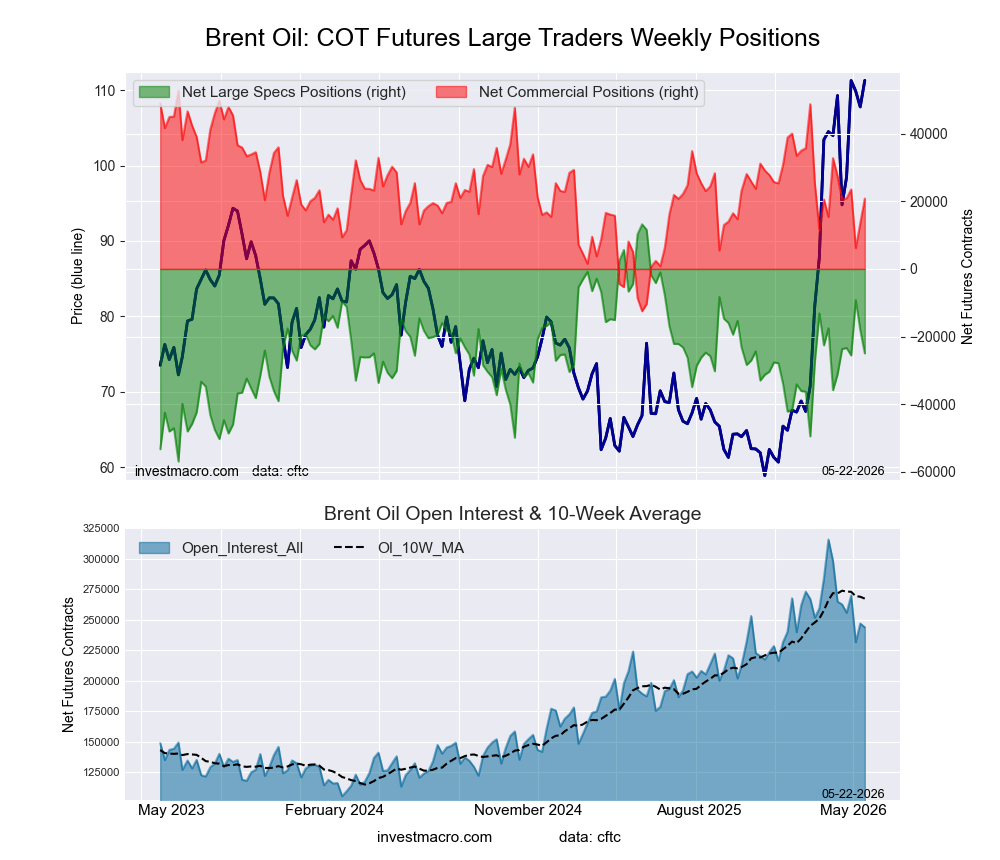
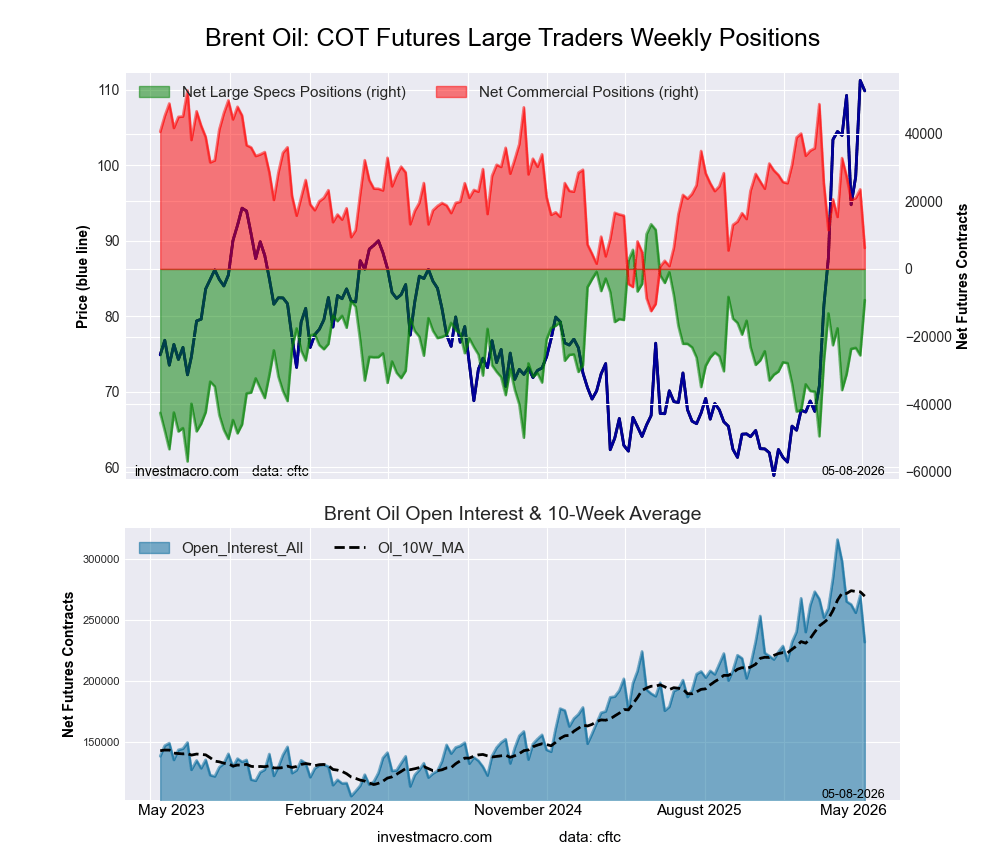
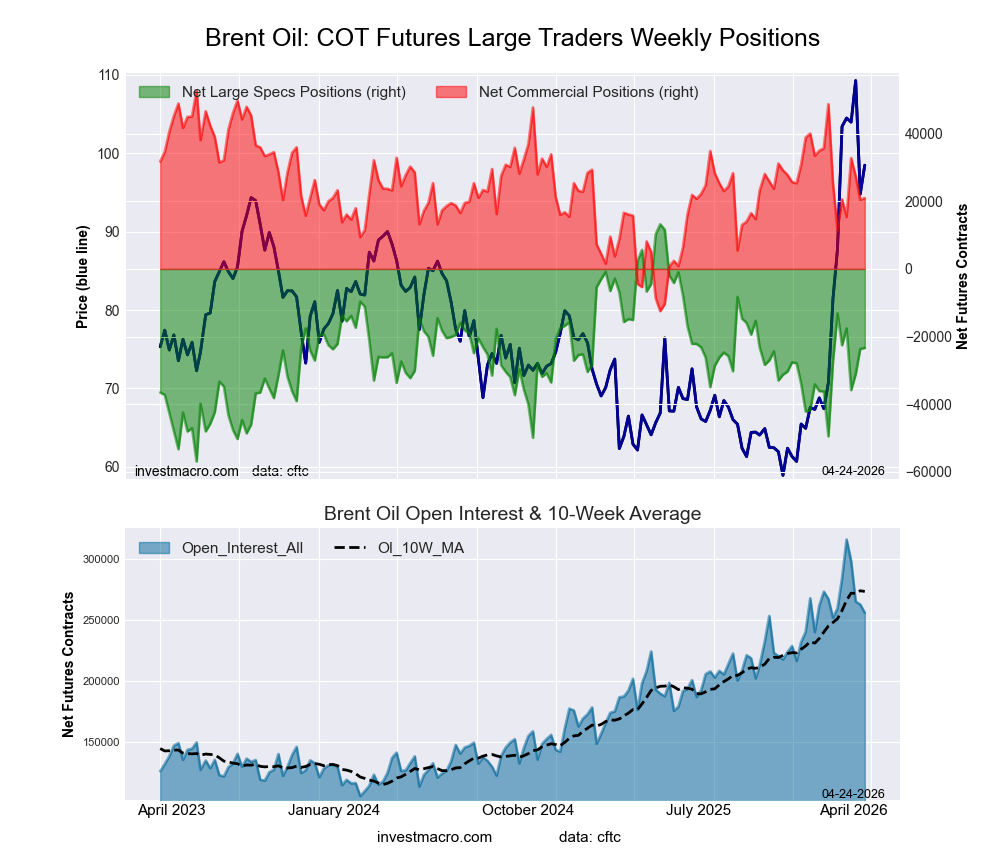
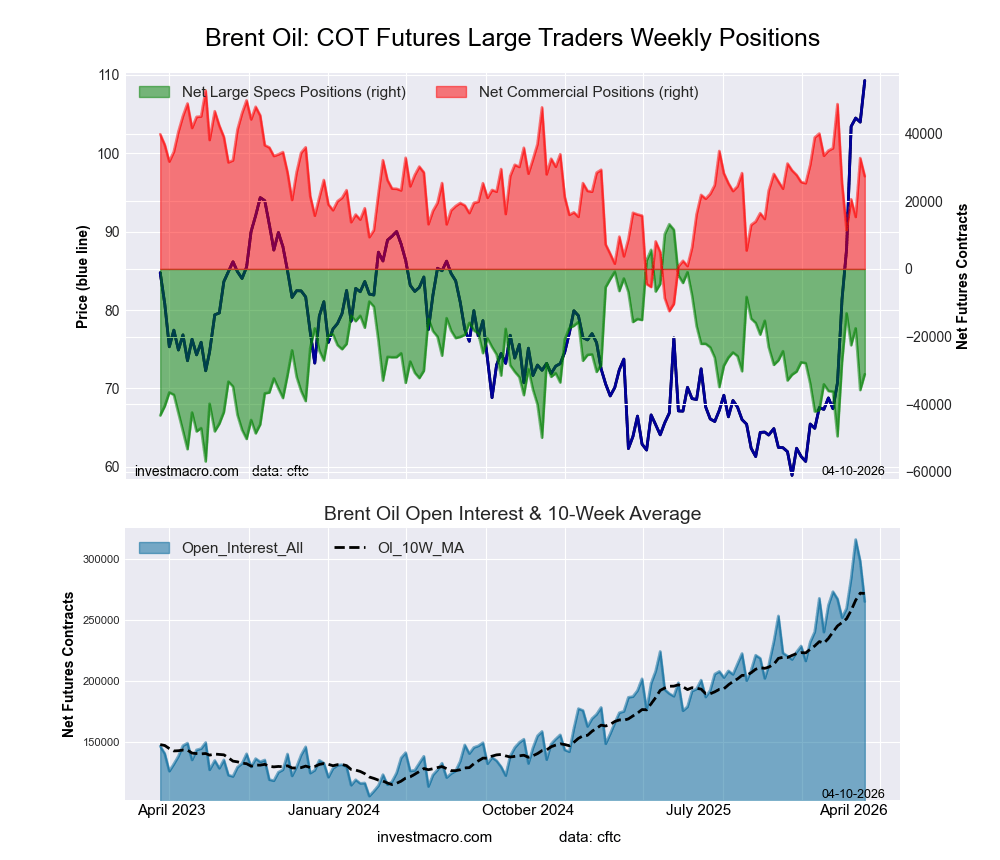
Brent Last Day Crude Oil Futures COT ChartThe Brent Crude Oil Futures large speculator standing this week totaled a net position of -35,815 contracts in the data reported through Tuesday. This was a weekly reduction of -18,260 contracts from the previous week which had a total of -17,555 net contracts.

This week’s current strength score (the trader positioning range over the past three years, measured from 0 to 100) shows the speculators are currently Bearish with a score of 30.1 percent. The commercials are Bullish with a score of 69.4 percent and the small traders (not shown in chart) are Bullish with a score of 70.7 percent.

Price Trend-Following Model: Strong Uptrend

Our weekly trend-following model classifies the current market price position as: Strong Uptrend.

Brent Crude Oil Futures StatisticsSPECULATORSCOMMERCIALSSMALL TRADERS
– Percent of Open Interest Longs:23.541.93.8
– Percent of Open Interest Shorts:35.530.92.8
– Net Position:-35,81532,7763,039
– Gross Longs:69,891124,71911,470
– Gross Shorts:105,70691,9438,431
– Long to Short Ratio:0.7 to 11.4 to 11.4 to 1
NET POSITION TREND:
– Strength Index Score (3 Year Range Pct):30.169.470.7
– Strength Index Reading (3 Year Range):BearishBullishBullish
NET POSITION MOVEMENT INDEX:
– 6-Week Change in Strength Index:0.6-4.528.7


Natural Gas Futures:

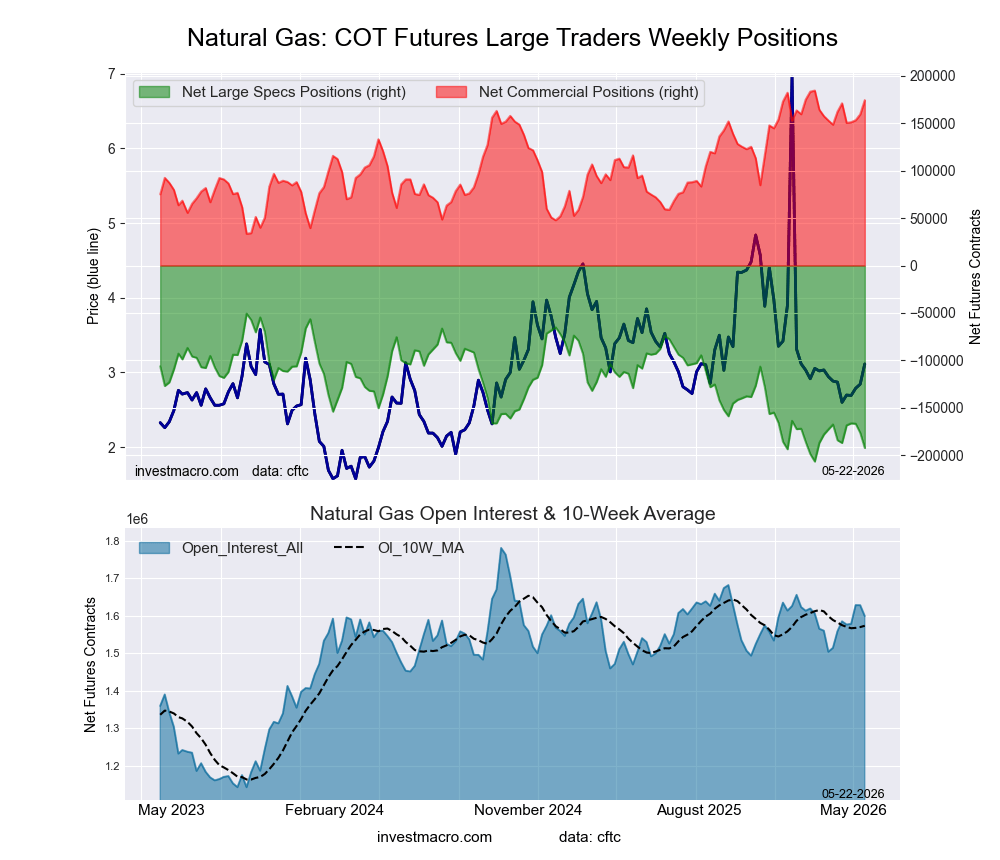
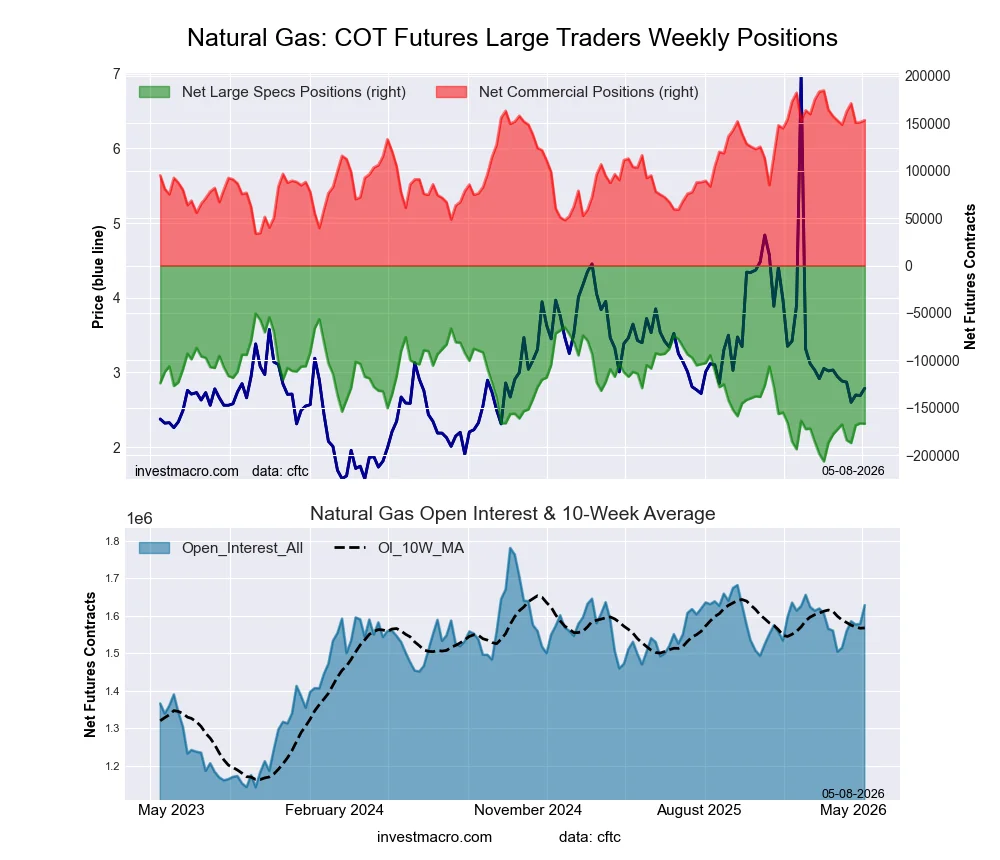
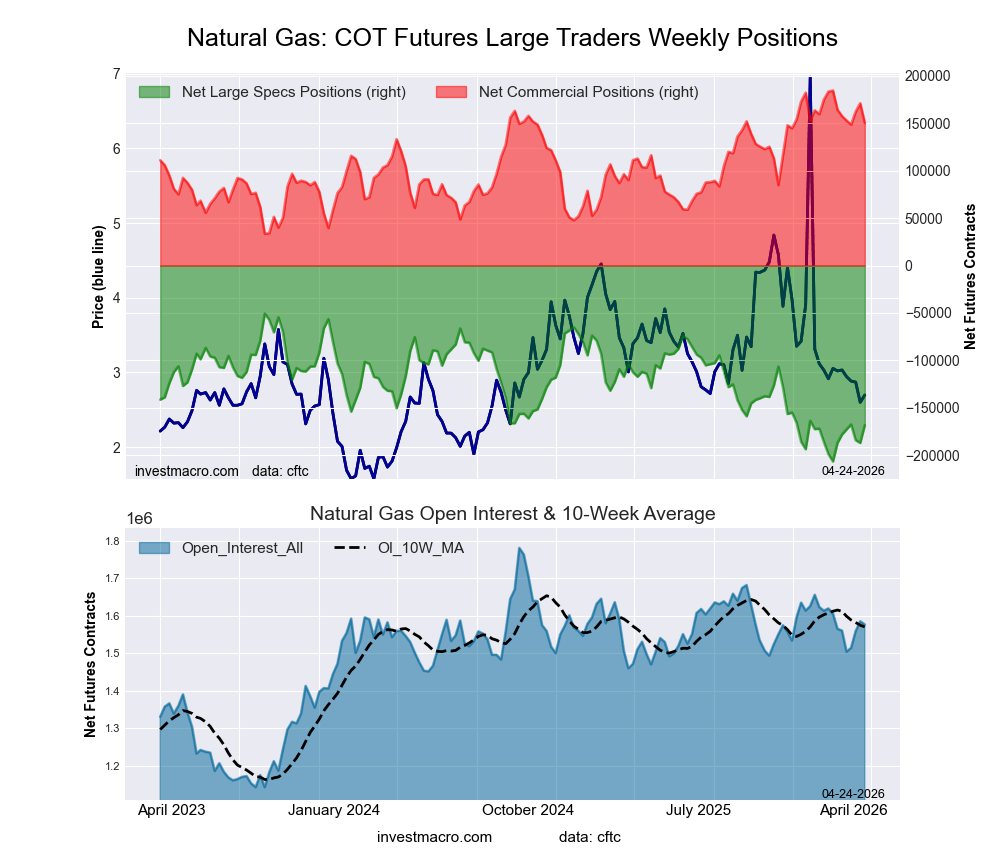
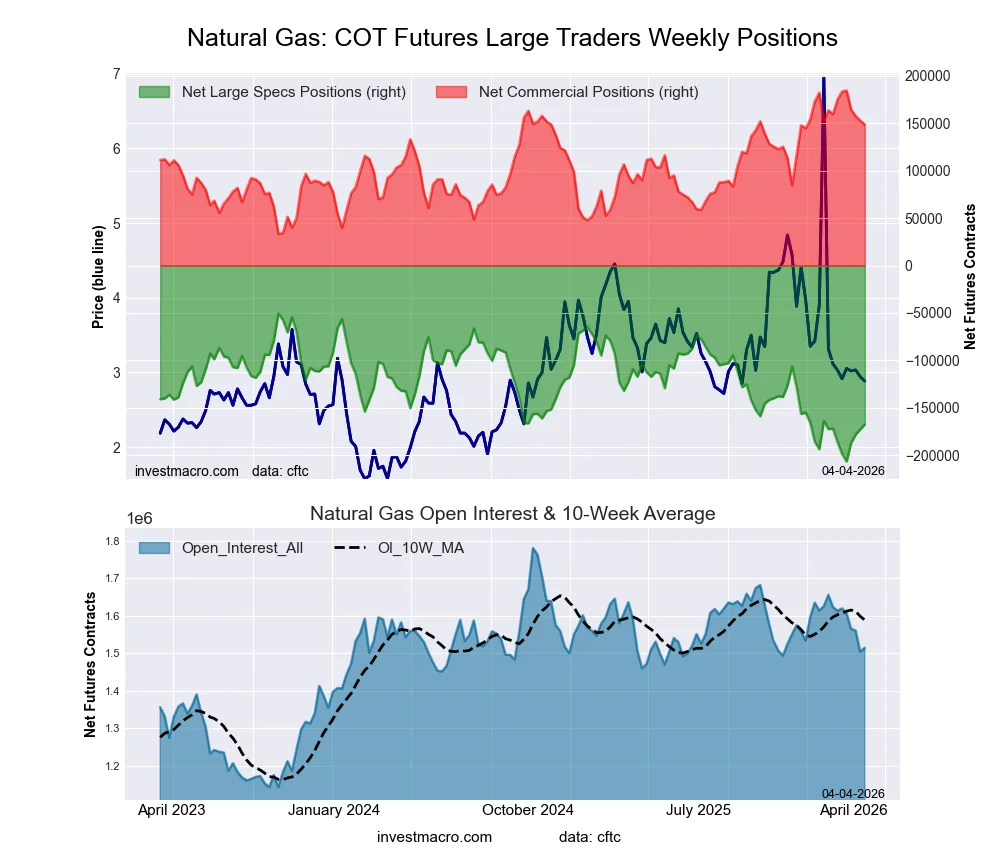
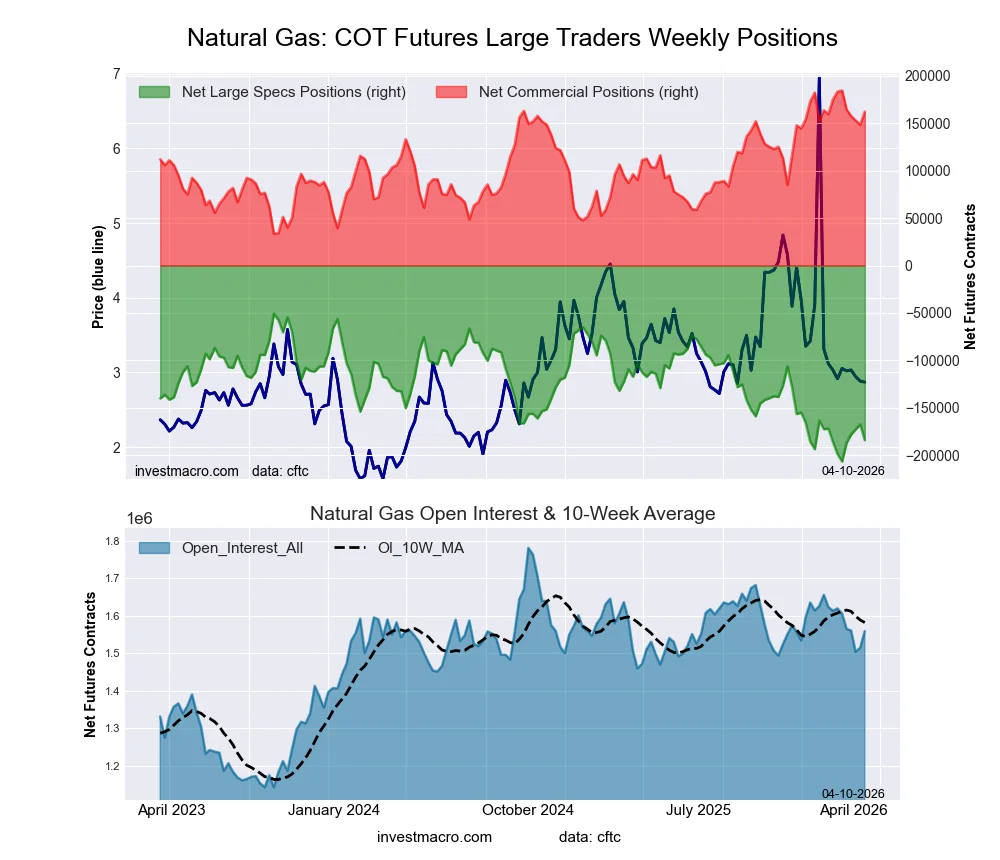
Natural Gas Futures COT ChartThe Natural Gas Futures large speculator standing this week totaled a net position of -167,456 contracts in the data reported through Tuesday. This was a weekly lift of 5,151 contracts from the previous week which had a total of -172,607 net contracts.

This week’s current strength score (the trader positioning range over the past three years, measured from 0 to 100) shows the speculators are currently Bearish with a score of 25.0 percent. The commercials are Bullish with a score of 76.2 percent and the small traders (not shown in chart) are Bullish with a score of 51.2 percent.

Price Trend-Following Model: Downtrend

Our weekly trend-following model classifies the current market price position as: Downtrend.

Natural Gas Futures StatisticsSPECULATORSCOMMERCIALSSMALL TRADERS
– Percent of Open Interest Longs:13.537.33.7
– Percent of Open Interest Shorts:24.527.52.4
– Net Position:-167,456148,42819,028
– Gross Longs:204,139564,65656,127
– Gross Shorts:371,595416,22837,099
– Long to Short Ratio:0.5 to 11.4 to 11.5 to 1
NET POSITION TREND:
– Strength Index Score (3 Year Range Pct):25.076.251.2
– Strength Index Reading (3 Year Range):BearishBullishBullish
NET POSITION MOVEMENT INDEX:
– 6-Week Change in Strength Index:11.8-17.520.3


Gasoline Blendstock Futures:

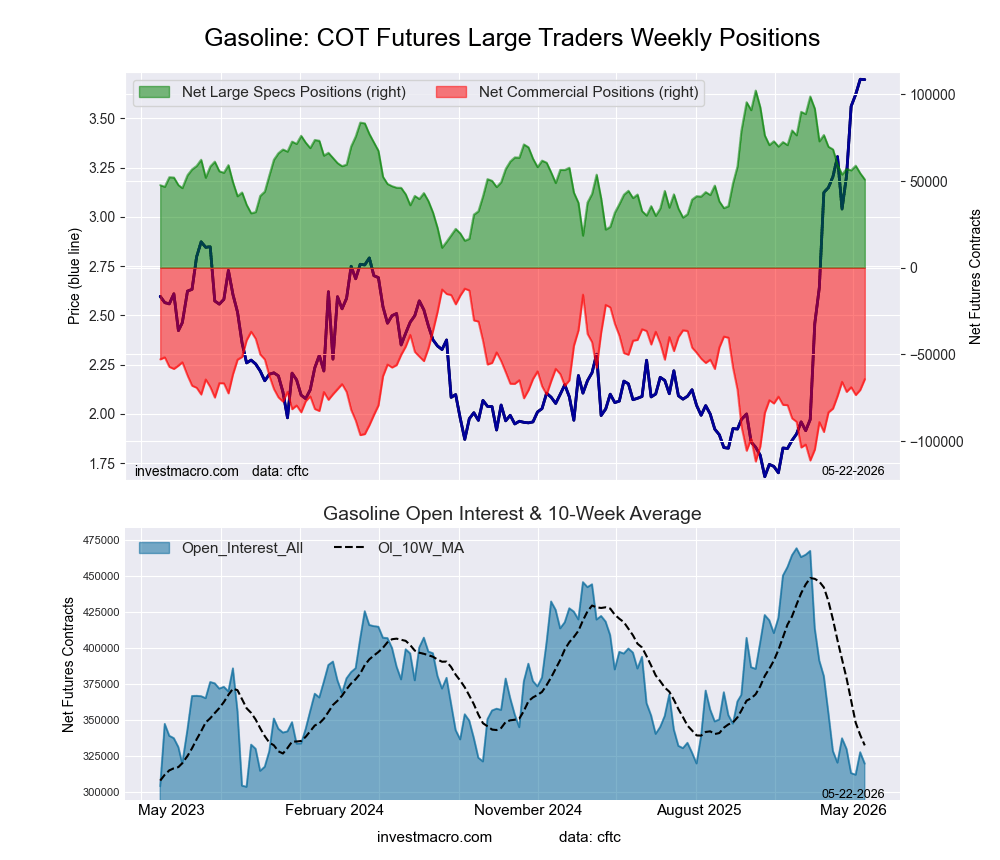
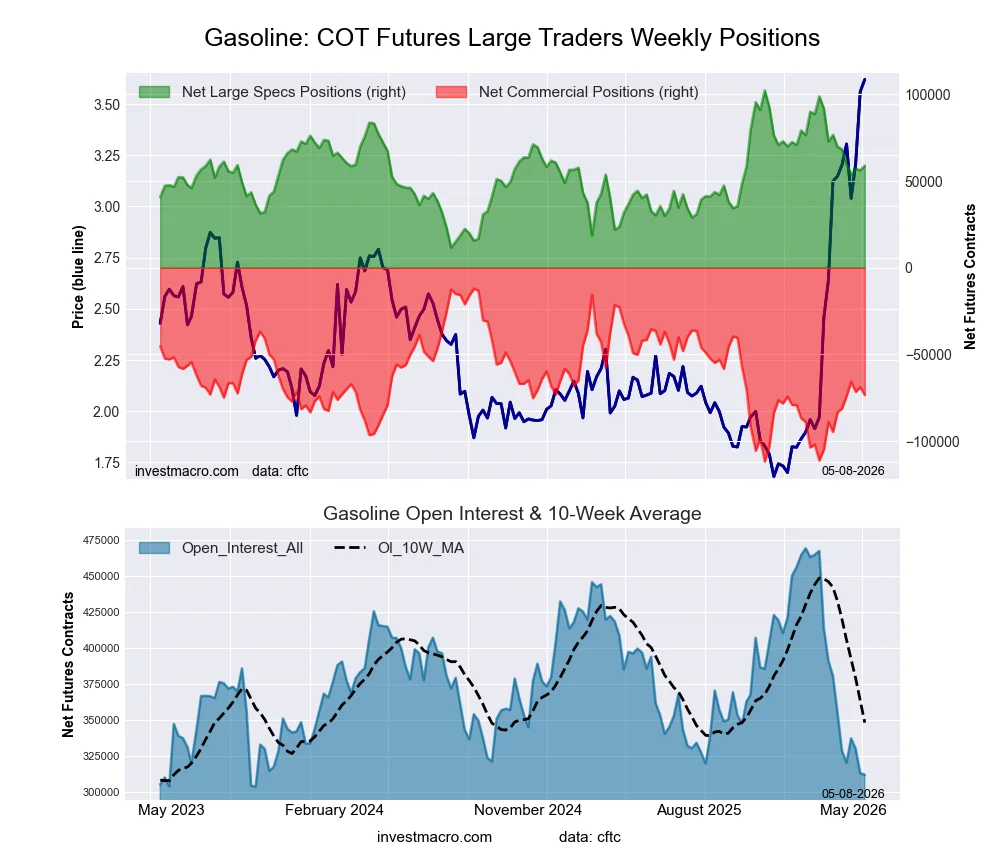
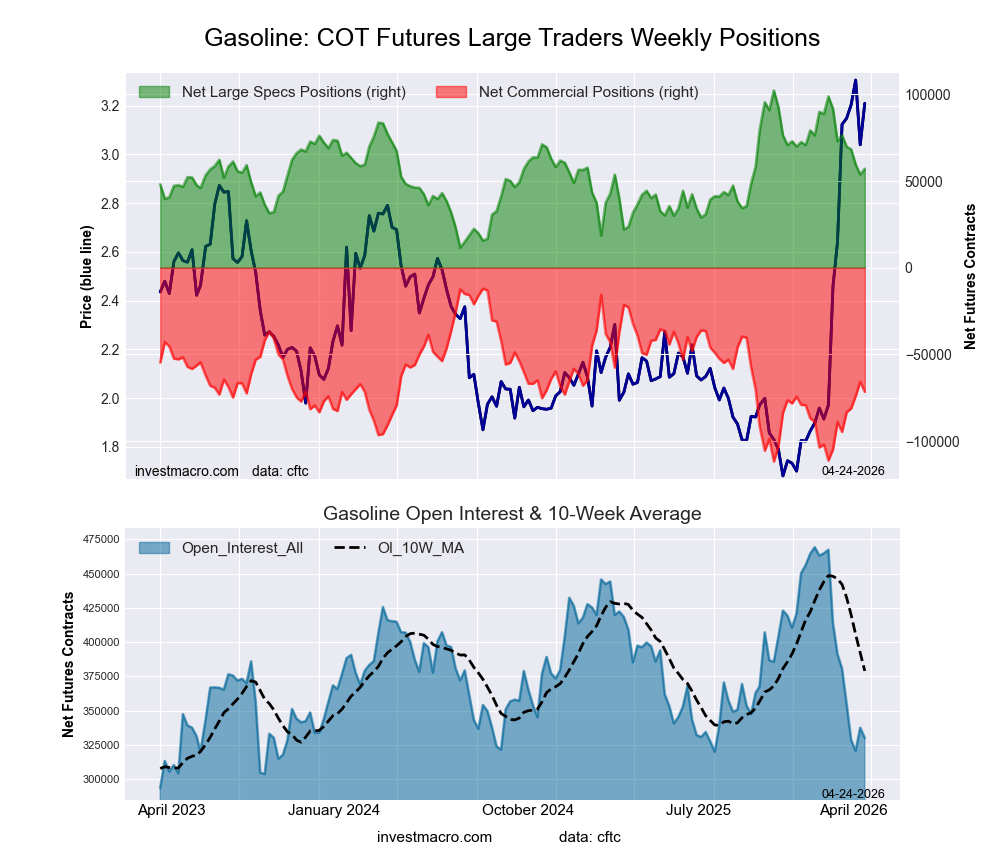
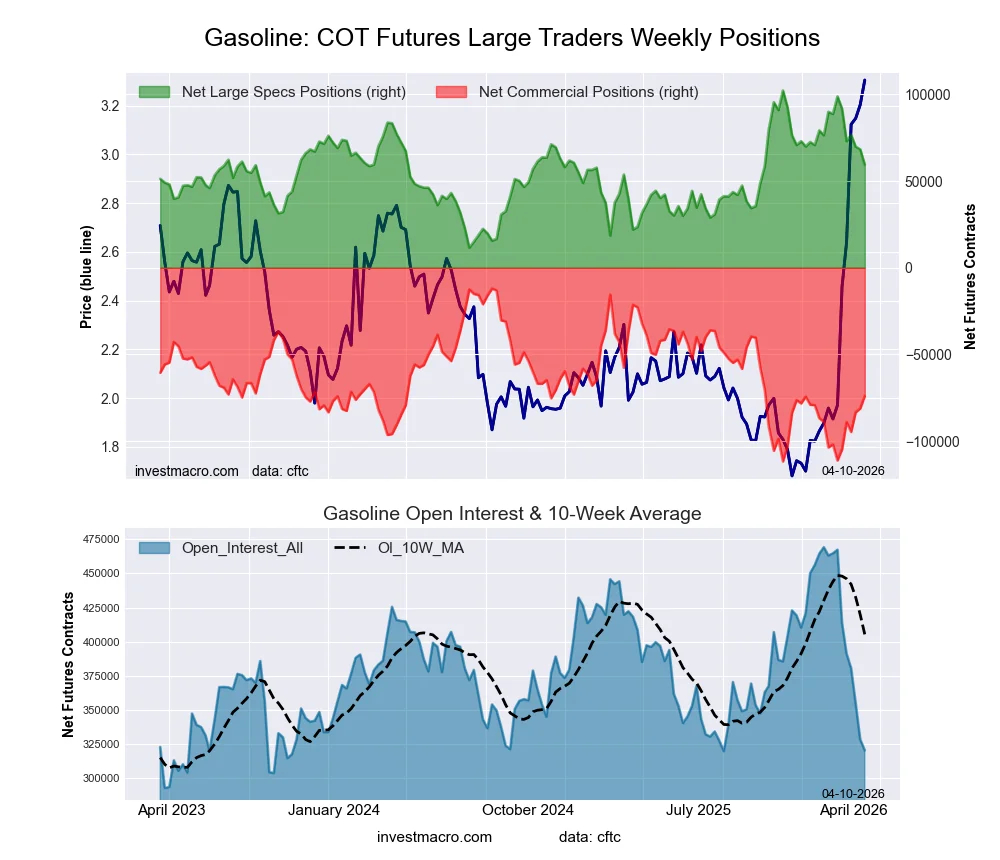
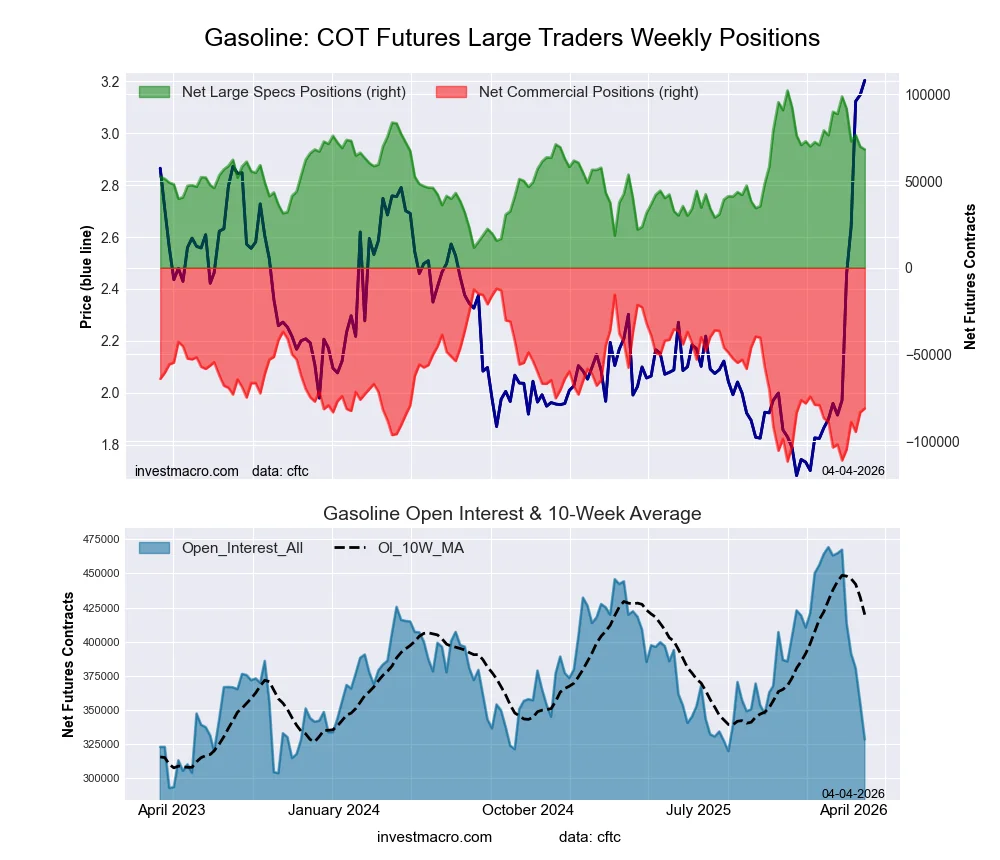
RBOB Gasoline Energy Futures COT ChartThe Gasoline Blendstock Futures large speculator standing this week totaled a net position of 68,326 contracts in the data reported through Tuesday. This was a weekly decline of -1,520 contracts from the previous week which had a total of 69,846 net contracts.

This week’s current strength score (the trader positioning range over the past three years, measured from 0 to 100) shows the speculators are currently Bullish with a score of 62.6 percent. The commercials are Bearish with a score of 30.7 percent and the small traders (not shown in chart) are Bullish with a score of 76.1 percent.

Price Trend-Following Model: Strong Uptrend

Our weekly trend-following model classifies the current market price position as: Strong Uptrend.

Nasdaq Mini Futures StatisticsSPECULATORSCOMMERCIALSSMALL TRADERS
– Percent of Open Interest Longs:26.649.08.6
– Percent of Open Interest Shorts:5.873.74.7
– Net Position:68,326-81,17212,846
– Gross Longs:87,284160,96828,280
– Gross Shorts:18,958242,14015,434
– Long to Short Ratio:4.6 to 10.7 to 11.8 to 1
NET POSITION TREND:
– Strength Index Score (3 Year Range Pct):62.630.776.1
– Strength Index Reading (3 Year Range):BullishBearishBullish
NET POSITION MOVEMENT INDEX:
– 6-Week Change in Strength Index:-22.520.9-1.8


#2 Heating Oil NY-Harbor Futures:

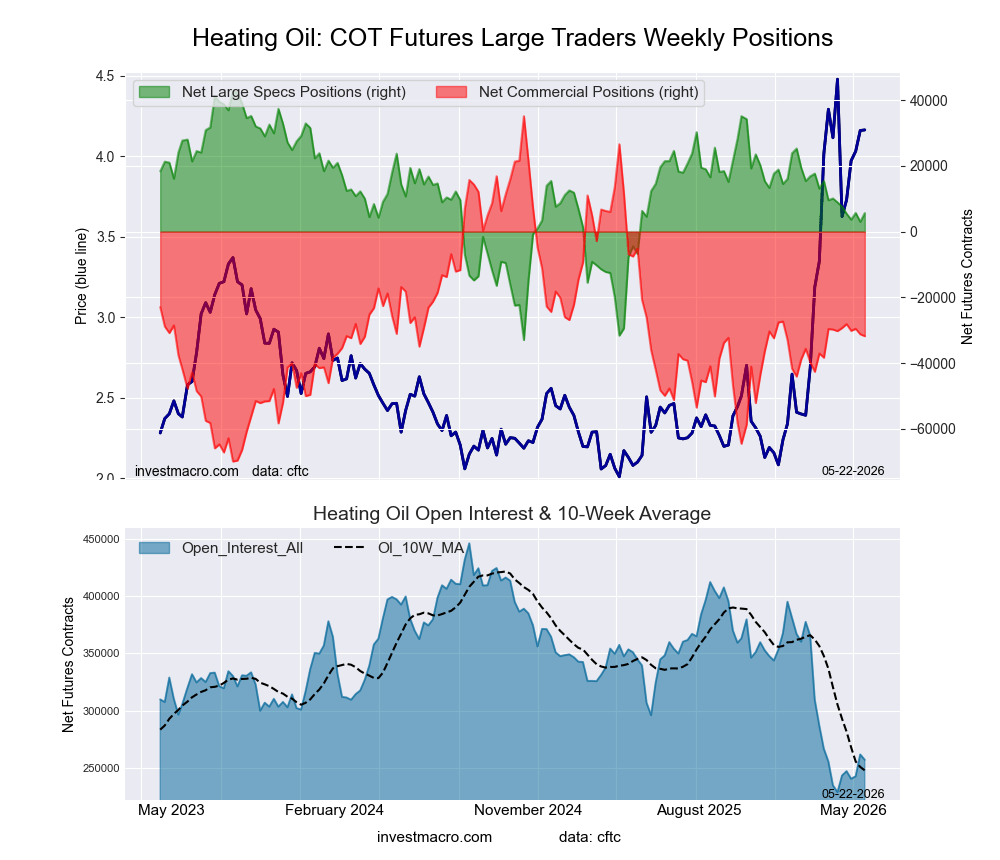
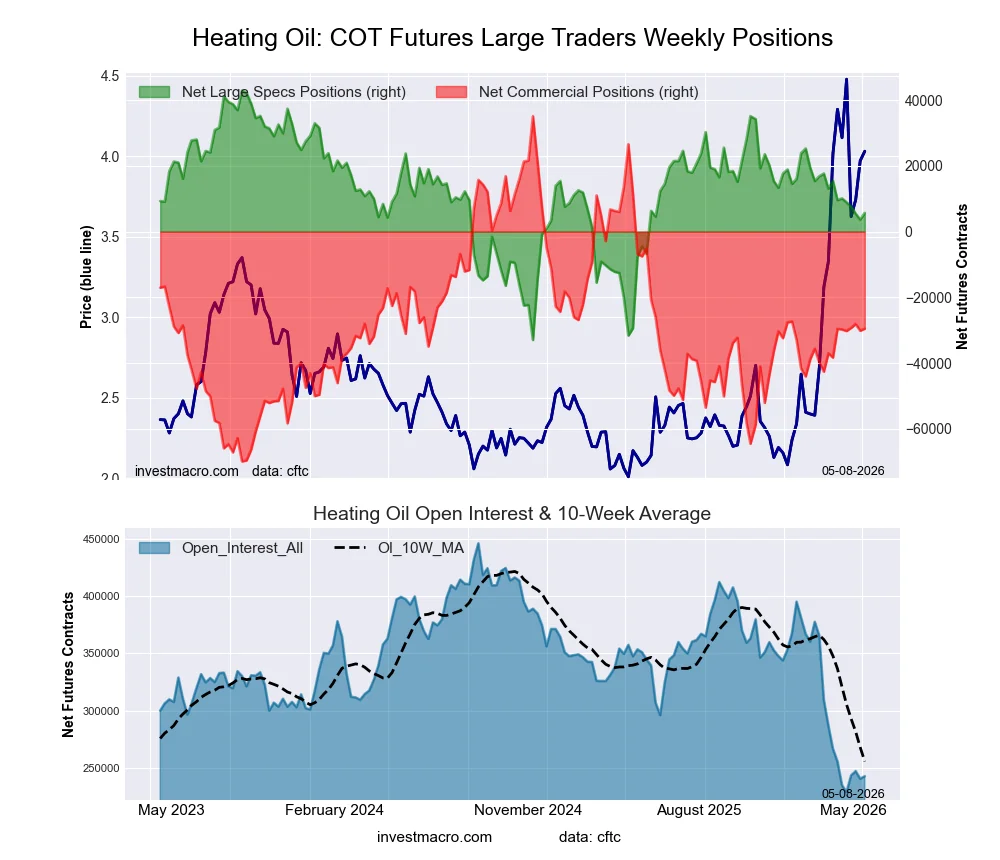
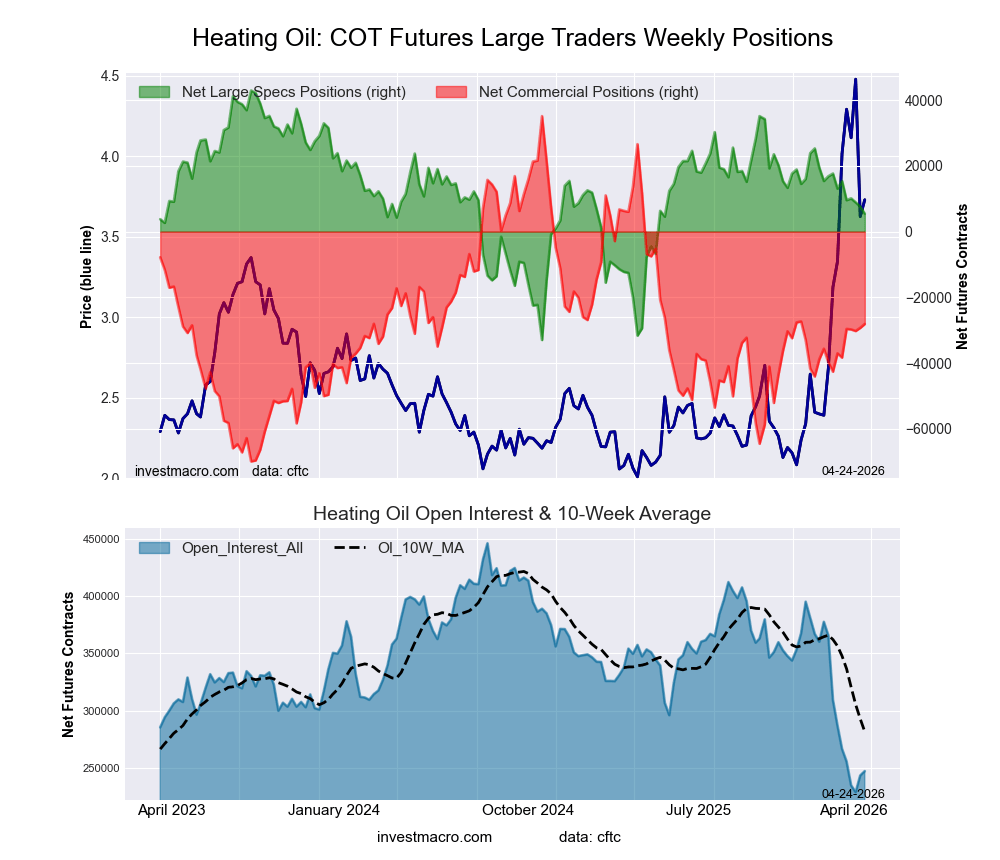
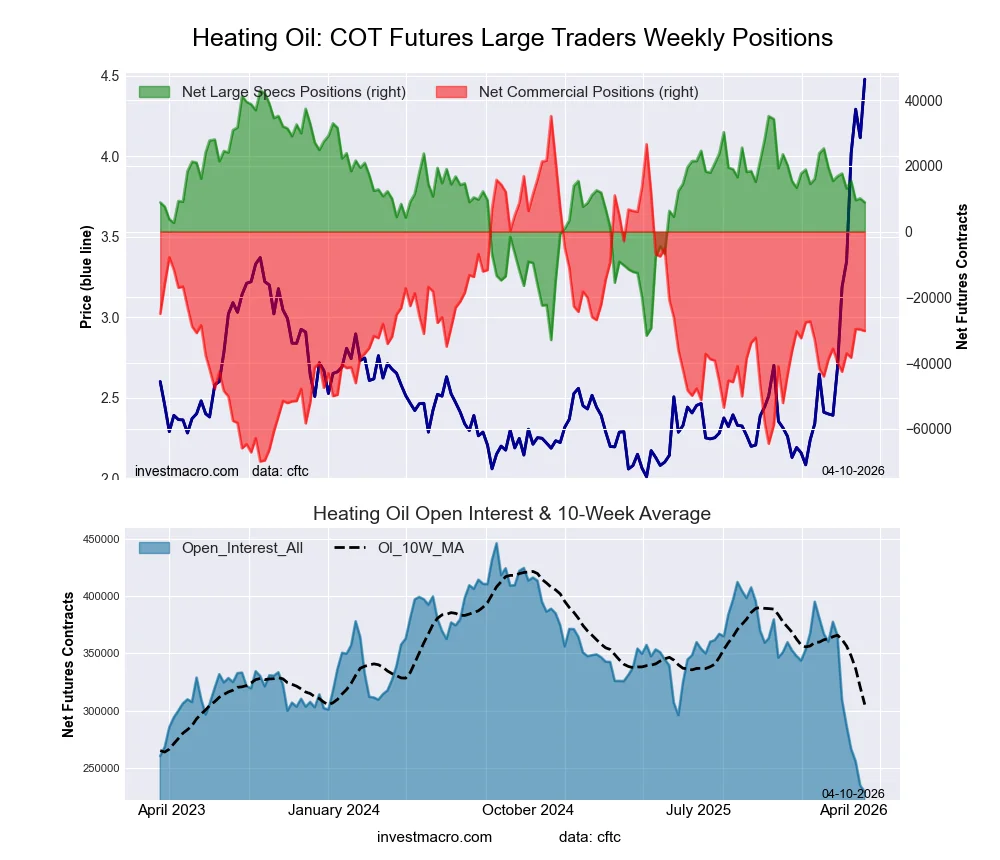
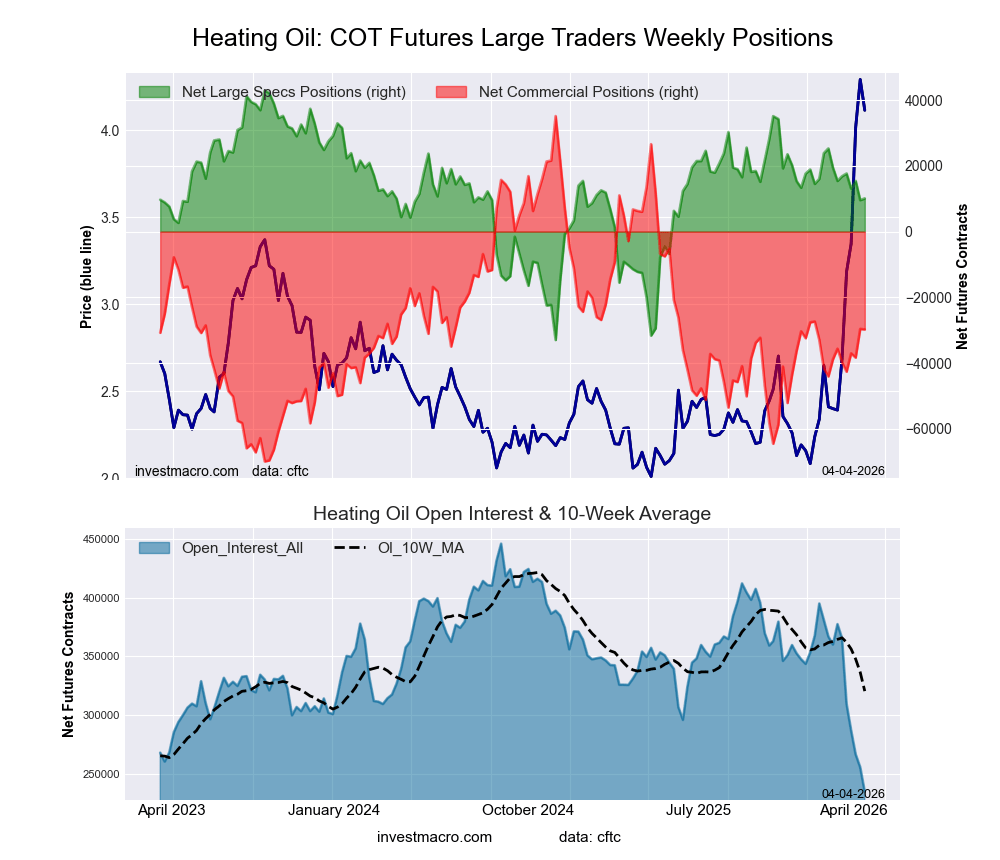
NY Harbor Heating Oil Energy Futures COT ChartThe #2 Heating Oil NY-Harbor Futures large speculator standing this week totaled a net position of 10,092 contracts in the data reported through Tuesday. This was a weekly rise of 525 contracts from the previous week which had a total of 9,567 net contracts.

This week’s current strength score (the trader positioning range over the past three years, measured from 0 to 100) shows the speculators are currently Bullish with a score of 56.7 percent. The commercials are Bearish with a score of 38.2 percent and the small traders (not shown in chart) are Bullish with a score of 71.9 percent.

Price Trend-Following Model: Strong Uptrend

Our weekly trend-following model classifies the current market price position as: Strong Uptrend.

Heating Oil Futures StatisticsSPECULATORSCOMMERCIALSSMALL TRADERS
– Percent of Open Interest Longs:15.350.917.8
– Percent of Open Interest Shorts:11.063.69.4
– Net Position:10,092-29,76019,668
– Gross Longs:35,976119,53041,809
– Gross Shorts:25,884149,29022,141
– Long to Short Ratio:1.4 to 10.8 to 11.9 to 1
NET POSITION TREND:
– Strength Index Score (3 Year Range Pct):56.738.271.9
– Strength Index Reading (3 Year Range):BullishBearishBullish
NET POSITION MOVEMENT INDEX:
– 6-Week Change in Strength Index:-7.05.6-1.5


Bloomberg Commodity Index Futures:

Bloomberg Commodity Index Futures COT ChartThe Bloomberg Commodity Index Futures large speculator standing this week totaled a net position of 23,297 contracts in the data reported through Tuesday. This was a weekly lift of 35,029 contracts from the previous week which had a total of -11,732 net contracts.

This week’s current strength score (the trader positioning range over the past three years, measured from 0 to 100) shows the speculators are currently Bullish-Extreme with a score of 100.0 percent. The commercials are Bearish-Extreme with a score of 0.0 percent and the small traders (not shown in chart) are Bullish with a score of 67.3 percent.

Price Trend-Following Model: Strong Uptrend

Our weekly trend-following model classifies the current market price position as: Strong Uptrend.

Bloomberg Index Futures StatisticsSPECULATORSCOMMERCIALSSMALL TRADERS
– Percent of Open Interest Longs:40.159.30.2
– Percent of Open Interest Shorts:30.169.50.0
– Net Position:23,297-23,828531
– Gross Longs:93,806138,791573
– Gross Shorts:70,509162,61942
– Long to Short Ratio:1.3 to 10.9 to 113.6 to 1
NET POSITION TREND:
– Strength Index Score (3 Year Range Pct):100.00.067.3
– Strength Index Reading (3 Year Range):Bullish-ExtremeBearish-ExtremeBullish
NET POSITION MOVEMENT INDEX:
– 6-Week Change in Strength Index:74.4-74.0-17.0


Article By InvestMacroReceive our weekly COT Reports by Email

*COT Report: The COT data, released weekly to the public each Friday, is updated through the most recent Tuesday (data is 3 days old) and shows a quick view of how large speculators or non-commercials (for-profit traders) were positioned in the futures markets.

The CFTC categorizes trader positions according to commercial hedgers (traders who use futures contracts for hedging as part of the business), non-commercials (large traders who speculate to realize trading profits) and nonreportable traders (usually small traders/speculators) as well as their open interest (contracts open in the market at time of reporting).See CFTC criteria here.

All information and opinions on this website and contained in this article are for general informational purposes only and do not constitute investment advice.

War in the Middle East made the case for renewables – what’s happening in each country tells a harder story

By Ezgi Canpolat, Harvard University 

The oil-dependent world is in crisis. Ship traffic in the Strait of Hormuz – through which more than a quarter of global seaborne oil trade and a fifth of the world’s liquefied natural gas flow – is at a virtual standstill. Oil prices have climbed, briefly topping US$119 a barrel.

The largest release of oil from countries’ strategic reserves in history is under way, in an effort to ease prices. But even so, billions of people are dealing with surging energy prices and spiking food and fertilizer costs. Governments are scrambling for alternatives, too. To reduce energy demand, Sri Lanka has declared every Wednesday a holiday for public officials, Myanmar is limiting private vehicle use to every other day, and Bangladeshi colleges have canceled classes.

Leaders of South Korea and the European Commission have used the current energy crisis to call for accelerating the shift away from fossil fuels and toward homegrown renewable sources. U.N. Secretary-General António Guterres put it plainly in a March 10, 2026, social media post: “There are no price spikes for sunlight and no embargoes on the wind.”

I grew up in a coal-mining town in Turkey. I now study energy transitions across the Middle East and North Africa in a research project I co-lead at Harvard University. I have seen that a country’s desire to increase renewable energy is not the same as a plan to do so.

The very region embroiled in this war reveals that there is not a linear shift from fossil fuels to renewable sources. Rather, there are distinct trajectories, driven by energy dependence, fiscal pressures, governance and stability. Disruption at the Strait of Hormuz does not mean the same thing in Riyadh, Saudi Arabia, as it does in Ankara, Turkey, or Baghdad, Iraq.

The petrostates hedging both sides

For Saudi Arabia, the United Arab Emirates and Qatar, this crisis is a warning dressed as a windfall.

Oil prices have surged, which in theory means higher revenues. But the very infrastructure that produces and delivers that wealth is under direct attack. Iran has targeted oil refineries and shipment centers across the Gulf. The Strait of Hormuz closure is simultaneously choking off their ability to get product to market, exposing how vulnerable the infrastructure of fossil fuel wealth can be.

All three countries have also committed to boosting renewable energy production. In Saudi Arabia, for example, the government aims for renewable energy sources to account for 50% of electricity generation by 2030, up from just 3% at the end of 2023.

Saudi Arabia’s biggest group of clean energy companies has pledged to spend $17 billion on solar and wind – across all their projects, spread out over several years.

But those efforts sit alongside vastly larger investments in fossil fuel production. In 2025 alone, the country’s nationally owned oil company, Saudi Aramco, spent $52.2 billion building new oil and gas infrastructure.

This is not a contradiction. It is a strategy built on the assumption that the world will keep buying fossil fuels for decades to come. The current crisis reinforces that assumption, but it also exposes its vulnerability: As war drives up oil prices, every oil-importing country is feeling the cost of continuing oil dependence. And every stranded export proves the energy transition can’t wait.

Price shock and necessity

Energy-importing countries such as Jordan, Morocco and Turkey are investing in renewable energy for a different reason: Fossil fuel dependence is bankrupting them.

Turkey imports over 70% of its fossil fuels, including virtually all of its natural gas, 17% of which comes from Iran. Natural gas accounts for less than a fifth of electricity generation, but it is the backbone of the country’s heating and industrial sectors and a major concern if supply falters. Turkey’s energy import bill is climbing at a time when the economy is already under strain from rising borrowing costs and weakening currency value.

Jordan, which historically has imported over 90% of its energy, faces similar pressure.

But these countries would be in far worse positions had they not already been investing in alternatives.

More than half of Turkey’s installed electricity capacity now comes from renewable energy sources. Morocco built one of the world’s largest concentrated solar facilities, and renewable sources now supply 25% of the country’s electricity. Similarly, Jordan has gone from virtually no renewable electricity to renewable sources providing more than a quarter of its power in roughly a decade.

The current war has vindicated their investments in renewable energy – though the vindication has limits. The same crisis that proves the value of renewable energy investment also raises inflation, tightens credit and strains the very public finances these countries need to keep building.

Every kilowatt-hour generated by a Turkish wind turbine or a Moroccan solar panel is one that does not depend on a tanker passing through the Strait of Hormuz. But the financial pressure means building the next renewable generating project just got harder.

Crisis upon crisis

Then there are countries where this war lands on top of existing emergencies.

Iraq, the second-largest oil producer in the region and in the Organization of the Petroleum Exporting Countries, depends on Iranian gas imports to generate much of its electricity – a supply line now directly threatened by the war. Oil exports through the southern port of Basra, on the Persian Gulf, fund roughly 90% of Iraq’s government revenue. If those revenues are disrupted, the government may be unable to function. Iraq already suffers chronic electricity shortages and has virtually no renewable energy capacity to fall back on.

In Yemen, Libya and Syria, energy infrastructure has been damaged or destroyed by years of conflict. These countries import fuel at global prices to run generators and keep hospitals lit. Every dollar added to the price of oil makes that harder. For them, this war is not pointing out reasons to shift to renewable sources: It is threatening energy access itself.

An international challenge

In November 2026, the U.N.’s annual climate summit comes to the region at the center of this crisis, with Turkey as host.

The war in the Middle East has made a powerful case for the economic, political and humanitarian benefits of transitioning from fossil fuels to renewable energy sources. But it has also exposed something the global conversation consistently misses: Different countries are heading in different directions, based on their own circumstances, many of which predate this war.

Understanding those paths matters because it reveals what countries’ promises cannot: where the real barriers are, where the incentives already exist, and where support would make a difference – before the next disruption hits. In my view, this war has helped win the argument about whether to shift to renewable energy, but it has also highlighted a harder question: What does it actually take to build those sources, country by country?The Conversation

About the Author:

Ezgi Canpolat, Visiting Postdoctoral Scholar, Center for Middle Eastern Studies, Harvard University

This article is republished from The Conversation under a Creative Commons license. Read the original article.

COT Energy Charts: Speculator Bets led by WTI, Natural Gas & Brent Crude Oil

By InvestMacro

Speculators OI Energy Futures COT Chart
Here are the latest charts and statistics for the Commitment of Traders (COT) data published by the Commodities Futures Trading Commission (CFTC).

The latest COT data is updated through Tuesday March 24th and shows a quick view of how large traders (for-profit speculators and commercial entities) were positioned in the futures markets.

Weekly Speculator Changes led by WTI, Natural Gas & Brent Crude Oil

Speculators Nets Energy Futures COT Chart
The COT energy market speculator bets were overall higher this week as four out of the six energy markets we cover had higher positioning while the other two markets had lower speculator contracts.

Leading the gains for the energy markets was WTI Crude (14,932 contracts) with Natural Gas (5,422 contracts), Brent Oil (5,002 contracts) and the Bloomberg Commodity Index (882 contracts) also having a positive week.

The markets with declines in speculator bets for the week were Gasoline (-6,749 contracts) and with Heating Oil (-5,864 contracts) also seeing lower bets on the week.

WTI Highlights Speculator Bets this week

WTI Crude Oil highlights the speculator bets this week with an increase of 14,932 net positions through Tuesday. The WTI Crude Oil speculator bets have been higher in 8 out of the past 11 weeks and have risen by +176,268 net contracts over that time-frame. The March 10th week saw a sharp increase with a weekly jump by +55,865 net positions. This week’s total net position for WTI Crude Oil is at +233,620 net contracts, which marks the highest position in 38 weeks, dating back to July 1, 2025 as the last time contracts have been higher than this week.

WTI Crude Leads Price Performance

Leading the Energy markets this week in price performance was WTI Crude Oil, which rose by 2.28% on the week. This was followed by the Bloomberg Commodity Index, which was up by 0.82%, and Heating Oil, which saw a 0.43% increase over the last five days. On the downside, the biggest loser on the week was Gasoline, which fell by -1.52%, followed by Natural Gas, which was down by -0.89%. Finally, Brent Oil slipped this week by -0.42%.

Over the past 30 days, the Energy markets have been exploding higher due to the Iran war. Heating Oil is up by 86% over the past 30 days. Brent Crude Oil is higher by 65% in that time-frame while WTI Crude Oil is up by 62%. Gasoline is higher by 51% over that period and the Bloomberg Commodity Index is higher by 17.39%.

Natural Gas is the outlier and has been lower by -1.21% over the past 30 days.


Energy Data:

Speculators Table Energy Futures COT Chart
Legend: Weekly Speculators Change | Speculators Current Net Position | Speculators Strength Score compared to last 3-Years (0-100 range)


Strength Scores led by Gasoline & WTI Crude

Speculators Strength Energy Futures COT Chart
COT Strength Scores (a normalized measure of Speculator positions over a 3-Year range, from 0 to 100 where above 80 is Extreme-Bullish and below 20 is Extreme-Bearish) showed that Gasoline (64.3 percent) and WTI Crude (62.5 percent) lead the energy markets this week.

On the downside, Natural Gas (21.7 percent) comes in at the lowest strength level currently.

Strength Statistics:
WTI Crude Oil (62.5 percent) vs WTI Crude Oil previous week (57.7 percent)
Brent Crude Oil (56.1 percent) vs Brent Crude Oil previous week (49.0 percent)
Natural Gas (21.7 percent) vs Natural Gas previous week (18.2 percent)
Gasoline (64.3 percent) vs Gasoline previous week (71.7 percent)
Heating Oil (56.1 percent) vs Heating Oil previous week (63.8 percent)
Bloomberg Commodity Index (51.6 percent) vs Bloomberg Commodity Index previous week (47.5 percent)


WTI Crude & Brent Oil top the 6-Week Strength Trends

Speculators Trend Energy Futures COT Chart
COT Strength Score Trends (or move index, calculates the 6-week changes in strength scores) showed that WTI Crude (37.3 percent) and Brent Oil (26.4 percent) lead the past six weeks trends for the energy markets.

Gasoline (-22.2 percent) leads the downside trend scores currently with Heating Oil (-13.0 percent) as the next market with lower trend scores.

Move Statistics:
WTI Crude Oil (37.3 percent) vs WTI Crude Oil previous week (30.3 percent)
Brent Crude Oil (26.4 percent) vs Brent Crude Oil previous week (16.5 percent)
Natural Gas (-0.5 percent) vs Natural Gas previous week (-3.7 percent)
Gasoline (-22.2 percent) vs Gasoline previous week (0.2 percent)
Heating Oil (-13.0 percent) vs Heating Oil previous week (-13.0 percent)
Bloomberg Commodity Index (-3.4 percent) vs Bloomberg Commodity Index previous week (-25.3 percent)


Individual COT Market Charts:

WTI Crude Oil Futures:

WTI Crude Oil Futures COT ChartThe WTI Crude Oil Futures large speculator standing this week equaled a net position of 233,620 contracts in the data reported through Tuesday. This was a weekly increase of 14,932 contracts from the previous week which had a total of 218,688 net contracts.

This week’s current strength score (the trader positioning range over the past three years, measured from 0 to 100) shows the speculators are currently Bullish with a score of 62.5 percent. The commercials are Bearish with a score of 35.2 percent and the small traders (not shown in chart) are Bullish with a score of 66.9 percent.

Price Trend-Following Model: Strong Uptrend

Our weekly trend-following model classifies the current market price position as: Strong Uptrend.

WTI Crude Oil Futures StatisticsSPECULATORSCOMMERCIALSSMALL TRADERS
– Percent of Open Interest Longs:18.842.03.8
– Percent of Open Interest Shorts:7.155.42.2
– Net Position:233,620-267,01033,390
– Gross Longs:376,150841,20076,513
– Gross Shorts:142,5301,108,21043,123
– Long to Short Ratio:2.6 to 10.8 to 11.8 to 1
NET POSITION TREND:
– Strength Index Score (3 Year Range Pct):62.535.266.9
– Strength Index Reading (3 Year Range):BullishBearishBullish
NET POSITION MOVEMENT INDEX:
– 6-Week Change in Strength Index:37.3-34.0-9.2


Brent Crude Oil Futures:

Brent Last Day Crude Oil Futures COT ChartThe Brent Crude Oil Futures large speculator standing this week equaled a net position of -17,555 contracts in the data reported through Tuesday. This was a weekly lift of 5,002 contracts from the previous week which had a total of -22,557 net contracts.

This week’s current strength score (the trader positioning range over the past three years, measured from 0 to 100) shows the speculators are currently Bullish with a score of 56.1 percent. The commercials are Bearish with a score of 42.7 percent and the small traders (not shown in chart) are Bullish with a score of 60.7 percent.

Price Trend-Following Model: Strong Uptrend

Our weekly trend-following model classifies the current market price position as: Strong Uptrend.

Brent Crude Oil Futures StatisticsSPECULATORSCOMMERCIALSSMALL TRADERS
– Percent of Open Interest Longs:27.342.53.5
– Percent of Open Interest Shorts:32.837.62.8
– Net Position:-17,55515,3732,182
– Gross Longs:86,045134,19811,152
– Gross Shorts:103,600118,8258,970
– Long to Short Ratio:0.8 to 11.1 to 11.2 to 1
NET POSITION TREND:
– Strength Index Score (3 Year Range Pct):56.142.760.7
– Strength Index Reading (3 Year Range):BullishBearishBullish
NET POSITION MOVEMENT INDEX:
– 6-Week Change in Strength Index:26.4-30.112.5


Natural Gas Futures:

Natural Gas Futures COT ChartThe Natural Gas Futures large speculator standing this week equaled a net position of -172,607 contracts in the data reported through Tuesday. This was a weekly lift of 5,422 contracts from the previous week which had a total of -178,029 net contracts.

This week’s current strength score (the trader positioning range over the past three years, measured from 0 to 100) shows the speculators are currently Bearish with a score of 21.7 percent. The commercials are Bullish with a score of 79.1 percent and the small traders (not shown in chart) are Bullish with a score of 53.3 percent.

Price Trend-Following Model: Downtrend

Our weekly trend-following model classifies the current market price position as: Downtrend.

Natural Gas Futures StatisticsSPECULATORSCOMMERCIALSSMALL TRADERS
– Percent of Open Interest Longs:14.037.43.8
– Percent of Open Interest Shorts:25.427.22.5
– Net Position:-172,607152,74819,859
– Gross Longs:210,159562,54056,760
– Gross Shorts:382,766409,79236,901
– Long to Short Ratio:0.5 to 11.4 to 11.5 to 1
NET POSITION TREND:
– Strength Index Score (3 Year Range Pct):21.779.153.3
– Strength Index Reading (3 Year Range):BearishBullishBullish
NET POSITION MOVEMENT INDEX:
– 6-Week Change in Strength Index:-0.5-4.418.8


Gasoline Blendstock Futures:

RBOB Gasoline Energy Futures COT ChartThe Gasoline Blendstock Futures large speculator standing this week equaled a net position of 69,846 contracts in the data reported through Tuesday. This was a weekly fall of -6,749 contracts from the previous week which had a total of 76,595 net contracts.

This week’s current strength score (the trader positioning range over the past three years, measured from 0 to 100) shows the speculators are currently Bullish with a score of 64.3 percent. The commercials are Bearish with a score of 28.4 percent and the small traders (not shown in chart) are Bullish with a score of 79.4 percent.

Price Trend-Following Model: Strong Uptrend

Our weekly trend-following model classifies the current market price position as: Strong Uptrend.

Nasdaq Mini Futures StatisticsSPECULATORSCOMMERCIALSSMALL TRADERS
– Percent of Open Interest Longs:26.050.17.3
– Percent of Open Interest Shorts:6.373.53.5
– Net Position:69,846-83,41813,572
– Gross Longs:92,274177,74826,021
– Gross Shorts:22,428261,16612,449
– Long to Short Ratio:4.1 to 10.7 to 12.1 to 1
NET POSITION TREND:
– Strength Index Score (3 Year Range Pct):64.328.479.4
– Strength Index Reading (3 Year Range):BullishBearishBullish
NET POSITION MOVEMENT INDEX:
– 6-Week Change in Strength Index:-22.220.3-0.6


#2 Heating Oil NY-Harbor Futures:

NY Harbor Heating Oil Energy Futures COT ChartThe #2 Heating Oil NY-Harbor Futures large speculator standing this week equaled a net position of 9,567 contracts in the data reported through Tuesday. This was a weekly reduction of -5,864 contracts from the previous week which had a total of 15,431 net contracts.

This week’s current strength score (the trader positioning range over the past three years, measured from 0 to 100) shows the speculators are currently Bullish with a score of 56.1 percent. The commercials are Bearish with a score of 38.4 percent and the small traders (not shown in chart) are Bullish with a score of 72.9 percent.

Price Trend-Following Model: Strong Uptrend

Our weekly trend-following model classifies the current market price position as: Strong Uptrend.

Heating Oil Futures StatisticsSPECULATORSCOMMERCIALSSMALL TRADERS
– Percent of Open Interest Longs:14.652.817.2
– Percent of Open Interest Shorts:10.964.49.4
– Net Position:9,567-29,59620,029
– Gross Longs:37,342134,96443,977
– Gross Shorts:27,775164,56023,948
– Long to Short Ratio:1.3 to 10.8 to 11.8 to 1
NET POSITION TREND:
– Strength Index Score (3 Year Range Pct):56.138.472.9
– Strength Index Reading (3 Year Range):BullishBearishBullish
NET POSITION MOVEMENT INDEX:
– 6-Week Change in Strength Index:-13.08.81.7


Bloomberg Commodity Index Futures:

Bloomberg Commodity Index Futures COT ChartThe Bloomberg Commodity Index Futures large speculator standing this week equaled a net position of -11,732 contracts in the data reported through Tuesday. This was a weekly advance of 882 contracts from the previous week which had a total of -12,614 net contracts.

This week’s current strength score (the trader positioning range over the past three years, measured from 0 to 100) shows the speculators are currently Bullish with a score of 51.6 percent. The commercials are Bearish with a score of 48.2 percent and the small traders (not shown in chart) are Bullish with a score of 61.3 percent.

Price Trend-Following Model: Strong Uptrend

Our weekly trend-following model classifies the current market price position as: Strong Uptrend.

Bloomberg Index Futures StatisticsSPECULATORSCOMMERCIALSSMALL TRADERS
– Percent of Open Interest Longs:30.569.20.2
– Percent of Open Interest Shorts:36.463.50.0
– Net Position:-11,73211,283449
– Gross Longs:60,948138,240486
– Gross Shorts:72,680126,95737
– Long to Short Ratio:0.8 to 11.1 to 113.1 to 1
NET POSITION TREND:
– Strength Index Score (3 Year Range Pct):51.648.261.3
– Strength Index Reading (3 Year Range):BullishBearishBullish
NET POSITION MOVEMENT INDEX:
– 6-Week Change in Strength Index:-3.45.0-24.9


Article By InvestMacroReceive our weekly COT Newsletter

*COT Report: The COT data, released weekly to the public each Friday, is updated through the most recent Tuesday (data is 3 days old) and shows a quick view of how large speculators or non-commercials (for-profit traders) were positioned in the futures markets.

The CFTC categorizes trader positions according to commercial hedgers (traders who use futures contracts for hedging as part of the business), non-commercials (large traders who speculate to realize trading profits) and nonreportable traders (usually small traders/speculators) as well as their open interest (contracts open in the market at time of reporting). See CFTC criteria here.

Why shadow tankers are the only ships still moving through the Strait of Hormuz

By Charles Edward Gehrke, US Naval War College 

The Strait of Hormuz is effectively closed. Since the beginning of the conflict involving the United States, Israel and Iran on Feb. 28, 2026, oil tanker traffic through the world’s most critical oil shipping choke point has collapsed, dropping by more than 90%.

Iran has threatened to destroy any ships, including oil tankers, that pass through the strait from the oil depots of the Persian Gulf to the Arabian Sea and the rest of the world. Companies that insure ships against the risks of traveling in war zones are deciding whether to issue coverage on an individual-ship basis. The international body that sets many shipping regulations has told ships’ crews that they have the right to refuse to sail into the area.

As of March 6, more than 400 tankers were stranded in the Persian Gulf, without permission from their owners to move.

But some vessels are still transiting the strait. Most of the ships still moving are those that operate outside the rules.

In maritime circles, these vessels are called the “shadow fleet.” They are vessels that ignore international restrictions on trade with certain countries, violate anti-pollution regulations, smuggle unauthorized goods or don’t want their cargo or activities too closely monitored.

They exist, even in a world filled with electronic tracking, because the world’s oceans aren’t governed the same way the land is. On land, armed personnel closely monitor carefully delineated borders, seeking to force everyone to follow clear rules. But at sea, regulation is almost the opposite. The system that governs international shipping is, at its foundation, voluntary.

The oceans run on trust

The tracking of ships is voluntary. The International Convention for the Safety of Life at Sea – signed by 167 countries – requires almost every commercial vessel to carry a radio transponder that broadcasts the ship’s identity, position, speed and heading to port authorities, coast guards and commercial tracking networks.

That international agreement, which is enforced by individual countries, requires ships to leave the transponders on and active. But there is no physical mechanism preventing a crew from switching it off or broadcasting a false position.

When a vessel turns off its transponder and goes dark, it doesn’t trigger an alarm at some global maritime headquarters. There is no such headquarters. The ship simply disappears from the map. Every map.

National jurisdiction is a matter of preference, not law. Every vessel sails under the flag of a nation, and that nation is theoretically responsible for regulating and inspecting it. But in practice, a ship’s registration in a particular country is a commercial transaction. Many law-abiding shipping companies make this business decision, but this system leaves an opening for those who seek to skirt the rules.

A ship owned by a shell company in the United Arab Emirates can register under the flag of Cameroon, Palau or Liberia, or any country that may lack the resources or the incentive to conduct real inspections. Even landlocked Mongolia has a registry of oceangoing ships flying its flag.

When a vessel comes under scrutiny from port inspectors or coast guards, it can simply reregister under a different flag. Some registries even offer online registration. If the new registration is fraudulent or the registry doesn’t actually exist, the vessel effectively becomes stateless.

Then there is insurance, which is the closest thing the maritime system has to a real enforcement mechanism. Mainstream insurers, mostly based in London, require vessels to meet safety standards, carry proper documentation and comply with international trade sanctions. A ship without insurance coverage cannot easily enter major ports or secure cargo contracts with reputable firms.
Those restrictions are precisely what froze so many law-abiding ships in the Persian Gulf when war broke out.

But companies can avoid those rules, too. Two-thirds of ships carrying Russian oil – the trade of which is restricted by the U.S. and other countries – reportedly have “unknown” insurance providers, meaning nobody knows whom to call to cover the cleanup costs after a spill or collision. The enforcement mechanism works until ship owners realize they can just opt out of it entirely, using less reputable ports or transferring oil from ship to ship out at sea.

What opting out looks like

The results of this voluntary system can be surreal. In December 2025, the United States seized a sanctioned tanker called the Skipper, which was flying the flag of Guyana – even though that country had never registered it. The vessel was, in legal terms, stateless, sailing under the authority of no nation on Earth.

Another vessel, the Arcusat, went further. Investigative reporting found that it had changed its International Maritime Organization identification number, a unique seven-digit code assigned permanently to every ship. It is the maritime equivalent of scraping the VIN off a car.

Now layer these techniques together. An entity purchases an aging tanker that would otherwise be scrapped. It registers the ship through a shell company, pays for a flag of convenience, carries opaque insurance and switches off its transponder when approaching sensitive waters.

It loads sanctioned oil through a ship-to-ship transfer on the open ocean and delivers its cargo to a buyer who asks no questions. If the vessel attracts attention, it changes its name, reregisters under a different flag and starts over.

According to maritime intelligence firm Windward, approximately 1,100 dark fleet vessels have been identified globally, representing roughly 17% to 18% of all tankers carrying liquid cargo, which is primarily oil.

Why it matters now

The dark fleet did not emerge because the maritime system is broken. It emerged because the system is built on voluntary participation, all theoretically ensured by market forces.

For decades, the system worked not because it forced compliance but rather because opting out was more costly than opting in.

What changed is that international sanctions made compliance ruinously expensive and politically disastrous for some countries. A system built on voluntary participation, it turned out, could be voluntarily left.

If your national economy depends on oil exports, and the compliance system is preventing those exports, you build a parallel system. Iran began doing so in 2018, after sanctions were reimposed as part of negotiations over its nuclear development. Russia dramatically expanded that system in 2022 as restrictions hit in the wake of its invasion of Ukraine.
Now, with the Strait of Hormuz effectively closed to aboveboard maritime trade, the only vessels still moving are the ones that ignore the rules.

But the existence of the dark fleet doesn’t mean that the rules of the sea have failed. Rather, it reveals what kind of rules they always were. Illegal oil is the only oil moving in a crisis. In my view, that sends a message to those still playing by the rules: Opting out might be a viable option.

The opinions and views expressed are those of the author alone and do not necessarily represent those of the Department of the Navy or the U.S. Naval War College.The Conversation

About the Author:

Charles Edward Gehrke, Deputy Division Director of Wargame Design and Adjudication, US Naval War College

This article is republished from The Conversation under a Creative Commons license. Read the original article.

Oil price volatility intensifies as conflict deepens

By ForexTime 

  • Risk aversion grips global stock markets
  • Brent crude hovers around triple digits amid supply shocks
  • Gold pressured by stronger dollar and inflation fears
  • RBA raises rates for second consecutive time
  • Fed seen leaving rates unchanged on Wednesday

Risk aversion returned to global markets on Tuesday as tensions in the Middle East sapped risk appetite.

The brief tech rally in the previous session merely served as a small distraction with equities on the back foot amid the overall caution.

All eyes remain on the ship traffic through the Strait of Hormuz as Trump calls for other nations to secure the critical waterway.

Ultimately, this has injected oil prices with monstrous levels of volatility with Brent rallying above $103 a barrel on Tuesday. Iran’s attacks on energy infrastructure around the Middle East have intensified fears around supply shocks, injecting oil bulls with renewed vigour.

To counter such shocks, the IEA launched its largest ever oil release amounting to 400million barrels of oil from their emergency stocks. In addition, the US issued its second temporary waiver for the purchase of Russian oil. Despite all of this, Brent is finding comfort at triple digits and could extend gains on geopolitical risk.

Gold remains on the back foot despite the growing risk aversion.

A broadly stronger dollar and dwindling bets around lower US interest rates have dealt gold a double blow. Traders are only pricing in just one Fed cut in 2026, thanks to concerns around conflict-induced inflation.

Gold’s near-term outlook may be influenced by the Fed decision on Wednesday. No changes are expected, but the Fed may be forced to reassess its policy strategy for 2026. Looking at the charts, gold is wobbling above $5000 as of writing. Weakness below this point may open a path toward $4900 while a rebound could see prices retest resistance at $5100.

Speaking of central banks, the RBA raised interest rates on Tuesday for a second consecutive meeting.

Growing concerns around conflict-induced inflation shocks may prompt central banks to reassess their policy strategies for 2026.

The Federal Reserve (Fed), European Central Bank (ECB) and Bank of England (BoE), among many others will be under the spotlight this week.

Market expectations have rapidly evaporated over the Fed cutting rates anytime while the BoE/ECB are seen potentially hiking rates by the end of the year if inflation persists. These sharp shifts in policy expectations may translate to heightened levels of volatility.


Forex-Time-LogoArticle by ForexTime


ForexTime Ltd (FXTM) is an award winning international online forex broker regulated by CySEC 185/12 www.forextime.com

Oil isn’t just fuel: Iran conflict could disrupt markets for everything from plastics to fertilizers

By André O. Hudson, Rochester Institute of Technology 

Tensions in the Middle East often trigger concerns about rising gasoline prices. But disruptions to oil supplies could affect much more than the cost of filling up a car. That’s because crude oil is not only burned as fuel. It is also the raw material for thousands of products that modern societies depend on, including plastics, fertilizers, clothing fibers, medicines and electronics.

As a biochemist, I’m interested in how certain chemicals can shape society, and oil is a prime example.

The stakes become clearer when looking at the Strait of Hormuz, a narrow waterway between Iran and Oman. About one-fifth of the world’s petroleum liquids consumption passes through the strait each day, making it one of the most important oil shipping routes on Earth. If conflict significantly disrupts traffic there, the effects could ripple far beyond energy markets.

A map of the Strait of Hormuz, which is a narrow body of water between Iran and Oman.
The Strait of Hormuz.
Goran_tek-en/Wikimedia Commons, CC BY-SA

Oil is a chemical starting point

Crude oil is a complex mixture of hydrocarbons – molecules made mainly of carbon and hydrogen. Refineries and chemical plants separate and transform these molecules into smaller chemical building blocks known as petrochemicals.

Some of the most important petrochemical building blocks include chemicals such as ethylene, propylene and benzene. Manufacturers can then convert these building blocks into more complex forms, which make up plastics, solvents, synthetic rubber and other industrial materials.
While fuel is a well-known product, fuels actually represents only a portion of what is produced from crude oil. The refining process generates a wide range of petroleum-based materials used to manufacture everyday items, such as plastics, medicines, electronics, cosmetics, clothing fibers and household goods.

A diagram showing a bunch of different types of hydrocarbon molecules derived from petroleum
Hydrocarbons are molecules made predominantly from hydrogen and carbon. Different forms, derived from crude oil, are used in many types of manufacturing.
André O. Hudson/Patel & Shah, 2013

Plastics that shape modern life

One of the most visible uses of oil is the production of plastics. Scientists can link individual petrochemical molecules to form polymers, which are long chains of repeating units that create materials such as polyethylene, polypropylene and polystyrene.
Because plastics are lightweight, durable and relatively inexpensive, they have become essential to global manufacturing.
These plastics appear in countless products, including food packaging and water bottles; medical equipment, such as syringes and IV bags; electronics casings and appliances; automotive parts; and construction materials, such as pipes and insulation.

Even technologies designed to reduce carbon emissions depend on them. Wind turbines, solar panels and electric vehicles all contain plastic components derived from petrochemicals.

Fertilizer that feeds billions

Oil and natural gas also play a critical role in agriculture. Modern fertilizers rely on nitrogen compounds, such as ammonia. Ammonia is produced through the Haber-Bosch process, which uses hydrogen typically derived from natural gas or other fossil fuels.

These fertilizers replenish nutrients in soil and dramatically increase crop yields. Without them, global food production would be far lower. Petrochemicals are also used to produce pesticides, herbicides and plastics used in irrigation systems and agricultural equipment.

Clothing, cosmetics and medicines

Petrochemicals also appear in many everyday consumer goods. Synthetic fabrics, such as polyester, nylon and acrylic, are made from petrochemical feedstocks. These feedstocks are the basic chemicals, made from crude oil or natural gas, that serve as the starting ingredients for products widely used in clothing, carpets and furniture.

Petroleum-derived ingredients are also common in cosmetics and personal care products. Certain lotions, shampoos and lipsticks rely on these compounds because they help stabilize formulas and extend shelf life.

Petrochemicals are also important in medicine. Petroleum-derived chemical intermediates − compounds made during the process of turning raw materials into a final product − are used to manufacture pharmaceuticals, medical tubing, sterile packaging and disposable gloves.

These materials help hospitals maintain sterility and safety in health care environments.

Crude oil is far more than just a source of gasoline.

Why the Strait of Hormuz matters

Because oil and petrochemical feedstocks move through global shipping routes, disruptions in one region will affect supply chains worldwide. The Strait of Hormuz is particularly important. If conflict or political tensions continue to interrupt shipping through the Strait, oil prices will rise quickly. Energy analysts have long warned that disruptions to the strait could send shock waves through global markets. The impact would not be limited to transportation fuels.

Petrochemical industries depend on steady supplies of crude oil and natural gas liquids as raw materials. If those supplies become more expensive or harder to obtain, manufacturers could face higher production costs.

The proportion of crude oil used for petrochemical feedstocks to create plastics, fertilizers and other materials represents around 10% to 20% of oil consumption. Most crude oil is refined for fuel production, including gasoline, diesel and jet fuel, so these fuel supply chains would likely be the first to take a hit. But over time, disruptions could affect the availability and price of products ranging from plastics and packaging to fertilizers, synthetic clothing fibers and even food.

A hidden foundation of modern economies

Because petrochemicals are often used behind the scenes as ingredients rather than finished products, the connection many agricultural, medical and consumer goods have to oil is easy to overlook. Yet, petrochemicals form a hidden foundation for modern economies. They enable large-scale agriculture, advanced health care systems and global manufacturing supply chains.

At the same time, concerns about climate change and plastic pollution are driving research into alternatives. Scientists are developing bio-based plastics made from plant materials, improving recycling technologies and exploring new ways to produce fertilizers with lower carbon emissions.

For now, the modern world remains deeply dependent on oil, not only for energy but also for the materials that shape everyday life. When news headlines focus on disruptions to oil supply, the consequences may extend far beyond the gas pump, affecting the products that underpin modern society.The Conversation

About the Author:

André O. Hudson, Dean of the College of Science, Professor of Biochemistry, Rochester Institute of Technology

This article is republished from The Conversation under a Creative Commons license. Read the original article.


COT Energy Charts: Speculator Bets led by Brent Oil & Heating Oil 

By InvestMacro

Speculators OI Energy Futures COT Chart
Here are the latest charts and statistics for the Commitment of Traders (COT) data published by the Commodities Futures Trading Commission (CFTC).

The latest COT data is updated through Tuesday March 3rd and shows a quick view of how large traders (for-profit speculators and commercial entities) were positioned in the futures markets.

Weekly Speculator Changes led by Brent Oil & Heating Oil

Speculators Nets Energy Futures COT Chart
The COT energy market speculator bets were overall lower this week as just two out of the six energy markets we cover had higher positioning while the other four markets had lower speculator contracts.

Leading the gains for the energy markets through Tuesday was Brent Oil (22,025 contracts) with Heating Oil (824 contracts) also having a small positive week.

The markets with declines in speculator bets for the week were Natural Gas (-7,903 contracts), Gasoline (-6,975 contracts), the Bloomberg Index (-1,650 contracts) and with WTI Crude (-562 contracts) also seeing lower bets on the week.

Oil Markets lead Price Performance this week as all 6 Markets saw strong gains on Iran War

Leading the Energy markets this week was WTI Crude Oil, which jumped by approximately 33% over the last five days due to the Iran war. Following next was Heating Oil, which also jumped by over 30%. And Brent Crude Oil was not to be outdone with a gain of 26.17% over that period. Gasoline rose sharply by 20% in the past five days, while Natural Gas was up by 10.73%, and the Bloomberg Commodity Index rose by a strong 8.69%.

These sharp increases in the past week have now pushed all of these six Energy markets higher over the past 30 days and over the past 90 days, with the exception of Natural Gas, which is down by -5.06% in the past 30 days and is also lower by -1.70% in the past 90 days.


Energy Data:

Speculators Table Energy Futures COT Chart
Legend: Weekly Speculators Change | Speculators Current Net Position | Speculators Strength Score compared to last 3-Years (0-100 range)


Strength Scores led by Gasoline & Heating Oil

Speculators Strength Energy Futures COT Chart
COT Strength Scores (a normalized measure of Speculator positions over a 3-Year range, from 0 to 100 where above 80 is Extreme-Bullish and below 20 is Extreme-Bearish) showed that Gasoline (88.5 percent) and Heating Oil (66.7 percent) lead the energy markets this week.

On the downside, Natural Gas (0.0 percent) comes in at the lowest strength level currently and is in Extreme-Bearish territory (below 20 percent). The next lowest strength score was the Bloomberg Commodity Index (40.8 percent).

Strength Statistics:
WTI Crude Oil (42.7 percent) vs WTI Crude Oil previous week (42.8 percent)
Brent Crude Oil (42.0 percent) vs Brent Crude Oil previous week (10.6 percent)
Natural Gas (0.0 percent) vs Natural Gas previous week (5.1 percent)
Gasoline (88.5 percent) vs Gasoline previous week (96.2 percent)
Heating Oil (66.7 percent) vs Heating Oil previous week (65.6 percent)
Bloomberg Commodity Index (40.8 percent) vs Bloomberg Commodity Index previous week (48.6 percent)


WTI Crude & Gasoline top the 6-Week Strength Trends

Speculators Trend Energy Futures COT Chart
COT Strength Score Trends (or move index, calculates the 6-week changes in strength scores) showed that WTI Crude (30.1 percent) and Gasoline (23.2 percent) lead the past six weeks trends for the energy markets.

The Bloomberg Index (-38.9 percent) leads the downside trend scores currently with Natural Gas (-8.3 percent) as the next market with lower trend scores.

Move Statistics:
WTI Crude Oil (30.1 percent) vs WTI Crude Oil previous week (36.9 percent)
Brent Crude Oil (20.9 percent) vs Brent Crude Oil previous week (-22.3 percent)
Natural Gas (-8.3 percent) vs Natural Gas previous week (-8.3 percent)
Gasoline (23.2 percent) vs Gasoline previous week (29.0 percent)
Heating Oil (2.1 percent) vs Heating Oil previous week (3.1 percent)
Bloomberg Commodity Index (-38.9 percent) vs Bloomberg Commodity Index previous week (-31.0 percent)


Individual COT Market Charts:

WTI Crude Oil Futures:

WTI Crude Oil Futures COT ChartThe WTI Crude Oil Futures large speculator standing this week reached a net position of 172,150 contracts in the data reported through Tuesday. This was a weekly decline of -562 contracts from the previous week which had a total of 172,712 net contracts.

This week’s current strength score (the trader positioning range over the past three years, measured from 0 to 100) shows the speculators are currently Bearish with a score of 42.7 percent. The commercials are Bearish with a score of 48.8 percent and the small traders (not shown in chart) are Bullish-Extreme with a score of 100.0 percent.

Price Trend-Following Model: Strong Uptrend

Our weekly trend-following model classifies the current market price position as: Strong Uptrend.

WTI Crude Oil Futures StatisticsSPECULATORSCOMMERCIALSSMALL TRADERS
– Percent of Open Interest Longs:17.140.74.3
– Percent of Open Interest Shorts:8.851.41.9
– Net Position:172,150-222,32750,177
– Gross Longs:355,158842,95789,225
– Gross Shorts:183,0081,065,28439,048
– Long to Short Ratio:1.9 to 10.8 to 12.3 to 1
NET POSITION TREND:
– Strength Index Score (3 Year Range Pct):42.748.8100.0
– Strength Index Reading (3 Year Range):BearishBearishBullish-Extreme
NET POSITION MOVEMENT INDEX:
– 6-Week Change in Strength Index:30.1-38.363.0


Brent Crude Oil Futures:

Brent Last Day Crude Oil Futures COT ChartThe Brent Crude Oil Futures large speculator standing this week reached a net position of -27,468 contracts in the data reported through Tuesday. This was a weekly increase of 22,025 contracts from the previous week which had a total of -49,493 net contracts.

This week’s current strength score (the trader positioning range over the past three years, measured from 0 to 100) shows the speculators are currently Bearish with a score of 42.0 percent. The commercials are Bullish with a score of 58.1 percent and the small traders (not shown in chart) are Bullish with a score of 59.3 percent.

Price Trend-Following Model: Strong Uptrend

Our weekly trend-following model classifies the current market price position as: Strong Uptrend.

Brent Crude Oil Futures StatisticsSPECULATORSCOMMERCIALSSMALL TRADERS
– Percent of Open Interest Longs:25.439.53.4
– Percent of Open Interest Shorts:36.429.42.6
– Net Position:-27,46825,4002,068
– Gross Longs:64,04099,3388,498
– Gross Shorts:91,50873,9386,430
– Long to Short Ratio:0.7 to 11.3 to 11.3 to 1
NET POSITION TREND:
– Strength Index Score (3 Year Range Pct):42.058.159.3
– Strength Index Reading (3 Year Range):BearishBullishBullish
NET POSITION MOVEMENT INDEX:
– 6-Week Change in Strength Index:20.9-20.7-14.1


Natural Gas Futures:

Natural Gas Futures COT ChartThe Natural Gas Futures large speculator standing this week reached a net position of -206,422 contracts in the data reported through Tuesday. This was a weekly decline of -7,903 contracts from the previous week which had a total of -198,519 net contracts.

This week’s current strength score (the trader positioning range over the past three years, measured from 0 to 100) shows the speculators are currently Bearish-Extreme with a score of 0.0 percent. The commercials are Bullish-Extreme with a score of 100.0 percent and the small traders (not shown in chart) are Bullish with a score of 58.9 percent.

Price Trend-Following Model: Downtrend

Our weekly trend-following model classifies the current market price position as: Downtrend.

Natural Gas Futures StatisticsSPECULATORSCOMMERCIALSSMALL TRADERS
– Percent of Open Interest Longs:13.137.83.9
– Percent of Open Interest Shorts:26.026.42.5
– Net Position:-206,422184,36022,062
– Gross Longs:210,477607,90762,972
– Gross Shorts:416,899423,54740,910
– Long to Short Ratio:0.5 to 11.4 to 11.5 to 1
NET POSITION TREND:
– Strength Index Score (3 Year Range Pct):0.0100.058.9
– Strength Index Reading (3 Year Range):Bearish-ExtremeBullish-ExtremeBullish
NET POSITION MOVEMENT INDEX:
– 6-Week Change in Strength Index:-8.31.526.9


Gasoline Blendstock Futures:

RBOB Gasoline Energy Futures COT ChartThe Gasoline Blendstock Futures large speculator standing this week reached a net position of 91,817 contracts in the data reported through Tuesday. This was a weekly decrease of -6,975 contracts from the previous week which had a total of 98,792 net contracts.

This week’s current strength score (the trader positioning range over the past three years, measured from 0 to 100) shows the speculators are currently Bullish-Extreme with a score of 88.5 percent. The commercials are Bearish-Extreme with a score of 6.9 percent and the small traders (not shown in chart) are Bullish-Extreme with a score of 96.2 percent.

Price Trend-Following Model: Strong Uptrend

Our weekly trend-following model classifies the current market price position as: Strong Uptrend.

Nasdaq Mini Futures StatisticsSPECULATORSCOMMERCIALSSMALL TRADERS
– Percent of Open Interest Longs:26.942.86.1
– Percent of Open Interest Shorts:4.768.22.9
– Net Position:91,817-104,85013,033
– Gross Longs:111,324177,26325,236
– Gross Shorts:19,507282,11312,203
– Long to Short Ratio:5.7 to 10.6 to 12.1 to 1
NET POSITION TREND:
– Strength Index Score (3 Year Range Pct):88.56.996.2
– Strength Index Reading (3 Year Range):Bullish-ExtremeBearish-ExtremeBullish-Extreme
NET POSITION MOVEMENT INDEX:
– 6-Week Change in Strength Index:23.2-25.726.3


#2 Heating Oil NY-Harbor Futures:

NY Harbor Heating Oil Energy Futures COT ChartThe #2 Heating Oil NY-Harbor Futures large speculator standing this week reached a net position of 17,655 contracts in the data reported through Tuesday. This was a weekly increase of 824 contracts from the previous week which had a total of 16,831 net contracts.

This week’s current strength score (the trader positioning range over the past three years, measured from 0 to 100) shows the speculators are currently Bullish with a score of 66.7 percent. The commercials are Bearish with a score of 26.0 percent and the small traders (not shown in chart) are Bullish-Extreme with a score of 86.3 percent.

Price Trend-Following Model: Strong Uptrend

Our weekly trend-following model classifies the current market price position as: Strong Uptrend.

Heating Oil Futures StatisticsSPECULATORSCOMMERCIALSSMALL TRADERS
– Percent of Open Interest Longs:18.345.415.4
– Percent of Open Interest Shorts:12.659.17.3
– Net Position:17,655-42,60224,947
– Gross Longs:56,514140,46347,560
– Gross Shorts:38,859183,06522,613
– Long to Short Ratio:1.5 to 10.8 to 12.1 to 1
NET POSITION TREND:
– Strength Index Score (3 Year Range Pct):66.726.086.3
– Strength Index Reading (3 Year Range):BullishBearishBullish-Extreme
NET POSITION MOVEMENT INDEX:
– 6-Week Change in Strength Index:2.1-9.222.0


Bloomberg Commodity Index Futures:

Bloomberg Commodity Index Futures COT ChartThe Bloomberg Commodity Index Futures large speculator standing this week reached a net position of -14,034 contracts in the data reported through Tuesday. This was a weekly reduction of -1,650 contracts from the previous week which had a total of -12,384 net contracts.

This week’s current strength score (the trader positioning range over the past three years, measured from 0 to 100) shows the speculators are currently Bearish with a score of 40.8 percent. The commercials are Bullish with a score of 58.1 percent and the small traders (not shown in chart) are Bearish with a score of 49.9 percent.

Price Trend-Following Model: Strong Uptrend

Our weekly trend-following model classifies the current market price position as: Strong Uptrend.

Bloomberg Index Futures StatisticsSPECULATORSCOMMERCIALSSMALL TRADERS
– Percent of Open Interest Longs:31.666.90.4
– Percent of Open Interest Shorts:38.360.50.0
– Net Position:-14,03413,355679
– Gross Longs:66,250140,036759
– Gross Shorts:80,284126,68180
– Long to Short Ratio:0.8 to 11.1 to 19.5 to 1
NET POSITION TREND:
– Strength Index Score (3 Year Range Pct):40.858.149.9
– Strength Index Reading (3 Year Range):BearishBullishBearish
NET POSITION MOVEMENT INDEX:
– 6-Week Change in Strength Index:-38.939.21.9


Article By InvestMacroReceive our weekly COT Newsletter

*COT Report: The COT data, released weekly to the public each Friday, is updated through the most recent Tuesday (data is 3 days old) and shows a quick view of how large speculators or non-commercials (for-profit traders) were positioned in the futures markets.

The CFTC categorizes trader positions according to commercial hedgers (traders who use futures contracts for hedging as part of the business), non-commercials (large traders who speculate to realize trading profits) and nonreportable traders (usually small traders/speculators) as well as their open interest (contracts open in the market at time of reporting). See CFTC criteria here.

Brent headed for $100?

By ForexTime 

  • Oil benchmarks surge over 15% since Monday on supply fears
  • Spiking energy prices have fueled inflation fears
  • Cooling Fed cut bets could hit equity markets
  • Brent firmly bullish with $90and $100 acting as key levels of interest

Brent oil has rallied as much as 17% since Monday, pushing 2026 gains to 35%.

Why:

  •  Iran conflict: Global oil markets have been thrown into turmoil by the US and Israeli war against Iran. This has halted trade, driven producers to lock output and forced the closure of a major refinery part.


  • Closure of the Strait of Hormuz: This is a narrow waterway that connects the Persian Gulf to the Indian Ocean where around 20% of the world’s oil passes through. Iran has effectively closed this passage – warning that any vessel that passes would be set “ablaze”.

What does this mean?

  • Consumer pain: A sustained rise in oil prices could be bad news for consumers as the cost of petrol and domestic energy bills increases.
  • Inflation fears: Aggressively rising energy prices may raise inflationary fears, forcing markets to push back against rate-cut expectations.
  • Return of equity bears: This domino effect may hit global stocks which have been benefiting from the prospect of lower rates in 2026.

Potential scenarios

Bullish Scenario: The direct military escalation in the Middle East has led to the closure of the Strait of Hormuz. Any supply shock could drive Brent toward $90 and $100.

Bearish Scenario: Easing tensions or the re-opening of the Strait of Hormuz may cool supple-side fears. A break below the $78 support could trigger a sell-off toward $75 for Brent.


Forex-Time-LogoArticle by ForexTime


ForexTime Ltd (FXTM) is an award winning international online forex broker regulated by CySEC 185/12 www.forextime.com

The oil price surge is just one symptom of a supply chain network that is not fit for this age of global tensions

By Maryam Lotfi, Cardiff University 

The escalating conflict between Iran, the US and Israel has taken a critical turn. The strait of Hormuz – one of the most important shipping routes for oil and gas – is facing significant disruption. The strait is the main route connecting Persian Gulf ports in Iran and some of the region’s other oil producers to the open ocean.

The strikes on Iran are already having tangible effects: energy flows are slowing, markets are reacting and supply chains are under pressure. This is not just a regional conflict – it is a global supply chain crisis unfolding in real time.

As an expert on supply chains, I am acutely aware of how central the strait is – not only for the stability of the region but also to the functioning of the global economy.

This narrow corridor is one of the world’s most critical chokepoints – around a fifth of the world’s oil passes through the strait daily. Its sudden disruption represents a “chokepoint failure” – a breakdown at a critical node that triggers cascading effects across global systems.

Tanker traffic has dropped sharply, with vessels waiting in surrounding waters as ship owners reassess the risks. Oil prices surged in response to the strikes and the threat to shipping routes. Analysts have warned that prices could climb significantly higher if the disruption persists.

But crucially, this reaction was not driven solely by actual shortages. Markets respond to uncertainty itself. The mere possibility that several million barrels per day could be disrupted is enough to push prices up, even before supply is properly hit. This reflects a broader feature of geopolitical risk: expectations and perceptions can be as economically powerful as material disruptions.

Because energy underpins almost every sector, these price increases transmit rapidly through supply chains. Higher fuel costs raise transportation expenses, increase production costs and ultimately feed into inflation across goods and services that eventually land with consumers.

The strategic importance of the Gulf states

The disruption is not confined to the strait. Instability across the wider Gulf region also affects the United Arab Emirates, as well as other strategically important energy producers and logistics hubs, such as Qatar, Kuwait and Saudi Arabia.

This dimension matters because the Gulf functions not only as an energy supplier but also as a crossroads in global trade and logistics.

Ports such as Dubai handle vast volumes of international shipping, linking Asia, Europe and Africa. As tensions spread, the reliability of these logistics systems is increasingly called into question.

The result is a shift to more widespread insecurity, where both energy flows and trade infrastructure – things like major container ports, shipping lanes, export terminals and storage facilities – are simultaneously at risk.

Energy is the heart of global supply chains. Manufacturing depends on electricity and fuel, transport relies on oil-based logistics and agriculture depends heavily on natural gas-derived fertilisers. When energy flows are disrupted or become more expensive, the effects propagate across entire networks.

Research on geopolitical crises shows that disruptions to key inputs such as oil and gas quickly translate into broader supply chain instability. This affects production, trade and the availability of goods far beyond the conflict zone. The Iran crisis reflects this dynamic. What begins as disruption in a maritime corridor can become a global economic issue within days.

For decades, global supply chains have been optimised for efficiency. This means that they concentrate sourcing and production in regions that minimise costs. This model has delivered large economic benefits, but it has also created weaknesses in the structure.

The concentration of energy flowing through a single chokepoint such as the strait of Hormuz exemplifies this trade-off. When it is disrupted, the system lacks resilience.

In response, supply chains are likely to accelerate efforts to diversify and invest in alternative energy routes and sources. Countries that are heavily dependent on oil transiting through the Gulf will seek to expand strategic reserves, diversify their import routes and invest in pipelines that bypass maritime chokepoints.

But at the same time, geopolitical instability strengthens the case for renewable energy, electrification and regional energy integration. Expanding solar, wind and green hydrogen capacity reduces exposure to concentrated fossil fuel corridors. And cross-border electricity connections can improve flexibility during shocks. In this sense, resilience is also an energy transition issue.

At the same time, instability in conflict-hit regions can fuel the rise of informal and illegal supply chains, particularly where governance is weakened. These can include things like unregulated oil trading, goods being smuggled through informal maritime routes and labour exploitation hidden within subcontracting chains.

What’s more, supply chains themselves are increasingly shaped by geopolitical forces, as states use trade, energy and logistics networks as instruments of power.

For consumers, this could mean greater price volatility, shortages and reduced choice as firms adjust sourcing strategies in response to sanctions, trade restrictions or security risks. In some cases, it may also mean higher costs over the long term, as businesses prioritise resilience over efficiency.

A turning point for globalisation?

The situation in the strait of Hormuz may mark a turning point in how global supply chains are understood. It has shone a light on a fundamental tension at the heart of globalisation. Efficiency depends on sourcing and production being concentrated in a few locations, but resilience depends on diversification. When critical links in the chain fail, the consequences extend far beyond their immediate location.

This war demonstrates that supply chains are not merely economic systems. They are deeply embedded in geopolitical realities. The challenge ahead is not simply to manage disruption, but to redesign supply chains and energy sources for a world in which geopolitical risk is no longer exceptional, but structural.The Conversation

About the Author:

Maryam Lotfi, Senior Lecturer in Sustainable Supply Chain Management, Cardiff University

This article is republished from The Conversation under a Creative Commons license. Read the original article.


How natural hydrogen, hiding deep in the Earth, could serve as a new energy source

By Promise Longe, University of Kansas 

In the search for more, new and cleaner sources of energy, a largely untapped resource is emerging: natural hydrogen.

Unlike hydrogen produced from industrial processes, natural hydrogen forms through geological reactions that occur normally within the Earth’s crust, meaning it costs nothing to make – though it costs some amount to extract – and does not emit any carbon dioxide or other human‑caused pollutants.

Today, hydrogen is used mainly in oil refining, production of ammonia for fertilizer and to make methanol, which can be a fuel and an ingredient in plastics. Emerging technologies are making hydrogen a viable fuel for cars, planes, ships and factories. Hydrogen demand around the world is projected to grow from around 90 million metric tons in 2022 to more than 500 million metric tons by 2050. Some of that supply could come from nature itself, as well.

To describe each source of hydrogen, energy researchers like me, and the energy industry as a whole, use a range of colors. In general, “gray” and “blue” hydrogen are made by burning fossil fuels, with blue hydrogen incorporating technology that captures the carbon dioxide produced in the process to reduce emissions. “Green” hydrogen comes from renewable‑energy‑powered electrolysis, using electricity to split water into hydrogen and oxygen. “White” or “gold” hydrogen occurs naturally underground and can be extracted directly with minimal processing.

How natural hydrogen forms

Natural hydrogen originates from several geological processes. The most well‑studied mechanism is serpentinization, a reaction where water interacts with iron‑rich rocks known as ultramafics, releasing hydrogen gas.

Serpentinization occurs in diverse settings around the world, including ocean ridges and continental formations such as the Midcontinent Rift in North America, a band of mostly igneous rocks with some sedimentary rocks mixed in, which extends from Minnesota through the Lake Superior region and southward toward Kansas.

Another process, thermogenic hydrogen formation, occurs in deep sedimentary basins when organic material decomposes under high temperatures, roughly 480 to 930 degrees Fahrenheit (250 to 500 degrees Celsius). These reactions can also produce hydrogen alongside other gases, such as methane or nitrogen.

Because these processes happen over millions of years, using natural hydrogen generally requires far less energy than human‑made methods such as electrolysis, which consumes roughly 50 kilowatt-hours of electricity per kilogram of hydrogen produced – enough to power an average home for a day or two, and more than the energy that kilogram of hydrogen can provide. Natural hydrogen is already made – it just has to be collected.

The science and the search

Researchers and exploration companies are developing methods similar to those used in oil and gas exploration to locate potential hydrogen accumulations. They are looking at three types of geological formations:

  1. Focused seepage, where hydrogen seeps naturally through cracks and faults. It tends to reach the surface and disperse quickly, making large-scale capture difficult.
  2. Coal beds, where hydrogen binds to coal layers, offer higher potential density but pose difficulties for extraction. The hydrogen must first be separated from the coal and then flow through tight rock layers to the extraction point.
  3. Reservoir‑trap‑seal systems, comparable to the rock formations that trap natural gas underground, are considered the most promising for commercial production because they can concentrate large volumes of hydrogen in well‑defined, drillable structures. However, they remain largely unproven in practice: The basic idea is well established, and geologists have a good sense of where those formations might occur, but they still lack detailed data on how much hydrogen these formations actually contain and how easy it would be to extract.

Massive reserves – somewhere

The U.S. Geological Survey estimates there could be more than 5 trillion metric tons of geological hydrogen underground around the world. But only a small fraction of that is estimated to be recoverable, both technically and in terms of reasonable costs.

However, even 2% of that total would be more than all proven natural gas reserves on the planetand enough to meet projected demand for the next 200 years, even accounting for increased consumption.

All of that reserve has built up over billions of years. The Earth naturally produces between 15 million and 31 million metric tons of natural hydrogen each year – less than 1% of the amount expected to be needed each year by 2050. But only a fraction of that is likely to be efficiently captured.

So geologic hydrogen is likely best viewed as a very large but ultimately finite source of low‑carbon energy that can substantially complement, but not replace, other energy sources, including various methods of producing hydrogen.

Global hot spots

Currently, only one hydrogen field, at Mali’s Bourakébougou village, produces natural hydrogen commercially, supplying tens of tons of hydrogen per year to power the village.

However, the number of companies exploring for natural hydrogen has increased rapidly, from roughly 10 in 2020 to about 40 by the end of 2023, according to Rystad Energy and related government and research‑lab reports.

Apart from that one field in Mali, exploration is concentrated in the United States, Australia, Canada and several European countries.

In the U.S., HyTerra’s Nemaha Project in Kansas has confirmed subsurface hydrogen concentrations reaching more than 90% hydrogen and 3% helium. The higher the concentration of hydrogen, the more efficient and cost‑effective it is to recover. HyTerra is also exploring elsewhere in the Midwest and Rocky Mountain regions.

A close-up image of a rock that is mottled in shades of green and gray.
The geologic process of forming serpentinite can produce hydrogen.
James St. John via Flickr, CC BY

Technical barriers

Transforming geological hydrogen into a commercial energy source presents tough scientific and technical challenges. Detecting and measuring hydrogen underground is difficult because of its small molecular size and reactivity with other elements in the rocks.

And if what’s found is low concentrations of hydrogen mixed with large amounts of other gases, it can be costly, even prohibitively so, to separate and purify the hydrogen before it can be used.

Economics and efficiency

The economic promise of natural hydrogen lies in its simplicity.

Because geological processes already performed the production work, early estimates suggest that extraction costs could be one‑tenth the production costs for other traditional hydrogen generation techniques – or possibly even less than that.

But those figures are based on the small amounts of hydrogen found so far and may not represent future large‑scale performance. Producing enough to serve commercial demand will require discovering large, high-quality accumulations.

As one leading research group noted, “This is not a gold rush.” It’s a careful exploration for scientific evidence that could lead, in time, to an abundant, carbon‑free and continuous energy source that complements other renewable energy sources.The Conversation

About the Author: 

Promise Longe, Ph.D. Candidate in Chemical and Petroleum Engineering, University of Kansas

This article is republished from The Conversation under a Creative Commons license. Read the original article.