Archive for Energy – Page 17

Brent Failed to Rise Despite Improved Sentiment

By RoboForex Analytical Department

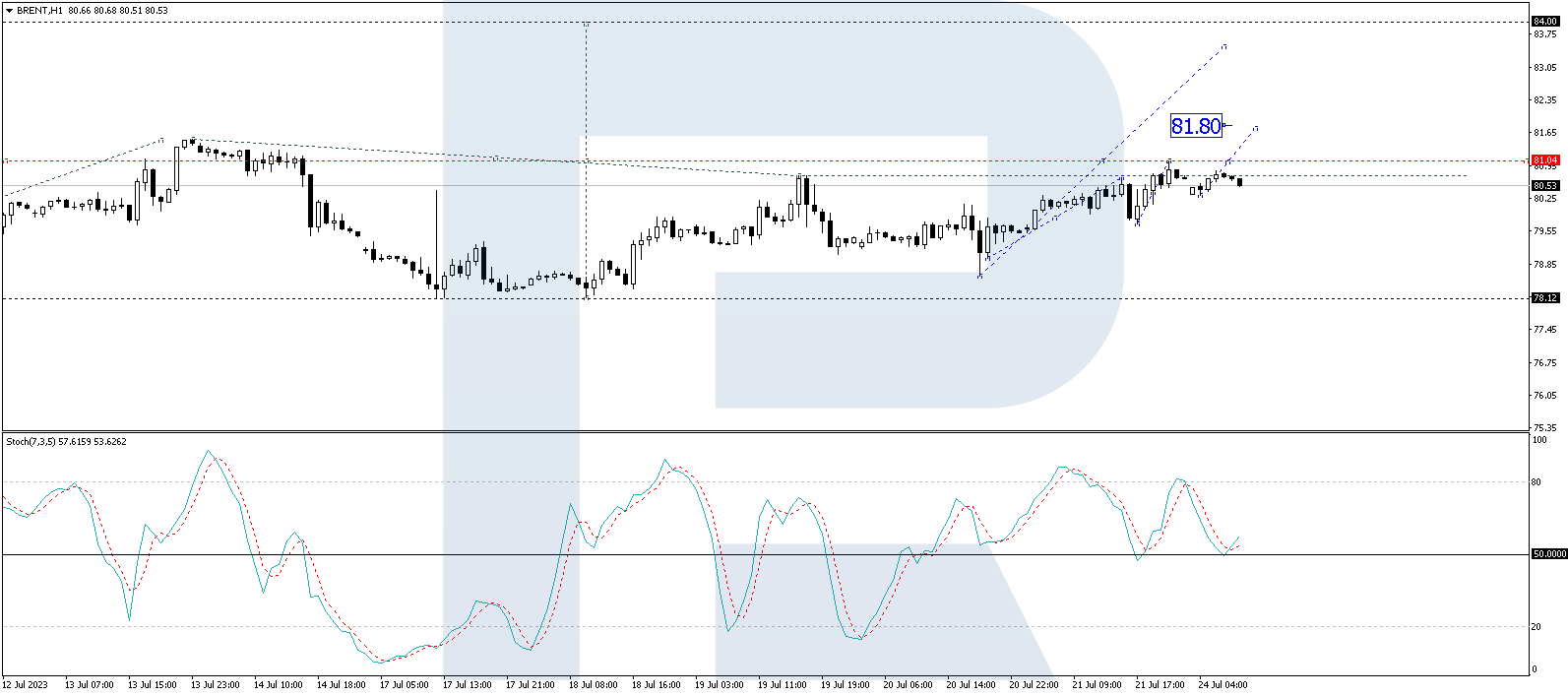
Crude oil prices have paused in their rally. Brent quotes on Monday dropped to 79.20 USD per barrel.

One of the reasons for this local decline might be the market decision to lock in a part of the profit after the steady growth earlier. This version is also supported by the fact that today is the first work day after the weekend.

At the same time, the commodity market sentiment improved noticeably over the last week. Large investment houses still expect a shortage in crude oil supply in the second half of this year, which looks like a favourable factor, keeping in mind the current demand parameters.

The buyers are equally supported by the fundamental background. The geopolitical situation in Libya is unstable, which might lead to problems with the supply of energy carriers.

Technical analysis of Brent:

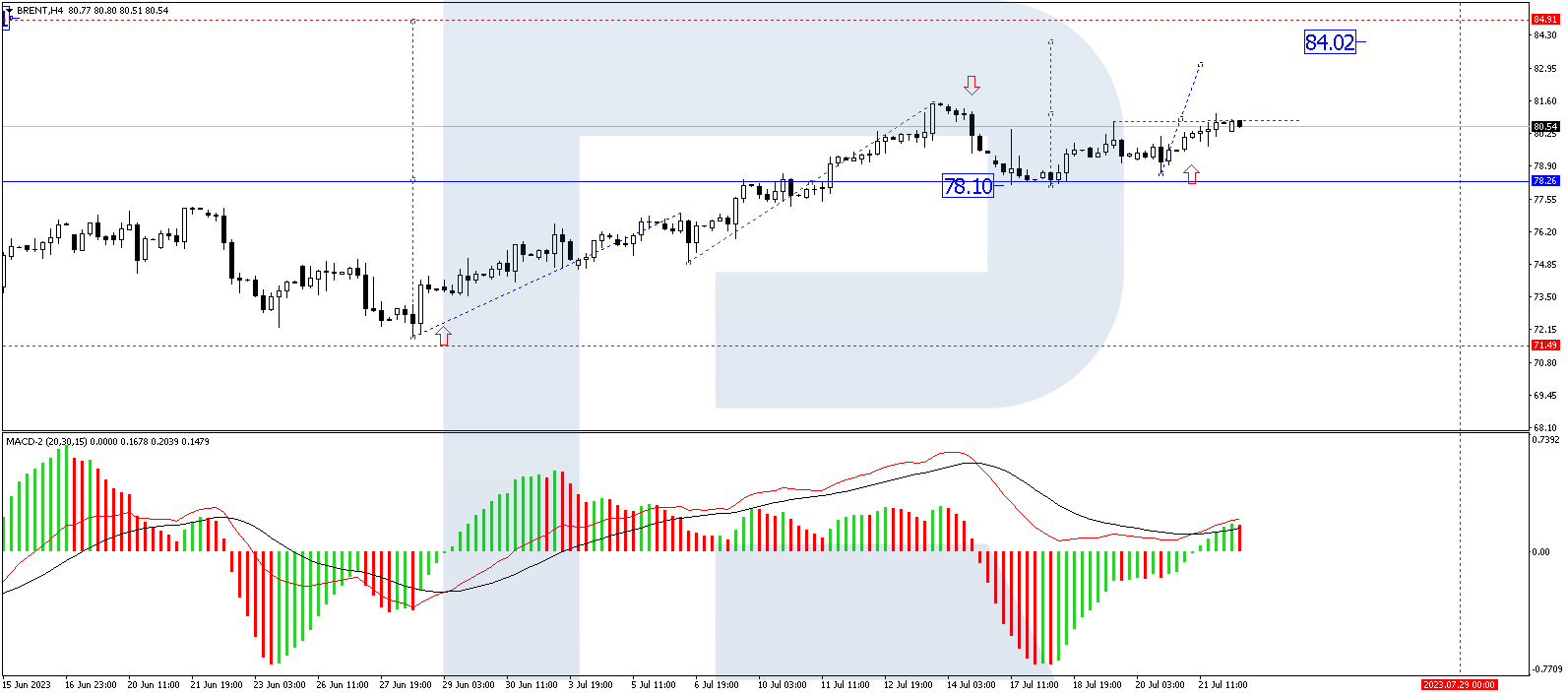
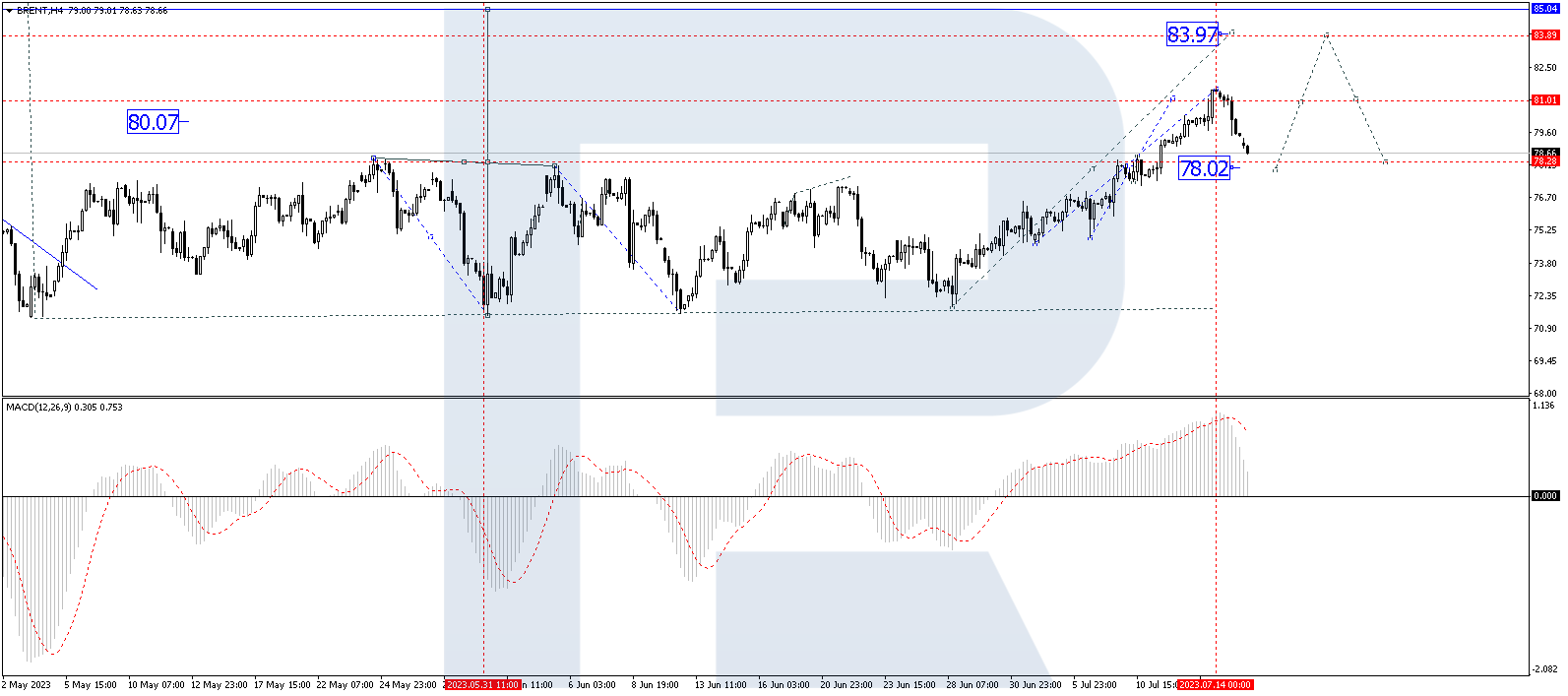
On the H4 Brent chart, the structure of the third wave of growth is developing. At a certain point, the quotes rose to 78.00. A consolidation range formed around this level, the price broke it upwards and extended to 81.45. Today the market is correcting this growth. A technical return to 78.00 is expected with a test of this level from above. Next, a rise to 84.00 is to follow. This is a local target. After the quotes reach this level, a new correction to 78.00 could develop, followed by an increase to 85.00. This is the first target. Technically, this scenario is confirmed by the MACD: its signal line is at the highs, moving out of the histogram area, which is a signal in favour of a decline to zero.

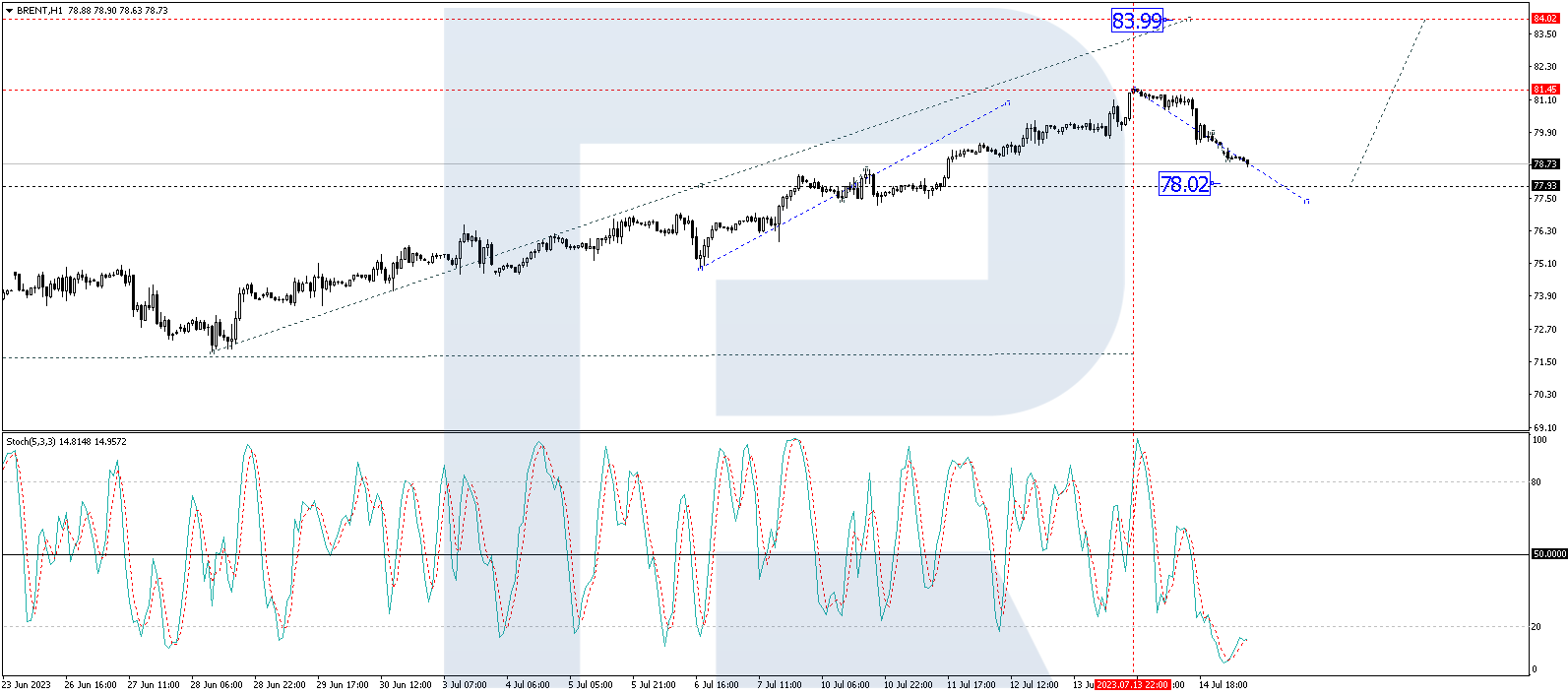
On the H1 Brent chart, a corrective wave to 78.00 is developing. After it is over, a wave of growth to 84.00 is expected to start. This is a local target. Technically, this scenario is confirmed by the Stochastic oscillator: its signal line is under 20, ready to go on growing to 50. And if this level also breaks, the potential for a rise to 80 could open.

Disclaimer

Any forecasts contained herein are based on the author’s particular opinion. This analysis may not be treated as trading advice. RoboForex bears no responsibility for trading results based on trading recommendations and reviews contained herein.

COT Energy Charts: Weekly Speculator Changes led by WTI Crude Oil and Natural Gas 

By InvestMacro

Here are the latest charts and statistics for the Commitment of Traders (COT) data published by the Commodities Futures Trading Commission (CFTC).

The latest COT data is updated through Tuesday July 11th and shows a quick view of how large traders (for-profit speculators and commercial hedgers) were positioned in the futures markets.

Weekly Speculator Changes led by WTI Crude Oil and Natural Gas

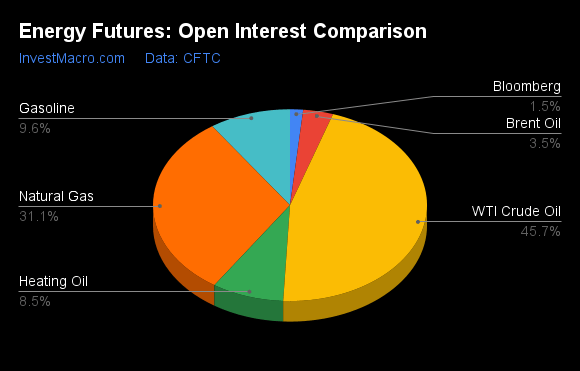
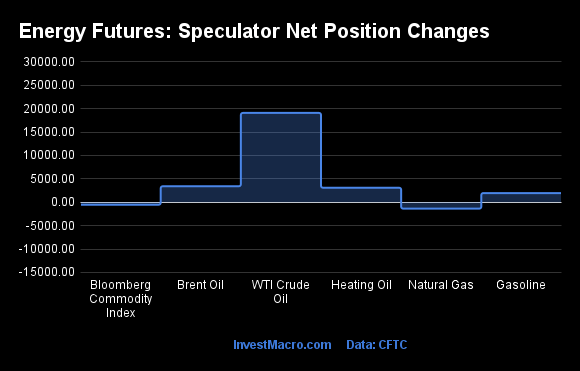
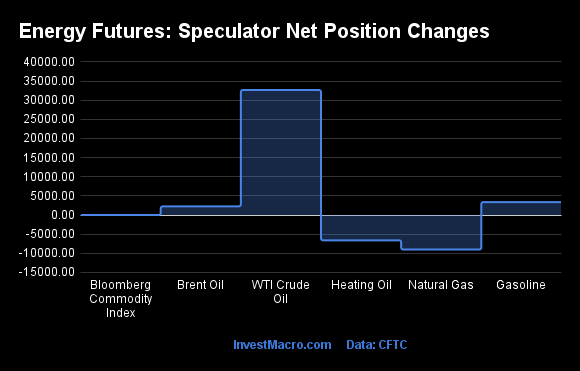
COT energy market speculator bets were higher this week as five out of the six energy markets we cover had higher positioning this week while the other one market had lower contracts.

Leading the gains for energy markets was WTI Crude Oil (32,004 contracts) with Natural Gas (12,020 contracts), Gasoline (7,393 contracts), Heating Oil (301 contracts) and Bloomberg Commodity Index (95 contracts) also showing positive weeks.

The energy market leading the declines in speculator bets this week was Brent Crude Oil with a decrease of -8,158 contracts also registering lower bets on the week.


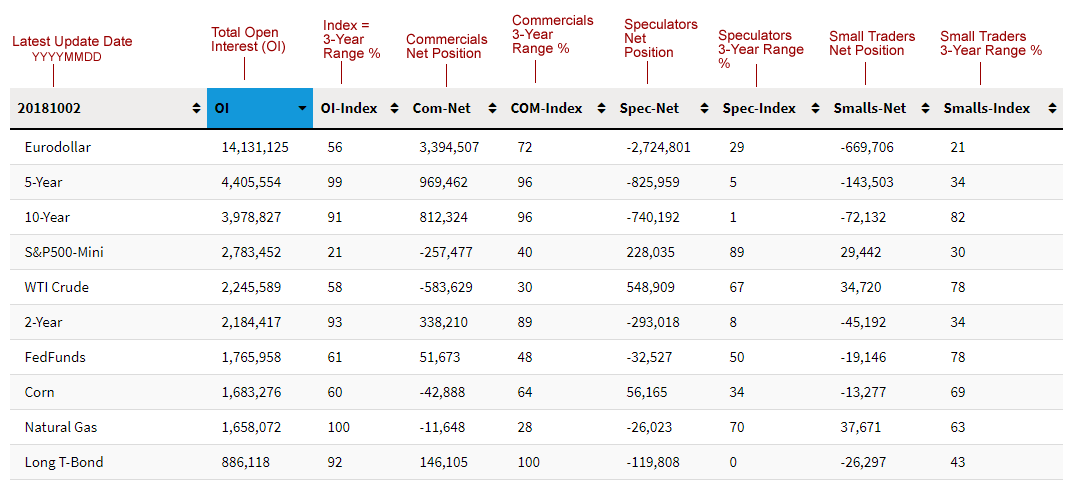
Data Snapshot of Commodity Market Traders | Columns Legend
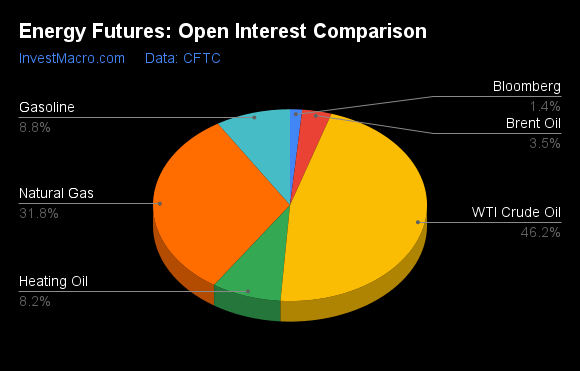
Jul-11-2023OIOI-IndexSpec-NetSpec-IndexCom-NetCOM-IndexSmalls-NetSmalls-Index
WTI Crude1,796,34836173,4339-196,6889323,25526
Gold483,17028165,75450-187,7495121,99535
Silver120,282620,29247-31,6495611,35729
Copper197,78541-11,157217,915783,24239
Palladium15,772100-8,27208,765100-49312
Platinum71,007727,78734-13,912656,12550
Natural Gas1,236,80256-86,7553755,5546231,20154
Brent134,6628-48,0311846,617871,41428
Heating Oil320,0014428,00079-47,7283119,72867
Soybeans622,5091190,86325-77,18070-13,68368
Corn1,241,94077,8112335,21581-43,02652
Coffee180,11838,49536-8,05268-4437
Sugar877,69543196,30460-226,0304129,72641
Wheat297,1467-40,4113845,50665-5,09556


Strength Scores

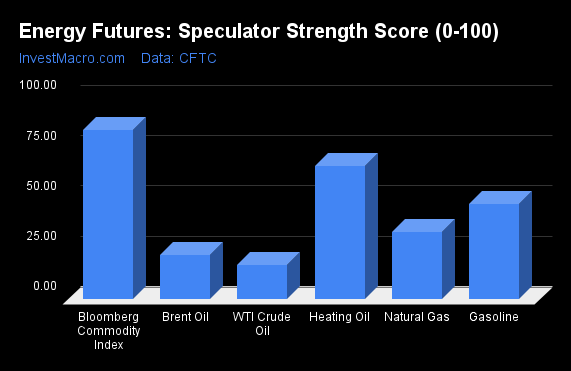
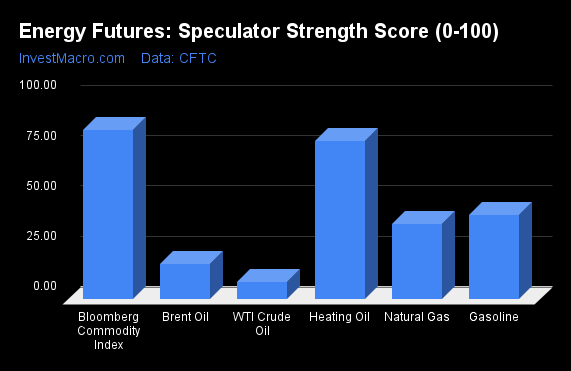
Strength Scores (a normalized measure of Speculator positions over a 3-Year range, from 0 to 100 where above 80 is extreme bullish and below 20 is extreme bearish) show that the Bloomberg Commodity Index (84.3 percent) and Heating Oil (79.0 percent) lead the energy close to the top of their respective ranges. Gasoline (41.9 percent) comes in as the next highest energy market in strength scores.

On the downside, WTI Crude Oil (8.5 percent) and Brent Crude Oil (17.7 percent) come in at the lowest strength scores currently and are in Extreme-Bearish levels (below 20 percent).

Strength Statistics:
WTI Crude Oil (8.5 percent) vs WTI Crude Oil previous week (0.7 percent)
Brent Crude Oil (17.7 percent) vs Brent Crude Oil previous week (34.0 percent)
Natural Gas (37.4 percent) vs Natural Gas previous week (32.6 percent)
Gasoline (41.9 percent) vs Gasoline previous week (29.7 percent)
Heating Oil (79.0 percent) vs Heating Oil previous week (78.4 percent)
Bloomberg Commodity Index (84.3 percent) vs Bloomberg Commodity Index previous week (83.9 percent)

Strength Trends

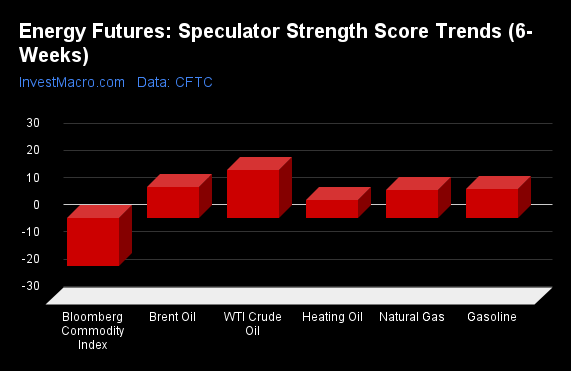
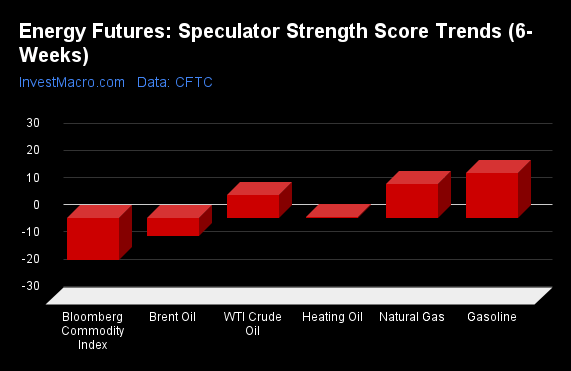
Strength Score Trends (or move index, calculates the 6-week changes in strength scores) show that Heating Oil (18.2 percent) leads the past six weeks trends for energy this week. Brent Crude Oil (10.5 percent), Gasoline (9.5 percent) and Natural Gas (7.7 percent) fill out the top movers in the latest trends data.

The Bloomberg Commodity Index (-15.0 percent) leads the downside trend scores currently.

Strength Trend Statistics:
WTI Crude Oil (2.6 percent) vs WTI Crude Oil previous week (-12.6 percent)
Brent Crude Oil (10.5 percent) vs Brent Crude Oil previous week (15.8 percent)
Natural Gas (7.7 percent) vs Natural Gas previous week (5.4 percent)
Gasoline (9.5 percent) vs Gasoline previous week (-2.1 percent)
Heating Oil (18.2 percent) vs Heating Oil previous week (35.1 percent)
Bloomberg Commodity Index (-15.0 percent) vs Bloomberg Commodity Index previous week (-15.3 percent)


Individual COT Market Charts:

WTI Crude Oil Futures:

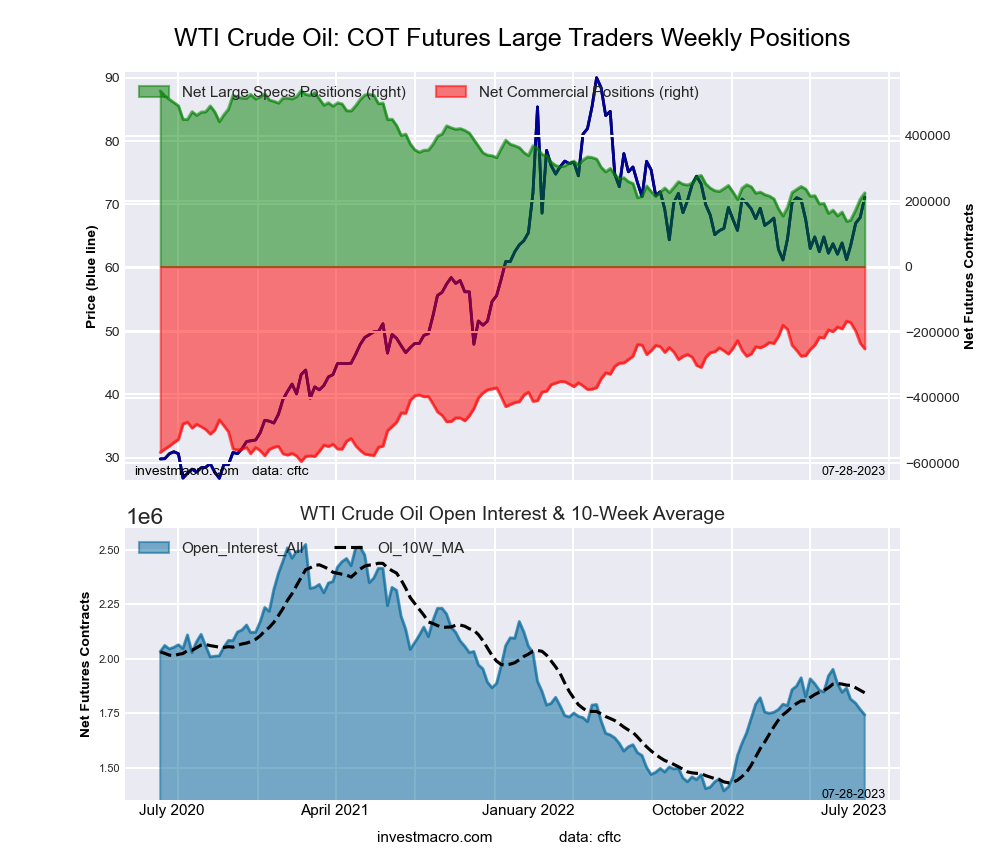
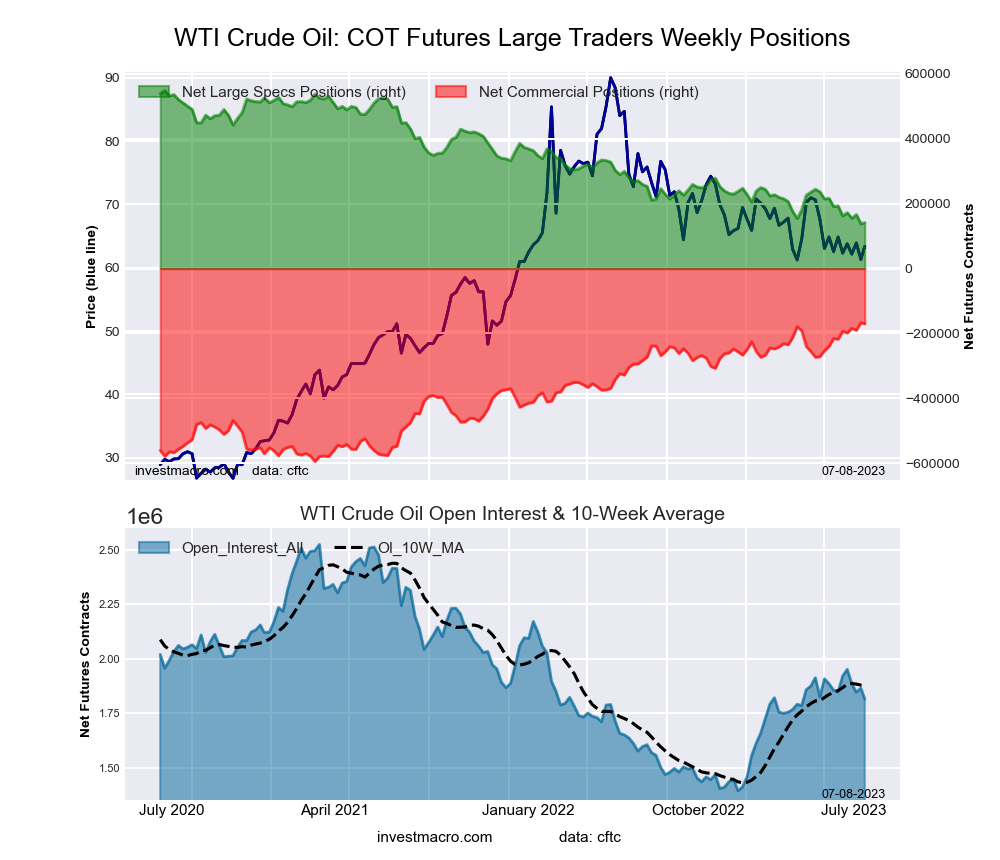
WTI Crude Oil Futures COT ChartThe WTI Crude Oil Futures large speculator standing this week reached a net position of 173,433 contracts in the data reported through Tuesday. This was a weekly increase of 32,004 contracts from the previous week which had a total of 141,429 net contracts.

This week’s current strength score (the trader positioning range over the past three years, measured from 0 to 100) shows the speculators are currently Bearish-Extreme with a score of 8.5 percent. The commercials are Bullish-Extreme with a score of 93.0 percent and the small traders (not shown in chart) are Bearish with a score of 25.5 percent.

Price Trend-Following Model: Weak Downtrend

Our weekly trend-following model classifies the current market price position as: Weak Downtrend. The current action for the model is considered to be: Hold – Maintain Short Position.

WTI Crude Oil Futures StatisticsSPECULATORSCOMMERCIALSSMALL TRADERS
– Percent of Open Interest Longs:18.939.05.0
– Percent of Open Interest Shorts:9.249.93.7
– Net Position:173,433-196,68823,255
– Gross Longs:339,297700,01989,390
– Gross Shorts:165,864896,70766,135
– Long to Short Ratio:2.0 to 10.8 to 11.4 to 1
NET POSITION TREND:
– Strength Index Score (3 Year Range Pct):8.593.025.5
– Strength Index Reading (3 Year Range):Bearish-ExtremeBullish-ExtremeBearish
NET POSITION MOVEMENT INDEX:
– 6-Week Change in Strength Index:2.6-0.9-14.1


Brent Crude Oil Futures:

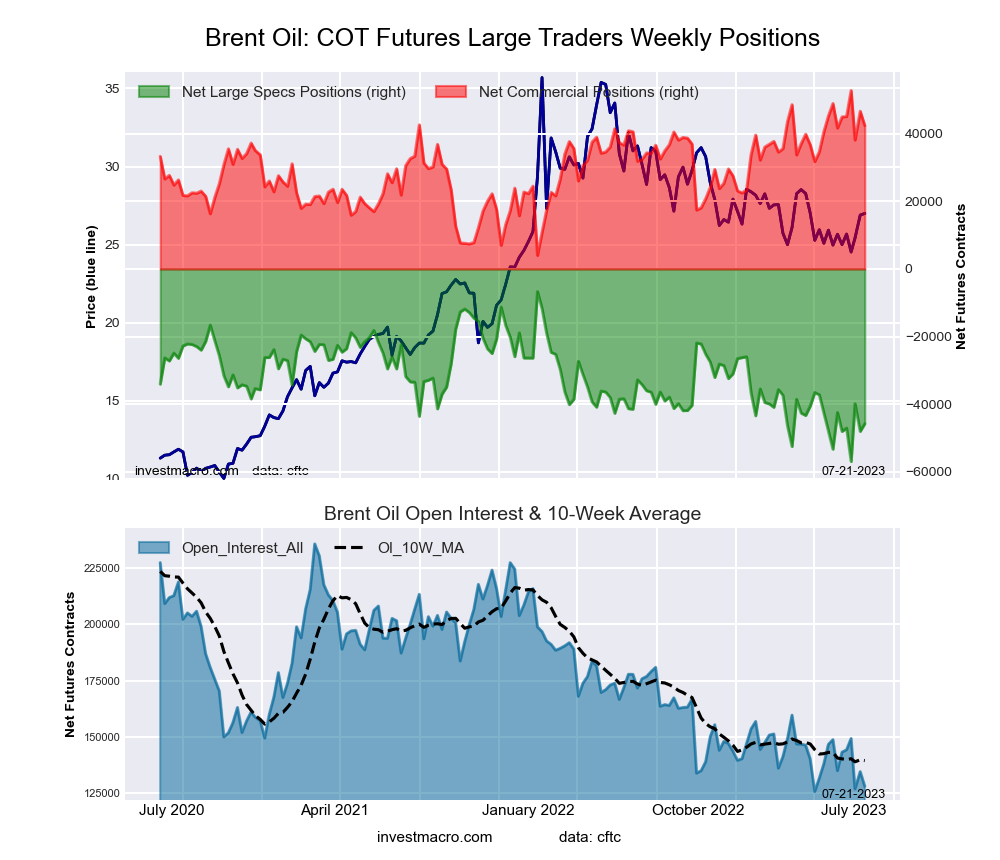
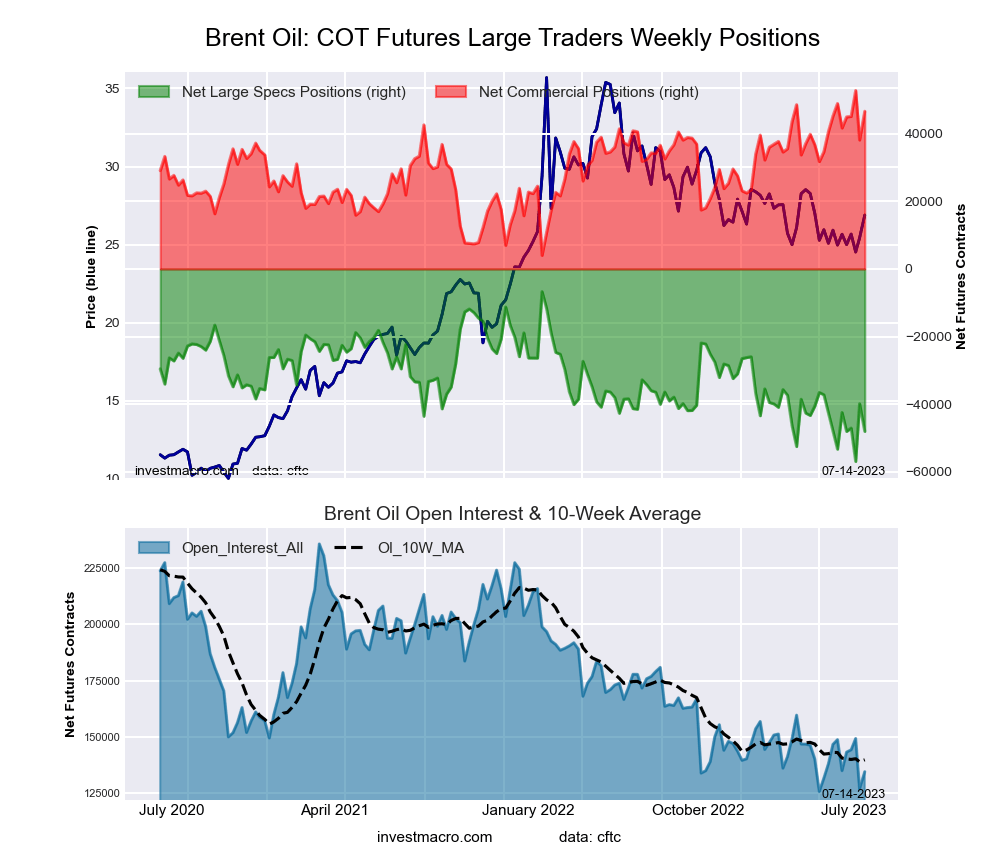
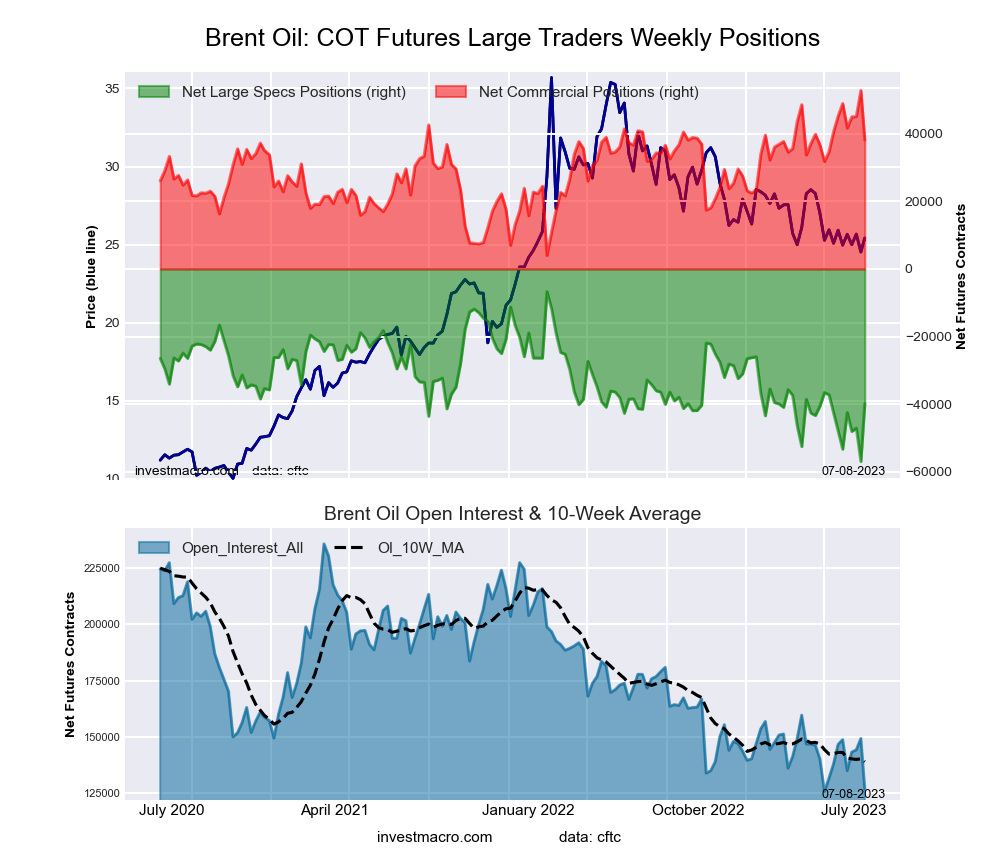
Brent Last Day Crude Oil Futures COT ChartThe Brent Crude Oil Futures large speculator standing this week reached a net position of -48,031 contracts in the data reported through Tuesday. This was a weekly decline of -8,158 contracts from the previous week which had a total of -39,873 net contracts.

This week’s current strength score (the trader positioning range over the past three years, measured from 0 to 100) shows the speculators are currently Bearish-Extreme with a score of 17.7 percent. The commercials are Bullish-Extreme with a score of 87.4 percent and the small traders (not shown in chart) are Bearish with a score of 28.3 percent.

Price Trend-Following Model: Weak Downtrend

Our weekly trend-following model classifies the current market price position as: Weak Downtrend. The current action for the model is considered to be: Hold – Maintain Short Position.

Brent Crude Oil Futures StatisticsSPECULATORSCOMMERCIALSSMALL TRADERS
– Percent of Open Interest Longs:10.254.15.6
– Percent of Open Interest Shorts:45.819.54.5
– Net Position:-48,03146,6171,414
– Gross Longs:13,70472,8347,524
– Gross Shorts:61,73526,2176,110
– Long to Short Ratio:0.2 to 12.8 to 11.2 to 1
NET POSITION TREND:
– Strength Index Score (3 Year Range Pct):17.787.428.3
– Strength Index Reading (3 Year Range):Bearish-ExtremeBullish-ExtremeBearish
NET POSITION MOVEMENT INDEX:
– 6-Week Change in Strength Index:10.5-4.7-40.2


Natural Gas Futures:

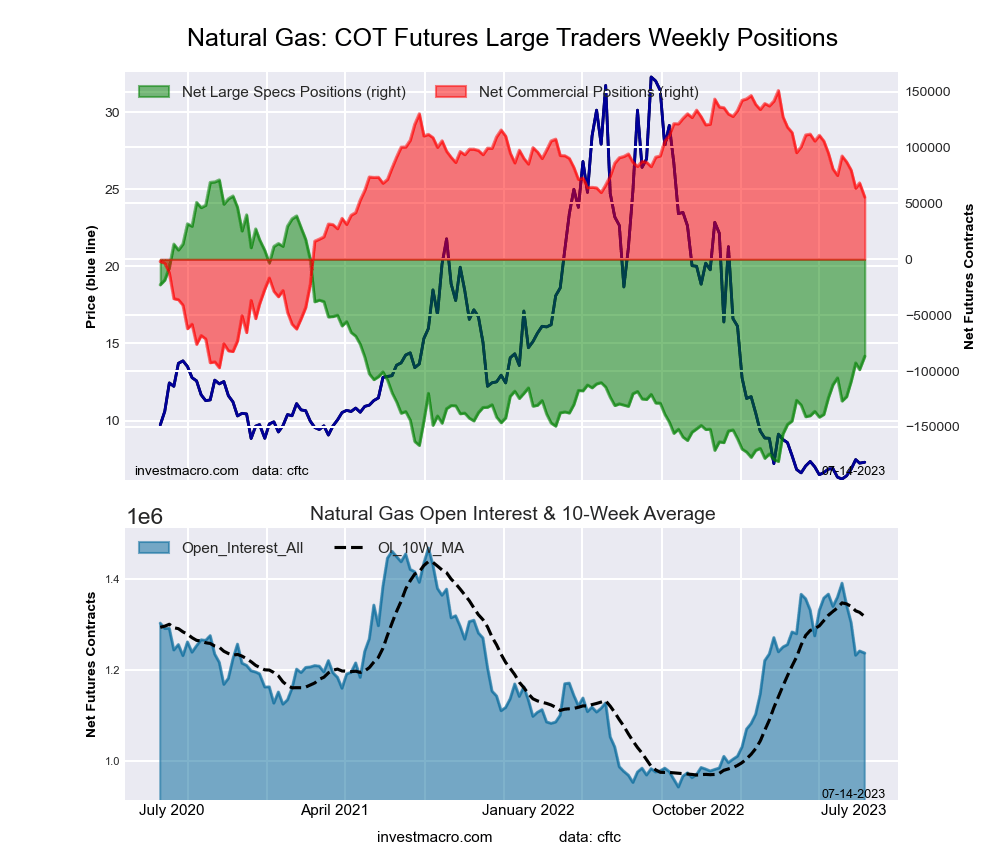
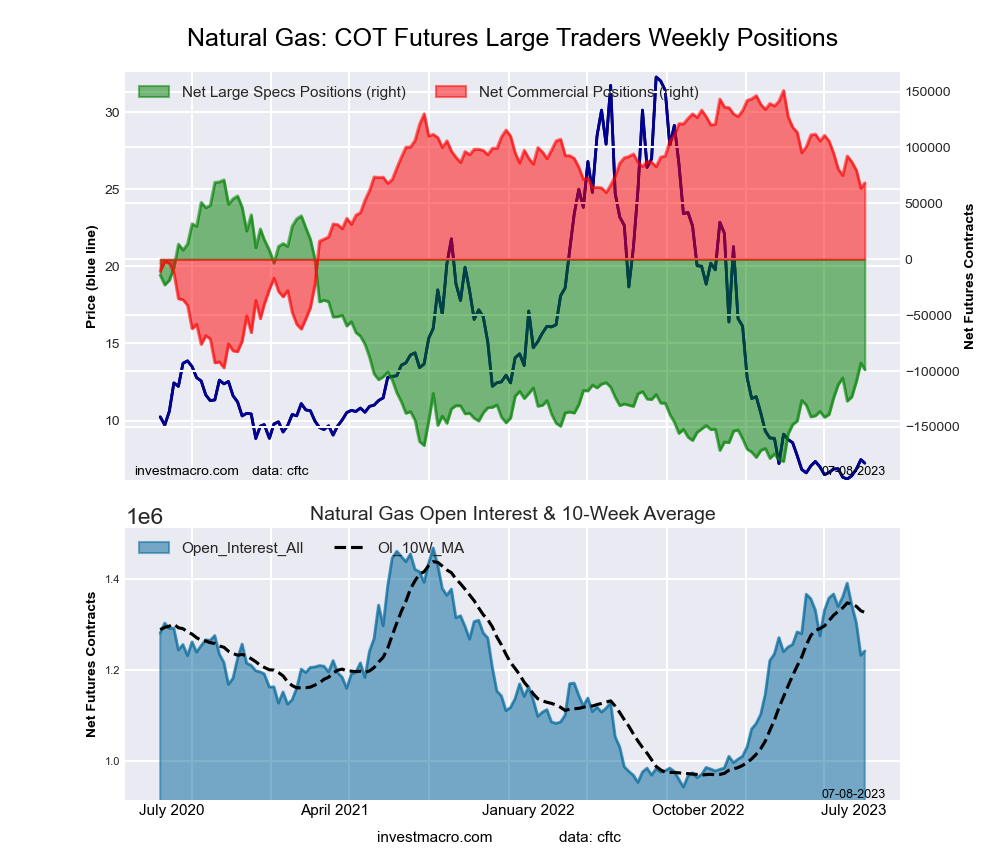
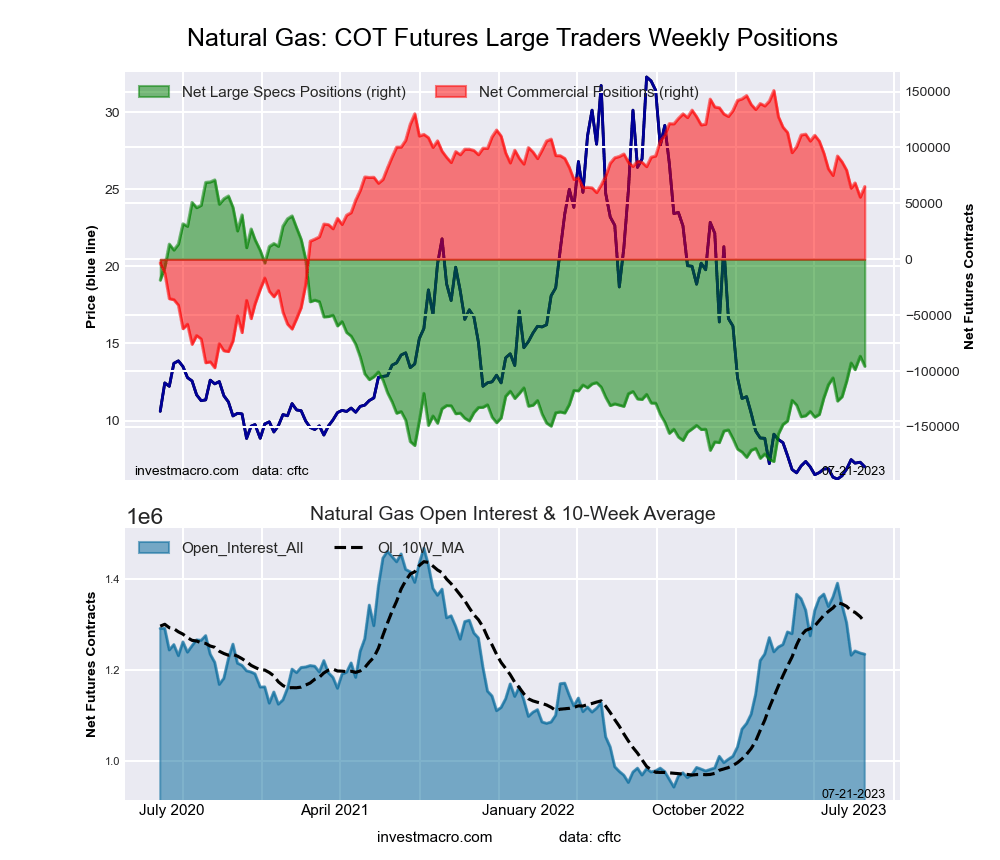
Natural Gas Futures COT ChartThe Natural Gas Futures large speculator standing this week reached a net position of -86,755 contracts in the data reported through Tuesday. This was a weekly increase of 12,020 contracts from the previous week which had a total of -98,775 net contracts.

This week’s current strength score (the trader positioning range over the past three years, measured from 0 to 100) shows the speculators are currently Bearish with a score of 37.4 percent. The commercials are Bullish with a score of 61.5 percent and the small traders (not shown in chart) are Bullish with a score of 54.1 percent.

Price Trend-Following Model: Downtrend

Our weekly trend-following model classifies the current market price position as: Downtrend. The current action for the model is considered to be: Hold – Maintain Short Position.

Natural Gas Futures StatisticsSPECULATORSCOMMERCIALSSMALL TRADERS
– Percent of Open Interest Longs:20.439.25.7
– Percent of Open Interest Shorts:27.434.73.2
– Net Position:-86,75555,55431,201
– Gross Longs:251,784484,75870,705
– Gross Shorts:338,539429,20439,504
– Long to Short Ratio:0.7 to 11.1 to 11.8 to 1
NET POSITION TREND:
– Strength Index Score (3 Year Range Pct):37.461.554.1
– Strength Index Reading (3 Year Range):BearishBullishBullish
NET POSITION MOVEMENT INDEX:
– 6-Week Change in Strength Index:7.7-7.80.0


Gasoline Blendstock Futures:

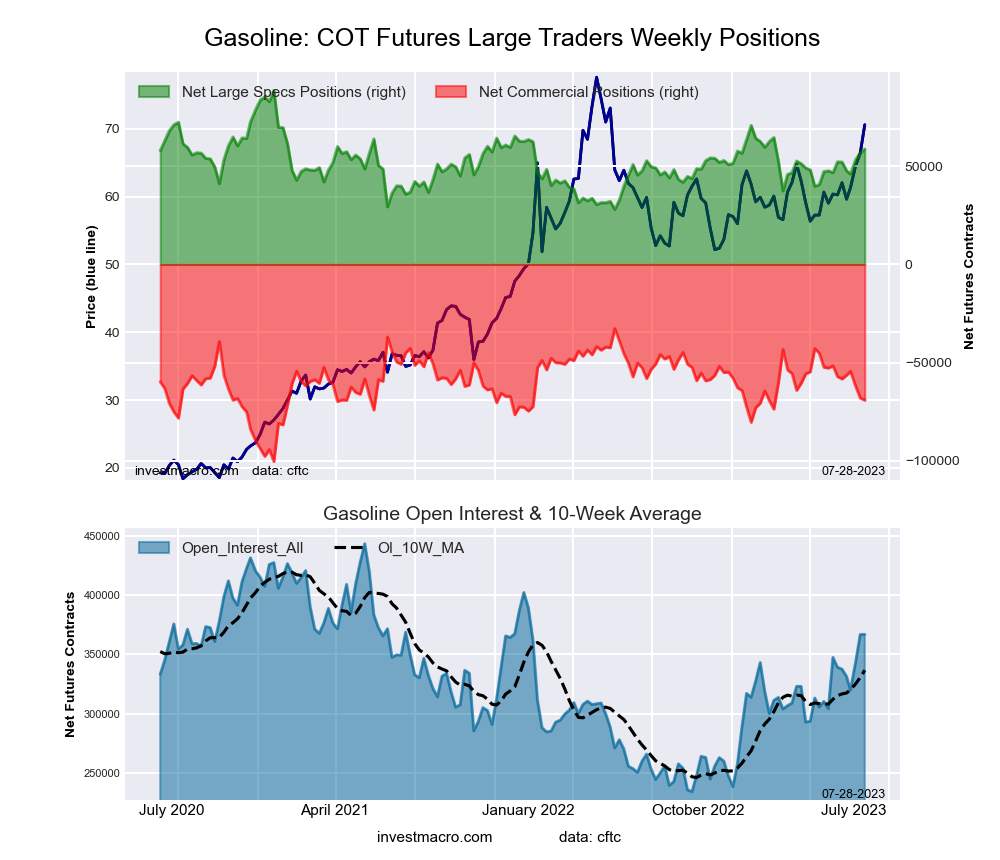
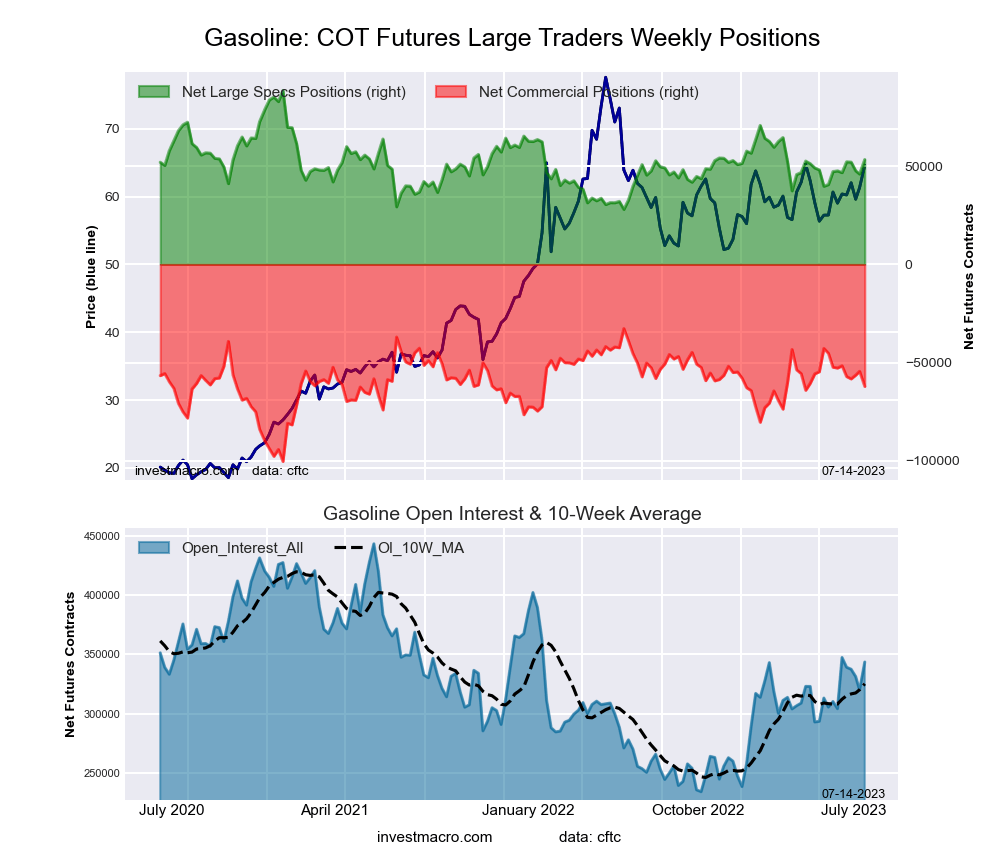
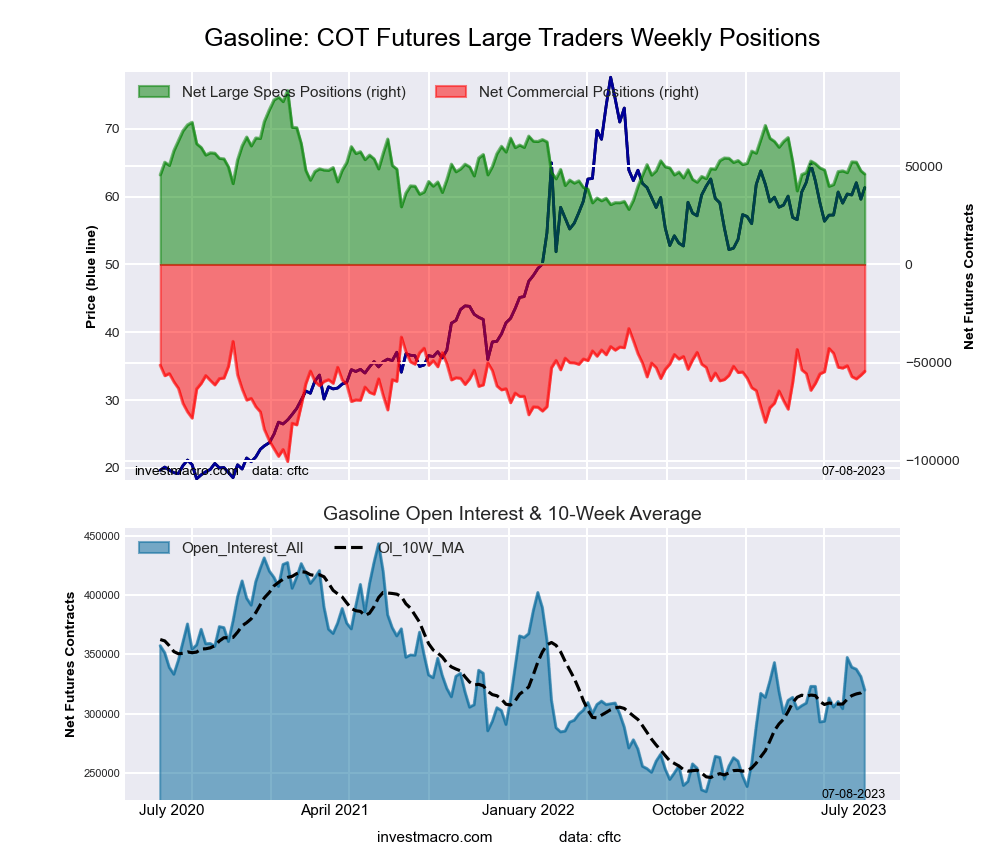
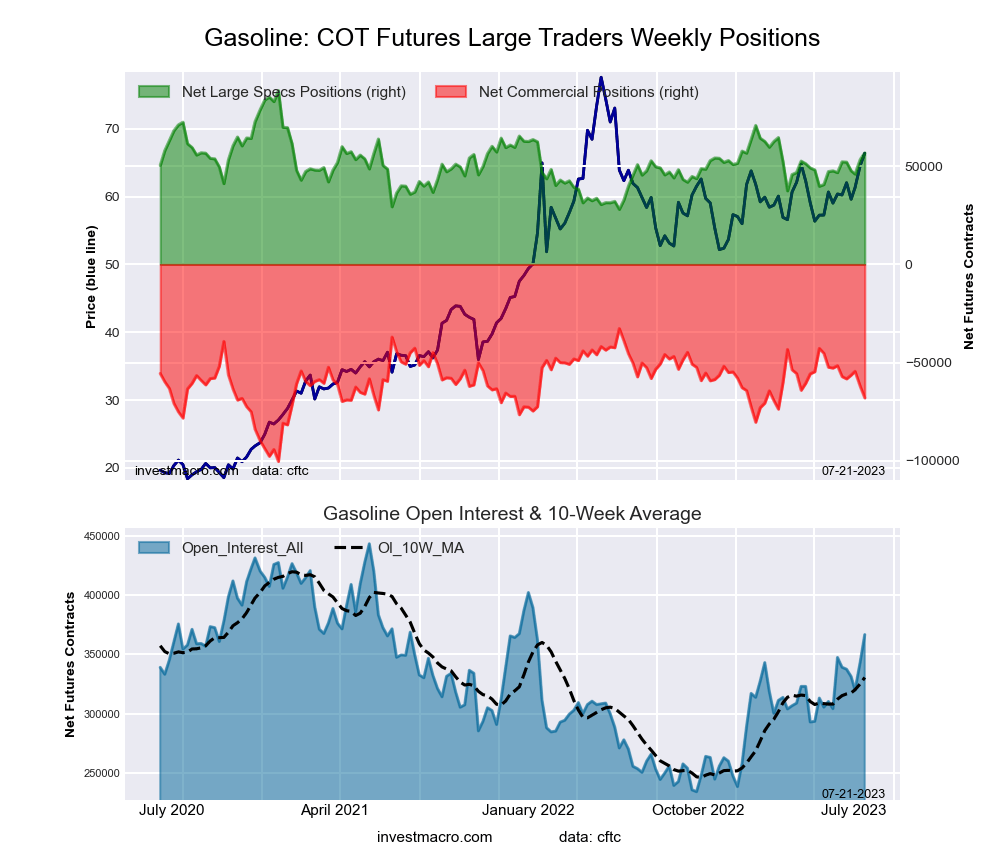
RBOB Gasoline Energy Futures COT ChartThe Gasoline Blendstock Futures large speculator standing this week reached a net position of 53,407 contracts in the data reported through Tuesday. This was a weekly increase of 7,393 contracts from the previous week which had a total of 46,014 net contracts.

This week’s current strength score (the trader positioning range over the past three years, measured from 0 to 100) shows the speculators are currently Bearish with a score of 41.9 percent. The commercials are Bullish with a score of 56.5 percent and the small traders (not shown in chart) are Bullish with a score of 71.1 percent.

Price Trend-Following Model: Strong Uptrend

Our weekly trend-following model classifies the current market price position as: Strong Uptrend. The current action for the model is considered to be: Hold – Maintain Long Position.

Nasdaq Mini Futures StatisticsSPECULATORSCOMMERCIALSSMALL TRADERS
– Percent of Open Interest Longs:27.844.46.8
– Percent of Open Interest Shorts:12.262.54.3
– Net Position:53,407-62,1648,757
– Gross Longs:95,389152,40723,514
– Gross Shorts:41,982214,57114,757
– Long to Short Ratio:2.3 to 10.7 to 11.6 to 1
NET POSITION TREND:
– Strength Index Score (3 Year Range Pct):41.956.571.1
– Strength Index Reading (3 Year Range):BearishBullishBullish
NET POSITION MOVEMENT INDEX:
– 6-Week Change in Strength Index:9.5-13.823.9


#2 Heating Oil NY-Harbor Futures:

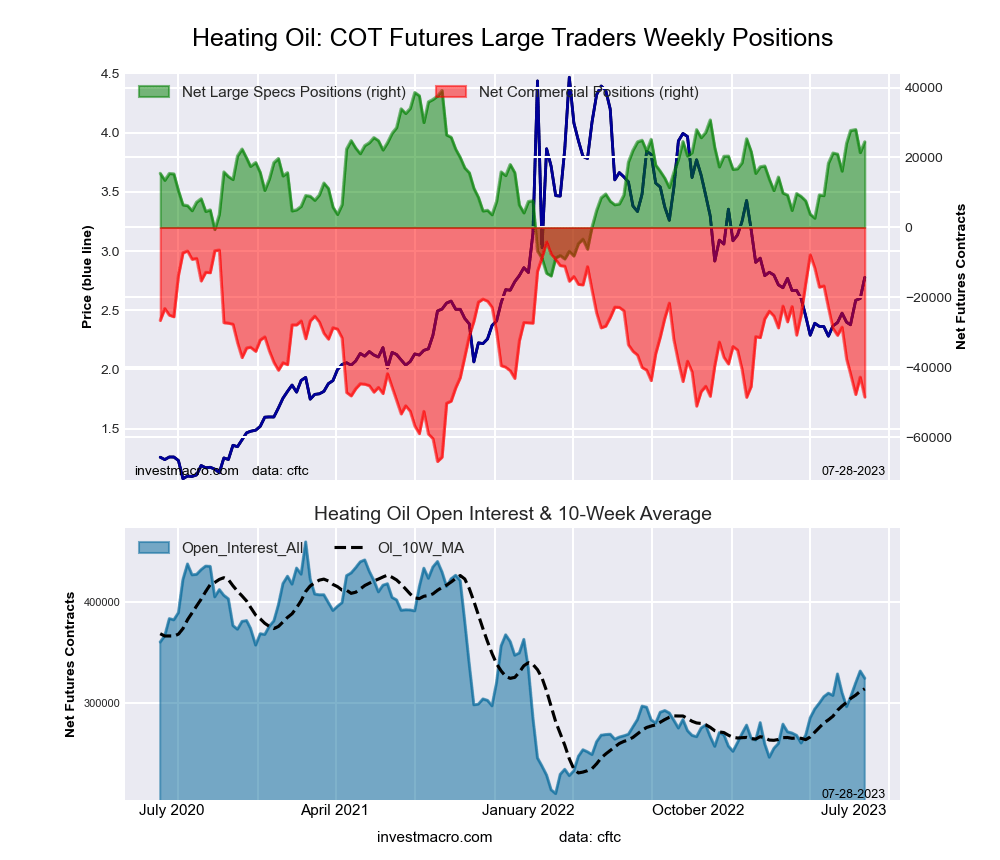
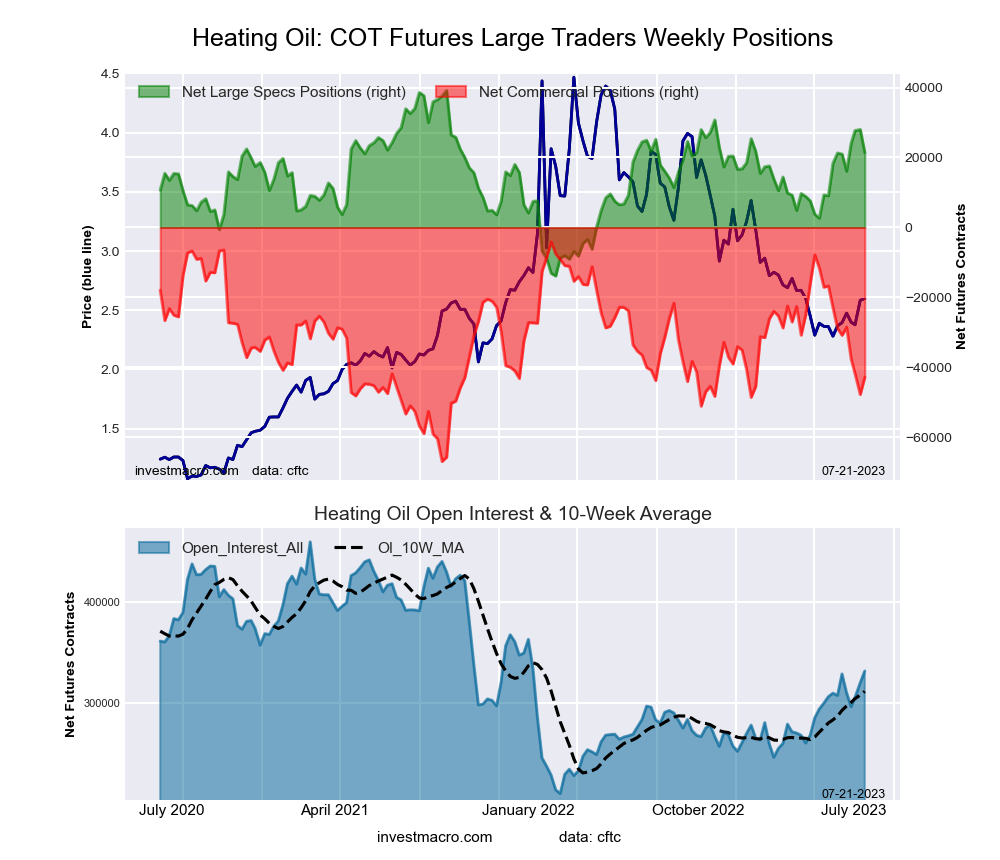
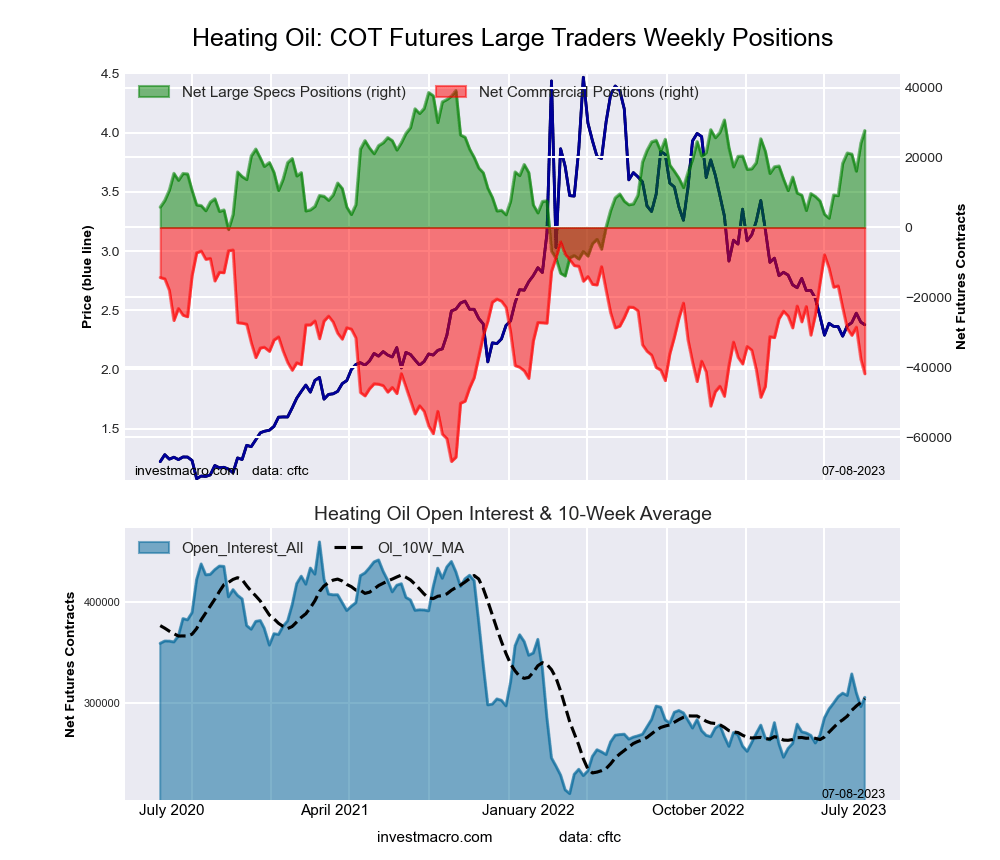
NY Harbor Heating Oil Energy Futures COT ChartThe #2 Heating Oil NY-Harbor Futures large speculator standing this week reached a net position of 28,000 contracts in the data reported through Tuesday. This was a weekly lift of 301 contracts from the previous week which had a total of 27,699 net contracts.

This week’s current strength score (the trader positioning range over the past three years, measured from 0 to 100) shows the speculators are currently Bullish with a score of 79.0 percent. The commercials are Bearish with a score of 30.5 percent and the small traders (not shown in chart) are Bullish with a score of 66.7 percent.

Price Trend-Following Model: Weak Downtrend

Our weekly trend-following model classifies the current market price position as: Weak Downtrend. The current action for the model is considered to be: Hold – Maintain Short Position.

Heating Oil Futures StatisticsSPECULATORSCOMMERCIALSSMALL TRADERS
– Percent of Open Interest Longs:16.346.014.6
– Percent of Open Interest Shorts:7.660.98.5
– Net Position:28,000-47,72819,728
– Gross Longs:52,184147,07646,782
– Gross Shorts:24,184194,80427,054
– Long to Short Ratio:2.2 to 10.8 to 11.7 to 1
NET POSITION TREND:
– Strength Index Score (3 Year Range Pct):79.030.566.7
– Strength Index Reading (3 Year Range):BullishBearishBullish
NET POSITION MOVEMENT INDEX:
– 6-Week Change in Strength Index:18.2-39.552.4


Bloomberg Commodity Index Futures:

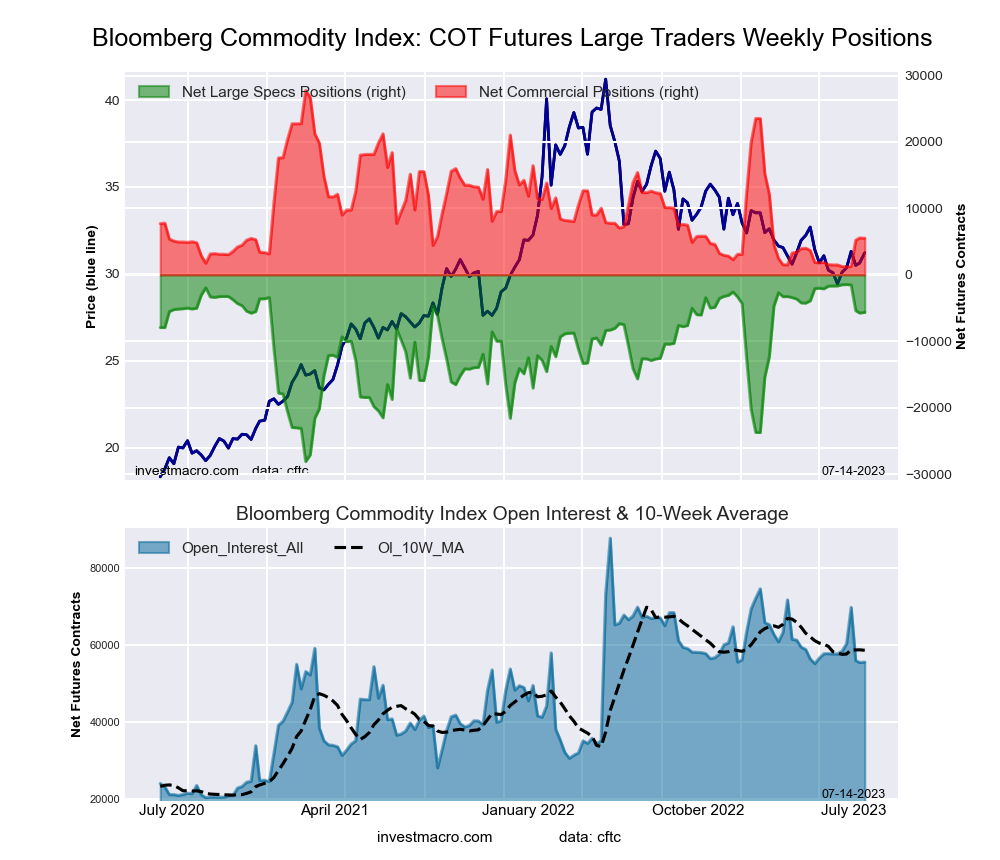
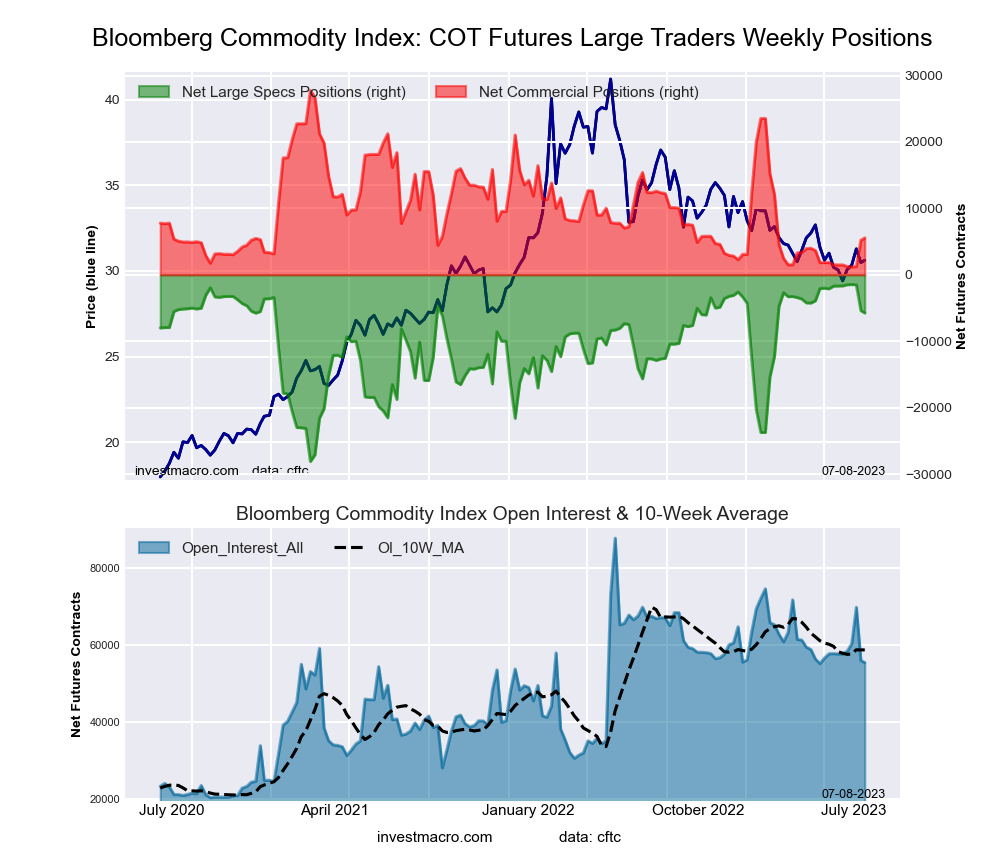
Bloomberg Commodity Index Futures COT ChartThe Bloomberg Commodity Index Futures large speculator standing this week reached a net position of -5,651 contracts in the data reported through Tuesday. This was a weekly gain of 95 contracts from the previous week which had a total of -5,746 net contracts.

This week’s current strength score (the trader positioning range over the past three years, measured from 0 to 100) shows the speculators are currently Bullish-Extreme with a score of 84.3 percent. The commercials are Bearish-Extreme with a score of 16.2 percent and the small traders (not shown in chart) are Bullish with a score of 54.1 percent.

Price Trend-Following Model: Weak Downtrend

Our weekly trend-following model classifies the current market price position as: Weak Downtrend. The current action for the model is considered to be: Hold – Maintain Short Position.

Bloomberg Index Futures StatisticsSPECULATORSCOMMERCIALSSMALL TRADERS
– Percent of Open Interest Longs:12.186.60.5
– Percent of Open Interest Shorts:22.276.70.2
– Net Position:-5,6515,508143
– Gross Longs:6,69848,079269
– Gross Shorts:12,34942,571126
– Long to Short Ratio:0.5 to 11.1 to 12.1 to 1
NET POSITION TREND:
– Strength Index Score (3 Year Range Pct):84.316.254.1
– Strength Index Reading (3 Year Range):Bullish-ExtremeBearish-ExtremeBullish
NET POSITION MOVEMENT INDEX:
– 6-Week Change in Strength Index:-15.015.1-0.8


Article By InvestMacroReceive our weekly COT Newsletter

*COT Report: The COT data, released weekly to the public each Friday, is updated through the most recent Tuesday (data is 3 days old) and shows a quick view of how large speculators or non-commercials (for-profit traders) were positioned in the futures markets.

The CFTC categorizes trader positions according to commercial hedgers (traders who use futures contracts for hedging as part of the business), non-commercials (large traders who speculate to realize trading profits) and nonreportable traders (usually small traders/speculators) as well as their open interest (contracts open in the market at time of reporting). See CFTC criteria here.
COT Energy Charts: Speculator Changes led by Brent Crude Oil

By InvestMacro

Here are the latest charts and statistics for the Commitment of Traders (COT) data published by the Commodities Futures Trading Commission (CFTC).

The latest COT data is updated through Monday July 03 2023 and shows a quick view of how large traders (for-profit speculators and commercial hedgers) were positioned in the futures markets.

Weekly Speculator Changes led by Brent Crude Oil

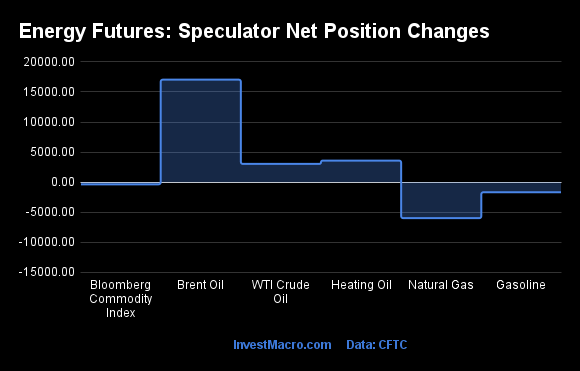
COT energy market speculator bets were mixed this week as three out of the six energy markets we cover had higher positioning this week while the other three markets had lower contracts.

Leading the gains for energy markets was Brent Crude Oil (17,049 contracts) with WTI Crude Oil (3,041 contracts) and Heating Oil (3,599 contracts) also showing positive weeks.

The energy markets leading the declines in speculator bets this week were Natural Gas (-5,975 contracts) with Gasoline (-1,666 contracts) and the Bloomberg Commodity Index (-350 contracts) also registering lower bets on the week.


Data Snapshot of Commodity Market Traders | Columns Legend
Jul-03-2023OIOI-IndexSpec-NetSpec-IndexCom-NetCOM-IndexSmalls-NetSmalls-Index
WTI Crude1,816,04337141,4291-170,1489928,71937
Gold448,06312163,09749-184,7175321,62034
Silver114,421017,99044-29,5695811,57931
Copper204,399461,88832-4,003682,11532
Palladium14,781100-7,89008,358100-46814
Platinum69,383708,06734-13,570655,50342
Natural Gas1,241,41957-98,7753368,3136730,46252
Brent127,0191-39,8733438,114701,75933
Heating Oil305,6813827,69978-41,8104014,11147
Soybeans610,352890,97325-71,92472-19,04955
Corn1,246,983846,4032852476-46,92746
Coffee180,11838,49536-8,05268-4437
Sugar863,84340199,36861-229,7133930,34542
Wheat297,9337-45,4643451,05370-5,58954


Strength Scores led by Bloomberg Commodity Index and Heating Oil

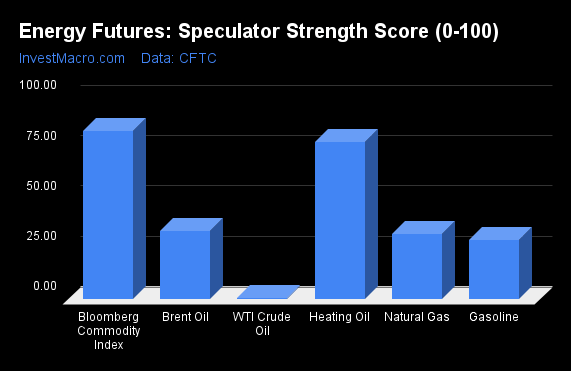
Strength Scores (a normalized measure of Speculator positions over a 3-Year range, from 0 to 100 where above 80 is extreme bullish and below 20 is extreme bearish) show that the Bloomberg Commodity Index (83.9 percent) and Heating Oil (78.4 percent) lead the energy near the top of their respective ranges.

On the downside, WTI Crude Oil (0.7 percent) comes in at the lowest strength level currently and is in a Bearish-Extreme level (below 20 percent).

Strength Statistics:
WTI Crude Oil (0.7 percent) vs WTI Crude Oil previous week (0.0 percent)
Brent Crude Oil (34.0 percent) vs Brent Crude Oil previous week (0.0 percent)
Natural Gas (32.6 percent) vs Natural Gas previous week (35.0 percent)
Gasoline (29.7 percent) vs Gasoline previous week (32.5 percent)
Heating Oil (78.4 percent) vs Heating Oil previous week (71.6 percent)
Bloomberg Commodity Index (83.9 percent) vs Bloomberg Commodity Index previous week (85.2 percent)

Strength Trends led by Heating Oil

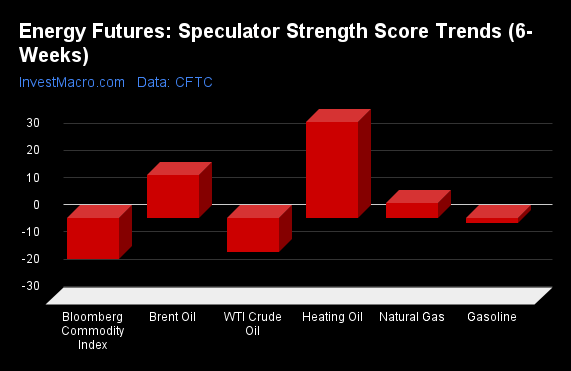
Strength Score Trends (or move index, calculates the 6-week changes in strength scores) show that Heating Oil (35.1 percent) leads the past six weeks trends for energy this week.

Bloomberg Commodity Index (-15.3 percent), WTI Crude Oil (-12.6 percent) and Gasoline (-2.1 percent) lead the downside trend scores currently.

Strength Trend Statistics:
WTI Crude Oil (-12.6 percent) vs WTI Crude Oil previous week (-12.9 percent)
Brent Crude Oil (15.8 percent) vs Brent Crude Oil previous week (-28.6 percent)
Natural Gas (5.4 percent) vs Natural Gas previous week (12.4 percent)
Gasoline (-2.1 percent) vs Gasoline previous week (11.6 percent)
Heating Oil (35.1 percent) vs Heating Oil previous week (27.9 percent)
Bloomberg Commodity Index (-15.3 percent) vs Bloomberg Commodity Index previous week (-13.9 percent)


Individual COT Market Charts:

WTI Crude Oil Futures:

WTI Crude Oil Futures COT ChartThe WTI Crude Oil Futures large speculator standing this week recorded a net position of 141,429 contracts in the data reported through Tuesday. This was a weekly advance of 3,041 contracts from the previous week which had a total of 138,388 net contracts.

This week’s current strength score (the trader positioning range over the past three years, measured from 0 to 100) shows the speculators are currently Bearish-Extreme with a score of 0.7 percent. The commercials are Bullish-Extreme with a score of 99.2 percent and the small traders (not shown in chart) are Bearish with a score of 36.5 percent.

Price Trend-Following Model: Downtrend

Our weekly trend-following model classifies the current market price position as: Downtrend. The current action for the model is considered to be: Hold – Maintain Short Position.

WTI Crude Oil Futures StatisticsSPECULATORSCOMMERCIALSSMALL TRADERS
– Percent of Open Interest Longs:17.540.64.8
– Percent of Open Interest Shorts:9.750.03.2
– Net Position:141,429-170,14828,719
– Gross Longs:316,998737,22887,049
– Gross Shorts:175,569907,37658,330
– Long to Short Ratio:1.8 to 10.8 to 11.5 to 1
NET POSITION TREND:
– Strength Index Score (3 Year Range Pct):0.799.236.5
– Strength Index Reading (3 Year Range):Bearish-ExtremeBullish-ExtremeBearish
NET POSITION MOVEMENT INDEX:
– 6-Week Change in Strength Index:-12.611.09.0


Brent Crude Oil Futures:

Brent Last Day Crude Oil Futures COT ChartThe Brent Crude Oil Futures large speculator standing this week recorded a net position of -39,873 contracts in the data reported through Tuesday. This was a weekly rise of 17,049 contracts from the previous week which had a total of -56,922 net contracts.

This week’s current strength score (the trader positioning range over the past three years, measured from 0 to 100) shows the speculators are currently Bearish with a score of 34.0 percent. The commercials are Bullish with a score of 70.0 percent and the small traders (not shown in chart) are Bearish with a score of 33.0 percent.

Price Trend-Following Model: Downtrend

Our weekly trend-following model classifies the current market price position as: Downtrend. The current action for the model is considered to be: Hold – Maintain Short Position.

Brent Crude Oil Futures StatisticsSPECULATORSCOMMERCIALSSMALL TRADERS
– Percent of Open Interest Longs:11.750.06.6
– Percent of Open Interest Shorts:43.120.05.2
– Net Position:-39,87338,1141,759
– Gross Longs:14,88263,5428,338
– Gross Shorts:54,75525,4286,579
– Long to Short Ratio:0.3 to 12.5 to 11.3 to 1
NET POSITION TREND:
– Strength Index Score (3 Year Range Pct):34.070.033.0
– Strength Index Reading (3 Year Range):BearishBullishBearish
NET POSITION MOVEMENT INDEX:
– 6-Week Change in Strength Index:15.8-14.6-11.3


Natural Gas Futures:

The Natural Gas Futures large speculator standing this week recorded a net position of -98,775 contracts in the data reported through Tuesday. This was a weekly fall of -5,975 contracts from the previous week which had a total of -92,800 net contracts.

This week’s current strength score (the trader positioning range over the past three years, measured from 0 to 100) shows the speculators are currently Bearish with a score of 32.6 percent. The commercials are Bullish with a score of 66.7 percent and the small traders (not shown in chart) are Bullish with a score of 52.3 percent.

Price Trend-Following Model: Downtrend

Our weekly trend-following model classifies the current market price position as: Downtrend. The current action for the model is considered to be: Hold – Maintain Short Position.

Natural Gas Futures StatisticsSPECULATORSCOMMERCIALSSMALL TRADERS
– Percent of Open Interest Longs:20.539.65.6
– Percent of Open Interest Shorts:28.534.13.1
– Net Position:-98,77568,31330,462
– Gross Longs:254,883491,19869,432
– Gross Shorts:353,658422,88538,970
– Long to Short Ratio:0.7 to 11.2 to 11.8 to 1
NET POSITION TREND:
– Strength Index Score (3 Year Range Pct):32.666.752.3
– Strength Index Reading (3 Year Range):BearishBullishBullish
NET POSITION MOVEMENT INDEX:
– 6-Week Change in Strength Index:5.4-5.1-2.3


Gasoline Blendstock Futures:

The Gasoline Blendstock Futures large speculator standing this week recorded a net position of 46,014 contracts in the data reported through Tuesday. This was a weekly decline of -1,666 contracts from the previous week which had a total of 47,680 net contracts.

This week’s current strength score (the trader positioning range over the past three years, measured from 0 to 100) shows the speculators are currently Bearish with a score of 29.7 percent. The commercials are Bullish with a score of 67.8 percent and the small traders (not shown in chart) are Bullish with a score of 69.1 percent.

Price Trend-Following Model: Strong Uptrend

Our weekly trend-following model classifies the current market price position as: Strong Uptrend. The current action for the model is considered to be: Hold – Maintain Long Position.

Nasdaq Mini Futures StatisticsSPECULATORSCOMMERCIALSSMALL TRADERS
– Percent of Open Interest Longs:27.045.77.3
– Percent of Open Interest Shorts:12.662.74.6
– Net Position:46,014-54,4808,466
– Gross Longs:86,285146,03123,246
– Gross Shorts:40,271200,51114,780
– Long to Short Ratio:2.1 to 10.7 to 11.6 to 1
NET POSITION TREND:
– Strength Index Score (3 Year Range Pct):29.767.869.1
– Strength Index Reading (3 Year Range):BearishBullishBullish
NET POSITION MOVEMENT INDEX:
– 6-Week Change in Strength Index:-2.1-3.122.3


#2 Heating Oil NY-Harbor Futures:

The #2 Heating Oil NY-Harbor Futures large speculator standing this week recorded a net position of 27,699 contracts in the data reported through Tuesday. This was a weekly lift of 3,599 contracts from the previous week which had a total of 24,100 net contracts.

This week’s current strength score (the trader positioning range over the past three years, measured from 0 to 100) shows the speculators are currently Bullish with a score of 78.4 percent. The commercials are Bearish with a score of 39.9 percent and the small traders (not shown in chart) are Bearish with a score of 47.2 percent.

Price Trend-Following Model: Downtrend

Our weekly trend-following model classifies the current market price position as: Downtrend. The current action for the model is considered to be: Hold – Maintain Short Position.

Heating Oil Futures StatisticsSPECULATORSCOMMERCIALSSMALL TRADERS
– Percent of Open Interest Longs:17.944.414.3
– Percent of Open Interest Shorts:8.858.09.7
– Net Position:27,699-41,81014,111
– Gross Longs:54,613135,61143,667
– Gross Shorts:26,914177,42129,556
– Long to Short Ratio:2.0 to 10.8 to 11.5 to 1
NET POSITION TREND:
– Strength Index Score (3 Year Range Pct):78.439.947.2
– Strength Index Reading (3 Year Range):BullishBearishBearish
NET POSITION MOVEMENT INDEX:
– 6-Week Change in Strength Index:35.1-40.022.5


Bloomberg Commodity Index Futures:

Bloomberg Commodity Index Futures COT ChartThe Bloomberg Commodity Index Futures large speculator standing this week recorded a net position of -5,746 contracts in the data reported through Tuesday. This was a weekly decline of -350 contracts from the previous week which had a total of -5,396 net contracts.

This week’s current strength score (the trader positioning range over the past three years, measured from 0 to 100) shows the speculators are currently Bullish-Extreme with a score of 83.9 percent. The commercials are Bearish-Extreme with a score of 16.4 percent and the small traders (not shown in chart) are Bullish with a score of 55.1 percent.

Price Trend-Following Model: Downtrend

Our weekly trend-following model classifies the current market price position as: Downtrend. The current action for the model is considered to be: Hold – Maintain Short Position.

Bloomberg Index Futures StatisticsSPECULATORSCOMMERCIALSSMALL TRADERS
– Percent of Open Interest Longs:11.886.80.5
– Percent of Open Interest Shorts:22.176.80.2
– Net Position:-5,7465,553193
– Gross Longs:6,51448,124294
– Gross Shorts:12,26042,571101
– Long to Short Ratio:0.5 to 11.1 to 12.9 to 1
NET POSITION TREND:
– Strength Index Score (3 Year Range Pct):83.916.455.1
– Strength Index Reading (3 Year Range):Bullish-ExtremeBearish-ExtremeBullish
NET POSITION MOVEMENT INDEX:
– 6-Week Change in Strength Index:-15.315.30.2


Article By InvestMacroReceive our weekly COT Newsletter

*COT Report: The COT data, released weekly to the public each Friday, is updated through the most recent Tuesday (data is 3 days old) and shows a quick view of how large speculators or non-commercials (for-profit traders) were positioned in the futures markets.

The CFTC categorizes trader positions according to commercial hedgers (traders who use futures contracts for hedging as part of the business), non-commercials (large traders who speculate to realize trading profits) and nonreportable traders (usually small traders/speculators) as well as their open interest (contracts open in the market at time of reporting). See CFTC criteria here.
All information and opinions on this website and in this article are for general informational purposes only and do not constitute investment advice.

Murrey Math Lines 07.07.2023 (Brent, S&P 500)

By RoboForex.com

Brent

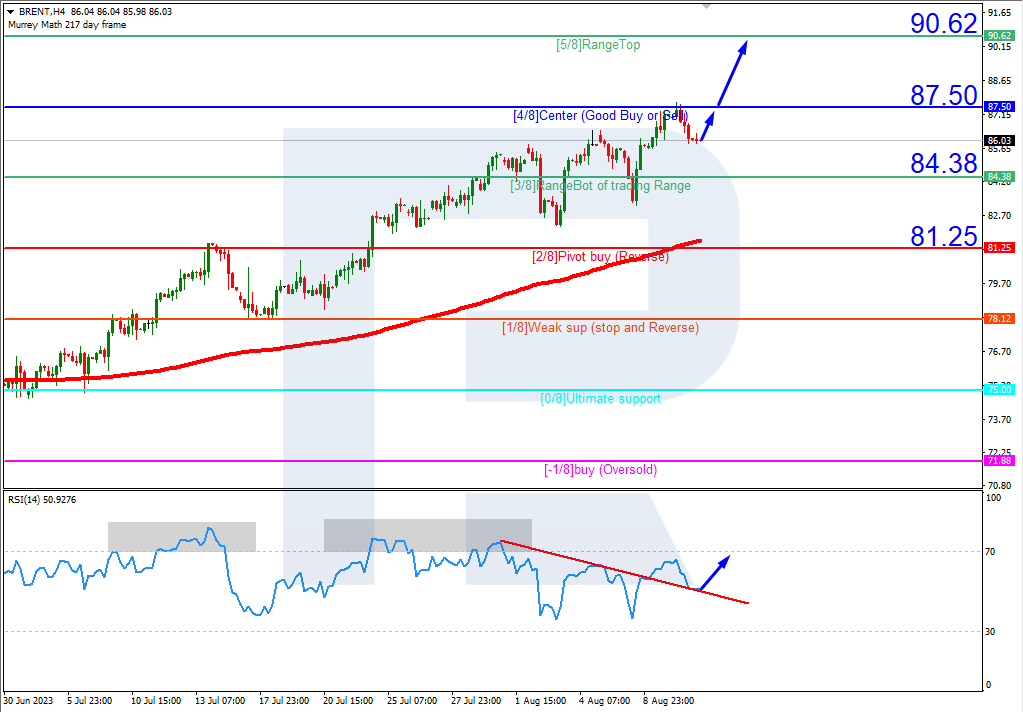
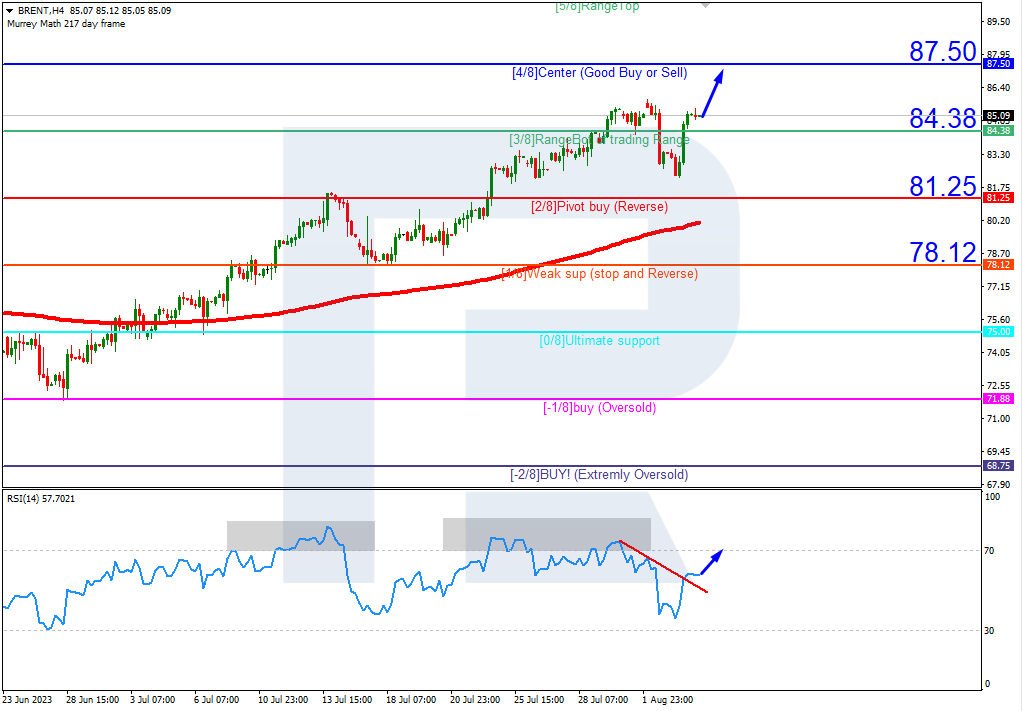
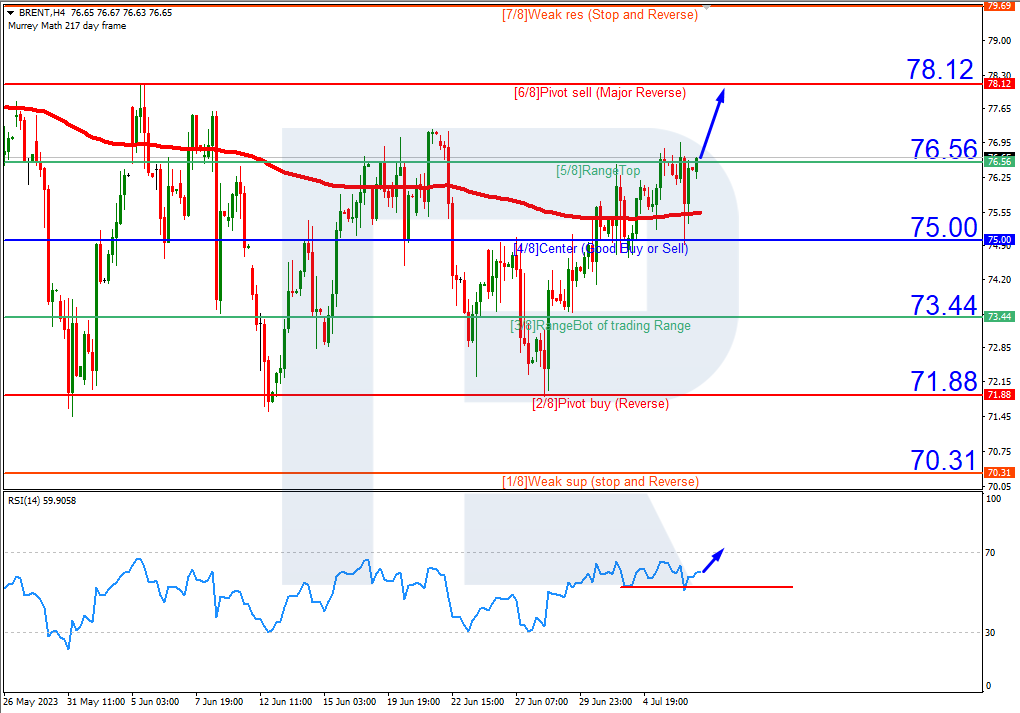
Brent quotes have broken the 200-day Moving Average on H4 and are now above it, indicating a probable development of an uptrend. The RSI has rebounded from the support line. In this situation, further growth to the resistance level of 6/8 (78.12) is to be expected. The scenario can be cancelled by a downward breakout of 4/8 (75.00). In this case, the quotes could drop to the support of 3/8 (73.44).

Brent_H4
Risk Warning: the result of previous trading operations do not guarantee the same results in the future

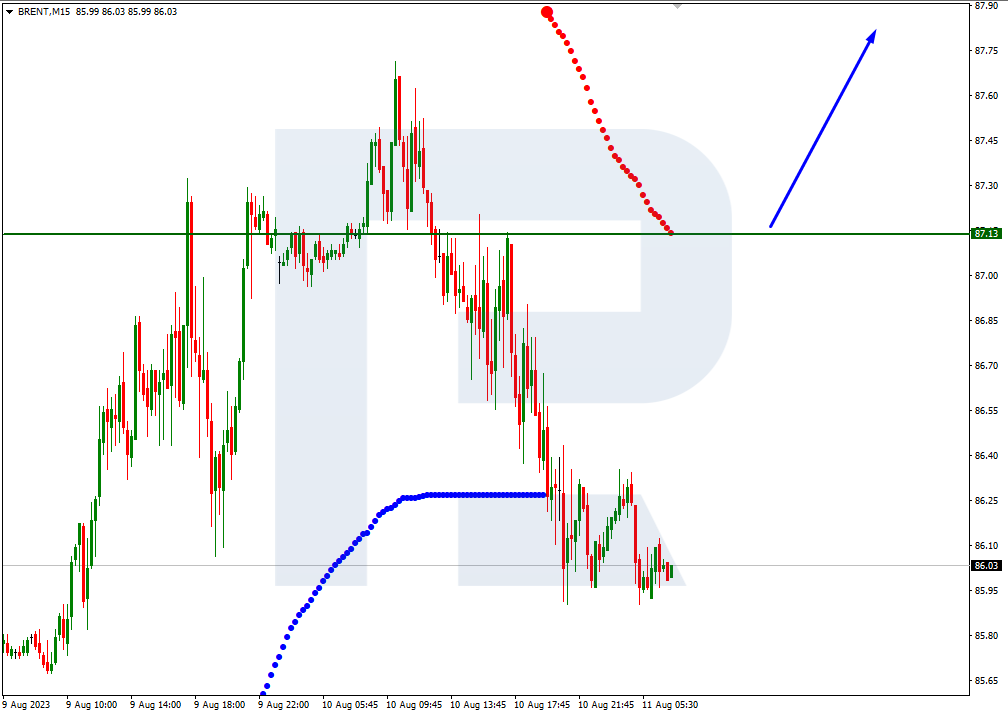
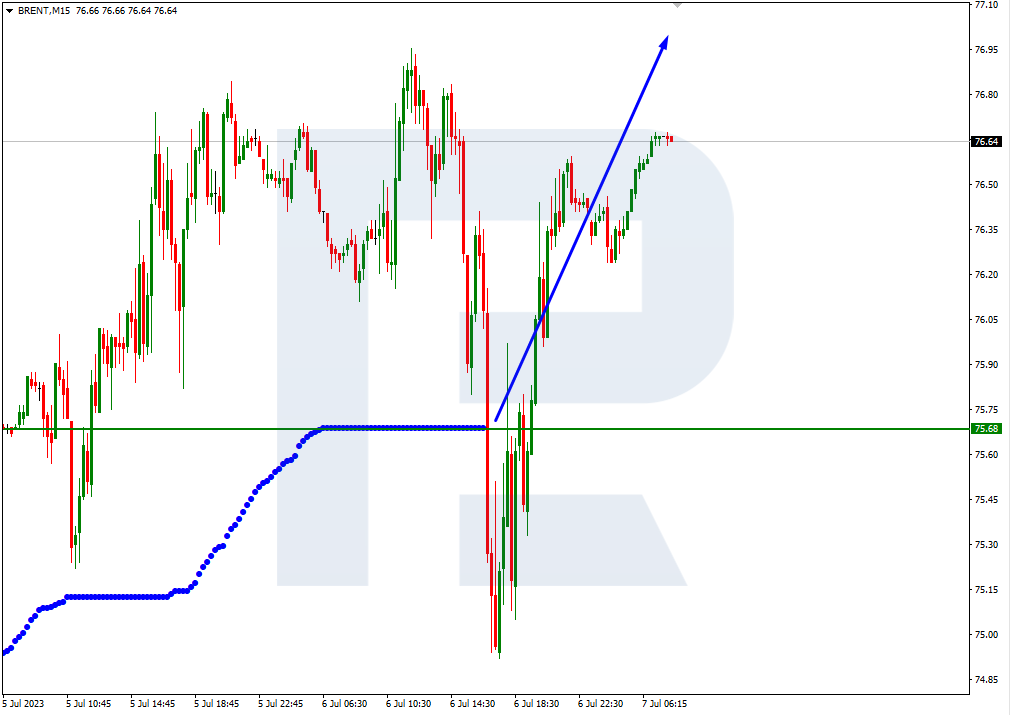
On M15, the upper line of the VoltyChannel is broken, which increases the probability of a rise to 6/8 (78.12) on H4.

Brent_M15
Risk Warning: the result of previous trading operations do not guarantee the same results in the future

S&P 500

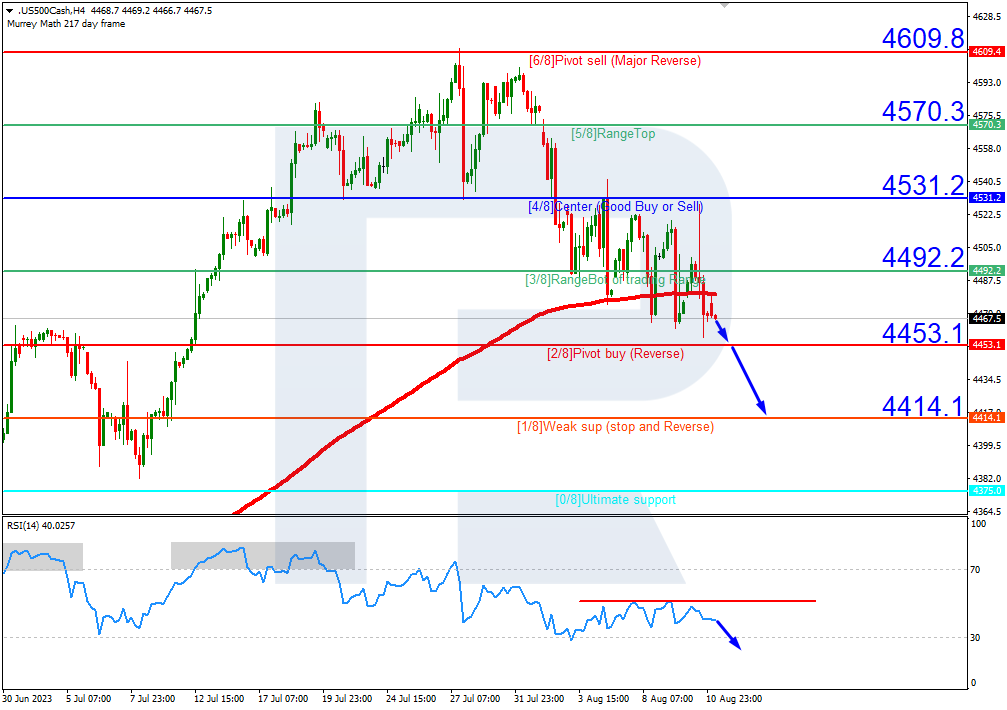
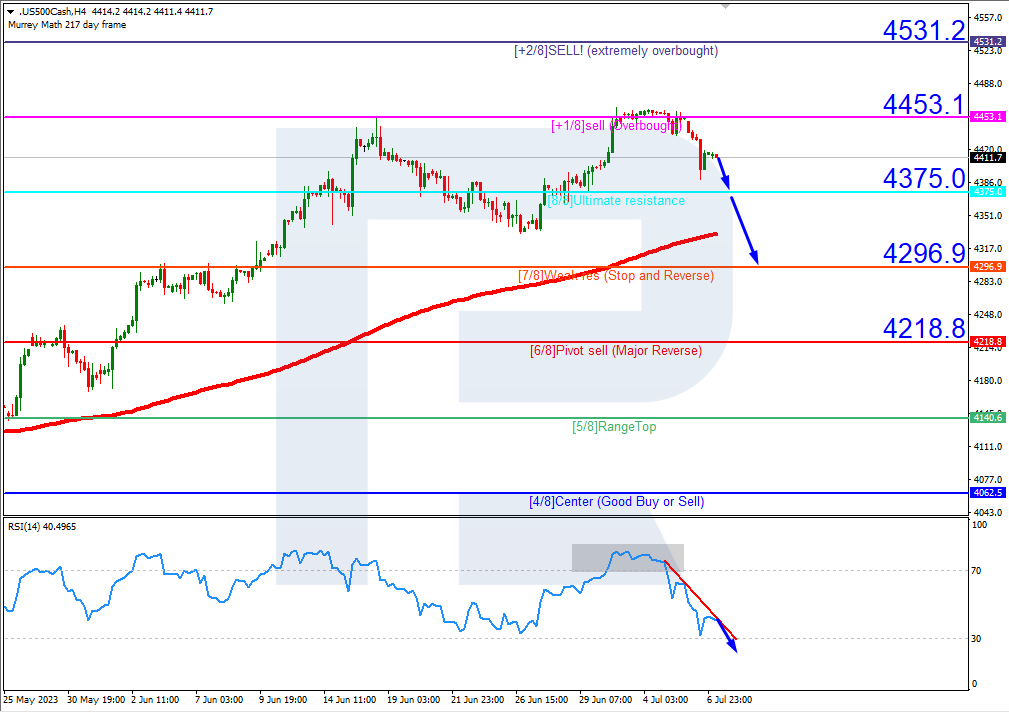
S&P 500 quotes remain in the overbought area on H4. The RSI is testing the resistance line. In this situation, a test of 8/8 (4375.0) is expected, followed by a breakout and a drop to the support at 7/8 (4296.9). The scenario can be cancelled by a rise above the resistance level of +1/8 (4453.1). In this case, the quotes could continue growing and reach +2/8 (4531.2).

S&P500_H4
Risk Warning: the result of previous trading operations do not guarantee the same results in the future

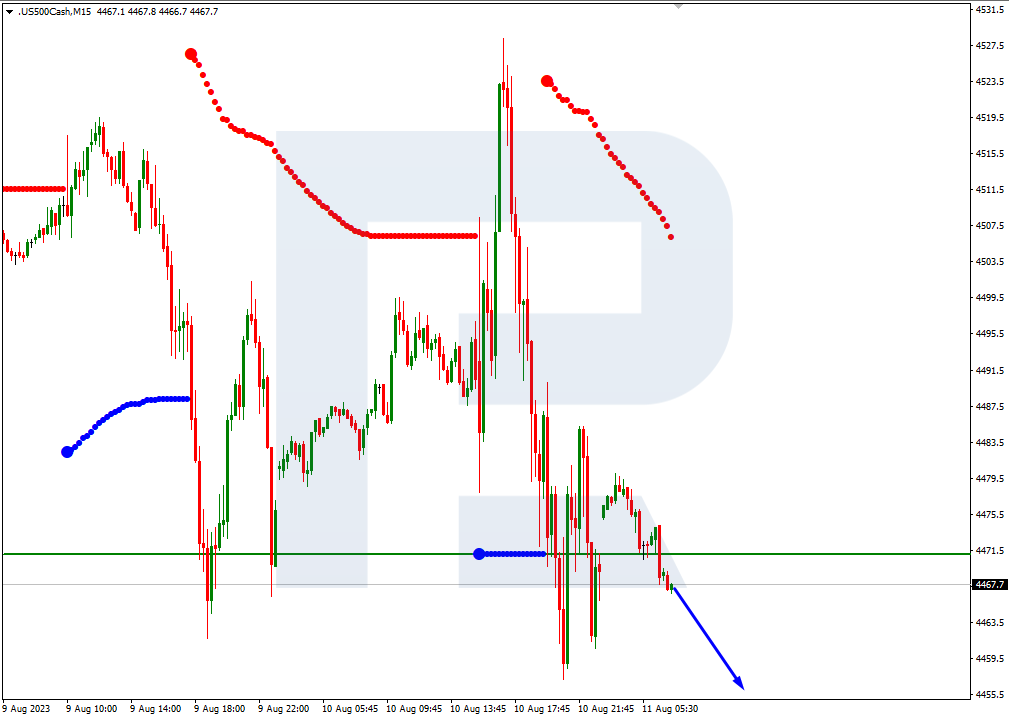
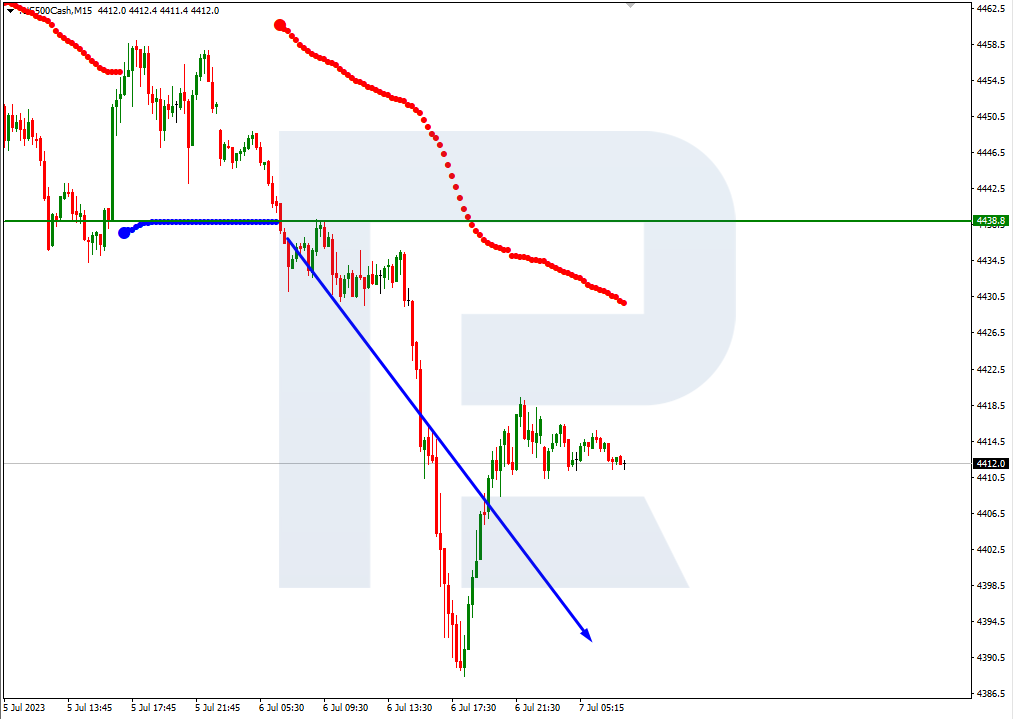
On M15, the lower line of the VoltyChannel is broken, which increases the probability of a price decline.

S&P500_M15

Article By RoboForex.com

Attention!
Forecasts presented in this section only reflect the author’s private opinion and should not be considered as guidance for trading. RoboForex LP bears no responsibility for trading results based on trading recommendations described in these analytical reviews.

Brent Crude Oil Price Sees Slight Decline as Energy Demand Concerns Persist

By RoboForex Analytical Department

The price of Brent crude oil commenced the new week in June with a marginal decline, reaching $75.70 per barrel.

Investor uncertainty regarding the expansion of energy demand remains a significant factor restricting the potential for price increases in the “black gold” market. There are currently no clear indications from global economies, particularly the United States and China, suggesting a rapid acceleration in GDP growth. Moreover, various pressures on economies, such as disruptions in the supply chain and subdued consumer demand, further contribute to this situation.

It is worth highlighting the weakened position of the US dollar, which provides some local support for oil prices. During periods of US currency depreciation, commodities tend to become more appealing for investment.

Technical Analysis:

On the H4 timeframe, Brent crude oil appears to be forming the structure of a third upward wave. Currently, it has risen to 76.06, and the market continues to consolidate around this level. There is a possibility of a breakout above this range, leading to the continuation of the third wave towards 79.19. Following the attainment of this level, a corrective pullback to 76.66 cannot be ruled out. Subsequently, there is a potential for further growth towards 80.60. The technical analysis supports this scenario, as the MACD indicator’s signal line has recently broken above the zero level, displaying confident growth towards new highs.

On the H1 timeframe, Brent has already formed an upward wave structure, reaching 76.06. The market is presently consolidating around this level, indicating a pattern of a continued upward trend. The projected target for this wave of growth is 79.30. Technical confirmation is provided by the Stochastic oscillator, with its signal line surpassing the level of 50 and exhibiting steady growth towards 80.

Disclaimer

Any forecasts contained herein are based on the author’s particular opinion. This analysis may not be treated as trading advice. RoboForex bears no responsibility for trading results based on trading recommendations and reviews contained herein.

Brent Crude Oil Prices Experience Decline Amidst Market Factors

By RoboForex Analytical Department

The commodity market is currently being impacted by various factors, causing Brent crude oil prices to decline. Currently, the price of a barrel of Brent is hovering around $72.35, reflecting a loss of approximately 4% within a 24-hour period.

Bearish sentiment in the oil market has been bolstered by Goldman Sachs’ updated price forecast. The investment bank now estimates that the average price per barrel will drop to $86.00, down from the previous forecast of $95.00 at the end of last year. Similarly, the outlook for WTI has worsened, with expectations declining from $89.00 to $81.00 per barrel.

Goldman Sachs analysts had previously held a more optimistic view on oil prices.

Furthermore, the pressure on commodity prices is being exerted by market anticipation of interest rate decisions by the Federal Reserve (Fed) and the European Central Bank (ECB). Both central banks are scheduled to hold their meetings later this week, on Wednesday and Thursday respectively.

Technical Analysis

On the H4 timeframe, Brent crude oil is currently forming a wide consolidation range, centered around 74.55. However, the market has extended this range downwards to 71.55, indicating a potential for further correction. Today, we expect to see a potential upward movement towards 74.55, which will be tested from below. Following this, a downward trend towards 71.10 and subsequent upward movement towards 78.50 cannot be ruled out. This is the initial target. Technically, this scenario is supported by the MACD indicator, as its signal line is currently below zero and preparing to exit the histogram area, suggesting potential price growth.

On the H1 timeframe, Brent crude oil is currently following an upward wave structure towards 73.10. Once the price reaches this level, a downward correction towards 72.30 may occur. Subsequently, if the price reaches the 72.30 level, a further rise towards 74.55 is anticipated. Technically, this scenario is confirmed by the Stochastic oscillator, as its signal line continues to decline towards 50. Once it reaches this level, an upward movement towards 80 is expected to begin.

Disclaimer

Any forecasts contained herein are based on the author’s particular opinion. This analysis may not be treated as trading advice. RoboForex bears no responsibility for trading results based on trading recommendations and reviews contained herein.

Will faster federal reviews speed up the clean energy shift? Two legal scholars explain what the National Environmental Policy Act does and doesn’t do

By J.B. Ruhl, Vanderbilt University and James Salzman, University of California, Los Angeles 

The National Environmental Policy Act, enacted in 1970, is widely viewed as a keystone U.S. environmental law. For any major federal action that affects the environment, such as building an interstate highway or licensing a nuclear power plant, NEPA requires relevant agencies to analyze environmental impacts, consider reasonable alternatives and accept public input. It also allows citizens to sue if they believe government has not complied.

Critics argue that NEPA reviews delay projects and drive up costs. In May 2023 negotiations over raising the federal debt ceiling, President Joe Biden agreed to certain changes to NEPA reviews, which both the White House and congressional Republicans said would streamline permitting for infrastructure projects. Legal scholars J.B. Ruhl and James Salzman explain these changes and what they mean for protecting the environment and expanding clean energy production.

What kinds of projects typically require NEPA reviews?

The statutory text of NEPA is quite sparse and open-ended. When people speak of what NEPA requires, they really are talking about how the White House Council on Environmental Quality, or CEQ, federal agencies and the courts have implemented the law over the past 50 years.

The simple requirement is for agencies to create a detailed statement on the impacts of any major federal action that significantly affects the environment. A whole body of law and policy creates filters that sort projects into different NEPA buckets.

NEPA requires all federal agencies to analyze the environmental impacts of their major actions, consider alternatives and receive public comment.

First, only projects that will be carried out, funded or authorized by a federal agency are subject to NEPA. That’s a pretty big universe, but it also excludes a lot. For example, a wind farm built on private land by a private utility might not require any federal funding or approval. That means it wouldn’t be subject to NEPA.

If a project is subject to NEPA, the federal agency that has primary oversight assesses its impacts to decide how much analysis is needed. Many agencies use a classification known as categorical exclusions to winnow out minor actions that they know have no significant impacts, either individually or cumulatively. For example, the Interior Department categorically excludes planned burns to clear brush on areas smaller than 4,500 acres.

If the expected impacts are more extensive, but it’s not clear by how much, the agency can prepare an environmental assessment. If that assessment finds the impacts to the human environment will not be significant, that’s the end of the NEPA process.

If the impacts are significant, the agency will prepare a full-blown environmental impact statement, or EIS, which is a far more intensive process. CEQ guidelines establish an elaborate template of topics agencies must evaluate, and the public has opportunities to comment on a draft version.

A CEQ review of EISs prepared by all federal agencies from 2010 through 2018 found that, on average, it took about four and a half years to issue an EIS, not including added time if someone sued. The lengths of these reviews ranged widely but averaged 575 pages.

Flow chart showing numerous steps in the NEPA process.
A schematic of the NEPA process.
NASA

If an agency conducts lots of the same actions under a particular program, such as timber leasing on federal land, it might conduct a high-level programmatic EIS to cover the large-scale issues and then follow up with individual NEPA analyses for specific projects.

Decisions not to issue an EIS can be challenged in court. So can the EIS itself if critics believe that it’s inadequate.

What are NEPA critics’ central arguments?

Critiques of NEPA come from many different interests. The law mainly affects land development, industry and resource extraction activities such as logging, mining and drilling for oil and gas, particularly on federal public lands.

NEPA requires an impact assessment, but it doesn’t prescribe any particular outcome. Still, it unquestionably can add substantial time and cost to any significant project. If a project is controversial, interested parties can submit public comments that get their views on the record. If opponents aren’t happy with the final EIS, they can sue the agency responsible for the decision in federal court.

Between agency review and litigation, NEPA can add many years to a project’s development timeline before it is “shovel ready.” For example, it takes roughly four to seven years to complete environmental reviews for prescribed burns that the U.S. Forest Service carries out to reduce wildfire risks.

Supporters argue that NEPA reviews have avoided many bad decisions. In our view, the NEPA process is an important feature of the country’s stewardship of its natural resources. But we also share the growing concern that it can be used to delay building renewable energy infrastructure that the U.S. urgently needs to mitigate climate change.

Did the debt ceiling agreement significantly change the NEPA process?

Many of the changes are little more than tweaks. Others codify long-standing practices based on how the Council on Environmental Quality, agencies and courts implement the law.

One notable change is requiring a single lead agency and a single environmental impact statement for projects, even when those projects require multiple agency approvals. There also are some new time and page limits. For example, environmental impact statements will be required to be completed within two years and be no more that 150 pages long for most projects, and 300 pages for the most complex projects.

There also are some changes to definitions, such as what constitutes a “major federal action,” that narrow NEPA’s scope to some degree, although it will take time to sort out their meaning. Overall, we do not see these changes as a major overhaul of NEPA.

Will the changes speed up work on clean energy systems?

Maybe, but not nearly as much as needed. First, NEPA applies to projects that need federal funding or approval, such as under the Endangered Species Act. Getting that money or agency green light can also involve delays and litigation independent of the NEPA review.

Second, many state and local laws can affect large renewable energy projects, and those statutes can also be used to slow projects down. The bottom line is that to move the needle, politicians will have to do more to reform the project review process.

The debt ceiling agreement left several big questions unaddressed. They include where to build high-voltage electric transmission lines; which federal public lands and offshore waters can be used for power lines and renewable power production; and where to mine for essential minerals.
Beyond those immediate priorities, if carbon sequestration technology can be developed and scaled up, the U.S. will need an enormous buildout of carbon capture and storage infrastructure to meet net-zero goals.

As renewable energy scales up in the U.S., local opposition could impede some utility-scale projects.

All of these involve incredibly complex permitting processes, and tweaking NEPA won’t change that. Other hot-button issues – including federal preemption of state and local laws, impacts on Native American cultural lands, and environmental justice – will make further permitting reforms politically difficult.

Even this first small measure was hotly contested, and happened now only because it was tied to the debt limit legislation. As the inclusion of federal approval for the Mountain Valley gas pipeline in the debt ceiling agreement shows, in politics you need a quid in exchange for a quo. We expect to see a lot more deal-making if Congress takes permitting reform seriously.The Conversation

About the Authors:

J.B. Ruhl, Professor of Law, Director, Program on Law and Innovation, and Co-director, Energy, Environment and Land Use Program, Vanderbilt University and James Salzman, Professor of Environmental Law, University of California, Los Angeles

This article is republished from The Conversation under a Creative Commons license. Read the original article.

Crude Oil Price Continues to Fall

By RoboForex Analytical Department

Oil continues to fall at the start of another May week. A barrel of Brent crude fell to 73.70 USD.

The sell-off in the commodities market has been ongoing for several weeks. Investors tried to get a foothold above 78.00 USD, but their attempts failed. The OPEC report, which normally looks optimistic, did not give investors any reason to buy this time. The main trigger for selling remains fears that the high interest rates around the world will put pressure on global economic activity. This, in turn, will reduce the demand for energy commodities.

Data from Baker Hughes showed that US drilling activity declined. Gas rigs were primarily affected (-16) but oil rigs also declined (-2).

On H4, Brent has worked its way up to the 77.44 level.  The market continues to develop a correction today. A decline to 72.33 is expected, followed by a new wave of growth to 80.07. After its breakdown, a new growth potential could open to the level of 87.77. The target is local. Technically, this scenario is confirmed by the MACD indicator: its signal line is below zero, with growth to new highs expected.

On H1, a consolidation range has formed around the 74.87 level. The market has escaped it downwards today. A decline to 72.56 is expected, followed by a rise to 74.87 and a decline to 72.33. After the price reaches this level, a wave of growth to 80.00 could begin. Technically, this scenario is confirmed by the Stochastic oscillator: Its signal line is breaking through the level of 20 upwards, aiming at 50. A rebound from this level is expected, followed by a new decline to 20. Next, growth to 80 could follow.

Disclaimer

Any forecasts contained herein are based on the author’s particular opinion. This analysis may not be treated as trading advice. RoboForex bears no responsibility for trading results based on trading recommendations and reviews contained herein.

What is hydrogen, and can it really become a climate solution?

By Hannes van der Watt, University of North Dakota 

Hydrogen, or H₂, is getting a lot of attention lately as governments in the U.S., Canada and Europe push to cut their greenhouse gas emissions.

But what exactly is H₂, and is it really a clean power source?

I specialize in researching and developing H₂ production techniques. Here are some key facts about this versatile chemical that could play a much larger role in our lives in the future.

So, what is hydrogen?

Hydrogen is the most abundant element in the universe, but because it’s so reactive, it isn’t found on its own in nature. Instead, it is typically bound to other atoms and molecules in water, natural gas, coal and even biological matter like plants and human bodies.
Hydrogen can be isolated, however. And on its own, the H₂ molecule packs a heavy punch as a highly effective energy carrier.

It is already used in industry to manufacture ammonia, methanol and steel and in refining crude oil. As a fuel, it can store energy and reduce emissions from vehicles, including buses and cargo ships.

Hydrogen can also be used to generate electricity with lower greenhouse gas emissions than coal or natural gas power plants. That potential is getting more attention as the U.S. government prepares new rules that would require existing power plants to cut their carbon dioxide emissions.

Because it can be stored, H₂ could help overcome intermittency issues associated with renewable power sources like wind and solar. It can also be blended with natural gas in existing power plants to reduce the plant’s emissions.

Using hydrogen in power plants can reduce carbon dioxide emissions when either blended or alone in specialized turbines, or in fuel cells, which consume H₂ and oxygen, or O₂, to produce electricity, heat and water. But it’s typically not entirely CO₂-free. That’s in part because isolating H₂ from water or natural gas takes a lot of energy.

How is hydrogen produced?

There are a few common ways to produce H₂:

  • Electrolysis can isolate hydrogen by splitting water – H₂O – into H₂ and O₂ using an electric current.
  • Methane reforming uses steam to split methane, or CH₄, into H₂ and CO₂. Oxygen and steam or CO₂ can also be used for this splitting process.
  • Gasification transforms hydrocarbon-based materials – including biomass, coal or even municipal waste – into synthesis gas, an H₂-rich gas that can be used as a fuel either on its own or as a precursor for producing chemicals and liquid fuels.

Each has benefits and drawbacks.

Green, blue, gray – what do the colors mean?

Hydrogen is often described by colors to indicate how clean, or CO₂-free, it is. The cleanest is green hydrogen.

Green H₂ is produced using electrolysis powered by renewable energy sources, such as wind, solar or hydropower. While green hydrogen is completely CO₂-free, it is costly, at around US$4-$9 per kilogram ($2-$4 per pound) because of the high energy required to split water.

Chart showing different colors of hydrogen and how each is made
The largest share of hydrogen today is made from natural gas, meaning methane, which is a potent greenhouse gas.
IRENA (2020), Green Hydrogen: A guide to policymaking

Other less energy-intensive techniques can produce H₂ at a lower cost, but they still emit greenhouse gases.

Gray H₂ is the most common type of hydrogen. It is made from natural gas through methane reforming. This process releases carbon dioxide into the atmosphere and costs around $1-$2.50 per kilogram (50 cents-$1 per pound).

If gray hydrogen’s CO₂ emissions are captured and locked away so they aren’t released into the atmosphere, it can become blue hydrogen. The costs are higher, at around $1.50-$3 per kilogram (70 cents-$1.50 per pound) to produce, and greenhouse gas emissions can still escape when the natural gas is produced and transported.

Another alternative is turquoise hydrogen, produced using both renewable and nonrenewable resources. Renewable resources provide clean energy to convert methane – CH₄ – into H₂ and solid carbon, rather than that carbon dioxide that must be captured and stored. This type of pyrolysis technology is still new, and is estimated to cost between $1.60 and $2.80 per kilogram (70 cents-$1.30 per pound).

Can we switch off the lights on fossil fuels now?

Over 95% of the H₂ produced in the U.S. today is gray hydrogen made with natural gas, which still emits greenhouse gases.

Whether H₂ can ramp up as a natural gas alternative for the power industry and other uses, such as for transportation, heating and industrial processes, will depend on the availability of low-cost renewable energy for electrolysis to generate green H₂.

It will also depend on the development and expansion of pipelines and other infrastructure to efficiently store, transport and dispense H₂.

Without the infrastructure, H₂ use won’t grow quickly. It’s a modern-day version of “Which came first, the chicken or the egg?” Continued use of fossil fuels for H₂ production could spur investment in H₂ infrastructure, but using fossil fuels releases greenhouse gases.

What does the future hold for hydrogen?

Although green and blue hydrogen projects are emerging, they are small so far.

Policies like Europe’s greenhouse gas emissions limits and the 2022 U.S. Inflation Reduction Act, which offers tax credits up to $3 per kilogram ($1.36 per pound) of H₂, could help make cleaner hydrogen more competitive.

Hydrogen demand is projected to increase up to two to four times its current level by 2050. For that to be green H₂ would require significant amounts of renewable energy at the same time that new solar, wind and other renewable energy power plants are being built to provide electricity directly to the power sector.

While green hydrogen is a promising trend, it is not the only solution to meeting the world’s energy needs and carbon-free energy goals. A combination of renewable energy sources and clean H₂, including blue, green or turquoise, will likely be necessary to meet the world’s energy needs in a sustainable way.The Conversation

About the Author:

Hannes van der Watt, Research Assistant Professor, University of North Dakota

This article is republished from The Conversation under a Creative Commons license. Read the original article.

Mid-Week Technical Outlook: Oil Hammered Ahead Of Fed

By ForexTime 

Oil markets have been plunged into a bloodbath over the past 24 hours.

The global commodity shed almost 3% this morning, extending a 5% drop on Tuesday after disappointing US economic data fuelled fears of a recession. With oil bears drawing ample strength from weak US factory data and renewed concerns about the US banking sector, further downside could be on the cards ahead of the Fed decision later today.

In the meantime, it will be wise to keep a close eye on the pending US ISM numbers and data from the Energy Information Agency (EIA) this afternoon. If the reports reinforce fears around the US economy or the EIA data shows a rise in oil inventories, this could keep bears in the driving seat.

Looking at the technical picture, both WTI and Brent Crude are under intense pressure on the daily charts. WTI extended losses on Wednesday with bears smashing into the $70 level. A strong break and daily close below this point could open a path toward $67 and $64.33 – the lowest level hit this year. Should $70 or $67 prove to be reliable support, prices may experience a technical pullback toward $74 before resuming the downtrend.

It is a similar story for Brent. Prices are trading below the 50, 100, and 200-day SMA while the MACD trades below zero. The bearish trend is healthy with the next key level of interest found at 72.50. Below this point, prices could test $70 and potentially lower.

Since we are discussing commodities, gold secured a daily close above the $2015 resistance as downbeat US economic data and renewed banking fears sparked risk aversion. However, it may take a potent fundamental spark to push prices higher with all eyes on the Fed meeting this evening. Although the central bank is widely expected to hike rates by 25 basis points, investors will be looking for any confirmation that a pause in hikes is on the table. Whatever the outcome, it will certainly impact gold.

The solid breakout above $2015 may open the doors toward $2032 and $2047. Should prices slip back below $2000, this could trigger a decline towards $1970 and $1950, respectively.


Forex-Time-LogoArticle by ForexTime

ForexTime Ltd (FXTM) is an award winning international online forex broker regulated by CySEC 185/12 www.forextime.com