The rapid spread of the Delta strain puts strong pressure on commodity markets

by JustForex

Despite positive JOLTs Job Openings data, US main stock indices slightly decreased on Monday. The US must overcome the economic crisis caused by the epidemic before the central bank begins to raise interest rates, according to Federal Reserve official Rafael Bostic. Most likely, the US stock market situation will not change significantly, and indices will continue to rise slowly until the annual symposium in Jackson Hole later this month.

European stock indices closed the day without a single dynamic. British stock index FTSE 100 increased by 0.13%, while German DAX decreased by 0.1%. Today, the ZEW institute will publish the economic forecasts for the European countries.

The situation with gold remains unchanged. It is important for traders to keep an eye on the dollar index and US government bond yields now, as gold has an inverse correlation to these instruments. The fall in gold prices is also a sign of strong sell-offs by investors and hedge funds, so many analysts are beginning to think that the Federal Reserve will begin reducing the QE program soon.

The situation in the oil market has not changed either. Oil prices slightly increased yesterday. However, the growth of quotes is still limited due to concerns about the rise of COVID-19 cases in Asian countries and the USA. Traders fear that introducing new restrictive measures to curb the spread of the Delta strain will weaken the global economy and decrease demand for fuel.

Persistent fears about the rapid spread of the Delta strain have undermined investor sentiment in Asia as well, making major stock indices decline. The broadest index of Asia-Pacific stocks outside Japan, the MSCI, decreased by 0.4% in opening trading today, while China’s CSI 300 blue-chip index decreased by 0.33%. Analysts at Goldman Sachs presented a more pessimistic forecast for Chinese economic growth as Chinese authorities were forced to impose quarantine restrictions to contain a new wave of Delta. According to the new forecast, China’s GDP will increase by 2.3% (previous forecast 5.8%) in the third quarter of this year and 8.3% (previous forecast 8.6%) at the end of the year.

Main market quotes:

S&P 500 (F) 4,432.35 -4.17 (-0.09%)

Dow Jones 35,101.85 -106.66 (-0.30%)

DAX 15,745.41 -16.04 (-0.10%)

FTSE 100 7,132.30 +9.35 (+0.13%)

USD Index 92.28 +0.68 (+0.70%)

Important events for today:
  • – Australia NAB Business Confidence (m/m) at 04:30 (GMT+3);
  • – Germany ZEW Economic Sentiment (m/m) at 12:00 (GMT+3);
  • – Eurozone ZEW Economic Sentiment (m/m) at 12:00 (GMT+3).

by JustForex


This article reflects a personal opinion and should not be interpreted as an investment advice, and/or offer, and/or a persistent request for carrying out financial transactions, and/or a guarantee, and/or a forecast of future events.

Markets Remain Cautious Amid Delta Fears

By Lukman Otunuga Senior Research Analyst, ForexTime

Asian shares kicked off Tuesday on a mixed note as persistent concerns over the spread of the Delta variant hampered risk sentiment. Commodity markets stabilised after Monday’s brutal selloff, while the dollar held overnight gains, appreciating against most G10 currencies. European markets are expected to open slightly lower with the lack of appetite for risk finding its way to Wall Street this afternoon according to US futures.

The negative developments revolving around Covid-19 have certainly left investors on edge with caution likely to remain the name of the game over the next few days.

Nevertheless, the week ahead promises to be eventful and potentially volatile thanks to key economic data including the US CPI report and speeches from numerous Fed members.

Speaking of central bank officials, Federal Reserve Bank of Atlanta President Raphael Bostic said on Monday that the Fed could start tapering in the final quarter of 2021 amid strong job gains. Although Richmond Fed Thomas Barkin said that the economy has made progress, he believed that there was still some room for improvement in the labour market. Both Bostic and Barkin are voters this year on the Federal Open Market Committee (FOMC).

Dollar King of the castle?

The dollar remained firm on Tuesday morning after last Friday’s blockbuster US jobs report boosted expectations over the Federal Reserve tapering sooner than expected. Rising bond yields and hawkish comments from Atlanta Fed’s Bostic have supported the upside, with the Dollar Index (DXY) trading around 93.00 as of writing.

The next few days could see increased volatility thanks to the numerous speeches from Federal Reserve officials and the widely anticipated US inflation report.

Headline CPI is expected to print at 5.3% year-over-year while core CPI is forecast to come in at 4.3%. The monthly reading is expected to drop to 0.5% in July from the 0.9% seen in June and core CPI is projected to print 0.4%, down from the 0.9% in the previous month. Further signs of rising inflationary pressures could instil dollar bulls with a renewed sense of confidence as expectations intensify over the Federal Reserve shifting its policy outlook. On the flip side, if inflation cools this may reduce some pressure on the Fed to act, potentially sending the dollar lower.

There are also a couple of Fed members scheduled to speak this week which could spark more dollar volatility. Cleveland Fed President Loretta Mester will steal the show today while Atlanta Fed President Bostic and Kansas City Fed President Esther George are due to speak on Wednesday.

Taking a look at the technical picture, the Dollar Index is turning bullish on the daily charts with the first key level of interest at 93.19. A breakout above this point may open the doors to 93.44 – its highest level in 2021.

Commodity spotlight – Gold

What a terrible way to kick off the trading week!

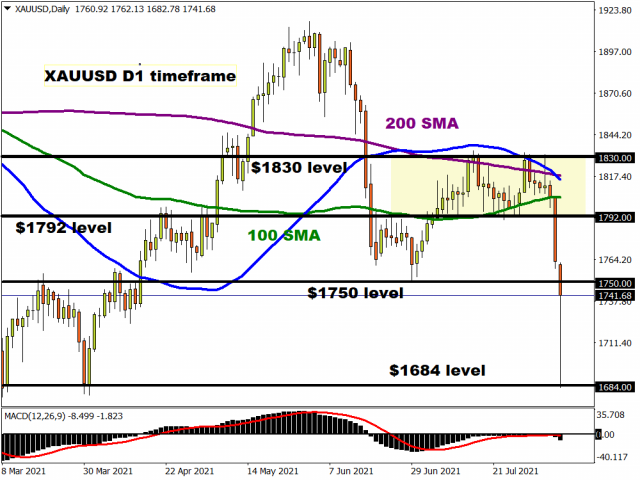
Gold collapsed like a house of cards yesterday, cutting through multiple support levels like a hot knife through butter thanks to last Friday’s strong US jobs data.

As expectations grow over the Federal Reserve tightening monetary policy sooner than anticipated, investors offloaded the precious metal, sending prices to levels not seen in five months.

Although the precious metal has edged higher today as bulls desperately struggle to nurse the deep wounds inflicted from the brutal selloff, gold remains heavily bearish on the daily charts. It will be interesting to see how the pending US inflation data influences prices. Looking at the technical picture, sustained weakness below $1760 may result in a decline back towards $1700 and below. Alternatively, a breakout above $1760 could trigger a move towards $1792 and $1800.

Disclaimer: The content in this article comprises personal opinions and should not be construed as containing personal and/or other investment advice and/or an offer of and/or solicitation for any transactions in financial instruments and/or a guarantee and/or prediction of future performance. ForexTime (FXTM), its affiliates, agents, directors, officers or employees do not guarantee the accuracy, validity, timeliness or completeness, of any information or data made available and assume no liability as to any loss arising from any investment based on the same.


Forex-Time-LogoArticle by ForexTime

ForexTime Ltd (FXTM) is an award winning international online forex broker regulated by CySEC 185/12 www.forextime.com

XAUUSD Has Intermediate Correction (4) Ended?

By Orbex

The current XAUUSD structure suggests that the intermediate correction wave (4), which is currently under construction, is a triple zigzag. This triple zigzag consists of minor sub-waves W-X-Y-X-Z.

The second minor intervening wave X has ended. The final minor wave Z is a double zigzag of a minute degree.

It is possible that the wave ⓨ will take the form of a double combination, as shown in the chart, and will complete its pattern near 1636.45. At that level, minor waves Y and Z will be equal.

The alternative scenario suggests that the formation of the intermediate correction (4) has ended.

To confirm this option, the development of wave (5) in an impulse or an ending diagonal will be required.

The price of gold could grow significantly above the level of 1917.03. This was shown by the minor intervening wave X.

By Orbex

Intraday Market Analysis – USD To Test Key Resistance

By Orbex

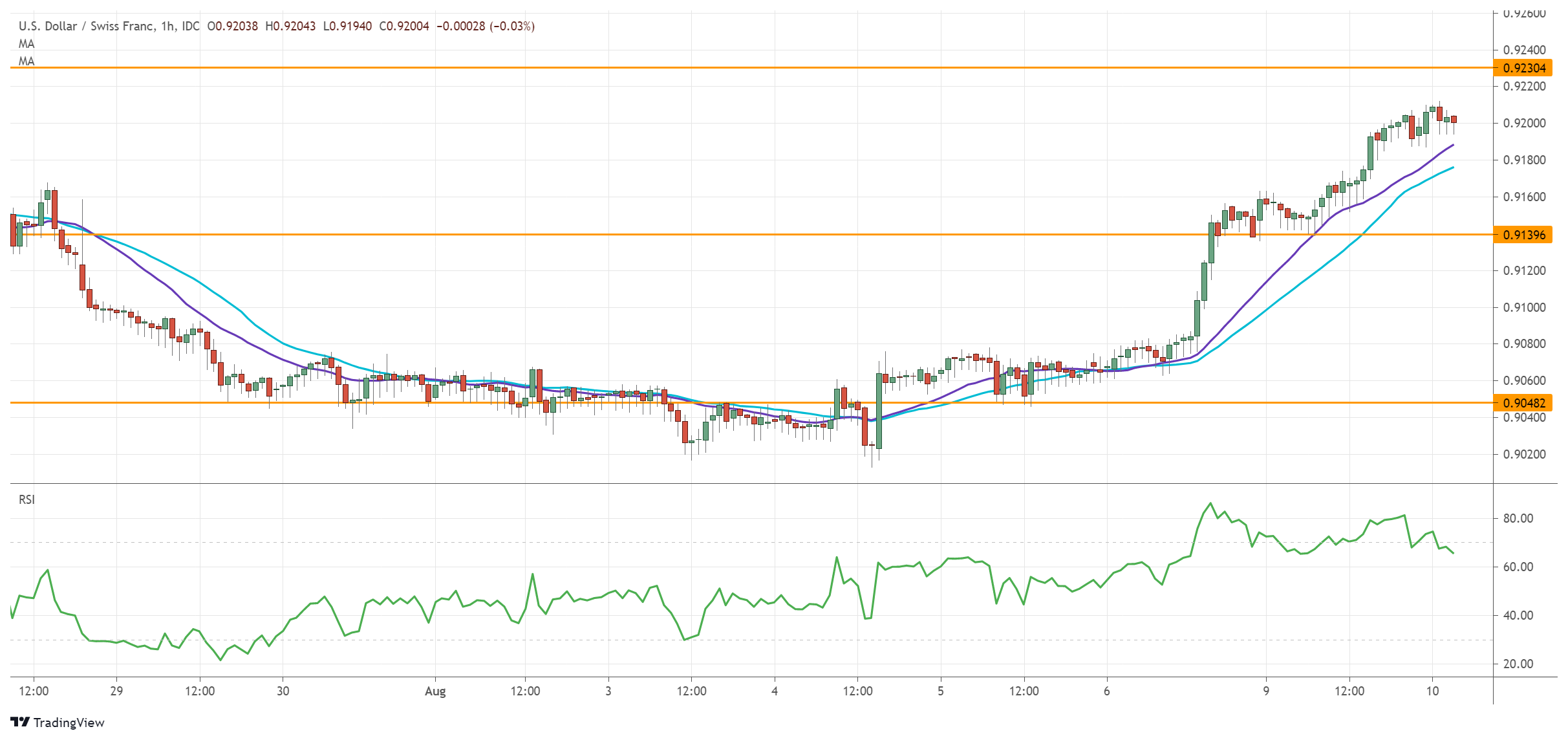
USDCHF approaches key hurdle

USDCHF

The US dollar continues to make up lost ground thanks to post-NFP momentum.

The break above 0.9150, the last leg of the previous sell-off, suggests solid commitment from the bulls. The rebound has originated from the demand zone around 0.9030 on the daily chart, and it is heading towards the major resistance at 0.9230.

A bullish breakout may help the dollar break free of a narrowing consolidation range and resume the rally from the start of the year.

0.9140 is the first support in case of a pullback to let the RSI cool down.

EURGBP tumbles through floor

EURGBP

The sterling rises as traders bet that the BOE would start to tighten its policy sooner than most of its peers.

The daily support at 0.8470 has failed to contain the firesale. The bearish breakout has invalidated April’s rebound as sellers became more aggressive.

The downward momentum is pushing the price towards 0.8400.

An oversold RSI may have caused a limited bounce as intraday traders take some chips off the table. Sentiment remains downbeat though, as long as the euro is under 0.8520.

GER 30 struggles to break higher

DAX

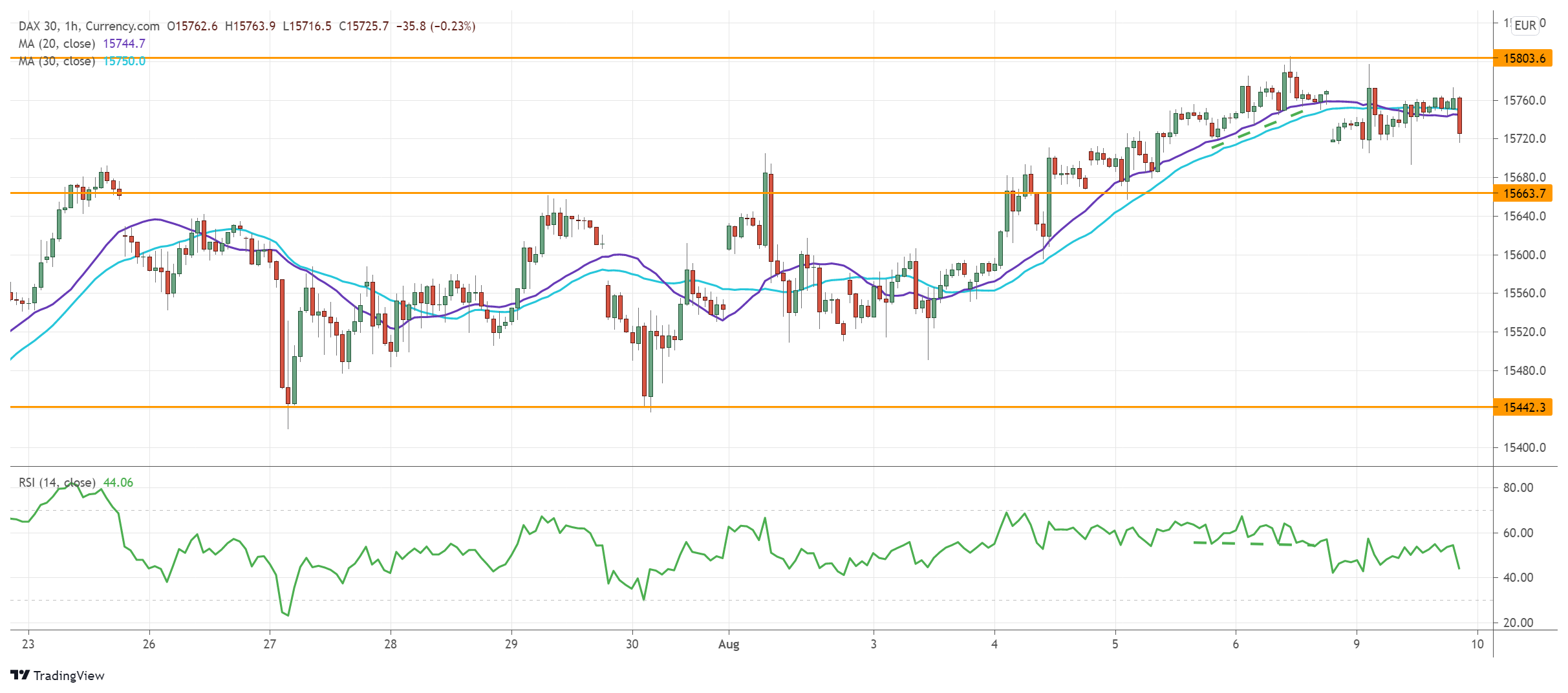
The Dax 30 hits a speed bump as investors fret about tapering in the wake of strong US jobs data. The rebound has come to a halt right at the peak at 15800.

Buyers’ struggle to push past the all-time high indicates stiff pressure from both profit-taking and fresh selling.

The RSI divergence in this kind of major supply area is a warning sign as buying has lost its impetus.

The break below 15660 could prompt the bulls to bail out. 15440 would be the next support as the index goes into a correction.

By Orbex

The 2021 Guide To Cryptocurrencies (Part 1)

By Ino.com

– Welcome to the 2021 Guide to Cryptocurrencies! If you’ve ever wondered what cryptocurrencies are all about, you’ve come to the right place!

This guide is perfect for just about anyone. In fact, you could be a seasoned crypto investor, a new investor to the space, or just someone who wants to learn more. No matter how you got here, this guide is built for you.

I’ve taken topics that are key to learning more about cryptocurrencies and blockchain. Then I’ve combed through every article I’ve written for INO.com over the past few months. Out of that pool of articles, I’ve selected just the right mix that are ideal for the topics you need to know about.

But before we get started, a quick word of caution. If you’re going to invest in cryptocurrencies – and there are good reasons why everyone should own a little – remember that the entire space is risky, highly volatile, and unpredictable. So, if you’re going to take the plunge, don’t devote more than 1% to 2% of your portfolio. And ask yourself if you’d be comfortable losing that 1% to 2% because you just might.

Now, with that out of the way, let’s get to the 2021 Guide to Cryptocurrencies!

What is Blockchain?

Fact is, this fundamental question is often the most confusing. And that’s because there’s a lot of jargon surrounding blockchain: Cryptography, distributed ledgers, mining, tokens, cold storage, wallet. And that’s just the beginning.

Forget about all that stuff for a minute. To understand blockchain, you simply need to understand a list.

Yep, that’s it. Blockchain, at its most basic, is simply a list of instructions for a computer to do. And those instructions could be financial transactions, items to do to fulfill a contract, a digital copy of a work of art, or the process of closing on a home.
It's Earnings Season - See Which Stocks are Starting to Drift

But here’s what makes blockchain so fascinating: When you create your list of instructions, everyone who is a member of the blockchain where the list is housed gets the same list of instructions. And once the instructions are completed, every blockchain member must sign off on what’s happened and verify that the list was completed properly. If they do, the list is closed, and the transaction is added to the blockchain.

If you notice, when you completed your list of instructions, you didn’t need a third party – like a bank or a real estate company – to get involved and approve the transaction. Instead, all you had to deal with were the people you were doing business with and members of the blockchain. This lack of central authority is another fascinating part of the blockchain.

And since all the blockchain members have the same list sitting on a wide array of sophisticated computers using cryptography, the process is very secure. This is another big plus.

Learn more: Here’s Why Cryptocurrency Is So Important!

What is Cryptocurrency?

Even if you don’t own any cryptocurrency, chances are you own a distant cousin.

Here’s what I mean…

Pretty much without exception, most money these days is digital currency. When you check your bank balance online, you’re looking at digital currency. When you use your debit or credit card, you’re using digital currency. When you send money to a relative, you’re using digital currency.

Just like these, a cryptocurrency is a form of digital currency. It has a life because it sits in a digital form on a computer.

But unlike your bank account, cryptocurrencies don’t need a bank – or other third parties – to approve and sign off on transactions. Provided everyone on the blockchain approves the transaction, the transaction takes place without the need of a third party.

Imagine doing business with someone else without the need of a Big Brother looking over your shoulder. Or without some other third party – like a closing agent or lawyer – making sure everyone did what they were supposed to do.

When you think about it, this is pretty big.

Learn more: What Is Cryptocurrency Anyway?

Should you own Cryptocurrencies?

Without a doubt, everyone should own a little cryptocurrency (keeping in mind our disclaimer above!)

And that’s because cryptocurrencies and the blockchain are going to revolutionize the way we live and do business, unlike any technology we’ve seen before. (Remember, if you can make a list of instructions, you can make a blockchain.) In fact, this transformation is already underway.

And beyond that, cryptocurrencies – particularly those with a limited supply like Bitcoin (BTC) – are an excellent store of value. Why? Because unlike fiat currencies like the dollar, they can’t be over-supplied or manipulated by central banks. And like gold, relative scarcity makes Bitcoin and similar cryptocurrencies inherently valuable.

Sure, cryptocurrencies like Bitcoin are volatile and unpredictable. But as adoption continues to increase, that volatility will likely subside to a degree. And don’t forget: We look at gold as valuable, but it too has its own fair share of volatility.

Learn more: Should You Own Cryptocurrency?

The 2021 Guide to Cryptocurrencies Continues!

Next week, I’ll bring you the second installment of The 2021 Guide to Cryptocurrencies. We’ll dig deeper into Bitcoin, cryptocurrency exchanges, and other essential cryptocurrency topics.

So, stay tuned!

Wayne Burritt
INO.com Contributor

Disclosure: This contributor may own cryptocurrencies mentioned in this article. This article is the opinion of the contributor themselves. The above is a matter of opinion provided for general information purposes only and is not intended as investment advice. This contributor is not receiving compensation (other than from INO.com) for their opinion.

By Ino.com – See our Trader Blog, INO TV Free & Market Analysis Alerts

Source: The 2021 Guide To Cryptocurrencies (Part 1)
Four clothing businesses that could lead us away from the horrors of fast fashion

By Elaine L Ritch, Glasgow Caledonian University 

It makes no sense to keep exploiting natural resources to feed an ever-consuming market, but this remains the nature of high-street fashion. Resources are finite – as is the space for landfill – but too often clothes shopping is about buying cheap soulless garments that end up being thrown away and not recycled.

The modern fashion business is too often about forgettable commodities that exist solely for the sake of consumption. And in 2020, online sales grew at their fastest rate since 2007. Given that online shopping returns often end up in landfill without even making it to anyone’s wardrobe, this looks like a step in the wrong direction.

Many argue that, after the pandemic, we need to shift towards a circular economy in which waste and pollution are removed from the system. Here, then, are four examples of clothing businesses that have been using lockdown to put this ideal into practice.

She’s not gotta have it.
The Blowup/Unsplash, CC BY-SA

Making children sustainable

Marketers view the early years of childhood as a golden opportunity for getting mums and dads to buy more stuff – not least because young children grow so fast. New parents are targeted with endless cute clothes and commodities for child-rearing, being constantly told that such purchases are essential to good parenting.

Many parents do turn to sharing networks to get some of the things they need secondhand – but one designer has come up with a different answer. London-based Ryan Mario Yasin, who won the James Dyson Award in 2017 for innovative problem solving, designs clothes that grow with the child.

Inspired by the Japanese fashion designer Issey Miyake, who developed flexible pleating initially for ballet dancers, this revolutionary concept applies engineering principles to material.

Yasin’s children’s garments, which are branded Petit Pli, stretch to fit kids aged three months to three years – offering parents a sustainable alternative to disposable clothing. More recently he has also added unisex adult clothing to his collection, marketing this new range as clothes that are built to last.

Vigga is another operator that is trying to make children’s clothing more sustainable, but in a different way. The Danish company offers a subscription-based rented clothing line for infants and small children.

Parents who subscribe to this service receive clothing every three months in the early years as their baby grows, and less frequently thereafter. When the clothes are returned to Vigga, they are washed and repaired for further use. This reflects a circular system where every garment is used several times, ensuring a lower environmental impact.

A different kind of mall

In the small Swedish city of Eskiltuna, a few kilometres west of Stockholm, is the world’s first recycling mall. Known as ReTuna Återbruksgalleria, all the clothes sold are recycled, while other products, including foods, are organically sourced or sustainably produced. The mall opened in 2015 and is deliberately located next to the town’s recycling centre, which makes it a convenient destination for the shops in the mall to pick up materials for their businesses.

The idea was driven by local politicians with the ambition for Eskilstuna to be a good example of addressing the challenges of sustainability. Store owners and employees go through all the donated goods to see what can be repaired, fixed and converted for selling.

With close links to the local school, the mall also provides workshops, lectures and themed days to educate wider society on sustainability practice. And note that this encourages people into the physical space – a strategy that could be useful to draw shoppers back to UK high streets after the pandemic.

The ‘For Days’ model

US clothing firm For Days was inspired by the volume of clothing hoarded in consumer wardrobes. In acknowledging that we need to buy less, For Days encourages customers to send their old clothes in the post. It doesn’t matter whether they were made by For Days in the first place, and people receive money-off vouchers for new items in return.

The whole approach is that nothing ends up in landfill. For Days sorts the donated clothes into colours and then mechanical recyclers convert them into new materials to be used to make new clothes. Clothes can be donated in any condition – which is important, considering the low quality of many fast-fashion garments. For Days is also carbon neutral, minimising waste with reusable packaging and carbon offsetting.

If the circular economy is to succeed, of course, consumers have to embrace it. The inevitable problem is that each of these four models is slightly more expensive than the mass market, and the rock-bottom prices of fast-fashion clothes have reduced the threshold that the average consumer would see as the maximum they would pay for something.

Woman looking at blouses on a clothing rack
Enough already.
Becca McHaffie/Unsplash, CC BY-SA

The trouble is that these higher prices reflect the true cost of resources, production and so on. So while such enterprises will attract consumers who are particularly concerned about sustainability and their carbon footprints, there will be limits to what they can achieve.

To get the majority of consumers onboard and truly move towards a circular economy, mass-market brands need to start pushing in the same direction. As the pandemic hopefully begins to move into the past, that is the big challenge for the future.The Conversation

About the Author:

Elaine L Ritch, Senior Lecturer in Marketing, Glasgow Caledonian University

This article is republished from The Conversation under a Creative Commons license. Read the original article.

Commodities are stealing the show

By Lukman Otunuga Senior Research Analyst, ForexTime

European and Asian stocks are mixed while the dollar and Treasury yields are unchanged after their sharp jump higher following Friday’s strong US jobs report. But a rising greenback and yields are not a good combination for commodities which are continuing to suffer losses.

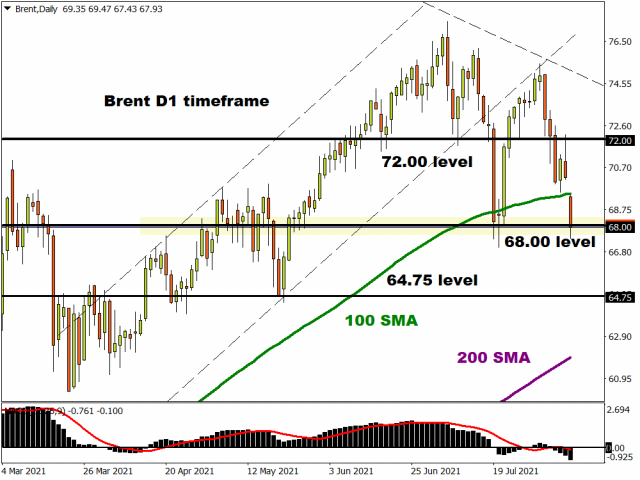
Oil is extending Friday’s price action, falling close to 4% this morning as the Delta Covid-19 variant spreads across Asia. After a 6% slump last week, Brent suffered its biggest weekly loss in four months.

Fears around potential global oil demand erosion are resurfacing with new restrictions in China, the world’s second largest oil consumer, raising increasing concerns about the short-term outlook.

Brent has broken through the 100-day moving average this morning and is now trading around the July support zone lows at $68. With the daily RSI not oversold, a weak close may see more downside into the May lows around $64.75.

Gold flash crash

Sentiment has also been tempered by a sudden dive in gold prices at the start of the Asian session. A break of $1750 triggered stop losses in thin market conditions, taking the precious metal to lows at $1684. This level coincides with the double bottom March lows. Prices have since rebounded this morning with bugs desperately trying to hold onto the previous cycle lows from June at $1750. There is also long-term uptrend support from the May 2019 lows in this area.

Gold hasn’t been trading as it historically should recently. Falling yields have failed to boost the price but their turnaround last week triggered a strong negative reaction. Flash crashes and capitulation like this can signal a major low is in place but the dollar move especially is hard to ignore at the moment.

NFP and the Fed

After the all-round buoyant US employment data, markets are now keen to see the colour of the Fed’s money; in other words more detail on tapering asset purchases at Jackson Hole towards the end of the this month.

With unemployment benefits expiring in early September in many US states, healthy jobs gains are expected to continue. Labour supply remains the key issue as the demand side remains robust.

The latest spread of the Delta variant does pose some questions for the Fed going forward, but more job reports similar to this one may also mean further pressure on wages. Short-term direction for markets will now shift to the other part of the Fed’s mandate – inflation – with the July CPI data out on Wednesday.

Disclaimer: The content in this article comprises personal opinions and should not be construed as containing personal and/or other investment advice and/or an offer of and/or solicitation for any transactions in financial instruments and/or a guarantee and/or prediction of future performance. ForexTime (FXTM), its affiliates, agents, directors, officers or employees do not guarantee the accuracy, validity, timeliness or completeness, of any information or data made available and assume no liability as to any loss arising from any investment based on the same.


Forex-Time-LogoArticle by ForexTime

ForexTime Ltd (FXTM) is an award winning international online forex broker regulated by CySEC 185/12 www.forextime.com

RoboMarkets Becomes Best Value Broker at the World Economic Awards

RoboMarkets, the company that provides financial services to European clients, has won the “Best Value Broker Global 2021” within the framework of the World Economic Awards. The organizing committee highly rated the variety and quality of the investment services provided by the company, as well as their availability to clients in comparison with competitors in the industry.

It should be emphasized that RoboMarkets is a multi-asset broker that offers to trade 8 asset types and over 12,000 instruments. Moreover, the company’s clients get access to professional trading platforms and the latest proprietary technologies.

The World Economic Awards organizers highlighted the following advantages of RoboMarkets:

  • Competitive trading conditions
  • Opportunity to trade on 5 account types for clients with different experiences.
  • Availability of both world-famous and proprietary trading solutions.
  • Security of clients’ funds.

The World Economic Awards event is intended to emphasize the spirit of revolutionaries on the global financial market. Awards are presented for the effectiveness of both B2B and B2C companies, as well as to opinion leaders, who redefine their values to support in today’s dynamic innovative economy. Winners are chosen and decided absolutely for free. A research team independently collects data from different public sources and rates nominees based on a lot of factors, such as success in the market, stability, business growth (steady or fast), innovations, etc.

Konstantin Rashap, Chief Business Officer at RoboMarkets, is commenting on the award reception: “This award is very important for us because it means that an independent committee recognized our services as the best on the global market in 2021. We’re very pleased to get such a high grade for our work and achievements. However, awards are not a reason for resting on laurel, just the other way around, it’s an excellent motivation to move forwards and put more effort to provide our clients with the best investment services on the market.”

About RoboMarkets

RoboMarkets is a European broker with the CySEC license No. 191/13. RoboMarkets offers brokerage services in many European countries by providing traders, who work on financial markets, with access to its proprietary trading platforms. More detailed information can be found on the official website at www.robomarkets.com.


August ZEW Survey: Uneven Outlook For Europe

By Orbex

Germany is heading into a period of increased economic uncertainty. And this just might be enough to weigh on the outlook of the whole eurozone.

Most of the focus is on the spread of the covid delta variant, but there are plenty of other issues going on that could move the currencies.

One thing to note for the delta variant, which caused the latest spike in cases in the UK, is the two-month span from start to peak.

Most of Europe has now caught up with the UK’s vaccination rates. Fully vaccinated adults make up over 70% of the population. The spike in the UK started about a month before it did on the continent. This suggests that there might be another month before Europe starts to see their case numbers decrease.

Is the current spike in cases the only reason for the increased economic uncertainty?

Where we are going

In Germany’s case, the increased covid cases could be a complicating factor, because Germans might be going to the polls near the peak of delta variant cases. Should the German government take measures to control the spread, which are increasingly unpopular, it might have an effect on the federal elections.

Back in May, before the lockdowns were lifted, the Greens party bested the CDU/CSU in the polls.

Since then, the outcome reverted, with moderate center-right Armin Laschet taking the lead to be the favored upcoming chancellor. However, the latest polling has once again shown the CDU/CSU losing support to the opposition.

So are the most recent poll results a mere coincidence with the rise of covid cases?

Is optimism even possible?

Naturally, the markets and businesses don’t like uncertainty.

Should the opposition win the elections, the Greens candidate Annalena Baerbock will lead. And there is a general understanding that she isn’t very favorable towards businesses.

Additionally, the Greens have never held the highest office in the country. That said, there isn’t a prior history that analysts can reference to get a clearer understanding of what their policies will be like.

Meanwhile, Germany has yet to return to its anemic pre-covid economic growth.

There has been some optimism about recovery, but as Germany approaches normalization, there could be some loss of optimism. Businesses were under significant pressure before covid, and analysts aren’t expecting things to be any better after covid.

What to look out for

Economists anticipate tomorrow’s ZEW Survey for Germany to show a narrowing between the current situation and the outlook.

This would suggest that German businesses are holding back slightly in the face of increased uncertainty, even as the situation improves.

They also expect the ZEW Current Condition to remain broadly pessimistic while showing an improvement to 30.0, from 21.9.

Generally, that would be considered a significant move. But given how far into a contraction the figure is, it’s more accurate to say that it’s a transition from awful to terrible.

Lastly, the expectation for ZEW Economic Sentiment (businesses’ predictions for where things will be in six months), is to drop substantially from 63.3 to 57.0.

By Orbex

Fibonacci Retracement Analysis for 09.08.2021 (XAUUSD, USDCHF)

Article By RoboForex.com

XAUUSD, “Gold vs US Dollar”

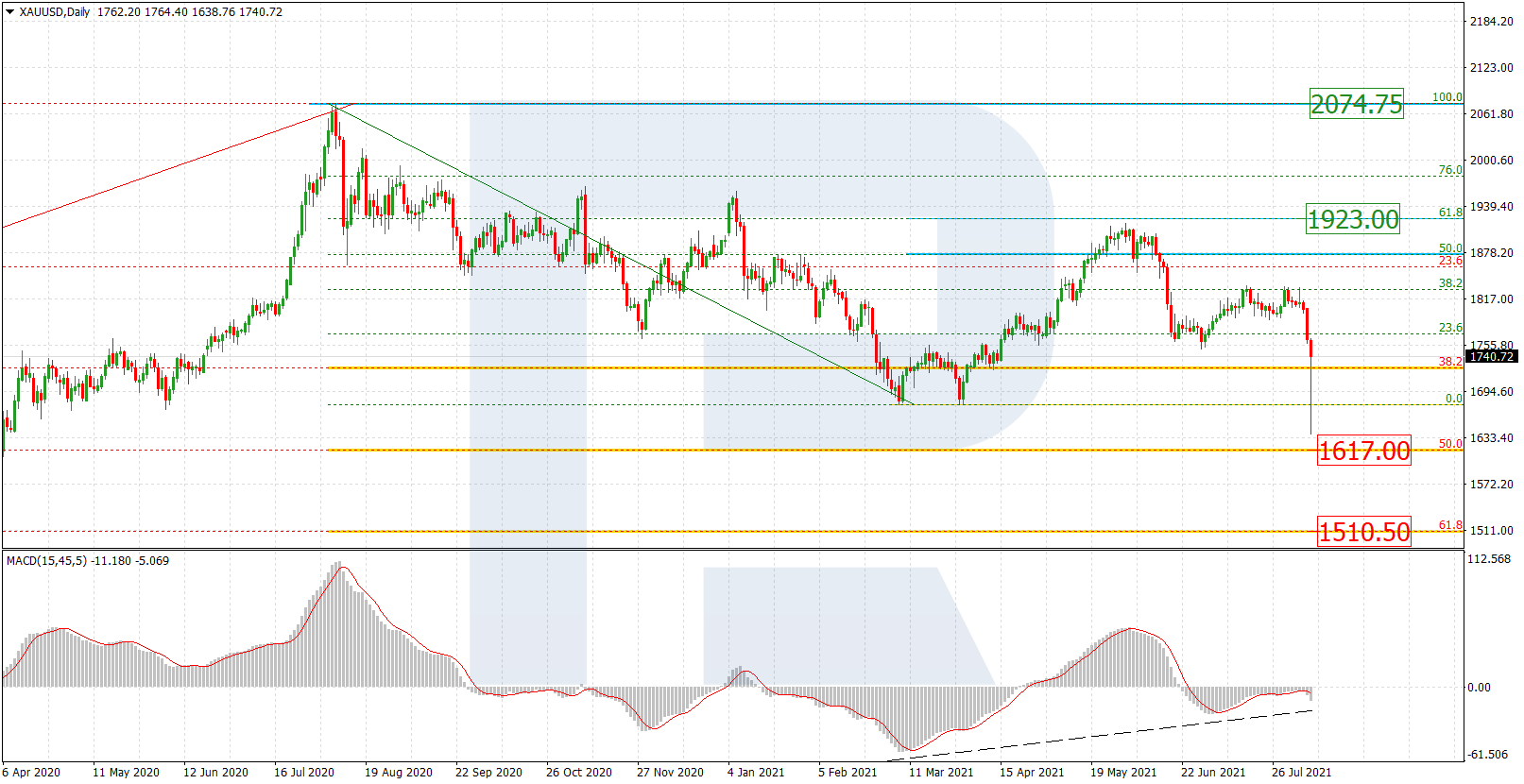
On today’s D1, one cannot skip a deep decline of the quotations. They have broken through the previous low of 1676.78 but failed to reach 50.0% (1617.00) Fibo. Today the market is pulling back. The correction might take long but the next impulse of decline will be aimed at 61.8% (1510.50). Meanwhile, there is a convergence forming on the MACD, which might mean there is the last wave of the bearish phase developing.

GOLD_D1
Risk Warning: the result of previous trading operations do not guarantee the same results in the future

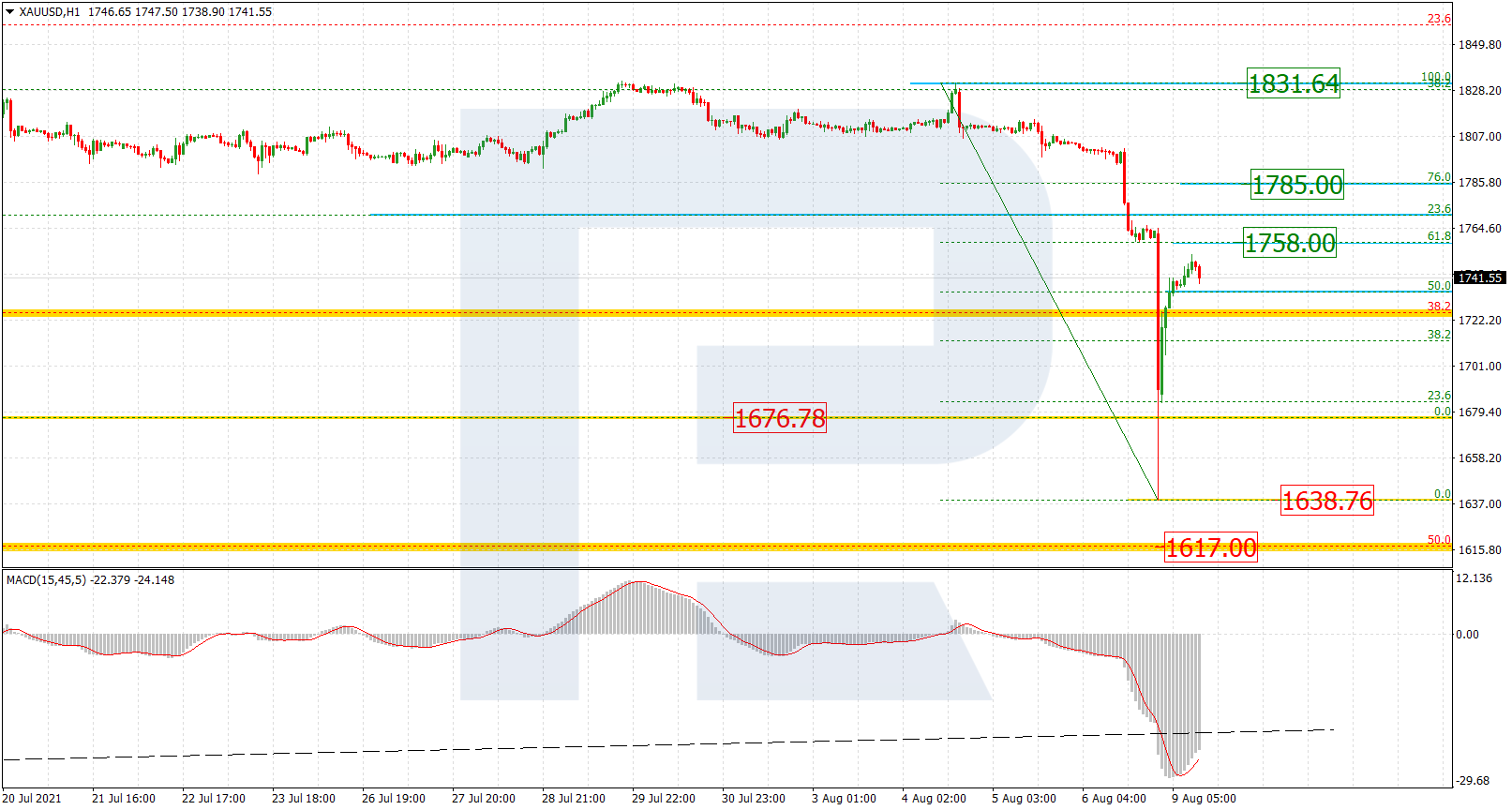
On H1, gold is growing in a correction of the descending wave. It rose over 50.0% but failed to test 61.8% (1758.00) Fibo. It can still rise to 76.0% (1785.00), but a breakaway of this level and the fractal resistance of 1831.64 will signal a reversal of the medium-tefm trend. When the correction is over, the next goal of decline will head for the local low of 1638.76.

GOLD_H1
Risk Warning: the result of previous trading operations do not guarantee the same results in the future

USDCHF, “US Dollar vs Swiss Franc”

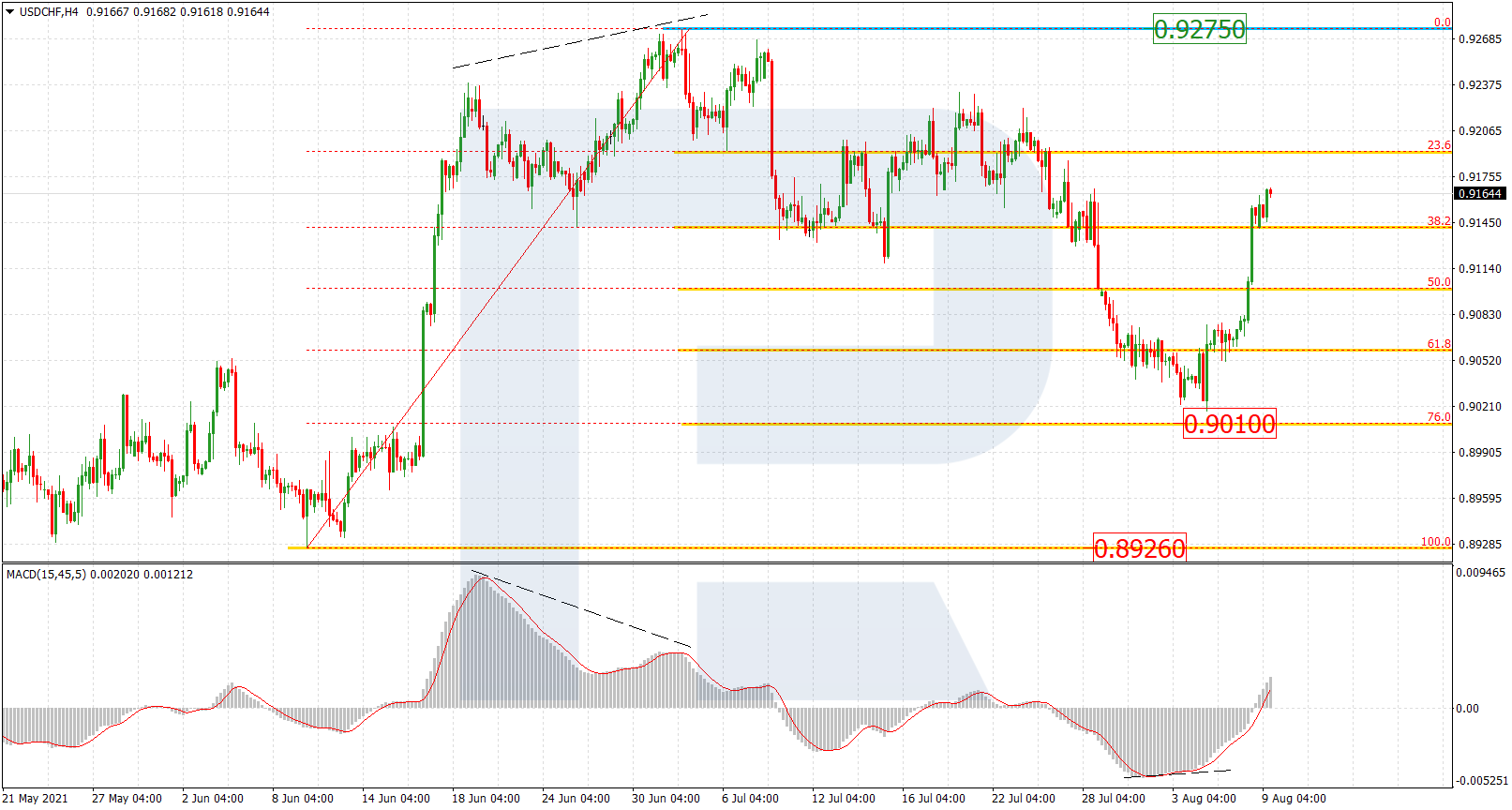
On H1, gold is growing in a correction of the descending wave. It rose over 50.0% but failed to test 61.8% (1758.00) Fibo. It can still rise to 76.0% (1785.00), but a breakaway of this level and the fractal resistance of 1831.64 will signal a reversal of the medium-tefm trend. When the correction is over, the next goal of decline will head for the local low of 1638.76.

USDCHF_H4
Risk Warning: the result of previous trading operations do not guarantee the same results in the future

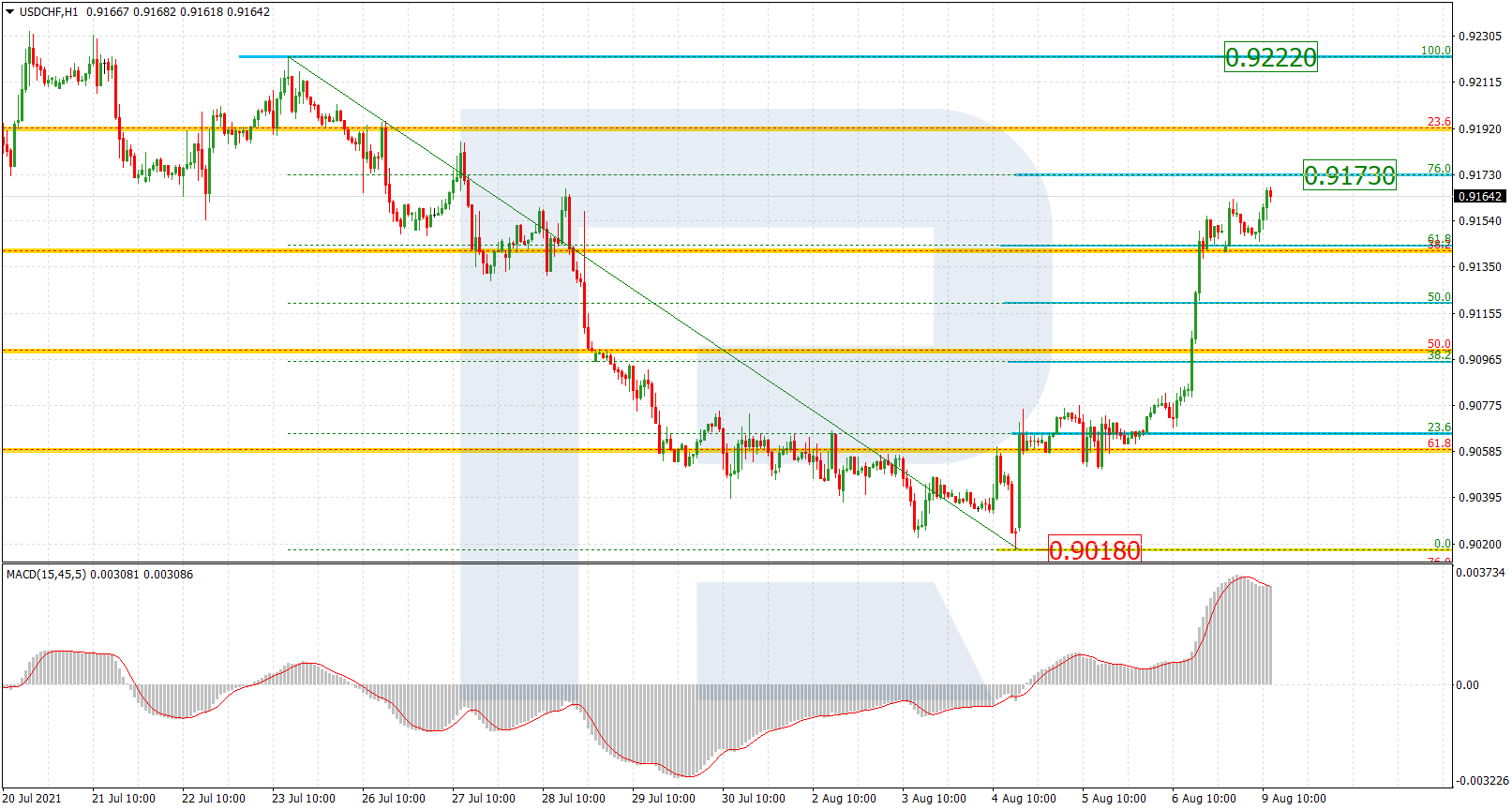
On H1, the ascending correction can be seen in detail. The growth is heading for 76.0% (0.9173) Fibo, while the resistance level is at the high of 0.9222. A breakaway of 0.9018 will signal the development of the downtrend.

USDCHF_H1

Article By RoboForex.com

Attention!
Forecasts presented in this section only reflect the author’s private opinion and should not be considered as guidance for trading. RoboForex LP bears no responsibility for trading results based on trading recommendations described in these analytical reviews.