The Analytical Overview of the Main Currency Pairs on 2021.11.03

by JustForex

The EUR/USD currency pair

Technical indicators of the currency pair:
  • Prev Open: 1.1605
  • Prev Close: 1.1578
  • % chg. over the last day: -0.23%

In addition to the Fed meeting, macroeconomic data on Europe will be released today, followed by ECB head Christine Lagarde’s speech. Any hints that ECB might start reducing its stimulus program soon might temporarily strengthen the Euro. However, it should be noted that a key indicator of long-term inflation expectations in the eurozone decreased below the 1.9% level for the first time in two weeks. Therefore taking into account the conservatism of the ECB, no hawkish statements should be expected.

Trading recommendations
  • Support levels: 1.1573, 1.1548, 1.1502, 1.1453
  • Resistance levels: 1.1618, 1.1645, 1.1667, 1.1717, 1.1772

From the technical point of view, the EUR/USD on the hour time frame is bearish. But the price managed to return above the breakdown level, which indicates a possible false break move. Under such market conditions, traders should consider sell positions from the resistance levels near the moving average. It is best to look for buy trades from the support levels of lower time frames, but only with short targets.

Alternative scenario: if the price breaks out through the 1.1667 resistance level and fixes above, the mid-term uptrend will likely resume.

EUR/USD
News feed for 2021.11.03:
  • – Eurozone Unemployment Rate (m/m) at 12:00 (GMT+2);
  • – Eurozone ECB President Lagarde Speaks at 12:15 (GMT+2);
  • – US ADP Non-Farm Employment Change (m/m) at 14:15 (GMT+2);
  • – US ISM Services PMI (m/m) at 16:00 (GMT+2);
  • – US FOMC Statement at 20:00 (GMT+2);
  • – US Fed Interest Rate Decision at 20:00 (GMT+2);
  • – US FOMC Press Conference at 20:30 (GMT+2).

The GBP/USD currency pair

Technical indicators of the currency pair:
  • Prev Open: 1.3660
  • Prev Close: 1.3613
  • % chg. over the last day: -0.34%

The Bank of England will hold its monetary policy meeting tomorrow. Representatives of the Central Bank of England have repeated many times that Britain should take a stricter policy regarding inflation suppression, up to raising the interest rate. Therefore, there is a high probability of tightening monetary policy shortly.

Trading recommendations
  • Support levels: 1.3617, 1.3532, 1.3457, 1.3360
  • Resistance levels: 1.3685, 1.3748, 1.3780, 1.3831, 1.3886

On the hourly time frame, the trend on GBP/USD has changed to bearish. The MACD indicator became negative, but there are signs of sellers’ weakness in the form of divergence. Buy trades should be considered only from the support levels of the higher time frame. It is best to look for sell deals from the resistance levels around the moving average.

Alternative scenario: if the price breaks out through the 1.3780 resistance level and consolidates above, the bullish scenario will likely resume.

GBP/USD
News feed for 2021.11.03:
  • – UK Services PMI (m/m) at 11:30 (GMT+2).

The USD/JPY currency pair

Technical indicators of the currency pair:
  • Prev Open: 113.97
  • Prev Close: 113.94
  • % chg. over the last day: -0.03%

Today, it’s a bank holiday in Japan, so the Japanese Yen will depend fully on the USD Index dynamics. If the head of Fed Jerome Powell officially confirms the beginning of “tapering,” the dollar index may sharply increase and lead to the growth of USD/JPY quotes.

Trading recommendations
  • Support levels: 113.42, 112.30, 111.53, 110.99, 110.65
  • Resistance levels: 114.48, 115.15

The main trend of the USD/JPY currency pair is bullish. The price is trading in a wide price corridor. The MACD indicator has become inactive. Under such market conditions, it’s better to look for buy positions from the buyers’ initiative zones on the lower time frames. Sell positions should be considered from the resistance levels of a higher time frame, given there is sellers’ initiative.

Alternative scenario: if the price falls below 112.30, the uptrend is likely to be broken.

USD/JPY
There is no news feed for today.

The USD/CAD currency pair

Technical indicators of the currency pair:
  • Prev Open: 1.2371
  • Prev Close: 1.2400
  • % chg. over the last day: +0.23%

The Canadian dollar is a commodity currency, so the USD/CAD currency pair is highly dependent on the dynamics of the dollar index and oil prices. The dollar index slightly increased yesterday, while oil prices decreased ahead of the OPEC+ meeting. As a result, the USD/CAD quotes increased due to the strengthening of the US currency.

Trading recommendations
  • Support levels: 1.2352, 1.2306, 1.2260
  • Resistance levels: 1.2428, 1.2518, 1.2565, 1.2628, 1.2729, 1.2774

From the technical point of view, the trend of the USD/CAD currency pair is bearish. But the pressure of buyers is increasing, and the price is approaching the priority change level. Under such market conditions, it is better to look for sell deals from the resistance levels of the higher time frame. Buy trades should be considered from the support levels, given there is the buyers’ initiative.

Alternative scenario: if the price breaks out through the 1.2428 resistance level and fixes above, the uptrend will likely resume.

USD/CAD
News feed for 2021.11.03:
  • – US Crude Oil Reserves (w/w) at 16:30 (GMT+2).

by JustForex


This article reflects a personal opinion and should not be interpreted as an investment advice, and/or offer, and/or a persistent request for carrying out financial transactions, and/or a guarantee, and/or a forecast of future events.

At today’s meeting, the FOMC will likely officially announce the reduction of the QE program

by JustForex

The main US indices closed in the green zone yesterday. By the end of the trading day Dow Jones index increased by 0.39%, S&P 500 gained 0.37%, NASDAQ added 0.34%. Dow Jones and S&P 500 indices renewed their highs. Tesla shares fell by 3% as the company recalled about 11.7 thousand Model S, Model 3, and Model X electric cars produced in 2017-2021 and Model Y (2020-2021) due to a software error. Pfizer’s stock price increased by 4.2%. The company increased net income 5.5 times in Q3 2021, revenue 8.5 times, and improved its full-year outlook.

Today, traders’ attention is focused on the Fed meeting. It is expected that the Federal Reserve will announce the cutting of its monthly bond purchase program. However, even if it happens, traders should not expect any significant shocks on the market because, firstly, it has been already priced in. Secondly, the “cut” will be gradual, most likely 10 billion a month. In other words, they will complete the tapering program and rest the interest rate by the summer fall next year. Also, a lot will depend on the dynamics of inflation. As many analysts expect, if inflation continues to rise rapidly, the Fed could raise interest rates sooner. If the central bank talks about a faster reduction (some Fed members favor a quicker cut), it could have a big impact on the market.

The head of the World Medical Association, Frank Ulrich Montgomery, wants to revaccinate the population every six months.

The US has approved the use of the Pfizer vaccine for children 5 to 11 years old. In New York, about 9,000 unvaccinated officials were placed on unpaid vacation. Canada suspended 3,300 unvaccinated doctors without pay. Air Canada suspended more than 800 employees due to refusing to vaccinate.

Last days Biden held a meeting with G-20 leaders that focused on supply chain issues. According to a White House report on the summit, the United States, the European Union, and 14 other countries agreed to promote the expansion of international cooperation in connection with short-term difficulties in the supply chain.

Another important international event attracting the attention of global markets is the climate summit in Glasgow, Scotland. The meeting is held under the auspices of the United Nations and is perceived as a crucial step for world leaders in taking action to reduce CO2 emissions. However, analysts do not expect countries to adopt highly ambitious targets at the end of the summit.

European stock indexes were trading yesterday without a single trend. The British FTSE 100 decreased by 0.19%, the German DAX gained 0.94%, and the French CAC 40 added 0.49%. Italy’s FTSE MIB and Spain’s IBEX 35 decreased by 0.06% and 0.84%, respectively. The Prime Minister of the Netherlands announced that the country is imposing new restrictions because of Covid-19. The government is asking people to work from home half the time.

Several oil traders said that the $100 oil price is fast approaching reality as the demand exceeds the proposal. Climate change has caused a slowdown in investment in new sources, which threatens the depletion of reserves. Futures quotes for oil rose sharply due to the worldwide spike in gas and coal prices caused by the global energy crisis. Iran plans to resume exporting oil products within two weeks.

Gas prices in Europe jumped over 2% on news of Gazprom’s refusal to book additional gas transit capacity via Ukraine and Poland.

The main Asian indices are trading in the red zone today. The only exception is the Australian index. Investors are cautious ahead of the Fed meeting today, and the main issue is not the reduction of the QE program but to make it clear when the Fed will start to raise interest rates.

China has unexpectedly increased its injection of short-term cash into the banking system fivefold because banks also need to postpone cash to buy bonds so that creditors can pay off the record 1 trillion yuan in medium-term loans.

Main market quotes:

S&P 500 (F) 4,630.65 +16.98 (+0.37%)

Dow Jones 36,052.63 +138.79 (+0.39%)

DAX 15,954.45 +148.16 (+0.94%)

FTSE 100 7,274.81 −13.81 (−0.19%)

USD Index 94.11 +0.23 (+0.25%)

Important events for today:
  • – UK Services PMI (m/m) at 11:30 (GMT+2);
  • – Eurozone Unemployment Rate (m/m) at 12:00 (GMT+2);
  • – Eurozone ECB President Lagarde Speaks at 12:15 (GMT+2);
  • – US ADP Non-Farm Employment Change (m/m) at 14:15 (GMT+2);
  • – US ISM Services PMI (m/m) at 16:00 (GMT+2);
  • – US Crude Oil Reserves (w/w) at 16:30 (GMT+2);
  • – US FOMC Statement at 20:00 (GMT+2);
  • – US Fed Interest Rate Decision at 20:00 (GMT+2);
  • – US FOMC Press Conference at 20:30 (GMT+2).

by JustForex


This article reflects a personal opinion and should not be interpreted as an investment advice, and/or offer, and/or a persistent request for carrying out financial transactions, and/or a guarantee, and/or a forecast of future events.

Australia holds rate but drops bond yield target

By CentralBankNews.info

Australia’s central bank left its key interest rate unchanged but dropped its policy of targeting the yield on a benchmark government bond and pulled forward the likely time for a rate hike to 2023 due to what it said was “the improvement in the economy and the earlier-than-expected progress towards the inflation target.”
The Reserve Bank of Australia (RBA) kept its cash target of 0.10 percent, unchanged since November 2020 when it was lowered for the third time last year during the first wave of the COVID-19 pandemic.
     And while RBA will no longer target a 0.10 percent yield on the benchmark April 2024 Australian government bond, it confirmed it will continue to buy government bonds at a rate of $4 billion a week until at least mid-February 2022.
     “The Australian economy is now growing again, after the recovery from the pandemic was interrupted by the Delta outbreak,” RBA Governor Philip  Lowe said, adding the economy is expected to record a solid gain in the fourth quarter after contracting in the third quarter.
     By the middle of next year, the RBA expects economic output to return to its pre-Delta path.
     But RBA also reiterated its guidance that will not raise the cash rate until inflation is sustainably within its target range of 2 to 3 percent.
     “The board is prepared to be patient,” Lowe said, seeking to dampen speculation in financial markets that RBA will soon follow the lead of 34 central banks in other countries that have raised rates this year in reaction to the recent rise in inflation.
      RBA expects underlying inflation to be no higher than 2.5 percent by the end of 2023, with wages growing 3 percent the same year. Previously it did not expect these conditions to be met before 2024.
      Lowe stressed the bank’s board would look through spikes in inflation and only expects inflation to reach the target once the labour market is tight enough to generate wage growth that is “materially higher than it is currently.”
      “While on the issue of timing, the latest data and forecasts do not arrange an increase in the cash rate in 2022,” Lowe said.
     Lowe said Australia is in a different situation than many other countries, with the labour force participation not falling and nor are supply disruptions showing up in consumer prices.
Although inflation has risen, the core or underlying rate, remains low and wages are only expected to pick up gradually as the labour market tightens.
      Australia’s headline inflation rate eased to 3.0 percent in the third quarter from 3.8 percent while core inflation rose to 2.1 percent from 1.6 percent.
      The rise in core inflation illustrates the general rise in global inflation and triggered expectations in financial markets that RBA would start to tighten its policy. The yield on the April 2024 government bond last week surged to 0.8 percent, significantly over RBA’s target of 0.1 percent.
      In addition to the three rate cuts last year, RBA also began targeting the yield on benchmark government bonds to anchor short-term interest rates and reinforce its guidance that its cash rate was unlikely to be raised until the bond matured.
     “Today, more than a year and a half on, the balance of probabilities is a little different,” Lowe said, adding he wants to make clear that dropping the yield target doesn’t mean the cash rate will be raised before 2024.
     Lowe said the yield target had been effective in supporting the economic recovery but its effectiveness as a monetary policy tool has declined as expectations about future interest rates shift due to the pace of the economic recovery and progress in reaching RBA’s goals.
     “There is genuine uncertainty as to the timing of future adjustments in the cash rate,” Lowe said, adding it is entirely possible it will remain at the current level until 2024.
     “But it is also possible that an earlier move will be appropriate,” Lowe said, adding: “But it is now also plausible that a lift in the cash rate could be appropriate in 2023.”
     RBA forecasts Australia’s economy will grow 3 percent this year, 5.5 percent in 2022 and 2.5 percent in 2023.
      Underlying inflation is seen around 2.25 percent this year and 2022, and 2.5 percent in 2023, while wages should grow 2.5 percent in 2022 and 3 percent in 2023.

–    The Reserve Bank of Australia issued the following two statements: A statement by its governor, Philip Lowe, regarding the board’s policy decision and a speech at a webinar:

“At its meeting today, the Board decided to:

  • maintain the cash rate target at 10 basis points and the interest rate on Exchange Settlement balances at zero per cent
  • continue to purchase government securities at the rate of $4 billion a week until at least mid February 2022
  • discontinue the target of 10 basis points for the April 2024 Australian Government bond.

The Australian economy is recovering after the interruption caused by the Delta outbreak. As vaccination rates increase even further and restrictions are eased, the economy is expected to bounce back relatively quickly. The central forecast is for GDP growth of 3 per cent over 2021 and 5½ per cent and 2½ per cent over the following two years. One important source of uncertainty continues to be the possibility of a further setback on the health front.

The Delta outbreak caused hours worked in Australia to fall sharply, but a bounce-back is now underway. The Bank’s business liaison and the data on job ads suggest that many firms are now hiring, which will boost employment over coming months. The central forecast is for the unemployment rate to trend lower over the next couple of years, reaching 4¼ per cent at the end of 2022 and 4 per cent at the end of 2023.

Inflation has picked up, but in underlying terms is still low, at 2.1 per cent. The headline CPI inflation rate is 3 per cent and is being affected by higher petrol prices, higher prices for newly constructed homes and the disruptions in global supply chains. A further, but only gradual, pick-up in underlying inflation is expected. The central forecast is for underlying inflation of around 2¼ per cent over 2021 and 2022 and 2½ per cent over 2023. Wages growth is expected to pick up gradually as the labour market tightens, with the Wage Price Index forecast to increase by 2½ per cent over 2022 and 3 per cent over 2023. The main uncertainties relate to the persistence of the current disruptions to global supply chains and the behaviour of wages at the lowest unemployment rate in decades.

Housing prices are continuing to rise in most markets and housing credit growth has picked up due to stronger demand for credit by both owner-occupiers and investors. The Bank welcomes APRA’s recent decision to increase the interest rate serviceability buffer on home loans. It is important that lending standards are maintained at a time of historically low interest rates.

Financial conditions in Australia remain highly accommodative, with most lending rates at record lows. Bond yields have increased recently and bond market volatility has also risen significantly. The exchange rate has appreciated a little, but remains within the range of the past year.

The decision to discontinue the yield target reflects the improvement in the economy and the earlier-than-expected progress towards the inflation target. Given that other market interest rates have moved in response to the increased likelihood of higher inflation and lower unemployment, the effectiveness of the yield target in holding down the general structure of interest rates in Australia has diminished.

The Board is committed to maintaining highly supportive monetary conditions to achieve a return to full employment in Australia and inflation consistent with the target. While inflation has picked up, it remains low in underlying terms. Inflation pressures are also less than they are in many other countries, not least because of the only modest wages growth in Australia.

The Board will not increase the cash rate until actual inflation is sustainably within the 2 to 3 per cent target range. This will require the labour market to be tight enough to generate wages growth that is materially higher than it is currently. This is likely to take some time. The Board is prepared to be patient, with the central forecast being for underlying inflation to be no higher than 2½ per cent at the end of 2023 and for only a gradual increase in wages growth.”

–    Speech by RBA Governor Philip Lowe:

“Good afternoon and thank you for joining this webinar.
The Reserve Bank Board met this morning. At our meeting we agreed to:

1. maintain the target for the cash rate at 10 basis points

2. continue to purchase government bonds at the rate of $4 billion per week until mid February 2022, with a further review to be undertaken then

3. discontinue the target for the yield on the April 2024 bond.

I would like to take this opportunity to explain these decisions – particularly the decision to discontinue the yield target – and to answer your questions.

I would like to start with some background and our updated forecasts.

The Australian economy is now growing again, after the recovery from the pandemic was interrupted by the Delta outbreak. GDP is expected to record a solid gain in the December quarter, following the sharp contraction in the September quarter. And by the middle of next year, GDP is expected to be back on its pre-Delta path. Our central scenario is for the economy to grow by around 51⁄2 per cent over 2022 and by around 21⁄2 per cent over 2023.

At the outset of the pandemic, economic policy, including monetary policy, set out to build a bridge to the other side. That other side is now clearly in sight. As restrictions are eased, spending is expected to pick up relatively quickly as people seek a return to a more normal way of life. The rapid increase in vaccination rates has been critical in getting us to this point. More broadly, the support provided by both monetary and fiscal policy means that the Australian economy is well placed to resume its expansion.

The resilience of the economy continues to be evident in the labour market. A strong bounce-back in hours worked is now under way, after a sharp fall during the lockdowns. The unemployment rate is expected to trend lower over the next couple of years. Our central scenario is for the unemployment rate to reach 41⁄4 per cent by the end of next year, and 4 per cent by the end of 2023. This would be a welcome development. Australia has not experienced a sustained period of unemployment at levels this low since the early 1970s.

Inflation, in underlying terms, remains low in Australia, at 2.1 per cent. Inflation is, however, a little higher than it has been over recent years. This increase largely reflects higher oil prices in global markets, higher prices for residential construction and strained global supply chains. Looking forward, we are expecting a further, but gradual, increase in underlying inflation. Our central forecast is for underlying inflation of 21⁄4 per cent in 2022 and 21⁄2 per cent in 2023.

While these forecasts for inflation are higher than our previous forecasts, we are not expecting the surge in inflation that has been experienced in some other countries. The situation in Australia is different. We have not seen the same fall in labour force participation as experienced elsewhere, and the impact of other supply disruptions, including in energy markets, is less evident in our CPI.

It is also relevant that the starting points for inflation and wages growth are lower in Australia than in many other countries. In addition, our business liaison suggests that wage growth remains modest, although there are some hotspots. Wages growth is expected to pick up as the labour market tightens, but this pick-up is expected to be gradual.

So that is the economic backdrop against which today’s decision was made. I will now turn to the yield target.

The yield target was introduced in the exceptional days of March 2020. It was part of a package of monetary policy measures designed to help build that bridge that I spoke about before. That package has been effective and it is one of the reasons that the Australian economy is now well placed to recover from the pandemic.

The yield target had two motivations.

The first was to directly anchor the short end of the yield curve so that funding costs were low across the economy. In the exceptional circumstances of the time, we judged that the most efficient way of anchoring the curve was to target a risk-free yield further out along the curve than the cash rate.

The second motivation was to reinforce the Board’s forward guidance that the cash rate was very unlikely to be increased for three years, which at the time ran until March 2023.

On both counts, the yield target has been effective and has supported the recovery of the Australian economy. But its effectiveness as a monetary policy tool declined as expectations about future interest rates shifted due to the run of data and the forecast progress towards our goals.

At the time the yield target was introduced, the Board assigned a very low probability to an increase in the cash rate over the three-year horizon of the target – which at the time aligned with the maturity date of the April 2023 bond. Indeed, the central scenario was that the cash rate would need to be held steady beyond that date and the likelihood of an earlier increase in the cash rate was considered to be very low.

Today, more than a year and a half on, the balance of probabilities is a little different. Given our forecasts, it is still entirely plausible that the first increase in the cash rate will not be before the maturity of the current target bond – that is, the bond with a maturity date of April 2024. But it is now also plausible that a lift in the cash rate could be appropriate in 2023.

In our central scenario, underlying inflation reaches the midpoint of the 2 to 3 per cent range only in late 2023. Having underlying inflation reach the midpoint of the target range for the first time in seven years does not, by itself, warrant an increase in the cash rate. It is also relevant that wages growth at the end of 2023 is expected to be running at 3 per cent. While this is higher than it is now, it is still below the average over the two decades to 2015. This expected configuration of inflation and wages growth allows the Board to be patient in considering a lift in interest rates.

It is also possible that the global inflation shock is more persistent than currently expected and that this is transmitted to Australia. There is also uncertainty as to how wages growth responds to the unemployment rate being near 4 per cent for an extended period. We have little historical experience to guide us and there is also the question of the impact on labour supply of the opening of the international border. Given this, it is possible that faster-than-expected progress continues to be made towards achieving the inflation target. The recovery of the economy and the recent inflation data have increased the probability of this. If this faster progress were to be sustained, there would be a case to lift the cash rate before 2024.

It is, of course, also possible that we experience yet another setback that throws the economy off course and delays progress towards our goals. One source of such a shock would be a new strain of the virus or a decline in vaccine effectiveness. In this case, the cash rate would need to remain at its current level for longer than otherwise.

At its meeting this morning, the Board considered these various possibilities and their implications for the yield target.

One option discussed was to continue with the target on the basis that it remained consistent with our central forecasts for the economy.

A second option considered was to lift the target yield or change the maturity of the target bond. However, this would not have been consistent with the Board’s view that the yield target was an appropriate tool during an exceptional period, but not one to be used on an ongoing basis.

The third option considered was to discontinue the target on the basis of the shift in the distribution of possible outcomes for the cash rate that I just spoke about.

The Board decided on this third option.

I want to make it clear that this decision does not reflect a view that the cash rate will be increased before 2024. As I have discussed, there is genuine uncertainty as to the timing of future adjustments in the cash rate. Given the information we currently have to hand, it is still entirely possible that the cash rate will remain at its current level until 2024. But it is also possible that an earlier move will be appropriate. Given this, the Board judged that there were more costs than benefits in seeking to anchor the yield on the April 2024 bond at 10 basis points.

Given the progress towards our goals and the revised outlook, the Board judged that it was no longer sustainable to maintain the target of 10 basis points. The Board took into account the fact that the shift in the distribution of possible outcomes was being reflected in other term interest rates in Australia. If we had sought to pin the yield on the April 2024 bond at 10 basis points in the face of these developments, we would have ended up holding all the freely tradable bonds in the bond line, so that trading in that bond would cease. This would have further diminished the usefulness of the target.

I recognise that the past few days have been turbulent ones in the bond market. Our decision to stand out of the market in the days between the release of the CPI and the Board meeting did result in uncertainty as to our policy and affected market pricing and liquidity. We faced a difficult choice over those days: stand out of the market until the Board had an opportunity to review the latest data and forecasts in a matter of a few days; or enter a thin market in an effort to defend a target that was losing credibility for the reasons I have spoken about. I thought the better approach was for the Board to review the situation and decide whether or not to confirm or discontinue the target.

I would now like to turn to a broader point and that is the nature of the RBA’s forward guidance. As I have stressed on previous occasions, our forward guidance is based on the state of the economy, not the calendar. Our focus has been on returning inflation sustainably to the 2 to 3 per cent range and doing what we reasonably can to reach full employment. These are our goals and it is progress on these fronts that will continue to determine decisions about the cash rate. These decisions are not driven by the calendar.

We have, though, supplemented this state-based guidance with a reference to our forecasts and the calendar. We have done this to provide the community with our expected time frame and the factors that will influence that time frame. This in no way has constituted a promise that the cash rate would remain unchanged to any particular date. Rather, at the time of each policy statement we provided our best expectation of the timing of when the cash rate might change, recognising that expected timing can change.

While on the issue of timing, the latest data and forecasts do not warrant an increase in the cash rate in 2022. I recognise that some other central banks are raising rates, but our situation is different. The Board will not increase the cash rate until inflation is sustainably in the target range. We are prepared to look through spikes in the inflation rate, as we have done with headline CPI inflation this year. For inflation to be sustainably in the target range, wages growth will have to be materially higher than it is now. This is likely to take time. The Board is prepared to be patient.

Finally, in terms of the bond purchase program, we will be including the April 2024 bond in our regular auctions from next week. We will also continue with the program at the current rate of purchases until February, when we will review it again. That review will be based on the same threeconsiderations as previous reviews: (i) the actions of other central banks; (ii) how our bond market is functioning; and (iii) most importantly, the actual and expected progress towards our goals for inflation and unemployment.

Thank you. I am here to answer your questions.”

www.CentralBankNews.info
Forex Technical Analysis & Forecast 02.11.2021

Article By RoboForex.com

EURUSD, “Euro vs US Dollar”

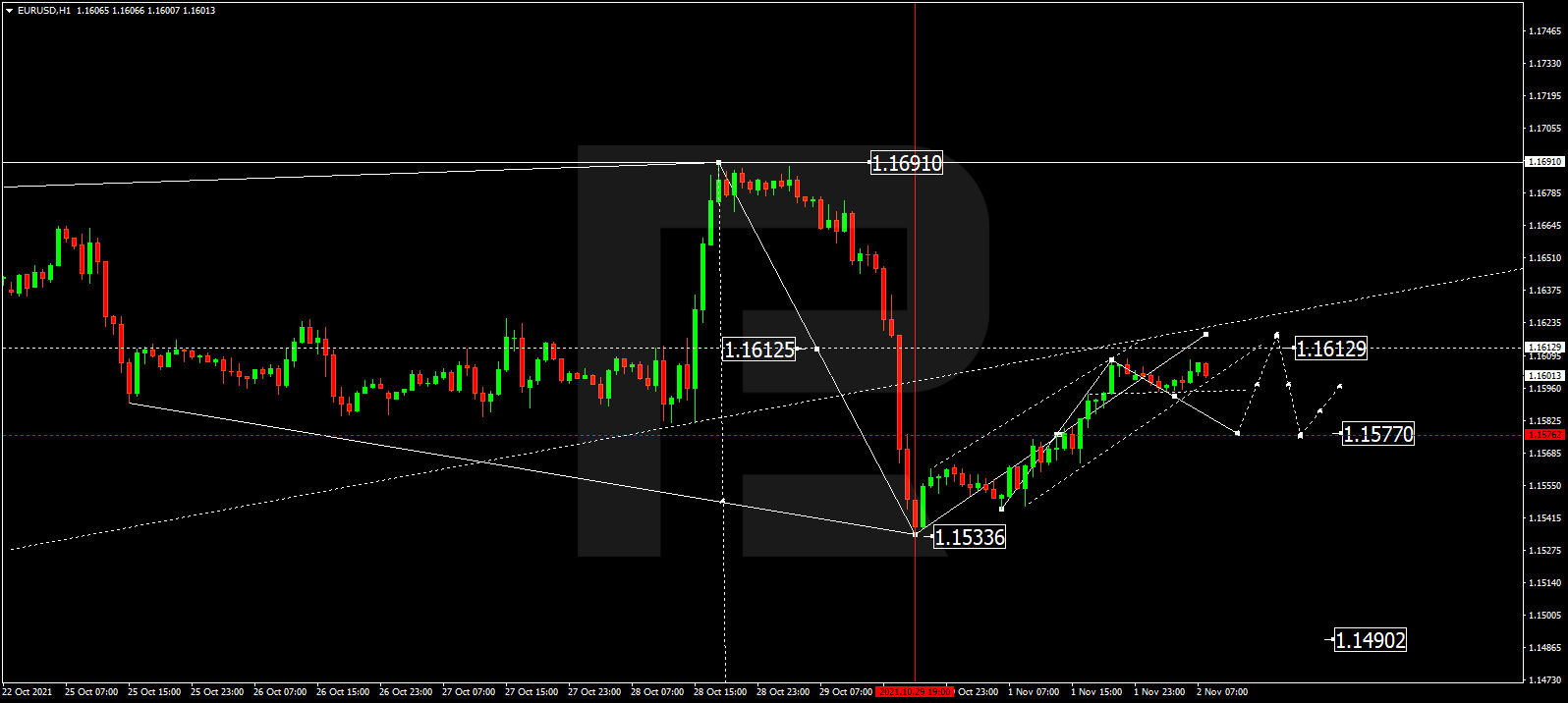
After forming a new consolidation range and breaking 1.1577 to the upside, EURUSD is still correcting towards 1.1612. Later, the market may fall to break 1.1533 and then continue trading downwards with the short-term target at 1.1490.

EURUSD
Risk Warning: the result of previous trading operations do not guarantee the same results in the future

GBPUSD, “Great Britain Pound vs US Dollar”

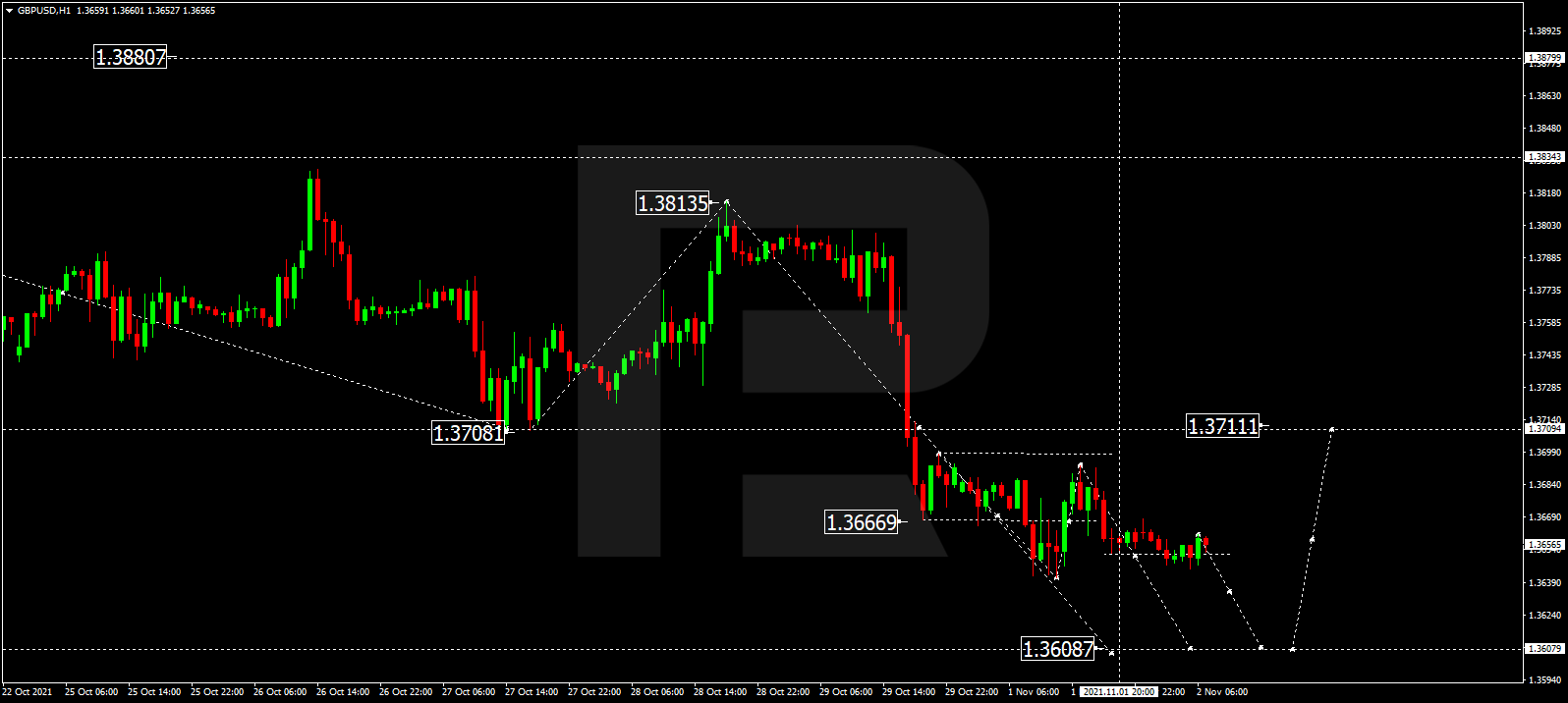
After forming a new consolidation rang around 1.3666 and breaking it to the downside, GBPUSD is expected to continue falling within the downtrend towards 1.3608. Later, the market may correct to test 1.3666 from below and then resume falling with the target at 1.3490.

GBPUSD
Risk Warning: the result of previous trading operations do not guarantee the same results in the future

USDRUB, “US Dollar vs Russian Ruble”

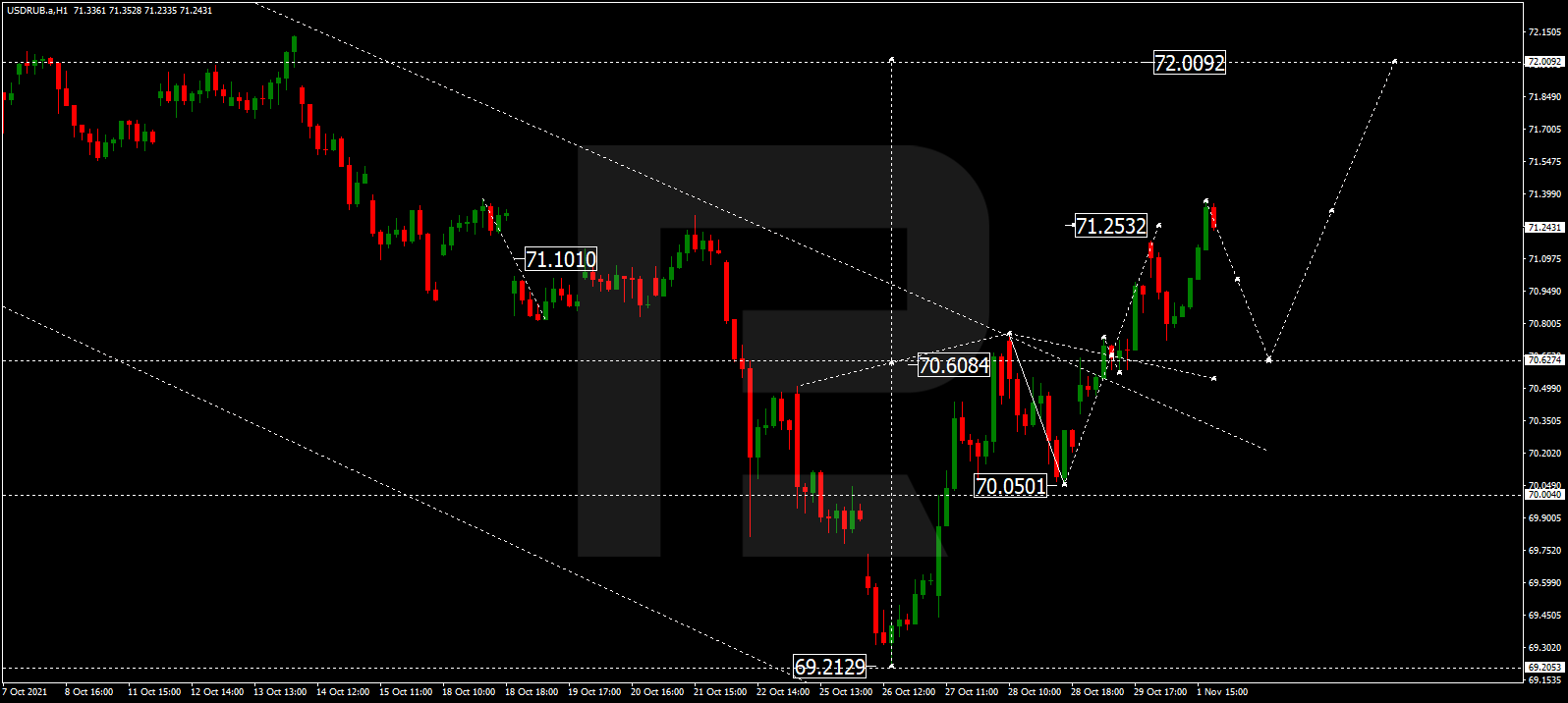
After expanding the consolidation range up to 71.25, USDRUB is expected to resume falling towards 70.60 and may later form one more ascending structure with the target at 72.00 to complete the correction. Later, the market may start another decline to reach 69.20.

USDRUB
Risk Warning: the result of previous trading operations do not guarantee the same results in the future

USDJPY, “US Dollar vs Japanese Yen”

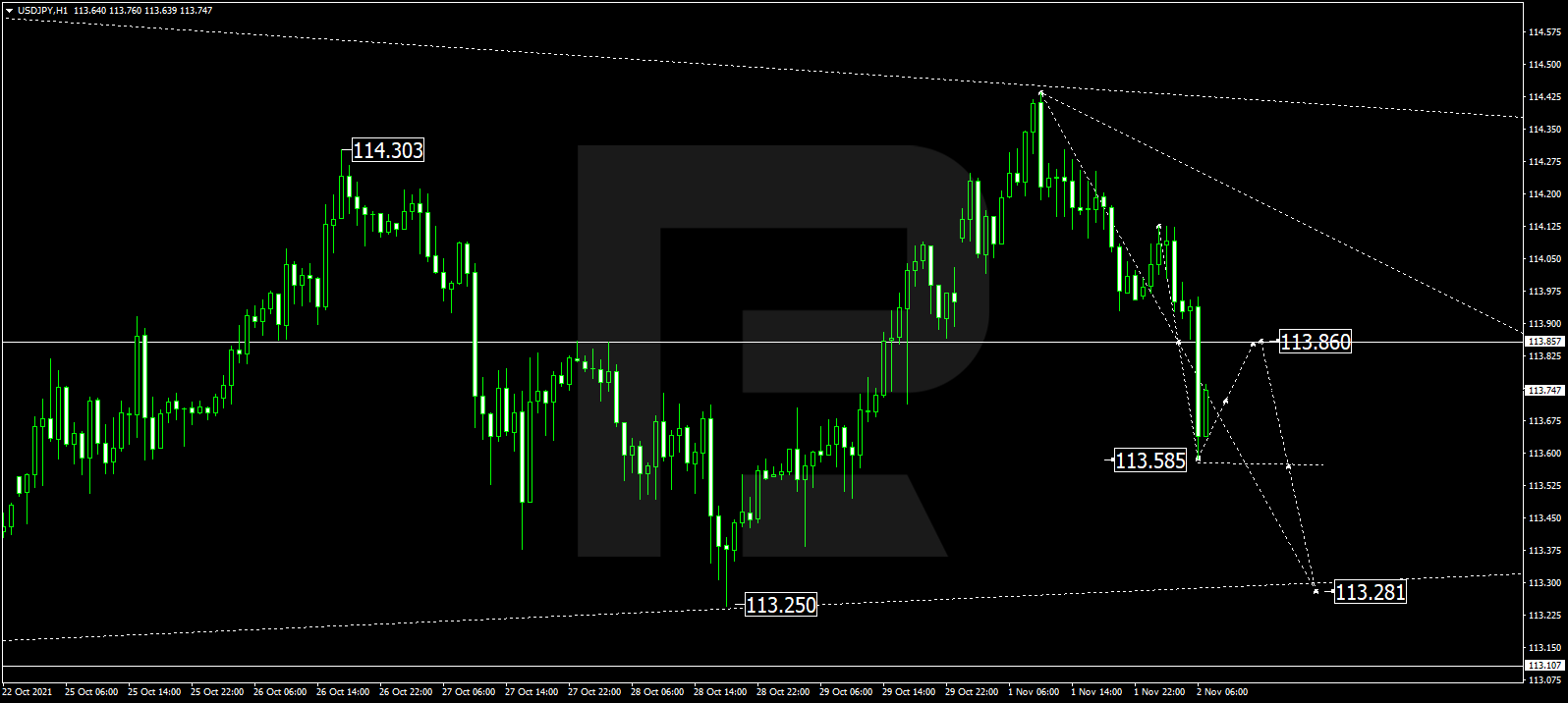
After returning to 113.86, USDJPY is expected to consolidate around this level. If later the price breaks this range to the downside, the market may resume falling towards 113.28 and then start a new growth with the target at 113.86.

USDJPY
Risk Warning: the result of previous trading operations do not guarantee the same results in the future

USDCHF, “US Dollar vs Swiss Franc”

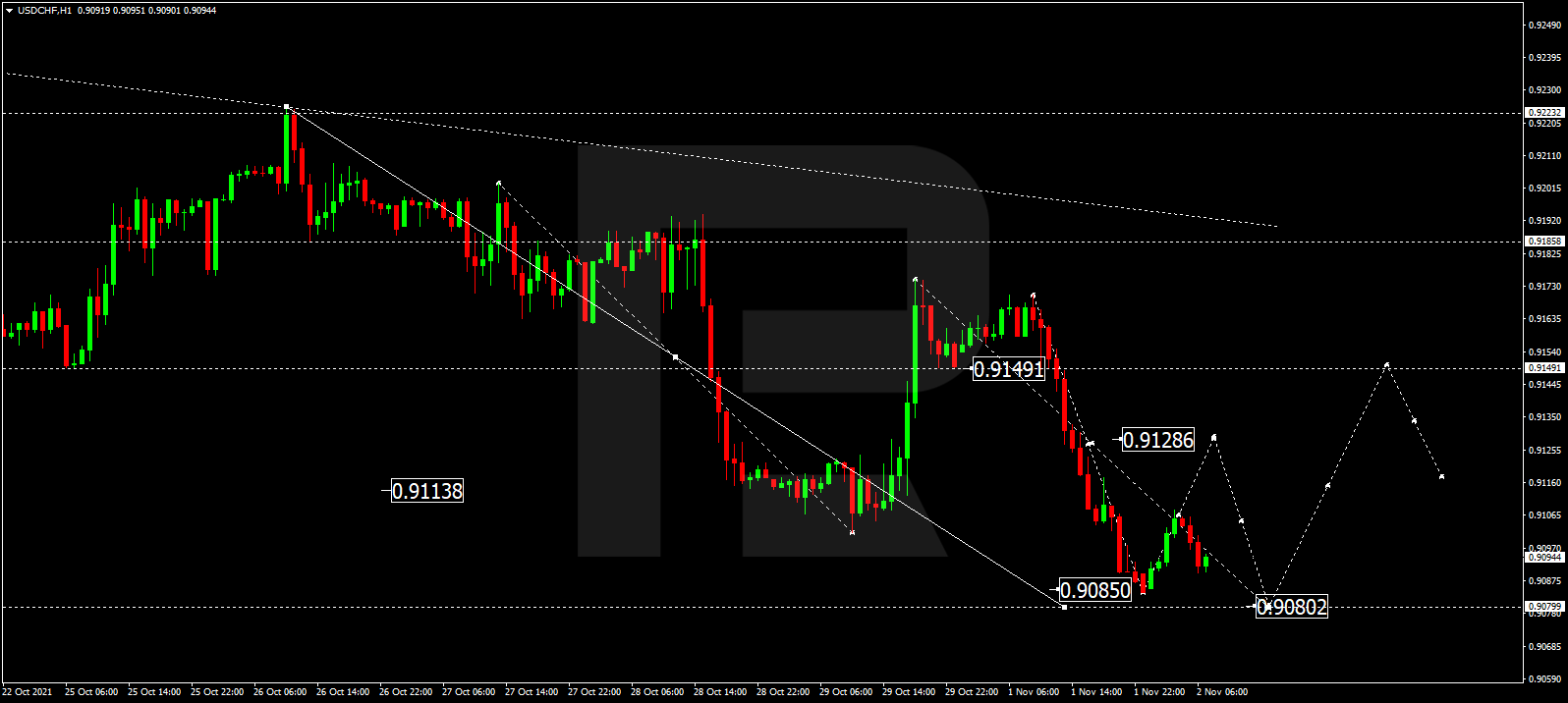
After breaking 0.9128 and then reaching the short-term downside target at 0.9090, USDCHF is forming a new consolidation range above the latter level. If later the price breaks this range to the upside, the market may grow to reach 0.9128; if to the downside – resume falling to complete the descending wave at 0.9080 and then start another growth with the target at 0.9150.

USDCHF
Risk Warning: the result of previous trading operations do not guarantee the same results in the future

AUDUSD, “Australian Dollar vs US Dollar”

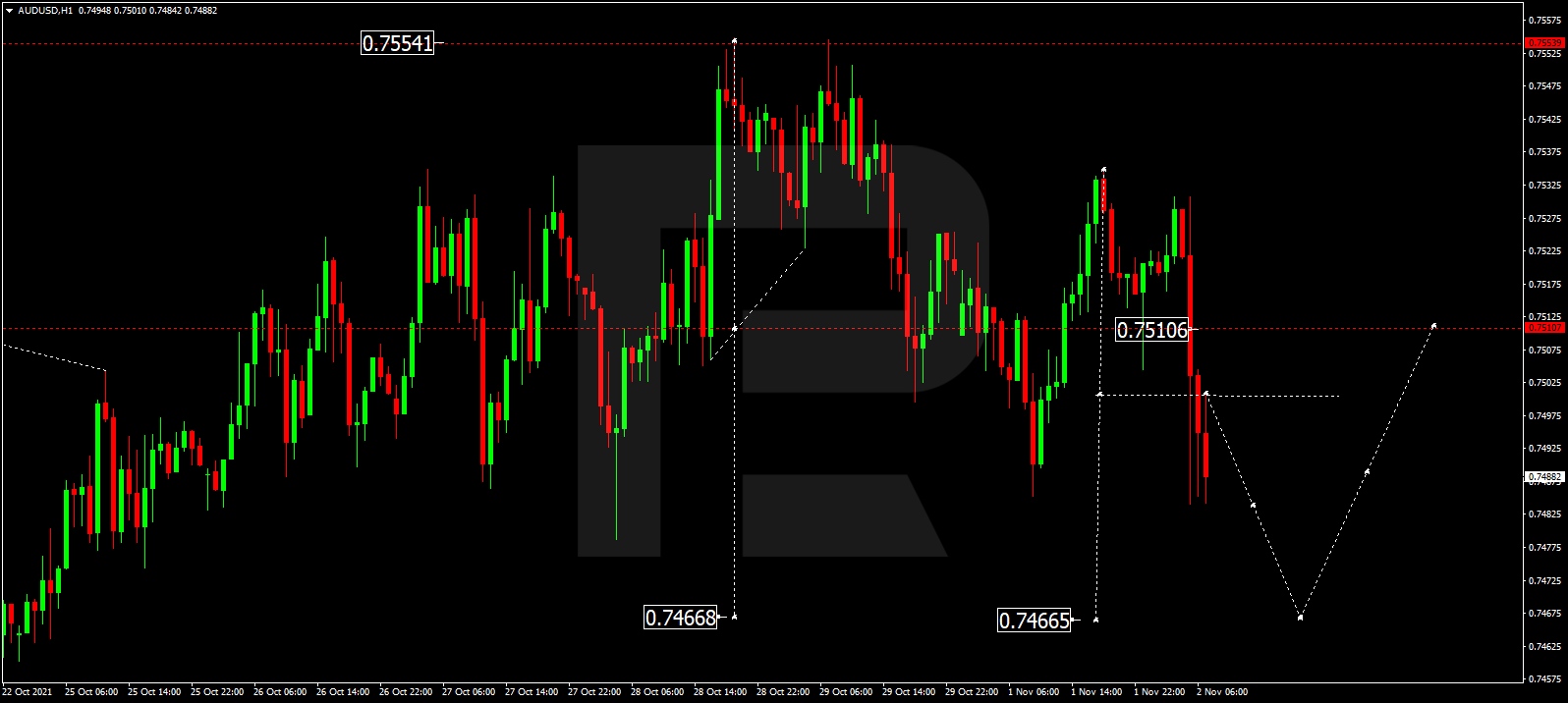
AUDUSD continues forming the descending wave towards 0.7466. After that, the instrument may correct to reach 0.7511 and resume trading downwards with the target at 0.7400.

AUDUSD
Risk Warning: the result of previous trading operations do not guarantee the same results in the future

BRENT

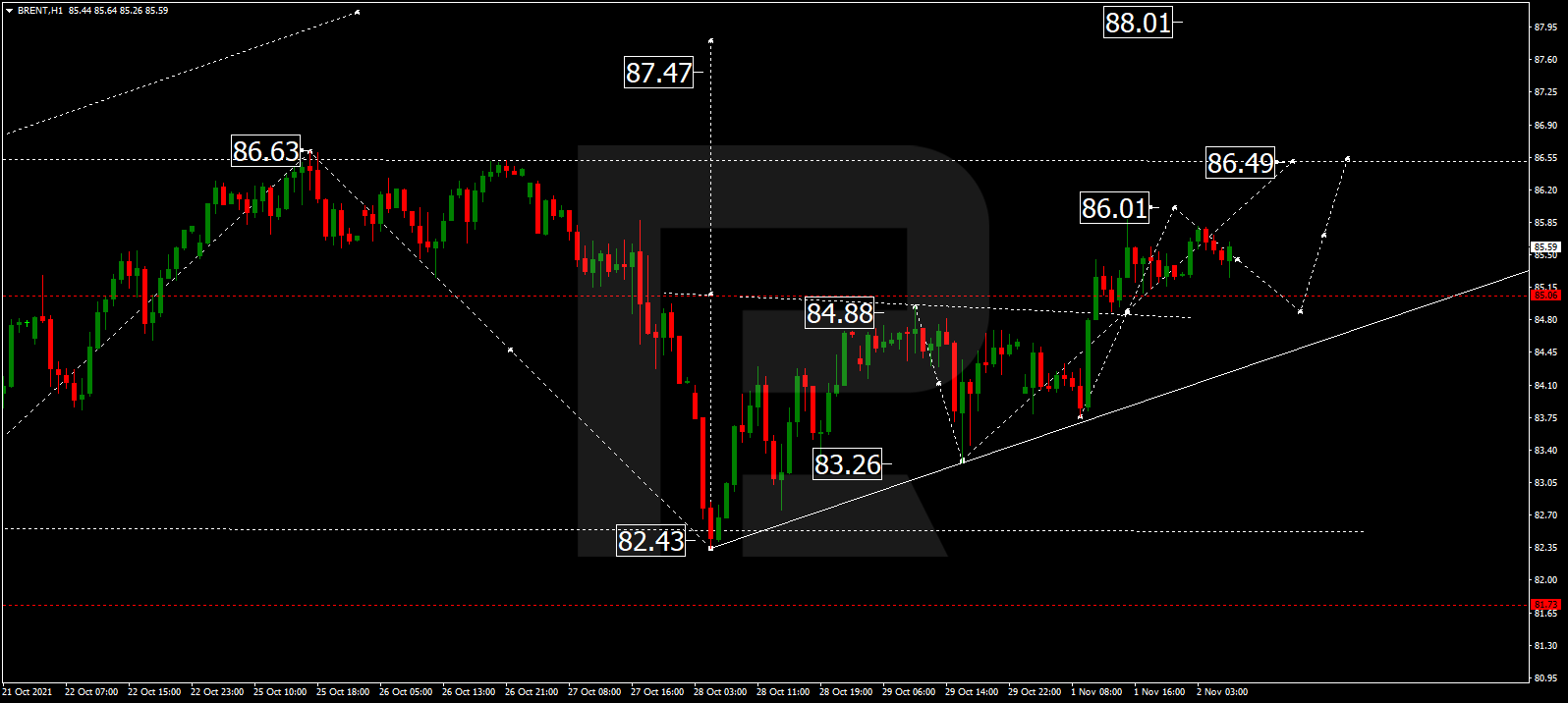
After breaking 85.05 to the upside, Brent is expected to continue growing and reach 86.50. After that, the instrument may correct to return to 85.05 and then resume trading upwards with the target at 88.00.

BRENT
Risk Warning: the result of previous trading operations do not guarantee the same results in the future

XAUUSD, “Gold vs US Dollar”

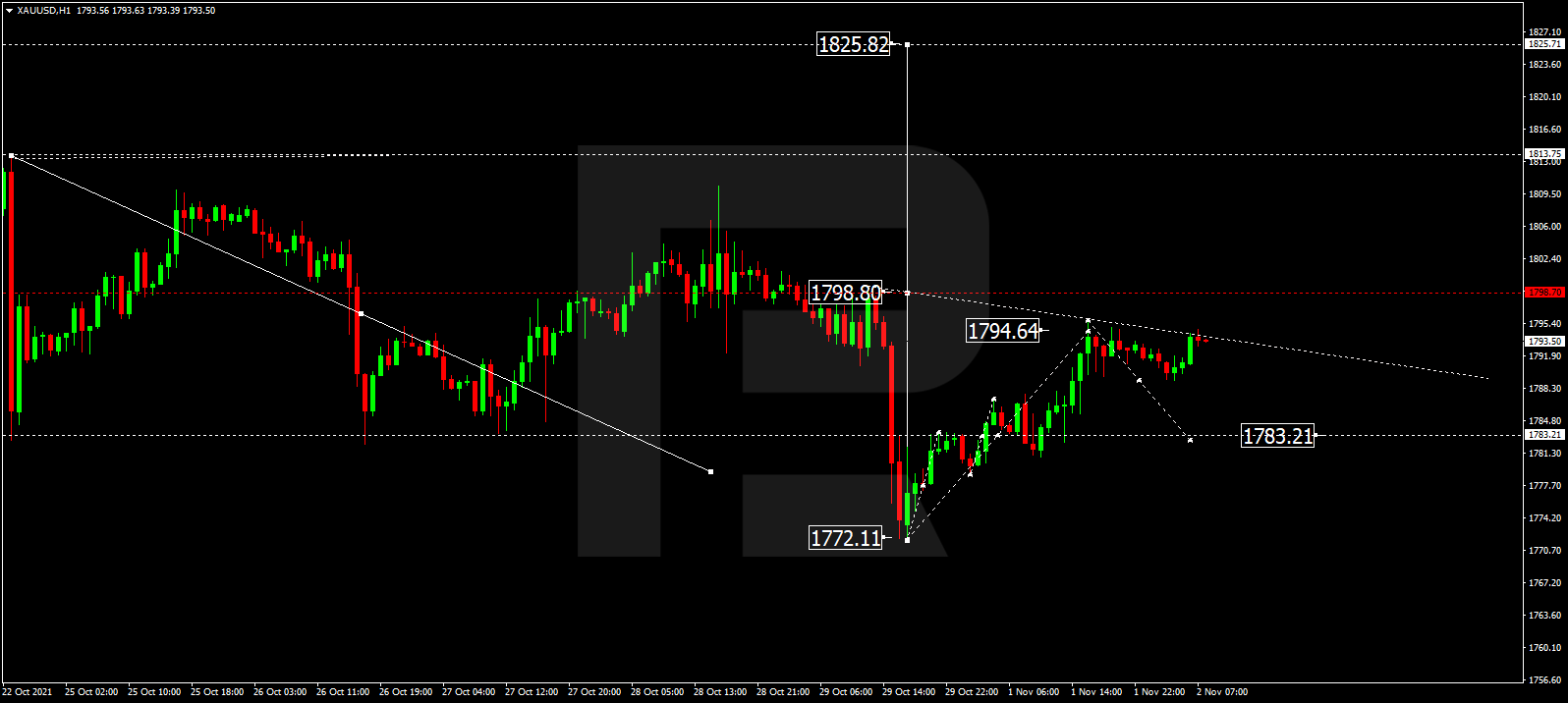
Gold has broken 1784.60; right now, it is still growing towards 1798.00. After that, the instrument may correct to return to 1785.00 and then resume trading upwards with the target at 1825.80.

GOLD
Risk Warning: the result of previous trading operations do not guarantee the same results in the future

S&P 500

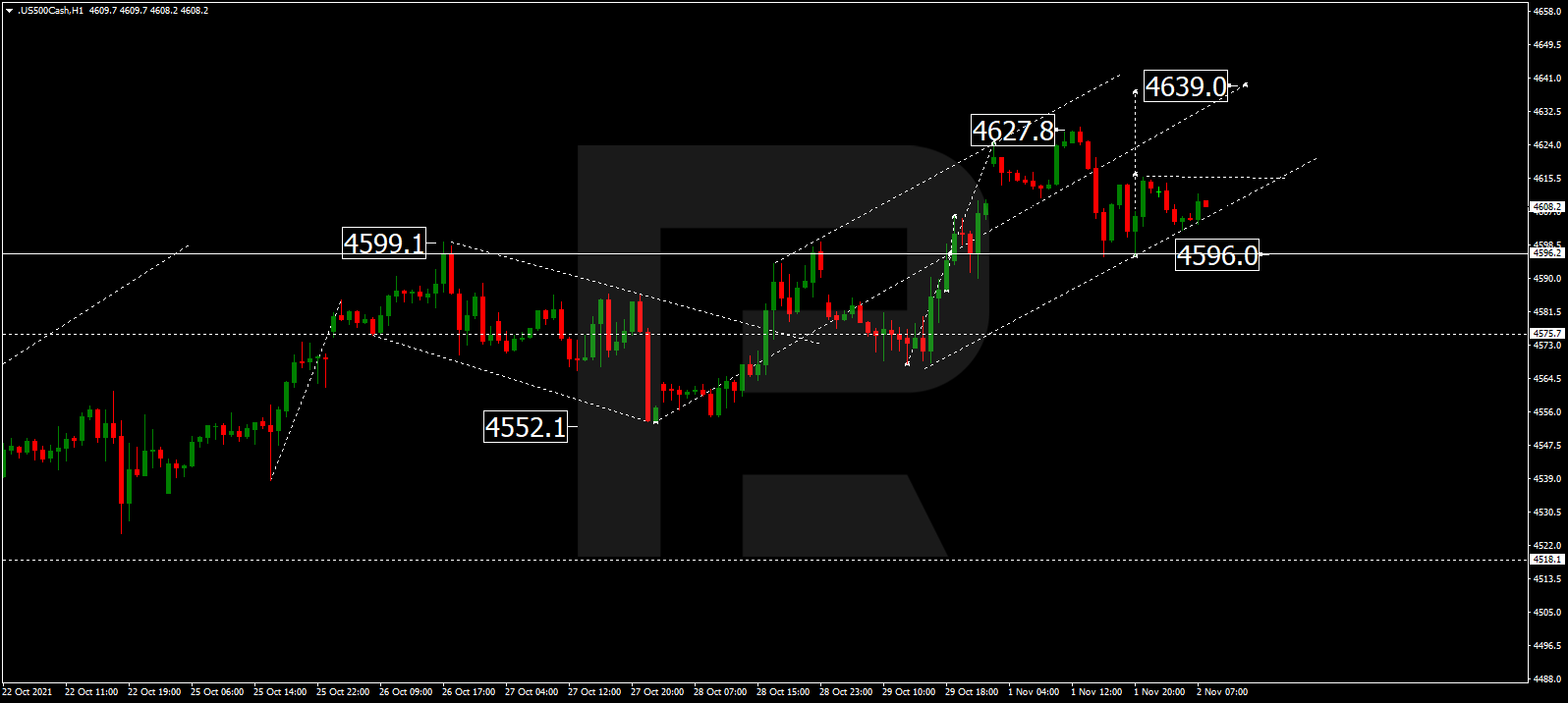
After completing the ascending structure at 4627.8 along with the correction towards 4596.0, the S&P index is consolidating above the latter level. Later, the market may break the range to the upside and start another growth towards with the target at 4639.0.

S&P 500

Article By RoboForex.com

Attention!
Forecasts presented in this section only reflect the author’s private opinion and should not be considered as guidance for trading. RoboForex LP bears no responsibility for trading results based on trading recommendations described in these analytical reviews.

FOMC Meeting: Will The Taper Become Official?

By Orbex

Back in September, the FOMC said that they would start reducing the number of asset purchases in the near future. The market broadly interpreted this to mean that they would start in two months’ time.

Now we’re at that point. And so there is a near-universal expectation that the Fed will announce the start of the taper following the meeting that ends tomorrow.

There are a couple of uncertainties that could push the market around a little bit, though. One is still the matter of timing, the other is the amount, and the third is the reaction from the US Treasury.

With all the focus on the FOMC, the change in the Treasury auction coupon expected for tomorrow is being ignored, despite potentially being the largest market-moving factor.

What to look out for

From the last meeting’s minutes, the conclusion is that the Fed will likely start pairing back its asset purchases by $15B per month. Out of that sum, $10B would be in Treasuries and the other $5B in mortgage-backed securities.

If the Fed accelerates the pace, that could support the dollar. However, if they won’t cut their purchases by as much, then we could see the dollar weaken.

The other factor is the pace.

Last time, each step in the cut was carried out after a meeting. Unlike then, the expectation now is that the Fed will announce a program where each month they will reduce purchases at a fixed amount. The question is whether they will do that immediately, or start next month.

Generally, this won’t have a huge impact. Nonetheless, analysts expect the Fed to try to signal that they won’t be raising rates soon. And one of the ways they could do that is to have a small delay in the effective start of the taper.

What else is happening tomorrow?

Concurrently, analysts anticipate that the US Treasury will announce its auction program for the coming months.

This is in the context of the battle over raising the debt ceiling and increased government funding. The Treasury has been taking measures to reduce the amount of debt it issues to keep from running up against the ceiling.

The expectation is that the Treasury will cut its bond issuance in a similar way the Fed will taper. That is, that they will announce that they will be selling ~$10B less in debt next month.

With the Treasury issuing less and the Fed buying less at the same amount, it effectively means that the treasury market will be unaffected. This would dramatically decrease the possibility of the taper having a major impact on bond yields.

Therefore, the markets are more likely to shrug off the effects.

The anticlimactic end

There has been a lot of anticipation ahead of the actual taper. And that just means the markets are extra ready for it.

If the taper happens in line with expectations, which the Fed has broadly pre-announced, it’s likely that there won’t be a major impact in the markets immediately. Rather, the focus will shift towards when the rate hike will be.

Powell will take pains to assure the markets that a rate hike is still far off. That said, the rhetoric might help provide a more dovish bias to the whole affair. Meanwhile, investors can start worrying about the budget discussion in Washington – again.


Orbex-LogoArticle by Orbex

Orbex is a fully licensed broker that was established in 2011. Founded with a mission to serve its traders responsibly and provides traders with access to the world’s largest and most liquid financial markets. www.orbex.com

Ichimoku Cloud Analysis 02.11.2021 (NZDUSD, AUDUSD, EURJPY)

Article By RoboForex.com

NZDUSD, “New Zealand Dollar vs US Dollar”

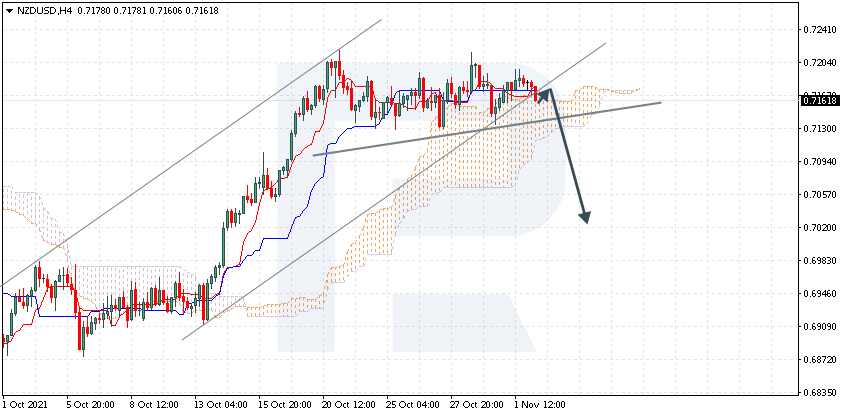
NZDUSD is trading at 0.7161; the instrument is moving inside Ichimoku Cloud, thus indicating a sideways tendency. The markets could indicate that the price may test the cloud’s upside border at 0.7165 and then resume moving downwards to reach 0.7025. Another signal in favour of a further downtrend will be a rebound from the rising channel’s downside border. However, the bearish scenario may no longer be valid if the price breaks the cloud’s upside border and fixes above 0.7205. In this case, the pair may continue growing towards 0.7305. To confirm further decline, the asset must break the “neckline” of a Head & Shoulders pattern and fix below 0.7120.

NZDUSD
Risk Warning: the result of previous trading operations do not guarantee the same results in the future

AUDUSD, “Australian Dollar vs US Dollar”

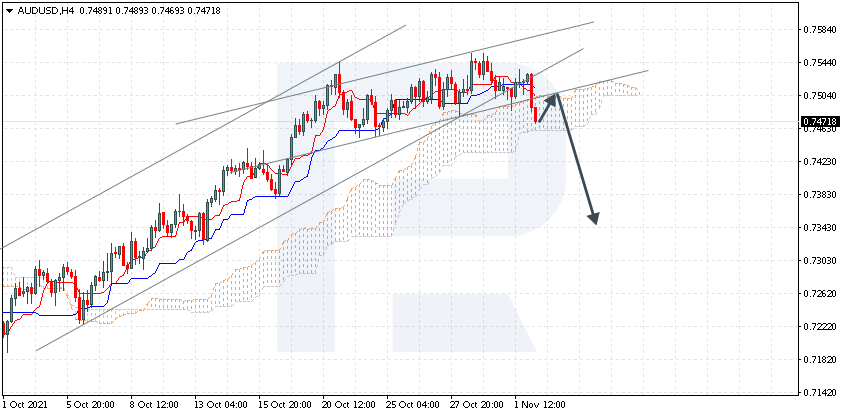
AUDUSD is trading at 0.7471; the instrument is moving inside Ichimoku Cloud, thus indicating a sideways tendency. The markets could indicate that the price may test the cloud’s upside border at 0.7505 and then resume moving downwards to reach 0.7345. Another signal in favour of a further downtrend will be a rebound from the rising channel’s downside border. However, the bearish scenario may no longer be valid if the price breaks the cloud’s upside border and fixes above 0.7545. In this case, the pair may continue growing towards 0.7635. To confirm further decline, the asset must break the cloud’s downside border and fix below 0.7455.

AUDUSD
Risk Warning: the result of previous trading operations do not guarantee the same results in the future

EURJPY, “Euro vs Japanese Yen”

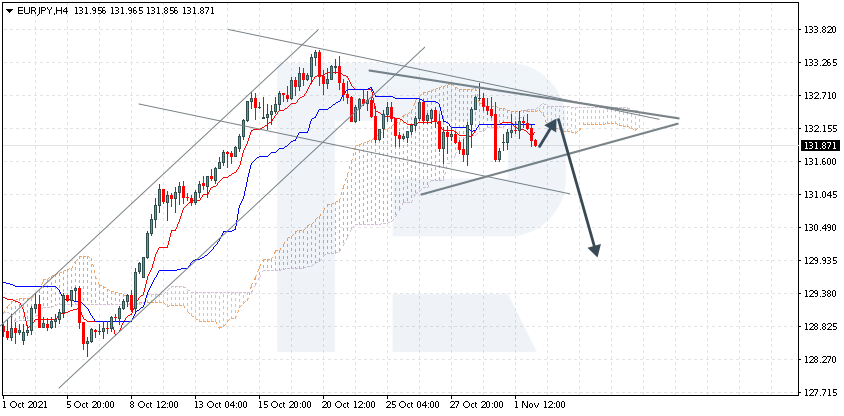
EURJPY is trading at 131.87; the instrument is moving below Ichimoku Cloud, thus indicating a descending tendency. The markets could indicate that the price may test the cloud’s downside border at 132.15 and then resume moving downwards to reach 129.95. Another signal in favour of a further downtrend will be a rebound from the descending channel’s upside border. However, the bearish scenario may no longer be valid if the price breaks the cloud’s upside border and fixes above 132.95. In this case, the pair may continue growing towards 133.95. To confirm further decline, the asset must break the downside border of a Triangle pattern and fix below 131.45.

EURJPY

Article By RoboForex.com

Attention!
Forecasts presented in this section only reflect the author’s private opinion and should not be considered as guidance for trading. RoboForex LP bears no responsibility for trading results based on trading recommendations described in these analytical reviews.

Markets Cautious As Investors Eye Central Banks

Lukman Otunuga

By Lukman Otunuga Senior Research Analyst, ForexTime

Asian shares were mixed on Tuesday as investors braced for a pivotal week, jampacked with key central bank meetings and economic reports from major economies. Currency markets are holding in tight ranges while gold prices rose slightly due to a softer dollar. European markets have opened this morning in mixed fashion, despite US stocks climbing to a record high in the previous session. Risk appetite may sour as market players look ahead to the Fed decision and US monthly non-farm payrolls report from a safe distance.

Earlier this morning, the Reserve Bank of Australia (RBA) was in the spotlight after scrapping its ultra-low target for bond yields. This was seen as a step towards winding back the emergency measures introduced to support the economy during the coronavirus pandemic. The RBA also announced that the latest data and forecasts do not warrant an interest rate rise in 2022. However, it did scrap a reference saying that the bank doesn’t expect that to happen “before 2024”.

Countdown to the Fed decision

The Federal Reserve is widely expected to keep interest rates unchanged at the end of its two-day FOMC meeting on Wednesday. However, investors will be more concerned with the possible tapering announcement and any details on the pace, timings, and composition. After talking about talking about tapering for many months, this meeting should mark a crucial turning point for the Fed as it steps away from its emergency policy.

Markets widely expect the central bank to announce it will reduce its bond purchases by $15 billion every month, with the taper to be completed by June 2022. It’s worth keeping a close eye on the central bank’s language on inflation and any hints on the timing for a first rate hike since December 2018. Traders are currently pricing in a 69% chance of at least one rate hike by mid-June 2022 .

A hawkish sounding meeting that strikes all the right notes could boost expectations over the Fed raising interest rates sooner than expected. Such an outcome could inject dollar bulls with renewed confidence ahead of the highly anticipated US jobs report on Friday.

Currency spotlight – GBPUSD

The pound has stumbled into November, depreciating against every single G-10 currency, ahead of the Bank of England policy meeting on Thursday. A sense of uncertainty over the BoE’s policy stance and escalating post-Brexit row with France over fish continues to weigh heavily on the currency.

GBPUSD is currently trading below its 50-day, 100-day, and 200-day simple moving average with prices currently trading below 1.3670. Sustained weakness under this level could encourage a decline towards 1.3570. Alternatively, a strong move above 1.3670 would signal a move towards 1.3750.

Commodity spotlight – Gold

The week ahead could be volatile for gold prices amid the string of central bank meetings and economic data. The yellow metal is likely to be influenced by the dollar’s movements, Treasury yields, inflation expectations, and global risk sentiment.

Although prices seem to be pushing higher this morning, bulls remain trapped in a sticky region with the 200-day simple moving average and $1800 acting as the first level of resistance. Beyond this point, prices may test the October high at $1813.67, ahead of $1833.84, the highest level hit in September. Ultimately, how gold ends the week will be impacted by the Federal Reserve meeting and US jobs report on Friday.

Disclaimer: The content in this article comprises personal opinions and should not be construed as containing personal and/or other investment advice and/or an offer of and/or solicitation for any transactions in financial instruments and/or a guarantee and/or prediction of future performance. ForexTime (FXTM), its affiliates, agents, directors, officers or employees do not guarantee the accuracy, validity, timeliness or completeness, of any information or data made available and assume no liability as to any loss arising from any investment based on the same.


Forex-Time-LogoArticle by ForexTime

ForexTime Ltd (FXTM) is an award winning international online forex broker regulated by CySEC 185/12 www.forextime.com

Intraday Market Analysis – USD Hits Resistance

By Orbex

USDCAD consolidates at 4-month low

USDCAD

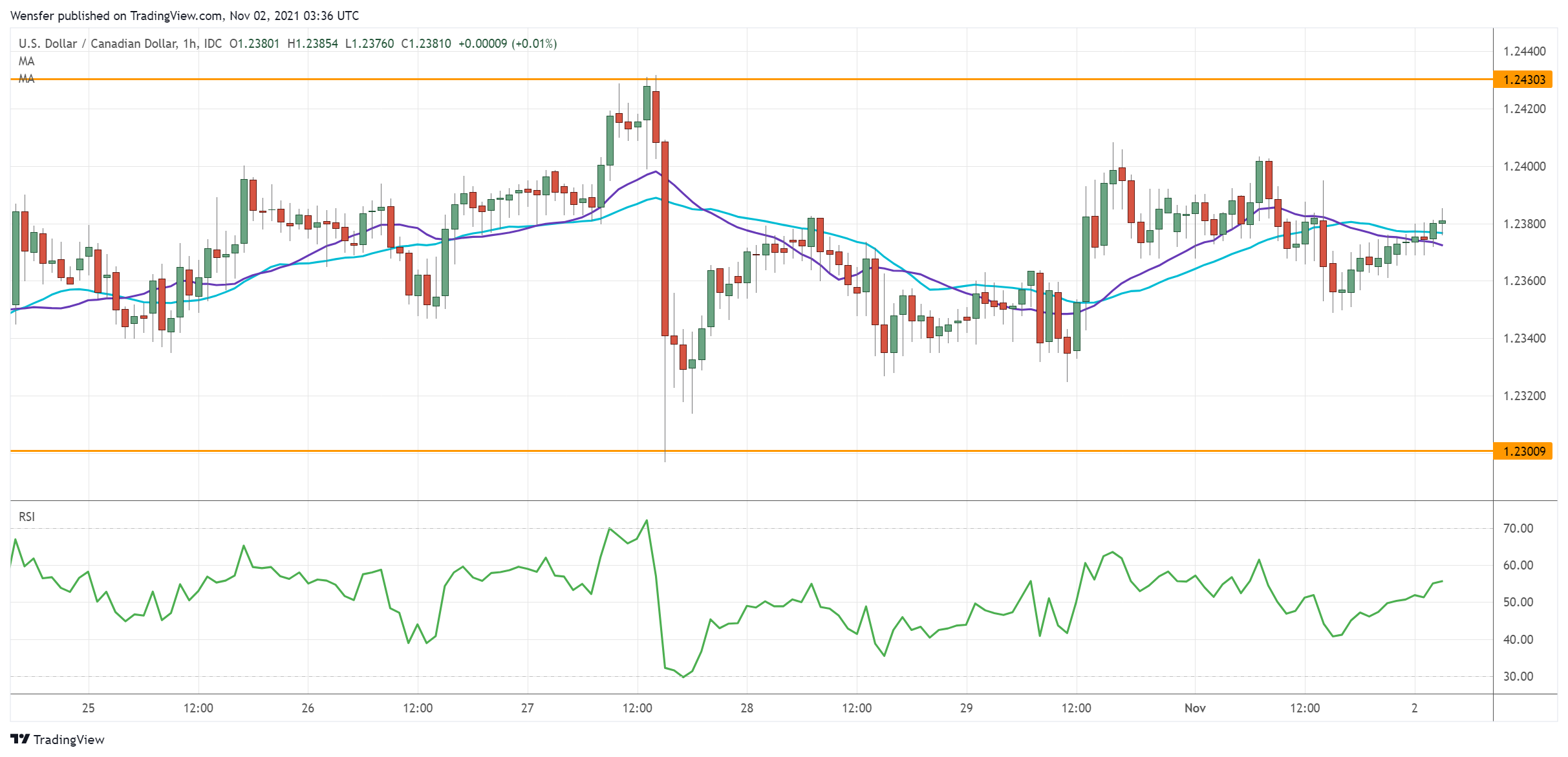
The US dollar retreats ahead of this week’s FOMC as traders await further catalysts. Price action has stabilized above 1.2300, a major demand zone from last summer.

1.2430 from the latest sell-off is a key resistance as it coincides with the 20-day moving average. The current consolidation suggests the market’s indecision, though overall sentiment remains bearish.

A deeper correction would send the greenback to 1.2150. A bullish breakout on the other hand may challenge the supply area around 1.2550.

EURJPY tests key support

EURJPY

The euro struggles to bounce higher after Germany’s lackluster retail sales in September.

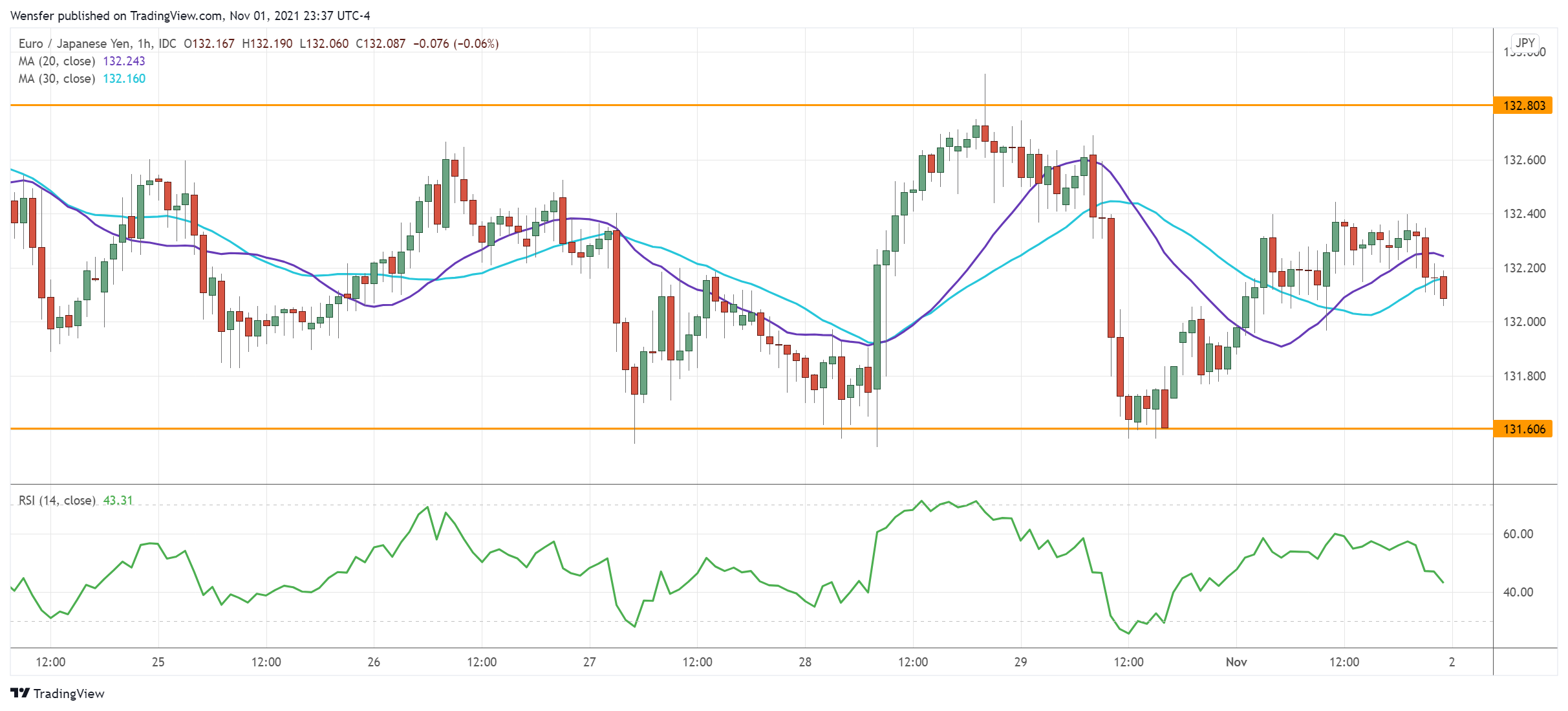
The pair has come under pressure at 133.45 near June’s peak. The subsequent retracement has met some bids at 131.60 when the RSI dipped into the oversold territory.

The triple test of the support level indicates solid buying interest. However, the bulls will need to push above 132.80 before the uptrend could resume.

On the downside, a bearish breakout would extend the sideways action towards 130.80 which sits on the 30-day moving average.

US 100 falls back for support

US 100

The Nasdaq 100 surges to a new all-time high as investors expect the strong growth trend to continue. The break above the previous peak at 15700 has put the index back on an upward trajectory.

A bullish MA cross on the daily chart is a confirmation of the market’s optimism. However, a brief pullback is necessary to let the bulls catch their breath.

15620 is the immediate support. Further down, 15280 is key daily support on the 20-day moving average. The psychological level of 16000 would be the next target rebound.


Orbex-LogoArticle by Orbex

Orbex is a fully licensed broker that was established in 2011. Founded with a mission to serve its traders responsibly and provides traders with access to the world’s largest and most liquid financial markets. www.orbex.com

Trade Of The Week: Dollar Braces For Pivotal Fed Meeting and NFP

Lukman Otunuga

By Lukman Otunuga Senior Research Analyst, ForexTime

If you are looking for some market action, then keep a close eye on the dollar.

The currency could turn volatile over the next few days thanks to the Federal Reserve meeting and highly anticipated US jobs report. Before we discuss what to expect from these two key risk events and potential market shakers, it is worth keeping in mind that the dollar entered November on a shaky note.

Bulls we missing in action on Monday despite the Dollar Index (DXY) posting its biggest daily rise in more than four months last Friday following the strong inflation numbers.

So far, the final quarter of 2021 has not been kind to the dollar due to the improving risk appetite and mixed US economic data. However, it is still early days with events of this week heavily influencing the dollars outlook.

Why November’s Fed meeting is a big deal

The Fed is expected to keep interest rates unchanged at the end of its two-day FOMC meeting. However, investors will be more concerned with the magic “T” word and the official announcement to get the ball rolling by either mid-November or mid-December. After talking about, talking about tapering for many months, this meeting will mark a crucial turning point for the Fed as it steps away from easy policy.

Investors will be paying very close attention to any key details on the pace and composition of the taper. Markets widely expect the central bank to announce it will reduce its bond purchases by $15 billion every month with the taper to be completed by June 2022.

Other key things to watch out for will be the central bank’s thoughts on rising inflation. Last Friday, the core PCE price index, which is the Fed’s preferred inflation measure held steady at 3.6% while US consumer prices remain at a 13 year high. Should Powell express concerns about price rises becoming sustained, this could fuel speculation over the Fed acting aggressively to tame inflation. Another thing to keep in mind is that the Fed has repeatedly emphasized that tapering does not indicate interest rates would rise immediately. Interestingly, markets currently see a 74.4% probability of at least one rate hike by mid-June 2022 as of writing.

A hawkish sounding Federal Reserve could inject dollar bulls with renewed confidence ahead of the US jobs report on Friday.

What to expect from Friday’s NFP 

All eyes will be on the US nonfarm payrolls report for October which could show some improvement in hiring thanks to falling new cases of Covid-19.

According to Bloomberg estimates, 450k jobs are expected to have been created in October compared to the 194k witnessed in the previous month. The unemployment rate is expected to tick lower to 4.7% from 4.8% while average hourly earnings is seen jumping 4.9% year-over-year compared to 4.6% in September. A report that meets or exceeds expectations is likely to support the dollar and fuel rate hike expectations. Alternatively, a disappointing report could see the dollar weaken.

USD Index breakout on the horizon?

The equally-weighted USD Index remains under pressure on the daily charts as there have been consistently lower lows and lower highs.

But prices seem to be trapped within a range with support at 1.0730 and resistance at 1.0810. A solid breakdown below 1.0730 could open the doors towards 1.0670 and 1.0600, respectively. Alternatively, a strong breakout above 1.0810 may open the doors towards 1.0880 and 1.0930.

Disclaimer: The content in this article comprises personal opinions and should not be construed as containing personal and/or other investment advice and/or an offer of and/or solicitation for any transactions in financial instruments and/or a guarantee and/or prediction of future performance. ForexTime (FXTM), its affiliates, agents, directors, officers or employees do not guarantee the accuracy, validity, timeliness or completeness, of any information or data made available and assume no liability as to any loss arising from any investment based on the same.


Forex-Time-LogoArticle by ForexTime

ForexTime Ltd (FXTM) is an award winning international online forex broker regulated by CySEC 185/12 www.forextime.com

AUDUSD Intervening Wave Ⓧ To Complete Near 0.770

By Orbex

For the AUDUSD currency pair, we can assume that a bearish intervening wave x of a cycle degree is forming. It hints at a triple Ⓦ-Ⓧ-Ⓨ-Ⓧ-Ⓩ zigzag.

The bullish intervening wave Ⓧ is currently under construction, which takes the form of an intermediate double (W)-(X)-(Y) zigzag. Wave (W) is a double zigzag with wave (X) being a triple zigzag. Wave (Y) is only half-built, and it will most likely also have the form of a double combination.

In the near future, there is an expectation for a slight decline in the minor intervening wave X. This may be followed by the final actionary wave Y to the level of 0.770.

At that level, wave Ⓧ will be at 76.4% of wave Ⓨ. After the full completion of the wave Ⓧ, market participants can expect a fall in the direction of the 0.710 level, or even lower.

AUDUSD

An alternative scenario suggests that the formation of the primary intervening wave Ⓧ has already completely come to an end. In fact, it took the form of an intermediate double zigzag.

A drop in price and the development of the primary wave Ⓩ are likely due to a reversal.

Bears could now be eyeing the 0.707 level.


Orbex-LogoArticle by Orbex

Orbex is a fully licensed broker that was established in 2011. Founded with a mission to serve its traders responsibly and provides traders with access to the world’s largest and most liquid financial markets. www.orbex.com