Murrey Math Lines 02.02.2023 (USDCHF, XAUUSD)

By RoboForex.com

USDCHF, “US Dollar vs Swiss Franc”

On H4, the quotes are nearing the oversold area, while the RSI has already got to its own. As a result, a test of 0/8 (0.9033) is expected, followed by a bounce off it and growth to the resistance level of 2/8 (0.9155). The scenario can be cancelled by a downward breakaway of the support level of 0/8 (0.9033). In this case, the pair may keep falling, and the quotes might drop to -1/8 (0.8972).

USDCHF_H4
Risk Warning: the result of previous trading operations do not guarantee the same results in the future

On M15, the upper line of VoltyChannel is too far away from the current price, so growth of the quotes can only be marked by a bounce off 0/8 (0.9033) on H4.

USDCHF_M15
Risk Warning: the result of previous trading operations do not guarantee the same results in the future

XAUUSD, “Gold vs US Dollar”

On H4, the quotes are above the 200-day Moving Average, which indicates prevalence of an uptrend. The RSI has broken through the resistance line. So, the quotes are expected to rise above 7/8 (1968.75) and grow as far as the resistance level of 8/8 (2000.00). The scenario can be cancelled by a downward breakaway of the support level of 6/8 (1937.50). This might bring the quotes down to 4/8 (1875.50).

XAUUSD_H4
Risk Warning: the result of previous trading operations do not guarantee the same results in the future

On M15, the upper line of VoltyChannel is broken away, which means an uptrend and high probability of further growth of the quotes.

XAUUSD_M15

Article By RoboForex.com

Attention!
Forecasts presented in this section only reflect the author’s private opinion and should not be considered as guidance for trading. RoboForex LP bears no responsibility for trading results based on trading recommendations described in these analytical reviews.

The Analytical Overview of the Main Currency Pairs on 2023.02.02

By JustMarkets

The EUR/USD currency pair

Technical indicators of the currency pair:
  • Prev Open: 1.0861
  • Prev Close: 1.0989
  • % chg. over the last day: +1.17 %

The euro area’s overall inflation rate fell sharply in January from 9.2% to 8.5% year-on-year, while the core indicator was unchanged from the previous month at 5.2%. Earlier data showed that the Eurozone Manufacturing PMI Index reached a five-month high of 48.8, up from 47.8 the previous month. Although the manufacturing sector remains in contraction territory (below 50), the data indicate that the worst of the recession is over. Today traders will focus on the ECB monetary policy meeting, where a 0.5% rate hike is expected.

Trading recommendations
  • Support levels: 1.0967, 1.0923, 1.0875, 1.0834, 1.0801, 1.0781, 1.0710, 1.0650, 1.0597
  • Resistance levels: 1.1017, 1.1077

The trend on the EUR/USD currency pair on the hourly time frame is still bullish. The Euro is getting stronger on the background of the decreasing interest rate differential between the US Federal Reserve and the ECB. The MACD indicator is overbought, and the price has deviated strongly from the moving averages. Under such market conditions, buy trades are best considered after correcting to the nearest support levels. The first such level is 1.0969, but confirmation in the form of a false breakdown is necessary. Sell deals can be considered from the resistance level of 1.1017, but better with a confirmation in the form of a reverse initiative.

Alternative scenario: if the price breaks down through the support level of 1.0834 and fixes below it, the downtrend will likely resume.

EUR/USD
News feed for 2023.02.02:
  • – Eurozone ECB Monetary Policy Statement at 15:15 (GMT+2);
  • – Eurozone ECB Interest Rate Decision at 15:15 (GMT+2);
  • – US Initial Jobless Claims (w/w) at 15:30 (GMT+2);
  • – Eurozone ECB Press Conference at 15:45 (GMT+2);
  • – Eurozone ECB President Lagarde Speaks at 17:15 (GMT+2).

The GBP/USD currency pair

Technical indicators of the currency pair:
  • Prev Open: 1.2316
  • Prev Close: 1.2372
  • % chg. over the last day: +0.45 %

The UK Manufacturing PMI rose from 46.7 to 47. Annual home price growth slowed to 1.1% from 2.8% in December, with prices now 3.2% below their August peak. These are encouraging signs that the real estate market is recovering. But there are new problems on the horizon: strikes. Yesterday, Britain faced one of the biggest strikes in a decade. Teachers, machinists, civil servants, and bus drivers did not go to work. People are demanding higher wages amid record rises in the cost of living. The Bank of England will hold its monetary policy meeting today, where a 0.5% rate hike is also expected.

Trading recommendations
  • Support levels: 1.2343, 1.2311, 1.2263, 1.2220, 1.2080, 1.2000, 1.1928
  • Resistance levels: 1.2416, 1.2446, 1.2519

From the technical point of view, the trend on the GBP/USD currency pair on the hourly time frame is bullish. The price is trading above the moving averages again. The MACD indicator is in the positive zone, and buyers’ pressure is prevailing again. Under such market conditions, it is better to look for buy deals on intraday time frames from the support level of  1.2343, but with confirmation in the form of initiative on the lower time frames. Sell trades are better to look for from the resistance level of 1.2416, but it is also better with a confirmation in the form of a reverse initiative or a false breakout because the level has been tested before.

Alternative scenario: if the price breaks down through the 1.2311 support level and fixes above it, the downtrend will likely resume.

GBP/USD
News feed for 2023.02.02:
  • – UK BoE Inflation Report at 14:00 (GMT+2);
  • – UK BoE Interest Rate Decision at 14:00 (GMT+2);
  • – UK BoE Monetary Policy Statement at 14:00 (GMT+2).

The USD/JPY currency pair

Technical indicators of the currency pair:
  • Prev Open: 130.08
  • Prev Close: 128.95
  • % chg. over the last day: -0.87 %

Fed officials have largely abandoned their hawkish views. But Jerome Powell denied cutting rates later in the year and indicated that the central bank would continue on its path of “fighting inflation.” The dollar index reacted to this news by falling because, despite further rate hikes, the Fed is nearing the end of its tightening cycle. And given the fact that the Bank of Japan is likely to start the process of monetary policy normalization this year, the USD/JPY outlook looks towards the downside, as the Japanese yen will start to strengthen on the background of the policy change.

Trading recommendations
  • Support levels: 128.16, 127.53, 126.19
  • Resistance levels: 129.05, 130.58, 131.10, 130.61, 131.58, 132.37, 132.95, 133.23

From the technical point of view, the medium-term trend on the currency pair USD/JPY is bearish. The price is trading below the moving averages. The MACD indicator has become negative, there is seller’s pressure inside the day, but the price has reached the support level. Buy trades are best sought from the level of 128.16, but only with confirmation on the lower time frames. Sell deals can be searched from the resistance level of 129.05, provided that there is a reverse reaction.

Alternative scenario: If the price fixes above the resistance level of 131.58, the uptrend will be renewed with a high probability.

USD/JPY
There is no news feed for today.

The USD/CAD currency pair

Technical indicators of the currency pair:
  • Prev Open: 1.3303
  • Prev Close: 1.3289
  • % chg. over the last day: -0.10 %

The Canadian dollar is a commodity currency and is dependent on instruments such as the dollar index and oil. The US dollar declined yesterday as the US Fed’s tightening slowed, while oil prices also fell more than 3% as oil inventories rose and the OPEC+ countries decided to leave production levels unchanged in the expectation that Chinese demand will pick up. The Canadian reacted to this news with volatility. At the moment, the midterm picture is toward the further decrease of the USD/CAD quotes.

Trading recommendations
  • Support levels: 1.3281, 1.3212
  • Resistance levels: 1.3326, 1.3379, 1.3428, 1.3445, 1.3496, 1.3520, 1.3554, 1.3595

From the point of view of technical analysis, the trend on the USD/CAD currency pair is bearish. The price is trading below the moving averages. The MACD indicator is in the negative zone, there is seller’s pressure inside the day, but there are signs of divergence. Now the price has reached the support level. Under such market conditions, buy trades can be considered from the 1.3281 support level, but with additional confirmation in the form of impulse initiative on the lower time frames. Sell deals should be considered from the resistance level of 1.3326, subject to a reverse reaction.

Alternative scenario: if the price breaks out and consolidates above the resistance level of 1.3428, the uptrend will likely resume.

USD/CAD
There is no news feed for today.

By JustMarkets


This article reflects a personal opinion and should not be interpreted as an investment advice, and/or offer, and/or a persistent request for carrying out financial transactions, and/or a guarantee, and/or a forecast of future events.

The US Federal Reserve reduced the rate hike to a 0.25% step. ECB and Bank of England to raise rates by 0.5% today

By JustMarkets

The US stock markets rose yesterday amid a slowdown in the rate hike. At the close of the stock market on Wednesday, the Dow Jones Index (US30) gained 0.02%, and the S&P 500 Index (US500) added 1.05%. The NASDAQ Technology Index (US100) jumped by 2.00% yesterday.

The Federal Reserve raised its interest rate by 0.25% on Wednesday but indicated that it expects more hikes in the future. The Fed is planning two more 0.25% rate hikes in March and May, but analysts doubt the Fed needs to go that high, especially since inflation is slowing and there are early warning signs in the labor market. But investors were generally encouraged by Powell’s answers to questions during his press conference about easing financial conditions, such as the rebound in stocks and falling bond yields in recent months. That pushed stock indices higher.

Meta Platforms stock jumped by 17% thanks to fourth-quarter revenue outperformance. Revenue was $32.17 billion, better than the consensus forecast of $31.53 billion. Facebook reached the milestone of 2 billion daily active users. Major tech companies like Alphabet (GOOGL), Apple (AAPL), and Amazon.com (AMZN) report today. Volatility in the stock market will be high, especially during the reporting period.

Equity markets in Europe traded flat yesterday. German DAX (DE30) gained 0.35%, French CAC 40 (FR40) decreased by 0.08%, Spanish IBEX 35 (ES35) added 0.74%, British FTSE 100 (UK100) closed on Wednesday down by 0.14%.

The ECB and the Bank of England will hold their monetary policy meetings today. In both cases, an interest rate hike of 0.5% is expected. This may give confidence to the euro and the British pound amid a narrowing interest rate differential with the US Fed. With the British economy already projected to fall into recession in 2023, Governor Andrew Bailey and his colleagues should assess how much of a delayed negative impact a further series of rate hikes will have. Public employee strikes have heightened the sense of despair in the economy.

Gold reached the $1,950 mark as the dollar fell because the US Federal Reserve nears the end of its tightening cycle. Gold has an inverse correlation to the dollar index and government bond yields.

The US crude oil inventories hit a 20-month-high. With OPEC+ countries deciding to leave production levels unchanged in the expectation that Chinese demand will pick up, oil prices fell more than 3% yesterday. But the long-term outlook for oil remains bullish.

Asian markets were mostly up yesterday. Japan’s Nikkei 225 (JP225) gained 0.07%, China’s FTSE China A50 (CHA50) jumped by 0.66%, Hong Kong’s Hang Seng (HK50) ended the day up by 1.05%, India’s NIFTY 50 (IND50) decreased by 0.26%, and Australia’s S&P/ASX 200 (AU200) ended the day up by 0.33%.

Bank of Japan spokesman Wakatabe said yesterday that the Bank of Japan’s resolve to continue monetary policy easing has not changed. But investors should understand that the Bank of Japan is likely to start the process of monetary policy normalization this year after the change of BoJ governor. Although some analysts believe that Japan’s central bank is unlikely to tighten monetary policy until deflation is defeated and the Ministry of Finance stops relying on ultra-low yields to control the cost of government debt. And that could take a much longer time.

S&P 500 (F) (US500) 4,119.21 +42.61 (+1.05%)

Dow Jones (US30) 34,092.96 +6.92 (+0.020%)

DAX (DE40) 15,180.74 +52.47 (+0.35%)

FTSE 100 (UK100) 7,771.70 −13.17 (−0.14%)

USD Index 102.06 −0.22 (−0.21%)

Important events for today:
  • – UK BoE Inflation Report at 14:00 (GMT+2);
  • – UK BoE Interest Rate Decision at 14:00 (GMT+2);
  • – UK BoE Monetary Policy Statement at 14:00 (GMT+2);
  • – Eurozone ECB Monetary Policy Statement at 15:15 (GMT+2);
  • – Eurozone ECB Interest Rate Decision at 15:15 (GMT+2);
  • – US Initial Jobless Claims (w/w) at 15:30 (GMT+2);
  • – Eurozone ECB Press Conference at 15:45 (GMT+2);
  • – Eurozone ECB President Lagarde Speaks at 17:15 (GMT+2);
  • – US Natural Gas Storage (w/w) at 17:30 (GMT+2).

By JustMarkets


This article reflects a personal opinion and should not be interpreted as an investment advice, and/or offer, and/or a persistent request for carrying out financial transactions, and/or a guarantee, and/or a forecast of future events.

US is spending record amounts servicing its national debt – interest rate hikes add billions to the cost

By Gerald P. Dwyer, Clemson University 

Consumers and businesses aren’t the only ones feeling the pain of higher borrowing costs because of Federal Reserve rate hikes. Uncle Sam is too.

The U.S. government spent a record US$213 billion on interest payments on its debt in the fourth quarter, up $63 billion from a year earlier. Indeed, a jump of almost $30 billion on the previous quarter represents the biggest quarterly jump on record. That comes as the Fed lifted interest rates a whopping 4.25 percentage points from March through December.

As an economist, I am concerned that the effect of higher interest payments on the government’s budget is being ignored. Higher interest payments mean the federal government will either have to lower spending, raise taxes or issue more debt to service its obligations. And financing interest payments by issuing more debt could be a particularly poor choice – sooner or later, the bill will come due.

The national debt – the amount the federal government borrows to balance the budget – increases when spending is greater than revenue and accumulates over time. As a general rule, it increases over time because of increases in spending, revenue and the deficit. Inflation tends to increase government spending, as well as revenue and deficits. As a result, the dollar value of government debt increases in times of inflation. Debt also tends to grow as the economy gets bigger – although this is not inevitable as policymakers could choose to balance the government’s budget.

In this way, total government debt has climbed over the years – by the end of 2022 it was 10 times larger than it was in 1990. It currently stands at over $31 trillion dollars and represents more than 120% of the nation’s gross domestic product. GDP is the total annual amount of goods and services produced by a country and often is used to judge whether debt is high or low.

Since 1990, government debt has more than doubled relative to the size of the economy – indicating that servicing debt could be quite a bit more of an issue than it once was.

A decade of record-low borrowing costs

But how concerning are these numbers? After all, it is not as if the government debt has to be paid off every year.

Government borrowing has some similarities to a person paying for an expensive item with a credit card, with the actual amount due to be paid off over an extended period. Just as with purchases on credit, interest is applied – and can add to the overall outlay. The federal government is different from consumers, though – it need not pay off its debt for the foreseeable future.

In terms of interest payments, the U.S. has been fortunate in recent years. Historically low interest rates since the 2008 financial crisis have held down interest payments. And just as low interest rates encourage would-be homeowners, for example, to take out a larger mortgage, they have also made it much more attractive for the federal government to borrow money to pay for whatever Congress and the administration want to finance.

But then came 2022. Soaring inflation – which reached levels not seen in 40 years – meant an end to the days of near-zero interest rates. To restrain inflation, the Fed raised rates seven times in 2022, taking the base rate from near zero to a range of 4.25% to 4.5% at the end of 2022. It is expected that the Fed will raise rates by a further 0.25 percentage point at its next monetary policy meeting starting Jan. 31. Projections made by Federal Board members indicate that, with future increases, rates will average 5% or more in 2023.

Not all government debt, however, carries these current higher interest rates. Just as with typical U.S. mortgages, much of the government debt bears the interest rate applied when it was taken on. The difference is, unlike homeowners, the government does not pay off its debt. Instead it rolls over old debt into new debt – and when it does so it takes on whatever the interest rate is when the debt is rolled over. And when this happens and interest rates have risen, the cost of servicing the overall debt goes up.

There may be trouble ahead

The federal government’s interest expense has only begun to reflect the higher interest rates. The average rate the U.S. paid in 2022 was just over 2%, which is up from the 1.61% average in 2021 but still lower than it’s been over much of the past decade. But even so, the effect is being felt. Since the Fed began hiking rates, the U.S. government’s exposure to debt interest has climbed sharply.

It may all sound a little worrying, especially amid talk of a recession – it is as if the interest on your credit card or mortgage suddenly jumped at a time when you were facing a possible cut in wages.

But there are some reassuring economic projections as well. Inflation declined substantially in the second half of 2022 and appears likely to be under control. And there is good reason to think that interest rates of 4% – or even less – are in the U.S.‘s future, as well as in the Federal Reserve projections. Whether there will be a “soft landing” in the economy – that is, a slowdown that avoids a recession – is not so obvious. While it is not inevitable, many indicators point to a recession in 2023.

Either way, the days of borrowing trillions of dollars at near-zero interest rates to finance extravagant spending are over for the foreseeable future.The Conversation

About the Author:

Gerald P. Dwyer, Professor Emeritus of Economics and BB&T Scholar, Clemson University

This article is republished from The Conversation under a Creative Commons license. Read the original article.

Fed’s hawkish tones and rate rises will become less relevant

By George Prior

Investors are set to largely shrug off hawkish tones and rate rises from the Federal Reserve moving forward, predicts the CEO of one of the world’s largest independent financial advisory, asset management and fintech organizations.

The prediction from Nigel Green of deVere Group, comes as the U.S. central bank’s policy-setting Federal Open Market Committee (FOMC) raised rates by 25 basis points at the conclusion of its two-day meeting, bringing its benchmark to a target range of 4.5% to 4.75%.

The deVere Group CEO observes: “The markets expected a 25bps rise, which is another step downward for the Fed, which increased rates by 50 basis points in December, following four 75 basis-point hikes in 2022.

“The Fed went strong on flagging worries about financial conditions becoming too loose, and that whilst progress on taming inflation has been made, officials remain concerned.

“The central bank delivered hawkish tones about rates having to remain higher for longer and reiterated the Fed’s commitment to cooling inflation.”

However, says Nigel Green, “There’s set to be some fluctuation, but moving forward markets are going to largely shrug off the Fed’s hawkish tones and rate rises.”

He continues: “Markets typically look to the future, not at the present, and will see that inflation has peaked, and the growing signs of a ‘soft landing’ for the U.S. economy as it appears that the central bank is reducing inflation without creating significant unemployment.

“There’s a sense that things are actually better than the Fed is admitting to, in order to stop over-exuberance of the markets.

“The Fed’s rhetoric doesn’t appear to be changing, despite the data, and the markets are aware of this.”

As the U.S. central bank steps down from the aggressive tightening agenda, markets are increasingly “going to overlook the Fed’s rate increases; they’re becoming less relevant.”

Nigel Green affirms: “Savvy investors know that now – in a year in which there will be big winners and big losers – it’s about being invested in the right companies, those which can consistently maintain or steadily grow margin, as well as diversification across sectors, asset classes and regions.

“A good fund manager will be critical in identifying these winners and losers as the economic cycle moves on.”

About the Author:

deVere Group is one of the world’s largest independent advisors of specialist global financial solutions to international, local mass affluent, and high-net-worth clients.  It has a network of more than 70 offices across the world, over 80,000 clients and $12bn under advisement.


UK regulation plans show crypto is mainstream, digital is future of finance

By George Prior

The UK’S plans to “robustly” regulate the cryptocurrency industry must be championed and highlight that “digital is the future of finance”, says the CEO of one of the world’s largest independent financial advisory, asset management and fintech organizations.

The comments from Nigel Green of deVere Group comes as the UK government plans to bring the cryptocurrency sector under the umbrella of mainstream financial services regulation.

The Treasury said late on Tuesday it would unveil a series of proposals to “regulate a broad suite of cryptoasset activities, consistent with its approach to traditional finance.”

It will also temporarily backtrack on a previous vow to align the regulation of crypto promotions with the regulations applied to stocks, shares and insurance products.

The deVere Group CEO notes: “The UK’s decision to regulate crypto must be championed as digital currencies, including Bitcoin, are set to play an ever greater role in the domestic and international financial system, and they should be held to the same standards as the rest of the system.

“The news that digital currencies are being brought into the regulatory tent in one of the world’s largest economies and most highly-regulated markets shows that crypto is now mainstream. It has come of age.

“A strong regulatory framework will help protect investors, tackle criminality, and reduce the potential possibility of disrupting financial stability.”

He continues: “It also offers a potential long-term economic boost to the UK as digital is the inevitable future of finance.

“This move will help further position Britain as a global hub for crypto, and fintech more generally.

“It will help attract the businesses of tomorrow – and the jobs they create – in the UK, as effective regulation gives them the confidence they need to think and invest long-term.

“We also expect this development comes as the government has expressed interest in launching its own ‘Britcoin’, or central bank-backed digital currency (CBDC).”

This news will further strengthen the case for cryptocurrencies and is likely to have a positive impact on prices of the major digital tokens, says Nigel Green.

“The move to regulate illustrates that retail and institutional investors are increasingly aware of the inherent characteristics of cryptocurrencies like Bitcoin which has the core values of being digital, global, borderless, decentralized and tamper-proof.”

According to the results of a study by deVere Group, 82% of high net worth clients, with between £1m and £5m of investable assets, sought advice on cryptocurrencies.

“Wealthy investors, a typically conservative cohort, also understand that digital currencies are the future of money, and they don’t want to be left in the past.”

The deVere CEO believes that this momentum of interest is set to build further as the bear market, or so-called ‘crypto winter’, of 2022 is thawing.

“Bitcoin is on track for its best January since 2013 based on hopes that inflation has peaked, monetary policies become more favourable, and the various crypto-sector crises including high-profile bankruptcies are now in the rear-view mirror,” he says.

“The world’s largest cryptocurrency is up over 40% since the turn of the year and this will not go unnoticed by investors and others who want to build wealth for the future.”

He concludes:  “Regulation will further shore up the crypto sector and further instil trust and confidence for investors. This will have a beneficial impact on the price trajectory long-term.”

About:

deVere Group is one of the world’s largest independent advisors of specialist global financial solutions to international, local mass affluent, and high-net-worth clients.  It has a network of more than 70 offices across the world, over 80,000 clients and $12bn under advisement.

Murrey Math Lines 01.02.2023 (USDJPY, USDCAD)

By RoboForex.com

USDJPY, “US Dollar vs Japanese Yen”

On H4, the quotes are under the 200-day Moving Average, which indicates prevalence of a downtrend. The RSI has bounced off the resistance line. As a result, 3/8 (129.68) is expected to be broken away, after which the quotes should fall to the support level of 2/8 (128.12). The scenario can be cancelled by rising over the resistance level of 4/8 (131.25), which might lead to a trend reversal and growth to 5/8 (132.81).

AUDUSD_H4
Risk Warning: the result of previous trading operations do not guarantee the same results in the future

On M15, a new breakaway of the lower border of VoltyChannel will increase the probability of further decline of the price.

AUDUSD_M15
Risk Warning: the result of previous trading operations do not guarantee the same results in the future

USDCAD, “US Dollar vs Canadian Dollar”

On H4, the quotes are under the 200-day Moving Average, which indicates prevalence of a downtrend. The RSI has bounced off the support line. As a result, we should expect a downward breakaway of 2/8 (1.3305) and further falling to the support level of 0/8 (1.3183). The scenario can be cancelled by rising above 3/8 (1.3366), after which the pair may rise to 4/8 (1.3427).

USDCAD_H4
Risk Warning: the result of previous trading operations do not guarantee the same results in the future

On M15, the lower line of VoltyChannel is broken away. This indicates presence of a downtrend and a high probability of further falling of the price.

USDCAD_M15

Article By RoboForex.com

Attention!
Forecasts presented in this section only reflect the author’s private opinion and should not be considered as guidance for trading. RoboForex LP bears no responsibility for trading results based on trading recommendations described in these analytical reviews.

The stock market is rising amid expectations of good reports from major technology companies

By JustMarkets

The US stock markets rose yesterday. At the close of the stock market on Tuesday, the Dow Jones Index (US30) gained 1.09%, and the S&P 500 Index (US500) added 1.46%. NASDAQ Technology Index (US100) jumped by 1.67%. Investors have been evaluating a lot of companies’ results, and they have generally been better than expected. But US economic indicators continue to decline. Consumer confidence fell from 109 to 107.1 in January, with the report indicating that consumers have become less optimistic about job prospects and expect a softening of business conditions in the near future.

General Motors (GM) shares rose more than 7% after its fourth-quarter results beat Wall Street estimates, and the automaker’s annual outlook was less bad than feared. Caterpillar (CAT) shares fell more than 3% after the heavy equipment maker’s fourth-quarter earnings missed Wall Street estimates. PayPal (PYPL) announced plans to lay off 2,000 employees, about 7% of its workforce, as the payments company prepares for a “challenging macroeconomic environment.”

Investors await further results from the big tech companies. Meta Platforms (META) will report as early as today. And on Thursday, Alphabet (GOOGL), Apple (AAPL), and Amazon.com (AMZN) will report.

The US Federal Reserve will hold an important monetary policy meeting today. The Fed is likely to raise the rate by 0.25%, and that increase is already in prices. Therefore, investors’ main focus will be on Fed Chairman Jerome Powell’s speech 30 minutes after the rate release. Investors will be looking for clues as to the Fed’s next move — whether the Fed will continue to raise rates or this hike will mark the end of the tightening cycle, after which the central bank will take a long pause.

Equity markets in Europe traded flat yesterday. German DAX (DE30) gained 0.01%, French CAC 40 (FR40) closed on the opening level, Spanish IBEX 35 (ES35) decreased by 0.19%, and British FTSE 100 (UK100) closed on Tuesday down by 0.17%.

Despite the energy crisis and the ensuing inflationary crisis, the eurozone economy once again showed resilience. Eurozone GDP grew by 0.1% in the last quarter. But most economies are now in stagnation with near zero growth. Germany and Italy, as the major industrialized countries, have seen small declines as they are hit the hardest by the energy crisis, while France and Spain have managed to achieve small growth rates. Despite the small increase, the growth momentum is downward, and the next quarter is likely to show a contraction.

The British Retail Consortium said that store price inflation accelerated to 8%, the highest since  2005. Prices for consumers have been rising steadily, even as the broader UK inflation rate is beginning to decline. Higher food prices mean that consumers are spending less on secondary goods.

The United States has expanded its sanctions list against Iranian entities that Washington accuses of being involved in supplying drones to Russia.

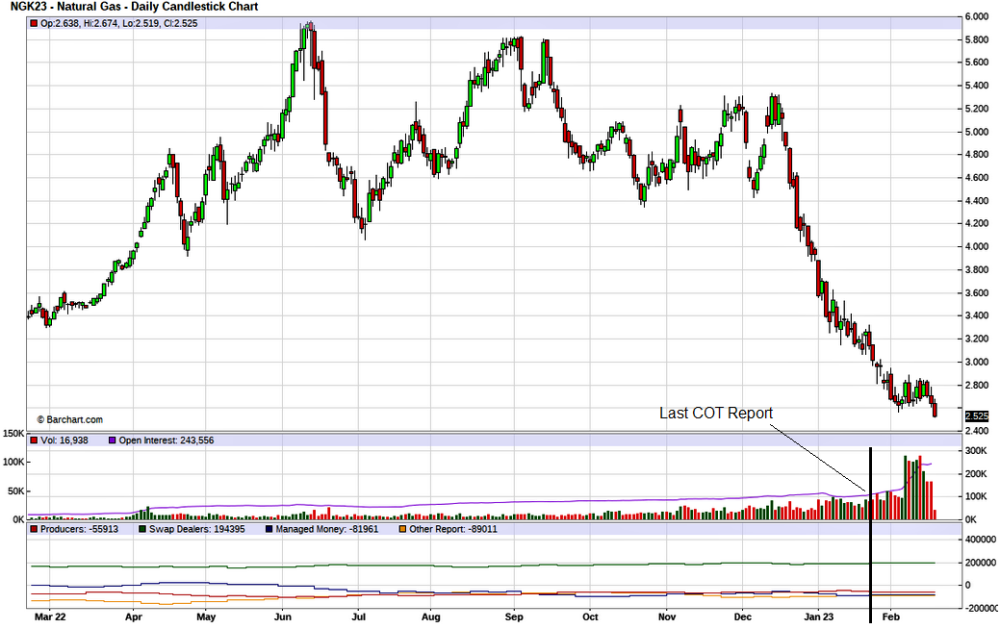
Natural gas prices continue to fall and have reached a 21-month low. The drop in gas prices came after an unusually warm start to the winter of 2022/23, which led to a drop in demand for heating fuel. But significantly colder temperatures are forecast for the region ahead, which will lead to increased consumption. In turn, increased consumption (demand growth) will put upward pressure on the quotes.

A weaker dollar and increased demand for crude oil and refined products, as reported late by the EIA or Energy Information Administration, supported oil prices yesterday. There will also be an OPEC+ meeting today where production quotas for the next two months will be approved. No surprises are expected, and production is projected to remain on target. However, volatility in oil will be elevated amid the release of strategic reserves data.

Asian markets were mostly down yesterday. Japan’s Nikkei 225 (JP225) decreased by 0.39%, China’s FTSE China A50 (CHA50) lost 1.27%, Hong Kong’s Hang Seng (HK50) ended the day down by 1.03%, India’s NIFTY 50 (IND50) gained 0.07%, and Australia’s S&P/ASX 200 (AU200) ended the day down by 0.07%.

Factory activity in Japan has been decreasing for the third month in a row. Amid worsening global economic conditions, Japanese companies are facing calls for higher wage increases to counter inflation and support the recovery of the world’s third-largest economy.

New Zealand’s labor market is starting to show signs of slowing. The unemployment rate rose from 3.3% to 3.4%, with quarterly job growth falling short of forecasts. Against this backdrop, the central bank may slow the pace of interest rate hikes.

S&P 500 (F) (US500) 4,076.60 +58.83 (+1.46%)

Dow Jones (US30) 34,086.04 +368.95 (+1.09%)

DAX (DE40) 15,128.27 +2.19 (+0.014%)

FTSE 100 (UK100) 7,771.70 −13.17 (−0.17%)

USD Index 102.06 −0.22 (−0.21%)

Important events for today:
  • – Japan Manufacturing PMI (m/m) at 02:00 (GMT+2);
  • – Spanish Manufacturing PMI (m/m) at 10:15 (GMT+2);
  • – Switzerland Manufacturing PMI (m/m) at 10:30 (GMT+2);
  • – Italian Manufacturing PMI (m/m) at 10:45 (GMT+2);
  • – French Manufacturing PMI (m/m) at 10:50 (GMT+2);
  • – German Manufacturing PMI (m/m) at 10:55 (GMT+2);
  • – Eurozone Manufacturing PMI (m/m) at 11:00 (GMT+2);
  • – UK Manufacturing PMI (m/m) at 11:30 (GMT+2);
  • – Eurozone Unemployment Rate (m/m) at 12:00 (GMT+2);
  • – Eurozone Consumer Price Index (m/m) at 12:00  (GMT+2);
  • – OPEC+ Meeting at 13:00 (GMT+2);
  • – US ADP Nonfarm Employment Change (m/m) at 15:15 (GMT+2);
  • – US JOLTs Job Openings (m/m) at 17:00 (GMT+2);
  • – US ISM Manufacturing PMI (m/m) at 17:00 (GMT+2);
  • – US Crude Oil Reserves (w/w) at 17:30 (GMT+2);
  • – US FOMC Statement at 21:00 (GMT+2);
  • – US Fed Interest Rate Decision at 21:00 (GMT+2);
  • – US FOMC Press Conference at 21:30 (GMT+2).

By JustMarkets


This article reflects a personal opinion and should not be interpreted as an investment advice, and/or offer, and/or a persistent request for carrying out financial transactions, and/or a guarantee, and/or a forecast of future events.

Mid-Week Technical Outlook: Exotics & Minors In Focus

By ForexTime 

The next few days promise to be incredibly eventful and volatile for financial markets thanks to major central bank decisions, earnings from tech titans, and key economic reports.

Caution remains the name of the game across markets as investors adopt a guarded approach towards riskier assets with all eyes on the Fed rate decision this evening. In Europe, shares edged higher but US equity futures slipped amid the growing tension and anticipation. Looking at currencies, the dollar has slipped against G10 majors while gold prices staged a sharp rebound from the $1900 region.

Over the past few weeks, we have been covering the dollar and other major currencies but today our attention falls not only on exotics but minor currency pairs. In the FX universe, a minor refers to non-USD currency pairs while exotics are the currency of a developing economy paired with another major. Exotics are notoriously known to be far less liquid than majors and explosively volatile…

While minors and exotics may be less popular than majors and often experience more wild swings thanks to less liquidity, they could still offer trading opportunities. So if you want a quick break from the dollar and other major currency pairs, check out the trading setups below.

GBPJPY trapped within a range

The GBPJPY remains trapped within a 300-pip range with resistance at 162.00 and support at 159.00. A breakout/down could be on the horizon with the correct fundamental spark. On Thursday, the Bank of England is expected to hike interest rates by 50 basis points to tame inflation.  The outcome of the meeting may have an impact on the GBPJPY in the near term. Talking technicals, a breakdown below 159.00 may open a path toward 156.00. Should prices push back above 162.00, the GBPJPY could attack 164.00.

EURJPY ready to resume selloff?

The technical bounce on the EURJPY could be over if prices fail to conquer the 141.50 level. Bears remain in some control with prices respecting a choppy bearish channel on the daily charts. A decline back under the 200-day Simple Moving Average could trigger a selloff towards 139.00 and 138.00, respectively. If prices can break above the 50-day SMA at 142.00, then a move toward 144.00 could become reality.

USDZAR set to slip?

It remains a choppy affair with the USDZAR as the currency swings between losses and gains. Prices seem to be in a wide range with some support found at 17.20. A strong breakdown below this level could encourage a move below the 50-day SMA and 200-day SMA at 16.95. Should prices experience a rebound, the first point of interest will be at 17.50 and 17.74, respectively.

EURAUD breakout/down?

As the subtitle says, the EURAUD can either experience a strong technical bounce from 1.5270 or break down below this point to hit 1.5070. The trend looks flat on the daily charts but prices are trading below the 100 but above the 200-day Simple Moving Average. Should 1.5270 prove to be reliable support, a move back toward 1.5670 after breaking through 1.5450.

AUDNZD bulls in control 

This currency pair remains firmly bullish on the daily timeframe. There have been consistently higher highs and higher lows while the MACD trades to the upside. A solid breakout and daily close above 1.1000 could encourage a move higher towards 1.1150 and 1.1250, respectively. Should 1.1000 prove to be reliable resistance, prices may sink back towards 1.0900.


Article by ForexTime

ForexTime Ltd (FXTM) is an award winning international online forex broker regulated by CySEC 185/12 www.forextime.com

Brazil’s economic challenges are again Lula’s to tackle – this time around they’re more daunting

By Marc-Andreas Muendler, University of California, San Diego and Carlos Góes, University of California, San Diego 

Even when they’re in trouble, Brazilians rarely lose their sense of humor. But in recent years, their joviality has often given way to political division everywhere from social media to the dinner table.

One familiar quip – that Brazil is the country of the future and always will be – has lost its levity as Luiz Inácio Lula da Silva begins his third presidential term. Lula previously led his country from 2003 to 2010. The president, who was sworn in again on Jan. 1, 2023, promised on the campaign trail that Brazil’s future can be like its past again: more prosperous and less polarized.

Having studied Brazil in our economic research, and having lived in the country for several years by birth or by choice, we argue that it will not be easy for Lula to fulfill his economic promises.

Unlike in his first two terms, when domestic and foreign markets helped the economy along, Lula now faces strong headwinds at home and abroad – and that means sound policies are even more important this time around.

Good times, bad times and economic choices

Brazil shot up from the world’s 14th-largest economy in 2003 to the seventh-biggest in 2010, during a boom that largely coincided with Lula’s prior presidency. At the same time, the country’s poverty rate, which the World Bank today pegs at the share of the population living on less than US$3.65 a day, fell sharply, from 26% to 12%.

Brazil exports so many gallons of orange juice, bags of coffee, bushels of wheat and other commodities that it’s serving up the world’s breakfast. Global growth during those years boosted the demand for these commodities as well as for Brazil’s processed goods. Manufacturing exports fueled Brazil’s growth in the decade following the year 2000 for the first time, led by sales of products like steel, car parts and cars, and aircraft made by Embraer.

During these boom years, Lula ran a balanced government budget, held inflation low and kept the Brazilian real’s exchange rate with other currencies under control – macroeconomic policies that he maintained from his predecessor, Fernando Henrique Cardoso. Lula also bundled Cardoso’s popular anti-poverty programs into Bolsa Família, a successful conditional cash transfer program. To remain enrolled and receive the monetary benefits, low-income families had to get their children vaccinated against diseases, keep them in school and meet other requirements.

Cynthia Benedetto, Embraer’s chief financial officer, observed in 2011: “Since my childhood I heard that Brazil is the country of the future,” and then warned, “Now the future has arrived, and I start to fear that it is short.”

She was right. The good times didn’t last.

During the second decade of this century, the prices of many of the commodities that Brazil exports fell or even plummeted. The country experienced two of the worst recessions in its history. In the downturn that lasted from late 2014 to mid-2016, nearly 5 million Brazilians lost their jobs. After a sluggish recovery, the COVID-19 pandemic hit, and 10 million Brazilians became jobless in another big downturn.

Political upheaval

Bad choices made tough and unlucky times worse.

A combination of economic mismanagement, widespread corruption, political turmoil and a global pandemic all contributed to 10 years of backward sliding after a decade of progress.

Lula’s allies, including some in his inner circle, were found to be part of one corruption scheme after another. Lula himself ended up in prison for corruption until Brazil’s Supreme Court declared the case a mistrial because the presiding judge was determined to have been biased.

Brazilians elected Lula’s hand-picked successor, Dilma Rousseff, in the 2010 and 2014 presidential races. She cast aside some of her predecessors’ policies that had buttressed economic stability.

Rousseff ended the central bank’s de facto independence and lowered interest rates in an abrupt turnaround that sparked inflation. She gave up on balancing the budget.

Once corruption was exposed in state-owned oil company Petrobras, the construction industry and at Brazil’s massive state-run development bank, economic activity slowed across the board. Rousseff oversaw one of Brazil’s most severe economic contractions in memory: GDP shrank by 7% and public debt increased 20 percentage points as a share of GDP from 2014 to 2016.

Brazil’s Congress impeached and convicted Rousseff in 2016 for fiscal improprieties. Her vice president, Michel Temer, served out the rest of her term and appointed Lula’s central bank chair, Henrique Meirelles, as minister of finance to help rein in public debt.

Jair Bolsonaro, a vocal admirer of Brazil’s 20th-century military dictatorship, became president in 2019 by riding the wave of widespread sentiment against Lula’s and Rousseff’s Workers’ Party. Bolsonaro prioritized short-term political gain over long-term adjustment, often clashing with his own economic aides and dodging rules meant to curb government spending.

By 2020, Brazil’s economy ranked No. 12 in the world in terms of GDP, and living conditions deteriorated. In 2021, the poverty rate likely hit the highest level in a decade, according to estimates by researchers at IPEA, a government think tank, as well as IBGE, Brazil’s statistics agency.

The pandemic and the social spending fluctuations it brought about have made it hard to accurately track economic trends in recent years. But the numbers suggest that Brazil is close again to where it started the 21st century.

Back to the future

Lula’s economic challenges are daunting, over and above the political crisis after the riots by opposition supporters in Brasília.

First, the economic outlook is gloomy. Inflation has led central banks worldwide to increase interest rates, and the International Monetary Fund forecasts a global slowdown in 2023.

Even if the world still wants Brazil’s coffee, orange juice and cereal from wheat or corn for breakfast, we doubt that foreign demand for Brazil’s exports will bounce back to the levels seen in past boom years.

Global prices for many of the commodities Brazil exports have been sliding downward for the past 15 years. They briefly reached their 2008 peak level again in mid-2022, partly driven by Russia’s invasion of Ukraine and the ensuing global turmoil that drove food prices up.

But the prices of commodities that are particularly important to Brazil, such as soybeans, corn and coffee, are all down significantly from their recent peaks.

During his 2022 campaign, Lula promised to slash taxes on the upper-middle class and increase benefits for the poor while keeping government finances under control.

This arithmetic is feasible in an era of rapid growth, when newly generated wealth can finance public transfers. At times of slow or no growth, like today, it becomes much harder to pull off.

Second, unlike when Lula first took office following a period of fiscal stability, this time he must credibly rebuild much of the fiscal framework.

After boosts to benefits, tax cuts and some unfunded pension commitments to retirees, it’s become hard to balance Brazil’s budget. In response to the crisis in the mid-2010s, Brazil’s Congress passed a spending cap that gradually rises so as to foster slow fiscal adjustment while avoiding harsh austerity. But Bolsonaro essentially got rid of the cap by circumventing it.

One example is the federal government’s obligation to cover court-mandated payments: Bolsonaro delayed the disbursement of 110 billion reais ($21.6 billion), equal to more than 1% of Brazil’s GDP, in 2022. That means the new government has to pay this year’s and some of last year’s bills at the same time.

While Bolsonaro dismissed the severity of COVID-19 when it was spreading uncontrolled through his country, his government did help people cope with its economic fallout by allowing emergency spending that breached Brazil’s spending cap. However, his administration maneuvered to perpetuate the state of emergency and kept spending levels higher than the cap would allow long after Brazilians stopped staying at home for public health reasons.

Third, we expect political divisions, including some within Lula’s administration, to be another obstacle. Different factions on his economic team are likely to be at loggerheads for the foreseeable future because they prefer starkly different policies.

Simone Tebet, the new economic planning minister who is in charge of coordinating spending, has several fiscal conservatives on her team.

Finance Minister Fernando Haddad, in contrast, has appointed undersecretaries known to invariably advocate for more spending. Plans for taxes and spending released to date set a budget surplus of 0.5% of GDP as the new government’s target, primarily financed with more tax collection.

Using budget projections by the International Monetary Fund, we consider those revenue projections overly optimistic.

To be sure, any new government deserves time to prove itself, especially under tough circumstances. But patience is rarer in Brazil than humor – and always has been.The Conversation

About the Author:

Marc-Andreas Muendler, Professor of Economics, University of California, San Diego and Carlos Góes, Doctoral Candidate in Economics, University of California, San Diego

This article is republished from The Conversation under a Creative Commons license. Read the original article.