Brazil holds rate 3rd time, signals end of f’ward guidance

Brazil’s central bank left its benchmark interest rates steady for the third month and while it acknowledged inflation is higher than expected, it still considers the rise temporary and with inflation expectations for 2022 around its target, the recently-adopted forward guidance may no longer be needed.
     The Central Bank of Brazil (BCP) left its benchmark Selic interest rate at 2.0 percent, unchanged since September when it paused in its easing cycle after 21 rate cuts in almost four years.
     This year the rate has been cut five times by a total of 250 basis points and since October 2016 the rate has been cut 12 percentage points.
     The central bank’s monetary policy committee confirmed the current level of “unusually strong monetary stimulus,” which is being provided by the current interest rate, is adequate amid the uneven economic recovery and larger-than-usual uncertainty about economic growth in light of the expected unwinding of the government’s emergency transfer programs.
      In August the central bank’s policy committee Copom adopted the policy of forward guidance, now used by many central banks worldwide, saying it did not foresee any reductions in the monetary stimulus unless inflation expectations and its own forecast were sufficiently close to the target.
      Copom said these conditions for the forward guidance are still being met and despite a higher-than-expected rise in inflation, it still considers this rise as temporary but is monitoring the situation closely.
      And even if inflation expectations, especially for 2021, have risen, they remain below the target, the fiscal regime hasn’t changed and long-term inflation expectations remain well anchored.
      Brazil’s headline inflation rate rose to 4.31 percent in November, the highest since December 2019, and while it is above the central bank’s midpoint inflation target of 4.0 percent it is still within its range of 2.5 to 5.5 percent.
      Copom’s view of inflation mirrors last month’s statement by its president, Roberto Campos Neto, who said policymakers should look through the temporary factors pushing up prices, such as a spike in food prices, a weak exchange rate and demand fueled by the government’s emergency income transfers.
     But the steady rise in inflation has begun to filter into inflation expectations, with economists in the bank’s latest FOCUS survey from Dec. 4 expecting 4.2 percent inflation for 2020.
     But in 2021 and 2022 inflation is seen easing to 3.3 percent and 3.5 percent, respectively.
     In 2021 the central bank will target inflation at a midpoint of 3.75 percent and in coming months inflation expectations for 2021 will become less relevant than those for 2022, BCB said.
     Since adopting the forward guidance, the previous declining trend in inflation expectations was reversed but Copom said even if the conditions for the forward guidance may soon no longer apply, this
“does not mechanically imply interest rates increases, since economic conditions still prescribe an extraordinarily strong monetary stimulus.”
     And in the event the forward guidances no longer applies, Copom said its monetary policy will still follow the inflation-targeting framework.
      The last two FOCUS surveys show that economists expect the Selic rate to rise by 100 basis points to 3.0 percent, up from 2.75 percent previously.
      Copom said its own projections also assumes the Selic rate would rise to 3.0 percent in 2021, then 4.50 percent in 2022.
     After falling sharply at the start of this year, Brazil’s real has slowly gained strength since mid-May and  has risen steadily since Nov. 1.
Today the real was trading at 5.17 to the U.S. dollar, up 14 percent since a record low of around 5.89 on May 14 but still down almost 23 percent since the start of 2020.
     Brazil’s economy has contracted in the last three quarters, with gross domestic product down 3.9 percent year-on-year in the third quarter after a 10.9 percent drop in the second quarter and a 0.3 percent fall in the first quarter.
     On Dec. 1 the International Monetary Fund forecast Brazil’s economy would shrink 5.8 percent this year and then grow 2.8 percent in 2021 while inflation will remain below target until 2023 given the slack in the economy.

The Central Bank of Brazil  issued the following statement:

“In its 235th meeting, the Copom unanimously decided to maintain the Selic rate at 2.00% p.a.

The following observations provide an update of the Copom’s baseline scenario:

·      Regarding the global outlook, the pandemic resurgence in some major economies is reversing previous mobility gains and should affect short-term activity. However, promising results in COVID-19 vaccine trials tend to improve confidence and growth in the medium term. Economic slack and central bank communication from major economies suggest monetary stimuli will last long, resulting in a favorable environment for emerging economies;

·      Turning to the Brazilian economy, recent indicators suggest the uneven recovery in economic activity continues, as expected. However, prospectively, uncertainty about economic growth remains larger than usual, especially for the period starting at the end of this year, concurrently with the expected unwinding of the emergency transfer programs;

·      The latest inflation readings were higher than expected and, despite the predicted retraction of food price pressures, December inflation should still remain elevated. In spite of the stronger short-term inflationary pressure, the Committee maintains the diagnosis that the current shocks are temporary, but continues to monitor closely its evolution, in particular the core inflation readings;

·      The various measures of underlying inflation are in levels compatible with meeting the inflation target at the relevant horizon for monetary policy;

·      Inflation expectations for 2020, 2021, and 2022 collected by the Focus survey are around 4.2%, 3.3%, and 3.5%, respectively;

·      The Copom’s inflation projections in its baseline scenario, with interest rate path extracted from the Focus survey and exchange rate starting at R$5.25/US$* and evolving according to the purchase power parity (PPP), stand around 4.3% for 2020, 3.4% for 2021 and 3.4% for 2022. This scenario assumes a path for the Selic rate that ends 2020 at 2.00% p.a., rises to 3.00% p.a. in 2021 and 4.50% p.a. in 2022; and

·      The scenario with constant interest rate at 2.00% p.a. and exchange rate starting at R$5.25/US$* and evolving according to the PPP yields inflation projections around 4.3% for 2020, 3.5% for 2021 and 4.0% for 2022.

The Committee emphasizes that risks to its baseline scenario remain in both directions.

On the one hand, economic slack may continue to produce a lower-than-expected prospective inflation trajectory, especially when the slack is concentrated in the service sector. This risk increases if a slower reversion of the pandemic effects lengthens the environment of high uncertainty and precautionary savings.

On the other hand, an extension of fiscal policy responses to the pandemic that aggravate the fiscal path or a frustration with the continuation of the reform agenda may increase the risk premium. The relative increase in the risks of these events imply an upward asymmetry to the balance of risks, i.e., in the direction of higher-than-expected paths for inflation over the relevant horizon for monetary policy.

The Committee believes that persevering in the process of reforms and necessary adjustments in the Brazilian economy is essential for a sustainable economic recovery. The Copom also stresses that uncertainty regarding the continuation of the reform agenda and permanent changes to the fiscal consolidation process could result in an increase in the structural interest rate.

Taking into account the baseline scenario, the balance of risks, and the broad array of available information, the Copom unanimously decided to maintain the Selic rate at 2.00% p.a. The Committee judges that this decision reflects its baseline scenario for prospective inflation, a higher-than-usual variance in the balance of risks, and it is consistent with the convergence of inflation to its target over the relevant horizon for monetary policy, which includes 2021 and 2022.

The Committee deems as adequate the current level of unusually strong monetary stimulus, which is being provided by the maintenance of the policy rate at 2.00% p.a. and the forward guidance introduced in the 232nd meeting. The forward guidance stated that the Copom does not intend to reduce the monetary stimulus as long as specified conditions are met. The Committee judges that those conditions continue to hold. In spite of having increased since the last meeting, in particular for 2021, inflation expectations, as well as inflation projections for its baseline scenario, are still below the inflation target for the relevant horizon for monetary policy; the current fiscal regime has not been changed; and long-term inflation expectations remain well anchored.

The Copom judges that, since adoption of the forward guidance, inflation expectations reversed their declining trend relative to the target for the relevant horizon. Additionally, over the next months, the 2021 calendar-year should become less relevant than the 2022 calendar-year, for which projections and expected inflation are around the target. A scenario of inflation expectations converging to the target suggests that the conditions for maintaining the forward guidance may soon no longer apply, which does not mechanically imply interest rates increases, since economic conditions still prescribe an extraordinarily strong monetary stimulus. In case the forward guidance ceases to apply, monetary policy will follow the inflation target framework, based on the analysis of prospective inflation and its balance of risks.

The following members of the Committee voted for this decision: Roberto Oliveira Campos Neto (Governor), Bruno Serra Fernandes, Carolina de Assis Barros, Fabio Kanczuk, Fernanda Feitosa Nechio, João Manoel Pinho de Mello, Maurício Costa de Moura, Otávio Ribeiro Damaso, and Paulo Sérgio Neves de Souza.”

www.CentralBankNews.info

Can the ECB drag the Euro lower?

By Hussein Sayed, Chief Market Strategist (Gulf & MENA), ForexTime

This year, the Euro has been one of the best performing major currencies, having appreciated 8% against the Dollar so far while rebounding 14% from the March lows. The rise in the Euro has come despite depressed bond yields across both the core and periphery economies, in which Portugal’s 10-year yield was the latest to fall below zero last week.

The latest lockdowns and an unknown Brexit outcome will only add further pressure on economic growth in the final quarter of the year and possibly well into the first half of 2021. Having a higher exchange rate in such circumstances puts further pressure on inflation and make exports from the bloc less competitive. On the bright side, a vaccine is arriving soon but the positive impact will only be felt in the long term.

This leaves the ECB in a tricky position as the Governing Council needs to decide whether to go all in with more monetary stimulus or take smaller steps to address current risks. The bank is expected to increase its emergency asset purchase program (PEPP) by another €500 billion to a total of €1.85 billion. That would keep yields across the bloc in check and possibly drag them a little further despite the rise in debt levels. However, without some form of yield curve control, investors know that the ECB’s actions are really just delivering the same outcome. This is likely to keep financing conditions loose but is not enough to meet the mandate of an inflation rate just below 2%. A stronger Euro is again to blame.

For the ECB to push the Euro lower, bolder action needs to be taken. The €500 billion increase in asset purchases is already priced and won’t curb the currency’s strength. Verbal intervention to talk down the exchange rate may last for hours or a couple of days but is not a long-term solution. The only game-changer is to deliver a surprise deposit rate cut and add more than €500 billion to the emergency asset purchase program. However, the chances of this happening are extremely low, especially as the ECB hawks will stand firm against such measures.

Christine Lagarde knows that monetary policy alone won’t be the answer to boosting inflation back to target levels and that comprehensive fiscal action is needed. It is highly significant then that the two-day EU summit kicks off today and we may learn if and when the new recovery fund will see the light.

The Euro’s fate over the next several weeks hangs on external forces. A failure in EU–UK negotiations in which Britain exits the bloc without a deal would lead to a big selloff in the EURUSD, but of course a steeper one in Sterling. Delivering a smaller than expected US stimulus package could be another factor, but the impact would be smaller. A third factor could be the resumption of the selloff in global equity markets triggered by US tech stocks, as we saw yesterday. Any sign of a steeper correction in equity markets is likely to provide a boost to the US Dollar.

Disclaimer: The content in this article comprises personal opinions and should not be construed as containing personal and/or other investment advice and/or an offer of and/or solicitation for any transactions in financial instruments and/or a guarantee and/or prediction of future performance. ForexTime (FXTM), its affiliates, agents, directors, officers or employees do not guarantee the accuracy, validity, timeliness or completeness, of any information or data made available and assume no liability as to any loss arising from any investment based on the same.


Forex-Time-LogoArticle by ForexTime

ForexTime Ltd (FXTM) is an award winning international online forex broker regulated by CySEC 185/12 www.forextime.com

Another Round Of Stimulus From ECB?

By Orbex

Among major economies, the Eurozone has been done the least in terms of government stimulus spending.

Even at the level of the member states, stimulus spending has been comparatively low.

We’re still waiting on an agreement on the first stimulus spending program on the Union level. And at €750B, it’s relatively small as a percentage of GDP compared to other countries.

So, stimulus in the Eurozone has relied largely on support from the ECB.

We are heading into the winter with extended periods of lockdowns still expected until the vaccines are available.

Retailers are struggling after being forced into closures during key shopping months ahead of holidays. There are also increasing calls for authorities to do more to support the economy during the upcoming months.

All this is likely to fall on Lagarde’s shoulders at the last meeting for the ECB this year.

What We Are Looking For

There is a unanimous consensus that the ECB will keep rates where they are. That’s not the issue.

What we do expect is a barrage of new measures to help boost the economy ahead of the official start of winter. These will be somewhat of a stopgap until the budget is finally approved.

Here are some of the potential announcements:

1) There is a pretty strong consensus that the ECB will decide to increase PEPP buying (Pandemic Emergency Purchase Programme) by a further €500B. This will bring it to a total of €1.85T.

They could also extend the duration of the program to the middle of 2022. The market has already priced that in, but it would still likely be supportive of risk sentiment.

2) There isn’t as much consensus on this point, but it’s possible that the ECB might extend the range of bonds that it could buy. This includes so-called “fallen angels” corporate bonds.

This would be unexpected. It would help support European stocks, but might have a bit of a drag on the euro.

3) We might expect the bank to adjust the TLTRO program. This would be in an effort to boost bank lending and allow using mortgages for securitization.

This is a more controversial proposal and we’re not considering it to be likely.

But if they do announce it, this would also likely support stocks.

4) Finally, and something there is more consensus on, an expansion of the regular QE program (called APP)

What’s Not Likely to be Mentioned

Ever since Chief Economist Haldane voiced concerns over a strengthening euro several months ago, there was speculation that the ECB would step in to address the issue.

It is relevant to price stability, as a stronger euro lowers the cost of buying imported goods and undermines efforts to reach inflation targets.

Until recently, the 1.2000 handle in the EURUSD was seen as a “red line” for the ECB, but that was passed without comment.

But, while there is a possibility, it’s not so likely because the ECB is not really worried about too little inflation at this point.

A higher euro might offset some fears of a rebound in inflation as a response to stimulus spending. And Lagarde is likely to want to put her foot down in terms of leadership, to keep that issue from coming up.

If there is no comment on the exchange rate, it might give euro bulls some incentive to push the currency higher after the press conference.

By Orbex

Politics, not money, is now the biggest taboo conversation: survey

By George Prior

Money – for the first time – is no longer the biggest taboo topic of conversation, according to an international poll.

In the global survey conducted by deVere Group, one of the world’s largest independent financial advisory and fintech organizations, 48% of those polled ranked politics as the most difficult subject to discuss with family, friends and colleagues.

It came ahead of personal finance (34%), sex and relationships (9%), religion (5%), and health issues (4%) in the study of 750+ clients. The respondents came from the UK, Europe, North America, Asia, Africa, Latin America and Australasia.

In the 2019 survey, 56% of those asked cited money as the hardest topic. It was the same in previous years too.

Of the findings, deVere Group CEO and founder Nigel Green observes: “This has been a year of immense political polarization around the world.

“Governments’ handling of the pandemic, and events such as the U.S. presidential election, Brexit, tensions in South Asia and in the Gulf, amongst other factors, have made things seem more divisive and partisan than ever.

“Therefore, it is perhaps of little surprise that 2020’s biggest conversation taboo is politics.”

He continues: “It’s been a highly unusual year and it’s very encouraging that personal finance – which includes income, taxes, pensions, debt, savings, expenses and estate planning – is now regarded as less taboo than in previous years. This is a good thing.

“The subject of money needs to be de-stigmatised.  Wealth provides people and their loved-ones with incredibly positive, life-enhancing opportunities, and if it is seen as unseemly to discuss there’s more chance that financial goals will go unrealised.”

One area of personal finance which has traditionally been regarded as ‘awkward’ to talk about is wills and estate planning.  This mindset has also shifted in 2020, says Mr Green for two key reasons.

“First, is the Covid-19 pandemic. Drawing up a will is not something anybody really rushes to do. But with alarming death tolls, infection rates and confirmed cases, there’s been an unprecedented focusing-of-minds in this area.  People are more aware than ever about what really matters: your loved ones” he notes.

“And second, the Great Transfer of Wealth. Tens of trillions of dollars of assets are to be passed down from the baby boomers – the wealthiest generation ever – to their children and other heirs over the next few years.

“As such, increasingly individuals are taking appropriate estate planning advice to avoid paying unnecessary inheritance tax and having beneficiaries miss out on their legacy.”

The deVere CEO concludes: “Money is a critical part of our lives, it gives us freedom, security and opportunity.

“It appears that 2020 has taught us that we need to get more comfortable discussing it.”

About:

deVere Group is one of the world’s largest independent advisors of specialist global financial solutions to international, local mass affluent, and high-net-worth clients.  It has a network of more than 70 offices across the world, over 80,000 clients and $12bn under advisement.


EURUSD Trades Soft As ECB Meeting Approaches

By Orbex

eurusd

The euro currency continues to trade weaker as price action is posting modest gains on Tuesday.

This comes after the euro settled near new highs above 1.2150 late last week.

For the moment, the currency pair remains flat unless it can break down below the 1.2100 level of support.

This will potentially open the way for the euro to fall to the 1.200 level.

However, support is likely to form near the 1.1900. We expect the euro to trade flat into Thursday’s ECB meeting.

By Orbex

Republicans And Democrats Clash Over Relief

By Orbex

Dollar Looks for Respite

The US index rose slightly higher yesterday, just under 0.1%, as it achieved its third consecutive daily gain.

Persistent Brexit uncertainty, added with the upcoming ECB meeting, saw investors shift sentiment somewhat towards the dollar.

However, the greenback remains under pressure with the tussling of another round of stimulus hopes, which is becoming more political by the day.

House Speaker Nancy Pelosi called for a review of the Trump administration’s relief package, as it would cut unemployment insurance by $140 billion.

Euro Flirts with 1.21

The euro closed indecisively on Tuesday as it bounced off the 1.21 handle.

Investors are currently eyeing the upcoming ECB interest rate decision and meeting, as economists predict no changes will be made to the base rate.

GDP data across the eurozone showed that the European economy rose by 12.5% in Q3 after crashing by 11.8% in Q2. However, on an annualized basis, the economy weakened by 4.3%.

Boris Goes to Brussels

The pound closed 0.18% lower yesterday as the ongoing Brexit saga looks to be coming to an end.

Deal or no-deal, Boris Johnson will fly to Brussels today for last-ditch talks with the European Commission President.

Talks have ended in a deadlock for the majority of the talks, as the make-or-break moment comes shortly before the 31st of December when the UK stops following EU trading rules.

Meanwhile, the first of 800,000 doses of the Pfizer/BioNTech vaccine that will be dispensed in the coming weeks took place yesterday.

When will other countries follow suit?

Indices Up as Investors Look to Vaccinations

Stocks rose on Tuesday as all three major indices ended the session by almost 0.5%.

Investors have noted the successful distribution of the Pfizer vaccine in the UK, with the FDA saying that the company has a favorable safety profile.

Economists can be confident that more antidotes will soon be distributed, as vaccine makers Johnson & Johnson and Moderna rose by 1.7% and 6.5% respectively. Pfizer, on the other hand, closed 3% higher.

Gold Maintains Momentum

Gold rose by 0.40% yesterday as the ascendency towards $1900 continued.

The yellow metal remained well supported despite positive vaccine updates. The increasingly shaky greenback has taken the negative sting out of further downside worries for gold.

How long until we reach another milestone?

API Weighs on WTI

Oil closed indecisively on Tuesday as it once again tussled with the $46 handle.

Markets were initially hopeful as Covid-19 vaccinations began. However, a crude build in the API data saw prices slip slightly.

We now look ahead at more Pfizer injection headlines to boost the black gold further.

By Orbex

Fibonacci Retracements Analysis 09.12.2020 (GBPUSD, EURJPY)

Article By RoboForex.com

GBPUSD, “Great Britain Pound vs US Dollar”

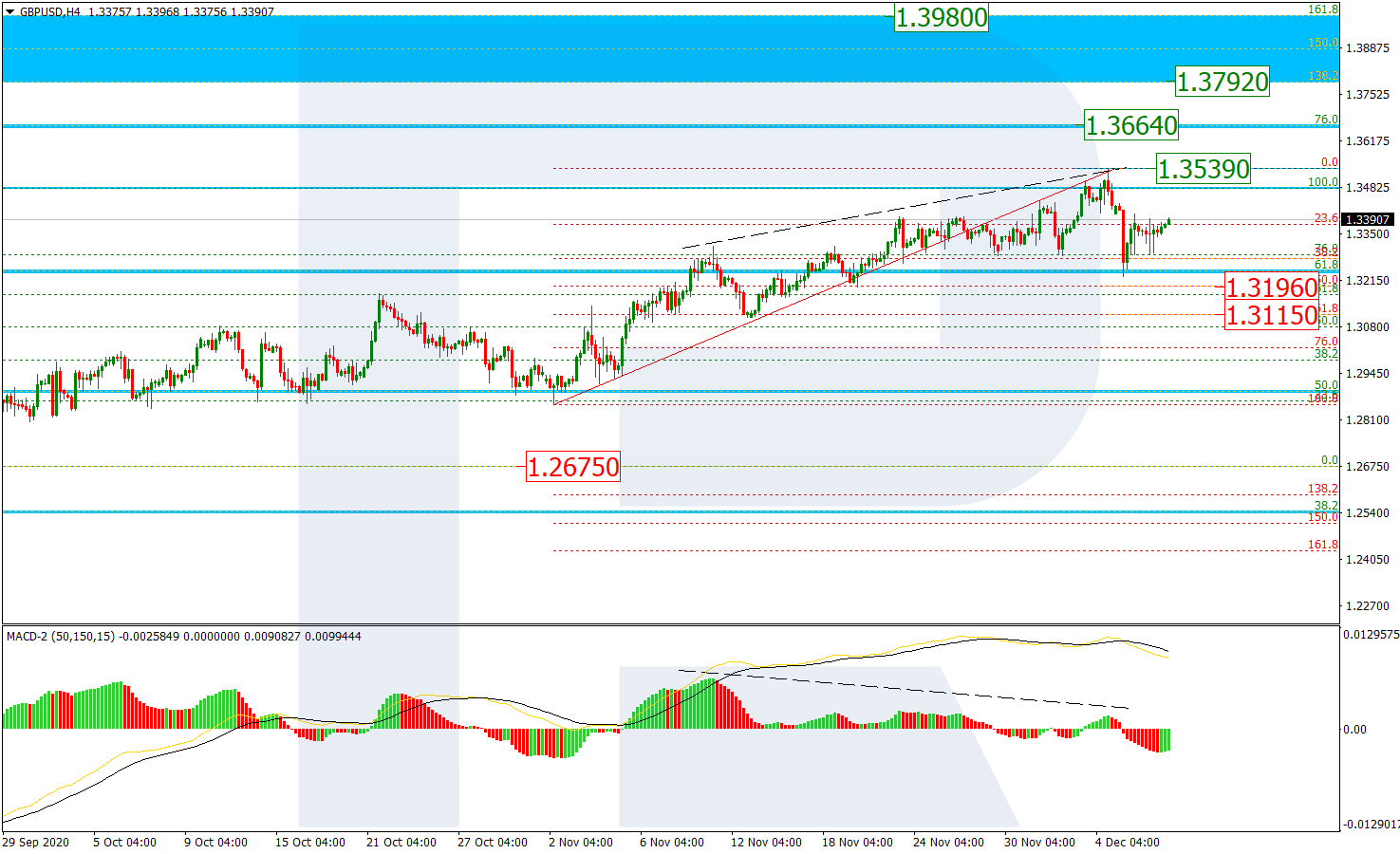
On H4, the market renewed the last important high of 1.3482, but after a divergence the quotations started pulling back. When the correction is over, the growth might resume to the long-term level of 76.0% (1.3664) and then – to the post-correctional extension area of 138.2-161.8% (1.3792-1.3980) Fibo. The local resistance is at 1.3539.

GBPUSD_H4
Risk Warning: the result of previous trading operations do not guarantee the same results in the future

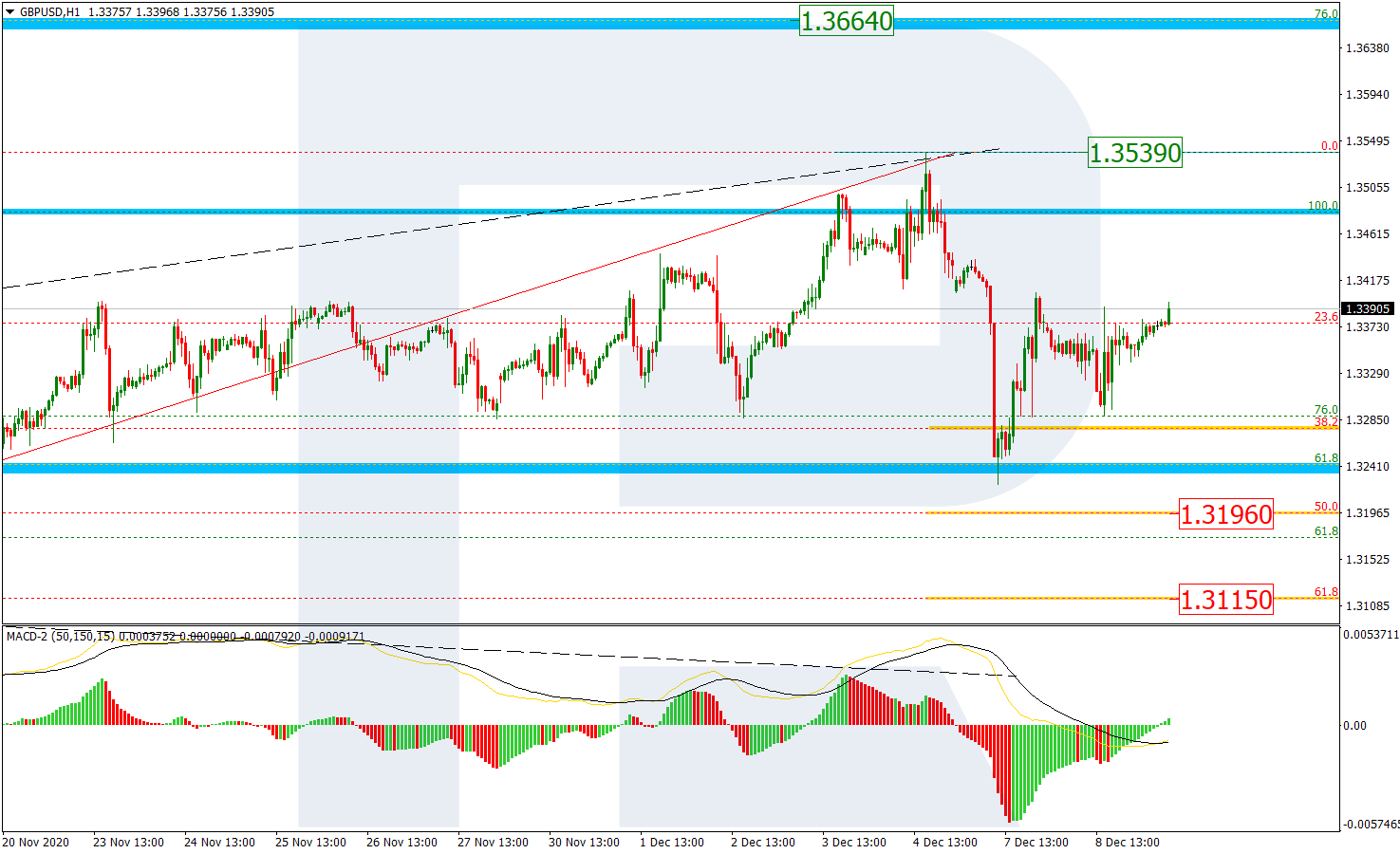
On H1, we can see a correctional phase beginning. The first fast impulse of decline has reached 38.2% Fibo. Further falling might be aimed at 50.0% (1.3196) and 61.8% (1.3115), but the correctional growth we see might turn into a full-scale new wave of growth aiming above the peak of 1.3539.

GBPUSD_H1
Risk Warning: the result of previous trading operations do not guarantee the same results in the future

EURJPY, “Euro vs Japanese Yen”

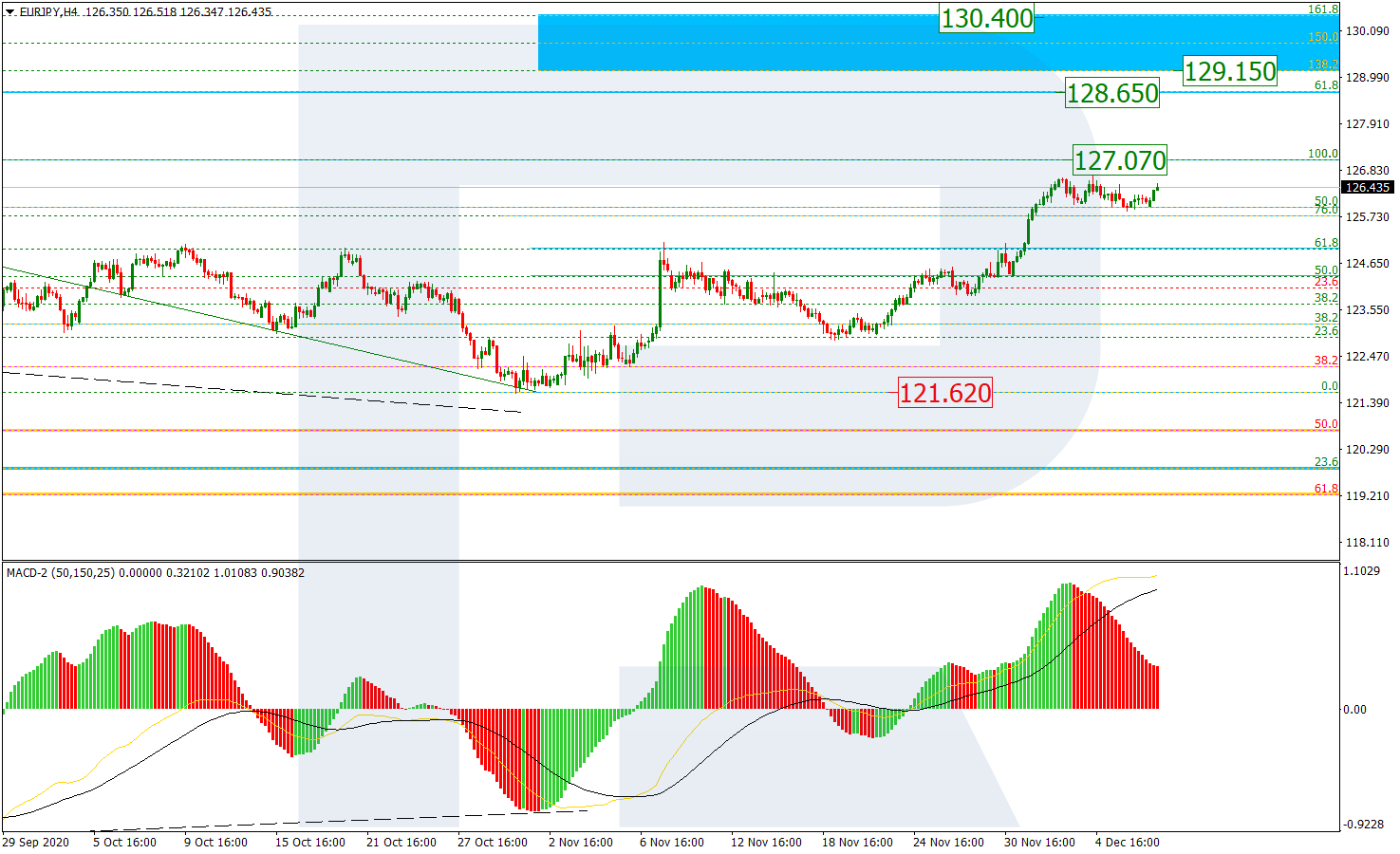
On H4, the wave of growth has stopped developing near the high of 127.07. After this high is broken, the quotations might rise to the medium-term level of 61.8% (128.65), and after it is broken – to the upper post-correctional extension range of 138.2-161.8% (129.15-130.40) Fibo. The main support is at the fractal low of 121.62.

EURJPY_H4
Risk Warning: the result of previous trading operations do not guarantee the same results in the future

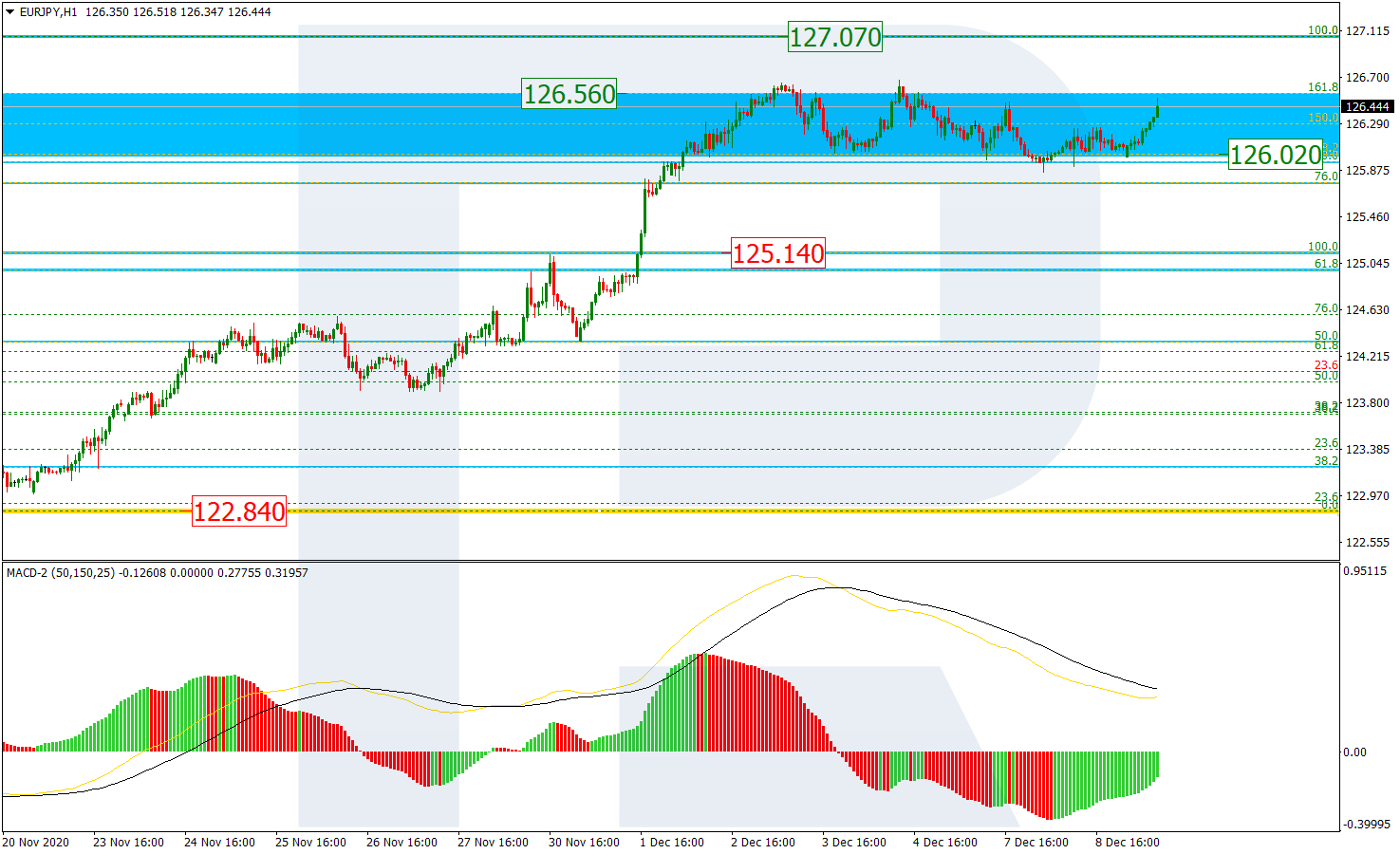
On H1, the pair demonstrates sideways correctional dynamics inside a short-term local post-correctional extension area of 138.2-161.8% (126.02-126.56) Fibo. Then we expect a breakaway of the upper border of the current flat and a rise to the high of 127.07.

EURJPY_H1

Article By RoboForex.com

Attention!
Forecasts presented in this section only reflect the author’s private opinion and should not be considered as guidance for trading. RoboForex LP bears no responsibility for trading results based on trading recommendations described in these analytical reviews.

Ichimoku Cloud Analysis 09.12.2020 (GOLD, CADJPY, NZDUSD)

Article By RoboForex.com

XAUUSD, “Gold vs US Dollar”

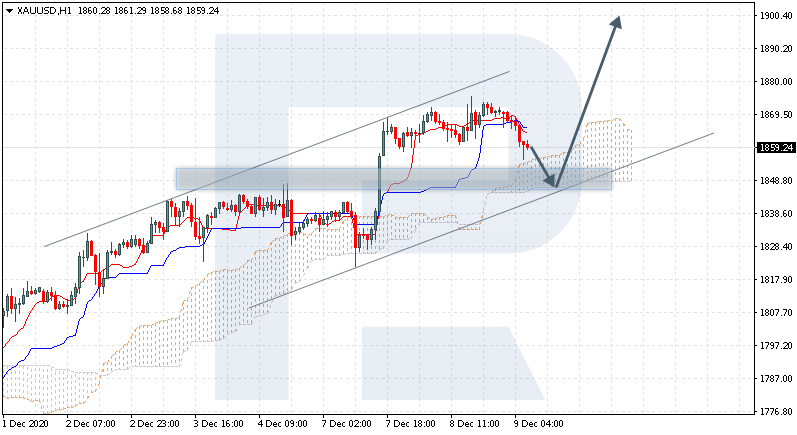
GOLD is trading at 1859 above the Ichimoku Cloud, suggesting an uptrend. A test of the lower border of the Cloud at 1850 is expected, followed by growth to 1900. An additional signal supporting the growth can be a bounce off the lower border of the ascending channel. The scenario can be canceled by a breakaway of the lower border of the Cloud and securing under 1835, which will entail further falling to 1805.

XAUUSD
Risk Warning: the result of previous trading operations do not guarantee the same results in the future

CADJPY, “Canadian Dollar vs Japanese Yen”

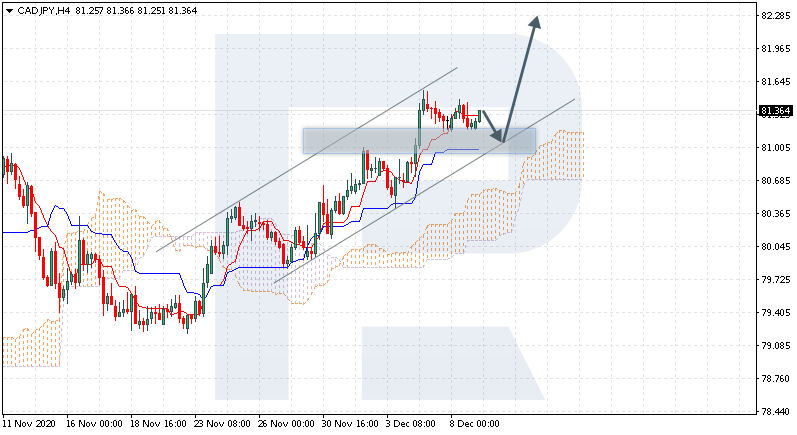
The currency pair is trading at 81.36 above the Ichimoku Cloud, suggesting an uptrend. A test of the signal lines of the indicator at 81.10 is expected, followed by growth to 82.25. An additional signal supporting the growth can be a bounce off the lower border of the ascending channel. The scenario can be canceled by a breakaway of the lower border of the Cloud and securing under 79.85, which will entail further falling to 79.05.

CADJPY
Risk Warning: the result of previous trading operations do not guarantee the same results in the future

NZDUSD, “New Zealand Dollar vs US Dollar”

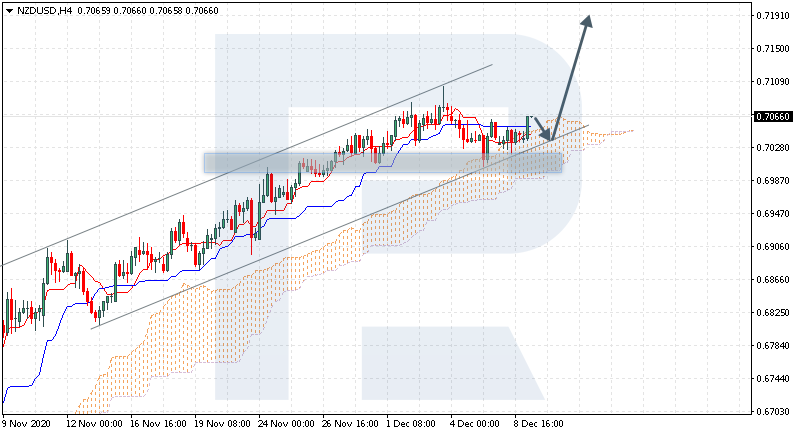
The currency pair is trading at 0.7066 above the Ichimoku Cloud, suggesting an uptrend. A test of the upper border of the Cloud at 0.7055 is expected, followed by growth to 0.7195. An additional signal supporting the growth can be a bounce off the lower border of the ascending channel. The scenario can be canceled by a breakaway of the lower border of the Cloud and securing under 0.6975, which will entail further falling to 0.6895.

NZDUSD

Article By RoboForex.com

Attention!
Forecasts presented in this section only reflect the author’s private opinion and should not be considered as guidance for trading. RoboForex LP bears no responsibility for trading results based on trading recommendations described in these analytical reviews.

Stocks livin’ the stimulus-charmed life

By Han Tan, Market Analyst, ForexTime

US stock indices hit new record highs after the latest attempts to break the political stalemate in Washington, as investors hope that a fresh US fiscal stimulus package could be rolled out by year-end. Risk assets are rejoicing at the thought of thawing political resistance, even though the actual package is not yet a done deal.

On Tuesday, Senate Majority Leader Mitch McConnell hinted at his willingness to compromise with Democrats, which prompted US equities to erase losses from the open and end the session in the green. After markets closed, outgoing US Treasury Secretary Steven Mnuchin then offered a US$916 billion proposal to Democrats as an olive branch, which is the first move by the Trump administration since the November elections to break the deadlock. The latest offer has yet to receive the Democrats’ blessing.

Energy boost: S&P 500 hits all-time high

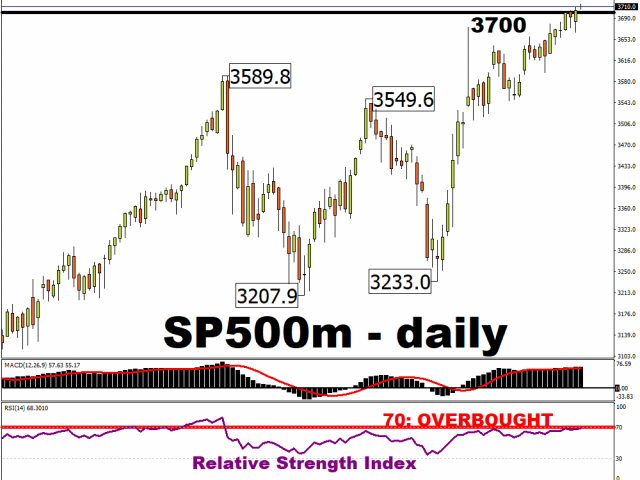
The S&P 500 closed above the 3,700 line for the first time in history, with energy stocks leading the rally once more, and its futures contracts are now holding steady above the psychologically-important level.

However, the blue-chip index is flirting with overbought levels, judging by its 14-day relative strength index. This suggests that a near-term pullback is in order, which may be necessary so that US equities can begin 2021 on the right foot and take full advantage of all the tailwinds that are in play.

Despite having already enjoyed stellar gains in November, the party in US equities is still alive and kicking, as market participants show little qualm pushing benchmark indices further into uncharted waters. Perhaps we are seeing the early makings of a “Santa rally”, with tech counters refusing to be left behind by the reflation rally.

Tech and December: a jolly combo

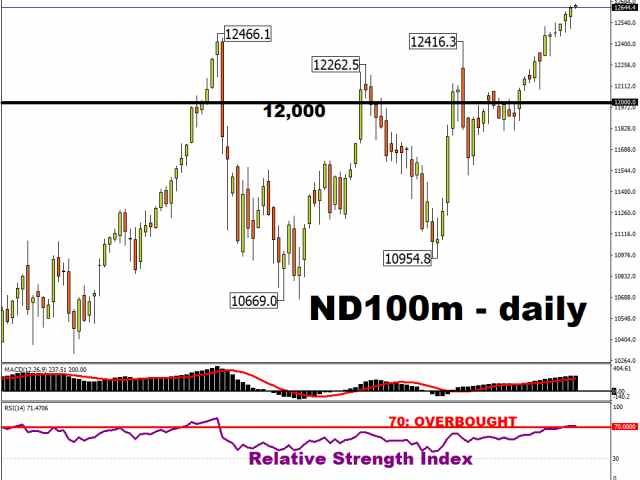
Futures on the Nasdaq 100 index are also holding around its highest levels ever, after the index posted 10 consecutive days of gains. It is now one short of the 11-day winning streak from December 2019.

Yet, as is the case with the S&P 500, the Nasdaq 100 appears due for a pullback towards healthier levels, which could still occur between now and Christmas.

Still the FXTM Trader’s Sentiments remain net long on both the US SPX 500 (Mini) and the US Tech 100 (Mini).

Pfizer vaccine: a big reason for the risk-on season

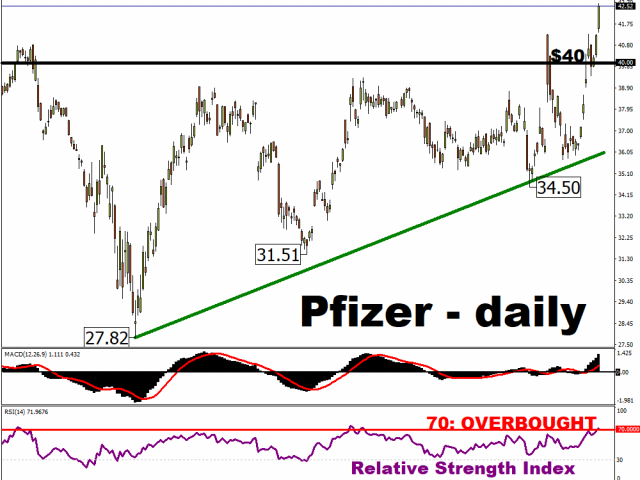
While investors welcome the thought of more incoming fiscal stimulus, with sentiment further supported by ultra-accommodative central banks around the world, the good news surrounding Covid-19 vaccines are also taking much of the credit for the stock gains of late. Investors have been keen to reward these vaccine-producing companies as well, with Pfizer’s shares being sent to a new two-year high.

With Pfizer’s vaccine widely expected to receive US emergency-use authorization tomorrow (Thursday, 10 December), that could spur further gains in the stock, given that trading momentum is still pointing northwards. However, bears may yet capitalize on this “sell-the-news” opportunity, which would in turn bring the stock away from ‘overbought’ levels.


Disclaimer: The content in this article comprises personal opinions and should not be construed as containing personal and/or other investment advice and/or an offer of and/or solicitation for any transactions in financial instruments and/or a guarantee and/or prediction of future performance. ForexTime (FXTM), its affiliates, agents, directors, officers or employees do not guarantee the accuracy, validity, timeliness or completeness, of any information or data made available and assume no liability as to any loss arising from any investment based on the same.


Forex-Time-LogoArticle by ForexTime

ForexTime Ltd (FXTM) is an award winning international online forex broker regulated by CySEC 185/12 www.forextime.com

Yes, “Active Investment Managers” DO Behave Like the “Crowd”

…and that’s not a good thing

By Elliott Wave International

When people hear the phrase “investing crowd,” they tend to think of Main Street investors. Usually dipping their toe in the water after the trend has been underway for quite some time, they are typically seen as the “more cautious” types than Wall Street pros.

Of course, there is a flip side to that “cautiousness”: The “investing crowd” is known for panic-selling near market bottoms and going “all in” near major market tops.

What’s more, Main Street investors are not alone in their “crowd” behavior. It actually permeates most of the investment world, including the professionals.

For example, one might think that professional money managers — with all their education and experience — would take a more reflective and independent stance when considering investment ideas.

But the evidence shows that investment professionals herd like most everyone else.

Here’s a chart and commentary from Robert Prechter’s 2017 book, The Socionomic Theory of Finance:

It is widely known that professional money managers, in the aggregate, fail to beat the market. The result is not, as some theorists say, because the market moves randomly. It is because most professionals are herding, right along with other speculators. [The chart shows] that at good prices for buying stock, mutual fund managers have high levels of cash, and at good prices for selling, they have low levels of cash. This record confirms that they consistently do the opposite of what they should be doing for maximum return.

This chart from Elliott Wave International’s Nov. 25 U.S. Short Term Update, a thrice weekly publication which provides near-term forecasts for major U.S. financial markets, shows another way that active investment managers herd. Here’s the commentary:

The current reading of 106.41 in the National Association of Active Investment Managers Exposure Index is compatible with the extreme readings in the II Survey and the equity p/c ratio. A 100 reading in the Exposure Index means that active managers are fully invested in equities. A level of 106.41 means managers are more than fully invested; they are leveraged long. … Notice managers’ equity position in March of this year, just 10.65. Active managers herd like all investors. They become more optimistic as stocks rally and more pessimistic as stocks decline.

When the stance of active investment managers reaches an extreme, it’s usually a sign that a trend reversal is just around the corner.

At times, however, such “extremes” can persist.

What does today’s extreme mean? For answers, it’s best to also consult the Elliott wave model. When sentiment measures and a market’s Elliott wave pattern are in agreement, a market juncture like today’s can be made with even greater confidence.

If you’d like to gain insights into Elliott wave patterns, you are encouraged to read the Wall Street classic book, Elliott Wave Principle: Key to Market Behavior, by Frost & Prechter. Here’s a quote:

[R.N.] Elliott himself never speculated on why the market’s essential form is five waves to progress and three waves to regress. He simply noted that that was what was happening. Does the essential form have to be five waves and three waves? Think about it and you will realize that this is the minimum requirement for, and therefore the most efficient method of, achieving both fluctuation and progress in linear movement. One wave does not allow fluctuation. The fewest subdivisions to create fluctuation is three waves. Three waves (of unqualified size) in both directions would not allow progress. To progress in one direction despite periods of regress, movements in that direction must be at least five waves, simply to cover more ground than the intervening three waves. While there could be more waves than that, the most efficient form of punctuated progress is 5-3, and nature typically follows the most efficient path.

Good news: You can access the entirety of the online version of Elliott Wave Principle: Key to Market Behavior for free.

Simply follow this link: Elliott Wave Principle: Key to Market Behavior — free and unlimited access.

This article was syndicated by Elliott Wave International and was originally published under the headline Yes, “Active Investment Managers” DO Behave Like the “Crowd”. EWI is the world’s largest market forecasting firm. Its staff of full-time analysts led by Chartered Market Technician Robert Prechter provides 24-hour-a-day market analysis to institutional and private investors around the world.