Archive for Opinions – Page 8

Tariffs 101: What they are, who pays them, and why they matter now

By Kent Jones, Babson College 

The U.S. Supreme Court is currently reviewing a case to determine whether President Donald Trump’s global tariffs are legal.

Until recently, tariffs rarely made headlines. Yet today, they play a major role in U.S. economic policy, affecting the prices of everything from groceries to autos to holiday gifts, as well as the outlook for unemployment, inflation and even recession.

I’m an economist who studies trade policy, and I’ve found that many people have questions about tariffs. This primer explains what they are, what effects they have, and why governments impose them.

What are tariffs, and who pays them?

Tariffs are taxes on imports of goods, usually for purposes of protecting particular domestic industries from import competition. When an American business imports goods, U.S. Customs and Border Protection sends it a tariff bill that the company must pay before the merchandise can enter the country.

Because tariffs raise costs for U.S. importers, those companies usually pass the expense on to their customers by raising prices. Sometimes, importers choose to absorb part of the tariff’s cost so consumers don’t switch to more affordable competing products. However, firms with low profit margins may risk going out of business if they do that for very long. In general, the longer tariffs are in place, the more likely companies are to pass the costs on to customers.

Importers can also ask foreign suppliers to absorb some of the tariff cost by lowering their export price. But exporters don’t have an incentive to do that if they can sell to other countries at a higher price.

Studies of Trump’s 2025 tariffs suggest that U.S. consumers and importers are already paying the price, with little evidence that foreign suppliers have borne any of the burden. After six months of the tariffs, importers are absorbing as much as 80% of the cost, which suggests that they believe the tariffs will be temporary. If the Supreme Court allows the Trump tariffs to continue, the burden on consumers will likely increase.

While tariffs apply only to imports, they tend to indirectly boost the prices of domestically produced goods, too. That’s because tariffs reduce demand for imports, which in turn increases the demand for substitutes. This allows domestic producers to raise their prices as well.

A brief history of tariffs

The U.S. Constitution assigns all tariff- and tax-making power to Congress. Early in U.S. history, tariffs were used to finance the federal government. Especially after the Civil War, when U.S. manufacturing was growing rapidly, tariffs were used to shield U.S. industries from foreign competition.

The introduction of the individual income tax in 1913 displaced tariffs as the main source of U.S. tax revenue. The last major U.S. tariff law was the Smoot-Hawley Tariff Act of 1930, which established an average tariff rate of 20% on all imports by 1933.

Those tariffs sparked foreign retaliation and a global trade war during the Great Depression. After World War II, the U.S. led the formation of the General Agreement on Tariffs and Trade, or GATT, which promoted tariff reduction policies as the key to economic stability and growth. As a result, global average tariff rates dropped from around 40% in 1947 to 3.5% in 2024. The U.S. average tariff rate fell to 2.5% that year, while about 60% of all U.S. imports entered duty-free.

While Congress is officially responsible for tariffs, it can delegate emergency tariff power to the president for quick action as long as constitutional boundaries are followed. The current Supreme Court case involves Trump’s use of the International Emergency Economic Powers Act, or IEEPA, to unilaterally change all U.S. general tariff rates and duration, country by country, by executive order. The controversy stems from the claim that Trump has overstepped his constitutional authority granted by that act, which does not mention tariffs or specifically authorize the president to impose them.

The pros and cons of tariffs

In my view, though, the bigger question is whether tariffs are good or bad policy. The disastrous experience of the tariff war during the Great Depression led to a broad global consensus favoring freer trade and lower tariffs. Research in economics and political science tends to back up this view, although tariffs have never disappeared as a policy tool, particularly for developing countries with limited sources of tax revenue and the desire to protect their fledgling industries from imports.

Yet Trump has resurrected tariffs not only as a protectionist device, but also as a source of government revenue for the world’s largest economy. In fact, Trump insists that tariffs can replace individual income taxes, a view contested by most economists.

Most of Trump’s tariffs have a protectionist purpose: to favor domestic industries by raising import prices and shifting demand to domestically produced goods. The aim is to increase domestic output and employment in tariff-protected industries, whose success is presumably more valuable to the economy than the open market allows. The success of this approach depends on labor, capital and long-term investment flowing into protected sectors in ways that improve their efficiency, growth and employment.

Critics argue that tariffs come with trade-offs: Favoring one set of industries necessarily disfavors others, and it raises prices for consumers. Manipulating prices and demand results in market inefficiency, as the U.S. economy produces more goods that are less efficiently made and fewer that are more efficiently made. In addition, U.S. tariffs have already resulted in foreign retaliatory trade actions, damaging U.S. exporters.

Trump’s tariffs also carry an uncertainty cost because he is constantly threatening, changing, canceling and reinstating them. Companies and financiers tend to invest in protected industries only if tariff levels are predictable. But Trump’s negotiating strategy has involved numerous reversals and new threats, making it difficult for investors to calculate the value of those commitments. One study estimates that such uncertainty has actually reduced U.S. investment by 4.4% in 2025.

A major, if underappreciated, cost of Trump’s tariffs is that they have violated U.S. global trade agreements and GATT rules on nondiscrimination and tariff-binding. This has made the U.S. a less reliable trading partner. The U.S. had previously championed this system, which brought stability and cooperation to global trade relations. Now that the U.S. is conducting trade policy through unilateral tariff hikes and antagonistic rhetoric, its trading partners are already beginning to look for new, more stable and growing trade relationships.

So what’s next? Trump has vowed to use other emergency tariff measures if the Supreme Court strikes down his IEEPA tariffs. So as long as Congress is unwilling to step in, it’s likely that an aggressive U.S. tariff regime will continue, regardless of the court’s judgment. That means public awareness of tariffs ⁠– and of who pays them and what they change ⁠– will remain crucial for understanding the direction of the U.S. economy.The Conversation

About the Author:

Kent Jones, Professor Emeritus, Economics, Babson College

This article is republished from The Conversation under a Creative Commons license. Read the original article.

Silver Hits Record High on Demand and Data

By RoboForex Analytical Department 

On Wednesday, silver surged past 66 USD per ounce, setting a new all-time high. The rally was driven by a mixed US employment report, which sparked investor interest in alternative high-return assets for portfolio diversification.

The November labour market data revealed the unemployment rate climbing to 4.6% – its highest level since 2021 – even as job creation exceeded expectations.

Silver’s year-to-date gain of nearly 130% is further supported by declining inventories and robust demand from both retail investors and industrial users. In particular, expanding sectors such as solar energy, electric vehicles, and data centres are driving increased industrial consumption.

Technical Analysis: XAG/USD

H4 Chart:

On the H4 chart, XAG/USD established a consolidation range around 57.65 USD. Following an upward breakout, the market has extended to 66.72 USD, with scope for further gains towards 69.79 USD. Having completed a growth impulse to 66.51 USD, a minor correction towards 64.64 USD appears possible before the uptrend resumes.

The MACD indicator supports the bullish outlook, with its signal line firmly above zero, indicating sustained upward momentum.

H1 Chart:

On the H1 chart, silver completed a growth wave to 65.30 USD and has since formed a consolidation range around this level. An upward breakout has extended the move to 66.51 USD. A technical pullback towards 65.65 USD may occur; a break below this level could extend the correction towards 60.85 USD. Conversely, a rebound from 65.65 USD would favour a continuation of the uptrend toward 66.72 USD.

The Stochastic oscillator aligns with this view, with its signal line above 80 and trending upward, though nearing overbought territory.

Conclusion

Silver’s record rally reflects strong fundamentals – tightening supply, robust industrial demand, and its appeal as a hedge amid economic uncertainty. While the near-term trend remains bullish, the market is approaching overextended levels, increasing the likelihood of a short-term correction. Key support lies around 65.65 USD, with a break below potentially signalling a deeper pullback. Until then, the momentum favours further tests towards 66.72 USD and possibly 69.79 USD.


Disclaimer:

Any forecasts contained herein are based on the author’s particular opinion. This analysis may not be treated as trading advice. RoboForex bears no responsibility for trading results based on trading recommendations and reviews contained herein.

US oil industry doesn’t see profit in Trump’s ‘pro-petroleum’ moves

By Skip York, Rice University 

As the Trump administration makes announcement after announcement about its efforts to promote the U.S. fossil fuel industry, the industry isn’t exactly jumping at new opportunities.

Some high-profile oil and gas industry leaders and organizations have objected to changes to long-standing government policy positions that give companies firm ground on which to make their plans.

And the financial picture around oil and gas drilling is moving against the Trump administration’s hopes. Though politicians may tout new opportunities to drill offshore or in Arctic Alaska, the commercial payoff is not clear and even unlikely.

Having worked in and studied the energy industry for decades, I’ve seen a number of discoveries that companies struggled to moved forward with because either the discovery was not large enough to be commercially profitable or the geology was too difficult to make development plausible. Market conditions are the prime drivers of U.S. energy investment – not moves by politicians seeking to seem supportive of the industry.

Market fundamentals trump policy announcements

The general decline in oil prices from 2022 through late 2025 has reduced the attractiveness of many drilling investments.

And opening the East and West coasts to drilling may sound significant, but these regions have unconfirmed reserves. That means a lot of subsurface work, such as seismic surveys, stratigraphic mapping and reservoir characterization – potentially taking years – would need to be done before any drilling would begin.

Offshore drilling also faces enormous opposition.

On the West Coast, California Gov. Gavin Newsom and California Attorney General Rob Bonta have made forceful statements against any new California offshore oil drilling. They have said any effort is economically unnecessary, environmentally reckless and “dead on arrival” politically in the state.

California local governments, environmental groups, business alliances and coastal communities also oppose drilling and have vowed to use legal and political tools to block them.

There is opposition on the East Coast, too. More than 250 East Coast local governments have passed resolutions against drilling.

Governors on both sides of the aisle, including Democrat Josh Stein of North Carolina and Republicans Brian Kemp of Georgia and Henry McMaster of South Carolina, have spoken out against drilling off their coasts.

Arctic drilling is even harder

Drilling for oil and gas in the Arctic National Wildlife Refuge and the Beaufort Sea off Prudhoe Bay in Alaska would be a massive undertaking. These projects require years of development and are subject to future reversals in federal policy – just as Trump has lifted long-standing drilling bans in those areas, at least for now.

In addition, Alaska is one of the most expensive and technically challenging places to drill. Specialized equipment, infrastructure for frozen landscapes, and risk mitigation for extreme weather drive costs far above other regions. These projects also face logistical challenges, such as pipelines running hundreds of miles through remote, icy terrain.

Natural gas from Alaska would likely be sold to Asian buyers, who increasingly have alternative sources of supply from Australia, Canada, Qatar and even the U.S. Gulf Coast. As production rises in those places, the entrance of Alaskan natural gas into the market raises the risk for global oversupply, which could depress prices and reduce profitability.

Despite political support from the Trump administration, the oil and gas companies would need financing to pay for the drilling. And those loans won’t come if the oil companies don’t have agreements with buyers for the petroleum products that are produced. Major oil companies have withdrawn from Alaska and signaled skepticism about attractive long-term returns.

Trump has helped some

In the first 10 months of the second Trump administration, the president has signed at least 13 executive orders pertaining to the energy industry. Most of them focus on streamlining U.S. energy regulation and removing barriers to the development and procurement of domestic energy resources. However, the broad nature of some of these orders may fall short of establishing the stable regulatory environment necessary for the development of capital-intensive energy projects with long time horizons.

Those efforts have reversed the Biden administration’s go-slow approach to oil drilling, reducing – though not completely eliminating – the backlog of requests for onshore and offshore drilling permits that accumulated during Biden’s presidency.

Delays in permit approvals increase project costs, risk and uncertainty. Delays can increase the chances that a project ultimately is downsized – as happened with ConocoPhillips’ Willow project in Alaska – or canceled altogether. Longer timelines increase financing and carrying costs, because capital is tied up without generating revenue and developers must pay interest on the debt while waiting for approvals. Delays also lead to higher project costs, eroding project economics and sometimes preventing the project from turning a profit.

Investment follows economics, not politics

Unlike in some countries, such as with Saudi Arabia’s Aramco, Norway’s Equinor or China’s CHN Energy, the U.S. does not have a national oil or gas company. All of the major energy producers in the U.S. are privately owned and answer to shareholders, not the government.

Executive orders or political slogans may set a tone or direction, but they cannot override the fundamental requirement for profitability. Investments can’t be mandated by presidential decree: Projects must make economic sense. Without that, whether due to low prices, high costs, uncertain demand or changing regulations, companies will not proceed.

Even if federal policies open new areas for drilling or relieve some regulatory restrictions, companies will invest only if they see a clear path to profit over the long term.

With most energy investments costing large amounts of money over many years, the industry likely wants a sense of policy stability from the Trump administration. That could include lowering barriers to profitable investments by accelerating the approval process for supporting infrastructure, such as transmission power lines, pipelines, storage capacity and other logistics, rather than relying on sweeping announcements that lack market traction.The Conversation

About the Author:

Skip York, Nonresident Fellow in Energy and Global Oil, Baker Institute for Public Policy, Rice University

This article is republished from The Conversation under a Creative Commons license. Read the original article.


Whether Netflix or Paramount buys Warner Bros., entertainment oligopolies are back – bigger and more anticompetitive than ever

By Matthew Jordan, Penn State 

News of Netflix’s bid to buy Warner Bros. last week sent shock waves through the media ecosystem.

The pending US$83 billion deal is being described as an upending of the existing entertainment order, a sign that it’s now dominated by the tech platforms rather than the traditional Hollywood power brokers.

As David Zaslav, CEO of Warner Bros. Discovery, put it, “The deal with Netflix acknowledges a generational shift: The rules of Hollywood are no longer the same.”

Maybe so. But what are those rules? And are they being rewritten, or will moviegoers and TV audiences simply find themselves back in the early 20th century, when a few powerful players directed the fate of the entertainment industry?

The rise of the Hollywood oligopolies

As Hollywood rose to prominence in the 1920s, theater chain owner Adolf Zuker spearheaded a new business model.

Cartoon of man straddling three different horses and cracking them with a whip.
Lew Merrell’s 1920 cartoon for Exhibitors Herald, a film industry trade publication, depicts Adolf Zukor performing the feat of vertical integration.
Wikimedia Commons

He used Wall Street financing to acquire and merge his film distribution company, Famous Players-Lasky, the film production company Paramount and the Balaban and Katz chain of theaters under the Paramount name. Together, they created a vertically integrated studio that would emulate the assembly line production of the auto industry: Films would be produced, distributed and shown under the same corporate umbrella.

Meanwhile, Harry, Albert, Sam and Jack Warner – the Warner brothers – had been pioneer theater owners during the nickelodeon era, the period from roughly 1890 to 1915, when movie exhibition shifted from traveling shows to permanent, storefront theaters called nickelodeons.

They used the financial backing of investment bank Goldman Sachs to follow Zucker’s Hollywood model. They merged their theaters with several independent production companies: the Vitagraph film distribution company, the Skouras Brothers theater chain and, eventually, First National.

But the biggest of the Hollywood conglomerates was Metro-Goldwyn-Mayer, created when the Loews theater chain merged Metro Pictures, Goldwyn Pictures and Mayer Pictures.

At its high point, MGM had the biggest stars of the day under noncompete contracts and accounted for roughly three-quarters of the entire industry’s gross revenues.

By the mid-1930s, a handful of vertically integrated studios dominated Hollywood – MGM, Paramount, Warner Brothers, RKO and 20th Century Fox – functioning like a state-sanctioned oligopoly. They controlled who worked, what films were made and what made it into the theaters they owned. And though the studios’ holdings came and went, the rules of the industry remained stable until after World War II.

Old Hollywood loses its cartel power

In 1938, the Department of Justice and the Federal Trade Commission sued the “Big Five” studios, arguing that their vertically integrated model was anti-competitive.

After the Supreme Court decided in favor of the U.S. government in 1948 – in what became known as the Paramount Decisionthe studios were forced to sell off their theater chains, which checked their ability to squeeze theaters and squeeze out independent producers.

With the studios’ cartel power weakened, independent filmmakers like Elia Kazan and John Cassavetes flourished in the 1950s, making pictures like “On the Waterfrontthat the studios had rejected. Foreign films found their ways to American screens no longer constrained by block booking, a practice that forced exhibitors to pay for a lot of mediocre films if they wanted the good ones, too.

By the 1960s, a new generation of filmmakers like Mike Nichols and Stanley Kubrick scored big with audiences hungry for something different than the escapist spectacles Hollywood was green-lighting. They took risks by hiring respected writers and unknown actors to tell stories that were truer to life. In doing so, they flipped Hollywood’s generic formulas upside down.

A decade ago, I wrote about how Netflix’s streaming model pointed to a renaissance of innovative storytelling, similar to the period after the Paramount Decision.

By streaming their indie film “Beast of No Nation” directly to subscribers at home, Netflix posed a direct threat to Hollywood’s blockbuster model, in which studios invested heavily in a small number of big-budget films designed to earn enormous box office returns. At the time, Netflix’s 65 million global subscribers gave it the capital to produce exclusive content for its expanding markets.

Hollywood quickly closed the streaming gap, developing its own platforms and restricting access of its vast catalogs to subscribers.

Warner Bros. bought and sold

In 2018, AT&T acquired Time Warner, the biggest media conglomerate of the time, and DirectTV. It hoped to merge its 125 million-plus telecommunication customers with Time Warner’s content and create a streaming giant to compete with Netflix.

Then came the COVID-19 pandemic, and the theatrical model for film distribution collapsed.

The pressure on AT&T’s stock led the company to sell off HBO and WarnerMedia to Discovery in 2022 for $43 billion. Armed with the HBO and Warner Bros. libraries – along with the advertising potential of CNN, TNT and Turner Sports – CEO David Zaslav was bullish about the company’s potential for growth.

Warner Bros. Discovery became the third-largest streaming platform in terms of subscribers behind Netflix and Disney+, which had gobbled up 20th Century Fox.

But the results have been bad for audiences.

In 2023, Zaslav rolled out a bundled streaming platform called Max that combined the libraries of HBO Max and Discovery+, which ended up confusing consumers and the market. So it reverted back to HBO Max because consumers recognized the brand.

Zaslav then decided it was more cost effective to cancel innovative projects or write off completed films as losses. Zaslav often claims his deals are “good for consumers,” in that they get more content in one place. But conglomerates who defend their anti-competitive practices as signs of an efficient market that benefit “consumer welfare” frequently say that, even when they are making the product worse and limiting choices.

His deals have been especially bad for the television side, yielding gutted newsrooms and canceled scripted shows.

Effectively, in only three years, the Warner Bros. Discovery merger has validated nearly all the concerns that critics of “market first” policymaking have warned about for years. Once it had a dominant market share, the company started providing less and charging more.

Meet the new boss – same as the old boss

If it does go through, the Netflix-Warner Bros. merger will likely please Wall Street, but it will further decrease the power of creators and consumers.

Like other companies that have moved from being a growth stock to a mature stock, Netflix is under pressure to be profitable. Indeed, it has been squeezing its subscribers with higher fees and more restrictive login protocols. It’s a sign of what tech blogger Cory Doctorow describes as the logic of “enshittification,” whereby platforms that have locked in audiences and producers start to squeeze both. Buying the competition – HBO Max – will mean Netflix can charge even more.

After the Netflix deal was announced, Paramount joined forces with President Donald Trump’s son-in-law Jared Kushner, the Saudi Sovereign Wealth fund and others to announce a hostile counteroffer.

Now, all bets are off. Whichever platform acquires Warner Bros. will have enormous power over the kind of stories that get sold and told.

In either case, Warner Bros. would be bought by a direct competitor. The Department of Justice, under the first Trump administration, already pushed to sunset the Paramount Decision, claiming that the distribution model had changed to such an extent that it was unlikely that Hollywood could ever reinstate its cartel. It’s hard to imagine that Trump 2.0 will forbid more media concentration, especially if the new parent company is friendly to the administration.

No matter which bidder becomes the belle of Trump’s ballroom, this merger illustrates how show business works: When dominant platforms also own the studios and their assets, they control the fate of the movie business – of actors, writers, producers and theaters.

Importantly, the concentration is taking place as artificial intelligence threatens to displace many aspects of film production. These corporate behemoths will determine if the film libraries spanning a century of Hollywood production will be used to train the machines that could replace artists and creatives. And with each prospective buyer taking on over $50 billion in bank debt to pay for the deal, the new parent of Warner Bros. will be looking everywhere for profits and opportunities to cut costs.

If history is any guide, there will be struggles ahead for consumers and competing creatives. In a media system that has veered back to following Hollywood’s yellow brick rules of the road, the new oligopolies are an awful lot like the old ones.The Conversation

About the Author:

Matthew Jordan, Professor of Media Studies, Penn State

This article is republished from The Conversation under a Creative Commons license. Read the original article.

 

Week Ahead: USDInd faces triple risk – NFP, CPI & ECB

By ForexTime 


  • USDInd ↓ 9% YTD, weakened against all G10 this year
  • ECB expected to leave rates unchanged
  • NFP + CPI + ECB = heightened volatility?
  • Over past year NFP triggered moves of ↑ 0.7% & ↓ 0.4%
  • Technical levels: 100.00, 98.00 & 97.20.

A flurry of high-risk events could rattle global markets in the week ahead. 

Rate decisions by major central banks, speeches from policy makers and key economic data spell fresh trading opportunities:

Monday, 15th December

  • JPY: Tankan Large Manufacturing Index (Q4)
  • CNY: China Industrial Production (Nov); Retail Sales (Nov); Fixed Asset Investment (Nov); Foreign Direct Investment (Nov)
  • EUR: Germany Wholesale Prices (Nov); Eurozone Industrial Production (Oct)
  • CAD: Canada Inflation Rate (Nov)
  • USDInd: New York Fed President John Williams speech


Tuesday, 16th December

  • AUD: Westpac Consumer Confidence Change (Dec)
  • JPY: Japan S&P Global manufacturing and Services PMIs (Dec)
  • GBP: UK Unemployment Rate (Oct); S&P Global Manufacturing and Services PMIs (Dec)
  • EUR: Germany Composite, Manufacturing and Services PMIs (Dec); ZEW Economic Sentiment Index (Dec)
  • USD: US NFP (Nov); Retail Sales (Oct); Unemployment Rate (Nov)


Wednesday, 17th December

  • NZD: New Zealand Current Account (Q3)
  • JPY: Japan Balance of Trade (Nov); Machinery Orders (Oct)
  • UK100: UK Inflation Rate (Nov)
  • EUR: Germany Ifo Business Climate (Dec)
  • US500: US Retail Sales (Nov); Business Inventories (MoM); Fed Williams and Bostic Speeches
  • WTI: API Crude Oil Stock Change (w/e Dec 12)


Thursday, 18th December

  • NZD: New Zealand GDP (Q3)
  • GBP: BoE Interest Rate Decision & MPC Meeting Minutes
  • EUR: ECB Interest Rate Decision
  • USD: US Inflation Rate (Nov); Initial Jobless Claims (w/e Dec 13)
  • MXN: Mexico Interest Rate Decision


Friday, 19th December

  • JPY: BoJ Interest Rate Decision; Inflation Rate (Nov)
  • UK100: UK Retail Sales (Nov); GfK Consumer Confidence (Dec)
  • EUR: Germany GfK Consumer Confidence (Jan); Germany PPI (Nov); Eurozone Consumer Confidence Dec)
  • CAD: Canada Retail Sales (Nov)
  • USD: US Existing Home Sales (Nov); Michigan Consumer Sentiment Final (Dec)


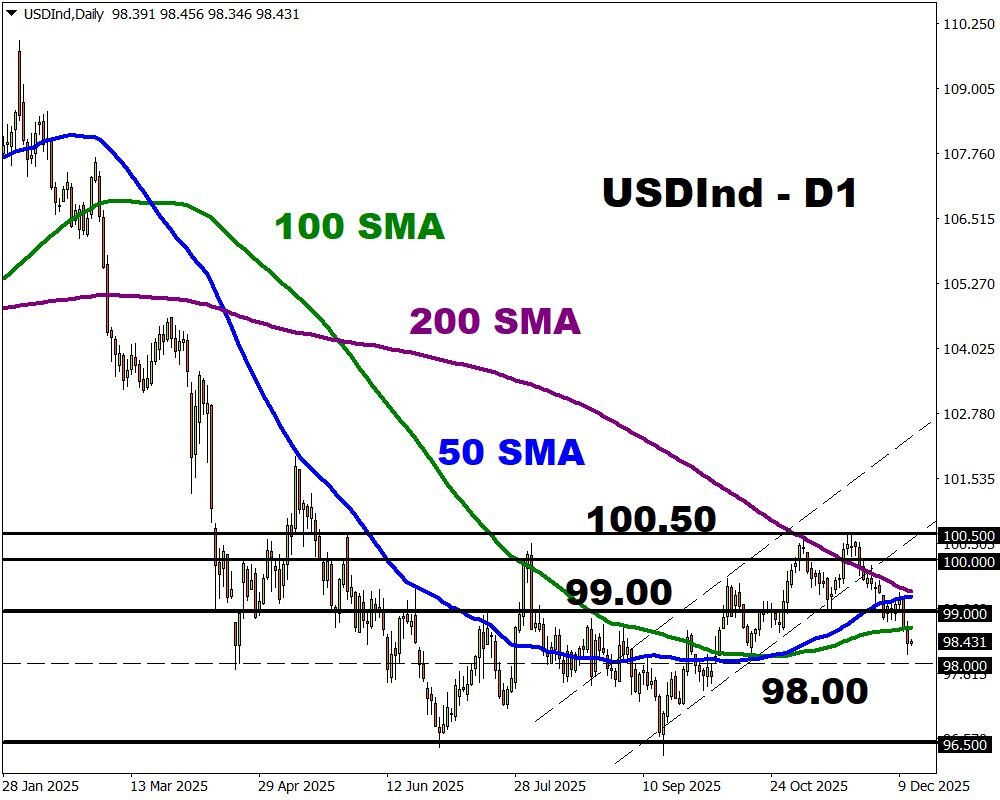
Our focus falls on the USDInd which has shed over 9% year-to-date.

Note: The USD Index tracks how the dollar is performing against a basket of six different G10 currencies, including the Euro, British Pound, Japanese Yen, and Canadian dollar.

Here is how they are weighed:

  • Euro: 57.6%
  • JPY: 13.6% 
  • GBP: 11.9% 
  • CAD: 9.1% 
  • SEK: 4.2%
  • CHF: 3.6%


These 3 factors could rock the USDInd in the week ahead:


1) US October/November NFP – Tuesday 16th December

The US is to release November nonfarm payroll figures, incorporating elements of October as well, the first major snapshot of employment since the government shutdown.

Markets expect the US economy to have created only 50,000 jobs in November while the unemployment rate to remain unchanged at 4.4%. The low numbers are reflective of how the government shutdown impacted labour markets.

  • A stronger-than-expected US jobs report could cool rate cut bets, pushing the USDInd higher as a result.
  • However, further evidence of a cooling US jobs market could reinforce expectations around lower US rates – pulling the USDInd lower.


USDInd is forecast to move 0.7% up or 0.4% down in a 6-hour window after the US NFP report.


2) US November CPI – Thursday 18th December

The incoming US Consumer Price Index (CPI) may impact bets around Fed cuts in the first few months of 2026.

Markets are forecasting:

  • CPI year-on-year (November 2025 vs. November 2024) to rise 3.1%.
  • Core CPI year-on-year to rise 3%.

Signs of rising inflation pressures may shave bets around the Fed cutting interest rates.

Note: The US retail sales reports and speeches by Fed officials may impact the USDInd throughout the week.

USDInd is forecast to move 0.2% up or 0.6% down in a 6-hour window after the US CPI report.

3) ECB rate decision – Thursday 18th December

The ECB is widely expected to leave interest rates unchanged at its meeting on Thursday, December 18th. This decision may be based on the Eurozone’s resilience in the face of trade tensions and improving economic outlook.

However, any clues about future policy moves could spark fresh volatility.

Note: The Euro accounts for almost 60% of the USDInd weight. A weaker euro tends to push the index higher and vice versa.

  • The USDInd could jump if the ECB strikes a dovish note and hints at potential cuts in 2026.
  • If the ECB sounds less dovish than expected on future rate cuts, this could drag the USDInd lower as the Euro appreciates.

USDInd is forecast to move 0.2% up or 0.3% down in a 6-hour window after the ECB rate decision.

Note: The Bank of England, Bank of Japan and Riksbank bank decisions may also impact the USDInd considering how they make up almost 30% of its weight.


4) Technical forces

FXTM’s USDInd is under pressure on the daily charts.

  • A solid breakout and daily close above 99.00 could trigger an incline towards the 200-day SMA at 99.50 and 100.00.
  • Should prices break below 98.00, bears could be encouraged to hit 97.20 and 96.50.


Forex-Time-LogoArticle by ForexTime


ForexTime Ltd (FXTM) is an award winning international online forex broker regulated by CySEC 185/12 www.forextime.com

The marketing genius of Spotify Wrapped

By Ishani Banerji, Clemson University 

Even before this year’s Spotify Wrapped dropped, I had a hunch what mine would reveal.

Lo and behold, one of my most-listened-to songs was an obscure 2004 track titled “Rusty Chevrolet” by the Irish band Shanneyganock. I heard it first thanks to my son, whose friend had been singing it on the swings at school. My son found it utterly hilarious, and it’s been playing in our house nonstop ever since.

Like parents all over the world, I rue how my son’s musical tastes have hijacked my listening history. But I’m also tickled to learn that our household is probably one of the few even listening to it.

Spotify Wrapped is an annual campaign by the popular streaming music platform. Since 2015, the streaming service has been repackaging user data – specifically, the listening history of Spotify’s users over the past year – into attractive, personalized slideshows featuring, among other data points, your top five songs, your total listening time and even your “listening personality.” (Are you a “Replayer,” a “Maverick” or a “Vampire”?)

As a consumer behavior researcher, I’ve thought about why these lists get so much attention each year. I suspect that the success of Spotify Wrapped may have a lot to do with how the flashy, shareable graphics are connected to a couple of fundamental – and somewhat contradictory – human needs.

Individuality and belonging

In 1991, social psychologist Marilynn Brewer introduced what she coined “optimal distinctiveness theory.”

She argued that most people are torn between two human needs. On the one hand, there’s the need for “validation and similarity to others.” On the other hand, people want to express their “uniqueness and individuation.” Thus, most of us are constantly striving for a balance between feeling connected to others while also maintaining a sense of our own distinct individuality.

At Thanksgiving, for example, your need for connection is likely more than satisfied. In that moment, you’re surrounded by family and friends who share a lot in common with you. In fact, it can feel so fulfilled that you may start craving the opposite: a way to assert your individuality. Maybe you choose to wear something that really reflects your personality, or you tell stories about interesting experiences you’ve had in the past year.

In contrast, you may feel relatively isolated when you move to a new town and feel a stronger need for connection. You may wear the styles and brands you see your neighbors and co-workers wearing, pop into popular cafes and restaurants, or invite people over to your home in an effort to make new friends.

Have it your way

When people buy things, they often make choices as a way to satisfy their needs for connection and individuality.

Brands recognize this and usually try to entice consumers with at least one of these two elements. It’s partly why Coca-Cola started releasing bottles featuring popular names on the labels as part of its “Share a Coke” campaign. The soft drink remains the same, but grabbing a Coke with your name on it can cultivate a sense of connection with everyone else who has it. And it’s why Apple offers custom, personalized engravings for products such as its AirPods and iPads.

Spotify Wrapped works because it nails the balance between competing needs: the desire to belong and the desire to stand out. Seeing the overlap between your lists and those of your friends fosters a sense of connection, and seeing the differences is a signal of your (or your kids’!) unique musical taste. It gives me a way to say, “Sure, I’ve been listening to ‘Soda Pop’ nonstop like everyone else. But I’m probably the only one playing ‘Rusty Chevrolet’ on repeat.”

The Wrapped campaign is also smart marketing. Spotify turns listeners’ unique, personal listening data into striking visuals that are tailor-made for posting to social media accounts. It’s no wonder, then, that the Wrapped feature has led to impressive engagement: On TikTok, the hashtag #SpotifyWrapped garnered 73.7 billion views in 2023. The annual campaign has earned numerous honors, including a Cannes Lion and several Webby Awards, otherwise known as the “Oscars of the Internet.”

It’s been so successful that it’s inspired a wave of copycats: Apple Music, Reddit, Uber and Duolingo now release similarly personalized “year-in-reviews.”

None, however, has managed to achieve the same level of cultural impact as Spotify Wrapped. So what’s on your list? And will you brag, hide or laugh at what it says about you?The Conversation

About the Author:

Ishani Banerji, Clinical Assistant Professor of Marketing, Clemson University

This article is republished from The Conversation under a Creative Commons license. Read the original article.


What 38 million obituaries reveal about how Americans define a ‘life well lived’

By Stylianos Syropoulos, Arizona State University; David Markowitz, Michigan State University, and Kyle Fiore Law, Arizona State University 

Obituaries preserve what families most want remembered about the people they cherish most. Across time, they also reveal the values each era chose to honor.

In a study published in the journal Proceedings of the National Academy of Sciences, we analyzed 38 million obituaries of Americans published from 1998 to 2024. We identified the values families most often highlight, and how those values shift across generations, regions and major historical events.

Specifically, working with psychologists Liane Young and Thomas Mazzuchi, we examined the language used on Legacy.com, an online platform where families often post obituaries and share memories of loved ones.

During their lifetime, most people tend to be guided by a small set of broad values like caring for others, honoring tradition, keeping loved ones safe and seeking personal growth. To understand how these values showed up in remembrance, we used text-analysis tools built on curated lists of everyday words people use when talking about those themes.

By analyzing the words that appeared again and again in memorials, we could see which values communities chose to emphasize when looking back on the lives of their loved ones, and how those patterns changed over time. Because the dataset included 38 million obituaries, the analysis ran on a supercomputer.

Across nearly 30 years of obituaries, words related to the value “tradition” appeared most often – many tributes described religious participation and enduring customs. Words related to the value “benevolence” – caring for the welfare of others – were also consistently prominent. In fact, tradition and benevolence formed the dominant value profile across the dataset: They appeared in more than 70% of the obituaries. By contrast, words related to values like “achievement” and “power” appeared far less often.

Historical events did leave a mark. After the attacks of Sept. 11, 2001, the language families used to remember loved ones shifted compared with the period just before the attacks – and those shifts persisted for at least a year. Words related to the value “security” – including terms like “surviving,” “health” and “order” – showed up less often. At the same time, families used more language related to values like “benevolence” and “tradition.” Terms like “caring,” “loyal” and “service” showed up more often. These changes were especially strong in New York, where the attacks had the most direct impact.

COVID-19, however, produced the most dramatic shifts. Beginning in March 2020, benevolence-related language – including terms like “love,” “sympathy” and “family” – declined sharply, and hasn’t been the same since. Tradition-related language – terms like “service,” “faith” and “heritage” – initially declined as well, then rose above baseline levels during later stages of the pandemic.

These changes show that collective disruptions impact the moral vocabulary families use when commemorating loved ones. They shift what it means to have lived a good life.

We also saw differences that reflect stereotypes about gender and age. Obituaries for men contained more language linked to achievement, conformity and power. Meanwhile, obituaries for women contained more language associated with benevolence and enjoying life’s pleasures.

Older adults were often remembered more for valuing tradition. Younger adults, on the other hand, were often remembered more for valuing the welfare of all people and nature, and for being motivated to think and act independently. Value patterns in men’s obituaries shifted more across the lifespan than those in women’s. In other words, the values highlighted in younger and older men’s obituaries differed more from each other, while women’s value profiles stayed relatively consistent across age.

Why it matters

The most visited parts of print newspapers and online memorial sites, obituaries offer a window into what societies value at different points in time.

This study contributes to the broader scientific understanding of legacy. People often hold strong preferences about how they want to be remembered, but far less is known about how they actually are remembered, in part because large-scale evidence about real memorials is rare. Our analysis of millions of obituaries helps fill that gap.

What’s next

Obituaries allow researchers to trace cultural values across time, geography and social groups. Future work can examine differences across race and occupation, as well as across regions. It could also look to earlier periods using historical obituary archives, such as those preserved in older newspapers and local records.

Another direction is to examine whether highlighting how often kindness shows up in obituaries could inspire people to be more caring in daily life.

Understanding what endures in memory helps clarify what people consider meaningful; those values shape how they choose to live.

The Research Brief is a short take on interesting academic work.The Conversation

About the Author: 

Stylianos Syropoulos, Assistant Professor of Psychology, Arizona State University; David Markowitz, Associate Professor of Communication, Michigan State University, and Kyle Fiore Law, Postdoctoral Research Scholar in Sustainability, Arizona State University

This article is republished from The Conversation under a Creative Commons license. Read the original article.

 

How keeping down borrowing costs for mortgages and other loans is built into the Fed’s ‘dual mandate’

By Arabinda Basistha, West Virginia University 

What’s the point of monetary policy?

For most of us, the main impact tends to be how much we have to pay to borrow to buy a house or car. But for the Federal Reserve, the purpose of its monetary policy is mandated by Congress.

This is widely known as the Federal Reserve’s dual mandate: promoting maximum employment and stable prices. The Fed itself refers to these two objectives regularly in its Federal Open Market Committee statements announcing its monetary policy decisions.

A third objective of monetary policy, however, is less well-known: moderate long-term interest rates.

This “third mandate” was a big news story in September 2025, when the Trump administration’s newly appointed Fed governor, Stephen Miran, referred to it in his testimony before the Senate Banking Committee. Financial markets paid close attention to this aspect of the testimony because the comments suggested that Miran and other presidential appointees may focus on this third mandate – and on driving down long-term borrowing costs – more than the Fed has in the recent past.

I’ve been closely following how the Fed conducts monetary policy for many years. Miran is correct that Congress has tasked the U.S. central bank with all three of these objectives – but that’s not the whole story. In fact, none of these goals were originally spelled out in the act that set up the Fed over a century ago.

Since then, the Fed’s goals have been revised several times – typically in response to a crisis.

The Fed’s shifting goals

The original purpose of the Fed, as explained in the Federal Reserve Act of 1913, was to provide flexibility in the nation’s currency supply and to supervise the U.S. banking system. The current dual mandate was not part of the original goals of the Fed.

Instead, its core goal was to reduce the frequent banking panics that were costly to the economy and sharply increased interest rates.

The first big change in the goals, in response to the Great Depression, was the Employment Act of 1946 that stated the goal of federal government policy – and, therefore that of the Fed – is to “promote maximum employment, production and purchasing power.”

This is where the two goals of the dual mandate first began to emerge, with purchasing power implying the Fed needed to keep inflation low.

Following the macroeconomic instability of the 1970s with high unemployment and high inflation, Congress enacted the Federal Reserve Reform Act of 1977 that formalized the Fed mandate: “maintain long run growth of the monetary and credit aggregates commensurate with the economy’s long run potential to increase production, so as to promote the goals of maximum employment, stable prices, and moderate long-term interest rates.”

In other words, Congress gave the Fed three mandates to follow in monetary policy.

What happened to the third mandate?

So why doesn’t the Fed still talk about that third mandate?

Part of the answer is that moderate long-term interest rates are a natural by-product of successfully managing the other two.

In pursuit of low inflation and maximum employment, the Fed primarily uses a short-term interest rate, known as the Federal Funds rate. When journalists report that the Fed raised or lowered interest rates, this refers to the so-called target rate that the central bank uses to control the Fed Funds rate. For example, the current target rate is a range of 3.75% to 4%, while the effective Fed Funds rate is 3.89%. Banks use the funds rate as the cost other banks must pay to borrow reserve funds for one day.

However, most of the interest rates that matter to people, businesses and the economy at large have much longer terms – such as five, 10 or 30 years. Examples include mortgages, car loans and corporate bonds. The Fed does not directly control these longer-term interest rates, which are set by financial markets.

But studies have found that the Fed’s policy decisions can influence long-term rates, primarily due to “expectations theory.” That theory argues that long-term rates reflect financial markets’ expectations of future short-term rates.

So if markets believe the Fed has inflation under control, they tend to keep long-term rates on mortgages and everything else low because they don’t expect the Fed will increase its target rate. If inflation is running high, long-term rates tend to rise because markets expect the Fed to have to lift its short-term rate to deal with it. But if unemployment is running high, long-term rates tend to fall because markets expect the Fed to reduce its short-term rate to deal with that.

Longer-term rates are, therefore, not independent of the dual mandate of the Fed. They are often an outcome of how successfully the Fed is meeting the dual mandate of full employment and stable prices currently and in the future.

As a result, the Fed doesn’t typically talk about this third mandate.

Promoting economic stability

That said, the Fed has, at times, although very rarely, influenced long-term rates directly.

For example, in late 2010, following the Great Recession of 2007-2009, the Fed purchased billions of dollars’ worth of long-term Treasury bonds and other securities – a program known as “QE2” for quantitative easing – in an effort to lower the cost of borrowing for consumers and businesses. The Fed did something similar in 1961 with Operation Twist, similarly with an aim to support the U.S. economy by reducing long-term borrowing costs.

But even this phase of quantitative easing was primarily about meeting the Fed’s dual mandate. More specifically, since inflation was already low, the Fed was trying to boost hiring in the wake of the Great Recession.

The Fed is keenly aware that longer-term interest rates that are not aligned with its dual mandate can be an important source of instability in the economy. A modern central bank’s primary goal is to promote stability in the economy, so longer-term interest rates should be at levels that are appropriate to ensure current and future economic stability.The Conversation

About the Author:

Arabinda Basistha, Associate Professor of Economics, West Virginia University

This article is republished from The Conversation under a Creative Commons license. Read the original article.


Netflix-Warner deal would drive streaming market further down the road of ‘Big 3’ domination

By David R. King, Florida State University 

When it comes to major U.S. industries, three tends to be the magic number.

Historically, auto manufacturing was long dominated by Chrysler, Ford and General Motors – the so-called “Big Three,” which at one point controlled over 60% of the U.S. auto market. A dominant trio shows up elsewhere, too, in everything from the U.S. defense market – think Lockheed Martin, Boeing and Northrup Grumman – to cellphone service providers (AT&T, T-Mobile and Verizon). The same goes for the U.S. airline industry in which American, Delta and United fly higher than the rest.

The rule of three also applies to what Americans watch; the glory days of television was dominated by three giants: ABC, CBS and NBC.

Now, in the digital age, we are rapidly moving to a “Big Three” dominating streaming services: Netflix, Amazon and Disney.

The latest step in that process is Netflix’s plan to acquire Warner Bros. for US$72 billion. If approved, the move would solidify Netflix as the dominant streaming platform.

When streams converge

Starting life as a mail DVD subscription service, Netflix moved into streaming movies and TV shows in 2007, becoming a first-mover into the sphere.

Being an early adopter as viewing went from cable and legacy to online and streaming gave Netflix an advantages in also developing support technology and using subscriber data to create new content.

The subsequent impact was Netflix became a market leader, with quarterly profits now far exceeding its competitors, which often report losses.

Today, even without the Warner Bros. acquisition, Netflix has a dominant global base of over 300 million subscribers. Amazon Prime comes second with roughly 220 million subscribers, and Disney – which includes both Disney+ and Hulu – is third, with roughly 196 million subscribers. This means that between them, these three companies already control over 60% of the streaming market.

Netflix’s lead would only be reinforced by the proposed deal with Warner Bros., as it would add ownership of Warner subsidiary HBO Max, which is currently the fourth-biggest streamer in the U.S. with a combined 128 million subscribers. While some of them will overlap, Netflix is likely to still gain subscribers and better retain them with a broader selection of content.

Netflix’s move to acquire Warner Bros. also follows prior entertainment industry consolidation, driven by a desire to control content to retain streaming service subscribers.

In 2019, Disney acquired 21st Century Fox for $71.3 billion. Three years later, Amazon acquired Metro-Goldwyn-Mayer for $8.5 billion.

Should the Netflix deal go through, it would continue this trend of streaming consolidation. It would also leave a clear gap at the top between the emerging Big Three and other services, such as Paramount+ with 79 million subscribers and Apple TV+, which has around 45 million. Paramount+ was also a rival bidder for Warner Bros., and while it is protesting Netflix’s deal for Warner Bros., it likely will need to pursue other options to remain relevant in streaming.

Why industries come in threes

But why do industries converge to a handful of companies?

As an expert on mergers, I know the answer comes down to market forces relating to competition, which tends to drive consolidation of an industry into three to five firms.

From a customer perspective, there is a need for multiple options. Having more than one option avoids monopolistic practices that can see prices fixed at a higher rate. Competition between more than one big player is also a strong incentive for additional innovation to improve a product or service.

For these reasons, governments – in the U.S. and over 100 other countries – have antitrust laws and practices to avoid any industry displaying limited competition.

However, as industries become more stable, growth tends to slow and remaining businesses are forced to compete over a largely fixed market. This can separate companies into industry leaders and laggards. While leaders enjoy greater stability and predictable profits, laggards struggle to remain profitable.

Lagging companies often combine to increase their market share and reduce costs.

The result is that consolidating industries quite often land on three main players as a source of stability – one or two risks falling into the pitfalls of monopolies and duopolies, while many more than three to five can struggle to be profitable in mature industries.

What’s ahead for the laggards

The long-term viability of companies outside the “Big Three” streamers is in doubt, as the main players get bigger and smaller companies are unable to offer as much content.

A temporary solution for smaller streamers to gain subscribers is to offer teaser rates that later increase for people that forget to cancel until companies take more permanent steps. But lagging services will also face increased pressure to exit streaming by licensing content to the leading streaming services, cease operations or sell their services and content.

Additionally, companies outside the Big Three could be tempted to acquire smaller services in an attempt to maintain market share.

There are already rumors that Paramount, which was a competing bidder for Warner Bros., may seek to acquire Starz or create a joint venture with Universal, which owns Peacock.

Apple shows no immediate plan of discontinuing Apple TV+, but that may be due to the company’s high profitability and an overall cash flow that limits pressures to end its streaming service.

Still, if the Netflix-Warner Bros. deal completes, it will likely increase the valuation of other lagging streaming services due to increased scarcity of valuable content and subscribers. This is due to competitive limits that restrict the Big Three from getting bigger, making the combination of smaller streaming services more valuable.

This is reinforced by shareholders expecting similar or greater premiums from prior deals, driving the need to pay higher prices for the fewer remaining available assets.

The cost to consumers

So what does this all mean for consumers?

I believe that in general, consumers will largely not be impacted when it comes to the overall cost of entertainment, as inflationary pressures for food and housing limit available income for streaming services.

But where they access content will continue to shift away from cable television and movie theaters.

Greater stability in the streaming industry through consolidation into a Big Three model only confirms the decline in traditional cable.

Netflix’s rationale in acquiring Warner Bros. is likely to enable it to offer streaming at a lower price than the combined price of separate subscriptions, but more than Netflix alone.

This could be achieved through additional subscription tiers for Netflix subscribers wanting to add HBO Max content. Beyond competition with other members of the “Big Three,” another reason why Netflix is unlikely to raise prices significantly is that it will likely commit to not doing so in order to get the merger approved.

Netflix’s goal is to ensure it remains consumer’s first choice for streaming TV and films. So while streaming is fast becoming a Big Three industry, Netflix’s plan is to remain at the top of the triangle.The Conversation

About the Author: 

David R. King, Higdon Professor of Management, Florida State University

This article is republished from The Conversation under a Creative Commons license. Read the original article.


Week Ahead: Fed showdown to set market tone

By ForexTime 


  • Fed expected to cut rates for third time in 2025 
  • Updated dot plot and economic projections in focus
  • Trader’s pricing 27% chance of another cut by January 2026 
  • RUS2000: Fed decision forecasted to trigger moves of ↑ 1.8% & ↓ 2.5% 
  • XAGUSD & Bitcoin to see fresh volatility?

The Fed’s decision on December 10th could be the biggest event in Q4!

Such an event is likely to trigger fresh opportunities across markets.

To be clear, US rates are expected to be cut for the third time this year but the outlook for 2026 is harder to determine.

Considering the many variables at play, anything is on the table…

Before we take a deep dive, here is a calendar of events for the week ahead:

Monday, 8th December

  • CNY: China Balance of Trade (Nov)
  • EUR: Germany Industrial Production (Oct)
  • JPY: Japan GDP (Q3 final)
  • CHF: Swiss Consumer Confidence (Nov)


Tuesday, 9th December

  • GBP: BRC Retail Sales Monitor (Nov)
  • AUD: RBA Interest Rate Decision; NAB Business Confidence (Nov)
  • EUR: Germany Balance of Trade (Oct)
  • USD: US JOLTs Job Openings (Sep & Oct); ADP Employment Change Weekly; Nonfarm productivity (Q3)
  • WTI: API Crude Oil Stocks Change (w/e Dec 5)


Wednesday, 10th December

  • CNY: China Inflation Rate (Nov); PPI (Nov)
  • USD: Fed Interest Rate Decision; FOMC Economic Projections
  • CAD: BoC Interest Rate Decision
  • SPN35: Spain Consumer Confidence (Nov)
  • WTI: US EIA Crude Oil Stocks Change (w/e Dec 5)


Thursday, 11th December

  • GBP: RICS House Price Balance (Nov)
  • CHF: SNB Interest Rate Decision
  • USD: US Balance of Trade (Sep); Initial Jobless Claims (w/e Dec 6); PPI (Oct & Nov)
  • NZD: New Zealand Business PMI (Nov)
  • Brent: OPEC Monthly Report

Friday, 12th December

  • GBP: UK GDP (Oct); Industrial Production (Oct); Manufacturing Production (Oct)
  • USD: Fed Goolsbee Speech


Why is the December Fed meeting a big deal?

Missing economic data caused by the government shutdown and a deeply divided committee have left most scratching their heads over what to expect in 2026.

The absence of October’s NFP report and the latest CPI will force officials to decide based on incomplete information, at a time when the FOMC is more divided than in recent years.

Amidst the uncertainty, the Fed also publishes its updated economic projections and dot plot which may set the tone for policy in 2026.


Market expectations…

Traders are pricing in a 98% probability of a rate cut in December and expecting up to four rate cuts in 2026.

But these expectations may be heavily influenced by Fed Chair Powell’s press conference and the updated dot plot.

Will the dot plot tilt more in favour of hawks or doves? Whatever the outcome, it could rock financial markets.

Potential market impact…

Dovish tilt: supports risk assets (US equities), softens USD, lowers yields; bullish for gold/silver and Bitcoin.

Hawkish tilt: pressures equities, boosts USD, lifts yields; headwind for precious metals and cryptos.


Here is how these assets are forecasted to react in a 6-hour period after the Fed decision.


Source: Bloomberg.

  • USDInd: ↑ 0.6 % or ↓ 0.2%
  • NAS100: ↑ 1.6 % or ↓ 1.5%
  • US500: ↑ 1.3 % or ↓ 1.3%
  • XAUUSD: ↑ 0.3 % or ↓ 1.0%
  • BITCOIN: ↑ 2.0 % or ↓ 1.8%
  • RUS2000: ↑ 1.8 % or ↓ 2.5%
  • XAGUSD: ↑ 0.5 % or ↓ 1.4%


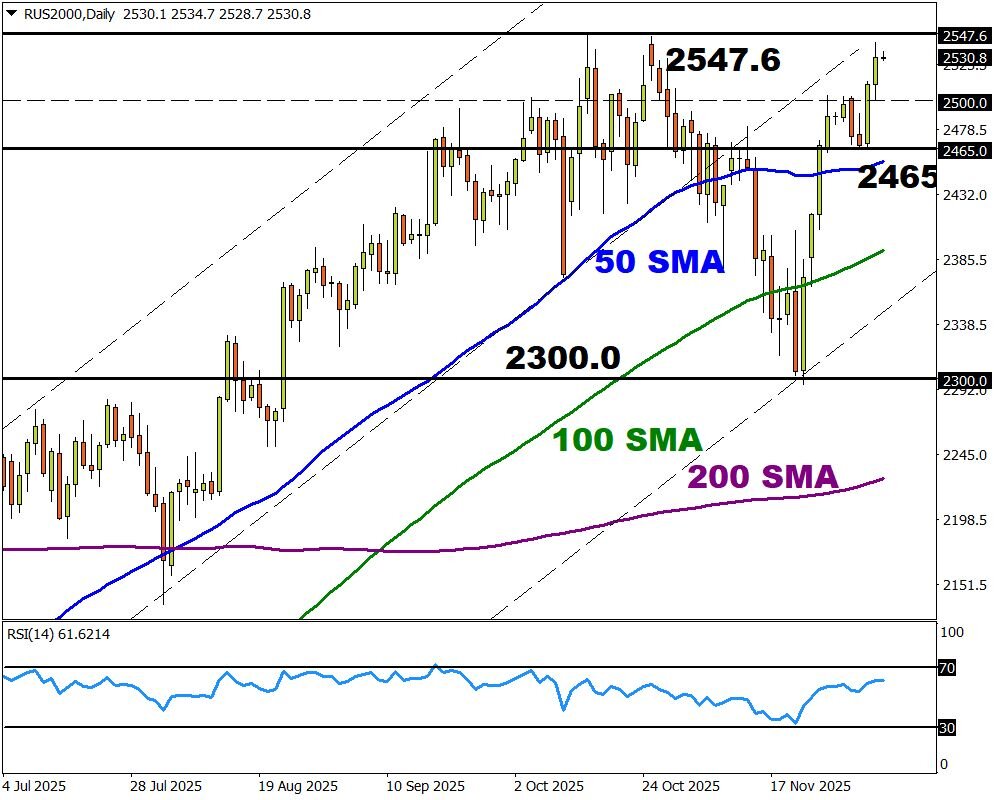
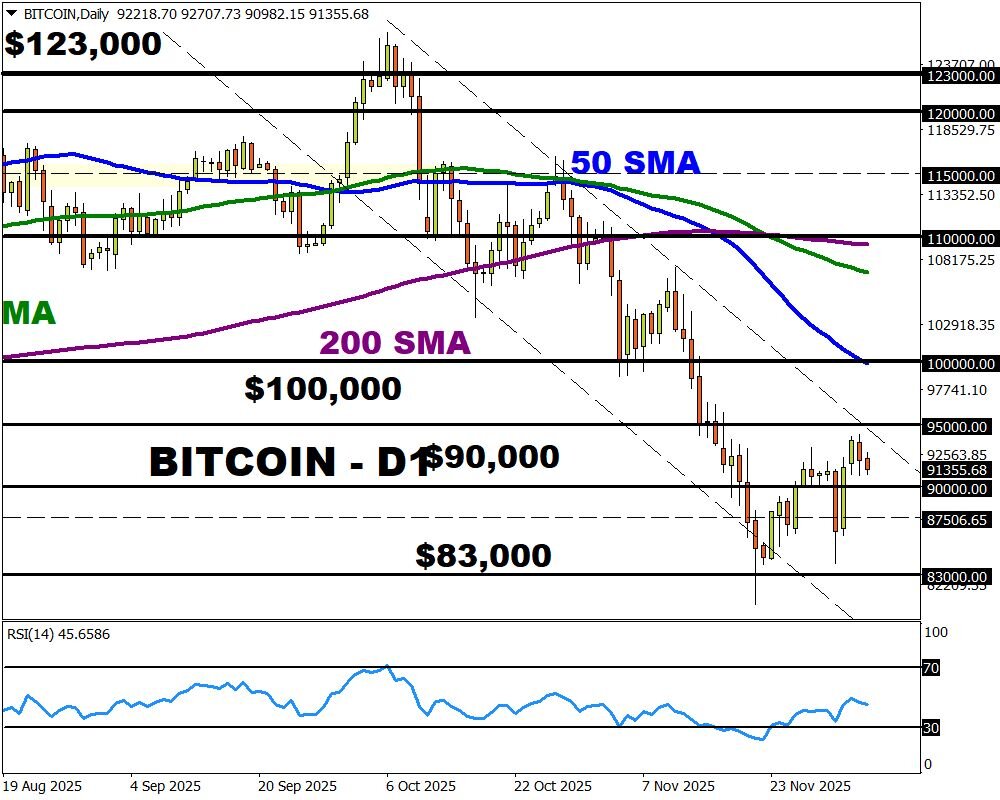
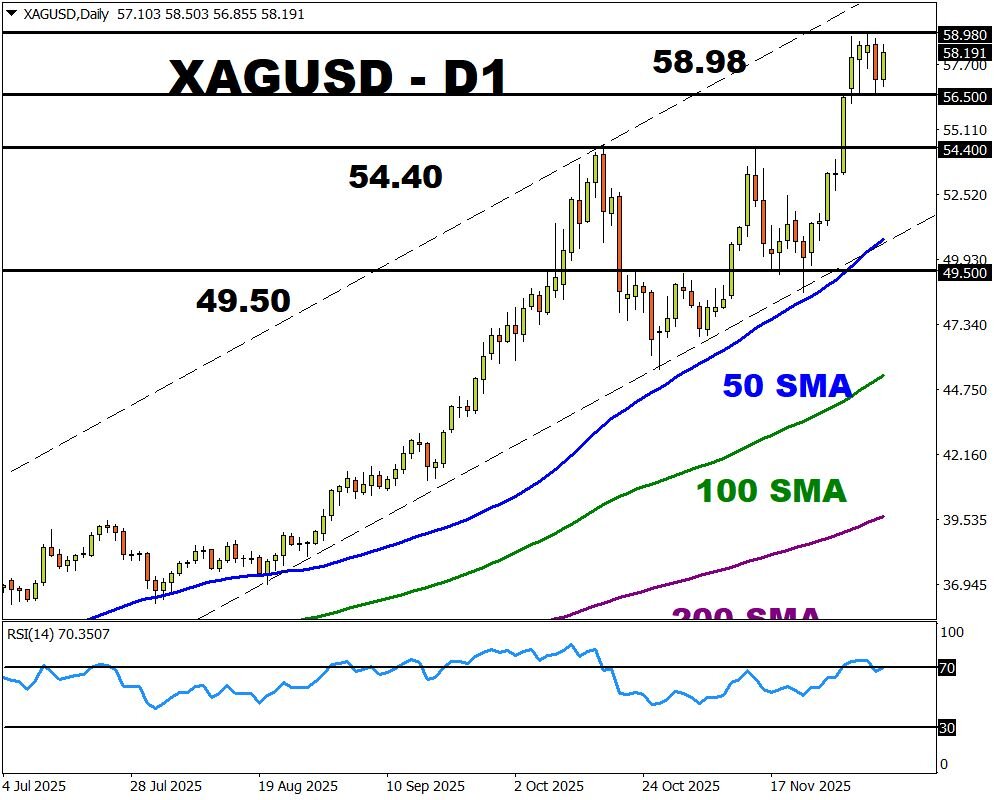
Looking at the charts, RUS2000, BITCOIN and XAGUSD could be set for significant price swings. Key price levels have been identified on the charts.


RUS2000

FXTM’s RUS2000 tracks the smallest 2000 publicly listed US companies that are more reflective of true economic conditions.

It has gained roughly 13% year-to-date, trading roughly 1% away from its all-time high.

Key levels of interest can be found at 2547.6, 2500. and 2465.0.


BITCOIN

Bitcoin is back above $90,000 but bulls need to take out the psychological $100,000 to regain back control.

As highlighted earlier, a dovish tile may boost prices higher while a hawkish tilt may spark a selloff.


XAGUSD

Silver is up almost 100% year-to-date, hitting an all-time high earlier in the week.

If the Fed signals further rate cuts in 2026, this could fuel the rally – opening a path to fresh highs.

Key levels can be found at $58.90, $54.40 and $49.50.


Forex-Time-LogoArticle by ForexTime


ForexTime Ltd (FXTM) is an award winning international online forex broker regulated by CySEC 185/12 www.forextime.com