Archive for Opinions – Page 118

The global risk of weaponization in semiconductors

By Dan Steinbock

– On August 9, President Biden signed the CHIPS Act. It is a prelude in an effort to weaponize the global IT supply chains.

In international media, the CHIPS and Science Act of 2022 is portrayed as a $52 billion package aiming to boost semiconductor manufacturing in the United States. But the underlying strategic objective is geopolitical.

Today Asia dominates global semiconductor manufacturing. Though a top exporter, US semiconductor industry no longer controls the global supply chains. However, it still accounts for over 80% of the world’s chip design equipment, 50% of intellectual property for chip designs, and half of the globe’s chip manufacturing equipment.

To dominate the semiconductors, which enable advanced military technology, the Biden team seeks to restore the past US superiority in global semiconductors.

The problem is that no single nation can any longer control entire supply chains. Hence, the effort to weaponize the system, to “counter” China.

Forcing semiconductor giants to pick sides

Currently, the US, Taiwan, South Korea and Japan supply most of the world’s semiconductors, whereas China represents the highest demand in the industry. The Biden administration would like to keep it that way.

In order to restore the US’ supremacy, the Biden administration needs to neutralize future rivals. That’s the likely reason why Washington is also considering restricting U.S. chipmaking equipment from being exported to Chinese memory chip makers.

Such restrictions are designed to hurt China and its progress in advanced technology. But they would also harm South Korea’s Samsung and SK Hynix, which have memory chip operations in China. Japanese semiconductor rivals were derailed already in the 1980s trade wars.

Unsurprisingly, Chinese critics of the “CHIP-4 alliance” call it a “hongmen Banquet”; a well-known Chinese expression for a feast that’s set up as a trap for the invitees.

Ambivalent “allies” divided

At present, six US-headquartered or foreign-owned semiconductor companies have 20 fabrication facilities (“fabs”) in America. South Korean Samsung is building a $17 billion fab in Texas, while the Taiwan Semiconductor Manufacturing Company (TSMC) is investing $12 billion on a plant in Arizona. The real costs are likely to prove far higher, as they have already affirmed.

Reportedly, the CHIPS Act would bar recipients of U.S. government funds from expanding or upgrading their advanced chip capacity in China, which has led South Korean firms to review their Chinese operations. That leaves Taiwan.

Hence, the recent Taiwan visit by the US House Speaker Nancy Pelosi, for which the way was paved by the Taiwan lobby (TECRO); Pelosi’s generous supporter that also helped to push through the recent $5 billion weapons sales deal to Taiwan.

In Taiwan, Pelosi insisted on a meeting with TSMC’s CEO Mark Liu, the largest contract chip maker. Reportedly, she said she hopes TSMC will side with the US.

In the long term, US and some of its allies hope to undermine Taiwan’s dominance in semiconductors, however. Effectively, such goals were initiated by the Obama administration, codified by the Trump White House and are now being executed by the Biden team.

Weaponizing semiconductors replaces competitiveness with geopolitics

In the 1980s, US technology giants pressed the Reagan administration to battle the Japanese competitors. By contrast, Trump and Biden administrations are pushing the reluctant US semiconductor giants to fight China.

The US-Sino ties soured and bilateral disputes escalated in July 2018, when the Trump administration imposed 25% tariffs on semiconductors imported from China, causing significant damage in the US industry. And as companies like Huawei bypassed US suppliers buying semiconductors from Taiwan and South Korea, the tariffs failed to have the desired effect. That’s why the White House is now trying to use an alliance to command the full semiconductor ecosystem.

In early 2021, the Biden administration signaled it planned to move ahead with a Trump administration-proposed rule to “secure” the information-technology (IT) supply chains. That allowed the Department of Commerce to monitor the transactions of governments, including those of China. Reportedly, it is part of the effort to weaponize the global IT ecosystem.

The activities of Eric Schmidt, ex-CEO of Google and financier of Obama, Clinton and Biden campaigns, reflects the new semiconductor geopolitics. Prior to his advisory role in artificial intelligence, Schmidt headed Pentagon’s advisory board to link Silicon Valley with Pentagon. “The US and its allies,” Schmidt urged, “should utilize targeted export controls on high-end semiconductor manufacturing equipment … to protect existing technical advantages and slow the advancement of China’s semiconductor industry.”

Such are the behind-the-façade strategic objectives.

Geopolitics derails supply chains, consumer welfare and innovation

The semiconductor debacles first intensified with the US-Japan trade wars of the 1980s. Eventually, Japan, heavily dependent on the US military, agreed to “voluntary restrictions” on contested export products, bilateral concessions, sky-high US tariffs, de facto currency revaluation, and structural reforms opening the Japanese market to the US.

As a result, Japan lost its mantle of world leader in microchips. Secular stagnation ensued soon thereafter. This precedent obviously makes executive teams uneasy in both South Korea and Taiwan.

Weaponization of the global semiconductor supply chains by any one country would be disastrous to the ecosystem. It would replace industry competition with geopolitical dicta. It would undermine consumer welfare. And it would derail innovation.

About the Author:

Dr. Dan Steinbock is an internationally recognized strategist of the multipolar world and the founder of Difference Group. He has served at the India, China and America Institute (USA), Shanghai Institutes for International Studies (China) and the EU Center (Singapore). For more, see https://www.differencegroup.net

The original version was published by China Daily on August 29, 2022


Making EVs without China’s supply chain is hard, but not impossible – 3 supply chain experts outline a strategy

By Ho-Yin Mak, Georgetown University; Christopher S. Tang, University of California, Los Angeles, and Tinglong Dai, Johns Hopkins University 

Two electrifying moves in recent weeks have the potential to ignite electric vehicle demand in the United States. First, Congress passed the Inflation Reduction Act, expanding federal tax rebates for EV purchases. Then California approved rules to ban the sale of new gasoline-powered cars by 2035.

The Inflation Reduction Act extends the Obama-era EV tax credit of up to US$7,500. But it includes some high hurdles. Its country-of-origin rules require that EVs – and an increasing percentage of their components and critical minerals – be sourced from the U.S. or countries that have free-trade agreements with the U.S. The law expressly forbids tax credits for vehicles with any components or critical minerals sourced from a “foreign entity of concern,” such as China or Russia.

That’s not so simple when China controls 60% of the world’s lithium mining, 77% of battery cell capacity and 60% of battery component manufacturing. Many American EV makers, including Tesla, rely heavily on battery materials from China.

The U.S. needs a national strategy to build an EV ecosystem if it hopes to catch up. As experts in supply chain management, we have some ideas.

Why the EV industry depends heavily on China

How did the U.S. fall so far behind?

Back in 2009, the Obama administration pledged $2.4 billion to support the country’s fledgling EV industry. But demand grew slowly, and battery manufacturers such as A123 Systems and Ener1 failed to scale up their production. Both succumbed to financial pressure and were acquired by Chinese and Russian investors.

China took the lead in the EV market through an aggressive mix of carrots and sticks. Its consumer subsidies raised demand at home, and Beijing and other major cities set licensing quotas mandating a minimum share of EV sales.

China also established a world-dominating battery supply chain by securing overseas mineral supplies and heavily subsidizing its battery manufacturers.

Today, the U.S. domestic EV supply chain is far from adequate to meet its goals. The new U.S. tax credits are designed to help turn that around, but building a resilient EV supply chain will inevitably entail competing with China for limited resources.

A comprehensive national strategy entails measures for the short, medium and long term.

Short-term: What can be done now?

Six of the 10 best-selling EV models in 2022 are already assembled in the U.S., fulfilling the Inflation Reduction Act’s final assembly location clause. The Hyundai-Kia alliance, which has three of the other four bestsellers, plans to open an EV assembly line in Georgia. Volkswagen has also started assembling its ID.4 electric SUV in Tennessee.

The challenge is batteries. Besides the Tesla-Panasonic factories in Nevada and planned in Kansas, U.S.-based battery manufacturers trail their Chinese counterparts in both size and growth.

For the U.S. to scale up its own production, it needs to rely on strategic partners overseas. The Inflation Reduction Act allows imports of critical minerals from countries with free trade agreements to still qualify for incentives, but not imports of battery components. This means overseas suppliers like Korea’s “Big Three” – LG Chem, SK Innovation and Samsung SDI – which supply 26% of the world’s EV batteries, are shut out, even though the U.S. and Korea have a free trade agreement.

A Sankey chart, also known as a spaghetti chart, shows the flow of cobalt Congo, with some resources in the rest of the world, through to the production of EVs.
The bulk of the world’s cobalt is mined in the Democratic Republic of Congo but processed and turned into lithium-ion battery components by Chinese companies. This chart shows the pathways from mining to EVs.
Based on an NREL presentation in 2020, CC BY-ND

The Korea Automobile Manufacturers Association has asked Congress to make an exception for Korean-made EVs and batteries.

In the spirit of “friend-shoring,” the Biden administration could think of a temporary waiver as a stopgap measure that makes it easier for Korean battery makers to move more of their supply chain to the U.S., such as LG’s planned battery plants in partnerships with GM and Honda.

The 2021 Infrastructure Act also provided $5 billion to expand charging infrastructure, which surveys show is critical to bolstering demand.

Medium-term: Diversifying lithium and cobalt supplies

A strong and concerted effort in trade and diplomacy is necessary for the U.S. to secure critical mineral supplies.

As EV sales rise, the world is expected to face a lithium shortage by 2025. In addition to lithium, cobalt is needed for high-performance battery chemistries.

The problem? The Democratic Republic of the Congo is where 70% of the world’s cobalt is mined, and Chinese companies control 80% of that. The distant second-largest producer is Russia.

The Biden administration’s “friend-shoring” vision has a chance only if it can diversify the lithium and cobalt supply chains.

Bars on a map show countries with the most critical mineral production.
Lithium, cobalt and nickel are critical components in many EV batteries. The largest 2021 production sources included the Democratic Republic of Congo for cobalt; Australia, Chile and China for lithium; and Indonesia, the Philippines and Russia for nickel.
The Conversation, USGS Mineral Commodity Summaries 2022, CC BY-ND

The “Lithium Triangle” of South America is one region to invest in. Also, Australia, a key U.S. ally, leads the world in lithium production and possesses rich cobalt deposits. Waste from many of Australia’s copper mines also contains cobalt, lowering the cost. GM has reached an agreement with the Australian mining giant Glencore to mine and process cobalt in Western Australia for its Ohio battery plant with LG Chem, bypassing China.

A way to avoid cobalt altogether also exists: lithium-iron-phosphate batteries are about 30% cheaper to make because they use minerals that are easy to find and plentiful. However, LFP batteries are heavier and have less power and range per unit.

For years, Chinese companies like CATL and BYD were the only ones making LFP batteries. But the patent rights associated with LFP batteries expire this year, opening up an important opportunity for the U.S.

Since not everyone needs a high-end electric supercar, affordable EVs powered by LFP batteries are an option. In fact, Tesla now offers Model 3s with LFP batteries that can travel about 270 miles on a charge.

The 2021 Bipartisan Infrastructure Law set aside $3.16 billion to support domestic battery supply chains. With the Inflation Reduction Act’s emphasis on supporting more affordable EVs – it has price caps for vehicles to qualify for incentives – these funds will be needed to help scale up domestic LFP manufacturing.

Long-term: US critical mineral production

Replacing overseas critical materials with domestic mining falls under long-term planning.

The scale of current domestic mining is minuscule, and new mining operations can take seven to 10 years to establish because of the lengthy permitting process. Lithium deposits exist in California, Maine, Nevada and North Carolina, and there are cobalt resources in Minnesota and Idaho.

Finally, to build an industrial commons for EVs, the U.S. must continue to invest in research and development of new battery technologies.

Also, end-of-life battery recycling is essential to the sustainability of EVs. The industry has been kicking the can down the road on this, as recycling demand has been minuscule thus far given the longevity of batteries. Yet, as a proactive step, the Inflation Reduction Act specifically permits battery content recycled in North America to qualify for the critical mineral clause.

To make this happen, the federal and state governments could use takeback legislation similar to producer responsibility laws for electronic waste enacted in more than 20 states, which stipulate that producers bear the responsibility for collecting, transporting and recycling end-of-cycle electronic products.

What’s ahead

With the new law, the Biden administration has set its sights on a future transportation system that is built in the U.S. and runs on electricity. But there are supply chain obstacles, and the U.S. will need both incentives and regulations to make it happen.

California’s announcement will help. Under the Clean Air Act, California has a waiver that allows it to set policies more strict than federal law. Other states can choose to follow California’s policies. Seventeen other states have adopted California’s emissions standards. At least three, New York, Washington and Massachusetts, have already announced plans to also phase out new gas-powered cars and light trucks by 2035.The Conversation

About the Author:

Ho-Yin Mak, Associate Professor in Operations & Information Management, Georgetown University; Christopher S. Tang, Professor of Supply Chain Management, University of California, Los Angeles, and Tinglong Dai, Professor of Operations Management & Business Analytics, Carey Business School, Johns Hopkins University

This article is republished from The Conversation under a Creative Commons license. Read the original article.


The most cost-effective energy efficiency investments you can make – and how the new Inflation Reduction Act could help

By Jasmina Burek, UMass Lowell 

Energy efficiency can save homeowners and renters hundreds of dollars a year, and the new Inflation Reduction Act includes a wealth of home improvement rebates and tax incentives to help Americans secure those saving.

It extends tax credits for installing energy-efficient windows, doors, insulation, water heaters, furnaces, air conditioners or heat pumps, as well as for home energy audits. It also offers rebates for low- and moderate-income households’ efficiency improvements, up to US$14,000 per home.

Together, these incentives aim to cut energy costs for consumers who use them by $500 to $1,000 per year and reduce the nation’s climate-warming greenhouse gas emissions.

With so many options, what are the most cost-effective moves homeowners and renters can make?

My lab at UMass Lowell works on ways to improve sustainability in buildings and homes by finding cost-effective design solutions to decrease their energy demand and carbon footprint. There are two key ways to cut energy use: energy-efficient upgrades and behavior change. Each has clear winners.

Stop the leaks

The biggest payoff for both saving money and reducing emissions is weatherizing the home to stop leaks. Losing cool air in summer and warm air in winter means heating and cooling systems run more, and they’re among the most energy-intensive systems in a home.

Gaps along the baseboard where the wall meets the floor and at windows, doors, pipes, fireplace dampers and electrical outlets are all prime spots for drafts. Fixing those leaks can cut a home’s entire energy use by about 6%, on average, by our estimates. And it’s cheap, since those fixes mostly involve caulk and weather stripping.

Illustration of a house showing common air leaks, primarily in the attic and along walls and vents.
Common places where homes leak – and where weatherization measures can save money.
Department of Energy

The Inflation Reduction Act offers homeowners a hand. It includes a $150 rebate to help pay for a home energy audit that can locate leaks.

While a professional audit can help, it isn’t essential – the Department of Energy website offers guidance for doing your own inspection.

Once you find the leaks, the act includes 30% tax credits with a maximum of $1,200 a year for basic weatherization work, plus rebates up to $1,600 for low- and moderate-income homeowners earning less than 150% of the local median.

Replace windows

Replacing windows is more expensive upfront but can save a lot of money on energy costs. Leaky windows and doors are responsible for 25% to 30% of residential heating and cooling costs, according to Department of Energy estimates.

Insulation can also reduce energy loss. But with the exception of older homes with poor insulation and homes facing extreme temperatures, it generally doesn’t have as high of a payoff in whole-house energy savings as weatherization or window replacement.

The Inflation Reduction Act includes up to $600 to help pay for window replacement and $250 to replace an exterior door.

Upgrade appliances, especially HVAC and dryers

Buildings cumulatively are responsible for about 40% of U.S. energy consumption and associated greenhouse gas emissions, and a significant share of that is in homes. Heating is typically the main energy use.

Among appliances, upgrading air conditioners and clothes dryers results in the largest environmental and cost benefits; however, HVAC systems – heating, ventilation and air conditioning – come with some of the highest upfront costs.

That includes energy-efficient electric heat pumps, which both heat and cool a home. The Inflation Reduction Act offers a 30% tax credit up to $2,000 available to anyone who purchases and installs a heat pump, in addition to rebates of up to $8,000 for low- and moderate-income households earning less than 150% of the local median income. Some high-efficiency wood-burning stoves also qualify.

The act also provides rebates for low- and moderate-income households for electric stoves of up to $840, heat-pump water heaters of up to $1,750 and heat-pump clothes dryers of up to $840.

Change your behavior in a few easy steps

You can also make a pretty big difference without federal incentives by changing your habits. My dad was energy-efficient before it was hip. His “hobby” was to turn off the lights. This action itself has been among the most cost-saving behavioral changes.

Just turning out the lights for an hour a day can save a home up to $65 per year. Replacing old lightbulbs with LED lighting also cuts energy use. They’re more expensive, but they save money on energy costs.

We found that a homeowner could save $265 per year and reduce emissions even more by adopting a few behavioral changes including unplugging appliances not being used, line-drying clothes, lowering the water heater temperature, setting the thermostat 1 degree warmer at night in summer or 1 degree cooler in winter, turning off lights for an hour a day, and going tech-free for an hour a day.

Some appliances are energy vampires – they draw electricity when plugged in even if you’re not using them. One study in Northern California found that plugged-in devices, such as TVs, cable boxes, computers and smart appliances, that weren’t being used were responsible for as much as 23% of electricity consumption in homes.

Start with a passive solar home

If you’re looking for a home to rent or buy, or even to build, you can make an even bigger difference by looking at how it’s built and powered.

Passive solar homes take advantage of local climate and site conditions, such as having lots of south-facing windows to capture solar energy during cool months to reduce home energy use as much as possible. Then they meet the remaining energy demand with on-site solar energy.

Studies show that for homeowners in cold climates, building a passive design home could cut their energy cost by 14% compared with an average home. That’s before taking solar panels into account.

The Inflation Reduction Act offers a 30% tax credit for rooftop solar and geothermal heating, plus accompanying battery storage, as well as incentives for community solar – larger solar systems owned by several homeowners. It also includes a $5,000 tax credit for developers to build homes to the Energy Department’s Zero Energy Ready Homes standard.

The entire energy and climate package – including incentives for utility-scale renewable energy, carbon capture and electric vehicles – could have a big impact for homeowners’ energy costs and the climate. According to several estimates, it has the potential to reduce U.S. carbon emissions by about 40% by the end of this decade.The Conversation

About the Author:

Jasmina Burek, Assistant Professor of Engineering, UMass Lowell

This article is republished from The Conversation under a Creative Commons license. Read the original article.
 

Forex Technical Analysis & Forecast for September 2022

By RoboForex.com 

EURUSD, “Euro vs US Dollar”

As we can see in the daily chart, after completing the descending wave at 1.1200, forming a new consolidation range around this level, and breaking it downwards to reach the short-term target at 0.9955, EURUSD has returned to test 1.0080 from below. Possibly, the pair may continue trading within the downtrend to reach 0.9900, or even extend this structure down to 0.9700.

EURUSD
Risk Warning: the result of previous trading operations do not guarantee the same results in the future

GBPUSD, “Great Britain Pound vs US Dollar”

On the daily chart, after finishing the descending wave at 1.1930 and failing to rebound from it, GBPUSD continues trading downwards with the short-term target at 1.1580. Later, the market may correct up to 1.1900 and then start a new decline to reach 1.1500.

GBPUSD
Risk Warning: the result of previous trading operations do not guarantee the same results in the future

USDJPY, “US Dollar vs Japanese Yen”

On the daily chart, after completing the ascending wave at 136.48 and forming a new consolidation range there, USDJPY has broken it to the upside; right now, it is still growing with the short-term target at 141.13. Later, the market may correct down to 136.48 and then start another growth to reach 142.52.

USDJPY
Risk Warning: the result of previous trading operations do not guarantee the same results in the future

BRENT

As we can see in the daily chart, after failing to fix above 99.00 and forming a new consolidation range, Brent has broken it to the downside and may continue falling towards 91.60. Later, the market may resume trading upwards with the target at 105.20, or even extend this structure up to 120.50.

BRENT
Risk Warning: the result of previous trading operations do not guarantee the same results in the future

XAUUSD, “Gold vs US Dollar”

On the daily chart, after completing the descending wave 1725.00 and forming a new consolidation range there, Gold has broken it to the downside and may continue trading downwards to reach 1680.00. Later, the market may form one more ascending wave to return to 1725.00 and then start a new decline with the target at 1650.00. After that, the instrument may resume growing towards 1766.00.

GOLD
Risk Warning: the result of previous trading operations do not guarantee the same results in the future

S&P 500

On the daily chart, after finishing the descending wave at 3975.0 and forming a new consolidation range above this level, the S&P index has broken it to the downside. Possibly, the asset may grow to test 3975.0 from below and then resume falling towards 3888.0, or even extend this structure to reach the short-term target at 3700.0.

S&P 500

Article By RoboForex.com

Attention!
Forecasts presented in this section only reflect the author’s private opinion and should not be considered as guidance for trading. RoboForex LP bears no responsibility for trading results based on trading recommendations described in these analytical reviews.

Mid-Week Technical Outlook: USD

By ForexTime 

– This could be another big week for king dollar as all attention falls on Friday’s nonfarm payroll report.

After receiving fresh inspiration from Fed hawks last week, the greenback could charge higher if the pending US jobs data ticks all the boxes for more aggressive rate hikes. Alternatively, bulls may be humbled if the data fails to meet expectations. Whatever the outcome on Friday, it may be wise to brace for explosive levels of volatility, especially in the FX space.

With market players tense and on the fence ahead of this major event, the dollar remains in a range – waiting for a potent fundamental spark to make its next big move. With this catalyst likely to be the NFP, this could provide a great opportunity to identify trading opportunities for September.

Our focus today will be major currency pairs with our tool of choice none other than technical analysis.

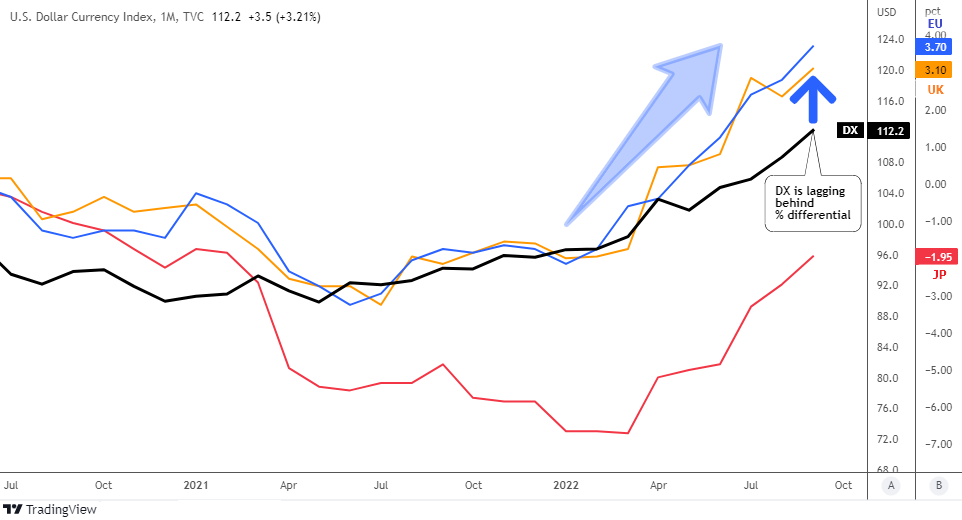
DXY hovers around 109.00

The path of least resistance for the dollar points north but a fresh catalyst may be needed for bulls to switch into a higher gear. A solid breakout and daily close above 109.14 could encourage an incline towards 110.00. If bulls run out of steam, a decline back towards 108.25 and 107.30 could be on the cards.

Equally-weighted USD remains bullish

Just like the DXY, the equally weighted USD index remains bullish on the daily charts. There have been consistently higher highs and higher lows while the MACD trades to the upside. The upside momentum could take prices towards 1.2184 and potentially higher. A move back below 1.1950 may open the doors back towards the 50-day Simple Moving Average at 1.1860.

EURUSD to retest 0.9900?

After breaking below parity, the EURUSD has remained shaky and vulnerable to losses. Bears clearly remain in a position of power with their eyes locked on 0.9900. A strong breakdown below this point may indicate a selloff towards 0.9800 and lower.

GBPUSD ventures towards 1.1600

An appreciating dollar continues to drag the GBPUSD lower. A strong break below 1.1600 may result in a decline towards 1.1500. If 1.1600 proves to be reliable support, prices could retest 1.17600.

AUDUSD breakdown on the horizon

A solid breakdown below 0.06850 could encourage a selloff towards 0.6700. If prices manage to keep above 0.6850, a rebound towards 0.7000 may be a possibility.

USDJPY ready to breakout?

The USDJPY remains bullish on the daily charts as there have been consistently higher highs and higher lows. Prices are trading above the 50, 100, and 200-day Simple Moving Average while the MACD trades above zero. A strong breakout above 139.380 could inspire an incline towards 140.00. A move back below 135.00 may trigger a selloff towards the 100-day Simple Moving Average and 131.34, respectively.


Forex-Time-LogoArticle by ForexTime

ForexTime Ltd (FXTM) is an award winning international online forex broker regulated by CySEC 185/12 www.forextime.com

Bitcoin and Ethereum: No Safety Net

By Ino.com

– Earlier this month, I updated on the crypto market with a title, ‘It Ain’t Over Yet”. I considered the recent strength in the main cryptocurrencies a “dead-cat bounce” within a classic sideways consolidation with a high probability of resuming collapse.

This time, I spotted new signals as the chart moves to the right building new bars over time. Let us start with the main coin in the weekly chart below.

Bitcoin Weekly Chart

Source: TradingView
 

The price of Bitcoin moves within large bearish trend channel (black). The top of above-mentioned sideways consolidation within red trendlines did not even approach the resistance, it stays intact.

The RSI indicator could not raise its head to test the “waterline” of 50 level. This means that the market has considered this short-term strength as a “dead-cat bounce” as well.

The chart bar of last week has punctured below the red support. This is a harbinger of another drop. The main coin indeed is looking into the abyss as the strong support appears only after the price halves down. The largest area of the Volume Profile histogram (orange) is located between $9k and $10k. The mid-channel (red dashed) fortifies that support with its intersection.

Your biggest bet last time was the drop of the Bitcoin down to $12.2k, where the second leg down is equal to the first one. It almost coincides with the above-mentioned double support.
The next volume area is located at the $4k level and this option was your least favorite.

This time I added the simple moving average (purple) covering the preceding 52 weeks (1 year). It has been offering a strong support to the price starting from 2020. This year it has flipped to become a strong resistance after the price has dropped below it. The $40k level is the barrier to break to confirm the new bullish cycle.

A rather interesting situation has developed for the main coin. The price should either half down to find support or it should double up from this level to crack the bearish cycle.

Now, let us check the Ethereum chart.

Ethereum Weekly Chart

Source: TradingView
 

In spite of all the hype around the upcoming transition of Ethereum onto the proof-of-stake (PoS) mechanism, the shadow of falling Bitcoin remains a backbreaking burden.

The black downtrend remains intact for the second largest coin also. There is a visible difference with the Bitcoin chart. The red mid-channel intersects with the red trendline support that contours consolidation.

Although the RSI was stronger here as it approached the barrier, it failed to break up and then dropped. Thus, the bearish mode continues.

Indeed, there is no safety net once the price slides below the red trendline support and the mid-channel until it touches the Volume Profile (orange) support of $250. It accords with the total annihilation model posted in May. Most of you agreed with this doomed forecast earlier.

The simple moving average (purple) for the preceding year stands at $2,845. The price should almost double to touch this resistance. This is a similar situation with Bitcoin. However, the downside gap is worse for Ethereum.

The forecasted collapse should show us for sure if the RSI will establish a new valley or not building the Bullish Divergence. HODL-ers will watch this event closely.

Intelligent trades!

Aibek Burabayev
INO.com Contributor

Disclosure: This contributor has no positions in any stocks mentioned in this article. This article is the opinion of the contributor themselves. The above is a matter of opinion provided for general information purposes only and is not intended as investment advice. This contributor is not receiving compensation (other than from INO.com) for their opinion.

By Ino.com – See our Trader Blog, INO TV Free & Market Analysis Alerts

Source: Bitcoin and Ethereum: No Safety Net

Trade of the Week: Gold to retest $1700 support?

By ForexTime 

At the start of this new trading week, spot gold has been dragged down to closer to the $1700 mark, although prices have trimmed losses at the time of writing.


And depending on how this Friday’s US nonfarm payrolls report turns out, the precious metal could retest that psychologically-important level for support.


Why has gold tumbled again?

The precious metal is clearly wilting in the wake of the scorching US dollar and the uptrend in Treasury yields.

These moves (gold down, dollar/Treasury yields up) have been fuelled by revived bets that US interest rates will move higher, and more importantly – stay elevated, for longer.


Markets have been gripped by Fed Chair Jerome Powell’s hawkish speech delivered at Jackson Hole this past Friday.

Here are the key takeaways:

  1. The Fed is set to persist with sending US interest rates higher.
  2. US interest rates are set to stay higher “for some time” (as in, the Fed isn’t likely to unwind its rate hikes in a hurry, as some segments of the markets had predicted up until recently).

In essence, the US central bank remains committed to subduing in inflationary pressures, even if it results in some pain for the economy.

Such language heralds a stronger US dollar and Treasury yields marching higher: a bad mix for bullion bulls.


What does the upcoming US jobs report have to do with gold prices?

Depending on the demonstrated strength of the US jobs market, that would inform the Fed as to how high it could send US interest rates.

  • A still-resilient US labour market would essentially give the green light for the Fed to send its benchmark rates even higher.
    In turn, that should heap more downward pressure on gold.
  • Signs that the US labour market is starting to creak under the weight of higher interest rates may force the Fed to adopt a more gradual approach with its rate hikes; thus spelling some relief for gold.


What to look out for in this Friday’s US jobs report?

As things stand, markets are forecasting the following:

  • US labour market added a further 300,000 jobs in August, judging by the headline US nonfarm payrolls (NFP) figure. If so, that would mark a 20th consecutive month of job gains.

    However, an official print of 300k would also mark its lowest number of jobs added since December 2019.

  • The August unemployment rate would stay at 3.5% – at its pre-pandemic lows.

Overall, the US jobs market is expected to remain resilient, even though the Fed has been hiking interest rates since March.


How might gold react to the upcoming NFP?

  1. If the US labour market adds more jobs than forecasted, that could lead to more declines in gold prices.

Potential support levels:

  • $1712: using the downward trendline that has gone from resistance to support level.
  • $1700: stronger support should arrive at this psychologically-important line, noting that previous dips below $1700 have proved short-lived in recent years.

Such declines would be based on the notion that still-robust hiring in the US is likely to give the green light to the Fed to continue sending interest rates higher, which in turn should heap more downward pressure on gold prices.


  1. However, if the US jobs market is starting to creak, that could force the Fed to adopt a more ‘gradual’ approach with its rate hikes.

That is to say policymakers may be more comfortable with triggering rate hikes that are relatively smaller than the 75bps hikes it has already triggered at each of its past two policy meetings. Smaller rate hikes may then be the way forward for policymakers, if they begin to fear choking the US jobs market and sending the US economy into a deep recession.

Such a narrative could then prompt a short-term rebound in spot gold.

Potential resistance levels:

  • $1764: around 50-day simple moving average (SMA)
  • $1800: stronger resistance set to arrive at psychologically-important mark


In summary:

Markets are currently forecasting a slightly higher chance (21.5%) of spot gold touching $1700, rather than prices reaching its 50-day SMA (20.8%) around $1764.

Ultimately, it could all come down to whether or not this Friday’s US nonfarm payrolls reports exceeds market expectations.


Forex-Time-LogoArticle by ForexTime

ForexTime Ltd (FXTM) is an award winning international online forex broker regulated by CySEC 185/12 www.forextime.com

Big new incentives for clean energy aren’t enough – the Inflation Reduction Act was just the first step, now the hard work begins

By Daniel Cohan, Rice University 

The new Inflation Reduction Act is stuffed with subsidies for everything from electric vehicles to heat pumps, and incentives for just about every form of clean energy. But pouring money into technology is just one step toward solving the climate change problem.

Wind and solar farms won’t be built without enough power lines to connect their electricity to customers. Captured carbon and clean hydrogen won’t get far without pipelines. Too few contractors are trained to install heat pumps. And EV buyers will think twice if there aren’t enough charging stations.

In my new book about climate solutions, I discuss these and other obstacles standing in the way of a clean energy transition. Surmounting them is the next step as the country figures out how to turn the goals of the most ambitious climate legislation Congress has ever passed into reality.

Two outcomes matter: how deeply U.S. actions slash emissions domestically, and how effectively they cut the costs of clean technologies so that other countries can slash their emissions too.

Infrastructure and obstacles

Various studies predict that the Inflation Reduction Act will cut U.S. greenhouse gas emissions to around 40% below their 2005 levels by 2030. That’s a cut of roughly 1 billion tons per year, far more than any other U.S. legislation has achieved.

But it still leaves a roughly 10 percentage point gap from President Joe Biden’s target of at least a 50% reduction in emissions by 2030.

What will it take to close that gap?

The Inflation Reduction Act’s subsidies will make clean technologies cheaper, but the biggest need domestically is for more infrastructure and stricter environmental regulations.

For infrastructure, tax credits for electric cars will do little good without enough publicly available chargers. The U.S. has around 145,000 gas stations, but only about 6,500 fast-charging stations that can power up a battery quickly for a driver on the go.

Over 1,300 gigawatts of wind, solar and battery projects – several times the existing capacity – are already waiting to be built, but they’ve been delayed for years by a lack of grid connections and backlogged approval processes by regional grid operators.

The Infrastructure Investment and Jobs Act passed by Congress last year provides some funding for chargers, power lines and pipelines, but nowhere near enough. For example, it sets aside only a few billion dollars for high-voltage power lines, a tiny share of the hundreds of billions of dollars needed to chart a path toward net-zero emissions. Its $7.5 billion for chargers is just a third of what electric car advocates project will be needed.

Map of US EV charging stations show large numbers in the Northeast and West Coast and US cities, but far fewer in less populated regions.
DOE Alternative Fuels Data Center • Data as of August 2022, CC BY-ND

Even more important is to clear the regulatory obstacles to building clean energy infrastructure.

Democratic leaders of the Senate and House have pledged to pass legislation to make it easier to obtain permits for power lines and pipelines, but doing so would require bipartisan support, and that remains in doubt.

State and local governments and regional grid operators also play pivotal roles in approving new infrastructure and clean energy projects. They must overcome not-in-my-backyard opposition – some of it from policymakers themselves – to the power lines, pipelines and facilities that will be needed for clean energy, and simplify approval processes for rooftop solar panels.

It can’t all be carrots: Sticks are needed, too

We’ll also need regulatory sticks to supplement the Inflation Reduction Act’s carrot cake buffet.

By tightening emissions limits for greenhouse gases and other air pollutants under its Clean Air Act authority, the Environmental Protection Agency can spur the closure of old fossil-fueled power plants, require carbon capture at new ones and drive emissions reductions across a range of industries.

Stricter emissions limits could force gasoline and diesel vehicles to become more efficient and accelerate the adoption of electric ones. Tougher reporting rules and better monitoring of methane leaks will be needed to back up the one stick in the Inflation Reduction Act – its tax on methane emissions.

States wield powerful regulatory sticks too. Ten states have already set 100% clean or renewable electricity standards. California and Oregon have set requirements for cleaner fuels, and states like New York and Washington are implementing comprehensive climate strategies. The more states follow their lead, the more quickly emissions can be cut. The new federal subsidies will ease the path to doing so.

Ramping up research and global impact

All the new spending has the potential to achieve deep emissions cuts domestically, but they will have little impact abroad without further action.

Other countries will only adopt clean technologies if they’re affordable, but the Inflation Reduction Act’s subsidy buffet is only available to U.S. citizens and companies. Its rewards for domestic solar manufacturers may help them gain market share in the U.S., but they’ll likely do little to reduce prices in markets dominated by low-cost Asian manufacturers.

More progress abroad may be driven in future decades by the boosts in funding for emerging technologies. For example, the Inflation Reduction Act provides billions of dollars for clean hydrogen and carbon capture technologies that are not yet commercially viable but could become so with greater deployment. Carbon capture should be targeted toward locking up carbon from difficult-to-decarbonize industries like biofuel production, rather than to prolong the use of coal power plants or subsidize oil and gas production.

The CHIPS and Science Act Biden signed in early August 2022 authorizes $67 billion in funding for zero-carbon industries and climate research, although subsequent legislation will be needed to ensure that those funds are actually appropriated.

It would double the budget for the Department of Energy’s ARPA-E program, which funds research into the most cutting-edge energy technologies. As I discuss in my book, that could be especially important for making clean hydrogen cheap, making geothermal viable in more places, and developing new forms of energy storage. Together with the subsidies provided by the Inflation Reduction Act, that could jump-start the research, development and deployment needed to make these technologies affordable worldwide in the decades ahead.

After years of gridlock, there’s reason to celebrate Congress passing three bills that will do more to cut U.S. emissions than any legislation in history. But much more will be needed to reach the nation’s climate goals and to make clean energy more affordable at home and abroad.The Conversation

About the Author:

Daniel Cohan, Associate Professor of Civil and Environmental Engineering, Rice University

This article is republished from The Conversation under a Creative Commons license. Read the original article.
 

What’s the dispute between Imran Khan and the Pakistan government about?

By Samina Yasmeen, The University of Western Australia 

Tensions between former Pakistan prime minister Imran Khan and the current coalition government are coming to a head.

Khan made a speech in the northern city of Rawalpindi near Islamabad on Sunday, August 21, seeking a return to office after losing a no-confidence vote in April and being ousted as prime minister. Just hours beforehand, Pakistan’s electronic media regulator prohibited Khan’s rallies from being broadcast live on all satellite TV channels.

As he started his address, which was being broadcast on social media, YouTube experienced “disruptions”. This prompted Khan to accuse the government of attempting to silence him.

Following this, Pakistani police laid charges of terrorism against Khan for comments he had made in a speech about the judiciary a day earlier in Islamabad.

Previously, the government had been quite permissive of Khan’s rallies, but this approach appears to have changed.

So how did we get here?

Khan’s narrative

Since March this year, even before he was ousted, Khan has held numerous rallies, gatherings and social media activities to present his narrative to the Pakistani people locally and overseas.

He has accused, without evidence, the coalition government of working at the behest of the United States. He has labelled the government an “imported government” and popularised the hashtag “imported government na Manzoor” (the imported government is unacceptable).

Khan has also levelled varying degrees of criticism against the judiciary, bureaucracy and media for enabling the coalition government’s return to power in April.

In contrast, he portrays himself as a good Muslim, someone who is following in the footsteps of the founder of the country, Mohammad Ali Jinnah, and as being knowledgeable about the West, honest and incorruptible.

He believes he’s different from the government, which he denounces as corrupt “thieves”, and that he can lead the people of Pakistan in their struggle for true independence. He has urged young people and others to wage the struggle for “haqiqi azadi” (real independence).

The often well-choreographed rallies feature music by renowned musicians and singers, and appearances by popular actors. The appeal of this narrative is obvious in the thousands of Pakistanis of all ages and backgrounds attending these rallies.

Khan’s speeches are broadcast on social media, including YouTube and Twitter, with the Pakistani diaspora following these developments.

The government’s changing stance

Since coming to power in April, the coalition government has allowed almost all of these rallies to take place.

One exception was Khan’s May 25 “independence march”, when his supporters marched to Islamabad to call for new elections. The government had attempted to shut down the march, but the Supreme Court overturned the ban. Media reported some clashes between police and Khan’s supporters, with police firing teargas and detaining some protesters.

There are two possible explanations for the government’s mostly permissive approach to Khan’s rallies. The first is that it’s keen to demonstrate its democratic credentials.

The second is that the military – which was instrumental in removing Khan from power – thought Khan’s popularity would run its course and decline over time, so there was no need to intervene especially given the support for Khan’s party apparent among some retired military officials. But that didn’t happen.

Khan’s criticism of the regime became more strident. His references to the “neutrals”, a euphemism for the military establishment, became increasingly pronounced. Calling upon the “neutrals” to see the light and return power to the rightful representatives, Khan implied the military had supported his ouster and needed to mend its ways. Coupled with his increasing popularity despite his own government’s poor performance, such references fuelled anti-military sentiment that has swept across social media.

A Pakistan Army helicopter crash on August 1 in the province of Balochistan killed six military officials. This unfortunately led to anti-military groups stoking speculation online that the military itself had orchestrated the crash, and that military hardware was more precious than the military officials lost.

The leadership of Khan’s party denied any connection to the widely circulating anti-military tweets. But within days of this denial, Khan’s chief of staff read a controversial statement on the ARY television network that authorities claim was seditious and amounted to an incitement of mutiny within the armed forces.

The terrorism charges, along with Pakistan’s electronic media regulator banning live broadcast of his rallies, show Pakistani authorities are coming down firmly on Khan. They are now attempting to deny Khan the ability to mobilise masses against the judiciary, law enforcement agencies and the military. Time will tell whether this will be successful. But there are ominous signs of impending instability.The Conversation

About the Author:

Samina Yasmeen, Director of Centre for Muslim States and Societies, The University of Western Australia

This article is republished from The Conversation under a Creative Commons license. Read the original article.

 

Mid-Week Technical Outlook: Majors & Minors

By ForexTime 

– There was an uneasy calm across financial markets on Wednesday as investors exercised caution ahead of the Jackson Hole Symposium this week.

European stocks were mixed, the dollar stabilised while gold prices wobbled above $1740 ahead of Federal Reserve Powell’s speech on Friday. The central bank head is expected to strike a hawkish note which may reinforce aggressive rate hike bets – ultimately boosting the dollar. In the event of an unexpected ‘dovish’ Fed pivot, the dollar could be dealt a heavy blow.

Given how this major event could inject markets with fresh volatility, this may present some opportunities across the FX space. If heavy technicals are what you seek, then check out the setups below covering major and minor currencies.

Dollar bulls back in action

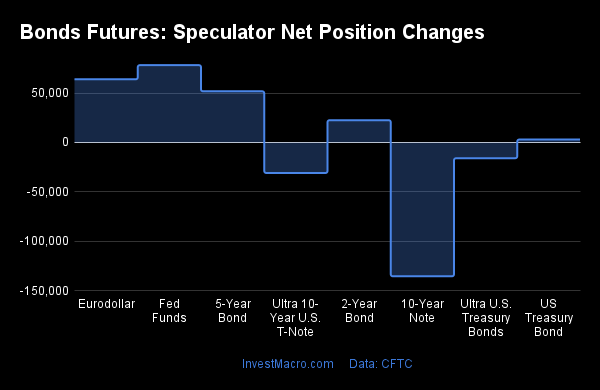
Despite yesterday’s selloff, the dollar continues to flex its safe-haven muscles ahead of this week’s potential market shaker. Prices are heavily bullish on the daily charts as there have been consistently higher highs and higher lows. A strong move above 109.14 may encourage an incline towards 109.70 and 110.00, respectively. Should prices slip back under 108.00, bears may target 107.30.

Equally weighted USD Index on standby…

Prices are likely to hover around the 1.1950 regions until a fresh directional catalyst is brought into the picture. Should this level prove to be reliable support, a move towards 1.2080 and 1.2184 could be expected. Below 1.1950, bears are likely to target the 50-day SMA and 1.1700, respectively.

EURUSD kisses 0.9900

After securing a solid daily close below parity, euro bears have marked their territory. The currency pair is heavily bearish on the daily timeframe with 0.9900 still a key level of interest. A breakdown below this level could encourage a selloff towards 0.9650 which acted as strong support back in the autumn of 2002. Should 0.9900 prove to be reliable support, prices could experience a bounce back to parity before resuming the selloff.

GBPUSD bears in control for now

Bears remain in the driving seat with prices wobbling above 1.1760 as of writing. The GBPUSD is under pressure on the daily charts with a break below 1.1760 opening the doors to 1.1700 and 1.1600. A move back above 1.1900 is seen triggering a move higher towards 1.2000.

AUDUSD back within range

An appreciating dollar could drag the AUDUSD out of its current range with a breakdown below the 0.6850 support opening a path back towards 0.6700. Should 0.6850 prove to be a tough nut to crack, prices may rebound back towards 0.7000.

USDJPY to resume uptrend?

The USDJPY is bullish on the daily charts. Prices are trading above the 50, 100, and 200-day Simple Moving Average while the MACD trades above zero. A solid break above 137.50 could trigger a move towards 139.38. Under 135.00, prices are seen testing 131.34.

EURGBP dips below 200-day SMA

As the subtitle says, the EURGBP is trading below the 200-day Simple Moving Average. This is a bearish sign and could result in further downside if 0.8440 proves to be reliable resistance. A EURGBP selloff may take prices back towards 0.8340.

GBPJPY respects bearish channel

Expect the GBPJPY to drift lower if prices fail to push above 162.00. A strong breakdown under 160.00 may signal a selloff towards the 200-day SMA at 159.00 and 157.50, respectively.

CADJPY supported above 104.80

We could see the CADJPY push higher if 104.80 proves to be reliable support. If prices use this level to push higher, the next key level of interest can be found at 107.50. A selloff below 104.800 could open the doors back towards the 100-day SMA and 102.00, respectively.


Forex-Time-LogoArticle by ForexTime

ForexTime Ltd (FXTM) is an award winning international online forex broker regulated by CySEC 185/12 www.forextime.com