Archive for Forex and Currency News – Page 43

AUD/USD surged, buoyed by RBA confidence and inflation growth

By RoboForex Analytical Department

The Australian dollar strengthened notably against the US dollar, with the AUD/USD pair reaching 0.6684. Australia’s May economic indicators from MI remained unchanged at zero compared to the previous value. Meanwhile, Australia’s weighted average consumer price index increased to 4.0% y/y from the last 3.6%, surpassing the less ambitious forecast of 3.8%.

Earlier statistics from Westpac also showed a rise in Australia’s consumer sentiment index in June, climbing by 1.7%, following a 0.3% decline in May.

At the Australian Banking Association conference, RBA Assistant Governor Chris Kent indicated that the Reserve Bank of Australia is not overly concerned about the growing interest in private loans among consumers. Kent highlighted the significant role that private credit plays in the market and underscored that the RBA is closely monitoring developments. However, the regulator is not overly concerned about growth in this area, as it is not particularly large in Australia.

Meanwhile, business investment is on the rise. Kent drew attention to a notable disparity between business confidence, business conditions, and consumer sentiment. The latter position appears to be below average levels.

AUDUSD technical analysis

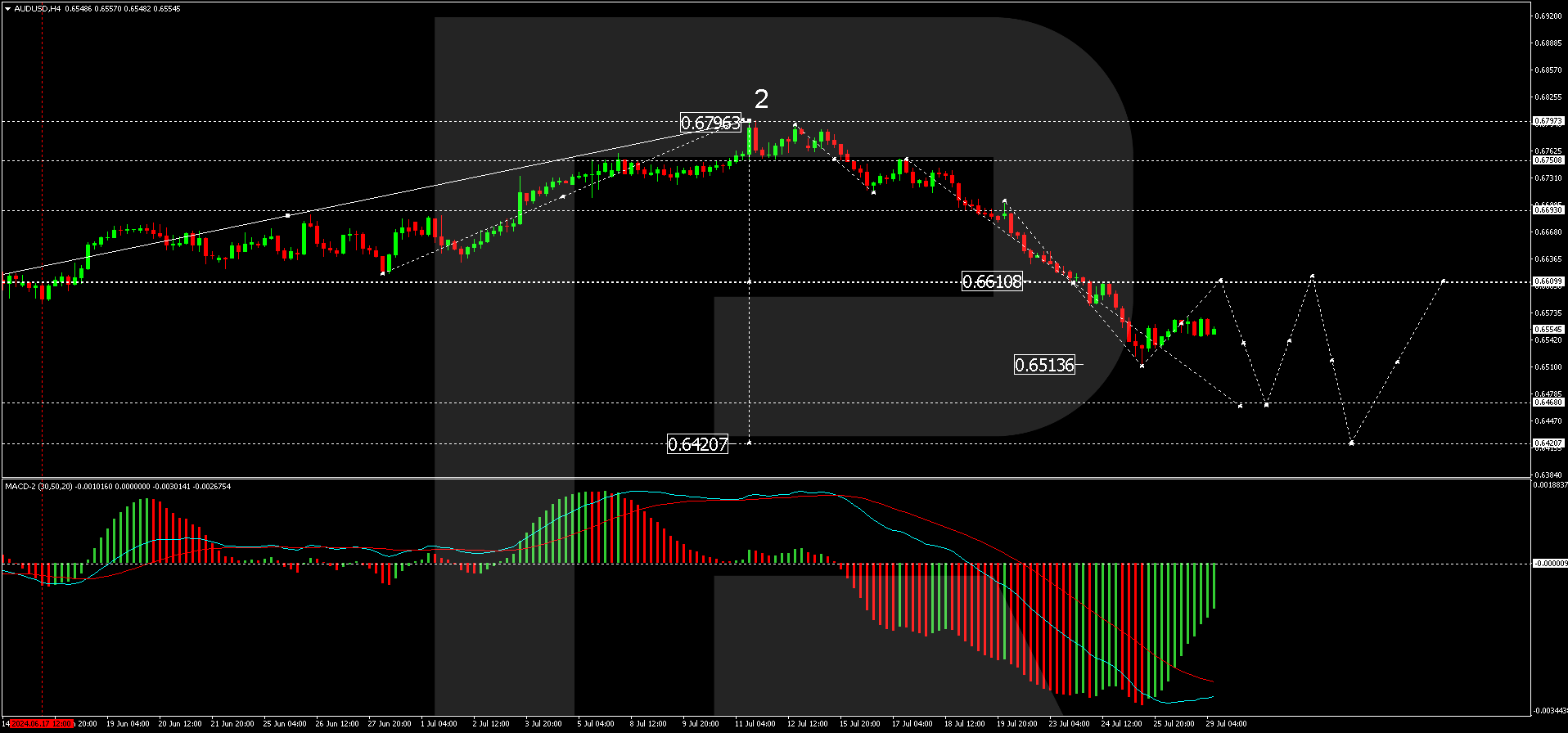
On the H4 chart of AUD/USD, the market ended the correction at 0.6577. Today, we consider a consolidation range forming around the level of 0.6666. With an upside exit, we will consider the probability of another growth structure to the level of 0.6703 with the prospect of continued growth to 0.6744. A correction link to the level of 0.6666 (test from above) is possible, followed by potential growth towards 0.6750. Technically, the MACD indicator supports this scenario. Its signal line is above the zero mark and is directed strictly upwards.

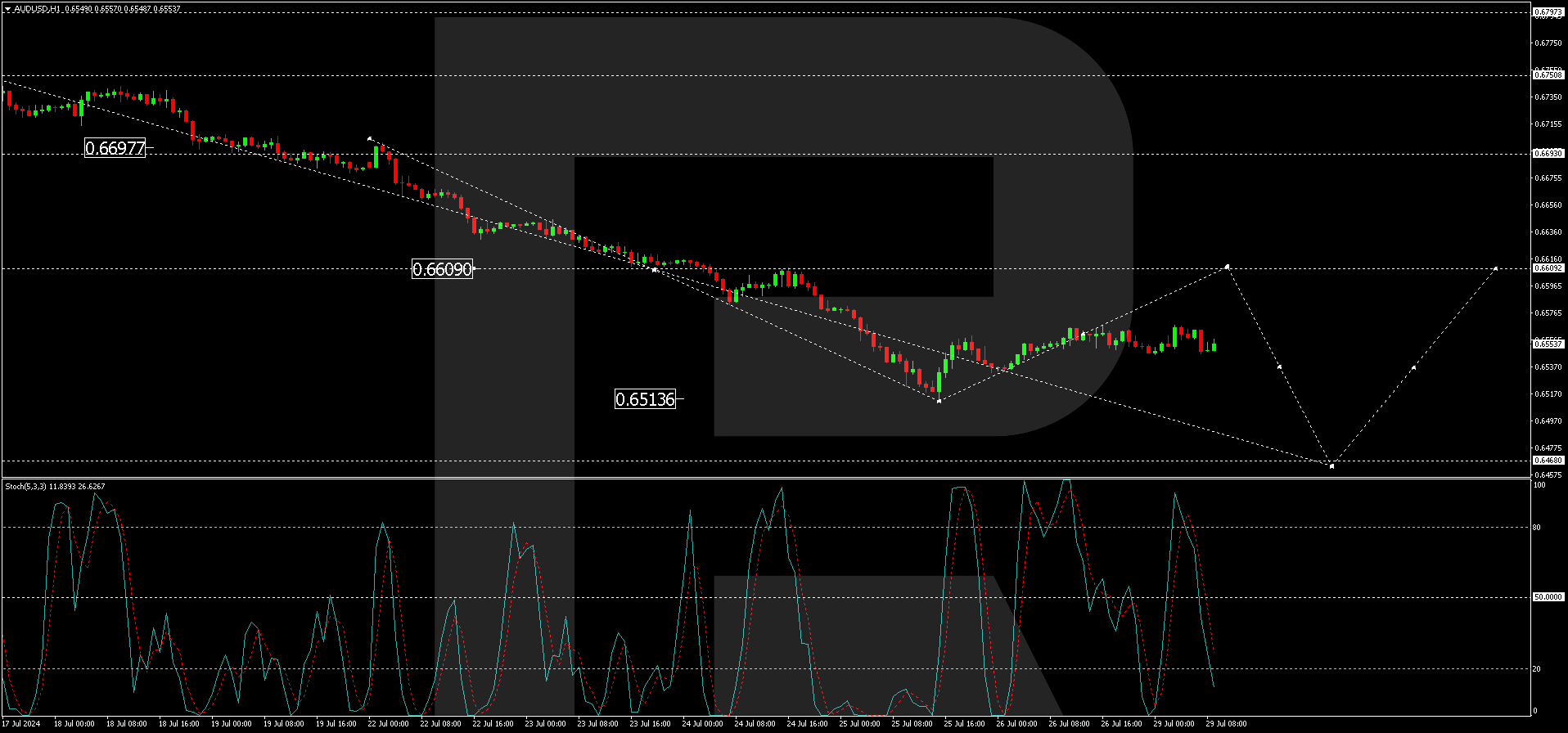
On the H1 chart of AUD/USD, a correction to 0.6626 is executed. Today, the market broke upwards to 0.6666 and continues growing towards 0.6694 with the prospect of continuing the development of the wave structure to 0.670, the local target. Technically, this scenario is confirmed by the Stochastic oscillator. Its signal line is above the level of 80. We expect the beginning of the decline to the level of 20.


Disclaimer

Any forecasts contained herein are based on the author’s particular opinion. This analysis may not be treated as trading advice. RoboForex bears no responsibility for trading results based on trading recommendations and reviews contained herein.

Trade of the Week: USDInd set for rollercoaster ride?

By ForexTime 

  • USDInd ↑ 0.9% MTD
  • US Presidential debate & PCE deflators in focus
  • Over past year PCE deflators triggered moves of 0.3% ↑ or ↓
  • Technical levels – 106.50, 105.60 & 105.20

Watch this space because FXTM’s USDInd could be jolted by economic and political forces!

It’s all about the Biden vs. Trump faceoff and US PCE deflators which may translate to heightened dollar volatility this week.

After securing a weekly close above the 105.60 resistance, prices are turning increasingly bullish. However, the next major level for bulls to crack can be found at 106.50.

Note: FXTM’s USDInd tracks the US Dollar Index.  This measures how the dollar performs against a basket of six different G10 currencies, including the Euro, British Pound, Japanese Yen, and Canadian dollar.

The lowdown…

Dollar bulls have made a return this month thanks to stronger-than-expected US data including the solid US May jobs report. Last Friday, reports revealed that both U.S manufacturing and services sectors expanded in June – further trimming rate cut bets.

The USDInd could end H1 with a bang, here are 3 reasons why:

    1) Biden vs. Trump: US Presidential debate

The spotlight shines on the first US presidential debate on Thursday, June 27th.

Investors will most likely focus on every little detail, starting from mental states, messaging, overall accuracy of information, and policies among other things. There are just over four months till the US presidential election with national polls suggesting that Biden and Trump are neck-and-neck! This could add more flavour to the upcoming debate which may shape the overall election result.

  • Whatever the outcome of this big political event, it could trigger fresh volatility for the dollar and across financial markets.


    2) US May PCE deflators

On the data front, the Fed’s preferred inflation gauge – the Core PCE could influence expectations about when the central bank will cut rates in 2024.

Markets are forecasting PCE deflators to cool in May with the core figure falling to 2.6% year-on-year compared with the 2.8% seen in the previous month. Ultimately, more signs of cooling price pressures could boost bets around lower US interest rates.

Traders are currently pricing in a 73% probability of a 25-basis point cut in September with a move fully priced in by November.

It will be wise to keep an eye on speeches by numerous Fed officials and other US data that could also move the USDInd.

Golden nugget: Over the past year, the US PCE deflators have triggered upside moves of as much as 0.3% or declines of 0.3% in a 6-hour window post-release.


  • The USDInd may slip on more signs of cooling price pressures in the United States, with dovish comments by Fed officials fuelling the downside.
  • Should the PCE deflators print higher than expected, this may support USDInd bulls as markets further push back Fed cut expectations.


    3) Technical forces

Prices are trending higher on the daily charts with support levels at 105.60 and 105.20.

There have been consistently higher highs and lows, while the candlesticks are trading above the 50, 100 and 200-day SMA.

  • Should 105.60 prove to be reliable support, this could encourage an incline towards 106.50.
  • A daily close below 105.60 could see prices re-test 105.20.
  • Weakness below 105.20 may open the doors towards the 100-day SMA at 104.70.


Forex-Time-LogoArticle by ForexTime

ForexTime Ltd (FXTM) is an award winning international online forex broker regulated by CySEC 185/12 www.forextime.com

The yen is falling again: the devaluation scenario remains the main one

By RoboForex Analytical Department

The Japanese yen is weakening against the US dollar again. The USD/JPY pair is rising to 158.97.

The currency pair is now again close to the levels when the Bank of Japan and the country’s authorities conducted currency interventions. Japan’s top currency diplomat, Masato Kanda, stated that the government is prepared to take measures against speculative movements of the national currency.

Among the significant news items, attention is drawn to the information that the US has added Japan to the list of countries being monitored for currency manipulation.

Following its regular committee meeting last week, the Bank of Japan refused to agree on reducing large-scale bond purchases. It plans to present a plan to wind down such a program at a meeting in July. The market interpreted this decision in different ways, but mostly negatively.

Inflation in Japan rose from 2.5% in April to 2.8% year-on-year in May, the maximum value since February of this year. The core consumer price index accelerated to 2.5% year-on-year despite being 2.2% earlier. Meanwhile, the forecast was not met and stood at 2.6%.

Technical analysis of USD/JPY

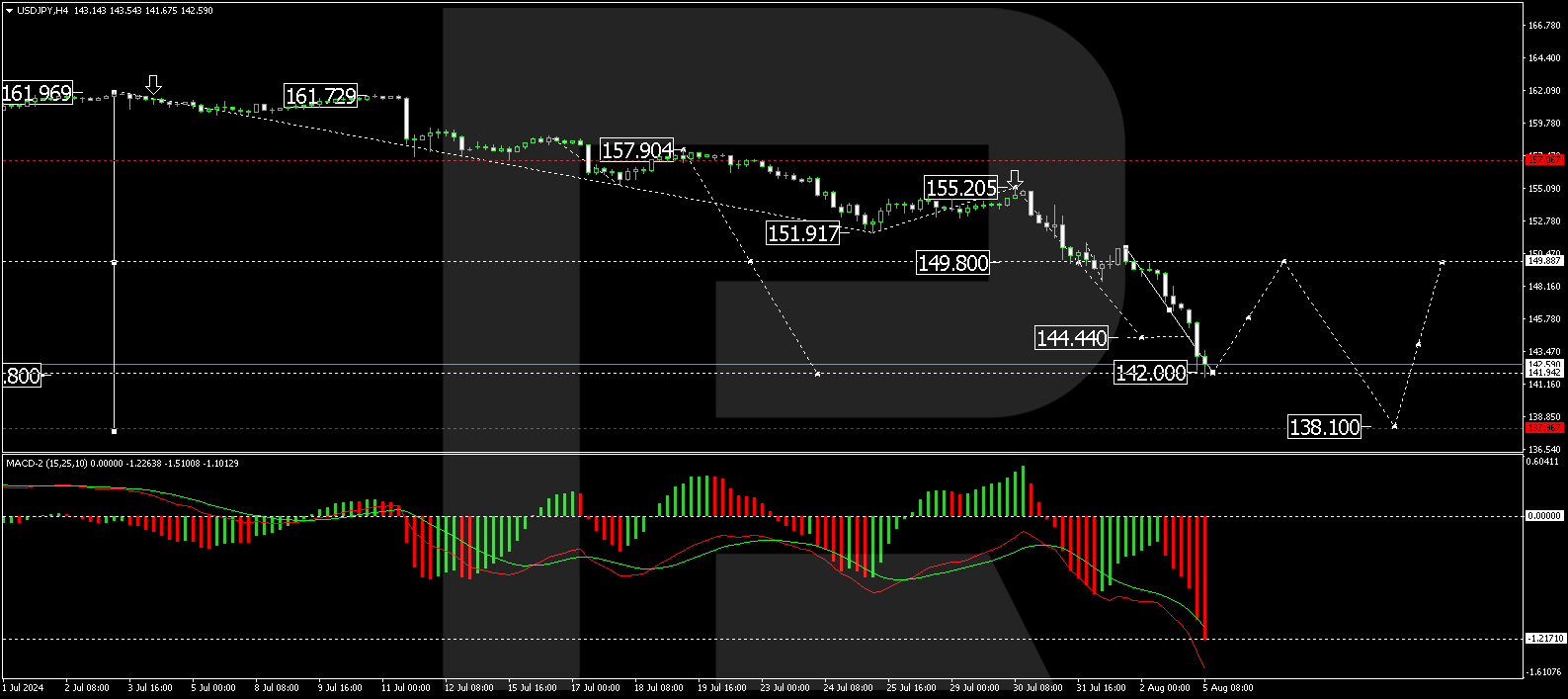
On the H4 USD/JPY chart, the market has achieved a wave of growth to 158.80. Today, a consolidation range is forming around this level. With the exit from this range downwards, we will consider a correction to the level of 158.40. An upward exit will open the potential for a growth wave to 159.35, the main target. This scenario is technically confirmed by the MACD indicator. Its signal line is above the zero level and is directed strictly upwards.

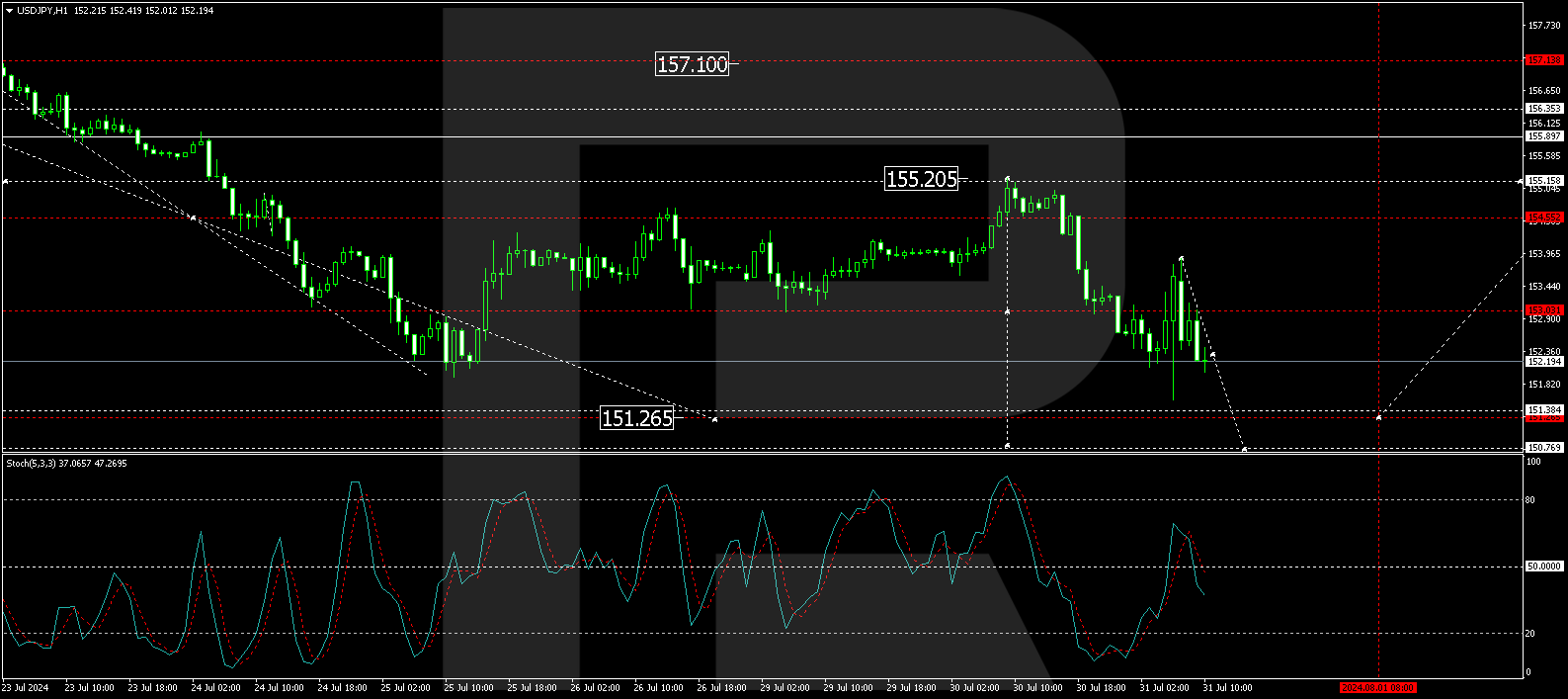
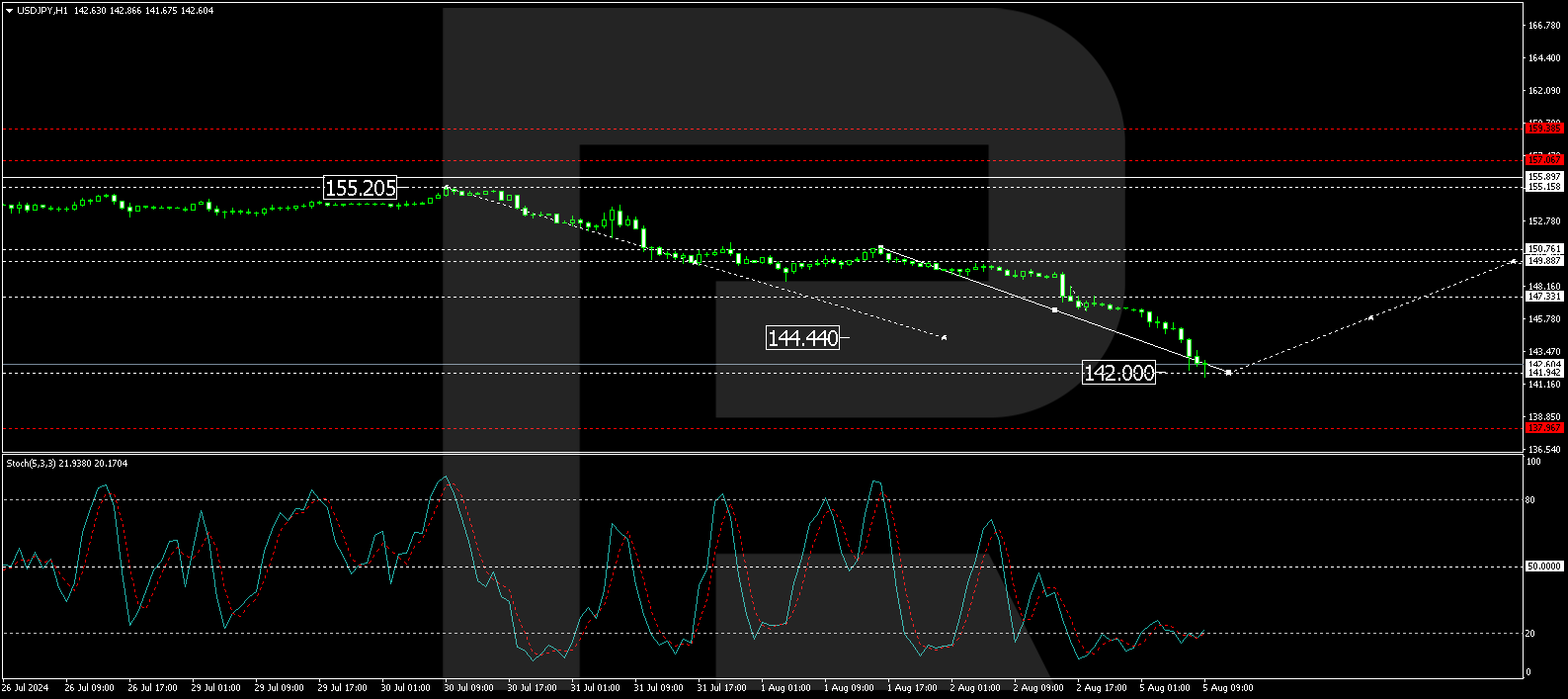
On the H1 USD/JPY chart, the market continues to develop a consolidation range around 158.80. With the exit down, we will consider the development of the correction towards at least 158.40. After the completion of this correction, we expect the beginning of a new growth structure to the level of 159.35. Technically, this scenario is confirmed by the Stochastic oscillator. Its signal line is below level 50 and is preparing to decline to level 20.


Disclaimer

Any forecasts contained herein are based on the author’s particular opinion. This analysis may not be treated as trading advice. RoboForex bears no responsibility for trading results based on trading recommendations and reviews contained herein.
Week Ahead: Yen headed for intervention “danger zone”?

By ForexTime

  • JPY is worst-performing G10 currency vs. USD in 1H24
  • USDJPY’s 160 price area triggered largest-ever JPY intervention in late-April
  • Besides intervention risk, traders watching Friday’s US/Japan inflation data
  • Bloomberg model: 77% chance of 156.69-160.58 trading range next week


The Yen is returning closer towards its 34-year low against the US dollar.

This widely-traded FX pair posted its 6th straight day of gains, with the Yen set for its longest losing streak against the US dollar since March.

Already the Yen is set to wrap up the first half of 2024 with the title of worst-performing G10 currency against the US dollar, by a mile.


Why is the Yen so weak?

USDJPY’s stunning ascent has been primarily driven by the surprise reluctance by both the US and Japanese central banks to change their policy stances:

  • The Bank of Japan has not been as quick to HIKE interest rates so far this year
  • The US Federal Reserve has not been as quick to CUT interest rates so far this year
Recall that a currency tends to weaken when its country’s interest rates are lower than its peers, and vice versa.

This persistent policy divergence has resulted in a still-wide spread between US Treasury yields and their Japanese counterparts, which greatly favours USD demand over JPY.

In other words …

With Japan’s interest rates staying lower-for-longer, while the Fed’s benchmark rates remain higher for longer, that has resulted in a resilient US Dollar and a weaker Japanese Yen, i.e. soaring USDJPY.


What should traders look out for?

Traders, especially Yen bears, are entering the final trading week of 1H24 with memories from end-April, which was the last time USDJPY was seen around these current levels.

Starting April 26th, the Japanese government had spent a record US$62.2 billion to defend its currency.

That record intervention contributed to USDJPY’s largest one-day price swing since 2022, as the FX pair breached 160, only to plummet to as low as 154.52.

That was a painful lesson for Yen bears (those hoping that USDJPY can move higher), although another showdown appears to be shaping up.

Hence, if we do see another round of intervention on the Yen, that could translate into massive profits for Yen bulls (those hoping for lower USDJPY).


Beyond the threat of another round of government intervention, the coming week also features scheduled events that could rock USDJPY:

Monday, June 24

  • NZD: New Zealand May trade balance
  • JPY: BoJ Summary of Opinions
  • SG20 index: Singapore May CPI
  • TWN index: Taiwan May unemployment, industrial production
  • GER40 index: Germany June IFO business climate
  • US30 index: Speech by San Francisco Fed President Mary Daly

Tuesday, June 25

  • AU200 index: Australia June consumer confidence
  • CAD: Canada CPI
  • USD index: US June consumer confidence; speeches by Fed Governors Lisa Cook and Michelle Bowman

Wednesday, June 26

  • AUD: Australia May CPI
  • GER40 index: Germany July consumer confidence

Thursday, June 27

  • JP225 index: Japan May retail sales
  • CNH: China May industrial profits
  • TRY: Turkey rate decision
  • SEK: Sweden rate decision
  • EU50 index: Eurozone June economic confidence
  • USD: US weekly initial jobless claims; 1Q GDP (final)
  • Nike earnings
  • Biden vs. Trump: US Presidential election debate

Friday, June 28

  • JPY: Tokyo June CPI; May jobless rate and industrial production
  • EUR: Germany June unemployment; France June CPI
  • GBP: UK 1Q GDP (final)
  • USD index: US May PCE deflators, personal income and spending; June consumer sentiment (final)


USDJPY set for freaky Friday?

Two events out of either side of the Pacific may hold greater potential to rock USDJPY on the final trading day of 1H24:


1) Tokyo June consumer price index (CPI)

Here’s what economists expect:

  • CPI year-on-year (June 2024 vs. June 2023): 2.3%
    If so, that would be slightly higher than May’s 2.2% year-on-year figure.
  • CPI year-on-year (excluding fresh food): 2.0%
    If so, that would be slightly higher than May’s 1.9% year-on-year figure.
  • CPI year-on-year (excluding fresh food and energy): 1.6%
    If so, that would be slightly higher than May’s 1.7% year-on-year figure.

Over the past 12 months, the 6 hours after these Tokyo CPI releases had seen upwards moves for USDJPY as much as 0.38%, or declines as much as 0.3%.


2) US May PCE Deflators

(this is the Fed’s preferred measure of inflation)

Here’s what economists expect:

  • PCE Deflator month-on-month (June 2024 vs. May 2024): 0.0%
    If so, that would be a notable drop from May’s 0.3% month-on-month figure.
  • PCE Deflator year-on-year (June 2024 vs. June 2023): 2.6%
    If so, that would be slightly lower than May’s 2.7% year-on-year figure.
  • PCE Core Deflator month-on-month (excluding food and energy prices): 0.1%
    If so, that would be slightly lower from May’s 0.2% month-on-month figure.
  • PCE Core Deflator year-on-year (excluding food and energy): 2.6%
    If so, that would be lower than May’s 2.8% year-on-year figure.

Over the past 12 months, the 6 hours after these US PCE Deflators had seen upwards moves for USDJPY as much as 1%, or declines as much as 0.35%.


POTENTIAL SCENARIOS:

  • USDJPY may fall if we see higher-than-expected Tokyo inflation (which is a frontrunner to the National CPI due later) which could allow the Bank of Japan to hike rates – a thought which should prompt a stronger Yen.On the US dollar side of the USDJPY equation, lower-than-expected US inflation might pave the way for the Fed to lower interest rates this year – potentially prompting the US dollar to weaken.


  • USDJPY may rise if we see lower-than-expected Tokyo inflation, which could further deter the Bank of Japan to hike rates – a thought which should prompt an even weaker Yen.On the US dollar side of the USDJPY equation, higher-than-expected US inflation might further delay the expected Fed rate cuts for later this year – potentially prompting a stronger US dollar.


Key levels

POTENTIAL RESISTANCE

  • 160.00
    The closer USDJPY moves towards this psychologically-important number, the louder the echoes of April’s intervention may haunt traders.Though to be clear, Japanese government officials have often warned that it’s the magnitude of the move, rather than a specific number, that invokes intervention.

Hence, an only gradual break above 160 may well prolong this battle between Yen bears and the Japanese government.


POTENTIAL SUPPORT

  • 158.427 – 157.80 region
    If traders grow wary of the intervention threat, that may prompt some profit-taking and push USDJPY back towards recent peaks-turned-support
  • 21-day SMA
  • 156.787: mid-May cycle high


According to the Bloomberg FX forecast model, there’s a 77% chance that USDJPY will trade between 156.69 – 160.58 before we enter July.


Forex-Time-LogoArticle by ForexTime

ForexTime Ltd (FXTM) is an award winning international online forex broker regulated by CySEC 185/12 www.forextime.com

The pound froze ahead of the Bank of England meeting: what will the Central Bank decide?

By RoboForex Analytical Department

The GBP/USD pair is balancing around 1.2709 on Thursday, after the British pound rose in price against the US dollar for three consecutive days and finally paused.

The Bank of England will convene for its regular meeting today, at which the regulator will review all the collected statistics and decide on the interest rate level. The prevailing forecast suggests the rate will remain unchanged at 5.25% per annum. However, other options are always possible.

It will be interesting to see how the BoE will assess its success in fighting inflation. The UK consumer price index slowed to 2.0% in May from 2.3% earlier. In comparison, the indicator increased by 0.3% month-over-month, as in April, while an increase of 0.4% m/m was expected.

It can be said with confidence that the inflation trend has developed positively. It is now essential that the Bank of England also notices and applies this.

The BoE may be able to reduce the rate at least twice in 2024. The business sector, industry, and retail are ready for this.

Technical analysis of GBP/USD

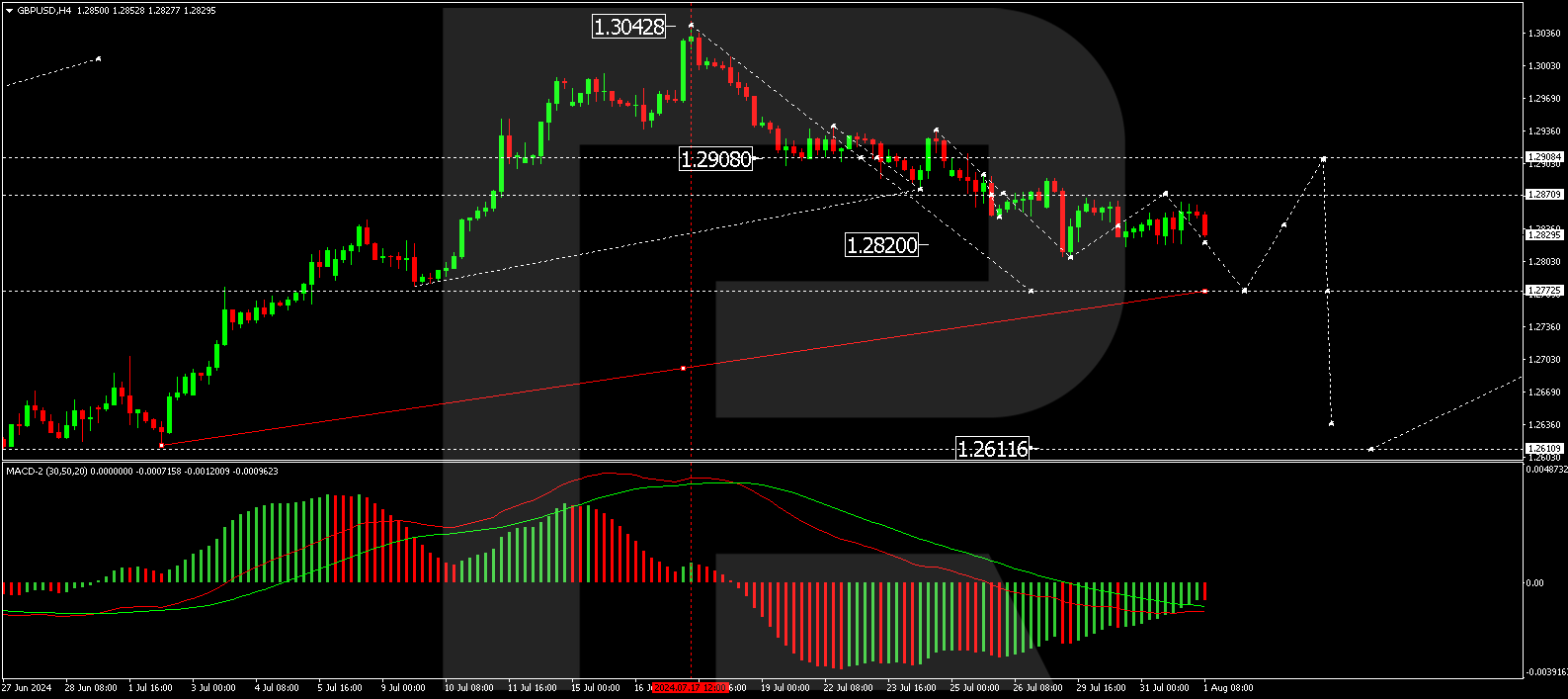
On the H4 GBP/USD chart, the first impulse of decline to the level of 1.2656 has been executed. Today, the market is forming a correction to the level of 1.2760. After reaching this level, we will consider the beginning of a decline to 1.2670. With the breakdown of this level, the potential of the wave will open to the level of 1.2576, a local target. Further, a correction wave to 1.2670 is possible (testing from below). Then, we will consider the beginning of a wave of decline to 1.2486, the main target. Technically, this scenario is confirmed by the MACD indicator. Its signal line is below the zero mark and continues developing the decline structure to new lows.

On the H1 GBP/USD chart, a correction wave was performed to 1.2739, and the decline structure to 1.2692 is forming today. After working out this level, let’s consider the growth probability towards 1.2760. At this point, the correction potential will be exhausted. After the correction is completed, we will consider the beginning of a new wave of decline to 1.2670. Technically, this scenario is confirmed by the Stochastic oscillator. Its signal line is below the zero level and continues to decline to the level of 20.


Disclaimer

Any forecasts contained herein are based on the author’s particular opinion. This analysis may not be treated as trading advice. RoboForex bears no responsibility for trading results based on trading recommendations and reviews contained herein.

The New Zealand dollar faces growth challenges

By RoboForex Analytical Department

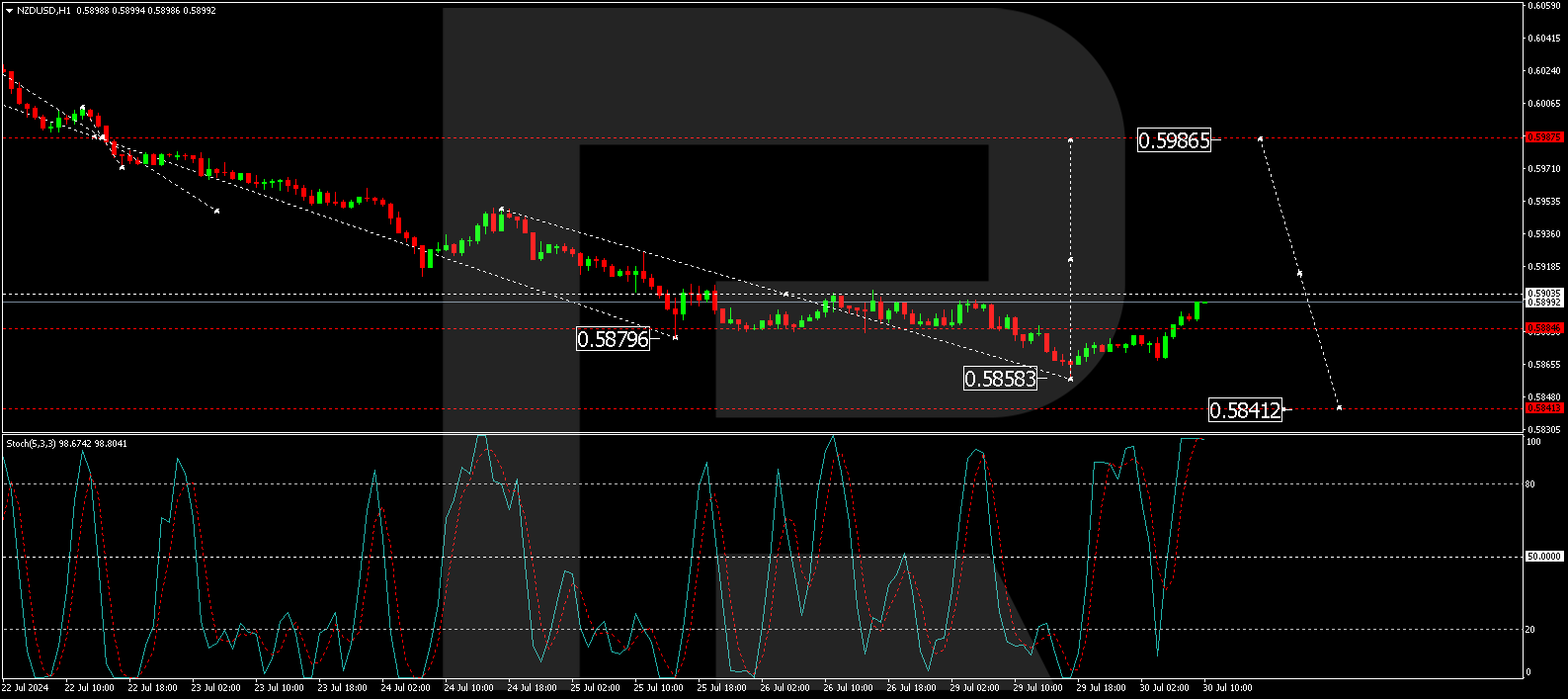
The NZD/USD pair declined to 0.6135 on Wednesday, despite the New Zealand dollar performing much better in the previous session. It rose in response to the fall of the US dollar, which was triggered by weaker-than-expected US retail sales data. These results increased bets on an imminent reduction in the cost of lending by the Federal Reserve System. This caused the USD to retreat, allowing other currencies to rise.

Today, Paul Conway, the chief economist of the Reserve Bank of New Zealand, announced that the process of returning inflation to the target is progressing well. The ongoing softening of the employment sector is releasing spare capacity in the economy, likely leading to a further reduction in inflationary pressure in the economic system.

At the same time, Conway noted that the inflation reduction process may not follow the predicted timeline. An extended period of maintaining a restrictive monetary policy is necessary to achieve a lasting result, a crucial step to ensure the goal is met. The market’s attention will now shift to the upcoming Q1 GDP statistics. The data may reflect a fairly modest increase, which could hurt the NZD.

Technical analysis of NZD/USD

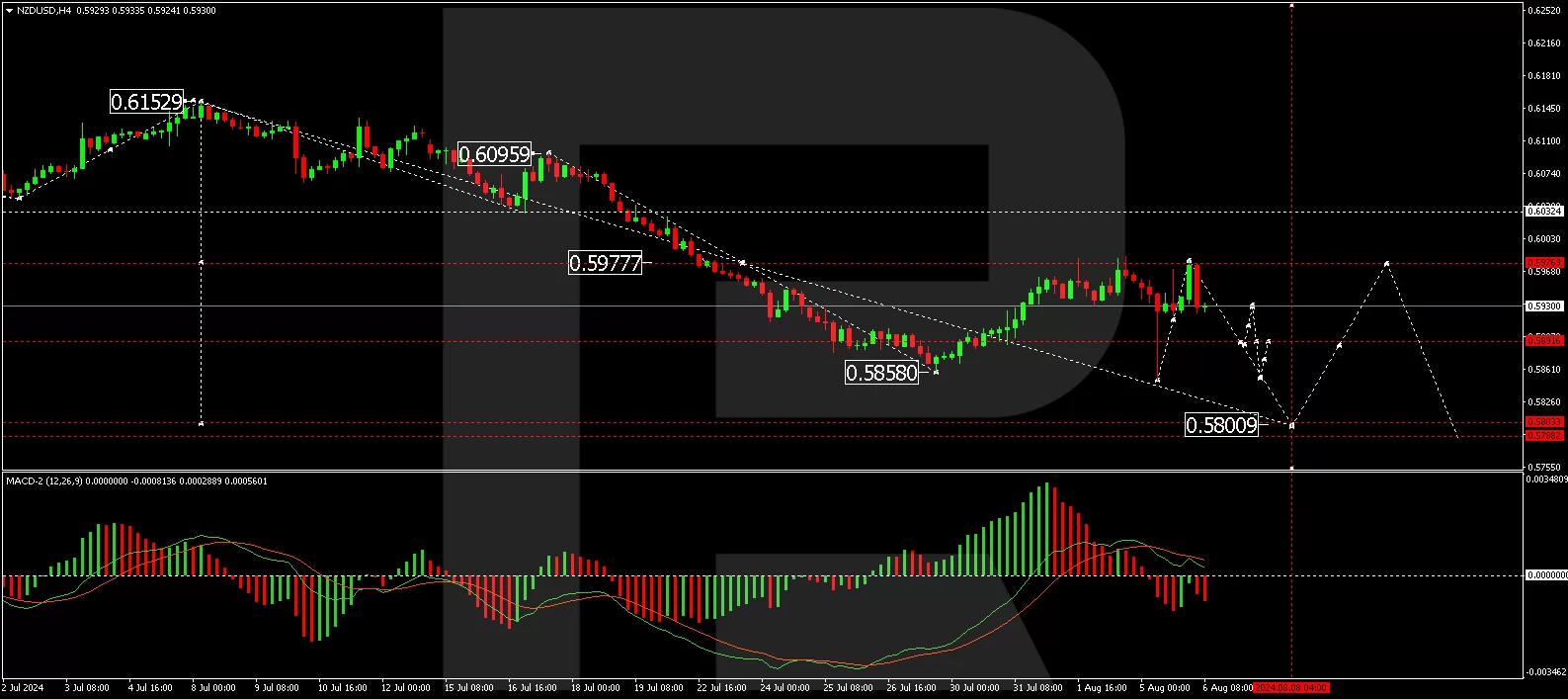
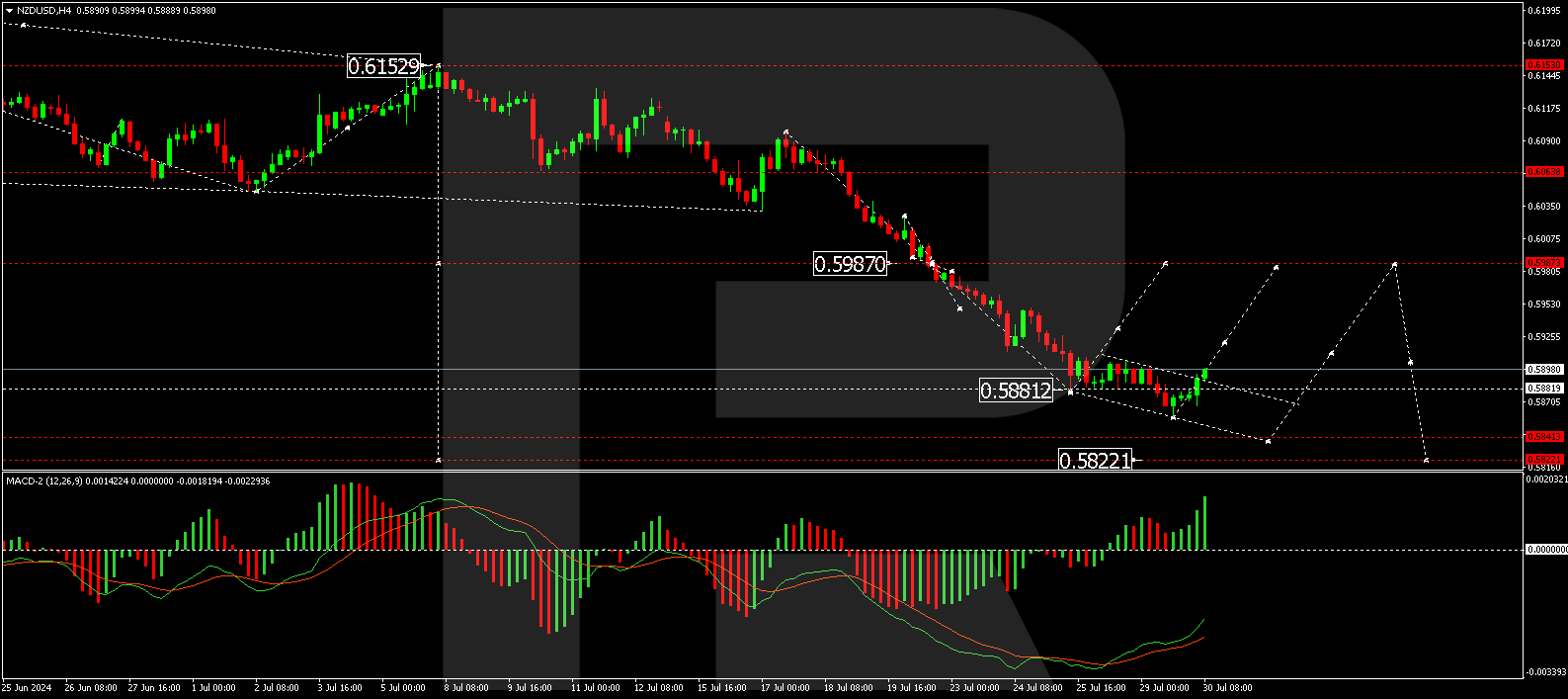
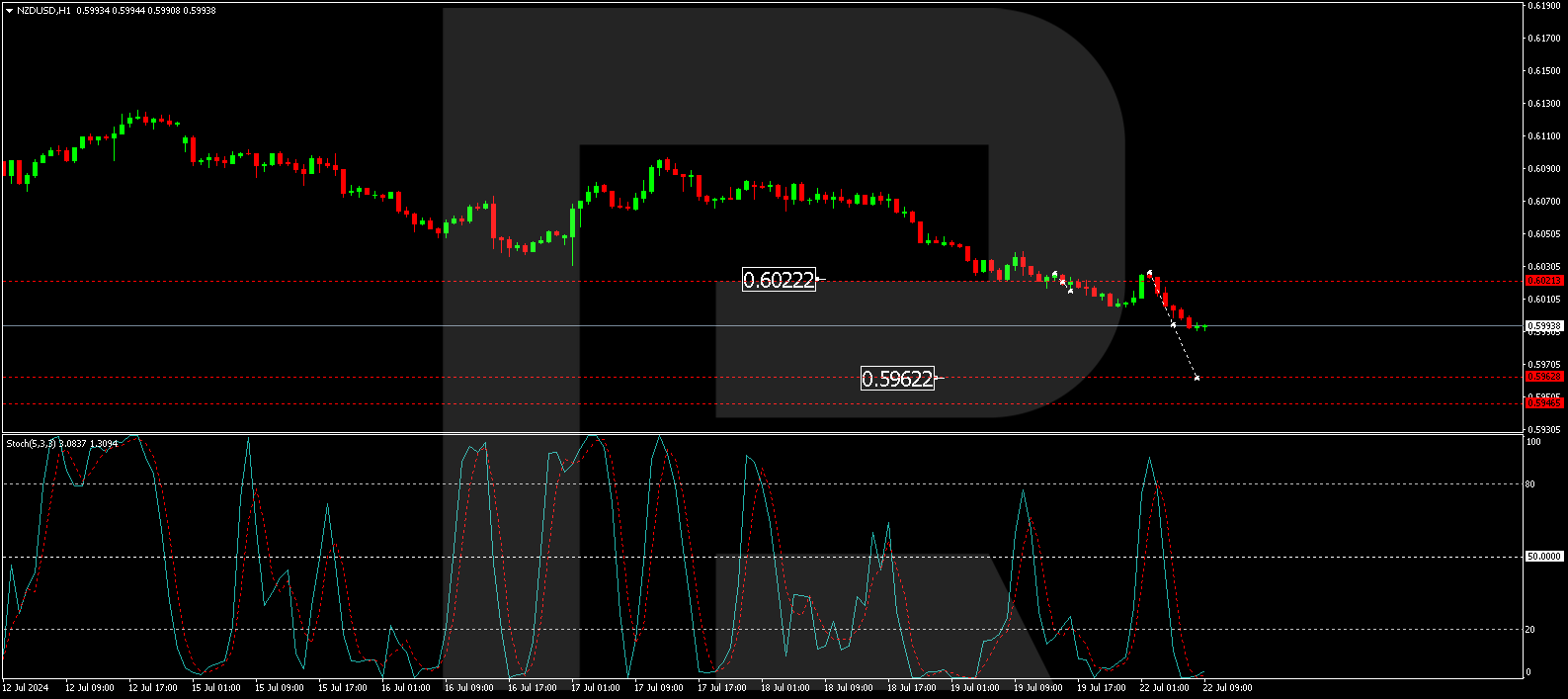
On the H4 NZD/USD chart, the market executed a wave of decline to the level of 0.6097 and a correction to the level of 0.6148. Today, we expect another downward trend to 0.6075, the first goal. After reaching this level, a correction to 0.6140 is possible (testing from below). Next, we will consider a new wave of decline to 0.6028, the local target. This scenario is technically confirmed by the MACD indicator, as its signal line is below the zero mark. An update of the lows is expected.

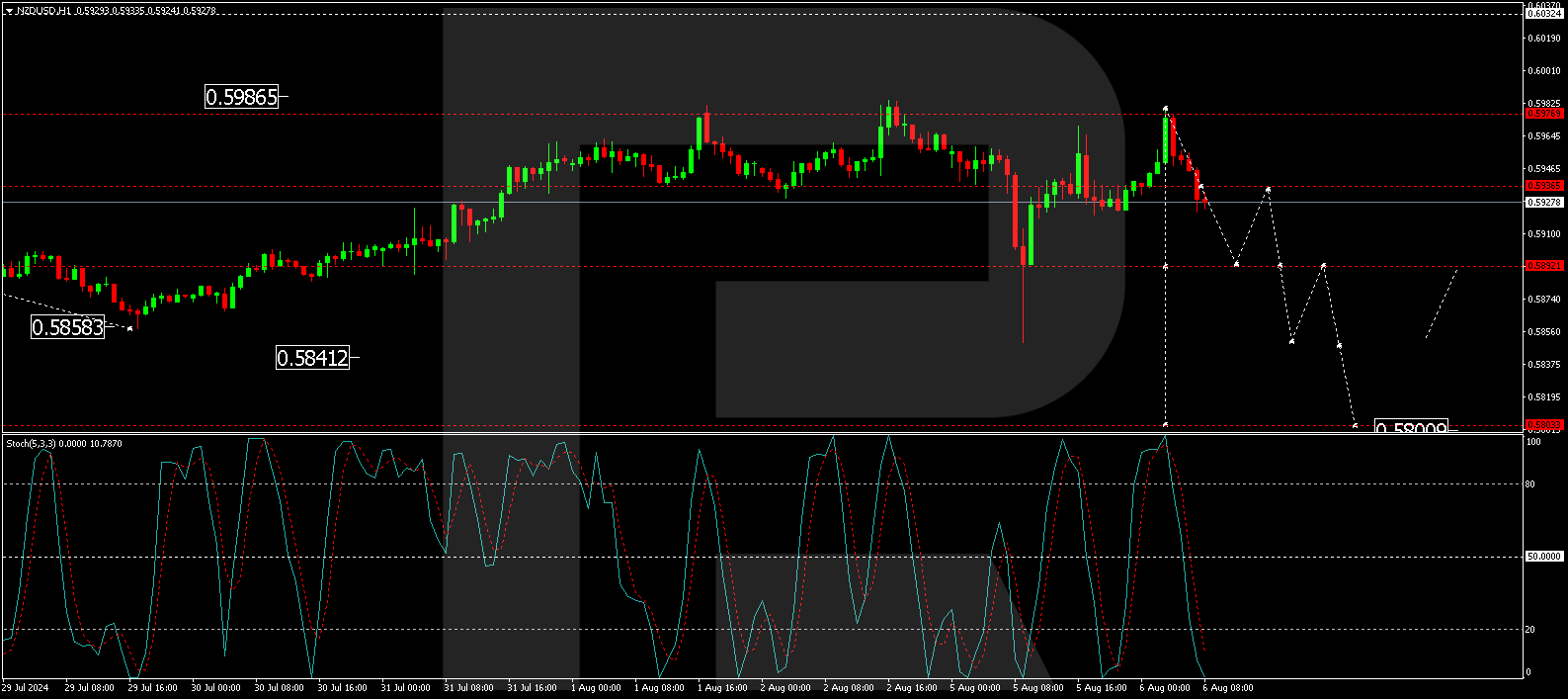
On the H1 NZD/USD chart, a correction has formed to 0.6148 (testing from below). Today, we expect a decrease to 0.6111. The breakdown of this level will open the potential for a downward trend to 0.6075. Technically, this scenario is also confirmed by the Stochastic oscillator. Its signal line is below the 50 mark, and another decline to the level of 20 is expected.

Disclaimer

Any forecasts contained herein are based on the author’s particular opinion. This analysis may not be treated as trading advice. RoboForex bears no responsibility for trading results based on trading recommendations and reviews contained herein.
The New Zealand dollar is falling

By RoboForex Analytical Department

Like other major currencies, the New Zealand dollar is under pressure from the strong US dollar. This development comes after the Federal Reserve’s updated forecasts last week. Stock market expectations point to only one interest rate cut this year, most likely in December.

Earlier, some American monetary policymakers confirmed these expectations, calling them reasonable.

The New Zealand services sector experienced a significant downturn in May, dropping the indicator to its lowest value since 2007. This reflects the country’s economic state, which is already in recession. The business activity index also decreased to 43.0 points from 46.6 points previously. Everything below the 50.0-point mark indicates a deterioration in the market situation.

Such data increases the likelihood that the Reserve Bank of New Zealand will decide to cut rates eventually. The main forecast is November. However, the RBNZ’s position, which has been voiced repeatedly, is that in 2024, the rates are unlikely to be revised down. The Central Bank believes that any reduction is not likely before mid-2025.

NZD/USD Technical Analysis

On the H4 NZD/USD chart, the market executed a correction wave to the level of 0.6220. At the moment, the market is forming another wave following the downward trend. The first target is at 0.6055. After reaching this level, a correction link to 0.6140 is possible (test from below). Next, we will consider a new wave of decline to 0.6016, the local target. Technically, this scenario is confirmed by the MACD indicator. Its signal line is located below the zero mark and is directed strictly downwards.

On the H1 NZD/USD chart, a downward impulse has been executed towards 0.6140. At the moment, a consolidation range has formed around this level. Today, we expect an exit from this range down to 0.6080. After reaching this level, a correction link to 0.6140 is possible (test from below), followed by a further decrease to 0.6055. The first target is trending down. Technically, this scenario is also confirmed by the Stochastic oscillator. Its signal line is located below the 20 mark and is directed strictly downwards.

Disclaimer

Any forecasts contained herein are based on the author’s particular opinion. This analysis may not be treated as trading advice. RoboForex bears no responsibility for trading results based on trading recommendations and reviews contained herein.
Speculator Extremes: New Zealand Dollar, Palladium lead Bullish & Bearish Positions

By InvestMacro

The latest update for the weekly Commitment of Traders (COT) report was released by the Commodity Futures Trading Commission (CFTC) on Friday for data ending on June 11th.

This weekly Extreme Positions report highlights the Most Bullish and Most Bearish Positions for the speculator category. Extreme positioning in these markets can foreshadow strong moves in the underlying market.

To signify an extreme position, we use the Strength Index (also known as the COT Index) of each instrument, a common method of measuring COT data. The Strength Index is simply a comparison of current trader positions against the range of positions over the previous 3 years. We use over 80 percent as extremely bullish and under 20 percent as extremely bearish. (Compare Strength Index scores across all markets in the data table or cot leaders table)


Here Are This Week’s Most Bullish Speculator Positions:

New Zealand Dollar


The New Zealand Dollar speculator position comes in as the most bullish extreme standing this week. The New Zealand Dollar speculator level is currently at a 91.5 percent score of its 3-year range.

The six-week trend for the percent strength score totaled 55.4 this week. The overall net speculator position was a total of 10,978 net contracts this week with a boost of 3,773 contract in the weekly speculator bets.


Speculators or Non-Commercials Notes:

Speculators, classified as non-commercial traders by the CFTC, are made up of large commodity funds, hedge funds and other significant for-profit participants. The Specs are generally regarded as trend-followers in their behavior towards price action – net speculator bets and prices tend to go in the same directions. These traders often look to buy when prices are rising and sell when prices are falling. To illustrate this point, many times speculator contracts can be found at their most extremes (bullish or bearish) when prices are also close to their highest or lowest levels.

These extreme levels can be dangerous for the large speculators as the trade is most crowded, there is less trading ammunition still sitting on the sidelines to push the trend further and prices have moved a significant distance. When the trend becomes exhausted, some speculators take profits while others look to also exit positions when prices fail to continue in the same direction. This process usually plays out over many months to years and can ultimately create a reverse effect where prices start to fall and speculators start a process of selling when prices are falling.


Copper


The Copper speculator position comes next in the extreme standings this week. The Copper speculator level is now at a 90.3 percent score of its 3-year range.

The six-week trend for the percent strength score was 3.0 this week. The speculator position registered 61,288 net contracts this week with a weekly edge higher by 161 contracts in speculator bets.


Mexican Peso


The Mexican Peso speculator position comes in third this week in the extreme standings. The Mexican Peso speculator level resides at a 89.8 percent score of its 3-year range.

The six-week trend for the speculator strength score came in at -0.0 this week. The overall speculator position was 118,993 net contracts this week with a decline of -5,678 contracts in the weekly speculator bets.


Silver


The Silver speculator position comes up number four in the extreme standings this week. The Silver speculator level is at a 89.0 percent score of its 3-year range.

The six-week trend for the speculator strength score totaled a change of -3.9 this week. The overall speculator position was 51,692 net contracts this week with a drop of -4,711 contracts in the speculator bets.


British Pound


The British Pound speculator position rounds out the top five in this week’s bullish extreme standings. The British Pound speculator level sits at a 87.8 percent score of its 3-year range. The six-week trend for the speculator strength score was 53.8 this week.

The speculator position was 52,121 net contracts this week with a boost of 8,911 contracts in the weekly speculator bets.


This Week’s Most Bearish Speculator Positions:

Palladium


The Palladium speculator position comes in as the most bearish extreme standing this week. The Palladium speculator level is at a 0.0 percent score of its 3-year range.

The six-week trend for the speculator strength score was -17.5 this week. The overall speculator position was -13,914 net contracts this week with a decline of -1,242 contracts in the speculator bets.


Canadian Dollar


The Canadian Dollar speculator position comes in next for the most bearish extreme standing on the week. The Canadian Dollar speculator level is at a 0.0 percent score of its 3-year range.

The six-week trend for the speculator strength score was -37.8 this week. The speculator position was -129,493 net contracts this week with a sharp decrease of -37,854 contracts in the weekly speculator bets.


Cotton


The Cotton speculator position comes in as third most bearish extreme standing of the week. The Cotton speculator level resides at a 0.0 percent score of its 3-year range.

The six-week trend for the speculator strength score was -27.8 this week. The overall speculator position was -20,056 net contracts this week with a reduction by -13,365 contracts in the speculator bets.


5-Year Bond


The 5-Year Bond speculator position comes in as this week’s fourth most bearish extreme standing. The 5-Year Bond speculator level is at a 4.5 percent score of its 3-year range.

The six-week trend for the speculator strength score was -21.0 this week. The speculator position was -1,497,424 net contracts this week with a gain of 75,613 contracts in the weekly speculator bets.


Soybean Oil


Finally, the Soybean Oil speculator position comes in as the fifth most bearish extreme standing for this week. The Soybean Oil speculator level is at a 4.6 percent score of its 3-year range.

The six-week trend for the speculator strength score was 4.6 this week. The speculator position was -48,951 net contracts this week with a drop of -12,366 contracts in the weekly speculator bets.


Article By InvestMacroReceive our weekly COT Newsletter

*COT Report: The COT data, released weekly to the public each Friday, is updated through the most recent Tuesday (data is 3 days old) and shows a quick view of how large speculators or non-commercials (for-profit traders) were positioned in the futures markets.

The CFTC categorizes trader positions according to commercial hedgers (traders who use futures contracts for hedging as part of the business), non-commercials (large traders who speculate to realize trading profits) and nonreportable traders (usually small traders/speculators) as well as their open interest (contracts open in the market at time of reporting). See CFTC criteria here.

The Japanese yen fell to a six-week low after the Bank of Japan ended its meeting

By RoboForex Analytical Department

The Japanese yen exchange rate paired with the US dollar looks unimpressive by the end of this week. The USD/JPY pair rose to almost 158.00 immediately after the end of the June meeting of the Bank of Japan, which left the interest rate unchanged. Everything went according to expectations.

In March, the BoJ raised the rate for the first time in seven years, moving it from negative territory to zero.

In its comments, the regulator noted that it will continue to buy Japanese government bonds at the same pace as agreed in March until its July meeting. Thus, market expectations were ignored, which worked against the JPY. Investors hoped that the BoJ would at least carefully consider gradually reducing its balance sheet through government bonds as part of a smooth monetary policy transition from quantitative easing to tightening.

Previously, Bank of Japan Governor Kazuo Ueda confirmed the regulator’s intention to gradually reduce its substantial balance sheet in the future. However, the timing of this action remains uncertain.

USD/JPY Technical Analysis

On the H4 USD/JPY chart, the market has breached 157.47 upwards and is continuing to develop a growth wave towards 158.74. After reaching this level, a correction down to the level of 157.47 is a possibility (test from above). We will then assess the probability of continuing the growth wave to 159.36. Technically, this scenario is supported by the MACD indicator, with its signal line above the zero level and pointing upwards.

On the H1 USD/JPY chart, the market continues to develop a wave of growth to the level of 158.40. Further, a correction wave to 157.47 is possible, followed by growth to 158.74, the local target. Technically, this scenario is confirmed by the Stochastic oscillator, with its signal line above level 80 and preparing to decline to level 20.


Disclaimer

Any forecasts contained herein are based on the author’s particular opinion. This analysis may not be treated as trading advice. RoboForex bears no responsibility for trading results based on trading recommendations and reviews contained herein.
US Dollar declines as Fed signals potential rate cut and inflation eases

By RoboForex Analytical Department

The EUR/USD pair is holding steady around 1.0805 on Thursday, following a surge in volatility the previous evening. The Federal Reserve concluded its meeting with a neutral stance, maintaining the interest rate at 5.25% per annum as anticipated. The Fed’s comments hinted at a possible interest rate cut by December while projecting more aggressive rate reductions for 2025, which the market viewed positively.

However, it was the US inflation data that significantly impacted the EUR/USD pair, more so than the Fed’s announcement. The Consumer Price Index (CPI) for May showed a year-on-year increase of 3.3%, down from 3.4% in the previous month. On a month-on-month basis, the CPI was flat, compared to a 0.3% increase in April. Core inflation, which excludes volatile food and energy prices, also decreased to 3.4% year-on-year, surpassing expectations. This decline in price pressures followed unexpectedly robust employment market reports.

Investors have been highly reactive to each successive set of statistics, partly because the Fed has emphasised the significance of these data releases in shaping its monetary policy decisions. Following the inflation report, the EUR/USD briefly spiked to 1.0852 before retreating slightly.

EUR/USD technical analysis

On the H4 chart, EUR/USD surged past the consolidation range on the news, executing a correction wave to 1.0851. Currently, a downward impulse has brought it to 1.0800. We anticipate the formation of a consolidation range around this level. A downward breakout could lead to a further decline to 1.0776, potentially extending to 1.0701. The MACD indicator supports this bearish outlook, with its signal line positioned below zero and pointing downward.

On the H1 chart, EUR/USD has completed a decline to 1.0800. A corrective movement to 1.0826 may occur, testing from below. Following this correction, a new downward wave is expected to target 1.0766, with a continuation towards 1.0706 likely. The Stochastic oscillator, with its signal line currently above 20, suggests an upward move to 80, confirming the potential for this bearish trajectory.

Market outlook

As the market digests the implications of the latest US economic data and the Federal Reserve’s statements, fluctuations in the EUR/USD pair will likely continue. Investors should remain vigilant and prepared for further volatility as more economic indicators are released and the Fed’s monetary policy evolves.

Disclaimer

Any forecasts contained herein are based on the author’s particular opinion. This analysis may not be treated as trading advice. RoboForex bears no responsibility for trading results based on trading recommendations and reviews contained herein.