Archive for Financial News – Page 71

Week Ahead: US500 braces for massive week of risk events

By ForexTime 

  • US500 rebounds 15% from 2025 low
  • Meta, Microsoft, Amazon & Apple make almost 20% of US500 weight
  • US GDP, PCE & NFP report could impact Fed cut bets 
  • NFP sparked moves of ↑ 1.2% & ↓ 3.2% over past year
  • Technical levels: 50-day SMA, 5500 & 5300

US-China trade developments, major economic data and big tech earnings will dominate the week ahead:


Sunday, 27th April 

  • CN50: China industrial profits

Monday, 28th April

  • SG20: Singapore unemployment
  • CAD: Canadians head to the polls in a snap vote

Tuesday, 29th April 

  • EUR: Eurozone consumer confidence
  • SPN35: Spain GDP, CPI
  • UK100: HSBC earnings
  • RUS2000: Conference Board consumer confidence

Wednesday, 30th April    

  • AUD: Australia CPI
  • CN50: China official PMIs, Caixin manufacturing PMI
  • EUR: Eurozone GDP
  • GER40: Germany CPI, GDP, unemployment
  • JP225: Japan industrial production, retail sales
  • TWN: Taiwan GDP
  • US500: US GDP, PCE price index, ADP employment, Meta, Microsoft earnings

Thursday, 1st May

  • May Day – European markets closed except UK
  • AUD: Australia trade
  • JPY: BoJ rate decision
  • UK100: UK S&P Global Manufacturing PMI
  • US500: US ISM manufacturing, initial jobless claims, Amazon, Apple earnings

Friday, 2nd May

  • AUD: Australia retail sales
  • EUR: Eurozone CPI, unemployment, Germany HCOB Manufacturing PMI
  • JP225: Japan unemployment
  • US500: US April jobs report 

The spotlight shines on FXTM’s US500 which has rebounded 15% from its 2025 low. 

Imagen
US500 W1

Note: FXTM’s US500 tracks the underlying S&P 500 index

Recently, US equities have been empowered by bets around the Fed cutting interest rates sooner than expected to prevent a recession. However, uncertainty around trade talks may impact upside gains.

Still, the US500 is over 4% this week, lingering around key resistance at 5500.


Here are 4 factors that could trigger significant price swings:  

1) US-China trade saga

China denied having any trade talks with the United States despite Trump’s claims of progress earlier in the week. However, Trump has pushed back against China’s denial, stating that negotiations were happening.

On a brighter note, there are reports of China’s government weighing the suspension of its 125% tariffs on some US imports.

  • If this eases tensions and paves the path to actual negotiations, the US500 may jump as risk appetite improves.
  • Any signs of escalating tensions or growing uncertainty around trade developments may weigh on the US500.


2) Big tech earnings

Four of the so-called “Magnificent” 7 tech giants with a combined market cap of over $9 trillion are set to publish their results in the week ahead.

Quarterly results from Meta, Microsoft, Amazon and Apple could provide fresh insight into how the industry fared last quarter in the face of Trump’s tariffs. Google-parent Alphabet has already set the bar high by reporting solid earnings.

Considering that the combined weight of Meta, Microsoft, Amazon and Apple makes up roughly 19% of the US500, the incoming earnings could spark significant price swings.

  • A solid set of results and optimistic forward guidance from tech titans may propel the US500 higher.
  • Should results disappoint and concerns expressed about the earnings outlook, the US500 could sink. 


3) US data dump: Q1 GDP, PCE inflation, ISM & NFP

Fed officials have hinted at a possible rate cut if tariffs start weighing on the US jobs market and economic growth.  

This puts extra attention on the US data dump in the week ahead, featuring Q1 GDP, Fed’s preferred inflation gauge and the latest NFP jobs report.

  • Wednesday 30th April – Q1 GDP, US PCE price index 

Note: Over the past 12 months, the US GDP report has triggered upside moves on the US500 of as much as 0.7% or declines of 1.7% in a 6-hour window post-release.

  • Thursday 1st April – US ISM Manufacturing 

Note: Over the past 12 months, the US ISM Manufacturing report has triggered upside moves on the US500 of as much as 1.0% or declines of 2.0% in a 6-hour window post-release.

  • Friday 2nd April – US April NFP report

Note: Over the past 12 months, the US NFP report has triggered upside moves on the US500 of as much as 1.2% or declines of 3.2% in a 6-hour window post-release.

Traders are currently pricing three Fed rate cuts in 2025 with the odds of a fourth cut by December at 35%. Any major shifts to these bets may influence the US500.

  • A set of figures that support the case around the Fed cutting interest rates sooner than expected may push the US500 higher. But gains may be capped by recession fears.
  • While stronger-than-expected data may cool Fed cut bets, the US500 may rise if sentiment improves over the US economic outlook. 


4) Technical forces

The US500 is testing key resistance at 5500, but prices remain below the 50, 100 and 200-day SMA.

  • A solid breakout and daily close above 5500 may inspire a move toward the 50-day SMA at 5637 and the 200-day SMA at 5764.
  • Sustained weakness below 5500, may drag prices back toward 5300 and 5150.
Imagen
US500 3

Forex-Time-LogoArticle by ForexTime

ForexTime Ltd (FXTM) is an award winning international online forex broker regulated by CySEC 185/12 www.forextime.com

EUR/USD Stuck in Consolidation: Rumours Abound, but Facts Remain Scarce

By RoboForex Analytical Department 

On Friday, the major currency pair became further entrenched within a local sideways channel, hovering around 1.1339. The US dollar retained gains accumulated over recent sessions, supported by US President Donald Trump’s confirmation that trade negotiations with China would continue.

Key factors driving EUR/USD movements

The dollar received additional support from signs of progress in trade discussions with Japan and South Korea.

Earlier in the week, US Treasury Secretary Scott Bessent emphasised that substantial US-China negotiations would require significant tariff reductions, highlighting the importance of reducing tensions between the world’s two largest economies.

Trump also softened his stance on Federal Reserve Chair Jerome Powell, saying he had no plans to replace him. This statement helped alleviate investor uncertainty regarding the Fed’s leadership.

Meanwhile, Cleveland Fed President Beth Hammack suggested that an interest rate cut could materialise as early as June, contingent on economic data. While this initially weighed on the dollar, the currency regained strength amid renewed trade optimism.

Technical analysis: EUR/USD

H4 chart

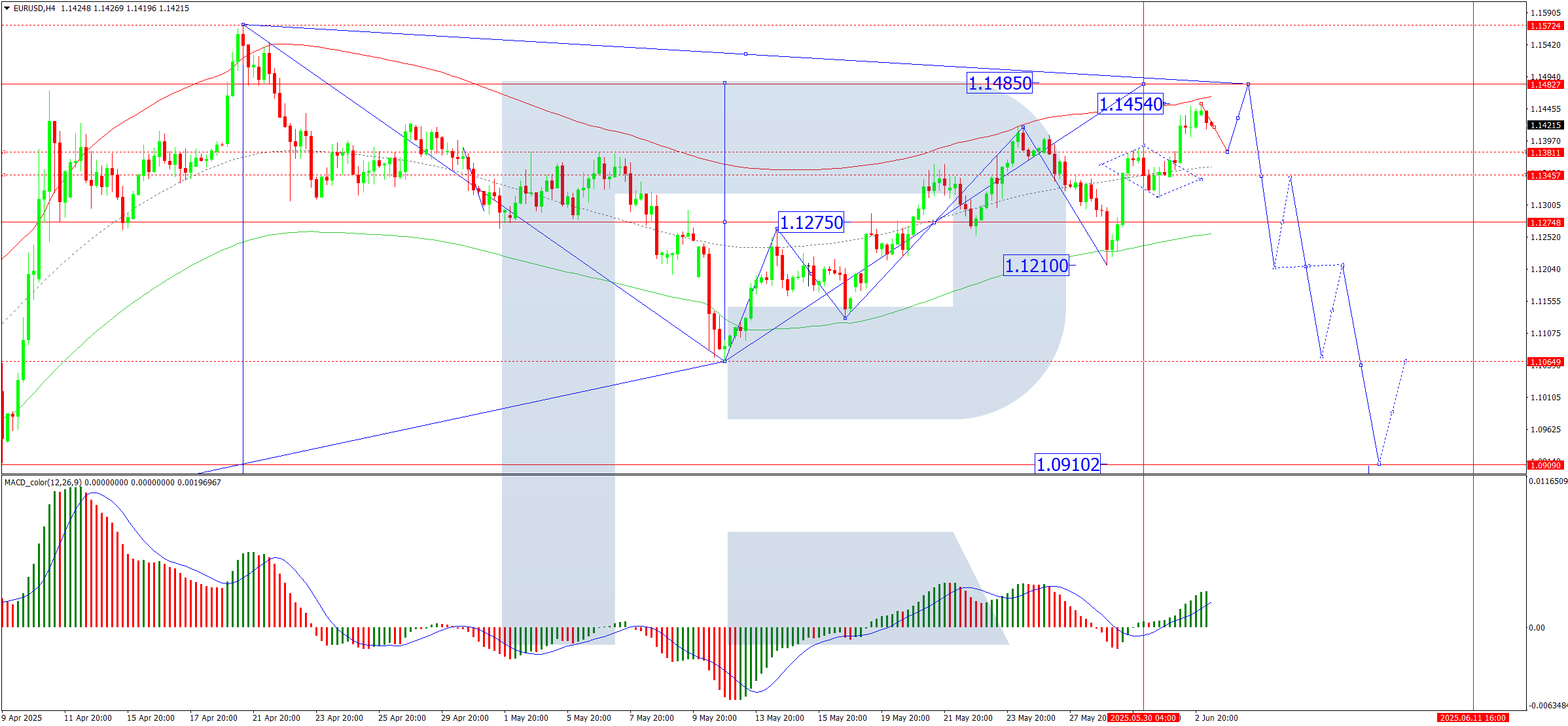
The EUR/USD pair has formed a consolidation range around 1.1358. We anticipate the downward wave to continue towards 1.1280, followed by a potential corrective rebound to 1.1427. A subsequent decline towards 1.1045 remains plausible. This scenario is technically supported by the MACD indicator, with its signal line firmly below zero and pointing downward.

H1 chart

On the hourly chart, the pair continues its downward trajectory towards 1.1280, with this level likely to be tested imminently. A corrective pullback towards 1.1427 may follow. The Stochastic oscillator corroborates this outlook, with its signal line currently below 20 and poised for an upward swing towards 80.

Conclusion

The EUR/USD remains confined within a consolidation phase, with trade developments and Fed policy expectations driving near-term volatility. Traders should monitor key support and resistance levels for confirmation of the next directional move.


Disclaimer

Any forecasts contained herein are based on the author’s particular opinion. This analysis may not be treated as trading advice. RoboForex bears no responsibility for trading results based on trading recommendations and reviews contained herein.


The focus of investors’ attention remains on the US tariff policy

By JustMarkets 

As of Wednesday, the Dow Jones Index (US30) rose by 1.07%. The S&P 500 Index (US500) gained 1.67%. The Nasdaq Technology Index (US100) was up 2.28%. Easing trade tensions between the US and China and President Trump’s assurances that he will not remove Fed Chairman Jerome Powell continue to boost sentiment.

The first-quarter earnings reporting season is in full swing. According to data compiled by Bloomberg Intelligence, market consensus expects first-quarter annualized first-quarter earnings growth of 6.7% for S&P 500 stocks, down from expectations of 11.1% in early November. Boeing (BA) rose more than 6% and topped the Dow Jones Industrials after reporting first-quarter revenue of $19.50 billion, better than the consensus expectations of $19.37 billion. Intel (INTC) closed higher by more than 6% after Bloomberg reported that the company plans to cut more than 20% of its workforce to streamline operations. Tesla (TSLA) shares rose by 5.4% after CEO Elon Musk announced that he will significantly reduce his involvement in the government to focus on running his companies.

The Canadian dollar weakened to US$1.39, down from a six-month high of US$1.38 on April 22, as it came under pressure from a recovering US dollar. Meanwhile, the IMF’s downgrade of Canada’s 2025 GDP expectations to 1.4% has renewed concerns about domestic demand, limiting Lonnie’s upside potential. And the Bank of Canada’s decision to keep the benchmark rate at 2.75% reflects caution amid the unclear outlook for US tariffs, which could either support sustainable growth with inflation around 2% or, if tariffs intensify, create the risk of recession and higher inflation.

Equity markets in Europe were mostly up on Wednesday. Germany’s DAX (DE40) rose by 3.14%, France’s CAC 40 (FR40) closed 2.13% higher, Spain’s IBEX 35 (ES35) gained 1.52%, and the UK’s FTSE 100 (UK100) closed positive 0.90%. European stocks closed sharply higher on Wednesday, following strong momentum in stock markets around the world after the US presidential administration signaled that tariffs against China are likely to be reduced or eliminated soon.

WTI crude prices fell below $62.6 a barrel on Wednesday, down 9% since early April, amid the likelihood that OPEC+ will continue to increase supply in the coming months. Key OPEC+ member Kazakhstan has said it will put national interests ahead of OPEC+ rules, signaling increased production for a key pool of consumers and raising tensions between cartel members as many countries fight to keep production below their quotas. That prompted individual cartel members to call for another production increase in June, adding to surprise plans to raise output three times faster than expected in May.

Asian markets were predominantly rising yesterday. Japan’s Nikkei 225 (JP225) gained 1.89% yesterday, China’s FTSE China A50 (CHA50) climbed 0.02%, Hong Kong’s Hang Seng (HK50) added 2.37%, and Australia’s ASX 200 (AU200) closed positive 1.33%.

Consumer sentiment in New Zealand rose to a 4-month high. The ANZ-Roy Morgan Consumer Confidence Index rose by 5 points to 98.3 in April, the highest reading since December, reinforcing a recovery that had begun to falter. The rise in the index was broad-based, with the current Conditions Index and future Conditions Index rising by 6 and 4 points, respectively.

S&P 500 (US500) 5,375.86 +88.10 (+1.67%)

Dow Jones (US30) 39,606.57 +419.59 (+1.07%)

DAX (DE40) 21,961.97 +668.44 (+3.14%)

FTSE 100 (UK100) 8,403.18 +74.58 (+0.90%)

USD Index 98.87 +0.95 (+0.96%)

News feed for: 2025.04.24

  • German IFO Business Climate (m/m) at 11:00 (GMT+3);
  • Mexican Inflation Rate (m/m) at 15:00 (GMT+3);
  • US Durable Goods Orders (m/m) at 15:30 (GMT+3);
  • US Initial Jobless Claims (w/w) at 15:30 (GMT+3);
  • US Existing Home Sales (m/m) at 17:00 (GMT+3);
  • Natural Gas Storage (w/w) at 17:30 (GMT+3).

By JustMarkets


This article reflects a personal opinion and should not be interpreted as an investment advice, and/or offer, and/or a persistent request for carrying out financial transactions, and/or a guarantee, and/or a forecast of future events.

Gold’s Downturn Won’t Last: Global Risks Remain Elevated

By RoboForex Analytical Department 

The gold price rebounded to $3,350 per troy ounce on Thursday after two consecutive days of steep declines unsettled investors. However, this dip is likely temporary.

Key Drivers Behind Gold’s Movements

U.S. Treasury Secretary Scott Bessent noted that high tariffs between the U.S. and China must be reduced before trade negotiations progress. However, he stressed that President Donald Trump would not unilaterally remove tariffs on Chinese goods.

Trump’s immediate focus includes exempting automakers from certain tariffs following weeks of intense discussions with industry leaders—a move that has partially eased concerns over trade complications.

Gold has surged over 30% since the start of the year, and the gold-to-silver ratio has hit its highest level since 1994 (excluding the pandemic period).

The primary catalyst behind gold’s rally is waning confidence in U.S. economic exceptionalism, driven by escalating trade barriers and unpredictable policy shifts. This has prompted investors to shift from U.S. assets to gold as a safe haven.

Technical Analysis: XAU/USD

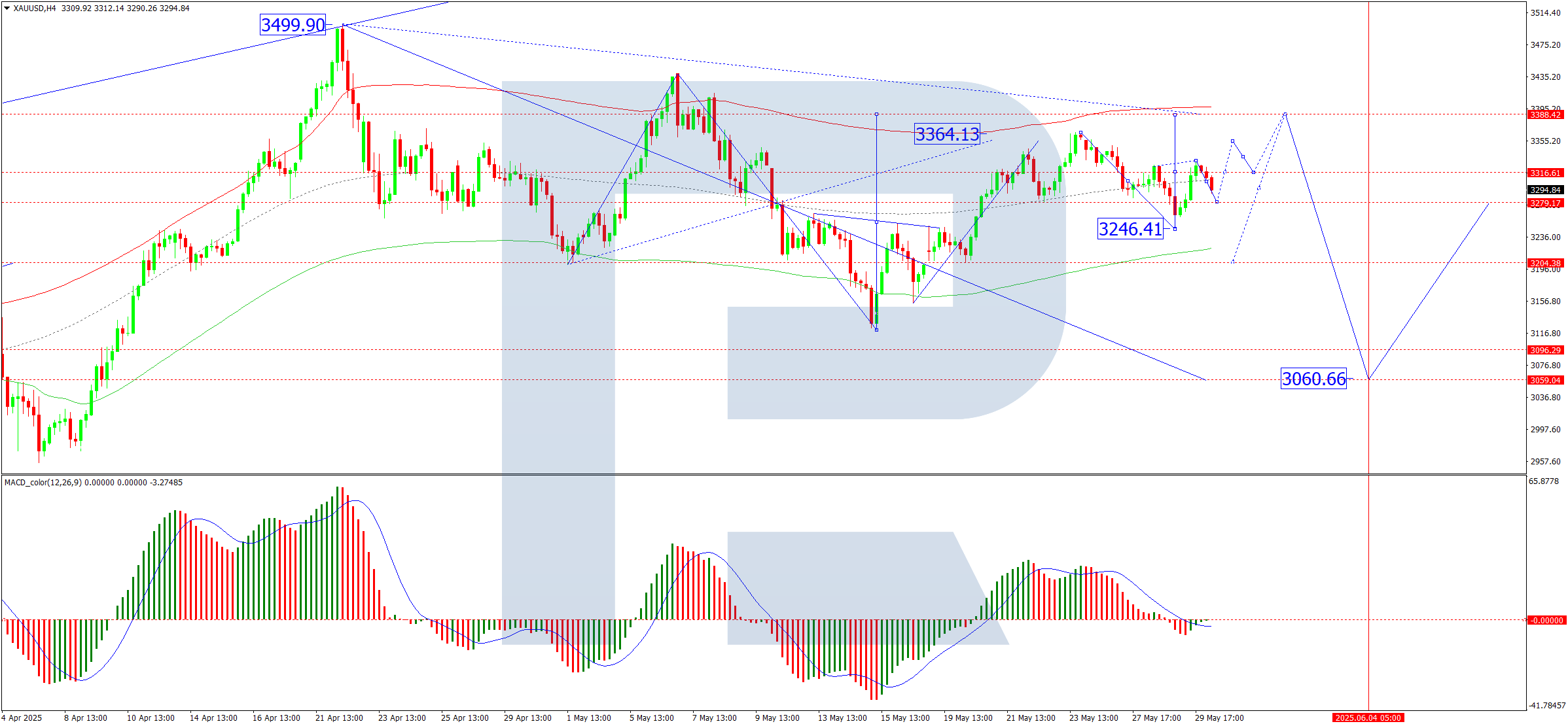
On the H4 chart of XAU/USD, the market is forming a downside wave structure to the 3225 level. Today we will consider the probability of reaching this target level. Further we will consider the probability of correction development to the level of 3363. After the completion of this correction, we will consider the probability of a new wave of decline to the level of 3055. The target is local. Technically, this scenario is confirmed by the MACD indicator. Its signal line is above the zero level and is directed strictly downwards.

On the H1 chart of XAU/USD the market formed a consolidation range around the level of 3363 and worked off the third wave of decline to the level of 3260 with a downward exit. Today the correction to the level of 6363 is executed. In the future it will be relevant to consider the development of the fifth wave of decline to the level of 3232, at least. Technically, this scenario is confirmed by the Stochastic oscillator. Its signal line is under the level of 50 and is directed strictly downwards to the level of 20.

Conclusion

Despite recent volatility, gold’s long-term bullish case remains intact, supported by persistent global risks and shifting investor sentiment.


Disclaimer

Any forecasts contained herein are based on the author’s particular opinion. This analysis may not be treated as trading advice. RoboForex bears no responsibility for trading results based on trading recommendations and reviews contained herein.
IMF warns that US tariffs portend a slowdown in global economic growth

By JustMarkets 

The Dow Jones (US30) Index was up 2.66% at Tuesday’s close. The S&P500 Index (US500) added 2.51%, and the Nasdaq Technology Index (US100) increased by 2.63%. US stocks rose on Tuesday as hopes of an easing trade war between the US and China lifted investor sentiment after a sharp drop the previous day. Meanwhile, concerns over President Trump’s attacks on Fed Chairman Jerome Powell persisted, contributing to recent market volatility.

Technology stocks led the rise, with Tesla shares up 4.6% ahead of its earnings release, although the company has fallen 40% in the period since. On the earnings side, General Electric shares jumped 6.1% after the release of results, while Verizon shares added 0.6% after the earnings release.

Producer prices for manufactured goods (a leading indicator of consumer inflation) in Canada rose by 0.5% month-over-month in March 2025, following an upwardly revised 0.6% increase in February and above market forecasts expecting a 0.3% increase. This marked the sixth consecutive monthly increase. Excluding energy and petroleum products, CPI rose by 1%. On an annualized basis, producer prices rose by 4.7%.

The IMF has warned that rising tariffs in the US mark the start of a new global era of slowing growth. President Trump has imposed massive import duties since January, triggering retaliatory tariffs and raising trade barriers to levels not seen since the Great Depression. The IMF has cut its global growth forecast 2024 to 2.8% from 3.3% and expects further weakening through 2026. The US will be hit hardest, with growth in 2025 falling to 1.8 % from 2.7 %. Mexico, China, and the Eurozone will also feel the effects. Although Trump claims the tariffs will revive US manufacturing, the IMF believes the real cause of job losses is automation, not trade. It warns that tariffs will hurt innovation and competitiveness in the long term.

Equity markets in Europe were mostly up on Tuesday. Germany’s DAX (DE40) rose by 0.41%, France’s CAC 40 (FR40) closed 0.56% higher, Spain’s IBEX 35 (ES35) gained 0.72%, and the UK’s FTSE 100 (UK100) closed 0.64% higher yesterday. On Tuesday, European stocks reversed early losses. They closed higher, benefiting from a rebound in US stocks as markets continued to assess how the risks of reduced trade relations with the US could affect European corporate giants. Automakers were among the session’s top gainers, with Mercedes-Benz, BMW, and Volkswagen adding more than 2%. Banks, meanwhile, rose steadily, with BNP Paribas, Intesa Sanpaolo, and ING adding around 1.5%. However, UniCredit fell nearly -3% after the Italian government placed restrictions on the lender’s bid to acquire Banco BPM. On the earnings side, L’Oreal shares rose more than 6% after posting strong results.

Silver prices (XAG/USD) are down nearly 1% to $32.30 an ounce on Tuesday as investors lock in profits after the precious metal’s strong rally. The pullback came after recent gains driven by safe-haven demand amid growing concerns about the impact of escalating trade tensions on the global economy. Market sentiment worsened due to stalled trade talks between the US and China, with Beijing accusing Washington of abusing tariffs and warning other countries against unilateral deals.

WTI crude prices rose above $64 a barrel on Wednesday, extending gains of more than 2% from the previous session, helped by new US sanctions and a sharp decline in crude inventories. The US has imposed new restrictions on a key Iranian figure supplying liquefied natural gas and crude oil. Meanwhile, industry data showed that US crude oil inventories fell by 4.6 million barrels last week, which could be the largest decline since November.

Asian markets traded flat. Japan’s Nikkei 225 (JP225) was down 0.17% yesterday, China’s FTSE China A50 (CHA50) was up 0.33%, Hong Kong’s Hang Seng (HK50) added 0.78%, and Australia’s ASX 200 (AU200) closed 0.03%.

Malaysia’s annual inflation rate eased to 1.4% in March 2025 from 1.5% in the previous month, the lowest since February 2021 and below market forecasts of 1.6%. Core consumer prices, excluding volatile fresh food and administrative expenses, rose to 1.9% y/y, holding steady for the second month and remaining at the lowest level in six months.

Singapore’s annual inflation rate for March 2025 was 0.9%, unchanged from the previous month but slightly below market expectations of 1%. The rate remained at its lowest level since February 2021.

S&P 500 (US500) 5,287.76 +129.56 (+2.51%)

Dow Jones (US30) 39,186.98 +1,016.57 (+2.66%)

DAX (DE40) 21,293.53 +87.67 (+0.41%)

FTSE 100 (UK100) 8,328.60 +52.94 (+0.64%)

USD index 98.99 +0.71 (+0.72%)

News feed for: 2025.04.23

  • Australia Manufacturing PMI (m/m) at 02:00 (GMT+3);
  • Australia Services PMI (m/m) at 02:00 (GMT+3);
  • Japan Manufacturing PMI (m/m) at 03:30 (GMT+3);
  • Japan Services PMI (m/m) at 03:30 (GMT+3);
  • Singapore Consumer Price Index (m/m) at 08:00 (GMT+3);
  • German Manufacturing PMI (m/m) at 10:30 (GMT+3);
  • German Services PMI (m/m) at 10:30 (GMT+3);
  • Eurozone Manufacturing PMI (m/m) at 11:00 (GMT+3);
  • Eurozone Services PMI (m/m) at 11:00 (GMT+3);
  • UK Manufacturing PMI (m/m) at 11:30 (GMT+3);
  • UK Services PMI (m/m) at 11:30 (GMT+3);
  • Eurozone Trade Balance (m/m) at 12:00 (GMT+3);
  • US Manufacturing PMI (m/m) at 16:45 (GMT+3);
  • US Services PMI (m/m) at 16:45 (GMT+3);
  • US New Home Sales (m/m) at 17:00 (GMT+3);
  • US Crude Oil Reserves (w/w) at 17:30 (GMT+3);
  • UK BOE Gov Bailey Speaks at 19:30 (GMT+3).

By JustMarkets


This article reflects a personal opinion and should not be interpreted as an investment advice, and/or offer, and/or a persistent request for carrying out financial transactions, and/or a guarantee, and/or a forecast of future events.

Pound Hits Fresh High Against the US Dollar Before Correcting: What’s Driving GBP/USD?

By RoboForex Analytical Department 

GBP/USD reached a seven-month peak at 1.3423 — its highest level since 26 September 2024 — before entering a corrective phase.

Key Drivers Behind GBP/USD Movements

Market concerns over US President Donald Trump’s criticism of Federal Reserve Chair Jerome Powell have eased. Trump has since clarified that Powell will not be dismissed, though he expressed frustration over the Fed’s reluctance to cut interest rates sooner.

The US Dollar’s rebound against the Pound followed the release of UK inflation data and a slightly weaker outlook for the labour market. Although the figures were published last week, the market has only now fully digested their implications.

In March, the UK Consumer Price Index (CPI) slowed to a three-month low. Meanwhile, the employment sector appears vulnerable ahead of another planned rise in employer taxes, due by the end of April.

Current market expectations suggest the Bank of England (BoE) will cut interest rates by 25 basis points (bps) in May, with an additional 85 bps of easing anticipated by year-end.

While US tariff policies are unlikely to directly impact UK inflation, their broader effect may contribute to lower rather than higher price pressures.

Technical Analysis: GBP/USD

H4 Chart Overview

  • The pair formed a consolidation range near 1.3066 before breaking upwards in a wave structure towards 1.3420.
  • A corrective pullback to 1.3200 is now underway.
  • The next phase may see a resumption of upward momentum towards 1.3310, potentially establishing a new consolidation range around this level.
  • The MACD indicator supports this outlook, with its signal line exiting the histogram area and pointing sharply downward, suggesting near-term bearish momentum.


H1 Chart Overview

  • GBP/USD broke below 1.3310, hitting a local downside target at 1.3233.
  • Today, the pair retested 1.3310 from below, and further downside movement towards 1.3200 is now in focus.
  • The Stochastic oscillator aligns with this view, as its signal line remains below 80 and is trending downward towards 20, indicating weakening bullish momentum.


Conclusion

The GBP/USD rally has paused as traders assess mixed UK economic data and shifting Fed policy expectations. While near-term corrections are likely, the broader trend could see renewed upside if key support levels hold. Technical indicators suggest further consolidation before the next decisive move.


Disclaimer

Any forecasts contained herein are based on the author’s particular opinion. This analysis may not be treated as trading advice. RoboForex bears no responsibility for trading results based on trading recommendations and reviews contained herein.
Trump lashed out at the US Federal Reserve chief Jerome Powell with criticism. Energy prices are falling

By JustMarkets 

The Dow Jones Index (US30) was down 2.48% on Monday. The S&P 500 Index (US500) decreased by 2.36%. The Nasdaq Technology Index (US100) fell 2.46%. The US stocks fell sharply on Monday after President Trump stepped up criticism of Federal Reserve Chairman Jerome Powell, heightening concerns about the Central Bank’s independence and undermining investor confidence. All 11 sectors ended trading in the negative, with technology, consumer discretionary, and energy stocks the hardest hit. In his Truth social media post, Trump called Powell “Mr. Too Late, a major lose” and demanded an immediate rate cut, just days after he said his team might consider removing Powell from his post. Uncertainty over global trade, especially with China, further weighed on sentiment as talks made little progress.

The Canadian dollar strengthened to $1.38 in April, hitting a six-month high, as investors digested the Bank of Canada’s recent decision, coupled with a weaker US dollar. The Bank of Canada kept its benchmark rate unchanged at 2.75%, citing the unclear outlook for tariffs in the US, which could either support solid growth with inflation around 2% or, if tariffs intensify, trigger a recession and higher inflation. In addition, China’s 90% cut in US oil imports has caused more than a quarter of its demand for offshore crude to shift to Canadian barrels.

The Mexican peso strengthened to 19.6 per dollar, a near six-month high, helped by general weakness in the US dollar, exacerbated by relatively high Banxico interest rates. The peso was bolstered by a “very productive” conversation between Presidents Trump and Sheinbaum, which allayed fears of new tariffs on steel, cars, and tomatoes, as well as steady oil export revenues that continue to boost Mexico’s trade receipts.

Equity markets in Europe were not trading on Friday and Monday.

WTI crude prices fell by 2.5% to $63.1 a barrel on Monday as easing tensions between the US and Iran raised the likelihood that more Iranian oil would return to the market. Talks between the two sides have made “very good progress”, and a framework for a potential nuclear deal is planned.

The US natural gas (XNG/USD) prices fell more than 5% to $3.0/MMBtu, the lowest level since late January, as record production and projections for milder weather lowered demand expectations. At the same time, uncertainty over President Trump’s tariff policy change has raised concerns about a slowing global economy and lower energy demand.

Asian markets traded without a single dynamic. Japan’s Nikkei 225 (JP225) was down 1.30%, China’s FTSE China A50 (CHA50) was up 0.06%, Hong Kong’s Hang Seng (HK50) and the ASX 200 (AU200) were not trading on Friday and Monday.

The People’s Bank of China (PBoC) is encouraging state-owned enterprises to use the yuan for payments and settlements in overseas transactions, seeking to expand the currency’s use globally amid ongoing trade tensions. The PBoC said it will strengthen the cross-border interbank payment system (CIPS), promote the implementation of blockchain to ensure the security and efficiency of global settlement services, and support the Shanghai Gold Exchange in cooperation with overseas exchanges to expand the use of yuan reference prices in major global markets.

The Australian dollar climbed above $0.64 on Tuesday, hitting its highest level in four months, as renewed criticism of the Federal Reserve from President Trump undermined investor confidence in US assets. Frustration over stalled global trade talks also weighed on sentiment, as China strongly opposes Trump’s tariff demands. On the domestic front, traders are increasingly betting that the Reserve Bank of Australia (RBA) will cut interest rates at its May meeting. While a 25 basis point rate cut is widely expected, some are pricing in a more aggressive 50 basis point rate cut amid growing fears of a global economic slowdown caused by trade tensions.

Markets still expect the Reserve Bank of New Zealand (RBNZ) to cut its 3.5% monetary rate by 25 bps in May, with a further cut to 2.75% by the end of the year. In terms of economic news, trade data for March showed New Zealand exports up 19% year-on-year, while imports rose 12%. These trends contributed to a double trade surplus of $970 million, the largest since the pandemic in 2020.

S&P 500 (US500) 5,158.20 −124.50 (−2.36%)

Dow Jones (US30) 38,170.41 −971.82 (−2.48%)

DAX (DE40) 21,205.86 0 (0%)

FTSE 100 (UK100) 8,275.66 0 (0%)

USD Index 98.32 −1.06 (−1.06%)

News feed for: 2025.04.22

  • New Zealand Trade Balance (q/q) at 01:45 (GMT+3);
  • Canada Producer Price Index (m/m) at 15:30 (GMT+3);
  • Eurozone ECB President Lagarde Speaks at 17:00 (GMT+3);
  • US Richmond Manufacturing Index (m/m) at 17:00 (GMT+3).

By JustMarkets


This article reflects a personal opinion and should not be interpreted as an investment advice, and/or offer, and/or a persistent request for carrying out financial transactions, and/or a guarantee, and/or a forecast of future events.

EUR/USD Hits Three-Year High as US White House Policy Concerns Mount

By RoboForex Analytical Department 

The EUR/USD pair surged to a fresh three-year peak on Monday, holding steady at 1.1518 amid growing unease over US economic policy.

Key Drivers Behind the EUR/USD Rally

Investors returning from the Easter break were met with renewed concerns over the US White House’s stance on the Federal Reserve and its Chair, Jerome Powell. Questions surrounding the Fed’s independence have unsettled markets, particularly after Donald Trump ramped up his criticism of Powell.

While the US President has previously threatened to dismiss Powell, legal and institutional barriers make such a move difficult. Nevertheless, Trump’s rhetoric has grown increasingly aggressive, as he pushes for swifter interest rate cuts and greater monetary policy flexibility. The Fed, however, remains caught between taming inflation and navigating a robust labour market—a delicate balancing act that has only heightened market anxiety.

These tensions compound existing worries over escalating trade conflicts and broader uncertainty surrounding the Trump administration’s economic policies. Over the weekend, Chicago Fed President Austan Goolsbee added to the unease, warning that US tariffs could dampen economic activity by summer.

Technical Analysis: EUR/USD

H4 Chart Outlook

  • The pair previously consolidated around 1.1333 before breaking upward.
  • After finding support at 1.1390, it formed a bullish wave towards 1.1530.
  • A downward correction towards 1.1390 is now anticipated. A break below this level could extend losses to 1.1245.
  • The MACD indicator supports this view, with its signal line above zero but pointing sharply downward.

H1 Chart Outlook

  • The market briefly consolidated near 1.1390 before rallying to 1.1530.
  • A pullback towards 1.1390 is now in focus, with a breakdown potentially opening the door to 1.1245.
  • The Stochastic oscillator aligns with this scenario, hovering above 80 and poised for a decline towards 20.


Conclusion

The EUR/USD rally reflects mounting scepticism towards US policy stability, with technical indicators now hinting at a potential retracement. Traders will be watching closely for further Fed commentary and political developments that could sway the pair’s trajectory.


Disclaimer

Any forecasts contained herein are based on the author’s particular opinion. This analysis may not be treated as trading advice. RoboForex bears no responsibility for trading results based on trading recommendations and reviews contained herein.
Today is Good Friday — most financial markets will be closed

By JustMarkets

As of Thursday’s close, the Dow Jones Index (US30) was down 1.33%. The S&P 500 Index (US500) was up 0.13%. The Nasdaq Technology Index (US100) closed at opening levels. The US stocks closed mixed ahead of the Good Friday holiday as investors weighed trade talks and interest rate uncertainty. A decline in weekly jobless claims indicates a resilient labor market, although attention remains focused on trade talks and monetary policy signals. The US initial jobless claims fell by 9,000 from the previous week to 215,000 in the second week of April, contrary to market expectations of a 1,000 increase to 225,000, the lowest in two months.

Equity markets in Europe were mostly down yesterday. Germany’s DAX (DE40) fell by 0.49%, France’s CAC 40 (FR40) closed down 0.60%, Spain’s IBEX 35 (ES35) lost 0.19%, and the UK’s FTSE 100 (UK100) closed positive 0.01%. Frankfurt’s DAX Index remained in negative territory after the ECB cut rates in an expected move to cushion the economy from tariff-related tensions.

The ECB cut all three key interest rates by 25 basis points, lowering the main refinancing rate to 2.40%, the deposit rate to 2.25%, and the marginal lending facility to 2.65%, as expected. The decision reflects growing confidence that inflation is on track for a sustained return to the 2% target. The ECB acknowledged that growth prospects have weakened and emphasized that further action will depend on the data. European markets will be closed for Easter through Monday and will reopen on Tuesday, April 22.

WTI crude oil prices rose by 3.5% on Thursday to settle at $64.70 a barrel, marking the second straight session of gains. The rise followed new US sanctions targeting Iran’s oil exports, adding to fears of a tightening global supply. The sanctions hit Iran’s oil sector and a refinery in China, increasing pressure on Tehran amid nuclear tensions. Supply concerns were further heightened after OPEC+ said it had received updated plans from Iraq, Kazakhstan, and other countries for additional production cuts.

Asian markets were predominantly up yesterday. Japan’s Nikkei 225 (JP225) gained 1.35%, China’s FTSE China A50 (CHA50) climbed 0.20%, Hong Kong’s Hang Seng (HK50) rose by 1.61%, and Australia’s ASX 200 (AU200) gained 0.78%. The recovery in Asian indices followed a rise in US futures after President Trump claimed “great progress” in talks aimed at helping Japan avoid a tariff hike. Investor sentiment was also boosted after Chinese President Xi Jinping called for regional unity and the creation of an “Asian family” during his tour of Southeast Asia.

The New Zealand dollar fell to US$0.593 on Friday, retreating from a five-month high and snapping a seven-day winning streak, as expectations of further easing by the Reserve Bank of New Zealand dampened momentum. This came despite stronger-than-expected first-quarter consumer inflation data, while core inflation figures declined. With price pressures contained and remaining within the RBNZ’s target range, markets still expect a rate cut in May and a reduction in the cash rate to 2.75% by the end of the year.

The Australian dollar slid to US$0.637 on Friday, breaking a seven-day winning streak in thin trading as local markets were closed due to the Good Friday holiday. The decline followed weaker-than-expected domestic employment data earlier in the week, which reinforced expectations of further monetary easing by the Reserve Bank of Australia.

Malaysia’s economy grew by 4.4% year-on-year in Q1 2025, compared to growth of 5% in the previous quarter. This is the slowest growth rate in a year, driven by weaker growth in services (5.2% vs. 5.4% in Q4), construction (14.5% vs. 20.7%), and manufacturing (4.2% vs. 4.4%). In quarterly terms, the economy contracted by 3.7% after growing by 2.7% in Q4.

S&P 500 (US500) 5,282.64 +6.94 (+0.13%)

Dow Jones (US30) 39,142.11 −527.28 (−1.33%)

DAX (DE40) 21,205.86 −105.16 (−0.49%)

FTSE 100 (UK100) 8,275.66 +0.061 (+0.01%)

USD Index 99.39 +0.01 (+0.01%)

News feed for: 2025.04.18

  • Japan National Core Consumer Price Index at 02:30 (GMT+3).

By JustMarkets


This article reflects a personal opinion and should not be interpreted as an investment advice, and/or offer, and/or a persistent request for carrying out financial transactions, and/or a guarantee, and/or a forecast of future events.

EUR/USD in Equilibrium: Quiet Trading Expected on Good Friday

By RoboForex Analytical Department

The EUR/USD pair continues to consolidate around 1.1371 this Friday, with trading activity subdued due to Good Friday market closures in the US and most of Europe.

Key Drivers of EUR/USD Movement

With low trading volumes, the pair’s movements remain constrained, leaving it near its three-year peak. Recent USD weakness stemmed from two primary factors:

  • Concerns over the impact of US tariff policies.
  • Growing political uncertainty under the Trump administration.

However, sentiment appears to be stabilising as the US engages in trade discussions with key partners, including Japan and Italy. President Trump hinted yesterday at a potential easing of trade tensions with China, suggesting he may halt further tariff hikes and even consider reductions in the future.

Simultaneously, Trump has sharpened his criticism of Federal Reserve Chairman Jerome Powell, expressing frustration over the slow pace of interest rate cuts. He emphasised, however, that Powell’s resignation is unlikely to happen soon.

On the data front, yesterday’s US jobless claims fell to a two-month low, reflecting the enduring strength of the labour market. Meanwhile, the ECB cut interest rates for the seventh consecutive time, adding further nuance to the currency dynamic.

Technical Analysis: EUR/USD

H4 Chart Outlook

  • The pair is consolidating near 1.1333, with a potential Triangle pattern forming.
  • A decline to 1.1280 is anticipated, followed by a possible rebound to 1.1370 before another drop toward 1.1250.
  • This scenario is technically supported by the MACD, where the signal line remains above zero but points firmly downward.

H1 Chart Outlook

  • The pair completed a downward wave to 1.1264, then corrected to 1.1412.
  • Today, focus remains on a further decline to 1.1250. A breach here could open the door for a third wave of decline, targeting 1.1080, with potential extension to 1.1030.
  • The Stochastic oscillator aligns with this view, as its signal line sits below 80 and trends sharply downward toward 20.


Conclusion

With markets quiet for Good Friday, EUR/USD remains range-bound. However, technical indicators suggest downside risks in the near term, contingent on key support breaks. Traders should monitor US-China trade developments and Fed policy rhetoric for directional cues.


Disclaimer

Any forecasts contained herein are based on the author’s particular opinion. This analysis may not be treated as trading advice. RoboForex bears no responsibility for trading results based on trading recommendations and reviews contained herein.