Archive for Financial News – Page 41

RBNZ unexpectedly cuts the rate by 0.5%. Natural gas prices jump amid drop in daily production

By JustMarkets 

The Dow Jones (US30) Index ended Tuesday down by 0.20%. The S&P 500 (US500) dropped 0.38%. The technology-heavy Nasdaq (US100) closed lower by 0.67%. The prolonged government shutdown continues to cloud the economic outlook, delaying the release of key data and putting pressure on policymakers to reach an agreement. Indices were also weighed down by a sharp sell-off in Oracle shares following weaker-than-expected reports on cloud segment margins. Tesla fell by 4.4% after presenting a lower-cost Model Y, Ford plunged 7.6% due to a supplier’s fire, and gold futures jumped above $4,000 per ounce as investors sought safe-haven assets. In the absence of new economic data, investors relied on secondary indicators and Federal Reserve statements, which pointed to a potential rate reduction amid the uncertainty.

The US consumer inflation expectations for the coming year rose to 3.4% in September 2025, the highest reading in five months, up from 3.2% in August. Meanwhile, five-year inflation expectations also increased from 2.9% to 3.0%, while three-year expectations remained at 3.0%. Unemployment expectations climbed 2.0 percentage points to 41.1%.

The Ivey Canadian Purchasing Managers’ Index (PMI) surged to 59.8 in September 2025 from 50.1 in August, hitting a 16-month high and beating market expectations of 51.2. The employment level also improved (50.2 vs. 46.0). Canada’s trade deficit widened to C$6.3 billion in August 2025, up from C$3.8 billion the previous month and significantly exceeding market expectations of C$5.6 billion, making it the second-largest trade deficit on record. Exports shrank by 3% month-over-month to C$60.6 billion, the first drop since April, extending a period of volatility that began after the US tariff threat and implementation. In turn, imports grew by 0.9% to C$66.9 billion, driven by a more than 500% surge in purchases of gold, silver, and platinum-group metals, which offset earlier declines this year due to tariff uncertainty.

Equity markets in Europe rose slightly yesterday. Germany’s DAX (DE40) edged up by 0.03%, France’s CAC 40 (FR40) closed higher by 0.04%, Spain’s IBEX35 (ES35) slipped 0.19%, and the UK’s FTSE 100 (UK100) closed up 0.05%.

The US natural gas prices jumped more than 2.5% on Tuesday to $3.45/MMBtu, nearing the 11-week high of $3.476 reached on October 1st, amid a drop in daily production. Output in the US 48 states averaged 106.5 billion cubic feet per day (bcfd) in October, down from September’s 107.4 bcfd and the record high of 108.0 bcfd in August.

Asian markets traded mixed yesterday. Japan’s Nikkei 225 (JP225) edged up by 0.01%, China’s FTSE China A50 (CHA50) and Hang Seng (HK50) did not trade yesterday, and Australia’s ASX 200 (AU200) posted a negative result of 0.27%.

The Reserve Bank of New Zealand (RBNZ) cut the Official Cash Rate (OCR) by 50 basis points to 2.5%, exceeding market expectations for a 25 basis point reduction, bringing the borrowing cost to its lowest level since mid-2022. Policymakers cited persistent spare capacity, subdued domestic activity, and downside risks from cautious household and business behavior that could slow the economic recovery, prompting them to implement a more significant easing. Inflation also remains near the upper bound of the 1-3% target band but is expected to return to the 2% midpoint by mid-2026 as tradable goods pressures ease. The committee remains prepared to ease policy further to anchor inflation near the 2% target.

S&P 500 (US500) 6,714.59 −25.69 (−0.38%)

Dow Jones (US30) 46,602.98 −91.99 (−0.20%)

DAX (DE40) 24,385.78 +7.49 (+0.03%)

FTSE 100 (UK100) 9,483.58 +4.44 (+0.05%)

USD Index 98.62 +0.51 (+0.52%)

News feed for: 2025.10.08

  • Japan Average Cash Earnings (m/m) at 02:30 (GMT+3);
  • RBNZ Interest Rate Decision at 04:00 (GMT+3);
  • RBNZ Rate Statement at 04:00 (GMT+3);
  • German Industrial Production (m/m) at 09:00 (GMT+3);
  • Sweden Inflation Rate (m/m) at 09:00 (GMT+3);
  • UK FPC Meeting Minutes at 12:30 (GMT+3);
  • US Crude Oil Reserves (w/w) at 17:30 (GMT+3);
  • Eurozone ECB President Lagarde Speaks at 19:00 (GMT+3);
  • US FOMC Meeting Minutes at 21:00 (GMT+3).

By JustMarkets


This article reflects a personal opinion and should not be interpreted as an investment advice, and/or offer, and/or a persistent request for carrying out financial transactions, and/or a guarantee, and/or a forecast of future events.

USD/JPY Hits February High as Dovish Policy Expectations Weigh on Yen

By RoboForex Analytical Department

The USD/JPY pair has rallied to its highest level since February, trading around 152.45. The Japanese yen has depreciated by over 3% this week, with selling pressure intensifying following the release of soft wage data. This has significantly dampened market expectations for further interest rate hikes from the Bank of Japan (BoJ).

The underlying driver is a persistent squeeze on household budgets: real incomes in Japan fell by 1.4% year-on-year in August, the eighth consecutive monthly decline. This confirms that price growth continues to outpace wage earnings.

While BoJ Governor Kazuo Ueda has previously signalled the regulator’s readiness to resume hiking rates should the economy and inflation align with forecasts, he has also highlighted risks from potential US trade tariffs.

On the political front, investors are assessing the implications of Sanae Takaichi’s victory in the leadership race. As a known supporter of the Abenomics stimulus programme, her election has bolstered expectations of large-scale budget injections and the continuation of an accommodative monetary policy stance.

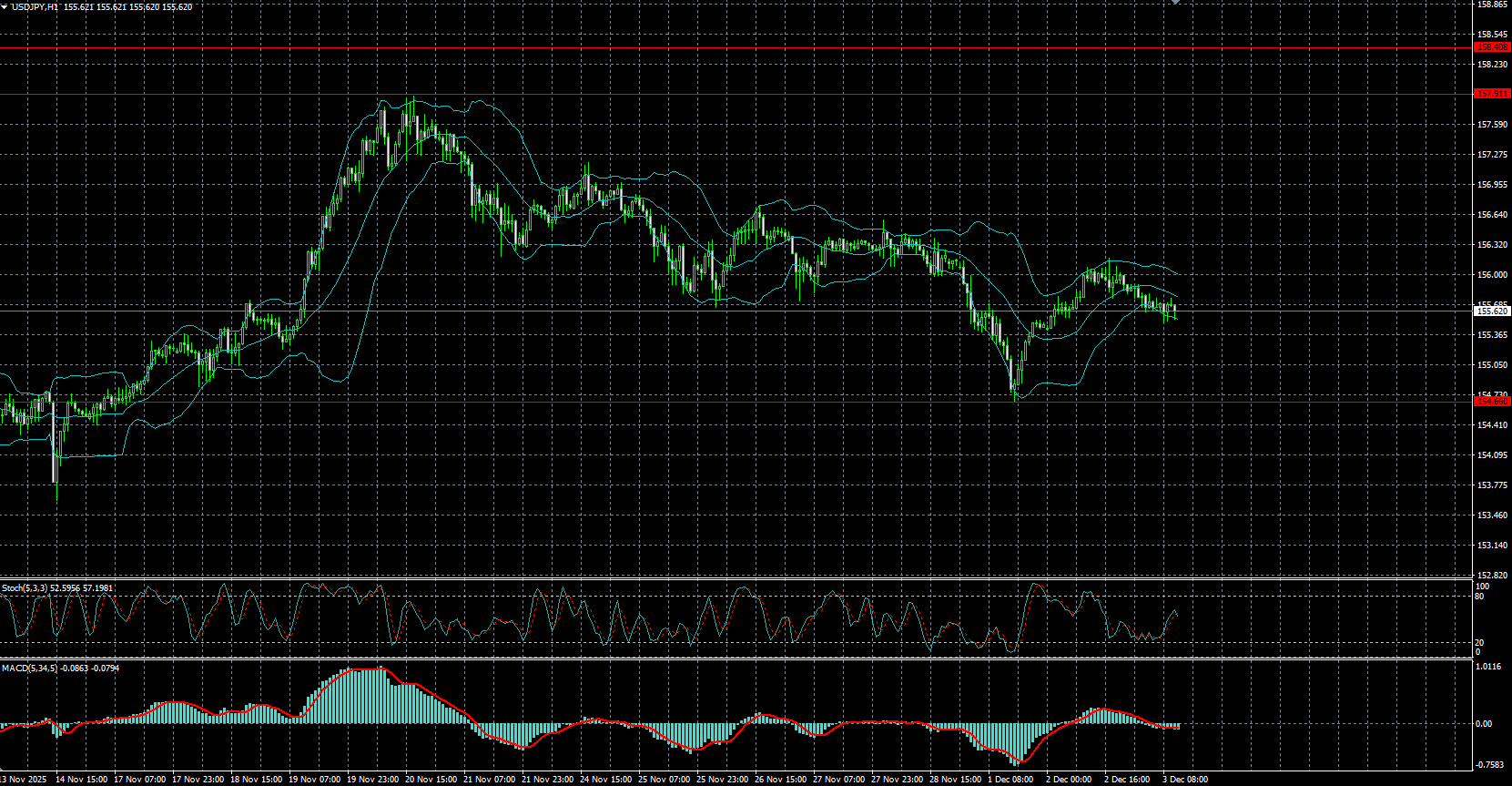
Technical Analysis: USD/JPY

H4 Chart:

On the H4 chart, USD/JPY is advancing towards the 153.00 resistance level. Upon testing this level, a corrective pullback towards 151.28 is a plausible scenario. Following such a correction, the potential for a further upward move to 155.69 would be in view, with a longer-term trend objective at 156.90. This bullish outlook is technically supported by the MACD indicator, whose signal line is positioned above zero and pointing sharply higher.

H1 Chart:

On the H1 chart, the market has fulfilled its short-term growth target at 152.62. For the current session, we anticipate a minor decline to the 151.61 support level, which may be followed by another attempt to rise towards 153.00. This intraday view is corroborated by the Stochastic oscillator. Its signal line is currently below the 80 mark and is turning downwards towards 20, suggesting a brief consolidation before the next potential leg higher.

Conclusion

Fundamentally, the yen remains under pressure from weak domestic data and political signals that favour continued stimulus, reducing the likelihood of a near-term policy shift from the BoJ. Technically, the path of least resistance remains upwards, with key resistance at 153.00. A successful break above this level could open the door for a further significant advance, though short-term corrections should be expected within the broader bullish trend.


Disclaimer:

Any forecasts contained herein are based on the author’s particular opinion. This analysis may not be treated as trading advice. RoboForex bears no responsibility for trading results based on trading recommendations and reviews contained herein.

Political upheaval in France. Japanese indices hit new historical highs

By JustMarkets 

The Dow Jones (US30) Index ended Monday down by 0.14%. The S&P 500 (US500) gained 0.36%. The technology-heavy Nasdaq (US100) closed higher by 0.78%. Indices continue to rally amid the artificial intelligence boom, despite the US government being in a shutdown for the second consecutive week. AMD shares surged by 23.7% after the announcement of a multi-year deal to supply AI chips to OpenAI, with an option to acquire up to a 10% stake in AMD, fueling optimism for broader M&A activity.

US President Donald Trump stated on Monday that a 25% tariff will be imposed on all medium and heavy-duty trucks imported into the US starting November 1st. Last month, Trump announced that new tariffs would be placed on heavy-duty truck imports starting October 1st for national security reasons, saying the duties were intended to protect manufacturers from “unfair foreign competition.” Under trade agreements with Japan and the EU, the US agreed to a 15% tariff on passenger vehicles, but it remains unclear if this rate will apply to larger vehicles. The Trump administration also allowed manufacturers to deduct the value of US-made components when calculating tariffs on light vehicles assembled in Canada and Mexico.

Equity markets in Europe were mostly lower yesterday. Germany’s DAX (DE40) edged down by 0.01%, France’s CAC 40 (FR40) closed lower by 1.36%, Spain’s IBEX35 (ES35) dropped 0.18%, and the UK’s FTSE 100 (UK100) closed down 0.13%. European stock indices mostly closed lower on Monday as renewed political turmoil in France sparked fresh concerns over financial instability across major Eurozone economies. Markets were shaken by the resignation of Prime Minister Lecornu, as the French parliament remained opposed to spending cuts in the country’s budget, just weeks after he took office and the day after President Macron unveiled a new cabinet. French banks and insurance companies fell sharply as the drop in OATs (French government bonds) put pressure on their balance sheets and raised their liquidity metrics, with BNP Paribas falling 3.5% and AXA dropping 2.5%.

WTI crude oil prices rose by 1.3% to $61.7 per barrel on Monday after OPEC+ agreed to a smaller-than-expected production increase, easing concerns about a significant supply surge. The group announced it would only raise output by 137,000 barrels per day in November, matching the October increase, despite earlier reports of a much larger hike. This restrained decision came amid internal disagreements within the alliance, with Moscow advocating for a moderate increase to protect prices, while Riyadh pushed for a more aggressive expansion to regain market share. Prices were further supported by reports of a fire and a drone attack that led to the shutdown of the Russian Kirishi oil refinery, heightening fears of supply disruptions.

Asian markets traded mixed yesterday. Japan’s Nikkei 225 (JP225) surged 4.75%, China’s FTSE China A50 (CHA50) did not trade yesterday, Hong Kong’s Hang Seng (HK50) fell by 0.67%, and Australia’s ASX 200 (AU200) posted a negative result of 0.07%.

The Nikkei 225 (JP225) Index climbed above 48,200, and the broader Topix Index rose to 3,240 on Tuesday, with both indices hitting new record highs after Sanae Takaichi, a proponent of soft fiscal policy and economic stimulus, won the leadership of the ruling Liberal Democratic Party over the weekend, positioning her as Japan’s next prime minister. Takaichi is expected to press the Bank of Japan to maintain its ultra-easy monetary policy, which is leading to a sharp decline in the yen’s value.

The Australian dollar climbed to around $0.661 on Tuesday, marking its third consecutive session of gains, as markets scaled back expectations for a near-term policy easing by the Reserve Bank of Australia. RBA Governor Michele Bullock recently indicated that rates are likely to remain on hold as persistent consumer spending and inflation, particularly in housing and services, reduce the need for cuts. Investors are now pricing in only a 40% chance of a 25 basis point rate cut in November, down from near-certainty a month ago. On the economic front, the Westpac-Melbourne Institute Index of Consumer Sentiment fell 3.5% month-over-month to 92.1 in October, the steepest contraction since April, reflecting growing household concerns over sustained inflation.

The New Zealand dollar slipped to around $0.584 on Tuesday as investors anticipated looser monetary policy from the Reserve Bank. Markets have fully priced in a 25 basis point rate cut on Wednesday, with growing bets on a more significant 50 basis point reduction. Expectations for deeper easing were supported by weak business sentiment survey results, which suggest the economy may have contracted again in the third quarter, increasing the risk of a renewed recession.

S&P 500 (US500) 6,740.28 +24.49 (+0.36%)

Dow Jones (US30) 46,694.97 −63.31 (−0.14%)

DAX (DE40) 24,378.29 −0.51 (−0.01%)

FTSE 100 (UK100) 9,479.14 −12.11 (−0.13%)

USD Index 98.11 +0.39 (+0.39%)

News feed for: 2025.10.07

  • Australia Westpac Consumer Confidence (m/m) at 03:30 (GMT+3);
  • US Trade Balance (m/m) at 15:30 (GMT+3) (Tentative);
  • Canada Trade Balance (m/m) at 15:30 (GMT+3);
  • Canada Ivey PMI (m/m) at 15:30 (GMT+3);
  • Eurozone ECB President Lagarde Speaks at 19:10 (GMT+3).

By JustMarkets


This article reflects a personal opinion and should not be interpreted as an investment advice, and/or offer, and/or a persistent request for carrying out financial transactions, and/or a guarantee, and/or a forecast of future events.

EUR/USD Edges Lower Amid Heightened Political Uncertainty

By RoboForex Analytical Department

The EUR/USD pair declined to 1.1706 on Tuesday, weighed down by a confluence of adverse political developments. In the US, the federal government shutdown entered its seventh day, with the Senate once again failing to pass competing funding bills proposed by Democrats and Republicans.

The political stalemate deepened after Democratic leader Chuck Schumer rejected President Donald Trump’s claims that negotiations with Democrats were ongoing.

From a monetary policy perspective, recent economic data have reinforced market expectations for further easing by the Federal Reserve. Traders are now almost fully pricing in a 25-basis-point rate cut in October, with another expected in December.

Market participants are awaiting fresh guidance from central bank officials, including scheduled speeches by Governing Council member Stephen Miran on Wednesday and Chair Jerome Powell on Thursday.

The US dollar found additional support from the weakness of its major counterparts. The euro was pressured by political uncertainty in Europe, while the yen softened on the election of a new, moderate prime minister in Japan, who is known to advocate for further accommodative stimulus measures.

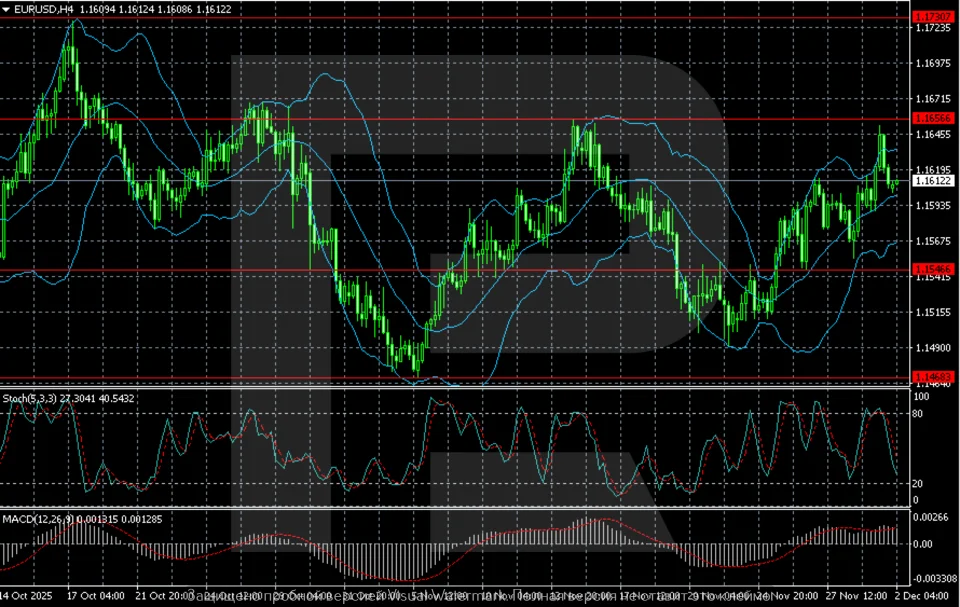
Technical Analysis: EUR/USD

H4 Chart:

On the H4 chart, the pair completed a downward impulse to 1.1652, followed by a corrective rebound to 1.1720. A subsequent decline towards 1.1685 is now forming. Later today, another rise towards 1.1723 is possible; however, the broader bearish structure suggests this will be followed by a further decline to 1.1650. A decisive break below this support level would open the potential for a move down to 1.1600, with a longer-term prospect of 1.1530. This bearish scenario is technically confirmed by the MACD indicator, whose signal line lies below zero and is pointing firmly downwards.

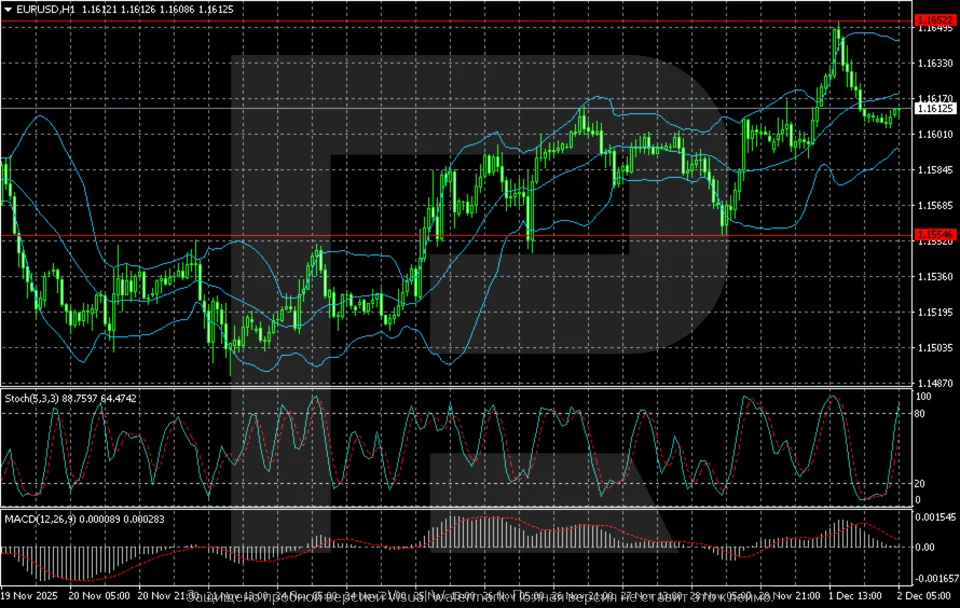
H1 Chart:

On the H1 chart, the market completed a corrective wave towards 1.1720. We anticipate a drop to 1.1680 today, followed by a potential rise to 1.1723. The overall trajectory, however, is expected to resume downwards, targeting 1.1650. A breach of this level would signal the potential for a downward wave to 1.1600, and if that level is breached, a third wave of decline towards 1.1530. This outlook is supported by the Stochastic oscillator, whose signal line is currently below 50 and is trending sharply downwards towards the 20 level.

Conclusion

The EUR/USD remains under pressure, caught between a resilient US dollar supported by Fed policy expectations and its own domestic political concerns. The technical structure remains predominantly bearish, suggesting further losses are likely if key support levels are breached.


Disclaimer:

Any forecasts contained herein are based on the author’s particular opinion. This analysis may not be treated as trading advice. RoboForex bears no responsibility for trading results based on trading recommendations and reviews contained herein.

Bitcoin sets a new all-time high. Silver reached a 14.5-year maximum

By JustMarkets 

By the end of Friday, the Dow Jones (US30) Index added 0.51% (up +0.98% for the week). The S&P 500 (US500) gained 0.01% (up +0.81% for the week). The technology-focused Nasdaq (US100) closed lower by 0.28% (up +0.78% for the week). The US government shutdown continued for a third day, but it had no impact on the indices. The shutdown has led to a delay in the September employment report and the unavailability of economic data ahead of the Federal Reserve’s October meeting. Private data suggested a slowdown in the pace of the labor market, but at the same time, it reinforced expectations for another Fed rate cut this month.

Bitcoin surged to nearly $126,000, setting a new all-time high, as global economic uncertainty and the ongoing US government shutdown spurred demand for leading digital assets as safe-haven assets. The government shutdown resulted in the suspension of key federal operations and the delay of crucial data releases. Expectations of further US Federal Reserve rate cuts also supported sentiment, with markets almost fully pricing in a quarter-point reduction this month and another in December. Strong inflows into US-listed spot Bitcoin ETFs, which recorded a total net inflow of $3.25 billion last week, provided an additional boost.

European stock markets were predominantly higher on Friday. Germany’s DAX (DE40) fell by 0.18% (up +2.28% for the week), France’s CAC 40 (FR40) closed higher by 0.31% (up +2.31% for the week), Spain’s IBEX35 (ES35) gained 0.57% (up +1.32% for the week), and the UK’s FTSE 100 (UK100) closed up 0.67% (up +2.22% for the week).

On Monday, silver prices (XAG/USD) climbed above $48.3 per ounce, reaching their highest level since April 2011, as the ongoing US government shutdown and expectations of further Federal Reserve rate cuts boosted demand for safe-haven assets. Lawmakers again failed to reach a funding agreement, leading to the suspension of key federal programs and the delay of important data releases, including the September employment report, which was originally scheduled for Friday. Beyond macroeconomic factors, silver received support from tightening supply conditions, with the Silver Institute projecting a global market deficit in 2025 for the fifth consecutive year.

WTI crude oil prices rose by 0.7% to reach $60.90 a barrel on Friday, recovering slightly after four consecutive sessions of losses, but still marking a 7% weekly decline. The gain came after US President Donald Trump warned of serious consequences if Hamas rejected his plan to end the war in Gaza, which overshadowed the upcoming OPEC+ decision on crude oil supplies. Despite these geopolitical risks, oil prices had been falling for the past four days, pressured by expectations that OPEC+ might accelerate supply increases. The increase in OPEC+ production and the potential US government closure continued to weigh on the market, offsetting short-term geopolitical tensions.

Asian markets traded strongly last week. Japan’s Nikkei 225 (JP225) surged by 1.45%, China’s FTSE China A50 (CHA50) traded for only one day last week due to holidays, Hong Kong’s Hang Seng (HK50) gained 3.31%, and Australia’s ASX 200 (AU200) posted a positive result of 2.01%.

On Monday, the Australian dollar edged up slightly to $0.66, extending gains from the previous week as investors processed the latest inflation report. The Melbourne Institute’s monthly Inflation Index showed a 0.4% rise in September 2025, recovering from a 0.3% drop in August. This increase reinforces signs that Q3 inflation may come in above expectations, even as the RBA aims to keep price growth within its 2-3% target range. The Central Bank held rates at 3.6% in September but noted that inflation remains persistent, particularly in market services amid a tight labor market. Although the majority of economists still expect a rate cut in November and another in 2026.

The New Zealand dollar traded flat on Monday as investors awaited the Reserve Bank’s monetary policy decision this week. The Central Bank is expected to cut its official cash rate from 3% on Wednesday, with markets fully pricing in a 25-basis point cut and assigning about a 30% chance of a deeper 50-basis point reduction following a series of soft economic data releases. Economists view this as a policy easing, signaling the likelihood of further easing in the future.

Vietnam’s annual inflation rate rose to a three-month high of 3.38% in September 2025. Meanwhile, core inflation, which excludes volatile items, slowed to a five-month low of 3.18% in September, compared to 3.25% in August. On a monthly basis, consumer prices rose by 0.42%, accelerating from a 0.05% increase in the prior month. In the third quarter of 2025, Vietnam’s GDP grew to 8.23% year-on-year, accelerating from a revised 8.19% growth in the previous period. The growth was broad-based, with all sectors demonstrating further progress.

S&P 500 (US500) 6,715.79 +0.44 (+0.01%)

Dow Jones (US30) 46,758.28 +238.56 (+0.51%)

DAX (DE40) 24,378.80 −43.76 (−0.18%)

FTSE 100 (UK100) 9,491.25 +63.52 (+0.67%)

USD Index 97.71 -0.13 (-0.14%)

News feed for: 2025.10.06

  • Eurozone Retail Sales (m/m) at 12:00 (GMT+3);
  • Eurozone ECB President Lagarde Speaks at 20:00 (GMT+3);
  • UK BOE Gov Bailey Speaks at 20:30 (GMT+3).

By JustMarkets


This article reflects a personal opinion and should not be interpreted as an investment advice, and/or offer, and/or a persistent request for carrying out financial transactions, and/or a guarantee, and/or a forecast of future events.

Gold Surges 50% Year-to-Date with Further Gains Expected

By RoboForex Analytical Department

Gold soared to a fresh record high on Monday, breaching 3,923 USD per ounce as demand for safe-haven assets intensified. The protracted US government shutdown continues to be a primary catalyst for the rally.

The budget crisis has extended into the new week following a failed Senate vote on Friday, leading to prolonged delays in key macroeconomic data publications—including the critical September non-farm payrolls report. In the absence of official statistics, investors are relying on indirect indicators that suggest a gradual softening of the US labour market.

With a vacuum in fresh economic data, market attention has turned to commentary from Federal Reserve officials for any clarity on the future path of monetary policy.

Since the start of the year, gold has appreciated by nearly 50%. This remarkable rally has been driven by a confluence of factors: persistent economic and geopolitical uncertainty, expectations of a protracted Fed easing cycle, and consistent investment inflows into gold-backed ETFs.

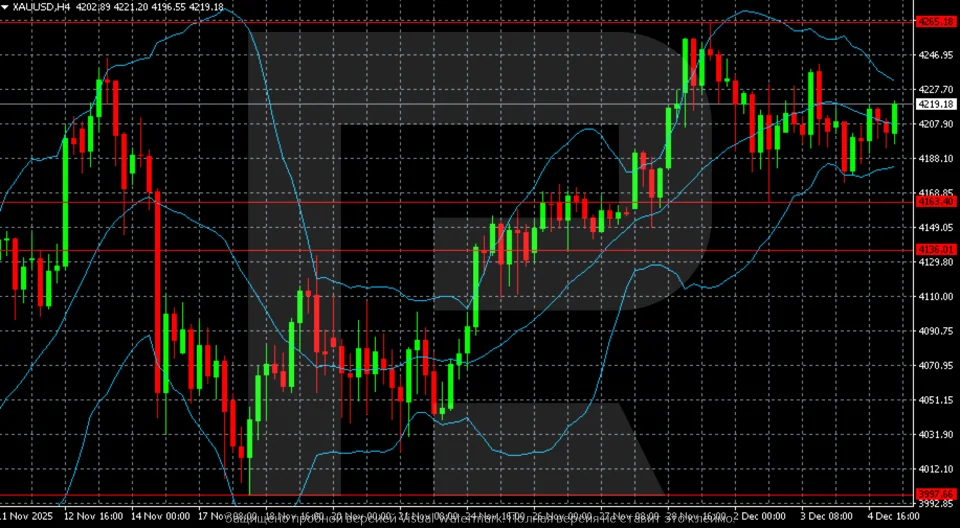
Technical Analysis: XAU/USD

H4 Chart:

On the H4 chart, XAU/USD found strong support at the 3,820 USD level and is now advancing within a growth wave targeting 4,000 USD. This is considered a local target. Upon reaching it, a corrective pullback towards 3,820 USD is anticipated. Following this correction, the formation of another upward wave targeting 4,170 USD is expected. This bullish outlook is technically confirmed by the MACD indicator, whose signal line is positioned above zero and pointing sharply upward.

H1 Chart:

The H1 chart shows the pair breaking above the 3,896 USD resistance, subsequently forming a consolidation range around this level. Today’s upside breakout has confirmed the continuation of the bullish impulse towards 3,972 USD. A correction back to 3,896 USD is likely upon reaching this target, after which a resumption of the uptrend towards 4,000 USD is expected. The Stochastic oscillator corroborates this view, with its signal line currently above 80 and poised to decline towards 50, indicating potential for a short-term pullback before further gains.

Conclusion

Gold’s record-breaking rally shows no signs of abating, underpinned by a supportive macroeconomic backdrop and strong technical momentum. While a short-term correction is increasingly likely as the market becomes overbought, the broader bullish trend remains firmly intact, with clear technical targets projecting further gains ahead.


Disclaimer:

Any forecasts contained herein are based on the author’s particular opinion. This analysis may not be treated as trading advice. RoboForex bears no responsibility for trading results based on trading recommendations and reviews contained herein.

Bitcoin jumps to $120,000. WTI oil prices may drop below $60

By JustMarkets 

At the close on Thursday, the Dow Jones (US30) rose by 0.17%. The S&P 500 (US500) gained 0.06%. The technology-heavy Nasdaq (US100) closed 0.39% higher. Major US stock indices closed at new records on Thursday. The rally was led by technology companies, spurred by gains in AI-related stocks like Nvidia (+1% ), Broadcom (+1.5% ) and AMD (+3.5% ), as well as a $6.6 billion share sale by OpenAI, which valued the company at $500 billion and highlighted its deal with South Korean chipmakers. Meanwhile, shares of Microsoft dropped 1.6% and Tesla fell by 1.8%, reversing earlier gains, despite the latter reporting a 7.4% year-over-year increase in global vehicle deliveries in the third quarter, which was boosted by the expiration of the EV tax credit at the end of September. Investors also monitored developments in Washington, where President Trump threatened to cut thousands of federal jobs to pressure Democrats during the second day of the government shutdown.

The Canadian dollar (CAD) weakened to 1.394 per USD, its lowest level since May, as softer domestic data fueled expectations of further policy easing by the Bank of Canada (BoC) and oil prices retreated. Following the BoC’s rate cut to 2.50% on September 17, a summary of deliberations indicated a willingness for additional cuts if downside risks persist, pushing markets to anticipate further easing and reducing demand for the yield-sensitive CAD. The S&P Global Manufacturing PMI for Canada fell to 47.7 in September, the eighth straight monthly contraction, underscoring a decline in new orders and production and strengthening the case for rate cuts. Lower oil prices, amid prospects of increased OPEC+ output and reduced demand in the US and Asia, removed crucial trade terms support for the currency, adding to the pressure.

Bitcoin surged to the $120,000 mark in early October, hitting a seven-week high, as political uncertainty and expectations of further US interest rate cuts supported demand. The US government entered its first shutdown in almost seven years after lawmakers failed to agree on temporary funding. The closure is expected to last at least three days and will delay the release of the September Non-Farm Payrolls report. Bitcoin also benefited from risk-on sentiment in stock markets, fueled by the OpenAI deal with South Korean chipmakers Samsung Electronics and SK Hynix, which boosted AI optimism.

European equity markets rose strongly on Thursday. The German DAX (DE40) climbed 1.28%, the French CAC 40 (FR40) closed 1.13% higher, the Spanish IBEX35 (ES35) fell 0.27%, and the UK FTSE 100 (UK100) closed negative 0.20%. The Frankfurt-based DAX Index rose by approximately 1.3%, reaching its highest level since July 10 and extending its rally for a fifth consecutive day. Global optimism about artificial intelligence helped mitigate concerns over the ongoing second day of the US government shutdown. On the corporate front, Siemens led the gains, rising 4.2% on reports that the German conglomerate is considering spinning off a significant part of its stake in Siemens Healthineers. This was followed by Siemens Energy shares, which rose 4.1% after Berenberg raised its price target to €122.00 from €75.00, maintaining a “buy” rating.

WTI crude oil prices dropped more than 2% on Thursday to 60.5 per barrel, their lowest in four months and marking a fourth straight decline amid supply concerns. OPEC+ is expected to approve a November production increase of up to 500,000 barrels per day, triple the October increase, with Saudi Arabia pushing to restore market share. Additionally, US crude and gasoline inventories are rising, and Iraqi Kurdish oil exports via Turkey’s Ceyhan terminal are set to resume following a deal to restart flows.

The US natural gas prices rose by 2% on Thursday to 3.54 per MMBtu, extending gains for a fifth straight session and reaching an 11-week high following a bullish EIA inventory report. Inventories rose by only 53 billion cubic feet (Bcf) for the week ending September 26, significantly below expectations of 67 Bcf and the five-year average of 85 Bcf. Total working gas in storage now stands at 3.561 trillion cubic feet, 0.6% above last year’s level and 5% above the five-year norm.

Asian markets were mostly up yesterday. Japan’s Nikkei 225 (JP225) rose by 0.87%, China’s FTSE China A50 (CHA50) did not trade due to holidays, Hong Kong’s Hang Seng (HK50) rose 1.61%, and the Australian ASX 200 (AU200) showed a positive result of 1.13%..

Japan’s ruling Liberal Democratic Party (LDP) will elect a new president on Saturday, who is typically set to become Prime Minister. Five contenders are vying to replace Shigeru Ishiba, who is stepping down following electoral setbacks. The race is led by Sanae Takaichi and Shinjiro Koizumi, whose platforms differ sharply. Takaichi, a conservative nationalist linked to the late Shinzo Abe, promises bold fiscal stimulus measures to “shake up the economy” and may push for a review of the US-Japan trade agreement. Koizumi supports tax cuts for households while maintaining Ishiba’s cautious economic stance. Takaichi plans to double Japan’s economy within ten years through massive public investment in technology and infrastructure.

S&P 500 (US500) 6,715.35 +4.15 (+0.062%)

Dow Jones (US30) 46,519.72 +78.62 (+0.17%)

DAX (DE40) 24,422.56 +308.94 (+1.28%)

FTSE 100 (UK100) 9,427.73 −18.70 (−0.20%)

USD Index 97.89 +0.18 (+0.18%)

News feed for: 2025.10.03

  • Australia Services PMI (m/m) at 02:00 (GMT+3);
  • Japan Unemployment Rate (m/m) at 02:30 (GMT+3);
  • Japan Services PMI (m/m) at 03:30 (GMT+3);
  • Japan BoJ Gov Ueda Speaks at 04:05 (GMT+3);
  • German Services PMI (m/m) at 10:55 (GMT+3);
  • Eurozone Services PMI (m/m) at 11:00 (GMT+3);
  • UK Services PMI (m/m) at 11:30 (GMT+3);
  • Eurozone Producer Price Index (m/m) at 12:00 (GMT+3);
  • Eurozone ECB President Lagarde Speaks at 12:40 (GMT+3);
  • US Nonfarm Payrolls (m/m) at 15:30 (GMT+3) (tentative).;
  • US Unemployment Rate (m/m) at 15:30 (GMT+3) (tentative).;
  • UK BOE Gov Bailey Speaks at 16:20 (GMT+3);
  • US ISM Services PMI (m/m) at 17:00 (GMT+3).

By JustMarkets


This article reflects a personal opinion and should not be interpreted as an investment advice, and/or offer, and/or a persistent request for carrying out financial transactions, and/or a guarantee, and/or a forecast of future events.

EUR/USD Holds Steady Amid Tense External Backdrop

By RoboForex Analytical Department

The EUR/USD pair held its ground around 1.1726 on Friday. While volatility in the currency market has picked up significantly, the immediate economic impact of the US government shutdown remains limited. Nonetheless, the political deadlock is fuelling broader concerns over policy uncertainty, persistent inflation risks, and a weakening US labour market.

Adding to the tense atmosphere, Finance Minister Scott Bessent warned on Thursday that the funding suspension could negatively impact GDP growth. Simultaneously, President Donald Trump threatened deep cuts to federal agencies in a bid to pressure Democratic opponents.

On the monetary policy front, Dallas Fed President Lorie Logan characterised the September rate cut as a justified step to shield the labour market from a sharper slowdown. However, she noted that the economic deceleration is gradual and does not yet warrant urgent further action.

Despite this cautious tone, market pricing indicates a near-certain probability of a 25 bps rate cut this month, with a second cut fully priced in by December.

Technical Analysis: EUR/USD

H4 Chart:

On the H4 chart, EUR/USD formed a consolidation range around 1.1740, which has since expanded downward to 1.1685. We now anticipate a move higher towards 1.1740, followed by a decline to 1.1707. A decisive upside breakout could propel the pair towards 1.1786, while a break below the current range would open the path for a continued downtrend towards 1.1625 and potentially lower. This bearish-leaning scenario is technically supported by the MACD indicator, with its signal line positioned below zero and pointing firmly downward.

H1 Chart:

The H1 chart shows the pair completed a downward wave to 1.1683 and a subsequent correction to 1.1728. We now expect a further decline to 1.1670. A break below this level would activate the potential for a downward wave targeting 1.1625. A breach of this latter level could then initiate a third wave of selling towards 1.1470. The Stochastic oscillator aligns with this view, as its signal line is above 80 and turning sharply downward towards 20.

Conclusion

EUR/USD is currently stabilising, but remains highly sensitive to the twin forces of US political instability and shifting Fed policy expectations. The overall technical structure retains a bearish bias, suggesting that any near-term stability is fragile and likely to give way to further declines unless fundamental drivers shift significantly.


Disclaimer:

Any forecasts contained herein are based on the author’s particular opinion. This analysis may not be treated as trading advice. RoboForex bears no responsibility for trading results based on trading recommendations and reviews contained herein.

Indices hit records despite the US labor and government shutdowns

By JustMarkets

At the close on Wednesday, the Dow Jones (US30) rose by 0.09%. The S&P 500 (US500) gained 0.34%. The technology-heavy Nasdaq (US100) closed 0.42% higher. Wall Street indices closed at record highs on Wednesday, driven by strong sectoral performance and optimism that the US government shutdown would be short-lived. The ADP report showed a contraction of 32,000 private-sector jobs in September, signaling a slowing labor market, while activity at American factories continued to contract for the seventh straight month. Overall, strong performance in specific sectors, particularly healthcare, and confidence that the economic impact of the shutdown would be limited, helped lift US equities to record levels.

The ISM Manufacturing PMI for the US rose to 49.1 in September 2025, up from 48.7 in August, slightly exceeding market expectations of 49.0. The reading marked the seventh consecutive month of contraction. Survey respondents cited tariffs, high costs, and weak demand as key issues, with many halting capital projects, cutting spending, and facing delayed orders, particularly in the machinery, metals, and semiconductor sectors.

In Canada, the Manufacturing PMI fell to 47.7 in September 2025 from 48.3 in August, continuing to reflect a contraction in activity at Canadian firms. This was the eighth consecutive month of decline in manufacturing, impacted by a series of US tariffs on Canadian goods and retaliatory domestic duties. Looking ahead, companies continued to cite uncertainty about prospects due to policy changes and tariffs, with business confidence easing from August’s seven-month high and remaining significantly below trend.

European equity markets rose strongly on Wednesday. The German DAX (DE40) climbed 0.98%, the French CAC 40 (FR40) closed 0.90% higher, the Spanish IBEX35 (ES35) gained 0.41%, and the UK FTSE 100 (UK100) closed up 1.03%. European indices extended their rally, closing higher on Wednesday, boosted by healthcare stocks, which received investor support related to tariffs. Shares of Merck jumped 10.1%, Bayer added 5%, Fresenius Medical Care gained 1.4%, and Siemens Healthineers rose 0.6%. This followed a deal between Pfizer and the Trump administration allowing patients to access discounted prescription drugs through a new federal platform. Nevertheless, broad market sentiment remained volatile amid ongoing concerns about the US government shutdown. Regarding data, Eurozone inflation rose to 2.2% in September, matching expectations and underpinning the European Central Bank’s (ECB) cautious approach to further rate cuts.

Brent crude oil prices fell below 66 per barrel on Wednesday, hitting their lowest in over three weeks, extending a three-day slide as OPEC+ considers a faster supply increase. The group meets on Sunday to discuss increasing output by 500,000 barrels per day per month for three months, despite projections warning that the market is already oversupplied. The IEA expects a record surplus next year, and TotalEnergies notes market saturation in the first quarter. Still, traders are skeptical that the full OPEC+ production increase will materialize, given Saudi Arabia’s cautious stance on capacity constraints.

Asian markets declined yesterday. Japan’s Nikkei 225 (JP225) fell by 0.85%, China’s FTSE China A50 (CHA50) and Hong Kong’s Hang Seng (HK50) did not trade due to holidays, and the Australian ASX 200 (AU200) posted a negative result of 0.04%.

Australia’s trade surplus fell to 1.83 billion AUD in August 2025, the lowest reading since June 2018 and well below market expectations of 6.2 billion AUD, compared to a downwardly revised 6.61 billion AUD in July. The sharp drop was driven by exports falling to a three-month low, stemming from reduced shipments to the US following new tariffs and a sharp decline in gold exports. Meanwhile, imports rebounded to a record high after falling in July. On the policy front, the Reserve Bank of Australia kept its cash rate at 3.6% earlier this week, with Governor Bullock noting that while some CPI components were slightly higher than anticipated, inflation remains contained.

S&P 500 (US500) 6,711.20 +22.74 (+0.34%)

Dow Jones (US30) 46,441.10 +43.21 (+0.093%)

DAX (DE40) 24,113.62 +232.90 (+0.98%)

FTSE 100 (UK100) 9,446.43 +96.00 (+1.03%)

USD Index 97.76 -0.02 (-0.02%)

News feed for: 2025.10.02

  • Australia Trade Balance (m/m) at 04:30 (GMT+3);
  • Switzerland Consumer Price Index (m/m) at 09:30 (GMT+3);
  • Eurozone Unemployment Rate (m/m) at 12:00 (GMT+3);
  • US Initial Jobless Claims (w/w) at 15:30 (GMT+3) (tentative);
  • US Natural Gas Storage (w/w) at 17:30 (GMT+3) (tentative).

By JustMarkets


This article reflects a personal opinion and should not be interpreted as an investment advice, and/or offer, and/or a persistent request for carrying out financial transactions, and/or a guarantee, and/or a forecast of future events.
USD/JPY on Hold, But Yen Rally Could Resume at Any Moment

By RoboForex Analytical Department

The USD/JPY pair has paused its recent decline, stabilising around 147.16 on Thursday.

The yen continues to find support from its status as a safe-haven asset, with demand bolstered by a weaker US dollar amid the ongoing US government shutdown. The political impasse in Washington, which could last for at least several days, has delayed the release of critical macroeconomic data, including the key September non-farm payrolls (NFP) report.

Domestically, the yen is gaining momentum from growing market expectations that the Bank of Japan (BoJ) could resume policy normalisation this year. Markets are currently pricing in a 40% probability of a 0.25 percentage point rate hike as early as the October meeting.

Supporting this hawkish tilt, the latest Tankan survey showed large manufacturers’ sentiment improved in the third quarter, reaching its highest level since late 2022. However, the economic outlook remains clouded by persistent pressure from US tariff measures.

Market participants are now turning their attention to the upcoming consumer confidence index, which may offer fresh clues on the economy’s trajectory.

Technical Analysis: USD/JPY

H4 Chart:

On the H4 chart, USD/JPY completed a correction to 146.62 and is now forming a narrow consolidation range above this level. A downside breakout would likely lead to an extension of the decline towards 146.50. Conversely, an upside breakout would open the potential for a growth wave towards 148.22, to be followed by a decline back to 146.50. Once this corrective phase is complete, the stage would be set for a new upward wave targeting 151.15. This scenario is technically supported by the MACD indicator, whose signal line is at lows below zero but appears poised to reverse upwards.

H1 Chart:

The H1 chart shows the pair achieving its local downside target at 146.60 and forming a consolidation range above it. An upward breakout from this range would initiate a growth wave towards 148.22, after which a corrective decline to 146.50 is expected. The Stochastic oscillator confirms this outlook, with its signal line above 50 and rising sharply towards 80.

Conclusion

While USD/JPY has entered a period of consolidation, the yen’s underlying drivers—safe-haven demand and BoJ policy speculation—remain potent. The technical structure suggests a near-term bounce is possible, but the potential for a resumption of the yen’s rally remains high, making the current pause a potentially temporary one.

Disclaimer:

Any forecasts contained herein are based on the author’s particular opinion. This analysis may not be treated as trading advice. RoboForex bears no responsibility for trading results based on trading recommendations and reviews contained herein.