Archive for Financial News – Page 39

COT Energy Charts: Weekly Speculator Bets led by Natural Gas & Brent Oil

By InvestMacro

Speculators OI Energy Futures COT Chart
Here are the latest charts and statistics for the Commitment of Traders (COT) data published by the Commodities Futures Trading Commission (CFTC).

The latest COT data is updated through Tuesday September 9th and shows a quick view of how large traders (for-profit speculators and commercial entities) were positioned in the futures markets.

Weekly Speculator Changes led by Natural Gas & Brent Oil

Speculators Nets Energy Futures COT Chart
The COT energy market speculator bets were overall lower this week as just two out of the six energy markets we cover had higher positioning while the other four markets had lower speculator contracts.

Leading the gains for the energy markets was Natural Gas (8,229 contracts) with Brent Oil (2,447 contracts) also having a positive week.

The markets with declines in speculator bets for the week were WTI Crude (-20,584 contracts), Heating Oil (-10,789 contracts), the Bloomberg Index (-522 contracts) and Gasoline (-185 contracts) also seeing lower bets on the week.

Brent Crude Oil Leads Weekly Price Performance

Brent Oil led the energy markets in price gains this week with a 1.83% rise for the last five days. Brent Crude has been down by over -5% in the last 30 days, but is up by 18% over the past 90 days.

The Bloomberg Commodity Index was the next highest gainer with a 1.4% increase over the past five days. Heating Oil rose by 1.33% this week and has been up by almost 20% over the last 90 days.

WTI Crude Oil rose by 0.97%. WTI has been down by about -8% over the past 30 days, while also being higher by 17.58% over the past 90 days. Gasoline was the next highest mover with a 0.92% increase for the week.

Natural Gas was the only decliner on the week with a -3.25% decrease. Natural Gas has been down by approximately -8% over the past 30 days, and over the past 90 days, Natural Gas has been down by over -30%.


Energy Data:

Speculators Table Energy Futures COT Chart
Legend: Weekly Speculators Change | Speculators Current Net Position | Speculators Strength Score compared to last 3-Years (0-100 range)


Strength Scores led by Heating Oil & Natural Gas

Speculators Strength Energy Futures COT Chart
COT Strength Scores (a normalized measure of Speculator positions over a 3-Year range, from 0 to 100 where above 80 is Extreme-Bullish and below 20 is Extreme-Bearish) showed that Heating Oil (69 percent) and Natural Gas (66 percent) lead the energy markets this week.

On the downside, WTI Crude (0 percent) comes in at the lowest strength level currently and is in Extreme-Bearish territory (below 20 percent).

Strength Statistics:
WTI Crude Oil (0.0 percent) vs WTI Crude Oil previous week (7.7 percent)
Brent Crude Oil (43.8 percent) vs Brent Crude Oil previous week (40.3 percent)
Natural Gas (66.3 percent) vs Natural Gas previous week (60.0 percent)
Gasoline (40.9 percent) vs Gasoline previous week (41.2 percent)
Heating Oil (69.1 percent) vs Heating Oil previous week (83.3 percent)
Bloomberg Commodity Index (44.7 percent) vs Bloomberg Commodity Index previous week (47.0 percent)


Gasoline & Brent Oil top the 6-Week Strength Trends

Speculators Trend Energy Futures COT Chart
COT Strength Score Trends (or move index, calculates the 6-week changes in strength scores) showed that all the energy markets have negative trend scores at the current time.

Gasoline (-1.7 percent) and Brent Oil (-5.8 percent) have the least negative scores while WTI Crude (-27.7 percent) and the Bloomberg Index (-10.4 percent) have the most negative scores in the latest trends data.

Move Statistics:
WTI Crude Oil (-27.7 percent) vs WTI Crude Oil previous week (-19.0 percent)
Brent Crude Oil (-5.8 percent) vs Brent Crude Oil previous week (-16.8 percent)
Natural Gas (-6.8 percent) vs Natural Gas previous week (-19.3 percent)
Gasoline (-1.7 percent) vs Gasoline previous week (9.2 percent)
Heating Oil (-6.7 percent) vs Heating Oil previous week (11.6 percent)
Bloomberg Commodity Index (-10.4 percent) vs Bloomberg Commodity Index previous week (-8.2 percent)


Individual COT Market Charts:

WTI Crude Oil Futures:

WTI Crude Oil Futures COT ChartThe WTI Crude Oil Futures large speculator standing this week equaled a net position of 81,844 contracts in the data reported through Tuesday. This was a weekly reduction of -20,584 contracts from the previous week which had a total of 102,428 net contracts.

This week’s current strength score (the trader positioning range over the past three years, measured from 0 to 100) shows the speculators are currently Bearish-Extreme with a score of 0.0 percent. The commercials are Bullish-Extreme with a score of 100.0 percent and the small traders (not shown in chart) are Bearish with a score of 42.9 percent.

Price Trend-Following Model: Uptrend

Our weekly trend-following model classifies the current market price position as: Uptrend.

WTI Crude Oil Futures StatisticsSPECULATORSCOMMERCIALSSMALL TRADERS
– Percent of Open Interest Longs:14.041.83.5
– Percent of Open Interest Shorts:9.847.12.5
– Net Position:81,844-102,15520,311
– Gross Longs:274,256818,83269,296
– Gross Shorts:192,412920,98748,985
– Long to Short Ratio:1.4 to 10.9 to 11.4 to 1
NET POSITION TREND:
– Strength Index Score (3 Year Range Pct):0.0100.042.9
– Strength Index Reading (3 Year Range):Bearish-ExtremeBullish-ExtremeBearish
NET POSITION MOVEMENT INDEX:
– 6-Week Change in Strength Index:-27.727.7-6.7


Brent Crude Oil Futures:

Brent Last Day Crude Oil Futures COT ChartThe Brent Crude Oil Futures large speculator standing this week equaled a net position of -26,195 contracts in the data reported through Tuesday. This was a weekly boost of 2,447 contracts from the previous week which had a total of -28,642 net contracts.

This week’s current strength score (the trader positioning range over the past three years, measured from 0 to 100) shows the speculators are currently Bearish with a score of 43.8 percent. The commercials are Bullish with a score of 58.0 percent and the small traders (not shown in chart) are Bearish with a score of 45.1 percent.

Price Trend-Following Model: Uptrend

Our weekly trend-following model classifies the current market price position as: Uptrend.

Brent Crude Oil Futures StatisticsSPECULATORSCOMMERCIALSSMALL TRADERS
– Percent of Open Interest Longs:18.144.53.5
– Percent of Open Interest Shorts:30.732.33.0
– Net Position:-26,19525,347848
– Gross Longs:37,67892,6257,193
– Gross Shorts:63,87367,2786,345
– Long to Short Ratio:0.6 to 11.4 to 11.1 to 1
NET POSITION TREND:
– Strength Index Score (3 Year Range Pct):43.858.045.1
– Strength Index Reading (3 Year Range):BearishBullishBearish
NET POSITION MOVEMENT INDEX:
– 6-Week Change in Strength Index:-5.85.37.0


Natural Gas Futures:

Natural Gas Futures COT ChartThe Natural Gas Futures large speculator standing this week equaled a net position of -94,547 contracts in the data reported through Tuesday. This was a weekly lift of 8,229 contracts from the previous week which had a total of -102,776 net contracts.

This week’s current strength score (the trader positioning range over the past three years, measured from 0 to 100) shows the speculators are currently Bullish with a score of 66.3 percent. The commercials are Bearish with a score of 38.5 percent and the small traders (not shown in chart) are Bearish with a score of 31.1 percent.

Price Trend-Following Model: Downtrend

Our weekly trend-following model classifies the current market price position as: Downtrend.

Natural Gas Futures StatisticsSPECULATORSCOMMERCIALSSMALL TRADERS
– Percent of Open Interest Longs:17.430.83.5
– Percent of Open Interest Shorts:23.125.72.8
– Net Position:-94,54783,31611,231
– Gross Longs:282,995502,93256,670
– Gross Shorts:377,542419,61645,439
– Long to Short Ratio:0.7 to 11.2 to 11.2 to 1
NET POSITION TREND:
– Strength Index Score (3 Year Range Pct):66.338.531.1
– Strength Index Reading (3 Year Range):BullishBearishBearish
NET POSITION MOVEMENT INDEX:
– 6-Week Change in Strength Index:-6.811.8-16.3


Gasoline Blendstock Futures:

RBOB Gasoline Energy Futures COT ChartThe Gasoline Blendstock Futures large speculator standing this week equaled a net position of 41,121 contracts in the data reported through Tuesday. This was a weekly fall of -185 contracts from the previous week which had a total of 41,306 net contracts.

This week’s current strength score (the trader positioning range over the past three years, measured from 0 to 100) shows the speculators are currently Bearish with a score of 40.9 percent. The commercials are Bullish with a score of 52.2 percent and the small traders (not shown in chart) are Bullish-Extreme with a score of 86.7 percent.

Price Trend-Following Model: Uptrend

Our weekly trend-following model classifies the current market price position as: Uptrend.

Nasdaq Mini Futures StatisticsSPECULATORSCOMMERCIALSSMALL TRADERS
– Percent of Open Interest Longs:23.948.77.9
– Percent of Open Interest Shorts:11.864.14.6
– Net Position:41,121-52,40511,284
– Gross Longs:81,040164,91126,762
– Gross Shorts:39,919217,31615,478
– Long to Short Ratio:2.0 to 10.8 to 11.7 to 1
NET POSITION TREND:
– Strength Index Score (3 Year Range Pct):40.952.286.7
– Strength Index Reading (3 Year Range):BearishBullishBullish-Extreme
NET POSITION MOVEMENT INDEX:
– 6-Week Change in Strength Index:-1.7-5.232.5


#2 Heating Oil NY-Harbor Futures:

NY Harbor Heating Oil Energy Futures COT ChartThe #2 Heating Oil NY-Harbor Futures large speculator standing this week equaled a net position of 19,457 contracts in the data reported through Tuesday. This was a weekly fall of -10,789 contracts from the previous week which had a total of 30,246 net contracts.

This week’s current strength score (the trader positioning range over the past three years, measured from 0 to 100) shows the speculators are currently Bullish with a score of 69.1 percent. The commercials are Bearish with a score of 23.5 percent and the small traders (not shown in chart) are Bullish-Extreme with a score of 91.9 percent.

Price Trend-Following Model: Uptrend

Our weekly trend-following model classifies the current market price position as: Uptrend.

Heating Oil Futures StatisticsSPECULATORSCOMMERCIALSSMALL TRADERS
– Percent of Open Interest Longs:14.843.913.9
– Percent of Open Interest Shorts:9.755.77.2
– Net Position:19,457-45,26925,812
– Gross Longs:56,751168,67753,529
– Gross Shorts:37,294213,94627,717
– Long to Short Ratio:1.5 to 10.8 to 11.9 to 1
NET POSITION TREND:
– Strength Index Score (3 Year Range Pct):69.123.591.9
– Strength Index Reading (3 Year Range):BullishBearishBullish-Extreme
NET POSITION MOVEMENT INDEX:
– 6-Week Change in Strength Index:-6.75.6-2.3


Bloomberg Commodity Index Futures:

Bloomberg Commodity Index Futures COT ChartThe Bloomberg Commodity Index Futures large speculator standing this week equaled a net position of -13,779 contracts in the data reported through Tuesday. This was a weekly reduction of -522 contracts from the previous week which had a total of -13,257 net contracts.

This week’s current strength score (the trader positioning range over the past three years, measured from 0 to 100) shows the speculators are currently Bearish with a score of 44.7 percent. The commercials are Bullish with a score of 54.9 percent and the small traders (not shown in chart) are Bullish with a score of 64.5 percent.

Price Trend-Following Model: Strong Uptrend

Our weekly trend-following model classifies the current market price position as: Strong Uptrend.

Bloomberg Index Futures StatisticsSPECULATORSCOMMERCIALSSMALL TRADERS
– Percent of Open Interest Longs:16.980.80.2
– Percent of Open Interest Shorts:23.774.10.1
– Net Position:-13,77913,468311
– Gross Longs:33,670161,484425
– Gross Shorts:47,449148,016114
– Long to Short Ratio:0.7 to 11.1 to 13.7 to 1
NET POSITION TREND:
– Strength Index Score (3 Year Range Pct):44.754.964.5
– Strength Index Reading (3 Year Range):BearishBullishBullish
NET POSITION MOVEMENT INDEX:
– 6-Week Change in Strength Index:-10.410.30.8


Article By InvestMacroReceive our weekly COT Newsletter

*COT Report: The COT data, released weekly to the public each Friday, is updated through the most recent Tuesday (data is 3 days old) and shows a quick view of how large speculators or non-commercials (for-profit traders) were positioned in the futures markets.

The CFTC categorizes trader positions according to commercial hedgers (traders who use futures contracts for hedging as part of the business), non-commercials (large traders who speculate to realize trading profits) and nonreportable traders (usually small traders/speculators) as well as their open interest (contracts open in the market at time of reporting). See CFTC criteria here.

COT Soft Commodities Charts: Speculator Bets led by Lean Hogs & Soybean Meal

By InvestMacro

Speculators OI Softs
Here are the latest charts and statistics for the Commitment of Traders (COT) reports data published by the Commodities Futures Trading Commission (CFTC).

The latest COT data is updated through Tuesday September 9th and shows a quick view of how large traders (for-profit speculators and commercial entities) were positioned in the futures markets.

Weekly Speculator Changes led by Lean Hogs & Soybean Meal

Speculators Nets Softs
The COT soft commodities markets speculator bets were overall lower this week as four out of the eleven softs markets we cover had higher positioning while the other seven markets had lower speculator contracts.

Leading the gains for the softs markets was Lean Hogs (8,244 contracts) with Soybean Meal (5,505 contracts), Coffee (3,531 contracts) and Cocoa (249 contracts) also showing positive weeks.

The markets with the declines in speculator bets this week were Sugar (-53,805 contracts), Soybeans (-13,097 contracts), Soybean Oil (-12,503 contracts), Wheat (-10,503 contracts), Live Cattle (-3,557 contracts), Cotton (-3,122 contracts) and with Corn (-1,789 contracts) also registering lower bets on the week.

Coffee led weekly price gains

The soft commodities price performance this week was overwhelmingly positive and led by Coffee, which rose by almost 6% on the week. Coffee is up by almost 37% in the last 30 days, and over the last 90 days, Coffee is higher by 6.54%.

Next, Cocoa was the second highest gainer over the last five days with a rise of 2.83%. Corn was also up over two percent with a 2.11% weekly rise. Soybeans increased by 1.71% over the last five days, Soybean meal was up by 1.44% and Sugar was rose by 1.19%. Lean Hogs came in next with a gain of 0.91%. Lean Hogs is now up by over 9% in the last 30 days and is higher by approximately 10% in the last 90 days.

Cotton rose by 0.87% this week while Wheat also saw a weekly rise of 0.48%.

Soybean Oil fell this week by -0.71%, while Live Cattle saw the largest decline on the week by -1.56%.


Soft Commodities Data:

Speculators Table Softs
Legend: Weekly Speculators Change | Speculators Current Net Position | Speculators Strength Score compared to last 3-Years (0-100 range)


Strength Scores led by Lean Hogs & Live Cattle

Speculators Strength Softs
COT Strength Scores (a normalized measure of Speculator positions over a 3-Year range, from 0 to 100 where above 80 is Extreme-Bullish and below 20 is Extreme-Bearish) showed that Lean Hogs (96 percent) and Live Cattle (83 percent) lead the softs markets this week. Coffee (63 percent), Soybean Oil (61 percent) and Soybeans (53 percent) come in as the next highest in the weekly strength scores.

On the downside, Sugar (0 percent), Cotton (7 percent), Soybean Meal (14 percent) and Cocoa (17 percent) come in at the lowest strength levels currently and are in Extreme-Bearish territory (below 20 percent).

Strength Statistics:
Corn (28.8 percent) vs Corn previous week (29.1 percent)
Sugar (0.0 percent) vs Sugar previous week (12.8 percent)
Coffee (63.2 percent) vs Coffee previous week (59.8 percent)
Soybeans (52.6 percent) vs Soybeans previous week (56.0 percent)
Soybean Oil (60.6 percent) vs Soybean Oil previous week (67.5 percent)
Soybean Meal (14.3 percent) vs Soybean Meal previous week (12.3 percent)
Live Cattle (83.2 percent) vs Live Cattle previous week (86.7 percent)
Lean Hogs (96.5 percent) vs Lean Hogs previous week (90.2 percent)
Cotton (6.6 percent) vs Cotton previous week (8.5 percent)
Cocoa (17.0 percent) vs Cocoa previous week (16.8 percent)
Wheat (29.1 percent) vs Wheat previous week (37.6 percent)


Soybean Meal & Lean Hogs top the 6-Week Strength Trends

Speculators Trend Softs
COT Strength Score Trends (or move index, calculates the 6-week changes in strength scores) showed that Soybean Meal (13 percent) and Lean Hogs (13 percent) lead the past six weeks trends for soft commodities. Corn (11 percent), Coffee (8 percent) and Soybeans (5 percent) are the next highest positive movers in the latest trends data.

Soybean Oil (-29 percent) leads the downside trend scores currently with Sugar (-18 percent), Cotton (-15 percent) and Wheat (-10 percent) following next with lower trend scores.

Strength Trend Statistics:
Corn (10.8 percent) vs Corn previous week (11.1 percent)
Sugar (-18.5 percent) vs Sugar previous week (-6.2 percent)
Coffee (8.4 percent) vs Coffee previous week (3.7 percent)
Soybeans (4.9 percent) vs Soybeans previous week (-3.7 percent)
Soybean Oil (-29.4 percent) vs Soybean Oil previous week (-16.6 percent)
Soybean Meal (12.8 percent) vs Soybean Meal previous week (7.2 percent)
Live Cattle (0.0 percent) vs Live Cattle previous week (1.4 percent)
Lean Hogs (13.1 percent) vs Lean Hogs previous week (6.2 percent)
Cotton (-14.9 percent) vs Cotton previous week (-12.7 percent)
Cocoa (-3.0 percent) vs Cocoa previous week (-1.7 percent)
Wheat (-10.1 percent) vs Wheat previous week (-14.3 percent)


Individual Soft Commodities Markets:

CORN Futures:

CORN Futures COT ChartThe CORN large speculator standing this week came in at a net position of -54,244 contracts in the data reported through Tuesday. This was a weekly lowering of -1,789 contracts from the previous week which had a total of -52,455 net contracts.

This week’s current strength score (the trader positioning range over the past three years, measured from 0 to 100) shows the speculators are currently Bearish with a score of 28.8 percent. The commercials are Bullish with a score of 70.2 percent and the small traders (not shown in chart) are Bullish with a score of 69.6 percent.

Price Trend-Following Model: Weak Downtrend

Our weekly trend-following model classifies the current market price position as: Weak Downtrend.

CORN Futures StatisticsSPECULATORSCOMMERCIALSSMALL TRADERS
– Percent of Open Interest Longs:23.345.88.7
– Percent of Open Interest Shorts:27.040.010.9
– Net Position:-54,24485,990-31,746
– Gross Longs:344,492677,221128,809
– Gross Shorts:398,736591,231160,555
– Long to Short Ratio:0.9 to 11.1 to 10.8 to 1
NET POSITION TREND:
– Strength Index Score (3 Year Range Pct):28.870.269.6
– Strength Index Reading (3 Year Range):BearishBullishBullish
NET POSITION MOVEMENT INDEX:
– 6-Week Change in Strength Index:10.8-11.8-1.5


SUGAR Futures:

SUGAR Futures COT ChartThe SUGAR large speculator standing this week came in at a net position of -139,610 contracts in the data reported through Tuesday. This was a weekly decrease of -53,805 contracts from the previous week which had a total of -85,805 net contracts.

This week’s current strength score (the trader positioning range over the past three years, measured from 0 to 100) shows the speculators are currently Bearish-Extreme with a score of 0.0 percent. The commercials are Bullish-Extreme with a score of 100.0 percent and the small traders (not shown in chart) are Bearish with a score of 20.1 percent.

Price Trend-Following Model: Strong Downtrend

Our weekly trend-following model classifies the current market price position as: Strong Downtrend.

SUGAR Futures StatisticsSPECULATORSCOMMERCIALSSMALL TRADERS
– Percent of Open Interest Longs:17.855.48.2
– Percent of Open Interest Shorts:32.440.78.3
– Net Position:-139,610140,084-474
– Gross Longs:170,080528,58578,302
– Gross Shorts:309,690388,50178,776
– Long to Short Ratio:0.5 to 11.4 to 11.0 to 1
NET POSITION TREND:
– Strength Index Score (3 Year Range Pct):0.0100.020.1
– Strength Index Reading (3 Year Range):Bearish-ExtremeBullish-ExtremeBearish
NET POSITION MOVEMENT INDEX:
– 6-Week Change in Strength Index:-18.515.46.0


COFFEE Futures:

COFFEE Futures COT ChartThe COFFEE large speculator standing this week came in at a net position of 38,517 contracts in the data reported through Tuesday. This was a weekly increase of 3,531 contracts from the previous week which had a total of 34,986 net contracts.

This week’s current strength score (the trader positioning range over the past three years, measured from 0 to 100) shows the speculators are currently Bullish with a score of 63.2 percent. The commercials are Bearish with a score of 37.9 percent and the small traders (not shown in chart) are Bullish with a score of 58.0 percent.

Price Trend-Following Model: Weak Downtrend

Our weekly trend-following model classifies the current market price position as: Weak Downtrend.

COFFEE Futures StatisticsSPECULATORSCOMMERCIALSSMALL TRADERS
– Percent of Open Interest Longs:34.437.95.2
– Percent of Open Interest Shorts:12.761.03.8
– Net Position:38,517-40,8932,376
– Gross Longs:60,92267,0679,133
– Gross Shorts:22,405107,9606,757
– Long to Short Ratio:2.7 to 10.6 to 11.4 to 1
NET POSITION TREND:
– Strength Index Score (3 Year Range Pct):63.237.958.0
– Strength Index Reading (3 Year Range):BullishBearishBullish
NET POSITION MOVEMENT INDEX:
– 6-Week Change in Strength Index:8.4-10.133.5


SOYBEANS Futures:

SOYBEANS Futures COT ChartThe SOYBEANS large speculator standing this week came in at a net position of 8,323 contracts in the data reported through Tuesday. This was a weekly decrease of -13,097 contracts from the previous week which had a total of 21,420 net contracts.

This week’s current strength score (the trader positioning range over the past three years, measured from 0 to 100) shows the speculators are currently Bullish with a score of 52.6 percent. The commercials are Bearish with a score of 45.4 percent and the small traders (not shown in chart) are Bullish with a score of 77.8 percent.

Price Trend-Following Model: Strong Uptrend

Our weekly trend-following model classifies the current market price position as: Strong Uptrend.

SOYBEANS Futures StatisticsSPECULATORSCOMMERCIALSSMALL TRADERS
– Percent of Open Interest Longs:17.757.65.8
– Percent of Open Interest Shorts:16.757.07.3
– Net Position:8,3234,933-13,256
– Gross Longs:153,365498,88750,276
– Gross Shorts:145,042493,95463,532
– Long to Short Ratio:1.1 to 11.0 to 10.8 to 1
NET POSITION TREND:
– Strength Index Score (3 Year Range Pct):52.645.477.8
– Strength Index Reading (3 Year Range):BullishBearishBullish
NET POSITION MOVEMENT INDEX:
– 6-Week Change in Strength Index:4.9-6.210.1


SOYBEAN OIL Futures:

SOYBEAN OIL Futures COT ChartThe SOYBEAN OIL large speculator standing this week came in at a net position of 33,880 contracts in the data reported through Tuesday. This was a weekly decline of -12,503 contracts from the previous week which had a total of 46,383 net contracts.

This week’s current strength score (the trader positioning range over the past three years, measured from 0 to 100) shows the speculators are currently Bullish with a score of 60.6 percent. The commercials are Bearish with a score of 41.0 percent and the small traders (not shown in chart) are Bullish with a score of 50.6 percent.

Price Trend-Following Model: Weak Uptrend

Our weekly trend-following model classifies the current market price position as: Weak Uptrend.

SOYBEAN OIL Futures StatisticsSPECULATORSCOMMERCIALSSMALL TRADERS
– Percent of Open Interest Longs:20.645.65.4
– Percent of Open Interest Shorts:15.252.04.4
– Net Position:33,880-40,3726,492
– Gross Longs:130,047287,87734,368
– Gross Shorts:96,167328,24927,876
– Long to Short Ratio:1.4 to 10.9 to 11.2 to 1
NET POSITION TREND:
– Strength Index Score (3 Year Range Pct):60.641.050.6
– Strength Index Reading (3 Year Range):BullishBearishBullish
NET POSITION MOVEMENT INDEX:
– 6-Week Change in Strength Index:-29.432.2-49.4


SOYBEAN MEAL Futures:

SOYBEAN MEAL Futures COT ChartThe SOYBEAN MEAL large speculator standing this week came in at a net position of -48,959 contracts in the data reported through Tuesday. This was a weekly increase of 5,505 contracts from the previous week which had a total of -54,464 net contracts.

This week’s current strength score (the trader positioning range over the past three years, measured from 0 to 100) shows the speculators are currently Bearish-Extreme with a score of 14.3 percent. The commercials are Bullish-Extreme with a score of 88.5 percent and the small traders (not shown in chart) are Bearish with a score of 26.0 percent.

Price Trend-Following Model: Downtrend

Our weekly trend-following model classifies the current market price position as: Downtrend.

SOYBEAN MEAL Futures StatisticsSPECULATORSCOMMERCIALSSMALL TRADERS
– Percent of Open Interest Longs:19.351.48.0
– Percent of Open Interest Shorts:27.445.75.5
– Net Position:-48,95934,37114,588
– Gross Longs:116,199310,43548,089
– Gross Shorts:165,158276,06433,501
– Long to Short Ratio:0.7 to 11.1 to 11.4 to 1
NET POSITION TREND:
– Strength Index Score (3 Year Range Pct):14.388.526.0
– Strength Index Reading (3 Year Range):Bearish-ExtremeBullish-ExtremeBearish
NET POSITION MOVEMENT INDEX:
– 6-Week Change in Strength Index:12.8-11.5-21.0


LIVE CATTLE Futures:

LIVE CATTLE Futures COT ChartThe LIVE CATTLE large speculator standing this week came in at a net position of 106,678 contracts in the data reported through Tuesday. This was a weekly reduction of -3,557 contracts from the previous week which had a total of 110,235 net contracts.

This week’s current strength score (the trader positioning range over the past three years, measured from 0 to 100) shows the speculators are currently Bullish-Extreme with a score of 83.2 percent. The commercials are Bearish-Extreme with a score of 16.5 percent and the small traders (not shown in chart) are Bearish with a score of 27.1 percent.

Price Trend-Following Model: Uptrend

Our weekly trend-following model classifies the current market price position as: Uptrend.

LIVE CATTLE Futures StatisticsSPECULATORSCOMMERCIALSSMALL TRADERS
– Percent of Open Interest Longs:48.229.47.8
– Percent of Open Interest Shorts:20.551.913.0
– Net Position:106,678-86,840-19,838
– Gross Longs:185,728113,09530,057
– Gross Shorts:79,050199,93549,895
– Long to Short Ratio:2.3 to 10.6 to 10.6 to 1
NET POSITION TREND:
– Strength Index Score (3 Year Range Pct):83.216.527.1
– Strength Index Reading (3 Year Range):Bullish-ExtremeBearish-ExtremeBearish
NET POSITION MOVEMENT INDEX:
– 6-Week Change in Strength Index:0.0-3.59.4


LEAN HOGS Futures:

LEAN HOGS Futures COT ChartThe LEAN HOGS large speculator standing this week came in at a net position of 91,584 contracts in the data reported through Tuesday. This was a weekly boost of 8,244 contracts from the previous week which had a total of 83,340 net contracts.

This week’s current strength score (the trader positioning range over the past three years, measured from 0 to 100) shows the speculators are currently Bullish-Extreme with a score of 96.5 percent. The commercials are Bearish-Extreme with a score of 3.1 percent and the small traders (not shown in chart) are Bearish with a score of 40.7 percent.

Price Trend-Following Model: Strong Uptrend

Our weekly trend-following model classifies the current market price position as: Strong Uptrend.

LEAN HOGS Futures StatisticsSPECULATORSCOMMERCIALSSMALL TRADERS
– Percent of Open Interest Longs:46.626.16.2
– Percent of Open Interest Shorts:22.148.97.8
– Net Position:91,584-85,459-6,125
– Gross Longs:174,21697,30923,110
– Gross Shorts:82,632182,76829,235
– Long to Short Ratio:2.1 to 10.5 to 10.8 to 1
NET POSITION TREND:
– Strength Index Score (3 Year Range Pct):96.53.140.7
– Strength Index Reading (3 Year Range):Bullish-ExtremeBearish-ExtremeBearish
NET POSITION MOVEMENT INDEX:
– 6-Week Change in Strength Index:13.1-13.4-4.9


COTTON Futures:

COTTON Futures COT ChartThe COTTON large speculator standing this week came in at a net position of -51,334 contracts in the data reported through Tuesday. This was a weekly fall of -3,122 contracts from the previous week which had a total of -48,212 net contracts.

This week’s current strength score (the trader positioning range over the past three years, measured from 0 to 100) shows the speculators are currently Bearish-Extreme with a score of 6.6 percent. The commercials are Bullish-Extreme with a score of 94.9 percent and the small traders (not shown in chart) are Bearish-Extreme with a score of 11.8 percent.

Price Trend-Following Model: Downtrend

Our weekly trend-following model classifies the current market price position as: Downtrend.

COTTON Futures StatisticsSPECULATORSCOMMERCIALSSMALL TRADERS
– Percent of Open Interest Longs:27.350.94.9
– Percent of Open Interest Shorts:47.230.35.5
– Net Position:-51,33452,788-1,454
– Gross Longs:70,171130,79712,610
– Gross Shorts:121,50578,00914,064
– Long to Short Ratio:0.6 to 11.7 to 10.9 to 1
NET POSITION TREND:
– Strength Index Score (3 Year Range Pct):6.694.911.8
– Strength Index Reading (3 Year Range):Bearish-ExtremeBullish-ExtremeBearish-Extreme
NET POSITION MOVEMENT INDEX:
– 6-Week Change in Strength Index:-14.914.8-10.2


COCOA Futures:

COCOA Futures COT ChartThe COCOA large speculator standing this week came in at a net position of 6,946 contracts in the data reported through Tuesday. This was a weekly increase of 249 contracts from the previous week which had a total of 6,697 net contracts.

This week’s current strength score (the trader positioning range over the past three years, measured from 0 to 100) shows the speculators are currently Bearish-Extreme with a score of 17.0 percent. The commercials are Bullish-Extreme with a score of 83.2 percent and the small traders (not shown in chart) are Bullish with a score of 55.6 percent.

Price Trend-Following Model: Strong Uptrend

Our weekly trend-following model classifies the current market price position as: Strong Uptrend.

COCOA Futures StatisticsSPECULATORSCOMMERCIALSSMALL TRADERS
– Percent of Open Interest Longs:25.647.311.9
– Percent of Open Interest Shorts:18.258.58.0
– Net Position:6,946-10,5533,607
– Gross Longs:23,99544,36011,124
– Gross Shorts:17,04954,9137,517
– Long to Short Ratio:1.4 to 10.8 to 11.5 to 1
NET POSITION TREND:
– Strength Index Score (3 Year Range Pct):17.083.255.6
– Strength Index Reading (3 Year Range):Bearish-ExtremeBullish-ExtremeBullish
NET POSITION MOVEMENT INDEX:
– 6-Week Change in Strength Index:-3.02.55.6


WHEAT Futures:

WHEAT Futures COT ChartThe WHEAT large speculator standing this week came in at a net position of -82,139 contracts in the data reported through Tuesday. This was a weekly decline of -10,503 contracts from the previous week which had a total of -71,636 net contracts.

This week’s current strength score (the trader positioning range over the past three years, measured from 0 to 100) shows the speculators are currently Bearish with a score of 29.1 percent. The commercials are Bullish with a score of 72.4 percent and the small traders (not shown in chart) are Bullish with a score of 55.1 percent.

Price Trend-Following Model: Strong Downtrend

Our weekly trend-following model classifies the current market price position as: Strong Downtrend.

WHEAT Futures StatisticsSPECULATORSCOMMERCIALSSMALL TRADERS
– Percent of Open Interest Longs:27.938.07.3
– Percent of Open Interest Shorts:46.119.87.3
– Net Position:-82,13981,977162
– Gross Longs:125,788171,47532,927
– Gross Shorts:207,92789,49832,765
– Long to Short Ratio:0.6 to 11.9 to 11.0 to 1
NET POSITION TREND:
– Strength Index Score (3 Year Range Pct):29.172.455.1
– Strength Index Reading (3 Year Range):BearishBullishBullish
NET POSITION MOVEMENT INDEX:
– 6-Week Change in Strength Index:-10.19.014.9


Article By InvestMacroReceive our weekly COT Newsletter

*COT Report: The COT data, released weekly to the public each Friday, is updated through the most recent Tuesday (data is 3 days old) and shows a quick view of how large speculators or non-commercials (for-profit traders) were positioned in the futures markets.

The CFTC categorizes trader positions according to commercial hedgers (traders who use futures contracts for hedging as part of the business), non-commercials (large traders who speculate to realize trading profits) and nonreportable traders (usually small traders/speculators) as well as their open interest (contracts open in the market at time of reporting). See CFTC criteria here.

US stock indices hit new all-time highs, and silver reached its strongest point since 2011

By JustMarkets 

On Thursday, the Dow Jones (US30) Index rose by 0.36%, the S&P 500 (US500) gained 0.85%, and the tech-heavy Nasdaq (US100) closed up 0.60%. All three major indices closed at record highs, with expectations that ongoing inflation won’t prevent the Federal Reserve from easing rates next week. The August Consumer Price Index (CPI) report showed that consumer prices increased by 0.4% month-over-month, exceeding expectations, but the annual rate held at 2.9%, in line with projections. Signs of a cooling labor market were exacerbated by jobless claims, which rose by 27,000 to 263,000, the highest since 2021. Traders priced in a 93% chance of a quarter-point rate cut at the September 17th Fed meeting, while the odds of a more significant half-point hike increased.

European stock mostly went up on Thursday. The German DAX (DE40) rose by 0.30%, the French CAC 40 (FR40) closed up 0.80%, the Spanish IBEX35 (ES35) gained 0.68%, and the British FTSE 100 (UK100) closed up 0.78%. Frankfurt’s DAX Index rose on Thursday as investors weighed the expected decision by the European Central Bank (ECB) to hold rates steady. The ECB left its three key interest rates unchanged as expected: the deposit rate at 2.00%, the main refinancing rate at 2.15%, and the marginal lending rate at 2.40%. Inflation remains close to the medium-term 2% target, and the overall outlook is unchanged from June. Among individual stocks, Airbus, Bayer, Heidelberg Materials, Zalando, and Deutsche Bank saw the largest gains, adding between 1% and almost 3%.

Sweden’s annual inflation rate in August 2025 rose to 1.1% from 0.8% in July, confirming preliminary estimates. This is the highest reading since February, although it remains below the Riksbank’s 2% target. On a monthly basis, consumer prices fell by 0.4%, the first decline in five months, reversing the 0.2% increase in July, in line with flash data.

WTI crude oil prices dropped more than 2% to $62.4 per barrel on Thursday, breaking a three-day rally. Concerns over US demand and a global supply surplus outweighed geopolitical risks in the Middle East and Ukraine. The International Energy Agency noted a larger-than-expected increase in supply driven by higher OPEC+ output, and the group itself confirmed plans to boost production from October. Additional pressure came from an unexpected increase of 3.9 million barrels in US crude oil inventories last week.

The US natural gas prices (XNG/USD) fell below the $3/MMBtu mark, nearing a two-week low due to weak LNG export demand and significant storage levels. Government data showed that for the week ending September 5th, storage volume exceeded the expected 71 billion cubic feet, compared to 36 billion cubic feet a year earlier and a five-year average of 56 billion cubic feet. Despite expectations of warmer weather and increased demand, surplus supplies continue to pressure the market.

Silver prices (XAG/USD) rose by 1% on Friday to $42 per ounce, hitting a new 14-year high, as strong expectations for a Federal Reserve rate cut next week supported demand. Markets are currently pricing in about a 93% probability of a 25 basis point rate cut at the September 17th Fed meeting, with the chance of a larger half-percent cut gradually rising. Safe-haven demand further supported precious metals amid ongoing geopolitical tensions.

Asian markets traded without a single trend yesterday. The Japanese Nikkei 225 (JP225) rose by 1.22%, China’s FTSE China A50 (CHA50) jumped 2.08%, Hong Kong’s Hang Seng (HK50) fell by 0.43%, and Australia’s ASX 200 (AU200) closed down 0.29%.

The offshore yuan weakened to 7.11 per dollar as renewed trade concerns negatively affected sentiment. The US has reportedly urged G7 countries to impose high tariffs – from 50% to 100% – on China and India for their continued purchases of Russian oil. This move is part of a broader Washington effort to pressure Moscow into peace talks over the war in Ukraine. In a separate development, China criticized Mexico’s plan to impose tariffs of up to 50% on vehicles and other imports from countries without free trade agreements, many of which are Chinese, calling the move discriminatory and subject to outside pressure.

S&P 500 (US500) 6,587.47 +55.43 (+0.85%)

Dow Jones (US30) 46,108.00 +617.08 (+1.36%)

DAX (DE40) 23,703.65 +70.70 (+0.30%)

FTSE 100 (UK100) 9,297.58 +72.19 (+0.78%)

USD Index 97.51 −0.27 (−0.27%)

News feed for: 2025.09.12

  • UK GDP (m/m) at 09:00 (GMT+3);
  • UK Industrial Production (m/m) at 09:00 (GMT+3);
  • UK Manufacturing Production (m/m) at 09:00 (GMT+3);
  • UK Trade Balance (m/m) at 09:00 (GMT+3);
  • US Michigan Consumer Sentiment (m/m) at 17:00 (GMT+3).

By JustMarkets


This article reflects a personal opinion and should not be interpreted as an investment advice, and/or offer, and/or a persistent request for carrying out financial transactions, and/or a guarantee, and/or a forecast of future events.

EUR/USD Digests Data Ahead of Fed Decision

By RoboForex Analytical Department

The EUR/USD pair held steady around 1.1727 USD on Friday, as the US dollar remained under pressure following the release of inflation data that largely met expectations. The figures reinforce the Federal Reserve’s scope to ease monetary policy amid growing signs of labour market softening.

The US August inflation report showed consumer prices rose 0.4% month-on-month, slightly above the forecast of 0.3%, while the annual rate came in at 2.9%, matching expectations. Meanwhile, initial jobless claims increased by 27,000 to 263,000 – the highest level since 2021 – underscoring emerging weakness in the employment sector.

Interest rate futures now indicate a 93% probability of a 25-basis-point cut at the Fed’s 17 September meeting. Market speculation around a more aggressive 50-basis-point reduction is also gradually building.

Across the Atlantic, the European Central Bank left its key rate unchanged at 2.0% for the second consecutive meeting. In political developments, the US and Japan issued a joint statement emphasising that exchange rates should be market-determined and that excessive volatility is undesirable.

Technical Analysis: EUR/USD

H4 Chart:

On the H4 chart, EUR/USD has completed an upward move towards 1.1735 USD. A sustained break above this resistance level signals a continuation of the broader uptrend. However, a short-term pullback toward this level – now potentially acting as support – cannot be ruled out.The MACD indicator supports further gains: both the histogram and signal line remain above zero and are rising, confirming bullish momentum. The primary outlook favours an extension towards 1.1810 USD, with a further target at 1.1870 USD, though intermittent corrections may occur.

H1 Chart:

On the H1 chart, the pair is testing resistance and showing signs of consolidation. A clear break above 1.1735 USD may trigger another leg higher. The Stochastic oscillator is testing the 80 level, suggesting strong upward momentum remains intact. The near-term upside target is 1.1810 USD.

Conclusion

EUR/USD remains well-supported as markets price in growing Fed dovishness, driven by softening labour data and stable inflation. With the ECB maintaining a steady stance and risk sentiment cautiously optimistic, the pair looks poised to extend gains, pending next week’s Fed decision. Technically, the path of least resistance appears upward, though a brief retracement may offer entry opportunities ahead of further advances.

Disclaimer:

Any forecasts contained herein are based on the author’s particular opinion. This analysis may not be treated as trading advice. RoboForex bears no responsibility for trading results based on trading recommendations and reviews contained herein.

GBP/USD Treads Water Ahead of Key Central Bank Decisions

By RoboForex Analytical Department

The GBP/USD pair traded in a tight range around 1.3524 USD on Thursday, with movement constrained as markets await key US inflation data and pivotal policy meetings from both the Federal Reserve and the Bank of England next week.

The pound has managed to recover from a sell-off earlier in September, when concerns over UK fiscal sustainability pushed the currency to monthly lows and propelled long-term government bond yields to levels last seen in the late 1990s.

Sterling is supported by investor expectations that the Bank of England will refrain from aggressive rate cuts, especially as other major central banks, including the Fed, move towards easing. Another supportive factor is the UK’s elevated inflation, which remains the highest among G7 nations, with particularly persistent price growth in services and wages.

Recent data indicate the economy is proving resilient despite lingering inflationary pressures and a softening labour market. In this context, Chancellor Rachel Reeves faces mounting pressure to maintain fiscal stability without breaching the government’s borrowing rules. The upcoming budget statement in November will be closely watched.

Technical Analysis: GBP/USD

H4 Chart:
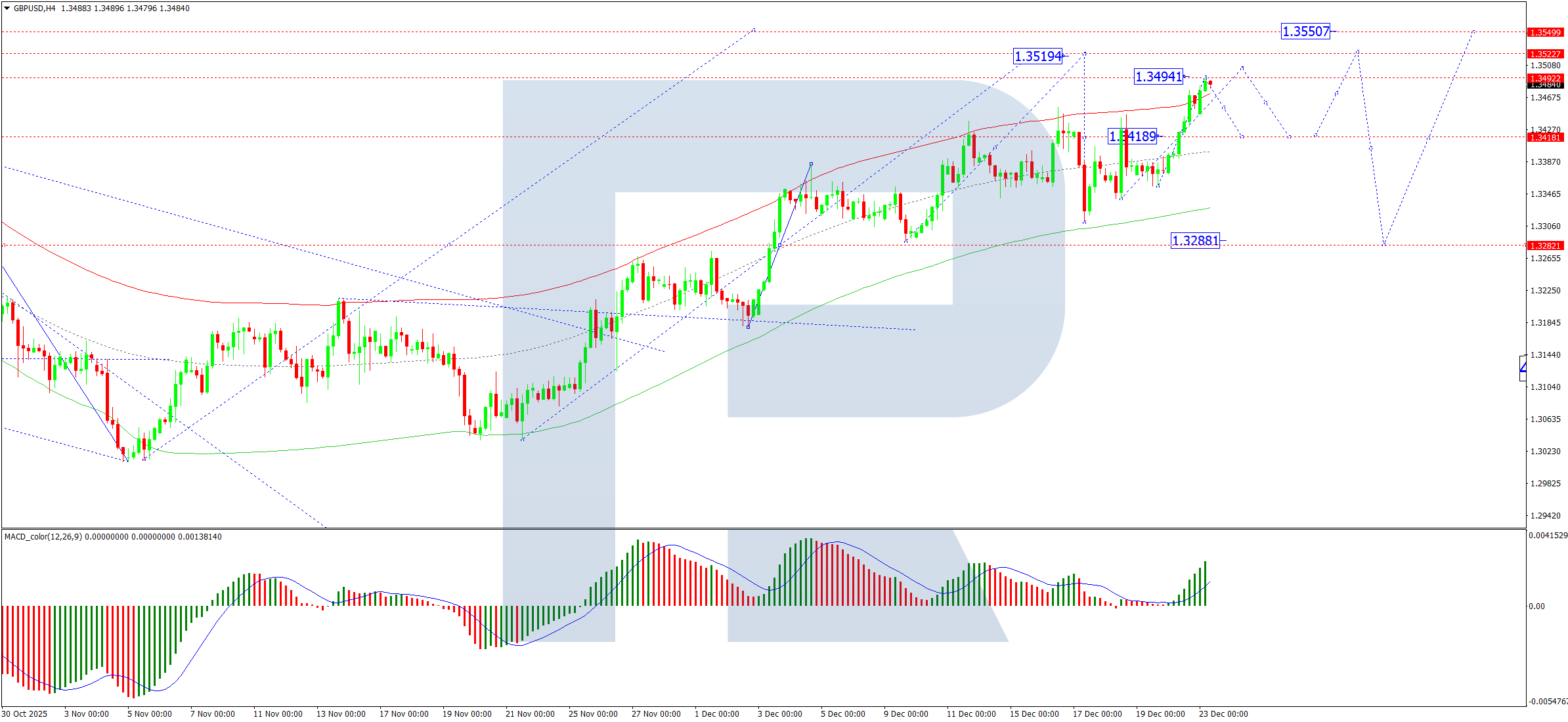
On the H4 chart, GBP/USD is continuing a corrective decline from the recent high near 1.3584 USD. The pair may extend this move towards support around 1.3420 USD. Once the correction is complete, a rebound from this level could initiate a new upward move, with initial resistance at 1.3548 USD, followed by a retest of 1.3584 USD. The MACD indicator supports this view: although the histogram and signal line remain above zero, both are declining, suggesting near-term downward momentum within a broader consolidation.

H1 Chart:

On the H1 chart, the pair has tested 1.3517 USD and continues its corrective phase. The immediate downside target is support at 1.3485 USD. A break below this level could extend the correction towards deeper supports. The Stochastic oscillator reinforces this near-term bearish bias, with its signal line hovering near 20.0, indicating oversold conditions, while continuing to trend lower.

Conclusion

GBP/USD is trading cautiously as markets brace for next week’s central bank decisions. While the pound remains supported by relatively hawkish BoE expectations and high inflation, its near-term direction will likely be determined by the Fed’s tone and upcoming UK fiscal developments. Technically, the pair is undergoing a short-term correction, which may present buying opportunities if key support levels hold.

Disclaimer:

Any forecasts contained herein are based on the author’s particular opinion. This analysis may not be treated as trading advice. RoboForex bears no responsibility for trading results based on trading recommendations and reviews contained herein.


Oil prices continue to rise amid a geopolitical risk premium. The Australian dollar has risen to a 10-month high

By JustMarkets

By the end of Wednesday, the Dow Jones Index (US30) fell by 0.48%. The S&P 500 Index (US500) gained 0.30%. The Nasdaq (US100) Technology Index closed up 0.04%. The US stocks rose to new records on Wednesday, supported by lower inflation data and a strong Oracle report. The Producer Price Index for August fell by 0.1% against expectations of a 0.3% increase, the first monthly decline in four months. The annual Producer Price Index was 2.6%, below the expectations of 3.3%, which increased hopes that Thursday’s CPI report would confirm the disinflationary trend. The inflation surprise, combined with soft labor market data, fueled bets that the Fed could cut rates by 50 basis points next week instead of the expected quarter-point change.

Oracle shares surged 39% after the company announced a sharp increase in cloud service orders, driven by demand for artificial intelligence. The company’s value increased by $85 billion in a single day, a new record. Nvidia (+3.8%) and AMD (+2.4%) shares rose, while Apple shares fell by 3.2% after the launch of the new iPhone 17 was underwhelming.

European stock markets traded mixed on Wednesday. The German DAX (DE40) fell by 0.36%, the French CAC 40 (FR40) closed up 0.15%, the Spanish IBEX35 (ES35) gained 1.29%, and the British FTSE 100 (UK100) closed down 0.19%. The ECB is expected to leave borrowing costs unchanged today, although updates to economic expectations and guidance on the policy outlook will be closely watched. Geopolitical risks also remained in focus, with Israel striking Hamas targets in Qatar and Poland intercepting drones that entered its airspace during a Russian attack on Ukraine.

Annual inflation in Norway for August 2025 rose to 3.5%, the highest since February, compared to 3.3% in July and in line with expectations. On a monthly basis, the CPI fell by 0.6%, the first decline since March, offsetting the 0.8% increase in July, which was also in line with projections.

WTI crude oil prices rose more than 1.5% on Wednesday to $63.7 per barrel, posting a third consecutive gain as traders balanced geopolitics and economic signals. The momentum accelerated when President Trump questioned the Russian drone invasion of Polish airspace on social media, triggering short-covering amid speculation that he might soon impose sanctions on Russian energy exports. This followed reports that Trump had urged the EU to join him in imposing tariffs on China and India, major buyers of Russian oil, to force Moscow to the negotiating table. Additionally, Israel’s strike on Hamas leaders in Qatar reignited Middle East tensions and added a geopolitical risk premium. However, the gains were capped as US government data showed a larger-than-expected increase in crude oil inventories of 3.9 million barrels.

Asian markets were mostly higher yesterday. The Japanese Nikkei 225 (JP225) rose by 0.87%, the Chinese FTSE China A50 (CHA50) jumped 0.48%, the Hong Kong Hang Seng (HK50) gained 1.01%, and the Australian ASX 200 (AU200) showed a positive result of 0.31%.

The Hang Seng Index rose to a four-year high on broad-based gains. In China, the sharpest drop in the Consumer Price Index in six months in August rekindled hopes for new government support, which could lead to an increase in consumer prices, while producer deflation hit a four-month low as Beijing’s efforts to curb corporate price wars were successful. Following a bilateral currency swap deal between China and Europe, shares in the real estate and financial sectors rose. Technology stocks also climbed, fueled by optimism about AI earnings after strong results from Oracle in the US. Alibaba rose by 0.6% on the optimistic outlook, and Baidu HK gained 2.6% after unveiling an updated artificial intelligence model.

The Australian dollar rose to around $0.662 on Thursday, nearing its highest level since early last November, driven by an improved risk appetite amid growing bets on a Fed rate cut. The commodity-linked Australian dollar also continued to benefit from rising oil and gold prices as escalating geopolitical risks fueled demand for safe-haven assets. Looking ahead, today’s speech by an RBA official will be closely monitored for further policy signals, as markets have generally priced in a 25 basis point cut in November.

New Zealand Central Bank chief Christian Hawkesby said on Thursday that the future path of the official cash rate (OCR) would depend on the pace of the economic recovery. The main prognoses for the OCR suggests a cut to around 2.50% by the end of the year. In August, the RBNZ lowered the OCR to a three-year low of 3.00% and signaled that it would continue to ease the rate as domestic and global factors constrain growth.

S&P 500 (US500) 6,532.04 +19.43 (+0.30%)

Dow Jones (US30) 45,490.92 −220.42 (−0.48%)

DAX (DE40) 23,632.95 −85.50 (−0.36%)

FTSE 100 (UK100) 9,225.39 −17.14 (−0.19%)

USD Index 97.83 +0.04 (+0.01%)

News feed for: 2025.09.11

  • RBNZ Gov Hawkesby Speaks at 02:15 (GMT+3);
  • Japan Producer Price Index (m/m) at 02:50 (GMT+3);
  • Eurozone ECB Monetary Policy Statement at 15:15 (GMT+3);
  • Eurozone ECB Interest Rate Decision at 15:15 (GMT+3);
  • US Consumer Price Index (m/m) at 15:30 (GMT+3);
  • US Initial Jobless Claims (w/w) at 15:30 (GMT+3);
  • Eurozone ECB Press Conference at 15:45 (GMT+3);
  • US Natural Gas Storage (w/w) at 17:30 (GMT+3).

By JustMarkets


This article reflects a personal opinion and should not be interpreted as an investment advice, and/or offer, and/or a persistent request for carrying out financial transactions, and/or a guarantee, and/or a forecast of future events.

USD/JPY Pauses After Volatility: Assessing the Path Ahead

By RoboForex Analytical Department

The USD/JPY pair consolidated around 147.32 JPY on Wednesday, following sharp fluctuations earlier in the week. Market participants are awaiting key US inflation data, which could significantly influence the Federal Reserve’s policy decision next week.

The recent downward revision of US employment statistics has strengthened the case for earlier monetary easing by the Fed. Some investors are even pricing in the possibility of a more aggressive 50-basis-point rate cut.

In Japan, a private survey revealed that business sentiment in the manufacturing sector reached a three-year high, driven mainly by reduced trade risks after the conclusion of a tariff agreement with the US.

On the political front, markets are monitoring the aftermath of Prime Minister Shigeru Ishiba’s resignation, which resulted from deepening divisions within the ruling party and political pressure following last year’s election defeat.

Technical Analysis: USD/JPY

H4 Chart:

On the H4 chart, USD/JPY continues to develop an upward wave within an ascending channel. The next likely target is the upper channel boundary near 148.40 JPY. Following this ascent, the pair may enter a corrective phase. The primary upside targets remain 149.00 JPY, with a further objective at 150.75 JPY. The MACD indicator supports this outlook: the histogram remains below zero but has begun to rise, while the signal line has moved above the histogram and is turning upward, signalling building bullish momentum.

H1 Chart:

On the H1 chart, the pair is testing the 147.50 JPY resistance level. A break above this level could open the way for further gains towards 148.40 JPY. The Stochastic oscillator aligns with this view, as its signal lines are rising towards the 50.0 level. A clear break above 50.0 would signal strengthening upward momentum.

Conclusion

USD/JPY is taking a breather after recent volatility as traders await crucial US inflation data. Weak figures could reinforce expectations of Fed easing, potentially weakening the dollar further. Technically, the pair retains a near-term bullish bias within the ascending channel, though a corrective pullback remains possible after testing higher resistance levels.

Disclaimer:

Any forecasts contained herein are based on the author’s particular opinion. This analysis may not be treated as trading advice. RoboForex bears no responsibility for trading results based on trading recommendations and reviews contained herein.

The French Parliament has passed a vote of no-confidence in the Prime Minister. Russia is attacking Poland, and Israel is attacking Hamas in the capital of Qatar

By JustMarkets

The Dow Jones Industrial Average (US30) rose by 0.43% on Tuesday. The S&P 500 (US500) gained 0.27%, and the tech-heavy Nasdaq (US100) finished 0.33% higher. All three major indices hit record highs despite signs of a slowing economy. Investors digested revised employment data showing that the US added 911,000 fewer jobs than previously estimated in the year ending in March, the most significant downward revision since 2002. This weaker job outlook increased expectations of a Federal Reserve rate cut next week, with debate centered mainly on the size of the reduction. Attention will now turn to the Producer Price Index (PPI) and Consumer Price Index (CPI) reports, which will be closely watched for clues about the direction of the Fed’s policy.

The Mexican peso strengthened to 18.6 per US dollar. In August, headline inflation slowed to 3.57%, while core inflation held steady at 4.23%, reinforcing expectations that the Bank of Mexico’s cautious easing cycle will continue at a moderate pace. The minutes from Banxico’s August meeting confirmed that the board approved a 25 basis point (bps) rate cut to 7.75%, with the majority favoring a slower pace of cuts and a potential additional quarter-point reduction later this year.

The Canadian dollar is under new selling pressure and is currently the second-worst performing major currency of 2025, behind only the US dollar. A combination of a deteriorating domestic economy and ongoing tariff uncertainty continues to weigh on the loonie, making traders skeptical about its near-term growth prospects. Canada’s latest GDP release confirmed sluggish growth, highlighting the impact of weak domestic activity. In response, the Bank of Canada may continue to cut rates.

European stock markets were mostly higher on Tuesday. The German DAX (DE40) fell by 0.37%, the French CAC 40 (FR40) rose by 0.19%, Spain’s IBEX35 (ES35) gained 0.14%, and the UK’s FTSE 100 (UK100) closed 0.23% higher. European equities ended slightly up on Tuesday, continuing their gains from the previous session. The French Parliament passed a vote of no-confidence in Prime Minister Bayrou as parties failed to agree on budget cuts, forcing President Macron to appoint the country’s fifth prime minister in less than two years. At the same time, bond yields traded quietly despite the turmoil, providing support for stocks ahead of the European Central Bank’s likely rate hold this week.

Russian strike drones have invaded Polish airspace, threatening cities approximately 40-50 miles from the Ukrainian border. Airports in Warsaw, Lublin, and Rzeszow were closed due to the attack. Poland has put its air defense systems on high alert and, according to preliminary reports, has shot down all the drones. On Wednesday morning local time, Polish armed forces stated that all necessary procedures were enacted to ensure the security of national airspace as Russia conducted large-scale overnight strikes on Ukraine. This is not the first time Russian drones have violated Polish airspace, forcing fighter jets to scramble, but this time, the number of drones crossing NATO’s borders was around 8-10, which does not appear to be accidental.

WTI crude oil prices rose more than 1% on Tuesday, surpassing $63 a barrel. The increase followed reports of explosions in Doha, Qatar, where Israel reportedly struck high-ranking Hamas leaders. According to eyewitnesses, Qatar, a key mediator in the Israel-Hamas conflict and a host of Hamas officials, was rattled by smoke rising over the area. This geopolitical shock added to existing bullish factors for oil. Prices were already supported by a smaller-than-expected OPEC+ output increase. Markets also anticipate that China will continue to build up its oil reserves, further tightening supply. Meanwhile, fears of new Western sanctions against Russia have heightened following its largest aerial attack on Ukraine in months.

Asian markets were mostly lower yesterday. Japan’s Nikkei 225 (JP225) fell by 0.42%, China’s FTSE China A50 (CHA50) dropped 0.35%, Hong Kong’s Hang Seng (HK50) rose by 1.19%, and Australia’s ASX 200 (AU200) had a negative result of 0.63%.

The New Zealand dollar rose to $0.594 USD on Wednesday as the US dollar strengthened ahead of key inflation reports. Traders are awaiting the release of the US PPI and CPI data this week, which could provide more clues about the Federal Reserve’s path for interest rates. Meanwhile, in China, New Zealand’s largest trading partner, data released today showed that consumer prices fell in August and factory gate deflation eased, pointing to continued deflationary pressures in an economy facing slowing growth.

S&P 500 (US500) 6,512.61 +17.46 (+0.27%)

Dow Jones (US30) 45,711.34 +196.39 (+0.43%)

DAX (DE40) 23,718.45 −88.68 (−0.37%)

FTSE 100 (UK100) 9,242.53 +21.09 (+0.23%)

USD Index 97.76 +0.30 (+0.31%)

News feed for: 2025.09.10

  • China Consumer Price Index (m/m) at 04:30 (GMT+3);
  • China Producer Price Index (m/m) at 04:30 (GMT+3);
  • Norway Inflation Rate (m/m) at 09:00 (GMT+3);
  • Switzerland SNB Chairman Schlegel Speaks at 14:45 (GMT+3);
  • US Producer Price Index (m/m) at 15:30 (GMT+3);
  • US Crude Oil Reserves (w/w) at 17:30 (GMT+3).

By JustMarkets


This article reflects a personal opinion and should not be interpreted as an investment advice, and/or offer, and/or a persistent request for carrying out financial transactions, and/or a guarantee, and/or a forecast of future events.

Hong Kong stocks rose to a 4-year high. The announced production hike from OPEC+ was smaller than analysts had projected

By JustMarkets 

By the end of Monday, the Dow Jones Index (US30) had risen by 0.25%. The S&P 500 (US500) gained 0.21%, and the Nasdaq (US100) Technology Index closed up 0.46%. Wall Street started the week with gains on Monday as investors positioned themselves ahead of a data-heavy week, which includes two key inflation reports that are likely to influence the Federal Reserve’s policy expectations. A weak August jobs report, combined with softer labor market data last week, fueled hopes that the Fed will cut rates at its September meeting, with traders increasingly pricing in the possibility of a more significant 50 basis point (bps) rate cut. This week, investors will monitor the PPI and CPI for new signals on the economy’s direction.

Stock markets in Europe were mostly up on Monday. Germany’s DAX (DE40) rose by 0.89%, France’s CAC 40 (FR40) closed up 0.78%, Spain’s IBEX35 (ES35) gained 1.02%, and the UK’s FTSE 100 (UK100) closed up 0.14%. European stocks closed with solid gains, as markets continued to assess the outlook for European rates and the latest corporate news. Banks closed sharply higher as Eurozone yield spreads narrowed, easing fragmentation concerns that had emerged in recent weeks before the expected dissolution of the French parliament. Prime Minister François Bayrou is expected to lose a confidence vote as the government rejects the current budget proposal, creating political risk and likely increasing the country’s budget deficit.

WTI crude oil prices rose 2% on Monday, climbing above the $63 per barrel mark and recovering from a three-day slide. The gains came as OPEC+ announced a smaller-than-expected production increase and concerns over potential new US sanctions on Russian oil intensified. The group agreed to raise production by 137,000 barrels per day from October, which is far below the increases of 555,000 bpd in August and September and 411,000 bpd in June and July. Analysts noted that some members are already overproducing, meaning the real impact on the market may be limited.

Silver prices (XAG/USD) climbed back above the $41 per ounce mark, reaching their highest level since August 2011, as signs of a cooling US labor market boosted expectations for a Federal Reserve rate cut this year. Markets are fully pricing in a 25 bps rate cut later this month, with some betting on a more significant half-point shift. On the industrial side, strong demand from solar panels, electric vehicles, and electronics has tightened the physical silver market amid limited supply.

Asian markets were mostly down yesterday. Japan’s Nikkei 225 (JP225) rose by 1.45%, China’s FTSE China A50 (CHA50) fell by 0.10%, Hong Kong’s Hang Seng (HK50) gained 0.85%, and Australia’s ASX 200 (AU200) ended the day with a 0.24% loss. In early Tuesday trading, Hong Kong stocks jumped 1.4%, rising for the third consecutive day to their highest level since October 2021, as all sectors saw gains. Optimism on Wall Street on Monday lifted the mood ahead of an expected Fed rate cut later this month. Hong Kong real estate company stocks were among the top gainers, rising by about 2% after the city of Shenzhen eased home purchase restrictions last week. Technology, financial, and consumer stocks also rose, supported by a third consecutive day of gains in mainland markets as Beijing moves toward a record trade surplus despite August exports hitting a six-month low. However, gains were capped by caution ahead of the release of China’s CPI and PPI data on Wednesday, as concerns about deflation persist.

The Westpac-Melbourne Institute Index of Consumer Sentiment in Australia fell by 3.1% month-over-month to 95.4 in September 2025, offsetting the 5.7% increase in August. This decline reflects renewed anxiety about the interest rate outlook, despite some easing of the cost-of-living crisis and support from monetary policy easing. Assessments of the economy worsened, with the 12-month outlook falling 8.9% to 92.2 and the 5-year outlook declining 5.9% to 92.7. The Head of Australian Macro Expectations said the survey shows that the recovery in consumer demand since mid-2024 remains sluggish and further policy easing will likely be needed. He expects the RBA to cut rates by 25 basis points in November and two more times in 2026.


S&P 500 (US500) 6,495.15 +13.65 (+0.21%)

Dow Jones (US30) 45,514.95 +114.09 (+0.25%)

DAX (DE40) 23,807.13 +210.15 (+0.89%)

FTSE 100 (UK100) 9,221.44 +13.23 (+0.14%)

USD Index 97.44 −0.33 (−0.33%)

News feed for: 2025.09.09

  • Australia NAB Business Confidence (m/m) at 04:30 (GMT+3);
  • Mexico Inflation Rate (m/m) at 15:00 (GMT+3).

By JustMarkets


This article reflects a personal opinion and should not be interpreted as an investment advice, and/or offer, and/or a persistent request for carrying out financial transactions, and/or a guarantee, and/or a forecast of future events.

EUR/USD Holds Firm as Upcoming Data Threatens the Dollar

By RoboForex Analytical Department

The EUR/USD pair advanced for a third consecutive session on Tuesday, climbing towards 1.1772 USD. Growing concerns about a cooling US labour market are reinforcing expectations of a Federal Reserve rate cut, weighing on the dollar.

Investors are particularly focused on the upcoming revised employment data for the period from April 2024 to March 2025. Estimates suggest a possible downward revision of up to 800,000 jobs, which could indicate that the Fed is falling short of its full employment mandate – a key factor in its policy decisions.

Market attention is also turning to two key inflation releases this week: the Producer Price Index (PPI) on Wednesday and the Consumer Price Index (CPI) on Thursday.

Interest rate futures currently price in an 89% probability of a 25-basis-point cut at next week’s Fed meeting. Some participants are even pricing in the possibility of a more aggressive 50-basis-point reduction.

Technical Analysis: EUR/USD

H4 Chart:

On the H4 chart, EUR/USD has extended its upward move towards 1.1810 USD. A decisive break above this resistance could signal a continuation of the uptrend. Alternatively, a rejection at this level may lead to a corrective pullback, retesting the former resistance – now acting as support around 1.1720–1.1740 USD. The MACD indicator supports this outlook: both the histogram and signal line remain above zero and are rising, suggesting bullish momentum. The primary scenario favours further gains toward 1.1810 USD, followed by 1.1870 USD, though minor corrections may occur along the way.

H1 Chart:

On the H1 chart, the pair is testing resistance and showing signs of short-term consolidation. A break above 1.1772 USD would likely confirm a continuation of the upward move. The Stochastic oscillator is testing the 50 level, indicating potential for a brief correction before the next leg higher. The near-term upside target remains 1.1810 USD.

Conclusion

The euro remains well-supported against the dollar as markets anticipate softer US labour data and key inflation prints this week. A confirmation of weaker employment figures or subdued inflation could further solidify expectations for Fed easing, likely propelling EUR/USD toward higher resistance levels. Technically, the pair retains bullish momentum, though a near-term correction remains possible.

Disclaimer:

Any forecasts contained herein are based on the author’s particular opinion. This analysis may not be treated as trading advice. RoboForex bears no responsibility for trading results based on trading recommendations and reviews contained herein.