Archive for Financial News – Page 32

Gold Extends Its Rally as Safe-Haven Demand Builds

By RoboForex Analytical Department

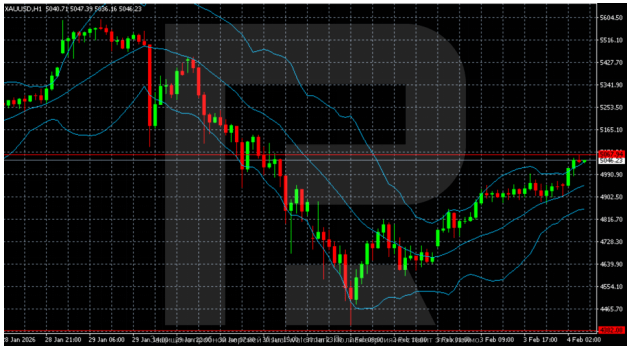
The gold market continues to attract strong inflows, underscoring its appeal as a premier defensive asset. Growing anxieties over a potential US government shutdown are fuelling investor nervousness, with Congress once again at a budget impasse. This political deadlock is prompting a flight to safety, benefiting traditional havens like gold and the Swiss franc.

Further pressure on the US dollar stems from the escalation of the trade war, as Donald Trump’s rhetoric grows increasingly assertive. Proposals for higher tariffs, a overhaul of import flows, and fresh threats against China are being factored into market expectations for future inflation and Federal Reserve policy.

Amid this backdrop, the yield on 10-year US Treasuries has dipped below 4.2%, while the DXY dollar index struggles for direction. Markets are progressively pricing in a more dovish Fed stance by year-end, creating a solid fundamental base for gold.

Investors are increasingly turning to XAU/USD as a hedge against mounting political and economic uncertainty, viewing the metal as a reliable insurance policy.

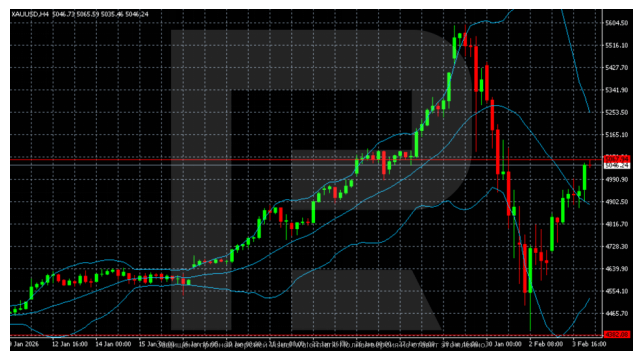
Technical Analysis: XAU/USD

H4 Chart:

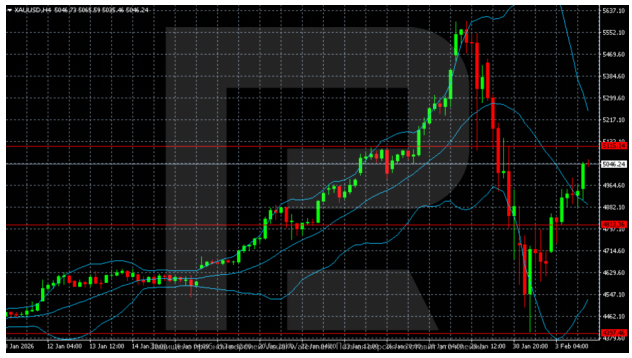
On the H4 chart, gold found strong support at 4,190 USD and is advancing towards an initial target of 4,266 USD. Upon reaching this level, a corrective pullback towards 4,100 USD is anticipated. Provided the broader bullish structure holds, this could establish a foundation for a subsequent upward wave, with potential targets at 4,300 – 4,400 USD. The MACD indicator corroborates this constructive outlook. Its signal line is firmly above zero and trending higher, confirming the current dominance of buyers.

H1 Chart:

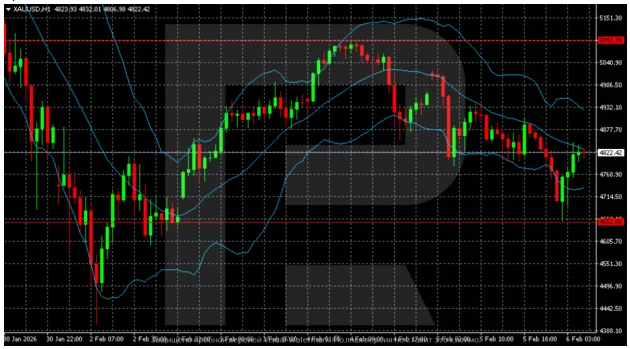
On the H1 chart, the instrument decisively broke above the 4,190 USD resistance, consolidating around this level before extending its gains towards 4,266 USD. A period of profit-taking is expected here, likely triggering a retracement to retest 4,190 USD as support. A successful hold above this level could signal a resumption of the uptrend, targeting 4,300 – 4,400 USD. The Stochastic oscillator aligns with this view, with its signal line positioned above 50 and advancing towards 80, reflecting sustained bullish momentum.

Conclusion

Gold’s rally is being driven by a powerful confluence of political uncertainty, trade war escalation, and shifting monetary policy expectations. While a short-term technical correction is likely as profits are taken, the fundamental and technical backdrop remains decidedly bullish.


Disclaimer:

Any forecasts contained herein are based on the author’s particular opinion. This analysis may not be treated as trading advice. RoboForex bears no responsibility for trading results based on trading recommendations and reviews contained herein.

Oil prices continue to fall. Platinum narrows its price gap with gold

By JustMarkets 

The Dow Jones Index (US30) closed up 0.42% on Tuesday. The S&P 500 Index (US500) declined by 0.20%. The technological Nasdaq Index (US100) closed lower by 0.69%. Speaking at the NABE meeting in Philadelphia, Fed Chair Jerome Powell acknowledged that economic activity was somewhat stronger than expected but warned of rising risks to employment. The Chair also indicated that the Federal Reserve could complete the reduction of its balance sheet in the coming months, noting that liquidity conditions are gradually tightening. He warned that procrastination risks increasing the impact of tariffs and potential job cuts, and the recent lack of key data has added uncertainty to the policy outlook.

The IMF expects a slowdown in global economic growth to 3.2% in 2025 and 3.1% in 2026, compared to 3.3% in 2024, as the world economy adapts to conditions of increased protectionism and fragmentation, according to the latest “World Economic Outlook” (WEO) report. By country, US economic growth is expected to be 2.0% in 2025 and 2.1% in 2026, while China’s economic growth rate will slow to 4.8% and 4.2%, respectively. Eurozone economic growth will be 1.2% in 2025 and 1.1% in 2026, the UK’s 1.3% in both years, and Japan’s 1.1% and 0.6%. Meanwhile, global inflation is expected to continue to decline, although trends will vary across countries: it will remain above target in the US, with risks skewed to the upside, while remaining subdued in other countries.

European indices traded mixed on Tuesday. Germany’s DAX (DE40) fell by 0.62%, France’s CAC 40 (FR 40) closed down by 0.18%, Spain’s IBEX35 Index (ES35) rose by 0.29%, and the UK’s FTSE 100 (UK100) closed up 0.10%. In France, Prime Minister Sébastien Lecornu announced plans to suspend pension reform this autumn, partially yielding to the demands of the Socialists, whose support is crucial for the government’s survival. On the corporate front, German parts manufacturer Continental showed a drop of more than 4%, following losses by the French company Michelin after the latter cut its outlook. It was followed by Siemens, which fell 3.2% after Morgan Stanley downgraded the company’s stock rating to “equal-weight” from “overweight”.

WTI crude oil prices fell 1.3% to reach $58.7 per barrel on Tuesday, recovering slightly after hitting a five-month low earlier in the session, as escalating US-China tensions and a bearish prognosis from the International Energy Agency weighed on sentiment. Beijing announced sanctions against five US-linked subsidiaries of South Korean shipbuilder Hanwha Ocean and hinted at further retaliation after Washington imposed new trade restrictions, increasing market uncertainty. The IEA expects a record global oil surplus in 2026 of nearly 4 million barrels per day, 18% higher than the previous outlook, as OPEC+ ramps up production and output from rivals continues to grow.

Platinum (XPT/USD) held above $1640 per ounce, nearing a 12-year high, supported by favorable market fundamentals and escalating US-China trade tensions. Platinum is regaining share in luxury jewelry as its price gap with gold narrows. Steady industrial demand persists for catalysts in gasoline cars, in refining, and the chemical industry. Demand for a “safe-haven currency” increased amid plans by the US and China to impose additional port fees on shipping companies starting Tuesday.

Asian markets were mostly down yesterday. Japan’s Nikkei 225 (JP225) fell by 2.58%, China’s FTSE China A50 (CHA50) decreased by 0.72%, Hong Kong’s Hang Seng (HK50) was down 1.73%, while Australia’s ASX 200 (AU200) showed a positive result of 0.19%.

On Wednesday, the offshore yuan rose to 7.12 per dollar, breaking a three-day losing streak, as the People’s Bank of China reaffirmed its commitment to maintaining currency stability. The central bank continued to set the daily yuan reference rate significantly above market expectations, aiming to mitigate the broader economic and geopolitical fallout from escalating US-China trade tensions. On the economic front, the latest inflation data indicated continued weakness, reflected in persistent deflationary pressure.

The Australian dollar strengthened to around $0.650, recovering some of the previous session’s losses, as investors assessed comments from an RBA official who indicated the probability of higher-than-expected inflation. Markets now estimate the probability of a rate cut at the November 4 meeting as roughly equal, and the probability of a December cut at about 60%, down from the previous 70%. Attention now turns to labor market data to be released later this week.

The New Zealand dollar rose to $0.572 but remained near the six-month low reached in the previous session, as investors digested statements from Reserve Bank of New Zealand Chief Economist Paul Conway. Conway noted that the current Official Cash Rate of 2.5% is at the lower end of the central bank’s neutral range but emphasized that the central bank remains open to further policy easing if necessary. He added that policymakers prefer to wait for economic data before making a decision. Additional pressure on the currency came from renewed US-China tensions, which introduced new uncertainty to global markets and dampened risk appetite.

S&P 500 (US500) 6,641.51 −13.21 (−0.20%)

Dow Jones (US30) 46,262.69 +195.11 (+0.42%)

DAX (DE40) 24,236.94 −150.99 (−0.62%)

FTSE 100 (UK100) 9,452.77 +9.90 (+0.10%)

USD Index 99.03 −0.24 (−0.24%)

News feed for: 2025.10.15

  • China Inflation Rate (m/m) at 04:30 (GMT+3);
  • Sweden Inflation Rate (m/m) at 09:00 (GMT+3);
  • Eurozone Industrial Production (m/m) at 12:00 (GMT+3);
  • US Empire State Manufacturing Index (m/m) at 15:30 (GMT+3);
  • Australia RBA Gov Bullock Speech at 22:45 (GMT+3).

By JustMarkets


This article reflects a personal opinion and should not be interpreted as an investment advice, and/or offer, and/or a persistent request for carrying out financial transactions, and/or a guarantee, and/or a forecast of future events.

British Pound Braces for Further Losses

By RoboForex Analytical Department

The British pound remains under sustained pressure, driven by a weakening domestic economy and receding inflation concerns. Recent UK macroeconomic data indicate stagnation in the service sector and a continued decline in consumer spending.

At the same time, slowing wage growth is giving the Bank of England greater flexibility to adopt a more dovish stance. Market expectations now point to a high likelihood of a rate cut at one of the bank’s forthcoming meetings.

Political uncertainty is also weighing on the currency. The government’s fragile parliamentary position and deepening internal divisions over tax and fiscal policy are adding to sterling’s vulnerability. This is compounded by falling business confidence and subdued investment activity, raising concerns about the UK’s economic trajectory into the fourth quarter.

Externally, the US dollar continues to gain support. Recent remarks from Federal Reserve officials suggest a commitment to maintaining current interest rate levels through year-end, bolstering the greenback’s appeal. In addition, escalating geopolitical tensions in the Middle East and ongoing volatility in commodity markets are fuelling demand for safe-haven assets, including the dollar.

Overall, the fundamental backdrop remains tilted towards further GBP/USD depreciation in the near to medium term.

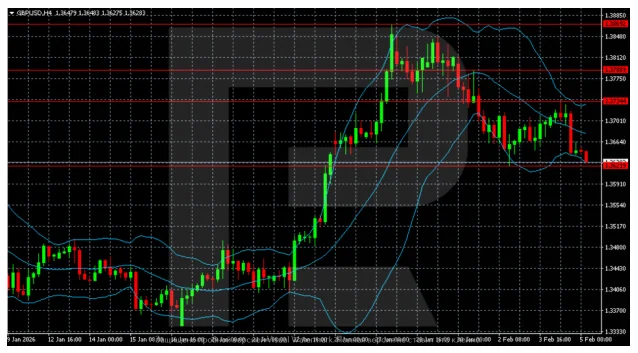
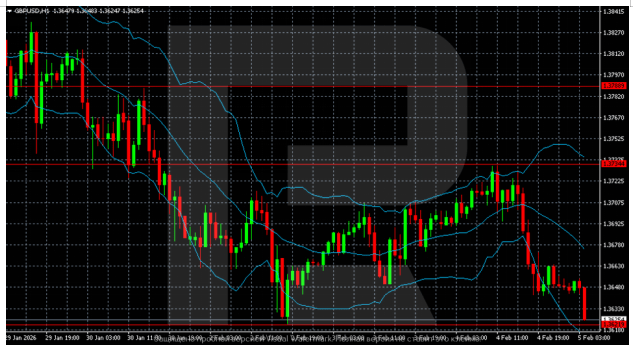
Technical Analysis: GBP/USD

H4 Chart:

A consolidation range has formed around 1.3310. A downward breakout appears likely, signalling a continuation of the third declining wave towards a local target of 1.3125. This bearish outlook is supported by the MACD indicator, whose signal line lies below zero and is pointing firmly downward.

H1 Chart:

The pair has also formed a consolidation range around 1.3310, with the third wave of the broader downtrend now largely confirmed. The first leg of this wave reached 1.3252, followed by a correction to 1.3372. A further decline toward at least 1.3244 is anticipated, with an extension of the downward structure to 1.3125 also possible. The Stochastic oscillator confirms this scenario, with its signal line below 80 and trending downward towards 20.

Conclusion

Sterling continues to face significant headwinds from both domestic and external factors. With monetary and political dynamics aligned against it and technical structure favouring the downside, GBP/USD appears set for further declines in the sessions ahead.


Disclaimer:

Any forecasts contained herein are based on the author’s particular opinion. This analysis may not be treated as trading advice. RoboForex bears no responsibility for trading results based on trading recommendations and reviews contained herein.

Investors focus shifts to Q3 earnings. Silver sets all-time high since 1980

By JustMarkets 

Yesterday, the Dow Jones (US30) fell by 0.52% on Thursday. The S&P 500 (US500) dropped by 0.28%. The tech-heavy Nasdaq (US100) closed 0.08% lower. Market sentiment worsened due to a government shutdown, which delayed the release of key economic data. This caused investor focus to shift to the upcoming third-quarter earnings reports, offering insight into the state of the economy, and to AI-driven growth. Shares of Apple, Alphabet, Tesla, and Walmart all lost more than -0.7%, while PepsiCo rose by 4.2% after reporting higher-than-expected revenue and profit. Delta Air Lines jumped 4.3% on optimistic guidance, Nvidia added 1.8% after the US approved billions of dollars in chip exports to the UAE, and Costco climbed 3.1% on strong September sales.

The Canadian dollar weakened to a level above 1.400 per US dollar, hitting its lowest level since early April amid a stronger dollar and lower oil prices. In Canada, attention turns to Friday’s official September jobs report, which is expected to show further labor market softening with the unemployment rate rising from 7.1% to 7.2%. This data could provide new insight into the Bank of Canada’s rate-change prospects.

Mexico’s annual inflation accelerated for the second consecutive month, reaching 3.76% in September 2025, up from 3.57% in August, though still within the central bank’s 2-4% target range. Analysts had anticipated a slightly higher figure of 3.79%. Every month, consumer prices rose by 0.23% after a 0.06% increase in August, compared to market estimates of 0.27%.

European equity markets were mostly down yesterday. Germany’s DAX (DE40) gained 0.06%, France’s CAC 40 (FR 40) closed down 0.23%, Spain’s IBEX35 (ES35) fell by 0.60%, and the UK’s FTSE 100 (UK100) closed down 0.41% on Thursday. European stocks fell from record highs on Thursday. European banks lost over 1%, driven mainly by the drop in HSBC, whose shares fell by 4.5% after announcing a proposal to privatize its 63% owned Hong Kong subsidiary, Hang Seng Bank. Luxury and consumer goods stocks also took a hit: Ferrari plunged 15% after slashing its full-year and 2030 forecasts and cutting its electric vehicle sales targets, while LVMH, Hermès, and L’Oréal fell 2.6%, 2.2%, and 1.7%, respectively. Today, the focus was on France as President Macron pledged to name a new Prime Minister within 48 hours following the resignation of Sebastien Lecornu, amid calls to avoid appointing another centrist ally.

The spot price of silver jumped more than 4% to a record high of $51 per ounce, surpassing the previous peak recorded during the Hunt brothers’ market squeeze in 1980, as strong safe-haven demand met limited supply. The precious metal has surged over 70% this year, outperforming gold. This surge is driven by concerns over US financial risks, the possibility of interest rate cuts, questions about the Federal Reserve’s independence, and unsustainable levels of global deficits and debt. A shortage of freely available silver in the London market is providing further support for prices.

The US natural gas prices dropped to around $3.3 per million British thermal units (MMBtu), retreating from an 11-week high following a larger-than-expected inventory build. The US Energy Information Administration reported a storage injection of 80 billion cubic feet (bcf) for the week ending October 3rd, exceeding the forecast of 77 bcf and slightly above last year’s 78 bcf, though below the five-year average of 94 bcf.

Asian markets were mostly up yesterday. Japan’s Nikkei 225 (JP225) rose by 1.77%, China’s FTSE China A50 (CHA50) gained 0.85%, Hong Kong’s Hang Seng (HK50) declined 0.29%, and Australia’s ASX 200 (AU200) posted a positive result of 0.25%.

The Australian economy is performing well with inflation within the central bank’s target range (2-3%) and the labor market remaining resilient, Governor Michele Bullock told a parliamentary committee on Friday. Household consumption is growing, offsetting weaker government demand and supporting growth. Last month, the Reserve Bank left interest rates at 3.6% after three cuts since February. Bullock noted that services inflation remains “sticky” and highlighted global uncertainty, including US protectionist policies, geopolitical tensions, and slowing Chinese demand. However, the worst-case scenarios for tariffs have not materialized.

S&P 500 (US500) 6,735.11 −18.61 (−0.28%)

Dow Jones (US30) 46,358.42 −243.36 (−0.52%)

DAX (DE40) 24,611.25 +14.12 (+0.06%)

FTSE 100 (UK100) 9,509.40 −39.47 (−0.41%)

USD index 99.40 +0.49 (+0.49%)

News feed for: 2025.10.10

  • Japan Producer Price Index (m/m) at 02:50 (GMT+3);
  • Norway Inflation Rate (m/m) at 09:00 (GMT+3);
  • US Nonfarm Payrolls (m/m) at 15:30 (GMT+3) (Tentative);
  • US Unemployment Rate (m/m) at 15:30 (GMT+3) (Tentative);
  • Canada Unemployment Rate (m/m) at 15:30 (GMT+3);
  • US Michigan Consumer Sentiment (m/m) at 17:00 (GMT+3);

By JustMarkets


This article reflects a personal opinion and should not be interpreted as an investment advice, and/or offer, and/or a persistent request for carrying out financial transactions, and/or a guarantee, and/or a forecast of future events.

EUR/USD Plummets as Investors Shun Risk

By RoboForex Analytical Department

The EUR/USD pair tumbled to 1.1569 on Friday, propelling the US dollar to a two-month high. The rally comes as investors retreat from both the euro and the yen, which have lost their appeal.

The yen has depreciated roughly 4.0% against the dollar since Sanae Takaichi won the race to become Japan’s next prime minister. Markets are anticipating an expansion of fiscal stimulus and a continuation of accommodative monetary policy under the new leadership.

Meanwhile, the euro has weakened by approximately 1.5%, pressured by political instability in France. President Emmanuel Macron is now seeking his sixth prime minister in just two years, creating significant uncertainty.

In the United States, the government shutdown has entered its ninth day. This has delayed the release of key macroeconomic data, leaving markets without crucial information to assess the Federal Reserve’s policy outlook.

Market pricing currently indicates a 95% probability of a 0.25 percentage point interest rate cut in October. However, the likelihood of a subsequent easing in December has fallen to 80%, down from 90% a week ago.

Technical Analysis: EUR/USD

H4 Chart:

The pair completed a downward wave to 1.1622 and subsequently formed a consolidation range around this level. Today’s downward breakout from this range has completed a further decline to 1.1542. A corrective pullback to 1.1584 is now possible. Following this, a decline towards 1.1520 is expected, with the potential to extend the downtrend to 1.1500. This bearish scenario is technically confirmed by the MACD indicator, whose signal line is below zero and pointing firmly downward.

H1 Chart:

A decline to 1.1640 was followed by the formation of a consolidation range below this level. The subsequent downward movement culminated in a wave reaching 1.1542. A short-term correction to 1.1580 is possible today. Upon its completion, a further decline to 1.1520 is anticipated, with the local target for the downward wave structure seen at 1.1500. Technically, this outlook is supported by the Stochastic oscillator, with its signal line below 80 and pointing sharply downward towards 20.

Conclusion

The EUR/USD is firmly on the back foot, driven by a stronger US dollar and distinct weaknesses in both the euro and yen. The technical structure is overwhelmingly bearish, pointing towards a continued decline with key targets at 1.1520 and 1.1500.


Disclaimer:

Any forecasts contained herein are based on the author’s particular opinion. This analysis may not be treated as trading advice. RoboForex bears no responsibility for trading results based on trading recommendations and reviews contained herein.

Silver nears $50 per ounce mark. Oil prices rise amid inventory drawdowns

By JustMarkets 

The Dow Jones (US30) Index fell by 0.01% at the close of Wednesday. The S&P 500 (US500) rose by 0.58%. The technological Nasdaq (US100) Index closed higher by 1.12%. The latest FOMC minutes showed that the majority of Federal Reserve officials noted the advisability of transitioning the federal funds rate to a more neutral level, as, in their view, the risks to employment had increased. However, according to the latest FOMC meeting minutes, the majority still emphasized that the risks to inflation remain tilted to the upside. Furthermore, a majority of participants deemed further policy easing likely for the remainder of the year, with about half of the officials expecting two more interest rate cuts by the end of 2025. Officials continued to state that they would weigh risks to both inflation and employment when considering their future actions.

AMD surged by 11.3% during the session and is up more than 40% since the start of the week as markets continued to price in the chipmaker’s deal with OpenAI, which marked over $1 trillion for the ChatGPT maker in a series of circular deals. Micron shares jumped 5.9%, while Nvidia, Oracle, and Amazon each rose by more than 2%. Cisco stock climbed 2% on the back of the release of a new artificial intelligence chip for data centers. Conversely, shares of defensive consumer companies and banks declined.

Stock markets in Europe rose yesterday. The German DAX (DE40) increased by 0.87%, the French CAC 40 (FR40) closed up by 1.07%, the Spanish IBEX35 (ES35) gained 0.97%, and the UK FTSE 100 (UK100) closed 0.69% higher. The Frankfurt DAX Index reached an all-time high on Wednesday. Market sentiment was lifted by new EU trade measures and plans to limit steel imports, although weak data from Germany and political uncertainty in France capped gains. Industrial production in Germany fell by 4.3% in August, the sharpest decline since March 2022, far exceeding the expected drop of 1%.

WTI oil prices rose by 1.5% to $62.65 per barrel after EIA data showed a sharp inventory drawdown at the key Cushing, Oklahoma hub. Inventories there shrank by 763,000 barrels last week, the largest drop since June, while nationwide crude inventories grew more than expected but remained close to seasonal lows. The report also showed a decline in refined product inventories, suggesting strengthening demand. Nevertheless, price gains were limited by expectations of abundant global supply. OPEC+ continues to ramp up production, and US oil output is expected to hit a record high this year.

Silver gained over 3% on Wednesday, nearing the $50 per ounce mark, an all-time high, as the protracted US government shutdown amid heightened geopolitical and economic uncertainty spurred demand for safe-haven assets. Markets are also anticipating the US Federal Reserve to cut its rate by a quarter point this month and likely one more in December. Concurrently, strong physical demand from the solar energy and electronics sectors continued to support prices, with the Silver Institute projecting a global supply deficit in 2025 for the fifth consecutive year.

Asian markets mostly fell yesterday. Japan’s Nikkei 225 (JP225) dropped by 0.45%, China’s FTSE China A50 (CHA50) did not trade yesterday, the Hang Seng (HK50) declined by 0.48%, and Australia’s ASX 200 (AU200) posted a negative result of 0.10%.

On Thursday, Chinese indices rose as mainland Chinese markets resumed trading after the long “Golden Week” holidays, during which a record 2.43 billion inter-regional passenger trips were recorded. Mining stocks led the gains after Beijing imposed export controls on rare-earth processing technology in a bid to solidify its dominance in the sector amid growing competition with the US.

The Australian dollar (AUD) climbed to around $0.660 on Thursday, extending gains from the previous session, as higher inflation expectations strengthened the Reserve Bank of Australia’s (RBA) hawkish stance. Consumer inflation expectations rose to 4.8% in October 2025 from 4.7% in September, the highest since June, on fears that third-quarter inflation could top prognoses. This reinforces the Central Bank’s cautious position, which is expected to keep its policy rate unchanged after setting it at 3.6% in September.

On Thursday, the New Zealand dollar (NZD) rose to $0.58, recovering from losses during the previous session when the Reserve Bank surprised markets with a larger-than-expected rate cut. On Wednesday, the Central Bank slashed the official cash rate (OCR) by 50 basis points to 2.50%, the lowest level since July 2022, citing concerns over the unsustainable state of the economy and leaving the door open for further easing. Markets are pricing in an 80% chance of a 25 bps rate cut at the RBNZ’s next meeting in November, and see roughly even odds that rates could fall to 2.0% by next year.

S&P 500 (US500) 6,753.72 +39.13 (+0.58%)

Dow Jones (US30) 46,601.78 −1.20 (−0.01%)

DAX (DE40) 24,597.13 +211.35 (+0.87%)

FTSE 100 (UK100) 9,548.87 +65.29 (+0.69%)

USD Index 98.85 +0.28 (+0.28%)

News feed for: 2025.10.09

  • German Trade Balance (m/m) at 09:00 (GMT+3);
  • Eurozone ECB Monetary Meeting Accounts at 14:30 (GMT+3);
  • Mexico Inflation Rate (m/m) at 15:00 (GMT+3);
  • US Initial Jobless Claims (w/w) at 15:30 (GMT+3) (Tentative);
  • US Fed Chair Powell Speaks at 15:30 (GMT+3);
  • US Natural Gas Storage (w/w) at 17:30 (GMT+3).

By JustMarkets


This article reflects a personal opinion and should not be interpreted as an investment advice, and/or offer, and/or a persistent request for carrying out financial transactions, and/or a guarantee, and/or a forecast of future events.

GBP/USD Halts Decline but Inflation Risks Linger

By RoboForex Analytical Department

The GBP/USD pair attempted to stabilise on Thursday, trading around 1.3413 USD. However, investor sentiment remains cautious amid a weak outlook for the UK economy and uncertainty surrounding the government’s November budget.

UK GDP growth is projected to remain moderate through year-end, while inflation is forecast to rise to 4% – double the Bank of England’s target. Recent data confirm the economy is losing momentum after a strong start to 2025.

The pound showed a muted reaction to this data. Nonetheless, markets are concerned that potential tax increases in the upcoming budget – aimed at ensuring compliance with fiscal rules – could exert further pressure on the currency.

This week, speeches from Bank of England officials Huw Pill and Catherine Mann are in focus. Both previously supported holding rates steady in September. Monetary policymakers have previously warned that global markets could face a shock if investors begin to doubt the prospects for the artificial intelligence sector or the independence of the US Federal Reserve.

Technical Analysis: GBP/USD

H4 Chart:

A narrow consolidation range has formed around 1.3420. Following a downward breakout, the pair is developing a decline towards 1.3300. This move represents only the first half of the third declining wave within the broader downtrend, with the primary target seen at 1.3130. This scenario is technically confirmed by the MACD indicator, whose signal line lies below zero and is pointing firmly downward.

H1 Chart:

The pair has formed a consolidation range around 1.3415. The subsequent downward movement continues the bearish wave towards a local target of 1.3337. Upon reaching this level, a corrective pullback towards 1.3415 is anticipated. Following this, another decline towards at least 1.3300 is expected, with an extension of the downward structure to 1.3200 also possible. Technically, this outlook is supported by the Stochastic oscillator, whose signal line is below 80 and is turning sharply downward towards 20.

Conclusion

While the GBP/USD has paused its descent, significant downside risks remain due to domestic economic concerns and looming fiscal policy decisions. The technical structure continues to point to further declines, with key support levels at 1.3337 and 1.3300 in focus.


Disclaimer:

Any forecasts contained herein are based on the author’s particular opinion. This analysis may not be treated as trading advice. RoboForex bears no responsibility for trading results based on trading recommendations and reviews contained herein.

RBNZ unexpectedly cuts the rate by 0.5%. Natural gas prices jump amid drop in daily production

By JustMarkets 

The Dow Jones (US30) Index ended Tuesday down by 0.20%. The S&P 500 (US500) dropped 0.38%. The technology-heavy Nasdaq (US100) closed lower by 0.67%. The prolonged government shutdown continues to cloud the economic outlook, delaying the release of key data and putting pressure on policymakers to reach an agreement. Indices were also weighed down by a sharp sell-off in Oracle shares following weaker-than-expected reports on cloud segment margins. Tesla fell by 4.4% after presenting a lower-cost Model Y, Ford plunged 7.6% due to a supplier’s fire, and gold futures jumped above $4,000 per ounce as investors sought safe-haven assets. In the absence of new economic data, investors relied on secondary indicators and Federal Reserve statements, which pointed to a potential rate reduction amid the uncertainty.

The US consumer inflation expectations for the coming year rose to 3.4% in September 2025, the highest reading in five months, up from 3.2% in August. Meanwhile, five-year inflation expectations also increased from 2.9% to 3.0%, while three-year expectations remained at 3.0%. Unemployment expectations climbed 2.0 percentage points to 41.1%.

The Ivey Canadian Purchasing Managers’ Index (PMI) surged to 59.8 in September 2025 from 50.1 in August, hitting a 16-month high and beating market expectations of 51.2. The employment level also improved (50.2 vs. 46.0). Canada’s trade deficit widened to C$6.3 billion in August 2025, up from C$3.8 billion the previous month and significantly exceeding market expectations of C$5.6 billion, making it the second-largest trade deficit on record. Exports shrank by 3% month-over-month to C$60.6 billion, the first drop since April, extending a period of volatility that began after the US tariff threat and implementation. In turn, imports grew by 0.9% to C$66.9 billion, driven by a more than 500% surge in purchases of gold, silver, and platinum-group metals, which offset earlier declines this year due to tariff uncertainty.

Equity markets in Europe rose slightly yesterday. Germany’s DAX (DE40) edged up by 0.03%, France’s CAC 40 (FR40) closed higher by 0.04%, Spain’s IBEX35 (ES35) slipped 0.19%, and the UK’s FTSE 100 (UK100) closed up 0.05%.

The US natural gas prices jumped more than 2.5% on Tuesday to $3.45/MMBtu, nearing the 11-week high of $3.476 reached on October 1st, amid a drop in daily production. Output in the US 48 states averaged 106.5 billion cubic feet per day (bcfd) in October, down from September’s 107.4 bcfd and the record high of 108.0 bcfd in August.

Asian markets traded mixed yesterday. Japan’s Nikkei 225 (JP225) edged up by 0.01%, China’s FTSE China A50 (CHA50) and Hang Seng (HK50) did not trade yesterday, and Australia’s ASX 200 (AU200) posted a negative result of 0.27%.

The Reserve Bank of New Zealand (RBNZ) cut the Official Cash Rate (OCR) by 50 basis points to 2.5%, exceeding market expectations for a 25 basis point reduction, bringing the borrowing cost to its lowest level since mid-2022. Policymakers cited persistent spare capacity, subdued domestic activity, and downside risks from cautious household and business behavior that could slow the economic recovery, prompting them to implement a more significant easing. Inflation also remains near the upper bound of the 1-3% target band but is expected to return to the 2% midpoint by mid-2026 as tradable goods pressures ease. The committee remains prepared to ease policy further to anchor inflation near the 2% target.

S&P 500 (US500) 6,714.59 −25.69 (−0.38%)

Dow Jones (US30) 46,602.98 −91.99 (−0.20%)

DAX (DE40) 24,385.78 +7.49 (+0.03%)

FTSE 100 (UK100) 9,483.58 +4.44 (+0.05%)

USD Index 98.62 +0.51 (+0.52%)

News feed for: 2025.10.08

  • Japan Average Cash Earnings (m/m) at 02:30 (GMT+3);
  • RBNZ Interest Rate Decision at 04:00 (GMT+3);
  • RBNZ Rate Statement at 04:00 (GMT+3);
  • German Industrial Production (m/m) at 09:00 (GMT+3);
  • Sweden Inflation Rate (m/m) at 09:00 (GMT+3);
  • UK FPC Meeting Minutes at 12:30 (GMT+3);
  • US Crude Oil Reserves (w/w) at 17:30 (GMT+3);
  • Eurozone ECB President Lagarde Speaks at 19:00 (GMT+3);
  • US FOMC Meeting Minutes at 21:00 (GMT+3).

By JustMarkets


This article reflects a personal opinion and should not be interpreted as an investment advice, and/or offer, and/or a persistent request for carrying out financial transactions, and/or a guarantee, and/or a forecast of future events.

USD/JPY Hits February High as Dovish Policy Expectations Weigh on Yen

By RoboForex Analytical Department

The USD/JPY pair has rallied to its highest level since February, trading around 152.45. The Japanese yen has depreciated by over 3% this week, with selling pressure intensifying following the release of soft wage data. This has significantly dampened market expectations for further interest rate hikes from the Bank of Japan (BoJ).

The underlying driver is a persistent squeeze on household budgets: real incomes in Japan fell by 1.4% year-on-year in August, the eighth consecutive monthly decline. This confirms that price growth continues to outpace wage earnings.

While BoJ Governor Kazuo Ueda has previously signalled the regulator’s readiness to resume hiking rates should the economy and inflation align with forecasts, he has also highlighted risks from potential US trade tariffs.

On the political front, investors are assessing the implications of Sanae Takaichi’s victory in the leadership race. As a known supporter of the Abenomics stimulus programme, her election has bolstered expectations of large-scale budget injections and the continuation of an accommodative monetary policy stance.

Technical Analysis: USD/JPY

H4 Chart:

On the H4 chart, USD/JPY is advancing towards the 153.00 resistance level. Upon testing this level, a corrective pullback towards 151.28 is a plausible scenario. Following such a correction, the potential for a further upward move to 155.69 would be in view, with a longer-term trend objective at 156.90. This bullish outlook is technically supported by the MACD indicator, whose signal line is positioned above zero and pointing sharply higher.

H1 Chart:

On the H1 chart, the market has fulfilled its short-term growth target at 152.62. For the current session, we anticipate a minor decline to the 151.61 support level, which may be followed by another attempt to rise towards 153.00. This intraday view is corroborated by the Stochastic oscillator. Its signal line is currently below the 80 mark and is turning downwards towards 20, suggesting a brief consolidation before the next potential leg higher.

Conclusion

Fundamentally, the yen remains under pressure from weak domestic data and political signals that favour continued stimulus, reducing the likelihood of a near-term policy shift from the BoJ. Technically, the path of least resistance remains upwards, with key resistance at 153.00. A successful break above this level could open the door for a further significant advance, though short-term corrections should be expected within the broader bullish trend.


Disclaimer:

Any forecasts contained herein are based on the author’s particular opinion. This analysis may not be treated as trading advice. RoboForex bears no responsibility for trading results based on trading recommendations and reviews contained herein.

Political upheaval in France. Japanese indices hit new historical highs

By JustMarkets 

The Dow Jones (US30) Index ended Monday down by 0.14%. The S&P 500 (US500) gained 0.36%. The technology-heavy Nasdaq (US100) closed higher by 0.78%. Indices continue to rally amid the artificial intelligence boom, despite the US government being in a shutdown for the second consecutive week. AMD shares surged by 23.7% after the announcement of a multi-year deal to supply AI chips to OpenAI, with an option to acquire up to a 10% stake in AMD, fueling optimism for broader M&A activity.

US President Donald Trump stated on Monday that a 25% tariff will be imposed on all medium and heavy-duty trucks imported into the US starting November 1st. Last month, Trump announced that new tariffs would be placed on heavy-duty truck imports starting October 1st for national security reasons, saying the duties were intended to protect manufacturers from “unfair foreign competition.” Under trade agreements with Japan and the EU, the US agreed to a 15% tariff on passenger vehicles, but it remains unclear if this rate will apply to larger vehicles. The Trump administration also allowed manufacturers to deduct the value of US-made components when calculating tariffs on light vehicles assembled in Canada and Mexico.

Equity markets in Europe were mostly lower yesterday. Germany’s DAX (DE40) edged down by 0.01%, France’s CAC 40 (FR40) closed lower by 1.36%, Spain’s IBEX35 (ES35) dropped 0.18%, and the UK’s FTSE 100 (UK100) closed down 0.13%. European stock indices mostly closed lower on Monday as renewed political turmoil in France sparked fresh concerns over financial instability across major Eurozone economies. Markets were shaken by the resignation of Prime Minister Lecornu, as the French parliament remained opposed to spending cuts in the country’s budget, just weeks after he took office and the day after President Macron unveiled a new cabinet. French banks and insurance companies fell sharply as the drop in OATs (French government bonds) put pressure on their balance sheets and raised their liquidity metrics, with BNP Paribas falling 3.5% and AXA dropping 2.5%.

WTI crude oil prices rose by 1.3% to $61.7 per barrel on Monday after OPEC+ agreed to a smaller-than-expected production increase, easing concerns about a significant supply surge. The group announced it would only raise output by 137,000 barrels per day in November, matching the October increase, despite earlier reports of a much larger hike. This restrained decision came amid internal disagreements within the alliance, with Moscow advocating for a moderate increase to protect prices, while Riyadh pushed for a more aggressive expansion to regain market share. Prices were further supported by reports of a fire and a drone attack that led to the shutdown of the Russian Kirishi oil refinery, heightening fears of supply disruptions.

Asian markets traded mixed yesterday. Japan’s Nikkei 225 (JP225) surged 4.75%, China’s FTSE China A50 (CHA50) did not trade yesterday, Hong Kong’s Hang Seng (HK50) fell by 0.67%, and Australia’s ASX 200 (AU200) posted a negative result of 0.07%.

The Nikkei 225 (JP225) Index climbed above 48,200, and the broader Topix Index rose to 3,240 on Tuesday, with both indices hitting new record highs after Sanae Takaichi, a proponent of soft fiscal policy and economic stimulus, won the leadership of the ruling Liberal Democratic Party over the weekend, positioning her as Japan’s next prime minister. Takaichi is expected to press the Bank of Japan to maintain its ultra-easy monetary policy, which is leading to a sharp decline in the yen’s value.

The Australian dollar climbed to around $0.661 on Tuesday, marking its third consecutive session of gains, as markets scaled back expectations for a near-term policy easing by the Reserve Bank of Australia. RBA Governor Michele Bullock recently indicated that rates are likely to remain on hold as persistent consumer spending and inflation, particularly in housing and services, reduce the need for cuts. Investors are now pricing in only a 40% chance of a 25 basis point rate cut in November, down from near-certainty a month ago. On the economic front, the Westpac-Melbourne Institute Index of Consumer Sentiment fell 3.5% month-over-month to 92.1 in October, the steepest contraction since April, reflecting growing household concerns over sustained inflation.

The New Zealand dollar slipped to around $0.584 on Tuesday as investors anticipated looser monetary policy from the Reserve Bank. Markets have fully priced in a 25 basis point rate cut on Wednesday, with growing bets on a more significant 50 basis point reduction. Expectations for deeper easing were supported by weak business sentiment survey results, which suggest the economy may have contracted again in the third quarter, increasing the risk of a renewed recession.

S&P 500 (US500) 6,740.28 +24.49 (+0.36%)

Dow Jones (US30) 46,694.97 −63.31 (−0.14%)

DAX (DE40) 24,378.29 −0.51 (−0.01%)

FTSE 100 (UK100) 9,479.14 −12.11 (−0.13%)

USD Index 98.11 +0.39 (+0.39%)

News feed for: 2025.10.07

  • Australia Westpac Consumer Confidence (m/m) at 03:30 (GMT+3);
  • US Trade Balance (m/m) at 15:30 (GMT+3) (Tentative);
  • Canada Trade Balance (m/m) at 15:30 (GMT+3);
  • Canada Ivey PMI (m/m) at 15:30 (GMT+3);
  • Eurozone ECB President Lagarde Speaks at 19:10 (GMT+3).

By JustMarkets


This article reflects a personal opinion and should not be interpreted as an investment advice, and/or offer, and/or a persistent request for carrying out financial transactions, and/or a guarantee, and/or a forecast of future events.