Archive for Financial News – Page 307

Unsealed court documents show the FBI was looking for evidence Trump violated the Espionage Act and other laws – here’s how the documents seized show possible wrongdoing

By Clark D. Cunningham, Georgia State University 

The FBI recovered confidential and top-secret items from Mar-a-Lago during its Aug. 8, 2022, search of the estate – pointing to former President Donald Trump’s potential violation of several federal laws.

A Florida federal judge – the same one who issued the warrant to search Trump’s estate – ordered on Aug. 12, 2022, that the document be made public – along with an inventory of items seized during the FBI’s raid.

The unsealed documents seem to indicate that the U.S. Department of Justice believes Trump may have violated the Espionage Act, as well as other criminal laws relating to the handling of public records.

Clark Cunningham, Georgia State University legal scholar and an expert on search warrants, explains how this new information connects to possible criminal wrongdoing by the former president.

These laws were potentially violated

The released warrant authorized the FBI to search for evidence that Trump has violated three key laws.

First, there is the Espionage Act, which applies to possession of information related to the national defense that could be used to harm the U.S. or aid a foreign adversary. This law applies to someone who, like Trump, initially had lawful possession of such information but who, after their time in office ended, refuses to return it to the government.

Then, there is obstruction of justice, which includes concealing documents to obstruct a federal investigation.

Finally, there is the Public Records statute, which prohibits someone entrusted with a public record from “concealing” that document.

What’s in the inventory

The inventory of items taken by the FBI from Mar-a-Lago apparently shows Trump may have violated these laws in a number of different ways.

The inventory shows that FBI agents seized documents designated “SCI,” which refers to Sensitive Compartmented Information. In simple terms, this is classified information that comes from intelligence sources – and must be handled only within secured government locations.

Because this kind of sensitive information can reveal both methods and procedures for collecting intelligence – including the identity of undercover agents in hostile countries – the presence of such materials at Mar-a-Lago may be a violation of the Espionage Act, if Trump was willfully retaining this information after the government demanded its return.

The inventory also refers to numerous “top-secret” documents. Federal law defines this as “information or material which requires the highest degree of protection” and could threaten national security. The FBI’s discovery of top-secret documents could corroborate The Washington Post’s report that the FBI search included classified documents related to nuclear weapons. The FBI also seized documents designated “secret” and “confidential.”

All told, the FBI removed 27 boxes and other individually listed items, including photographs.

Trump received a federal subpoena in the spring of 2022 to return documents taken from the White House.

So if the inventory includes items that should have been returned in response to the subpoena, but were not, that can be evidence of obstruction of justice and concealment of public records.

A defense that might not hold

Trump has suggested that the FBI may have planted evidence during its search.

However, federal rules about search warrants provide strong protection against such a possibility, by requiring that a government officer present when a search warrant is carried out “prepare and verify an inventory” of property seized in the presence of “another officer” and “the person from whom, or from whose premises, the property was taken.”

The officer must then “give a copy of the warrant and a receipt for the property taken to the person from whom, or from whose premises, the property was taken,” according to these rules.

U.S. Attorney General Merrick Garland said during his Aug. 11 statement about the search that these procedures were followed. “Copies of both the warrant and the FBI property receipt were provided on the day of the search to the former president’s counsel, who was on site during the search,” Garland said.

The federal rules say that if the owner of the premises is not present, another “credible person” can verify the inventory – in this case, the unsealed records confirm that Trump’s attorney, Christine Bobbs, acknowledged receipt of the inventory at 6:19 p.m. on Aug. 8, 2022.

Limited precedent for unsealing these types of documents

It’s relatively rare for a judge to unseal court records of a search warrant, unless an actual criminal prosecution is underway and the record is needed in court.

One other notable exception occurred in December 2016 when a New York federal court issued an unsealing order for the Oct. 30, 2016, search warrant requested by former FBI Director James Comey to investigate emails improperly stored by former Secretary of State Hillary Clinton.

Unlike the Justice Department’s Aug. 12, 2022, order regarding Trump, the unsealing of the Clinton-related warrant included the underlying affidavit. An affidavit is a statement made under oath to the issuing judge to obtain the warrant.

Disclosure of these documents provided the basis for a firestorm of criticism by Clinton allies that there was insufficient evidence to support the FBI’s warrant application.

As explained in a judge’s October 2016 order to make the search warrant for the Clinton investigation public, warrant application proceedings “have historically been highly secretive in nature and closed to the press and public.” In that case, the judge said that in deciding whether to unseal, courts must consider both the government’s interest in not compromising an ongoing criminal investigation and the need to protect the privacy and reputation of the person subject to the search who may never be charged with a crime.

However, for the Mar-a-Lago warrant, both the government and Trump, the subject of the search, consented to the unsealing.

True to his reputation for careful judgment, Garland went by the book in response to an avalanche of attacks from Trump allies demanding transparency about the search. The warrant and inventory have now been released for all to see through a proper court procedure – which Trump publicly endorsed.The Conversation

About the Author:

Clark D. Cunningham, W. Lee Burge Chair in Law & Ethics; Director, National Institute for Teaching Ethics & Professionalism, Georgia State University

This article is republished from The Conversation under a Creative Commons license. Read the original article.


Farmers can save water with wireless technologies, but there are challenges – like transmitting data through mud

By Abdul Salam, Purdue University 

Water is the most essential resource for life, for both humans and the crops we consume. Around the world, agriculture accounts for 70% of all freshwater use.

I study computers and information technology in the Purdue Polytechnic Institute and direct Purdue’s Environmental Networking Technology (ENT) Laboratory, where we tackle sustainability and environmental challenges with interdisciplinary research into the Agricultural Internet of Things, or Ag-IoT.

The Internet of Things is a network of objects equipped with sensors so they can receive and transmit data via the internet. Examples include wearable fitness devices, smart home thermostats and self-driving cars.

In agriculture, it involves technologies such as wireless underground communications, subsurface sensing and antennas in soil. These systems help farmers track conditions on their land in real time, and apply water and other inputs such as fertilizer exactly when and where they are needed.

White sticks embedded in soil among corn stalks
Sensors installed in a corn field.
Abdul Salam, CC BY-ND

In particular, monitoring conditions in the soil has great promise for helping farmers use water more efficiently. Sensors can now be wirelessly integrated into irrigation systems to provide real-time awareness of soil moisture levels. Studies suggest that this strategy can reduce water demand for irrigation by anywhere from 20% to 72% without hampering daily operations on crop fields.

What is the Agricultural Internet of Things?

Even in dry places such as the Middle East and North Africa, farming is possible with efficient water management. But extreme weather events driven by climate change are making that harder. Recurrent droughts in the western U.S. over the past 20 years, along with other disasters like wildfires, have caused billions of dollars in crop losses.

Water experts have measured soil moisture to inform water management and irrigation decisions for decades. Automated technologies have largely replaced hand-held soil moisture tools because it is hard to take manual soil moisture readings in production fields in remote locations.

In the past decade, wireless data harvesting technologies have begun to provide real-time access to soil moisture data, which makes for better water management decisions. These technologies could also have many advanced IoT applications in public safety, urban infrastructure monitoring and food safety.

The Agricultural Internet of Things is a network of radios, antennas and sensors that gather real-time crop and soil information in the field. To facilitate data collection, these sensors and antennas are interconnected wirelessly with farm equipment. The Ag-IoT is a complete framework that can detect conditions on farmland, suggest actions in response and send commands to farm machinery.

Graphic showing satellites, drones, wireless underground communications systems and other digital components collecting and sharing signals around a farm
Technologies that together comprise the Agricultural Internet of Things.
Abdul Salam/Purdue University, CC BY-ND

Interconnecting devices such as soil moisture and temperature sensors in the field makes it possible to control irrigation systems and conserve water autonomously. The system can schedule irrigation, monitor environmental conditions and control farm machines, such as seed planters and fertilizer applicators. Other applications include estimating soil nutrient levels and identifying pests.

The challenges of putting networks underground

Wireless data collection has the potential to help farmers use water much more efficiently, but putting these components in the ground creates challenges. For example, at the Purdue ENT Lab, we have found that when the antennas that transmit sensor data are buried in soil, their operating characteristics change drastically depending on how moist the soil is. My new book, “Signals in the Soil,” explains how this happens.

A scientist stands next to a wood-framed test bed containing equipment embedded in soil
Abdul Salam takes measurements in a test bed at Purdue University to determine the optimum operating frequency for underground antennas.
Abdul Salam, CC BY-ND

Farmers use heavy equipment in fields, so antennas must be buried deep enough to avoid damage. As soil becomes wet, the moisture affects communication between the sensor network and the control system. Water in the soil absorbs signal energy, which weakens the signals that the system sends. Denser soil also blocks signal transmission.

We have developed a theoretical model and an antenna that reduces the soil’s impact on underground communications by changing the operation frequency and system bandwidth. With this antenna, sensors placed in top layers of soil can provide real-time soil condition information to irrigation systems at distances up to 650 feet (200 meters) – longer than two football fields.

Another solution I have developed for improving wireless communication in soil is to use directional antennas to focus signal energy in a desired direction. Antennas that direct energy toward air can also be used for long-range wireless underground communications.

Two metal radios on the ground
Using software-defined radios to detect soil measurement signals. These radios can adjust their operating frequencies in response to soil moisture changes. In actual operation, the radios are buried in the soil.
Abdul Salam, CC BY-ND

What’s next for the Ag-IoT

Cybersecurity is becoming increasingly important for the Ag-IoT as it matures. Networks on farms need advanced security systems to protect the information that they transfer. There’s also a need for solutions that enable researchers and agricultural extension agents to merge information from multiple farms. Aggregating data this way will produce more accurate decisions about issues like water use, while preserving growers’ privacy.

These networks also need to adapt to changing local conditions, such as temperature, rainfall and wind. Seasonal changes and crop growth cycles can temporarily alter operating conditions for Ag-IoT equipment. By using cloud computing and machine learning, scientists can help the Ag-IoT respond to shifts in the environment around it.

Finally, lack of high-speed internet access is still an issue in many rural communities. For example, many researchers have integrated wireless underground sensors with Ag-IoT in center pivot irrigation systems, but farmers without high-speed internet access can’t install this kind of technology.

Integrating satellite-based network connectivity with the Ag-IoT can assist nonconnected farms where broadband connectivity is still unavailable. Researchers are also developing vehicle-mounted and mobile Ag-IoT platforms that use drones. Systems like these can provide continuous connectivity in the field, making digital technologies accessible for more farmers in more places.The Conversation

About the Author:

Abdul Salam, Assistant Professor of Computer and Information Technology, Purdue University

This article is republished from The Conversation under a Creative Commons license. Read the original article.


Single Stock ETFs Are Here

By Ino.com

In July, AXS Investments debuted US-based investors’ first single stock Exchange Traded Funds. These ETFs allow investors to gain leverage on certain individual stocks.

However, because you are using leverage, there is more risk involved, and the authorities want investors to understand these risks before purchasing these new products.

The risks are associated with the leveraged exposure these new ETFs offer and the risk associated with investing in individual stocks. But since leverage is being applied, the risk level multiplies.

For example, one of the new ETFs being offered is the AXS 2X NKE Bull Daily ETF (NKEL) which provides investors 2X leverage to Nike (NKE) stock. This would mean that if you owned NKEL on a day when Nike stock increased by 0.50%, the NKEL ETF, which is 2X leverage, will go up 1.00%.

But, the opposite is also true. So if Nike stock fell by 1%, the NKEL ETF, which tracks Nike stock at a 2X leveraged ratio, would lose 2%.

Leverage is a very nice thing to have when it is being applied in the direction you want it to move. But leverage can be deadly when it is going against you.

Hence why the Securities and Exchange Commission is warning investors of the dangers associated with any single stock ETF, even if it is not marketing itself as leveraged.

One example of a new single stock ETF that is not marketing itself as leveraged is the AXS TSLA Bear Daily ETF (TSLQ). This ETF only tracks Tesla, but to the downside with just 1X leveraged exposure.

This essentially means that the TSLQ is shorting Tesla. But, unlike having to short a stock, which would require approval from your broker, a margin account, and the risk of not losing more than 100% of your investment, you simply have to buy this one ETF and not worry about the other things.

AXS currently has eight single-stock ETFs:

The AXS TSLA Bear Daily ETF (TSLQ), shorts Tesla.
The AXS 1.25X NVDA Bear Daily ETF (NVDS) is short NVDA.
The AXS 1.5X PYPL Bear Daily ETF (PYPS) which shorts PayPal.
The AXS 1.5X PYPL Bull Daily ETF (PYPT) which is long PayPal.
The AXS 2X NKE Bear Daily ETF (NKEQ) which is short Nike.
The AXS 2X NKE Bull Daily ETF (NKEL) which is bullish Nike.
The AXS 2X PFE Bear Daily ETF (PFES) is short Pfizer.
The AXS 2X PFE Bull Daily ETF (PFEL) is long Pfizer.

The leveraged ones have the amount of leverage they are providing in the name of the ETF. But all the funds currently charge a 1.15% expense ratio and are intended to be held one day at a time due to the contango effect caused by gaining leverage or the inversion.

More single stock leveraged and inverse ETFs are coming to the market as Direxion, GraniteShares, and Kurv Investment Management all have filed with the SEC to be permitted to offer their own single stock ETFs.

The filing shows that roughly 35 stocks will have a corresponding ETF, with some being blue chip stocks, some in the technology world, some in energy, and even some that are just very volatile stocks.

Investors are and will continue to be given a lot of opportunities to invest with leverage and make ‘bets’ on the direction of individual stocks.

But, just because you can do something does not always mean you should do it.

Learn more about the risks of investing in these ETFs and how contango will affect your investment if you hold these ETFs for longer than one day at a time before owning these single stock ETFs.

Matt Thalman
INO.com Contributor
Follow me on Twitter @mthalman5513

Disclosure: This contributor did not hold a position in any investment mentioned above at the time this blog post was published. This article is the opinion of the contributor themselves. The above is a matter of opinion provided for general information purposes only and is not intended as investment advice. This contributor is not receiving compensation (other than from INO.com) for their opinion.

By Ino.com – See our Trader Blog, INO TV Free & Market Analysis Alerts

Source: Single Stock ETFs Are Here

Big Bitcoin Bets Burn This Firm: What’s Next for the Cryptocurrency?

MicroStrategy executive remains bullish on Bitcoin — mentions “ideal entry point”

By Elliott Wave International

Big bets on a hot financial market can be rewarding, but you know the flip side.

These sizzling markets can just as quickly severely punish because they have a way of cooling off just when nearly everyone is convinced that the market will get even hotter.

Consider MicroStrategy, a software firm which borrowed money to invest in Bitcoin.

So far, things haven’t worked out so well. Here’s an August 3 Marketwatch headline:

MicroStrategy racks up $1 billion loss, says CEO will leave that post

That loss was due almost entirely to its investment in Bitcoin and occurred in Q2 — cumulatively, MicroStrategy has racked up around $2 billion in Bitcoin losses.

These losses are mentioned as an update to the January Global Market Perspective coverage (The Global Market Perspective is an Elliott Wave International monthly which provides analysis of 50-plus worldwide financial markets):

The chart shows the long-term trend in the largest corporate holder of bitcoin, MicroStrategy Inc. At this point, MicroStrategy is down 62% from a countertrend rally top in February 2021. … The Global Market Perspective issued [a] reversal warning in April 2021 based on the latest change of trend in MicroStrategy’s share price: “The huge looming thing is how common these reversals of fortune are going to become.”

At the time of that Global Market Perspective coverage of more than six months ago, MicroStrategy had already raised its Bitcoin holdings to $5.9 billion (as of Dec. 30, 2021).

Despite the loss, MicroStrategy is not backing off its bullish view of Bitcoin with the CEO saying in an early August interview that this is an ideal entry point to buy Bitcoin.

Of course, only time will tell if the CEO turns out to be right or wrong. All the while, Bitcoin’s Elliott wave pattern is revealing its own message.

If you’d like to learn how Elliott wave analysis can be useful to you as an investor (or you simply need a refresher), you are encouraged to read Frost & Prechter’s Elliott Wave Principle: Key to Market Behavior. Here’s a quote from that book:

Without Elliott, there appear to be an infinite number of possibilities for market action. What the Wave Principle provides is a means of first limiting the possibilities and then ordering the relative probabilities of possible future market paths. Elliott’s highly specific rules reduce the number of valid alternatives to a minimum. Among those, the best interpretation, sometimes called the “preferred count,” is the one that satisfies the largest number of guidelines.

Review the “guidelines” and delve into many more details of the Elliott wave model by reading the online version of Elliott Wave Principle: Key to Market Behavior for free!

The only requirement for free and instant access to this Wall Street classic is a Club EWI membership. Club EWI is the world’s largest Elliott wave educational community and is free to join with zero obligations.

Club EWI members get free access to Elliott wave resources on financial markets and investing, including articles and videos from Elliott Wave International’s analysts.

Follow this link and you can have Elliott Wave Principle: Key to Market Behavior on your computer screen in moments — 100% free.

This article was syndicated by Elliott Wave International and was originally published under the headline Big Bitcoin Bets Burn This Firm: What’s Next for the Cryptocurrency?. EWI is the world’s largest market forecasting firm. Its staff of full-time analysts led by Chartered Market Technician Robert Prechter provides 24-hour-a-day market analysis to institutional and private investors around the world.

Week Ahead: GBPUSD upside likely capped around 1.24

By ForexTime

Various asset classes, from FX to stocks, have been swayed by how central bankers are going about trying to tame surging global inflation.

That theme will continue to be the focus in the coming week:


Monday, August 15

  • JPY: Japan 2Q GDP, June industrial production (final)
  • CNH: China July industrial production, retail sales, jobless rate

Tuesday, August 16

  • GBP: UK June unemployment rate, July jobless claims
  • EUR: Eurozone August ZEW survey expectations
  • USD: US July industrial production
  • Walmart Q2 earnings

Wednesday, August 17

  • NZD: RBNZ rate decision
  • GBP: UK July CPI
  • EUR: Eurozone 2Q GDP, unemployment
  • USD: FOMC minutes, US July retail sales
  • US crude: EIA weekly oil inventory report
  • Tencent 2Q earnings

Thursday, August 18

  • AUD: Australia July unemployment
  • EUR: Eurozone July CPI (final print)
  • USD: US weekly jobless claims; speeches by Kansas City Fed President Esther George and Minneapolis Fed President Neel Kashkari

Friday, August 19

  • NZD: New Zealand July external trade
  • JPY: Japan July National CPI
  • GBP: UK July retail sales, August consumer confidence
  • CAD: Canada June retail sales


For the UK’s July consumer price index (CPI), markets are forecasting a year-on-year print of 9.9%.

If so, that would mark the fastest advance in UK inflation since the 10.2% print back in February 1982.

Though keep in mind that the Bank of England (BOE) had already forecasted double-digit inflation to arrive by October, hence it’ll be no surprise if the CPI print continues moving higher.


A higher-than-expected headline inflation print next week may not be enough to even prompt markets to significantly raise their bets that the Bank of England can proceed even with a 50-basis point hike at its September meeting.

  • A week ago, the odds of a 50bps hike in September was placed at 95.3%.
  • At the time of writing, markets are forecasting a 77% chance that the BOE can even follow through with such a “2-in-1” hike (rate adjustments by major central bankers are traditionally carried out at 25bps per policy meeting).


Markets have walked back bets of the BOE being overly aggressive with its rate hikes, given the cracks that are already showing in the UK economy:

  • Q2 GDP shrank 0.1% compared to Q1 (though slightly better than the -0.2% median estimate)
  • Industrial production fell 0.9% in June (second month-on-month contraction from the past 3)
  • Q2 private consumption contracted by 0.2% compared to Q1
  • Q2 imports fell by 1.5% quarter-on-quarter


Overall, it’s difficult to retain any optimism about the UK economic outlook, considering the ongoing cost of living crisis.

And the widely-held consensus is that the worst is yet to come, with a recession looming.

Such a woeful outlook, with the BOE already expecting a recession by the end of this year, is set to cap significant upside for the Pound.

Sterling has weakened against all of its G10 peers this week, except versus the US dollar.


While GBPUSD has found support at its 21-day simple moving average in recent sessions, upside appears capped around the 1.24 mark.

Should we see a resurgence in the US dollar in the coming week, perhaps fuelled by fresh hawkish clues out of the FOMC minutes or the scheduled speeches by Fed officials, that might see GBPUSD falling below its 21-day SMA and retesting the psychologically-important 1.20 level.

Weaker-than-expected UK jobs data, consumer confidence, and retail sales in the coming week could also prompt GBPUSD to revisit recent lows.


Forex-Time-LogoArticle by ForexTime

ForexTime Ltd (FXTM) is an award winning international online forex broker regulated by CySEC 185/12 www.forextime.com


The cryptocurrency market digest (BTC, ETH). Overview for 12.08.2022

Article By RoboForex.com

The BTC is looking neutral on Friday and trading at $23,962. It feels like the asset is slowly pushing its trading range upwards. The BTC owes its positive momentum to improved sentiment in the US stock market – the major crypto has a direct correlation with S&P 500/NASDAQ. Indices moved upwards yesterday and the BTC followed. However, this enthusiasm disappeared by Thursday evening.

The current situation in the BTC is looking quite bullish. There are several important resistance levels at $25,000-$25,500, and it’s very important for bulls to break $25,000. The sooner they break it, the fewer chances investors will have to record a profit: everyone will be focused on buying.

At the end of this trading week, the capitalisation of the crypto market is estimated at 1.144 trillion; the fear index has grown to 42 points.

Coinbase rating declined

The S&P Global agency downgraded Coinbase long-term to ВВ from ВВ+, negative forecast. In the comments, the agency explained that the company had an unimpressive financial statement in the previous quarter. Another reason is an increase in competitive pressure.

ETH takes the centre stage

It became known yesterday that the Ethereum upgrade is known as the “The Merge”, and the whole network switch is now scheduled for 15 September, not 19. It’s going to be one of the most significant events in the history of the company and the entire crypto world. The point of this two-stage update (Bellatrix and Paris) is to shift the ecosystem to Proof-of-Stake. After the second stage, the platform will operate at its full power. The first stage, Bellatrix, is scheduled for 6 September. Apart from switching to Proof-of-Stake, the update will improve scalability and increase the network’s ecological sustainability.

Article By RoboForex.com

Attention!
Forecasts presented in this section only reflect the author’s private opinion and should not be considered as guidance for trading. RoboForex LP bears no responsibility for trading results based on trading recommendations described in these analytical reviews.
Ichimoku Cloud Analysis 12.08.2022 (GBPUSD, AUDUSD, USDCAD)

Article By RoboForex.com

GBPUSD, “Great Britain Pound vs US Dollar”

GBPUSD is testing Tenkan-Sen and Kijun-Sen. The instrument is currently moving above Ichimoku Cloud, thus indicating an ascending tendency. The markets could indicate that the price may test the cloud’s upside border at 1.2130 and then resume moving upwards to reach 1.2415. Another signal in favour of a further uptrend will be a rebound from the rising channel’s downside border. However, the bullish scenario may no longer be valid if the price breaks the cloud’s downside border and fixes below 1.2040. In this case, the pair may continue falling towards 1.1950.

GBPUSD
Risk Warning: the result of previous trading operations do not guarantee the same results in the future

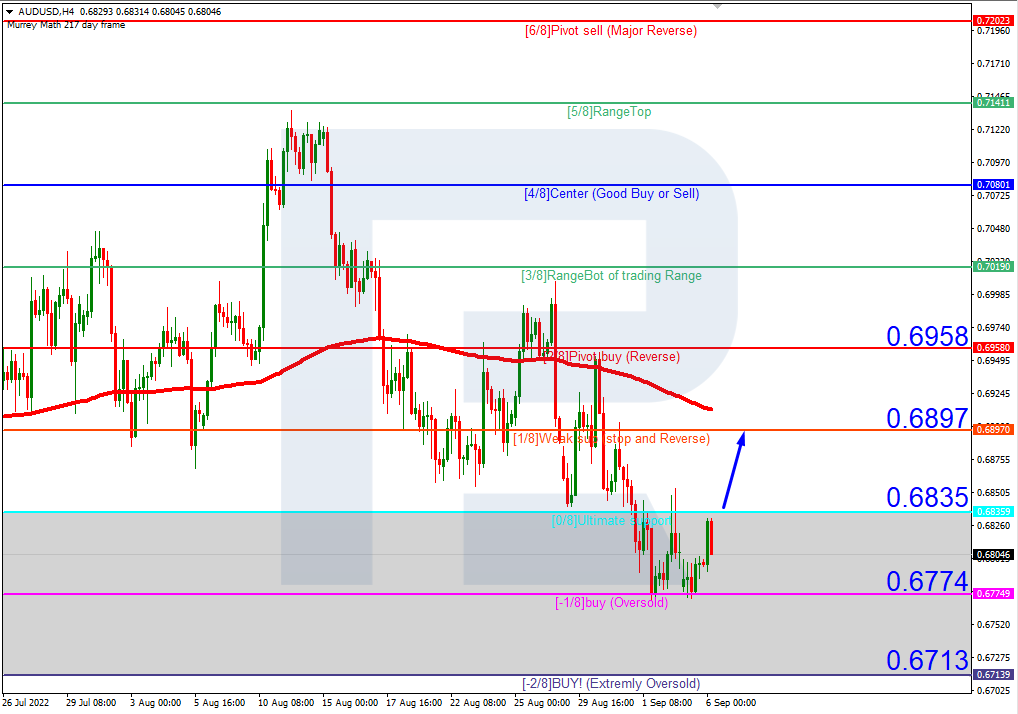
AUDUSD, “Australian Dollar vs US Dollar”

AUDUSD is growing inside the bullish channel. The instrument is currently moving above Ichimoku Cloud, thus indicating an ascending tendency. The markets could indicate that the price may test Kijun-Sen at 0.7040 and then resume moving upwards to reach 0.7275. Another signal in favour of a further uptrend will be a rebound from the rising channel’s downside border. However, the bullish scenario may no longer be valid if the price breaks the cloud’s downside border and fixes below 0.6905. In this case, the pair may continue falling towards 0.6805. To confirm a further uptrend, the price must break the bearish channel’s upside border and fix above 0.7205.

AUDUSD
Risk Warning: the result of previous trading operations do not guarantee the same results in the future

USDCAD, “US Dollar vs Canadian Dollar”

USDCAD is rebounding from Tenkan-Sen and Kijun-Sen. The instrument is currently moving below Ichimoku Cloud, thus indicating a descending tendency. The markets could indicate that the price may test resistance area at 1.2790 and then resume moving downwards to reach 1.2535. Another signal in favour of a further downtrend will be a rebound from the descending channel’s upside border. However, the bearish scenario may no longer be valid if the price breaks the cloud’s upside border and fixes above 1.2940. In this case, the pair may continue growing towards 1.3035.

USDCAD
Risk Warning: the result of previous trading operations do not guarantee the same results in the future

Article By RoboForex.com

Attention!
Forecasts presented in this section only reflect the author’s private opinion and should not be considered as guidance for trading. RoboForex LP bears no responsibility for trading results based on trading recommendations described in these analytical reviews.
The Analytical Overview of the Main Currency Pairs on 2022.08.12

By JustForex

The EUR/USD currency pair

Technical indicators of the currency pair:
  • Prev Open: 1.0298
  • Prev Close: 1.0319
  • % chg. over the last day: +0.20%

Data on Thursday showed that producer prices in the US unexpectedly fell in July amid falling energy costs. Meanwhile, core producer inflation is also trending lower. In the labor market, jobless claims rose for the second week in a row. Traders of federal funds futures contracts currently estimate a 66% chance of a 50 basis point increase and a 34% chance of a 75 basis point increase in September.

Trading recommendations
  • Support levels: 1.0286, 1.0247, 1.0201, 1.0112, 1.0035, 1.0000
  • Resistance levels: 1.0317, 1.0365, 1.0415, 1.050

From a technical point of view, the trend on the EUR/USD currency pair on the hourly time frame is bullish. The price is now forming a small balance with the borders of 1.0286-1.0317. Under such market conditions, buy trades are best sought on intraday time frames from the support level of 1.0286, but with confirmation. Sell trades can be considered from the resistance level of 1.0317, but only after additional confirmation and with short targets.

Alternative scenario: if the price breaks down through the 1.0201 support level and fixes below, the downtrend will likely resume.

EUR/USD
News feed for 2022.08.12:
  • – Eurozone Industrial Production (m/m) at 12:00 (GMT+3);
  • – US Michigan Consumer Sentiment (m/m) at 17:00 (GMT+3).

The GBP/USD currency pair

Technical indicators of the currency pair:
  • Prev Open: 1.2218
  • Prev Close: 1.2199
  • % chg. over the last day: -0.16%

In the UK, the week ends with Friday’s second quarter GDP report and manufacturing data. Markets expect weak data – GDP is forecasted to fall by 2.5% annually. For the quarter, GDP is forecast to be down by 0.2% after rising by 0.8% in the first quarter. The pound rose strongly on Wednesday thanks to US inflation data. But if GDP and manufacturing data are worse than forecast, the pound will likely lose ground.

Trading recommendations
  • Support levels: 1.2130, 1.2063, 1.2000
  • Resistance levels: 1.2240, 1.2294

From the technical point of view, the currency pair GBP/USD trend on the hour timeframe is still upward. The price has corrected to the levels of the moving averages, where a small balance is forming. The MACD indicator has become inactive. At the moment, it is best to look for buy trades on intraday time frames from the support level of 1.2130, but only with confirmation. Sell trades can be considered from the resistance level of 1.2240, but only after additional confirmation and with short targets.

Alternative scenario: if the price breaks down through the 1.2063 support level and fixes below, the downtrend will likely resume.

GBP/USD
News feed for 2022.08.12:
  • – UK GDP (m/m) at 09:00 (GMT+3);
  • – UK Industrial Production (m/m) at 09:00 (GMT+3);
  • – UK Manufacturing Production (m/m) at 09:00 (GMT+3).

The USD/JPY currency pair

Technical indicators of the currency pair:
  • Prev Open: 132.89
  • Prev Close: 132.97
  • % chg. over the last day: +0.06%

According to the Corpay chief strategist, in connection with the prospect of less aggressive monetary and credit policy from the Federal Reserve System, the appetite for risk has somewhat recovered, which allowed the Japanese yen to strengthen against the background of the dollar decline. But investors should not count on a long-term downward trend, as the difference in interest rates is not in favor of strengthening the Japanese Yen.

Trading recommendations
  • Support levels: 132.41, 131.08, 130.85
  • Resistance levels: 134.36, 136.02, 137.12

From the technical point of view, the medium-term trend on the currency pair USD/JPY is still bullish. The price has formed an accumulation zone above the 134.36 level, so a test of this zone is very likely. Under such market conditions, buy trades can be sought from the support level of 132.41, but with additional confirmation. For sell deals, it is possible to consider the level of resistance 134.36, but only with additional confirmation in the form of a reverse initiative, as fundamentally, USD/JPY quotes are inclined to grow.

Alternative scenario: If the price fixes above 136.02, the uptrend will likely resume.

USD/JPY
There is no news feed for today.

The USD/CAD currency pair

Technical indicators of the currency pair:
  • Prev Open: 1.2769
  • Prev Close: 1.2760
  • % chg. over the last day: -0.07%

Canadians have a chronic housing shortage, and the Canada Mortgage and Housing Corporation estimate that about six million housing units must be built by 2030 to make housing more affordable. Banks are considering lending to Canadians, but amid rising interest rates, the appeal of such lending and mortgage programs is falling. According to a recent Manulife survey, about a quarter of Canadian homeowners say they will have to sell their properties if interest rates continue to rise. A recession is also looming, which could prove disastrous for already overstretched owners.

Trading recommendations
  • Support levels: 1.2750, 1.2701
  • Resistance levels: 1.2817, 1.2871, 1.2918, 1.2965

In terms of technical analysis, the USD/CAD currency pair trend has changed to bearish. The price has consolidated below the priority change level and below the moving averages. The MACD indicator has become negative, but the divergence is observed. Under such market conditions, buy trades should be considered on the lower time frames from the support level 1.2750, but only with confirmation and short targets. For sell deals, it is better to consider the resistance level 1.2817 or 1.2871, but with confirmation.

Alternative scenario: if the price breaks out and consolidates above the 1.2871 resistance level, the uptrend will likely resume.

USD/CAD
There is no news feed for today.

By JustForex


This article reflects a personal opinion and should not be interpreted as an investment advice, and/or offer, and/or a persistent request for carrying out financial transactions, and/or a guarantee, and/or a forecast of future events.

Russian citizens may be banned from obtaining Schengen visas to Europe. Gas prices in Europe are breaking new records

By JustForex

US Federal Reserve officials tried to temper expectations for looser policy, and Neel Kashkari said at a conference on Wednesday that the Central Bank is a long way from declaring victory. Kashkari also added that the Central Bank’s proposal to cut interest rates early next year is unrealistic. In an interview with the Financial Times, San Francisco Fed President Mary Daly also warned that it is too early for the US Central Bank to “declare victory” in the fight against inflation. Amid such comments, stock indices fell slightly. At the close of the stock market yesterday, the Dow Jones Index (US30) added 0.08%, while the S&P 500 Index (US500) was down 0.07%. The NASDAQ Technology Index (US100) lost 0.58%.

The slowdown in US inflation may have opened the door for the Federal Reserve to soften the pace of the coming interest rate hikes, but policymakers left no doubt that they will continue to tighten monetary policy until price pressures are fully resolved. At this point, traders of federal funds futures contracts currently estimate a 66% chance of a 50 basis point hike and a 34% chance of a 75 basis point hike in September. Calling inflation “unacceptably high,” Chicago Fed President Charles Evans said he thinks the Fed will probably need to raise the rates to 3.25-3.5% this year and 3.75-4% by the end of next year.

Equity markets in Europe traded yesterday without a single dynamic. German DAX (DE30) decreased by 0.05%, French CAC 40 (FR40) added 0.33%, Spanish IBEX 35 (ES35) gained 0.33%, British FTSE 100 (UK100) was down by 0.55%.

European futures on gas exceeded $2350 per thousand cubic meters. Energy carriers are getting more expensive amid unprecedented heat waves in Europe. High temperatures caused unexpected strain on the region’s power grids, boosting the demand for electricity to power fans and air conditioners. Oil is in increasing demand in this environment as power plants seek alternatives to expensive gas. The International Energy Agency (IEA) raised its forecast for oil demand this year by 380,000 BPD. Normally, the IEA is negative on oil demand, but rising global natural gas prices may encourage more energy consumers to switch to oil for winter heating.

Meanwhile, the Organization of the Petroleum Exporting Countries (OPEC), which usually does its best to boost oil prices, has lowered its forecast for global oil demand growth for 2022. OPEC said it expects oil demand to grow by 3.1 million BPD in 2022, down 260,000 BPD from its previous forecast. Goldman Sachs analysts again forecast an oil price above $130 a barrel by the end of the year.

Gold futures closed lower Thursday as a three-week rally in the precious metal’s prices halted, and investors shifted their attention to the rising US stock market rather than safe-haven assets such as gold and the dollar.

The Latvian Saeima declared Russia a sponsor of terrorism. Earlier, the US Senate passed a resolution urging the State Department to recognize Russia as a state sponsor of terrorism because of the events in Ukraine, Chechnya, Georgia, and Syria. A ban on issuing Schengen visas to all Russians could be part of the seventh package of European sanctions against Russia. EU countries are now discussing the issue.

Asian markets were trading up yesterday. Japan’s Nikkei 225 (JP225) was not trading due to the bank holiday, Hong Kong’s Hang Seng (HK50) added 2.40%, while Australia’s S&P/ASX 200 (AU200) ended the day up by 1.12%. But Asian stocks started declining at the open on Friday amid a new blockage in China. China’s economy is still reeling from a series of economically devastating quarantine restrictions imposed earlier this year, and investors are wary of further such measures. Quarantine in a major commodity center such as Yiwu could cause further problems for China’s industrial sector, which unexpectedly contracted in July.

S&P 500 (F) (US500) 4,207.27 −2.97 (−0.071%)

Dow Jones (US30) 33,336.67 +27.16 (+0.082%)

DAX (DE40) 13,694.51 −6.42 (−0.047%)

FTSE 100 (UK100) 7,465.91 −41.20 (−0.55%)

USD Index 105.19 −0.01 (−0.01%)

Important events for today:
  • – UK GDP (m/m) at 09:00 (GMT+3);
  • – UK Industrial Production (m/m) at 09:00 (GMT+3);
  • – Eurozone Industrial Production (m/m) at 12:00 (GMT+3);
  • – US Michigan Consumer Sentiment (m/m) at 17:00 (GMT+3).

By JustForex


This article reflects a personal opinion and should not be interpreted as an investment advice, and/or offer, and/or a persistent request for carrying out financial transactions, and/or a guarantee, and/or a forecast of future events.

Boosting renewable energy use can happen quickly – and reduce harm to low-income people if done thoughtfully

By Erin Baker, UMass Amherst 

With many nations making efforts to transition away from fossil fuels to renewable energy, SciLine interviewed Erin Baker, a professor of industrial engineering and operations at UMass Amherst. Baker discussed the technological, political and regulatory efforts needed for this transition, as well as ways that our fossil fuel-dependent system disproportionately harms poor communities and communities of color.

The Conversation has collaborated with SciLine to bring you highlights from the discussion, which have been edited for brevity and clarity.

How is our country doing at making the transition to renewable energy?

Erin Baker: There has been amazing technological change over the past 15 years. Offshore wind costs 50% less than it did six years ago. Solar has had a sixfold decrease in costs since 2010. And I think there’s a lot of evidence that technology will adapt and improve if we set the goals and incentives for it.

In terms of policy and regulations, we are moving forward, but we need to be more aggressive. Something that we’re missing and that would be really helpful would be a coherent, federal-level climate policy – whether that is regulatory policy, such as we have for pollution, or a carbon tax or some kind of a cap. The Inflation Reduction Act would be a fantastic starting point if it becomes law.

A good example of something that has been done is President Biden’s move to coordinate and streamline the federal approval process for offshore wind. There are seven federal agencies involved, and having them all separate and moving at their own pace was really difficult for offshore wind energy developers. So Biden has coordinated that, and that’s fantastic. But there are tens of local and state-level agencies and processes that developers still have to go through. It would be really great if we could figure out ways to coordinate and streamline those.

How does our current energy system disproportionately harm poor communities and communities of color?

Erin Baker: Unfortunately, in a lot of different ways. Polluting facilities tend to be located disproportionally in areas that are low income and home to people of color, which can lead to negative health outcomes. Also, in the Texas blackout last winter that killed around 250 people, some research done by my colleague Jay Teneja showed that the long blackouts were four times as likely in communities of color as in predominantly white communities. And, unfortunately, the energy transition won’t necessarily be any more equitable.

For example, it’s common for states to subsidize rooftop solar. And this is good, but the people who get the subsidies are people who own roofs with sun shining on them. People who live in apartments and in cities don’t have access to this, and yet they’re paying for the subsidies. We take the money for the subsidies from everyone, including low-income people, and send them mostly to white, wealthy suburbs.

How can injustices in our energy system be rectified?

Erin Baker: There’s obviously no one solution, but there are a couple of categories of things we can do. One thing that would be really helpful would be to collect data. We have very little data about energy equity issues.

We also need to involve and listen to the traditionally marginalized communities that are most affected by the inequities.

What do you think of the federal and state targets set for offshore wind?

Erin Baker: The Biden administration set a target for 30 gigawatts by 2030. That’s an ambitious goal, since in 2019 the entire world had only 30 GW. But it’s growing rapidly, with global capacity at an astounding 56 GW.

Having this goal of 30 gigawatts helps to organize the supply chain – all the pieces that need to get done for this to happen. We need people who know how to install offshore wind farms. We need special ships. We need planning for transmission. Having these goals really helps to organize all that and make sure all these pieces are in place.

What are the environmental costs and benefits of offshore wind?

Erin Baker: Offshore wind is a really promising technology. The ocean has really good wind resources. And it’s near population centers – we have lots of cities up and down the coasts. Because wind energy is carbon-free, it will provide benefits by reducing emissions and reducing costs.

Some of the work I’ve done has shown that there are billions, and maybe even trillions, of dollars of climate value in offshore wind. We lose between US$10 million and $150 million per year per wind farm by delaying them. We really want to keep these large global environmental benefits in mind as we plan. These can be balanced against local environmental costs and benefits, as well as other factors, like jobs.

In terms of local environmental benefits, when you build an offshore wind farm, the stuff underneath the water ends up creating an artificial reef and actually increasing sea life in that area, which is a benefit.

Negatively, they interfere with bird migrations. Birds don’t actually fly into the wind turbines that much. They fly around them. But if there are a lot of wind farms, that’s a lot of flying around, and that can be hard on the birds. And some animals, like right whales, can get caught in mooring lines if we have floating wind turbines. So, there are local environmental costs. What we need to do is balance these with the global benefits from addressing climate change.

Are you hopeful about our ability to address climate change?

Erin Baker: I am optimistic that we can solve climate change, because humans are very inventive. My work on technological change has shown that once we have a goal or incentive, we tend to improve technologies much faster than we ever predicted. So I think we can be ambitious. We can aim for net-zero by 2030 instead of 2050. And we can solve climate change while at the same time stimulating innovation, fueling growth and increasing quality of life. But we have to set these goals. To access the benefits of the energy transition, we really need to act boldly and decisively.

Watch the full interview to hear more about what’s required for a just, renewable energy transition.

SciLine is a free service based at the nonprofit American Association for the Advancement of Science that helps journalists include scientific evidence and experts in their news stories.The Conversation

About the Author:

Erin Baker, Professor of Industrial Engineering Applied to Energy Policy, UMass Amherst

This article is republished from The Conversation under a Creative Commons license. Read the original article.