Archive for Financial News – Page 193

Lithuania positioned to emerge as Baltic economic powerhouse?

By George Prior

Lithuania is the best-positioned country in its region to overcome the economic fallout from the war in Ukraine, affirms the founder of one of the world’s largest independent financial advisory, asset management and fintech organisations.

The comments from deVere Group’s Nigel Green come as the war has intensified over the last week, again sending shockwaves through the economies of neighbouring countries.

He says: “The ongoing conflict in Ukraine has cast a long shadow over the economies of nearby countries, creating a ripple effect that demands immediate attention.

“Countries like Lithuania have not been spared from the repercussions of this crisis, with economic disruptions posing significant challenges.

“However, amid adversity lies the opportunity for strategic action to drive economic recovery and growth.”

Lithuania, a key player in the Baltic region, has experienced first-hand the economic consequences of the conflict in Ukraine. The prevailing uncertainty has dealt a blow to investor confidence, causing domestic and foreign investments to stagnate.

Trade, a vital engine of growth for Lithuania, has been hampered by the disruption of supply chains and the deterioration of trade routes.

One of the most pronounced effects has been the sharp increase in energy prices. Disruptions in natural gas pipelines traversing Ukraine have led to supply concerns, causing energy costs to soar in Lithuania. This rise not only impacts households but also places local industries at a competitive disadvantage.

“Lithuania recognises the need for proactive measures to counter the adverse effects of the conflict,” says Nigel Green. “This is why I believe it’s the best-positioned country in the region to stimulate economic growth.

“In light of disrupted trade with Ukraine, Lithuania is diversifying its trade portfolio. By establishing robust trade relationships with stable economies beyond its immediate region, Lithuania can buffer itself against future shocks and bolster economic resilience.”

He continues: “Acknowledging the vulnerability of traditional energy sources, Lithuania is turning towards renewable energy investments. This transition not only ensures energy security but also aligns with global sustainability goals, contributing to a more stable energy landscape.”

Lithuania plans to invest in its infrastructure and by creating well-connected transport networks, “the country seeks to position itself as a pivotal link between Eastern and Western Europe,” attracting trade and investment.

“Most importantly, Lithuania aims to attract foreign direct investment by encouraging a business-friendly environment. Streamlining bureaucracy, offering incentives, and showcasing the country’s potential can attract foreign companies to invest, thereby boosting economic activity and job and wealth creation.”

In addition, by promoting research, innovation, and technology-driven industries, “Lithuania aspires to become a hub for high-value, knowledge-based jobs,” and embracing cutting-edge technologies will “propel the nation towards economic rejuvenation.”

Nigel Green concludes: “By adopting a multi-pronged approach that encompasses trade diversification, renewable energy, infrastructure development, foreign direct investment attraction, innovation, and diplomatic engagement, Lithuania is poised to weather the storm and emerge stronger than before.

“This commitment to progress underscores Lithuania’s determination to turn adversity into an opportunity for sustainable growth.”

About:

deVere Group is one of the world’s largest independent advisors of specialist global financial solutions to international, local mass affluent, and high-net-worth clients.  It has a network of offices across the world, over 80,000 clients and $12bn under advisement.

Here’s a “Bold Call” on U.S. Housing Prices (Don’t Hang Your Hat on It)

This does not look like a bottom in median existing home prices

By Elliott Wave International

Back in October 2022, none other than Realtor.com asked the question:

Is America in a housing bubble–and is it getting ready to burst?

That was 10 months ago and just like a widely anticipated recession, the feared bursting of the housing bubble has yet to materialize.

Indeed, another real estate sector firm — Zillow — has gone out on a limb with this prediction (Fortune, July 28):

In February, Zillow economists made a bold call that U.S. home prices had bottomed…

In the months that have followed, U.S. home prices as tracked by the Zillow Home Value Index have stopped falling, and between February and June rose 4.8%.

Yes, Zillow’s forecast has mainly worked out so far, however, let’s also keep in mind seasonal and other factors.

Here’s a perspective from our July Elliott Wave Financial Forecast, which used another measure to gauge the health of the U.S. housing market (The Elliott Wave Financial Forecast is a monthly publication which covers major U.S. financial markets):

HomeSalesPrices

This chart showing the year-over-year change in the median existing home price doesn’t look much like a bottom. According to the National Association of Realtors, the median existing home sold for $396,100 in May 2023, a 3.1% decline from May 2022, “marking the largest year-over-year price reductions since December 2011.” Recent increases can be attributed to two factors: spring buying, which happens every year, and the run-up in equity prices, which makes people feel wealthier.

So, we’ll see what happens after the seasonal bias passes. And, just as importantly (or more so), we’ll have to keep an eye on the stock market.

History shows that the housing and stock markets tend to be correlated.

So, if the stock market tanks in a big way, we could have a replay of 2007-2012 on our hands.

Of course, that’s a big “if.”

One way to gauge the health of the stock market, and thus the housing market, is to keep an eye on the stock market’s unfolding Elliott wave pattern.

If you’re unfamiliar with Elliott wave analysis or need to brush up on your knowledge, read Frost & Prechter’s Elliott Wave Principle: Key to Market Behavior.

Here’s a quote from the Wall Street classic:

In the 1930s, Ralph Nelson Elliott discovered that stock market prices trend and reverse in recognizable patterns. The patterns he discerned are repetitive in form but not necessarily in time or amplitude. Elliott isolated five such patterns, or “waves,” that recur in market price data. He named, defined and illustrated these patterns and their variations. He then described how they link together to form larger versions of themselves, how they in turn link to form the same patterns of the next larger size, and so on, producing a structured progression. He called this phenomenon The Wave Principle.

All that’s required for free access to the online version of the book is a Club EWI membership. Club EWI is free to join and allows members complimentary access to a wealth of Elliott wave insights regarding financial markets, investing and trading.

Follow this link to join Club EWI so you can read the book for free: Elliott Wave Principle: Key to Market Behavior.

This article was syndicated by Elliott Wave International and was originally published under the headline Here’s a “Bold Call” on U.S. Housing Prices (Don’t Hang Your Hat on It). EWI is the world’s largest market forecasting firm. Its staff of full-time analysts led by Chartered Market Technician Robert Prechter provides 24-hour-a-day market analysis to institutional and private investors around the world.

RoboForex Ltd Clinches the Best Trading Conditions Accolade at the Prestigious International Business Magazine Awards

RoboForex, an esteemed financial brokerage firm, has been bestowed with the highly coveted accolade for ‘Best Trading Conditions’ at the International Business Magazine Awards.

RoboForex Ltd, with its decade-long history of impeccable service, has bagged the esteemed honour this year for its dedication to providing outstanding trading conditions, which is a testament to its commitment to offering optimal trading opportunities to clients worldwide.

Since its inception in 2009, RoboForex has continuously strived to enhance the trading experience for its customers. Its vast trading portfolio is truly impressive, boasting over 12,000 instruments encompassing Stocks, ETFs, Gold, Oil, and Indices, among others. This extensive offering caters to traders of all backgrounds and preferences, regardless of their trading strategies or risk appetites.

But it is not merely the breadth of trading instruments that earned RoboForex this commendation. The company offers incredibly cost-effective conditions, making it the go-to choice for traders around the globe. RoboForex offers commission charges for Stocks starting at only 0.009 USD per share, while the lowest commission for Indices is set at 4 USD for 1 million USD of trading volume. Moreover, the market-based spreads can reach as low as 0 pips – another feature for traders keen on minimising trading costs.

RoboForex has democratised the financial markets, providing access to traders of all levels, thanks to its unbeatable trading conditions. The firm has ensured that the world of trading, often perceived as exclusive, becomes inclusive – a feat that certainly warrants recognition and appreciation.

The ‘Best Trading Conditions’ award is not just an emblem of success; it is a testament to the relentless pursuit of excellence and customer satisfaction by RoboForex. The firm’s constant endeavour to streamline trading processes, optimise performance, and ensure its clientele has access to the best possible conditions has placed it at the forefront of the trading industry.

Discover the award-winning trading conditions at RoboForex and start your trading journey today by visiting the RoboForex official website.

About RoboForex

RoboForex is a company that delivers brokerage services. The company provides traders who work in financial markets with access to its proprietary trading platforms. RoboForex Ltd operates under brokerage licence FSC 000138/437. View more detailed information about the Company’s products and activities on the official website roboforex.com.

About International Business Magazine Awards

Established in 2018, the International Business Magazine Awards have quickly become a beacon of recognition within the world of international finance and business, shining a light on companies and organisations that have shown exceptional levels of performance, service quality, and ethical business conduct. The awards are decided by a council comprised of key industry experts, who, along with the event’s jury panel, maintain a strict process to ensure a fair and transparent selection of winners.

The cryptocurrency market digest (BTC). Overview for 30.08.2023

By RoboForex.com

The BTC exchange rate climbed to 27,434 USD on Wednesday. The daily gain was 5.26%.

The cryptocurrency’s value started appreciating last night after the market heard about Grayscale’s victory in court. The judicial authorities ruled in favour of Grayscale in the company’s case against the US Securities and Exchange Commission (SEC). The lawsuit was filed in October 2021 and concerned the SEC’s repeated refusals to acknowledge Grayscale’s trusts as fully-fledged ETFs.

The Grayscale victory could serve as the long-awaited trigger for the cryptocurrency industry. The bitcoin-ETF matter had temporarily faded into the background because investors had grown pessimistic about a positive resolution.

The BlackRock fund awaits a decision on its ETF, expected this Friday.

So far, BTC has not used the support at 25,150 USD, which is a good sign.

The majority of altcoins followed BTC’s trajectory. The price of ETH increased by 4.12%, BNB rose by 3.23%, and SOL and TON also demonstrated growth, rising by 5.63% and 12.08%, respectively.

The cryptocurrency market capitalisation has increased to USD 1.09 trillion. The share of BTC rose to 48.8%, while the share of ETH remains at 18.9%.

“X” has been granted a licence for crypto payments

The X company (Twitter) has obtained a licence to conduct payments in cryptocurrency in the US. The document is necessary for providing digital asset-related services. Elon Musk is determined to transform the social network into an “app for everything” and is making rapid progress in this regard.

Losses incurred by mining companies exceed 4 billion USD

The mining industry is facing a challenging phase. According to Finbold, the combined losses of the industry’s 16 largest companies amount to a minimum of 4.47 billion USD. These losses have accumulated over the last twelve months.

Article By RoboForex.com

Attention!
Forecasts presented in this section only reflect the author s private opinion and should not be considered as guidance for trading. RoboForex LP bears no responsibility for trading results based on trading recommendations described in these analytical reviews.

Stock indices were supported amid weak US economic data. Australia is experiencing a drop in inflation

By JustMarkets

At yesterday’s stock market close, the Dow Jones Index (US30) increased by 0.85%, while the S&P 500 Index (US500) added 1.45%. The NASDAQ Technology Index (US100) closed positive by 1.74% on Tuesday. The S&P 500 Index (US500) hit a 2.5-week high, the Dow Jones Industrials (US30) hit a 1.5-week high, and the Nasdaq 100 Index hit a 3-week high. The stock indexes rose after weaker-than-expected economic news from the US on Tuesday regarding JOLTS job openings for July and consumer confidence for August, pushing bond yields lower and raising the possibility that the Federal Reserve will pause its rate hike campaign.

US JOLTS job openings for July fell by 338,000 to a 2-year low of 8.827 million, weaker than expectations of 9.500 million. The Conference Board’s US consumer confidence index for August fell by 7.9 to 106.1, weaker than expectations of 116.0. Today, the US will release GDP data for August as well as labor market data from ADP. GDP growth on the back of solid labor market data may give confidence to the dollar and correct stock indices.

Equity markets in Europe were mostly up yesterday. Germany’s DAX (DE40) climbed 0.88%, France’s CAC 40 (FR40) gained 0.67%, Spain’s IBEX 35 (ES35) jumped by 1.05%, and the UK’s FTSE 100 (UK100) closed positive by 1.72%.

As the ECB’s September meeting approaches, hawks have begun to actively advocate for policy tightening. Market pricing for the September meeting is likely what ECB policymakers are concerned about. Markets are very reluctant to price in the possibility of another rate hike from the ECB, and the implied probability of a September rate hike is below 50%. But a lot will depend on Eurozone inflation data to be released today and tomorrow.

Asian markets were also mostly up yesterday. Japan’s Nikkei 225 (JP225) increased by 0.18%, China’s FTSE China A50 (CHA50) gained 0.52%, Hong Kong’s Hang Seng (HK50) added 1.95% on Tuesday, and Australia’s S&P/ASX 200 (AU200) was positive by 0.71% yesterday.

China’s actions over the weekend to stimulate its markets have sparked optimism about a possible resumption of economic growth, which is having a positive impact on energy demand and crude oil prices. In addition, gains in US stock markets on Monday boosted confidence in the economic outlook, supporting energy demand. But investors are refraining from taking large oil positions ahead of the release of key economic indicators from the US and China later this week.

Australia’s ASX 200 Index (AU200) was the best performer among its peers on Wednesday, rising more than 1% after data showed that the Consumer Price Index (CPI) declined more than expected in July (from 5.4% to 4.9% y/y, expectation 5.2% y/y). The data suggests that the Reserve Bank of Australia’s aggressive rate hikes are taking their toll, which in turn gives the central bank less incentive to raise interest rates further. However, separate data showed that Australia’s new construction fell in July, and current construction also rose less than expected in the second quarter, suggesting that high-interest rates are putting pressure on the country’s real estate market. Australia’s economic growth is expected to slow this year.

Japan’s unemployment rate rose in July for the first time in four months, while a measure of labor demand fell slightly. The number of employed people fell by 100,000 from the previous month, while the number of unemployed rose by 110,000. The weakening labor market risks triggering a negative spiral that would lead to lower wage growth, which is contrary to the BoJ’s plans as the BoJ wants demand to fuel inflation rather than cost increases.

China is set to cut mortgage interest rates by trillions of yuan for the first time since the global financial crisis. In addition, China’s state-owned banks plan to cut deposit rates for the third time in a year.

S&P 500 (F)(US500) 4,497.63 +64.32 (+1.45%)

Dow Jones (US30) 34,852.67 +292.69 (+0.85%)

DAX (DE40)  15,930.88 +138.27 (+0.88%)

FTSE 100 (UK100) 7,464.99 +126.41 (+1.72%)

USD Index  103.44 -0.62 (-0.60%)

Important events for today:
  • – Australia Consumer Price Index (m/m) at 04:30 (GMT+3);
  • – German Consumer Price Index (m/m) at 15:00 (GMT+3);
  • – US ADP Non-Farm Employment Change (m/m) at 15:15 (GMT+3);
  • – US GDP (m/m) at 15:30 (GMT+3);
  • – US Pending Home Sales (m/m) at 16:45 (GMT+3);
  • – US Crude Oil Reserves (w/w) at 17:30 (GMT+3).

By JustMarkets


This article reflects a personal opinion and should not be interpreted as an investment advice, and/or offer, and/or a persistent request for carrying out financial transactions, and/or a guarantee, and/or a forecast of future events.

China is trying to stimulate economic growth. The probability of another rate hike by the Fed rose to 67%

By JustMarkets

At yesterday’s stock market close, the Dow Jones Index (US30) increased by 0.62%, while the S&P 500 Index (US500) added 0.63%. The NASDAQ Technology Index (US100) closed positive by 0.84% on Monday. Stocks rose on Monday while bond yields declined thanks to support provided by comments from US Federal Reserve Governor Powell on Friday that the Fed is prepared to continue raising interest rates if needed but “will proceed cautiously” on whether to raise rates again, opening the door for a potential pause in Fed operations. Currently, there is a 23% chance of a 25 bps rate hike at the September 20 FOMC meeting and a 67% chance of a 25 bps rate hike at the November 1 FOMC meeting.

Monday’s US economic news was positive for stocks after the August reading of the Dallas Fed’s measure of overall business activity in the manufacturing sector rose by 2.8 to a 5-month high of minus 17.2, which was stronger than expectations of minus 19.0.

Shares of 3M Co. rose more than 5% after it agreed to pay $5.5 billion to settle lawsuits related to military earplugs.

Equity markets in Europe were mostly up on Monday. Germany’s DAX (DE40) increased by 1.30%, France’s CAC 40 (FR40) added 1.32% yesterday, Spain’s IBEX 35 (ES35) jumped by 1.93%, and the UK’s FTSE 100 (UK100) was not trading due to the bank holiday.

Eurozone money supply unexpectedly declined by 0.4% y/y in July, weaker than expected and the sharpest rate of contraction in 13 years. ECB Governing Council spokesperson Holzmann said the following: “If there are no major surprises, I see grounds for continuing to raise rates without a pause.” The next ECB meeting will be held on September 14.

China’s actions over the weekend to stimulate its markets have sparked optimism about a possible resumption of economic growth, which is having a positive impact on energy demand and crude oil prices. In addition, gains in US stock markets on Monday boosted confidence in the economic outlook, supporting energy demand. But investors are refraining from taking large oil positions ahead of the release of key economic indicators from the US and China later this week.

Asian markets were also predominantly up yesterday. Japan’s Nikkei 225 (JP225) increased by 1.73%, China’s FTSE China A50 (CHA50) added 1.21%, Hong Kong’s Hang Seng (HK50) was up by 0.97% on Monday’s close, and Australia’s S&P/ASX 200 (AU200) was positive by 0.63% yesterday.

Asian equities were supported after China took a number of measures to stimulate its markets, including cutting the tax levied on share trading. The People’s Bank of China (PBOC) could potentially lower reserve requirement ratios sooner than expected, providing local markets with more liquidity. Chinese officials also talked about potential financial support for the economy.

S&P 500 (F)(US500) 4,433.31 +27.60 (+0.63%)

Dow Jones (US30) 34,559.98 +213.08 (+0.62%)

DAX (DE40)  15,792.61 +160.79 (+1.03%)

FTSE 100 (UK100) 7,338.58 0 (0%)

USD Index  104.02 -0.06 (-0.05%)

Important events for today:
  • – German GfK German Consumer Climate (m/m) at 09:00 (GMT+3);
  • – Australia RBA Gov-Designate Bullock Speaks at 10:40 (GMT+3);
  • – US CB Consumer Confidence (m/m) at 17:00 (GMT+3);
  • – US JOLTs Job Openings (m/m) at 17:00 (GMT+3).

By JustMarkets


This article reflects a personal opinion and should not be interpreted as an investment advice, and/or offer, and/or a persistent request for carrying out financial transactions, and/or a guarantee, and/or a forecast of future events.

Dollar braces for data-heavy week

By ForexTime

Chinese stocks paved the way higher for Asian shares on Tuesday as optimism from China’s measures to cut stamp duty boosted risk appetite. European futures are pointing to a positive open with the UK returning from a day’s holiday ahead of a data-heavy week for markets. In the commodity space, gold is modestly higher this morning with bulls drawing strength from a softer dollar and falling Treasury yields. Oil markets are flat, waiting for the next fundamental spark as supply concerns counter worries over demand.

US PCE Inflation and NFP in focus

The US dollar was choppy on Tuesday as investors watched on the sidelines ahead of a slew of key US economic releases over the next few days.

Due to the Federal Reserve’s current data dependent stance, every release of US economic data could play a critical role in determining whether the Fed raises rates again in 2023. As a result, close attention will be paid to upcoming releases such as August consumer confidence, Q2 GDP (2nd estimate), and weekly initial jobless claims.

However, the potential market shakers could be Thursday’s PCE inflation data and the NFP report on Friday. The Fed’s preferred inflation gauge, the Core Personal Consumption Expenditure will be closely scrutinised by investors for more signs of inflationary pressures cooling. Regarding the August NFP report, markets expect the US economy to have added 170,000 jobs in August with the unemployment rate unchanged at 3.5%. Ultimately, a strong set of economic releases may strengthen the argument around the Fed raising rates one more time this year, especially after Powell’s hawkish remarks last Friday.

Regarding the dollar, it has appreciated against every G10 currency this month with the USD Index trading around 104.00 as of writing. Although the trend is bullish on the daily charts, there are early signs of exhaustion with a break under 103.30 encouraging bears to jump back into the scene. Should 104.00 prove to be reliable support, prices could push back above 104.50, rising towards levels not seen since March around 105.00.


Forex-Time-LogoArticle by ForexTime

ForexTime Ltd (FXTM) is an award winning international online forex broker regulated by CySEC 185/12 www.forextime.com

EUR/USD Consolidates Around 1.0810 as Powell’s Speech Influences Market Sentiment

By RoboForex Analytical Department

The EUR/USD currency pair is entering the final week of August in a phase of consolidation around the 1.0810 level. This follows a speech by Jerome Powell, the Chair of the Federal Reserve, during the recent Jackson Hole Symposium in the US. Powell highlighted the Fed’s commitment to raising interest rates continuously to maintain elevated levels of inflation, while also considering the effectiveness of measures already in place.

As a result, the Federal Reserve plans to make necessary interest rate adjustments and maintain a stringent monetary policy until it successfully manages price control.

With a relatively quiet macroeconomic calendar at the beginning of the week, the market is relying on existing factors to determine direction.

Technical Analysis of the EUR/USD Currency Pair

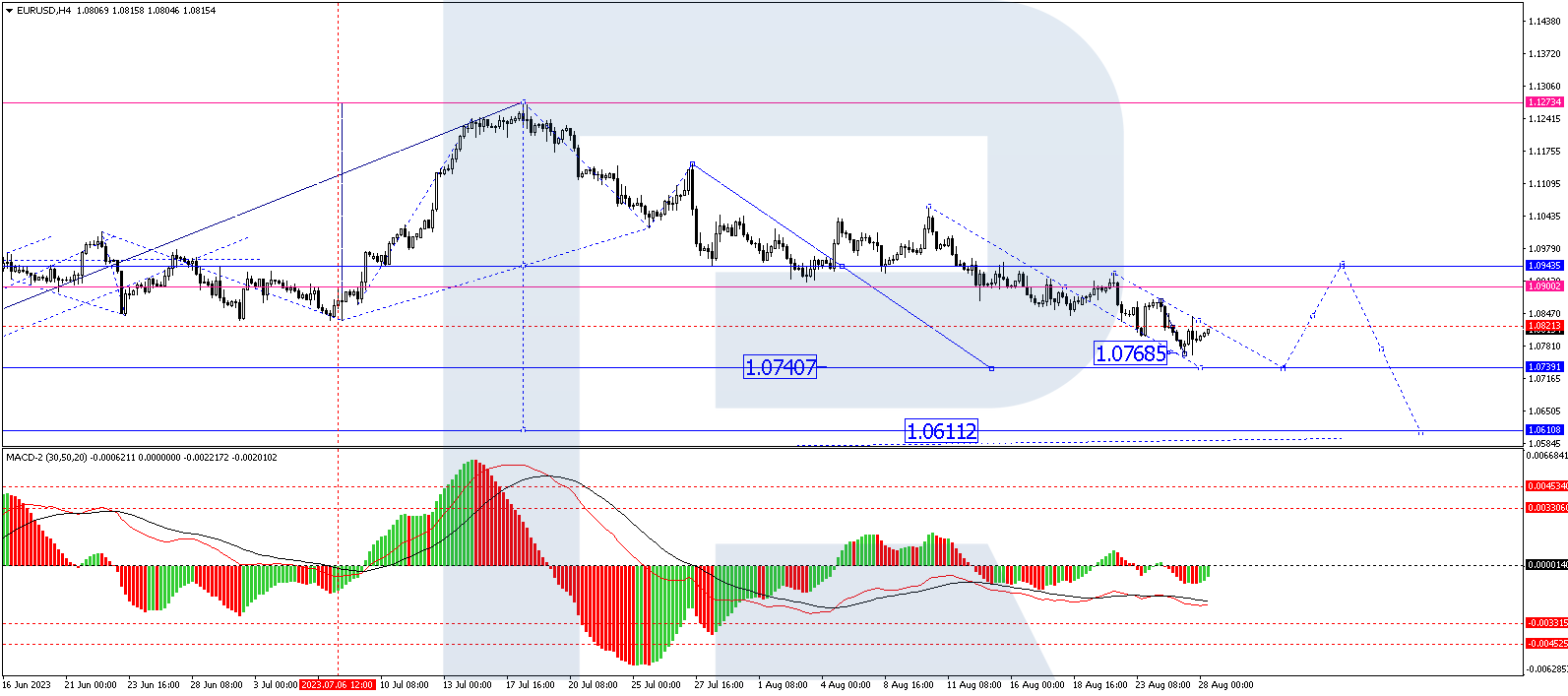
On the H4 chart, EUR/USD has completed a decline to 1.0765, followed by a corrective structure forming up to 1.0816. Once this correction is complete, there is potential for the decline to continue to 1.0740, a local target. The scenario is supported by the MACD indicator, as its signal line is below zero and pointed downwards.

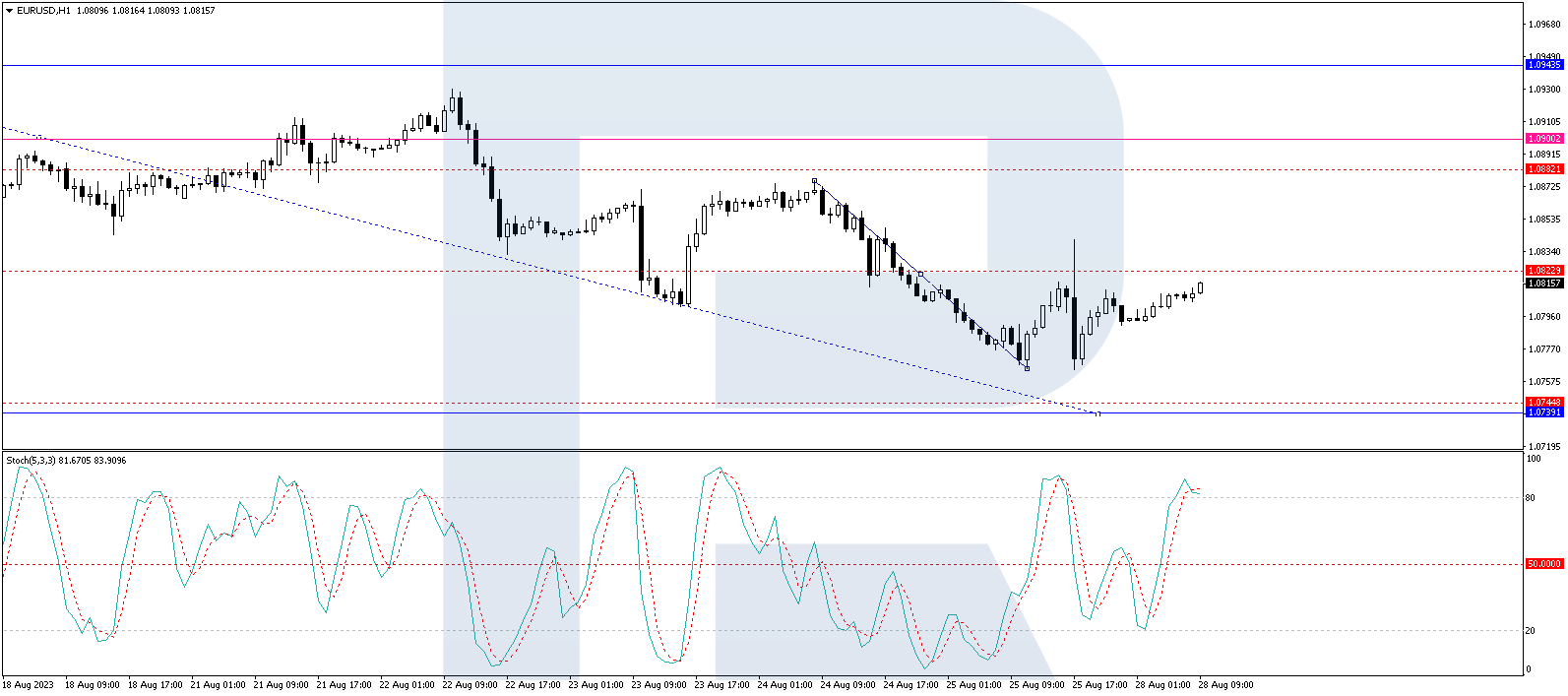
On the H1 chart, EUR/USD has undergone a correction to 1.0816, possibly leading to the formation of a consolidation range below that level. If the price breaks out of this range in a downward direction, a new wave of decline to 1.0740 could be formed. This scenario is backed by the Stochastic oscillator, as its signal line is currently above 80, indicating a potential drop to 50. A break of this level could open the door to a decline towards 20.

Disclaimer

Any forecasts contained herein are based on the author’s particular opinion. This analysis may not be treated as trading advice. RoboForex bears no responsibility for trading results based on trading recommendations and reviews contained herein.

Fed chief hints at another rate hike. Oil may come under pressure in the coming weeks

By JustMarkets

At Friday’s close, the Dow Jones Index (US30) increased by 0.73% (-0.53% for the week), while the S&P 500 Index (US500) added 0.67% (+0.58% for the week). The NASDAQ Technology Index (US100) closed positive by 0.94% (+1.82% for the week) on Friday. Fed Chairman Jerome Powell said on Friday that policymakers are prepared to raise interest rates further if necessary but also signaled that they may keep rates at current levels in September if economic data support it.

Key talking points from US Federal Reserve Chairman Jerome Powell’s speech at the conclusion of a conference in Jackson Hole:

  • We are attentive to signs that the economy may not be cooling as expected;
  • Evidence of sustained above-trend growth could jeopardize further progress in inflation and warrant further monetary tightening;
  • Evidence that labor market tightness is no longer easing could also warrant a monetary policy response.

According to analysts, despite the hawkish tones in Jerome Powell’s speech, the Fed is happy with current trends, and if they continue, they won’t change anything. But if the US Central Bank sees that these economic trends are fading or suddenly beginning to change, it will increase the likelihood of another rate hike because the Fed will be very sensitive to the data, and this sensitivity will be one-sided – in the direction of tightening.

Equity markets in Europe were mostly rising on Friday. German DAX (DE40) rose by 0.07% (week’s total +0.37%), French CAC 40 (FR40) rose by 0.38% (week’s total +0.90%), Spanish IBEX 35 (ES35) jumped by 0.15% (week’s total +0.76%), British FTSE 100 (UK100) closed up by 0.07% (week’s total +1.05%). Germany’s August business climate fell by 1.7 to a 10-month low of 85.7, below expectations of 86.8. ECB President Lagarde said at a symposium in Jackson Hole that the ECB “will set interest rates at a fairly restrictive level for as long as necessary to bring inflation back to the medium-term target of 2% in a timely manner.” For his part, Nagel of the ECB’s Governing Council said that with inflation still standing around 5%, “it is too early to think about a pause” in interest rate hikes. European inflation data will be released this week. Core inflation in Germany, as well as across the Eurozone, is expected to fall slightly, raising the possibility that the ECB may hit the pause button in September.

Oil was supported on Friday after Marathon Petroleum shut down its Garyville refinery in Louisiana, the third-largest refinery in the United States with a refining capacity of 596,000 BPD, due to a fire. In addition, Friday’s weekly report from Baker Hughes was upbeat for oil as the report showed that active oil rigs in the US fell to their lowest level in a year and a half. But analysts believe that against the backdrop of September, which is considered a seasonally weak month, there is a high probability of oil price declines in the coming weeks. Moreover, open interest is sharply declining, suggesting that oil bulls are taking profits after the rally.

Asian markets were also mostly up last week. Japan’s Nikkei 225 (JP225) increased by 0.23% for the week, China’s FTSE China A50 (CHA50) gained 0.04%, Hong Kong’s Hang Seng (HK50) ended the week up by 0.89%, and Australia’s S&P/ASX 200 (AU200) ended the week negative by 0.46%.

In Australia, seasonally adjusted retail sales for July rose by 0.5% month-over-month versus an expected 0.3%. Despite the increase, Australian Treasurer Jim Chalmers said he expects growth in the Australian economy to weaken significantly due to interest rate hikes by the Reserve Bank of Australia (RBA) and a slowdown in China.

A meeting between Bank of Canada Governor Kazuo Ueda and Japan’s Prime Minister last week sparked new rumors of monetary policy normalization. Traders are also wary of government intervention against the yen after it hit a nine-month low last week. The weak yen, which has helped Japanese stocks outperform global peers this year, is now pressuring the market, raising expectations that the Bank of Japan will be forced to move toward monetary tightening.

S&P 500 (F)(US500) 4,405.71 +29.40 (+0.67%)

Dow Jones (US30) 34,346.90 +247.48 (+0.73%)

DAX (DE40)  15,631.82 +10.33 (+0.07%)

FTSE 100 (UK100) 7,338.58 +4.95 (+0.07%)

USD Index  104.19 +0.21 (+0.20%)

Important events for today:
  • – Australia Retail Sales (m/m) at 04:30 (GMT+3).

By JustMarkets


This article reflects a personal opinion and should not be interpreted as an investment advice, and/or offer, and/or a persistent request for carrying out financial transactions, and/or a guarantee, and/or a forecast of future events.

Lithuania should seize the foreign direct investment advantage

By George Prior

Lithuania needs to harness “the enormous power” of international investment to boost its economic opportunities in an increasingly globalised world, says serial global investor Nigel Green.

The European Union-based international entrepreneur, investor, and government advisor stresses that foreign direct investment (FDI) is a lifeline for economic growth and development.

He says: “Countries worldwide compete to attract foreign direct investment due to its ability to bring capital, technology, expertise, market access and large-scale job and wealth-building opportunities to a nation.

“All over the world, history proves that foreign direct investment ignites long-term, sustainable economic growth.”

As a long-term investor in and advocator of Lithuania, Nigel Green says that Lithuania should now “harness the power of foreign direct investment (FDI) and allow it to become a cornerstone of national economic development.”

He says: “I’m a huge believer in the potential of Lithuania and I think the time is right for Lithuania to seize the FDI advantage.

“By properly pushing the FDI programme, there will be a surge of capital into Lithuania, catalysing economic activity and driving growth.

“This influx of funds can be channelled into critical sectors such as infrastructure, technology, and manufacturing, creating jobs and improving the standard of living for the Lithuanian people.”

Nigel Green continues: “As I have seen around the world, foreign investors typically introduce different technologies, best practices, and management expertise.

“This transfer of knowledge enhances local innovation capacity and accelerates Lithuania’s progress toward becoming a knowledge-based, top-tier economy.”

Foreign direct investment would also help diversify Lithuania’s industrial landscape, reducing overreliance on specific sectors and fostering resilience against economic fluctuations.

“The establishment of new industries and sectors enhances economic stability and paves the way for a more balanced economy,” he notes.

“In addition, by going big on foreign direct investment, Lithuania gains more access to international markets through the establishment of export-oriented industries. These industries create products for global consumption, generating foreign exchange earnings and contributing to the country’s export revenue.”

Infrastructure development, from transportation networks to energy systems, would also receive a boost. Improved infrastructure not only attracts investors but also contributes to the overall development of the country for the long-term.

Additionally, as foreign investors seek local talent, Lithuania’s workforce is then exposed to global business practices, higher salaries, and skill enhancement, all of which creates a more competitive labour force.

Nigel Green concludes: “As Lithuania continues to assert itself on the global stage, the strategic use of foreign direct investment should take on greater significance.

“The transformative impact of a comprehensive FDI agenda on Lithuania’s economy, from innovation to job creation, would be undeniable.

“With the right approach, Lithuania can position itself as a beacon of opportunity, attracting investments from around the world that empower its people, enhance its economic resilience, and pave the way for a brighter and prosperous future.”

About:

deVere Group is one of the world’s largest independent advisors of specialist global financial solutions to international, local mass affluent, and high-net-worth clients.  It has a network of offices across the world, over 80,000 clients and $12bn under advisement.