Archive for Financial News – Page 115

USD/JPY Plummets as Bank of Japan Tightens Policy

By RoboForex Analytical Department

The USD/JPY pair has experienced a sharp decline, currently at 152.79, following decisive monetary policy adjustments by the Bank of Japan (BoJ). In a significant shift, the BoJ raised its interest rate to 0.25% per annum and unveiled plans to scale back monthly bond purchases to approximately 3 trillion yen by Q1 2026. Further interest rate hikes and monetary policy adjustments are on the table if economic activities and inflation pressures align with projections.

This move comes as the BoJ faces increasing pressure from government and financial authorities to mitigate the yen’s weakness and curb rising inflation. The yen’s devaluation has been a pressing concern, intensifying inflationary pressures within the country.

Recent data from Japan provided mixed signals: retail sales reached a four-month high in June, indicating robust consumer activity, whereas industrial production showed a smaller-than-expected decline.

As the market continues to digest the BoJ’s new stance, the USD/JPY pair shows potential for further declines, especially if the market fully assimilates these recent adjustments from the Japanese central bank.

Technical Analysis: USD/JPY

The USD/JPY pair formed a consolidation range around 153.03, extending between 155.20 and 152.10. Following a breakout below this range, there is a visible downward trajectory towards 151.26, potentially extending to 150.77. The MACD indicator, positioned below zero with a downward trajectory, supports this bearish outlook.

After completing a decline to 151.57 and a subsequent correction to 153.88, the market is poised for another downward movement towards 151.35, potentially continuing to 150.77. This bearish forecast is bolstered by the Stochastic oscillator, below the 50 mark and trending downwards, indicating continued selling pressure.


Disclaimer

Any forecasts contained herein are based on the author’s particular opinion. This analysis may not be treated as trading advice. RoboForex bears no responsibility for trading results based on trading recommendations and reviews contained herein.

Oil prices fell to June lows. Traders are waiting for Australian inflation data

By JustMarkets

At the end of Monday, the Dow Jones (US30) decreased by 0.12%, while the S&P 500 (US500) was up 0.08%. The NASDAQ Technology Index (US100) closed positive 0.07%. The broad market rose on Monday and extended last Friday’s rally on expectations of a Fed rate cut in September after the June Personal Consumption Expenditures Price Index, the Fed’s preferred gauge of inflation, declined as expected. Rising shares of chip companies also boosted the overall market on Monday after ON Semiconductor reported better-than-expected second-quarter earnings per share.

Stock investors will continue to pay attention to technology stocks as key earnings reports are due this week. This week, companies such as Microsoft (MSFT) will report on Tuesday, Meta (META) on Wednesday, and Apple (AAPL) and Amazon (AMZN) on Thursday.

The US economic news on Monday was weaker than expected and negatively impacted stocks after the Dallas Fed’s survey of overall manufacturing activity unexpectedly fell by 2.4 to 17.5, weaker than expectations for a rise to 14.2.

The major central banks will meet this week to decide on monetary policy. The Bank of Japan (BoJ) is expected to unveil details of plans to reduce monthly bond purchases after a two-day meeting on Wednesday and possibly signal it will start raising interest rates at its September meeting. The US Federal Reserve is likely to signal its intention to cut interest rates in September after its two-day meeting on Wednesday. Markets are pricing in a 25 bps chance of a rate cut at 4% for this week’s FOMC meeting and 100% for the next meeting on September 17–18. On Thursday, the Bank of England (BoE) is expected to cut the bank rate by 25 bps to 5.00% from 5.25%.

Equity markets in Europe were mostly up on Friday. Germany’s DAX (DE40) fell 0.53%, France’s CAC 40 (FR40) closed down 0.98%, Spain’s IBEX 35 (ES35) lost 0.43%, and the UK’s FTSE 100 (UK100) closed positive 0.08%. According to preliminary data, the French economy grew 0.3% QoQ in Q2 2024, matching the upwardly revised Q1 figure but beating market estimates of 0.2% growth. This was the strongest quarterly growth since Q2 2023.

WTI crude prices fell to $75.6 a barrel on Tuesday, hitting their lowest level since early June, amid lingering concerns about demand from major consumer China. The latest data showed that China’s total fuel oil imports fell by 11% in the first half of 2024. Concerns about the outlook for the Chinese economy intensified after disappointing GDP data and the unexpected rate cut by the PBOC last week to stimulate growth, which negatively impacted the market. In addition, concerns over geopolitical tensions in the Middle East eased slightly after reports that Hezbollah said it was not seeking to provoke a full-scale war with Israel.

Asian markets were predominantly down yesterday. Japan’s Nikkei 225 (JP225) added 2.13%, China’s FTSE China A50 (CHA50) was down 0.39%, Hong Kong’s Hang Seng (HK50) was up 1.28%, and Australia’s ASX 200 (AU200) was positive 0.86%.

The Australian dollar is holding near $0.655 as traders avoid making big bets ahead of the release of key domestic inflation data that could influence the Reserve Bank of Australia’s next move. Markets expect Australia’s annual core inflation rate to remain at 4% in the second quarter, well above the central bank’s target range of 2–3%, bolstering the case for another rate hike in August. Traders currently see a 22% chance of the RBA raising rates by 25 basis points next month, while the likelihood of a rate cut before April next year is ruled out.

Japan’s unemployment rate in June 2024 was 2.5%, compared to market estimates of 2.6%, which had also been recorded in the previous four months. It was the lowest unemployment rate since January.

S&P 500 (US500) 5,463.54 +4.44 (+0.081%)

Dow Jones (US30) 40,539.93 −49.41 (−0.12%)

DAX (DE40) 18,320.67 −96.88 (−0.53%)

FTSE 100 (UK100) 8,292.35 +6.64 (+0.08%)

USD Index 104.57 +0.25 (+0.24%)

Important events today:
  • – Japan Unemployment Rate (m/m) at 02:30 (GMT+3);
  • – Switzerland KOF Leading Indicators (m/m) at 10:00 (GMT+3);
  • – German GDP (m/m) at 11:00 (GMT+3);
  • – Eurozone GDP (m/m) at 12:00 (GMT+3);
  • – German CPI (m/m) at 15:00 (GMT+3);
  • – US CB Consumer Confidence (m/m) at 17:00 (GMT+3);
  • – US JOLTs Job Openings (m/m) at 17:00 (GMT+3).

By JustMarkets


This article reflects a personal opinion and should not be interpreted as an investment advice, and/or offer, and/or a persistent request for carrying out financial transactions, and/or a guarantee, and/or a forecast of future events.

USDJPY: Braced for BoJ & Fed combo

By ForexTime 

  • USDJPY could see extreme volatility this week
  • Over past year BoJ decision triggered moves of ↑ 1.1%
  • Fed decision sparked moves of ↑ 0.6% & ↓ 1.3% over past year
  • Bloomberg FX model: 77% USDJPY – (151.30 – 157.99)
  • Key technical level – 155.00

A super central bank combo featuring the Bank of Japan (BoJ) and Federal Reserve (Fed) could rattle the USDJPY!

That’s right, markets are forecasting this to be one of the most volatile weeks for the currency pair this year.

Vol

After trending lower this month and touching levels not seen since early May 2024, a significant move could be on the horizon.

Weekly

On the daily charts, a technical bounce seems to be taking place with prices lingering around resistance at 155.00.

Daily

This rebound may be the product of yen weakness as investors question whether the BoJ will hike rates tomorrow.

weakness

Nevertheless, this is a big week for the USDJPY with fresh trading opportunities on the horizon. 

This is what you need to keep an eye on.

     1) BoJ rate decision

Expectations are mixed over what actions the Bank of Japan will take this month.

Traders are currently pricing in a 50% probability that the BoJ hikes rates by 10bp in July.

Given how inflation and wage growth have picked up, this presents an argument for higher rates. However, the BoJ has a solid record of disappointing market expectations.

  • The USDJPY may trade lower if the BOJ hikes interest rates and signals more hikes down the road.
  • Should the central bank leave rates unchanged and sound more dovish than expected, this could push the USDJPY higher.

Golden nugget: Over the past year, the BoJ decision has only triggered upside moves on the USDJPY with prices rising as much as 1.1% a 6-hour window post-release.


    2) Fed rate decision

No changes to US interest rates are expected. However, much focus will be on the press conference which could offer fresh clues on future policy moves.

Traders have priced in a 25-basis point Fed cut by September with a 75% probability of another cut by November.

  • The USDJPY may fall if the Fed strikes a dovish note and signals that rates will be cut in September.
  • Should the Fed sound more hawkish than expected, the USDJPY could rise.

Golden nugget: Over the past year, the Fed decision has triggered upside moves of as much as 0.6% or declines of 1.3% in a 6-hour window post-release.


    3) Technical forces

Prices remain under pressure on the daily charts despite the recent rebound. Although the Relative Strength Index (RSI) is moving away from oversold conditions, prices are still below the 50 & 100-day SMA.  

  • A solid breakout and daily close above 155.00 may open a path toward the 100-day SMA at 155.60, 157.00 and 157.80.
  • Should 155.00 prove reliable resistance, this could send prices towards 153.70, 153.00 and the 200-day SMA at 151.70.

USDJPY2

Bloomberg’s FX model points to a 74% chance that USDJPY will trade within the 151.30 – 157.99 range over the next one-week period.


Forex-Time-LogoArticle by ForexTime

ForexTime Ltd (FXTM) is an award winning international online forex broker regulated by CySEC 185/12 www.forextime.com

NZD/USD Sinks to Three-Month Minimum, Driven by Rate Speculation and Strengthening USD

By RoboForex Analytical Department

The NZD/USD pair plummeted to 0.5892, marking a significant three-month low. The New Zealand dollar remains under pressure as the US dollar gains strength due to the start of the Federal Reserve’s two-day meeting.

The Fed is expected to leave the interest rate in the target range of 5.25-5.50% this time. At the same time, the market eagerly anticipates clear signals regarding the September meeting, when borrowing costs are expected to be lowered.

A week earlier, the NZD fell by almost 2% against the USD due to overly large-scale risk aversion in the global market, reduced carry trade positions with JPY, and China’s relatively sluggish macroeconomic background.

Expectations regarding the Reserve Bank of New Zealand’s future steps also exert fundamental pressure on the NZD. The main forecast assumes that the RBNZ will lower the interest rate soon. At the moment, investors take a rate cut at the August meeting with a 44% probability, which is quite a lot, given all the inputs.

Technical Analysis of NZD/USD

On the H4 chart of NZD/USD, the market executed a wave of decline to the level of 0.5858. Today, the market is correcting this wave of decline. We expect a growth link to the level of 0.5903. If this level is breached upwards, the correction continuing to 0.5987 (test from below) is possible. After the correction is completed, we will consider the beginning of a new wave of decline to the level of 0.5840 with the prospect of trend continuation to the level of 0.5822. Technically, this scenario is confirmed by the MACD indicator. Its signal line is under the zero mark and is directed strictly upwards.

On the H1 chart of NZD/USD, the market is forming a growth structure towards the level of 0.5903. After working off this level, we will consider the probability of a decline to the level of 0.5884 (test from above). Then, we will consider the likelihood of another growth structure to the level of 0.5986. Technically, this scenario is confirmed by the Stochastic oscillator. Its signal line is above the 80 mark. We expect a decline to the level of 50 and further to the level of 20.


Disclaimer

Any forecasts contained herein are based on the author’s particular opinion. This analysis may not be treated as trading advice. RoboForex bears no responsibility for trading results based on trading recommendations and reviews contained herein.

AUD/USD Gains Amid Anticipation for Key Economic Data

By RoboForex Analytical Department

The AUD/USD pair is climbing towards 0.6552 on Monday. The Australian dollar is bouncing back from a 12-week low as investors await Australian inflation data.

In the past two weeks, the AUD, in the currency pair with the USD, has fallen more than 3%. This happened amid a global sell-off in risky assets and also due to weak reports from China.

This week, the release of crucial price statistics will significantly influence the Reserve Bank of Australia’s future course of action. Inflation is expected to have accelerated slightly in Australia in Q2 2024. For example, for April-June, inflation could have risen by 1.0% QoQ, the same as before. In annualised terms, it could accelerate to 3.8% from 3.6% previously. The data will be released on Wednesday.

This week, Australia’s macroeconomic calendar will be particularly active. The release of reports on last quarter’s retail sales, trade balance, exports and imports, and the producer price index will provide crucial insights into the economy. The stronger the data, the better – especially amid China’s economic weakness, Australia’s main economic partner. In this context, it is essential to remain resilient.

Currently, the market estimates the probability of the RBA interest rate hike in August to be 20%.

AUD/USD technical analysis

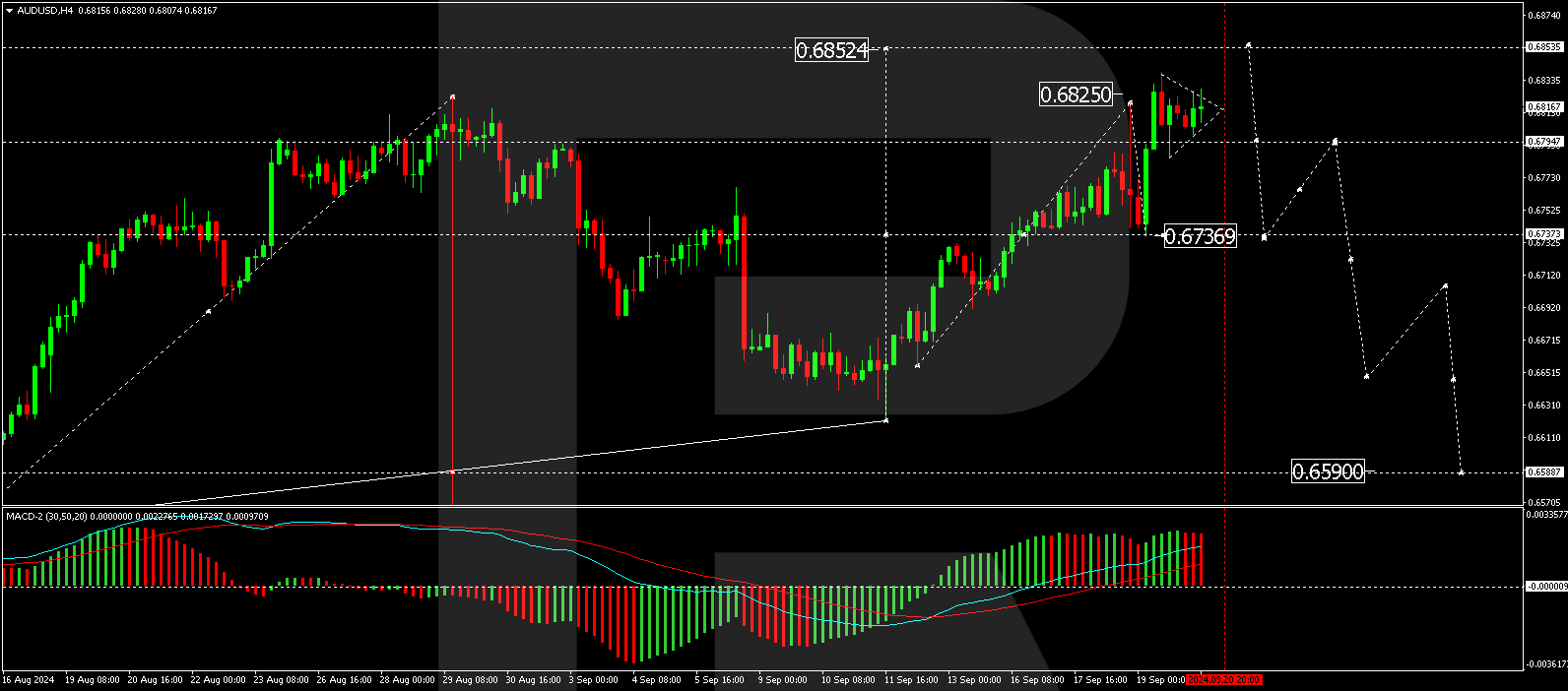
On the H4 chart of AUD/USD, the market performed a wave of decline to 0.6513. Today, it is relevant to consider the probability of correction development to the level of 0.6609. After the correction is completed, we will consider the likelihood of trend continuation to the level of 0.6468 with the prospect of trend continuation to the level of 0.6420. Technically, such a scenario is confirmed by the MACD indicator. Its signal line is under the zero mark and is directed strictly downwards.

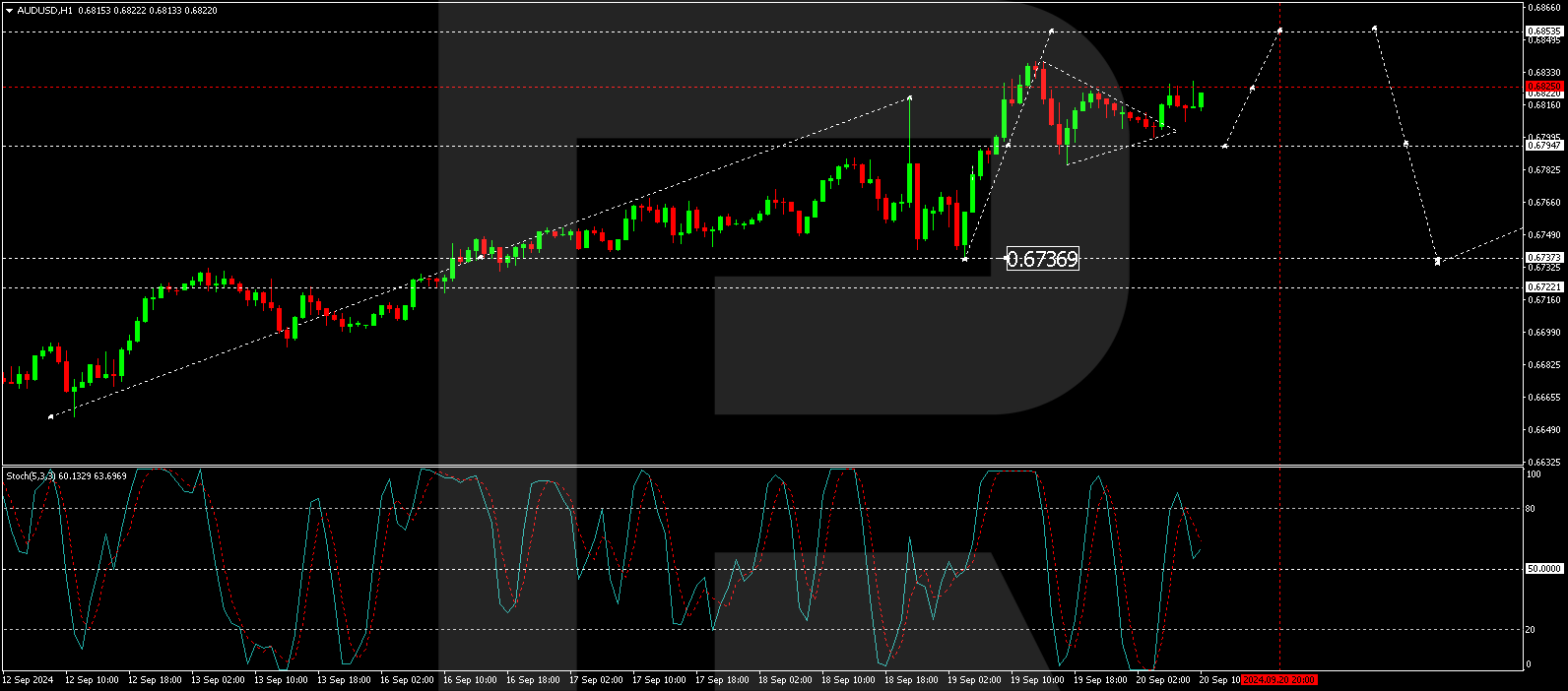
On the H1 AUD/USD chart, the market is forming a consolidation range around the level of 0.6561. In case of an upside exit, the potential of a wave to the level of 0.6609 will open. In case of a downward exit, we will consider the continuation of the wave to the level of 0.6468. The target is local. Technically, this scenario is confirmed by the Stochastic oscillator. Its signal line is under 50 and is directed strictly downwards to 20.


Disclaimer

Any forecasts contained herein are based on the author’s particular opinion. This analysis may not be treated as trading advice. RoboForex bears no responsibility for trading results based on trading recommendations and reviews contained herein.

Oil rises in price amid rising geopolitical tensions in the Middle East. Bitcoin has reached the $70,000 mark

By JustMarkets

On Friday, the Dow Jones (US30) Index gained 1.64% (for the week +0.43%), while the S&P 500 (US500) Index gained 1.11% (for the week -1.54%). The NASDAQ Technology Index (US100) closed positive at 1.03% (for the week -3.16%). Market sentiment was fueled by new data showing weakening inflation, which heightened expectations of a potential interest rate cut in September. The PCE, the Federal Reserve’s preferred measure of inflation, matched expectations, although the core rate rose 0.2%, slightly above the 0.1% forecast. All sectors showed gains, led by industrials.

Bitcoin climbed toward the $70,000 mark on Monday, reaching the key level for the first time in six weeks after US presidential candidate Donald Trump doubled down on his support for cryptocurrencies in a keynote speech at the Bitcoin 2024 conference in Nashville over the weekend. Trump said he would make the US the “crypto capital of the world” and promised to maintain the country’s current level of bitcoin ownership. Moreover, Republican Senator Cynthia Lummis has introduced a legislative proposal to create an official US strategic reserve of 1 million BTC over the next five years, representing nearly 5% of total BTC.

Equity markets in Europe were mostly up on Friday. The German DAX (DE40) rose by 0.65% (for the week +3.82%), the French CAC 40 (FR40) closed 1.22% higher (for the week -0.74%), the Spanish IBEX 35 (ES35) added 0.18% (for the week +0.15%), and the British FTSE 100 (UK100) closed positive 1.21% (for the week +1.59%) on Friday. European equity markets were set for gains on Monday amid hopes that the US Federal Reserve and the Bank of England will open the door to monetary easing.

WTI crude oil prices rose to $77.5 a barrel on Monday, cutting more than 1% of the previous session’s drop on fears of a possible full-scale war in the Middle East. Israel vowed a strong response to Hezbollah on Sunday, accusing the Iranian-backed group of killing 12 children and teenagers in a rocket attack on a soccer field in the Golan Heights. Hezbollah, however, “strongly denies” its involvement in the strike. Escalating tensions in the Middle East are creating supply risks and increasing oil prices.

Asian markets were mostly down last week. Japan’s Nikkei 225 (JP225) fell by 5.71%, China’s FTSE China A50 (CHA50) declined by 3.07%, Hong Kong’s Hang Seng (HK50) lost 2.54% over five trading days, and Australia’s ASX 200 (AU200) was negative -0.63%.

Vietnam’s annual inflation rate rose to 4.36% in July 2024 from a three-month low of 4.34% in the previous month. Prices rose mainly for medical services (8.13% vs. 8.04% in June) and transportation (4.4% vs. 3.03%), while the cost of postal and telecommunication services fell at a slower pace (-1.06% vs. -1.18%). Meanwhile, annual core inflation, which excludes volatile goods, was 2.61%, remaining at its lowest level in nearly two years.

The offshore yuan stabilized at 7.26 per dollar after hitting a two-month high last week. Traders took a cautious stance ahead of a key Politburo meeting, which was expected to indicate near-term policy measures following the Third Plenum reforms. China recently surprised markets by lowering key interest rates and conducting a surprise credit operation, indicating that the central bank intends to provide stronger monetary stimulus to support the economy.

The debate over whether Australia’s central bank needs to tighten policy at the end of the cycle will likely be resolved with quarterly inflation data release this week. The RBA has raised rates by a smaller amount than other countries to hold down job growth while worrying about the ability of heavily indebted households to cope. If the RBA fails to meet its goal of returning price growth to its 2%-3% target late next year, further rate hikes are likely to be needed – and that’s a big risk of plunging the weak economy into recession.

S&P 500 (US500) 5,459.10 +59.88 (+1.11%)

Dow Jones (US30) 40,589.34 +654.27 (+1.64%)

DAX (DE40) 18,417.55 +118.83 (+0.65%)

FTSE 100 (UK100) 8,285.71 +99.36 (+1.21%)

USD Index 104.32 -0.04 (-0.04%)

There are no important events today.

By JustMarkets


This article reflects a personal opinion and should not be interpreted as an investment advice, and/or offer, and/or a persistent request for carrying out financial transactions, and/or a guarantee, and/or a forecast of future events.

MAS has maintained a monetary policy. Japan’s inflation is on the rise

By JustMarkets

At Thursday’s close, the Dow Jones Index (US30) added 0.20%, while the S&P 500 Index (US500) was down 0.51%. The NASDAQ Technology Index (US100) closed negative 0.93%. Stocks continued to decline on Thursday amid weakness in chip stocks and selloffs in several individual stocks driven by negative earnings surprises. In addition, the market continues to worry about weakening economic growth despite Thursday’s slightly stronger-than-expected US economic reports.

The US real GDP grew 2.8% (annualized) in the second quarter, beating expectations of 2.0% and up from the 1.4% growth in the first quarter. The GDP report helped ease market fears of lower consumer spending and a slowing economy. Looking ahead, markets expect US GDP to decline to 2.0% in Q3 and 1.6% in Q4. In addition, personal consumption rose 2.3% in Q3, exceeding expectations of 2.0% and up from Q1’s 1.5% increase. The US weekly initial jobless claims declined by 8,000 to 235,000, indicating a modest strengthening of the labor market compared to expectations of a decline to 238,000. June durable goods orders excluding defense and aviation, an indicator of corporate capital spending in the US, rose 1.0%, stronger than expectations of 0.2%.

Equity markets in Europe were declining yesterday. Germany’s DAX (DE40) fell by 0.48%, France’s CAC 40 (FR40) closed down 1.15%, Spain’s IBEX 35 (ES35) lost 0.58%, and the UK’s FTSE 100 (UK100) closed positive 0.40%. European equities closed sharply lower on Thursday, extending the sell-off from the previous session amid weak corporate results. ASML shares continued their bearish momentum and closed 4% lower, representing a 20% decline over the past two weeks

WTI crude oil prices recovered from earlier losses to reach $78.28 per barrel on Thursday, helped by stronger-than-expected economic growth in the US and lower crude inventories. Despite these factors, oil prices remain near six-week lows due to concerns over lower oil imports and refinery activity in China amid sluggish economic growth.

The US natural gas (XNGUSD) prices fell to $2.05/MMBtu after the EIA reported a larger-than-expected increase in storage inventories. The US utilities added 22 billion cubic feet (Bcf) of gas to storage last week, beating market expectations of a 15 Bcf increase. Gas storage levels are now 16.4% above the 5-year average. Natural gas prices are set to decline for a second week due to higher production.

Asian markets were mostly down yesterday. Japan’s Nikkei 225 (JP225) fell by 3.28%, China’s FTSE China A50 (CHA50) was down 0.74%, Hong Kong’s Hang Seng (HK50) lost 1.77%, and Australia’s ASX 200 (AU200) was negative 1.29%.

The offshore yuan weakened to 7.25 per dollar after hitting a more than two-month high in the previous session, likely due to a technical correction. Earlier, the yuan’s appreciation was attributed to state bank intervention, which took advantage of the weakening US dollar by aggressively selling the dollar and buying yuan in offshore and domestic markets to support its appreciation.

The Monetary Authority of Singapore (MAS) left monetary policy on hold for July 2024, extending the pause for the 5th consecutive time amid moderate imported inflation. The Central Bank said it will maintain the prevailing pace of appreciation of the SGD nominal effective exchange rate (S$NEER), with no change to its breadth and the level at which it is pegged. MAS noted that the city-state’s core inflation, the Consumer Price Index for all goods, declined to 2.8% y/y in Q2 2024 from 3.0% in Q1. At the same time, it maintained estimates for core inflation at 2.5–3.5% this year, noting a further slowdown in Q4 to around 2% in 2025.

Tokyo Japan’s core consumer price index rose to 2.2% year-on-year in July 2024, accelerating for the third straight month to the highest level since March, confirming the need for the central bank to normalize policy. The latest data also matched market expectations and followed a 2.1% rise in June. Next week’s BoJ meeting is expected to discuss the need to raise interest rates to defend the yen and combat inflationary pressures. Tokyo’s inflation data is widely seen as a leading indicator of nationwide price trends.

S&P 500 (US500) 5,399.22 −27.91 (−0.51%)

Dow Jones (US30) 39,935.07 +81.20 (+0.20%)

DAX (DE40) 18,298.72 −88.74 (−0.48%)

FTSE 100 (UK100) 8,186.35 +32.66 (+0.40%)

USD Index 104.39 0 (0%)

Important events today:
  • – Japan Tokyo Core CPI (m/m) at 02:30 (GMT+3);
  • – US PCE Price index (m/m) at 15:30 (GMT+3);
  • – US Michigan Consumer Sentiment (m/m) at 17:00 (GMT+3).

By JustMarkets


This article reflects a personal opinion and should not be interpreted as an investment advice, and/or offer, and/or a persistent request for carrying out financial transactions, and/or a guarantee, and/or a forecast of future events.

USD/CAD Rally Pauses: Awaiting Next Correction

By RoboForex Analytical Department

The USD/CAD pair ended its continuous upward trend on Friday, 26 June 2024, settling around 1.3813, signalling a potential shift towards correction.

The Bank of Canada decided to lower the interest rate from 4.75% p.a. to 4.50% p.a. at its meeting this week. Overall, the tone of the Canadian regulator’s remarks has changed. The Bank of Canada expects the economy to grow by 1.2% this year versus the previous forecast of 1.5%. Expectations for 2025 and 2026 were adjusted to 2.1% and 2.4% from 2.2% and 1.9%.

Inflation forecasts were also changed. By the end of 2024, the overall consumer price index is expected to fall to 2.6%. Inflation will be 2.4% in 2025 and 2.0% in 2026.

The Bank of Canada is confident that the state of the economy is well positioned for inflation to return to target even if economic activity improves slightly in the second half of this year.

Since 11 July, the CAD has been falling almost nonstop in tandem with the USD. It has only started to correct now that it has reached a three-month low.

USD/CAD technical analysis

On the H4 chart of USD/CAD, the market has formed a consolidation range around 1.3740 and worked off the local target of the growth wave at 1.3847 in an upward movement. Today, we expect a new consolidation range to form at the current highs. In case of a downside exit, we will consider the probability of correction to 1.3740 (test from above). In case of an upward exit, we will consider the likelihood of the trend’s continuation to 1.3892. Technically, this scenario is confirmed by the MACD indicator. Its signal line is at the maximum and is preparing for a decline.

On the USD/CAD H1 chart, the market made a downward impulse to the level of 1.3795 and a correction to the level of 1.3825. The market has practically marked the boundaries of the consolidation range. We expect the exit from this range down to the level of 1.3790. If this level is breached, we will consider the correction wave development to continue to 1.3763. The target is local. Technically, this scenario is confirmed by the Stochastic oscillator. Its signal line is under the mark of 50 and is directed strictly downwards to the level of 20.


Disclaimer

Any forecasts contained herein are based on the author’s particular opinion. This analysis may not be treated as trading advice. RoboForex bears no responsibility for trading results based on trading recommendations and reviews contained herein.

GBP/USD Faces Downward Pressure Amid US Dollar Strength

By RoboForex Analytical Department

GBP/USD pair is down to 1.2892 on Thursday. Selling intensified on the 18th of July. Since then, GBP has remained under pressure, although it is making attempts to stabilise.

Statistics released earlier showed that UK private sector activity improved in July. PMI data indicated that activity in the services sector expanded slightly, while in the industrial segment, it was the highest since February 2022.

The data aligned with forecasts and confirmed the positive sentiment in industrial production after Labour’s convincing election victory.

The market is watching the situation with the Bank of England interest rate. The probability of a rate reduction at the August meeting is at most 40%. The UK regulator holds a neutral view of the monetary policy structure and is unlikely to make decisions that could have a mixed effect.

Overall, GBP remains under pressure from the US Dollar, which is receiving support from various sides.

GBP/USD Technical Analysis

On the H4 chart of GBP/USD, the market has formed a consolidation range around the 1.2911 level. Today, the market broke out of this range downwards. The potential for a downside wave to 1.2777 is almost open. The target is the first one. After reaching this level, we will consider the probability of correction to 1.2911 (test from below). Technically, this scenario is confirmed by the MACD indicator. Its signal line is above the zero mark and is directed strictly downwards.

On the H1 chart of GBP/USD, a correction wave to the level of 1.2937 is performed. Today, the structure of decrease to the level of 1.2858 is formed. After working off this level, we will consider the probability of a growth link to the level of 1.2897. At this point, the correction potential will be exhausted. After the correction is over, we will consider the beginning of a new wave of decline to 1.2824 with the prospect of trend continuation to the level of 1.2777. Technically, this scenario is confirmed by the Stochastic oscillator. Its signal line is under the level of 50 and continues to decline to the level of 20.


Disclaimer

Any forecasts contained herein are based on the author’s particular opinion. This analysis may not be treated as trading advice. RoboForex bears no responsibility for trading results based on trading recommendations and reviews contained herein.

The Bank of Canada lowered the rate for the second time. The People’s Bank of China unexpectedly cut its one-year lending rate

By JustMarkets

At the end of Tuesday, the Dow Jones Index (US30) decreased by 1.25%, while the S&P 500 Index (US500) was down 2.31%. The NASDAQ Technology Index (US100) closed negative 3.64%. Stocks fell yesterday amid disappointing earnings from Tesla and Google and weakness in chip maker stocks. Next week, companies such as Microsoft (MSFT) will report on Tuesday, Meta (META) on Wednesday, and Apple (AAPL) and Amazon (AMZN) on Thursday. Nvidia (NVDA) is expected to report earnings on August 28. The stock market is also concerned about the outlook for corporate earnings after the election. Vice President Kamala Harris performs better than President Biden and appears to have a better chance of defeating Donald Trump.

The market consensus expects second-quarter earnings for S&P 500 companies to rise 9% YoY. About a quarter of the companies in the S&P 500 have already reported, and most of them beat earnings forecasts.

The US economic reports released on Wednesday were weak and negative for the US economy, although they were at least dovish for Fed policy. S&P’s preliminary US manufacturing PMI for July fell 2.1 points to 49.5, much weaker than expectations of an unchanged 51.6. The US manufacturing PMI fell below the 50.0 level for the first time since December 2023, indicating weakness in the US manufacturing sector.

As some of the markets expected, the Bank of Canada (BoC) cut its key interest rate by 25 bps to 4.5% at its July 2024 meeting, extending the 25 bps rate cut from the June meeting. The Bank of Canada’s Board of Governors noted that oversupply in the Canadian economy has helped slow inflation in recent months, justifying a looser monetary policy. The central bank also noted that, combined with indicators suggesting excess supply, lower interest rates could help slow mortgage and housing cost growth, contributing most to inflation.

Equity markets in Europe were declining yesterday. Germany’s DAX (DE40) fell 0.92%, France’s CAC 40 (FR40) closed down 1.12%, Spain’s IBEX 35 (ES35) lost 0.02%, and the UK’s FTSE 100 (UK100) closed negative 0.17% on Wednesday. European equity markets opened lower on Thursday, following a global equity sell-off as disappointing earnings reports from mega-large tech companies in the US triggered massive sell-offs. On the corporate front, earnings are expected from Nestle, Roche, AstraZeneca, Sanofi, and Stellantis, among others.

The preliminary Eurozone manufacturing PMI for July fell 0.2 points to 45.6, weaker than expectations for a 0.3 point increase to 46.1. The preliminary Eurozone Services PMI for July fell 0.9 points to 51.9, weaker than expectations for a 0.1 point increase to 52.9.

WTI crude oil prices fell to $77 per barrel on Thursday, hitting their lowest since early June, as the prevailing negative sentiment in global stock markets put pressure on risk assets. In addition, the prospects of an impending ceasefire agreement between Israel and Hamas brokered by Egypt, Qatar, and the US put downward pressure on oil prices. Meanwhile, EIA data showed a 3.74 million barrel decline in inventories last week, the fourth consecutive decline, exceeding forecasts for a 2.05 million barrel drop.

Asian markets were predominantly down yesterday. Japan’s Nikkei 225 (JP225) fell 1.11%, China’s FTSE China A50 (CHA50) declined 0.32%, Hong Kong’s Hang Seng (HK50) lost 0.91%, and Australia’s ASX 200 (AU200) was negative 0.09%. Asian equity markets fell sharply on Thursday, following losses on Wall Street overnight, as disappointing earnings from mega-large companies triggered a sell-off in technology and artificial intelligence stocks. Japanese stocks led the decline in regional markets, which were also pressured by a rising yen amid bets of a Bank of Japan rate hike next week.

The People’s Bank of China (PBOC) unexpectedly cut its one-year lending rate, known as the medium-term lending facility (MLF), by 20 bps to 2.3% from 2.5% on July 25. It was the first cut in almost a year and the biggest since April 2020. The central bank stepped up support for the weakening economy following the Third Plenum in mid-July, weaker-than-expected second-quarter GDP data, and mixed economic data in June just days after cutting the key short-term rate.

S&P 500 (US500) 5,427.13 −128.61 (−2.31%)

Dow Jones (US30) 39,853.87 −504.22 (−1.25%)

DAX (DE40) 18,387.46 −170.24 (−0.92%)

FTSE 100 (UK100) 8,153.69 −13.68 (−0.17%)

USD Index 104.33 -0.12 (-0.12%)

Important events today:
  • – German Ifo Business Climate (m/m) at 11:00 (GMT+3);
  • – US Core Durable Goods Orders (m/m) at 15:30 (GMT+3);
  • – US GDP (q/q) at 15:30 (GMT+3);
  • – US Initial Jobless Claims (w/w) at 15:30 (GMT+3);
  • – US Natural Gas Storage (w/w) at 17:30 (GMT+3);
  • – Eurozone ECB President Lagarde Speaks at 18:00 (GMT+3).

By JustMarkets


This article reflects a personal opinion and should not be interpreted as an investment advice, and/or offer, and/or a persistent request for carrying out financial transactions, and/or a guarantee, and/or a forecast of future events.