Archive for Economics & Fundamentals – Page 131

Central Banks need to slow the pace of interest rate hikes for financial stability

By JustMarkets

Economic data Friday showed that US labor costs rose significantly in the third quarter. Still, private sector wage growth slowed, indicating that inflation has either peaked or is close to it. This coincides with recent statements from Fed officials that the US Central Bank may be less aggressive in future Fed meetings. Hedge fund analysts agree and point out that the US Fed will be forced to slow the pace to avoid financial instability. At the close of the stock market on Friday, the Dow Jones Index (US30) increased by 2.49% (+5.37% for the week), and the S&P500 (US500) added 2.46% (+3.70% for the week). The NASDAQ Technology Index (US100) increased by 2.87% on Friday (+2.17% for the week).

Nearly half of economists believe the international impact of a strong dollar is very likely to affect the US economy over the next 18 months and affect monetary policy. Only 28% of economists believe that a stronger currency is unlikely to have any impact on the economy. The dollar has risen about 13% this year against other major currencies amid geopolitical tensions following Russia’s invasion of Ukraine and the Fed’s aggressive interest rate hikes to combat inflation, which have reached a 40-year high. A stronger dollar tends to curb inflation by lowering the cost of imports and domestic production, as it raises export prices. Fed officials are expected to continue their campaign and raise rates another 75 basis points on Wednesday, but the rate of increase will slow down further. The latest forecast is for rates to reach 4.4% by the end of the year and 4.6% in 2023.

The third-quarter earnings season is halfway through, and the week ahead will test whether stocks can continue to withstand the disappointing earnings.

Equity markets in Europe traded flat on Friday but closed the week in positive territory. German DAX (DE30) gained 0.24% (+2.94% for the week), French CAC 40 (FR40) added 0.46% (+3.24% for the week), Spanish IBEX 35 (ES35) decreased by 0.06% (+3.91% for the week), British FTSE 100 (UK100) lost 0.37% (+1.12% for the week).

Friday’s inflation data showed new record highs for Germany, France, and Italy. Eurozone’s inflation data will be released today. Headline inflation is expected to return to a new high of 10.3% on an annualized basis, while core inflation (which excludes energy and food prices) will remain about the same.

Klaas Knot of the European Central Bank’s Governing Council spoke in favor of an interest rate hike of 50 or 75 basis points in December, but he added that a decision has not yet been made. The Dutch central banker, one of the region’s most hawkish officials, said the ECB is still in the process of returning the cost of borrowing to a neutral level, at which it neither stimulates nor constrains the economy. With Europe threatened by a recession, ECB officials declined to mention that rate hikes will continue over the next few meetings.

Gold prices fell last week despite a weaker US dollar and lower US Treasury yields as a rally in risky assets prompted traders to avoid defensive positions. But in terms of fundamentals, buying gold in the medium term looks like a promising scenario.

Asian markets mostly declined last week. Japan’s Nikkei 225 (JP225) decreased by 0.47% for the week, Hong Kong’s Hang Seng (HK50) lost 6.49% last week, and Australia’s S&P/ASX 200 (AU200) was down 0.87% for the week.

China’s Central Bank governor promised to keep monetary policy “normal” in the near future amid an economic slowdown caused by repeated Covid outbreaks, a sharp slowdown in the real estate sector, and weakening external demand. China has the conditions to maintain a normal monetary policy and keep the yuan stable for an extended period of time. Experts believe that China will improve the stability of credit growth and continue reducing the cost of credit for businesses and individuals to maintain macroeconomic stability.

In the commodities market, futures on natural gas (+16.96%), WTI oil (+3.92%), Brent oil (+3.01%), and platinum (+1.67%) showed the biggest gains by the end of the week. Futures on lumber (-15.03%), coffee (-9.66%), cotton (-8.87%), palladium (-5.21%), gasoline (-4.28%), sugar (-4.08%) and wheat (-2.41%) showed the biggest drop.

S&P 500 (F) (US500) 3,901.06 +93.76 (+2.46%)

Dow Jones (US30) 32,861.80 +828.52 (+2.59%)

DAX (DE40) 13,243.33 +32.10 (+0.24%)

FTSE 100 (UK100) 7,047.67 −26.02 (−0.37%)

USD Index 110.67 +0.08 (+0.07%)

Important events for today:
  • – Japan Industrial Production (m/m) at 01:50 (GMT+2);
  • – Japan Retail Sales (m/m) at 01:50 (GMT+2);
  • – Australia Retail Sales (m/m) at 02:30 (GMT+2);
  • – China Manufacturing PMI (m/m) at 03:30 (GMT+2);
  • – China Non-Manufacturing PMI (m/m) at 03:30 (GMT+2);
  • – German Retail Sales (m/m) at 09:00 (GMT+2);
  • – Switzerland Retail Sales (m/m) at 09:30 (GMT+2);
  • – Eurozone Consumer Price Index (m/m) at 12:00 (GMT+2);
  • – Eurozone GDP (q/q) at 12:00 (GMT+2);
  • – US Chicago PMI (m/m) at 15:45 (GMT+2).

By JustMarkets


This article reflects a personal opinion and should not be interpreted as an investment advice, and/or offer, and/or a persistent request for carrying out financial transactions, and/or a guarantee, and/or a forecast of future events.

Week Ahead: Hawkish Fed, robust jobs report should fuel Dollar rebound

By ForexTime

The US Federal Reserve (Fed) is widely expected to hike its benchmark rates by another 75 basis points (bps) yet again in the new month.

However, how high the US central bank can ultimately raise interest rates would depend on the state of the economy, of which the jobs data is a key indicator.

The upcoming Fed policy meeting, along with the latest US nonfarm payrolls report, will be of utmost importance in the week ahead, also featuring these scheduled data releases and events

Monday, October 31

  • JPY: Japan September industrial production, retail sales, October consumer confidence
  • AUD: Australia September retail sales, October inflation
  • CNH: China October PMIs
  • EUR: Eurozone 3Q GDP and October inflation, ECB Chief Economist Philip Lane speech, Germany September retail sales
  • Brent: OPEC releases 2022 World Oil Outlook

Tuesday, November 1

  • AUD: Reserve Bank of Australia policy decision
  • CNH: China October Caixin manufacturing PMI
  • GBP: UK October manufacturing PMI (final)
  • CAD: Canada October manufacturing PMI (final)
  • USD: US October manufacturing PMI (final), ISM manufacturing

Wednesday, November 2

  • NZD: New Zealand 3Q unemployment rate
  • JPY: Bank of Japan September meeting minutes
  • EUR: Eurozone October manufacturing PMI (final); Germany September external trade and October unemployment
  • USD: FOMC rate decision
  • US crude: EIA weekly oil inventory report

Thursday, November 3

  • AUD: Australia September external trade, October PMIs (final)
  • CNH: China October composite and services PMIs
  • EUR: Eurozone September unemployment, ECB President Christine Lagarde speech
  • GBP: Bank of England rate decision
  • USD: US weekly initial jobless claims, October ISM services index

Friday, November 4

  • EUR: Eurozone September PPI, Germany September factory orders, ECB President Christine Lagarde speech
  • USD: US October nonfarm payrolls, Boston Fed President Susan Collins speech
  • CAD: Canada October unemployment rate


With next week’s hike already well-telegraphed, markets are already honing their attentions to what Fed Chair Jerome Powell might say during Wednesday’s press conference about potential policy adjustments to be made at the Fed’s December meetings and beyond.

Assuming we indeed see yet another 75bps hike next week, that would bring the upper bound of the Fed benchmark rates up to 3.75%.

  • Markets currently believe that such a move (75bps hike next week) would put the largest chunks of the Fed rate hikes behind us.
  • At present, markets also expect that US interest rates would peak around 4.8% in Q2 2023.
  • That suggests just another couple of relatively smaller 50bps hikes left in the Fed’s pipeline before this rate-hiking cycle is over (again, assuming that a 75bps hike does indeed materialize next week).

The above essentially comprises the “dovish pivot” narrative that traders and investors have been testing at various intervals since the summer.

This latest iteration of that “dovish pivot” narrative has prompted a softening of the US dollar, with the equally-weighted USD index falling away from its post-pandemic high and bounce off its 50-day simple moving average (SMA) as key support.


Ultimately, how high US interest rates would go could ultimately depend on the incoming economic data.

And the incoming US nonfarm payrolls (NFP) report is expected to remind investors of the resilience evident in the jobs market of the world’s largest economy, potentially paving the way for more Fed rate hikes.

Here’s what economists are predicting for the upcoming US jobs report:

  • Headline NFP figure: 200,000 jobs added in October; lower than September’s 263k.
  • Unemployment rate: a slight uptick to 3.6% compared to the 3.5% in the month prior.

A lower-than-expected headline NFP figure, or a higher-than-expected unemployment rate, could bolster the “dovish pivot” narrative.

That should, in turn, prompt the USD Index to unwind more of its year-to-date gains and retest the early-September peak around 1.22 for support, with stronger support set to follow around its 100-day SMA at 1.21.

However, if hiring in the US economy comes in better than expected, being able to withstand the Fed rate hikes that have been ongoing since March, that could restore this USD Index back on a path back closer to its mid-October high above 1.29 as the “dovish pivot” proponents are forced to forego their expectations for a while longer.

And of course, much of the USD Index’s performance in the coming week should rely heavily on the latest policy clues due out of the FOMC policy statement and Fed Chair Jerome Powell’s press conference.

If the Fed signals that it remains hell bent on squashing red-hot US inflation by sending US interest rates past the market-forecasted 4.7% peak, such hawkish policy clues should reinvigorate dollar bulls.


While this Week Ahead article has been rather US-centric, also note that the Bank of England is in action at the onset of November. With central banks on either side of the pond in action in the coming week, that sets up some potential volatility for GBPUSD.

So be sure to check back in on Monday when we publish our regular Trade of the Week article.


Forex-Time-LogoArticle by ForexTime

ForexTime Ltd (FXTM) is an award winning international online forex broker regulated by CySEC 185/12 www.forextime.com

Amazon crashed the Nasdaq. The US GDP rises after 2 quarters of decline

By JustMarkets

The US stock indices traded yesterday without a single trend. At the close of the stock market yesterday, the Dow Jones Index (US30) increased by 0.61%, while the S&P 500 Index (US500) lost 0.61%. The NASDAQ Technology Index (US100) fell by 1.63% on Thursday.

After two consecutive quarters of negative GDP growth, the US economy grew by 2.6% in the third quarter. However, analysts believe the outlook is deteriorating quickly as the cumulative effect of a 300 basis point rate hike is hurting business activity, and the Fed will continue to raise rates through the end of the year to ensure that inflation targets are met. The biggest drop in performance has been in the real estate sector, as home sales have fallen month to month. This component reduced the overall GDP figure by 1.4% in the third quarter, indicating that the housing market is moving from a period of excess demand to a period of moderate oversupply.

The US durable goods orders rose in September, but the data also showed signs that the growth momentum is decreasing. Durable goods orders are reported in nominal terms by the government, so it is difficult to determine the impact of inflation on the data. Economists point out that surveys of the Federal Reserve’s regional district banks point to a decline in business investment, prompting talk of a recession.

Shares of tech giant Amazon (AMZN) fell more than 20% in after-hours trading after the company released its third-quarter earnings report, with revenue and guidance falling short of analysts’ consensus expectations. The company pointed out that Europe is likely to be its hardest-hit region during the holiday season, with Germany and the UK being its biggest markets after the US.

Apple (AAPL) beat analysts’ expectations by posting record revenue and earnings per share. Apple said its active installed device base hit a record high for all major product categories. But despite the good report, the company’s stock declined in the evening session.

Caterpillar (CAT) gave investors optimism by reporting better-than-expected quarterly results. Rising prices and increased sales support the heavy equipment company’s growth.

Equity markets in Europe mostly rallied yesterday. Germany’s DAX (DE30) increased by 0.12%, France’s CAC 40 (FR40) lost 0.51%, Spain’s IBEX 35 (ES35) added 0.64%, and the British FTSE 100 (UK100) closed Thursday in plus 0.25%.

The European Central Bank raised its interest rate by 0.75%. As a result of this step, the refinancing rate reached 2%. This is the biggest rate hike in the history of the ECB. In addition to the expected rate hike, the ECB also announced changes to the current operations of the Targeted Long-Term Refinancing (TLTRO) in terms of the applied interest rate and earlier maturity dates. But the balance sheet reduction was postponed to the December meeting.

According to experts, the gold market is forming conditions for medium-term growth. Firstly, it is connected with the fact that the US Federal Reserve will soon finish the cycle of rate increases, and the pressure on the gold industry will decrease. Secondly, such markers like Gold miners AD Line and GDX to GLD ratio have long stopped falling and are on the reverse point. Third, gold has a strong seasonal factor ahead – December and January have been the best months of the year for the past 10 years.

Oil prices decreased on Friday as China, the world’s biggest oil importer, imposed new Covid blocks in several cities as the number of infections began to rise again.

Asian markets traded flat yesterday. Japan’s Nikkei 225 (JP225) decreased by 0.32% for the day, Hong Kong’s Hang Seng (HK50) ended the day up 0.72%, and Australia’s S&P/ASX 200 (AU200) increased by 0.50%.

The Bank of Japan (BoJ) kept interest rates at record lows as expected on Friday. The central bank kept its short-term interest rate target at negative -0.1% and said in a statement that it would continue to target 10-year bond yields at 0%. But the statement also indicates that inflation is likely to rise in the near term as the Japanese economy struggles with rising commodity costs and supply chain problems. The Сentral Bank expects CPI inflation to be 3% by the end of the year, up from its previous forecast of 2.3%. But inflation is also expected to fall to about 1.5% in 2023 and 2024. Data released a little earlier showed that annual inflation in Tokyo reached a 33-year high of 3.4% in October. Japan is slowly beginning to add up to the conditions for abandoning ultra-low interest rates.

S&P 500 (F) (US500) 3,807.30 −23.30 (−0.61%)

Dow Jones (US30) 32,033.28 +194.17 (+0.61%)

DAX (DE40) 13,211.23 +15.42 (+0.12%)

FTSE 100 (UK100)  7,073.69  +17.62 (+0.25%)

USD Index 110.58 +0.88 (+0.80%)

Important events for today:
  • – Japan Unemployment Rate (m/m) at 02:30 (GMT+3);
  • – Japan Tokyo Core CPI (m/m) at 02:30 (GMT+3);
  • – Japan BoJ Interest Rate Decision at 06:00 (GMT+3);
  • – Japan BoJ Monetary Policy Statement at 06:00 (GMT+3);
  • – Japan BoJ Outlook Report at 06:00 (GMT+3);
  • – Japan BoJ Press Conference (Tentative);
  • – Eurozone French GDP (m/m) at 08:30 (GMT+3);
  • – Eurozone French CPI (m/m) at 09:45 (GMT+3);
  • – Eurozone Spanish GDP (m/m) at 10:00 (GMT+3);
  • – Eurozone Spanish CPI (m/m) at 10:00 (GMT+3);
  • – Eurozone Italian CPI (m/m) at 12:00 (GMT+3);
  • – Eurozone German GDP (m/m) at 11:00 (GMT+3);
  • – Eurozone German CPI (m/m) at 15:00 (GMT+3);
  • – US PCE Price index (m/m) at 15:30 (GMT+3);
  • – Canada GDP (m/m) at 15:30 (GMT+3);
  • – US Michigan Consumer Sentiment (m/m) at 17:00 (GMT+3);
  • – US Pending Home Sales (m/m) at 17:00 (GMT+3).

By JustMarkets


This article reflects a personal opinion and should not be interpreted as an investment advice, and/or offer, and/or a persistent request for carrying out financial transactions, and/or a guarantee, and/or a forecast of future events.

The UK is facing an economic crisis – here’s why it needs to find a global solution

By Muhammad Ali Nasir, University of Leeds 

Recent changes in the UK’s top job have had a positive effect on pound sterling and long-term sovereign bond yields. But the financial market reaction has been muted compared with the financial turmoil blamed on former prime minister Liz Truss and ex-chancellor Kwasi Kwarteng in recent weeks.

After the mini-budget on September 23, the markets reacted to a bad policy: Truss’s strategy to undertake massive tax cuts without providing much certainty on how this would be funded. Its reversal brought bond yields down from recent highs (essentially reducing the cost of government borrowing) and saw the pound appreciate. But overall, the market losses seen following the mini-budget have barely been recovered.

To investors, sound and stable economic policies matter much more than the person residing in Number 10. And that’s why, even with a new prime minister, recent market movements indicate investors continue to see more significant issues with the UK economy, both immediately and over the longer term.

In the short term, yields on UK sovereign bonds have shot up after the mini-budget, increasing the government’s cost of borrowing. The lack of an accompanying forecast by the Office of Budgetary Responsibility (OBR) exacerbated this negative reaction.

Before this, the Bank of England had been contemplating a bond-selling exercise to try to bring rising inflation back to its 2% target by reducing the supply of money in circulation (this is known as quantitative tightening). Instead, it had to quickly change course after the mini-budget. It not only postponed this tightening, but also restarted quantitative easing and bond purchases, promising to buy up to £10 billion in gilts per day to address a related crisis among pension funds.

Two things will now determine future sovereign bond yield dynamics and dictate government borrowing costs.

First, clarity on how long the Bank of England plans to continue its policy of quantitative easing (buying bonds to keep yields low) before it reverts to quantitative tightening again. Markets are watching these actions very carefully and any suggestion that this support by the Bank will be cut off could make traders and investors nervous.

Second, the government’s medium-term fiscal plan, currently scheduled for October 31, will also affect bond yields. Unlike the mini-budget, this plan will come with an in-depth assessment from the OBR, giving markets more information. Plus, the current chancellor, Jeremy Hunt, has brought some of the fiscal plan measures forward to ease market concerns.

It’s still unclear what kind of plan it will be, however. A debt-cutting strategy from Hunt and the new government headed by Rishi Sunak should assure the markets about the UK’s fiscal stability, but it’s still unknown whether this would happen via more taxes or less spending. Some evidence on what would be best for the economy supports raising capital income taxes (capital gains tax and inheritance tax) rather than cutting public spending or raising income taxes.

In the long term, the UK’s major problems are stagnating growth and lack of productivity. And if the new government addresses current problems by raising taxes and cutting spending – alongside higher interest rates from the Bank of England – there will be more economic pain.

Changing global economy

Many countries are suffering similar issues to the UK, contributing to a weak global economic outlook in general right now. After a prolonged period of historically ultra-low interest rates, increases – so-called normalisation of monetary policy – were expected in most countries. But a sharp surge in inflation due to Russia’s invasion of Ukraine and pandemic-era supply chain issues have caused most central banks to scramble to tighten monetary policy even further by increasing rates more rapidly.

Recent rate changes by central banks

Graph showing changes in central bank base rates over the past decade, with a sharp rise in early 2022.
Interest rate changes by central banks in the UK, Japan, the US and the Eurozone between October 2012 and October 2022.
Author’s chart using Bank for International Settlements data.

These rate hikes and policy tightening strategies by central banks could create significant financial and fiscal instability. Already, the US Federal Reserve’s unwinding of its balance sheet from a peak of US$8.97 trillion (£7.9 trillion) in April 2022, for example, caused the dollar to appreciate by more than 13% in the last six months. This has created challenges for emerging market currencies, as well as major currencies – the yen, pound sterling and the euro – which have all depreciated considerably against the US dollar.

This has added to inflationary pressures, particularly in the Eurozone and UK, but it also affects sovereign bond yields, challenging economic stability in these countries. Since August, the cost of borrowing has more than doubled for many.

The rising cost of government borrowing

Line graph showing the rising cost of borrowing in recent months for governments in the UK, US, Germany, Italy, Canada, France and Greece.
10-year sovereign bond yields from August to October 2022.
Author’s chart using Thomson Reuters data.

But to address rising inflation, even more central banks will want to shrink their balance sheets by selling bonds. The total size of the asset purchase programmes of the main four central banks alone is about US$26.7 trillion. With a weak global economy and these other financial fragilities, this is going to be a painful exercise for the global economy.

Indeed, such tightening will increase the cost of government borrowing further, creating major issues, particularly for highly leveraged governments, and those still paying off pandemic-era support such as the UK and Eurozone.

The UK specifically, is also dealing with a shift in the global economic centre of gravity away from its economy. In less than two decades, the UK has shrunk in relative terms from being an economy larger than China to being about nine times smaller. And the pound no longer enjoys the same status as the US dollar, meaning financial markets will punish it severely if it steps out of line.

This means the new UK government faces a tricky task in reigniting global investor confidence in its economic stability, even with a new prime minister widely seen as a steady hand.The Conversation

About the Author:

Muhammad Ali Nasir, Associate Professor in Economics, University of Leeds

This article is republished from The Conversation under a Creative Commons license. Read the original article.

The whole world is facing a debt crisis – but richer countries can afford to stop it

By Patrick E. Shea, University of Glasgow 

Countries across the world are drifting towards a debt crisis. Economic slowdowns and rising inflation have increased demands on spending, making it almost impossible for many governments to pay back the money they owe.

In normal times, those countries could simply take on new debt to replace the old debt. But international conditions have made it much more difficult to do this.

As a result, some of those approaching repayment deadlines will simply not be able to meet them. Sri Lanka and Zambia have already missed payments, throwing both countries into an economic tailspin, and offering perhaps a preview of impending global problems.

One of the main reasons for this worrying scenario is that countries across the world are essentially compelled to borrow money in US dollars or Euros, and keep foreign currency reserves for future debt payments.

But those reserves face other vital demands. They are needed to purchase oil and other imports, and well as maintaining the credible value of their domestic currency.

Unfortunately for many emerging economies, the reserves they hold are simply not enough to cover all of these demands – especially after energy prices soared when Russia invaded Ukraine.

At the same time, foreign currencies have become more expensive to buy because the US Federal Reserve and the European Central Bank are raising interest rates. Sri Lanka reportedly has no reserves left, while Pakistan is said to be operating on a month-to-month basis.

Countries usually issue new bonds (think of them as tradeable IOUs) to roll over old debt, a process that works just fine – until it doesn’t. In July 2022, no emerging countries issued any new bonds, indicating that investors are alarmed by the risk of low currency reserves, and are no longer interested in lending to them.

China too has scaled back its lending since the beginning of the pandemic to limit its exposure to global risk. So without bond markets or China, countries are turning to alternative sources of credit.

Kenya and Ghana for example, recently took out bank loans to alleviate budget shortfalls. And while the precise terms of these loans are not known, banks usually demand higher interest rates and shorter repayment periods, which may only add to a country’s financial stress levels.

Other countries are turning to some of the oil-rich gulf states currently profiting from high energy prices. Egypt and Pakistan have received loans from Saudi Arabia, the United Arab Emirates (UAE) and Qatar, while Turkey has also borrowed from the UAE. These loans may be welcome lifelines, but they also create opportunities for richer countries to effectively buy influence and generate dependency.

Overall then, a multitude of factors are working against some of the world’s poorest and indebted countries. If a global debt crisis does ensue, expect political turmoil to follow.

Sri Lanka’s default prompted wide spread protests, forcing the president to resign. And research shows that extremist parties perform better after a financial crisis.

Liquidity and transparency

But it is not too late for the international community to help avoid such a scenario.

First off, the US and the EU should slow down their interest rate hikes. These US and EU rate hikes slow economic growth around the world, as the United Nations warned, and they are draining countries’ foreign currency reserves.

It is also not clear that these interest rate hikes are addressing domestic inflation problems. If wealthier countries wish to lower inflation without igniting a global debt crisis, they should lower the trade barriers that artificially raise prices. For example, both the US and EU levy tariffs on imported agricultural products, which increase the price of food for their consumers.

Second, the International Monetary Fund (IMF) should drop or at least soften the austerity requirements linked to its emergency lending. For example, Zambia’s new IMF deal requires lower government subsidies on fuel and food at a time when prices are increasing. These policies are politically unpopular and encourage countries to seek help from China and oil-rich states instead.

Those countries that are compelled to borrow from the IMF face the risk of emboldening extremist political elements. Now is not the time to push orthodox fiscal requirements that are questionable in their effectiveness. Instead, the IMF should prioritise global liquidity during these difficult economic conditions.

Finally, China should take a leading, transparent role in debt negotiations. Many of the countries facing debt problems owe money to China, a process often shrouded in secrecy.

We know, for instance, that China has agreed to participate in restructuring negotiations in Zambia but has not done the same in Sri Lanka. China has provided emergency loans and debt relief to Pakistan and Argentina, though the effectiveness or extent of this aid is unknown.

A more transparent approach would reduce uncertainty in global markets and allow other creditors to coordinate with China. While China’s lending has not been transparent up until this point, more clarity would benefit China’s overseas investments as well as the global debt market.

Time is running out before many debt distressed countries face repayment day. Debt problems are contagious, as was seen with the Latin American debt crises of the 1980s, the Asian financial crises of the 1990s, and the Eurozone debt crises of the 2010s. The global community should work together to avert another global economic spiral, and help millions of people avoid needless suffering.The Conversation

About the Author:

Patrick E. Shea, Senior Lecturer in International Relations and Global Governance, University of Glasgow

This article is republished from The Conversation under a Creative Commons license. Read the original article.

A game of numbers: How air defense systems work and why Ukraine is eager for more protection

By Iain Boyd, University of Colorado Boulder 

Ukraine has received a broad array of military supplies from the U.S. and other allies. Recently, Ukrainian President Volodymyr Zelenskyy made an urgent plea specifically for additional air defense resources from the West in response to increased air attacks by Russia.

To understand Zelenskyy’s emphasis on air defense, it’s important to look at the types of air weapons that Ukraine faces and how air defenses work to counteract those threats. It’s also important to understand why this type of warfare is all about the number of assets each side has at its disposal.

Increased air attacks

On Oct. 10, 2022, Russia launched a large barrage of airborne weapons against a variety of targets in Ukraine. The types of weapons involved in the attack included short-range ballistic missiles and cruise missiles.

Ballistic missiles are accelerated by rockets from the ground or from aircraft, tend to follow a predictable path and are somewhat easier to track. Cruise missiles carry a propulsion system that allows them to maintain speed and fly more unpredictable flight paths, including trajectories that are close to the ground. They are much more difficult to detect, track and shoot down.

Then, on Oct. 17, Russia launched a barrage of explosive drones at Ukraine’s capital city, Kyiv. Explosive drones, known as loitering munitions, tend to be small weapons that are difficult to defend against. By circling overhead, they are able to surveil a region of interest, gathering information before identifying a specific target to attack. Russia has acquired explosive drones from Iran, according to U.S. officials.

Air defense systems

The defense against all such air threats involves an integrated system of several elements.

Early warning radars located at Ukraine’s borders first detect the approach of missiles. These weapons are further tracked along their flight trajectories by a dispersed network of additional radars. The primary defensive countermeasure against ballistic and cruise missiles involves surface-to-air missiles (SAMs): You destroy a missile using a missile. This is no easy feat because the SAM must track, home in on and hit a high-speed target that may be changing direction.

a diagram showing the trajectory of a missile along with a radar system tracking the missile and a defensive missile intercepting the attacking missile
The fundamental elements of a missile defense system.
Nguyen, Dang-An et al., CC BY-NC

In the U.S., key strategic assets such as the White House are protected against aerial attack by the National Advanced Surface-to-Air Missile System (NASAMS). NASAMS was designed to counteract a variety of incoming threats, including cruise missiles, aircraft and drones. Each NASAMS contains 12 interceptor SAMs. No information is available publicly on its effectiveness. NASAMS is one of the options being considered by the U.S. to help support Ukraine.

Another notable example of an air defense system is the Israeli Iron Dome. The system is designed to defend against rockets and artillery shells launched from up to 155 miles (250 kilometers) away. Each Iron Dome missile battery consists of three to four missile launchers, each with up to 20 interceptor SAMs.

The system is reported to have a 90% kill rate for rockets launched against Israel. Veteran national security correspondent Mark Thompson described Iron Dome as possibly the most effective missile defense system the world has seen.

Both NASAMS and Iron Dome are reported to be effective against drones. However, SAMs are an expensive way to defend against such low-cost targets, and they could be overwhelmed by large numbers of drones. Directed energy weapons such as high energy lasers are being developed and deployed to provide a potentially more cost-effective approach to neutralizing low-cost drones.

A numbers game

The significance of the plea by Zelenskyy for additional air defense systems can be understood in the context of a numbers game. Different air defense systems have a range of effectiveness against different aerial threats. However, none of the defense systems is 100% effective.

Moreover, an adversary can significantly reduce the effectiveness of air defense by launching salvos of multiple weapons simultaneously. Therefore, an attacker can always overwhelm a defender if the attacker has more attack missiles than the defender has defensive missiles. Conversely, a sufficient number of defensive systems may cause an attacker to stop firing altogether. It becomes a war of attrition, with the winner being the side with the most missiles.

Ukraine likely has sufficient air defenses to protect strategic military targets such as command and control centers and ammunition dumps. They do not have coverage of many other key assets such as transportation hubs and power and water facilities, the types of targets Russian forces have been targeting in recent days.

Should the West agree to provide significant numbers of air defense systems to Ukraine, it could significantly change the course of the conflict. At some point, Russia will have to confront the finite depth of its missile stockpile. The number of remaining Russian high-precision missiles is already reported to be running low.

Without the ability to wear down and demoralize Ukraine through airstrikes, Russia would be faced with the much more daunting and drawn-out prospect of relying solely on ground forces to grind out its objectives.The Conversation

About the Author:

Iain Boyd, Professor of Aerospace Engineering Sciences, University of Colorado Boulder

This article is republished from The Conversation under a Creative Commons license. Read the original article.

The US Real Estate market continues to decline. ECB to raise interest rate today

By JustMarkets

The US stock indices were trading yesterday without a single trend. By the close of trading, the Dow Jones Index (US30) gained 0.01%, while the S&P 500 Index (US500) decreased by 0.74%. The NASDAQ Technology Index (US100) fell by 2.04% on Wednesday.

The US economic data released by the US Commerce Department showed that home sales in September fell by 10.9% from the previous month, while August’s 685,000 unit figure was revised downward to 677,000, indicating that the Federal Reserve’s aggressive policies continue to hold back the real estate market.

Shares of Meta Platforms Inc (Facebook) fell more than 20% on the report after third-quarter earnings missed Wall Street estimates.

Visa, meanwhile, closed 5% higher after posting quarterly results that beat net income estimates, driven by continued consumer spending and a recovery in activity.

Equity markets in Europe were mostly up yesterday. Germany’s DAX (DE30) gained 1.09%, France’s CAC 40 (FR40) added 0.41%, Spain’s IBEX 35 (ES35) increased by 0.97%, and the British FTSE 100 (UK100) closed by 0.61% on Wednesday.

The euro weakness may lead to a further rise in consumer prices at the expense of imports, said German Deputy Finance Minister Florian Toncar. Toncar’s remarks contrast with recent comments from other European leaders, who stressed the risk of recession and suggested that the cost of borrowing in the eurozone should not increase too sharply.

The European Central Bank will raise interest rates again today and likely provide a subsidy to commercial banks, taking another important step in tightening policy (QT) to combat a historic spike in inflation. The ECB will almost certainly raise its deposit rate by 75 basis points to 2% and make clear that the size of the next steps remains open for discussion. The central bank is also likely to take the first steps to reduce its balance sheet of €8.8 trillion. Signaling that future steps will be more difficult, ECB President Christine Lagarde is likely to give only vague guidance, arguing that additional increases are needed, but incoming data and new economic forecasts in December will be the key.

According to the World Bank, a sharp slowdown in global growth and restrictions imposed because of the coronavirus pandemic in China are key downside risks to oil consumption. But with OPEC+ countries limiting oil production starting in November, the medium-term outlook for oil remains upward.

Shell company on Thursday reported third-quarter earnings of $9.45 billion, down from the previous quarter. But the company announced plans to increase its dividend by 15% by the end of the year. Shell also expanded its stock buyback program, announcing plans to buy $4 billion worth of stock over the next three months.

Asian markets closed in positive territory yesterday. Japan’s Nikkei 225 (JP225) jumped by 0.67%, Hong Kong’s Hang Seng (HK50) ended the day up by 1.00%, and Australia’s S&P/ASX 200 (AU200) increased by 0.18%.

Solid wage growth is likely to be the trigger that will push the Bank of Japan away from ultra-low interest rates. With Japan’s economy still weak, the Bank of Japan is not expected to raise interest rates soon, even if it means increasing downward pressure on the yen, which has fallen to a 32-year low against the dollar. Analysts say that Governor Haruhiko Kuroda’s second five-year term ends in April, opening the prospect of a gradual withdrawal of his radical economic stimulus program.

S&P 500 (F) (US500) 3,830.60 −28.51 (−0.74%)

Dow Jones (US30) 31,839.11 +2.37 (+0.01%)

DAX (DE40) 13,195.81 +142.85 (+1.09%)

FTSE 100 (UK100)  7,056.07 −0.51 (+0.61%)

USD Index 109.71 −1.24 (−1.14%)

Important events for today:
  • – Eurozone Monetary Policy Statement at 15:15 (GMT+3);
  • – Eurozone Interest Rate Decision at 15:15 (GMT+3);
  • – US Initial Jobless Claims (w/w) at 15:30 (GMT+3);
  • – US GDP (q/q) at 15:30 (GMT+3);
  • – US Durable Goods Orders (m/m) at 15:30 (GMT+3);
  • – Eurozone ECB Press Conference at 15:45 (GMT+3);
  • – US Natural Gas Storage (w/w) at 17:30 (GMT+3).

By JustMarkets


This article reflects a personal opinion and should not be interpreted as an investment advice, and/or offer, and/or a persistent request for carrying out financial transactions, and/or a guarantee, and/or a forecast of future events.

Reports from Google and Microsoft disappointed investors. Inflation in Australia reached a 32-year-high

By JustMarkets

At yesterday’s close of the stock market, the Dow Jones Index (US30) increased by 1.07%, and the S&P 500 Index (US500) added 1.63%. Technology Index NASDAQ (US100) gained 2.25% on Tuesday. Investor sentiment improved amid growing expectations that the high-interest rate damage to the US economy may prompt the Federal Reserve to soften its hawkish stance. Also, a positive for the market is the reporting season, but tech giants were disappointing yesterday.

Google Inc (GOOGL) failed to beat quarterly earnings estimates Tuesday as advertisers cut back in the face of the economic downturn. As a result, the company’s stock plummeted nearly 7% on the report release.

Microsoft (MSFT) shares also fell more than 6% in after-hours trading after the software giant disappointed in its revenue growth forecast for its Azure cloud computing business.

On Tuesday, Spotify Technology SA (SPOT) beat Wall Street estimates for third-quarter revenue and subscriber growth but said harsh economic conditions led to slower-than-forecast advertising growth.

The US consumer confidence fell more than expected in October to a three-month low as high inflation, and growing concerns about the economic outlook put pressure on Americans. The drop in confidence shows that the Federal Reserve’s aggressive interest rate hikes are taking a toll on consumers. And with the midterm elections just two weeks away, this is a worrying sign for President Joe Biden and the Democrats, who are trying to maintain their slim majority in Congress. In the future, inflationary pressures will continue to pose strong obstacles to consumer confidence and spending, leading to a difficult holiday season for retailers.

Equity markets in Europe were mostly up yesterday. Germany’s DAX (DE30) gained 0.94%, France’s CAC 40 (FR40) added 1.94%, Spain’s IBEX 35 (ES35) increased by 1.49%, Britain’s FTSE 100 (UK100) closed down slightly by 0.01% on Tuesday.

Deutsche Bank reported a significant jump in earnings in the third quarter despite a downturn in deal-making. UniCredit raised its 2022 earnings target, with the second-largest Italian bank supported by higher interest rates and lower loan loss reserves.

Financial markets are convinced that tomorrow’s ECB meeting will include another significant increase in key interest rates. In line with the last move in September, the only uncertainty concerns the step of raising. The 75-basis-point hike that ECB officials have been talking about in recent weeks is still an unresolved issue since last month, and several Governing Council members demanded only a 50-basis-point increase on the grounds that a possible recession would itself reduce inflationary pressures. And more and more members are now talking about the likelihood of a limited recession in 2023. This week’s meeting will almost certainly also include a discussion of quantitative tightening (QT). But even without QT, financial markets are increasingly convinced that key interest rates are far from their peak. From the current level of 1.25%, analysts are predicting a rate hike to 2.25% by the end of the year.

New Prime Minister Rishi Sunak promises to lead the UK out of its economic crisis. Sunak reappointed Jeremy Hunt as his finance minister to appease markets that had abandoned his predecessor’s debt-driven economic plans. Sunak also warned that difficult decisions lie ahead as he hopes to cut government spending.

Asian markets traded flat yesterday. Japan’s Nikkei 225 (JP225) jumped by 1.02%, Hong Kong’s Hang Seng (HK50) ended the day down by 0.10%, and Australia’s S&P/ASX 200 (AU200) was up by 0.28%. But since the market opened today, Hong Kong’s and China’s shares are showing the best dynamics of the day. Hong Kong’s Hang Seng Index (HK50) jumped by 2% from a 13-year low, while China’s Shanghai Shenzhen CSI 300 blue-chip index increased by 1.4%.

Inflation in Australia has jumped to a 32-year high. The reason for this is a sharp rise in home construction costs and rising gas prices. Data from the Australian Bureau of Statistics showed Wednesday that the consumer price index (CPI) jumped by 1.8% over the last quarter. On an annualized basis, the inflation rate rose from 6.1% to 7.3%. This is negative data that will push the Reserve Bank of Australia (RBA) to resume raising interest rates more aggressively. Initially, the RBA wanted to slow growth so that rising interest rates would not affect consumer spending too much, but that plan has not been successful.

S&P 500 (F) (US500) 3,859.11 +61.77 (+1.63%)

Dow Jones (US30) 31,836.74 +337.12 (+1.07%)

DAX (DE40) 13,052.96 +121.51 (+0.94%)

FTSE 100 (UK100) 7,013.48 −0.51 (−0.01%)

USD Index 110.88 −1.11 (−0.99%)

Important events for today:
  • – Australia Consumer Price Index (m/m) at 03:30 (GMT+3);
  • – US New Home Sales (m/m) at 17:00 (GMT+3);
  • – Canada BoC Monetary Policy Report at 17:00 (GMT+3);
  • – Canada BoC Interest Rate Decision at 17:00 (GMT+3);
  • – US Crude Oil Reserves (w/w) at 17:30 (GMT+3);
  • – Canada BoC Press Conference at 18:00 (GMT+3).

By JustMarkets


This article reflects a personal opinion and should not be interpreted as an investment advice, and/or offer, and/or a persistent request for carrying out financial transactions, and/or a guarantee, and/or a forecast of future events.

Is This the Vaunted Fed Pivot?

Source: Clive Maund  (10/24/22)

Expert Clive Maund believes the Fed may pivot soon. Read to find out why he believes this is true and where he thinks the market is heading.

The stock market was at a critical juncture by late last week, and without Fed intervention, or at least the talk of Fed intervention, it would have plunged, so right on cue, it was put about that the Fed would “pivot” soon, meaning abandon its policy of jacking up interest rates to battle inflation (a battle it cannot win, by the way).

This was, of course, what the oversold market wanted to hear, and the effect was immediate, with early losses being reversed and the Dow closing up almost 750 points on the day as yields started to drop and the dollar took a hit.

It hardly looks like the time has arrived to start cracking open the champagne, for overall, the setup remains incredibly dangerous, so if the Fed doesn’t deliver with a “pivot,” or even if it does and it has little effect, the market could yet turn tail and plunge.

If the Fed (and other central banks) keep creating money at an exponentially faster rate than they are now to stop the debt markets from imploding, the result will be hyperinflation, and we are heading in that direction already.

In the writer’s view (that is to say me), this way of carrying on suits the Globalists or New World Order just fine.

After all, they have already had the effrontery to put up loads of adverts saying, “You will own nothing and be happy,” and a policy of continually expanding the money supply will enable them to buy up everything and, at the same time exterminate the population at large by creating hyperinflation that renders them destitute so that they end up going “cap in hand” for their universal-basic-income subsistence handouts which they will have to qualify for by being fully vaxxed and not visiting websites that their Masters don’t approve of, etc.

Clearly, if this is the approach they adopt, it could have a stabilizing effect on the markets regardless of the economy being in terminal decline.

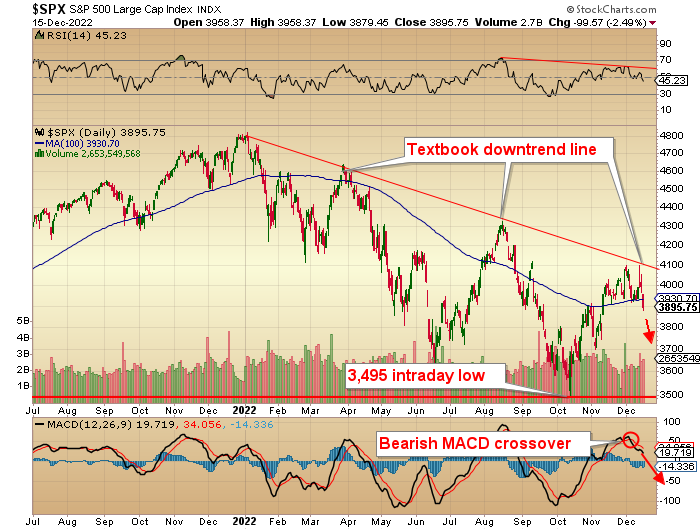
Thus it was that the mere hint yesterday of the Fed going easy caused a dramatic reversal in markets back to risk-on, and the S&P500 index (and other índices) finished the day with a nice big white candle on their charts, as we can see on the latest 6-month chart for the S&P500 index below.

If the Fed takes the easy way out, which is to keep creating money until it leads to hyperinflation, then the precious metals (and many other commodities) should soar.

Incidentally, this positive candle builds on the impressive “bullish engulfing pattern” reversal that appeared the week before last, which involved an impressive large white candle, so it is looking increasingly like the market has put in an intermediate low for now.

However, that said, it hardly looks like the time has arrived to start cracking open the champagne, for overall, the setup remains incredibly dangerous, so if the Fed doesn’t deliver with a “pivot,” or even if it does and it has little effect, the market could yet turn tail and plunge.

We can see the horribly bearish setup on the latest 5-year chart for the S&P500 index, which would not be changed by a rally in the coming weeks back up to the Dome boundary.

What could be going on now is that the Fed is complicit in massaging sentiment to keep the market propped up until the mid-terms, after which they may permit it to drop like a rock. Therefore a good tactic may be to see if the market can make it up to or near to the Dome boundary, at which point it will be time to thin positions or lay on more hedges, buy tranches of Puts at good prices, etc.

We will be on the lookout for this.

The chart for the 2008 crash is shown below to enable you to see the uncanny similarity between then and now.

The difference is that if the markets do crash soon, they won’t bounce back afterward as in 2008 and 2009.

This is because the bond market will be crashing, too, as there will be no QE card to play, unlike last time, as the entire system flies apart.

On the 6-month chart for the S&P500 index, we can see the large bullish engulfing pattern that appeared the week before last, which marked the turn, and the impressive white candle that occurred yesterday as the Fed leaked out hints that it will “pivot.”

We will be turning our attention to the precious metals sector tomorrow since clearly, if the Fed takes the easy way out, which is to keep creating money until it leads to hyperinflation, then the precious metals (and many other commodities) should soar, so it’s no wonder we saw impressive action in many PM stocks yesterday. Keep in mind the political motivations for keeping the markets propped up until the mid-terms.

CliveMaund.com Disclosures

The above represents the opinion and analysis of Mr. Maund, based on data available to him, at the time of writing. Mr. Maund’s opinions are his own, and are not a recommendation or an offer to buy or sell securities. Mr. Maund is an independent analyst who receives no compensation of any kind from any groups, individuals or corporations mentioned in his reports. As trading and investing in any financial markets may involve serious risk of loss, Mr. Maund recommends that you consult with a qualified investment advisor, one licensed by appropriate regulatory agencies in your legal jurisdiction and do your own due diligence and research when making any kind of a transaction with financial ramifications. Although a qualified and experienced stock market analyst, Clive Maund is not a Registered Securities Advisor. Therefore Mr. Maund’s opinions on the market and stocks can only be construed as a solicitation to buy and sell securities when they are subject to the prior approval and endorsement of a Registered Securities Advisor operating in accordance with the appropriate regulations in your area of jurisdiction.

Disclosures:
1) Statements and opinions expressed are the opinions of Clive Maund and not of Streetwise Reports or its officers. The author is wholly responsible for the validity of the statements. Streetwise Reports was not involved in any aspect of the article preparation. The author was not paid by Streetwise Reports LLC for this article. Streetwise Reports was not paid by the author to publish or syndicate this article.

2) This article does not constitute investment advice. Each reader is encouraged to consult with his or her individual financial professional and any action a reader takes as a result of information presented here is his or her own responsibility. By opening this page, each reader accepts and agrees to Streetwise Reports’ terms of use and full legal disclaimer. This article is not a solicitation for investment. Streetwise Reports does not render general or specific investment advice and the information on Streetwise Reports should not be considered a recommendation to buy or sell any security. Streetwise Reports does not endorse or recommend the business, products, services or securities of any company mentioned on Streetwise Reports.

3) From time to time, Streetwise Reports LLC and its directors, officers, employees or members of their families, as well as persons interviewed for articles and interviews on the site, may have a long or short position in securities mentioned. Directors, officers, employees or members of their immediate families are prohibited from making purchases and/or sales of those securities in the open market or otherwise from the time of the decision to publish an article until three business days after the publication of the article. The foregoing prohibition does not apply to articles that in substance only restate previously published company releases.

US economic indicators continue to fall. Investors’ attention is focused on tech giants’ reports

By JustMarkets

The US stocks continued to rise on Monday. Weaker economic data on business activity caused Treasury yields to fall slightly and pushed stocks higher on the background that the Federal Reserve may consider a less aggressive monetary policy after a 75 basis point rate hike next month. Stocks also rallied ahead of a wave of quarterly results from major tech companies.

As the stock market closed yesterday, the Dow Jones Index (US30) increased by 1.34%, and the S&P 500 Index (US500) added 1.19%. The NASDAQ Technology Index (US100) closed by 0.86% on Monday.

Forecasts from HSBC Holdings Plc suggest markets are still underestimating the likelihood of a return to ultra-low US interest rates as the Federal Reserve’s hawkish stance risks bringing down the economy. There is a “fairly high” probability that the US Central Bank will need to cut rates near zero over the next three to five years.

The US Treasury is taking steps to make the Treasury debt market, the private money market, and bond funds more resilient, but according to US Treasury Secretary Janet Yellen, the US financial system is functioning well despite the heightened global volatility.

Companies reporting today include Alphabet (GOOGL), Visa (V), Coca-Cola (KO), Texas Instruments (TXN), United Parcel Service (UPS), NextEra Energy (NEE), Lockheed Martin (LMT), HSBC ADR (HSBC), General Electric (GE) and 3M (MMM).

Equity markets in Europe were mostly up yesterday. Germany’s DAX (DE30) gained 1.58%, France’s CAC 40 (FR40) added 1.59%, Spain’s IBEX 35 (ES35) increased by 1.79%, and the British FTSE 100 (UK100) closed Monday with 0.64%.

In the UK, heightened political and economic uncertainty has led to a drop in business activity to 2009 crisis levels. A government report released Friday showed that retail sales fell by 1.4% in September, and consumer confidence is near its worst level ever, as inflation returned to a 40-year high. And all of these problems will now have to be addressed by the new Prime Minister Rishi Sunak. Financial experts believe the new prime minister’s key focus should be a credible fiscal responsibility plan that can guarantee that the national debt will shrink in the medium term.

Oil declined Monday as data showed Chinese demand remained sluggish in September, while weak US business data eased expectations for more aggressive interest rate hikes and limited price cuts.

Asian markets traded flat on Monday. Japan’s Nikkei 225 (JP225) jumped by 0.31% on the day, Hong Kong’s Hang Seng (HK50) ended the day sharply down by 6.36%, and Australia’s S&P/ASX 200 (AU200) was up by 1.54%.

Shares of Chinese technology companies fell sharply on Monday after Chinese President Xi Jinping’s leadership reshuffle raised fears of increased regulatory scrutiny of tech stocks. Investor sentiment also remains tense as markets fear further disruptions to the economy by the government, especially after Beijing reiterated its commitment to its strict zero COVID policy. Concerns about US restrictions on semiconductor exports to China are also having an impact.

S&P 500 (F) (US500) 3,797.34 +44.59 (+1.19%)

Dow Jones (US30) 31,499.62 +417.06 (+1.34%)

DAX (DE40) 12,931.45 +200.55 (+1.58%)

FTSE 100 (UK100) 7,013.99 +44.26 (+0.64%)

USD Index 112.01 0.00 (0.00%)

Important events for today:
  • – Singapore Consumer Price Index (m/m) at 08:00 (GMT+3);
  • – German Ifo Business Climate (m/m) at 11:00 (GMT+3);
  • – US CB Consumer Confidence (m/m) at 17:00 (GMT+3);
  • – FOMC Member Waller Speaks at 20:55 (GMT+3).

By JustMarkets


This article reflects a personal opinion and should not be interpreted as an investment advice, and/or offer, and/or a persistent request for carrying out financial transactions, and/or a guarantee, and/or a forecast of future events.