
By Orbex
While everyone has been focused on the horrors of the war in Ukraine, the potential economic fallout has been a little ignored. There have been some passing mentions of the wheat prices, but it still appears to be something only niche traders are looking into.
Here’s why you should pay more attention to it: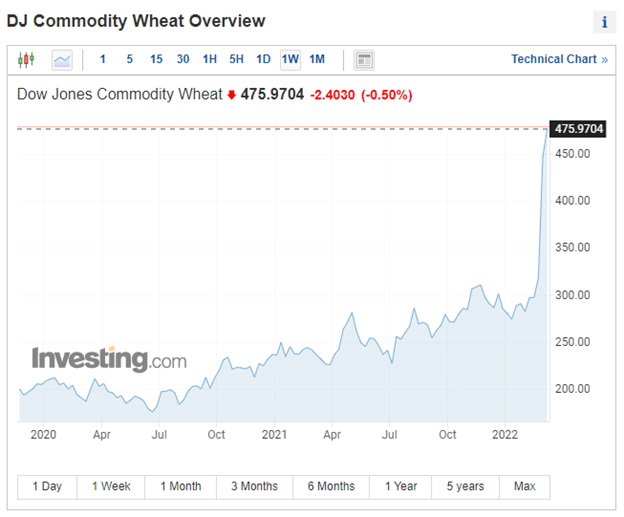
Global consequences
Wheat futures have skyrocketed to the highest they’ve ever been. More importantly, they are more than double the levels from 2013. That was a watershed year for global relations, as the high price of food in the world led to substantial discontent, particularly in North Africa and the Middle East.
Many analysts point to the social unrest high food prices and inflation caused in those areas. In fact, that’s due in part to the high price of wheat, as one of the catalysts behind the Arab Spring. The subsequent collapse of several governments left some civil wars lasting until today.
Free Reports:
 Get our Weekly Commitment of Traders Reports - See where the biggest traders (Hedge Funds and Commercial Hedgers) are positioned in the futures markets on a weekly basis.
 Download Our Metatrader 4 Indicators – Put Our Free MetaTrader 4 Custom Indicators on your charts when you join our Weekly Newsletter
Ukraine is one of the world’s largest producers not just of wheat, but other cereals such as corn. Besides being food staples, they are also used as feed for stock animals, particularly chicken. Even more than Ukraine, Russia is the world’s second-largest producer of cereals.
With the enforcement of global sanctions, a substantial portion of the world’s basic food component is restricted. In turn, this could potentially lead to significant food inflation around the world.
What to look out for
Wheat prices were already on the rise months before the invasion of Ukraine, and they were close to 2013’s levels. The invasion took an already stressed market and pushed it into an acute phase.
High natural gas prices have driven fertilizer prices higher, coupled with a reduction in phosphate production in China. Fertilizer and fuel are the primary costs for farmers. And those prices are now at a record high – something that farmers will have to pass on to consumers. Adding to that, there’s also the threat of a potential crops disruption in Ukraine. So, speculators have been pushing the price substantially higher.
However, there is a bit of optimism.
Wheat is planted the year before (winter wheat, the largest crop). This means that there’s no immediate threat that if the war in Ukraine continues into spring, farmers won’t be able to plant. Harvesting should start in July, and if the conflict isn’t resolved by then, there could be significant shortages in grains which are necessary to maintain food supplies.
Where things could be difficult
The developed world will likely be able to afford the higher prices. But it could lead to substantial discontent in poorer nations which will be less able to afford increased prices. Higher food prices in the developed world would likely lead to higher inflation, no matter what central banks do.
Food and energy are the most volatile elements in inflation. And they are both under pressure from the current conflict.
Trading the news requires access to extensive market research – and that’s what we do best. Open your Orbex account now.
 Article by Orbex
Orbex is a fully licensed broker that was established in 2011. Founded with a mission to serve its traders responsibly and provides traders with access to the world’s largest and most liquid financial markets. www.orbex.com

- The US introduces new import tariffs for 60 countries. Brent crude surpasses $100 per barrel Jul 24, 2026
- USD/JPY Breaks Records: Nothing Slows the Yen’s Decline Jul 24, 2026
- Oil prices reached a 6‑week high. The AUD strengthened on the back of a strong labor‑market report Jul 23, 2026
- EUR/USD Recovers as Dollar Weakens Jul 23, 2026
- Bitcoin rose to $66,000. The New Zealand dollar continues to strengthen Jul 22, 2026
- Inflationary pressure is easing in Canada. In New Zealand, on the contrary, inflation is rising Jul 21, 2026
- GBP/USD Falls After Cabinet Changes Jul 21, 2026
- Geopolitical and macroeconomic conditions continue to pressure market sentiment Jul 20, 2026
- USD/JPY Poised to Continue Gains as Expensive Oil and Lack of Support Weigh on Yen Jul 20, 2026
- COT Metals Charts: Weekly Speculator Bets led by Copper & Steel Jul 18, 2026
