Archive for Forex and Currency News – Page 73

Shift away from US dollar is happening in real time – why investors need to be vigilant

By George Prior

The US dollar’s dominance is in decline as Russia and Saudi Arabia eye the Chinese yuan for oil trades, and investors might need to begin to revise their long-term investment strategies, warns the CEO and founder of one of the world’s largest independent financial advisory, asset management and fintech organizations.

The warning from Nigel Green of deVere Group says the shift in how global oil trading is carried out will have far-reaching consequences for economies and, therefore, investors around the world.

He says: “One of the most significant, but under-reported, outcomes of last week’s three-day summit between Russia’s Vladimir Putin and China’s Xi Jinping was that Putin said Russia is now in favour of using the Chinese yuan for oil settlements.

“This suggests that the world’s second-largest economy and the world’s largest energy exporter are actively intending to reduce the dominance of the US dollar as the bedrock of the international financial system.

“Separately, two deals, announced on Sunday and Monday, would see Saudi Arabia’s Aramco supplying two Chinese companies with a combined 690,000 barrels a day of crude oil, bolstering its rank as China’s top provider of the commodity. It’s been reported that Saudi Arabia is also in talks with Beijing to settle with the yuan, instead of the dollar.”

Aramco is one of the largest oil producers in the world and is fully owned and controlled by the Saudi Arabian government.

He continues: “It appears US rivals, led by China, are forming a new major economic bloc. If Saudi Arabia – home to massive oil reserves, which are estimated to be the largest in the world – does move to the yuan that would lead to an enormous shift in the global economic system.

“Oil is one of the most important and widely traded commodities in the world, and it has traditionally been priced and traded in US dollars. This has given the US dollar a dominant role in global financial markets, as countries that want to purchase oil must first acquire US dollars in order to do so.

“If oil trading were to shift away from the US dollar it would dramatically reduce the demand for US dollars, which would lead to a decrease in the value of the US currency. This could have a number of ripple effects throughout the global economy, including hugely increased inflation in the United States and potentially destabilizing effects on financial markets.”

Additionally, a shift away from the US dollar in oil trading could lead to greater economic and geopolitical competition between countries.

“If the yuan were to become more widely used in oil trading, this could significantly increase the economic power and influence of China, challenging the dominance of the United States in major global affairs.”

These shifts are not just theoretic they are “beginning to happen in real time,” says Nigel Green, meaning investors may need to begin to revise their portfolios.

“If oil were priced and traded in a different currency, investors would be exposed to currency risk as the value of the currency could impact the value of their investments. They would need to consider the potential impact of currency fluctuations on their portfolio and may need to adjust their holdings accordingly,” he notes.

There are also industry-specific risks. “Companies that generate significant revenue from oil production or related services would be impacted by changes in the currency used for trading. Investors with exposure to these types of companies would need to evaluate the potential impact of a shift away from the dollar on their investments.”

He goes on to say: “Oil is a critical input for many industries, and changes in the price of it can have enormous, far-reaching implications for the global economy. If oil were no longer traded in the US dollar, it would impact the global financial system and would have ripple effects throughout the world economy.”

The deVere CEO concludes: “Investors who are serious about building their wealth for the long-term need to be alive to the impact of the dollar’s decline not in the future but now.”

About:

deVere Group is one of the world’s largest independent advisors of specialist global financial solutions to international, local mass affluent, and high-net-worth clients.  It has a network of more than 70 offices across the world, over 80,000 clients and $12bn under advisement.

Trade Of The Week: EURAUD Major Breakout On The Horizon?

By ForexTime 

If you have an appetite for volatility, then keep a close eye on the EURAUD!

The currency pair has rallied over 550 pips since the start of March with bulls smashing through key levels of resistance with the destructive force of a wrecking ball. After hitting a fresh 2023 high at 1.6254 last week and concluding on a firm note, the path of least resistance certainly points north.

Euro strength remains the primary driver behind the EURAUD’s incredible upside. We have seen the euro appreciate against most G10 currencies month-to-date.

On the other hand, the past few weeks have certainly not been kind to the Australian dollar thanks to risk aversion and concerns over the health of Australia’s economy.

This potent combination of euro strength and aussie weakness reinforced the bullish fundamental view for the EURAUD. Given how prices are also trading well above the 50, 100, and 200-day SMA, the technicals also favour more upside momentum. However, the key question is whether bulls have enough strength to conquer the weekly resistance at 1.6200. It is worth keeping in mind that the last time prices secured a weekly close above this point was back in August 2021.

The low down…

It has been an intense month for the EURAUD thanks to central bank meetings, key economic reports, and major risk events.

Earlier this month, the RBA delivered a dovish hike by moving ahead with a 25bp rate increase and signalling a potential pause in its 10-month tightening cycle. One week later, the European Central Bank hiked rates by 50bp, focusing on its fight against inflation despite the chaos revolving around Silicon Valley Bank. As the negative developments concerning the banking sector intensified with Credit Suisse hijacking the headlines, the risk-off sentiment hit appetite for the Australian dollar. Although some stability has returned to markets, lingering fears around the banking sector could keep the Australian dollar depressed. A weaker Aussie is likely to fuel the upside on the EURAUD.

 The week ahead…

We could see some increased activity on the AUD and EUR this week due to key economic reports.

Sentiment towards the German economy received a boost on Monday after the Ifo Business Climate indicator increased to 93.3 in March – the highest seen since February 2021. Given how this survey is seen as one of the best indicators for economic growth, it could support the euro in the near term.

Mid-week, the focus will be directed toward Australia’s February CPI report which is expected to show inflation easing to 7.2% from 7.4% in January. Signs of easing inflation pressures may support the argument for the RBA to pause its monetary tightening cycle in its April report. Ultimately, this development has the potential the weaken the Aussie further.

Germany’s latest inflation figures and Eurozone confidence data will be published on Thursday. The preliminary estimates are expected to reveal that inflation cooled to 7.3% in March from 8.7% in February.

The major risk event for the euro may be on Friday due to the Eurozone’s February unemployment and March inflation figures. Markets expect the rate of unemployment to remain unchanged at 6.7% in February. In regards to inflation, this is expected to fall sharply in March to 7.1% from 8.5% in the previous month. If the swift decline in inflation becomes reality, it will be interesting to see whether fuels speculation around the ECB pausing rates down the road.

Will EURAUD conquer weekly 1.6200 resistance?

It looks like the EURAUD could be gearing up for a bullish breakout if 1.6200 can be conquered. Although prices are firmly bullish on the daily charts, some consolidation is taking place as bulls and bears wait for a fresh fundamental spark. Minor support can be found at 1.6140 and minor resistance around 1.6250. A solid daily breakout and close above 1.6250 could inject bulls with enough strength to end the week above the key 1.6200 level. Such an outcome may open doors towards 1.6400 and 1.6550.

Alternatively, sustained weakness below 1.6200 could see prices slip back towards 1.6140 and 1.5900 – a level just above the 200-week Simple Moving Average.


Forex-Time-LogoArticle by ForexTime

ForexTime Ltd (FXTM) is an award winning international online forex broker regulated by CySEC 185/12 www.forextime.com

Currency Speculators drop their Canadian Dollar bets fall to 218-week low

By InvestMacro

Here are the latest charts and statistics for the Commitment of Traders (COT) data published by the Commodities Futures Trading Commission (CFTC).

The latest COT data is updated through Tuesday March 21st and shows a quick view of how large market participants (for-profit speculators and commercial traders) were positioned in the futures markets. All currency positions are in direct relation to the US dollar where, for example, a bet for the euro is a bet that the euro will rise versus the dollar while a bet against the euro will be a bet that the euro will decline versus the dollar.

* This COT data is fully up-to-date after weeks of delays due to a cybersecurity event that happened in early February to ION Cleared Derivatives (a subsidiary of ION Markets). The hacking incident had disrupted the ability for the CFTC to report large trader positions.

Weekly Speculator Changes led by Japanese Yen & EuroFX

The COT currency market speculator bets were lower this week as five out of the eleven currency markets we cover had higher positioning while the other six markets had lower speculator contracts.

Leading the gains for the currency markets was the Japanese Yen (8,449 contracts) with the EuroFX (4,886 contracts), Swiss Franc (2,668 contracts), Australian Dollar (1,632 contracts) and the US Dollar Index (387 contracts) also showing positive weeks.

The currencies seeing declines in speculator bets on the week were the Canadian Dollar (-25,106 contracts) with the Mexican Peso (-14,597 contracts), the New Zealand Dollar (-4,042 contracts), the British Pound (-3,184 contracts), the Brazilian Real (-3,414 contracts) and Bitcoin (-519 contracts) also registering lower bets on the week.

CAD bets fall to 218-week low

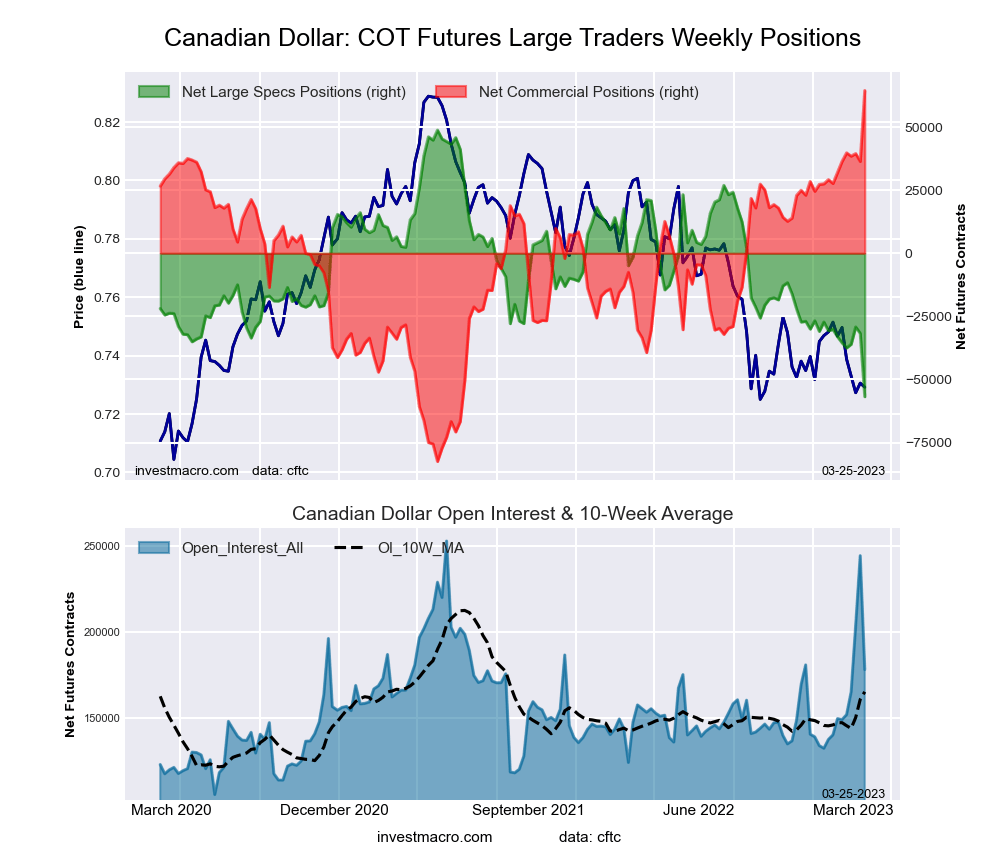
Highlighting the COT currency’s data this week is the bearishness of the speculator’s positioning in the Canadian dollar. Large speculative CAD positions fell this week by over -25,000 contracts and have now declined in five out of the past seven weeks. This recent bearishness has brought the overall net position (currently at -56,821 contracts) to the lowest level in the past 218 weeks, dating back all the way to January 15th of 2019. The CAD speculator strength score (range from 0 to 100) is currently at 0.0 percent while the 6-week speculator strength trend is at -22 percent.

The Canadian dollar exchange rate versus the US dollar has been in a downtrend to start 2023 with the CAD futures (front month) price sitting currently at 0.7287. The CAD futures opened 2023 around the 0.7382 exchange rate and reached its highest level in late January at 0.7541 before trending lower.


Data Snapshot of Forex Market Traders | Columns Legend
Mar-21-2023OIOI-IndexSpec-NetSpec-IndexCom-NetCOM-IndexSmalls-NetSmalls-Index
USD Index33,8193114,14449-16,708492,56445
EUR737,43770144,84274-191,1712646,32953
GBP190,79631-20,4985125,50651-5,00848
JPY169,18831-66,3452872,48471-6,13941
CHF35,83721-7,2973512,61166-5,31440
CAD178,18549-56,821064,449100-7,6286
AUD151,83650-38,4594950,55457-12,09523
NZD32,17913-8,783308,89667-11350
MXN222,1304551,53088-56,413134,88386
RUB20,93047,54331-7,15069-39324
BRL42,2223024,85767-30,775275,918100
Bitcoin14,04970-62166-103072429


Strength Scores led by Mexican Peso & EuroFX
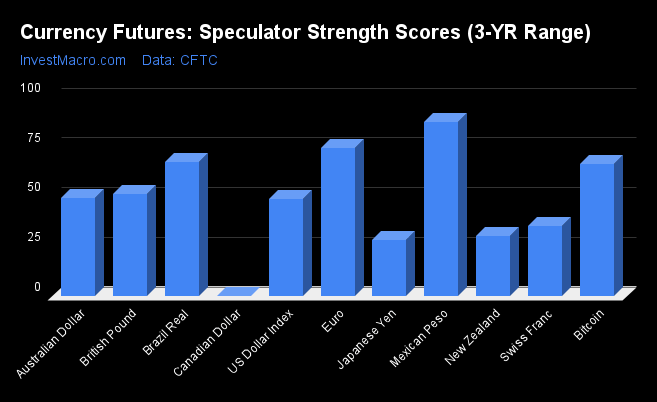
COT Strength Scores (a normalized measure of Speculator positions over a 3-Year range, from 0 to 100 where above 80 is Extreme-Bullish and below 20 is Extreme-Bearish) showed that the Mexican Peso (88 percent) and the EuroFX (74 percent) lead the currency markets this week. The Brazilian Real (67 percent), Bitcoin (66 percent) and the British Pound (51 percent) come in as the next highest in the weekly strength scores.

On the downside, the Canadian Dollar (0 percent) comes in at the lowest strength level currently and is in Extreme-Bearish territory (below 20 percent). The next lowest strength scores are the Japanese Yen (28 percent), New Zealand Dollar (30 percent) and the Swiss Franc (35 percent).

Strength Statistics:
US Dollar Index (48.5 percent) vs US Dollar Index previous week (47.9 percent)
EuroFX (74.2 percent) vs EuroFX previous week (72.3 percent)
British Pound Sterling (51.4 percent) vs British Pound Sterling previous week (54.1 percent)
Japanese Yen (28.0 percent) vs Japanese Yen previous week (22.8 percent)
Swiss Franc (35.3 percent) vs Swiss Franc previous week (28.3 percent)
Canadian Dollar (0.0 percent) vs Canadian Dollar previous week (23.8 percent)
Australian Dollar (49.2 percent) vs Australian Dollar previous week (47.7 percent)
New Zealand Dollar (29.8 percent) vs New Zealand Dollar previous week (40.7 percent)
Mexican Peso (87.6 percent) vs Mexican Peso previous week (98.7 percent)
Brazilian Real (67.4 percent) vs Brazilian Real previous week (71.7 percent)
Bitcoin (66.1 percent) vs Bitcoin previous week (75.2 percent)


Mexican Peso & Bitcoin top the 6-Week Strength Trends
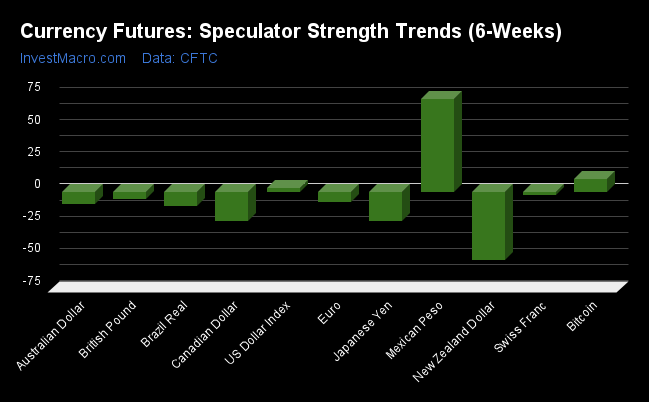
COT Strength Score Trends (or move index, calculates the 6-week changes in strength scores) showed that the Mexican Peso (73 percent) and Bitcoin (10 percent) lead the past six weeks trends for the currencies. The US Dollar Index (3 percent), the Swiss Franc (-2 percent) and the British Pound (-5 percent) are the next highest positive movers in the latest trends data.

The New Zealand Dollar (-53 percent) leads the downside trend scores currently with the Japanese Yen (-23 percent), Canadian Dollar (-22 percent) and the Brazilian Real (-11 percent) following next with lower trend scores.

Strength Trend Statistics:
US Dollar Index (3.1 percent) vs US Dollar Index previous week (-4.6 percent)
EuroFX (-7.8 percent) vs EuroFX previous week (-4.1 percent)
British Pound Sterling (-5.5 percent) vs British Pound Sterling previous week (0.9 percent)
Japanese Yen (-22.9 percent) vs Japanese Yen previous week (-33.7 percent)
Swiss Franc (-2.5 percent) vs Swiss Franc previous week (-4.4 percent)
Canadian Dollar (-22.5 percent) vs Canadian Dollar previous week (-1.4 percent)
Australian Dollar (-9.6 percent) vs Australian Dollar previous week (-8.8 percent)
New Zealand Dollar (-53.2 percent) vs New Zealand Dollar previous week (-35.6 percent)
Mexican Peso (72.6 percent) vs Mexican Peso previous week (84.4 percent)
Brazilian Real (-10.8 percent) vs Brazilian Real previous week (8.5 percent)
Bitcoin (9.7 percent) vs Bitcoin previous week (29.6 percent)


Individual COT Forex Markets:

US Dollar Index Futures:
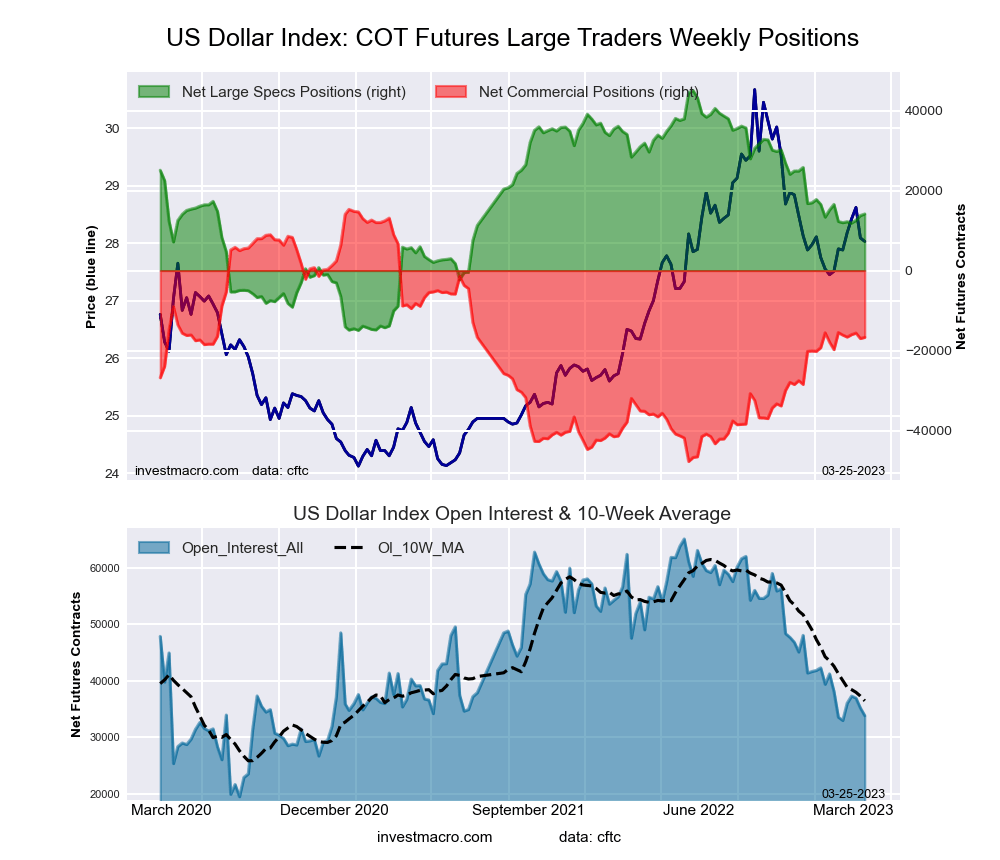
US Dollar Index Forex Futures COT ChartThe US Dollar Index large speculator standing this week came in at a net position of 14,144 contracts in the data reported through Tuesday. This was a weekly lift of 387 contracts from the previous week which had a total of 13,757 net contracts.

This week’s current strength score (the trader positioning range over the past three years, measured from 0 to 100) shows the speculators are currently Bearish with a score of 48.5 percent. The commercials are Bearish with a score of 49.2 percent and the small traders (not shown in chart) are Bearish with a score of 44.6 percent.

US DOLLAR INDEX StatisticsSPECULATORSCOMMERCIALSSMALL TRADERS
– Percent of Open Interest Longs:77.64.014.4
– Percent of Open Interest Shorts:35.853.46.8
– Net Position:14,144-16,7082,564
– Gross Longs:26,2581,3384,864
– Gross Shorts:12,11418,0462,300
– Long to Short Ratio:2.2 to 10.1 to 12.1 to 1
NET POSITION TREND:
– Strength Index Score (3 Year Range Pct):48.549.244.6
– Strength Index Reading (3 Year Range):BearishBearishBearish
NET POSITION MOVEMENT INDEX:
– 6-Week Change in Strength Index:3.1-1.9-7.3


Euro Currency Futures:

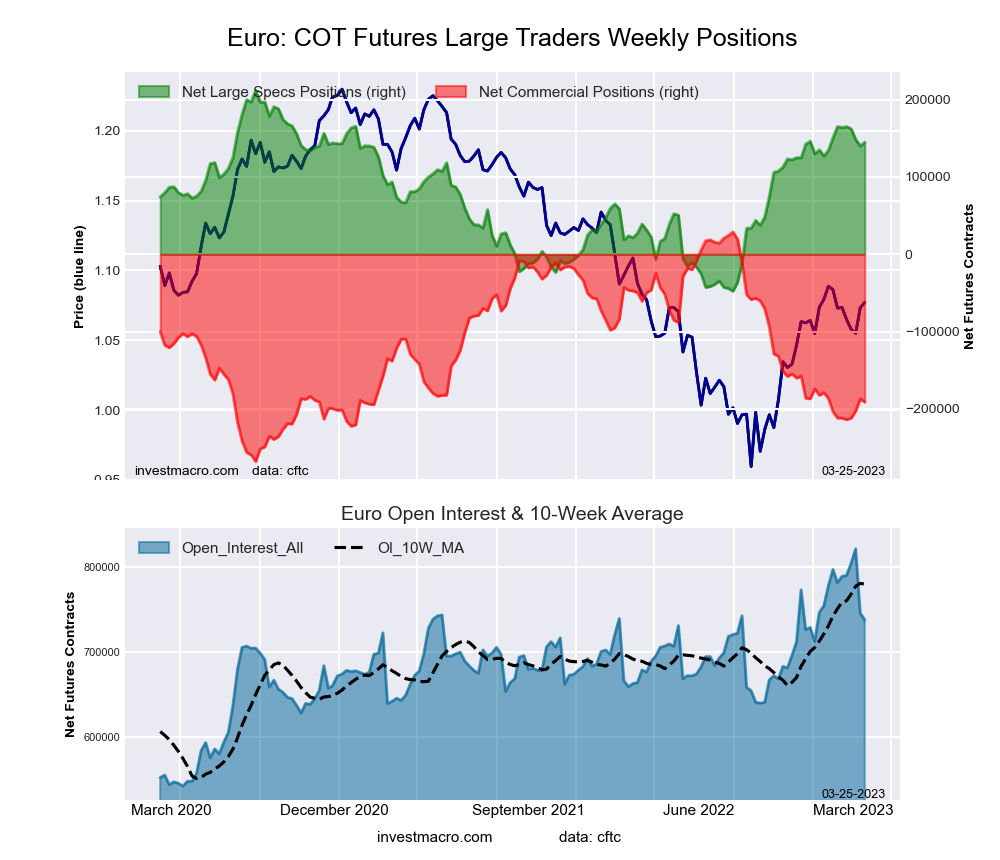
Euro Currency Futures COT ChartThe Euro Currency large speculator standing this week came in at a net position of 144,842 contracts in the data reported through Tuesday. This was a weekly boost of 4,886 contracts from the previous week which had a total of 139,956 net contracts.

This week’s current strength score (the trader positioning range over the past three years, measured from 0 to 100) shows the speculators are currently Bullish with a score of 74.2 percent. The commercials are Bearish with a score of 25.9 percent and the small traders (not shown in chart) are Bullish with a score of 52.9 percent.

EURO Currency StatisticsSPECULATORSCOMMERCIALSSMALL TRADERS
– Percent of Open Interest Longs:29.356.711.9
– Percent of Open Interest Shorts:9.682.65.6
– Net Position:144,842-191,17146,329
– Gross Longs:215,825417,80287,688
– Gross Shorts:70,983608,97341,359
– Long to Short Ratio:3.0 to 10.7 to 12.1 to 1
NET POSITION TREND:
– Strength Index Score (3 Year Range Pct):74.225.952.9
– Strength Index Reading (3 Year Range):BullishBearishBullish
NET POSITION MOVEMENT INDEX:
– 6-Week Change in Strength Index:-7.86.9-0.6


British Pound Sterling Futures:

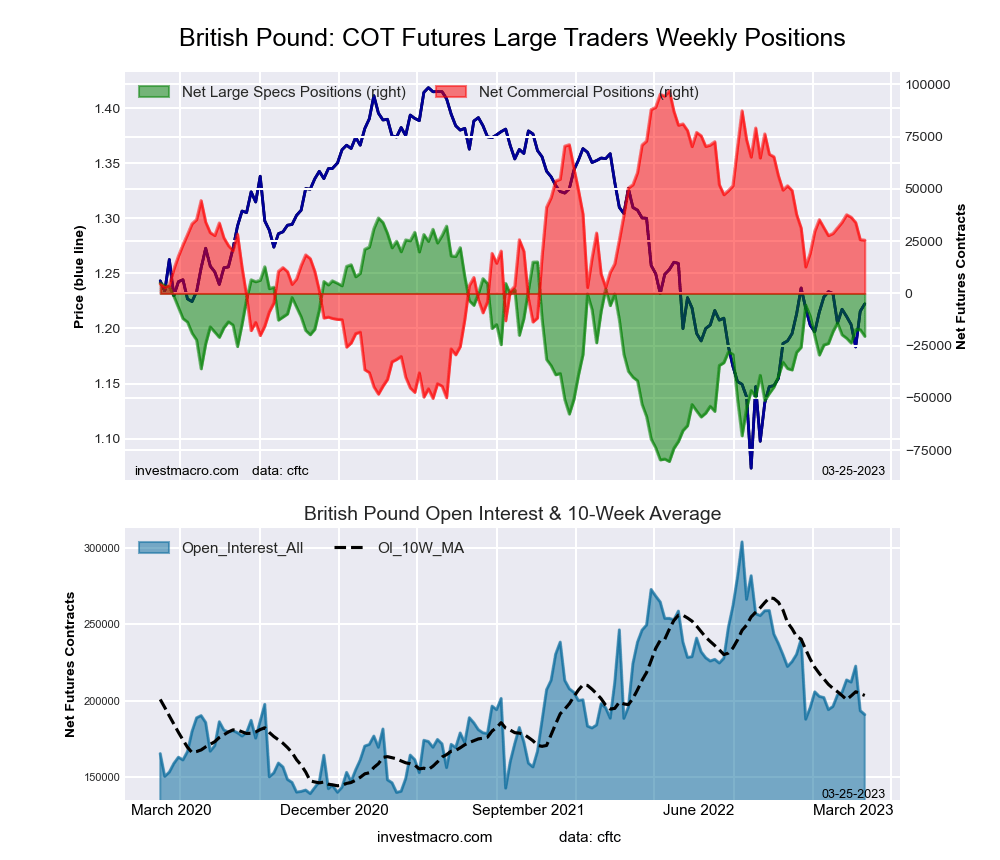
British Pound Sterling Futures COT ChartThe British Pound Sterling large speculator standing this week came in at a net position of -20,498 contracts in the data reported through Tuesday. This was a weekly reduction of -3,184 contracts from the previous week which had a total of -17,314 net contracts.

This week’s current strength score (the trader positioning range over the past three years, measured from 0 to 100) shows the speculators are currently Bullish with a score of 51.4 percent. The commercials are Bullish with a score of 51.4 percent and the small traders (not shown in chart) are Bearish with a score of 48.2 percent.

BRITISH POUND StatisticsSPECULATORSCOMMERCIALSSMALL TRADERS
– Percent of Open Interest Longs:15.067.612.3
– Percent of Open Interest Shorts:25.854.314.9
– Net Position:-20,49825,506-5,008
– Gross Longs:28,652129,03023,376
– Gross Shorts:49,150103,52428,384
– Long to Short Ratio:0.6 to 11.2 to 10.8 to 1
NET POSITION TREND:
– Strength Index Score (3 Year Range Pct):51.451.448.2
– Strength Index Reading (3 Year Range):BullishBullishBearish
NET POSITION MOVEMENT INDEX:
– 6-Week Change in Strength Index:-5.5-4.024.0


Japanese Yen Futures:

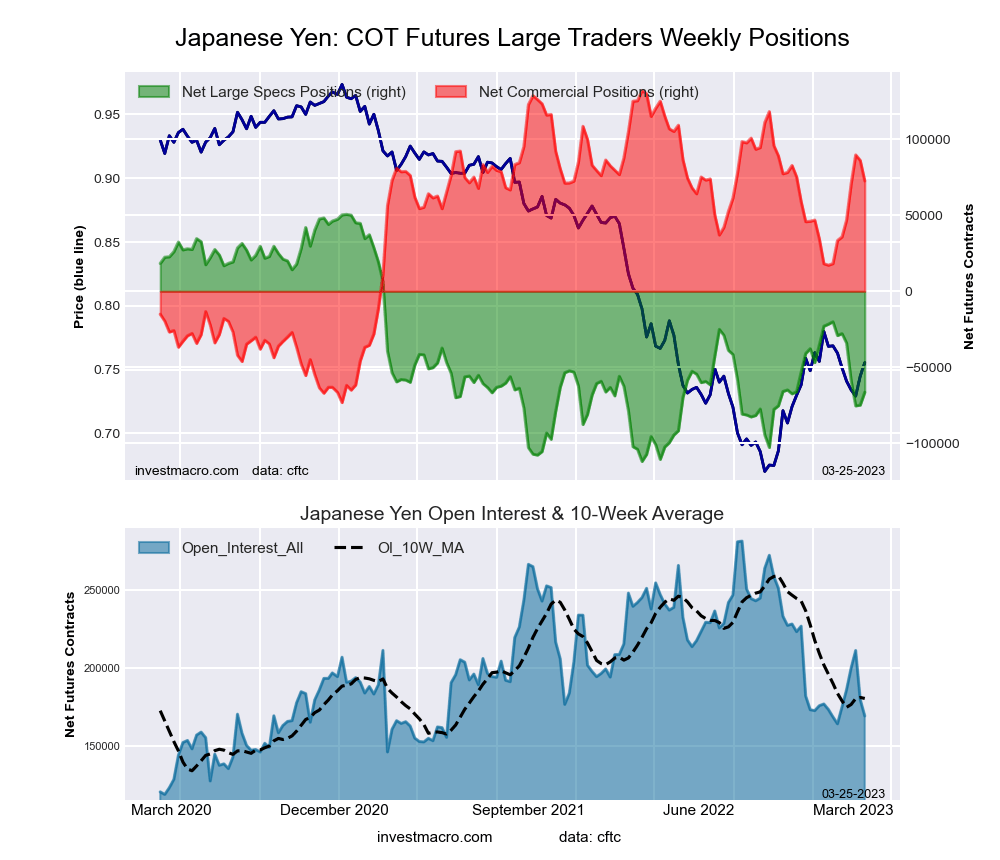
Japanese Yen Forex Futures COT ChartThe Japanese Yen large speculator standing this week came in at a net position of -66,345 contracts in the data reported through Tuesday. This was a weekly advance of 8,449 contracts from the previous week which had a total of -74,794 net contracts.

This week’s current strength score (the trader positioning range over the past three years, measured from 0 to 100) shows the speculators are currently Bearish with a score of 28.0 percent. The commercials are Bullish with a score of 71.0 percent and the small traders (not shown in chart) are Bearish with a score of 41.0 percent.

JAPANESE YEN StatisticsSPECULATORSCOMMERCIALSSMALL TRADERS
– Percent of Open Interest Longs:4.379.414.4
– Percent of Open Interest Shorts:43.536.618.0
– Net Position:-66,34572,484-6,139
– Gross Longs:7,255134,38924,336
– Gross Shorts:73,60061,90530,475
– Long to Short Ratio:0.1 to 12.2 to 10.8 to 1
NET POSITION TREND:
– Strength Index Score (3 Year Range Pct):28.071.041.0
– Strength Index Reading (3 Year Range):BearishBullishBearish
NET POSITION MOVEMENT INDEX:
– 6-Week Change in Strength Index:-22.919.1-3.8


Swiss Franc Futures:

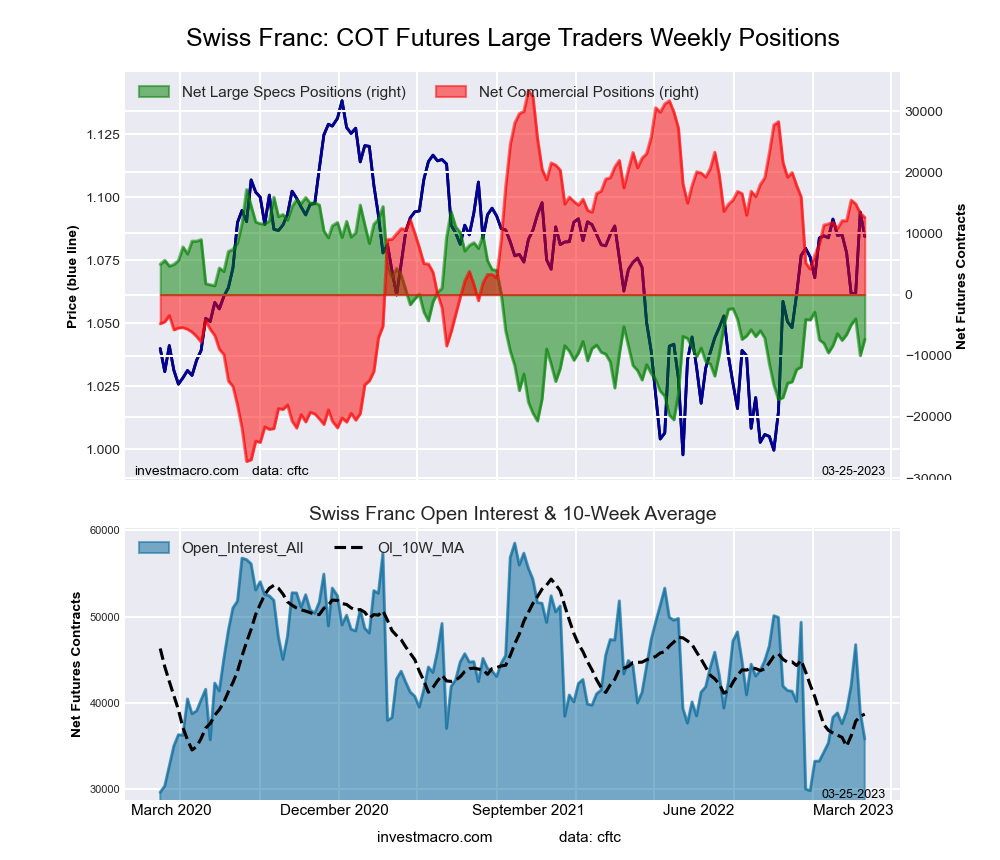
Swiss Franc Forex Futures COT ChartThe Swiss Franc large speculator standing this week came in at a net position of -7,297 contracts in the data reported through Tuesday. This was a weekly boost of 2,668 contracts from the previous week which had a total of -9,965 net contracts.

This week’s current strength score (the trader positioning range over the past three years, measured from 0 to 100) shows the speculators are currently Bearish with a score of 35.3 percent. The commercials are Bullish with a score of 65.8 percent and the small traders (not shown in chart) are Bearish with a score of 39.5 percent.

SWISS FRANC StatisticsSPECULATORSCOMMERCIALSSMALL TRADERS
– Percent of Open Interest Longs:13.554.627.8
– Percent of Open Interest Shorts:33.919.442.7
– Net Position:-7,29712,611-5,314
– Gross Longs:4,85319,5559,978
– Gross Shorts:12,1506,94415,292
– Long to Short Ratio:0.4 to 12.8 to 10.7 to 1
NET POSITION TREND:
– Strength Index Score (3 Year Range Pct):35.365.839.5
– Strength Index Reading (3 Year Range):BearishBullishBearish
NET POSITION MOVEMENT INDEX:
– 6-Week Change in Strength Index:-2.53.0-3.0


Canadian Dollar Futures:

Canadian Dollar Forex Futures COT ChartThe Canadian Dollar large speculator standing this week came in at a net position of -56,821 contracts in the data reported through Tuesday. This was a weekly decline of -25,106 contracts from the previous week which had a total of -31,715 net contracts.

This week’s current strength score (the trader positioning range over the past three years, measured from 0 to 100) shows the speculators are currently Bearish-Extreme with a score of 0.0 percent. The commercials are Bullish-Extreme with a score of 100.0 percent and the small traders (not shown in chart) are Bearish-Extreme with a score of 5.9 percent.

CANADIAN DOLLAR StatisticsSPECULATORSCOMMERCIALSSMALL TRADERS
– Percent of Open Interest Longs:10.671.716.7
– Percent of Open Interest Shorts:42.435.621.0
– Net Position:-56,82164,449-7,628
– Gross Longs:18,812127,79829,717
– Gross Shorts:75,63363,34937,345
– Long to Short Ratio:0.2 to 12.0 to 10.8 to 1
NET POSITION TREND:
– Strength Index Score (3 Year Range Pct):0.0100.05.9
– Strength Index Reading (3 Year Range):Bearish-ExtremeBullish-ExtremeBearish-Extreme
NET POSITION MOVEMENT INDEX:
– 6-Week Change in Strength Index:-22.522.1-19.5


Australian Dollar Futures:

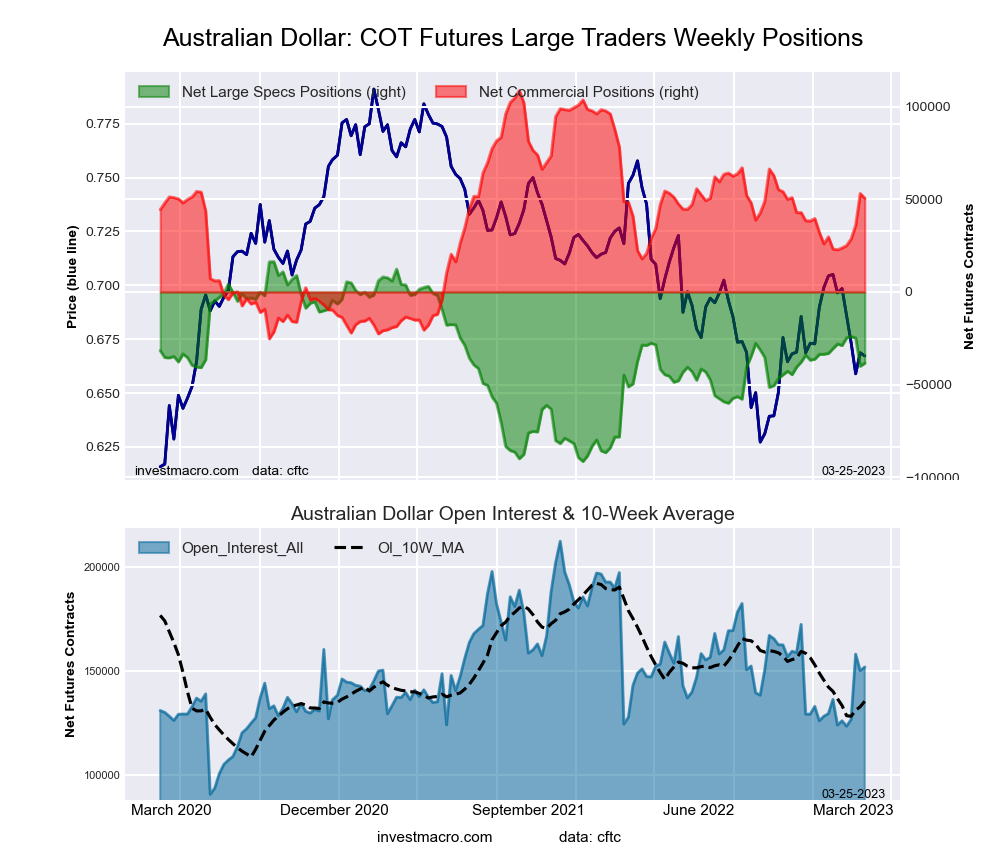
Australian Dollar Forex Futures COT ChartThe Australian Dollar large speculator standing this week came in at a net position of -38,459 contracts in the data reported through Tuesday. This was a weekly advance of 1,632 contracts from the previous week which had a total of -40,091 net contracts.

This week’s current strength score (the trader positioning range over the past three years, measured from 0 to 100) shows the speculators are currently Bearish with a score of 49.2 percent. The commercials are Bullish with a score of 56.6 percent and the small traders (not shown in chart) are Bearish with a score of 22.9 percent.

AUSTRALIAN DOLLAR StatisticsSPECULATORSCOMMERCIALSSMALL TRADERS
– Percent of Open Interest Longs:27.157.511.8
– Percent of Open Interest Shorts:52.524.219.8
– Net Position:-38,45950,554-12,095
– Gross Longs:41,18387,35417,905
– Gross Shorts:79,64236,80030,000
– Long to Short Ratio:0.5 to 12.4 to 10.6 to 1
NET POSITION TREND:
– Strength Index Score (3 Year Range Pct):49.256.622.9
– Strength Index Reading (3 Year Range):BearishBullishBearish
NET POSITION MOVEMENT INDEX:
– 6-Week Change in Strength Index:-9.620.8-42.6


New Zealand Dollar Futures:

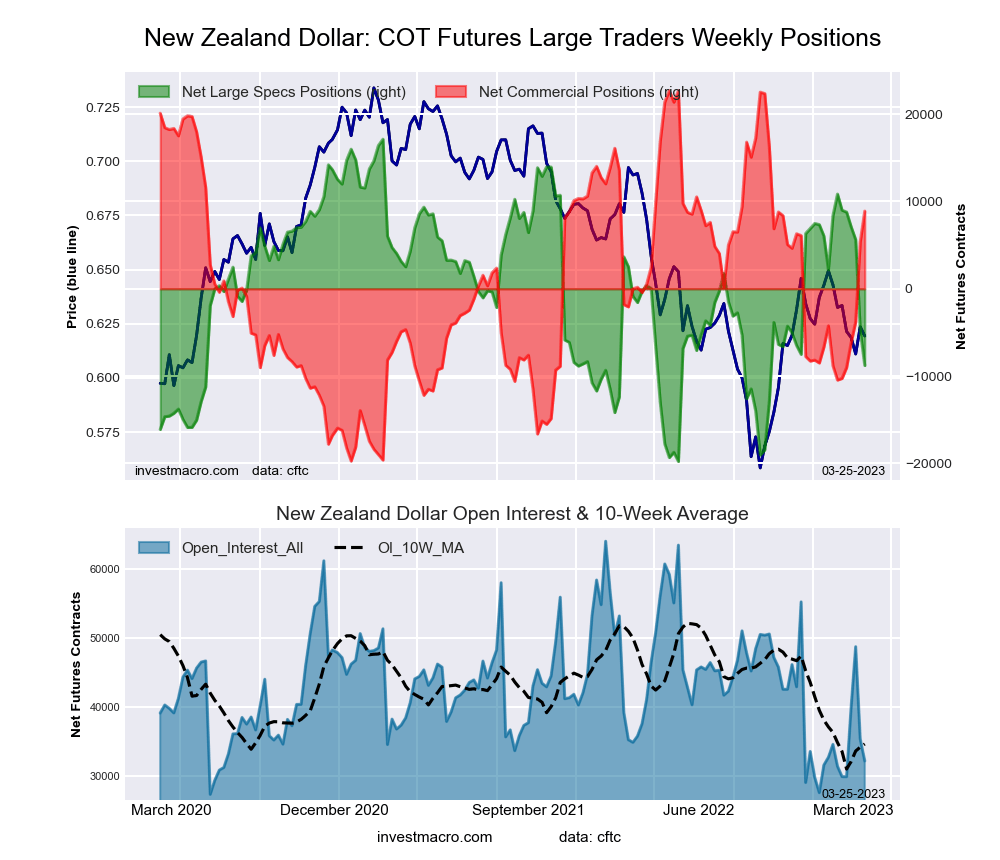
New Zealand Dollar Forex Futures COT ChartThe New Zealand Dollar large speculator standing this week came in at a net position of -8,783 contracts in the data reported through Tuesday. This was a weekly reduction of -4,042 contracts from the previous week which had a total of -4,741 net contracts.

This week’s current strength score (the trader positioning range over the past three years, measured from 0 to 100) shows the speculators are currently Bearish with a score of 29.8 percent. The commercials are Bullish with a score of 67.5 percent and the small traders (not shown in chart) are Bullish with a score of 50.3 percent.

NEW ZEALAND DOLLAR StatisticsSPECULATORSCOMMERCIALSSMALL TRADERS
– Percent of Open Interest Longs:21.067.010.5
– Percent of Open Interest Shorts:48.339.410.9
– Net Position:-8,7838,896-113
– Gross Longs:6,76521,5763,392
– Gross Shorts:15,54812,6803,505
– Long to Short Ratio:0.4 to 11.7 to 11.0 to 1
NET POSITION TREND:
– Strength Index Score (3 Year Range Pct):29.867.550.3
– Strength Index Reading (3 Year Range):BearishBullishBullish
NET POSITION MOVEMENT INDEX:
– 6-Week Change in Strength Index:-53.245.63.2


Mexican Peso Futures:

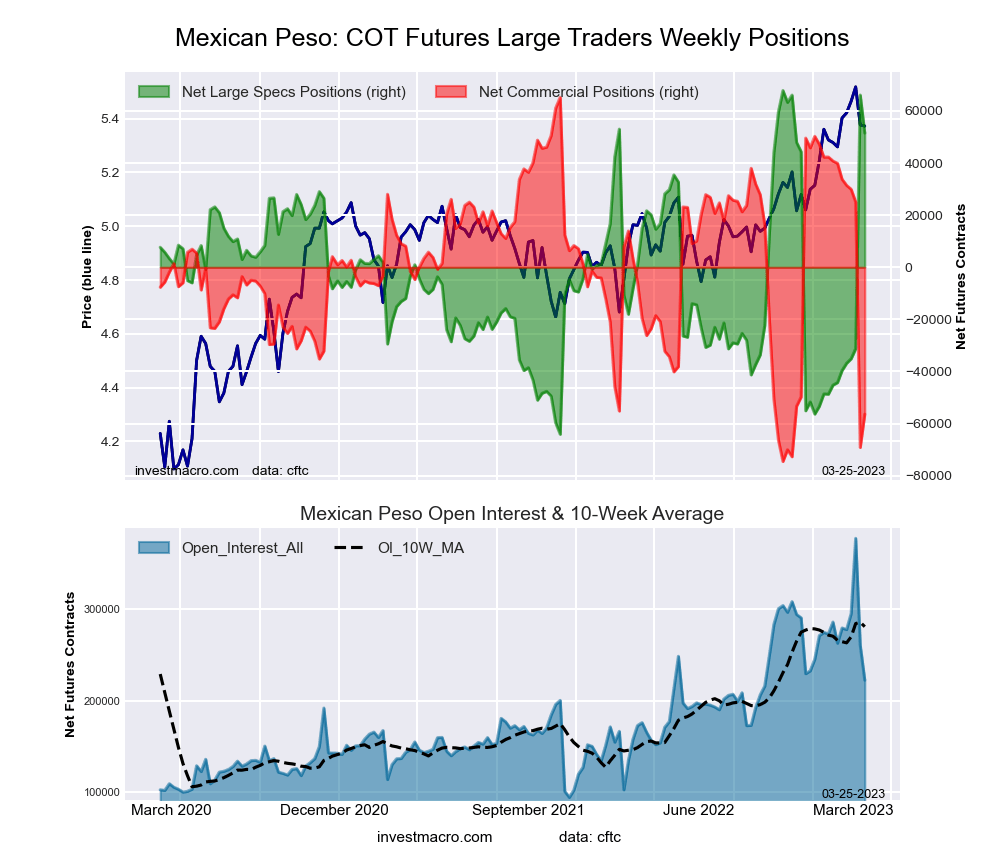
Mexican Peso Futures COT ChartThe Mexican Peso large speculator standing this week came in at a net position of 51,530 contracts in the data reported through Tuesday. This was a weekly fall of -14,597 contracts from the previous week which had a total of 66,127 net contracts.

This week’s current strength score (the trader positioning range over the past three years, measured from 0 to 100) shows the speculators are currently Bullish-Extreme with a score of 87.6 percent. The commercials are Bearish-Extreme with a score of 13.0 percent and the small traders (not shown in chart) are Bullish-Extreme with a score of 86.5 percent.

MEXICAN PESO StatisticsSPECULATORSCOMMERCIALSSMALL TRADERS
– Percent of Open Interest Longs:45.950.93.2
– Percent of Open Interest Shorts:22.776.31.0
– Net Position:51,530-56,4134,883
– Gross Longs:101,899113,0137,110
– Gross Shorts:50,369169,4262,227
– Long to Short Ratio:2.0 to 10.7 to 13.2 to 1
NET POSITION TREND:
– Strength Index Score (3 Year Range Pct):87.613.086.5
– Strength Index Reading (3 Year Range):Bullish-ExtremeBearish-ExtremeBullish-Extreme
NET POSITION MOVEMENT INDEX:
– 6-Week Change in Strength Index:72.6-68.92.9


Brazilian Real Futures:

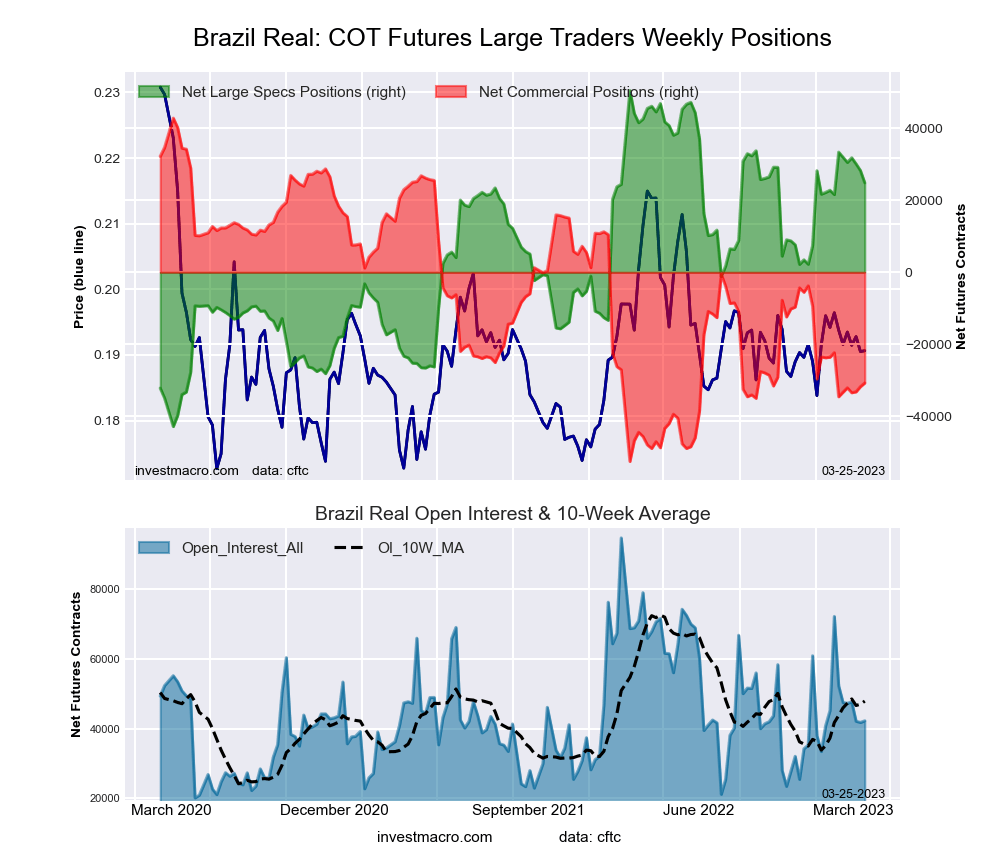
Brazil Real Futures COT ChartThe Brazilian Real large speculator standing this week came in at a net position of 24,857 contracts in the data reported through Tuesday. This was a weekly fall of -3,414 contracts from the previous week which had a total of 28,271 net contracts.

This week’s current strength score (the trader positioning range over the past three years, measured from 0 to 100) shows the speculators are currently Bullish with a score of 67.4 percent. The commercials are Bearish with a score of 26.7 percent and the small traders (not shown in chart) are Bullish-Extreme with a score of 100.0 percent.

BRAZIL REAL StatisticsSPECULATORSCOMMERCIALSSMALL TRADERS
– Percent of Open Interest Longs:65.617.516.9
– Percent of Open Interest Shorts:6.790.42.9
– Net Position:24,857-30,7755,918
– Gross Longs:27,6817,4017,140
– Gross Shorts:2,82438,1761,222
– Long to Short Ratio:9.8 to 10.2 to 15.8 to 1
NET POSITION TREND:
– Strength Index Score (3 Year Range Pct):67.426.7100.0
– Strength Index Reading (3 Year Range):BullishBearishBullish-Extreme
NET POSITION MOVEMENT INDEX:
– 6-Week Change in Strength Index:-10.84.741.0


Bitcoin Futures:

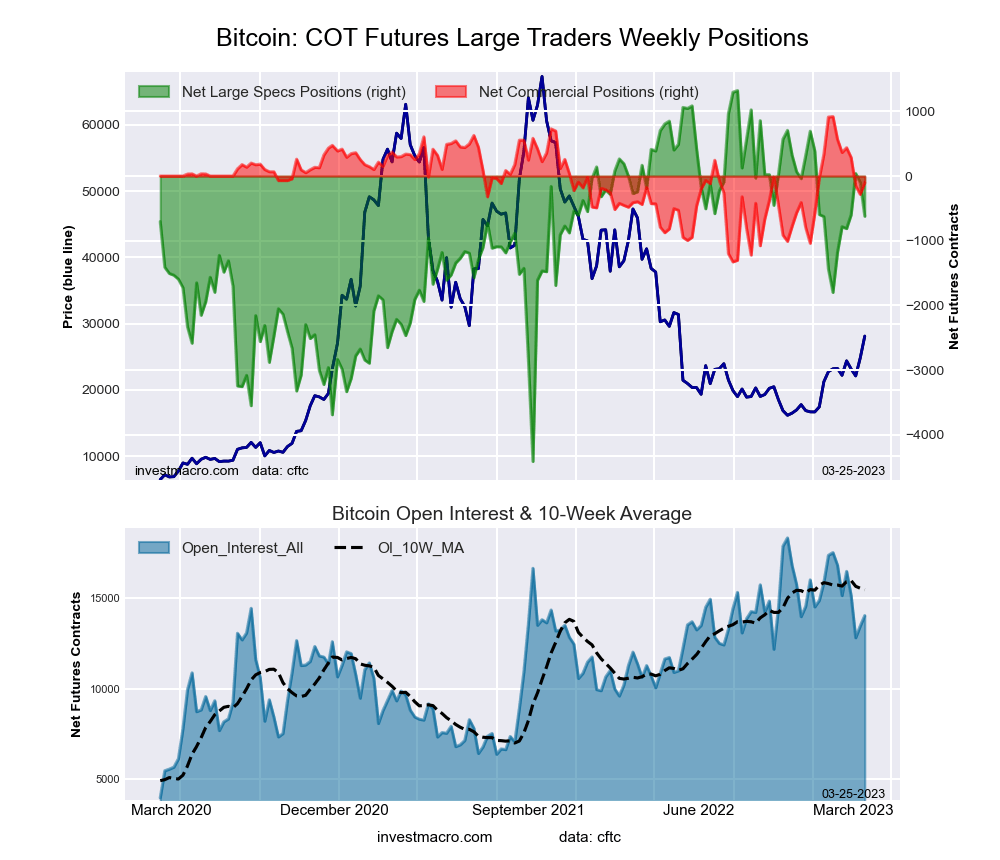
Bitcoin Crypto Futures COT ChartThe Bitcoin large speculator standing this week came in at a net position of -621 contracts in the data reported through Tuesday. This was a weekly reduction of -519 contracts from the previous week which had a total of -102 net contracts.

This week’s current strength score (the trader positioning range over the past three years, measured from 0 to 100) shows the speculators are currently Bullish with a score of 66.1 percent. The commercials are Bullish with a score of 54.5 percent and the small traders (not shown in chart) are Bearish with a score of 29.4 percent.

BITCOIN StatisticsSPECULATORSCOMMERCIALSSMALL TRADERS
– Percent of Open Interest Longs:77.23.110.3
– Percent of Open Interest Shorts:81.73.85.2
– Net Position:-621-103724
– Gross Longs:10,8514291,450
– Gross Shorts:11,472532726
– Long to Short Ratio:0.9 to 10.8 to 12.0 to 1
NET POSITION TREND:
– Strength Index Score (3 Year Range Pct):66.154.529.4
– Strength Index Reading (3 Year Range):BullishBullishBearish
NET POSITION MOVEMENT INDEX:
– 6-Week Change in Strength Index:9.7-29.82.6


Article By InvestMacroReceive our weekly COT Newsletter

*COT Report: The COT data, released weekly to the public each Friday, is updated through the most recent Tuesday (data is 3 days old) and shows a quick view of how large speculators or non-commercials (for-profit traders) were positioned in the futures markets.

The CFTC categorizes trader positions according to commercial hedgers (traders who use futures contracts for hedging as part of the business), non-commercials (large traders who speculate to realize trading profits) and nonreportable traders (usually small traders/speculators) as well as their open interest (contracts open in the market at time of reporting). See CFTC criteria here.


Murrey Math Lines 24.03.2023 (Brent, S&P 500)

By RoboForex.com

Brent

On H4, Brent quotes are under the 200-day Moving Average, revealing the prevalence of a downtrend. The RSI has broken the support line. In such circumstances, we should expect 0/8 (75.00) to break and the price to go down to the support at -1/8 (71.88). The scenario can be canceled if the price grows to the resistance at 2/8 (81.25).

Brent_H4
Risk Warning: the result of previous trading operations do not guarantee the same results in the future

On M15, a new breakaway of the lower line of the VoltyChannel indicator will increase the probability of further falling of the price.

Brent_M15
Risk Warning: the result of previous trading operations do not guarantee the same results in the future

S&P 500

A similar situation has formed on the S&P 500 chart. On H4, the quotes are under the 200-day Moving Average, while the RSI has broken the support line. As a result, we expect the level of 1/8 (3945.3) to break and the price to fall to the support level of -1/8 (3867.2). The scenario can be canceled if the price rises above the resistance at 2/8 (3984.4), which might lead to a trend reversal and growth of the S&P 500 index to 3/8 (4023.4).

S&P500_H4
Risk Warning: the result of previous trading operations do not guarantee the same results in the future

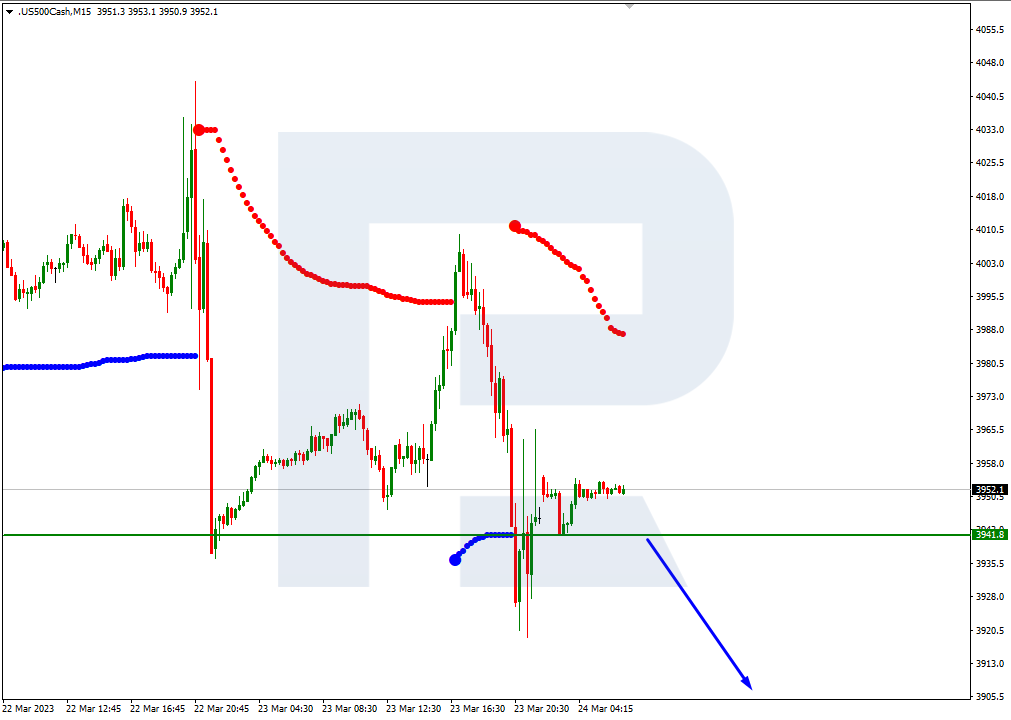
On M15, the decline in the price can be additionally supported by a breakaway of the lower line of VoltyChannel.

S&P500_M15
Risk Warning: the result of previous trading operations do not guarantee the same results in the future

Article By RoboForex.com

Attention!
Forecasts presented in this section only reflect the author’s private opinion and should not be considered as guidance for trading. RoboForex LP bears no responsibility for trading results based on trading recommendations described in these analytical reviews.

Week Ahead: 3 factors that could jolt EURUSD

By ForexTime 

We return to the usual servings of tier-1 macroeconomic data for major economies, where inflation is all the rage, after highly anticipated central bank meetings this week have come and gone.

The final week of Q1 2023 also has the added spice of hearings on Capitol Hill to uncover “what went wrong”, as Fed Chair Jerome Powell asked publicly recently, in Silicon Valley Bank’s collapse.

Here are the economic data releases and events that could move global markets in the coming week:

Monday, March 27

  • CNH: China February industrial profits
  • EUR: Germany March IFO business climate
  • GBP: BOE Governor Andrew Bailey speech

Tuesday, March 28

  • AUD: Australia February retail sales
  • USD: US Senate hearings on Silicon Valley Bank begins; US March consumer confidence

Wednesday, March 29

  • AUD: Australia February CPI
  • Crude: Weekly EIA Crude Oil Inventories
  • WSt30_m: House panel on recent US bank failures

Thursday, March 30

  • EUR: Germany March CPI; Eurozone March economic and consumer confidence
  • USD: US weekly jobless claims; US 4Q GDP (third estimate); speeches by Boston Fed President Susan Collins and Richmond Fed President Thomas Barkin

Friday, March 31

  • JPY: Japan February unemployment, retail sales, industrial production; March Tokyo CPI
  • CNH: China March PMIs
  • EUR: Eurozone February unemployment and March inflation; Germany March unemployment
  • GBP: UK GDP (final)
  • USD: US February PCE Deflator, personal income and spending; New York Fed President John Williams speech


Here are 3 events in the week ahead that could trigger big moves for the world’s most-traded FX pair, EURUSD, in the week ahead:


1) Hearings on Silicon Valley Bank failure

The US government is under pressure to find out why and how Silicon Valley Bank collapsed, despite all the regulatory oversight and safeguards that have been put in place since the global financial crisis more than a decade ago.

Note that fears over further banking turmoil are still plaguing market sentiment, as evidenced by the selloffs in banking stocks and the US dollar of late.

Even during Fed Chair Jerome Powell’s press conference on March 22nd, the greenback’s larger move came following comments surrounding US financial stability, rather than the conventional monetary policy talking points pertaining to the Fed’s inflation target.

Should these mid-week hearings before the House and Senate reveal new information of failings pertaining to the US banking sector, further stoking contagion fears, that may trigger further declines for the US Dollar while lifting EURUSD higher.


2) Fed Speak

Fresh from the just-concluded FOMC meeting, Fed officials are released back into the public arena, with markets eager for more clues about the Fed’s thinking about its own rate-hike cycle.

Chair Powell did reveal that the FOMC even considered pausing its rate hikes, in light of the recent banking turmoil.

The FOMC’s own projections (a.k.a. Dot Plot) still point to a 5.1% rates peak, suggesting that the end is near for the Fed rate hikes that began 12 months ago and resulted in 475 basis points worth of hikes so far.

As things stand, markets are now fully expecting the Fed to instead, CUT its benchmark rates by 50 basis points by September.

Should the upcoming speeches by Boston Fed President Susan Collins and Richmond Fed President Thomas Barkin on Thursday push back on such forecasts, such hawkish language may help restore the US dollar, provided there aren’t any further negative developments surrounding the US financial sector in the interim.


3) US, Eurozone inflation

In what could be a frantic Friday for EURUSD, traders will be met with fresh inflation data out of both sides of the Atlantic.

Here are the market forecasts for these tier-1 prints:

  • Eurozone March CPI*: 7.5% (lower than February’s 8.5% year-on-year advance)
  • US February Core PCE Deflator**: 4.7% (matching January’s year-on-year figure)
*CPI = consumer price index, which is used to measure headline inflation
**The US Core PCE print is the Fed’s preferred way of measuring inflation (as opposed to the CPI)

As things stand, inflation in both the US and Eurozone economies remain much higher than their respective central banks’ 2% target.

Markets are set to bid up the currency of the economy whose official inflation print produces the higher gap above market forecasts.

In other words, EURUSD traders are set to react using this simplified formula:

Higher-than-expected inflation = more rate hikes = stronger currency

And here’s why:

  • Evidence of stubbornly-elevated inflation should require more rate hikes by the central bank.
  • The prospects of more rate hikes for an economy (relative to its peers) tend to translate into more currency strength.


Overall, EURUSD’s performance over the remainder of Q1 2023 may be largely dependent on how the confluence of above-listed factors play out over the coming week.


Key levels for EURUSD

RESISTANCE

  • 1.09297 intraday peak on March 23rd
  • 1.09426 – 50% Fibonacci retracement from January 2021 to October 2022 plummet
  • 1.10329 early-February peak


SUPPORT

  • 1.0800 psychologically-important level, also resistance for mid-Feb cycle high
  • 50-day SMA (simple moving average)
  • 1.0690 resistance turn support


From current levels (around 1.083) at the time of writing, Bloomberg’s FX model points to a 73% chance that EURUSD will trade within the 1.0688 – 1.0981 range over the next week.


Forex-Time-LogoArticle by ForexTime

ForexTime Ltd (FXTM) is an award winning international online forex broker regulated by CySEC 185/12 www.forextime.com

Mid-Week Technical Outlook: USD Shaky Ahead Of Fed Meeting

By ForexTime 

A sense of calm returned to financial markets on Wednesday as investors prepared for the highly anticipated Federal Reserve interest rate decision this evening.

Investors remain hopeful that the Fed could adopt a more cautious approach toward interest rates following the market chaos sparked by a collapse in Credit Suisse and two large U.S. regional banks. Although the recent market turmoil concerning Silicon Valley Bank and contagion fears have left investors on edge, U.S. inflation still remains at uncomfortable levels. Markets expect the Fed to raise interest rates by 25 basis points in March, but there is still widespread uncertainty over what to expect in Q2 and beyond.

As discussed earlier in the week, if the Federal Reserve decides to leave interest rates unchanged – this could signal the end of the rat hike cycle. Such a move could deal a heavy blow to the dollar which has already weakened against almost every G10 currency this week. Although markets widely expect the Fed to move ahead with a 25bp hike, the dollar could end up weakening if this decision is served in a dovish fashion.

Taking a look at the technical picture, the Dollar Index (DXY) remains under pressure. The recent closer below 103.00 could signal further downside with 102.30 and 102.00 key levels of interest. If prices can push back above 103.00, then bulls may target 104.00.

EURUSD kisses 1.0800

The EURUSD remains firmly bullish on the daily charts with prices touching the 1.0800 resistance. Bulls continue to draw strength from a weaker dollar with a breakout on the horizon. A solid daily close above the 1.0800 level could open the doors towards 1.0900. Should bears jump back into the scene, prices could sink back towards 1.0750.

GBPUSD breakout on the horizon?

Pound bulls were injected with fresh inspiration after hot UK inflation figures fuelled expectations around the Bank of England hiking rates. Prices rose unexpectedly in the UK last month, rising 10.4% from January’s 10.1% thanks to the rising cost of food, clothing, restaurants, and hotels. The GBPUSD surged towards 1.2300 and could push higher if the dollar remains shaky ahead of the Fed meeting. A solid move above 1.2300 could signal an incline towards 1.2420.

USDJPY rises ahead of FOMC

The improving market mood has rekindled risk sentiment, dulling the appetite for safe-haven assets like the Yen. Prices have edged higher today, extending the rebound from yesterday with bulls eyeing resistance around 133.30. However, this move higher could come to an abrupt end if a cautious Fed hits demand for the dollar. Looking at the technical picture, sustained weakness below 133.30 may encourage a decline back toward 132.50 and 131.20, respectively. Should 133.30 prove to be unreliable resistance, this could trigger an incline towards 134.30.

AUDUSD waits for catalyst

It’s all about the 0.6720 level on the AUDUSD. This pivotal level could determine whether the currency pair pushes higher or trades lower. Although a strong daily close above this point may open the doors toward 0.6800, more resistance can be found around the 100 and 200-day Simple Moving Averages. Alternatively, sustained weakness under this level could inspire a selloff back towards 0.6650 and 0.6560.


Forex-Time-LogoArticle by ForexTime

ForexTime Ltd (FXTM) is an award winning international online forex broker regulated by CySEC 185/12 www.forextime.com

Japanese Candlesticks Analysis 21.03.2023 (XAUUSD, NZDUSD, GBPUSD)

By RoboForex.com

XAUUSD, “Gold vs US Dollar”

Near the resistance, gold has formed a Shooting Star reversal pattern. Currently, the instrument might go by the reversal signal in a descending wave. The target of the decline might be 1960.00. Upon testing the support level, the pair might push off it and continue the uptrend. However, the quotes might grow directly to 2000.00 without any pullback.

GOLD
Risk Warning: the result of previous trading operations do not guarantee the same results in the future

NZDUSD, “New Zealand Dollar vs US Dollar”

On H4, near the resistance, NZDUSD has formed a Harami reversal pattern. Currently, the instrument might go by the reversal signal in a descending wave. The target of the correction might be 0.6180. After a rebound from the support level, the quotes might continue the uptrend. However, the pair might rise to 0.6270 without testing the support.

NZDUSD
Risk Warning: the result of previous trading operations do not guarantee the same results in the future

GBPUSD, “Great Britain Pound vs US Dollar”

On H4, near the resistance level, GBPUSD has formed a Shooting Star reversal pattern. Currently, the instrument might go by the reversal signal in a descending wave. The target of the pullback might be 1.2200. However, the price might grow to 1.2325 and continue the uptrend without correcting to the support.

GBPUSD

Article By RoboForex.com

Attention!
Forecasts presented in this section only reflect the author’s private opinion and should not be considered as guidance for trading. RoboForex LP bears no responsibility for trading results based on trading recommendations described in these analytical reviews.

The Fed Will Set the Mood for EURUSD

By RoboForex Analytical Department

EUR/USD starts a new week of March by consolidating around 1.0670.

This week, investors will be anxious. The key event is the meeting of the US Federal Reserve System, where monetary politicians will have to make difficult decisions, specifically the ones concerning the interest rate. As soon as problematic spots emerged in the US banking sector, the market started discussing the necessity to make a pause in lifting the interest rate to stop the crisis from expanding.

On the other hand, there are appearing more and more arguments supporting the growth of the interest rate. Among them there are the increase in base inflation and the Core PCE inflation index, tracked by the Fed.

Earlier the ECB lifted its rate by 50 base points, dismissing banking problems, and continued tightening the monetary policy. Its main goal is still beating high prices.

By the end of the week, volatility of EUR/USD will have increased noticeably.

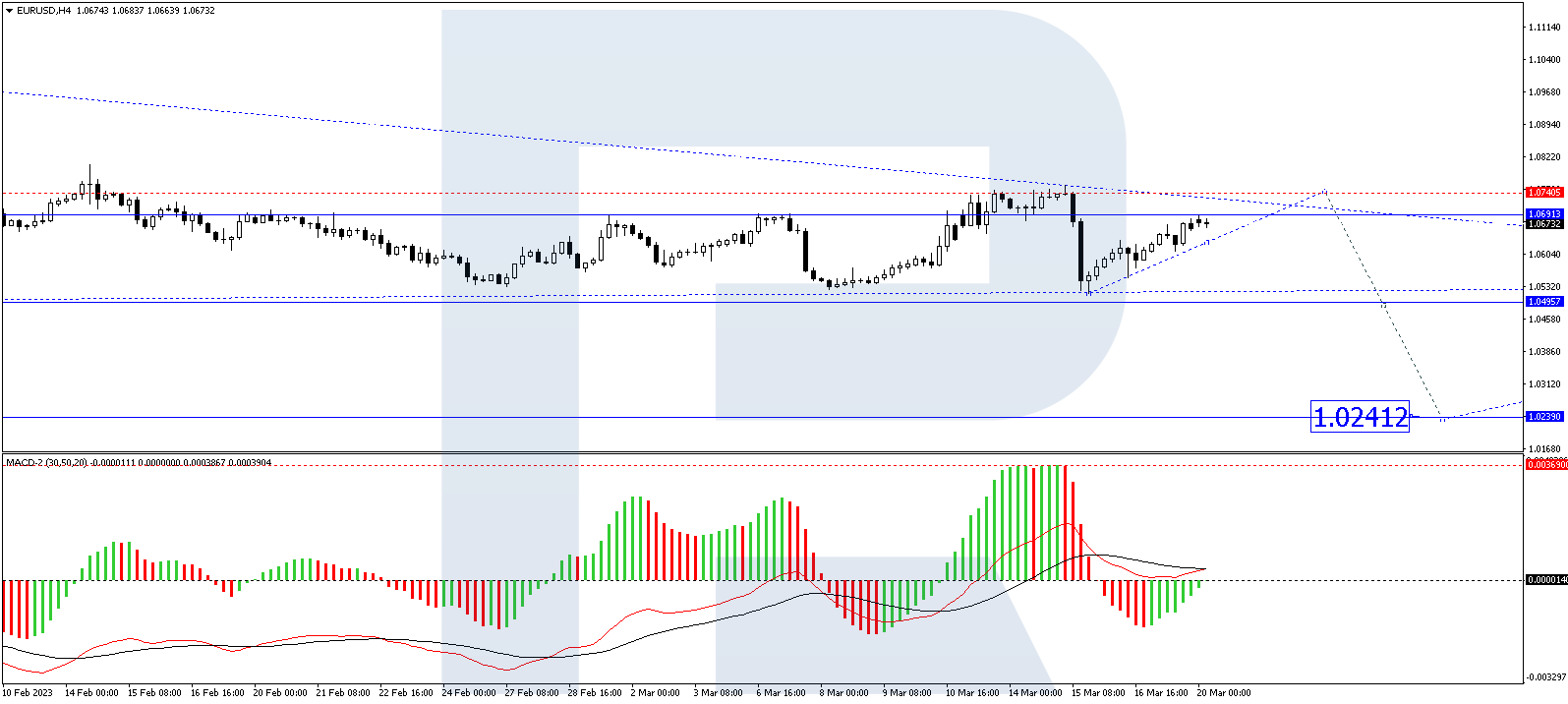
On H4, EUR/USD has formed a correctional structure to 1.0630. At the moment, the market is consolidating around it and with an escape from the range upwards might extend the structure to 1.0708. Then a decline to 1.0630 might follow. And then a link of growth to 1.0742 is not excluded. There the wave of growth will exhaust its potential. Next, the pair should go down by the trend to 1.0505. Technically, this scenario is confirmed by the MACD. Its signal line is above zero and is preparing to renew the highs.

On the H1 chart, EUR/USD has completed a wave of growth to 1.0650. Today the market has already formed a link of decline to 1.0620 and a link of growth to 1.0687. At the moment, a consolidation range is forming under this level. The price might escape it upwards, opening a pathway to 1.0708. Then a decline to 1.0620 and growth to 1.0742 are expected. Upon reaching this level, the price might fall to 1.0600, and if this level breaks, the quotes might drop to 1.0540. Technically, this scenario is confirmed by the Stochastic oscillator. Its signal line is near 50, and later it should fall to 20.

Disclaimer

Any forecasts contained herein are based on the author’s particular opinion. This analysis may not be treated as trading advice. RoboForex bears no responsibility for trading results based on trading recommendations and reviews contained herein.

Week Ahead: More big swings for USDCHF?

By ForexTime

The Swiss Franc has been the most volatile G10 currency against the US dollar this week.

The turmoil from recent days surrounding Silicon Valley Bank and Credit Suisse has roiled USDCHF, while altering the market’s expectations for key central bank meetings due in the coming week.

And there could be more volatility in store for this FX pair, in a week that features these economic data releases and events:

Monday, March 20

  • CNH: China loan prime rates
  • EUR: ECB President Christine Lagarde speech

Tuesday, March 21

  • AUD: RBA meeting minutes release
  • EUR: Germany March ZEW survey expectations
  • CAD: Canada February consumer price index (CPI)
  • Nike earnings

Wednesday, March 22

  • NZD: New Zealand 1Q consumer confidence
  • GBP: UK February CPI
  • USD: Fed rate decision

Thursday, March 23

  • CHF: Swiss National Bank rate decision
  • NOK: Norges Bank rate decision
  • GBP: Bank of England rate decision
  • USD: US weekly jobless claims

Friday, March 24

  • JPY: Japan February CPI
  • EUR: Eurozone January manufacturing and services PMIs
  • GBP: UK February retail sales; March PMIs, consumer confidence


Typically, in a week like the upcoming one, we’d be focusing on the US Federal Reserve (Fed) and the Bank of England (BOE), being the central banks of larger economies compared to the Swiss National Bank (SNB).

However, given the recent Credit Suisse crisis, the SNB has muscled its way into the spotlight, along with its currency, the Swiss Franc (CHF).


Here are 3 reasons to watch how USDCHF fares next week:

1) Swiss National Bank’s take on Credit Suisse crisis

The SNB carries out its monetary policy assessment just 4 times per year, half the number of policy meetings that the Fed has scheduled for 2023.

For the upcoming SNB meeting, markets had expected another hike of 50-basis points (bps), following the central bank’s hikes last year totalling 175bps.

Yet, the Credit Suisse saga that’s unfolding in the SNB’s own backyard, noting the irony of Switzerland’s long-held stature as a banking haven, adds a dramatic dimension to the press conference by SNB President Thomas Jordan next week.

And the Swiss Franc (CHF) may react less to the actual adjustment to the policy rate, but rather any commentary that President Jordan may offer surrounding the Credit Suisse crisis.

Note how CHF weakened against every single one of its G10 peers as the CS drama played out across global financial markets this week:

The stakes are high for the SNB.

After all, CS is Switzerland’s second biggest lender, with the bank’s assets equal to about 70% of the country’s GDP!

Furthermore, the Bank of International Settlements has listed Credit Suisse as one of the top-30 banks most important to the global financial system.


Credit Suisse’s importance prompted the SNB to step in and extend a US$ 54 billion (CHF 50 billion) credit line to the embattled bank to help shore up liquidity.

Also, following the central bank’s previous policy meeting in December 2022, the SNB President had deviated from the norm of not commenting on individual commercial banks and publicly supported Credit Suisse’s ongoing 3-year transformation to its business.

Having already extended verbal, written, and liquidity support, should the SNB even hint that it has to step in with further aid for CS, that may actually have the unintended effect of weakening the Swiss Franc on the notion that Credit Suisse’s turmoil is not yet over.

2) Fed’s dilemma between inflation and financial stability

Last week, markets had assigned a 70% chance that the Fed would trigger a 50-bps hike at its March meeting.

That would reassert its aggressiveness in its fight against inflation after having downshifted to a relatively smaller 25-bps hike at its previous policy meeting held on January 31 – February 1st, 2023.

But that calculus has been altered dramatically, as the collapse of Silicon Valley Bank continues reverberating across the US banking sector.

With the Fed having to shore up financial stability in its own backyard, markets believe policymakers cannot follow through with yet another larger rate hike, which are intended to incur further damage to the economy so as to subdue US inflation that’s still stubbornly elevated.

Hence, at the time of writing, markets have whittled down their forecasts to an 81% chance of a 25-bps hike by the Fed next week.

Similar to the SNB (and the ECB’s press conference this week), concerns surrounding financial stability risks are set to dominate Fed Chair Powell’s session with the media after the FOMC meeting concludes.

Should markets even get a whiff that Chair Powell and his colleagues are growing more concerned about potential contagion risks and are refusing the shut the door on winding down, or perhaps even an abrupt pause, to the Fed’s rate-hike cycle, such policy clues may weaken the US dollar and drag USDCHF lower.

3) USDCHF’s one-week implied volatility surges to fresh year-to-date high

All of the above is clearly not lost on markets, prompting a surge in the expected volatility for USDCHF over the next one-week period.


With the banking woes of late leaving policymakers, both the Fed and the SNB, between a rock and a hard place:

  • Do these central bankers keep focusing on their ongoing battle against inflation and persist with a 50-bps hike, risking further damage to its financial sector that’s still raw and vulnerable?
  • Or do the likes of the SNB and the Fed opt for a relatively smaller 25-bps hike to preserve the still-fragile sentiment surrounding banks, but risk letting inflation rage further?


With so much at stake, markets are ready to react to the slightest clues.

The central bank that shows the greater concern for its own banking sector, should see its currency weaken further.

  • Should fears surrounding Credit Suisse spike anew over the coming week, that could even launch USDCHF above its 100-day simple moving average.
  • On the other hand, if yet another US bank is added to this infamous list which already features the likes of Silicon Valley Bank, Signature Bank, and First Republic, fresh alarms surrounding the US banking sector may drag USDCHF back into sub-0.920 domain.


Key levels for USDCHF

RESISTANCE

  • 0.93393: previous cycle high
  • 100-day SMA
  • 0.9440 region: early-March peaks


SUPPORT

  • 50-day SMA
  • 0.920 psychologically-important region
  • 0.905 – 0.907: year-to-date lows


From current levels, Bloomberg’s FX model points to a 73% chance that USDCHF will trade within the 0.9088 to 0.9420 range over the next week.


Forex-Time-LogoArticle by ForexTime

ForexTime Ltd (FXTM) is an award winning international online forex broker regulated by CySEC 185/12 www.forextime.com

Murrey Math Lines 16.03.2023 (USDCHF, XAUUSD)

By RoboForex.com

USDCHF, “US Dollar vs Swiss Franc”

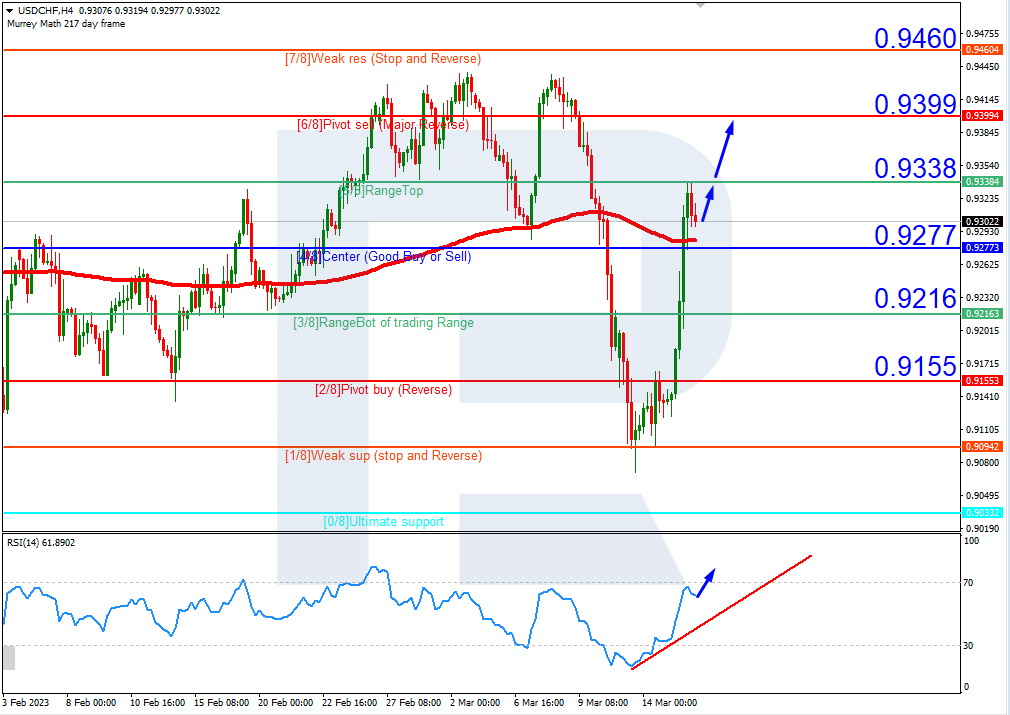
On H4, USDCHF pair has broken through the 200-day Moving Average and is now above it, which indicates a possible bullish trend. The RSI is approaching the overbought area. In this situation we should expect the price to test 5/8 (0.9338) and its further breakdown and increase to resistance level of 6/8 (0.9399). A break-down of the support at 4/8 (0.9277) will cancel this scenario. In this case the pair may fall to the 3/8 (0.9216).

USDCHF_H4
Risk Warning: the result of previous trading operations do not guarantee the same results in the future

On M15, the upper line of the VoltyChannel indicator has been broken. This event increases the probability of further price growth.

USDCHF_M15
Risk Warning: the result of previous trading operations do not guarantee the same results in the future

XAUUSD, “Gold vs US Dollar”

On H4, level 8/8 (1937.50) and broke away from it, which indicates a possible corrective decline in the price. Convergence is observed on the RSI, which is also a signal of drop in the price. As a result, the price is likely to break down the level of 6/8 (1906.25) and then fall to the support level 4/8 (1875.00). Overcoming resistance at 7/8 (1921.88) can cancel this scenario. If that happens, the price of gold might return to the 8/8 (1937.50).

XAUUSD_H4
Risk Warning: the result of previous trading operations do not guarantee the same results in the future

On M15, a break-down of the bottom line of the VoltyChannel indicator will be an additional signal for the downside movement of the price.

XAUUSD_M15

Article By RoboForex.com

Attention!
Forecasts presented in this section only reflect the author’s private opinion and should not be considered as guidance for trading. RoboForex LP bears no responsibility for trading results based on trading recommendations described in these analytical reviews.