Archive for Financial News – Page 241

China’s stock market rally underscores expectations of economic recovery

By JustMarkets

The US stock market did not trade yesterday due to the holiday. But futures on indices traded in the European and partly in the US session. By the close of the futures market on Monday, the indices were down a bit, so the stock market’s opening on Tuesday will be accompanied by a price gap.

Traders should not forget that it is the earnings season in the United States. Such companies as Morgan Stanley (MS), Goldman Sachs (GS), Interactive Brokers (IBKR), and United Airlines Holdings (UAL) are reporting today.

Equity markets in Europe were mostly up yesterday. German DAX (DE30) gained 0.31%, French CAC 40 (FR40) added 0.28%, Spanish IBEX 35 (ES35) fell by 0.12%, and British FTSE 100 (UK100) closed on Monday with a 0.20% gain.

Short-term interest rate differentials are a good indicator of the future trajectory of relative monetary policy cycles. Using central bank policy projections, economists expect the two-year EUR/USD swap differential to reverse this year. Right now, swaps are trading at about 125 basis points in favor of the dollar, and by the end of this year, that differential could change to 40 basis points in favor of the euro. If this materializes, the EUR/USD currency pair will reach the 1.20 level before the end of the year.

In Europe, a surprisingly warm winter led to a drop in natural gas prices. Europe may come out of the heating season with more than 50% of its storage capacity filled. This could limit the jump in natural gas prices in the second half of 2023 to around €140-160/MWh. This is still high but well below the €250-300/MWh level seen last summer.

Goldman Sachs raised its aluminum price forecast due to rising demand in China and Europe. According to analysts, the metal is likely to cost an average of $3125 per tonne this year. However, it is pointed out that the upward price impulse will gradually increase in the spring.

Oil prices fell on Monday, consolidating after a strong rise last week ahead of the publication of demand forecasts from OPEC and IEA. These monthly reports strongly influence oil market trends in global oil demand. They may be essentially this month, given the importance the market attaches to a potential recovery in oil demand in China.

Asian markets traded flat yesterday. Japan’s Nikkei 225 (JP225) decreased by 1.14% on Monday, China’s FTSE China A50 (CHA50) added 1.50%, Hong Kong’s Hang Seng (HK50) was up by 0.04% on the day, India’s NIFTY 50 (IND50) fell by 0.34%, and Australia’s S&P/ASX 200 (AU200) was positive by 0.82%.

China’s GDP growth slowed in the latest quarter to +2.9% year-over-year, down from +3.9% in the previous quarter. But industrial production rose by 1.3% last month, while the unemployment rate fell to 5.5% from 5.7%. Analysts say rising domestic demand in China could be an important counterbalance to slowing growth in the US and Europe. Investors are once again buying up Chinese blue chips, from large consumer goods to financial companies. China’s stock market rally underscores expectations of an economic recovery at a time when most developed countries are in a recession. Foreign capital inflows into China reached about 44 billion yuan last week, the highest since May 2021.

There is a growing possibility that the Bank of Japan may announce a significant policy change this week as bond yields reach the upper limit again. According to economists, there are two options at the moment. The first (main scenario) is the abolition of the yield curve control policy. This might lead to a sell-off in Japanese equities, which would strengthen the yen. The second scenario is that Japan’s central bank can extend the range to 75 basis points on either side of its 0% target for 10-year government bonds. This would save time until the end of the quarter when Kuroda resigns. Either way, the closer we get to spring, the more likely the Bank of Japan will change course.

S&P 500 (F) (US500) 3,999.09 0 (0%)

Dow Jones (US30)34,302.61 0 (0%)

DAX (DE40) 15,134.04 +47.52 (+0.31%)

FTSE 100 (UK100) 7,860.07 +16.00 (+0.20%)

USD Index 102.39 +0.19 (+0.18%)

Important events for today:
  • – China GDP (q/q) at 04:00 (GMT+2);
  • – China Industrial Production (m/m) at 04:00 (GMT+2);
  • – China Retail Sales (m/m) at 04:00 (GMT+2);
  • – China Unemployment Rate (m/m) at 04:00 (GMT+2).
  • – UK Average Earnings Index (m/m) at 09:00 (GMT+2);
  • – UK Claimant Count Change (m/m) at 09:00 (GMT+2);
  • – UK Unemployment Rate (m/m) at 09:00 (GMT+2);
  • – German Consumer Price Index (m/m) at 09:00 (GMT+2);
  • – World Economic Forum Annual Meetings at 10:00 (GMT+2);
  • – German ZEW Economic Sentiment (m/m) at 12:00 (GMT+2);
  • – Eurozone ZEW Economic Sentiment (m/m) at 12:00 (GMT+2);
  • – Canada Consumer Price Index (m/m) at 15:30 (GMT+2);
  • – US NY Empire State Manufacturing Index (m/m) at 15:30 (GMT+2);
  • – US FOMC Member Williams Speaks at 22:00 (GMT+2).

By JustMarkets


This article reflects a personal opinion and should not be interpreted as an investment advice, and/or offer, and/or a persistent request for carrying out financial transactions, and/or a guarantee, and/or a forecast of future events.
EUR Renewed Its Highs

By RoboForex Analytical Department

EUR/USD starts this new week of January in a strong position. It is mainly fluctuating near 1.0855, which is very close to five-month highs. After the market got at hand some facts about a slow-down of the US inflation, dollar got under fierce attacks. This time, investors abandoned the “but on rumors, sell on facts” strategy and went on getting rid of the USD.

Market participants suppose that some positive signals from the background will let the Fed launch the final phase of the tight monetary policy.

Investors estimate the increase in the interest rate, expected by the market in February, as 25 base points. This is forecast by almost 92% of the poll participants.

On H4, EUR/USD has completed a wave of growth to 1.0871. Today the market is forming an impulse of decline to 1.0777. Practically, a consolidation range is likely to develop at these levels. With an escape downwards, a wave of decline should continue to 1.0677. Technically, this scenario is confirmed by the MACD: its signal line is at the highs, getting ready for a decline to zero.

On H1, the pair has formed a structure of a wave of growth to 1.0872. Today the market is developing the first wave of decline to 1.0775. After this level is reached, a link of correction to 1.0808 is not excluded, followed by a decline to 1.0677. Technically, this scenario is confirmed by the Stochastic oscillator. Its signal line is above 80. A decline to 50 is expected. With a breakaway downwards here, a pathway for 20 will open.

Disclaimer

Any forecasts contained herein are based on the author’s particular opinion. This analysis may not be treated as trading advice. RoboForex bears no responsibility for trading results based on trading recommendations and reviews contained herein.

Pound to soar if UK & EU reach post-Brexit NI protocol deal

By George Prior

The British pound will be given a “much-needed and significant bounce” if a political agreement between the UK and the EU on the Northern Ireland protocol is reached, says the CEO of deVere Group.

Nigel Green, the chief executive and founder of one of the world’s largest independent financial advisory, asset management and fintech organizations, is speaking out as the UK and European Union negotiators are reportedly closing in on a deal to end their long-running row over post-Brexit trading arrangements in Northern Ireland.

The protocol keeps Northern Ireland inside the EU’s single market for goods, meaning trade can flow across the land border without additional documentation or checks.  But, it also means there are further checks and more paperwork on goods entering Northern Ireland from Great Britain, angering some businesses and is opposed by unionists in Northern Ireland.

The deVere Group CEO says: “After sealing an agreement last week on trade data, the two sides are also nearing a resolution on customs aimed at reducing frictions between Great Britain and Northern Ireland since Brexit.

“It’s hoped that this could lead to a broader deal on the Northern Ireland Protocol and, ultimately, easing the political stalemate at Stormont.”

He continues: “Should this happen, we expect the pound to benefit from a significant bounce.

The hitherto hard-line approach on the Protocol has delivered a body blow to the British currency as it has hit businesses hard, impacting growth and investment, and the political uncertainty has whipped up market turbulence.”

Nigel Green goes on to add that a relief rally would be welcomed by many given the currency’s dismal performance last year.

“A boost is much-needed as sterling was the third-worst performing major currency of 2022.”

He concludes: “As the mood music on both sides improves with negotiators preparing for intensified talks this week, the pound will react positively.

“If a solution is found, pound pessimism will have peaked and we expect the currency to experience a decent rally.”

About:

deVere Group is one of the world’s largest independent advisors of specialist global financial solutions to international, local mass affluent, and high-net-worth clients.  It has a network of more than 70 offices across the world, over 80,000 clients and $12bn under advisement.

WEF will “spectacularly fail” unless it advances crypto rules

By George Prior

The World Economic Forum (WEF), which starts today in Davos, Switzerland, will “spectacularly fail” unless it advances cryptocurrency regulation, warns the CEO and founder of one of the world’s largest financial advisory, asset management and fintech organizations.

The stark warning from Nigel Green of deVere Group comes as business, financial, economic, political, media, academic and civic leaders head to the Swiss mountain resort for the annual four-day conference.

It’s returning to its traditional timeslot and destination after two years of pandemic-triggered disruption.

Its return coincides with Bitcoin, the world’s biggest crypto by market capitalisation, recording a staggering 28% jump in value since the beginning of January.

The deVere CEO says: “The leaders assembled in Davos at the WEF must next week return home to their governments who then need to insist that their financial regulators must stop ‘talking the talk’ and begin to up the ante on regulating the cryptocurrency market.

“The time for endless platitudes on greater regulatory scrutiny is over. Action is required.

“Should those in attendance at the WEF not advance the agenda of crypto regulation as a result of the 2023 summit, they will have spectacularly failed.”

Nigel Green, who has long been an internationally high-profile champion of digital currencies such as Bitcoin, cites three key reasons why regulation is needed.

“First, as more and more institutional investors – including pension funds, mutual funds, investment banks, commercial trusts and hedge funds – as well as individual investors, increase their exposure to crypto, and as mass adoption increasingly takes hold, inevitably cryptocurrencies will play an ever-greater role in the international financial system.

“Yet crypto remains a relatively young market and, therefore, a volatile one.

“As such, in the interests of avoiding wide-scale disruption to the safety and soundness of the broader global financial system, crypto must be brought into the regulatory tent and held to the same standards as the rest of the system.”

He continues: “Second, after a year of significant crypto firm collapses, accusations of top-level fraud and prison sentences for insider trading, there’s no denying that greater scrutiny would help protect investors.

“Third, regulation could provide a potential long-term, sustainable economic boost to those countries which introduce it as crypto is widely regarded as the future of finance.”

What is needed now, says Nigel Green, is a workable internationally agreed and recognised regulatory framework that “is sensible and doesn’t hamper innovation or compromise the inherent nature of the digital assets and market.”

After Bitcoin reached above $21,095 on January 13 for the first time since November 8 2022, he told the media that: “The ‘crypto winter’ is thawing amid growing signs that inflation is beginning to cool. Of course, the crypto market will not go in a straight line – no market ever does – but we expect the bears to go into hibernation and bulls are ready to run!”

He concludes: “Cryptocurrencies are here to stay and the market is only set to grow exponentially.

“There can be no doubt that regulation of the crypto ecosystem is required, and it should be a priority at this year’s WEF in Davos.”

About:

deVere Group is one of the world’s largest independent advisors of specialist global financial solutions to international, local mass affluent, and high-net-worth clients.  It has a network of more than 70 offices across the world, over 80,000 clients and $12bn under advisement.

The US Fed is likely to reduce the pace of rate hikes. The ECB remains on an aggressive path

By JustMarkets

The Dow Jones Index (US30) increased by 0.40% (+1.90% for the week), and the S&P 500 Index (US500) added 0.40% (+2.26% for the week) at the close of the stock market on Friday. The Technology Index NASDAQ (US100) gained 0.71% on Friday (+3.91% for the week). All three indices closed in positive territory on last week’s results.

The University of Michigan consumer survey on Friday showed that Americans’ inflation expectations for the year ahead fell for the fourth straight month in January, falling to 4.0% from 4.4% in December. According to the survey, this is the lowest price pressure since April 2021.

Atlanta Federal Reserve Bank President Rafael Bostic said he is leaning toward supporting a small interest rate hike at the Fed’s next meeting after Thursday’s report showed a further slowdown in inflation. This coincides with other comments from Fed officials. In fact, most Fed policymakers (except Bullard, who has always been more hawkish) agree to reduce the rate hike to 0.25%. Fed officials expect interest rates to exceed 5% this year and remain at that level until 2024, according to projections.

Investors will keep a close eye on the start of the reporting season this week to see if US companies can beat estimates amid concerns. Goldman Sachs (GS) and Morgan Stanley (MS) are due to report earnings before the opening on Tuesday, followed by Procter & Gamble (PG) and Netflix (NFLX) on Thursday. According to Refinitiv, annual earnings for S&P 500 companies are expected to fall by 2.2% for the quarter. This will be the first quarterly decline in US earnings since the third quarter of 2020,

Stock markets in Europe were mostly up Friday. Germany’s DAX (DE30) increased by 0.19% (+2.97% for the week), France’s CAC 40 (FR40) added 0.69% (+2.36% for the week), Spain’s IBEX 35 (ES35) jumped by 0.61% (+2.19% for the week), the British FTSE 100 (UK100) closed Friday up by 0.64% (+1.88% for the week).

The British GDP grew by 0.1% last month, while it was expected to decline by 0.2%. Despite the positive data, analysts point out that GDP has shrunk by 0.3% in the last three months and economists believe that a recession can only be postponed but not prevented. Moreover, the effects of the Bank of England’s monetary tightening have yet to affect the economy fully. Along with the corporate tax hike to 25% and the expiration of the tax credit for new investments, the economy will only shrink.

Fitch Ratings raised its outlook for the ECB’s policy rates as the Central Bank became much more concerned about core inflation pressures and signaled that rates would reach higher levels. Economists believe the ECB will raise the refinancing rate (MRO) to 4% (previously: 3%) by May 2023, and the deposit rate (DFR) will reach 3.5%. In total, there will be a 150 basis point increase in 1H 2023, starting with 50 basis points at each of the ECB meetings on February 5 and March 16, 2023.

Gold prices rose last week after the December inflation data release. Gold has approached a nine-month high and is trading near the key resistance at $1,950 an ounce. The US dollar continues to fall, which positively affects the precious metals, which are inversely correlated to the dollar and US government bond yields. Gold prices are rising as analysts believe the Fed is at the end of its rate hike cycle.

The US inflation easing play is also helping oil bulls, although rising oil prices alone could eventually lead to higher inflation. WTI crude oil increased by 8.54% over the past week. British Brent crude for March delivery added 8.73% for the week in London trading on Friday.

Asian markets were mostly up last week. Japan’s Nikkei 225 (JP225) gained 1.47% over the week, China’s FTSE China A50 (CHA50) gained 3.13%, Hong Kong’s Hang Seng (HK50) increased by 2.08%, India’s NIFTY 50 (IND50) declined by 0.19%, and Australia’s S&P/ASX 200 (AU200) added 3.07%.

The Bank of Japan (BOJ) may adjust its yield control policy to roll back monetary stimulus this year if wage increases continue to spread. The BOJ may also slightly revise its inflation forecasts for the fiscal year beginning in April as companies continue to raise prices on a wide range of goods. Markets are still reeling from rumors that the Bank of Japan will soon abandon its Yield Curve Control (YCC) policy and begin raising interest rates.

In the commodities market, futures on lumber (+18.01%), gasoline (+13.05%), Brent oil (+8.73%), WTI oil (+8.54%), copper (+7.84%), sugar (+4.01%), corn (+3.33%) and gold (+2.85%) showed the biggest gains last week. Futures on natural gas (-6.17%), coffee (-4.86%), cotton (-3.82%), and platinum (-2.65%) showed the biggest drop.

S&P 500 (F) (US500) 3,999.09 +15.92 (+0.40%)

Dow Jones (US30)34,302.61 +112.64 (+0.33%)

DAX (DE40) 15,086.52 +28.22 (+0.19%)

FTSE 100 (UK100) 7,844.07 +50.03 (+0.64%)

USD Index 102.18 -0.07 (-0.06%)

Important events for today:
  • – World Economic Forum Annual Meetings at 10:00 (GMT+2);
  • – UK BoE Gov Bailey Speaks at 17:30 (GMT+2);
  • – Canada Business Outlook Survey at 17:30 (GMT+2).

By JustMarkets


This article reflects a personal opinion and should not be interpreted as an investment advice, and/or offer, and/or a persistent request for carrying out financial transactions, and/or a guarantee, and/or a forecast of future events.

Inflation report is a mixed bag – an economist explains why some items are rising faster than others

By Edouard Wemy, Clark University 

Economists worried about soaring inflation got some good news to start the year: The rate of inflation has eased. The first report card of 2023 on consumer prices, released on Jan. 12, showed that the overall cost of goods and services decelerated to an annual pace of 6.5% in December, the slowest in over a year and down from 7.1% in November.

But there’s bad news too, especially if you are an egg-munching renter fond of frequent regular haircuts. In quite a few categories, the cost of living rose at an even faster pace.

That’s because price inflation isn’t uniform. Different products and services are affected by myriad factors. So while some prices may have fallen during December, slowing the annual rate of inflation, other items kept getting more expensive.

The Conversation asked Edouard Wemy – an economist from Clark University who never sets off to work without his morning breakfast of two eggs, sunny side up – to explain how different items in the consumer price basket fared in the latest inflation report.

Energy

When you look at the detail of the latest report on the consumer price index, you’ll see that overall energy costs declined. That’s because there was a steep decline in gasoline prices – down 9.4% in the month of December after dropping 2% in November.

While that’s good news, it’s a bit puzzling. AAA was expecting demand for gasoline to be very high over the month, which usually happens in winter. This typically pushes prices up. My best guess is either demand wasn’t as strong as expected due to fears of a coming recession or there has been an easing on the supply constraints that has contributed to pushing the price of gas up.

An exception to this downward energy price trend was in energy services – that is, electricity and piped gas – where prices actually ticked up. The reason is largely due to the rising cost of doing business. Utility companies and pipeline services are suffering as a result of higher labor costs and are passing on the added cost to consumers through higher prices. The latest jobs report shows average hourly earnings rose 4.6% in December from a year earlier.

Groceries

Overall food inflation slowed in December, with the cost of groceries rising just 0.2% in the month – down from 0.5% in November.

But there is a lot of variation in the cost of grocery items. While the price of fruits and vegetables fell in December, the cost of eggs jumped by 11.1%. That’s due to an outbreak of bird flu that could well last until into the summer.

In addition to that, farms are seeing the same wage pressures as other businesses, which are then passed on to consumers.

Housing

The cost of shelter, whether from renting or owning, rose 0.8% in December – the biggest one-month gain since the 1980s.

This is understandable given the numerous interest rate hikes during 2022. Rising interest rates means that taking out a home loan is more costly, which in turn pushes more people into renting. Added demand on rental properties in turn pushes the prices that landlords demand up.

When interest rates eventually drop, it should bring the overall cost of shelter down, as it would encourage more people to buy homes. But I’m not optimistic that rates will fall until 2024, so don’t expect any downward movement on shelter in the coming months.

Hospital visits

The cost of going to the hospital was another category that saw a big increase. Average prices for hospital and related services jumped 1.5% in December, the biggest gain since 2015.

Again, this is due to the rising cost of doing business – that is, upward pressure on wages – coupled with still-high energy costs.

Used cars and trucks

Another category that helped the overall pace of inflation slow down is used cars and trucks.

After soaring throughout the initial phase of the COVID-19 pandemic, used car prices have been plunging in recent months. They fell 2.5% in December, putting the annual decline at 8.8%. The cost of new cars also dropped in December.The Conversation

About the Author:

Edouard Wemy, Assistant Professor of Economics, Clark University

This article is republished from The Conversation under a Creative Commons license. Read the original article.

Bitcoin hits $21k: the ‘bulls are ready to run!’

By George Prior

The Bitcoin price rally demonstrates that cryptocurrency investors are pricing in more favourable market conditions in 2023 as inflation looks set to peak, affirms the CEO and founder of one of the world’s largest independent financial advisory, asset management and fintech organizations.

Nigel Green of deVere Group, a high-profile crypto entrepreneur, is commenting after Bitcoin reached above $21,095 on January 13 for the first time since November 8 2022, before falling back slightly.

At the time of this release, the largest crypto by market capitalisation is $20,890, according to the exchange deVere Crypto.

He says: “We are technically still in a bear market, but the signs are the bulls are beginning to take back control.

“Bitcoin price has jumped yet again– another 3.8% in the last 24 hours – on top of gains made through the week.  It’s estimated that around $70 billion has been traded in crypto over the last day alone.”

He continues: “The relief rally began on the back of the latest U.S. inflation data which was released on Thursday. It revealed U.S. CPI slowed to 6.5% in December from 7.1% the previous month.

“As inflation in the world’s largest economy is, it seems, being brought under control thanks to the Federal Reserve’s aggressive interest rate hikes, it makes it more likely that the central bank will begin to take its foot off the brake of the economy by slowing the hikes.

“The Fed will continue hiking rates for a while yet (albeit at a slower pace) as they can’t afford to slide backwards. Officials will continue to sound hawkish too in order to avoid over-excitement in the markets and wider complacency.”

The asset classes that have fallen hardest due to central banks’ policy tightening in 2022 may be the strongest performers during the unwinding of the rate hike programmes, predicts the deVere CEO.

“These include cryptocurrencies, such as Bitcoin, which alongside tech stocks, were hit hard.

“As the central banks begin to stop tightening the screws, and the cyclical upturn gets underway, these asset classes could outperform others.

“Knowing they are likely to be rewarded for doing so, many crypto investors are positioning themselves now for the pivot.”

The developments will be welcomed by crypto enthusiasts after Bitcoin lost over 60% of its value in 2022, with many other tokens experiencing similar losses, due to the bleak macro outlook, the collapse of several crypto firms, and greater regulatory scrutiny.

Nigel Green concludes: The ‘crypto winter’ is thawing amid growing signs that inflation is beginning to cool.

“Of course, the crypto market will not go in a straight line – no market ever does – but we expect the bears to go into hibernation and bulls are ready to run.”

About:

deVere Group is one of the world’s largest independent advisors of specialist global financial solutions to international, local mass affluent, and high-net-worth clients.  It has a network of more than 70 offices across the world, over 80,000 clients and $12bn under advisement.


Stock Market Speculators nudge up Russell, Dow Jones & push SP500 bets more bearish

By InvestMacro

Here are the latest charts and statistics for the Commitment of Traders (COT) data published by the Commodities Futures Trading Commission (CFTC).

The latest COT data is updated through Tuesday January 10th and shows a quick view of how large traders (for-profit speculators and commercial entities) were positioned in the futures markets.

Weekly Speculator Changes led by Russell-Mini & DowJones-Mini

The COT stock markets speculator bets were higher this week as four out of the seven stock markets we cover had higher positioning while the other four markets had lower speculator contracts.

Leading the gains for the stock markets was Russell-Mini (7,233 contracts) with the DowJones-Mini (2,749 contracts) and the Nikkei 225 (255 contracts) also showing positive weeks.

The markets with the declines in speculator bets this week were S&P500-Mini (-45,873 contracts), Nasdaq-Mini (-9,513 contracts), MSCI EAFE-Mini (-7,413 contracts) and the VIX (-4,807 contracts) also registering lower bets on the week.


Data Snapshot of Stock Market Traders | Columns Legend
Jan-10-2023OIOI-IndexSpec-NetSpec-IndexCom-NetCOM-IndexSmalls-NetSmalls-Index
S&P500-Mini2,032,5663-213,17417202,9337710,24129
Nikkei 22511,9914-2,719652,71743228
Nasdaq-Mini253,62544-8,1517013,92835-5,77741
DowJones-Mini77,62839-9,1422912,64774-3,50523
VIX301,21534-72,8076479,81038-7,00357
Nikkei 225 Yen41,161239,08562-9018-8,18464


Strength Scores led by Nasdaq-Mini & Nikkei 225

COT Strength Scores (a normalized measure of Speculator positions over a 3-Year range, from 0 to 100 where above 80 is Extreme-Bullish and below 20 is Extreme-Bearish) showed that the Nasdaq-Mini (70 percent) and the Nikkei 225 (65 percent) lead the stock markets this week. The VIX (64 percent) comes in as the next highest in the weekly strength scores.

On the downside, the S&P500-Mini (17 percent) comes in at the lowest strength level currently and is in Extreme-Bearish territory (below 20 percent). The next lowest strength score is the MSCI EAFE-Mini (27 percent).

Strength Statistics:
VIX (64.1 percent) vs VIX previous week (67.3 percent)
S&P500-Mini (16.7 percent) vs S&P500-Mini previous week (25.2 percent)
DowJones-Mini (29.3 percent) vs DowJones-Mini previous week (25.2 percent)
Nasdaq-Mini (70.5 percent) vs Nasdaq-Mini previous week (75.8 percent)
Russell2000-Mini (34.7 percent) vs Russell2000-Mini previous week (30.6 percent)
Nikkei USD (64.6 percent) vs Nikkei USD previous week (63.3 percent)
EAFE-Mini (27.2 percent) vs EAFE-Mini previous week (36.1 percent)


MSCI EAFE-Mini tops the 6-Week Strength Trends

COT Strength Score Trends (or move index, calculates the 6-week changes in strength scores) showed that the MSCI EAFE-Mini (16 percent) leads the past six weeks trends for the stock markets and is the only positive mover this week.

The Nasdaq-Mini (-10 percent) leads the downside trend scores currently with the DowJones-Mini (-4.5 percent) coming in as the next market with lower trend scores.

Strength Trend Statistics:
VIX (-3.5 percent) vs VIX previous week (-3.1 percent)
S&P500-Mini (-1.7 percent) vs S&P500-Mini previous week (4.5 percent)
DowJones-Mini (-4.5 percent) vs DowJones-Mini previous week (-8.2 percent)
Nasdaq-Mini (-10.0 percent) vs Nasdaq-Mini previous week (-0.9 percent)
Russell2000-Mini (-0.3 percent) vs Russell2000-Mini previous week (-0.2 percent)
Nikkei USD (-3.9 percent) vs Nikkei USD previous week (-5.0 percent)
EAFE-Mini (15.7 percent) vs EAFE-Mini previous week (26.9 percent)


Individual Stock Market Charts:

VIX Volatility Futures:

VIX Volatility Futures COT ChartThe VIX Volatility large speculator standing this week equaled a net position of -72,807 contracts in the data reported through Tuesday. This was a weekly reduction of -4,807 contracts from the previous week which had a total of -68,000 net contracts.

This week’s current strength score (the trader positioning range over the past three years, measured from 0 to 100) shows the speculators are currently Bullish with a score of 64.1 percent. The commercials are Bearish with a score of 38.0 percent and the small traders (not shown in chart) are Bullish with a score of 57.4 percent.

VIX Volatility Futures StatisticsSPECULATORSCOMMERCIALSSMALL TRADERS
– Percent of Open Interest Longs:16.656.76.4
– Percent of Open Interest Shorts:40.830.28.7
– Net Position:-72,80779,810-7,003
– Gross Longs:50,080170,76619,207
– Gross Shorts:122,88790,95626,210
– Long to Short Ratio:0.4 to 11.9 to 10.7 to 1
NET POSITION TREND:
– Strength Index Score (3 Year Range Pct):64.138.057.4
– Strength Index Reading (3 Year Range):BullishBearishBullish
NET POSITION MOVEMENT INDEX:
– 6-Week Change in Strength Index:-3.54.3-5.5


S&P500 Mini Futures:

SP500 Mini Futures COT ChartThe S&P500 Mini large speculator standing this week equaled a net position of -213,174 contracts in the data reported through Tuesday. This was a weekly drop by -45,873 contracts from the previous week which had a total of -167,301 net contracts.

This week’s current strength score (the trader positioning range over the past three years, measured from 0 to 100) shows the speculators are currently Bearish-Extreme with a score of 16.7 percent. The commercials are Bullish with a score of 77.3 percent and the small traders (not shown in chart) are Bearish with a score of 28.5 percent.

S&P500 Mini Futures StatisticsSPECULATORSCOMMERCIALSSMALL TRADERS
– Percent of Open Interest Longs:12.074.411.7
– Percent of Open Interest Shorts:22.564.511.2
– Net Position:-213,174202,93310,241
– Gross Longs:243,5031,512,933236,946
– Gross Shorts:456,6771,310,000226,705
– Long to Short Ratio:0.5 to 11.2 to 11.0 to 1
NET POSITION TREND:
– Strength Index Score (3 Year Range Pct):16.777.328.5
– Strength Index Reading (3 Year Range):Bearish-ExtremeBullishBearish
NET POSITION MOVEMENT INDEX:
– 6-Week Change in Strength Index:-1.70.21.6


Dow Jones Mini Futures:

Dow Jones Mini Futures COT ChartThe Dow Jones Mini large speculator standing this week equaled a net position of -9,142 contracts in the data reported through Tuesday. This was a weekly lift of 2,749 contracts from the previous week which had a total of -11,891 net contracts.

This week’s current strength score (the trader positioning range over the past three years, measured from 0 to 100) shows the speculators are currently Bearish with a score of 29.3 percent. The commercials are Bullish with a score of 74.4 percent and the small traders (not shown in chart) are Bearish with a score of 22.8 percent.

Dow Jones Mini Futures StatisticsSPECULATORSCOMMERCIALSSMALL TRADERS
– Percent of Open Interest Longs:33.447.815.8
– Percent of Open Interest Shorts:45.231.520.4
– Net Position:-9,14212,647-3,505
– Gross Longs:25,94337,12012,296
– Gross Shorts:35,08524,47315,801
– Long to Short Ratio:0.7 to 11.5 to 10.8 to 1
NET POSITION TREND:
– Strength Index Score (3 Year Range Pct):29.374.422.8
– Strength Index Reading (3 Year Range):BearishBullishBearish
NET POSITION MOVEMENT INDEX:
– 6-Week Change in Strength Index:-4.5-0.316.6


Nasdaq Mini Futures:

Nasdaq Mini Futures COT ChartThe Nasdaq Mini large speculator standing this week equaled a net position of -8,151 contracts in the data reported through Tuesday. This was a weekly decline of -9,513 contracts from the previous week which had a total of 1,362 net contracts.

This week’s current strength score (the trader positioning range over the past three years, measured from 0 to 100) shows the speculators are currently Bullish with a score of 70.5 percent. The commercials are Bearish with a score of 35.1 percent and the small traders (not shown in chart) are Bearish with a score of 41.2 percent.

Nasdaq Mini Futures StatisticsSPECULATORSCOMMERCIALSSMALL TRADERS
– Percent of Open Interest Longs:22.561.513.0
– Percent of Open Interest Shorts:25.756.015.3
– Net Position:-8,15113,928-5,777
– Gross Longs:57,068156,03132,962
– Gross Shorts:65,219142,10338,739
– Long to Short Ratio:0.9 to 11.1 to 10.9 to 1
NET POSITION TREND:
– Strength Index Score (3 Year Range Pct):70.535.141.2
– Strength Index Reading (3 Year Range):BullishBearishBearish
NET POSITION MOVEMENT INDEX:
– 6-Week Change in Strength Index:-10.08.67.5


Russell 2000 Mini Futures:

Russell 2000 Mini Futures COT ChartThe Russell 2000 Mini large speculator standing this week equaled a net position of -58,128 contracts in the data reported through Tuesday. This was a weekly lift of 7,233 contracts from the previous week which had a total of -65,361 net contracts.

This week’s current strength score (the trader positioning range over the past three years, measured from 0 to 100) shows the speculators are currently Bearish with a score of 34.7 percent. The commercials are Bullish with a score of 63.9 percent and the small traders (not shown in chart) are Bearish with a score of 37.7 percent.

Russell 2000 Mini Futures StatisticsSPECULATORSCOMMERCIALSSMALL TRADERS
– Percent of Open Interest Longs:10.482.75.7
– Percent of Open Interest Shorts:23.870.14.9
– Net Position:-58,12854,5393,589
– Gross Longs:44,813357,51524,756
– Gross Shorts:102,941302,97621,167
– Long to Short Ratio:0.4 to 11.2 to 11.2 to 1
NET POSITION TREND:
– Strength Index Score (3 Year Range Pct):34.763.937.7
– Strength Index Reading (3 Year Range):BearishBullishBearish
NET POSITION MOVEMENT INDEX:
– 6-Week Change in Strength Index:-0.30.9-3.5


Nikkei Stock Average (USD) Futures:

Nikkei Stock Average (USD) Futures COT ChartThe Nikkei Stock Average (USD) large speculator standing this week equaled a net position of -2,719 contracts in the data reported through Tuesday. This was a weekly increase of 255 contracts from the previous week which had a total of -2,974 net contracts.

This week’s current strength score (the trader positioning range over the past three years, measured from 0 to 100) shows the speculators are currently Bullish with a score of 64.6 percent. The commercials are Bearish with a score of 43.2 percent and the small traders (not shown in chart) are Bearish with a score of 28.4 percent.

Nikkei Stock Average Futures StatisticsSPECULATORSCOMMERCIALSSMALL TRADERS
– Percent of Open Interest Longs:24.152.223.8
– Percent of Open Interest Shorts:46.729.523.7
– Net Position:-2,7192,7172
– Gross Longs:2,8866,2572,848
– Gross Shorts:5,6053,5402,846
– Long to Short Ratio:0.5 to 11.8 to 11.0 to 1
NET POSITION TREND:
– Strength Index Score (3 Year Range Pct):64.643.228.4
– Strength Index Reading (3 Year Range):BullishBearishBearish
NET POSITION MOVEMENT INDEX:
– 6-Week Change in Strength Index:-3.96.5-6.0


MSCI EAFE Mini Futures:

MSCI EAFE Mini Futures COT ChartThe MSCI EAFE Mini large speculator standing this week equaled a net position of -13,409 contracts in the data reported through Tuesday. This was a weekly fall of -7,413 contracts from the previous week which had a total of -5,996 net contracts.

This week’s current strength score (the trader positioning range over the past three years, measured from 0 to 100) shows the speculators are currently Bearish with a score of 27.2 percent. The commercials are Bullish with a score of 68.5 percent and the small traders (not shown in chart) are Bullish with a score of 73.7 percent.

MSCI EAFE Mini Futures StatisticsSPECULATORSCOMMERCIALSSMALL TRADERS
– Percent of Open Interest Longs:4.591.53.5
– Percent of Open Interest Shorts:8.389.51.7
– Net Position:-13,4096,9686,441
– Gross Longs:15,571318,98312,299
– Gross Shorts:28,980312,0155,858
– Long to Short Ratio:0.5 to 11.0 to 12.1 to 1
NET POSITION TREND:
– Strength Index Score (3 Year Range Pct):27.268.573.7
– Strength Index Reading (3 Year Range):BearishBullishBullish
NET POSITION MOVEMENT INDEX:
– 6-Week Change in Strength Index:15.7-18.218.4


Article By InvestMacroReceive our weekly COT Newsletter

*COT Report: The COT data, released weekly to the public each Friday, is updated through the most recent Tuesday (data is 3 days old) and shows a quick view of how large speculators or non-commercials (for-profit traders) were positioned in the futures markets.

The CFTC categorizes trader positions according to commercial hedgers (traders who use futures contracts for hedging as part of the business), non-commercials (large traders who speculate to realize trading profits) and nonreportable traders (usually small traders/speculators) as well as their open interest (contracts open in the market at time of reporting). See CFTC criteria here.

The cryptocurrency market digest (BTC, SOL, AVAX). Overview for 13.01.2023

By RoboForex.com

The BTC grew to 18,813 USD. Weekly growth amounts to 11.9%.

As long as the market closed the previous session above the resistance level at 18,500 USD, buyers may freely set new goals. Now they may reach 21,500-22,000 USD.

Currently, the BTC correlates with the US stock indices (S&P 500 and Nasdaq) by more than 80%. This means that the anticipated slow-down in increasing the US interest rate is good not only for stocks but for crypto as well.

Is it crypto spring at last?..

Capitalisation of the crypto sector on Friday grew to 904,108 billion USD, the BTC taking up 40.1% already, and the ETH – 19.1%.

Solana activity increased

The SOL sky-rocketed to two-month peaks because the network got active. Transaction volumes and the number of active accounts returned to the highs of the last four months. The number of active addresses amounts to 240 thousand.

BTC is becoming more complex

On 15 January, the BTC network will live through a record increase in complexity of mining. First thing, the hashrate will grow, i.e. more hashes will be needed for mining a BTC block.

AVAX reacted to news about Amazon

The price of the AVAX token grew noticeably after on the Internet they spoke about cooperation of Amazon Web Services (AWS) with Ava Labs. This is meant to implement blockchain technology deeper in enterprises and governments.

Article By RoboForex.com

Attention!
Forecasts presented in this section only reflect the author’s private opinion and should not be considered as guidance for trading. RoboForex LP bears no responsibility for trading results based on trading recommendations described in these analytical reviews.

Japanese Candlesticks Analysis 13.01.2023 (USDCAD, AUDUSD, USDCHF)

By RoboForex.com

USDCAD, “US Dollar vs Canadian Dollar”

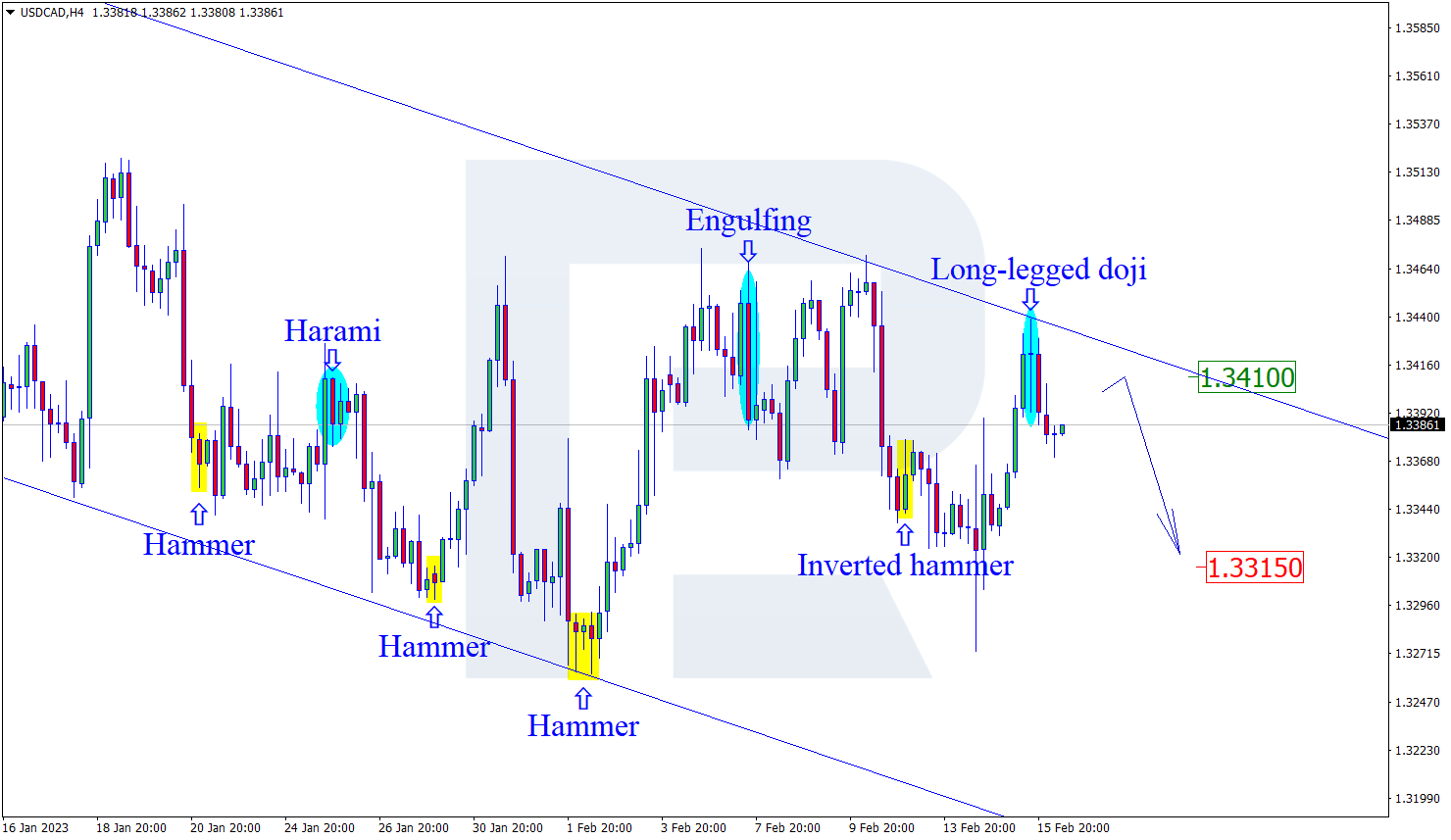
On H4, at the support level, the pair has formed a Hammer reversal pattern. The pair is now going by the signal in an ascending wave. The goal of the growth might be 1.3455; later the price might break through it and extend correction. However, the price may drop to 1.3300 without any correction at all.

USDCAD
Risk Warning: the result of previous trading operations do not guarantee the same results in the future

AUDUSD, “Australian Dollar vs US Dollar”

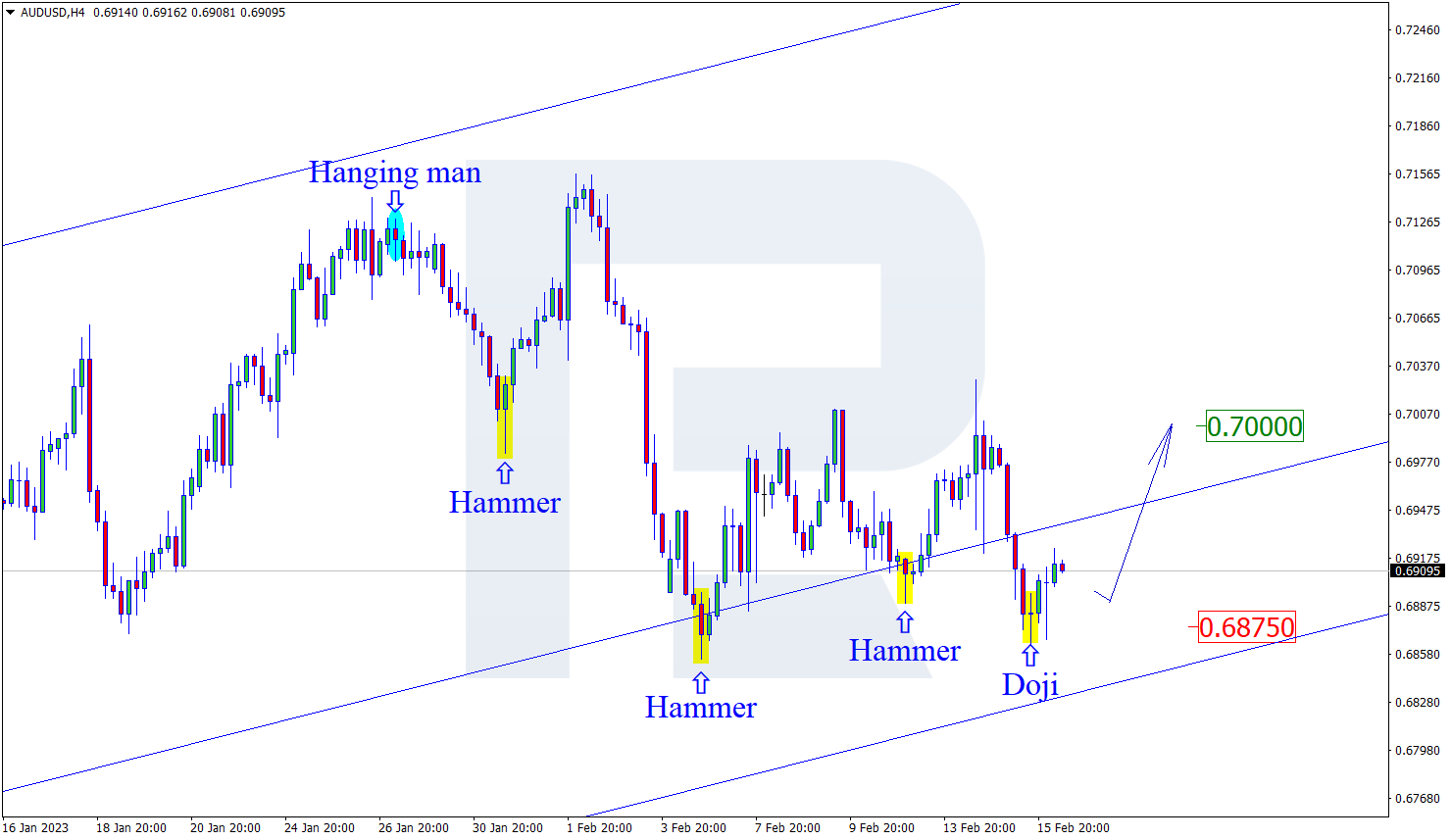
In H4, at the resistance level, the pair has formed a Handing Man reversal pattern. The pair may now go by the signal in an ascending wave. The goal of the pullback might be 0.6920. After a test of the support level the quotes might get the chance for a bounce off it and an extension of the uptrend. However, the price may grow to 0.7015 without any pullback.

AUDUSD
Risk Warning: the result of previous trading operations do not guarantee the same results in the future

USDCHF, “US Dollar vs Swiss Franc”

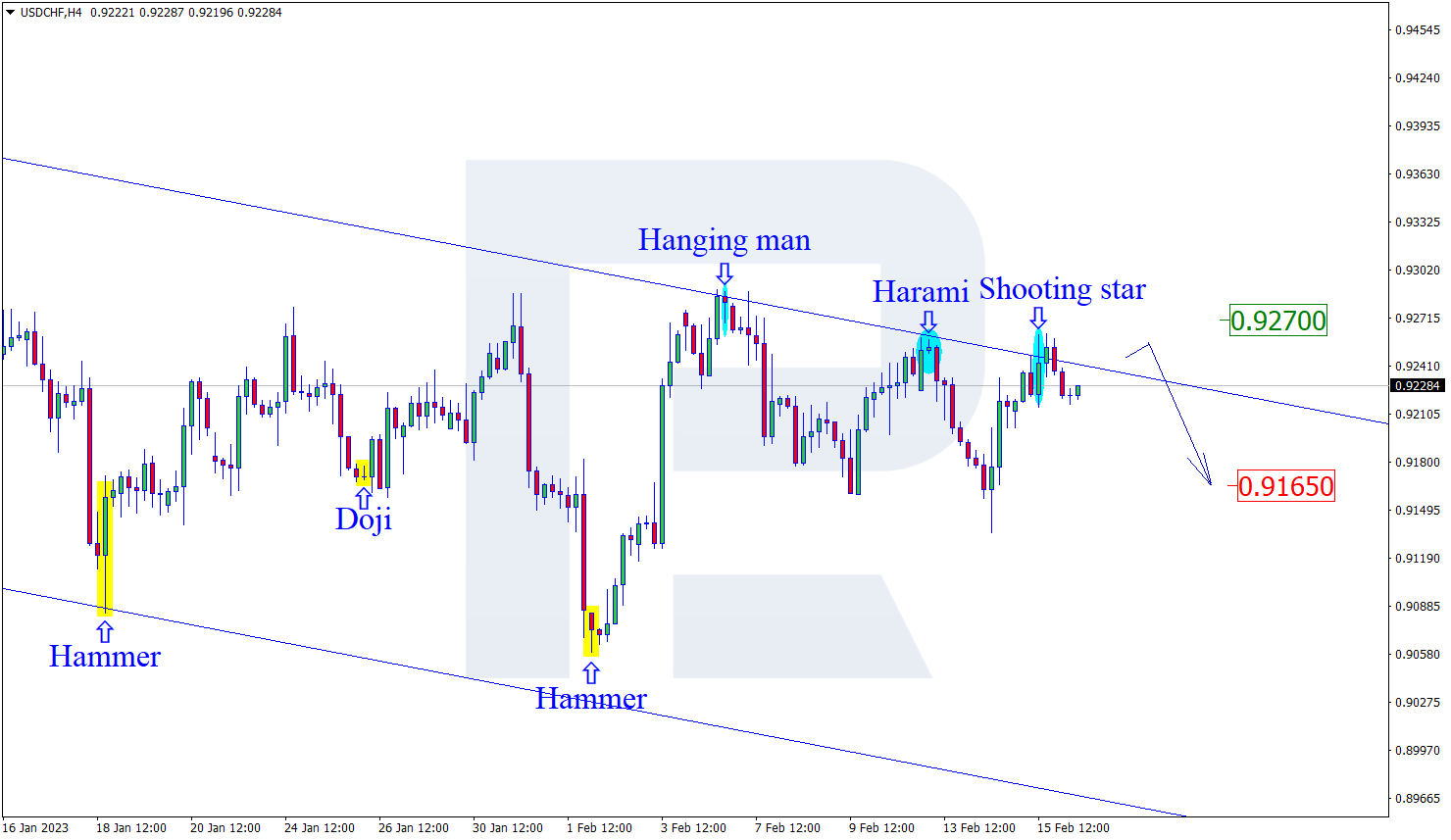
On H4, at the resistance level, the pair has formed a Shooting Star reversal pattern. The pair may now go by the signal in a descending wave. The goal of the decline might be 0.9250. Upon testing the resistance level, the pair might break through it and continue the downtrend. However, the price may pull back to 0.9350 before falling.

USDCHF
Risk Warning: the result of previous trading operations do not guarantee the same results in the future

Article By RoboForex.com

Attention!
Forecasts presented in this section only reflect the author’s private opinion and should not be considered as guidance for trading. RoboForex LP bears no responsibility for trading results based on trading recommendations described in these analytical reviews.