By Tuesday’s close, the Dow Jones Index (US30) gained 1.18%. The S&P 500 Index (US500) rose by 0.21%. The Nasdaq (US100) closed lower at 0.25%. Investors shifted away from technology stocks into “blue chips” and cyclical sectors amid expectations that the House of Representatives will approve the funding agreement and the government will reopen as early as Wednesday. Progress on the bill in the Senate improved sentiment in economy-sensitive industries. Investors hope that reopening the government will allow delayed macroeconomic data to be released and support short-term growth prospects.
European stock markets rose yesterday. Germany’s DAX (DE40) gained 0.53%, France’s CAC 40 (FR40) closed up 1.25%, Spain’s IBEX 35 (ES35) rose by 1.27%, and the UK’s FTSE 100 (UK100) closed positive 1.15%. The ZEW Economic Sentiment Index for the Eurozone in November 2025 climbed to 25 points, above market expectations (23.5 points), indicating cautious optimism among analysts. The assessment of the current economic situation also improved, rising by 4.5 points, but remained negative at 27.3. This means analysts still view the Eurozone economy as weak, though less bleak than a month ago.
WTI crude oil prices rose to $61 per barrel, extending gains for the third consecutive session. Support came from expectations of a swift end to the record-long 42-day US government shutdown: the Senate approved temporary funding, and the House will review the bill on Wednesday. Optimism boosted interest in risk assets and commodities overall. On the supply side, limiting factors emerged. The US sanctions against major Russian oil companies have begun to affect logistics: seaborne shipments of Russian oil have declined for the third week in a row. This creates a risk of reduced supply in the global market.
The US natural gas prices (XNG/USD) rose by 5% to $4.54 per MMBtu – the highest since December 2022. The increase was driven by bets on a colder December and higher electricity demand, despite temporarily mild weather expected next week. In November, deliveries to the eight largest US LNG plants averaged 17.8 billion cubic feet per day, above October’s record of 16.7 billion. Meanwhile, Europe is increasing imports from the U.S. to reduce dependence on Russian gas.
Asian markets mostly declined yesterday. Japan’s Nikkei 225 (JP225) fell by 0.14%, China’s FTSE China A50 (CHA50) dropped 0.56%, Hong Kong’s Hang Seng (HK50) added 0.18%, and Australia’s ASX 200 (AU200) closed down 0.19%. At the end of the week, final Q3 GDP data for Hong Kong will be released, with preliminary estimates signaling moderate improvement in economic dynamics. Indonesia’s central bank expects the economy to grow about 5.33% in 2026. According to the Bank Indonesia Governor, growth could reach the government’s target of 5.4% if budget spending accelerates and fiscal stimulus is more actively deployed. The inflation prognosis for 2026 remains moderate at around 2.62%. The rupiah is expected to average near 16,430 per dollar.
This article reflects a personal opinion and should not be interpreted as an investment advice, and/or offer, and/or a persistent request for carrying out financial transactions, and/or a guarantee, and/or a forecast of future events.
By Friday’s close, the Dow Jones Index (US30) rose by 0.16% (weekly -1.49%). The S&P 500 Index (US500) gained 0.13% (weekly -2.23%). The tech-heavy Nasdaq (US100) closed lower at 0.28% (-4.04%). Sentiment was supported by hopes of progress in resolving the government shutdown. The latest inflation expectations data came out mixed: one-year inflation expectations rose from 4.6% to 4.7%, while long-term expectations fell from 3.9% to 3.6%. Friday’s top gainers included Exxon Mobil, T-Mobile, and Coca-Cola (+2% and above), while the tech sector, including Tesla (-4%), Meta, and Oracle (-2%), continued to face pressure from concerns over inflated valuations of AI companies.
The Canadian dollar strengthened to 1.4 USD, rebounding from a seven-month low of 1.41 after strong labor market data. Unemployment fell to 6.9%, employment increased, and wage growth accelerated to 4% – the highest in eight months and above current inflation. This reinforced expectations that the Bank of Canada has ended its rate-cutting cycle, as the economy remains resilient and core inflation stays above target.
In October, inflation in Mexico slowed as expected. Annual inflation eased to 3.57% in October (from 3.76% in September), the first decline in three months and in line with the prognosis of 3.56%. Core inflation stood at 4.28% – the highest since April 2024 and close to market expectations (4.27%). European stock markets fell on Friday. Germany’s DAX (DE40) dropped 0.69% (weekly -1.75%), France’s CAC 40 (FR40) closed down 0.18% (weekly -2.08%), Spain’s IBEX 35 (ES35) fell by 1.34% (weekly -0.82%), and the UK’s FTSE 100 (UK100) closed negative 0.55% (weekly -0.36%). European equities opened in the “green zone” on Monday amid improved risk appetite. Optimism grew after the US Senate approved an initial funding bill, raising hopes for a swift end to the record-long government shutdown.
On Monday, silver rose above $49 per ounce, hitting a three-week high amid dollar weakness and growing concerns about the US economy. The University of Michigan Consumer Sentiment Index fell to 50.3 – the second-worst reading in history, against the backdrop of the prolonged government shutdown. The market remains divided ahead of the Fed’s December decision, with the probability of a 25 bps rate cut estimated at around 67%.
Asian markets traded mixed last week. Japan’s Nikkei 225 (JP225) fell by 2.62%, China’s FTSE China A50 (CHA50) rose by 1.18%, Hong Kong’s Hang Seng (HK50) gained 0.93%, while Australia’s ASX 200 (AU200) posted a five-day decline of 1.00%.
In October 2025, consumer prices in China rose 0.2% year-over-year. This was the first increase in consumer inflation since June and the fastest pace since January. Core inflation, excluding food and energy, rose 1.2% year-over-year, the highest in 20 months. The offshore yuan remained around 7.12 per dollar, trading sideways.
The Australian dollar climbed above $0.65 after comments from RBA Deputy Governor Andrew Hauser on the need to maintain tight policy to curb inflation. He noted that GDP growth was the strongest since the early 1980s and demand remains slightly above potential, limiting room for easing. The RBA previously kept rates at 3.6%, and markets still expect a possible cut next year, though some believe the easing cycle may be over. Additional support for the AUD came from improved global sentiment and easing trade tensions between the US and China.
The Japanese government plans to finalize its first major economic package on November 21. The measures focus on supporting weak recovery, tax incentives for 17 industries, and maintaining low interest rates: the cabinet will urge the Bank of Japan to target strong economic growth with stable prices. The package includes steps to ease the burden of high living costs, stimulate investment, crisis management, and strengthen defense. Authorities pledged close coordination with the Bank of Japan to prevent a return to deflation.
This article reflects a personal opinion and should not be interpreted as an investment advice, and/or offer, and/or a persistent request for carrying out financial transactions, and/or a guarantee, and/or a forecast of future events.
This is the second in a two-part series. Read part one here.
Globalisation has always had its critics – but until recently, they have come mainly from the left rather than the right.
In the wake of the second world war, as the world economy grew rapidly under US dominance, many on the left argued that the gains of globalisation were unequally distributed, increasing inequality in rich countries while forcing poorer countries to implement free-market policies such as opening up their financial markets, privatising their state industries and rejecting expansionary fiscal policies in favour of debt repayment – all of which mainly benefited US corporations and banks.
This was not a new concern. Back in 1841, German economist Friedrich List had argued that free trade was designed to keep Britain’s global dominance from being challenged, suggesting:
When anyone has obtained the summit of greatness, he kicks away the ladder by which he climbs up, in order to deprive others of the means of climbing up after him.
By the 1990s, critics of the US vision of a global world order such as the Nobel-winning economist Joseph Stiglitz argued that globalisation in its current form benefited the US at the expense of developing countries and workers – while author and activist Naomi Klein focused on the negative environmental and cultural consequences of the global expansion of multinational companies.
Mass left-led demonstrations broke out, disrupting global economic meetings including, most famously, the World Trade Organization (WTO) in 1999. During this “battle of Seattle”, violent exchanges between protesters and police prevented the launch of a new world trade round that had been backed by then US president, Bill Clinton. For a while, the mass mobilisation of a coalition of trade unionists, environmentalists and anti-capitalist protesters seemed set to challenge the path towards further globalisation – with anti-capitalism “Occupy” protests spreading around the world in the wake of the 2008 financial crash.
A documentary about the 1999 ‘batte of Seattle’, directed by Jill Friedberg and Rick Rowley.
In the US, a further critique of globalisation centred on its domestic consequences for American workers – namely, job losses and lower pay – and led to calls for greater protectionism. Although initially led by trade unions and some Democratic politicians, this critique gradually gained purchase in radical right circles who opposed giving any role to international organisations like the WTO, on the grounds that they impinged on American sovereignty. According to this view, only by stopping foreign competition whose low wages undercut American workers could prosperity be restored. Immigration was another target.
Under Donald Trump’s second term as US president, these criticisms have been transformed into radical, deeply disruptive economic and social policies – with tariffs and protectionism at their heart. In so doing, Trump – despite all his grandstanding on the world stage – has confirmed what has long been clear to close observers of US politics and business: that the American century of global dominance, with the dollar as unrivalled no.1 currency, is drawing rapidly to a close.
Even before Trump first took office in 2017, the US had begun to withdraw from its leadership role in international economic institutions such as the WTO. Now, the strongest part of its economy, the hi-tech sector, is under intense pressure from China, whose economy is already bigger than the US’s by one key measure of GDP. Meanwhile, the majority of US citizens are facing stagnant incomes, higher prices and more insecure jobs.
In previous centuries, when first France and then Great Britain reached the end of their eras of world domination, these transitions had painful impacts beyond their borders. This time, with the global economy more closely integrated than ever before and no single dominant power waiting in the wings to take over, the impacts could be felt even more widely – with very damaging, if not catastrophic, results.
Why no one is ready to take the US’s place
When it comes to taking over from the US as the world’s leading hegemonic power, the only viable candidates with big enough economies are the European Union and China. But there are strong reasons to doubt that either could take on this role – notwithstanding the fact that in 2022, then US president Joe Biden’s National Security Strategy called China: “The only competitor with both the intent to reshape the international order and, increasingly, the economic, diplomatic, military and technological power to do so.”
At times Biden’s successor, President Trump, has sounded almost jealous of the control China’s leaders exert over their national economy, and the fact they do not face elections and limits on their terms in office. But a one-party, authoritarian political system which lacks legal checks and balances is a key reason China will find it hard to gain the cultural and political dominance among democratic nations that is part of achieving world no.1 status – despite the influence it already wields in large parts of Asia and Africa.
China still faces big economic challenges too. While it is already the global leader in manufactured goods (rapidly moving into hi-tech products) and the world’s largest exporter, its economy is still very unbalanced – with a much smaller consumer sector, a weak property market, many inefficient state industries that are highly indebted, and a relatively small financial sector restricted by state ownership. Nor does China possess a global currency, despite its (limited) attempts to make the renminbi a truly international currency.
The Insights section is committed to high-quality longform journalism. Our editors work with academics from many different backgrounds who are tackling a wide range of societal and scientific challenges.
As I found on a reporting trip to Shanghai in 2007 to investigate the effects of globalisation, there are also enormous differences between China’s prosperous coastal megacities – whose main thoroughfares rival New York and Paris – and the relative poverty in the interior, especially in rural areas. But nearly two decades on from that visit, with the country’s growth rate slowing, many university-educated young people are also finding it hard to find well-paid jobs now.
Meanwhile Europe – the only other contender to take the US’s place as global no.1 – is deeply politically divided, with smaller, weaker economies to the east and south far more sceptical about the benefits of globalisation, and increasingly divided on issues such as migration and the Ukraine war. The challenges of achieving broad policy agreement among all member states, and the problem of who can speak for Europe, make it unlikely that the EU as currently constituted could initiate and enforce a new global world order on its own.
The EU’s financial system also lacks the heft of the US’s. Although it has a common currency (the euro) managed by the European Central Bank, its financial system is far more fragmented. Banks are regulated nationally, and each country issues its own government bonds (although a few eurobonds now exist). This makes it hard for the euro to replace the dollar as a store of value, and reduces the incentive for foreigners to hold euros as an alternative reserve currency.
Meanwhile, any future prospects of a renewal of US global leadership look similarly unpromising. Trump’s policy of cutting taxes while increasing the size of the US government debt – which now stands at US$38 trillion, or 120% of GDP – threatens both the stability of the world economy and the ability of the US to finance this mind-boggling deficit.
US national debt hits record high. Video: The Economic Times.
Tellingly, the Trump administration shows no interest in reviving, or even engaging with, many of the international financial institutions which America once dominated, and which helped shape the world economic order – as US trade representative Jamieson Greer expressed disdainfully in the New York Times recently:
Our current, nameless global order, which is dominated by the WTO and is notionally designed to pursue economic efficiency and regulate the trade policies of its 166 member countries, is untenable and unsustainable. The US has paid for this system with the loss of industrial jobs and economic security, and the biggest winner has been China.
While the US is not, so far, withdrawing from the IMF, the Trump administration has urged it to call out China for running such a large trade surplus, while abandoning its concern about climate change. Greer concluded that the US has “subordinated our country’s economic and national security imperatives to a lowest common denominator of global consensus”.
World without a global no.1
To understand the potential dangers ahead, we must go back more than a century to the last time there was no global hegemon. By the time the first world war officially ended with the signing of the Treaty of Versailles on June 28 1919, the international economic order had collapsed. Britain, world leader over the previous century, no longer possessed the economic, political or military clout to enforce its version of globalisation.
The UK government, burdened by the huge debts it had taken out to finance the war effort, was forced to make major cuts in public spending. In 1931, it faced a sterling crisis: the pound had to be devalued as the UK exited from the gold standard for good, despite having yielded to the demands of international bankers to cut payments to the unemployed. This was a final sign that Britain had lost its dominant place in the world economic order.
The 1930s were a time of deep political unease and unrest in Britain and many other countries. In 1936, unemployed workers from Jarrow, a town in north-east England with 70% unemployment after its shipyards closed, organised a non-political “hunger march” to London which became known as the Jarrow crusade. More than 200 men, dressed in their Sunday best, marched peacefully in step for over 200 miles, gaining great support along the way. Yet when they reached London, prime minister Stanley Baldwin ignored their petition – and the men were informed their dole money would be docked because they had been unavailable for work over the past fortnight.
Europe was also facing a severe economic crisis. After Germany’s government refused to pay the reparations agreed in the 1919 Versailles treaty, saying they would bankrupt its economy, the French army occupied the German industrial heartland of the Ruhr and German workers went on strike, supported by their government. The ensuing struggle fuelled hyperinflation in Germany. By November 1923, it took 200,000 million marks to buy a loaf of bread, and the savings and pensions of the German middle class were wiped out. That month, Adolf Hitler made his first attempt to seize power in the failed “Beer hall putsch” in Munich.
In contrast, across the Atlantic, the US was enjoying a period of postwar prosperity, with a booming stock market and explosive growth of new industries such as car manufacturing. But despite emerging as the world’s strongest economic power, having financed much of the Allied war effort, it was unwilling to grasp the reins of global economic leadership.
The Republican US Congress, having blocked President Woodrow Wilson’s plan for a League of Nations, instead embraced isolationism and washed its hands of Europe’s problems. The US refused to cancel or even reduce the war debts owed it by the Allied nations, who eventually repudiated their debts. In retaliation, the US Congress banned all American banks from lending money to these so-called allies.
Then, in 1929, the affluent American “jazz age” came to an abrupt halt with a stock market crash that wiped off half its value. The country’s largest manufacturer, Ford, closed its doors for a year and laid off all its workers. With a quarter of the nation unemployed, long lines for soup kitchens were seen in every city, while those who had been evicted camped out wherever they could – including in New York’s Central Park, renamed “Hooverville” after the hapless US president of that time, Herbert Hoover.
In rural areas where the collapse in agricultural prices meant farmers could no longer make a living, armed farmers stopped food and milk trucks and destroyed their contents in a vain attempt to limit supply and raise prices. By March 1933, as President Franklin D. Roosevelt took office, the entire US banking system had ground to a standstill, with no one able to withdraw money from their bank account.
With its focus on this devastating Great Depression, the US refused to get involved in attempts at international economic cooperation. With no notice, Roosevelt withdrew from the 1933 London Conference which had been called to stabilise the world’s currencies – sending a message denouncing “the old fetishes of the so-called international bankers”.
With the US following the UK off the gold standard, the resulting currency wars exacerbated the crisis and further weakened European economies. As countries reverted to mercantilist policies of protectionism and trade wars, world trade shrank dramatically.
The situation became even worse in central Europe, where the collapse of the huge Credit-Anstalt bank in Austria in 1931 reverberated around the region. In Germany, as mass unemployment soared, centrist parties were squeezed and armed riots broke out between communist and fascist supporters. When the Nazis came to power, they introduced a policy of autarky, cutting economic ties with the west to build up their military machine.
The economic rivalries and antagonisms which weakened western economies paved the way for the rise of fascism in Germany. In some sense, Hitler – an admirer of the British empire – aspired to be the next hegemonic economic as well as military power, creating his own empire by conquering and ruthlessly exploiting the resources of the rest of Europe.
Troubled by rampant hyperinflation, Germans queue up with large bags to withdraw money from Berlin’s Reichsbank in 1923. Bundesarchiv/Wikimedia, CC BY-NC-SA
Nearly a century later, there are some disturbing parallels with that interwar period. Like America after the first world war, Trump insists that countries the US has supported militarily now owe it money for this protection. He wants to encourage currency wars by devaluing the dollar, and raise protectionist barriers to protect domestic industry. The 1920s was also a time when the US sharply limited immigration on eugenic grounds, only allowing it from northern European countries which (the eugenicists argued) would not “pollute the white race”.
Clearly, Trump does not view the lack of international cooperation that could amplify the damaging economic effects of a stock or bond market crash as a problem that should concern him. And in today’s unstable world, for all the US’s past failings as a global leader, that is a very worrying proposition.
How the US responded to the last financial crisis
Once again, the rules of the international order are breaking down. While it is possible that Trump’s approach will not be fully adopted by his successor in the White House, the direction of travel in the US will almost certainly remain sceptical about the benefits of globalisation, with limited support for any worldwide economic rules or initiatives.
We see similar scepticism about the benefits of globalisation emerging in other countries, amid the rise of rightwing populist parties in much of Europe and South America – many backed by Trump. Fuelling these parties’ support are growing concerns about income inequality, slow growth and immigration which are not being addressed by the current political system – and all of which would be exacerbated by the onset of a new global economic crisis.
With the global economy and financial system far bigger than ever before, a new crisis could be even more severe than the one that occurred in 2008, when the failure of the banking system left the world teetering on the brink of collapse.
The scale of this crisis was unprecedented, but key US and UK government officials moved boldly and swiftly. As a BBC reporter in Washington, I attended the House of Representatives’ Financial Services Committee hearing three days after Lehman Brothers went bankrupt, paralysing the global financial system, to find out the administration’s response. I remember the stunned look on the face of the committee’s chairman, Barney Frank, when he asked US Treasury secretary Hank Paulson and US Federal Reserve chairman Ben Bernanke how much money they might need to stabilise the situation:
“Let’s start with US$1 trillion,” Bernanke replied coolly. “But we have another US$2 trillion on our balance sheet if we need it.”
Documentary on the collapse of Lehman Brothers bank in September 2008.
Shortly afterwards, the US Congress approved a US$700 billion rescue package. While the global economy has still not fully recovered from this crisis, it could have been far worse – possibly as bad as the 1930s – without such intervention.
Around the world, governments ended up pledging US$11 trillion to guarantee the solvency of their banking systems, with the UK government putting up a sum equivalent to the country’s entire yearly GDP. But it was not just governments. At the G20 summit in London in April 2009, a new US$1.1 trillion fund was set up by the International Monetary Fund (IMF) to advance money to countries that were getting into financial difficulty.
The G20 also agreed to impose tougher regulatory standards for banks and other financial institutions that would apply globally, to replace the weak regulation of banks that had been one of the main causes of the crisis. As a reporter at this summit, I recall widespread excitement and optimism that the world was finally working together to tackle its global problems, with the host prime minister, Gordon Brown, briefly glowing in the limelight as organiser of that summit.
Behind the scenes, the US Federal Reserve had also been working to contain the crisis by quietly passing on to the world’s other leading central banks nearly US$600 billion in “currency swaps” to ensure they had the dollars they needed to bail out their own banking systems. The Bank of England secretly lent UK banks £100 billion to ensure they didn’t collapse, although two of the four major banks, Royal Bank of Scotland (now NatWest) and Lloyds, ultimately had to be nationalised (to different extents) to keep the financial system stable.
However, these rescue packages for banks, while much needed to stabilise the global economy, did not extend to many of the victims of the crash – such as the 12 million US households whose homes were now worth less than the mortgage they had taken out to pay for them, or the 40% of households who experienced financial distress during the 18 months after the crash. And the ramifications of the crisis were even greater for those living in developing countries.
A few months after the 2008 financial crisis began, I travelled to Zambia, an African country totally dependent on copper exports for its foreign exchange. I visited the Luanshya copper mine near Ndola in the country’s copper belt. With demand for copper (used mainly in construction and car manufacturing) collapsing, all the copper mines had closed. Their workers, in one of the few well-paid jobs in Zambia, were forced to leave their comfortable company homes and return to sharing with their relatives in Lusaka without pay.
Zambia’s government was forced to shut down its planned poverty reduction plan, which was to be funded by mining profits. The collapse in exports also damaged the Zambian currency, which dropped sharply. This hit the country’s poorest people hard as it raised the price of food, most of which was imported.
The ripple effects of the 2008 global financial crisis soon hit Luanshya copper mine in Zambia. Nerin Engineering Co., CC BY-SA
I also visited a flower farm near Lusaka, where Dutch expats Angelique and Watze Elsinga had been growing roses for export for over a decade – employing more than 200 workers who were given housing and education. As the market for Valentine’s Day roses collapsed, their bankers, Barclays South Africa, suddenly ordered them to immediately repay all their loans, forcing them to sell their farm and dismiss their workers. Ultimately, it took a US$3.9 billion loan from the IMF and World Bank to stabilise Zambia’s economy.
Should another global financial crisis hit, it is hard to see the Trump administration (and others that follow) being as sympathetic to the plight of developing countries, or allowing the Federal Reserve to lend major sums to foreign central banks – unless it is a country politically aligned with Trump, such as Argentina. Least likely of all is the idea of Trump working with other countries to develop a global trillion-dollar rescue package to help save the world economy.
Rather, there is a real worry that reckless actions by the Trump administration – and weak global regulation of financial markets – could trigger the next global financial crisis.
What happens if the US bond market collapses?
Economic historians agree that financial crises are endemic in the history of global capitalism, and they have been increasing in frequency since the “hyper-globalisation” of the 1970s. From Latin America’s debt crisis in the 1980s to the Asia currency crisis in the late 1990s and the US dotcom stock market collapse in the early 2000s, crises have regularly devastated economies and regions around the world.
Today, the greatest risk is the collapse of the US Treasury bond market, which underpins the global financial system and is involved in 70% of global financial transactions by banks and other financial institutions. Around the world, these institutions have long regarded the US bond market, worth over $30 trillion, as a safe haven, because these “debt securities” are backed by the US central bank, the Federal Reserve.
Increasingly, the unregulated “shadow banking system” – a sector now larger than regulated global banks – is deeply involved in the bond market. Non-bank financial institutions such as private equity, hedge funds, venture capital and pension funds are largely unregulated and, unlike banks, are not required to hold reserves.
Bond market jitters are already unnerving global financial markets, which fear its unravelling could precipitate a banking crisis on the scale of 2008 – with highly leveraged transactions by these non-bank financial institutions leaving them exposed.
US bonds play a key role in maintaining the stability of the global economy. Video: Wall Street Journal.
Buyers of US bonds are also troubled by the Trump administration’s plan to raise the US deficit even higher to pay for tax cuts – with the national debt now forecast to rise to 134% of US GDP by 2035, up from 120% in 2025. Should this lead to a widespread refusal to buy more US bonds among jittery investors, their value would collapse and interest rates – both in the US and globally – would soar.
The governor of the Bank of England, Andrew Bailey, recently warned that the situation has “worrying echoes of the 2008 financial crisis”, while the head of the IMF, Kristalina Georgieva, said her worries about the collapse of private credit markets sometimes keep her awake at night.
A bad situation would grow even worse if problems in the bond market precipitate a sharp decline in the value of the dollar. The world’s “anchor currency” would no longer be seen as a safe store of value – leading to more withdrawals of funds from the US Treasury bond market, where many foreign governments hold their reserves.
A weaker dollar would also make imported goods more expensive for US consumers, while potentially boosting the country’s exports. This is precisely the course of action advocated by Stephen Miran, chair of the US president’s Council of Economic Advisors – who Trump appears to want to be the next head of the Federal Reserve.
One example of what could happen if bond markets become destabilised occurred when the shortest-lived prime minister in UK history, Liz Truss, announced huge unfunded tax cuts in her 2022 budget, causing the value of UK gilts (the equivalent of US Treasury bonds) to plummet as interest rates spiked. Within days, the Bank of England was forced to put up an emergency £60 billion rescue fund to avoid major UK pension funds collapsing.
In the case of a US bond market crash, however, there are growing fears that the US government would be unable – and unwilling – to step in to mitigate such damage.
A new era of financial chaos
Just as worrying would be a crash of the US stock market – which, by historic standards, is currently vastly overvalued.
Huge recent increases in the US stock market’s overall value have been driven almost entirely by the “magnificent seven” hi-tech companies, which alone make up a third of its total value. If their big bet on artificial intelligence is not as lucrative as they claim, or is overshadowed by the success of China’s AI systems, a sharp downturn, similar to the dotcom crash of 2000-02, could well occur.
Jamie Dimon, head of the US’s biggest bank JPMorgan Chase, has said he is “far more worried than other [experts]” about a serious market correction, which he warned could come in the next six months to two years.
Big tech executives have been overoptimistic before. Reporting from Silicon Valley in 2001 as the dotcom bubble was bursting, I was struck by the unshakeable belief of internet startup CEOs that their share prices could only go up.
Furthermore, their companies’ high stock valuations had allowed them to take over their competitors, thus limiting competition – just as companies such as Google and Meta (Facebook) have since used their highly valued shares to purchase key assets and potential rivals including YouTube, WhatsApp, Instagram and DeepMind. History suggests this is always bad for the economy in the long run.
With the business and financial worlds now ever more closely linked, not only has the frequency of financial crises increased in the last half-century, each crisis has become more interconnected. The 2008 global financial crisis showed how dangerous this can be: a global banking crisis triggered stock market falls, collapses in the value of weak currencies, a debt crisis in developing countries – and ultimately, a global recession that has taken years to recover from.
The IMF’s latest financial stability report summarised the situation in worrying terms, highlighting “elevated” stability risks as a result of “stretched asset valuations, growing pressure in sovereign bond markets, and the increasing role of non-bank financial institutions. Despite its deep liquidity, the global foreign exchange market remains vulnerable to macrofinancial uncertainty.”
The IMF has warned about instability in the global financial system. Video: CGTN America.
I believe we may be entering a new era of sustained financial chaos during which the seeds sown by the death of globalisation – and Trump’s response to it – finally shatter the world economic and political order established after the second world war.
Trump’s high and erratically applied tariffs – aimed most strongly at China – have already made it difficult to reconfigure global supply chains. Even more worrying could be the struggle over the control of key strategic raw materials like the rare earth minerals needed for hi-tech industries, with China banning their export and the US threatening 100% tariffs in return (as well as hoping to take over Greenland, with its as-yet-untapped supply of some of these minerals).
This conflict over rare earths, vital for the computer chips needed for AI, could also threaten the market value of high-flying tech stocks such as Nvidia, the first company to exceed US$4 trillion in value.
The battle for control of critical raw materials could escalate. There is a danger that in some cases, trade wars might become real wars – just as they did in the former era of mercantilism. Many recent and current regional conflicts, from the first Iraq war aimed at the conquest of the oilfields of Kuwait, to the civil war in Sudan over control of the country’s goldmines, are rooted in economic conflicts.
The history of globalisation over the past four centuries suggests that the presence of a global superpower – for all its negative sides – has brought a degree of economic stability in an uncertain world.
In contrast, a key lesson of history is that a return to policies of mercantilism – with countries struggling to seize key natural resources for themselves and deny them to their rivals – is most likely a recipe for perpetual conflict. But this time around, in a world full of 10,000 nuclear weapons, miscalculations could be fatal if trust and certainty are undermined.
The challenges ahead are immense – and the weakness of international institutions, the limited visions of most governments and the alienation of many of their citizens are not optimistic signs.
This is the second in a two-part series. In case you missed it, read part one here.
This is the first in a two-part series. Read part two here.
For nearly four centuries, the world economy has been on a path of ever-greater integration that even two world wars could not totally derail. This long march of globalisation was powered by rapidly increasing levels of international trade and investment, coupled with vast movements of people across national borders and dramatic changes in transportation and communication technology.
According to economic historian J. Bradford DeLong, the value of the world economy (measured at fixed 1990 prices) rose from US$81.7 billion (£61.5 billion) in 1650, when this story begins, to US$70.3 trillion (£53 trillion) in 2020 – an 860-fold increase. The most intensive periods of growth corresponded to the two periods when global trade was rising fastest: first during the “long 19th century” between the end of the French revolution and start of the first world war, and then as trade liberalisation expanded after the second world war, from the 1950s up to the 2008 global financial crisis.
Now, however, this grand project is on the retreat. Globalisation is not dead yet, but it is dying.
Is this a cause for celebration, or concern? And will the picture change again when Donald Trump and his tariffs of mass disruption leave the White House? As a longtime BBC economics correspondent who was based in Washington during the global financial crisis, I believe there are sound historical reasons to worry about our deglobalised future – even once Trump has left the building.
Trump’s tariffs have amplified the world’s economic problems, but he is not the root cause of them. Indeed, his approach reflects a truth that has been emerging for many decades but which previous US administrations – and other governments around the world – have been reluctant to admit: namely, the decline of the US as the world’s no.1 economic power and engine of world growth.
In each era of globalisation since the mid-17th century, a single country has sought to be the clear world leader – shaping the rules of the global economy for all. In each case, this hegemonic power had the military, political and financial power to enforce these rules – and to convince other countries that there was no preferable path to wealth and power.
But now, as the US under Trump slips into isolationism, there is no other power ready to take its place and carry the torch for the foreseeable future. Many people’s pick, China, faces too many economic challenges, including its lack of a truly international currency – and as a one-party state, nor does it possess the democratic mandate needed to gain acceptance as the world’s new dominant power.
While globalisation has always produced many losers as well as winners – from the slave trade of the 18th century to displaced factory workers in the American Midwest in the 20th century – history shows that a deglobalised world can be an even more dangerous and unstable place. The most recent example came during the interwar years, when the US refused to take up the mantle left by the decline of Britain as the 19th century’s hegemonic global power.
In the two decades from 1919, the world descended into economic and political chaos. Stock market crashes and global banking failures led to widespread unemployment and increasing political instability, creating the conditions for the rise of fascism. Global trade declined sharply as countries put up trade barriers and started self-defeating currency wars in the vain hope of giving their countries’ exports a boost. On the contrary, global growth ground to a halt.
A century on, our deglobalising world is vulnerable again. But to chart whether this means we are destined for a similarly chaotic and unstable future, we first need to explore the birth, growth and reasons behind the imminent demise of this extraordinary global project.
French model: mercantilism, money and war
By the mid-1600s, France had emerged as the strongest power in Europe – and it was the French who developed the first overarching theory of how the global economy could work in their favour. Nearly four centuries later, many aspects of “mercantilism” have been revived by Trump’s US playbook, which could be entitled How To Dominate the World Economy by Weakening Your Rivals.
France’s version of mercantilism was based on the idea that a country should put up trade barriers to limit how much other countries could sell to it, while boosting its own industries to ensure that more money (in the form of gold) came into the country than left it.
England and the Dutch Republic had already adopted some of these mercantilist policies, establishing colonies around the globe run by powerful monopolistic trading companies that aimed to challenge and weaken the Spanish empire, which had prospered on the gold and silver it seized in the Americas. In contrast to these “seaborne empires”, the much larger empires in the east such as China and India had the internal resources to generate their own revenue, meaning international trade – although widespread – was not critical to their prosperity.
But it was France which first systematically applied mercantilism across the whole of government policy – led by the powerful finance minister Jean-Baptiste Colbert (1661-1683), who had been granted unprecedented powers to strengthen the financial might of the French state by King Louis XIV. Colbert believed trade would boost the coffers of the state and strengthen France’s economy while weakening its rivals, stating:
It is simply, and solely, the absence or abundance of money within a state [which] makes the difference in its grandeur and power.
In Colbert’s view, trade was a zero-sum game. The more France could run a trade surplus with other countries, the more gold bullion it could accumulate for the government and the weaker its rivals would become if deprived of gold. Under Colbert, France pioneered protectionism, tripling its import tariffs to make foreign goods prohibitively expensive.
At the same time, he strengthened France’s domestic industries by providing subsidies and granting them monopolies. Colonies and government trading companies were established to ensure France could benefit from the highly lucrative trade in goods such as spices, sugar – and slaves.
Colbert oversaw the expansion of French industries into areas like lace and glass-making, importing skilled craftsmen from Italy and granting these new companies state monopolies. He invested heavily in infrastructure such as the Canal du Midi, and dramatically increased the size of France’s navy and merchant marine to challenge its British and Dutch rivals.
Global trade at this time was highly exploitative, involving the forced seizure of gold and other raw materials from newly discovered lands (as Spain had been doing with its conquests in the New World from the late 15th century). It also meant benefiting from the trade in humans, with huge profits as slaves were seized and sent to the Caribbean and other colonies to produce sugar and other crops.
In this era of mercantilism, trade wars often led to real wars, fought across the globe to control trade routes and seize colonies. Following Colbert’s reforms, France began a long struggle to challenge the overseas empires of its maritime rivals, while also engaging in wars of conquest in continental Europe.
France initially enjoyed success in the 17th century both on land and sea against the Dutch. But ultimately, its state-run French Indies company was no rival to the ruthless, commercially driven activities of the Dutch and British East India companies, which delivered enormous profits to their shareholders and revenues for their governments.
Indeed, the huge profits made by the Dutch from the Far Eastern spice trade explains why they had no hesitation in handing over their small North American colony of New Amsterdam, in return for expelling the British from a small toehold of one of their spice islands in what is now Indonesia. In 1664, that Dutch outpost was renamed New York.
After a century of conflict, Britain gradually gained ascendancy over France, conquering India and forcing its great rival to cede Canada in 1763 after the Seven Years war. France never succeeded in fully countering Britain’s naval strength. Resounding defeats by fleets led by Horatio Nelson in the early 19th century, coupled with Napoleon’s defeat at Waterloo by a coalition of European powers, marked the end of France’s time as Europe’s hegemonic power.
The battle of Trafalgar, off southwestern Spain in October 1805, was decisive in ending France’s era of dominance. Yale Center for British Art/Wikimedia
But while the French model of globalisation ultimately failed in its attempt to dominate the world economy, that has not prevented other countries – and now President Trump – from embracing its principles.
France found that tariffs alone could not sufficiently fund its wars nor boost its industries. Its broad version of mercantilism led to endless wars that spread around the globe, as countries retaliated both economically and militarily and tried to seize territories.
More than two centuries later, there is an uncomfortable parallel with what the results of Trump’s endless tariff wars might bring, both in terms of ongoing conflict and the organisation of rival trade blocs. It also shows that more protectionism, as proposed by Trump, will not be enough to revive the US’s domestic industries.
British model: free trade and empire
The ideology of free trade was first spelled out by British economists Adam Smith and David Ricardo, the founding fathers of classical economics. They argued trade was not a zero-sum game, as Colbert had suggested, but that all countries could mutually benefit from it. According to Smith’s classic text, The Wealth of Nations (1776):
If a foreign country can supply us with a commodity cheaper than we ourselves can make, better buy it off them with some part of the produce of our own industry, employed in such a way that we have some advantages.
As the world’s first industrial nation, by the 1840s Britain had created an economic powerhouse based on the new technologies of steam power, the factory system, and railroads.
Smith and Ricardo argued against the creation of state monopolies to control trade, proposing minimal state intervention in industry. Ever since, Britain’s belief in the benefits of free trade has proved stronger and more long-lasting than any other major industrial power – more deeply embedded in both its politics and popular imagination.
This ironclad commitment was born out of a bitter political struggle in the 1840s between manufacturers and landowners over the protectionist Corn Laws. The landowners who had traditionally dominated British politics backed high tariffs, which benefited them but resulted in higher prices for staples like bread. The repeal of the Corn Laws in 1846 upended British politics, signalling a shift of power to the manufacturing classes – and ultimately to their working-class allies once they gained the right to vote.
An Anti-Corn Law League meeting held in London’s Exeter Hall in 1846. Wikimedia
In time, Britain’s advocacy of free trade unleashed the power of its manufacturing to dominate global markets. Free trade was framed as the way to raise living standards for the poor (the exact opposite of President Trump’s claim that it harms workers) and had strong working-class support. When the Conservatives floated the idea of abandoning free trade in the 1906 general election, they suffered a devastating defeat – the party’s worst until 2024.
As well as trade, a central element in Britain’s role as the new global hegemonic power was the rise of the City of London as the world’s leading financial centre. The key was Britain’s embrace of the gold standard which put its currency, the pound, at the heart of the new global economic order by linking its value to a fixed amount of gold, ensuring its value would not fluctuate. Thus the pound became the worldwide medium of exchange.
This encouraged the development of a strong banking sector, underpinned by the Bank of England as a credible and trustworthy “lender of last resort” in a financial crisis. The result was a huge boom in international investment, opening access to overseas markets for British companies and individual investors.
In the late 19th century, the City of London dominated global finance, investing in everything from Argentinian railways and Malaysian rubber plantations to South African gold mines. The gold standard became a talisman of Britain’s power to dominate the world economy.
The pillars of Britain’s global economic dominance were a highly efficient manufacturing sector, a commitment to free trade to ensure its industry had access to global markets, and a highly developed financial sector which invested capital around the world and reaped the benefits of global economic development. But Britain also did not hesitate to use force to open up foreign markets – for example, during the Opium Wars of the 1840s, when China was compelled to open its markets to the lucrative trade in opium from British-owned India.
By the end of the 19th century, the British empire incorporated one quarter of the world’s population, providing a source of cheap labour and secure raw materials as well as a large market for Britain’s manufactured goods. But that was still not enough for its avaricious leaders: Britain also made sure that local industries did not threaten its interests – by undermining the Indian textile industry, for example, and manipulating the Indian currency.
In reality, globalisation in this era was about domination of the world economy by a few rich European powers, meaning that much global economic development was curtailed to protect their interests. Under British rule between 1750 and 1900, India’s share of world industrial output declined from 25% to 2%.
But for those at the centre of Britain’s global formal and informal empire, such as the middle-class residents of London, this was a halcyon time – as economist John Maynard Keynes would later recall:
For middle and upper classes … life offered, at a low cost and with the least trouble, conveniences, comforts and amenities beyond the compass of the richest and most powerful monarchs of other ages. The inhabitant of London could order by telephone, sipping his morning tea in bed, the various products of the whole Earth, in such quantity as he might see fit, and reasonably expect their early delivery upon his doorstep.
US model: protectionism to neoliberalism
While Britain enjoyed its century of global dominance, the United States embraced protectionism for longer after its foundation in 1776 than all other major western economies.
The introduction of tariffs to protect and subsidise emerging US industries had first been articulated in 1791 by the fledgling nation’s first treasury secretary, Alexander Hamilton – Caribbean immigrant, founding father and future subject of a record-breaking musical. The Whig party under Henry Clay and its successor, the Republican Party, were both strong supporters of this policy for most of the 19th century. Even as US industry grew to overshadow all others, its government maintained some of the highest tariff barriers in the world.
Founding father Alexander Hamilton on the front of a US$10 note from 1934. Wikimedia
Tariff rates rose to 50% in the 1890s with the backing of future president William McKinley, both to help industrialists and pay for generous pensions for 2 million civil war veterans and their dependants – a key part of the Republican electorate. It is no accident that President Trump has festooned the White House with pictures of Hamilton, Clay and McKinley – all supporters of protectionism and high tariffs.
In part, the US’s enduring resistance to free trade was because it had access to an internal supply of seemingly limitless raw materials, while its rapidly growing population, fuelled by immigration, provided internal markets that fuelled its growth while keeping out foreign competition.
By the late 19th century, the US was the world’s biggest steel producer with the largest railroad system in the world and was moving rapidly to exploit the new technologies of the second industrial revolution – based on electricity, petrol engines and chemicals. Yet it was only after the second world war that the US assumed the role of global superpower – in part because it was the only country on either side of the war that had not suffered severe damage to its economy and infrastructure.
In the wake of global destruction in Europe and Asia, the US’s dominance was political, military and cultural, as well as financial – but the US vision of a globalised world had some important differences from its British predecessor.
The US took a much more universalist and rules-based approach, focusing on the creation of global organisations that would establish binding regulations – and open up global markets to unfettered American trade and investment. It also aimed to dominate the international economic order by replacing the pound sterling with the US dollar as the global medium of exchange.
Within a week of its entry in the second world war, plans were laid to establish US global financial hegemony. The US treasury secretary, Henry Morgenthau, began work on establishing an “inter-allied stabilisation fund” – a playbook for post-war monetary arrangements which would enshrine the US dollar at its heart.
This led to the creation of the International Monetary Fund (IMF) and World Bank at the Bretton Woods conference in New Hampshire in 1944 – institutions dominated by the US, which encouraged other countries to adopt the same economic model both in terms of free trade and free enterprise. The Allied nations who were simultaneously meeting to establish the United Nations to try to ensure future world peace, having suffered the devastating effects of the Great Depression and war, welcomed the US’s commitment to shape a new, more stable economic order.
How the 1944 Bretton Woods deal ensured the US dollar would be the world’s dominant currrency. Video: Bloomberg TV.
As the world’s biggest and strongest economy, there was (initially) little resistance to this US plan for a new international economic order in its own image. The motive was as much political as economic: the US wanted to provide economic benefits to ensure the loyalty of its key allies and counter the perceived threat of a communist takeover – in complete contrast to Trump’s mercantilist view today that all other countries are out to “rip off” the US, and that its own military might means it has no real need for allies.
After the war finally ended, the US dollar, now linked to gold at a fixed rate of $35 per ounce to guarantee its stability, assumed the role as the free world’s principal currency. It was both used for global trade transactions and held by foreign central banks as their currency reserves – giving the US economy an “exorbitant privilege”. The stable value of the dollar also made it easier for the US government to sell Treasury bonds to foreign investors, enabling it to more easily borrow money and run up trade deficits with other countries.
The conditions were set for an era of US political, financial and cultural dominance, which saw the rise of globally admired brands such as McDonald’s and Coca Cola, as well as a powerful US marketing arm in the form of Hollywood. Perhaps even more significantly, the relaxed, well-funded campuses of California would prove a perfect petri dish for the development of new computer technologies – backed initially by cold war military investment – which, decades later, would lead to the birth of the big-tech companies that dominate the tech landscape today.
The US view of globalisation was broader and more interventionist than the British model of free trade and empire. Rather than having a formal empire, it wanted to open up access to the entire world economy, which would provide global markets for American products and services.
The US believed you needed global economic institutions to police these rules. But as in the British case, the benefits of globalisation were still unevenly shared. While countries that embraced export-led growth such as Japan, Korea and Germany prospered, other resource-rich but capital-poor countries such as Nigeria only fell further behind.
From dream to despair
Though the legend of the American dream grew and grew, by the 1970s the US economy was coming under increasing pressure – in particular from German and Japanese rivals, who by then had recovered from the war and modernised their industries.
Troubled by these perceived threats and a growing trade deficit, in 1971 President Richard Nixon stunned the world by announcing that the US was going off the gold standard – forcing other countries to bear the cost of adjustment for the US balance of payments crisis by making them revalue their currencies. This had a profound effect on the global financial system: within a decade, most major currencies had abandoned fixed exchange rates for a new system of floating rates, effectively ending the 1944 Bretton Woods settlement.
US president Richard Nixon announces the US is leaving the gold standard on August 15 1971.
The end of fixed exchange rates opened the door to the “financialisation” of the global economy, vastly expanding global investment and lending – much of it by US financial firms. This gave succour to the burgeoning neoliberal movement that sought to further rewrite the rules of the financial world order. In the 1980s and ’90s, these policy prescriptions became known as the Washington consensus: a set of rules – including opening markets to foreign investment, deregulation and privatisation – that was imposed on developing economies in crisis, in return for them receiving support from US-led organisations like the World Bank and IMF.
In the US, meanwhile, the increasing reliance on the finance and hi-tech sectors increased levels of inequality and fostered resentment in large parts of American society. Both Republicans and Democrats embraced this new world order, shaping US policy to favour their hi-tech and financial allies. Indeed, it was the Democrats who played a key role in deregulating the financial sector in the 1990s.
Meanwhile, the decline of US manufacturing industries accelerated, as did the gap between the incomes of those in the hinterland, where manufacturing was based, and residents of the large metropolitan cities.
By 2023, the lowest 50% of US citizens received just 13% of total personal income, while the top 10% received almost half (47%). The wealth gap was even greater, with the bottom 50% only having 6% of total wealth, while a third (36%) was held by just the top 1%. Since 1980, real incomes of the bottom 50% have barely grown for four decades.
The bottom half of the US population was suffering from a surge in “deaths of despair” – a term coined by the Nobel-winning economist Angus Deaton to describe high mortality rates from drug abuse, suicide and murder among younger working-class Americans. Rising costs of housing, medical care and university education all contributed to widespread indebtedness and growing financial insecurity. By 2019, a study found that two-thirds of people who filed for bankruptcy cited medical issues as a key reason.
The decline in US manufacturing accelerated after China was admitted to the World Trade Organization in 2001, increasing America’s soaring trade and budget deficit even more. Political and business elites hoped the move would open up the huge Chinese market to US goods and investment, but China’s rapid modernisation made its industry more competitive than its American rivals in many fields.
Ultimately, this era of intensive financialisation of the world economy created a series of regional and then global financial crises, damaging the economies of many Latin American and Asian economies. This culminated in the 2008 global financial crisis, precipitated by reckless lending by US financial institutions. The world economy took more than a decade to recover as countries wrestled with slower growth, lower productivity and less trade than before the crisis.
For those who chose to read it, the writing was on the wall for America’s era of global domination decades ago. But it would take Trump’s victory in the 2016 presidential election – a profound shock to many in the US “liberal establishment” – to make clear that the US was now on a very different course that would shake up the world.
Making a bad situation more dangerous
In my view, Trump is the first modern-day US president to fully understand the powerful alienation felt by many working-class American voters, who believed they were left out of the US’s immense post-war economic growth that so benefited the largely urban American middle classes. His strongest supporters have always been lower-middle-class voters from rural areas who are not college-educated.
Yet Trump’s key policies will ultimately do little for them. High tariffs to protect US jobs, expulsion of millions of illegal immigrants, dismantling protections for minorities by opposing DEI (diversity, equality and inclusion) programmes, and drastically cutting back the size of government will have increasingly negative economic consequences in the future, and are very unlikely to restore the US economy to its previous dominant position.
US president Donald Trump unveils his global tariff ‘hit list’ on April 3 2025. BBC News.
Long before he first became president, Trump hated the eye-watering US trade deficit (he’s a businessman, after all) – and believed that tariffs would be a key weapon for ensuring US economic dominance could be maintained. Another key part of his “America First” ideology was to repudiate the international agreements that were at the heart of the US’s postwar approach to globalisation.
In his first term, however, Trump (having not expected to win) was ill-prepared for power. But second time around, conservative thinktanks had spent years outlining detailed policies and identifying key personnel who could implement the radical U-turn in US economic policy.
Under Trump 2.0, we have seen a return to the mercantilist point of view reminiscent of France in the 17th and 18th centuries. His assertion that countries which ran a trade surplus with the US “were ripping us off” echoed the mercantilist belief that trade was a zero-sum game – rather than the 20th-century view, pioneered by the US, that globalisation brings benefits to all, no matter the precise balance of that trade.
Trump’s tax-and-tariff plans, which extend the tax breaks to the very rich while reducing benefits for the poor through benefit cuts and tariff-driven inflation, will increase inequality in the US.
At the same time, the passing of the One Big Beautiful Bill is predicted to add some US$3.5 trillion to US government debt – even after the Elon Musk-led “Department of Government Efficiency” cuts imposed on many Washington departments. This adds pressure to the key US Treasury bond market at the centre of the world financial system, and raises the cost of financing the huge US deficit while weakening its credit rating. Continuing these policies could threaten a default by the US, which would have devastating consequences for the entire global financial system.
For all the macho grandstanding from Trump and his supporters, his economic policies are a demonstration of American weakness, not strength. While I believe his highlighting of some of the ills of the US economy were overdue, the president is rapidly squandering the economic credibility and good will that the US built up in the postwar years, as well as its cultural and political hegemony. For people living in America and elsewhere, he is making a bad situation more dangerous – including for many of his most ardent supporters.
That said, even without Trump’s economic and societal disruptions, the end of the US era of hegemonic dominance would still have happened. Globalisation is not dead, but it is dying. The troubling question we all face now, is what happens next.
This is the first of a two-part Insights long read on the rise and fall of globalisation. Read part two here: why the next global financial meltdown could be much worse with the US on the sidelines.
Every few years since 1953, the Chinese government has unveiled a new master strategy for its economy: the all-important five-year plan.
For the most part, these blueprints have been geared at spurring growth and unity as the nation transformed from a rural, agrarian economy to an urbanized, developed powerhouse.
Their solution? More of the same. In pledging to deliver “high-quality development” through technological self-reliance, industrial modernization and expanded domestic demand, Beijing is doubling down on a state-led model that has powered its rise in recent years. President Xi Jinping and others who ironed out the 2026-2030 plan are betting that innovation-driven industrial growth might secure China’s future, even as questions loom about underpowered consumer spending and mounting economic risks.
As an expert on China’s political economy, I view China’s new five-year plan as being as much about power as it is about economics. Indeed, it is primarily a blueprint for navigating a new era of competition. As such, it risks failing to address the widening gap between surging industrial capacity and tepid domestic demand.
High-tech dreams
At the heart of the new plan are recommendations that put advanced manufacturing and tech innovation front and center. In practice, this means upgrading old-line factories, automating and “greening” heavy industry and fostering “emerging and future industries” such as aerospace, renewable energy and quantum computing.
To insulate China from export controls put in place by other countries to slow China’s ascent, Beijing is doubling down on efforts to “indigenize” critical technologies by pumping money into domestic companies while reducing dependence on foreign suppliers.
This quest for self-reliance is not just about economics but explicitly tied to national security.
Under Xi, China has aggressively pursued what the Chinese Communist Party calls “military-civil fusion” – that is, the integration of civilian innovation with military needs.
The new five-year plan is poised to institutionalize this fusion as the primary mechanism for defense modernization, ensuring that any breakthroughs in civilian artificial intelligence or supercomputing automatically benefit the People’s Liberation Army.
Reshaping global trade
China’s state-led push in high-tech industries is already yielding dividends that the new five-year plan seeks to extend. In the past decade, China has surged to global leadership in green technologies such as solar panels, batteries and electric vehicles thanks to hefty government support. Now, Beijing intends to replicate that success in semiconductors, advanced machinery, biotechnology and quantum computing.
Such ambition, if realized, could reshape global supply chains and standards.
But it also raises the stakes in China’s economic rivalry with advanced economies. Chinese prowess in building entire supply chains has spurred the United States and Europe to talk of reindustrialization to avoid any overreliance on Beijing.
By pledging to build “a modern industrial system with advanced manufacturing as the backbone” and to accelerate “high-level scientific and technological self-reliance,” the new plan telegraphs that China will not back down from its bid for tech dominance.
An elusive rebalancing
What the plan gives comparatively modest attention, however, is the lack of strong domestic demand.
Boosting consumer spending and livelihoods gets little more than lip service in the communiqué that followed the plenum at which the five-year plan was mapped out.
Chinese leaders did promise efforts to “vigorously boost consumption” and build a “strong domestic market,” alongside improvements to education, health care and social security. But these goals were listed only after the calls for industrial upgrading and tech self-sufficiency – suggesting old priorities still prevail.
And this will disappoint economists who have long urged Beijing to shift from an overt, export-led model and toward a growth model driven more by household consumption.
With local governments mired in debt and facing fiscal strain, there is skepticism that bold social spending or pro-consumption reforms will materialize anytime soon.
With Beijing reinforcing manufacturing even as domestic demand stays weak, the likelihood is extra output will be pushed abroad – especially when it comes to EVs, batteries and solar technologies – rather than be absorbed at home.
Beijing has traditionally portrayed its five-year plans as a boon not only for China but for the world. The official narrative, echoed by state media, emphasizes that a stable, growing China remains an “engine” of global growth and a “stabilizer” amid worldwide uncertainty.
Notably, the new plan calls for “high-level opening-up,” aligning with international trade rules, expanding free-trade zones and encouraging inbound investment – even as it pursues self-reliance.
Yet China’s drive to climb the technological ladder and support its industries will likely intensify competition in global markets – potentially at the expense of other countries’ manufacturers. In recent years, China’s exports have surged to record levels. This flood of cheap Chinese goods has squeezed manufacturers among trading partners from Mexico to Europe, which have begun contemplating protective measures. If Beijing now doubles down on subsidizing both cutting-edge and traditional industries, the result could be an even greater glut of Chinese products globally, exacerbating trade frictions.
In other words, the world may feel more of China’s industrial might but not enough of its buying power – a combination that could strain international economic relations.
A high-stakes bet on the future
With China’s 15th five-year plan, Xi Jinping is making a strategic bet on his long-term vision. There is no doubt that the plan is ambitious and comprehensive. And if successful, it could guide China to technological heights and bolster its claim to great-power status.
But the plan also reveals Beijing’s reluctance to depart from a formula that has yielded growth at the cost of imbalances that have hurt many households across the vast country.
Rather than fundamentally shift course, China is trying to have it all ways: pursuing self-reliance and global integration, professing openness while fortifying itself, and promising prosperity for the people while pouring resources into industry and defense.
But Chinese citizens, whose welfare is ostensibly the plan’s focus, will ultimately judge its success by whether their incomes rise and lives improve by 2030. And that bet faces long odds.
On Thursday, the Dow Jones Index (US30) fell by 0.84%. The S&P 500 Index (US500) dropped by 1.12%. The technology-heavy Nasdaq Index (US100) closed lower by 1.90%. Pressure on the technology sector and companies linked to artificial intelligence once again hit Wall Street sentiment. Weak signals from the labor market exacerbated the tech sell-off. According to Challenger, employers announced 153,000 job cuts in October, the highest figure for this month in 22 years, with a significant portion of the reductions linked to AI adoption and cost optimization. Due to limited official data releases amid the government shutdown, investors were forced to rely on private indicators.
The Mexican peso strengthened above 18.6 per US dollar, rebounding from an eight-week low, as investors digested the latest decision from the Bank of Mexico (Banxico) amid a weakening dollar. As expected, the regulator cut the key interest rate by 25 bps to 7.25% with a 4-to-1 vote, but the accompanying statement was more balanced than some market participants had feared. Domestic inflation continues to slow: the Headline Index hovers around 3.63%, and the Core Index is around 4.24%, which expands the central bank’s room for maneuver.
European stock markets generally declined on Thursday. Germany’s DAX (DE40) fell by 1.31%, France’s CAC 40 (FR 40) closed down by 1.36%, Spain’s IBEX 35 (ES35) gained 0.12%, and the UK’s FTSE 100 (UK100) closed negative 0.42%. The German DAX Index dropped to a one-month low. Sentiment worsened amid renewed concerns about the overstretched valuations of AI-linked companies and the risk of a bubble forming in that segment. Investors were also assessing fresh corporate reports and macro data. German industrial production rose by 1.3% in September after a revised 3.7% drop the previous month, but the pace of recovery was weaker than the 3% consensus prognosis.
The Norges Bank (Central Bank of Norway) maintained its key interest rate at 4%, following a 25 bps cut at the previous meeting, which was in line with market expectations. The regulator noted that no new information has emerged since the September meeting that could significantly alter the expectations for the Norwegian economy. Core inflation remains around 3%, and unemployment has risen slightly. Policymakers stated that a restrictive policy remains warranted. WTI crude oil prices dropped to the $59.3 per barrel area on Thursday, continuing their decline amid new pricing decisions by Saudi Arabia and persistent supply risks. Saudi Aramco lowered its official selling prices for Asian buyers. India, highly dependent on imports, is striving to diversify its sources of crude oil as sanctions risks complicate the purchase of Russian oil. Against this backdrop, even major refiner Reliance is reportedly reselling Middle Eastern oil cargoes – a move considered atypical.
The US natural gas prices (XNG/USD) rose to around $4.30 per million British thermal units (MMBtu), reaching a high since March. The increase was driven by near-record demand for LNG exports: the average gas flow to the eight largest terminals in November hit 17.4 billion cubic feet per day, surpassing the October record. Exports are expected to grow further as Europe continues to seek alternatives to Russian gas, and Asian buyers negotiate long-term supply deals with the US.
Asian markets saw solid gains yesterday. Japan’s Nikkei 225 (JP225) rose by 1.34%, China’s FTSE China A50 (CHA50) climbed by 1.21%, Hong Kong’s Hang Seng (HK50) gained 2.12%, and Australia’s ASX 200 (AU200) recorded a positive result of 0.30%. On Friday, the offshore Chinese yuan weakened to around 7.12 per dollar, pulling back from the previous session’s gain as an unexpected contraction in Chinese exports amplified economic pressure. China’s exports in October 2025 declined for the first time in eight months, falling to the lowest level since February. Shipments to the US fell for the seventh consecutive month by more than 25%. Meanwhile, imports grew at the slowest pace since May and were significantly weaker than market expectations, signaling weak domestic demand and labor market uncertainty.
S&P 500 (US500) 6,720.32 −75.97 (−1.12%)
Dow Jones (US30) 46,912.30 −398.70 (−0.84%)
DAX (DE40) 23,734.02 −315.72 (−1.31%)
FTSE 100 (UK100) 9,735.78 −41.30 (−0.42%)
USD Index 99.70 −0.51% (−0.51%)
News feed for: 2025.11.07
China Trade Balance (m/m) at 05:00 (GMT+2);
German Trade Balance (m/m) at 09:00 (GMT+2);
Mexico Inflation Rate (m/m) at 14:00 (GMT+2);
Canada Unemployment Rate (m/m) at 15:30 (GMT+2);
US Michigan Consumer Sentiment (m/m) at 17:00 (GMT+2).
This article reflects a personal opinion and should not be interpreted as an investment advice, and/or offer, and/or a persistent request for carrying out financial transactions, and/or a guarantee, and/or a forecast of future events.
On Wednesday, the Dow Jones Index (US30) rose by 0.48%. The S&P 500 Index (US500) gained 0.37%. The technology-heavy Nasdaq Index (US100) closed higher by 0.65%. A positive factor for the market was the skeptical stance of the US Supreme Court regarding the case on Donald Trump’s “reciprocal tariffs,” which reduced the likelihood of their premature application. Against this backdrop, market participants cut their bets on the Supreme Court upholding the imposed tariffs. Further support for risk appetite came from stronger-than-expected employment data: the ADP report showed a moderate job gain of about 42,000, and the ISM Services PMI rose to an eight-month high, signaling continued economic resilience.
The Canadian dollar weakened to 1.41 CAD per US Dollar, nearing a seven-month low, amid the further strengthening of the US currency and heightened trade uncertainty. An additional factor was the announcement of the new federal budget, which will see the deficit more than double to approximately 78.3 billion CAD this year. This significant expansion of fiscal spending eases financial conditions but increases pressure on the currency amid an already weak macroeconomic outlook.
European stock markets grew steadily on Wednesday. Germany’s DAX (DE40) rose by 0.42%, France’s CAC 40 (FR40) closed up by 0.08%, Spain’s IBEX 35 (ES35) gained 0.39%, and the UK’s FTSE 100 (UK100) closed up by 0.64%.
The Swedish Central Bank (Riksbank), as expected, left its key interest rate unchanged at 1.75% at its October meeting, adhering to a course of supporting economic activity and gradually returning inflation to its medium-term target of 2%. The regulator indicated that the borrowing cost is likely to remain unchanged in the near term. Economic growth in the third quarter was slightly above expectations, but the labor market continues to signal weakness. The Swiss franc traded near 0.81 per US dollar, remaining near its maximum levels since 2011, amid increased demand for safe-haven assets and expectations that the Swiss National Bank (SNB) will refrain from cutting rates in the near future. Simultaneously, softer-than-expectations inflation data in Switzerland renewed discussions about the possibility of further policy easing, which could theoretically return rates to negative territory. However, the SNB leadership is exercising caution, citing risks to financial stability.
WTI crude oil prices dropped to the $60 per barrel area. Concerns over excess supply and sluggish demand continued to weigh on the market. According to the US Energy Information Administration (EIA), crude oil inventories rose by 5.202 million barrels for the week – the largest increase since July. Pressure on prices is intensified by rising production from both OPEC+ countries and non-OPEC producers, fueling concerns about a global market glut. Asian markets also declined yesterday. Japan’s Nikkei 225 (JP225) fell by 2.50%, China’s FTSE China A50 (CHA50) dropped by 0.01%, Hong Kong’s Hang Seng (HK50) declined by 0.07%, and Australia’s ASX 200 (AU200) showed a negative result of 0.13%.
Australia’s trade surplus expanded to 3.94 billion AUD in September, compared to a revised 1.11 billion AUD in August, and exceeded the prognosis of 3.85 billion AUD. The increase was driven by a 7.9% jump in exports, primarily due to increased shipments of gold amidst rising prices for the precious metal. Meanwhile, imports rose by 1.1% and reached a record level, supported by an increase in the inflow of capital goods.
S&P 500 (US500) 6,796.29 +24.74 (+0.37%)
Dow Jones (US30) 47,311.00 +225.76 (+0.48%)
DAX (DE40) 24,049.74 +100.63 (+0.42%)
FTSE 100 (UK100) 9,777.08 +62.12 (+0.64%)
USD Index 100.16 -0.06% (-0.06%)
News feed for: 2025.11.06
Japan Average Cash Earnings (m/m) at 01:30 (GMT+2);
Japan Services PMI (m/m) at 02:30 (GMT+2);
Australia Trade Balance (m/m) at 02:30 (GMT+2);
German Industrial Production (m/m) at 09:00 (GMT+2);
Sweden Inflation Rate at 09:00 (GMT+2);
Switzerland Unemployment Rate (m/m) at 10:00 (GMT+2);
This article reflects a personal opinion and should not be interpreted as an investment advice, and/or offer, and/or a persistent request for carrying out financial transactions, and/or a guarantee, and/or a forecast of future events.
On Tuesday, the Dow Jones Index (US30) fell by 0.53%. The S&P 500 Index (US500) declined by 1.17%. The technology-heavy Nasdaq Index (US100) closed lower by 2.04%. Investors intensified their concerns over the overheated valuations of artificial intelligence (AI) companies. Pressure mounted as the S&P 500’s forward P/E ratio rose above 23, bringing the metric close to the highs of the early 2000s and triggering fears of a correction after months of gains concentrated among a narrow group of AI giants. The technology sector was the hardest hit. Palantir plunged 8.1% due to valuation concerns despite reporting better-than-expected earnings. Nvidia (-2.7%), AMD (-2.1%), and Oracle (-2.6%) also saw notable drops. Market caution was amplified by warnings from Goldman Sachs CEO David Solomon and Morgan Stanley CEO Ted Pick, who both suggested a potential market drop of 10-20%.
The Mexican peso weakened to 18.6 per US dollar, hitting an eight-week low as domestic and external factors amplified pressure on the currency. Local interest rates are now being priced by the market to include future cuts, while the dollar strengthened amid reduced expectations for an imminent Federal Reserve rate cut. The market anticipates that Banxico (Mexico’s central bank) will continue its easing cycle this week and lower the rate by 25 bps to 7.25%, which would narrow Mexico’s yield advantage and potentially weaken capital inflows into the peso.
The Bitcoin price dropped below $100,000, approaching two-month lows and intensifying the downtrend that began after the digital assets market’s “Black Friday” in mid-October. Global equities and digital assets were under pressure amid mounting concerns over the overheated valuations of artificial intelligence companies. Against this backdrop, spot Bitcoin ETFs experienced significant capital outflows. The correction also affected a broad range of altcoins.
European stock markets were mostly lower on Tuesday. Germany’s DAX (DE40) fell by 0.76%, France’s CAC 40 (FR40) closed down by 0.52%, Spain’s IBEX 35 (ES35) declined by 0.01%, and the UK’s FTSE 100 (UK100) closed up by 0.14%. Trading saw profit-taking amidst continued market uncertainty: the publication of key economic data remains suspended due to the ongoing US government shutdown.
Silver (XNG/USD) was under pressure yesterday due to weak demand for industrial metals after total US auto sales in October fell to a 14-month low. Additional negative impact came from comments by ECB Governing Council member Yannis Stournaras, who stated that the Eurozone’s economic growth prospects are subject to multiple downside risks. Nevertheless, precious metals retain fundamental support as safe-haven assets due to the ongoing US government shutdown, uncertainty surrounding tariff policy, geopolitical tensions, active central bank purchases, and political pressure on the Federal Reserve. Asian markets also declined yesterday. Japan’s Nikkei 225 (JP225) fell by 1.74%, China’s FTSE China A50 (CHA50) dropped by 0.27%, Hong Kong’s Hang Seng (HK50) declined by 0.79%, and Australia’s ASX 200 (AU200) recorded a negative result of 0.91%.
The overnight sell-off on Wall Street dampened investor sentiment, increasing caution and lowering risk appetite in regional markets. The correction was driven by rising concerns over inflated valuations, particularly in the high-tech and AI-related sectors. An additional pressure factor was a private survey that showed China’s services sector posted its weakest growth in three months in October. The indicator reflects weakening external demand and continued job contraction. New Zealand’s unemployment rate rose to 5.2% in the second quarter of 2025, slightly exceeding the previous quarter’s figure (5.1%) and matching market expectations. This marks the highest level since late 2016. The number of unemployed individuals increased to 158,000 compared to 156,000 in March, representing an annual increase of 16,000 people, or 11.1%. The data points to a further softening of the labor market and intensifies pressure on the RBNZ amidst the ongoing economic downturn.
S&P 500 (US500) 6,771.55 −80.42 (−1.17%)
Dow Jones (US30) 47,085.24 −251.44 (−0.53%)
DAX (DE40) 23,949.11 −183.30 (−0.76%)
FTSE 100 (UK100) 9,714.96 +13.59 (+0.14%)
USD Index 100.20 +0.33% (+0.33%)
News feed for: 2025.11.05
Japan Monetary Policy Meeting Minutes at 01:50 (GMT+2);
Australia Services PMI (m/m) at 02:30 (GMT+2);
Sweden Riksbank Rate Decision at 10:30 (GMT+2);
German Services PMI (m/m) at 10:55 (GMT+2);
Eurozone Services PMI (m/m) at 11:00 (GMT+2);
UK Services PMI (m/m) at 11:30 (GMT+2);
Eurozone Producer Price Index (m/m) at 12:00 (GMT+2);
This article reflects a personal opinion and should not be interpreted as an investment advice, and/or offer, and/or a persistent request for carrying out financial transactions, and/or a guarantee, and/or a forecast of future events.
The Dow Jones Index (US30) fell by 0.48% at the close on Monday. The S&P 500 Index (US500) rose by 0.17%. The technology-heavy Nasdaq Index (US100) closed higher by 0.46%. US stock indices received support on Monday amid continued optimism surrounding artificial intelligence following the report that OpenAI purchased $38 billion worth of AI computing capacity from Amazon. Markets also reacted to a number of dovish comments from Federal Reserve officials. Federal Reserve Board Governor Stephen Miran stated that the Fed’s current policy is “too tight” and above the neutral rate level, adding that he sees no need to maintain such a restrictive stance given a more moderate outlook on inflation. Lisa Cook also noted that the risks of the labor market weakening now outweigh the risks of accelerating inflation. According to the futures market, investors are pricing in an approximately 66% chance of a December rate cut of 25 basis points (bps).
Investors are also preparing for a US Supreme Court hearing on Wednesday regarding the legality of President Trump’s “reciprocal tariffs.” Lower courts had previously ruled these tariffs illegal. If the Supreme Court upholds this decision, the US could face the necessity of repaying over $80 billion in collected tariffs, and the White House’s authority to impose tariffs would be restricted to only existing sections of trade law.
European stock markets were mostly up on Monday. Germany’s DAX (DE40) rose by 0.73%, France’s CAC 40 (FR 40) closed down by 0.14%, Spain’s IBEX 35 (ES35) increased by 0.03%, and the UK’s FTSE 100 (UK100) closed negative 0.16%. Sectorally, car manufacturers made the largest contribution: shares in Mercedes-Benz, Volkswagen, BMW, and Stellantis rose by 0.9-2.3% following statements from China about the possible granting of exceptions for the export of Nexperia chips, which are vital for automotive electronics.
WTI crude oil prices fell to $60.8 per barrel on Tuesday after four days of gains, as markets continued to assess oversupply risks despite the OPEC+ decision to freeze production increases early next year. The group of producers agreed to a moderate production increase in December, but further growth will be frozen from January to March due to a seasonal decline in demand. The decision comes amid expectations that the oil market may face a supply surplus in 2026 due to expanded supplies from both OPEC countries and non-OPEC producers.
Platinum is trading near $1570 per ounce, correcting from its mid-October peak of around $1722, as demand for safe-haven assets weakened following the US-China trade agreement and amid a stricter tone from the Federal Reserve. Despite the correction, platinum has risen by nearly 60% since the start of the year, outperforming gold and silver, thanks to limited supply and high industrial demand, primarily from the auto industry and hydrogen technologies. Traders are also anticipating the potential launch of platinum futures trading in China, which could boost market liquidity.
Asian markets traded with mixed dynamics last week. Japan’s Nikkei 225 (JP225) rose by 2.12%, China’s FTSE China A50 (CHA50) increased by 0.16%, Hong Kong’s Hang Seng (HK50) rose by 0.97%, and Australia’s ASX 200 (AU200) showed a positive result of 0.15% yesterday. In the first ten months of 2025, 80 IPOs were registered in Hong Kong, highlighting the resilience of the local capital market.
The Australian dollar weakened to below 0.652 USD, marking its fifth consecutive day of decline after the Reserve Bank of Australia (RBA) left the cash rate unchanged, fully aligning with market expectations. At the November meeting, the RBA Board unanimously voted to keep the official cash rate at 3.60%, declining to consider a further rate hike despite persistent inflationary pressure. The regulator also downplayed the unexpected rise in unemployment in September, noting that the labor market remains “slightly tight.” RBA Governor Michele Bullock stressed that the potential for further rate cuts is limited and that the scale of the forthcoming easing may be smaller than in previous cycles.
The New Zealand dollar reached a nearly 7-month low amid growing expectations of further interest rate cuts by the Reserve Bank of New Zealand (RBNZ). Markets have almost fully priced in a 25 bps rate cut at the late-November meeting, following the 50 bps reduction that already occurred last month, against the backdrop of weak economic activity and slowing inflation. Investors are now awaiting the release of Q3 labor market data. Unemployment is expected to rise to a near nine-year high, which could further strengthen the case for more policy easing
S&P 500 (US500) 6,851.97 +11.77 (+0.17%)
Dow Jones (US30) 47,336.68 −226.19 (−0.48%)
DAX (DE40) 24,132.41 +174.11 (+0.73%)
FTSE 100 (UK100) 9,701.37 −15.88 (−0.16%)
USD Index 99.88 +0.08% (+0.08%)
News feed for: 2025.11.04
Japan Manufacturing PMI (m/m) at 02:30 (GMT+2);
Australia RBA Interest Rate Decision at 05:30 (GMT+2);
Australia RBA Rate Statement at 05:30 (GMT+2);
Australia RBA Press Conference at 06:30 (GMT+2);
Eurozone ECB President Lagarde Speaks at 09:40 (GMT+2);
Eurozone ECB President Lagarde Speaks at 12:00 (GMT+2);
New Zealand RBNZ Financial Stability Report at 22:00 (GMT+2);
This article reflects a personal opinion and should not be interpreted as an investment advice, and/or offer, and/or a persistent request for carrying out financial transactions, and/or a guarantee, and/or a forecast of future events.
By the end of Friday, the Dow Jones Index (US30) rose by 0.09% (for the week +0.32%). The S&P 500 Index (US500) gained 0.26% (for the week, 0.08%). The Technology Index Nasdaq (US100) closed higher by 0.48% (for the week +0.61%). AMZN shares jumped over 10% after reporting that third-quarter cloud revenue increased by 20% and exceeded analyst expectations. This supported the entire technology sector. Positive momentum was also observed in companies related to the development of artificial intelligence: Palantir and Oracle shares added 3% and 2.8%, respectively. Netflix rose by 2.9% on news of a planned 10-for-1 stock split, while Tesla gained 3.1%.
The Canadian dollar fell below the 1.40 per USD mark following the release of a surprisingly weak GDP report, which fueled market expectations of a potential rate cut by the Bank of Canada. Canada’s GDP in September is expected to have grown by 0.1% month-over-month, while the August figure was revised down to 0.3%, the largest drop since December 2022. The weak data reflects the consequences of trade frictions with the US and the negative impact of higher Bank of Canada rates.
European stock markets mostly declined on Friday. Germany’s DAX (DE40) fell by 0.67% (for the week -1.54%), France’s CAC 40 (FR40) closed lower by 0.44% (for the week -1.41%), Spain’s IBEX 35 (ES35) dropped by 0.05% (for the week +0.72%), and the UK’s FTSE 100 (UK100) closed negative 0.44% (for the week +0.74%). Investors were taking profits and evaluating a busy week during which markets processed a significant volume of corporate earnings, macro statistics, and central bank decisions. The situation surrounding the one-year technology and trade truce between the US and China remained an additional factor of uncertainty. Focus also remained on the upcoming Bank of England meeting. A broad consensus suggests keeping the rate unchanged, but expectations of possible policy easing are already beginning to intensify.
Eight key OPEC+ participants are likely to approve another increase in the collective target oil production level by 137 thousand barrels per day. This would be the ninth consecutive monthly increase for Saudi Arabia, Iraq, Kuwait, Russia, UAE, Algeria, Oman, and Kazakhstan. The meeting takes place against the backdrop of recently imposed US sanctions against Russian oil companies Rosneft and Lukoil, creating uncertainty about Russia’s ability to maintain current production and export volumes. The group emphasized that it will approach the monthly production increase flexibly, adjusting it according to market conditions.
The US natural gas prices (XNG/USD) rose above $4.1 per MMBtu, reaching a seven-month high, amid a combination of increased demand for heating and projections of active LNG exports to Europe and Asia. Expectations of colder weather leading into the winter season have boosted gas consumption for heating. Asian markets traded without a unified direction last week. Japan’s Nikkei 225 (JP225) rose by 5.02%, China’s FTSE China A50 (CHA50) fell by 1.59%, Hong Kong’s Hang Seng (HK50) dropped by 1.03%, and Australia’s ASX 200 (AU200) showed a negative result of 1.94%.
On Monday, the offshore yuan held near 7.12 per USD after two consecutive days of weakening. The private manufacturing PMI for October declined more than expected, continuing the negative trend confirmed by official statistics last week, which indicated that the industry’s downturn was the longest in nine years. Weak macro statistics once again amplified expectations of additional government support. On the trade front, China agreed to suspend new export control measures on rare earth metals and cease investigations into US semiconductor manufacturers. In response, the US will suspend a range of tariffs and forgo the planned 100% duty tax on Chinese exports.
S&P 500 (US500) 6,840.20 +17.86 (+0.26%)
Dow Jones (US30) 47,562.87 +40.75 (+0.09%)
DAX (DE40) 23,958.30 −160.59 (−0.67%)
FTSE 100 (UK100) 9,717.25 −42.81 (−0.44%)
USD Index 99.72 +0.19% (+0.19%)
News feed for: 2025.11.03
Australia Manufacturing PMI (m/m) at 00:00 (GMT+2);
Switzerland Consumer Price Index at 09:30 (GMT+2);
German Manufacturing PMI (m/m) at 10:55 (GMT+2);
Eurozone Manufacturing PMI (m/m) at 11:00 (GMT+2);
UK Manufacturing PMI (m/m) at 11:30 (GMT+2);
Canada Manufacturing PMI (m/m) at 16:30 (GMT+2);
US ISM Manufacturing PMI (m/m) at 17:00 (GMT+2);
Canada BoC Gov Macklem Speaks (m/m) at 20:30 (GMT+2).
This article reflects a personal opinion and should not be interpreted as an investment advice, and/or offer, and/or a persistent request for carrying out financial transactions, and/or a guarantee, and/or a forecast of future events.




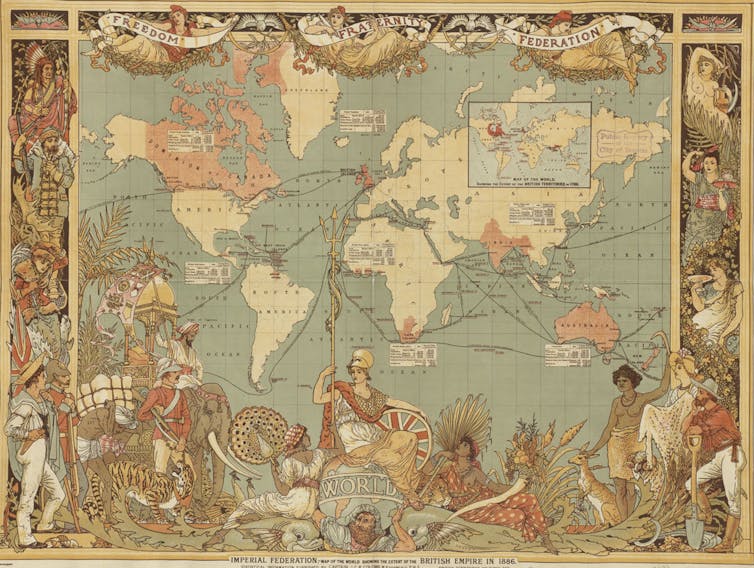 A world map showing the extent of the British Empire in 1886.





.jpg)


