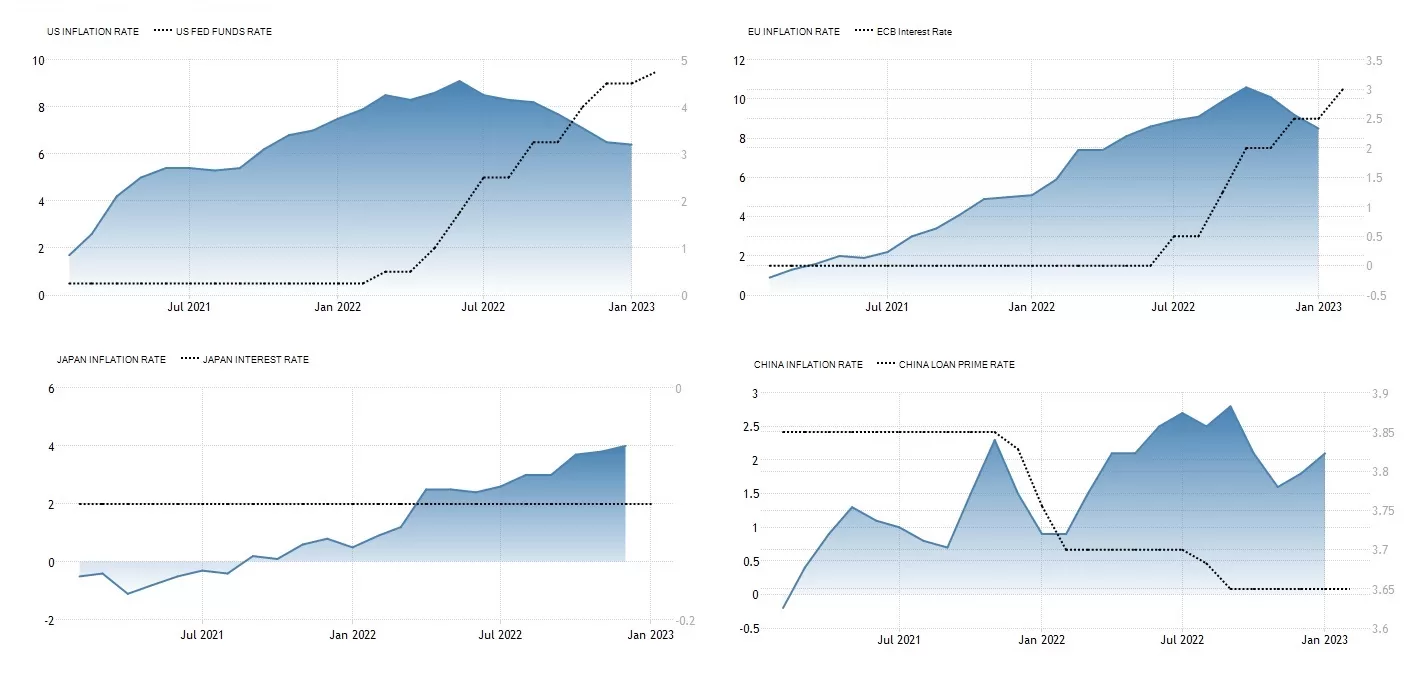
Economists worried about soaring inflation got some good news to start the year: The rate of inflation has eased. The first report card of 2023 on consumer prices, released on Jan. 12, showed that the overall cost of goods and services decelerated to an annual pace of 6.5% in December, the slowest in over a year and down from 7.1% in November.
But there’s bad news too, especially if you are an egg-munchingrenter fond of frequent regular haircuts. In quite a few categories, the cost of living rose at an even faster pace.
That’s because price inflation isn’t uniform. Different products and services are affected by myriad factors. So while some prices may have fallen during December, slowing the annual rate of inflation, other items kept getting more expensive.
The Conversation asked Edouard Wemy – an economist from Clark University who never sets off to work without his morning breakfast of two eggs, sunny side up – to explain how different items in the consumer price basket fared in the latest inflation report.
Energy
When you look at the detail of the latest report on the consumer price index, you’ll see that overall energy costs declined. That’s because there was a steep decline in gasoline prices – down 9.4% in the month of December after dropping 2% in November.
While that’s good news, it’s a bit puzzling. AAA was expecting demand for gasoline to be very high over the month, which usually happens in winter. This typically pushes prices up. My best guess is either demand wasn’t as strong as expected due to fears of a coming recession or there has been an easing on the supply constraints that has contributed to pushing the price of gas up.
An exception to this downward energy price trend was in energy services – that is, electricity and piped gas – where prices actually ticked up. The reason is largely due to the rising cost of doing business. Utility companies and pipeline services are suffering as a result of higher labor costs and are passing on the added cost to consumers through higher prices. The latest jobs report shows average hourly earnings rose 4.6% in December from a year earlier.
Groceries
Overall food inflation slowed in December, with the cost of groceries rising just 0.2% in the month – down from 0.5% in November.
But there is a lot of variation in the cost of grocery items. While the price of fruits and vegetables fell in December, the cost of eggs jumped by 11.1%. That’s due to an outbreak of bird flu that could well last until into the summer.
In addition to that, farms are seeing the same wage pressures as other businesses, which are then passed on to consumers.
Housing
The cost of shelter, whether from renting or owning, rose 0.8% in December – the biggest one-month gain since the 1980s.
This is understandable given the numerous interest rate hikes during 2022. Rising interest rates means that taking out a home loan is more costly, which in turn pushes more people into renting. Added demand on rental properties in turn pushes the prices that landlords demand up.
When interest rates eventually drop, it should bring the overall cost of shelter down, as it would encourage more people to buy homes. But I’m not optimistic that rates will fall until 2024, so don’t expect any downward movement on shelter in the coming months.
Hospital visits
The cost of going to the hospital was another category that saw a big increase. Average prices for hospital and related services jumped 1.5% in December, the biggest gain since 2015.
Again, this is due to the rising cost of doing business – that is, upward pressure on wages – coupled with still-high energy costs.
Used cars and trucks
Another category that helped the overall pace of inflation slow down is used cars and trucks.
After soaring throughout the initial phase of the COVID-19 pandemic, used car prices have been plunging in recent months. They fell 2.5% in December, putting the annual decline at 8.8%. The cost of new cars also dropped in December.
The Japanese Yen could be set for more near-term gains …
as the Bank of Japan holds its policy meeting amidst these other economic data releases and events in the days ahead:
Monday, January 16
AUD: Australia December inflation gauge
World Economic Forum begins in Davos – attended by central bank heads, finance ministers, and global business leaders
US markets closed
Tuesday, January 17
AUD: Australia January consumer confidence
CNH: China 4Q GDP; December industrial production, retail sales, jobless rate
EUR: Germany January ZEW survey
GBP: UK November unemployment rate, December jobless claims
CAD: Canada December inflation
USD: New York Fed President John Williams speech
S&P 500: Q4 earnings by Goldman Sachs, Morgan Stanley, United Airlines
Wednesday, January 18
JPY: Bank of Japan rate decision
EUR: Eurozone December CPI (final)
GBP: UK December CPI
USD: US December retail sales, industrial production, Fed Beige Book
USD: Fed Speak – speeches by Atlanta Fed President Raphael Bostic, Dallas Fed President Lorie Logan, Philadelphia Fed President Patrick Harker
Thursday, January 19
JPY: Japan December external trade
AUD: Australia January consumer inflation expectations; December unemployment
NOK: Central Bank of Norway’s rate decision
EUR: ECB publishes December meeting minutes; ECB President Christine Lagarde speaks at Davos
USD: US weekly initial jobless claims; Fed Speak – speeches by Boston Fed President Susan Collins, New York Fed President John Williams
Friday, January 20
JPY: Japan December CPI
CNH: China loan prime rates
EUR: Germany December PPI
GBP: UK December retail sales
USDJPY has been dropping on expectations for an eventual BoJ rate hike.
To be clear, markets are only forecasting a mere38% chance that we could see a Bank of Japan rate hike on Wednesday, January 18th.
But recall that markets are forward-looking in nature; today’s prices reflect tomorrow’s expectations.
And markets currently fully expect the BoJ to finally see a rate liftoff in April, under the helm of the central bank’s new incoming governor.
If so, Japan can finally exit its negative interest rates regime, having kept its benchmark rate at negative 0.1% since 2016.
Also, here’s a recap of recent events that have spurred the surge for the Japanese Yen:
December 20: BoJ policy shocker The BoJ unexpectedly allowed Japanese 10-year yields to reach a limit of 0.50% – which is double the prior ceiling of 0.25%.
January 12: Yomiuru report The Japanese national newspaper claimed that BoJ officials will, over the coming week, “review the side-effects” of its ultra-loose policy stance.
January 13: Yields cap breached Recall the new 0.5% cap for Japan’s 10-year yields? That level was breached today, forcing the Bank of Japan to make unscheduled bond purchases to try and reinforce the cap (more bond buying, lower yields)
These events have prompted markets to believe that more policy tightening is on the cards for 2023.
And such hopes have translated into JPY gains.
Week Ahead: Potential scenarios for USDJPY
With all that in mind …
if current BoJ Governor Haruhiko Kuroda pushes back against the market’s expectations for a rate hike this year, that may prompt the Japanese Yen to unwind some of its recent gains and potentially pull USDJPY back above the psychologically-important 130 mark.
On the other hand, should markets detect the slightest of hawkish hints (BoJ is getting closer to a rate hike) out of Governor Kuroda next week, that should move USDJPY closer towards 126.0 and potentially test the lower downtrend line that began in November.
And if the Yomiuru report proves true, AND the BoJ’s review does show that side-effects of its ultra-loose policy settings are proving harder to contain, suggesting a faster-than-expected exit from negative interest rates, that may translate into further JPY gains as well.
At the time of writing, market forecasts are currently giving a slight edge that we’ll see USDJPY back at 130 over the next one-week period, with such odds being placed at 70%, compared to the 65% chance that we’ll see USDJPY touch 127.0.
Also look out for these other two potential catalysts that could move USDJPY over the coming week:
December 20: Japan inflation data
Japan’s national consumer price index (CPI) – which measures headline inflation – is forecasted to come in at 4%.
If so, that would be the fastest inflation since January 1991!
Rising inflationary pressures might prompt the BoJ to follow in the footsteps of its major central banking peers who have been aggressively hiking their own interest rates last year in a bid to quell red-hot inflation.
Hence, a higher-than-expected CPI out of Japan next week may reinforce bets for a BoJ rate hike in 2023, likely translating into further gains for the Japanese Yen.
Fed Speak in the coming week
The USD side of USDJPY could be moved by any policy clues contained within scheduled speeches by officials of the US central bank – the Federal Reserve a.k.a. the Fed.
Markets expect the Fed to hike by just 25 basis points at its next policy decision due on February 1st, which is a far cry from the supersized 75-bps hikes that we saw four times last year.
It’ll be interesting to get these Fed officials’ takes on the slowdown in the US headline CPI that we just received yesterday (6.5% CPI for December; much lower than June’s 9.1%).
If these Fed officials fuel expectations that the slowdown in US inflation in turn allows the Fed to ease up on its rate hikes, that could translate into more Dollar weakness and further declines for USDJPY.
After all, the US dollar has been weakening since late September on the notion that the worst of the Fed rate hikes are now behind us.
The US indices continued to rise amid declining inflationary pressures. By the trading day’s close, the Dow Jones index (US30) gained 0.64%, and S&P500 (US500) added 0.34%. The NASDAQ Technology Index (US100) increased by 0.64% on Thursday.
The US consumer price index fell from 7.1% to 6.5% (forecast 6.5%) on an annualized basis. Core inflation (which excludes food and energy prices) also slowed year over year from 6% to 5.7% (5.7% forecast). Lower inflationary pressures have increased bets that the Federal Reserve will move to smaller hikes. According to CME Group’s Fedwatch tool, investors now estimate a nearly 95% chance that the Central Bank will raise rates by 25 basis points on February 1. Philadelphia Fed President Patrick Harker supported a 0.25% hike next month, while St. Louis Fed President James Bullard prefers that the Fed maintain the pace of rate hikes.
Weekly initial US jobless claims came in at 205,000, below the expected 215,000. Many market participants are looking for signs of weakness in the labor market as another signal of slowing inflation.
Today is the start of the reporting season in the United States. As usual, the banking sector will report first. Analysts are predicting weak data, with the expectation that Q4 2022 earnings will be worse than Q3. But this does not apply to retailers, which may show good results at the end of the quarter due to Christmas sales.
Equity markets in Europe rose yesterday. Germany’s DAX (DE30) gained 0.74%, France’s CAC 40 (FR40) added 0.74%, Spain’s IBEX 35 index (ES35) jumped by 1.30%, Britain’s FTSE 100 (UK100) closed 0.89% on Thursday.
Gold prices hit an eight-week-high. A decline in US inflation increases the likelihood that the US Federal Reserve will move to a slower interest rate hike, which is positive for precious metals. Gold and silver are inversely correlated to the dollar Index and US government bond yields.
Lower inflationary pressures have returned investors’ appetite for risky assets, including oil. Crude oil futures rose for the fifth time in seven days, with WTI crude for February increased by 1.3% yesterday. London Brent crude oil for March delivery jumped by 1.7%. The fundamental picture is now pointing toward further growth in oil prices.
Asian markets were mostly on the rise yesterday. Japan’s Nikkei 225 (JP225) gained 0.01%, China A50 (CHA50) added 0.32%, Hong Kong’s Hang Seng (HK50) increased by 0.36%, India’s NIFTY 50 (IND50) fell by 0.21%, while Australia’s S&P/ASX 200 (AU200) was up 1.18% on the day.
The Japanese government’s Higher Economic Policy Commission invited eight economists, including inflation and monetary policy experts, to upcoming special meetings to discuss the country’s long-term policy. Analysts believe that these meetings are intended to discuss the strategy of the Bank of Japan’s exit from the soft monetary policy program and the development of a new agreement between the Bank of Japan and the government.
S&P 500 (F) (US500) 3,983.17 +13.56 (+0.34%)
Dow Jones (US30) 34,189.97 +216.96 (+0.64%)
DAX (DE40) 15,058.30 +110.39 (+0.74%)
FTSE 100 (UK100) 7,794.04 +69.06 (+0.89%)
USD Index 102.22 -0.97 (-0.94%)
Important events for today:
– China Trade Balance (m/m) at 05:00 (GMT+2);
– UK GDP (m/m) at 09:00 (GMT+2);
– UK Industrial Production (m/m) at 09:00 (GMT+2);
– UK Manufacturing Production (m/m) at 09:00 (GMT+2);
– French Consumer Price Index (m/m) at 09:45 (GMT+2);
– Spanish Consumer Price Index (m/m) at 10:00 (GMT+2);
– Eurozone Industrial Production (m/m) at 12:00 (GMT+2);
– US Michigan Consumer Sentiment (m/m) at 17:00 (GMT+2).
This article reflects a personal opinion and should not be interpreted as an investment advice, and/or offer, and/or a persistent request for carrying out financial transactions, and/or a guarantee, and/or a forecast of future events.
The bilateral meeting in the U.S. is the final stop for Kishida in a five-day tour of allies that has also seen him visit France, Italy, the U.K. and Canada. It comes as Japan takes over the presidency of the G-7, with leaders of the seven largest economies due to meet in Hiroshima in May.
It also marks the first visit to the White House by a Japanese prime minister since the country revamped its defense priorities with the release of its National Security Strategy in December 2022. The new strategy supports a more robust and assertive security stance by Japan in the face of shifting geopolitical and domestic realities. The new defense plan forms the backdrop to the meeting with Biden.
As an expert on U.S.-Japan relations, I believe the National Security Strategy is the lens through which the meeting should be viewed, with a focus on four key items.
1. Underscoring the US-Japan alliance
The preeminent goal of the leaders’ meeting will be to emphasize the strength and importance of the U.S.-Japan alliance, both rhetorically and in substance.
The two governments will likely seek to display to both foreign and domestic audiences that Japan and the U.S. are in lockstep on foreign policy priorities. Both countries have framed “democracy” and “the rule of law” as common values underpinning the U.S.-Japan alliance, and there is no reason to believe that Biden or Kishida will deviate from that line, especially regarding their shared vision of a “free and open Indo-Pacific.”
Given the context of the meeting, such rhetoric can have substantive consequences and shed some light on how the alliance is being positioned within, and may evolve after, Japan’s latest shift in its defense strategy. Japan’s National Security Strategy is ambitious in its development of new strategic capabilities, including counterstrike measures, and represents unprecedented financial commitments from the Japanese government. Yet Japan can only achieve its new defense goals in close cooperation with the U.S. As a result, Japan will be looking for Biden’s fulsome show of support for both the bilateral alliance and Japan’s new defense strategy.
But the meeting isn’t all about satisfying Japanese concerns – framing the U.S.-Japan alliance as solid and stable supports Biden’s objective of reinvigorating relationships with U.S. allies and acts as a deterrence to any country seeking to disrupt the status quo in the Indo-Pacific region.
The U.S. views the steps being laid out in Japan’s new defense strategy to be important for regional security as a form of deterrence against aggression from China and North Korea and as a means for the U.S. and Japanese militaries to work together more seamlessly in the event of conflict in the region. The White House meeting provides an opportunity for Biden and Kishida to reiterate their common regional concerns and display a united resolve against any saber-rattling in the region.
3. Confronting Russian aggression
As both the current G-7 president and as a non-permanent member of the United Nations Security Council for 2023-24, Japan will have to confront the main geopolitical drama playing out on the global stage: the Russian war in Ukraine. The new National Security Strategy illustrates how the Japanese government’s view of Russia has shifted, from a potential strategic partner to a strategic threat. Japan has also voiced concerns that Russia could join forces with China in ways that undermine regional security.
These changes in the Japanese government’s perception of Russia bring it more in line with the U.S. position and will likely be reflected in the way in which the Russian invasion of Ukraine is addressed between the two leaders at the White House meeting.
4. Economic security
In 2021, Japan created a cabinet-level post of economic security minister, and the importance of insulating the economy from outside threats was reiterated in the National Security Strategy.
A priority is working toward securing supply chain resilience in the face of existing – or potential – disruptions from pandemics, climate change, military conflict or politically motivated actions, such as withholding needed goods or services by other governments.
Both the U.S. and Japan have emphasized that a crucial part of supply chain resilience is partnering with like-minded nations. As such, a plan for enhanced economic and technological cooperation is among the topics likely to be discussed by the two leaders.
… so how much of this is about China?
The U.S.-Japan bilateral summit is not all about China – conspicuously, China was not mentioned by name in either the White House announcement of the planned content of Friday’s meeting between Biden and Kishida or in the White House overview of the two leader’s last meeting in Cambodia in November 2022.
Yet, China looms large for the U.S. and Japan in each of these four areas, as both seek to enhance the two nations’ defense, diplomatic and economic ties – and will likely never be far from the surface of what is being discussed.
The US indices rose yesterday as investors bet that today’s US consumer price data will show a further slowdown in inflation. At the close of the stock market yesterday, the Dow Jones index (US30) increased by 0.80%, and the S&P500 index (US500) added 1.28%. The technology index NASDAQ (US100) gained 1.76% on Wednesday.
Important inflation data will be released in the US today. Economists expect the Consumer Price Index to decline from 7.1% to 6.5% year-over-year in December. The December consumer price index reading will determine the pace at which the US Federal Reserve will continue to raise rates. Expectations of further signs of easing inflationary pressures will support a less hawkish Fed stance (0.25% hike at the next meeting). Conversely, if the data disappoints, especially in core inflation, then the US Fed may leave a high rate of growth in interest rates (increase by 0.50% at the next meeting).
Federal Reserve Bank of Boston President Susan Collins said yesterday that she is leaning toward supporting a 0.25% interest rate hike at the central bank’s next meeting on February 1st. According to Collins, moving to a smaller step away from a more aggressive rate hike would give officials more time to see how their actions affect the economy.
Stock markets in Europe rose yesterday. Germany’s DAX (DE30) gained 1.17%, France’s CAC 40 (FR 40) jumped by 0.80%, Spain’s IBEX 35 (ES35) added 0.15%, and the British FTSE 100 (UK100) closed by 0.40% on Wednesday.
ECB spokesman De Kos said yesterday that the ECB would continue to raise interest rates at future meetings at a steady pace. This coincides with comments from other ECB officials. Analysts are currently forecasting 2 consecutive 0.5% hikes at the next ECB meetings. This is a green flag for the European currency, as the euro will benefit from a higher risk appetite on the back of the Chinese opening outlook and the Federal Reserve’s aggressive policy slowdown.
Oil jumped by 3% yesterday despite a large increase in US crude oil inventories. That’s because oil traders are betting on easing rate hikes due to lower inflation. Meanwhile, analysts at Goldman Sachs are predicting an oil price in 2023 above $100 a barrel. According to experts, a barrel of Brent oil could reach $110 by the third quarter if China and other Asian economies are fully open from the constraints associated with the coronavirus.
Asian markets were mostly up yesterday. Japan’s Nikkei 225 (JP225) gained 1.03%, China’s FTSE China A50 (CHA50) added 0.07%, Hong Kong’s Hang Seng (HK50) ended the day up 0.49%, India’s NIFTY 50 (IND50) decreased by 0.10%, and Australia’s S&P/ASX 200 (AU200) ended the day up 0.90%.
China has begun lifting its ban on Australian coal imports. This move is the first concrete step taken to improve relations between the countries. The fact that the decision is coming from China suggests that the country is looking for ways to mend relations with Western countries, relations with which have soured amid increased competition between the US and China. The resumption of coal imports from China boosts Australia’s main commodity sector. Before the unofficial ban, China was one of the largest markets for Australian coal.
China’s Consumer Price Index increased from 1.6% to 1.8% year-over-year. Consumer inflation, which reflects prices between factories and plants, decreased by 0.7% in December. The improved inflation data indicates that the removal of COVID-19 restrictions is indeed having a positive effect on China’s economy and may signal a larger economic recovery later this year. Business activity indicators also indicate a slight improvement in conditions, although the overall activity is still below average. But markets are concerned that rising infections could hinder a more significant near-term economic recovery.
S&P 500 (F) (US500) 3,969.61 +50.36 (+1.28%)
Dow Jones (US30) 33,973.01 +268.91 (+0.80%)
DAX (DE40) 14,947.91 +173.31 (+1.17%)
FTSE 100 (UK100) 7,724.98 +30.49 (+0.40%)
USD Index 103.25 +0.01 (+0.01%)
Important events for today:
– China Consumer Price Index (m/m) at 03:30 (GMT+2);
– China Producer Price Index (m/m) at 03:30 (GMT+2);
– US Initial Jobless Claims (w/w) at 15:30 (GMT+2);
This article reflects a personal opinion and should not be interpreted as an investment advice, and/or offer, and/or a persistent request for carrying out financial transactions, and/or a guarantee, and/or a forecast of future events.
This is the fifth instalment in our series on where the global economy is heading in 2023. It follows recent articles on inflation, energy, food and the cost of living.
Canada: assertive unions getting results
Jim Stanford, Economist and Director, Centre for Future Work, Australia Institute
Canada’s trade union movement is among the more resilient in the OECD, the club of developed countries. This is related to laws that prevent “free riding”, which is where workers can benefit from collective agreements without being union members.
Union density in Canada has been around 30% of workers since the turn of the century, although membership in the private sector is barely half that and slowly falling. In contrast, unionisation is high in public services (over 75%) and growing.
This relatively stability has left Canadian workers better prepared to confront the impact of inflation on their wages. Unions made higher wage demands than in recent decades, and more frequently went on strike (continuing a trend from 2021).
From January to October 2022, there were 145 strikes, and the final year tally will likely exceed the 161 in 2021 – itself a marked increase. A total of 1.9 million person-days of work were lost in strikes up to October (the highest in 15 years). Unlike in recent years, the majority were in the private sector.
A spring wave of strikes in construction in Ontario (Canada’s most populous province) symbolised the increased militancy. At peak, over 40,000 workers downed tools for higher wages, including carpenters, dry-wallers and engineers. Tentative agreements reached by officials were sometimes rejected by members, prolonging the strikes.
A second historic flash point came later in the year when Ontario’s right-wing government invoked a rarely used constitutional clause to override the right to strike for 55,000 education support workers. After unions in the public and private sector threatened a province-wide general strike, the government backed down.
Meanwhile, employer lockouts have virtually disappeared. This tactic, in which employers suspend operations until workers agree to terms being offered, had only been used eight times by October, compared to 60 per year a decade ago.
Annual wage growth increased modestly to an average of 5% by late in the year. That still lagged the 6.8% inflation, but closed the gap from 2021.
It remains to be seen whether this union pressure can be sustained in the face of rapid interest rate increases, a likely recession in 2023, and continued government suppression of union rights in some provinces.
United Kingdom: an olive branch for the health service?
Phil Tomlinson, Professor of Industrial Strategy, University of Bath
The sense of grievance is high following the austerity and real-terms pay cuts of the 2010s. Strikes – estimated to have cost the UK economy £1.7 billion in 2022 – are being co-ordinated across different unions, adding to the public inconvenience.
The UK government has steadfastly refused to yield, however. It has hidden behind independent recommendations by public-sector pay review bodies, despite not always following them. They have also claimed that inflation matching public sector pay rises would cost each UK household an extra £1,000 a year, though this figure has been debunked.
The Treasury also echoes Bank of England concerns about setting off a wage-price spiral. Yet this is unlikely, given the current inflation is largely down to supply shocks (from COVID and the war in Ukraine), while average wage growth is well below inflation.
There is an economic case for a generous deal, especially in the National Health Service (NHS): with over 133,000 unfilled vacancies, better wages might help improve staff retention and recruitment. Of course, funding this in a recession involves tough choices.
Higher taxes would be politically difficult with the tax burden at a 70-year high. Higher government borrowing could aggravate inflation if accommodated by the Bank of England increasing the money supply through more quantitative easing.
Public opinion appears largely sympathetic to the strikes, especially in the NHS. But if the government relents in one sector, it sets a precedent for others, with potentially wider economic consequences.
For the NHS, it may instead bring forward public sector pay review body negotiations for 2023 to allow for an improved deal – possibly alongside a one-off hardship payment. Elsewhere it will probably hold firm and hope the trade unions lose their resolve.
Australia and New Zealand: strikes remain rare despite inflation
Jim Stanford, Economist and Director, Centre for Future Work, Australia Institute
Strikes in Australia have become very rare in recent decades, thanks to restrictive labour laws passed since the 1990s. Despite historically low unemployment and wages lagging far behind inflation, these laws continue to short-circuit most industrial action.
In 2022, union density fell to 12.5% of employees, an all-time low. As recently as 1990, union density was over 50% of workers. Union members can legally strike only after negotiations, ballots and specific plans for action have been publicly divulged (thus fully revealing union strategy to the employer). Even when there are strikes, they tend to be short.
A total of 182 industrial disputes occurred in the year to September. (The statistics don’t distinguish between strikes and employer lockouts, which have become common in Australia.) This is similar to the pre-COVID years, following a drop in 2020, and only a fraction of 1970s and 1980s industrial action.
The only visible increase in strike action in 2022 was a series of one-day protest strikes organised by teachers and health care workers in New South Wales, the country’s most populous state. Having put up with a decade of austere wage caps by the conservative state government, they decided they had had enough as inflation picked up.
Most other workers have been passive despite Australia experiencing among the slowest wage growth of any major industrial country. Nominal wages grew just 2% per year over the decade to 2021. That rose to 3.1% by late 2022, but it’s still less than half the 7.3% inflation rate.
Australia’s newly elected Labor government did pass a series of important labour law reforms at the end of 2022, aimed at strengthening collective bargaining and wage growth. That might herald incremental improvement in workers’ bargaining power in the years ahead.
The industrial relations outlook in New Zealand is somewhat more hospitable for workers and their unions. Union density increased in 2021, to 17% of employees (from 14% in 2020). Average ordinary hourly earnings grew an impressive 7.4% in the latest 12-month period – helped by a 6% boost in the minimum wage by New Zealand’s Labour government.
Industrial action remains rare – perhaps in part because workers are successfully lifting wages via other means. No official strike data is available for 2022, but in 2021, just 20 work stoppages occurred, down sharply from an average of 140 per year in the previous three years.
Indonesia: anger against labour law reforms
Nabiyla Risfa Izzati, Lecturer of Labour Law, Universitas Gadjah Mada
A few weeks ago, the government replaced its controversial “omnibus law” with new emergency regulation. This was in response to the Indonesian constitutional court finding it unconstitutional in 2021.
Passed in late 2020, the omnibus law embodies President Joko Widodo’s ambition to attract foreign investors by slashing red tape at the cost of employees’ rights. It made it easier for businesses to lay off employees without prior notice.
It also lowered statutory severance pay and extended the maximum length of temporary contracts, while ignoring worker safety. In 2022, its new formula to determine the minimum wage also resulted in the lowest annual increase ever. The law attracted much criticism from workers, activists and civil society organisations.
The new emergency regulation is arguably even more problematic. The majority of its provision simply copies the omnibus law. Several changes and additional provisions are confusing and overlap with previous regulations, as well as leaving many loopholes that could be exploited in future.
Yet despite complaints from workers and trade unions that the new rules were passed suddenly and without consultation, strike action is out of the question. Strikes are not popular because they can only be organised with permission from the company in question. If labourers hold informal strikes, employers also entitled to get rid of them.
Public protests are the obvious alternative, though pandemic rules restricting mobility and mass gatherings have made these difficult. Nevetheless, thousands or perhaps even millions of workers staged protests in their respective cities in the second half of 2022.
The workers wanted the omnibus law revoked, and for the government to not use the minimum wage formulations stipulated in the law. The demonstrations got more intense as the government raised subsidised fuel prices in September, which boosted already high inflation due to rising food prices.
The government has since issued a separate regulation to determine the 2023 minimum wage, so the demands were successful, although both workers and employers are furious that the minimum wage rules have changed again under the emergency regulation.
Clearly the protesters did not see the rest of the rules in the omnibus law removed. Some workers have been protesting on social media. This might not induce the government to change the law, but a few viral tweets have pushed several businesses to change abusive practices.
The controversy is likely to continue in 2023 and into the election year of 2024, especially amid possible massive layoffs in the midst of a global recession.
United States: worker protest showing signs of life
Marick Masters, Professor of Business and Adjunct Professor of Political Science, Wayne State University
US workers organised and took to the picket line in increased numbers in 2022 to demand better pay and working conditions, leading to optimism among labour leaders and advocates that they’re witnessing a turnaround in labour’s sagging fortunes.
Teachers, journalists and baristas were among tens of thousands of workers who went on strike. And it took an act of Congress to prevent 115,000 railroad employees from walking out as well.
Workers at Starbucks, Amazon, Apple and dozens of other companies also filed over 2,000 petitions to form unions during the year – the most since 2015. Workers won 76% of the 1,363 elections that were held.
Historically, however, these figures are tepid. The number of major work stoppages has been plunging for decades, from nearly 200 as recently as 1980.
As of 2021, union membership was at about the lowest level on record, at 10.3%. In the 1950s, over one in three workers belonged to a union.
The deck is still heavily stacked against unions, with unsupportive labour laws and very few employers showing real receptivity to having a unionised workforce. Unions are limited in how much they can change public policy. Reforming labour law through legislation has remained elusive, and the results of the 2022 midterms are not likely to make it easier.
Nonetheless, public support for labour is at its highest since 1965, with 71% saying they approve of unions, according to a Gallup poll in August. And workers themselves are increasingly showing an interest in joining them.
In 2017, 48% of workers polled said they would vote for union representation, up from 32% in 1995, the last time the question was asked.
Future success may depend on unions’ ability to tap into their growing popularity and emulate the recent wins in establishing union representation at Starbucks and Amazon, as well as the successful “Fight for $15” campaign, which since 2012 has helped pass US$15 minimum wage laws in a dozen states and Washington DC.
The odds may be steep, but the seeds of opportunity are there if labour can exploit them.
TotalEnergies announced “super profits” in the second quarter of 2022 and increased CEO Patrick Pouyanné’s salary by 52% to €5,944,129. In September the militant CGT union demanded a 10% salary increase for workers and called for a strike at the group’s refineries.
Five of Total’s refineries went on strike, joined by two owned by ExxonMobil subsidiary Esso. Esso was already talking to its unions about a pay deal, but Total had only planned to open negotiations in November.
The strikes in the refineries threatened to bring France to a standstill, and the CGT used its power over this key resource to demand that discussions begin more quickly with Total (in the end, the company negotiated earlier and pay deals were done, ending the strikes by early November).
The strike at EDF’s nuclear power stations similarly gave the company’s workers the balance of power because it made it impossible for France to build up energy reserves (since fossil fuels had to be burned to make up for the lack of nuclear power). In the end, the company signed deals with the unions in October.
Unions may have succeeded in both cases, but they are arguably endangered by these kinds of practices. Too many trades union leaders remain stuck in their old militant ways.
There’s a fragile balance between negotiation and protest, and such ransom tactics might damage unions’ public image, making dialogue more difficult in future. In 50 years, the rate of unionisation in France has already halved from over 20% to around 10%.
It’s telling that two of the major strikes at the end of 2022, first by train workers and then by general practitioners, were initiated by groups independent from the unions. They both started spontaneously through social media and the unions found out very late.
In 2023 the unions have an opportunity to improve their influence if they manage to prevent the government from passing its unpopular bill on pensions, which seeks to raise the full pensionable retirement age from 62 to 64 or 65.
The unions have already announced their strong opposition to the bill. With major demonstrations due to take place after the full bill is presented today, January 10, it will be interesting to see their tactics.
This is based on an excerpt from an article published in October 2022.
Spain: unequal support measures could cause trouble
Rubén Garrido-Yserte, Director del Instituto Universitario de Análisis Económico y Social, Universidad de Alcalá
Global inflation is triggering a global economic slowdown and interest rates raised to levels not seen since before 2008. Interest rates will continue to rise in 2023, especially affecting economies as indebted as Spain.
It will undermine both families’ disposable income and the profitability of companies (especially small ones), while making public debt repayments more expensive. Meanwhile, inflation is expected to cause a sustained increase in the cost of the shopping basket in the medium term.
Government measures have partially mitigated this loss of purchasing power so far. Spain capped power prices, subsidised fuel and made public transport free for urbanites and commuters.
However, many of these measures must necessarily be temporary. The danger is that they come to be seen as rights that should not be renounced. They also distort the economy and create problems with fairness by excluding or insufficiently supporting some groups. Private salaries will not rise enough to cover inflation, for instance.
The government’s measures have been such that there has been very little industrial action in response to the cost of living crisis. The danger is that they create a scenario where today’s calm may be the harbinger of a social storm tomorrow.
This article is part of Global Economy 2023, our series about the challenges facing the world in the year ahead. You might also like our Global Economy Newsletter, which you can subscribe to here.
From steam power and electricity to computers and the internet, technological advancements have always disrupted labor markets, pushing out some jobs while creating others. Artificial intelligence remains something of a misnomer – the smartest computer systems still don’t actually know anything – but the technology has reached an inflection point where it’s poised to affect new classes of jobs: artists and knowledge workers.
Specifically, the emergence of large language models – AI systems that are trained on vast amounts of text – means computers can now produce human-sounding written language and convert descriptive phrases into realistic images. The Conversation asked five artificial intelligence researchers to discuss how large language models are likely to affect artists and knowledge workers. And, as our experts noted, the technology is far from perfect, which raises a host of issues – from misinformation to plagiarism – that affect human workers.
To jump ahead to each response, here’s a list of each:
Lynne Parker, Associate Vice Chancellor, University of Tennessee
Large language models are making creativity and knowledge work accessible to all. Everyone with an internet connection can now use tools like ChatGPT or DALL-E 2 to express themselves and make sense of huge stores of information by, for example, producing text summaries.
These new AI tools can’t read minds, of course. A new, yet simpler, kind of human creativity is needed in the form of text prompts to get the results the human user is seeking. Through iterative prompting – an example of human-AI collaboration – the AI system generates successive rounds of outputs until the human writing the prompts is satisfied with the results. For example, the (human) winner of the recent Colorado State Fair competition in the digital artist category, who used an AI-powered tool, demonstrated creativity, but not of the sort that requires brushes and an eye for color and texture.
While there are significant benefits to opening the world of creativity and knowledge work to everyone, these new AI tools also have downsides. First, they could accelerate the loss of important human skills that will remain important in the coming years, especially writing skills. Educational institutes need to craft and enforce policies on allowable uses of large language models to ensure fair play and desirable learning outcomes.
Educators are preparing for a world where students have ready access to AI-powered text generators.
Second, these AI tools raise questions around intellectual property protections. While human creators are regularly inspired by existing artifacts in the world, including architecture and the writings, music and paintings of others, there are unanswered questions on the proper and fair use by large language models of copyrighted or open-source training examples. Ongoing lawsuits are now debating this issue, which may have implications for the future design and use of large language models.
As society navigates the implications of these new AI tools, the public seems ready to embrace them. The chatbot ChatGPT went viral quickly, as did image generator Dall-E mini and others. This suggests a huge untapped potential for creativity, and the importance of making creative and knowledge work accessible to all.
Potential inaccuracies, biases and plagiarism
Daniel Acuña, Associate Professor of Computer Science, University of Colorado Boulder
I am a regular user of GitHub Copilot, a tool for helping people write computer code, and I’ve spent countless hours playing with ChatGPT and similar tools for AI-generated text. In my experience, these tools are good at exploring ideas that I haven’t thought about before.
I’ve been impressed by the models’ capacity to translate my instructions into coherent text or code. They are useful for discovering new ways to improve the flow of my ideas, or creating solutions with software packages that I didn’t know existed. Once I see what these tools generate, I can evaluate their quality and edit heavily. Overall, I think they raise the bar on what is considered creative.
But I have several reservations.
One set of problems is their inaccuracies – small and big. With Copilot and ChatGPT, I am constantly looking for whether ideas are too shallow – for example, text without much substance or inefficient code, or output that is just plain wrong, such as wrong analogies or conclusions, or code that doesn’t run. If users are not critical of what these tools produce, the tools are potentially harmful.
Another problem is biases. Language models can learn from the data’s biases and replicate them. These biases are hard to see in text generation but very clear in image generation models. Researchers at OpenAI, creators of ChatGPT, have been relatively careful about what the model will respond to, but users routinely find ways around these guardrails.
Plagiarism is easier to see in images than in text. Is ChatGPT paraphrasing as well? Somepalli, G., et al., CC BY
These tools are in their infancy, given their potential. For now, I believe there are solutions to their current limitations. For example, tools could fact-check generated text against knowledge bases, use updated methods to detect and remove biases from large language models, and run results through more sophisticated plagiarism detection tools.
With humans surpassed, niche and ‘handmade’ jobs will remain
Kentaro Toyama, Professor of Community Information, University of Michigan
We human beings love to believe in our specialness, but science and technology have repeatedly proved this conviction wrong. People once thought that humans were the only animals to use tools, to form teams or to propagate culture, but science has shown that other animals do each of thesethings.
Meanwhile, technology has quashed, one by one, claims that cognitive tasks require a human brain. The first adding machine was invented in 1623. This past year, a computer-generated work won an art contest. I believe that the singularity – the moment when computers meet and exceed human intelligence – is on the horizon.
How will human intelligence and creativity be valued when machines become smarter and more creative than the brightest people? There will likely be a continuum. In some domains, people still value humans doing things, even if a computer can do it better. It’s been a quarter of a century since IBM’s Deep Blue beat world champion Garry Kasparov, but human chess – with all its drama – hasn’t gone away.
In other domains, human skill will seem costly and extraneous. Take illustration, for example. For the most part, readers don’t care whether the graphic accompanying a magazine article was drawn by a person or a computer – they just want it to be relevant, new and perhaps entertaining. If a computer can draw well, do readers care whether the credit line says Mary Chen or System X? Illustrators would, but readers might not even notice.
And, of course, this question isn’t black or white. Many fields will be a hybrid, where some Homo sapiens find a lucky niche, but most of the work is done by computers. Think manufacturing – much of it today is accomplished by robots, but some people oversee the machines, and there remains a market for handmade products.
If history is any guide, it’s almost certain that advances in AI will cause more jobs to vanish, that creative-class people with human-only skills will become richer but fewer in number, and that those who own creative technology will become the new mega-rich. If there’s a silver lining, it might be that when even more people are without a decent livelihood, people might muster the political will to contain runaway inequality.
Old jobs will go, new jobs will emerge
Mark Finlayson, Associate Professor of Computer Science, Florida International University
Large language models are sophisticated sequence completion machines: Give one a sequence of words (“I would like to eat an …”) and it will return likely completions (“… apple.”). Large language models like ChatGPT that have been trained on record-breaking numbers of words (trillions) have surprised many, including many AI researchers, with how realistic, extensive, flexible and context-sensitive their completions are.
Like any powerful new technology that automates a skill – in this case, the generation of coherent, albeit somewhat generic, text – it will affect those who offer that skill in the marketplace. To conceive of what might happen, it is useful to recall the impact of the introduction of word processing programs in the early 1980s. Certain jobs like typist almost completely disappeared. But, on the upside, anyone with a personal computer was able to generate well-typeset documents with ease, broadly increasing productivity.
Further, new jobs and skills appeared that were previously unimagined, like the oft-included resume item MS Office. And the market for high-end document production remained, becoming much more capable, sophisticated and specialized.
I think this same pattern will almost certainly hold for large language models: There will no longer be a need for you to ask other people to draft coherent, generic text. On the other hand, large language models will enable new ways of working, and also lead to new and as yet unimagined jobs.
To see this, consider just three aspects where large language models fall short. First, it can take quite a bit of (human) cleverness to craft a prompt that gets the desired output. Minor changes in the prompt can result in a major change in the output.
Second, large language models can generate inappropriate or nonsensical output without warning.
These failings are opportunities for creative and knowledge workers. For much content creation, even for general audiences, people will still need the judgment of human creative and knowledge workers to prompt, guide, collate, curate, edit and especially augment machines’ output. Many types of specialized and highly technical language will remain out of reach of machines for the foreseeable future. And there will be new types of work – for example, those who will make a business out of fine-tuning in-house large language models to generate certain specialized types of text to serve particular markets.
In sum, although large language models certainly portend disruption for creative and knowledge workers, there are still many valuable opportunities in the offing for those willing to adapt to and integrate these powerful new tools.
Leaps in technology lead to new skills
Casey Greene, Professor of Biomedical Informatics, University of Colorado Anschutz Medical Campus
Technology changes the nature of work, and knowledge work is no different. The past two decades have seen biology and medicine undergoing transformation by rapidly advancing molecular characterization, such as fast, inexpensive DNA sequencing, and the digitization of medicine in the form of apps, telemedicine and data analysis.
Some steps in technology feel larger than others. Yahoo deployed human curators to index emerging content during the dawn of the World Wide Web. The advent of algorithms that used information embedded in the linking patterns of the web to prioritize results radically altered the landscape of search, transforming how people gather information today.
Just as the skills for finding information on the internet changed with the advent of Google, the skills necessary to draw the best output from language models will center on creating prompts and prompt templates that produce desired outputs.
For the cover letter example, multiple prompts are possible. “Write a cover letter for a job” would produce a more generic output than “Write a cover letter for a position as a data entry specialist.” The user could craft even more specific prompts by pasting portions of the job description, resume and specific instructions – for example, “highlight attention to detail.”
As with many technological advances, how people interact with the world will change in the era of widely accessible AI models. The question is whether society will use this moment to advance equity or exacerbate disparities.
The US indices were trading up yesterday. By the close of trading yesterday, the Dow Jones (US30) increased by 0.56%, and the S&P500 (US500) added 0.70%. The NASDAQ Technology Index (US100) jumped by 1.01% on Tuesday.
In his speech at a banking symposium in Sweden, Federal Reserve Chairman Jerome Powell provided no new information on monetary policy but pointed to the Central Bank’s resolve, saying that unpopular decisions may be needed to lower inflation. This is in line with comments from other US Federal Reserve officials: San Francisco Fed President Mary Daley and Atlanta Fed President Rafael Bostic are insisting that the US Fed will hold rates higher for a longer period of time. Investors are trying to predict the next steps of the major central banks. The main factor will be the US inflation data, which will be released on Thursday. The decline in consumer prices will likely force the US Federal Reserve to lower the pace of rate hikes to 0.25%.
The World Bank lowered its growth forecasts for most countries and regions and warned that more adverse shocks could lead to a global recession. Global gross domestic product will likely increase by 1.7% this year. This would be the third-worst result in three decades. The bank also cut its growth estimates for 2024. Among the main reasons are persistent inflation, high-interest rates, Russia’s invasion of Ukraine, and lower investment.
Stock markets in Europe were mostly down yesterday. Germany’s DAX (DE30) decreased by 0.12%, France’s CAC 40 (FR40) lost 0.55%, Spain’s IBEX 35 (ES35) added 0.29%, Britain’s FTSE 100 (UK100) closed down 0.39% on Tuesday.
ECB board spokeswoman Isabelle Schnabel said yesterday at the International Symposium on Central Bank Independence that the ECB will continue its rate hike cycle and that rates should rise significantly. With the Fed’s rate hike cycle coming to an end and the ECB still operating at full power, the rate differential is likely to strengthen the euro.
Crude oil prices rose slightly on Tuesday. Oil traders are waiting for the key data on US oil inventories, which are expected to decline. Against the background of the opening of China (the largest oil importer), it may be a trigger for oil to rise.
Asian markets traded without a single dynamic yesterday. Japan’s Nikkei 225 (JP225) gained 0.78%, China’s FTSE China A50 (CHA50) added 0.11%, Hong Kong’s Hang Sengv(HK50) ended the day down 0.27%, India’s NIFTY 50 (IND50) decreased by 1.03%, and Australia’s S&P/ASX 200 (AU200) ended the day down 0.28%
China is considering allowing local governments to borrow more debt for infrastructure projects. Base metals, especially copper, rose on the prospect that China will resume higher levels of industrial production after the economy opens. A revival in consumer demand is likely to lead China to improve international relations as well. The focus this week will also be on China’s inflation data for December. The country’s slowing economic growth is expected to lead to deflationary trends.
The consumer price level in Australia rose to a 30-year high. On an annualized basis, consumer prices rose from 6.9% to 7.3% (7.2% expected). Rising inflation will likely lead to further tightening of policy by the Central Bank, which will provide additional support to the Australian currency.
S&P 500 (F) (US500) 3,919.25 −2.99 (+0.70%)
Dow Jones (US30) 33,704.10 +186.45 (+0.56%)
DAX (DE40) 14,774.60 −18.23 (−0.12%)
FTSE 100 (UK100) 7,694.49 −30.45 (−0.39%)
USD Index 103.27 +0.27 (+0.26%)
Important events for today:
– Australia Consumer Price Index (m/m) at 02:30 (GMT+2);
This article reflects a personal opinion and should not be interpreted as an investment advice, and/or offer, and/or a persistent request for carrying out financial transactions, and/or a guarantee, and/or a forecast of future events.
The US indices traded yesterday without a single trend. Dips in healthcare and energy stocks offset gains in the high-tech sector. At the close of trading yesterday, the Dow Jones index (US30) decreased by 0.34%, while the S&P500 index (US500) lost 0.08%. The NASDAQ Technology Index (US100) gained 0.63% on Monday.
Goldman Sachs analysts believe the US economy will be more resilient to monetary tightening than other G10 economies, as not only a strong labor market but also a housing finance structure and energy self-sufficiency will help. Unlike Europe, most US households have fixed-rate mortgages that are locked in at historically low levels and are not subject to Fed rate hikes.
Neuberger’s experts believe that now is a great opportunity to buy Tesla (TSLA) stock. According to analysts, the electric carmaker’s business model remains strong, and current price levels are attractive.
The heads of the central banks of the United States, Canada, and Japan will speak at a banking symposium in Sweden today. Markets will be watching for any changes to the Fed chairman’s hawkish rhetoric, especially amid growing signs of declining inflation in the US.
At the end of this week, the US earning season begins. As usual, the season will start with the banking sector. US banking giants are forecast to report lower profits and lower next quarter forecasts.
Equity markets in Europe were mostly up yesterday. German DAX (DE30) gained 1.25%, French CAC 40 (FR40) added 0.68%, Spanish IBEX 35 (ES35) lost 0.07%, and British FTSE 100 (UK100) closed on Monday with a 0.33% gain.
Geopolitics in Europe and energy prices are likely to continue to be the focus of investors’ attention. In early 2023, Europe’s energy outlook seems more hopeful. Gas reserves in Germany are back above 90%, and Europe as a whole is at 83%. The milder weather has led to a drop in demand.
After surging prices for most of 2022 due to weather-related disruptions and supply reductions caused by political and other disruptions in Russian gas production following the invasion of Ukraine, natural gas futures suddenly collapsed in December 2022. The market reversal was caused by unusually high winter temperatures last month. But on Monday, natural gas prices rose more than 5% as the forecast for the coming week points to lower temperatures that will increase consumption. Long-term forecasts from the European (ECMWF) weather forecast model version 2 (CFSv2) hint at another potentially cold period of weather that will occur from late January into February. If this forecast materializes, it could result in the withdrawal of more than 200 BСF or more in the coming weeks.
Oil traders are betting China’s economic recovery from tough COVID policies will boost oil consumption. With current production, increased demand will drive oil prices higher. Oil fell more than 8% last week, the most significant weekly decline in months. Oil rebounded on Monday after China fully reopened its borders to international trade. Oil demand in China usually rises every year after the Lunar New Year, which this year falls at the end of January.
Asian markets rose steadily yesterday. Japan’s Nikkei 225 (JP225) gained 0.59%, China’s FTSE China A50 (CHA50) added 0.97%, Hong Kong’s Hang Seng (HK50) jumped by 1.89%, India’s NIFTY 50 (IND50) increased by 1.35%, and Australia’s S&P/ASX 200 (AU200) ended the day up 0.59%.
According to bank analysts, Japan’s GDP growth will slow in 2023 from 1.2% to 1.0% but remain above its potential level, helped by a favorable macroeconomic environment. A stronger yen and softer border controls will likely improve trade conditions, and a fiscal stimulus program will support the recovery. Nationwide inflation in Japan has not yet peaked and is likely to reach 4.0% in early 2023, but will soon slow to 2% in the second quarter. Inflation in Tokyo has reached 4%, indicating a stronger-than-expected trend in consumer prices. This is the highest value since 1982. The largest contributors to the price increase were food and energy. Inflation in Tokyo is a leading indicator of the national CPI, and its higher rate suggests that national price growth is also likely to accelerate in December. This factor could further fuel rumors that the Bank of Japan will begin to adjust its monetary policy.
This article reflects a personal opinion and should not be interpreted as an investment advice, and/or offer, and/or a persistent request for carrying out financial transactions, and/or a guarantee, and/or a forecast of future events.
It’s a new year but the same old story with markets sensitive to Fed rate hike bets and hawkish chatter by policymakers.
Asian shares were knocked lower during early trading as investors evaluated comments from two Federal Reserve officials overnight. A sense of caution ahead of the key US inflation report on Thursday dampened the overall mood, encouraging investors to adopt a guarded approach towards riskier assets.
European futures are pointing to a lower open this morning amid the shaky risk sentiment. In the currency markets, the dollar was little changed but remains pressured by market expectations of a less hawkish Fed, despite the recent comments from Raphael Bostic and Mary Daly. Gold continues to shine, kissing levels not seen since May 2022 above $1880 while oil remains a fierce battleground for bulls and bears.
In other news, the World Bank is expected to unveil its global economic prospects report today. The international financial institution has already expressed concerns about the global economic outlook, warning of recession risk in 2023. Should the forecasts point to a global economic slowdown, another wave of risk aversion could sweep across markets as investors rush to safety.
More pain ahead for the Dollar?
Over the past few weeks, it has been the same old story for the tired dollar.
Expectations around a less hawkish Fed and subdued Treasury yields have clipped the greenback’s wings. Things are looking rough for the buck which has depreciated against almost every single G10 currency since the start of 2023. Bears remain in the vicinity despite the recent hawkish comments from Fed officials overnight with further downside on the cards if Thursday’s US inflation cools again.
According to Bloomberg, annual headline inflation for December is expected to cool to 6.5% from the prior print of 7.1%. Should expectations become reality, this will mark the sixth straight monthly decline and the lowest since October 2021. More signs of falling inflation may fuel talk around the Federal Reserve steering to a smaller rate hike at the start of next month. Alternatively, a hotter-than-expected CPI report could revive aggressive rate hike bets as investors question how slowly inflation will fall. Such a development could see the dollar rebound.
Before the key US inflation data later in the week, all eyes will be on Fed Chair Jerome Powell as he speaks during an international symposium at the Riksbank in Stockholm later today. Should the Fed Chair provide any guidance on rate hikes, this could influence the dollar.
Looking at the technicals, the DXY could be in store for more pain as the death cross technical pattern strikes. With the 50-period simple moving average (SMA) crossing down below the 200-day SMA, this signals a major trend reversal to the downside. Sustained weakness below 103.00 could encourage a decline towards 101.30.
Currency spotlight – GBPUSD
It has been a choppy affair for GBPUSD recently as prices have traded within a 200-pip range with support at 1.1900 and resistance at 1.2100. However, the recent breakout has shifted the scales of power in favour of the bulls, with further upside on the cards. Bank of England Governor Andrew Bailey will be under the spotlight this morning as he speaks at the event at the Riksbank. This could translate to pound volatility depending on his remarks. Nevertheless, pound bulls remain in some control above 1.2100 with the next key levels of interest found at 1.2230 and 1.2300.
Commodity spotlight – Gold
Gold has kicked off 2023 on a solid note, gaining 2.7% since the start of the New Year.
The precious metal continues to draw strength from a softer dollar, falling Treasury yields, and growing expectations of a less hawkish Federal Reserve. Given how last Friday’s mixed jobs report has fanned speculation around the Fed slowing its rate hikes, further upside could be on the cards. In the meantime, gold’s outlook is likely to be influenced by the upcoming US inflation report. A further cooling in prices in December and lower bond yields would be a welcome development for zero-yielding gold. Looking at the technical picture, bulls remain in a position of power with the next key level of interest found at $1900.