
By Analytical Department RoboForex
Gold fell below 4,700 USD per troy ounce on Monday, extending last week’s losses. Pressure on the precious metal has intensified following the breakdown of attempts to resume negotiations between the US and Iran, as well as the continued closure of the Strait of Hormuz, supporting inflationary risks.
Donald Trump cancelled the US delegation’s trip to Islamabad for negotiations, while Tehran stated that it would not participate in dialogue under pressure or while under blockade.
Meanwhile, oil prices are rising. The Middle East conflict has now entered its ninth week. According to the IEA, it has triggered the largest supply shock in the energy market in recent history.
High inflationary risks are increasing expectations that central banks will keep interest rates elevated for longer, or even tighten policy further, putting pressure on gold as a non-yielding asset.
The Federal Reserve, for its part, remains cautious. The market still anticipates a gradual rate cut, but not in the near term.
Free Reports:
 Download Our Metatrader 4 Indicators – Put Our Free MetaTrader 4 Custom Indicators on your charts when you join our Weekly Newsletter
 Get our Weekly Commitment of Traders Reports - See where the biggest traders (Hedge Funds and Commercial Hedgers) are positioned in the futures markets on a weekly basis.
Technical Analysis
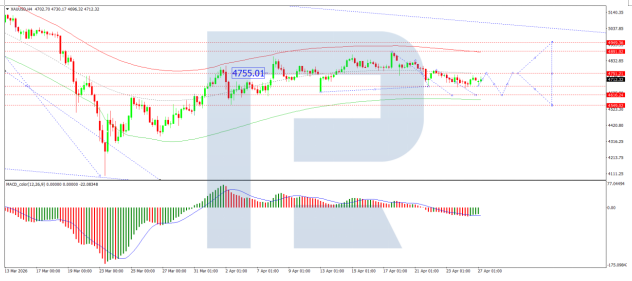
On the H4 XAU/USD chart, gold is trading within a consolidation range around the 4,690 USD level. An upside breakout could push prices towards 4,751 USD, while a downside break could lead to a move lower towards 4,616 USD. The MACD indicator confirms the current downside momentum, with its signal line below the centre line and pointing firmly downwards.
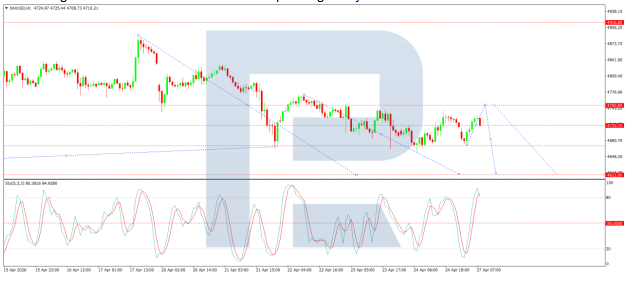
On the H1 chart, gold has broken below the 4,710 USD level and continues to move lower towards 4,680 USD. A corrective rebound towards 4,750 USD (testing from below) is likely, followed by a possible decline to 4,610 USD. The Stochastic oscillator supports this scenario, with its signal line below 80 and pointing firmly downwards towards 20.
Conclusion
Gold continues to decline as geopolitical tensions show no signs of easing. The breakdown of US-Iran negotiations, combined with the ongoing blockade of the Strait of Hormuz, has pushed oil prices higher and heightened inflationary risks. With the conflict now in its ninth week and the IEA describing it as the largest supply shock in energy markets, central banks are expected to maintain or even tighten policy rates for longer. This environment remains unfavourable for non-yielding gold. The Fed’s cautious stance offers little immediate relief. Technical indicators point firmly lower, with further downside towards 4,616–4,610 USD likely in the near term.
Disclaimer
Any forecasts contained herein are based on the author’s particular opinion. This analysis may not be treated as trading advice. RoboForex bears no responsibility for trading results based on trading recommendations and reviews contained herein.

- GBP/USD Starts the Week on a Strong Footing Aug 10, 2026
- The US stock indices finished the session with solid gains following the release of weak labor‑market data Aug 10, 2026
- COT Metals Charts: Speculator Bets led by Gold, Copper & Platinum Aug 9, 2026
- COT Bonds Charts: Speculator Bets led by 2-Year Bonds & US Treasury Bonds Aug 9, 2026
- COT Energy Charts: Speculator Bets led by Heating Oil & Bloomberg Index Aug 9, 2026
- COT Soft Commodities Charts: Speculator Bets led by Sugar & Cotton Aug 9, 2026
- The Central Bank of Mexico kept its interest rate unchanged. Iran plans to introduce strict bans for US and Israeli vessels in the Strait of Hormuz Aug 7, 2026
- USD/JPY Holds Firm: Yen Loses Some Support Aug 7, 2026
- Australian trade balance returned to positive territory Aug 6, 2026
- Results in Line for Most Reporting Companies Aug 5, 2026
