
By RoboForex Analytical Department
USDJPY rose to 154.98 on Monday, with the yen continuing to fall. Pressure on the currency increased after statements by Japanese Prime Minister Sanae Takaichi. Over the weekend, the politician noted that a weak yen could be a significant advantage for export industries, indicating that Takaichi continues to favour a softer exchange rate. She later clarified that her comments concerned the need to build an economy resistant to currency fluctuations.
On Friday, the yen lost about 1% against the dollar after US President Donald Trump nominated Kevin Warsh as the next Fed chairman. The market regarded this choice as more “hawkish”, supporting the dollar and adding to the pressure on the yen.
An additional factor of uncertainty remains the upcoming extraordinary vote in the lower house of parliament on 8 February. Takaichi’s ruling party is expected to strengthen its position and advance expansive fiscal policies, increasing the risk of higher borrowing. Against this background, both Japanese government bonds and the yen were under pressure last month.
Expectations of fiscal stimulus and discussion of tax breaks increase the burden on public finances and restrain demand for the national currency.
Technical Analysis
Free Reports:
 Get our Weekly Commitment of Traders Reports - See where the biggest traders (Hedge Funds and Commercial Hedgers) are positioned in the futures markets on a weekly basis.
 Download Our Metatrader 4 Indicators – Put Our Free MetaTrader 4 Custom Indicators on your charts when you join our Weekly Newsletter
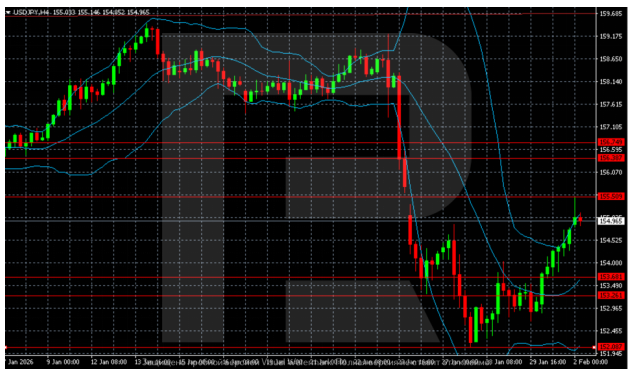
On the H4 chart, a corrective rebound follows after a sharp drop from the 158.50–159.00 area. The price recovered from a low in the 152.00 zone and is testing the 155.50 area, but remains below medium-term resistance. The structure still looks corrective inside the broader downward phase until the quotes settle above 156.50–157.00.
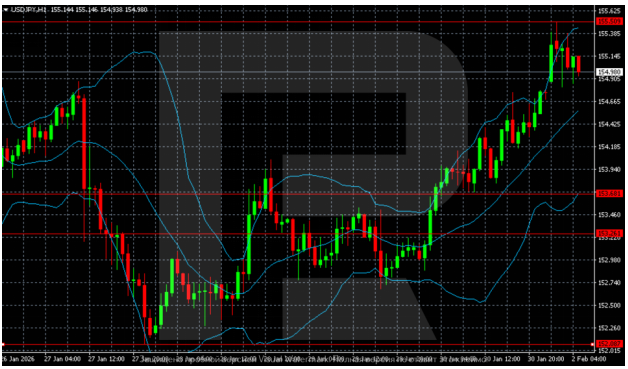
The H1 chart shows that after a sharp decline, the pair entered a recovery phase and has been sequentially updating local maxima. The price climbed above the 153.26–153.88 zone and is trading along the upper end of the Bollinger Bands, indicating continued near-term momentum. A slowdown is observed near the 155.50–155.60 level, with a possible pause or pullback within the ongoing correction.
Conclusion
In summary, the USDJPY rebound is primarily a technical correction within a broader bearish context for the yen. The move is exacerbated by political commentary favouring a weaker currency and reinforced by a hawkish Fed appointment. While near-term momentum persists, the pair faces significant resistance ahead. The fundamental backdrop of anticipated expansive fiscal policy in Japan continues to apply structural pressure on the yen, suggesting the current recovery may be limited in scope before the larger downtrend potentially resumes.
Disclaimer
Any forecasts contained herein are based on the author’s particular opinion. This analysis may not be treated as trading advice. RoboForex bears no responsibility for trading results based on trading recommendations and reviews contained herein.

- COT Metals Charts: Weekly Speculator Bets led by Copper & Steel Jul 18, 2026
- COT Bonds Charts: Weekly Speculator Bets led by 2-Year, SOFR 3M & 5-Year Bonds Jul 18, 2026
- COT Energy Charts: Weekly Speculator Bets led by Brent Oil & Heating Oil Jul 18, 2026
- COT Soft Commodities Charts: Weekly Speculator Bets led by Wheat, Corn & Soybean Meal Jul 18, 2026
- The Bank of Canada kept its interest rate unchanged. Platinum prices reached a three‑week high Jul 16, 2026
- Stock indices rose after the release of US inflation data. China’s GDP slowed sharply Jul 15, 2026
- GBP/USD Awaits Political News: What Will Happen Next Jul 15, 2026
- USD/JPY Holds at Highs: Pressure Lingers on Yen Jul 14, 2026
- Oil prices jumped 4% amid a new wave of escalation between the US and Iran Jul 13, 2026
- EUR/USD: US Inflation Will Determine Everything Jul 13, 2026
