
Hike, hike, hike, hike, hike, hike, and hike.
The Fed has just informed markets that policymakers are coming out guns blazing in the fight against inflation. They raised interest rates in the US by 25 basis points on Wednesday, their first hike since December 2018, and signaled they’re set to hike further at each of their 6 remaining scheduled meetings in 2022.
And then they’ll likely hike a few times more in 2023 as well, potentially bringing rates closer to 2.8% by the end of next year.
Overall, this was seen as a very “hawkish” scenario, with Fed Chair Jerome Powell believing that the US economy can withstand higher interest rates (which makes it more expensive to borrow money and reduces the amount of money circulating in an economy).
How did markets react?
Free Reports:
 Sign Up for Our Stock Market Newsletter – Get updated on News, Charts & Rankings of Public Companies when you join our Stocks Newsletter
 Get our Weekly Commitment of Traders Reports - See where the biggest traders (Hedge Funds and Commercial Hedgers) are positioned in the futures markets on a weekly basis.
Interestingly, bond markets told a different story compared to stocks.
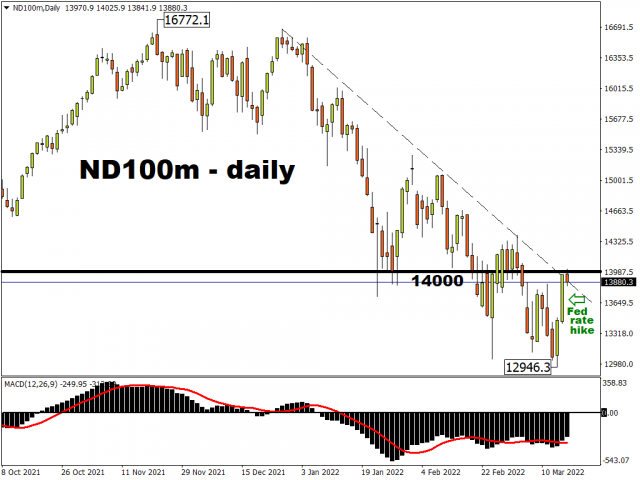
- US equities jumped, as Fed Chair Jerome Powell downplayed the risk of a US recession in 2023. The Dow Jones, S&P 500, and Nasdaq 100 indices climbed between 1.55 – 3.7% each.
The surge in the tech-heavy Nasdaq was particularly intriguing, given that growth stocks have a disliking for higher interest rates, as so conventional wisdom holds.
- Bond markets however were a lot more skeptical about Powell’s optimism about the US economy. Bond traders think that the Fed, in its haste to raise interest rates to quell inflation, could ultimately pour cold water onto US economic growth.
This skepticism appears evident in the inverted yield curve between the 5-year and 10-year US Treasuries, which suggests that investors are more willing to park their money in the safety of US government bonds for 10 years, more so than “just” 5 years, for fear that the US economy would see a recession and need some time to recover after.
What would more Fed rate hikes potentially mean for markets?
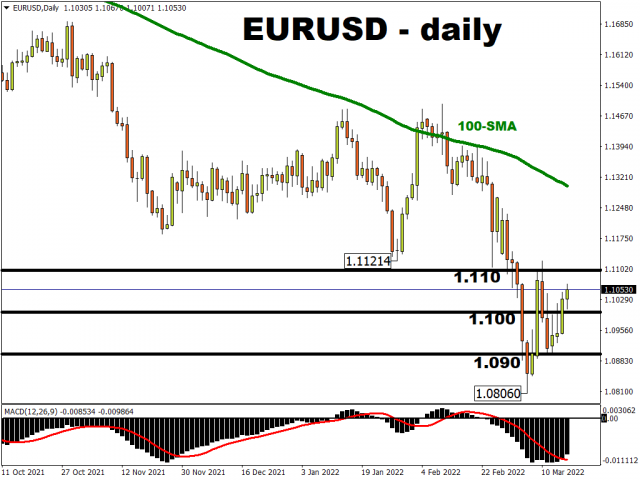
As long as markets believe that the Federal Reserve can stick to its aggressive approach to combatting inflation without triggering a recession, the US dollar is expected to rise.
This could be especially so if the Russia-Ukraine war exerts more of a negative impact on the European and UK economies relative to the States, perhaps forcing the European Central Bank and the Bank of England to pause on their respective hawkish intentions.
Notable policy divergence between the Fed and the ECB/BOE could translate into more dollar strength.
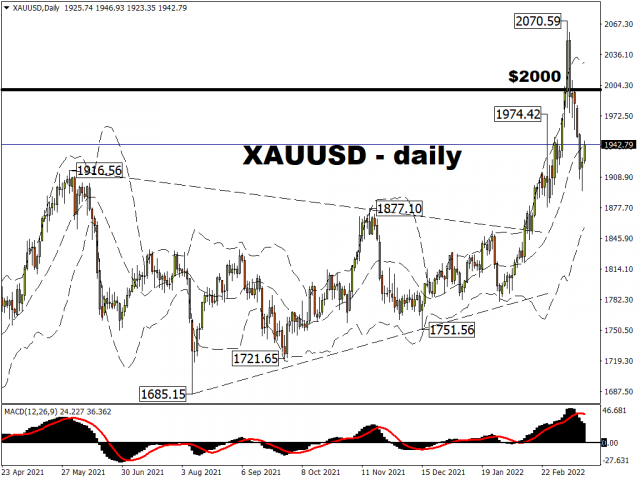
- Gold softens to sub-$1900
Considering the inverse relationship between the US dollar and gold, the latter may be forced to retreat further if more and more Fed rate hikes come through the pipeline.
Sure, the precious metal has been well-bid amidst the still-raging Russia-Ukraine war.
However, once markets think that the worst of the military conflict is over, investors’ and traders’ attentions could well pivot back to the Fed’s policy actions as the main driver for gold prices, potentially forcing gold back into sub-$1900 levels once more.
- S&P 500 could be dragged closer to 4000
Wednesday’s post-FOMC surge has seen the S&P 500 pull out from a technical correction (which is when an asset’s price falls by 10% or more from its recent peak).
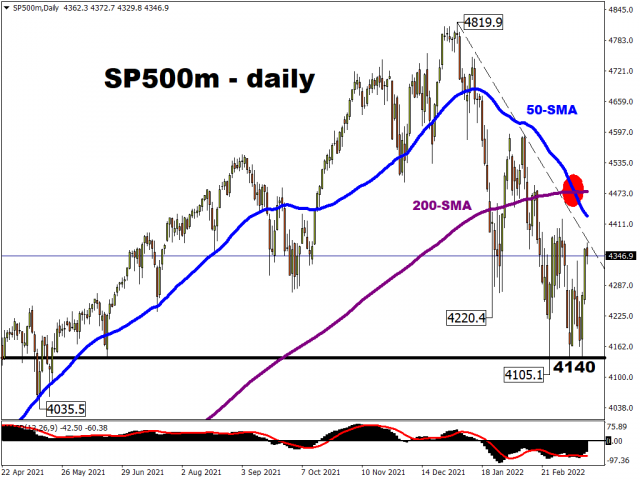
However, if there are more signs that the Fed is willing to press ahead with rate hikes, perhaps foregoing economic growth in order to bring down consumer prices, that could trigger more selling in the S&P 500 and drag it closer to the psychologically-important 4k mark.
Disclaimer: The content in this article comprises personal opinions and should not be construed as containing personal and/or other investment advice and/or an offer of and/or solicitation for any transactions in financial instruments and/or a guarantee and/or prediction of future performance. ForexTime (FXTM), its affiliates, agents, directors, officers or employees do not guarantee the accuracy, validity, timeliness or completeness, of any information or data made available and assume no liability as to any loss arising from any investment based on the same.
 Article by ForexTime
ForexTime Ltd (FXTM) is an award winning international online forex broker regulated by CySEC 185/12 www.forextime.com

- The US introduces new import tariffs for 60 countries. Brent crude surpasses $100 per barrel Jul 24, 2026
- USD/JPY Breaks Records: Nothing Slows the Yen’s Decline Jul 24, 2026
- Oil prices reached a 6‑week high. The AUD strengthened on the back of a strong labor‑market report Jul 23, 2026
- EUR/USD Recovers as Dollar Weakens Jul 23, 2026
- Bitcoin rose to $66,000. The New Zealand dollar continues to strengthen Jul 22, 2026
- Inflationary pressure is easing in Canada. In New Zealand, on the contrary, inflation is rising Jul 21, 2026
- GBP/USD Falls After Cabinet Changes Jul 21, 2026
- Geopolitical and macroeconomic conditions continue to pressure market sentiment Jul 20, 2026
- USD/JPY Poised to Continue Gains as Expensive Oil and Lack of Support Weigh on Yen Jul 20, 2026
- COT Metals Charts: Weekly Speculator Bets led by Copper & Steel Jul 18, 2026
