
After the fireworks of last week, when several major central banks finally acknowledged the threat posed by high inflation amid the Omicron variant, the next few days have less significant calendar risk.
Monday
Tuesday:
- AUD: RBA minutes and weekly consumer confidence
- EUR: Eurozone December consumer confidence
- CAD: Canada October retail sales
Wednesday:
- NZD: New Zealand December consumer confidence
- GBP: UK 3Q GDP (final)
- US crude: EIA weekly US crude oil inventory report
- USD: US 3Q GDP and December consumer confidence
Thursday:
Free Reports:
 Sign Up for Our Stock Market Newsletter – Get updated on News, Charts & Rankings of Public Companies when you join our Stocks Newsletter
 Get our Weekly Commitment of Traders Reports - See where the biggest traders (Hedge Funds and Commercial Hedgers) are positioned in the futures markets on a weekly basis.
- JPY: Bank of Japan Governor Haruhiko Kuroda speaks
- USD: US initial weekly jobless claims, November personal income and spending, November PCE deflator and December consumer sentiment
Friday:
- US markets closed, European stock markets half-day
But in the wind down to the festive period, liquidity will start to thin which means we could see more whipsaw market price action.
We are now entering a world of tighter monetary policy, with the world’s most important central bank indicating that interest rates may need to rise three times next year if inflation proves persistent. The clarity offered by the Fed soothed traders’ nerves but there remains major uncertainty and this has caused strong rotation in stock markets.
Growth sectors like technology and consumers stocks have lagged, while small-cap and value stocks have both entered correction territory over the past four weeks. A major US investment bank has noted that the average US stock is down 28% from its highs, even as the benchmark indices are up 20% or more for the year. This is unprecedented and it will be instructive to see if this continues.
US data to inform on price pressures
Thursday will see a US data dump with personal income and spending numbers along with the core PCE index. This is the Fed’s preferred measure of inflation and may hit its highest level since the 1980s, ticking up to 4.5% y/y from 4.1% in October. Some economists see the index getting worse through the winter before falling back through next year as the demand for goods moderate with the peak stay-at-home and stimulus effects fading.
Durable goods orders, new home sales and the final reading of the Michigan consumer sentiment are also released. The former points to a very good outlook for capex in the first half of next year. The dollar closed last week strongly and looks like it will challenge the year-to-date high from November at 96.93 on the widely watched DXY Index.
PBoC meets amid mounting headwinds
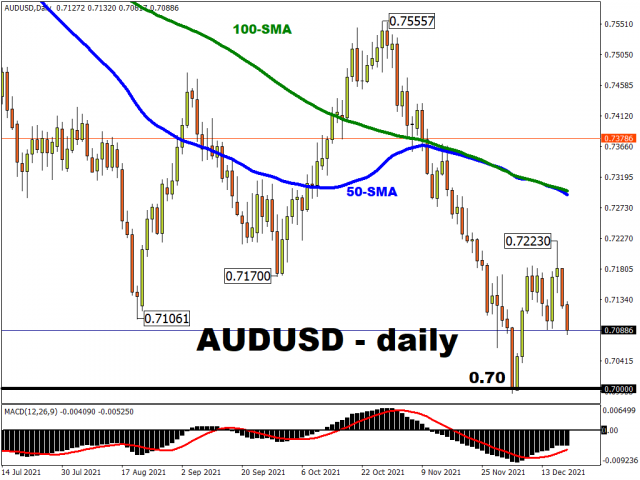
The central bank has already been proactive in increasing liquidity in recent weeks with broad-based RRR cuts and targeted SME lending. It is highly unlikely policymakers cut their policy rates, but markets may see more similar policy easing measures to those seen recently. Asian equity markets and China-sensitive risk currencies like AUD should find a bid if big measures are enacted.
Disclaimer: The content in this article comprises personal opinions and should not be construed as containing personal and/or other investment advice and/or an offer of and/or solicitation for any transactions in financial instruments and/or a guarantee and/or prediction of future performance. ForexTime (FXTM), its affiliates, agents, directors, officers or employees do not guarantee the accuracy, validity, timeliness or completeness, of any information or data made available and assume no liability as to any loss arising from any investment based on the same.
 Article by ForexTime
ForexTime Ltd (FXTM) is an award winning international online forex broker regulated by CySEC 185/12 www.forextime.com

- The US Tech sector hit by sell‑off. Oil prices decline on renewed negotiations Jul 28, 2026
- Gold Declines, Focus on Fed and Falling Oil Prices Jul 28, 2026
- This week will be one of the most crowded for central‑bank meetings Jul 27, 2026
- EUR/USD Ahead of a Key Week: Holding Near Lows Jul 27, 2026
- COT Metals Charts: Weekly Speculator Changes led by Copper Jul 26, 2026
- COT Bonds Charts: Speculator Bets led by SOFR 3-Months & 5-Year Bonds Jul 26, 2026
- COT Energy Charts: Weekly Speculator Bets led by WTI Crude & Natural Gas Jul 26, 2026
- COT Soft Commodities Charts: Weekly Speculator Bets led by Corn & Soybeans Jul 26, 2026
- The US introduces new import tariffs for 60 countries. Brent crude surpasses $100 per barrel Jul 24, 2026
- USD/JPY Breaks Records: Nothing Slows the Yen’s Decline Jul 24, 2026
