Archive for Economics & Fundamentals – Page 21

The tech-heavy Nasdaq Index is breaking price records again. In Thailand, there are plans to introduce a tax on gold trading in baht

By JustMarkets 

On Monday, the Dow Jones (US30) Index rose by 0.11%, the S&P 500 (US500) gained 0.47%, and the tech-heavy Nasdaq (US100) closed up 0.94%, setting an all-time high. The US stocks closed higher, driven by a surge in technology shares. Tesla jumped by 3.6% after CEO Elon Musk reported purchasing about $1 billion in stock, his largest open-market purchase ever, while Alphabet gained 4.3%, reaching a $3 trillion valuation and boosting the communication services sector. Nvidia ended the session flat, paring losses after a Chinese regulator stated the company had violated antitrust law, and Texas Instruments fell 2.4% on news of a Chinese anti-dumping investigation into US analog chipmakers. Trade tensions also persisted as President Donald Trump signaled progress in US-China talks, including a potential deal related to TikTok, though risks from tariffs and tech restrictions remain.

The Mexican peso strengthened to 18.4 per US dollar, its strongest level since July 2024, as the US dollar weakened and Mexico’s macroeconomic indicators remained stable, increasing the attractiveness of peso-denominated assets. Banco de México is maintaining a tight policy and signaling careful calibration even amid moderate inflation. Higher real interest rate differentials compared to peer countries, sustained demand for forward markets, and Mexico’s strong trade ties with the US support demand for local securities, limiting capital outflows.

European stock markets were mostly up on Monday. The German DAX (DE40) rose by 0.21%, the French CAC 40 (FR40) closed up 0.92%, the Spanish IBEX35 (ES35) gained 0.57%, and the British FTSE 100 (UK100) closed down 0.07%. The DAX Index in Frankfurt experienced some volatility. Investors are awaiting decisions from major central banks, including the US Federal Reserve, the Bank of England, the Bank of Japan, and the Bank of Canada. The US Central Bank is widely expected to cut rates by at least 25 basis points. Meanwhile, attention remains on France, as Fitch downgraded its credit rating, citing rising public debt and increasing political polarization, which raises concerns about the size of the upcoming budget deficit.

WTI crude oil prices rose nearly 1% to $63.3 per barrel on Monday, extending last week’s gains as traders weighed escalating Ukrainian drone attacks on Russian energy facilities against expectations of an impending supply surplus. Ukraine launched a major strike with over 360 drones, briefly causing a fire at the 355,000 bpd Kirishi oil refinery, just days after an attack on the Primorsk export terminal, which handles around 1 million bpd. Pressure on Moscow intensified after US President Donald Trump reaffirmed his willingness to impose massive sanctions on Russian oil if NATO allies cease their purchases, which could alter global energy flows.

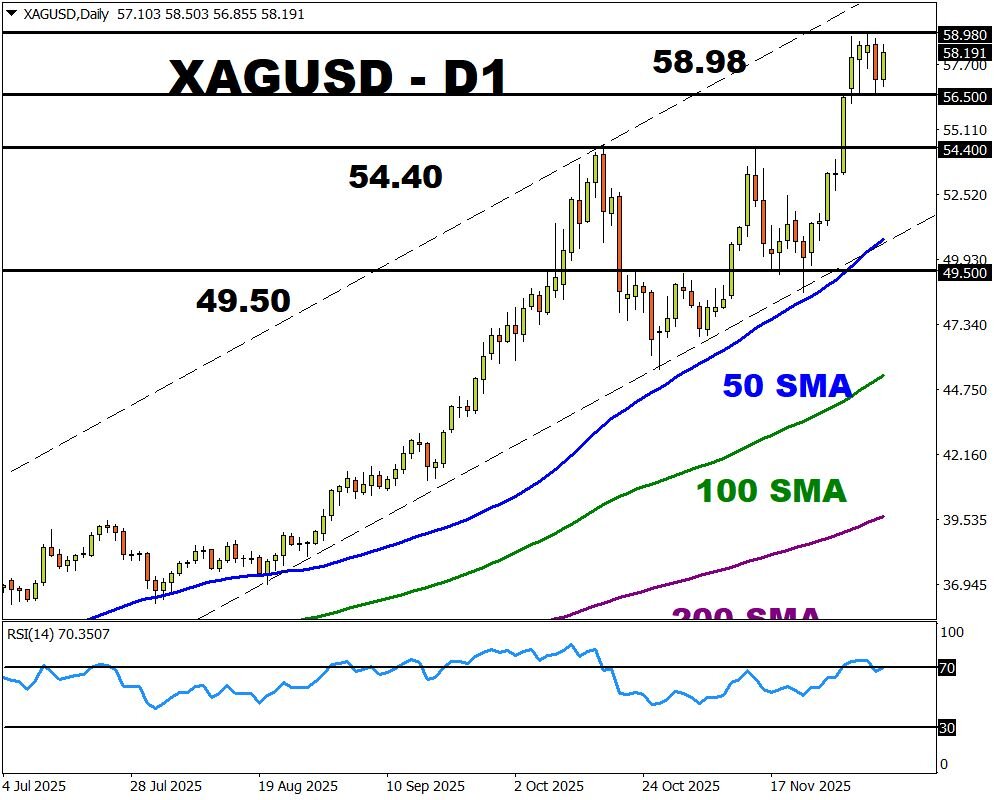
On Tuesday, silver (XAG/USD) stabilized at around $42.5 per ounce, trading near its 14-year high as investors prepared for an expected US Federal Reserve rate cut this week. Markets are almost fully pricing in a 25 basis point cut on Wednesday, with 67 basis points of cuts projected by the end of the year. President Donald Trump also pressured Fed Chair Jerome Powell for a more significant cut, citing weakness in the housing market. Elsewhere, the central banks of Canada and China are expected to ease policy this week, while the central banks of Japan and the UK are likely to hold theirs unchanged. On the geopolitical front, US-China trade talks in Spain showed progress, and talks between Trump and Chinese President Xi Jinping are scheduled for Friday. Meanwhile, industrial demand from solar energy, electric vehicles, and electronics continues to intensify pressure on the physical silver market, while supply constraints support prices.

Asian markets had a strong day. The Japanese Nikkei 225 (JP225) rose by 0.89%, China’s FTSE China A50 (CHA50) climbed 0.46%, Hong Kong’s Hang Seng (HK50) gained 0.22%, and the Australian ASX 200 (AU200) posted a negative result of 0.13%.

The Bank of Thailand and the Ministry of Finance are considering introducing a tax on online gold trading in baht. Officials state the measure will limit gold exports and make holding it in the country more expensive, as the influx of dollars from gold shipments has strengthened the currency. Bank of Thailand representatives will meet with gold traders on Monday to discuss the metal’s impact and stricter reporting requirements.

S&P 500 (US500) 6,615.28 +30.99 (+0.47%)

Dow Jones (US30) 45,883.45 +49.23 (+0.11%)

DAX (DE40) 23,748.86 +50.71 (+0.21%)

FTSE 100 (UK100) 9,277.03 −6.26 (−0.07%)

USD Index 97.31 −0.24 (−0.24%)

News feed for: 2025.09.16

  • UK Unemployment Rate (m/m) at 09:00 (GMT+3);
  • German ZEW Economic Sentiment (m/m) at 12:00 (GMT+3);
  • Eurozone ZEW Economic Sentiment (m/m) at 12:00 (GMT+3);
  • US Retail Sales (m/m) at 15:30 (GMT+3);
  • Canada Consumer Price Index (m/m) at 15:30 (GMT+3);
  • US Industrial Production (m/m) at 16:15 (GMT+3).

By JustMarkets


This article reflects a personal opinion and should not be interpreted as an investment advice, and/or offer, and/or a persistent request for carrying out financial transactions, and/or a guarantee, and/or a forecast of future events.

Oil continues to get more expensive. The Japanese Nikkei index has reached a new all-time high

By JustMarkets 

The US stocks had a mixed close on Friday. The Dow Jones (US30) fell by 0.59% for the day (+0.89% for the week). The S&P 500 (US500) dropped 0.05% (+1.33% for the week), while the tech-heavy Nasdaq (US100) closed up 0.44% (+1.54% for the week). Investors interpreted weak employment data and low inflation as signs that the Federal Reserve would lower interest rates this week. The Nasdaq jumped, driven by a 7.4% surge in Tesla shares and a 1.7% gain in Microsoft after the company avoided a potential EU antitrust fine, lifting the broader tech sector.

European stock markets were mostly down on Friday. The German DAX (DE40) fell 0.02% (-0.31% for the week), the French CAC 40 (FR40) closed up 0.02% (+1.54% for the week), the Spanish IBEX35 (ES35) dropped 0.08% (+2.86% for the week), and the British FTSE 100 (UK100) closed down 0.15% on Friday (+0.82% for the week). European stocks closed slightly lower on Friday as markets continued to assess the global rate outlook and awaited France’s credit rating from Fitch. At the same time, pharmaceutical stocks across Europe fell after Goldman Sachs downgraded Novartis due to increasing competition from generic brands, causing the company’s shares to drop by 3%, while Roche, AstraZeneca, and GSK all declined by over 1%. On Thursday, the ECB signaled that its easing cycle was complete, with President Lagarde noting that the bank is now in a “good place” and that growth risks appear more balanced.

WTI crude oil prices rose more than 1.5% on Friday. Ukrainian strikes temporarily halted operations at Primorsk, Russia’s main oil-handling port in the Baltic, and hit three pumping stations that supply the Ust-Luga hub. Meanwhile, the US reportedly said it might force G7 allies to impose tariffs of up to 100% on Chinese and Indian purchases of Russian oil, and Canada convened a meeting of finance ministers to discuss additional measures. Further pressure comes from the International Energy Agency’s forecast of a record oil supply surplus next year, with OPEC+ planning to bring idle barrels back to the market in October, albeit at a slower pace.

Asian markets had a strong week. The Japanese Nikkei 225 (JP225) rose by 3.03%, China’s FTSE China A50 (CHA50) climbed 1.88%, Hong Kong’s Hang Seng (HK50) gained 3.73%, and the Australian ASX 200 (AU200) posted a positive result of 0.11% last week. Japanese stocks reached new record highs, following gains on Wall Street. In Japan, investors continued to assess the Bank of Japan’s policy direction amid mixed economic signals and political uncertainty. Prime Minister Shigeru Ishiba recently announced his resignation, facing increasing pressure after a defeat in last year’s elections and deepening divisions within the ruling party. The Hang Seng rose by about 4%, marking its second consecutive weekly gain, fueled by reports that Beijing may direct state-owned banks to help local governments cover unpaid bills. However, gains were capped by concerns that the US could restrict supplies of Chinese medicines and tighten oversight of licensing deals for experimental drugs. Hong Kong-listed Alibaba jumped 7%, and Baidu surged nearly +4% after both companies began using their self-developed chips to train AI models, reducing their reliance on Nvidia.

China’s economy continues to face numerous risks and challenges, as evidenced by weak August 2025 data amid intensifying global issues. Economic activity was also negatively impacted by extreme weather conditions: the hottest heatwave since 1961 and the longest rainy season during the same period. Industrial production grew by 5.2% year-on-year that month, missing forecasts of 5.8% and marking the slowest growth rate in a year, while retail sales increased by 3.4%, the weakest showing in eight months and below the consensus forecast of 3.8%. The unemployment rate rose to a six-month high of 5.3%, and real estate investment continued to contract, highlighting the sector’s prolonged downturn amid tightening regulations on speculation and debt.

The New Zealand dollar declined to $0.596 on Friday but remained near multi-month highs on a weak US dollar. The US dollar was under pressure as slightly higher US consumer inflation data and a sharp increase in jobless claims maintained expectations of Federal Reserve interest rate cuts next week and beyond. At the same time, on the domestic front, the Reserve Bank of New Zealand’s dovish forecasts continue to pressure the currency. RBNZ Governor Christian Hawkesby confirmed on Thursday the central bank’s forecast for another 50 basis points of cuts to the official cash rate by the end of the year, with the pace of easing to be determined by incoming data, particularly next week’s GDP report. Meanwhile, fresh data showed that New Zealand’s manufacturing sector contracted again in August, underscoring the economy’s fragile state.

S&P 500 (US500) 6,584.29 −3.18 (−0.05%)

Dow Jones (US30) 45,834.22 −273.78 (−0.59%)

DAX (DE40) 23,698.15 −5.50 (−0.02%)

FTSE 100 (UK100) 9,283.29 −14.29 (−0.15%)

USD index 97.62 +0.08 (+0.09%)

News feed for: 2025.09.15

  • China Industrial Production (m/m) at 05:00 (GMT+3);
  • China Retail Sales (m/m) at 05:00 (GMT+3);
  • China Unemployment Rate (m/m) at 05:00 (GMT+3);
  • Switzerland Producer Price Index (m/m) at 09:30 (GMT+3);
  • Eurozone Trade Balance (m/m) at 12:00 (GMT+3);
  • Eurozone ECB President Lagarde Speaks (m/m) at 21:10 (GMT+3).

By JustMarkets


This article reflects a personal opinion and should not be interpreted as an investment advice, and/or offer, and/or a persistent request for carrying out financial transactions, and/or a guarantee, and/or a forecast of future events.

US stock indices hit new all-time highs, and silver reached its strongest point since 2011

By JustMarkets 

On Thursday, the Dow Jones (US30) Index rose by 0.36%, the S&P 500 (US500) gained 0.85%, and the tech-heavy Nasdaq (US100) closed up 0.60%. All three major indices closed at record highs, with expectations that ongoing inflation won’t prevent the Federal Reserve from easing rates next week. The August Consumer Price Index (CPI) report showed that consumer prices increased by 0.4% month-over-month, exceeding expectations, but the annual rate held at 2.9%, in line with projections. Signs of a cooling labor market were exacerbated by jobless claims, which rose by 27,000 to 263,000, the highest since 2021. Traders priced in a 93% chance of a quarter-point rate cut at the September 17th Fed meeting, while the odds of a more significant half-point hike increased.

European stock mostly went up on Thursday. The German DAX (DE40) rose by 0.30%, the French CAC 40 (FR40) closed up 0.80%, the Spanish IBEX35 (ES35) gained 0.68%, and the British FTSE 100 (UK100) closed up 0.78%. Frankfurt’s DAX Index rose on Thursday as investors weighed the expected decision by the European Central Bank (ECB) to hold rates steady. The ECB left its three key interest rates unchanged as expected: the deposit rate at 2.00%, the main refinancing rate at 2.15%, and the marginal lending rate at 2.40%. Inflation remains close to the medium-term 2% target, and the overall outlook is unchanged from June. Among individual stocks, Airbus, Bayer, Heidelberg Materials, Zalando, and Deutsche Bank saw the largest gains, adding between 1% and almost 3%.

Sweden’s annual inflation rate in August 2025 rose to 1.1% from 0.8% in July, confirming preliminary estimates. This is the highest reading since February, although it remains below the Riksbank’s 2% target. On a monthly basis, consumer prices fell by 0.4%, the first decline in five months, reversing the 0.2% increase in July, in line with flash data.

WTI crude oil prices dropped more than 2% to $62.4 per barrel on Thursday, breaking a three-day rally. Concerns over US demand and a global supply surplus outweighed geopolitical risks in the Middle East and Ukraine. The International Energy Agency noted a larger-than-expected increase in supply driven by higher OPEC+ output, and the group itself confirmed plans to boost production from October. Additional pressure came from an unexpected increase of 3.9 million barrels in US crude oil inventories last week.

The US natural gas prices (XNG/USD) fell below the $3/MMBtu mark, nearing a two-week low due to weak LNG export demand and significant storage levels. Government data showed that for the week ending September 5th, storage volume exceeded the expected 71 billion cubic feet, compared to 36 billion cubic feet a year earlier and a five-year average of 56 billion cubic feet. Despite expectations of warmer weather and increased demand, surplus supplies continue to pressure the market.

Silver prices (XAG/USD) rose by 1% on Friday to $42 per ounce, hitting a new 14-year high, as strong expectations for a Federal Reserve rate cut next week supported demand. Markets are currently pricing in about a 93% probability of a 25 basis point rate cut at the September 17th Fed meeting, with the chance of a larger half-percent cut gradually rising. Safe-haven demand further supported precious metals amid ongoing geopolitical tensions.

Asian markets traded without a single trend yesterday. The Japanese Nikkei 225 (JP225) rose by 1.22%, China’s FTSE China A50 (CHA50) jumped 2.08%, Hong Kong’s Hang Seng (HK50) fell by 0.43%, and Australia’s ASX 200 (AU200) closed down 0.29%.

The offshore yuan weakened to 7.11 per dollar as renewed trade concerns negatively affected sentiment. The US has reportedly urged G7 countries to impose high tariffs – from 50% to 100% – on China and India for their continued purchases of Russian oil. This move is part of a broader Washington effort to pressure Moscow into peace talks over the war in Ukraine. In a separate development, China criticized Mexico’s plan to impose tariffs of up to 50% on vehicles and other imports from countries without free trade agreements, many of which are Chinese, calling the move discriminatory and subject to outside pressure.

S&P 500 (US500) 6,587.47 +55.43 (+0.85%)

Dow Jones (US30) 46,108.00 +617.08 (+1.36%)

DAX (DE40) 23,703.65 +70.70 (+0.30%)

FTSE 100 (UK100) 9,297.58 +72.19 (+0.78%)

USD Index 97.51 −0.27 (−0.27%)

News feed for: 2025.09.12

  • UK GDP (m/m) at 09:00 (GMT+3);
  • UK Industrial Production (m/m) at 09:00 (GMT+3);
  • UK Manufacturing Production (m/m) at 09:00 (GMT+3);
  • UK Trade Balance (m/m) at 09:00 (GMT+3);
  • US Michigan Consumer Sentiment (m/m) at 17:00 (GMT+3).

By JustMarkets


This article reflects a personal opinion and should not be interpreted as an investment advice, and/or offer, and/or a persistent request for carrying out financial transactions, and/or a guarantee, and/or a forecast of future events.

Oil prices continue to rise amid a geopolitical risk premium. The Australian dollar has risen to a 10-month high

By JustMarkets

By the end of Wednesday, the Dow Jones Index (US30) fell by 0.48%. The S&P 500 Index (US500) gained 0.30%. The Nasdaq (US100) Technology Index closed up 0.04%. The US stocks rose to new records on Wednesday, supported by lower inflation data and a strong Oracle report. The Producer Price Index for August fell by 0.1% against expectations of a 0.3% increase, the first monthly decline in four months. The annual Producer Price Index was 2.6%, below the expectations of 3.3%, which increased hopes that Thursday’s CPI report would confirm the disinflationary trend. The inflation surprise, combined with soft labor market data, fueled bets that the Fed could cut rates by 50 basis points next week instead of the expected quarter-point change.

Oracle shares surged 39% after the company announced a sharp increase in cloud service orders, driven by demand for artificial intelligence. The company’s value increased by $85 billion in a single day, a new record. Nvidia (+3.8%) and AMD (+2.4%) shares rose, while Apple shares fell by 3.2% after the launch of the new iPhone 17 was underwhelming.

European stock markets traded mixed on Wednesday. The German DAX (DE40) fell by 0.36%, the French CAC 40 (FR40) closed up 0.15%, the Spanish IBEX35 (ES35) gained 1.29%, and the British FTSE 100 (UK100) closed down 0.19%. The ECB is expected to leave borrowing costs unchanged today, although updates to economic expectations and guidance on the policy outlook will be closely watched. Geopolitical risks also remained in focus, with Israel striking Hamas targets in Qatar and Poland intercepting drones that entered its airspace during a Russian attack on Ukraine.

Annual inflation in Norway for August 2025 rose to 3.5%, the highest since February, compared to 3.3% in July and in line with expectations. On a monthly basis, the CPI fell by 0.6%, the first decline since March, offsetting the 0.8% increase in July, which was also in line with projections.

WTI crude oil prices rose more than 1.5% on Wednesday to $63.7 per barrel, posting a third consecutive gain as traders balanced geopolitics and economic signals. The momentum accelerated when President Trump questioned the Russian drone invasion of Polish airspace on social media, triggering short-covering amid speculation that he might soon impose sanctions on Russian energy exports. This followed reports that Trump had urged the EU to join him in imposing tariffs on China and India, major buyers of Russian oil, to force Moscow to the negotiating table. Additionally, Israel’s strike on Hamas leaders in Qatar reignited Middle East tensions and added a geopolitical risk premium. However, the gains were capped as US government data showed a larger-than-expected increase in crude oil inventories of 3.9 million barrels.

Asian markets were mostly higher yesterday. The Japanese Nikkei 225 (JP225) rose by 0.87%, the Chinese FTSE China A50 (CHA50) jumped 0.48%, the Hong Kong Hang Seng (HK50) gained 1.01%, and the Australian ASX 200 (AU200) showed a positive result of 0.31%.

The Hang Seng Index rose to a four-year high on broad-based gains. In China, the sharpest drop in the Consumer Price Index in six months in August rekindled hopes for new government support, which could lead to an increase in consumer prices, while producer deflation hit a four-month low as Beijing’s efforts to curb corporate price wars were successful. Following a bilateral currency swap deal between China and Europe, shares in the real estate and financial sectors rose. Technology stocks also climbed, fueled by optimism about AI earnings after strong results from Oracle in the US. Alibaba rose by 0.6% on the optimistic outlook, and Baidu HK gained 2.6% after unveiling an updated artificial intelligence model.

The Australian dollar rose to around $0.662 on Thursday, nearing its highest level since early last November, driven by an improved risk appetite amid growing bets on a Fed rate cut. The commodity-linked Australian dollar also continued to benefit from rising oil and gold prices as escalating geopolitical risks fueled demand for safe-haven assets. Looking ahead, today’s speech by an RBA official will be closely monitored for further policy signals, as markets have generally priced in a 25 basis point cut in November.

New Zealand Central Bank chief Christian Hawkesby said on Thursday that the future path of the official cash rate (OCR) would depend on the pace of the economic recovery. The main prognoses for the OCR suggests a cut to around 2.50% by the end of the year. In August, the RBNZ lowered the OCR to a three-year low of 3.00% and signaled that it would continue to ease the rate as domestic and global factors constrain growth.

S&P 500 (US500) 6,532.04 +19.43 (+0.30%)

Dow Jones (US30) 45,490.92 −220.42 (−0.48%)

DAX (DE40) 23,632.95 −85.50 (−0.36%)

FTSE 100 (UK100) 9,225.39 −17.14 (−0.19%)

USD Index 97.83 +0.04 (+0.01%)

News feed for: 2025.09.11

  • RBNZ Gov Hawkesby Speaks at 02:15 (GMT+3);
  • Japan Producer Price Index (m/m) at 02:50 (GMT+3);
  • Eurozone ECB Monetary Policy Statement at 15:15 (GMT+3);
  • Eurozone ECB Interest Rate Decision at 15:15 (GMT+3);
  • US Consumer Price Index (m/m) at 15:30 (GMT+3);
  • US Initial Jobless Claims (w/w) at 15:30 (GMT+3);
  • Eurozone ECB Press Conference at 15:45 (GMT+3);
  • US Natural Gas Storage (w/w) at 17:30 (GMT+3).

By JustMarkets


This article reflects a personal opinion and should not be interpreted as an investment advice, and/or offer, and/or a persistent request for carrying out financial transactions, and/or a guarantee, and/or a forecast of future events.

The French Parliament has passed a vote of no-confidence in the Prime Minister. Russia is attacking Poland, and Israel is attacking Hamas in the capital of Qatar

By JustMarkets

The Dow Jones Industrial Average (US30) rose by 0.43% on Tuesday. The S&P 500 (US500) gained 0.27%, and the tech-heavy Nasdaq (US100) finished 0.33% higher. All three major indices hit record highs despite signs of a slowing economy. Investors digested revised employment data showing that the US added 911,000 fewer jobs than previously estimated in the year ending in March, the most significant downward revision since 2002. This weaker job outlook increased expectations of a Federal Reserve rate cut next week, with debate centered mainly on the size of the reduction. Attention will now turn to the Producer Price Index (PPI) and Consumer Price Index (CPI) reports, which will be closely watched for clues about the direction of the Fed’s policy.

The Mexican peso strengthened to 18.6 per US dollar. In August, headline inflation slowed to 3.57%, while core inflation held steady at 4.23%, reinforcing expectations that the Bank of Mexico’s cautious easing cycle will continue at a moderate pace. The minutes from Banxico’s August meeting confirmed that the board approved a 25 basis point (bps) rate cut to 7.75%, with the majority favoring a slower pace of cuts and a potential additional quarter-point reduction later this year.

The Canadian dollar is under new selling pressure and is currently the second-worst performing major currency of 2025, behind only the US dollar. A combination of a deteriorating domestic economy and ongoing tariff uncertainty continues to weigh on the loonie, making traders skeptical about its near-term growth prospects. Canada’s latest GDP release confirmed sluggish growth, highlighting the impact of weak domestic activity. In response, the Bank of Canada may continue to cut rates.

European stock markets were mostly higher on Tuesday. The German DAX (DE40) fell by 0.37%, the French CAC 40 (FR40) rose by 0.19%, Spain’s IBEX35 (ES35) gained 0.14%, and the UK’s FTSE 100 (UK100) closed 0.23% higher. European equities ended slightly up on Tuesday, continuing their gains from the previous session. The French Parliament passed a vote of no-confidence in Prime Minister Bayrou as parties failed to agree on budget cuts, forcing President Macron to appoint the country’s fifth prime minister in less than two years. At the same time, bond yields traded quietly despite the turmoil, providing support for stocks ahead of the European Central Bank’s likely rate hold this week.

Russian strike drones have invaded Polish airspace, threatening cities approximately 40-50 miles from the Ukrainian border. Airports in Warsaw, Lublin, and Rzeszow were closed due to the attack. Poland has put its air defense systems on high alert and, according to preliminary reports, has shot down all the drones. On Wednesday morning local time, Polish armed forces stated that all necessary procedures were enacted to ensure the security of national airspace as Russia conducted large-scale overnight strikes on Ukraine. This is not the first time Russian drones have violated Polish airspace, forcing fighter jets to scramble, but this time, the number of drones crossing NATO’s borders was around 8-10, which does not appear to be accidental.

WTI crude oil prices rose more than 1% on Tuesday, surpassing $63 a barrel. The increase followed reports of explosions in Doha, Qatar, where Israel reportedly struck high-ranking Hamas leaders. According to eyewitnesses, Qatar, a key mediator in the Israel-Hamas conflict and a host of Hamas officials, was rattled by smoke rising over the area. This geopolitical shock added to existing bullish factors for oil. Prices were already supported by a smaller-than-expected OPEC+ output increase. Markets also anticipate that China will continue to build up its oil reserves, further tightening supply. Meanwhile, fears of new Western sanctions against Russia have heightened following its largest aerial attack on Ukraine in months.

Asian markets were mostly lower yesterday. Japan’s Nikkei 225 (JP225) fell by 0.42%, China’s FTSE China A50 (CHA50) dropped 0.35%, Hong Kong’s Hang Seng (HK50) rose by 1.19%, and Australia’s ASX 200 (AU200) had a negative result of 0.63%.

The New Zealand dollar rose to $0.594 USD on Wednesday as the US dollar strengthened ahead of key inflation reports. Traders are awaiting the release of the US PPI and CPI data this week, which could provide more clues about the Federal Reserve’s path for interest rates. Meanwhile, in China, New Zealand’s largest trading partner, data released today showed that consumer prices fell in August and factory gate deflation eased, pointing to continued deflationary pressures in an economy facing slowing growth.

S&P 500 (US500) 6,512.61 +17.46 (+0.27%)

Dow Jones (US30) 45,711.34 +196.39 (+0.43%)

DAX (DE40) 23,718.45 −88.68 (−0.37%)

FTSE 100 (UK100) 9,242.53 +21.09 (+0.23%)

USD Index 97.76 +0.30 (+0.31%)

News feed for: 2025.09.10

  • China Consumer Price Index (m/m) at 04:30 (GMT+3);
  • China Producer Price Index (m/m) at 04:30 (GMT+3);
  • Norway Inflation Rate (m/m) at 09:00 (GMT+3);
  • Switzerland SNB Chairman Schlegel Speaks at 14:45 (GMT+3);
  • US Producer Price Index (m/m) at 15:30 (GMT+3);
  • US Crude Oil Reserves (w/w) at 17:30 (GMT+3).

By JustMarkets


This article reflects a personal opinion and should not be interpreted as an investment advice, and/or offer, and/or a persistent request for carrying out financial transactions, and/or a guarantee, and/or a forecast of future events.

Hong Kong stocks rose to a 4-year high. The announced production hike from OPEC+ was smaller than analysts had projected

By JustMarkets 

By the end of Monday, the Dow Jones Index (US30) had risen by 0.25%. The S&P 500 (US500) gained 0.21%, and the Nasdaq (US100) Technology Index closed up 0.46%. Wall Street started the week with gains on Monday as investors positioned themselves ahead of a data-heavy week, which includes two key inflation reports that are likely to influence the Federal Reserve’s policy expectations. A weak August jobs report, combined with softer labor market data last week, fueled hopes that the Fed will cut rates at its September meeting, with traders increasingly pricing in the possibility of a more significant 50 basis point (bps) rate cut. This week, investors will monitor the PPI and CPI for new signals on the economy’s direction.

Stock markets in Europe were mostly up on Monday. Germany’s DAX (DE40) rose by 0.89%, France’s CAC 40 (FR40) closed up 0.78%, Spain’s IBEX35 (ES35) gained 1.02%, and the UK’s FTSE 100 (UK100) closed up 0.14%. European stocks closed with solid gains, as markets continued to assess the outlook for European rates and the latest corporate news. Banks closed sharply higher as Eurozone yield spreads narrowed, easing fragmentation concerns that had emerged in recent weeks before the expected dissolution of the French parliament. Prime Minister François Bayrou is expected to lose a confidence vote as the government rejects the current budget proposal, creating political risk and likely increasing the country’s budget deficit.

WTI crude oil prices rose 2% on Monday, climbing above the $63 per barrel mark and recovering from a three-day slide. The gains came as OPEC+ announced a smaller-than-expected production increase and concerns over potential new US sanctions on Russian oil intensified. The group agreed to raise production by 137,000 barrels per day from October, which is far below the increases of 555,000 bpd in August and September and 411,000 bpd in June and July. Analysts noted that some members are already overproducing, meaning the real impact on the market may be limited.

Silver prices (XAG/USD) climbed back above the $41 per ounce mark, reaching their highest level since August 2011, as signs of a cooling US labor market boosted expectations for a Federal Reserve rate cut this year. Markets are fully pricing in a 25 bps rate cut later this month, with some betting on a more significant half-point shift. On the industrial side, strong demand from solar panels, electric vehicles, and electronics has tightened the physical silver market amid limited supply.

Asian markets were mostly down yesterday. Japan’s Nikkei 225 (JP225) rose by 1.45%, China’s FTSE China A50 (CHA50) fell by 0.10%, Hong Kong’s Hang Seng (HK50) gained 0.85%, and Australia’s ASX 200 (AU200) ended the day with a 0.24% loss. In early Tuesday trading, Hong Kong stocks jumped 1.4%, rising for the third consecutive day to their highest level since October 2021, as all sectors saw gains. Optimism on Wall Street on Monday lifted the mood ahead of an expected Fed rate cut later this month. Hong Kong real estate company stocks were among the top gainers, rising by about 2% after the city of Shenzhen eased home purchase restrictions last week. Technology, financial, and consumer stocks also rose, supported by a third consecutive day of gains in mainland markets as Beijing moves toward a record trade surplus despite August exports hitting a six-month low. However, gains were capped by caution ahead of the release of China’s CPI and PPI data on Wednesday, as concerns about deflation persist.

The Westpac-Melbourne Institute Index of Consumer Sentiment in Australia fell by 3.1% month-over-month to 95.4 in September 2025, offsetting the 5.7% increase in August. This decline reflects renewed anxiety about the interest rate outlook, despite some easing of the cost-of-living crisis and support from monetary policy easing. Assessments of the economy worsened, with the 12-month outlook falling 8.9% to 92.2 and the 5-year outlook declining 5.9% to 92.7. The Head of Australian Macro Expectations said the survey shows that the recovery in consumer demand since mid-2024 remains sluggish and further policy easing will likely be needed. He expects the RBA to cut rates by 25 basis points in November and two more times in 2026.


S&P 500 (US500) 6,495.15 +13.65 (+0.21%)

Dow Jones (US30) 45,514.95 +114.09 (+0.25%)

DAX (DE40) 23,807.13 +210.15 (+0.89%)

FTSE 100 (UK100) 9,221.44 +13.23 (+0.14%)

USD Index 97.44 −0.33 (−0.33%)

News feed for: 2025.09.09

  • Australia NAB Business Confidence (m/m) at 04:30 (GMT+3);
  • Mexico Inflation Rate (m/m) at 15:00 (GMT+3).

By JustMarkets


This article reflects a personal opinion and should not be interpreted as an investment advice, and/or offer, and/or a persistent request for carrying out financial transactions, and/or a guarantee, and/or a forecast of future events.

Global markets end the week on a mixed note

By JustMarkets

The US stocks finished Friday with mixed results. The Dow Jones (US30) Index fell by 0.48% for the day and 0.42% for the week. The S&P 500 (US500) dropped by 0.32% on Friday and 0.12% for the week. The tech-heavy Nasdaq (US100) closed up by 0.08% for the day and 0.19% for the week. The US economy added just 22,000 jobs, falling short of the 75,000 prognoses, and the unemployment rate rose to 4.3%, signaling a cooling labor market. Traders quickly priced in the likelihood of an interest rate cut, with bets on a potential 50-basis-point (bps) reduction this month increasing. BofA Global Research expects the US Federal Reserve will cut rates twice by 25 bps in September and December, and predicts an additional 75 bps of easing in 2026.

Economically sensitive sectors led the decline, with banks, energy, and industrials falling, while real estate rose on optimism about rate cuts. Broadcom shares surged 9% after expecting significant AI-driven revenue growth, while Nvidia and AMD shares dropped 4% and 6.5%, respectively, following a warning from President Trump about substantial semiconductor tariffs. Lululemon fell 18.3% after a second profit warning, and major banks, including JPMorgan and Wells Fargo, were down more than 2.5%.

The Canadian dollar traded around 1.38 to the US dollar as US dollar weakness was offset by growing expectations for a more “dovish” stance from the Bank of Canada following an unexpected rise in unemployment. Bets on dovish action from the Bank of Canada increased after unemployment in August 2025 rose to its highest level since the pandemic at 7.1%, exceeding expectations of 7% and the 6.9% rate in July. This aligned with the Bank of Canada’s view that a labor supply surplus and growing risks from US tariffs and policy uncertainty could further worsen the country’s employment situation.

European stock markets were mostly lower on Friday. Germany’s DAX (DE40) fell by 0.73% (down -1.73% for the week), France’s CAC 40 (FR40) closed down 0.31% (down -0.65% for the week), Spain’s IBEX35 (ES35) dropped 0.45% (down -0.70% for the week), and the UK’s FTSE 100 (UK100) closed down 0.09% (up +0.23% for the week). Eurozone GDP grew by 1.5% year-over-year in the second quarter of 2025, higher than the initial estimate of 1.4%. Among the bloc’s largest economies, GDP increased by 0.2% in Germany, 0.8% in France, 0.4% in Italy, and 2.8% in Spain. Eurozone employment rose by 0.1% quarter-over-quarter, marking the 17th consecutive period of job growth and extending a slow but consistent trend of job creation in the European labor market. Among the largest economies, Spain saw the highest employment growth (0.7%), while Germany experienced a fourth consecutive month of stagnation, France saw a new stagnation, and Italy’s employment contracted (-0.1%).

WTI crude oil prices continued their third straight day of declines on Friday, falling 2.5% to $61.9 per barrel and marking their first weekly drop in three weeks. The decline followed a 2.4 million barrel build in US crude inventories, contrary to expectations, and came ahead of a Sunday OPEC+ meeting to consider an additional output increase. Reports suggest Saudi Arabia favors a production increase to regain market share, which could reverse some of the existing 1.65 million barrels per day in cuts. Geopolitical tensions are also affecting the market, with the US pressuring buyers of Russian oil and imposing new duties on imports from India. Expectations for new fields coming online in Guyana and Brazil are adding to the bearish sentiment.

The US natural gas prices (XNG/USD) fell to $3.05 per MMBtu on Friday, tracking declines in other energy commodities as pessimistic US labor market data capped demand prospects. Liquefied natural gas (LNG) exports from US ports rose to a record high of 9.33 tons amid elevated European demand and increased capacity at LNG plants following the end of maintenance at the Plaquemines facility. At the same time, the EIA noted that the US is expected to reach a new production peak of 91.4 billion cubic feet per day in 2025.

Asian markets were mostly down last week. Japan’s Nikkei 225 (JP225) rose by 1.55%, while China’s FTSE China A50 (CHA50) fell by 0.46%, Hong Kong’s Hang Seng (HK50) dropped 0.35%, and Australia’s ASX 200 (AU200) ended the week down 0.87%.

Japanese Prime Minister Shigeru Ishiba announced he would resign after less than a year in office following two major electoral defeats. The announcement came a day before the Liberal Democratic Party (LDP) was set to vote on a leadership ballot that could have forced his departure. The LDP has governed Japan for most of the last seven decades, but under Ishiba, it lost its majority in the lower house of parliament for the first time in 15 years, and then lost its majority in the upper house in July. Japan, the world’s fourth-largest economy and a key US ally, is now entering a period of political uncertainty amid rising tensions with China and heightened regional instability.

Vietnam’s annual inflation rate rose to 3.24% in August 2025, up from a three-month low of 3.19% in July. Meanwhile, core inflation, which excludes volatile items, declined to a four-month low of 3.25% in August from 3.30% in July. Monthly, consumer prices increased by 0.05%, down from the 0.11% gain in the previous month and marking the lowest increase in five months.

S&P 500 (US500) 6,481.50 −20.58 (−0.32%)

Dow Jones (US30) 45,400.86 −220.43 (−0.48%)

DAX (DE40) 23,596.98 −173.35 (−0.73%)

FTSE 100 (UK100) 9,208.21 −8.66 (−0.09%)

USD Index 97.74 −0.61 (−0.62%)

News feed for: 2025.09.08

  • Japan GDP (q/q) at 02:50 (GMT+3);
  • China Trade Balance (m/m) at 06:00 (GMT+3);
  • Germany Trade Balance (m/m) at 09:00 (GMT+3);
  • Germany Industrial Production (m/m) at 09:00 (GMT+3).

By JustMarkets


This article reflects a personal opinion and should not be interpreted as an investment advice, and/or offer, and/or a persistent request for carrying out financial transactions, and/or a guarantee, and/or a forecast of future events.

Trump is reducing tariffs on Japanese cars from 27.5% to 15%. Oil inventories continue to rise, slowing demand

By JustMarkets 

On Thursday, US stocks rose as investors evaluated fresh labor market data and increased bets on a Federal Reserve interest rate cut later this month. The Dow Jones (US30) climbed 0.77%, the S&P 500 (US500) gained 0.83%, and the Nasdaq (US100) was up 0.98%. New data showed that private sector jobs in August increased by only 54,000, which was significantly below expectations. Additionally, jobless claims rose to their highest level since June, signaling a cooling labor market. Traders interpreted this slowdown as a catalyst for a September rate cut, with federal fund futures pricing in a more than 95% chance of a reduction.

Corporate earnings also influenced market momentum. Amazon shares jumped 4.3% on optimism about the company’s AI connections, Meta added 1.6%, and Broadcom rose by 1.2% ahead of its results. However, Salesforce dropped 5.1% following a weak prognosis.

The Mexican peso (MXN) weakened to around 18.75 per US dollar, a two-week low, due to a stronger US dollar and weaker domestic flows. The outlook on Banxico’s (Mexico’s Central Bank) policy appears increasingly gradual. Unemployment rose to 2.8% in July from 2.7% in June, a moderate increase that is cooling consumption and strengthening the case for further monetary easing. The Central Bank started a moderate easing cycle by cutting its rate by 25 basis points to 7.75%, signaling a slow, data-dependent path for reductions, which lessens the appeal of interest-rate carry trades.

European stock markets were mostly higher on Thursday, with the German DAX (DE40) up 0.74%, the Spanish IBEX35 (ES35) gaining 0.87%, and the UK FTSE 100 (UK100) closing 0.42% higher. The French CAC 40 (FR40), however, closed down 0.27%. European equities closed with solid gains on a drop in long-term bond yields and easing concerns about rising borrowing costs.

WTI crude oil prices fell to $63.5 per barrel on Thursday, extending a 2.5% drop from the previous session. Supply concerns were heightened by an unexpected increase in US inventories. US commercial crude oil stocks rose by 2.4 million barrels in the week ending August 29, significantly exceeding expectations. This signals slowing current demand and inflated stockpiles, confirming data from the API (American Petroleum Institute). Meanwhile, OPEC+ is poised to increase production further, with talks underway for additional cuts to output and increased supply in October, which would exacerbate an already saturated market.

Asian markets were mostly down yesterday. The Japanese Nikkei 225 (JP225) rose by 1.53%, while the Chinese FTSE China A50 (CHA50) fell by 1.24%, and the Hong Kong Hang Seng (HK50) dropped 1.12%. The Australian ASX 200 (AU200) posted a positive result, up 1.00%.

Japan: According to an executive order signed by President Donald Trump on Thursday, the United States will cut tariffs on imported Japanese automobiles to 15% by the end of the month. This move formalizes a trade agreement between Washington and Tokyo announced in July, easing months of negotiations and reducing uncertainty for the Japanese automotive sector. The 15% cap will also apply to most other Japanese imports under the agreement. The deal also confirms Japan’s commitment to invest $550 billion in US projects. The tariff cuts will take effect seven days after the order is published, with some benefits retroactive to August 7.

Australia: Strong economic data this week led investors to lower expectations for further RBA (Reserve Bank of Australia) policy easing. Markets are now pricing in an 80% chance of a 0.25% rate cut in November, down from 100% at the start of the week. Economists note that rising household consumption and improving sentiment are supporting the Australian dollar, while robust consumer spending and a stable labor market could limit further rate cuts.

New Zealand: Expectations of further monetary policy easing by the RBNZ (Reserve Bank of New Zealand) continued to cap the New Zealand dollar’s rise. Markets are pricing in a rate cut at the Central Bank’s next meeting in October, with rates projected to fall to around 2.50% by early next year. The currency has been on the defensive since the RBNZ lowered its official cash rate to 3.0% last month and signaled that further cuts may be needed to stimulate a sluggish economy.

S&P 500 (US500) 6,502.08 +53.82 (+0.83%)

Dow Jones (US30) 45,621.29 +350.06 (+0.77%)

DAX (DE40) 23,770.33 +175.53 (+0.74%)

FTSE 100 (UK100) 9,216.87 +38.88 (+0.42%)

USD Index 98.29 −0.15 (−0.15%)

News feed for: 2025.09.05

  • UK Retail Sales (m/m) at 09:00 (GMT+3);
  • Eurozone GDP (q/q) at 12:00 (GMT+3);
  • US Nonfarm Payrolls (m/m) at 15:30 (GMT+3);
  • US Unemployment Rate (m/m) at 15:30 (GMT+3);
  • Canada Unemployment Rate (m/m) at 15:30 (GMT+3);
  • Canada Ivey PMI (m/m) at 17:00 (GMT+3).

By JustMarkets


This article reflects a personal opinion and should not be interpreted as an investment advice, and/or offer, and/or a persistent request for carrying out financial transactions, and/or a guarantee, and/or a forecast of future events.

OPEC+ considers a production increase. The Bank of Japan is still ready to continue raising interest rates

By JustMarkets 

By the end of Wednesday, the Dow Jones Index (US30) fell by 0.05%. The S&P 500 Index (US500) gained 0.51%. The technology-heavy Nasdaq (US100) closed higher by 1.02%. Wall Street finished mixed on Wednesday as tech gains offset broader market weakness, with investors weighing a favorable antitrust ruling for Google and signs of a cooling labor market. Alphabet shares surged 9.1% after a court allowed the company to maintain Chrome and its lucrative search deal with Apple, easing fears of a forced breakup. Apple shares rose by 3.8%, helping to bolster confidence in the resilience of large technology companies despite regulatory pressures. In contrast, the Dow dropped 24 points as weakness in the financial and energy sectors countered tech-sector gains. On the data front, the JOLTS report showed job openings fell to their lowest level since September, and factory orders contracted by 1.3%.

European stock markets were mostly up on Wednesday. Germany’s DAX (DE40) was up 0.46%, France’s CAC 40 (FR40) closed with a gain of 0.86%, Spain’s IBEX35 (ES35) gained 0.58%, and the UK’s FTSE 100 (UK100) closed up 0.67%. The Eurozone’s HCOB Composite Business Activity Index rose to 51 in August 2025 from 50.9 the previous month, which was slightly below the preliminary estimate of 51.1 but beat initial market expectations of 50.7. The total volume of new orders increased for the first time in 15 months, despite a contraction in new export orders. The signal of renewed demand for production capacity led companies to increase staff to the highest level in 14 months. Meanwhile, input cost inflation accelerated to a five-month high, which subsequently led to a rise in output prices. Despite the stronger headline figures, overall business confidence remained unchanged during the period amid concerns about US tariffs and economic issues within the Eurozone.

WTI crude oil prices fell below $64 per barrel on Wednesday, retreating from a four-week high of $65.7 reached earlier in the session, on renewed signs of a supply increase. Reports indicate that the OPEC+ group is considering an increase in oil production at its meeting this coming weekend, surprising markets that had largely expected production levels to be maintained. Such a decision would extend the cartel’s series of production increases this year, despite expectations of slowing fuel demand, as major producers and exporters prioritize regaining market share and boosting their budget revenues from energy sales.

Asian markets were mostly down yesterday. Japan’s Nikkei 225 (JP225) fell by 0.88%, China’s FTSE China A50 (CHA50) declined 0.96%, Hong Kong’s Hang Seng (HK50) was down 0.60%, and Australia’s ASX 200 (AU200) showed a negative result of 1.82%. Hong Kong stocks dropped nearly 1.0% on Thursday morning, marking their third consecutive decline amid widespread losses in the sector. Sentiment became increasingly cautious as traders continued to assess financial difficulties in major economies. The Hang Seng Index also followed mainland Chinese stocks, which extended their slide for a third straight session after reports that regulators are preparing measures to cool down Chinese markets.

Bank of Japan Governor Kazuo Ueda stated on Wednesday that the Bank of Japan remains ready to continue raising interest rates if the economy and prices develop in line with expectations. His statement followed a meeting with Prime Minister Shigeru Ishiba, the first since February, as part of a regular exchange of views on the economy and markets. The Central Bank concluded a decade-long stimulus program last year and raised short-term rates to 0.5% in January, confident that Japan was approaching its 2% inflation target. However, political uncertainty could complicate the outlook, as Ishiba is under pressure and may resign after the LDP’s defeat in the upper house elections in July.

Indonesia’s Central Bank agreed to a “burden-sharing” arrangement with the government, under which it will raise interest rates on government deposits to help fund state programs. This arrangement is designed to support the government’s efforts to raise funds through the bond market for initiatives like building affordable housing and creating village-level cooperatives. Additionally, BI acquired IDR 200 trillion (US$12.3 billion) in government bonds on the secondary market, including IDR 150 trillion through a debt swap with the government.

S&P 500 (US500) 6,448.26 +32.72 (+0.51%)

Dow Jones (US30) 45,271.23 −24.58 (−0.054%)

DAX (DE40) 23,594.80 +107.47 (+0.46%)

FTSE 100 (UK100) 9,177.99 +61.30 (+0.67%)

USD Index 98.15 −0.25 (−0.25%)

News feed for: 2025.09.04

  • Australia Trade Balance (m/m) at 04:30 (GMT+3);
  • Switzerland Consumer Price Index (m/m) at 09:30 (GMT+3);
  • Switzerland Unemployment Rate (m/m) at 10:00 (GMT+3);
  • Eurozone Retail Sales (m/m) at 12:00 (GMT+3);
  • US ADP Non-Farm Employment Change (m/m) at 15:15 (GMT+3);
  • US Initial Jobless Claims (w/w) at 15:30 (GMT+3);
  • Canada Trade Balance (m/m) at 15:30 (GMT+3);
  • US Trade Balance (m/m) at 15:30 (GMT+3);
  • US ISM Services PMI (m/m) at 17:00 (GMT+3);
  • US Natural Gas Storage (w/w) at 17:30 (GMT+3);
  • US Crude Oil Reserves (w/w) at 18:00 (GMT+3).

By JustMarkets


This article reflects a personal opinion and should not be interpreted as an investment advice, and/or offer, and/or a persistent request for carrying out financial transactions, and/or a guarantee, and/or a forecast of future events.

Rising Treasury yields intensified pressure on US and European stock indices

By JustMarkets 

Wall Street opened September on a negative note, with US stocks falling alongside bonds amid uncertainty about trade policy, interest rates, and economic data. At the close of trading on Tuesday, the Dow Jones Index (US30) dropped by 0.55%. The S&P 500 Index (US500) declined by 0.69%. The technology-heavy Nasdaq Index (US100) closed down by 0.82%. Rising Treasury yields added to the pressure, with 10-year yields approaching 4.3% and 30-year yields nearing 5%, which is seen as an unfavorable factor for equities. Sentiment was further dampened after a federal appeals court ruled that most of Trump’s tariffs were illegal, although they will remain in effect until October 14 pending a Supreme Court decision. Investors are now looking ahead to Friday’s August employment report, which could influence the Fed’s next rate decision, with markets currently expecting a 25-basis-point cut.

European stock markets were mostly down on Tuesday. The German DAX (DE40) fell by 2.29%, the French CAC 40 (FR40) closed down by 0.70%, the Spanish IBEX 35 (ES35) declined by 1.57%, and the UK’s FTSE 100 (UK100) closed down by 0.87%. European stocks closed sharply lower on Tuesday, following a broad sell-off in global equities amid rising long-term borrowing costs, as markets digested the latest inflation data. The Eurozone’s annual inflation rate edged up to 2.1%, while the core rate did not decrease for the third consecutive month, fueling persistent concerns about sticky service sector inflation. This data coincided with a new record for European bond issuance in a single session amid large sales in the UK and Italy, which put additional pressure on long-term securities.

WTI oil prices fluctuated around $65.7 per barrel on Wednesday, holding onto gains of more than 1% from the previous session, a rally supported by US sanctions and ongoing supply concerns. Washington recently imposed sanctions on shipping companies and vessels linked to an Iraqi-Kurdish businessman involved in transporting Iranian oil under the guise of Iraqi crude. Supply pressure also intensified after Ukrainian drones attacked facilities representing about 17% of Russia’s oil refining capacity. Meanwhile, traders are turning their attention to the September 7th OPEC+ meeting, though analysts do not expect any immediate changes to production levels.

Asian markets were mostly lower yesterday. Japan’s Nikkei 225 (JP225) rose by 0.29%, China’s FTSE China A50 (CHA50) gained 0.40%, Hong Kong’s Hang Seng (HK50) fell by 0.47%, and Australia’s ASX 200 (AU200) closed down by 0.30%.

Hong Kong stocks fell in early Wednesday trading, marking a second straight session of losses after a weak start on Wall Street the day before, where investors were assessing the outlook for President Donald Trump’s tariffs following a federal appeals court ruling that most of his sweeping measures were illegal. Further declines in mainland Chinese stocks also soured sentiment, even as a private survey showed that China’s composite PMI rose to a 9-month high in August, indicating a third consecutive month of private sector growth amid broad gains in manufacturing and services.

The Australian dollar was little changed at around $0.652 on Wednesday after falling by 0.5% in the previous session, as a strengthening US dollar offset optimistic domestic GDP data. On the domestic front, Australia’s economy grew by 0.6% in the second quarter, surpassing expectations of 0.5% and accelerating from a revised 0.3% in the first quarter, marking the 15th consecutive quarter of growth. Annual GDP also increased by 1.8%, the fastest growth since the third quarter of 2023, though investors remained cautious about the outlook, with market swaps indicating more than an 80% chance that the Reserve Bank of Australia will keep rates unchanged later this month.

A quarterly survey by the Monetary Authority of Singapore (MAS) revealed that economists have raised their 2025 growth expectations for Singapore and expect monetary policy to remain unchanged at the next review. The median growth expectations was raised from 1.7% in June to 2.4% after the government increased its 2025 projections range to 1.5%–2.5% in August, driven by stronger first-half results. Economists projections a 0.9% year-on-year growth for the third quarter. Geopolitical tensions were cited as the primary downside risk, while an easing of trade disputes and a pickup in the technology sector were named as key growth drivers.

On Wednesday, the New Zealand dollar held its recent decline at around $0.585 amid growing expectations of further policy easing by the Reserve Bank, given the weakness of the domestic economy. Recent data showed a sharp fall in export volumes in the June quarter, while import volumes rose significantly, indicating that trade likely had a major impact on GDP. Analysts now expect two more rate cuts, which would bring the rate down to 2.50%, the lowest level since mid-2022.

S&P 500 (US500) 6,415.54 −44.72 (−0.69%)

Dow Jones (US30) 45,295.81 −249.07 (−0.55%)

DAX (DE40) 23,487.33 −550.00 (−2.29%)

FTSE 100 (UK100) 9,116.69 −79.65 (−0.87%)

USD Index 98.32 +0.55 (+0.57%)

News feed for: 2025.09.03

  • Australia Services PMI (m/m) at 02:00 (GMT+3);
  • Japan Services PMI (m/m) at 03:30 (GMT+3);
  • Australia GDP (q/q) at 04:30 (GMT+3);
  • China Caxin Services PMI (m/m) at 04:45 (GMT+3);
  • Eurozone ECB President Lagarde Speaks at 10:30 (GMT+3);
  • German Services PMI (m/m) at 10:55 (GMT+3);
  • Eurozone Services PMI (m/m) at 11:00 (GMT+3);
  • UK Services PMI (m/m) at 11:30 (GMT+3);
  • Eurozone Producer Price Index (m/m) at 12:00 (GMT+3);
  • UK Monetary Policy Report Hearings at 16:45 (GMT+3);
  • US JOLTs Job Openings (m/m) at 17:00 (GMT+3).

By JustMarkets


This article reflects a personal opinion and should not be interpreted as an investment advice, and/or offer, and/or a persistent request for carrying out financial transactions, and/or a guarantee, and/or a forecast of future events.