Archive for Economics & Fundamentals – Page 155

1970s-style stagflation now playing on central bankers’ minds

By John Hawkins, University of Canberra 

– “Stagflation” is an ugly word for an ugly situation – the unpleasant combination of economic stagnation and inflation.

The last time the world experienced it was the early 1970s, when oil-exporting countries in the Middle East cut supplies to the United States and other supporters of Israel. The “supply shock” of a four-fold increase in the cost of oil drove up many prices and dampened economic activity globally.

Stagflation was thought left behind. But now there is a real risk of it coming back, warns the central bank for the world’s central banks.

“We may be reaching a tipping point, beyond which an inflationary psychology
spreads and becomes entrenched,” says the Bank for International Settlements BIS in its latest annual economic report.

By “inflationary psychology” it means that expectations of higher prices lead consumers to spend now rather than later, on the assumption waiting will cost more. This increases demand, pushing up prices. Thus expectations of inflation become a self-fulfilling prophecy.

The danger of stagflation comes from this inflationary cycle becoming so entrenched that attempts to curb it through higher interest rates push economies into recession.


Global inflation since the 19th century
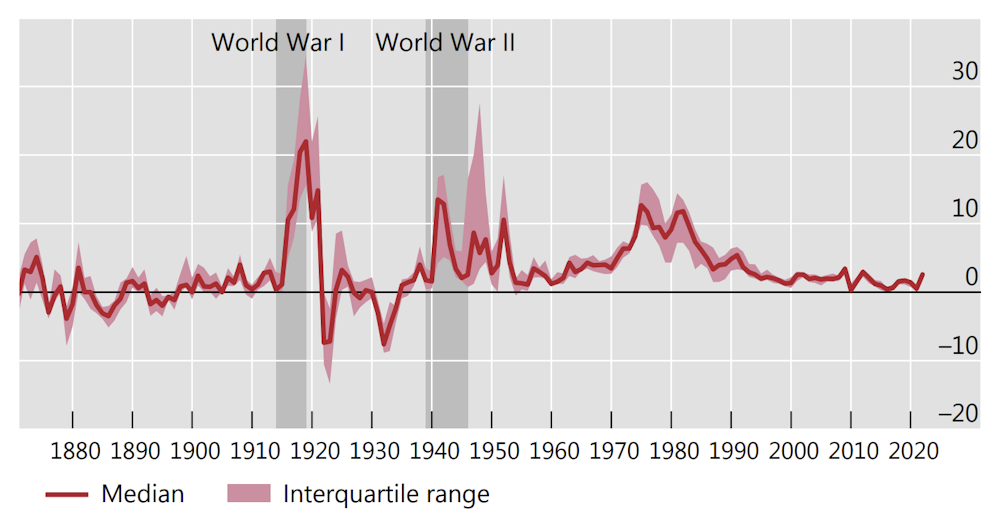
Graph of global inflation since the 19th century.
BIS, CC BY

What’s driving inflation

As well as its own expert staff, the BIS brings together expertise from its member central banks, such as the US Federal Reserve, the European Central Bank, the Bank of England and Reserve Bank of Australia. So its views are worth paying attention to.

Its report makes clear its experts, like most forecasters, have been surprised by the extent of the rise in inflation.

This is a global phenomenon, which the report attributes to a combination of an unexpectedly strong economic rebound from the COVID-19 lockdowns, a sustained switch in demand from services to goods, and supply bottlenecks exacerbated by a shift from “just-in-time” to “just-in-case” inventory management.

Then there is Russia’s invasion of Ukraine.

The war’s effect in driving up the price of oil, gas, food, fertilisers and other commodities has been “inherently stagflationary”:

Since commodities are a key production input, an increase in their cost constrains output. At the same time, soaring commodity prices have boosted inflation everywhere, exacerbating a shift that was already well in train before the onset of the war.

The only bright note is that BIS expects these price surges to be less disruptive than the oil supply shock of the 1970s.

This is because the relative impact of the oil supply shock was greater due to economies in the 1970s being more energy-intensive.

There is also much more focus now on containing inflation, with most central banks having a clearly stated inflation target (2% in Europe and the US, 2%-3% in Australia).
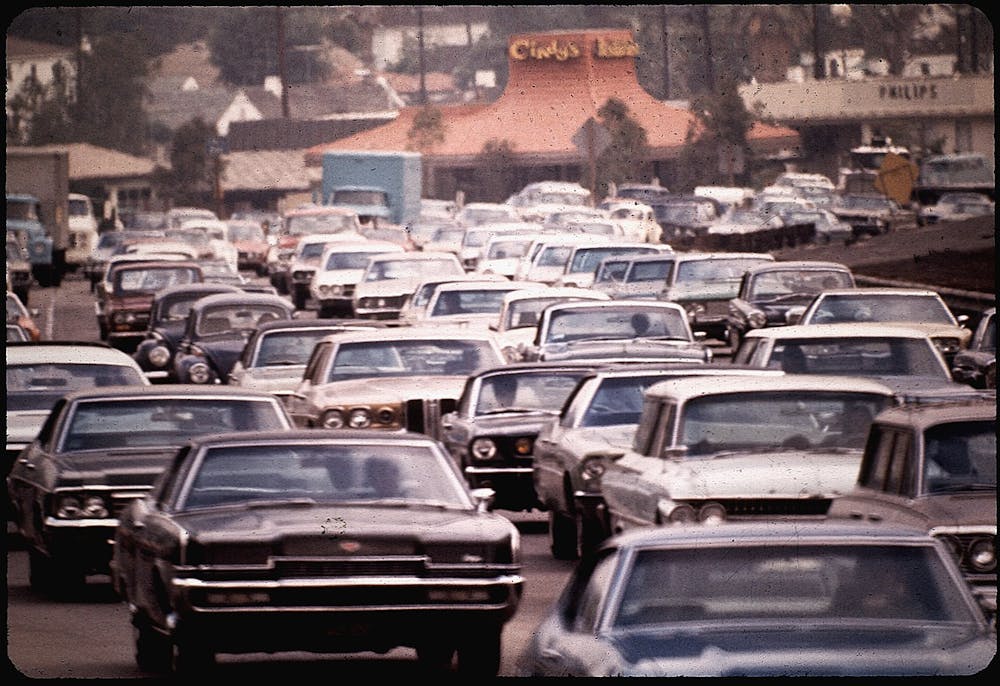
Traffic in Los Angeles, 1973. Economies were much more energy-intensive than now.
Gene Daniels/Wikimedia Commons, CC BY

What are the biggest dangers?

But the current situation is still very challenging, the report says, because increases in the price of food and energy are particularly conducive to spreading inflationary psychology.

This is because food is bought frequently, so price changes are notable. The same goes for fuel prices, which are prominently displayed on large roadside signs.

There is also the risk in many economies of a wage-price spiral – in which higher prices drive demands for higher wages, which employers then pass on in higher prices.

Central banks face what Reserve Bank of Australia governor Philip Lowe has called a “narrow path”.

To achieve a “soft landing” they need to raise interest rates enough to bring inflation down. But not enough to cause a recession (and thus stagflation).

How to avoid a ‘hard landing’?

The BIS report cites an analysis of monetary tightening cycles – defined as interest rate rises in at least three consecutive quarters – in 35 countries between 1985 and 2018. A soft landing was achieved in only about half the cases.

A key factor in the hard landings was the extent of financial vulnerabilities, particularly debt. Economies with hard landings on average had double the growth in credit to GDP prior to the interest-rate rises.

This factor contributes to BIS concerns now. As the report notes:

Unlike in the past, stagflation today would occur alongside heightened financial vulnerabilities, including stretched asset prices and high debt levels, which could magnify any growth slowdown.


Furthermore, the slowdown in China’s labour productivity is removing an important boost to global economic growth and restraint on global inflation.

But a key lesson from the 1970s is that the long-term costs of doing nothing outweigh the short-term pain of bringing inflation under control.

This means governments must curb handouts or tax cuts to help people with cost-of-living pressures. Expansionary fiscal policy will only make things worse. Assistance must be strictly targeted to those who most need it.

There is also a need to rebuild monetary and fiscal buffers to cope with future shocks. This will require raising interest rates above inflation targets and returning government budgets (close) to surplus.The Conversation

About the Author:

John Hawkins, Senior Lecturer, Canberra School of Politics, Economics and Society, University of Canberra

This article is republished from The Conversation under a Creative Commons license. Read the original article.

 

The US inflation is showing signs of slowing, but other economic indicators are decreasing to recessionary levels

By JustForex

The inflation rate, which the Federal Reserve closely monitors, was 6.3% in May, unchanged from April’s level. Personal spending increased by 0.2% in May, missing forecasts of a 0.4% increase, and April’s rate was revised down to 0.6% from 0.9%. Recession fears are growing after the Federal Reserve raised rates to combat rising inflation. Chronically high inflation has become a major threat to the economy and a political danger to President Joe Biden and the Democrats. As the stock market closed yesterday, the Dow Jones Index (US30) decreased by 0.82%, and the S&P 500 Index (US500) lost 0.88%. The NASDAQ Technology Index (US100) fell by 1.33% yesterday.

Wells Fargo CEO Charles Scharf said on Wednesday that the Federal Reserve would continue to raise rates more. Scharf praised the Fed for being very clear about the future moves, but the bank CEO still thinks the economy will be unpleasantly surprised by the consequences.

Biden said the US intends to announce an additional $800 million in arms aid to Ukraine.

Stock markets in Europe traded lower yesterday. German DAX (DE30) decreased by 1.69%, French CAC 40 (FR40) lost 1.80%, Spanish IBEX 35 (ES35) fell by 1.09%, British FTSE 100 (UK100) closed on Thursday down by 1.96%.

Fresh economic data showed that the seasonally adjusted unemployment rate in the Eurozone was 6.6%, down from 6.7% in April 2022. Inflation in France climbed to a record high of 6.5% in June, with consumer price growth of 0.7% last month. Today, Europe will release a preliminary overall inflation figure for the Eurozone, and analysts are leaning that consumer prices will rise from 8.1% to 8.5% year-over-year.

The outlook for the Swiss economy in the coming months remains subdued. The KOF economic barometer fell again in June and now stands at 96.9 points. It is below its long-term average for the second time in a row. The barometer’s downward movement is mainly due to a combination of external demand and production indicators.

The value of precious metals fell more than 8% in the second quarter. The fall is due to a tightening of central bank monetary policy. Precious metal prices are inversely correlated with the dollar index and US government bond yields. During monetary tightening, the dollar index strengthens, and government bond yields rise, which leads to a decrease in gold and silver prices.

OPEC+ countries said they would stick to their previously announced production plan, resisting calls to accelerate production. At the same time, oil prices fell another 3%. Analysts believe the drop in oil prices is due to US traders closing positions ahead of a three-day Independence Day weekend in the US on July 4. But fundamentally, such a situation usually leads to higher prices in an environment where production is lower than demand. In Norway, 74 offshore oil workers on the Equinor Gudrun, Oseberg South, and Oseberg East platforms will go on strike starting July 5, the Lederne union said Thursday, which will likely halt about 4% of Norway’s oil production.

Asian markets traded lower on Wednesday. Japan’s Nikkei 225 (JP225) decreased by 1.54% yesterday, Hong Kong’s Hang Seng (HK50) ended the day down by 0.62%, and Australia’s S&P/ASX 200 (AU200) closed by 1.97% lower. Japan’s main Purchasing Managers’ Index (PMI) declined from 53.3 in May to 52.7 in June. According to the PMI report, Japanese companies noted that rising costs and persistent material shortages contributed to the slowdown in production, and new orders increased only fractionally. Continued supply chain disruptions and delays led to further rapid cost increases, leading to a sharp rise in factory prices, the fastest in the survey’s history. That said, companies are increasingly confident that these problems will dissipate next year as business confidence rose to its highest level since March.

Tokyo’s consumer price level increased from 1.9% to 2.1% annually. Inflation is thus slowly consolidating above the Bank of Japan’s 2% target.

S&P 500 (F) (US500) 3,785.39 −33.44 (−0.88%)

Dow Jones (US30) 30,775.43 −253.88 (−0.82%%)

DAX (DE40) 12,783.77 −219.58 (−1.69%)

FTSE 100 (UK100) 7,169.28 −143.04 (−1.96%)

USD Index 104.73 −0.38 (−0.36%)

Important events for today:
  • – Japan Tokyo Core CPI (m/m) at 02:30 (GMT+3);
  • – Japan Large Manufacturers Index (m/m) at 02:50 (GMT+3);
  • – Japan Large Non-Manufacturers Index (m/m) at 02:50 (GMT+3);
  • – Japan Manufacturing PMI (m/m) at 03:30 (GMT+3);
  • – China Caixin Manufacturing PMI (m/m) at 04:45 (GMT+3);
  • – Eurozone Spanish Manufacturing PMI (m/m) at 10:15 (GMT+3);
  • – Switzerland Manufacturing PMI (m/m) at 10:35 (GMT+3);
  • – Eurozone Italian Manufacturing PMI (m/m) at 10:45 (GMT+3);
  • – Eurozone French Manufacturing PMI (m/m) at 10:50 (GMT+3);
  • – Eurozone German Manufacturing PMI (m/m) at 10:55 (GMT+3);
  • – Eurozone Manufacturing PMI (m/m) at 11:00 (GMT+3);
  • – UK Manufacturing PMI (m/m) at 11:30 (GMT+3);
  • – Eurozone Italian Consumer Price Index (m/m) at 12:00 (GMT+3);
  • – Eurozone Consumer Price Index (m/m) at 12:00 (GMT+3);
  • – US ISM Manufacturing PMI (m/m) at 17:00 (GMT+3).

By JustForex


This article reflects a personal opinion and should not be interpreted as an investment advice, and/or offer, and/or a persistent request for carrying out financial transactions, and/or a guarantee, and/or a forecast of future events.

According to central bankers, the era of ultra-low inflation will not return soon

By JustForex

Federal Reserve Chairman Jerome Powell reiterated the Central Bank’s commitment to tighten monetary policy further to reduce inflation as GDP data showed a faster-than-expected decline in quarterly economic growth. Real gross domestic product (GDP) fell by 1.6% year-over-year in the first quarter of 2022. This situation led to a rise in the US Dollar Index and a decline in the major indices. As the stock market closed yesterday, the Dow Jones Index (US30) added 0.26%, while the S&P 500 Index (US500) decreased by 0.08%. The NASDAQ Technology Index (US100) fell by 0.03%.

The US Personal Consumption Expenditures Price Index, part of the Fed’s inflation tracking indicators, will be released today. Analysts expect the PCE to rise another 0.4%. In other words, experts do not expect inflation to slow down.

Equity markets in Europe traded lower yesterday. German DAX (DE30) decreased by 1.73%, French CAC 40 (FR40) fell by 0.90%, Spanish IBEX 35 (ES35) lost 1.56%, British FTSE 100 (UK100) closed on Wednesday down by 0.15%.

European Central Bank President Christine Lagarde said that the era of ultra-low inflation that preceded the pandemic is unlikely to return. Speaking at an ECB forum in Sintra, Portugal, along with US Federal Reserve Chairman Jerome Powell and Bank of England Governor Andrew Bailey, Lagarde added that central banks need to adjust to higher price growth expectations.

This week, a series of data on inflation rates in European countries will be released. Germany’s preliminary consumer price level was 7.6% year-over-year, down from 7.9% in May. But in Spain, the inflation rate jumped from 8.7% to 10.2% annually.

Morgan Stanley now expects the Eurozone to fall into a moderate recession in the fourth quarter of this year and show GDP contracting for the next two quarters before resuming growth in the second quarter of next year, driven by increased investment.

Predictions that the Eurozone will likely slip into recession because of energy security problems caused by the war in Ukraine prompted investors to buy the Swiss franc. The Swiss franc rose on Wednesday to its highest level against the euro in four months as growing fears of a recession in the Eurozone led investors to seek safe-haven assets.

Palladium increased by 6.2% yesterday, while nickel gained 9.2% amid UK sanctions against Russian billionaire and co-owner of Nornickel Vladimir Potanin.

Fears of a global slowdown continue to weigh on copper and the Australian dollar. Copper has long been known as a barometer for assessing the global economy’s health, and the Australian dollar has a high positive correlation with copper. If this week’s PMI data is worse than expected, copper could continue to fall.

The Energy Information Administration (EIA) did release new crude oil inventory data yesterday. Last week’s report was not published due to server problems. The US crude oil inventories have declined over the past two weeks, falling by 2.8 million barrels. But despite the decline in inventories amid strong demand, oil quotes were down by 2% yesterday as disappointing US GDP data counterbalanced the negative price sentiment. OPEC+ is meeting today, so volatility in oil prices will remain high.

Asian markets were trading lower on Wednesday. Japan’s Nikkei 225 (JP225) decreased by 0.91% yesterday, Hong Kong’s Hang Seng (HK50) ended the day down 1.88%, and Australian S&P/ASX 200 (AU200) lost 0.94%.

Industrial production in Japan fell by 7.2% in May from the previous month. Of the 15 industries surveyed, production declined in 13. The auto industry was hit the hardest due to parts shortages resulting from the COVID-19 blockage in Shanghai. Auto production fell 8.0% from the previous month, including a 33.2% drop in truck production.

China’s official PMI returned above the 50 levels. It suggests that China’s economy improved in June compared to May, but there are signs in the sub-indices that a full recovery will take some time. The headwinds remain, including a still depressed real estate market, low consumer spending, and fear of any recurring waves of infections.

S&P 500 (F) (US500) 3,818.70 −2.85 (−0.075%)

Dow Jones (US30) 31,027.92 +80.93 (+0.26%)

DAX (DE40) 13,003.35 −228.47 (−1.73%)

FTSE 100 (UK100) 7,312.32 −11.09 (−0.15%)

USD Index 105.12 +0.61 (+0.59%)

Important events for today:
  • – Japan Industrial Production (m/m) at 02:50 (GMT+3);
  • – China Manufacturing PMI (m/m) at 04:30 (GMT+3);
  • – China Non-Manufacturing PMI (m/m) at 04:30 (GMT+3);
  • – UK GDP (q/q) at 09:00 (GMT+3);
  • – Eurozone German Retail Sales (m/m) at 09:00 (GMT+3);
  • – Switzerland Retail Sales (m/m) at 09:30 (GMT+3);
  • – Eurozone French Consumer Price Index (m/m) at 09:45 (GMT+3);
  • – Eurozone German Unemployment Rate (m/m) at 10:55 (GMT+3);
  • – Eurozone Unemployment Rate (m/m) at 12:00 (GMT+3);
  • – OPEC+ meeting (m/m) at 12:00 (GMT+3);
  • – US PCE Price index (m/m) at 15:30 (GMT+3);
  • – US Initial Jobless Claims (w/w) at 15:30 (GMT+3);
  • – Canada GDP (q/q) at 15:30 (GMT+3);
  • – US Natural Gas Storage (w/w) at 17:30 (GMT+3).

By JustForex


This article reflects a personal opinion and should not be interpreted as an investment advice, and/or offer, and/or a persistent request for carrying out financial transactions, and/or a guarantee, and/or a forecast of future events.

2022 mid-year outlook – where do investors go from here?

By George Prior

Volatility will define financial markets in the second half of 2022, but there are major reasons for investor optimism, affirms the CEO of one of the world’s largest independent financial advisory, asset management and fintech organizations.

This is the upbeat assessment from deVere Group’s Nigel Green at the midpoint of the year as investors take stock of the past six months and look ahead to the last half of 2022.

He notes: “The first half of 2022 has been challenging, to say the least, for investors seeking both capital growth and capital protection.

“With soaring inflation, interest rate rises, slowing growth, the pandemic still not over, and geopolitical tensions including a tragic war in Europe, uncertainty has been heightened which has unleashed huge waves of volatility in financial markets.

“For many investors, it has been the perfect storm with both stocks and fixed income hit with simultaneous bouts of weakness, making proper portfolio diversification more difficult to achieve.”

He continues: “However, despite turbulence still being the defining characteristic of the second half of 2022, there are four key reasons why investors should be optimistic for the next six months.

“First, our latest thinking is that inflation could be peaking soon, and we expect it to decelerate through the rest of this year. History shows that the markets typically fall just before the peak in inflation, just as we have experienced in recent months. This will be bullish for stocks.

“Second, as markets continue to be unsteady in the near-term, investors will be using the downturn to their financial advantage by topping-up their portfolios with quality stocks at lower prices.

“The panic-selling has created some important long-term opportunities with high upside potential and low risk possibilities for those who buy judiciously.

“Third, China is beginning to loosen its strict Covid restrictions which will help ease global supply chain disruption, which is positive for companies and consumers.

“And fourth, financial markets have already priced-in much of the bad news from geopolitical issues, meaning there should be less wild swings in the months ahead.”

In this environment, the deVere CEO says investors wanting to safeguard and grow their wealth should be proactive. “You should be fully and sensibly invested in a properly diversified portfolio.

“Whilst you may be tempted to stash cash during periods of volatility, experience demonstrates that such attempts to ‘time the market’ almost always fail.

“You should resist complacency, be active, revise and adjust with an adviser to build a resilient and dynamic portfolio, perhaps with some less-traditional, return-enhancing assets.”

He concludes: “After a difficult start to the year, the rest of 2022 will remain volatile – but there’s much to be done to grow your wealth.

“This is the time to remain fully and cleverly invested.”

About:

deVere Group is one of the world’s largest independent advisors of specialist global financial solutions to international, local mass affluent, and high-net-worth clients.  It has a network of more than 70 offices across the world, over 80,000 clients and $12bn under advisement.

Investors once again fear a recession in the economy. The Monetary Policy Forum is coming to a close

By JustForex

The mood of investors and analysts changes almost every day. Yesterday, US stock indexes saw a new massive sell-off as gloomy consumer confidence data once again dampened investor optimism and heightened fears that the Federal Reserve’s aggressive fight against inflation will lead to a recession in the economy. The Conference Board’s Consumer Confidence Index fell to its lowest level since February 2021, and short-term expectations reached their most pessimistic level in nearly a decade.

As the stock market closed yesterday, the Dow Jones Index (US30) decreased by 1.56%, and the S&P 500 Index (US500) lost 2.01%. The Technology Index NASDAQ (US100) fell by 2.98%. At the end of the day, all three indices were down.

Federal Reserve Bank of New York President John Williams told CNBC on Tuesday that interest rates should “definitely” be between 3% and 3.5% by the end of the year, but he does not expect a recession in the United States.

Stock markets in Europe traded higher yesterday. Germany’s DAX (DE30) increased by 0.35%, France’s CAC 40 (FR40) jumped by 0.64%, Spain’s IBEX 35 (ES35) added 0.91%, and the British FTSE 100 (UK100) closed Tuesday in plus 0.90%.

The ECB is expected to follow its colleagues from the Fed and raise interest rates in July to try to curb skyrocketing inflation. However, economists disagree on the extent of any rate hike. For now, a 0.25% move is being considered, but if Friday’s Eurozone inflation data show a new acceleration in inflation, policymakers may reconsider their decision to 0.5%.

Today at the monetary policy forum in Portugal, there will be the final speech of the heads of the central banks of the US, the ECB, and the UK. Investors and traders should pay attention to this performance.

Crude oil prices jumped another 2% on Tuesday as Saudi Arabia and the United Arab Emirates indicated they are near maximum production levels.

On the other hand, the leaders of the G7 countries reached an agreement to impose a price cap on Russian oil.

Lithuania has officially banned imports of Russian gas. The Seimas of the republic has adopted the appropriate amendments to the law on natural gas.

Gold futures fell in price yesterday. Gold and silver are inversely correlated to the dollar index and government bond yields. When the dollar rises, gold and silver tend to fall. And while the US Federal Reserve tightens monetary policy, there is no fundamental reason for increasing precious metal prices.

Asian markets were trading higher on Tuesday. Japan’s Nikkei 225 (JP225) gained 0.66% yesterday, Hong Kong’s Hang Seng (HK50) added 0.85% on the day, while Australia’s S&P/ASX 200 (AU200) was up 0.86%.

The head of the Bank of Japan said today that the Japanese economy had not suffered much from the global inflation trend so monetary policy will remain soft.

The Chinese yuan rose after China eased the quarantine related to the COVID-19 pandemic for international travelers. It also became known that China will cut retail prices on gasoline and diesel starting on Wednesday.

S&P 500 (F) (US500) 3,821.55 −78.56 (−2.01%)

Dow Jones (US30) 30,946.99 −491.27 (−1.56%)

DAX (DE40) 13,231.82 +45.75 (+0.35%)

FTSE 100 (UK100) 7,323.41 +65.09 (+0.90%)

USD Index 104.48 +0.54 (+0.52%)

Important events for today:
  • – Japan Retail Sales (m/m) at 02:50 (GMT+3);
  • – Australia Retail Sales (m/m) at 04:30 (GMT+3);
  • – Eurozone Spanish Consumer Price Index (m/m) at 10:00 (GMT+3);
  • – US FOMC Member Mester Speaks (m/m) at 13:30 (GMT+3);
  • – Eurozone German Consumer Price Index (m/m) at 15:00 (GMT+3);
  • – US GDP (q/q) at 15:30 (GMT+3);
  • – US Fed Chair Powell Speaks (m/m) at 16:00 (GMT+3);
  • – Eurozone ECB President Lagarde Speaks (m/m) at 16:00 (GMT+3);
  • – UK BoE Gov Bailey Speaks (m/m) at 16:00 (GMT+3);
  • – US FOMC Bullard Speaks (m/m) at 20:05 (GMT+3).

By JustForex


This article reflects a personal opinion and should not be interpreted as an investment advice, and/or offer, and/or a persistent request for carrying out financial transactions, and/or a guarantee, and/or a forecast of future events.

Fears of a recession are decreasing. Russia has defaulted

By JustForex

On Monday, the US dollar fell slightly from a 20-year high hit earlier this month. It followed positive US economic data that eased expectations of an aggressive rate hike by the Federal Reserve. At the same time, stock indices also showed weakness, but usually, when the dollar index declines, indices rise.

At the close of trading on Monday, the Dow Jones index (US30) decreased by 0.20% and the S&P 500 index (US500) lost 0.30%. The technology index NASDAQ (US100) fell by 0.72% yesterday. At the end of the day, all three indices were down.

Goldman Sachs says the US rate market is underestimating the risk of recession. While market expectations for the Fed Funds rate have declined in recent weeks to levels with “limited downside potential for early 2023, federal funds pricing for 2024 likely underestimates recession risk,” strategists said. According to expectations implied by interest rate swaps, the Fed policy rate will peak at 3.60% by March 2023, up 2% from current levels.

Equity markets in Europe traded flat yesterday. German DAX (DE30) gained by 0.52%, French CAC 40 (FR 40) fell by 0.43%, Spanish IBEX 35 (ES35) lost 0.02%, British FTSE 100 (UK100) closed on Monday in plus 0.69%.

On Monday, Prime Minister Boris Johnson said that Britain may introduce unilateral changes to Northern Ireland’s trade rules after Brexit this year. The EU calls the move illegal.

Russia’s first major international default in more than a century became a fact on Monday. It was followed by months of coordinated Western sanctions that left Moscow with cash but denied access to an international financial network.

Oil jumped by 2% yesterday on rumors that a G7 decision against Russia would lead to further supply cuts. The Saudi-led OPEC+ alliance also cut its projected 2022 oil market surplus to 1 million barrels per day from a previous estimate of 1.4 million. Some oil investors are hesitant to open large positions after the US Energy Information Administration said the weekly inventory report would be delayed for the second week in a row because of server problems. The EIA weekly oil report was not released on June 24 and will likely not be released on June 29.

G7 leaders warned that Russian President Vladimir Putin would be held accountable for committing the heinous and deadly attack on a crowded shopping mall in Ukraine. According to President Vladimir Zelenski, at least 1,000 shoppers were in the mall when a Russian missile hit it, making it “one of the most devastating terrorist attacks in European history.” At least 18 people were killed and more than 40 injured. The number of casualties is difficult to determine as rescuers continue to search among the rubble. With a high probability, Russia will be declared a sponsor of terrorism in the near future.

Asian markets were trading higher on Monday. Japan’s Nikkei 225 (JP225) gained 1.43%, Hong Kong’s Hang Seng (HK50) added 2.35% for the day, and Australia’s S&P/ASX 200 (AU200) jumped by 1.94%.

Earlier this month, the Bank of Japan may have suffered a 600 billion yen ($4.4 billion) unrealized loss on Japanese government bonds as the widening gap between domestic and foreign monetary policy led to rising yields and prices. Despite this, the Bank of Japan continues to keep its monetary policy soft as policymakers attribute rising inflation to rising energy and commodity prices. More and more analysts are starting to think that at some point, the Bank of Japan will make currency intervention, as the yen’s weakness is taking a heavy toll on the Japanese economy. Both BOJ Governor Kuroda and Prime Minister of Japan Kishida acknowledge this point.

S&P 500 (F) (US500) 3,900.11 −11.63 (−0.30%)

Dow Jones (US30) 31,438.26 −62.42 (−0.20%)

DAX (DE40) 13,186.07 +67.94 (+0.52%)

FTSE 100 (UK100) 7,258.32 +49.51 (+0.69%)

USD Index 103.98 -0.21 (-0.20%)

Important events for today:
  • – US FOMC Member Williams Speaks (m/m) at 01:30 (GMT+3);
  • – ECB President Lagarde Speaks at 11:00 (GMT+3);
  • – US CB Consumer Confidence (m/m) at 17:00 (GMT+3).

By JustForex


This article reflects a personal opinion and should not be interpreted as an investment advice, and/or offer, and/or a persistent request for carrying out financial transactions, and/or a guarantee, and/or a forecast of future events.

Stocks steady while crude prices jump

By ForexTime

US stock futures have perked up this morning on news that China will cut its quarantine time on foreign travellers. This comes as Wall Street pared gains after initially rising from stronger-than-expected US durable goods data.

Meanwhile, there’s more action in the oil markets as crude extends its recent gains on supply disruptions.

The blue-chip benchmark S&P500 ended Monday 0.3% lower, after a turbulent day of trading in which the index slowly gave up earlier gains. The broad-based index remains around 18% lower for the year.

Technically, the S&P500 had been trading at the bottom of a bear channel after the highs at the end of March.

Prices were also oversold on the daily and weekly charts with the RSIs dipping towards 30. The rebound has taken us above the May low at 3811.1 and the bulls are now challenging trendline resistance from the October 2021 low.

Above here is the key psychological level at 4,000 with the 50-day simple moving average at 4028.4.


Crude bounces off trendline support

Oil prices had their worst week since early April, with Brent falling more than 7% over the last week. 

Concern over the macro outlook has weighed heavily despite fundamentals remaining constructive. G-7 nations are meeting at the moment, and discussions around a potential price limit on Russian oil appear to be on the agenda. It is suggested that any limits would be done through insurance and shipping.

However, it would likely take some time to come to an agreement and would require the EU to renegotiate its last round of sanctions which some member countries may be reluctant to do, given how long it originally took EU countries to finalise its Russian oil ban.

OPEC members are set to meet tomorrow with an OPEC+ ministerial meeting on Thursday.

The cartel already agreed at its previous meeting on larger supply increases for July and August so confirmation of that supply increase for August is expected.

After falling sharply from the high at the start of the month at $123.27, Brent found support last week at the upward trendline touching the March, April and May lows. The 100-day simple moving average has also helped hold up prices and currently sits at $107.76.

We are now trading just above the 50-day simple moving average at $111.64 with bulls eyeing up the $114 resistance level which had capped Brent prices for much of April-May.


Forex-Time-LogoArticle by ForexTime

ForexTime Ltd (FXTM) is an award winning international online forex broker regulated by CySEC 185/12 www.forextime.com

Wealth of nations: Why some are rich, others are poor – and what it means for future prosperity

By Amitrajeet A. Batabyal, Rochester Institute of Technology 

– Why are some nations rich and others poor? Can the governments of poor nations do something to ensure that their nations become rich? These sorts of questions have long fascinated public officials and economists, at least since Adam Smith, the prominent Scottish economist whose famous 1776 book was titled “An Inquiry into the Nature and Causes of the Wealth of Nations.”

Economic growth matters to a country because it can raise living standards and provide fiscal stability to its people. But getting the recipe consistently right has eluded both nations and economists for hundreds of years.

As an economist who studies regional, national and international economics, I believe that understanding an economic term called total factor productivity can provide insight into how nations become wealthy.

Growth theory

It is important to understand what helps a country grow its wealth. In 1956, Massachusetts Institute of Technology economist Robert Solow wrote a paper analyzing how labor – otherwise known as workers – and capital – otherwise known as physical items such as tools, machinery and equipment – can be combined to produce goods and services that ultimately determine people’s standard of living. Solow later went on to win a Nobel Prize for his work.

One way to increase a nation’s overall quantity of goods or services is to increase labor, capital or both. But that doesn’t continue growth indefinitely. At some point, adding more labor only means that the goods and services these workers produce is divided between more workers. Hence, the output per worker – which is one way of looking at a nation’s wealth – will tend to go down.

Similarly, adding more capital such as machinery or other equipment endlessly is also unhelpful, because those physical items tend to wear out or depreciate. A company would need frequent financial investment to counteract the negative effect of this wear and tear.

In a later paper in 1957, Solow used U.S. data to show that ingredients in addition to labor and capital were needed to make a nation wealthier.

He found that only 12.5% of the observed increase in American output per worker – the quantity of what each worker produced – from 1909 to 1949 could be attributed to workers becoming more productive during this time period. This implies that 87.5% of the observed increase in output per worker was explained by something else.

Total factor productivity

Solow called this something else “technical change,” and today it is best known as total factor productivity.

Total factor productivity is the portion of goods and services produced that is not explained by the capital and labor used in production. For example, it could be technological advancements that make it easier to produce goods.

Another way to understand total factor productivity.

It’s best to think of total factor productivity as a recipe that shows how to combine capital and labor to obtain output. Specifically, growing it is akin to creating a cookie recipe to ensure that the largest number of cookies – that also taste great – are produced. Sometimes this recipe gets better over time because, for example, the cookies can bake faster in a new type of oven or workers become more knowledgeable about how to mix ingredients more efficiently.

Will total factor productivity continue to grow in the future?

Given how important total factor productivity is to economic growth, asking about the future of economic growth is basically the same as asking whether total factor productivity will continue to grow – whether the recipes will always get better – over time.

Solow assumed that TFP would grow exponentially over time, a dynamic explained by the economist Paul Romer, who also won a Nobel Prize for his research in this field.

Romer argued in a prominent 1986 paper that investments in research and development that result in the creation of new knowledge can be a key driver of economic growth.

This means that each earlier bit of knowledge makes the next bit of knowledge more useful. Put differently, knowledge has a spillover effect that creates more knowledge as it spills out.

Despite Romer’s efforts to provide a basis for the assumed exponential growth of TFP, research shows that productivity growth in the world’s advanced economies has been declining since the late 1990s and is now at historically low levels. There are concerns that the COVID-19 crisis may exacerbate this negative trend and further reduce total factor productivity growth.

Recent research shows that if TFP growth falls, then this can negatively affect living standards in the U.S. and in other rich countries.

A very recent paper by the economist Thomas Philippon analyzes a large amount of data for 23 countries over 129 years, finding that TFP does not actually grow exponentially, as Solow and Romer had thought.

Instead, it grows in a linear, and slower, progression. Philippon’s analysis suggests that new ideas and new recipes do add to the existing stock of knowledge, but they don’t have the multiplier effect previous scholars had thought.

Ultimately, this finding means that economic growth used to be quite fast and is now slowing down – but it’s still occurring. The U.S. and other nations can expect to get wealthier over time but just not as quickly as economists once expected.The Conversation

About the Author:

Amitrajeet A. Batabyal, Distinguished Professor and Arthur J. Gosnell Professor of Economics, Rochester Institute of Technology

This article is republished from The Conversation under a Creative Commons license. Read the original article.

 

Falling commodity prices last week eased inflation fears

By JustForex

At the close of the stock market on Friday, the Dow Jones index (US30) increased by 2.68% (+5.31% per week), while the S&P 500 index (US500) added 3.06% (+6.71% per week). Technology index NASDAQ (US100) gained 3.34% on Friday (+8.51% per week). All three indices closed in the plus as the week ended.

On Friday, Fed member Daly, the usual political dovish spokeswoman, indicated she supports a 75 basis point rate hike at the upcoming Fed meeting in July. At the same time, the indices have rallied substantially, suggesting that the 0.75% rate hike scenario at the next Fed meeting is probably already priced in. And since there is no new negativity, no new factors contribute to the decline. But analysts believe that inflation will not slow anytime soon, which means the Fed will raise rates more and move faster, putting downward pressure on the economy.

A significant factor last week was the drop in oil and commodity prices, which eased inflation fears and allowed stock markets to rebound. Falling commodity prices could help lower overall inflation, especially during the autumn months, which would reduce the need for aggressive monetary tightening.

The three-day forum will begin on Monday with the main topic “Challenges for monetary policy in a rapidly changing world.” The forum will conclude with speeches by the heads of the Fed, the ECB, and the Bank of England on Wednesday, so investors should keep a close eye on this event.

The second quarter is coming to a close. These six months have already been characterized by the fastest rate hike cycle in decades, market turmoil, and a war that has caused rising inflation. As investor expectations fluctuate between continued high inflation and an economic slowdown caused by hawkish central bank policies in major countries, few believe market volatility will subside anytime soon.

Stock markets in Europe traded higher on Friday. German DAX (DE30) gained 1.59% on Friday (-0.68% per week), French CAC 40 (FR 40) jumped by 3.23% (+2.91% per week), Spanish IBEX 35 (ES35) added 1.70% (+0.79% per week), British FTSE 100 (UK100) gained 2.68% on Friday (+2.74% per week).

On Sunday, G7 leaders promised to raise $600 billion in private and government funds over five years to finance needed infrastructure in developing countries. Biden said the United States would raise $200 billion over five years in grants, federal funds, and private investment to support projects in low- and middle-income countries. It will help fight climate change as well as improve global health, gender equality, and digital infrastructure. Europe is mobilizing 300 billion euros for the initiative over the same period.

US President Joe Biden and other G7 leaders have agreed to announce a ban on new gold imports from Russia. It will be part of a new sanctions package to be announced Tuesday.

Asian markets traded higher last week. Japan’s Nikkei 225 (JP225) gained 1.28% over the week, Hong Kong’s Hang Seng (HK50) jumped by 3.68%, and Australia’s S&P/ASX 200 (AU200) was up +1.60%.

The People’s Bank of China, with the Bank for International Settlements and five other regulators, will create a yuan-denominated reserve pool to provide liquidity to member countries during periods of market volatility. China, along with Chile, Indonesia, Malaysia, Hong Kong, and Singapore, will contribute at least 15 billion yuan ($2.2 billion) or the equivalent in US dollars to the so-called “RMB liquidity agreement.” Participating central banks will not only be able to use their contributions if liquidity is needed but will also have access to additional financing through a secured liquidity window. The agreement marks a move by Beijing to internationalize China’s currency, challenging the global financial system dominated by the US dollar.

Over the weekend, Russia launched new missile strikes against Ukraine’s two largest cities, Kyiv and Kharkiv. Russia has stepped up its use of cruise missiles, mainly striking at targets in northwestern Ukraine from Belarus. The Kremlin is also seriously considering military action against Lithuania. Last week, Lithuania banned the rail transit of sanctioned goods through its territory to Russia’s Kaliningrad region.

Russia is one step away from default. The issue is the payment of about $100 million on government bonds. The grace period for this payment ended on Sunday, June 26.

At the commodities market the biggest gains over the week showed the futures on lumber (+5.54%) and palladium (+3.21%). Cotton (-17.25%), corn (-13%), soybeans (-10.4%), natural gas (-9.74%), wheat (-9.4%), copper (-6.84%), orange juice (-6.34%) and platinum (-2.8%) futures showed the biggest drops.

Main market quotes:

S&P 500 (F) (US500) 3,911.74 +116.01 (+3.06%)

Dow Jones (US30) 31,500.68 +823.32 (+2.68%)

DAX (DE40) 13,118.13 +205.54 (+1.59%)

FTSE 100 (UK100) 7,208.81 +188.36 (+2.68%)

USD Index 104.12 -0.31 (-0.30%)

Important events for today:
  • – German Retail Sales (m/m) at 09:00 (GMT+3);
  • – US Durable Goods Orders (m/m) at 15:30 (GMT+3);
  • – US Pending Home Sales (m/m) at 17:00 (GMT+3);
  • – Eurozone ECB President Lagarde Speaks at 20:30 (GMT+3).

By JustForex


This article reflects a personal opinion and should not be interpreted as an investment advice, and/or offer, and/or a persistent request for carrying out financial transactions, and/or a guarantee, and/or a forecast of future events.

Inflation in Japan is holding above target. European PMI data are disappointing

By JustForex

On Thursday, US central bank governor Jerome Powell said to the House of Representatives that The Federal Reserve’s commitment to curbing 40-year inflation is “unconditional,” but it carries the risk of rising unemployment. On Wednesday, Powell told the US Senate Banking Committee that the Fed is not trying to trigger a recession but is “certainly possible” due to global events beyond its control, particularly the effects of the war in Ukraine and the COVID-19 pandemic. At the same time, Powell expects US economic growth to accelerate in the year’s second half.

On Thursday, another Fed official, Michelle Bowman, said that she supports a 75 basis point rate hike in July, followed by a 50 basis point increase at the next few meetings. That statement coincides with Reuters polls. Economists polled by Reuters this week forecast that the Fed will hold another 75 basis point rate hike next month, followed by a 0.5% hike in September.

New jobless claims fell last week from 231,000 to 229,000, while the key PMI for manufacturing and service sector activity fell to 52.5 (from 57) and 51.6 (from 53.4), respectively.

As the stock market closed yesterday, the Dow Jones Index (US30) increased by 0.64% and the S&P 500 Index (US500) added 0.95%. The technology index NASDAQ (US100) jumped by 1.62%.

Stock markets in Europe were mostly trading lower yesterday. German DAX (DE30) lost 1.76%, French CAC 40 (FR40) decreased by 0.56%, Spanish IBEX 35 (ES35) fell by 0.48%, British FTSE 100 (UK100) was 0.97% down.

German and French PMI data showed that the Eurozone economy is starting to show signs of a slowdown. In Germany, the manufacturing PMI decreased from 54.8 to 52 while the services PMI dropped from 55 to 52.4. In France, the manufacturing PMI decreased from 58.3 to 54.4, and the services PMI declined from 54.6 to 51. Typically, a PMI falling below 50 is a sign of recession in which the central bank raises interest rates. At that time, Fed spokesman Kazimir said yesterday that some Eurozone countries might face a short-term recession.

The Norwegian Central Bank surprised markets by raising its interest rate by 50 bps from 0.75% to 1.25%. Concerns about rising inflation in a tight labor market were the reasons for the scale of the increase. Norway’s inflation rate was 5.7% y/y in May versus 5.4% y/y in April. It is the highest level since December 1988.

Ukraine and Moldova officially received candidate status for EU accession.

The Russian State Duma called for bombing the US Embassy in Kyiv because of the deliveries of MLRSs to Ukraine. Such a statement was made by the deputy chairman of the Duma committee for defense, Yuriy Shvytkin. He said that the United States “is bringing World War III closer” by supplying HIMARS multiple-launch rocket systems. At the same time, Estonian Prime Minister Kaja Kallas said that in case of a Russian invasion, Estonia would be wiped off the face of the earth because of the ineffective NATO plan to defend the Baltic states. She called for sending at least 20,000 to 25,000 NATO soldiers to each Baltic country.

Natural gas futures fell more than 5% yesterday on the news of reserves. US domestic natural gas inventories increased by 74 billion cubic feet over the week. Meanwhile, total natural gas in storage is 2.169 trillion cubic feet, 305 billion cubic feet less than a year ago, and 331 billion cubic feet below the five-year average.

Official weekly estimates of US oil inventories had to be released on Thursday, but technical problems delayed those numbers until next week, the US Energy Information Administration said. Russia continues to find alternative buyers for its oil, with China and India among the biggest buyers. China’s crude oil imports from Russia increased by 55% in May from a year earlier to a record high.

Asian markets closed yesterday in green territory. Japan’s Nikkei 225 (JP225) gained 0.08%, Hong Kong’s Hang Seng (HK50) added 1.26%, and Australia’s S&P/ASX 200 (AU200) closed with a gain of 0.31%.

The nationwide core Consumer Price Index was 2.1% for the second month in a row and again exceeded the Bank of Japan’s target level. This data challenges the Bank of Japan’s view that the recent price increase is temporary and does not require a withdrawal of monetary stimulus. Such sentiment provided a brief boost to the Japanese yen. But with wage growth slowing, many analysts expect the Bank of Japan to remain on a soft monetary policy rather than fighting inflation by raising interest rates.

Main market quotes:

S&P 500 (F) (US500) 3,795.72 +35.83 (+0.95%)

Dow Jones (US30) 30,677.36 +194.23 (+0.64%)

DAX (DE40) 12,912.59 −231.69 (−1.76%)

FTSE 100 (UK100) 7,020.45 −68.77 (−0.97%)

USD Index 104.35 +0.16 (+0.15%)

Important events for today:
  • – Japan National Core Consumer Price Index at 02:30 (GMT+3);
  • – UK Retail Sales (m/m) at 09:00 (GMT+3);
  • – Eurozone German Ifo Business Climate Index (m/m) at 11:00 (GMT+3);
  • – Eurozone EU Leaders Summit at 13:00 (GMT+3);
  • – Australia RBA Governor Lowe Speaks at 14:30 (GMT+3);
  • – US New Home Sales (m/m) at 17:00 (GMT+3).

By JustForex


This article reflects a personal opinion and should not be interpreted as an investment advice, and/or offer, and/or a persistent request for carrying out financial transactions, and/or a guarantee, and/or a forecast of future events.