
By Analytical Department RoboForex
USD/JPY opens the week at 162.36 on Monday. The Japanese yen remains near its lowest level since 1996. Pressure on the currency is being exerted by a strengthening US dollar and a sharp rise in oil prices amid escalating conflict in the Middle East.
The US military launched new airstrikes on Iran following the deaths of three American troops. Tehran has stated that the ceasefire has effectively ceased to operate. Over the weekend, Iranian forces intercepted four vessels passing through the Strait of Hormuz.
Japan is heavily dependent on oil supplies from the Middle East, making it particularly vulnerable to regional disruptions and rising energy costs. Expensive oil worsens the country’s trade balance and intensifies pressure on the yen.
Investors have yet to see decisive action from Tokyo to support the currency. Data on foreign exchange interventions will be released at the end of the month, which may reveal whether Japanese authorities were behind the yen’s abrupt-though brief-strengthening in recent weeks.
Technical Analysis
Free Reports:
 Get our Weekly Commitment of Traders Reports - See where the biggest traders (Hedge Funds and Commercial Hedgers) are positioned in the futures markets on a weekly basis.
 Sign Up for Our Stock Market Newsletter – Get updated on News, Charts & Rankings of Public Companies when you join our Stocks Newsletter
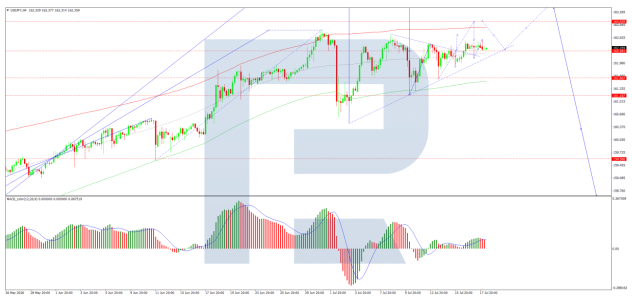
On the H4 USD/JPY chart, the market is forming a consolidation range around the 162.58 level, currently extending up to 162.58 and down to 162.28. A rise to the 163.00 level is expected today, with the prospect of the trend continuing to 163.50. Technically, this scenario is confirmed by the MACD indicator, whose signal line is above the zero level and pointing strictly upwards.
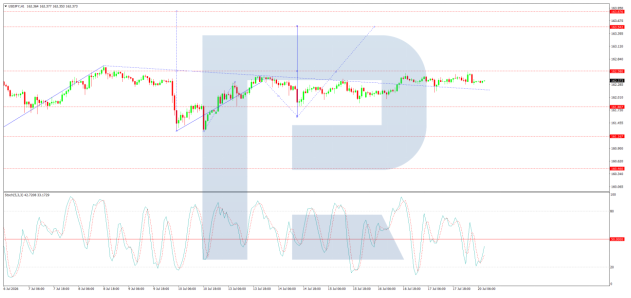
On the H1 chart, USD/JPY has completed a downward wave structure to the 162.28 level. A wave extension to 162.00 cannot be ruled out. Thereafter, the start of a growth wave to at least 163.00 is expected. A breakout above this level would open potential for a continuation of the growth wave to 163.50. Technically, this scenario is confirmed by the Stochastic oscillator, whose signal line is below the 50 level and pointing strictly upwards to 80, indicating short-term upward momentum.
Conclusion
USD/JPY remains elevated as the yen stays near multi-decade lows, weighed down by a strong dollar, surging oil prices, and escalating Middle East tensions. US airstrikes on Iran and Tehran’s interception of vessels in the Strait of Hormuz have heightened geopolitical risks, leaving Japan-a major oil importer-particularly exposed to energy price shocks. Expensive oil worsens Japan’s trade balance and adds to the yen’s downward pressure. Markets are also awaiting end-of-month intervention data to see if Japanese authorities have been active in supporting the currency. Technically, the pair appears poised for further gains towards 163.00 and potentially 163.50, though intervention risks remain a wildcard for yen bulls.
Disclaimer
Any forecasts contained herein are based on the author’s particular opinion. This analysis may not be treated as trading advice. RoboForex bears no responsibility for trading results based on trading recommendations and reviews contained herein.

- COT Metals Charts: Speculator Bets led by Gold, Copper & Platinum Aug 9, 2026
- COT Bonds Charts: Speculator Bets led by 2-Year Bonds & US Treasury Bonds Aug 9, 2026
- COT Energy Charts: Speculator Bets led by Heating Oil & Bloomberg Index Aug 9, 2026
- COT Soft Commodities Charts: Speculator Bets led by Sugar & Cotton Aug 9, 2026
- The Central Bank of Mexico kept its interest rate unchanged. Iran plans to introduce strict bans for US and Israeli vessels in the Strait of Hormuz Aug 7, 2026
- USD/JPY Holds Firm: Yen Loses Some Support Aug 7, 2026
- Australian trade balance returned to positive territory Aug 6, 2026
- Results in Line for Most Reporting Companies Aug 5, 2026
- Stock indices continue to break records. Oil is falling amid intensified diplomatic dialogue between the US and Iran Aug 5, 2026
- USD/JPY Holds Steady After Intervention: Outlook Remains Uncertain Aug 5, 2026
