
By Weihuan Zhou, UNSW and Lisa Toohey, University of Newcastle
Australia is reportedly ready to initiate its first litigation against China at the World Trade Organisation.
China has this year taken punitive action against imports of Australian coal, wine, beef, lobster and barley.
It is the five-year 80.5% barley tariff China imposed in May that Australia will take to the World Trade Organisation. More than half of all Australian barley exports in 2019 were sold to China, worth about A$600 million a year to Australian farmers.
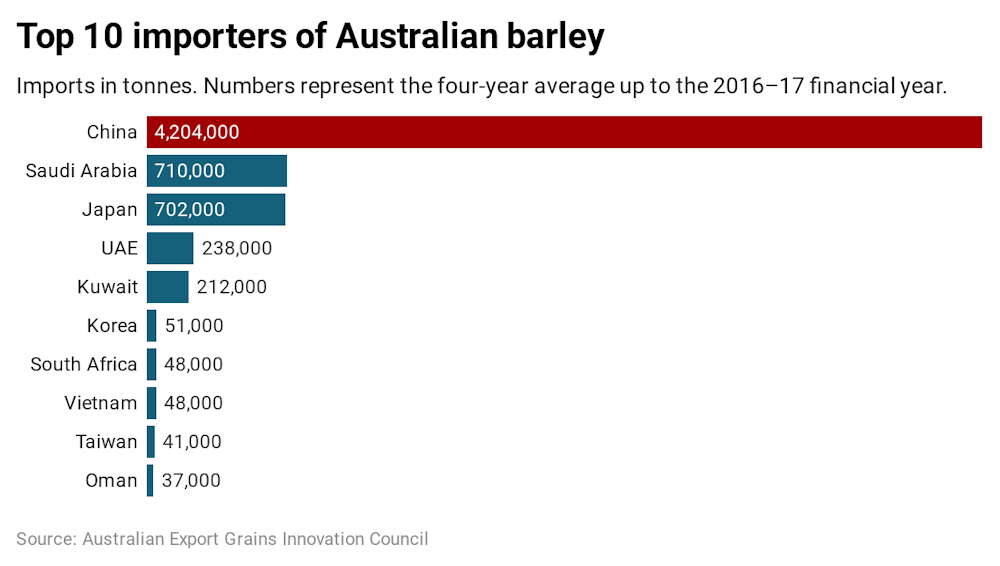
Chinese authorities began an anti-dumping investigation into Australian barley in November 2018. Anti-dumping trade rules are meant to protect local producers from unfair competition from “dumped” imported goods.
Dumping occurs where a firm sells goods in an overseas market at a price lower than the normal value of the goods. China calculated the normal value of barley using “best information available” on the grounds that Australian producers and exporters failed to provide all information Chinese investigators requested.
Free Reports:
 Download Our Metatrader 4 Indicators – Put Our Free MetaTrader 4 Custom Indicators on your charts when you join our Weekly Newsletter
 Get our Weekly Commitment of Traders Reports - See where the biggest traders (Hedge Funds and Commercial Hedgers) are positioned in the futures markets on a weekly basis.
The barley tariff will last for five years unless Chinese investigators initiate a review and decide to extend it beyond 2025.
What can Australia hope to achieve from a WTO dispute?
Not a quick and easy win. A formal resolution will likely take years. But it plants a seed, starting a structured process for dialogue. This is an important step in the right direction.
A lengthy process
WTO litigation is no quick fix. There is a set process that moves through three phases – consultation, adjudication and compliance.
The standard timetable would ideally have disputes move through consultation and adjudication within a year. In reality it often take several years, particularly if appeals or compliance actions are involved.
The timetable schedules 60 days for the first stage of negotiations, though these can take many more months. That’s worthwhile if it leads to a resolution. But given the tensions between China and Australia, a quick resolution looks remote.
The adjudication process typically involves a decision by a WTO panel followed by an appeal to the organisation’s Appellate Body.
A WTO panel is meant to issue its decision within nine months of its establishment, but it usually takes much more time. If the panel’s decision is appealed, the Appellate Body is meant to make its decisions within 90 days, but nor is this time frame met in many cases.
Once a WTO decision is final, it is up to the losing party to comply with the ruling. That may include a request for time to make the necessary changes. In practice, this can take six to 15 months.
Appeals blockage
One complication is the current non-functioning WTO appeals process. Appointing judges to the WTO’s Appellate Body requires agreement from all WTO member nations. US obstruction of new appointments has reduced the number of judges to zero, and the Appellate Body requires three judges to hear appeals.
This paralysis has created a major loophole, enabling an “appeal into the void” to block unfavourable rulings.
In light of this, the 27 European Union nations and 22 other WTO members – including both China and Australia – have signed on to a temporary appeals process known as the “multi-party interim appeal arbitration arrangement” (MPIA).
Given China’s commitment to the WTO and its dispute settlement system, there is no reason to anticipate it snubbing interim arrangements if an appeal arises. But the appeal process is also likely to take just as long as the Appellate Body procedure.
No guaranteed win
Federal Trade Minister Simon Birmingham has expressed confidence in Australia’s “strong case” but victory against China is not assured.
China’s tariff on Australian barley comprises an “anti-dumping duty” of 73.6% and a “countervailing duty” of 6.9%. Anti-dumping and countervailing calculations are highly technical. Whether China’s barley tariff has violated WTO rules will require detailed examination of its methodology.
A key challenge to the Chinese methodology is that it largely disregarded information on domestic sales by Australian barley producers and used data from Australian sales to Egypt.
The WTO has found China’s use of similar methods in several past disputes breached WTO rules. But every case depends on very specific facts. The past rulings against China do not necessarily predict the result here.
No compensation
Even if Australia is successful, a “win” isn’t total.
The WTO system is designed to make states change their ways. It is not designed to compensate those harmed by illegal trade measures. In other words, an Australian win may require China only to remove the tariff, not compensate those who paid more or lost revenue as a result.
There is also a risk that China could simply initiate a re-investigation of the barley tariff, which might lead to a decision to impose duties very similar to the original ones. In some past disputes, it took China five years or longer to remove duties.
So even if the World Trade Organisation rules in favour of Australia, this might not lead to the tariff’s end before its current expiry date in 2025.
Still the best option
Despite all this, the World Trade Organisation is Australia’s best step.
The WTO is not perfect, but it is now a tested and respected mechanism to resolve trade disputes.
WTO litigation also compels the disputing parties to enter into consultations – and talking is something Australia’s officials have had difficulty having with their Chinese counterparts.
China might drag its heels in other ways, but it can be expected to respect the WTO’s procedural rules and enter into these negotiations. Those talks could help repair communication channels better than missives through social media and press conferences.
Litigation the new normal
In commencing a formal dispute, Australia also sends a firm but dignified message – that it is willing to use international rules and procedures to solve grievances.
WTO litigation is a normal feature of trade relations between countries. Even close allies bring disputes against one another – such as New Zealand’s case against Australia’s restrictions on New Zealand apples, or Australia’s case against Canadian restrictions on imported wines in liquor stores.
China and Australia badly need a relationship reset. Meeting in a rules-based forum with structured processes for dialogue can do no harm.
About the Author:
Weihuan Zhou, Senior Lecturer and member of Herbert Smith Freehills CIBEL Centre, Faculty of Law, UNSW Sydney, UNSW and Lisa Toohey, Professor of Law, University of Newcastle
This article is republished from The Conversation under a Creative Commons license. Read the original article.

- EUR/USD: Busy Week Ahead Aug 3, 2026
- Positive sentiment in the AI sector supported stock indices. Oil prices remain volatile Aug 3, 2026
- The Tech‑heavy NASDAQ Index jumped by more than 3.3%. The offshore yuan is trading at its highest level since 2023 Jul 31, 2026
- USD/JPY After Volatility: Multiple Events in One Day Jul 31, 2026
- The US indices sell off amid renewed US-Iran clashes. Oil jumps by 7% Jul 30, 2026
- USD/JPY Temporary in Equilibrium: Multiple Factors in Focus Jul 30, 2026
- GBP/USD at Month’s Lows: The Outlook Remains Weak Jul 29, 2026
- Crude oil falls below $80 per barrel. Australia sees inflation slowdown Jul 29, 2026
- The US Tech sector hit by sell‑off. Oil prices decline on renewed negotiations Jul 28, 2026
- Gold Declines, Focus on Fed and Falling Oil Prices Jul 28, 2026
