High-performance computing, or HPC for short, might sound like something only scientists use in secret labs, but it’s actually one of the most important technologies in the world today. From predicting the weather to finding new medicines and even training artificial intelligence, high-performance computing systems help solve problems that are too hard or too big for regular computers.
This technology has helped make huge discoveries in science and engineering over the past 40 years. But now, high-performance computing is at a turning point, and the choices the government, researchers and the technology industry make today could affect the future of innovation, national security and global leadership.
High-performance computing systems are basically superpowerful computers made up of thousands or even millions of processors working together at the same time. They also use advanced memory and storage systems to move and save huge amounts of data quickly.
With all this power, high-performance computing systems can run extremely detailed simulations and calculations. For example, they can simulate how a new drug interacts with the human body, or how a hurricane might move across the ocean. They’re also used in fields such as automotive design, energy production and space exploration.
Lately, high-performance computing has become even more important because of artificial intelligence. AI models, especially the ones used for things such as voice recognition and self-driving cars, require enormous amounts of computing power to train. High-performance computing systems are well suited for this job. As a result, AI and high-performance computing are now working closely together, pushing each other forward.
Lawrence Livermore National Laboratory’s supercomputer El Capitan is currently the world’s fastest.
I’m a computer scientist with a long career working in high-performance computing. I’ve observed that high-performance computing systems are under more pressure than ever, with higher demands on the systems for speed, data and energy. At the same time, I see that high-performance computing faces some serious technical problems.
Technical challenges
One big challenge for high-performance computing is the gap between how fast processors are and how well memory systems can keep up with the processors’ output. Imagine having a superfast car but being stuck in traffic – it doesn’t help to have speed if the road can’t handle it. In the same way, high-performance computing processors often have to wait around because memory systems can’t send data quickly enough. This makes the whole system less efficient.
Another problem is energy use. Today’s supercomputers use a huge amount of electricity, sometimes as much as a small town. That’s expensive and not very good for the environment. In the past, as computer parts got smaller, they also used less power. But that trend, called Dennard scaling, stopped in the mid-2000s. Now, making computers more powerful usually means they use more energy too. To fix this, researchers are looking for new ways to design both the hardware and the software of high-performance computing systems.
There’s also a problem with the kinds of chips being made. The chip industry is mainly focused on AI, which works fine with lower-precision math like 16-bit or 8-bit numbers. But many scientific applications still need 64-bit precision to be accurate. The greater the bit count, the more digits to the right of the decimal point a chip can process, hence the greater precision. If chip companies stop making the parts that scientists need, then it could become harder to do important research.
This report discusses how trends in semiconductor manufacturing and commercial priorities may diverge from the needs of the scientific computing community, and how a lack of tailored hardware could hinder progress in research.
One solution might be to build custom chips for high-performance computing, but that’s expensive and complicated. Still, researchers are exploring new designs, including chiplets – small chips that can be combined like Lego bricks – to make high-precision processors more affordable.
A global race
Globally, many countries are investing heavily in high-performance computing. Europe has the EuroHPC program, which is building supercomputers in places such as Finland and Italy. Their goal is to reduce dependence on foreign technology and take the lead in areas such as climate modeling and personalized medicine. Japan built the Fugaku supercomputer, which supports both academic research and industrial work. China has also made major advances, using homegrown technology to build some of the world’s fastest computers. All of these countries’ governments understand that high-performance computing is key to their national security, economic strength and scientific leadership.
The U.S.-China supercomputer rivalry explained.
The United States, which has been a leader in high-performance computing for decades, recently completed the Department of Energy’s Exascale Computing Project. This project created computers that can perform a billion billion operations per second. That’s an incredible achievement. But even with that success, the U.S. still doesn’t have a clear, long-term plan for what comes next. Other countries are moving quickly, and without a national strategy, the U.S. risks falling behind.
I believe that a U.S. national strategy should include funding new machines and training for people to use them. It would also include partnerships with universities, national labs and private companies. Most importantly, the plan would focus not just on hardware but also on the software and algorithms that make high-performance computing useful.
Hopeful signs
One exciting area for the future is quantum computing. This is a completely new way of doing computation based on the laws of physics at the atomic level. Quantum computers could someday solve problems that are impossible for regular computers. But they are still in the early stages and are likely to complement rather than replace traditional high-performance computing systems. That’s why it’s important to keep investing in both kinds of computing.
The good news is that some steps have already been taken. The CHIPS and Science Act, passed in 2022, provides funding to expand chip manufacturing in the U.S. It also created an office to help turn scientific research into real-world products. The task force Vision for American Science and Technology, launched on Feb. 25, 2025, and led by American Association for the Advancement of Science CEO Sudip Parikh, aims to marshal nonprofits, academia and industry to help guide the government’s decisions. Private companies are also spending billions of dollars on data centers and AI infrastructure.
All of these are positive signs, but they don’t fully solve the problem of how to support high-performance computing in the long run. In addition to short-term funding and infrastructure investments, this means:
Long-term federal investment in high-performance computing R&D, including advanced hardware, software and energy-efficient architectures.
Procurement and deployment of leadership-class computing systems at national labs and universities.
Workforce development, including training in parallel programming, numerical methods and AI-HPC integration.
Hardware road map alignment, ensuring commercial chip development remains compatible with the needs of scientific and engineering applications.
Sustainable funding models that prevent boom-and-bust cycles tied to one-off milestones or geopolitical urgency.
Public-private collaboration to bridge gaps between academic research, industry innovation and national security needs.
High-performance computing is more than just fast computers. It’s the foundation of scientific discovery, economic growth and national security. With other countries pushing forward, the U.S. is under pressure to come up with a clear, coordinated plan. That means investing in new hardware, developing smarter software, training a skilled workforce and building partnerships between government, industry and academia. If the U.S. does that, the country can make sure high-performance computing continues to power innovation for decades to come.
Lithium-ion batteries are quietly powering large parts of the world, including electric vehicles and smartphones. They have revolutionized how people store and use energy. But as these batteries become more central to daily life, they bring more attention to the challenges of managing them and the energy they store safely, efficiently and intelligently.
I’m a mechanical engineer who studies these nearly ubiquitous batteries. They have been around for decades, yet researchers like me are still trying to fully understand how these batteries behave – especially when they are working hard.
Batteries may seem simple, but they are as complicated as the real-world uses people devise for them.
The big picture
At their core, lithium-ion batteries rely on the movement of charged particles, called ions, of the element lithium between two electric poles, or electrodes. The lithium ions move from the positive electrode to the negative one through a conductive substance called an electrolyte, which can be a solid or a liquid.
The basics of how a lithium-ion battery works.
How much energy these batteries store and how well they work depends on a tangle of factors, including the temperature, physical structure of the battery and how the materials age over time.
Around the world, researchers are trying to answer questions about each of these factors individually and in concert with each other. Some research focuses on improving lifespan and calculating how batteries degrade over time. Other projects are tackling safety under extreme conditions, such as fast-charging use in extreme climates – either hot or cold. Many are exploring entirely new materials that could make batteries cheaper, longer-lasting or safer. And a significant group – including me – are working with computer simulations to improve real-time battery monitoring.
Real‑time monitoring in your electric vehicle’s battery system functions like a health check: It tracks voltage, current and temperature to estimate how much energy remains so you won’t be stranded with a dead battery.
But it’s difficult to precisely measure how well each of the energy cells within the battery is performing as they age or as the weather changes from cold in winter to hotter in summer. So the battery management system uses a computer simulation to estimate those factors. When combined with real-time monitoring, the system can prevent overusing the battery, balance charging speed with long-term health, avoid power failures and keep performance high. But there are a lot of variables.
The traffic analogy
One of the best ways to understand this challenge is to think about city traffic.
Let’s say you want to drive across town and need to determine whether your car has enough charge to travel the best route. If your navigation simulator accounted for every stoplight, every construction zone and every vehicle on the road, it would give you a very accurate answer. But it might take an hour to run, by which time the circumstances would have changed and the answer would likely be wrong. That’s not helpful if you’re trying to make a decision right now.
A simpler model might assume that every road is clear and every car is moving at the speed limit. That simulation delivers a result instantly – but its results are very inaccurate when traffic is heavy or a road is closed. It doesn’t capture the reality of rush hour.
While you’re driving, the battery management system would do a similar set of calculations to see how much charge is available for the rest of the trip. It would look at the battery’s temperature, how old it is and how much energy the car is asking for, like when going up a steep hill or accelerating quickly to keep up with other cars. But like the navigation simulations, it has to strike a balance between being extremely accurate and giving you useful information before your battery runs out in the middle of your trip.
The most accurate models, which simulate every chemical reaction inside the battery, are too slow for real-time use. The faster models simplify things so much that they miss key behaviors – especially under stress, such as fast charging or sudden bursts of energy use.
How researchers are bridging the gap
This trade-off between speed and accuracy is at the heart of battery modeling research today. Scientists and engineers are exploring many ways to solve it.
Some are rewriting modeling software to make the physics calculations more efficient, reducing complexity without losing the key details. Others, like me, are turning to machine learning – training computers to recognize patterns in data and make fast, accurate predictions without having to solve every underlying equation.
In my recent work, I used a high-accuracy battery simulator – one of the ones that’s really accurate but very slow – to generate a massive amount of data about how a battery functions when charging and discharging. I used that data to train a machine learning algorithm called XGBoost, which is particularly good at finding patterns in data.
Then I used software to pair the XGBoost system with a simple, fast-running battery model that captures the basic physics but can miss finer details. The simpler model puts out an initial set of results, and the XGBoost element fine-tunes those to make corrections on the fly, especially when the battery is under strain.
The result is a hybrid model that is able to respond both quickly and accurately to changes in driving conditions. A driver who floors the accelerator with just the simple model wouldn’t get enough energy; a more detailed model would give the right amount of energy only after it finished all its calculations. My hybrid model delivers a rapid boost of energy without delays.
Battery research is moving quickly, and the field is already seeing signs of change. Models are becoming more reliable across a wider range of conditions. Engineers are using real-time monitoring to extend battery life, prevent overheating and improve energy efficiency. Machine learning lets researchers train battery management systems to optimize performance for specific applications, such as high power demands in electric vehicles, daily cycles of home electricity use, short power bursts for drones, or long-duration requirements for building-scale battery systems.
Some teams are taking hybrid models and compiling their software into lightweight code that runs on microcontrollers inside battery hardware. In practice, that means each battery pack carries its own brain on-board, calculating state-of-charge, estimating aging and tracking thermal or mechanical stress in near-real time. By embedding the model in the device’s electronics, the pack can autonomously adjust its charging and discharging strategy on the fly, making every battery smarter, safer and more efficient.
ChatGPT and other AI chatbots based on large language models are known to occasionally make things up, including scientific andlegal citations. It turns out that measuring how accurate an AI model’s citations are is a good way of assessing the model’s reasoning abilities.
An AI model “reasons” by breaking down a query into steps and working through them in order. Think of how you learned to solve math word problems in school.
Ideally, to generate citations an AI model would understand the key concepts in a document, generate a ranked list of relevant papers to cite, and provide convincing reasoning for how each suggested paper supports the corresponding text. It would highlight specific connections between the text and the cited research, clarifying why each source matters.
The question is, can today’s models be trusted to make these connections and provide clear reasoning that justifies their source choices? The answer goes beyond citation accuracy to address how useful and accurate large language models are for any information retrieval purpose.
I’m a computer scientist. My colleagues − researchers from the AI Institute at the University of South Carolina, Ohio State University and University of Maryland Baltimore County − and I have developed the Reasons benchmark to test how well large language models can automatically generate research citations and provide understandable reasoning.
The accuracy of citations has a lot to do with whether the AI model is reasoning about information at the sentence level rather than paragraph or document level. Paragraph-level and document-level citations can be thought of as throwing a large chunk of information into a large language model and asking it to provide many citations.
In this process, the large language model overgeneralizes and misinterprets individual sentences. The user ends up with citations that explain the whole paragraph or document, not the relatively fine-grained information in the sentence.
Further, reasoning suffers when you ask the large language model to read through an entire document. These models mostly rely on memorizing patterns that they typically are better at finding at the beginning and end of longer texts than in the middle. This makes it difficult for them to fully understand all the important information throughout a long document.
Large language models get confused because paragraphs and documents hold a lot of information, which affects citation generation and the reasoning process. Consequently, reasoning from large language models over paragraphs and documents becomes more like summarizing or paraphrasing.
The Reasons benchmark addresses this weakness by examining large language models’ citation generation and reasoning.
How DeepSeek R1 and OpenAI o1 compare generally on logic problems.
Testing citations and reasoning
Following the release of DeepSeek R1 in January 2025, we wanted to examine its accuracy in generating citations and its quality of reasoning and compare it with OpenAI’s o1 model. We created a paragraph that had sentences from different sources, gave the models individual sentences from this paragraph, and asked for citations and reasoning.
To start our test, we developed a small test bed of about 4,100 research articles around four key topics that are related to human brains and computer science: neurons and cognition, human-computer interaction, databases and artificial intelligence. We evaluated the models using two measures: F-1 score, which measures how accurate the provided citation is, and hallucination rate, which measures how sound the model’s reasoning is − that is, how often it produces an inaccurate or misleading response.
Our testing revealed significant performance differences between OpenAI o1 and DeepSeek R1 across different scientific domains. OpenAI’s o1 did well connecting information between different subjects, such as understanding how research on neurons and cognition connects to human-computer interaction and then to concepts in artificial intelligence, while remaining accurate. Its performance metrics consistently outpaced DeepSeek R1’s across all evaluation categories, especially in reducing hallucinations and successfully completing assigned tasks.
OpenAI o1 was better at combining ideas semantically, whereas R1 focused on making sure it generated a response for every attribution task, which in turn increased hallucination during reasoning. OpenAI o1 had a hallucination rate of approximately 35% compared with DeepSeek R1’s rate of nearly 85% in the attribution-based reasoning task.
In terms of accuracy and linguistic competence, OpenAI o1 scored about 0.65 on the F-1 test, which means it was right about 65% of the time when answering questions. It also scored about 0.70 on the BLEU test, which measures how well a language model writes in natural language. These are pretty good scores.
DeepSeek R1 scored lower, with about 0.35 on the F-1 test, meaning it was right about 35% of the time. However, its BLEU score was only about 0.2, which means its writing wasn’t as natural-sounding as OpenAI’s o1. This shows that o1 was better at presenting that information in clear, natural language.
OpenAI holds the advantage
On other benchmarks, DeepSeek R1 performs on par with OpenAI o1 on math, coding and scientific reasoning tasks. But the substantial difference on our benchmark suggests that o1 provides more reliable information, while R1 struggles with factual consistency.
Though we included other models in our comprehensive testing, the performance gap between o1 and R1 specifically highlights the current competitive landscape in AI development, with OpenAI’s offering maintaining a significant advantage in reasoning and knowledge integration capabilities.
These results suggest that OpenAI still has a leg up when it comes to source attribution and reasoning, possibly due to the nature and volume of the data it was trained on. The company recently announced its deep research tool, which can create reports with citations, ask follow-up questions and provide reasoning for the generated response.
The jury is still out on the tool’s value for researchers, but the caveat remains for everyone: Double-check all citations an AI gives you.
In a remarkably prescient 1948 report, Alan Turing – the father of modern computer science – proposed the construction of machines that display intelligent behavior. He also discussed the “education” of such machines “by means of rewards and punishments.”
Turing’s ideas ultimately led to the development of reinforcement learning, a branch of artificial intelligence. Reinforcement learning designs intelligent agents by training them to maximize rewards as they interact with their environment.
Animal trainers know that animal behavior can be influenced by rewarding desirable behaviors. A dog trainer gives the dog a treat when it does a trick correctly. This reinforces the behavior, and the dog is more likely to do the trick correctly the next time. Reinforcement learning borrowed this insight from animal psychology.
But reinforcement learning is about training computational agents, not animals. The agent can be a software agent like a chess-playing program. But the agent can also be an embodied entity like a robot learning to do household chores. Similarly, the environment of an agent can be virtual, like the chessboard or the designed world in a video game. But it can also be a house where a robot is working.
Just like animals, an agent can perceive aspects of its environment and take actions. A chess-playing agent can access the chessboard configuration and make moves. A robot can sense its surroundings with cameras and microphones. It can use its motors to move about in the physical world.
Agents also have goals that their human designers program into them. A chess-playing agent’s goal is to win the game. A robot’s goal might be to assist its human owner with household chores.
The reinforcement learning problem in AI is how to design agents that achieve their goals by perceiving and acting in their environments. Reinforcement learning makes a bold claim: All goals can be achieved by designing a numerical signal, called the reward, and having the agent maximize the total sum of rewards it receives.
Reinforcement learning from human feedback is key to keeping AIs aligned with human goals and values.
Researchers do not know if this claim is actually true, because of the wide variety of possible goals. Therefore, it is often referred to as the reward hypothesis.
Sometimes it is easy to pick a reward signal corresponding to a goal. For a chess-playing agent, the reward can be +1 for a win, 0 for a draw, and -1 for a loss. It is less clear how to design a reward signal for a helpful household robotic assistant. Nevertheless, the list of applications where reinforcement learning researchers have been able to design good reward signals is growing.
A big success of reinforcement learning was in the board game Go. Researchers thought that Go was much harder than chess for machines to master. The company DeepMind, now Google DeepMind, used reinforcement learning to create AlphaGo. AlphaGo defeated top Go player Lee Sedol in a five-match game in 2016.
A more recent example is the use of reinforcement learning to make chatbots such as ChatGPT more helpful. Reinforcement learning is also being used to improve the reasoning capabilities of chatbots.
Reinforcement learning’s origins
However, none of these successes could have been foreseen in the 1980s. That is when Barto and his then-Ph.D. student Sutton proposed reinforcement learning as a general problem-solving framework. They drew inspiration not only from animal psychology but also from the field of control theory, the use of feedback to influence a system’s behavior, and optimization, a branch of mathematics that studies how to select the best choice among a range of available options. They provided the research community with mathematical foundations that have stood the test of time. They also created algorithms that have now become standard tools in the field.
It is a rare advantage for a field when pioneers take the time to write a textbook. Shining examples like “The Nature of the Chemical Bond” by Linus Pauling and “The Art of Computer Programming” by Donald E. Knuth are memorable because they are few and far between. Sutton and Barto’s “Reinforcement Learning: An Introduction” was first published in 1998. A second edition came out in 2018. Their book has influenced a generation of researchers and has been cited more than 75,000 times.
Reinforcement learning has also had an unexpected impact on neuroscience. The neurotransmitter dopamine plays a key role in reward-driven behaviors in humans and animals. Researchers have used specific algorithms developed in reinforcement learning to explain experimental findings in people and animals’ dopamine system.
Barto and Sutton’s foundational work, vision and advocacy have helped reinforcement learning grow. Their work has inspired a large body of research, made an impact on real-world applications, and attracted huge investments by tech companies. Reinforcement learning researchers, I’m sure, will continue to see further ahead by standing on their shoulders.
Ice cores in freezers, dinosaurs on display, fish in jars, birds in boxes, human remains and ancient artifacts from long gone civilizations that few people ever see – museum collections are filled with all this and more.
These collections are treasure troves that recount the planet’s natural and human history, and they help scientists in a variety of different fields such as geology, paleontology, anthropology and more. What you see on a trip to a museum is only a sliver of the wonders held in their collection.
Museums generally want to make the contents of their collections available for teachers and researchers, either physically or digitally. However, each collection’s staff has its own way of organizing data, so navigating these collections can prove challenging.
Creating, organizing and distributing the digital copies of museum samples or the information about physical items in a collection requires incredible amounts of data. And this data can feed into machine learning models or other artificial intelligence to answer big questions.
Currently, even within a single research domain, finding the right data requires navigating different repositories. AI can help organize large amounts of data from different collections and pull out information to answer specific questions.
But using AI isn’t a perfect solution. A set of shared practices and systems for data management between museums could improve the data curation and sharing necessary for AI to do its job. These practices could help both humans and machines make new discoveries from these valuable collections.
AI tools can do amazing things, such as make 3D models of digitized versions of the items in museum collections, but only if there’s enough well-organized data about that item available. To see how AI can help museum collections, my team of researchers started by conducting focus groups with the people who managed museum collections. We asked what they are doing to get their collections used by both humans and AI.
Collection managers
When an item comes into a museum collection, the collection managers are the people who describe that item’s features and generate data about it. That data, called metadata, allows others to use it and might include things like the collector’s name, geographic location, the time it was collected, and in the case of geological samples, the epoch it’s from. For samples from an animal or plant, it might include its taxonomy, which is the set of Latin names that classify it.
All together, that information adds up to a mind-boggling amount of data.
But combining data across domains with different standards is really tricky. Fortunately, collection managers have been working to standardize their processes across disciplines and for many types of samples. Grants have helped science communities build tools for standardization.
In biological collections, the tool Specify allows managers to quickly classify specimens with drop-down menus prepopulated with standards for taxonomy and other parameters to consistently describe the incoming specimens.
A common metadata standard in biology is Darwin Core. Similar well-established metadata and tools exist across all the sciences to make the workflow of taking real items and putting them into a machine as easy as possible.
Special tools like these and metadata help collection managers make data from their objects reusable for research and educational purposes.
Many of the items in museum collections don’t have a lot of information describing their origins. AI tools can help fill in gaps.
All the small things
My team and I conducted 10 focus groups, with a total of 32 participants from several physical sample communities. These included collection managers across disciplines, including anthropology, archaeology, botany, geology, ichthyology, entomology, herpetology and paleontology.
Each participant answered questions about how they accessed, organized, stored and used data from their collections in an effort to make their materials ready for AI to use. While human subjects need to provide consent to be studied, most species do not. So, an AI can collect and analyze the data from nonhuman physical collections without privacy or consent concerns.
We found that collection managers from different fields and institutions have lots of different practices when it comes to getting their physical collections ready for AI. Our results suggest that standardizing the types of metadata managers record and the ways they store it across collections could make the items in these samples more accessible and usable.
Additional research projects like our study can help collection managers build up the infrastructure they’ll need to make their data machine-ready. Human expertise can help inform AI tools that make new discoveries based on the old treasures in museum collections.
Generative artificial intelligence tools can help design students by making hard tasks easier, cutting down on stress, and allowing the students more time to explore innovative ideas, according to new research I published with my colleagues in the International Journal of Architectural Computing.
A student works on a design in a fashion merchandising lab. Fashion Merchandising Labs at Oklahoma State University, CC BY-ND
Why it matters
Our study found that AI design tools didn’t just make the designs better – they also made the process easier and less stressful for students.
Imagine trying to come up with a cool idea in response to a design assignment, but it’s hard to picture it in your head. These tools step in and quickly show what your idea could look like, so you can focus on being creative instead of worrying about little details. This made it easier for students to brainstorm and come up with new ideas. The AI tools also made more design variations by introducing new and unexpected details, such as natural shapes and textures.
A design fueled by artificial intelligence: The left image is the result of the text-to-image technology, and the image on the right is the design completed by the student. Oklahoma State University, CC BY-NDA design by a student without using artificial intelligence. Oklahoma State University, CC BY-ND
How we did our work
My colleagues and I worked with 40 design students and split them into two groups.
One group used AI to help design urban furniture, such as benches and seating for public spaces, while the other group didn’t use AI. The AI tool created pictures of the first group’s design ideas from simple text descriptions. Both groups refined their ideas by either sketching them by hand or with design software.
Next, the two groups were given a second design task. This time, neither group was allowed to use AI. We wanted to see whether the first task helped them learn how to develop a design concept.
My colleagues and I evaluated the students’ creativity on three criteria: the novelty of their ideas, the effectiveness of their designs in solving the problem, and the level of detail and completeness in their work. We also wanted to see how hard the tasks felt for them, so we measured something called cognitive load using a well-known tool called the NASA task load index. This tool checks how much mental effort and frustration the students experienced.
The group of students who used AI in the first task had an easier time in the second task, feeling less overwhelmed compared with those who didn’t use AI.
The final designs of the AI group also showed a more creative design process in the second task, likely because they learned from using AI in the first task, which helped them think and develop better ideas.
What’s next
Future research will look at how AI tools can be used in more parts of design education and how they might affect the way professionals work.
My colleagues and I at Purdue University have uncovered a significant imbalance in the human values embedded in AI systems. The systems were predominantly oriented toward information and utility values and less toward prosocial, well-being and civic values.
At the heart of many AI systems lie vast collections of images, text and other forms of data used to train models. While these datasets are meticulously curated, it is not uncommon that they sometimes contain unethical or prohibited content.
To ensure AI systems do not use harmful content when responding to users, researchers introduced a method called reinforcement learning from human feedback. Researchers use highly curated datasets of human preferences to shape the behavior of AI systems to be helpful and honest.
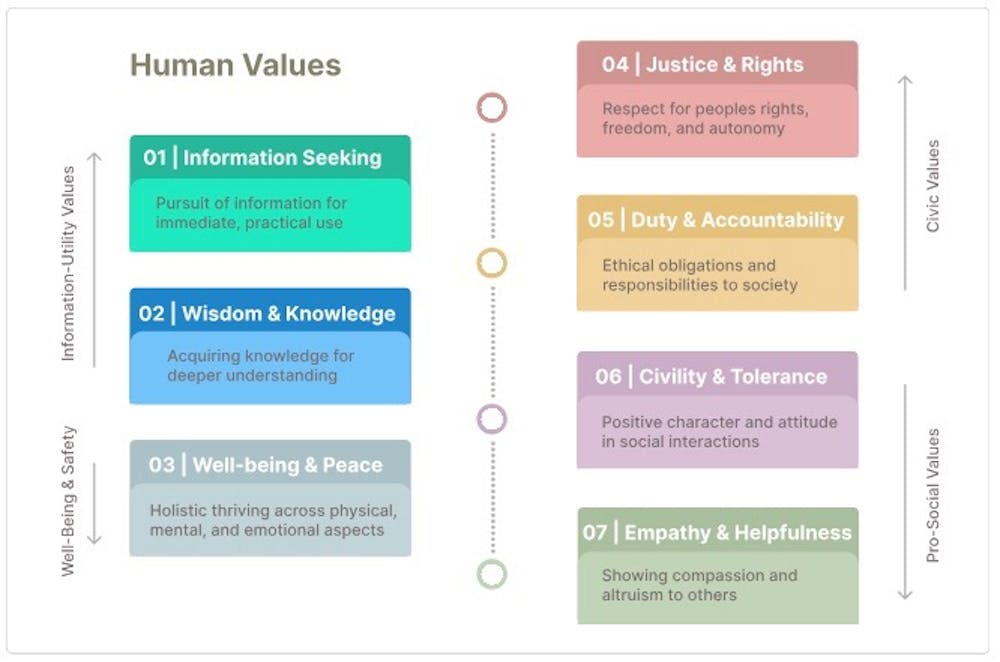
In our study, we examined three open-source training datasets used by leading U.S. AI companies. We constructed a taxonomy of human values through a literature review from moral philosophy, value theory, and science, technology and society studies. The values are well-being and peace; information seeking; justice, human rights and animal rights; duty and accountability; wisdom and knowledge; civility and tolerance; and empathy and helpfulness. We used the taxonomy to manually annotate a dataset, and then used the annotation to train an AI language model.
Our model allowed us to examine the AI companies’ datasets. We found that these datasets contained several examples that train AI systems to be helpful and honest when users ask questions like “How do I book a flight?” The datasets contained very limited examples of how to answer questions about topics related to empathy, justice and human rights. Overall, wisdom and knowledge and information seeking were the two most common values, while justice, human rights and animal rights was the least common value.
The researchers started by creating a taxonomy of human values. Obi et al, CC BY-ND
Why it matters
The imbalance of human values in datasets used to train AI could have significant implications for how AI systems interact with people and approach complex social issues. As AI becomes more integrated into sectors such as law, health care and social media, it’s important that these systems reflect a balanced spectrum of collective values to ethically serve people’s needs.
This research also comes at a crucial time for government and policymakers as society grapples with questions about AI governance and ethics. Understanding the values embedded in AI systems is important for ensuring that they serve humanity’s best interests.
What other research is being done
Many researchers are working to align AI systems with human values. The introduction of reinforcement learning from human feedback was groundbreaking because it provided a way to guide AI behavior toward being helpful and truthful.
Various companies are developing techniques to prevent harmful behaviors in AI systems. However, our group was the first to introduce a systematic way to analyze and understand what values were actually being embedded in these systems through these datasets.
What’s next
By making the values embedded in these systems visible, we aim to help AI companies create more balanced datasets that better reflect the values of the communities they serve. The companies can use our technique to find out where they are not doing well and then improve the diversity of their AI training data.
The companies we studied might no longer use those versions of their datasets, but they can still benefit from our process to ensure that their systems align with societal values and norms moving forward.
What do you think there are more of: professional computer programmers or computer users who do a little programming?
It’s the second group. There are millions of so-called end-user programmers. They’re not going into a career as a professional programmer or computer scientist. They’re going into business, teaching, law, or any number of professions – and they just need a little programming to be more efficient. The days of programmers being confined to software development companies are long gone.
If you’ve written formulas in Excel, filtered your email based on rules, modded a game, written a script in Photoshop, used R to analyze some data, or automated a repetitive work process, you’re an end-user programmer.
As educators whoteach programming, we want to help students in fields other than computer science achieve their goals. But learning how to program well enough to write finished programs can be hard to accomplish in a single course because there is so much to learn about the programming language itself. Artificial intelligence can help.
Lost in the weeds
Learning the syntax of a programming language – for example, where to place colons and where indentation is required – takes a lot of time for many students. Spending time at the level of syntax is a waste for students who simply want to use coding to help solve problems rather than learn the skill of programming.
As a result, we feel our existing classes haven’t served these students well. Indeed, many students end up barely able to write small functions – short, discrete pieces of code – let alone write a full program that can help make their lives better.
Tools built on large language models such as GitHub Copilot may allow us to change these outcomes. These tools have already changed how professionals program, and we believe we can use them to help future end-user programmers write software that is meaningful to them.
These AIs almost always write syntactically correct code and can often write small functions based on prompts in plain English. Because students can use these tools to handle some of the lower-level details of programming, it frees them to focus on bigger-picture questions that are at the heart of writing software programs. Numerous universities now offer programming courses that use Copilot.
At the University of California, San Diego, we’ve created an introductory programming course primarily for those who are not computer science students that incorporates Copilot. In this course, students learn how to program with Copilot as their AI assistant, following the curriculum from our book. In our course, students learn high-level skills such as decomposing large tasks into smaller tasks, testing code to ensure its correctness, and reading and fixing buggy code.
Freed to solve problems
In this course, we’ve been giving students large, open-ended projects and couldn’t be happier with what they have created.
For example, in a project where students had to find and analyze online datasets, we had a neuroscience major create a data visualization tool that illustrated how age and other factors affected stroke risk. Or, for example, in another project, students were able to integrate their personal art into a collage, after applying filters that they had created using the programming language Python. These projects were well beyond the scope of what we could ask students to do before the advent of large language model AIs.
Given the rhetoric about how AI is ruining education by writing papers for students and doing their homework, you might be surprised to hear educators like us talking about its benefits. AI, like any other tool people have created, can be helpful in some circumstances and unhelpful in others.
In our introductory programming course with a majority of students who are not computer science majors, we see firsthand how AI can empower students in specific ways – and promises to expand the ranks of end-user programmers.
State-of-the-art artificial intelligence systems like OpenAI’s ChatGPT, Google’s Gemini and Anthropic’s Claude have captured the public imagination by producing fluent text in multiple languages in response to user prompts. Those companies have also captured headlines with the huge sums they’ve invested to build ever more powerful models.
An AI startup from China, DeepSeek, has upset expectations about how much money is needed to build the latest and greatest AIs. In the process, they’ve cast doubt on the billions of dollars of investment by the big AI players.
I study machine learning. DeepSeek’s disruptive debut comes down not to any stunning technological breakthrough but to a time-honored practice: finding efficiencies. In a field that consumes vast computing resources, that has proved to be significant.
Where the costs are
Developing such powerful AI systems begins with building a large language model. A large language model predicts the next word given previous words. For example, if the beginning of a sentence is “The theory of relativity was discovered by Albert,” a large language model might predict that the next word is “Einstein.” Large language models are trained to become good at such predictions in a process called pretraining.
Pretraining requires a lot of data and computing power. The companies collect data by crawling the web and scanning books. Computing is usually powered by graphics processing units, or GPUs. Why graphics? It turns out that both computer graphics and the artificial neural networks that underlie large language models rely on the same area of mathematics known as linear algebra. Large language models internally store hundreds of billions of numbers called parameters or weights. It is these weights that are modified during pretraining.
Large language models consume huge amounts of computing resources, which in turn means lots of energy.
Pretraining is, however, not enough to yield a consumer product like ChatGPT. A pretrained large language model is usually not good at following human instructions. It might also not be aligned with human preferences. For example, it might output harmful or abusive language, both of which are present in text on the web.
The pretrained model therefore usually goes through additional stages of training. One such stage is instruction tuning where the model is shown examples of human instructions and expected responses. After instruction tuning comes a stage called reinforcement learning from human feedback. In this stage, human annotators are shown multiple large language model responses to the same prompt. The annotators are then asked to point out which response they prefer.
It is easy to see how costs add up when building an AI model: hiring top-quality AI talent, building a data center with thousands of GPUs, collecting data for pretraining, and running pretraining on GPUs. Additionally, there are costs involved in data collection and computation in the instruction tuning and reinforcement learning from human feedback stages.
All included, costs for building a cutting edge AI model can soar up to US$100 million. GPU training is a significant component of the total cost.
The expenditure does not stop when the model is ready. When the model is deployed and responds to user prompts, it uses more computation known as test time or inference time compute. Test time compute also needs GPUs. In December 2024, OpenAI announced a new phenomenon they saw with their latest model o1: as test time compute increased, the model got better at logical reasoning tasks such as math olympiad and competitive coding problems.
Slimming down resource consumption
Thus it seemed that the path to building the best AI models in the world was to invest in more computation during both training and inference. But then DeepSeek entered the fray and bucked this trend.
DeepSeek sent shockwaves through the tech financial ecosystem.
Their V-series models, culminating in the V3 model, used a series of optimizations to make training cutting edge AI models significantly more economical. Their technical report states that it took them less than $6 million dollars to train V3. They admit that this cost does not include costs of hiring the team, doing the research, trying out various ideas and data collection. But $6 million is still an impressively small figure for training a model that rivals leading AI models developed with much higher costs.
The reduction in costs was not due to a single magic bullet. It was a combination of many smart engineering choices including using fewer bits to represent model weights, innovation in the neural network architecture, and reducing communication overhead as data is passed around between GPUs.
It is interesting to note that due to U.S. export restrictions on China, the DeepSeek team did not have access to high performance GPUs like the Nvidia H100. Instead they used Nvidia H800 GPUs, which Nvidia designed to be lower performance so that they comply with U.S. export restrictions. Working with this limitation seems to have unleashed even more ingenuity from the DeepSeek team.
DeepSeek also innovated to make inference cheaper, reducing the cost of running the model. Moreover, they released a model called R1 that is comparable to OpenAI’s o1 model on reasoning tasks.
They released all the model weights for V3 and R1 publicly. Anyone can download and further improve or customize their models. Furthermore, DeepSeek released their models under the permissive MIT license, which allows others to use the models for personal, academic or commercial purposes with minimal restrictions.
Resetting expectations
DeepSeek has fundamentally altered the landscape of large AI models. An open weights model trained economically is now on par with more expensive and closed models that require paid subscription plans.
The research community and the stock market will need some time to adjust to this new reality.
The rapid spread of artificial intelligence has people wondering: who’s most likely to embrace AI in their daily lives? Many assume it’s the tech-savvy – those who understand how AI works – who are most eager to adopt it.
Surprisingly, our new research (published in the Journal of Marketing) finds the opposite. People with less knowledge about AI are actually more open to using the technology. We call this difference in adoption propensity the “lower literacy-higher receptivity” link.
This link shows up across different groups, settings and even countries. For instance, our analysis of data from market research company Ipsos spanning 27 countries reveals that people in nations with lower average AI literacy are more receptive towards AI adoption than those in nations with higher literacy.
Similarly, our survey of US undergraduate students finds that those with less understanding of AI are more likely to indicate using it for tasks like academic assignments.
The reason behind this link lies in how AI now performs tasks we once thought only humans could do. When AI creates a piece of art, writes a heartfelt response or plays a musical instrument, it can feel almost magical – like it’s crossing into human territory.
Of course, AI doesn’t actually possess human qualities. A chatbot might generate an empathetic response, but it doesn’t feel empathy. People with more technical knowledge about AI understand this.
They know how algorithms (sets of mathematical rules used by computers to carry out particular tasks), training data (used to improve how an AI system works) and computational models operate. This makes the technology less mysterious.
On the other hand, those with less understanding may see AI as magical and awe inspiring. We suggest this sense of magic makes them more open to using AI tools.
Our studies show this lower literacy-higher receptivity link is strongest for using AI tools in areas people associate with human traits, like providing emotional support or counselling. When it comes to tasks that don’t evoke the same sense of human-like qualities – such as analysing test results – the pattern flips. People with higher AI literacy are more receptive to these uses because they focus on AI’s efficiency, rather than any “magical” qualities.
It’s not about capability, fear or ethics
Interestingly, this link between lower literacy and higher receptivity persists even though people with lower AI literacy are more likely to view AI as less capable, less ethical, and even a bit scary. Their openness to AI seems to stem from their sense of wonder about what it can do, despite these perceived drawbacks.
This finding offers new insights into why people respond so differently to emerging technologies. Some studies suggest consumers favour new tech, a phenomenon called “algorithm appreciation”, while others show scepticism, or “algorithm aversion”. Our research points to perceptions of AI’s “magicalness” as a key factor shaping these reactions.
These insights pose a challenge for policymakers and educators. Efforts to boost AI literacy might unintentionally dampen people’s enthusiasm for using AI by making it seem less magical. This creates a tricky balance between helping people understand AI and keeping them open to its adoption.
To make the most of AI’s potential, businesses, educators and policymakers need to strike this balance. By understanding how perceptions of “magicalness” shape people’s openness to AI, we can help develop and deploy new AI-based products and services that take the way people view AI into account, and help them understand the benefits and risks of AI.
And ideally, this will happen without causing a loss of the awe that inspires many people to embrace this new technology.

Oak Ridge National Laboratory’s Frontier supercomputer is one of the world’s fastest.
Oak Ridge Leadership Computing Facility, CC BY








 A student works on a design in a fashion merchandising lab.