Archive for Energy – Page 9

Oil and gas communities are a blind spot in America’s climate and economic policies

By Noah Kaufman, Columbia University 

On a recent visit to Rangely, a small town in northwest Colorado, my colleagues and I met with the administrators of a highly regarded community college to discuss the town’s economy. Leaving the scenic campus, we saw families driving into the mountains in off-road vehicles, a favorite activity for this outdoors-loving community. With a median household income above US$70,000 and a low cost of living, Rangely does not have the signs of a town in economic distress.

But an existential risk looms over Rangely. The town is here because of an oil boom during World War II. Today, the oil and gas industry contributes over half of the county’s economic output.

Rangely is not unique in the United States, which is the world’s largest producer of oil and natural gas. There are towns across the country that depend on the oil and gas industry for well-paying jobs and public revenues that fund their schools and other critical services.

A heavy dependence on any single industry is risky, and the oil industry is prone to booms and busts. But the economies of oil- and gas-dependent towns face a unique threat from global efforts to address the risks of climate change, which is fueled by the burning of oil and natural gas. Any serious strategy to halt global warming involves policies that will, over time, sharply reduce demand for all fossil fuels.

Early signs of this transformation can be seen in last year’s international agreement to “transition away from fossil fuels” and in the spread of electric vehicles that are starting to displace gasoline- and diesel-powered cars, trucks and buses.

As an economist who worked at the White House during the Obama administration and early Biden administration, I contributed to detailed strategies to reduce greenhouse gas emissions and to support communities in economic distress. But we did not have a plan to prepare oil and gas towns like Rangely for future economic challenges.

Why oil and gas towns are overlooked

Congress has prioritized support for small towns in recent legislation. However, oil- and gas-dependent towns were largely absent from these strategies for three primary reasons.

First is a perceived lack of urgency. The attention to a “just transition” as the nation moves away from fossil fuels has been disproportionately directed to coal-dependent communities. U.S. coal production has declined for 15 years, and a continued transition away from coal appears imminent and inevitable.

In contrast, U.S. production of oil and natural gas continues to grow. To be sure, some oil and gas communities are already struggling. But the widespread economic risks of a shift away from oil and gas may feel more like a problem for future decades.

Second, politicians downplay risks to oil and gas communities.

Most Republicans are not planning for a future decline in oil and gas production at all, and that includes many local politicians in oil and gas-dependent communities. For their part, most Democratic politicians prefer to focus on how climate action can be an engine of future economic growth. President Joe Biden likes to say, “When I think about climate change, I think jobs.”

He is not wrong to highlight the economic opportunities of climate solutions. But clean energy jobs rarely offer one-for-one replacements for the high-paying jobs in the oil and gas industries and the public revenues those industries bring local communities.

Third, economists’ policy toolbox is poorly suited to the challenges facing oil and gas communities.

Proposals to support local economic development commonly suggest targeting persistently distressed local economies with measures such as wage subsidies that have the potential to rapidly put more people to work.

A different prescription is needed for oil and gas communities, which are not generally struggling today. Over the 15-year period prior to the pandemic, the U.S. counties with oil and gas production experienced average annual GDP growth of 2.4% per year, compared with 1.9% nationwide.

Most oil and gas communities do not need economic stimulus policies that provide immediate relief. What they need are holistic economic development strategies that can cultivate new industries – building on their existing strengths – that will enable them to prosper into the future.

Solutions to help oil and gas towns prepare

Harvard economist Ricardo Hausmann compares the challenge of developing new economic capabilities to the game of Scrabble, where each additional letter enables the creation of more words. He cites the Finish economy as an example: It evolved from harvesting lumber to making tools that cut wood to producing automated cutting machines. From there, it evolved to sophisticated automated machines, including those used by global corporations such as telecommunications giant Nokia.

Such economic evolutions must be tailored to the characteristics of individual places. But the initial step is to recognize the problem and invest in solutions.

The Southern Ute Indian Tribe is doing this in southwest Colorado. It devotes oil and gas revenues to a Permanent Fund, which promotes fiscal sustainability by ensuring the tribe’s assets are aligned with its long-term financial goals, and a Growth Fund that diversifies the tribe’s revenue sources by investing in a range of businesses.

At the national level, a recent National Academies panel proposed the creation of a federally chartered corporation to help communities facing acute economic threats, including a future decline in oil and gas. This corporation could provide funding for displaced workers, critical public infrastructure and programs that ensure access to economic opportunities.

Colorado’s state Office of Just Transition has started to serve this role. Currently, it focuses only on the transition away from coal, with the goals of helping communities develop new economic opportunities and helping workers transition to new jobs. But its mission could be expanded in the future. In fact, Rangely is already receiving some support due to coal closures nearby.

No one-size-fits-all solution

Small, rural towns like Rangely illustrate how oil- and gas-reliant regions will need unique strategies tailored to the strengths and limitations of individual places. No off-the-shelf playbook exists.

Our group of researchers who visited Rangely are part of the Resilient Energy Economies initiative, which was created by universities, research institutes and philanthropic organizations to ensure that policymakers have the information they need to help fossil fuel-dependent communities successfully navigate the energy transition.

The best time to build a more resilient economy is before a crisis arrives. Anyone familiar with the Bible – or Broadway – knows the story of Joseph, whose dreams foresaw seven years of abundance for Egypt followed by seven years of famine. The pharaoh acted on Joseph’s vision, using the boom to prepare for the bust.

The United States is experiencing abundant oil and gas production today. Policymakers know risks are coming. But so far, the country is failing to prepare communities for harder days to come.The Conversation

About the Author:

Noah Kaufman, Senior Research Scholar in Climate Economics, Columbia University

This article is republished from The Conversation under a Creative Commons license. Read the original article.

Brent Crude Under Pressure Amid Supply Expansion Concerns

By RoboForex Analytical Department

Brent crude oil prices have experienced significant selling pressure recently, dipping to 77.21 USD per barrel on Tuesday. Although there has been a slight recovery from earlier lows, the overall market sentiment remains bearish.

Investors are reacting to recent data from OPEC, which indicates that 8 OPEC+ members plan to increase their production by 180,000 barrels per day. This anticipated rise in supply casts a shadow over the oil market, particularly as it coincides with weakening demand indicators from major economies.

A report from the Department of Energy in the US highlighted a drop in oil consumption in June to levels not seen since the summer of 2020, considering seasonal adjustments. This downturn in demand is mirrored by troubling economic data from China, where factory activity has reportedly reached a six-month low. Moreover, the decline in selling prices and a reduction in new orders from Chinese manufacturing sectors add to the pessimism surrounding future demand.

However, some support for oil prices stems from production issues in Libya, where the largest local oilfield has halted production due to state-imposed force majeure. This disruption could pose supply challenges for major oil consumers and as highlighted in commodities analysis, temporarily cushion the impact of broader negative trends.

Brent technical analysis

The H4 chart shows a previous growth impulse peaking at 81.85, followed by a correction down to 75.20, forming a broad consolidation range at this lower level. There is an expectation for a growth move towards 79.00 today. If this level is breached upward, it may signal the continuation of the growth wave to 82.87. This bullish scenario is tentatively supported by the MACD indicator, whose signal line is below zero but shows signs of an upward trajectory.

On the H1 chart, Brent has formed a corrective structure down to 76.02 and is currently developing a growth structure towards 77.55. A successful breach of this level could open the way for further growth to 79.00, potentially continuing to 82.87. The Stochastic oscillator supports this outlook, with its signal line positioned around 50 and pointing upwards, indicating potential for further price increases.


Overall, while the short-term technical indicators suggest a possible recovery in Brent prices, the broader market context remains challenging due to increased supply forecasts and weak demand signals from vital global markets.


Disclaimer

Any forecasts contained herein are based on the author’s particular opinion. This analysis may not be treated as trading advice. RoboForex bears no responsibility for trading results based on trading recommendations and reviews contained herein.

Recycling more than pop cans: A circular economy for our energy landscapes

By Martin J. Pasqualetti, Arizona State University; Chad Walker, Dalhousie University, and Michelle Adams, Dalhousie University 

From cereal boxes to our distinct milk bags, Canadians have been told that one of the best things we can do for the planet is to embrace the circular economy — reusing, repurposing or reallocating assets to ensure they’re kept within useful circulation as long as possible, and ideally forever.

Originally conceptualized as recycling, we are all familiar with the good feeling that comes from tossing paper, plastic and other materials into the blue bin rather than throwing them in a landfill. It’s time to consider applying an expanded version of this approach to what we call energy landscapes.

Considering the thousands of square kilometres that we have carved, scraped and bulldozed to produce the energy we crave, it is past time we started figuring out how we can recycle energy landscapes and make them useful for new purposes.

In our over-crowded world, we can no longer justify exploiting our landscapes for the energy we need and then simply walking away. We need to embrace a circular economy for our energy landscapes of the past and prepare to recycle the landscapes of the future.

Recycling landscapes

Recycling of energy landscapes comes to two forms; that is, the land itself and the infrastructure we place upon it.

Although rare in Canada, the idea is quickly catching on elsewhere. Lignite pits in Germany have been converted to recreational lakes. A derelict, coal-burning power plant in London has been transformed into an exhibition, condominiums and retail space.

In Nova Scotia, a 14 MW wind farm was developed at the site of the province’s coal-fired Lingan power station, and newly proposed green hydrogen production facilities are to be built on the land of stalled liquefied natural gas projects.

The idea of recycling or reusing applies not just to fossil fuels, but to renewable energy policies as well.

Last summer, the Conservative government of Alberta made decisions on the future land use of renewable energy projects like wind and solar farms. As outlined by academic Ian Urquhart earlier this year, the government’s seven-month moratorium banned all new projects under the rationale they threatened the province’s best agricultural lands and “Alberta’s pristine landscapes.”

However, the restrictions brought in, including a 35-kilometre buffer zone, do not apply to new oil and gas projects. Alberta Premier Danielle Smith’s government therefore created a unique set of recycling concerns around renewables that didn’t apply to fossil fuels.

Reusing space in an energy transition

At a time when more local smart grid projects — bringing together local renewables, battery storage, smart controls, heat pumps and electric vehicles — are being developed, there’s a need to consider how to go beyond recycling to reuse existing space and infrastructure.

Rooftop solar is an obvious choice to better utilize space, though the footprint of household and on-street EV charging infrastructure is similarly unsubstantial compared to your neighbourhood gas station.

Recycling in a clean energy transition will not only have great value in energy landscapes, but also in new clean energy technologies themselves. While we are already slowing the rise of climate change-fuelling emissions, we can go further if we advance the practice of recycling EV batteries and solar panels.

But we can’t stop there. We must also prepare to recycle the landscapes these technologies create.

Abandonment is not an option

Abandoning exhausted energy sites is wasteful, unnecessary and costly. The customary energy life cycle includes exploration, development, extraction, processing, transmission and sometimes reclamation. We advocate for an additional stage: recycling, thus preparing the land to be reimagined for another cycle of useful purpose.

We must take greater care of the precious Canadian landscape, especially those that have paid dearly to provide the energy we need. Once the land gives all it can, we should consider it not the end of the life cycle but as a new beginning.

Recycling energy landscapes as a strategy challenges the status quo. We must chart a path toward ensuring that such landscapes are repurposed to benefit both ecosystems and society, and embrace a circular economy for the land.The Conversation

About the Authors:

Martin J. Pasqualetti, Professor of Geography and Senior Global Futures Scientist, Arizona State University; Chad Walker, Assistant professor, Low-carbon Transitions, School of Planning, Dalhousie University, and Michelle Adams, Associate professor, School for Resource and Environmental Studies, Dalhousie University

This article is republished from The Conversation under a Creative Commons license. Read the original article.

Brent Oil Falters Amid Surprising Inventory Growth and Geopolitical Developments

By RoboForex Analytical Department

Brent crude oil has seen a decline to 77.07 USD a barrel on Wednesday, influenced by unexpected shifts in U.S. energy inventories and ongoing geopolitical developments. The analysis of Brent prices highlights key factors contributing to this downturn.

The market has had to adjust its risk assessment following a recent increase in U.S. crude oil stocks, contrary to the anticipated decrease. According to the American Petroleum Institute (API), inventories rose by 0.347 million barrels, whereas analysts had forecast a reduction of 2.800 million barrels. This update has fueled bearish sentiments among traders, marking the second inventory increase in the last eight weeks, impacting the broader commodities analysis as well.

Geopolitically, the situation in the Middle East remains a critical focus. Although Israel has agreed to a proposal to resolve tensions with the Gaza Strip, the absence of a full ceasefire keeps the regional stability fragile and continues to impact global oil supply fears. This geopolitical uncertainty has also influenced Brent signals, adding to the complexity of forecasting future price movements.

Additionally, economic signals from China are exerting fundamental pressure on oil prices. The persistent economic struggles in China, a major global oil consumer, are dampening demand expectations and consequently affecting oil prices. As a result, Brent forecasts remain cautious, with analysts watching closely for any shifts in economic indicators that could influence demand.

Technical analysis of Brent

The market has established a consolidation range at approximately 78.20 USD, from which a downtrend towards 74.74 USD is currently developing. Looking ahead, there is potential for a reversal with growth targets at 81.81 USD and possibly extending to 88.80 USD should the upper resistance break. This bullish scenario is technically supported by the MACD indicator, whose Brent signal line is positioned below zero but poised for an upward shift, suggesting a possible change in momentum.

On the hourly chart, Brent analysis indicates the commodity is progressing through a bearish phase towards 75.75 USD. Once this target is reached, a retracement to 78.20 USD could occur before further declines towards 74.74 USD. This outlook is corroborated by the Stochastic oscillator, with its Brent signal line currently hovering around the 50 mark and directed downward, reinforcing the short-term bearish trend.

In summary, Brent forecast suggests that the market is facing a period of volatility, with the potential for both short-term declines and longer-term bullish reversals depending on how global events and economic indicators unfold.


Disclaimer

Any forecasts contained herein are based on the author’s particular opinion. This analysis may not be treated as trading advice. RoboForex bears no responsibility for trading results based on trading recommendations and reviews contained herein.

Offshore wind farms connected by an underwater power grid for transmission could revolutionize how the East Coast gets its electricity

By Tyler Hansen, Dartmouth College; Abraham Silverman, Johns Hopkins University; Elizabeth J. Wilson, Dartmouth College, and Erin Baker, UMass Amherst 

Offshore winds have the potential to supply coastlines with massive, consistent flows of clean electricity. One study estimates wind farms just offshore could meet 11 times the projected global electricity demand in 2040.

In the U.S., the East Coast is an ideal location to capture this power, but there’s a problem: getting electricity from ocean wind farms to the cities and towns that need it.

While everyone wants reliable electricity in their homes and businesses, few support the construction of the transmission lines necessary to get it there. This has always been a problem, both in the U.S. and internationally, but it is becoming an even bigger challenge as countries speed toward net-zero carbon energy systems that will use more electricity.

The U.S. Department of Energy and 10 states in the Northeast States Collaborative on Interregional Transmission are working on a potentially transformative solution: plans for an offshore electric power grid.

Two illustrations show a line of wind farms, the first with each one individually connected to land and the second with all connected to a transmission backbone with only two connections to land.
How an offshore transmission backbone could reduce the number of transmission lines and land crossings.
Illustrations by Billy Roberts, NREL

At the core of this grid would be backbone transmission lines off the East Coast, from North Carolina to Maine, where dozens of offshore wind projects are already in the pipeline.

The plans envision it supporting at least 85 gigawatts of offshore wind power by 2050 – close to the U.S. goal of 110 GW of installed wind power by mid-century, enough to power 40 million homes and up from 0.2 GW today. The Northeast States Collaborative formalized their goals in July 2024 through a multistate memorandum of understanding.

Emerging research from the Department of Energy, the research company Brattle and other groups suggests that an offshore electric power grid could mitigate key challenges to building new transmission lines on land and reduce the costs of offshore wind power.

Cutting costs would be welcome news – offshore wind project costs rose as much as 50% from 2021 to 2023. While some of the underlying causes have subsided, such as inflation and global supply chain disruptions, interest rates remain high, and the industry is still trying to find its footing in the U.S.

What is an offshore electric power grid?

Today’s offshore wind projects use a point-to-point, or radial design, where each offshore wind farm is individually connected to the onshore grid.

This method works if a region has only a few projects, but it quickly becomes more expensive due to the cabling and other infrastructure. Its lines are also disruptive to communities and marine life. And it requires more costly onshore grid upgrades.

Coordinated offshore transmission can avoid many of those costs with what the Department of Energy calls “meshed” or “backbone” designs.

Rather than individual connections to land, many offshore wind farms would be connected to a shared transmission line, which would connect to the onshore grid through strategically placed “points of interconnection.” This way, electricity produced by an offshore wind farm would be transmitted to where it is most needed, up and down the East Coast.

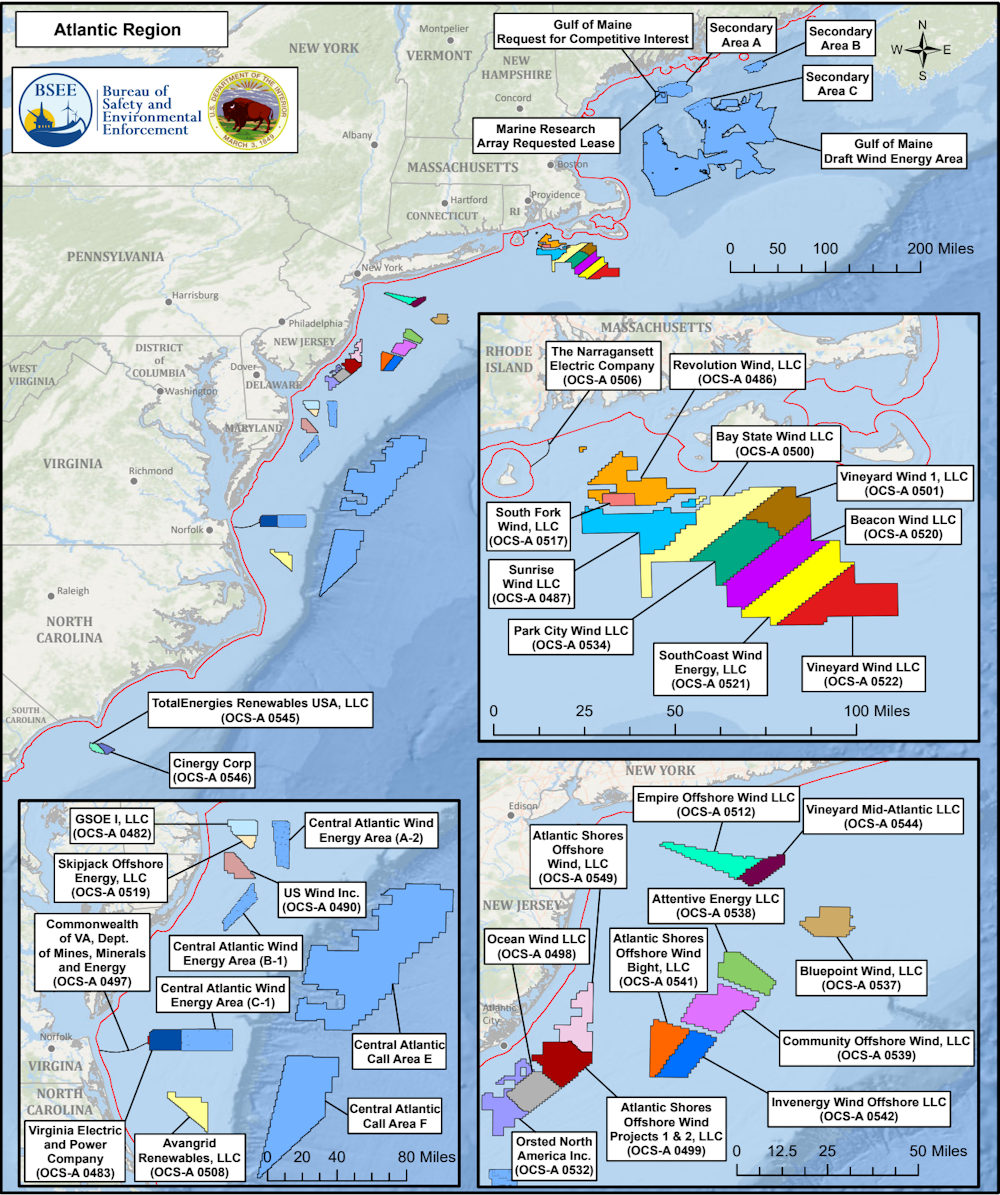
A map shows lease areas, from South Carolina to Massachusetts.
Several areas along the Atlantic continental shelf have been leased for wind power development.
U.S. Department of the Interior, 2024

Even better, electricity generated onshore could also be transmitted through these shared lines to move energy to where it is needed. This could improve the resilience of power grids and reduce the need for new transmission lines over land, which have been notoriously difficult to gain approval for, especially on the East Coast.

Coordinated offshore transmission was part of early U.S. discussions on offshore wind planning and development. In the late 2000s when Google and partners first proposed the Atlantic Wind Connection, an offshore transmission project, the benefits in both offshore renewables and the entire energy system were intriguing. At the time, the U.S. had just one utility-scale offshore wind project in the pipeline, and it ultimately failed.

Today, the U.S. has 53 GW of offshore wind projects being planned or developed. As energy researchers, we believe coordinated offshore transmission is important for the industry to succeed at scale.

Offshore grid could save money, reduce impacts

By enabling power from offshore wind farms and onshore electricity generators to travel to more places, coordinated transmission can enhance grid reliability and enable electricity to get to where it is most needed. This reduces the need for more expensive and often more polluting power plants.

A 2024 report from the National Renewable Energy Lab found the benefits of a coordinated design are nearly three times higher than the costs when compared with a standard point-to-point design.

Studies from Europe, the U.K. and Brattle have pointed to additional benefits, including reducing planet-warming carbon emissions, cutting the number of beach crossings by a third and reducing the miles of transmission cables needed by 35% to 60%.

Three maps show how a backbone design connects systems all along the coast and requires fewer wind farm-to-land connections.
Three transmission designs show the difference between intraregional systems with several land connections and interregional and backbone designs. These three were investigated by the National Renewable Energy Lab in the Atlantic Offshore Wind Transmission Study.
Illustrations by Billy Roberts, NREL

In the U.S., offshore transmission lines would be almost entirely in federal waters, potentially avoiding many of the conflicts associated with onshore projects, though it would still face challenges.

Challenges and next steps

Building an offshore grid will require some important changes.

First is changing government incentives. The federal investment tax credit for offshore wind, which covers at least 30% of the upfront capital cost of a project, does not currently help pay for coordinated transmission designs.

Second, planning needs to take everyone’s concerns into account from the beginning. While the overall benefits of coordinated transmission designs outweigh overall costs, who receives the benefits and who bears the costs matters. For example, more expensive power generators could earn less, and some communities feel threatened by offshore development.

Third, greater coordination will be needed among everyone involved to dispatch power to and from the regional grids. The Federal Energy Regulatory Commission’s recent Order 1920, requiring power providers to plan for future needs, may serve as a blueprint, but it does not apply to interregional projects, such as an offshore transmission backbone connecting over a dozen states across three regions.

A pier with cranes and huge wind turbine blades, seen from the water
Several New England states are seeing economic growth from the offshore wind industry. Here, blades are prepared for shipping at a pier in New London, Conn.
Elizabeth J. Wilson, CC BY-ND

The U.S. reached an important milestone in March 2024 with the completion of South Fork Wind, the country’s first utility-scale wind farm, bringing U.S. offshore wind power capacity to nearly 200 megawatts. Eight more projects are under construction or approved for construction. Once built, they would bring installed capacity to over 13 gigawatts, roughly the same as three dozen coal-fired power plants.

An offshore transmission backbone could support offshore wind development and the East Coast’s energy needs for generations to come.

This article was updated July 31, 2024, to clarify that the states formalized the memorandum of understanding.The Conversation

About the Authors:

Tyler Hansen, Research Associate in Environmental Studies, Dartmouth College; Abraham Silverman, Research Scholar, Ralph O’Connor Sustainable Energy Institute, Johns Hopkins University; Elizabeth J. Wilson, Professor of Environmental Studies, Dartmouth College, and Erin Baker, Professor of Industrial Engineering Applied to Energy Policy, UMass Amherst

This article is republished from The Conversation under a Creative Commons license. Read the original article.

Brent Crude Oil Faces Demand Concerns Despite Recent Gains

By RoboForex Analytical Department

After five consecutive days of upward movement, Brent crude oil is now experiencing a consolidation phase, with prices retreating slightly to 81.80 USD per barrel on Tuesday. Market sentiment is being influenced by renewed concerns over global oil demand, particularly following OPEC’s downward adjustment of its demand forecasts for 2024 and 2025. This adjustment reflects weaker-than-expected economic data from China and reduced regional demand projections.

OPEC now estimates global oil demand will grow by 2.11 million barrels per day (bpd) in 2024, down from its previous forecast of 2.25 million bpd. For 2025, the projection has been revised to 1.78 million bpd from 1.85 million bpd. These revisions are mainly due to the sluggish economic indicators emerging from China, a significant driver of global oil demand.

The ongoing conflict in the Middle East keeps market participants on edge. A new round of negotiations could be scheduled for Thursday, although there remains uncertainty about whether they will occur. Market players are particularly concerned about the potential for escalated conflicts involving Israel and Iran, which could disrupt oil supplies from the region and create further volatility in oil prices.

Technical analysis of Brent crude oil

The technical forecast on the Brent crude shows that the price is forming a consolidation range around 78.75 USD, with a recent upward breakout continuing the growth trend towards 81.97 USD. This level serves as a local target. Upon reaching this level, a correction back to 78.75 USD may occur, followed by a potential rise towards 82.40 USD. This bullish scenario is supported by the MACD indicator, which, despite being below zero, shows a clear upward trajectory.

On the H1 chart, Brent found support at 78.44 USD and is developing a growth structure towards 81.97 USD. Having already reached a local target at 81.90 USD, a corrective move to at least 80.17 USD could follow before resuming the upward trend. The stochastic oscillator, positioned near the 20 mark, indicates potential for upward movement, aligning with the broader bullish sentiment observed on the H4 chart.


Disclaimer

Any forecasts contained herein are based on the author’s particular opinion. This analysis may not be treated as trading advice. RoboForex bears no responsibility for trading results based on trading recommendations and reviews contained herein.

Brent Oil Price Analysis: Anticipating a Correction

By RoboForex Analytical Department

Brent crude oil’s price increased to 76.88 USD per barrel on Wednesday, continuing to rise for the second consecutive session. This rebound helps mitigate previous losses, which were part of a broader market risk aversion phase.

Current market dynamics

Investor concerns about energy supply disruptions are heightening due to political developments in Hamas and ongoing unrest affecting Libya’s Sharara oil field. These factors contribute to apprehensions about potential threats to oil supply from the Middle East.

Additionally, the latest data from the American Petroleum Institute (API) indicated a modest rise in US oil inventories, less than market forecasts, which had anticipated a more considerable increase. This was the first inventory build in five weeks, adding a layer of complexity to market dynamics.

Broader economic concerns, including fears of a US recession and weak Chinese demand, continue to exert downward pressure on oil prices.

Technical analysis of Brent

The H4 chart suggests that Brent is progressing towards the 78.12 USD level. After reaching this target, a pullback to 76.33 USD could occur, potentially setting the stage for another upward movement towards 79.85 USD and extending to 81.37 USD. The MACD indicator supports this bullish scenario, with the signal line positioned for upward momentum from current lows.

On the H1 chart, Brent has established a consolidation range of around 76.33 USD. An upward breakout towards 78.12 USD is anticipated. Once this target is achieved, a retracement to 76.33 USD might follow. The Stochastic oscillator is poised near the 80 level, suggesting an impending downturn, which aligns with the expected corrective phase following the initial rise.


Market outlook

Investors should monitor further geopolitical developments and additional inventory reports, which could significantly influence oil price movements. The upcoming Federal Reserve communications and economic indicators will also be crucial in shaping market sentiment, especially concerning the potential for economic slowdowns, which could impact oil demand.

Disclaimer

Any forecasts contained herein are based on the author’s particular opinion. This analysis may not be treated as trading advice. RoboForex bears no responsibility for trading results based on trading recommendations and reviews contained herein.

Brent Oil Prices Decline Amid Inventory Reductions and Middle East Optimism

By RoboForex Analytical Department

Brent crude oil prices have continued their downward trajectory, reaching 81.14 USD per barrel as of Wednesday. This marks the fifth consecutive session of decline, primarily influenced by significant reductions in US oil inventories. The latest data from the API indicates a decrease of 3.9 million barrels, surpassing the forecasted reduction of 2.5 million barrels and marking the fourth consecutive week without a correction.

Concurrently, developments in the Middle East are also impacting oil prices. There is emerging optimism regarding ceasefire negotiations between Israel and Hamas, which has helped alleviate some geopolitical pressures on oil prices. Additionally, concerns about potential disruptions in oil supplies due to forest fires in Canada influence market dynamics, albeit helping to stabilise prices momentarily.

The strength of the US dollar continues to make commodities less attractive, as a stronger dollar typically reduces the purchasing power of other currencies in the commodities market.

Technical analysis of Brent

Brent oil is forming a consolidation range around the 80.80 USD level with an extension down to 79.76 USD. A further decline to 79.33 USD may occur. If the price exits this range on the upside, we might see the initiation of a growth wave targeting 84.24 USD. The MACD indicator supports this scenario, showing potential for new growth as it prepares at the lows.

The market has established a consolidation range around the 81.84 USD level. The target level of 79.76 USD has been reached with a downward exit. We anticipate a new consolidation range forming at these lows, potentially followed by another decline to 79.33 USD. If the price exits the range upward, a rebound to 81.44 USD could occur. The Stochastic oscillator, currently below the 50 level and heading towards 20, supports this potential downward movement.


Investors and market analysts must closely monitor these developments, as any significant changes in US monetary policy or geopolitical events could further influence oil prices.


Disclaimer

Any forecasts contained herein are based on the author’s particular opinion. This analysis may not be treated as trading advice. RoboForex bears no responsibility for trading results based on trading recommendations and reviews contained herein.

Brent Oil Price Trends Upward Amid Positive Market Signals

By RoboForex Analytical Department

Brent crude oil has reached $85.40, marking a continued increase over two consecutive sessions. This upward trend is primarily supported by recent US energy inventory statistics, which showed a significant decrease of 4.87 million barrels against an anticipated decline of 0.8 million barrels. This marks the longest stretch of inventory reductions since last September, underscoring a robust demand for oil.

Fueling the market optimism further, recent comments from Federal Reserve representatives suggest an imminent rate cut, with a 98% market expectation for this to occur in September. Lower interest rates typically stimulate economic activity, thereby boosting demand for oil.

Geopolitical tensions also play a role in the current price dynamics. Reports of renewed attacks by Hussite forces on vessels in the Red Sea have raised concerns about potential disruptions in oil supplies, prompting the market to add a risk premium to oil prices.

Brent technical analysis

Brent crude oil has shown a growth wave reaching 84.42. A consolidation range has been established around this level. If the market breaks above this range, we anticipate a move towards 86.10, which is the immediate target. After reaching this target, a retest of 84.42 could occur, potentially setting the stage for further growth towards 87.70 and possibly extending to 90.00. The MACD indicator supports this bullish outlook, indicating an upward trajectory from below the zero mark.

The market has found support at 84.42 and is progressing through a growth phase with an expected target at 86.10. We anticipate this target will be reached shortly, followed by a correction phase returning to 84.42. This view is supported by the Stochastic oscillator, which is nearing the 80 level, suggesting a potential pullback after the target is met.

Investors and traders should closely monitor these levels and the broader market context, including geopolitical developments and further signals from the Federal Reserve, as these factors will likely influence Brent’s price movements in the near term.


Disclaimer

Any forecasts contained herein are based on the author’s particular opinion. This analysis may not be treated as trading advice. RoboForex bears no responsibility for trading results based on trading recommendations and reviews contained herein.

Is the Carbon Credit Market Dead?

Source: Streetwise Reports (7/12/24) 

We explain carbon credits, cover some of the system’s inherent problems, discuss future market growth and highlight some carbon credit streaming companies working hard to operate transparently.

Last year, scrutiny of the carbon credits/offsets market rose with media exposés on unethical carbon projects and system abuses. Despite issues with the system and harsh criticisms, the market is reportedly gaining traction.

Forecasts call for rapid growth over the next decade due to efforts by countries around the world to reach a net zero carbon status in the foreseeable future.

A Quick Primer

Carbon credits were introduced in 1997 as a way to lower carbon dioxide (CO2) emissions. Today, their purpose goes further, to help speed up decarbonization by offsetting global emissions.

“We are in a climate emergency, and we need every tool in the box to meet the 1.5 degrees C [global warming] target,” said Annette Nazareth, council chair of the Integrity Council for the Voluntary Carbon Market. “High-integrity carbon credits can mobilize private finance at scale for projects to reduce and remove billions of tons of emissions that would not otherwise be viable.”

Carbon credits allow a company or entity to emit CO2 or other greenhouse gases, specifically one ton of either per credit, according to Investopedia. Though these credits are akin to rations, companies earn them by avoiding, reducing, or removing carbon through a project verified by an independent third party.

As explained by Carbon Direct, “Carbon avoidance is an action that prevents a carbon-emitting activity from happening. Carbon reduction is an action that decreases the amount of greenhouse gas emissions compared to prior practices. Carbon removal is the process of removing carbon dioxide from the atmosphere and locking it away for decades, centuries, or millennia.”

After a project is verified, the company behind it receives the credits. Companies may either use, trade, or sell their credits.

Carbon Cowboys

While the concept is lofty, the carbon credit system has inherent problems. This has dampened companies’ confidence in it, which is reflected in the decrease in traded carbon credits in 2023, reported the Center for Strategic and International Studies.

The world learned about one major abuse in 2006, when Gustav Daphne and three coconspirators were arrested for stealing €5−10 billion (€5−10B) from the European Union’s carbon emissions trading system, meant to facilitate transactions between member countries, according to an article by The Guardian. The scammers achieved “the fraud of the century,” the media called it, in just months, by exploiting a loophole in the market’s policy.

According to MIT News, “Several experts at the Massachusetts Institute of Technology (MIT) now say that the system could be effective.”

The case of the Kariba REDD+ project in Zimbabwe illustrates two additional issues with carbon credit systems: a lack of transparency and accountability in where revenues from carbon-offsetting projects go and a lack of checks and balances in the verification process.

The Kariba project promised to conserve vast forest areas to sequester carbon and pass on benefits to the community by, for instance, investing in infrastructure and job creation. Reportedly, an independent third party verified the project, and it generated more than €100 million (€100M) from sales of carbon credits to Western companies. Yet only €14M of the proceeds went to the local villages, The Guardian reported. The other €86M went to the project broker/lead and local coordinator for costs and profits.

This very scheme has happened enough around the world, primarily in developing countries, that there is a name for groups involved in nature-based carbon markets just to make money from trading carbon: “carbon cowboys.” Like with Kariba, questions linger about the integrity and value of many projects.

Critics argue that forest carbon schemes often benefit international traders over local communities. More broadly, opponents of carbon credits/offsets claim they do not work and, sometimes, the associated projects harm the planet.

“Scientific studies and investigative have found that a growing number of projects failed to deliver the emission reductions promised,” reported Climate Home News on May 29. “Nongovernmental organizations have also denounced instances of human rights abuse and environmental damage caused by carbon-offsetting activities.”

Notable Growth Projected

Despite the controversy, the carbon credit/offset market is forecasted to skyrocket between 2023 and 2028 at a compound annual growth rate (CAGR) of 31%, according to Market and Markets, even with the expectation that transparency and traceability will hamper its growth. By 2028, the market is projected to reach US$414.8B in value, more than 250 times the US$1.6B it was in 2023. The primary growth driver will continue to be the massive global effort to reach net zero carbon targets.

CarbonCredits.com highlighted Carbon Streaming Corp. as one of its Top 4 Carbon Stocks To Watch in 2024. The company, the first of its kind in the carbon credit market.

“Rising environmental concerns and government support are expected to offer lucrative opportunities for the market players in the next five years,” the report said.

Demand for voluntary carbon markets (VCMs), marketplaces in which entities may buy, sell, or trade carbon credits, is growing. Thus, the voluntary carbon credit market is projected to expand at a 27% CAGR between 2024 and 2032, according to Global Market Insights. During this period, the market value is forecasted to reach US$21.7B, up from US$2.4B.

In the U.S. in May, the Departments of Treasury, Agriculture, and Energy and White House representatives published a joint policy statement that laid out seven principles for responsibly participating in VCMs and ensuring they are effective, fair, and equitable, noted a White House fact sheet.

Carbon Streaming Isn’t Over

While bad actors may have previously polluted the carbon credit market, there are companies striving to operate transparently, and some experts consider the system worth looking into.

According to MIT News, “Several experts at the Massachusetts Institute of Technology (MIT) now say that the system could be effective, at least in certain circumstances, but it must be thoroughly evaluated and regulated.”

Base Carbon

One company, Base Carbon (BCBN:NEO; BCBNF:OTCMKTS), is working to set standards for transparency in the sale of carbon credits. Base Carbon is a carbon credit company focusing on carbon capital allocation, project origination, and data transparency tools. According to the company, its primary objective is to allocate “capital directly into carbon reduction projects and carbon development companies.”

According to Base Carbon, “Pledges to lower carbon emissions now cover 92% of GDP and 88% of emissions worldwide. However, emission reduction, capture, and sequestration technologies are not yet scaled to meet these targets, creating a growing demand for quality carbon credits.”

Base Carbon aims to aid in this divide by connecting project developers who need financing and credit buying who may be searching for reputable carbon credits for their individual climate pledges.

Source: Base Carbon

In terms of renewing credibility in the carbon market, CEO Michael Costa stated, “Our mission is to simplify the carbon credit economy, and we are working to become the trusted financier within the voluntary carbon markets.”

One of the ways it does this is through data transparency tools. The company’s data standardization frameworks help capture and organize information from initial carbon emission sources. This process transforms raw data into valuable, usable components within the carbon credit ecosystem. By ensuring the accuracy and consistency of project-generated data, the company hopes to build a solid foundation of trust for our investment decisions and collaborative efforts.

You can see Base Carbon’s list of projects in the image below.

While past “bad apples” in the carbon credit space may have put a bad taste in investors’ mouths, Base Carbon is not slowing down anytime soon. As an article from Green Investing notes, “There’s a never-ending list of potential factors that turn people away from the space. This can either be seen as a contrarian opportunity or a reason to look elsewhere. Regardless, Base Carbon is going to continue advancing in the industry.”

The article solidified this opinion by sharing Base Carbon’s upcoming catalysts, which include:

  • The company will likely become profitable this year (2024).
  • Base Carbon has 8.1 million credits to be issued from its cookstove and household devices projects, which Green Investing believes could result in US$50 million in revenue.
  • Announcements about deals to sell carbon credits or get government approval for these sales.
  • New developments from current partnerships and more potential projects in the works.
  • More information about the company’s joint investment plan with STX Group to be released.

    Streetwise Ownership Overview*

    Base Carbon (BCBN:NEO;BCBNF:OTCMKTS)

Retail: 65.54%
Strategic Investors: 16.79%
Management & Insiders: 10.57%
Institutions: 7.1%
65.5%
16.8%
10.6%
7.1%
  • *Share Structure as of 7/11/2024

Graham Mattison of Water Tower Research also sees promise in Base Carbon, as shown in a May 1 research note. Mattison wrote he saw “continued execution across all projects,” a growing cash flow, and “multiple potential catalysts ahead” for Base Carbon.

He wrote, “The current market cap of Base Carbon is ~US$40 million; the Vietnam project alone will deliver cash of ~US$29.1 million in the next 12 months.”

According to Reuters, 10.57% of the company is with management and insiders.

16.79% is with strategic investor Abaxx Technologies Inc.

7.10% is with institutions.

The rest is with retail.

According to the company, Base Carbon has a market cap of US$46.8 million, US$0 in debt, US$667,391 in cash, and 117.1 million shares outstanding as of May 16, 2024.

Market Watch notes that the company trades in the 52-week range between US$0.2025 and US$0.4520.

Carbon Streaming Corp.

Base Carbon is not alone in its mission to make carbon credits more attractive to the market. Carbon Streaming Corp. (NEO-NETZ; OTC-OFSTF) is also working on changing this perspective as part of a corporate turnaround following a drop in its stock price to CA$0.50 per share from CA$15.

The largest investor in the company, Marin Katusa of Katusa Research, is spearheading the changes. He willingly became a technical and financial adviser to the board at no cost, he said, to benefit all shareholders.

Certain changes at the management and board level were required to make the company a success for shareholders, which in turn will enable more investments to help improve the environment, in my eyes,” he told Streetwise Reports. “I trust the individuals I’ve asked to be on the board fully, and I believe we [the shareholders] are in good hands moving forward.” The new interim chair is Olivier Garret, and the interim chief executive officer is CEO Christian Milau.

Katusa also provided Carbon Streaming’s five-part plan for moving forward:

  1. Go through the existing deals and see what we are dealing with. I don’t have an answer for anyone at this point, but I will within 120 days. I will be involved in the technical review of the projects with the new board.
  2. Immediately meet with all existing employees and figure out who we want to keep and who needs to move on and pursue a new venture. Getting rid of the ridiculous compensation that was taken by certain prior management members has now stopped, and further cuts to G&A will be put into place.
  3. In addition to 1&2 above, we have initiated a search both internally and externally for a new permanent CEO. There are two individuals currently employed at NETZ who did catch my eye as the potential to rise to the occasion, and every person at the firm will be given every opportunity to see if the CEO role is the right one. The culture of the company has already changed immediately after replacing the former CEO, and this is a chance for anyone in the firm to rise from the ashes or move on. Christian and the rest of the new NETZ board have the same “business culture” as my own, as does Alice Schroeder, and that will be paramount moving forward.
  4. Moving forward, when it comes to Voluntary Carbon Markets — I’ll be encouraging Carbon Streaming will adopt my rule from 2022, only invest in the VCM market if there is an offtake in place for the credits. No offtake, no investment in the voluntary market.
  5. We will look at all projects, assets, etc., to return shareholder value.

Unlike the company’s previous practice, Katusa said the board members now will only receive the standard options, no cash, no deferred or restricted stock units, nor any other form of compensation “third-party consultants justify.”

About the new culture Katusa is working to achieve, he commented, “This is a win for the shareholder rights. I am proud of this result. It wasn’t easy, but we got what we needed to give this company a chance to succeed. We live to see another day, and I’m expecting big things.”


Streetwise Ownership Overview*

Carbon Streaming Corp. (NEO-NETZ; OTC-OFSTF)

Retail: 93.52%
Management & Insiders: 6.46%
Institutions: 0.02%
93.5%
6.5%
*Share Structure as of 6/7/2024


On July 3, 2024, the company also announced it had closed its acquisition with Blue Dot Carbon Corp. Blue Dot is a private company with an equity investment in a carbon project developer and certain option rights to invest in future removals (reforestation) projects of its partners.

CarbonCredits.com highlighted Carbon Streaming Corp. as one of its Top 4 Carbon Stocks To Watch in 2024. The company, the first of its kind in the carbon credit market, “expects moderate and then rapid growth of credits in the coming years, peaking near 20 million (20M) credits per year by 2027,” the article indicated. “Its unique business model could help it outperform the competition.”

On June 7, Jack Gilleland of the American Association of Individual Investors gave Carbon Streaming Corp. a Value Score of 62, which, according to the article, he considers good.

According to Reuters, management and insiders hold 6.5% or 3.12M shares of Carbon Streaming. In this category, Ross Beaty owns 2.9%, or 1.39M shares.

The company has one institutional investor, Black Diamond Asset Management Inc., which holds 0.02%, or 0.01M shares.

The rest of the company, 93.48%, is with retail.

Carbon Streaming has 47.97M shares outstanding and 44.85M free float traded shares.

Its market cap is CA$31.51M. Its stock price range over the past 52 weeks was CA$0.46−$1.47 per share.

Pioneer Key Carbon Ltd., A Private Co.

Most of the large carbon credit companies are private. These include Carbon by Indigo, Nori, TrueCarbon by TrueTerra, Bayer Carbon Program, and Nutrien Ag.

Another carbon credit streamer striving to be transparent is Key Carbon. Headquartered in Vancouver, British Columbia, this private company finances and supports developers of carbon projects around the world and is building a diversified portfolio of carbon credit streams and royalties. Corporations and other entities may purchase Key Carbon’s voluntary carbon credits to help them achieve their climate and sustainability goals.

“We will be a large environmental services company,” Luke Leslie, co-founder and chief executive officer of Key Carbon Ltd., told Streetwise Reports. “We want to do that to service these projects in a way others can’t, with cutting-edge monitoring systems to provide the data to better understand the impact.”

How it works is Key Carbon selectively chooses a carbon project after rigorously vetting its developer. The company pays the developer upfront in return for a portion of future carbon credits, as defined in an exclusive financing agreement created by Key Carbon. It receives the credits once an independent third party, such as Verra, verifies the project. Then Key Carbon sells the credits to corporations or groups that need them to offset their carbon emissions. Key Carbon also continues to support the developer with strategy and operational improvements.

Current partners of Key Carbon include BURN, Africa’s leading clean cooking company, and Worldview International Foundation, a nonprofit organization that has pioneered 680 sustainable development projects in 26 countries.

BURN is a small project with a big impact, in which Key Carbon has invested US$36M. Through BURN, they provide fuel-efficient cookstoves to families cooking on open fires, a practice that has caused 4M premature deaths, noted Leslie. Cookstoves use less fuel, are safer, and free up users’ time.

Key Carbon’s work with Worldview is an example of a higher-value project that Key Carbon has helped fund. This project consists of reforestation of native trees, specifically mangroves.

With Key Carbon’s portfolio, an estimated 41.2 million tons of carbon will be removed or avoided, according to the company’s website.

The types of projects Key Carbon could partner on are numerous, Leslie said, given that “the carbon markets have 200 ways to generate carbon credit.”

As for catalysts, Key Carbon will close a US$15M financing this month, moving it closer to its goal of raising US$100M by year-end, Leslie said. The company is continuing to build out direct sales channels and acquire biodiversity businesses. Also, of course, additional partnerships and project deals could also move the stock.

Carbon Industry Surviving

While so-called “carbon cowboys” may have sullied the name of carbon credits, these three companies, Base Carbon, Carbon Streaming, and Key Carbon, and growth forecasts might be showing that the carbon credits industry is surviving the negative aspects is very much alive, and is expanding.

These companies are working to ensure transparency and efficiency within the companies and to create a sustainable army in the fight against the climate crisis.


Important Disclosures:

  1. As of the date of this article, officers and/or employees of Streetwise Reports LLC (including members of their household) own securities of Key Carbon Ltd.
  2.  Doresa Banning and Katherine DeGilio wrote this article for Streetwise Reports LLC and provide services to Streetwise Reports as an independent contractor/employee.
  3.  This article does not constitute investment advice and is not a solicitation for any investment. Streetwise Reports does not render general or specific investment advice and the information on Streetwise Reports should not be considered a recommendation to buy or sell any security. Each reader is encouraged to consult with his or her personal financial adviser and perform their own comprehensive investment research. By opening this page, each reader accepts and agrees to Streetwise Reports’ terms of use and full legal disclaimer. Streetwise Reports does not endorse or recommend the business, products, services or securities of any company.

For additional disclosures, please click here.