Archive for Economics & Fundamentals – Page 41

Market round-up: Big tech mixed, Fed holds, ECB next

By ForexTime 

  • Magnificent 3 post mixed earnings; DeepSeek elephant in room
  • Fed in no rush to act, rate cut not expected until June.
  • ECB seen slashing rates by 25bp in January

Big tech earnings season has kicked off with mixed results from Microsoft, Meta and Tesla.

1) Microsoft shares fell over 6% pre-market despite reporting strong quarterly earnings.

Its cloud business missed revenue estimates, disappointing investors – especially after recent events surrounding DeepSeek.

Still, Microsoft CEO assured investors that DeepSeek was good for business – triggering a rebound that recouped all pre-market losses.

2) Meta also published a mixed bag of results, sending its shares whipsawing pre-market.

The tech giant posted quarterly results that beat expectations, but first-quarter revenue projections were slightly weak. However, positive comments by CEO Mark Zuckerberg pushed meta stocks higher.

3) Tesla’s revenue and profit not only missed expectations, but the EV titan also softened projections for 2025 vehicle sales growth.

Despite slipping as much as 6% pre-market prices later rebounded rising over 5%.

Note: Apple reports its fiscal first-quarter earnings on Thursday 30th after US markets close.

DeepSeek remains the elephant in the room and will likely to dominate big tech earnings. If investors remain fearful over DeepSeek threatening US exceptionalism in AI, this could drag tech stocks lower.


Fed in no rush to cut rates

The Federal Reserve left interest rates unchanged as widely expected on Wednesday.

But the biggest takeaway was that officials were not in a rush to cut rates thanks to a strong economy and more time needed to monitor inflation.

Indeed, inflationary pressures could make a return due to possible tariffs and immigration policies implemented by Trump.

Traders are currently pricing in a 53% probability of a 25 bp Fed cut by May with a move fully priced in by June.

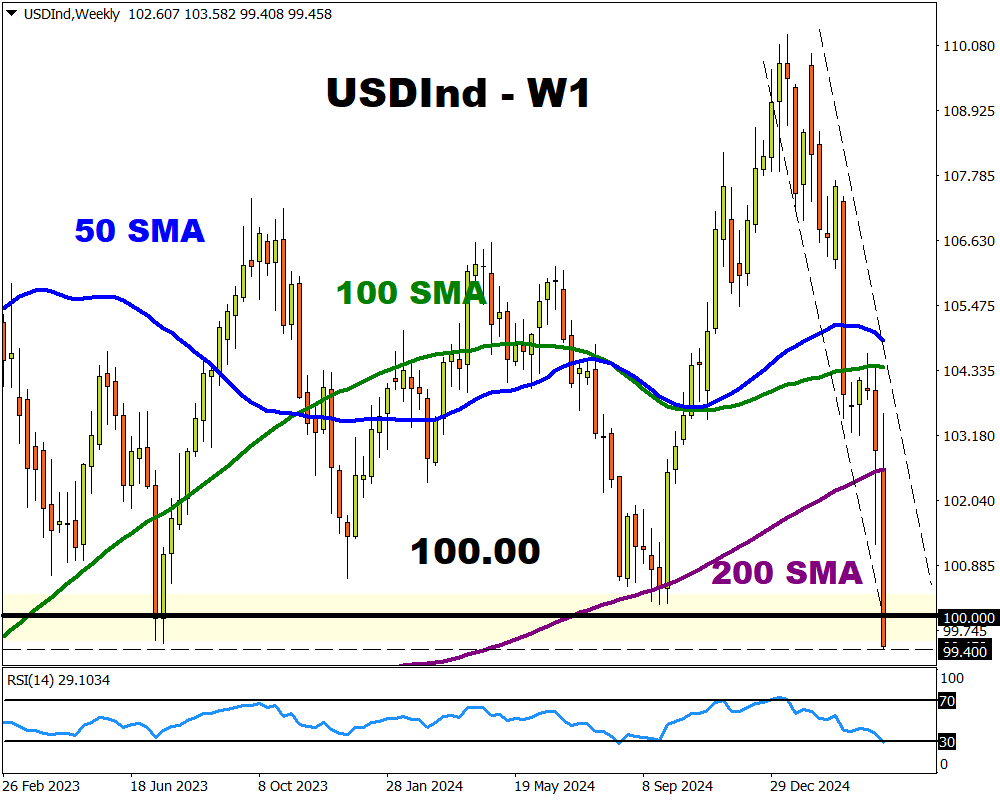
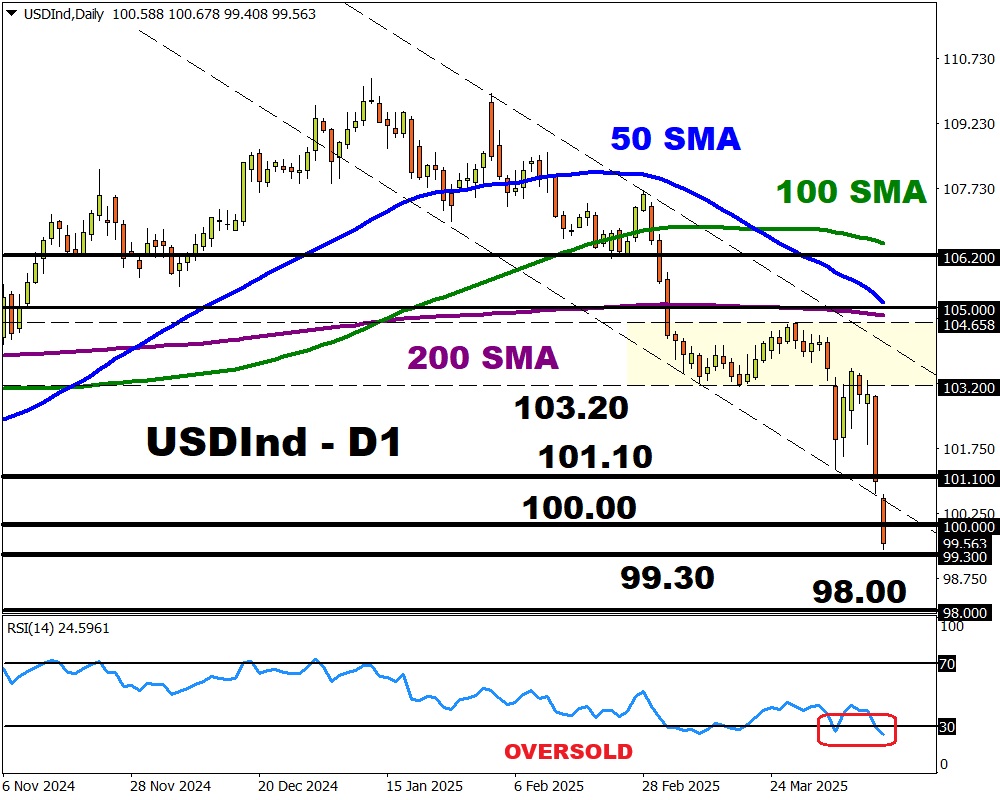
FXTM’s USDInd offered a muted reaction to the Fed meeting, with prices trading around 108.00 as of writing.

The outlook for the dollar may be shaped by what actions Trump take on February 1st when 25% tariffs on Canada, and Mexico and 10% tariffs on China. Trump has also threatened to hit the European Union with tariffs, but no date has been confirmed.


ECB expected to cut rates by 25bp

The ECB is expected to cut interest rates by 25 basis points when it meets this afternoon.

Should the central bank signal faster and deeper rate cuts in 2025 due to Trump’s potential tariffs, this could weaken the euro further.

Looking at the charts, the EURUSD is trading below the 50-day SMA as of writing.

Over the past year, the ECB meeting has triggered upside moves of as much as 0.2% or declines of 0.15% in a 6-hour window post-release.

  • Sustained weakness below this point could open a path toward the 21-day SMA at 1.0350 and 1.0276 – the lower bound of Bloomberg’s FX model.
  • A move back above 1.0434 could see an incline back toward 1.0500.

eurusd 2


Forex-Time-LogoArticle by ForexTime

ForexTime Ltd (FXTM) is an award winning international online forex broker regulated by CySEC 185/12 www.forextime.com

Australian dollar falls amid soft inflation data. Natural gas prices fell to a 3-week low

By JustMarkets

The Dow Jones Index (US30) was up 0.31% on Tuesday. The S&P 500 Index (US500) added 0.92%. The Nasdaq Technology Index (US100) jumped 1.59%. The US stocks rose by 1.5%, led by the Nasdaq Index, as technology stocks recovered from Monday’s selloff. Nvidia rose by 8.8%, recovering some of the historic 17% loss in a single session that wiped out a market value of $593 billion. Broadcom and Oracle added 2.6% and 3.6%, respectively, amid general strength in the technology sector. Meanwhile, Royal Caribbean soared 11.9% on optimistic earnings estimates and General Motors fell 8.9% due to earnings concerns and potential US tariffs on imports of microchips, pharmaceuticals and steel.

The FOMC will meet today for its monetary policy meeting. Markets expect the FOMC to keep the target range for the federal funds rate unchanged at 4.25-4.50% when the 2-day FOMC meeting concludes on Wednesday. However, markets will gauge the Fed’s views on growth and inflation in Fed Chair Powell’s comments after the meeting.

Equity markets in Europe traded flat yesterday. The German DAX (DE40) rose by 0.70%, the French CAC 40 (FR40) closed down 0.12%, the Spanish IBEX 35 (ES35) added 1.31%, and the British FTSE 100 (UK100) closed positive 0.35%. The DAX hit a new record high on Tuesday, following yesterday’s losses due to concerns over the high valuations of some companies and the prospects for the growth of artificial intelligence.

WTI crude oil prices are hovering around $73 a barrel, remaining near a two-week low, as traders’ attention turned to President Donald Trump’s wide-ranging set of tariffs. Trump has said he will soon impose tariffs on foreign-made goods such as steel, aluminum and copper, raising concerns about the potential impact on global demand for commodities. In addition, Treasury Secretary Scott Bessent reportedly supports the gradual imposition of universal tariffs on US imports, starting at 2.5%.

The US natural gas (XNG/USD) prices fell below $3.6/MMBtu, nearly to a three-week low, due to warmer-than-expected weather projections for early February. However, analysts still expect 317 Bcf of gas to be withdrawn in the week ended January 24, which could eliminate a gas inventory glut for the first time since early 2022 and boost gas prices. Meanwhile, LNG exports are rising, helped by the restart of Texas-based Freeport LNG.

Asian markets were mostly down yesterday. Japan’s Nikkei 225 (JP225) fell by 1.39%, China’s FTSE China A50 (CHA50) and Hong Kong’s Hang Seng (HK50) were not trading due to holidays, and Australia’s ASX 200 (AU200) was negative 0.12%.

The Australian dollar fell below USD 0.625 on Wednesday, posting a third straight session of losses as weaker-than-expected domestic inflation data fueled expectations of an interest rate cut by the Reserve Bank of Australia (RBA) in February. The data showed Australia’s annual inflation rate slowed to 2.4% in Q4, down from 2.8% in Q3 and below the prognosis of 2.5%. The quarterly figure was also below expectations at 0.2%. Markets are now pricing in an 80% chance that the RBA will cut its monetary rate by 25 basis points to 4.35% at its February 18 meeting. The Australian dollar also faced downward pressure due to escalating tariff threats from US President Donald Trump and ongoing economic problems in China, Australia’s main trading partner.

S&P 500 (US500) 6,067.70 +55.42 (+0.92%)

Dow Jones (US30) 44,850.35 +136.77 (+0.31%)

DAX (DE40) 21,430.58 +148.40 (+0.70%)

FTSE 100 (UK100) 8,533.87 +30.16 (+0.35%)

USD Index 107.91 +0.57 (+0.53%)

News feed for: 2025.01.29

  • Japan Monetary Policy Meeting Minutes at 01:50 (GMT+2);
  • Australia Consumer Price Index (m/m) at 02:30 (GMT+2);
  • Japan Consumer Confidence (m/m) at 07:00 (GMT+2);
  • German GfK German Consumer Climate (m/m) at 09:00 (GMT+2);
  • Sweden Riksbank Interest Rate Decision at 10:30 (GMT+2);
  • UK BOE Gov Bailey Speaks at 16:15 (GMT+2);
  • Canada BoC Interest Rate Decision at 16:45 (GMT+2);
  • Canada BoC Monetary Policy Report at 16:45 (GMT+2);
  • Canada BoC Press Conference at 17:30 (GMT+2);
  • US Crude Oil Reserves (w/w) at 16:30 (GMT+2);
  • US Fed Interest Rate Decision at 21:00 (GMT+2);
  • US FOMC Statement at 21:00 (GMT+2);
  • US Fed Press Conference at 21:30 (GMT+2).

By JustMarkets


This article reflects a personal opinion and should not be interpreted as an investment advice, and/or offer, and/or a persistent request for carrying out financial transactions, and/or a guarantee, and/or a forecast of future events.

DeepSeek sends NVDA into a knockdown. Falling oil prices have a negative impact on commodity currencies

By JustMarkets

At Monday’s close, the Dow Jones Index (US30) was up 0.65%. The S&P 500 Index (US500) decreased by 1.46%. The Nasdaq Technology Index (US100) fell by 2.97%. The fall in technology stocks on Monday impacted the overall market. Shares of chipmakers and artificial intelligence-related companies fell on Monday as Chinese artificial intelligence startup DeepSeek appears to be delivering performance comparable to Western chatbots for less price. DeepSeek’s latest, released last week, is widely considered competing with OpenAI and Meta Platforms and is now ranked number one on the Apple App Store.

Shares of artificial intelligence company Nvidia (NVDA) fell nearly 17% on Monday, wiping out $589 billion in market value and weighing down the Nasdaq Composite Tech Index as a new model from Chinese startup DeepSeek cast doubt on recent investments in AI infrastructure. Much of the current rise has been on the expectation that US companies have an exclusive advantage in AI, and they can dominate the field and make a lot of money accordingly. However, a Chinese startup is shattering this myth by proving that neural networks can be affordable and accessible. This could significantly hit US stock indices, which many experts believe are inflated due to the AI bubble.

Falling prices for crude oil, which plays a key role in Canada’s economy, are adding pressure on the Canadian dollar as market participants fear the broader implications of tariffs imposed on Canada, Mexico and China, which could reduce global energy demand and growth. These risks, combined with the growing interest rate differential between the US and Canada, put additional pressure on the loonie, making it difficult for it to recover in the near term, especially amid expectations of a possible rate cut by the Bank of Canada.

Equity markets in Europe traded yesterday without a single dynamics. German DAX (DE40) fell by 0.53%, French CAC 40 (FR40) closed down by 0.27%, Spanish IBEX 35 (ES35) gained 0.12%, British FTSE 100 (UK100) closed up 0.02%.

On Monday, WTI crude futures fell more than 2% to $73 per barrel, setting a one-month low. Earlier in the session, weak economic data from China, indicating a decline in factory activity, heightened fears of weaker demand from the world’s largest oil importer. These concerns were heightened by the prospect of US tariffs that could exacerbate economic growth and energy demand problems. Despite these concerns, Saudi Arabia has signaled its intention to raise oil prices for Asia, reflecting tightening global supplies due to OPEC+ production cuts and recent US sanctions against Russian oil exports.

Asian markets were predominantly up yesterday. Japan’s Nikkei 225 (JP225) was down 0.92%, China’s FTSE China A50 (CHA50) was up 0.07%, Hong Kong’s Hang Seng (HK50) increased by 0.66% and Australia’s ASX 200 (AU200) was positive 0.36%.

On Tuesday, the New Zealand dollar extended its fall to US$0.565, continuing its retreat from a five-week high as the US dollar recovered from President Donald Trump’s new tariff threats. On Monday, Trump announced plans to impose tariffs on imported microchips, pharmaceuticals, steel, aluminum, and copper to boost domestic production. Traders also remain on edge as the February 1 deadline for the first round of tariffs aimed at countries including China, New Zealand’s biggest trading partner, approaches.

The Australian dollar weakened to US$0.625 on Tuesday, declining for a second straight session as the US dollar gained ground after fresh tariff threats from US President Donald Trump. On the domestic front, data showed business confidence in Australia improved in December. Investors are now focused on upcoming inflation data, which could heighten expectations of a potential rate cut by the Reserve Bank of Australia in February.

S&P 500 (US500) 6,012.28 −88.96 (−1.46%)

Dow Jones (US30) 44,713.58 +289.33 (+0.65%)

DAX (DE40) 21,282.18 −112.75 (−0.53%)

FTSE 100 (UK100) 8,503.71 +1.36 (+0.02%)

USD Index 107.33 (−0.10%)

News feed for: 2025.01.28

  • Australia NAB Business Confidence at 02:30 (GMT+2);
  • US Durable Goods Orders (m/m) at 15:30 (GMT+2);
  • US CB Consumer Confidence (m/m) at 17:00 (GMT+2).

By JustMarkets


This article reflects a personal opinion and should not be interpreted as an investment advice, and/or offer, and/or a persistent request for carrying out financial transactions, and/or a guarantee, and/or a forecast of future events.

DeepSeek set to wipe out over US$ 1 trillion from tech stock valuations

By ForexTime

  • Nvidia flirts with bear market; nearly 20% drop from record high
  • China AI startup, DeepSeek, challenges US AI dominance
  • DeepSeek to dominate Apple, Microsoft, Tesla, Meta earnings this week
  • Stocks selloff adds to market concerns, including  Fed, Trump watch

DeepSeek – China’s rival to ChatGPT – is stoking fear across global financial markets.

  • Nvidia is down 11%, flirting with a bear market (falling almost 20% from its current record high)
  • FXTM’s NAS100 fell as much as 5% pre-market
  • European equities EU50 and NETH225 tumbled as ASML fell as much as 12%.
  • Even Bitcoin tumbled as low as $97720, mirroring the selloff in Western AI stocks.


What is going on?

The answer is DeepSeek – a Chinese artificial intelligence startup that is China’s answer to ChatGPT.


The bigger picture…

Chinese AI company DeepSeek has gatecrashed the AI party by releasing a new product.

But here is the thing, it is just a fraction of the production cost seen in the United States.

This has raised questions about whether the hundreds of billions of dollars invested were required to stay ahead of the AI race.


A deeper dive…

This development could not have come at a worse time for big tech companies scheduled to publish their latest earnings this week.

4 of the 7 magnificent tech stocks namely Tesla, Meta, Microsoft and Apple will be under the spotlight.

DeepSeek has shown the world that it could develop complex AI models that do not cost hundreds of billions of dollars.

So, this may place extra scrutiny on big tech earnings this week as investors focus all their attention on how much was invested in AI last quarter.

  • If the existing AI leaders can convince investors that they’ll be able to fend off DeepSeek, this could trigger a rebound in AI stocks/US stock indices.
  • However, if AI leaders are unable to soothe market fears about DeepSeek’s threat, this could spell more pain for AI stocks.


What next?

Any more positive developments around DeepSeek could fuel fears about US exceptionalism being eroded.

This may translate to more pain in the US tech space as jittery investors book profits.


Forex-Time-LogoArticle by ForexTime

ForexTime Ltd (FXTM) is an award winning international online forex broker regulated by CySEC 185/12 www.forextime.com

Oil continues to fall in price. The Australian dollar reached the maximum for 5 weeks

By JustMarkets

By the end of Thursday, the Dow Jones Index (US30) added more than 400 points and closed positive 0.92%. The S&P 500 Index (US500) gained 0.53% and hit a new record high, breaking the 6,100 mark. The Nasdaq Technology Index (US100) added 0.22%. Favorable corporate earnings results supported the overall market on Thursday. General Electric (GE) closed higher by more than 6% after reporting fourth-quarter adjusted earnings per share and announcing $7 billion in share repurchase plans. Moderna (MRNA) shares rose more than 10% and led the S&P 500 higher, adding to a 7% rally Wednesday after Oracle CEO Ellison spoke about the promise of artificial intelligence in early cancer diagnosis and the development of cancer vaccines. Netflix (NFLX) shares closed higher by more than 3% after Wolfe Research upgraded the stock to “outperform” from “perform” with a price target of $1,100. Electronic Arts (EA) fell more than 16% and topped the list of losers in the S&P 500 and Nasdaq 100 after the company reported preliminary third-quarter net revenues of $2.22 billion, weaker than consensus of $2.51 billion, and lowered its full-year net revenue guidance.

President Donald Trump reiterated in Davos his previous promises of tax cuts, tariffs on trading partners and increased energy production, and called on the Federal Reserve and other major central banks to cut interest rates. As for economic data, weekly US initial jobless claims rose 6,000 to a 6-week high of 223,000, indicating a weaker labor market than expected at 220,000.

The Mexican peso (USD/MXN) exchange rate rose to 20.4 per USD as the latest inflation data bolstered hawkish arguments from Bank of Mexico officials, dampening expectations of further monetary policy easing. While Mexico’s annual core inflation fell to 3.69% in mid-January, the lowest in four years, core inflation rebounded to 3.72%, beating estimates of 3.68%, signaling continued price pressures.

Equity markets in Europe were mostly up on Thursday. Germany’s DAX (DE40) rose by 0.74%, France’s CAC 40 (FR40) closed up 0.70%, Spain’s IBEX 35 (ES35) added 0.92%, and the UK’s FTSE 100 (UK100) closed positive 0.23%. In Europe, Puma shares fell about 20% after the German sportswear brand reported lower-than-expected fourth-quarter sales and lower annual profit, missing its 2024 earnings target.

The Bank of Norway decided to leave the discount rate at 4.5% on January 22, matching market expectations, but the head of Norges Bank said a rate cut is possible in March. Unemployment has risen slightly, but inflation is close to target. Although inflation is lower than expected, rising business costs may spur it again.

WTI crude oil fell to $74 a barrel on Thursday as President Donald Trump delivered a virtual speech at the Davos forum. In his speech, Trump announced plans to ask Saudi Arabia and OPEC to lower oil prices, emphasizing his administration’s energy priorities. Meanwhile, crude inventories fell by 1.02 million barrels, below market consensus that expected a 2.1 million barrel decline, and extended a 2 million barrel drop from the previous week.

Asian markets were predominantly up yesterday. Japan’s Nikkei 225 (JP225) added 0.79%, China’s FTSE China A50 (CHA50) rose by 0.64%, Hong Kong’s Hang Seng (HK50) gained 0.40%, and Australia’s ASX 200 (AU200) was negative 0.61%.

S&P Global’s Australian manufacturing PMI rose to 49.8 in January 2025 from 47.8 in December, according to flash data. This is the highest reading in 12 months, following 13 consecutive months of contraction. The index of business activity in the services sector fell to 50.4 in January 2025 from 50.8 in December 2024, according to flash data. That’s the lowest reading in six months, suggesting the sector’s growth is slowing. The Australian dollar climbed above $0.63 on Friday, hitting a five-week high after US President Donald Trump said after speaking with Chinese President Xi Jinping that he would prefer to strike a trade deal with China rather than impose tariffs. Given the close economic ties between Australia and China, it could have a significant impact on Australian markets. Trump also called on the US Federal Reserve to lower interest rates.

S&P 500 (US500) 6,118.71 +32.34 (+0.53%)

Dow Jones (US30) 44,565.07 +408.34 (+0.92%)

DAX (DE40) 21,411.53 +157.26 (+0.74%)

FTSE 100 (UK100) 8,565.20 +20.07 (+0.23%)

USD Index 108.13 -0.04 (-0.04%)

News feed for: 2025.01.24

  • Australia Manufacturing PMI (m/m) at 00:00 (GMT+2);
  • Australia Services PMI (m/m) at 00:00 (GMT+2);
  • Japan National Core Consumer Price Index at 01:30 (GMT+2);
  • Japan Manufacturing PMI (m/m) at 02:30 (GMT+2);
  • Japan Services PMI (m/m) at 02:30 (GMT+2);
  • Japan BOJ Policy Rate at 05:00 (GMT+2);
  • Japan Monetary Policy Statement at 05:00 (GMT+2);
  • Japan BOJ Outlook Report at 05:00 (GMT+2);
  • German Manufacturing PMI (m/m) at 10:30 (GMT+2);
  • German Services PMI (m/m) at 10:30 (GMT+2);
  • Eurozone Manufacturing PMI (m/m) at 11:00 (GMT+2);
  • Eurozone Services PMI (m/m) at 11:00 (GMT+2);
  • UK Manufacturing PMI (m/m) at 11:30 (GMT+2);
  • UK Services PMI (m/m) at 11:30 (GMT+2);
  • Eurozone ECB President Lagarde Speaks at 12:00 (GMT+2);
  • US Manufacturing PMI (m/m) at 16:45 (GMT+2);
  • US Services PMI (m/m) at 16:45 (GMT+2);
  • US Existing Home Sales (m/m) at 17:00 (GMT+2);
  • World Economic Forum Annual Meeting (Day 5).

By JustMarkets


This article reflects a personal opinion and should not be interpreted as an investment advice, and/or offer, and/or a persistent request for carrying out financial transactions, and/or a guarantee, and/or a forecast of future events.

I’m an economist. Here’s why I’m worried the California insurance crisis could trigger broader financial instability

By Gary W. Yohe, Wesleyan University 

The devastating wildfires in Los Angeles have made one threat very clear: Climate change is undermining the insurance systems American homeowners rely on to protect themselves from catastrophes. This breakdown is starting to become painfully clear as families and communities struggle to rebuild.

But another threat remains less recognized: This collapse could pose a threat to the stability of financial markets well beyond the scope of the fires.

It’s been widely accepted for more than a decade that humanity has three choices when it comes to responding to climate risks: adapt, abate or suffer. As an expert in economics and the environment, I know that some degree of suffering is inevitable — after all, humans have already raised the average global temperature by 1.6 degrees Celsius, or 2.9 degrees Fahrenheit. That’s why it’s so important to have functioning insurance markets.

While insurance companies are often cast as villains, when the system works well, insurers play an important role in improving social welfare. When an insurer sets premiums that accurately reflect and communicate risk — what economists call “actuarially fair insurance” — that helps people share risk efficiently, leaving every individual safer and society better off.

But the scale and intensity of the Southern California fires — linked in part to climate change, including record-high global temperatures in 2023 and again in 2024 — has brought a big problem into focus: In a world impacted by increasing climate risk, traditional insurance models no longer apply.

How climate change broke insurance

Historically, the insurance system has worked by relying on experts who study records of past events to estimate how likely it is that a covered event might happen. They then use this information to determine how much to charge a given policyholder. This is called “pricing the risk.”

Many California wildfire survivors face insurance struggles, as this CBS Evening News report shows.

When Americans try to borrow money to buy a home, they expect that mortgage lenders will make them purchase and maintain a certain level of homeowners insurance coverage, even if they chose to self-insure against unlikely additional losses. But thanks to climate change, risks are increasingly difficult to measure, and costs are increasingly catastrophic. It seems clear to me that a new paradigm is needed.

California provided the beginnings of such a paradigm with its Fair Access to Insurance program, known as FAIR. When it was created in 1968, its authors expected that it would provide insurance coverage for the few owners who were unable to get normal policies because they faced special risks from exposure to unusual weather and local climates.

But the program’s coverage is capped at US$500,000 per property – well below the losses that thousands of Los Angeles residents are experiencing right now. Total losses from the wildfires’ first week alone are estimated to exceed $250 billion.

How insurance could break the economy

This state of affairs isn’t just dangerous for homeowners and communities — it could create widespread financial instability. And it’s not just me making this point. For the past several years, central bankers at home and abroad have raised similar concerns. So let’s talk about the risks of large-scale financial contagion.

Anyone who remembers the Great Recession of 2007-2009 knows that seemingly localized problems can snowball.

In that event, the value of opaque bundles of real estate derivatives collapsed from artificial and unsustainable highs, leaving millions of mortgages around the U.S. “underwater.” These properties were no longer valued above owners’ mortgage liabilities, so their best choice was simply to walk away from the obligation to make their monthly payments.

Lenders were forced to foreclose, often at an enormous loss, and the collapse of real estate markets across the U.S. created a global recession that affected financial stability around the world.

Forewarned by that experience, the U.S. Federal Reserve Board wrote in 2020 that “features of climate change can also increase financial system vulnerabilities.” The central bank noted that uncertainty and disagreement about climate risks can lead to sudden declines in asset values, leaving people and businesses vulnerable.

At that time, the Fed had a specific climate-based example of a not-implausible contagion in mind – global risks from sudden large increases in global sea level rise over something like 20 years. A collapse of the West Antarctic Ice Sheet could create such an event, and coastlines around the world would not have enough time to adapt.

In a 2020 press conference, Federal Reserve Chair Jerome Powell discusses climate change and financial stability.

The Fed now has another scenario to consider – one that’s not hypothetical.

It recently put U.S. banks through “stress tests” to gauge their vulnerability to climate risks. In these exercises, the Fed asked member banks to respond to hypothetical but not-implausible climate-based contagion scenarios that would threaten the stability of the entire system.

We will now see if the plans borne of those stress tests can work in the face of enormous wildfires burning throughout an urban area that’s also a financial, cultural and entertainment center of the world.The Conversation

About the Author:

Gary W. Yohe, Huffington Foundation Professor of Economics and Environmental Studies, Wesleyan University

This article is republished from The Conversation under a Creative Commons license. Read the original article.


The threat of tariffs by the US against Mexico, Canada, and China is adding uncertainty to financial markets

By JustMarkets

At the end of Tuesday, the Dow Jones Index (US30) was up 1.24%. The S&P 500 Index (US500) added 0.88%. The Nasdaq Technology Index (US100) increased by 0.58%. Yesterday, on his first day in office, Trump took a number of steps to advance his agenda, but refrained from immediately imposing tariffs as many expected. However, he later revealed plans to impose a 25% levy on Mexico and Canada, while avoiding mentioning China. First and foremost, the move would put pressure on the peso by depriving Mexican manufacturing, especially the auto sector, of a major source of demand, which could force the Bank of Mexico to accelerate rate cuts. Second, these tariffs will significantly reduce demand for Canada’s largest exports, which will reduce dollar inflows. Further pressure comes from Trump’s emphasis on increasing domestic energy production in the US, which could reduce Canadian energy exports, forcing producers to lower selling prices.

Canada’s annualized inflation rate for December 2024 fell to 1.8% from 1.9% in the previous month, slightly below market expectations, which had expected it to remain at 1.9%, and marked the lowest rate of price increases since September. As a result, inflation remained at or below the Bank of Canada’s (BoC) 2% average target for the fifth consecutive month, reinforcing expectations for further rate cuts this year.

Equity markets in Europe were mostly up on Tuesday. Germany’s DAX (DE40) rose by 0.25%, France’s CAC 40 (FR40) closed up 0.48%, Spain’s IBEX 35 (ES35) fell by 0.14%, and the UK’s FTSE 100 (UK100) closed positive 0.33%. The ZEW Economic Sentiment Indicator for Germany fell to 10.3 in January 2025 from 15.7 in December and well below the projection of 15.3 as the German economy contracted for the second consecutive year in 2024 and inflationary pressures are rising. If these trends continue this year, Germany will fall further and further behind other eurozone countries. In addition, political uncertainty is increasing due to the potentially difficult coalition-building process in Germany and the unpredictability of economic policies implemented by the new Trump administration.

Silver (XAG/USD) rose to $31 an ounce on Wednesday, hitting its highest level in six weeks, as US President Donald Trump’s tariff threats fueled demand for safe-haven assets. Silver is also supported by expectations of further interest rate cuts by the Federal Reserve this year, which could weaken the dollar and boost demand for commodities.

Asian markets were predominantly rising yesterday. Japan’s Nikkei 225 (JP225) added 0.32%, China’s FTSE China A50 (CHA50) was down 0.10%, Hong Kong’s Hang Seng (HK50) was up 0.91% and Australia’s ASX 200 (AU200) was positive 0.66%. Chinese stocks opened lower on Wednesday after US President Donald Trump said his team is discussing imposing 10% tariffs on goods imported from China, which could take effect as early as February 1. Trump’s comments overshadowed more positive developments Friday, when he held a friendly phone conversation with Chinese President Xi Jinping. At the World Economic Forum, Chinese Vice Premier Ding Xuexiang emphasized that there are no winners in the trade war and called for greater international economic cooperation.

Hong Kong’s annualized inflation rate stood at 1.4% in December 2024, unchanged for the third consecutive month and the lowest since May. On a month-on-month basis, consumer prices rose by 0.1% in December after stalling in the previous month.

Malaysia’s annualized inflation rate for December 2024 was 1.7%, slightly below market consensus and November’s 1.8%. Core consumer prices, excluding volatile fresh food and administrative costs, were 1.6% y/y in December, the lowest since January 2022.

The New Zealand dollar fell to $0.565 on Wednesday as investors priced in the country’s latest inflation data. New Zealand’s annualized inflation rate for the fourth quarter of 2024 remained at 2%, slightly higher than expected but still within the Reserve Bank of New Zealand’s (RBNZ) target range of 1-3%. On a quarterly basis, the Consumer Price Index rose by 0.5%, down slightly from a 0.6% increase in the previous period. The data suggests that price pressures remain largely subdued, reinforcing expectations of a 50bp rate cut at the Central Bank’s February meeting.

S&P 500 (US500) 6,049.24 +52.58 (+0.88%)

Dow Jones (US30) 44,025.81 +537.98 (+1.24%)

DAX (DE40) 21,042.00 +51.69 (+0.25%)

FTSE 100 (UK100) 8,548.29 +27.75 (+0.33%)

USD Index 108.01 −1.34 (−1.23%)

News feed for: 2025.01.22

  • Canada Producer Price Index (m/m) at 15:30 (GMT+2);
  • Eurozone ECB President Lagarde Speech at 17:15 (GMT+2);
  • World Economic Forum Annual Meeting (Day 3).

By JustMarkets


This article reflects a personal opinion and should not be interpreted as an investment advice, and/or offer, and/or a persistent request for carrying out financial transactions, and/or a guarantee, and/or a forecast of future events.

Hong Kong index rises for the 6th consecutive session. Oil declines amid Trump’s statements to increase production

By JustMarkets

The US stock indices were not traded yesterday due to the Martin Luther King Jr. holiday. However, the US stock futures continued to rise on Monday. The rise followed a WSJ report that the president plans to direct federal agencies to review trade policy and assess US trade relations with China and neighboring countries. Contrary to earlier concerns, no new tariffs are expected to be imposed on his first day in office.

Bitcoin retreated towards the $100,000 mark on Tuesday after hitting a record high of $109,000 in the previous session as volatility persists following the inauguration of Donald Trump as the 47th president of the United States. Investors are expecting Trump to issue an executive order declaring digital assets a “national priority,” but it has yet to be issued. Trump is also expected to create a digital assets’ advisory board and increase deregulation to support the sector. Over the weekend, Trump unveiled his own digital token, which trades under the ticker “Trump” on the Solana blockchain. Melania Trump also joined the wave of digital assets by launching her own memecoin, further emphasizing the administration’s growing involvement in this space.

Equity markets in Europe were mostly up on Monday. Germany’s DAX (DE40) rose by 0.42%, France’s CAC 40 (FR 40) closed 0.31% higher, Spain’s IBEX 35 (ES35) Index gained 0.23%, and the UK’s FTSE 100 (UK100) closed 0.18% higher. On Monday, the FTSE 100 closed at 8521, a new record high. Traders were reassured by news that the incoming Trump administration will refrain from imposing trade tariffs for now.

WTI crude oil prices held below $76.9 a barrel on Monday as markets reacted to US President Donald Trump’s pledge to boost domestic oil production, including plans to invoke emergency powers to boost energy production immediately after taking office. In addition, his decision to delay the imposition of tariffs against China, Canada, and Mexico brought temporary relief, easing fears of supply disruptions, especially from Canada, the largest supplier of oil to the US.

Silver (XAG/USD) rose to $30.34 an ounce on Monday amid supply concerns and narrowing price discrepancies between New York and London markets. The threat of tariffs, especially after President Trump’s inauguration, initially raised premiums on silver futures as traders braced for potential disruptions. Geopolitical factors, including a reduction in tensions between the US and China following a positive conversation between Trump and Xi, are also boosting silver’s appeal as an asset.

Platinum (XPT/USD) prices fell below $950 per ounce, a sharp retreat from the two-month high of $982 reached on January 10, and continued last year’s lagging performance against other precious metals amid weaker demand for platinum for industrial use. The World Platinum Investment Council (WPIC) said slowing demand for internal combustion engines, which use platinum as a raw material for a catalyst, had pressured prices throughout the year due to a slowing Chinese economy and a growing preference for electric vehicles.

Asian markets were predominantly rising yesterday. Japan’s Nikkei 225 (JP225) added 1.17%, China’s FTSE China A50 (CHA50) gained 0.69%, Hong Kong’s Hang Seng (HK50) rose by 1.75% and Australia’s ASX 200 (AU200) was positive 0.45%. Hong Kong’s stock market rose by 142 points on Tuesday morning, marking its sixth session of gains and holding at its highest level in three weeks. The bullish momentum came after Donald Trump steered clear of China in his inauguration speech on Monday and did not immediately impose previously threatened tariffs. Meanwhile, Chinese President Xi Jinping urged policymakers to pursue more active macroeconomic policies this year to support growth.

In Japan, investors remain cautious ahead of the Bank of Japan’s upcoming monetary policy decision this week as BoJ officials hinted at the possibility of a rate hike. Such a move would push up Japan’s short-term borrowing costs to 0.5%, the highest level since the 2008 global financial crisis.

S&P 500 (US500) 5,996.66 0 (0%)

Dow Jones (US30) 43,487.83 0 (0%)

DAX (DE40) 20,990.31 +86.92 (+0.42%)

FTSE 100 (UK100) 8,520.54 +15.32 (+0.18%)

USD Index 108.07 (−1.17%)

News feed for: 2025.01.21

  • UK Average Earnings Index (m/m) at 09:00 (GMT+2);
  • UK Claimant Count Change (m/m) at 09:00 (GMT+2);
  • UK Unemployment Rate (m/m) at 09:00 (GMT+2);
  • Hong Kong Inflation Rate (m/m) at 10:30 (GMT+2);
  • German ZEW Economic Sentiment (m/m) at 12:00 (GMT+2);
  • Eurozone ZEW Economic Sentiment (m/m) at 12:00 (GMT+2);
  • Canada Consumer Price Index (m/m) at 15:30 (GMT+2);
  • New Zealand Consumer Price Index (m/m) at 23:45 (GMT+2);
  • World Economic Forum Annual Meeting (Day 2).

By JustMarkets


This article reflects a personal opinion and should not be interpreted as an investment advice, and/or offer, and/or a persistent request for carrying out financial transactions, and/or a guarantee, and/or a forecast of future events.

Soaring wealth inequality has remade the map of American prosperity

By Tom Kemeny, University of Toronto 

One need only glance at headlines about Jeff Bezos, Elon Musk and other super-wealthy individuals to understand that wealth in America is increasingly concentrated in fewer and fewer hands. Inequality is sharply on the rise.

Until now, however, little has been known about where the richest households are located, which cities are the most unequal and how these trends have evolved.

In a new analysis I conducted with my colleagues, we reveal where wealth is most concentrated within and between communities, cities and states. The result is GEOWEALTH-US – the first data that tracks the geography of wealth in the United States and how it has changed since 1960.

The overall picture is worrying. The wealthiest cities in the U.S. are now almost seven times richer than the poorest regions, a disparity that has almost doubled since 1960. Meanwhile, especially in urban coastal areas, wealth has become highly concentrated in the hands of a few. The picture from the geography of wealth suggests we are even more divided than we thought.

Mapping inequality

To measure wealth locally, we built precise models of household wealth, applying sophisticated machine learning techniques to data from the Federal Reserve’s survey of consumer finances.

We then used the models to estimate wealth among households in the decennial census and American community survey, where we can identify where people live.

Experts define wealth as the difference between the value of a household’s assets – cash, real estate and stocks, for example – and its liabilities, including mortgages, student loans and credit card debt. Wealth is also called “net worth.”

Using GEOWEALTH-US, we show that the wealth distribution across the U.S. has transformed since 1960. Inequality between the nation’s flourishing urban centers and other areas of the country, especially in parts of the South and Midwest, is higher than it has ever been over the previous 60 years.

The expansion of wealth inequality is a challenge to the American Dream: the notion that, with hard work, opportunity and prosperity are accessible to all.

Wealth enables choice and stability. Poorer households have more trouble providing the best nutrition and education for their children. Additionally, people growing up in lower-wealth households are less likely to spur innovation in a field or start successful new businesses. Wealth also profoundly affects one’s health, leaving the least wealthy in our society significantly more vulnerable to premature death and disability.

Large wealth gaps between places

We analyzed average household wealth across the U.S. between 1960 and 2022, using census-defined communities of about 100,000 residents.

At the community level, the lack of wealth can make a major difference in how well cities work for their residents.

People who grow up in wealthier places can reap benefits that span generations. As a result of property taxes and philanthropy, wealthier communities have greater resources for schools, health care, transportation and other infrastructure.

Good schools are one benefit of wealthy communities that may improve social mobility even for children born into poverty, studies suggest.

The map for 2022 reveals major disparities in typical (median) net worth across communities. Many of the least wealthy locations are in poor neighborhoods in some of America’s biggest cities – for instance, parts of the Bronx and East Harlem in New York, and areas of Houston and Milwaukee. A typical household in the five poorest communities had assets worth about $18,000. Many households in these locations held more debt than assets. Other wealth-poor areas of the country included parts of Baton Rouge, Louisiana, and Cincinnati, Ohio.

The wealthiest communities today tend to be found in urban coastal areas.

Palo Alto, California, and Nassau County, New York, are two of the nation’s five wealthiest places. The top five areas had median household net worth of nearly $1.7 million. That’s almost 90 times wealthier than the poorest five places.

These wealth divides help explain why, between 2019 and 2021, according to the school finance indicators database, the Palo Alto Unified School District in California spent about $7,000 more per student than the minimum required to achieve national benchmark test scores. Meanwhile, the East Baton Rouge school district spent almost $4,000 less per student than is required to meet those same national standards. Cincinnati Public Schools underspent by more than $9,000 per pupil.

Large wealth gaps within places

We also looked at wealth divides in cities and communities. Average wealth levels in a community matter, but so does their unequal distribution.

Inequality, especially when a community is racially diverse and spatially segregated, has been linked to underinvestment in public goods such as schools, roads and hospitals.

Our research identified large gaps in wealth within communities.

For example, in certain parts of California such as San Jose and Santa Monica, we found that the richest 10% of residents are about seven times wealthier than the median household. In contrast, in many parts of Utah and Minnesota, the wealthiest 10% of households are only about three times wealthier than the median household.

Coastal areas, then, are not simply wealthier than the rest of the country; wealth in these places is also less equally shared.

We also found that wealth is unequally distributed across many parts of the South. This reflects the legacy of slavery, discrimination and uneven economic development over generations.

Regardless of geography, across America we found that the most unequal places were likely to have larger populations of African Americans, Hispanics and other people of color. In these locations, white households were overrepresented among the wealthiest. Households of color, meanwhile, generally had much lower net worth.

The map of wealth is changing

Extensive testing shows that our model estimates wealth with a high level of accuracy. And by mapping household wealth rather than household income, which is what researchers more commonly use to assess economic well-being, we found that place-based divides are much worse than previously believed.

Our data shows that wealth gaps between places have grown much more than income gaps since 1960. By 2020, gaps in average wealth levels were about 60% higher than equivalent income gaps.

This appears to be driven by the changing economic fortunes of cities.

Average wealth levels in the San Francisco Bay Area, Seattle, New York and Boston have risen dramatically as these areas have cemented their leadership in high-technology sectors and finance.

The loss of manufacturing jobs, meanwhile, destroyed wealth in many American communities. In 1960, the industrial hub of Cleveland, Ohio, had among the highest levels of average household wealth in the country, according to our data. In 2020, Cleveland ranked 466th out of the 722 areas in our study.

Within cities, we also observed a rise in wealth concentration. In the Minneapolis metropolitan area, for instance, the share of total wealth held by the richest 0.1% of households has almost tripled, from about 3% in 1960 to almost 9% by 2020. This means that, compared with the past, just a few families there now own a much larger piece of the pie.

Ladder to success becoming harder to climb

Multiple factors may explain the growing pooling of wealth. They include the rising concentration of high-paying jobs in major metro areas and the explosive growth in housing values in these high-performing cities.

Changing federal tax policies have also favored the affluent at the expense of regular Americans.

If such policies continue under the next Trump administration, the divided geography of wealth may well grow worse – with significant consequences for U.S. democracy.The Conversation

About the Author:

Tom Kemeny, Associate Professor, Munk School of Global Affairs & Public Policy, University of Toronto

This article is republished from The Conversation under a Creative Commons license. Read the original article.

China’s GDP data beat expectations of 5%. Malaysia’s Q4 GDP growth slowed to 4.8%

By JustMarkets

The Dow Jones (US30) Index fell by 0.16% at the end of Thursday. The S&P500 Index (US500) was down 0.21%. The Nasdaq Technology Index (US100) decreased by 0.69%. Weakness in mega-cap technology stocks on Thursday impacted the broader market. Health insurance stocks also declined, hurting the broader market after UnitedHealth Group fell more than 6% after reporting weaker-than-expected fourth-quarter earnings. Bond yields declined slightly amid dovish comments from Fed Chief Waller, who said that if inflation is falling, rate cuts could be larger than the market expects, with 3-4 rate cuts possible this year if data is favorable.

The Canadian dollar weakened to 1.44 per dollar, approaching the January 2016 low of 1.445, driven by monetary policy divergence, weak domestic data, and geopolitical uncertainty. Aggressive rate cuts by the Bank of Canada (expected to be 25 bps lower this month) contrast with the Federal Reserve’s less lenient stance, contributing to a widening yield gap between US and Canadian government bonds, which draws capital to the US dollar, adding pressure on the loonie.

Equity markets in Europe were mostly up on Thursday. Germany’s DAX (DE40) rose by 0.39%, France’s CAC 40 (FR40) closed 2.14% higher, Spain’s IBEX 35 (ES35) index fell by 0.49%, and the UK’s FTSE 100 (UK100) closed 1.09% yesterday. The FTSE 100 (UK100) Index rose to a three-month high on Thursday, supported by investor optimism over a possible rate cut.

Silver (XAG/USD) slipped to $30.66 per ounce on Friday but maintained its trend for a third straight weekly gain, helped by a decline in US core inflation that reinforced expectations of further interest rate cuts by the Federal Reserve this year. However, despite the bullish momentum, silver prices remain below the 12-year high of $35 reached in October as concerns over uncertain industrial demand persist.

WTI crude oil prices rose above $79 a barrel on Friday, rebounding from the previous session’s losses and heading for a fourth straight weekly gain. The overnight drop was driven by speculation that President-elect Trump may ease sanctions on Russian energy exports as part of diplomatic efforts to resolve tensions between Russia and Ukraine. Reports of a cease-fire in the Middle East also helped lower the geopolitical risk premium.

The US natural gas prices (XNG/USD) eased slightly to $4.055/MMBtu after the EIA reported declining storage inventories in line with expectations. Federal data showed that utilities pulled 258 billion cubic feet of gas from storage in the week ended Jan. 10, well above the 150 Bcf in the same week last year and well above the five-year average of 128 Bcf. Analysts expect the next two January 17 and 24 reports to show further consumption above 200 Bcf amid rising heating demand.

Asian markets were mostly up. Japan’s Nikkei 225 (JP225) was up 0.33%, China’s FTSE China A50 (CHA50) was down 0.21%, Hong Kong’s Hang Seng (HK50) added 1.23% and Australia’s ASX 200 (AU200) was positive 1.38% for yesterday.

China’s economy grew at an annualized rate of 5.4% in the fourth quarter of 2024, accelerating from 4.6% in the third quarter and beating expectations of 5%. Industrial production and retail sales in December exceeded forecasts, while new home prices declined. The latest data did not indicate whether Beijing will take additional stimulus measures in the near term. However, state media reported that China’s central bank may lower the reserve requirement ratio for banks ahead of the Spring Festival later this month.

Malaysia’s economy grew at a 4.8% annualized rate in the fourth quarter of 2024, slowing from a 5.3% expansion in the previous quarter. On a seasonally adjusted basis, GDP grew by 2.5% in Q4, easing from an upwardly revised 4.6% growth in the previous quarter.

S&P 500 (US500) 5,937.34 −12.57 (−0.21%)

Dow Jones (US30) 43,153.13 −68.42 (−0.16%)

DAX (DE40) 20,655.39 +80.71 (+0.39%)

FTSE 100 (UK100) 8,391.90 +90.77 (+1.09%)

USD index 108.94 −0.15 (−0.14%)

News feed for: 2025.01.17

  • China GDP (m/m) at 04:00 (GMT+2);
  • China Industrial Production (m/m) at 04:00 (GMT+2);
  • China Retail Sales (m/m) at 04:00 (GMT+2);
  • China Unemployment Rate (m/m) at 04:00 (GMT+2);
  • UK Retail Sales (m/m) at 09:00 (GMT+2);
  • US Building Permits (m/m) at 15:30 (GMT+2);
  • US Industrial Production (m/m) at 16:15 (GMT+2).

By JustMarkets


This article reflects a personal opinion and should not be interpreted as an investment advice, and/or offer, and/or a persistent request for carrying out financial transactions, and/or a guarantee, and/or a forecast of future events.