Archive for Cryptocurrencies

How rogue nations are capitalizing on gaps in crypto regulation to finance weapons programs

By Nolan Fahrenkopf, University at Albany, State University of New York 

Two years after Hamas attacked Israel on Oct. 7, 2023, families of the victims filed suit against Binance, a major cryptocurrency platform that has been plagued by scandals.

In a Nov. 24, 2025, filing by representatives of more than 300 victims and family members, Binance and its former CEO – recently pardoned Changpeng Zhao – were accused of willfully ignoring anti-money-laundering and so-called “know your customer” controls that require financial institutions to identify who is engaging in transactions.

In so doing, the suit alleged that Binance and Zhao – who in 2023 pleaded guilty to money laundering violations – allowed U.S.-designated terrorist entities such as Hamas and Hezbollah to launder US$1 billion. Binance has declined to comment on the case but issued a statement saying it complies “fully with internationally recognized sanctions laws.”

The problem the Binance lawsuit touches upon goes beyond U.S.-designated terrorist groups.

As an expert in countering the proliferation of weapons technology, I believe the Binance-Hamas allegations could represent the tip of the iceberg in how cryptocurrency is being leveraged to undermine global security and, in some instances, U.S. national security.

Cryptocurrency is aiding countries such as North Korea, Iran and Russia, and various terror- and drug-related groups in funding and purchasing billions of dollars worth of technology for illicit weapons programs.

Though some enforcement actions continue, I believe the Trump administration’s embrace of cryptocurrency might compromise the U.S.’s ability to counter the illicit financing of military technology.

In fact, experts such as professor Yesha Yadav, professor Hilary J. Allen and Graham Steele, anti-corruption advocacy group Transparency International and even the U.S. Treasury itself warn it and other legislative loopholes could further risk American national security.

A tool to evade sanctions

For the past 13 years, the Project on International Security, Commerce, and Economic Statecraft, where I serve as a research fellow, has conducted research and led industry and government outreach to help countries counter the proliferation of dangerous weapons technology, including the use of cryptocurrency in weapons fundraising and money laundering.

Over that time, we have seen an increase in cryptocurrency being used to launder and raise funds for weapons programs and as an innovative tool to evade sanctions.

Efforts by state actors in Iran, North Korea and Russia rely on enforcement gaps, loopholes and the nebulous nature of cryptocurrency to launder and raise money for purchasing weapons technology. For example, in 2024 it was thought that around 50% of North Korea’s foreign currency came from crypto raised in cyberattacks.

A digital bank heist

In February 2025, North Korea stole over $1.5 billion worth of cryptocurrency from Bybit, a cryptocurrency exchange based in the United Arab Emirates. Such attacks can be thought of as a form of digital bank heist. Bybit was executing regular transfers of cryptocurrency from cold offline wallets – like a safe in your home – to “warm wallets” that are online but require human verification for transactions.

North Korean agents duped a developer working at a service used by Bybit to install malware that granted them access to bypass the multifactor authentication. This allowed North Korea to reroute the crypto transfers to itself. The funds were moved to North Korean-controlled wallets but then washed repeatedly through mixers and multiple other crypto currencies and wallets that serve to hide the origin and end location of the funds.

While some funds have been recovered, many have disappeared.

The FBI eventually linked the attack to the North Korean cyber group TraderTraitor, one of many intelligence and cyber units engaging in cyberattacks.

Lagging behind on security

Cryptocurrency is attractive because of the ease with which it can be acquired and transferred between accounts and various digital and government-issued currencies, with little to no requirements to identify oneself.

And as countries such as Russia, Iran and North Korea have become constricted by international sanctions, they have turned to cryptocurrency to both raise funds and purchase materials for weapons programs.

Even stablecoins, promoted by the Trump administration as safer and backed by hard currency such as the U.S. dollar, suffer from extensive misuse linked to funding illicit weapons programs and other activities.

Traditional financial networks, while not immune from money laundering, have well-established safeguards to help prevent money being used to fund illicit weapons programs.

But recent analysis shows that despite enforcement efforts, the cryptocurrency industry continues to lag behind when it comes to enforcing anti-money-laundering safeguards. In at least some cases this is willful, as some crypto firms may attempt to circumvent controls for profit motives, ideological reasons or policy disputes over whether platforms can be held accountable for the actions of individual users.

It isn’t only the raising of these funds by rogue nations and terrorist groups that poses a threat, though that is often what makes headlines. A more pressing concern is the ability to quietly launder funds between front companies. This helps actors avoid the scrutiny of traditional financial networks as they seek to move funds from other fundraising efforts or firms they use to purchase equipment and technology.

The incredible number of crypto transactions, the large number of centralized and decentralized exchanges and brokers, and limited regulatory efforts have made crypto incredibly useful for laundering funds for weapons programs.

This process benefits from a lack of safeguards and “know your customer” controls that banks are required to follow to prevent financial crimes. These should, I believe, and often do apply to entities large and small that help move, store or transfer cryptocurrency known as virtual asset service providers, or VASPs. However, enforcement has proven difficult as there are an incredibly large number of VASPs across numerous jurisdictions. And jurisdictions have fluctuating capacity or willingness to implement controls.

The cryptocurrency industry, though supposedly subject to many of these safeguards, often fails to implement the rules, or it evades detection due to its decentralized nature.

Digital funds, real risk

The rewards for rogue nations and organizations such as North Korea can be great.

Ever the savvy sanctions evader, North Korea has benefited the most from its early vision on the promise of crypto. The reclusive country has established an extensive cyber program to evade sanctions that relies heavily on cryptocurrency. It is not known how much money North Korea has raised or laundered in total for its weapons program using crypto, but in the past 21 months it has stolen at least $2.8 billion in crypto.

Iran has also begun relying on cryptocurrency to aid in the sale of oil linked to weapons programs – both for itself and proxy forces such as the Houthis and Hezbollah. These efforts are fueled in part by Iran’s own crypto exchange, Nobitex.

Russia has been documented going beyond the use of crypto as a fundraising and laundering tool and has begun using its own crypto to purchase weapons material and technology that fuel its war against Ukraine.

A threat to national security

Despite these serious and escalating risks, the U.S. government is pulling back enforcement.

The controversial pardon of Binance founder Changpeng Zhao raised eyebrows for the signal it sends regarding U.S. commitment to enforcing sanctions related to the cryptocurrency industry. Other actions such as deregulating the banking industry’s use of crypto and shuttering the Department of Justice’s crypto fraud unit have done serious damage to the U.S.’s ability to interdict and prevent efforts to utilize cryptocurrencies to fund weapons programs.

The U.S. has also committed to ending “regulation by prosecution” and has withdrawn numerous investigations related to failing to enforce regulations meant to prevent tactics used by entities such as North Korea. This includes abandoning an admittedly complicated legal case regarding sanctions against a “mixer” allegedly used by North Korea.

These actions, I believe, send the wrong message. At this very moment, cryptocurrency is being illicitly used to fund weapons programs that threaten American security. It’s a real problem that deserves to be taken seriously.

And while some enforcement actions do continue, failing to implement and enforce safeguards up front means that crypto will continue to be used to fund weapons programs. Cryptocurrency has legitimate uses, but ignoring the laundering and sanctions-evasion risks will damage American national interests and global security.The Conversation

About the Author:

Nolan Fahrenkopf, Research Fellow at Project on International Security, Commerce and Economic Statecraft, University at Albany, State University of New York

This article is republished from The Conversation under a Creative Commons license. Read the original article.

$2B Counter-Strike 2 crash exposes a legal black hole: Your digital investments aren’t really yours

By João Marinotti, Indiana University 

In late October 2025, as much as US$2 billion vanished from a digital marketplace. This wasn’t a hack or a bubble bursting. It happened because one company, Valve, changed the rules for its video game Counter-Strike 2, a popular first-person shooter with a global player base of nearly 30 million monthly users.

For years, its players have bought, sold and traded digital cosmetic items, known as “skins.” Some rare items, particularly knives and gloves, commanded high prices in real-world money – up to $1.5 million – leading some gamers to treat the market like an investment portfolio. As a result, many investment-style analytics websites charge monthly fees for financial insight, trends and transaction data from this digital marketplace.

In one fell swoop, Valve unilaterally changed the game. It expanded the “trade up contract,” allowing players to exchange – or “trade up” – a number of their common assets into knives or gloves.

By flipping this switch, Valve instantly upended digital scarcity. The market was flooded with new supply, and the value of existing high-end items collapsed. Prices plummeted, initially erasing half the market’s total value, which exceeded $6 billion before the recent crash. Although a partial recovery brought the net loss to roughly 25%, significant volatility continues, leaving investors unsure whether the bottom has truly fallen out.

Many of those who saw their digital fortunes evaporate immediately wondered whether there was anything they could do to get their money back. Speaking as a law professor and a gamer myself, the answer isn’t what they want to hear: no. In fact, the existing legal structure largely protects Valve’s ability to engage in this sort of digital market manipulation. Players and investors were simply out of luck.

The Counter-Strike 2 crash reveals a troubling reality that extends far beyond video games: Corporations have built exchange-scale investment markets governed primarily by private terms-of-service agreements, rather than the robust set of public regulations that oversee traditional financial and consumer markets. These digital economies occupy a legal blind spot, lacking the fundamental guardrails of property rights, meaningful consumer protection or even securities regulation.

Buyer’s guides like this one have cropped up on YouTube.

Your digital ‘property’ isn’t really yours

If you spend real money on a digital item, it may feel like you should own it. Legally, you don’t.

The digital economy is built on a crucial distinction between ownership and licensing. When users sign up for Steam, Valve’s platform, they agree to the Steam subscriber agreement. Buried in that contract is a critical piece of legalese stating that all digital assets and services provided by Valve, including the Counter-Strike 2 skins, are merely “licensed, not sold.” The license granted to users “confers no title or ownership” at all. This isn’t meaningless corporate jargon; it’s a legal standard routinely affirmed by U.S. courts.

The legal implication is clear: Because players only license their skins, they have no property rights over them. When Valve changed the game’s mechanics in a way that collapsed the items’ market value, it didn’t steal, damage or destroy anyone’s “property.” In the eyes of the law, Valve simply altered the conditions of a license, something that its terms-of-service agreement allows it to do unilaterally, at any time, for any reason.

Consumer protection laws don’t apply

While the Counter-Strike 2 crash may seem like a violation of consumer rights, current laws are ill-equipped to handle this type of corporate behavior.

Lawmakers have begun addressing concerns about digital goods, primarily focusing on instances where purchased movies or games disappear entirely from user libraries. For example, California recently enacted AB 2426. This law requires transparency, prohibiting terms like “buy” or “purchase” unless the consumer confirms that they understand they will receive only a revocable license.

As commendable as this law is, it protects only against confusion and loss of access, not loss of market value when platforms rebalance virtual economies. Valve can comply with consumer transparency laws and still adjust the supply of digital items, rendering them valueless overnight. Ultimately, current consumer protection laws are designed to ensure users know what they are licensing. They do not, however, create ownership interests or protect the speculative value of those digital items.

Game items are treated like unregulated stocks

Perhaps the most significant legal vacuum is the absence of financial regulation. The Counter-Strike 2 economy, a multibillion-dollar ecosystem with dedicated investors and third-party cash markets, looks and behaves like a traditional financial market. Yet, it remains outside the purview of any financial regulator, such as the U.S. Securities and Exchange Commission.

Under U.S. law, the primary standard for determining whether an asset should be governed as a security is the Howey test. According to this Supreme Court precedent, an asset is a security if it meets four criteria. Securities involve an “investment of money” in a “common enterprise” with a reasonable expectation of “profits” derived from the “efforts of others.”

Counter-Strike 2 skins arguably meet all of these criteria. Participants invest real money in a common enterprise – Valve’s platform – with an expectation of profit. Crucially, that profit depends on the “efforts of others.” The SEC notes this prong is met when a promoter provides “essential managerial efforts” that affect the enterprise’s success. Valve controls the game’s development, manages the platform and – as the recent update proves – dictates item supply and scarcity.

If a publicly traded company unilaterally changed its rules in a way that predictably tanked the price of its own shares, regulators would immediately investigate for market manipulation. So how can Valve get away with this? Three things cut against the skins’ status as securities.

First is their “consumptive intent” – skins are primarily game cosmetics. Second, there’s no way to convert the skins into dollars within Valve’s own ecosystem. In other words, third-party markets allow users to cash out, but these markets operate outside Valve’s own immediate control. And finally, the Howey test generally governs assets, such as stocks and bonds, that grant investors enforceable rights. Valve’s licensing scheme attempts to circumvent this by ensuring players hold nothing but a revocable license.

In my view, the $2 billion crash is a wake-up call. As digital economies grow in financial significance, society must decide: Will these markets continue to be governed solely by private corporate contracts? Or will they require integration into more robust legal frameworks, such as securities regulation, consumer protection and property law?The Conversation

About the Author:

João Marinotti, Associate Professor of Law, Indiana University

This article is republished from The Conversation under a Creative Commons license. Read the original article.
 

Bitcoin sets a new all-time high. Silver reached a 14.5-year maximum

By JustMarkets 

By the end of Friday, the Dow Jones (US30) Index added 0.51% (up +0.98% for the week). The S&P 500 (US500) gained 0.01% (up +0.81% for the week). The technology-focused Nasdaq (US100) closed lower by 0.28% (up +0.78% for the week). The US government shutdown continued for a third day, but it had no impact on the indices. The shutdown has led to a delay in the September employment report and the unavailability of economic data ahead of the Federal Reserve’s October meeting. Private data suggested a slowdown in the pace of the labor market, but at the same time, it reinforced expectations for another Fed rate cut this month.

Bitcoin surged to nearly $126,000, setting a new all-time high, as global economic uncertainty and the ongoing US government shutdown spurred demand for leading digital assets as safe-haven assets. The government shutdown resulted in the suspension of key federal operations and the delay of crucial data releases. Expectations of further US Federal Reserve rate cuts also supported sentiment, with markets almost fully pricing in a quarter-point reduction this month and another in December. Strong inflows into US-listed spot Bitcoin ETFs, which recorded a total net inflow of $3.25 billion last week, provided an additional boost.

European stock markets were predominantly higher on Friday. Germany’s DAX (DE40) fell by 0.18% (up +2.28% for the week), France’s CAC 40 (FR40) closed higher by 0.31% (up +2.31% for the week), Spain’s IBEX35 (ES35) gained 0.57% (up +1.32% for the week), and the UK’s FTSE 100 (UK100) closed up 0.67% (up +2.22% for the week).

On Monday, silver prices (XAG/USD) climbed above $48.3 per ounce, reaching their highest level since April 2011, as the ongoing US government shutdown and expectations of further Federal Reserve rate cuts boosted demand for safe-haven assets. Lawmakers again failed to reach a funding agreement, leading to the suspension of key federal programs and the delay of important data releases, including the September employment report, which was originally scheduled for Friday. Beyond macroeconomic factors, silver received support from tightening supply conditions, with the Silver Institute projecting a global market deficit in 2025 for the fifth consecutive year.

WTI crude oil prices rose by 0.7% to reach $60.90 a barrel on Friday, recovering slightly after four consecutive sessions of losses, but still marking a 7% weekly decline. The gain came after US President Donald Trump warned of serious consequences if Hamas rejected his plan to end the war in Gaza, which overshadowed the upcoming OPEC+ decision on crude oil supplies. Despite these geopolitical risks, oil prices had been falling for the past four days, pressured by expectations that OPEC+ might accelerate supply increases. The increase in OPEC+ production and the potential US government closure continued to weigh on the market, offsetting short-term geopolitical tensions.

Asian markets traded strongly last week. Japan’s Nikkei 225 (JP225) surged by 1.45%, China’s FTSE China A50 (CHA50) traded for only one day last week due to holidays, Hong Kong’s Hang Seng (HK50) gained 3.31%, and Australia’s ASX 200 (AU200) posted a positive result of 2.01%.

On Monday, the Australian dollar edged up slightly to $0.66, extending gains from the previous week as investors processed the latest inflation report. The Melbourne Institute’s monthly Inflation Index showed a 0.4% rise in September 2025, recovering from a 0.3% drop in August. This increase reinforces signs that Q3 inflation may come in above expectations, even as the RBA aims to keep price growth within its 2-3% target range. The Central Bank held rates at 3.6% in September but noted that inflation remains persistent, particularly in market services amid a tight labor market. Although the majority of economists still expect a rate cut in November and another in 2026.

The New Zealand dollar traded flat on Monday as investors awaited the Reserve Bank’s monetary policy decision this week. The Central Bank is expected to cut its official cash rate from 3% on Wednesday, with markets fully pricing in a 25-basis point cut and assigning about a 30% chance of a deeper 50-basis point reduction following a series of soft economic data releases. Economists view this as a policy easing, signaling the likelihood of further easing in the future.

Vietnam’s annual inflation rate rose to a three-month high of 3.38% in September 2025. Meanwhile, core inflation, which excludes volatile items, slowed to a five-month low of 3.18% in September, compared to 3.25% in August. On a monthly basis, consumer prices rose by 0.42%, accelerating from a 0.05% increase in the prior month. In the third quarter of 2025, Vietnam’s GDP grew to 8.23% year-on-year, accelerating from a revised 8.19% growth in the previous period. The growth was broad-based, with all sectors demonstrating further progress.

S&P 500 (US500) 6,715.79 +0.44 (+0.01%)

Dow Jones (US30) 46,758.28 +238.56 (+0.51%)

DAX (DE40) 24,378.80 −43.76 (−0.18%)

FTSE 100 (UK100) 9,491.25 +63.52 (+0.67%)

USD Index 97.71 -0.13 (-0.14%)

News feed for: 2025.10.06

  • Eurozone Retail Sales (m/m) at 12:00 (GMT+3);
  • Eurozone ECB President Lagarde Speaks at 20:00 (GMT+3);
  • UK BOE Gov Bailey Speaks at 20:30 (GMT+3).

By JustMarkets


This article reflects a personal opinion and should not be interpreted as an investment advice, and/or offer, and/or a persistent request for carrying out financial transactions, and/or a guarantee, and/or a forecast of future events.

Bitcoin jumps to $120,000. WTI oil prices may drop below $60

By JustMarkets 

At the close on Thursday, the Dow Jones (US30) rose by 0.17%. The S&P 500 (US500) gained 0.06%. The technology-heavy Nasdaq (US100) closed 0.39% higher. Major US stock indices closed at new records on Thursday. The rally was led by technology companies, spurred by gains in AI-related stocks like Nvidia (+1% ), Broadcom (+1.5% ) and AMD (+3.5% ), as well as a $6.6 billion share sale by OpenAI, which valued the company at $500 billion and highlighted its deal with South Korean chipmakers. Meanwhile, shares of Microsoft dropped 1.6% and Tesla fell by 1.8%, reversing earlier gains, despite the latter reporting a 7.4% year-over-year increase in global vehicle deliveries in the third quarter, which was boosted by the expiration of the EV tax credit at the end of September. Investors also monitored developments in Washington, where President Trump threatened to cut thousands of federal jobs to pressure Democrats during the second day of the government shutdown.

The Canadian dollar (CAD) weakened to 1.394 per USD, its lowest level since May, as softer domestic data fueled expectations of further policy easing by the Bank of Canada (BoC) and oil prices retreated. Following the BoC’s rate cut to 2.50% on September 17, a summary of deliberations indicated a willingness for additional cuts if downside risks persist, pushing markets to anticipate further easing and reducing demand for the yield-sensitive CAD. The S&P Global Manufacturing PMI for Canada fell to 47.7 in September, the eighth straight monthly contraction, underscoring a decline in new orders and production and strengthening the case for rate cuts. Lower oil prices, amid prospects of increased OPEC+ output and reduced demand in the US and Asia, removed crucial trade terms support for the currency, adding to the pressure.

Bitcoin surged to the $120,000 mark in early October, hitting a seven-week high, as political uncertainty and expectations of further US interest rate cuts supported demand. The US government entered its first shutdown in almost seven years after lawmakers failed to agree on temporary funding. The closure is expected to last at least three days and will delay the release of the September Non-Farm Payrolls report. Bitcoin also benefited from risk-on sentiment in stock markets, fueled by the OpenAI deal with South Korean chipmakers Samsung Electronics and SK Hynix, which boosted AI optimism.

European equity markets rose strongly on Thursday. The German DAX (DE40) climbed 1.28%, the French CAC 40 (FR40) closed 1.13% higher, the Spanish IBEX35 (ES35) fell 0.27%, and the UK FTSE 100 (UK100) closed negative 0.20%. The Frankfurt-based DAX Index rose by approximately 1.3%, reaching its highest level since July 10 and extending its rally for a fifth consecutive day. Global optimism about artificial intelligence helped mitigate concerns over the ongoing second day of the US government shutdown. On the corporate front, Siemens led the gains, rising 4.2% on reports that the German conglomerate is considering spinning off a significant part of its stake in Siemens Healthineers. This was followed by Siemens Energy shares, which rose 4.1% after Berenberg raised its price target to €122.00 from €75.00, maintaining a “buy” rating.

WTI crude oil prices dropped more than 2% on Thursday to 60.5 per barrel, their lowest in four months and marking a fourth straight decline amid supply concerns. OPEC+ is expected to approve a November production increase of up to 500,000 barrels per day, triple the October increase, with Saudi Arabia pushing to restore market share. Additionally, US crude and gasoline inventories are rising, and Iraqi Kurdish oil exports via Turkey’s Ceyhan terminal are set to resume following a deal to restart flows.

The US natural gas prices rose by 2% on Thursday to 3.54 per MMBtu, extending gains for a fifth straight session and reaching an 11-week high following a bullish EIA inventory report. Inventories rose by only 53 billion cubic feet (Bcf) for the week ending September 26, significantly below expectations of 67 Bcf and the five-year average of 85 Bcf. Total working gas in storage now stands at 3.561 trillion cubic feet, 0.6% above last year’s level and 5% above the five-year norm.

Asian markets were mostly up yesterday. Japan’s Nikkei 225 (JP225) rose by 0.87%, China’s FTSE China A50 (CHA50) did not trade due to holidays, Hong Kong’s Hang Seng (HK50) rose 1.61%, and the Australian ASX 200 (AU200) showed a positive result of 1.13%..

Japan’s ruling Liberal Democratic Party (LDP) will elect a new president on Saturday, who is typically set to become Prime Minister. Five contenders are vying to replace Shigeru Ishiba, who is stepping down following electoral setbacks. The race is led by Sanae Takaichi and Shinjiro Koizumi, whose platforms differ sharply. Takaichi, a conservative nationalist linked to the late Shinzo Abe, promises bold fiscal stimulus measures to “shake up the economy” and may push for a review of the US-Japan trade agreement. Koizumi supports tax cuts for households while maintaining Ishiba’s cautious economic stance. Takaichi plans to double Japan’s economy within ten years through massive public investment in technology and infrastructure.

S&P 500 (US500) 6,715.35 +4.15 (+0.062%)

Dow Jones (US30) 46,519.72 +78.62 (+0.17%)

DAX (DE40) 24,422.56 +308.94 (+1.28%)

FTSE 100 (UK100) 9,427.73 −18.70 (−0.20%)

USD Index 97.89 +0.18 (+0.18%)

News feed for: 2025.10.03

  • Australia Services PMI (m/m) at 02:00 (GMT+3);
  • Japan Unemployment Rate (m/m) at 02:30 (GMT+3);
  • Japan Services PMI (m/m) at 03:30 (GMT+3);
  • Japan BoJ Gov Ueda Speaks at 04:05 (GMT+3);
  • German Services PMI (m/m) at 10:55 (GMT+3);
  • Eurozone Services PMI (m/m) at 11:00 (GMT+3);
  • UK Services PMI (m/m) at 11:30 (GMT+3);
  • Eurozone Producer Price Index (m/m) at 12:00 (GMT+3);
  • Eurozone ECB President Lagarde Speaks at 12:40 (GMT+3);
  • US Nonfarm Payrolls (m/m) at 15:30 (GMT+3) (tentative).;
  • US Unemployment Rate (m/m) at 15:30 (GMT+3) (tentative).;
  • UK BOE Gov Bailey Speaks at 16:20 (GMT+3);
  • US ISM Services PMI (m/m) at 17:00 (GMT+3).

By JustMarkets


This article reflects a personal opinion and should not be interpreted as an investment advice, and/or offer, and/or a persistent request for carrying out financial transactions, and/or a guarantee, and/or a forecast of future events.

Scams and frauds: Here are the tactics criminals use on you in the age of AI and cryptocurrencies

By Rahul Telang, Carnegie Mellon University 

Scams are nothing new – fraud has existed as long as human greed. What changes are the tools.

Scammers thrive on exploiting vulnerable, uninformed users, and they adapt to whatever technologies or trends dominate the moment. In 2025, that means AI, cryptocurrencies and stolen personal data are their weapons of choice.

And, as always, the duty, fear and hope of their targets provide openings. Today, duty often means following instructions from bosses or co-workers, who scammers can impersonate. Fear is that a loved one, who scammers also can impersonate, is in danger. And hope is often for an investment scheme or job opportunity to pay off.

AI-powered scams and deepfakes

Artificial intelligence is no longer niche – it’s cheap, accessible and effective. While businesses use AI for advertising and customer support, scammers exploit the same tools to mimic reality, with disturbing precision.

Deepfake scams use high-tech tools and old-fashioned emotional manipulation.

Criminals are using AI-generated audio or video to impersonate CEOs, managers or even family members in distress. Employees have been tricked into transferring money or leaking sensitive data. Over 105,000 such deepfake attacks were recorded in the U.S. in 2024, costing more than US$200 million in the first quarter of 2025 alone. Victims often cannot distinguish synthetic voices or faces from real ones.

Fraudsters are also using emotional manipulation. The scammers make phone calls or send convincing AI-written texts posing as relatives or friends in distress. Elderly victims in particular fall prey when they believe a grandchild or other family member is in urgent trouble. The Federal Trade Commission has outlined how scammers use fake emergencies to pose as relatives.

Cryptocurrency scams

Crypto remains the Wild West of finance — fast, unregulated and ripe for exploitation.

Pump-and-dump scammers artificially inflate the price of a cryptocurrency through hype on social media to lure investors with promises of huge returns – the pump – and then sell off their holdings – the dump – leaving victims with worthless tokens.

Pig butchering is a hybrid of romance scams and crypto fraud. Scammers build trust over weeks or months before persuading victims to invest in fake crypto platforms. Once the scammers have extracted enough money from the victim, they vanish.

Pig-butchering scams lure people into fake online relationships, often with devastating consequences.

Scammers also use cryptocurrencies as a means of extracting money from people in impersonation scams and other forms of fraud. For example, scammers direct victims to bitcoin ATMs to deposit large sums of cash and convert it to the untraceable cryptocurrency as payment for fictitious fines.

Phishing, smishing, tech support and jobs

Old scams don’t die; they evolve.

Phishing and smishing have been around for years. Victims are tricked into clicking links in emails or text messages, leading to malware downloads, credential theft or ransomware attacks. AI has made these lures eerily realistic, mimicking corporate tone, grammar and even video content.

Tech support scams often start with pop-ups on computer screens that warn of viruses or identity theft, urging users to call a number. Sometimes they begin with a direct cold call to the victim. Once the victim is on a call with the fake tech support, the scammers convince victims to grant remote access to their supposedly compromised computers. Once inside, scammers install malware, steal data, demand payment or all three.

Fake websites and listings are another current type of scam. Fraudulent sites impersonating universities or ticket sellers trick victims into paying for fake admissions, concerts or goods.

One example is when a website for “Southeastern Michigan University” came online and started offering details about admission. There is no such university. Eastern Michigan University filed a complaint that Southeastern Michigan University was copying its website and defrauding unsuspecting victims.

The rise of remote and gig work has opened new fraud avenues.

Victims are offered fake jobs with promises of high pay and flexible hours. In reality, scammers extract “placement fees” or harvest sensitive personal data such as Social Security numbers and bank details, which are later used for identity theft.

How you can protect yourself

Technology has changed, but the basic principles remain the same: Never click on suspicious links or download attachments from unknown senders, and enter personal information only if you are sure that the website is legitimate. Avoid using third-party apps or links. Legitimate businesses have apps or real websites of their own.

Enable two-factor authentication wherever possible. It provides security against stolen passwords. Keep software updated to patch security holes. Most software allows for automatic update or warns about applying a patch.

Remember that a legitimate business will never ask for personal information or a money transfer. Such requests are a red flag.

Relationships are a trickier matter. The state of California provides details on how people can avoid being victims of pig butchering.

Technology has supercharged age-old fraud. AI makes deception virtually indistinguishable from reality, crypto enables anonymous theft, and the remote-work era expands opportunities to trick people. The constant: Scammers prey on trust, urgency and ignorance. Awareness and skepticism remain your best defense.The Conversation

About the Author:

Rahul Telang, Professor of Information Systems, Carnegie Mellon University

This article is republished from The Conversation under a Creative Commons license. Read the original article.

Bitcoin set a new all-time high. Oil prices fell to a 2-month low

By JustMarkets

By the end of Tuesday, the Dow Jones (US30) Index grew by 1.04%. The S&P 500 (US500) gained 0.32%. The technology-heavy Nasdaq (US100) closed up by 0.04%. On Wednesday, the US stock indices closed higher, extending recent momentum, as growing expectations of a Federal Reserve rate cut in September continued to lift sentiment. The rally continued the gains from Tuesday, which were triggered by softer-than-expected inflation data that fueled bets on monetary easing, with traders fully pricing in a September rate cut and some even expecting a 50 basis point reduction. Among the gainers were AMD, which rose by 5.4%, while some mega-cap tech stocks like Nvidia, Alphabet, and Microsoft saw declines.

On Thursday, Bitcoin climbed above $123,000, setting a new record, fueled by growing institutional demand and expectations of monetary easing. An executive order issued last week opened the possibility of including digital assets in 401(k) retirement plans, signaling a more favorable regulatory stance in the US. Further boosting Bitcoin’s rise were steady inflows into spot exchange-traded funds and purchases by public companies following the example of MicroStrategy, which has transformed from a software company into a major player in the Bitcoin market. Since the beginning of the year, Bitcoin has appreciated by approximately 28%.

European stock markets grew steadily yesterday. Germany’s DAX (DE40) was up by 0.67%, France’s CAC 40 (FR40) closed up by 0.66%, Spain’s IBEX35 (ES35) gained 1.08%, and the UK’s FTSE 100 (UK100) closed up 0.19%. European stocks surged on Wednesday, reaching a two-week high, as prospects of US interest rate cuts and the possibility of lower energy prices supported a backdrop of stronger growth in the bloc. Banks, the luxury sector, and the technology sector were among the session’s leaders. Healthcare stocks also closed sharply higher after a change in their performance from the first half of the month: Sanofi and Bayer added 2% and 3.5%, respectively, while AstraZeneca jumped 3% outside the Eurozone Index. Conversely, oil producers declined, primarily due to a 1% drop in TotalEnergies shares following a signal from the IEA about a global surplus.

WTI crude oil prices fell to $62.6 per barrel, their lowest level in more than two months, after the International Energy Agency (IEA) expected a growing oil surplus this year and next. Inventories are expected to grow at a record pace and reach a 46-month high by June 2026, confirming similar expectations from the US government. The US oil production is projected to peak this year and then decline next year, driven by improved efficiency in existing wells. Meanwhile, EIA data showed that inventories grew slightly last week, which aligned with an industry report on Tuesday.

Asian markets were mostly higher yesterday. Japan’s Nikkei 225 (JP225) grew by 2.15%, China’s FTSE China A50 (CHA50) rose by 0.88%, Hong Kong’s Hang Seng (HK50) gained 0.25%, and Australia’s ASX 200 (AU200) posted a positive result of 0.41%.

In July 2025, employment in Australia grew by 24,500 to a record high of 14.64 million people, a sharp increase after a downwardly revised gain of 1,000 in the previous month, but slightly missing the market consensus of a 25,000 increase. Full-time employment rose to a record level of 10.13 million people. The employment-to-population ratio grew to 64.2%, while the participation rate remained at 67.0%. The strong labor market reduced the likelihood of further rate cuts from the RBA.

S&P 500 (US500) 6,466.58 +20.82 (+0.32%)

Dow Jones (US30) 44,922.27 +463.66 (+1.04%)

DAX (DE40) 24,185.59 +160.81 (+0.67%)

FTSE 100 (UK100) 9,165.23 +17.42 (+0.19%)

USD Index 97.83 −0.27 (−0.27%)

News feed for: 2025.08.14

  • Australia Unemployment Rate (m/m) at 04:30 (GMT+3);
  • UK GDP (q/q) at 09:00 (GMT+3);
  • UK Industrial Production (m/m) at 09:00 (GMT+3);
  • UK Manufacturing Production (m/m) at 09:00 (GMT+3);
  • UK Trade Balance (m/m) at 09:00 (GMT+3);
  • Switzerland Producer Price Index (m/m) at 09:30 (GMT+3);
  • Eurozone Employment Change (m/m) at 12:00 (GMT+3);
  • Eurozone Industrial Production (m/m) at 12:00 (GMT+3);
  • Eurozone GDP (q/q) at 12:00 (GMT+3);
  • US Producer Price Index (m/m) at 15:30 (GMT+3);
  • US Initial Jobless Claims (w/w) at 15:30 (GMT+3);
  • US Natural Gas Storage (w/w) at 17:30 (GMT+3).

By JustMarkets


This article reflects a personal opinion and should not be interpreted as an investment advice, and/or offer, and/or a persistent request for carrying out financial transactions, and/or a guarantee, and/or a forecast of future events.

Bitcoin waits for fresh directional spark

By ForexTime

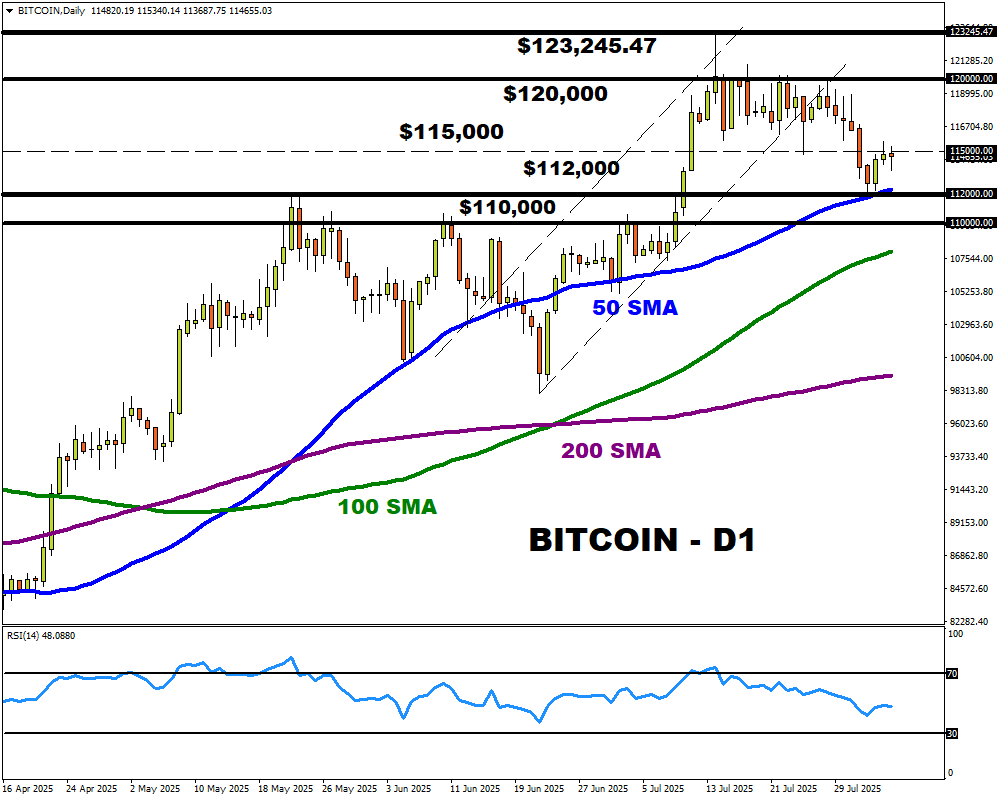
  • Bitcoin ↓ 1.6% month-to-date
  • Fresh catalyst needed to break out of range 
  • Trump’s tariff & US data could spark volatility
  • Technical levels: $120k, $115k, $112k


Bitcoin remains in standby mode with prices lingering around $115k in the absence of a fresh directional catalyst.

Despite the action witnessed last Friday, the “OG” crypto remains trapped within a range with support identified at the 50-day SMA. 

This period of calm could come to an end amid Trump’s tariff drama and market bets around the Fed cutting interest rates. 

As of now, the massive ETF outflow of $812 million last Friday suggests that bears could strike. This was the biggest single-day outflow seen since late February 2025, when Bitcoin ended the month 17% lower. 

Considering how Trump’s updated tariffs come into effect on Thursday, 7th August, risk assets, including Bitcoin could be exposed to downside risks.

Beyond the tariff drama, Bitcoin could also be influenced by US economic data and Fed cut expectations. Should US data support the argument around lower interest rates, this may support Bitcoin. The same can be said vice versa.


Potential scenarios:

Bullish Scenario: A clean breakout above $115k could push prices toward $120k and $123k. 

Bearish Scenario: Weakness below $115k may trigger a decline back toward $112k and $110k.


Imagen
Bitcoin

Forex-Time-LogoArticle by ForexTime

ForexTime Ltd (FXTM) is an award winning international online forex broker regulated by CySEC 185/12 www.forextime.com

Is the Bitcoin Cycle Dead?

Source: Stephen McBride (7/29/25) 

Stephen McBride of RiskHedge shares his thoughts on the Bitcoin cycle, and what investors should really be paying attention to.

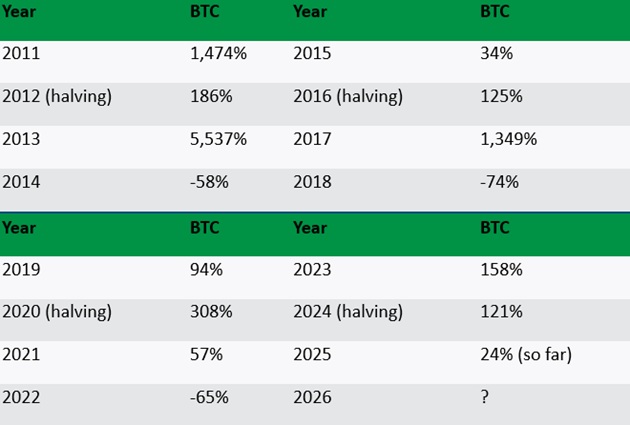
“3 up, 1 down.” This represents the historical rhythm that Bitcoin (BTC) and cryptocurrency values have typically followed.

We refer to it as the four-year cycle. It was a sequence so reliable, you could synchronize your timepiece to it, as demonstrated by this chart of Bitcoin’s yearly performance:

Numerous investors continue to operate according to this four-year framework. However, as I’ll demonstrate, the conventional four-year pattern has likely concluded, and that’s actually positive news.

January 11, 2024 . . .

The moment Bitcoin’s rhythm broke.

What occurred that day?

The initial Bitcoin ETFs commenced trading in the United States.

Bitcoin was previously a fringe asset. To acquire it, you needed to establish a cryptocurrency wallet, transfer your funds to a suspicious-looking exchange, and hope it remained secure. And incorporating it into your retirement portfolio was virtually impossible. Too complicated for most people.

Currently, you can purchase Bitcoin as straightforwardly as Apple Inc. (AAPL:NASDAQ) or Tesla Inc. (TSLA:NASDAQ).

ETFs unlocked access to Wall Street capital. And funds rapidly streamed in. BlackRock, Inc.’s (BLK:NYSE) Bitcoin ETF — the iShares Bitcoin Trust ETF (IBIT) — emerged as the fastest-expanding ETF ever. Within less than two years, $87 billion flowed into it. It represents the most successful ETF introduction in history, by a substantial margin. For context, the biggest gold ETF — the SPDR Gold Trust (GLD) — has existed for over twenty years and manages $100 billion. I anticipate IBIT will exceed GLD within the coming months.

Hello, infinite bid. . .

The reality that anyone can easily purchase BTC and Ethereum (ETH) through an ETF has fundamentally altered cryptocurrency markets permanently.

The “infinite bid” from wealth administrators constitutes the most significant positive force in cryptocurrency’s existence.

Cryptocurrency is now substantially controlled by professional investors who are theoretically less susceptible to excessive speculation. Though I’ll share a secret: Many I’m familiar with remain impulsive gamblers.

This suggests the explosive peaks and devastating 80% collapses we’ve become accustomed to will likely transform into more consistent upward trends interrupted by less severe corrections.

The traditional four-year cycle has likely concluded, and that’s actually positive news. Less frenzied expansion. More sustainable growth. This shift mirrors financial market evolution. Early stock markets experienced complete panics every couple of years, while contemporary markets face crises every 20–30 years.

Cryptocurrency is following the same maturation trajectory, just compressed into a briefer timeframe.

This consistent influx of capital didn’t exist in cryptocurrency . . . at least until ETFs arrived.

When tens of millions of Americans receive paychecks biweekly, they invest in stocks through their retirement accounts and 401(k)s. This generates ongoing demand for stocks, which I’d suggest establishes a minimum price threshold.

Now, the planet’s largest asset managers — including BlackRock, Fidelity, VanEck, and others — are advising their clients to acquire and maintain BTC in their 401(k)s.

The barriers have collapsed. Billions of dollars of Wall Street capital are entering cryptocurrency for the first time ever. There’s $8 trillion allocated in 401(k) plans currently. If cryptocurrency captures merely 1% of 401(k) assets, that’s $80 billion in fresh money entering the market.

If you’re curious about our position in the Bitcoin cycle, you’re focusing on the wrong issue.

The more relevant question is: Which cryptocurrency asset will Wall Street target next?

Bitcoin was the first “legitimate” cryptocurrency that institutions could engage with. Everything else was too ambiguous. The regulatory uncertainty was excessive.

But that’s changing as well.

The current U.S. administration has made its stance clear. They intend to “make America the crypto capital of the world” (their words).

In recent weeks, Congress approved several pro-cryptocurrency bills that will provide the industry with essential regulatory clarity. Regulation has shifted from risk to opportunity. And now, the entire cryptocurrency space will become accessible to Wall Street. That’s driving investment currently.

Ethereum stands as the obvious successor.

It offers considerably more functionality than Bitcoin. It’s rapidly becoming the settlement foundation for a new global financial infrastructure.

Robinhood Markets Inc. (HOOD:NASDAQ) is developing its tokenized stock platform on Ethereum. A selection of companies creating products on Ethereum includes: PayPal Holdings Inc. (PYPL:NASDAQ), Visa Inc. (V:NYSE), Stripe, Fidelity,JPMorgan Chase & Co (JPM:NYSE), Mastercard Inc. (MA:NYSE), and Shopify Inc. (SHOP:NASDAQ).

Wall Street is finally recognizing this potential.

Inflows into ETH ETFs are accelerating exponentially.

From July 2024 to June 2025, a total of $4.2 billion entered these funds. This month alone (July 2025), witnessed $4.4 billion pour into the ETH ETFs! That indicates Wall Street is moving into cryptocurrency in a big way.

One final thing: the Bitcoin cycle may be dead, but the opportunity in crypto is very much alive. I’ll have more to say on emerging crypto developments in future issues of my twice-weekly investing letter The Jolt. If you’d like to join, you can sign up here.


Important Disclosures:

  1. Stephen McBride: I, or members of my immediate household or family, own: Ethereum. My company has a financial relationship with: None. My company has purchased stocks mentioned in this article for my management clients: None. I determined which companies would be included in this article based on my research and understanding of the sector.
  2. Statements and opinions expressed are the opinions of the author and not of Streetwise Reports, Street Smart, or their officers. The author is wholly responsible for the accuracy of the statements. Streetwise Reports was not paid by the author to publish or syndicate this article. Streetwise Reports requires contributing authors to disclose any shareholdings in, or economic relationships with, companies that they write about. Any disclosures from the author can be found  below. Streetwise Reports relies upon the authors to accurately provide this information and Streetwise Reports has no means of verifying its accuracy.
  3.  This article does not constitute investment advice and is not a solicitation for any investment. Streetwise Reports does not render general or specific investment advice and the information on Streetwise Reports should not be considered a recommendation to buy or sell any security. Each reader is encouraged to consult with his or her personal financial adviser and perform their own comprehensive investment research. By opening this page, each reader accepts and agrees to Streetwise Reports’ terms of use and full legal disclaimer. Streetwise Reports does not endorse or recommend the business, products, services or securities of any company.

For additional disclosures, please click here.

NASDAQ Listing for Crypto Co. a Milestone

Source: Mark Palmer (5/27/25)

The upgrade from the OTC should afford this growing fintech various benefits, including greater visibility, noted a Benchmark report.

DeFi Technologies Inc. (DEFT:NASDAQ; DEFI:CBOE; R9B:FSE) received approval to list its common shares on the NASDAQ starting today, under the symbol DEFT, reported Benchmark Analyst Mark Palmer in a May 12 research note. Benchmark increased its target price on the fintech firm on expected growth in 2025.

“We believe DeFi’s uplisting to the NASDAQ is likely to result in significantly increased liquidity for the stock, broader institutional ownership and sell-side coverage of its shares and a lower overall cost of capital for the company,” Palmer wrote.

DeFi, offering exposure to a differentiated portfolio of cryptocurrencies, no longer will trade on the OTC. It will, however, continue on the CBOE in Canada (symbol DEFI), where it has traded since September 2016, and on the Frankfurt Stock Exchange (symbol R9B).

Target Price Raised

Benchmark raised its target price on the digital assets firm to CA$8 per share from CA$5 based on 15x its forecasted full-year 2025 earnings per share (EPS) of CA$0.53, noted Palmer.

“Our bullish stance toward DeFi’s shares is rooted in our confidence that it will be able to execute on its aggressive growth plans during the balance of the year and beyond,” wrote the analyst.

Those include adding at least 40 new crypto-focused exchange-traded products (ETPs) by year-end, taking the total count to more than 100. Plans also include expansion in the U.K., Africa, Asia, and the Middle East, toward which the company has been working.

DeFi announced in its last monthly update that it increased its assets under management (AUM) in April to CA$988 (CA$988M), reflecting an 11.7% month-over-month increase. This is attributed to rising crypto prices and CA$10.8M of net inflows into DeFi’s ETPs. In other growth news, the DeFi Alpha trading desk closed a CA$30.5M arbitrage trade on May 5.

Stock Undervalued, 44% Uplift

DeFi was trading, at the time of Palmer’s report, at CA$5.55 per share, the analyst noted. While this level is consistent with the fintech’s growth prospects, it is at a steep discount to other crypto-related stocks, including Coinbase Global Inc. (COIN:NASDAQ), Robinhood Markets Inc. (HOOD:NASDAQ) and Galaxy Digital Holdings Ltd. (GXLY:TSX).

From this share price, the return to target is 44%. DeFi is a Buy.

Changes to Estimates

Palmer reported that Benchmark tweaked its estimates for DeFi to account for its progress as well as the recent uptick in crypto prices. For Q1/25, estimated revenue was reduced to CA$27M from CA$52.7M and estimate earnings per share was lowered to CA$0.06 from CA$0.09.

Q2/25 EPS was raised to CA$0.16 from CA$0.10 to reflect DeFi Alpha’s May 5 arbitrage trade.

More Stock Details

Palmer reported that on May 12, DeFi had 298 million shares outstanding, a market cap of CA$1.2 billion and a 52-week range of CA$0.75–5.56 per share.


Important Disclosures:

  1. Doresa Banning wrote this article for Streetwise Reports LLC and provides services to Streetwise Reports as an independent contractor.
  2.  This article does not constitute investment advice and is not a solicitation for any investment. Streetwise Reports does not render general or specific investment advice and the information on Streetwise Reports should not be considered a recommendation to buy or sell any security. Each reader is encouraged to consult with his or her personal financial adviser and perform their own comprehensive investment research. By opening this page, each reader accepts and agrees to Streetwise Reports’ terms of use and full legal disclaimer. Streetwise Reports does not endorse or recommend the business, products, services or securities of any company.

For additional disclosures, please click here.

Disclosures for Benchmark Equity Research, DeFi Technologies Inc., May 12, 2025

alyst Certification The Benchmark Company, LLC (“Benchmark”) analyst(s) whose name(s) appears on the front page of this research report certifies that the recommendations and opinions expressed herein accurately reflect the research analyst’s personal views about any and all of the subject securities or issues discussed herein. Furthermore, no part of the research analyst’s compensation was, is, or will be, directly or indirectly, related to the specific recommendations or views expressed by the research analyst(s) in this research report.

Equity Research Ratings System Firm-Wide Stock Ratings Distribution As of March 31, 2025 All Covered Companies Investment Banking Clients Buy 266 73.7% 57 15.8% Hold 73 20.2% 5 1.4% Speculative Buy 20 5.5% 11 3.0% Sell 2 0.6% 0 0.0% Company Ratings Buy: Stock is expected to outperform the analyst’s defined Sector/Industry Index* over the following 6 to 12 months. Speculative Buy: The stock has a market value below $100M and/or a higher financial risk profile. It is expected to outperform the analyst’s defined sector/industry index over the following 6 to 12 months. Hold: Stock is expected to perform in-line with the analyst’s defined Sector/Industry Index* over the following 6 to 12 months. Sell: Stock is expected to underperform the analyst’s defined Sector/Industry Index* over the following 6 to 12 months. Industry Ratings Overweight: Analyst’s defined Sector/Industry Index* is expected to outperform the S&P 500 over the following 6 to 12 months. Market Weight: Analyst’s defined Sector/Industry Index* is expected to perform in-line with the S&P 500 over the following 6 to 12 months. Underweight: Analyst’s defined Sector/Industry Index* is expected to underperform the S&P 500 over the following 6 to 12 months. Benchmark Disclosures as of May 12, 2025 Company Disclosure DeFi Technologies Inc Research Disclosure Legend 1. In the past 12 months, Benchmark and its affiliates have received compensation for investment banking services from the subject company. 2. In the past 12 months, Benchmark and its affiliates have managed or comanaged a public offering of securities for the subject company. 3. Benchmark and its affiliates expect to receive or intend to seek compensation for investment banking services from the subject company in the next three months. 4. The research analyst, a member of the research analyst’s household, any associate of the research analyst, or any individual directly involved in the preparation of this report has a long position in the shares or derivatives of the subject company. 5. The research analyst, a member of the research analyst’s household, any associate of the research analyst, or any individual directly involved in preparation of this report has a short position in the shares or derivatives of this subject company. 6. A member of the research analyst’s household serves as an officer, director or advisory board member of the subject company. 7. As of the month end immediately preceding the date of publication of this report, or the prior month end if publication is within 10 days following a month end, Benchmark and its affiliates, in the aggregate, beneficially owned 1% or more of any class of equity securities of the subject company. 8. A partner, director, officer, employee or agent of Benchmark, or a member of his/her household, is an officer, director or advisor, board member of the subject company and/or one of its subsidiaries. 9. Benchmark makes a market in the securities of the subject company. 10. In the past 12 months, Benchmark, its partners, affiliates, officers or directors, or any analyst involved in the preparation of this report, has provided non-investment banking securities-related services to the subject company for remuneration. 11. In the past 12 months, Benchmark, its partners, affiliates, officers or directors, or any analyst involved in the preparation of this report, has provided non-securities related services to the subject company for remuneration. Investment Risk Risks to our investment thesis include crypto market volatility, regulatory risk, changing investor sentiment resulting in reduced ETP flows, and liquidity risk. Valuation Methodology Our C$8.00 price target for DEFI is based on 15x the company’s FY25E diluted earnings per share of C$0.53. We believe the multiple we have used reflects DEFI’s ample growth prospects. Price Charts Benchmark’s disclosure price charts are updated within the first fifteen days of each new calendar quarter per FINRA regulations. Price charts for companies initiated upon in the current quarter, and rating and target price changes occurring in the current quarter, will not be displayed until the following quarter. Additional information on recommended securities is available on request.

General Disclosures The Benchmark Company, LLC. (“Benchmark” or “the Firm”) compensates research analysts, like other Firm employees, based on the Firm’s overall revenue and profitability, which includes revenues from the Firm’s institutional sales, trading, and investment banking departments. No portion of the analyst’s compensation is based on a specific banking transaction. Analyst compensation is based upon a variety of factors, including the quality of analysis, performance of recommendations and overall service to the Firm’s institutional clients. This publication does not constitute an offer or solicitation of any transaction in any securities referred to herein. Ratings that use the “Speculative” risk qualifier are considered higher risk. Any recommendation contained herein may not be suitable for all investors. The Benchmark Company, LLC makes every effort to use reliable, comprehensive information, but we make no representation that it is accurate or complete. We have no obligation to disclose when information in this report changes apart from when we intend to discontinue research coverage of a subject company. Although the information contained in the subject report has been obtained from sources, we believe to be reliable, its accuracy and completeness cannot be guaranteed. This publication and any recommendation contained herein speak only as of the date hereof and are subject to change without notice. The Benchmark Company, LLC and its affiliated companies and employees shall have no obligation to update or amend any information herein. This publication is being furnished to you for informational purposes only and on the condition that it will not form a primary basis for any investment decision. Each investor must make its own determination of the appropriateness of an investment in any securities referred to herein based on the legal, tax and accounting considerations applicable to such investor and its own investment strategy. By virtue of this publication, none of The Benchmark Company, LLC or any of its employees shall be responsible for any investment decision. This report may discuss numerous securities, some of which may not be qualified for sale in certain states and may therefore not be offered to investors in such states. The “Recent Price” stated on the cover page reflects the nearest closing price prior to the date of publication. For additional disclosure information regarding the companies in this report, please contact The Benchmark Company, LLC, 150 East 58th Street, New York, NY 10155, 212-312-6770. The Benchmark Company, LLC is not in any way affiliated with or endorsed by the Menlo Park, California venture capital firm Benchmark Capital.

Decentralized finance is booming – and so are the security risks. My team surveyed nearly 500 crypto investors and uncovered the most common mistakes

By Mingyi Liu, Georgia Institute of Technology 

When the first cryptocurrency, Bitcoin, was proposed in 2008, the goal was simple: to create a digital currency free from banks and governments. Over time, that idea evolved into something much bigger: “decentralized finance,” or “DeFi.”

With decentralized finance, people trade, borrow and earn interest on crypto assets without relying on traditional intermediaries. DeFi services run on blockchains, which are essentially digital ledgers, and use “smart contracts” − self-executing code that automates financial transactions. Tens of billions of dollars have poured into the DeFi market.

But with innovation comes risks. The lack of centralized oversight has made crypto, including decentralized finance, a prime target for hackers and scammers. In 2024 alone, people lost nearly US$1.5 billion due to security exploits and fraud. And unlike traditional finance, there’s usually no way to recover stolen crypto.

As a computer scientist, I wanted to better understand how people perceive and respond to these risks. So my colleagues and I first conducted in-depth interviews with 14 crypto investors, then surveyed nearly 500 others to validate our findings.

Our study found that people often made the same mistakes, driven by recurring misconceptions and gaps in security awareness. Here are some of the most important.

Mistake 1: Thinking the blockchain guarantees security

Many people told us they thought decentralized finance was secure – but their reasoning wasn’t very convincing. Some seemed to confuse decentralized finance with blockchain technology itself, which is designed to ensure transactions are tamper-resistant through so-called “consensus mechanisms.” One told us that DeFi is secure “because a hacker would have to override an entire blockchain” to steal funds.

But services on the blockchain are still vulnerable to implementation and design flaws. These include smart contract breaches, in which bad guys exploit bugs in a service’s code, and front-end attacks, where a user interface is altered to redirect funds into a hacker’s wallet. A front-end attack was reportedly to blame for a recent $1.5 billion crypto heist.

CNBC reports on the record-breaking $1.5 billion crypto theft.

Mistake 2: Thinking safe keys mean safe funds

Another common misconception is that DeFi is secure if private keys are well stored. A private key is a secret code that allows someone to access their crypto assets. It’s true that in DeFi – unlike in centralized crypto finance where an exchange holds private keys – users have full control over their own private keys.

But even with perfect private key management, users can still lose funds by interacting with compromised DeFi platforms. That’s because safeguarding private keys can prevent only direct attacks targeting private key access, such as phishing attempts.

The people we spoke with also failed to follow best practices for securing their private keys. Using a hardware wallet – a physical device that stores private keys offline – is one of the most secure options for protecting keys from online threats. However, our study found that only a handful of participants actually used hardware wallets.

Mistake 3: Thinking 2-factor authentication is a silver bullet

Two-factor authentication, or 2FA, is a standard security mechanism in which two forms of verification are required to access an account. Think being texted a one-time code before you can log into your bank account.

To prevent account breaches, centralized crypto exchanges such as Binance and Coinbase use two-factor authentication for logins, account recovery and withdrawal confirmations. But while 2FA is crucial to security in the traditional and centralized crypto finance system, it plays a much smaller role in decentralized finance.

DeFi wallets give users access based on private key ownership rather than identity verification, which means traditional 2FA can’t be used. Instead, only 2FA-like mechanisms are available in DeFi. For instance, multisignature wallets require approval from multiple private key holders. However, if your private key is compromised, attackers can perform wallet operations on your behalf without any additional verification. In addition, even users who adopt 2FA-like measures can’t prevent the security breaches on the DeFi services’ end.

Unfortunately, our participants were overly confident regarding the effectiveness of 2FA, with one saying, “Two-factor authentication has been one of the best solutions for keeping wallets safe.” In our survey, 57.1% of users relied on 2FA as their only technical countermeasure against rug pulls – scams where project creators suddenly withdraw funds – and 49.3% did so for smart contract exploits. This misplaced trust could lead them to ignore more effective security strategies.

Mistake 4: Not managing token approvals

One such effective strategy is revoking token approvals. In DeFi, tokens are digital assets on a blockchain that represent value or rights, and users often need to approve smart contracts to access or spend them. But if you leave these approvals open, a malicious contract – or one that’s been hacked – can drain your wallet. So it’s crucial to routinely check all token approvals you’ve granted to prevent losses caused by fraudulent or hacked DeFi services. Specifically, you should limit spending allowances instead of using the default “unlimited” option, and revoke approvals for apps you no longer use or trust.

Worryingly, we found that only 10.8% and 16.3% of participants regularly checked and revoked token approvals to protect against rug pulls and smart contract exploits, respectively. In light of this, we recommend that wallet providers introduce a reminder feature to prompt users to review their token approvals periodically.

Mistake 5: Not learning from past incidents

Even after they’re hacked or scammed, people often don’t do anything to improve their security practices, we found. Just 17.6% of those who reported being victims of a DeFi scam regularly checked token approvals afterward. Worse, 26% took no action at all after a scam, and 16.4% doubled down by investing even more in other DeFi services.

Surprisingly, more than half of the victims said their belief in DeFi either stayed the same or grew stronger after the incident. One user who lost $4,700 due to a rug-pull incident said, “My belief in cryptocurrency has grown stronger after that because I made good money from it.” That person added, “An opportunity to make money is something I believe in.” This suggests that DeFi users’ financial motivations can sometimes outweigh their security concerns – and, perhaps, their better judgment.

There’s no one-size-fits-all solution to DeFi security. But awareness is the first step. To stay safe, crypto investors should use hardware wallets, revoke unused token approvals and continually learn new techniques to protect themselves from evolving threats. Most importantly, they should stay rational and not let the allure of profits cloud their security practices.The Conversation

About the Author:

Mingyi Liu, Ph.D. student in Computer Science, Georgia Institute of Technology

This article is republished from The Conversation under a Creative Commons license. Read the original article.