
By RoboForex Analytical Department
The NZD/USD pair is stable, consolidating around 0.6189 on Wednesday. The New Zealand dollar maintains a sideways trend and appears relatively robust in the current market environment.
Recent pressure on the US dollar, triggered by disappointing employment statistics, has led to speculation that the US Federal Reserve might reduce interest rates after the September meeting. The Job Openings and Labor Turnover Survey (JOLTS) revealed a decline in job openings to 8.059 million in April, the lowest since February 2021, indicating a cooling employment market. These developments are of significant concern for the Fed, suggesting a need to adjust monetary policy to support employment.
Market attention is now turning to the upcoming May private sector jobs data from ADP, which is expected to provide further insights into labour market conditions. The week will culminate with a comprehensive set of employment market statistics on Friday.
Regarding the Reserve Bank of New Zealand (RBNZ), there are no expectations of an interest rate cut until at least mid-2025. The RBNZ is expected to maintain a stable policy to allow for a thorough data assessment.
Technical analysis of NZD/USD
Free Reports:
 Get our Weekly Commitment of Traders Reports - See where the biggest traders (Hedge Funds and Commercial Hedgers) are positioned in the futures markets on a weekly basis.
 Sign Up for Our Stock Market Newsletter – Get updated on News, Charts & Rankings of Public Companies when you join our Stocks Newsletter
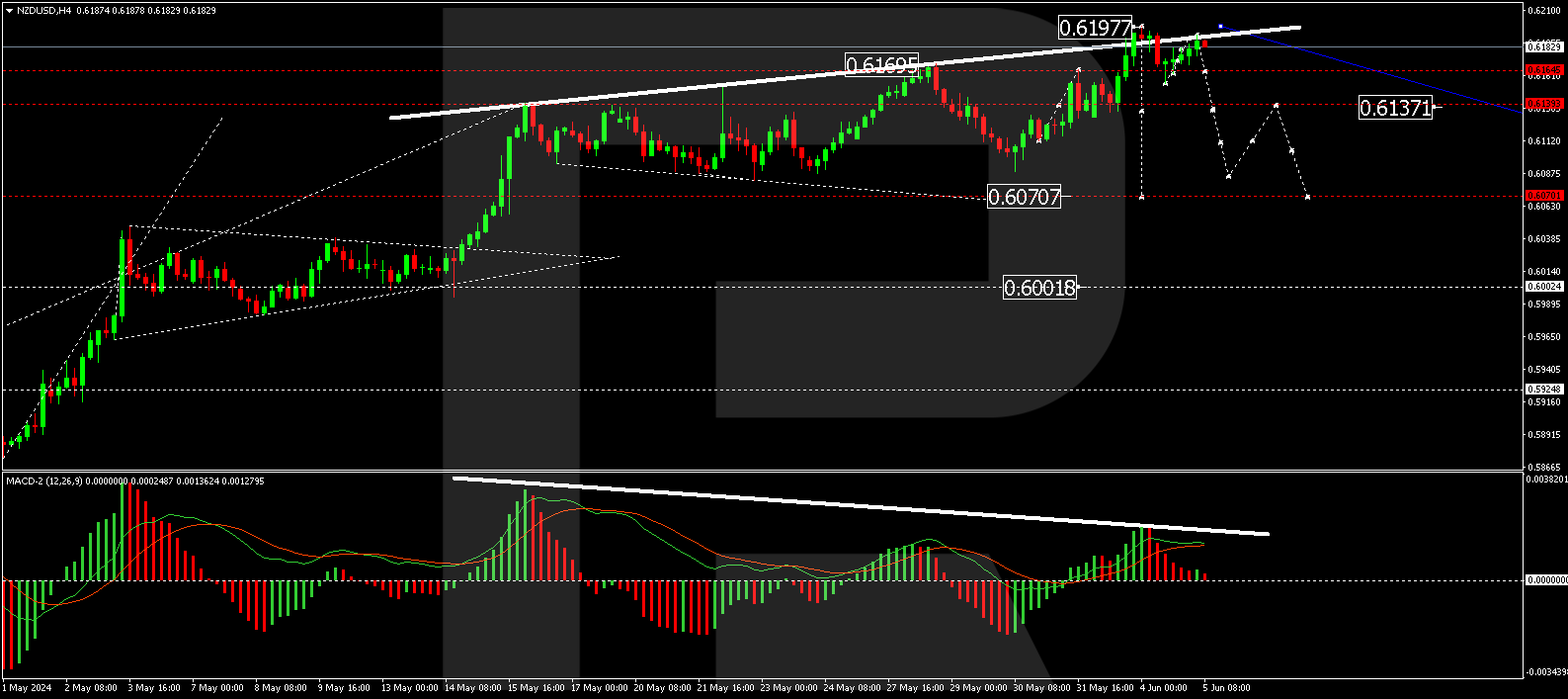
On the H4 chart, the NZD/USD pair is evolving within a broad consolidation range around the 0.6136 level. A recent growth impulse has reached 0.6197. Today, a potential decline to 0.6137 is expected, which could test from below. Following this correction, a new wave of decline may initiate, targeting the 0.6136 level, potentially extending to 0.6070 if this level is breached. The MACD indicator supports this bearish outlook, with its signal line below zero and pointed downwards. The notable divergence between the chart peaks and the indicator further reinforces this analysis.
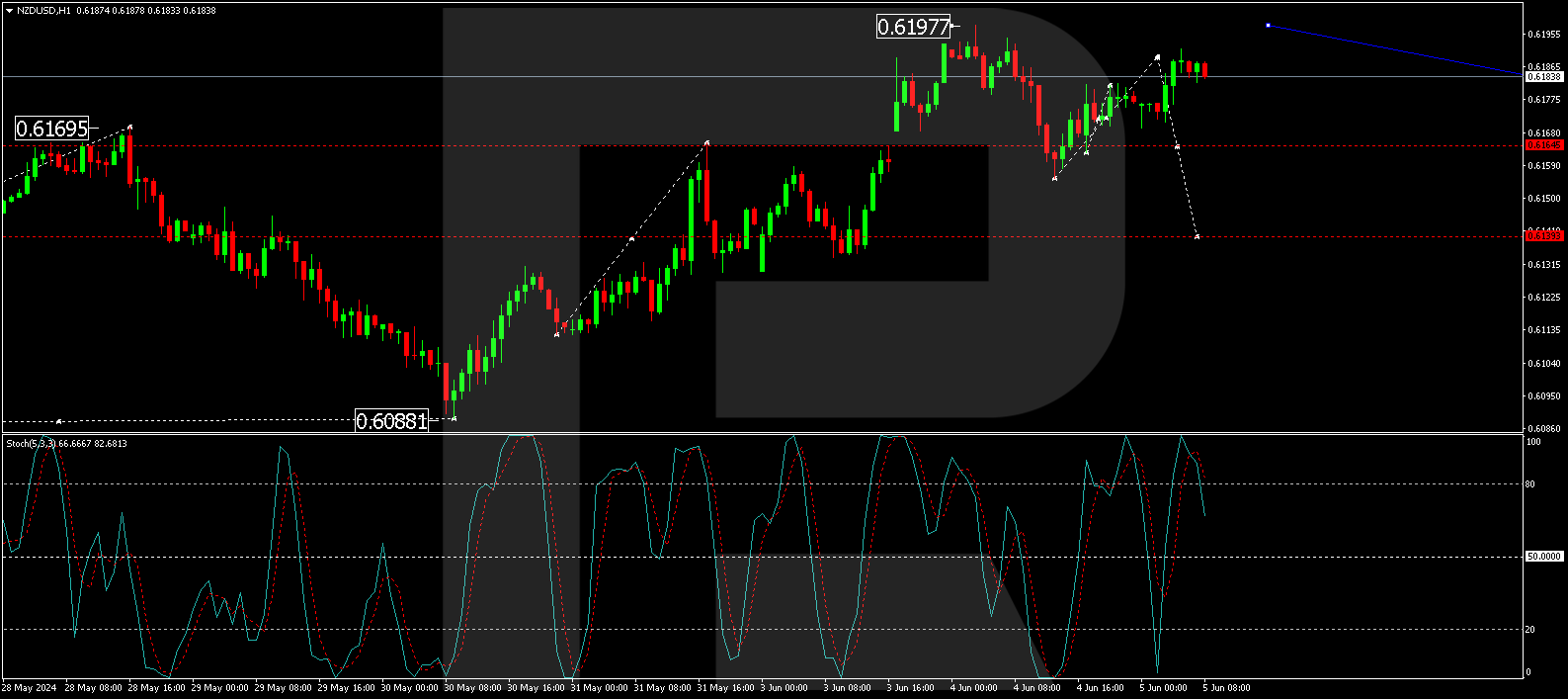
On the H1 chart, the pair showed a downward impulse to 0.6155, followed by a correction to 0.6191. Today, the market may execute an impulse to 0.6160, with the potential for a further decline to 0.6140 and an extension towards 0.6080, the first target of the downward wave. This scenario is technically validated by the Stochastic oscillator, with its signal line currently above 80 but trending sharply downward.
Market outlook
As the NZD/USD pair continues to show resilience amidst fluctuating US economic indicators, it is crucial for investors to closely monitor incoming data, particularly from the US employment market, which could significantly influence the Fed’s next steps. The stability of the New Zealand dollar, supported by the RBNZ’s steady policy stance, contrasts the potential volatility in the US dollar as fiscal and monetary policy expectations evolve.
Disclaimer
Any forecasts contained herein are based on the author’s particular opinion. This analysis may not be treated as trading advice. RoboForex bears no responsibility for trading results based on trading recommendations and reviews contained herein.

- The US and European stock indices are rising again amid renewed investor interest in the AI industry. Jul 10, 2026
- USD/JPY Falls as Yen Recovers Weekly Losses Jul 10, 2026
- Crude oil prices surged sharply by 7% in reaction to the rapid escalation of the conflict in the Middle East Jul 9, 2026
- Middle East Tensions Weigh on Gold Jul 9, 2026
- Pound Awaits Tighter Policy from Bank of England Jul 8, 2026
- The United States carried out airstrikes on Iran after Iran’s attacked tankers in the Strait of Hormuz. The RBNZ raised the interest rate to 2.5% Jul 8, 2026
- RoboForex Brings Full-Scale Trading to Telegram Jul 7, 2026
- Your Bourse Integrates TradingView Charts and Trading Platform Library with Trade Server Jul 7, 2026
- Yen Still Under Pressure: Markets Await Action from Authorities Jul 7, 2026
- Germany’s DAX Index has updated its all‑time high. OPEC+ countries have agreed to increase production Jul 7, 2026
