
By Edward Thomas Jones, Bangor University and Laurence Jones, Bangor University
You can also read this article in Welsh.
The global cryptocurrency market has seen a number of recent setbacks: from the collapse of the Terra/Luna system in May 2022 to the failure of FTX, one of the largest crypto exchanges in the world.
Because of these factors, and other concerns over cryptocurrencies’ carbon emissions, these assets lost US$2 trillion in value (£1.5 trillion) in 2022.
But while cryptocurrencies get a lot of attention today, in some ways they are not a revolutionary concept. Hundreds of years ago, workers in Wales were often paid with alternative currencies instead of money.
These currencies were physical tokens that represented and were linked to the value of real money. Many cryptocurrencies work in a similar way, acting as digital tokens that represent a ledger of financial assets (this is known as “tokenisation”).
Free Reports:
 Download Our Metatrader 4 Indicators – Put Our Free MetaTrader 4 Custom Indicators on your charts when you join our Weekly Newsletter
 Get our Weekly Commitment of Traders Reports - See where the biggest traders (Hedge Funds and Commercial Hedgers) are positioned in the futures markets on a weekly basis.
Digital currencies are also not reliant on any central authority, such as a government or bank, to uphold or maintain their network of exchange. Again, this is similar to how physical tokens were used by Welsh mining companies.
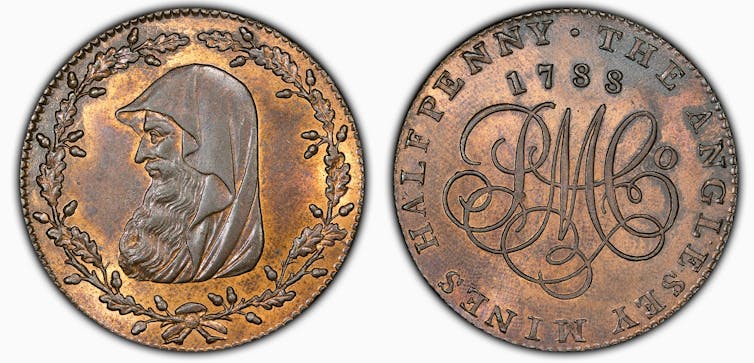 A halfpenny token issued by the Parys Mining Company of Anglesey in 1788. The hooded druid design was used for many years and was the first of hundreds of token designs.
BrandonBigheart/Wikimedia
Currency crisis
Towards the end of the 18th century the coinage of Britain was in a deplorable state due to the severe shortages of silver and copper coins. During the Industrial Revolution people migrated from the countryside into mining and manufacturing centres. But living in towns required money, and the ability to pay wages was impossible for businesses without small change.
With an influx of new workers using money, new shops were opened to meet demand, creating more jobs that required payment in coins. Although the production of counterfeit coins was illegal and punishable by death, it was not illegal to produce tokens with other designs which could be used instead of coins.
The first great era of token production during the first Industrial Revolution began in 1787 with the issue of the Parys Mining Company token. This company mined at Parys Mountain on the Welsh island of Anglesey. It briefly produced more copper than any other mine in the world during the Industrial Revolution.
It also used the high-quality ore from its mine to produce tokens which could be exchanged for official coin at full value at any one of its shops or offices. This made the Parys Mining Company the first company in the world to issue tokens. These were described as the “premier tokens” of the 18th century by that era’s coin experts.
Soon, practically every town in Britain was producing its own tokens. This was driven in part by a shortage of government coinage and improvements in coin manufacturing by Matthew Boulton’s Soho Mint in Birmingham, who also turned his hand to tokens.
By the turn of the 19th century, the total supply and fast circulation of tokens, foreign coins and other substitutes probably exceeded those of the official coin of the country.
The process of tokenisation was subsequently seen in other countries, in particular the United States. Mining and logging camps in the 19th century US were typically owned and operated by a single company, often in remote locations with poor access to cash.
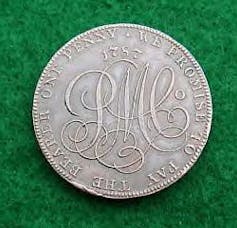 A Parys penny produced by the Parys Mining Company. Obscurasky/Wikimedia
These companies would often pay their workers in “scrip”, or tokens. The workers, given the limited places they could spend scrips, had little choice but to purchase goods at company-owned stores. By placing large mark ups on goods, the company could increase their profits and enforce employee loyalty.
While the production of tokens by the Parys Mining Company were spurred on by the first Industrial Revolution, the adoption and popularity of Bitcoin and other cryptocurrencies has been hastened by the fourth Industrial Revolution.
Although they are more than 200 years apart, the history of these tokens have important lessons for today’s cryptocurrencies. First, for cryptocurrencies to succeed there needs to be various ways for individuals to accumulate the crypto/tokens, plus a demand and use for the crypto that means it holds its value, and trusted environments where exchange for goods and services can take place.
And second, for cryptocurrencies to be successful and sustainable in the long term they must uphold their original purpose of having an ecosystem that remains independent of a single company or government. Efforts to lock cryptocurrencies to a single organisation do not look positive, for example Facebook’s failed attempt to launch a cryptocurrency, announced in 2019.
The tokens of Welsh mining companies inherently failed when the closures of the mine or shops led to the removal of one or more of the three components of the ecosystem. And then people left with the tokens lost their money, a lesson for us today.
About the Author:
Edward Thomas Jones, Senior Lecturer in Economics / Director of the Institute of European Finance, Bangor University and Laurence Jones, Lecturer in Finance, Bangor University
This article is republished from The Conversation under a Creative Commons license. Read the original article.

- The ceasefire between Israel and Lebanon has reduced the geopolitical premium Jun 5, 2026
- EUR/USD: All Eyes on Non-Farm Payrolls Jun 5, 2026
- The escalation of the conflict in the Middle East put pressure on US and European stock indices Jun 4, 2026
- Gold Remains Under Pressure, but a Rebound Is Still Possible Jun 4, 2026
- Bitcoin drops below the psychological $70,000 level. The US stock indices hit new record highs Jun 3, 2026
- EUR/USD on Edge as Markets Await Key Employment Data Jun 3, 2026
- Oil prices surged again amid rumors of a freeze in diplomacy between the United States and Iran Jun 2, 2026
- GBP/USD in a State of Uncertainty: Risks Remain, but Market Reactions Are Muted Jun 2, 2026
- The US stock indices once again finished the trading session at new all‑time highs Jun 1, 2026
- USD/JPY Approaches 160.00: Is Another Intervention Coming? Jun 1, 2026


